this place matters
re-thinking local leadership
What do we want our
place to be like?
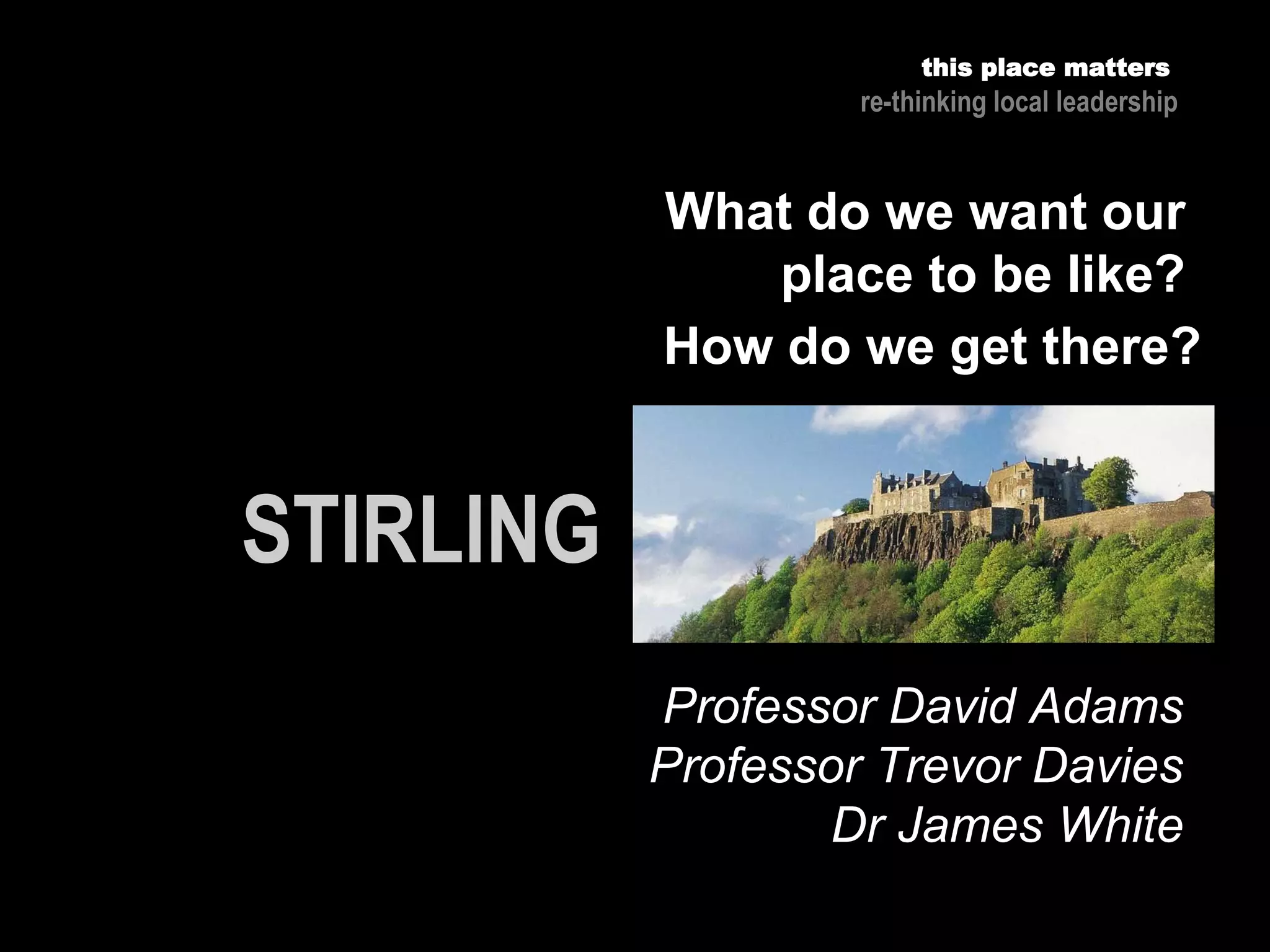
How do we get there?
Professor David Adams
Professor Trevor Davies
Dr James White
Professor David Adams
this place matters
re-thinking local leadership
WHY Place Matters
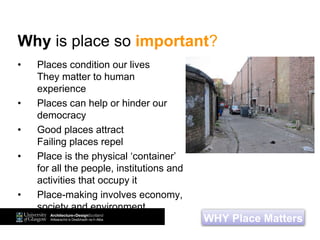
• Places condition our lives
They matter to human
experience
• Places can help or hinder our
democracy
• Good places attract
Failing places repel
• Place is the physical ‘container’
for all the people, institutions and
activities that occupy it
• Place-making involves economy,
society and environment
WHY Place Matters
Why is place so important?
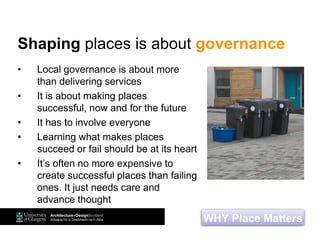
• Local governance is about more
than delivering services
• It is about making places
successful, now and for the future
• It has to involve everyone
• Learning what makes places
succeed or fail should be at its heart
• It’s often no more expensive to
create successful places than failing
ones. It just needs care and
advance thought
WHY Place Matters
Shaping places is about governance
• Leadership drives forward
action, breeds confidence,
reduces risk & widens
participation
• Leadership is about
vision, culture, motivation,
resources.
• This cannot be privatised – it
needs local action within a local
democratic mandate
WHY Place Matters
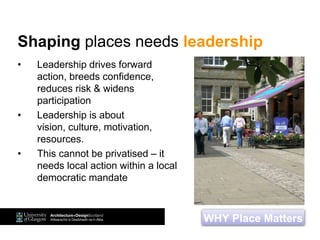
Shaping places needs leadership
Professor David Adams
this place matters
re-thinking local leadership
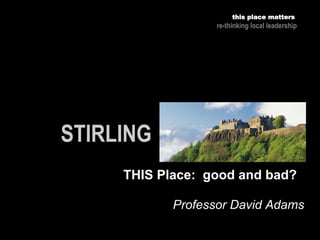
THIS Place: good and bad?
Top of the Town: good and bad?
One good image of this place
THIS Place
One bad image of this place
THIS Place
Workshop
this place matters
re-thinking local leadership
Why does THIS place matter?
Why does this place matter?
Why this place matters to you today
THIS Place
Then find the things that matter that you share
THIS Place
Where are we going?
In practice, who is leading here now?
THIS Place
What are the current relationships between
leaders and citizens?
In practice, who is leading?
Where are we going?
In practice, who is leading here now?
THIS Place
What are the current relationships between
leaders and citizens?
In practice, who is leading?What is local collaboration like?
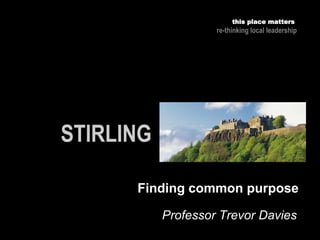
Professor Trevor Davies
this place matters
re-thinking local leadership
Finding common purpose
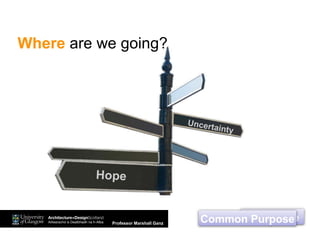
Where are we going?
THIS Place
And how does all that about your place make you feel?
In practice, who is leading?
THIS PlaceCommon PurposeProfessor Marshall Ganz
Where are we going?
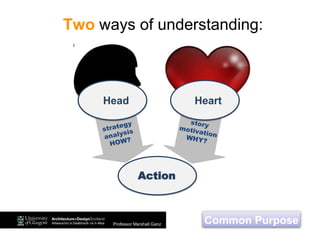
Head Heart
Action
Common Purpose
Two ways of understanding:
Professor Marshall Ganz
green
Leadership is taking responsibility
for enabling others to achieve shared
purpose in the face of uncertainty
Common PurposeProfessor Marshall Ganz
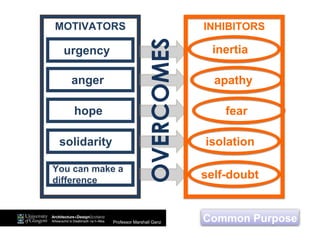
MOTIVATORS
urgency inertia
anger apathy
hope fear
solidarity isolation
You can make a
difference
self-doubt
OVERCOMES
Common Purpose
INHIBITORS
Professor Marshall Ganz
Common PurposeProfessor Marshall Ganz
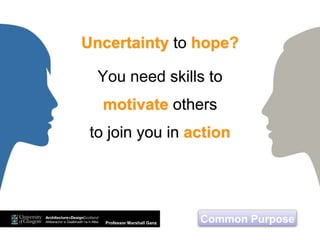
Uncertainty to hope?
You need skills to
motivate others
to join you in action
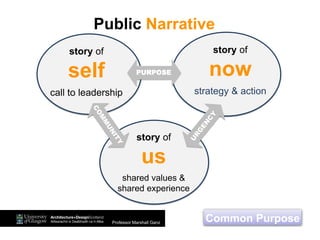
story of
self
call to leadership
story of
now
strategy & action
story of
us
shared values &
shared experience
PURPOSE
Common PurposeProfessor Marshall Ganz
Public Narrative
The Story of your future part 1
Common Purpose
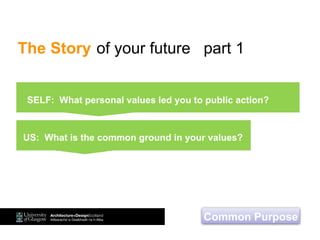
SELF: What personal values led you to public action?
The Story of your future part 1
Common Purpose
What personal values led you to public action?
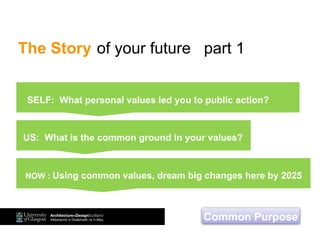
US: What is the common ground in your values?
SELF: What personal values led you to public action?
Common Purpose
US: What is the common ground in your values?
NOW : Using common values, dream big changes here by 2025
The Story of your future part 1
Professor Trevor Davies
this place matters
re-thinking local leadership
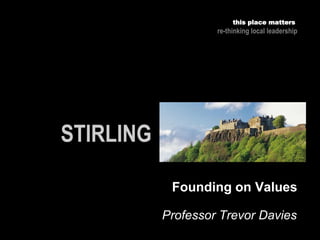
Founding on Values
action
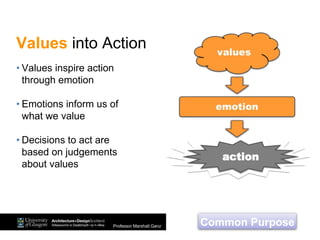
• Values inspire action
through emotion
• Emotions inform us of
what we value
• Decisions to act are
based on judgements
about values
Values into Action
Common PurposeProfessor Marshall Ganz
25
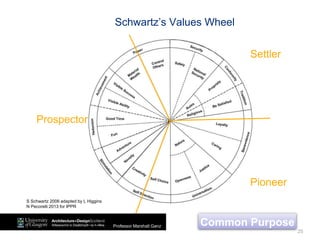
S Schwartz 2006 adapted by L Higgins
N Pecorelli 2013 for IPPR
Schwartz’s Values Wheel
Prospector
Settler
Pioneer
Professor Marshall Ganz Common Purpose
this place matters
re-thinking local leadership
BREAK!
Dr James White
this place matters
re-thinking local leadership
What makes a successful place?
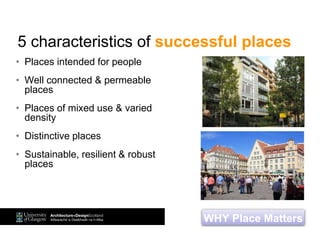
5 characteristics of successful places
• Places intended for people
• Well connected & permeable
places
• Places of mixed use & varied
density
• Distinctive places
• Sustainable, resilient & robust
places
WHY Place Matters
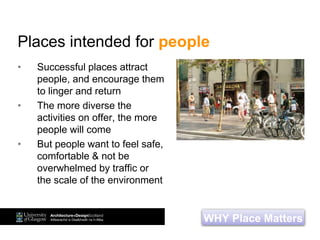
Places intended for people
• Successful places attract
people, and encourage them
to linger and return
• The more diverse the
activities on offer, the more
people will come
• But people want to feel safe,
comfortable & not be
overwhelmed by traffic or
the scale of the environment
WHY Place Matters
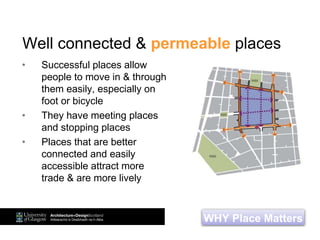
Well connected & permeable places
• Successful places allow
people to move in & through
them easily, especially on
foot or bicycle
• They have meeting places
and stopping places
• Places that are better
connected and easily
accessible attract more
trade & are more lively
WHY Place Matters
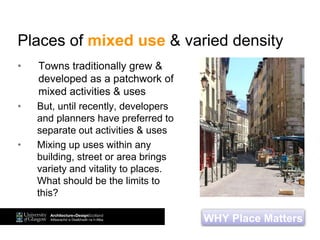
Places of mixed use & varied density
• Towns traditionally grew &
developed as a patchwork of
mixed activities & uses
• But, until recently, developers
and planners have preferred to
separate out activities & uses
• Mixing up uses within any
building, street or area brings
variety and vitality to places.
What should be the limits to
this?
WHY Place Matters
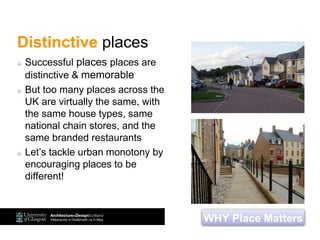
Distinctive places
Successful places places are
distinctive & memorable
But too many places across the
UK are virtually the same, with
the same house types, same
national chain stores, and the
same branded restaurants
Let’s tackle urban monotony by
encouraging places to be
different!
WHY Place Matters
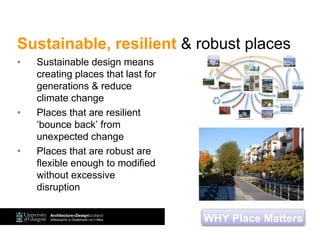
Sustainable, resilient & robust places
• Sustainable design means
creating places that last for
generations & reduce
climate change
• Places that are resilient
‘bounce back’ from
unexpected change
• Places that are robust are
flexible enough to modified
without excessive
disruption
WHY Place Matters
Workshop
this place matters
re-thinking local leadership
Building your future
The Story of your future part 2
THIS Place
Describe your DESTINATION.
What does this place in 2025 look like?
The Story of your future part 2
THIS Place
Describe your DESTINATION.
What does this place in 2025 look like?
Tell the story of the journey from now till then …….
this place matters
re-thinking local leadership
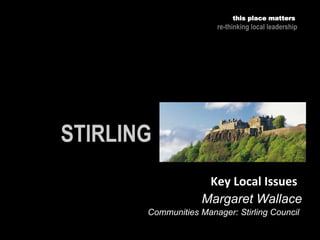
Key Local Issues
Margaret Wallace
Communities Manager: Stirling Council
THIS Place
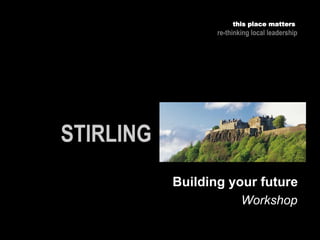
Top of the Town and Mercat Cross
Both areas sit within the Castle ward and share a
community council. The area is currently represented by:
• Johanna Boyd (Labour)
• John Hendry (Labour)
• Jim Thomson (SNP)
The Mercat Cross Community Council has an approximate
population of 4066.
THIS Place
Profile
• A high % of the population are 16-24 years due to the high
number of University students.
• Fewer people are economically active (24.8%) compared
to the rest of Stirling (36.7%) because of this concentration
of students.
• 25.6% of the Mercat Cross area are students compared to
7.6% as the Stirling average.
THIS Place
Health & Wellbeing
• Life expectancy for this area represents the average for
Scotland.
• Some health inequalities exist in terms of lower than
average birth weight and poor uptake of immunisation.
• The Stirling Castle and St Mary’s area are in the 15%
most deprived areas of Scotland. Top of theTown, the
Castle and St Mary’s are in the lowest15% most deprived
for educational performance. Upper Bridge Street sits in
the top 15% in terms of crime.
THIS Place
Key Points
The Top of the Town & Mercat Cross represents:
• an area of significant built heritage.
• it serves as a focus for Culture (Tollbooth).
• a developing plan exists to create a ‘cultural quarter’
integrated into the local community.
• a disjoint between the retail centre of Stirling and the
potential of the Top of the Town.
• community safety is a key issue (Substance Misuse &
ASB key). Particularly in Friar Street, Back Walk and
Murray Place.
• tenancies are transient due to student population this can
challenge the sense of place.
THIS Place
Summary
The Top of the Town and Mercat Cross are areas of
regeneration and are experiencing community safety
concerns.
The potential however is significant with its history,
architecture and the arrival of large businesses.
The community is active and articulate and requires support
to establish a strong identity.
Workshop
this place matters
re-thinking local leadership
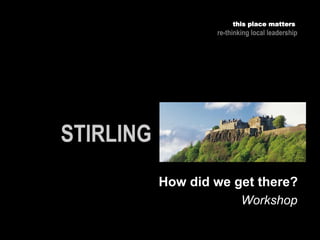
How did we get there?
Getting there: You got there!
THIS Place
Who led the changes your dream needed?
What did they do?
What happened in your place as a result?
Looking back from 2025:
What assets & resources did they adapt or use?
THIS Place
BUT THAT FUTURE DIDN’T HAPPEN! Why?
Getting there: Oops!
What were the barriers and blocks to your future?
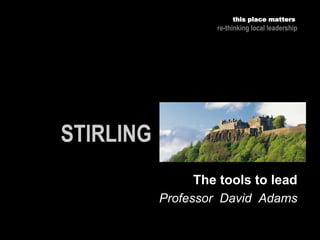
Professor David Adams
this place matters
re-thinking local leadership
The tools to lead
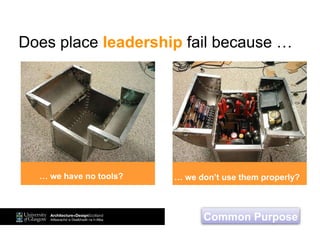
… we don’t use them properly?… we have no tools?
Does place leadership fail because …
Common Purpose
To shape places, we need effective
policy tools
How well stocked is our
policy toolbox?
How well used in our
policy toolbox?
Common Purpose
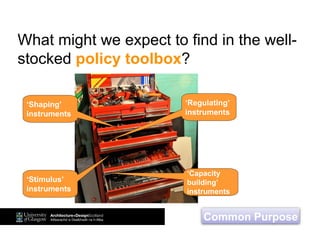
What might we expect to find in the well-
stocked policy toolbox?
‘Shaping’
instruments
‘Capacity
building’
instruments
‘Regulating’
instruments
‘Stimulus’
instruments
Common Purpose
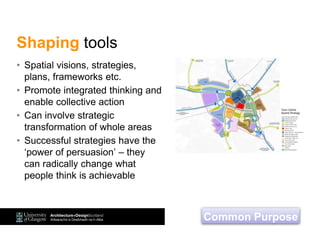
• Spatial visions, strategies,
plans, frameworks etc.
• Promote integrated thinking and
enable collective action
• Can involve strategic
transformation of whole areas
• Successful strategies have the
‘power of persuasion’ – they
can radically change what
people think is achievable
Shaping tools
Common Purpose
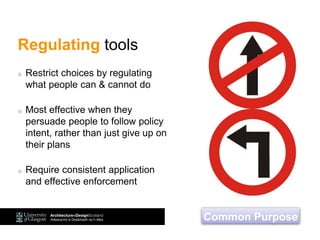
Regulating tools
Restrict choices by regulating
what people can & cannot do
Most effective when they
persuade people to follow policy
intent, rather than just give up on
their plans
Require consistent application
and effective enforcement
Common Purpose
Stimulus tools
Open up opportunities by ‘making
things happen’ through:
Actions to kick-start development
by direct state intervention
Development grants, taxation
incentives and other price-adjusting
actions
Holistic place management and
other risk-reducing actions
Public-private partnerships and
other capital-raising actions
Common Purpose
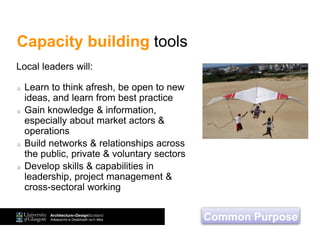
Capacity building tools
Learn to think afresh, be open to new
ideas, and learn from best practice
Gain knowledge & information,
especially about market actors &
operations
Build networks & relationships across
the public, private & voluntary sectors
Develop skills & capabilities in
leadership, project management &
cross-sectoral working
Local leaders will:
Common Purpose
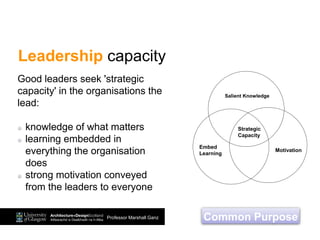
Leadership capacity
Strategic
Capacity
Motivation
Embed
Learning
Salient Knowledge
Professor Marshall Ganz
Good leaders seek 'strategic
capacity' in the organisations the
lead:
knowledge of what matters
learning embedded in
everything the organisation
does
strong motivation conveyed
from the leaders to everyone
Common Purpose
Workshop
this place matters
re-thinking local leadership
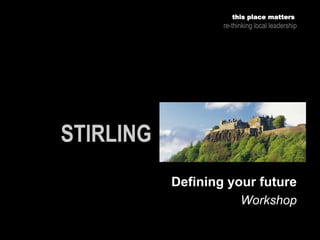
Defining your future
The Story of your future part 3
THIS Place
Tell the story of getting from now till then …….
Say what your future is like
Where did change first start?
What action was most important?
Workshop
this place matters
re-thinking local leadership
Getting started
Leadership is taking responsibility
for enabling others to achieve shared
purpose in the face of uncertainty
Common PurposeProfessor Marshall Ganz
The Story of your future Getting Started
THIS Place
Tell the story of getting from now till then …….
So what happens now?
this place matters
re-thinking local leadership
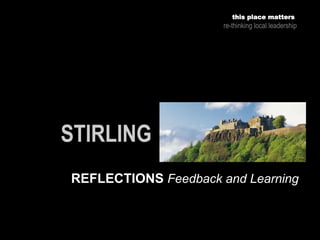
REFLECTIONS Feedback and Learning
this place matters
re-thinking local leadership
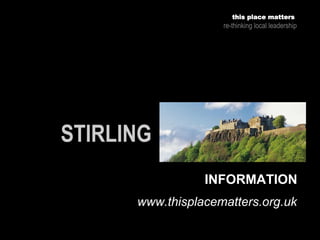
INFORMATION
www.thisplacematters.org.uk

This Place Matters - Stirling 27 May 2015

  • 1.
    this place matters re-thinkinglocal leadership What do we want our place to be like? How do we get there? Professor David Adams Professor Trevor Davies Dr James White
  • 2.
    Professor David Adams thisplace matters re-thinking local leadership WHY Place Matters
  • 3.
    • Places conditionour lives They matter to human experience • Places can help or hinder our democracy • Good places attract Failing places repel • Place is the physical ‘container’ for all the people, institutions and activities that occupy it • Place-making involves economy, society and environment WHY Place Matters Why is place so important?
  • 4.
    • Local governanceis about more than delivering services • It is about making places successful, now and for the future • It has to involve everyone • Learning what makes places succeed or fail should be at its heart • It’s often no more expensive to create successful places than failing ones. It just needs care and advance thought WHY Place Matters Shaping places is about governance
  • 5.
    • Leadership drivesforward action, breeds confidence, reduces risk & widens participation • Leadership is about vision, culture, motivation, resources. • This cannot be privatised – it needs local action within a local democratic mandate WHY Place Matters Shaping places needs leadership
  • 6.
    Professor David Adams thisplace matters re-thinking local leadership THIS Place: good and bad?
  • 7.
    Top of theTown: good and bad? One good image of this place THIS Place One bad image of this place THIS Place
  • 8.
    Workshop this place matters re-thinkinglocal leadership Why does THIS place matter?
  • 9.
    Why does thisplace matter? Why this place matters to you today THIS Place Then find the things that matter that you share THIS Place
  • 10.
    Where are wegoing? In practice, who is leading here now? THIS Place What are the current relationships between leaders and citizens? In practice, who is leading?
  • 11.
    Where are wegoing? In practice, who is leading here now? THIS Place What are the current relationships between leaders and citizens? In practice, who is leading?What is local collaboration like?
  • 12.
    Professor Trevor Davies thisplace matters re-thinking local leadership Finding common purpose
  • 13.
    Where are wegoing? THIS Place And how does all that about your place make you feel? In practice, who is leading?
  • 14.
    THIS PlaceCommon PurposeProfessorMarshall Ganz Where are we going?
  • 15.
    Head Heart Action Common Purpose Twoways of understanding: Professor Marshall Ganz green
  • 16.
    Leadership is takingresponsibility for enabling others to achieve shared purpose in the face of uncertainty Common PurposeProfessor Marshall Ganz
  • 17.
    MOTIVATORS urgency inertia anger apathy hopefear solidarity isolation You can make a difference self-doubt OVERCOMES Common Purpose INHIBITORS Professor Marshall Ganz
  • 18.
    Common PurposeProfessor MarshallGanz Uncertainty to hope? You need skills to motivate others to join you in action
  • 19.
    story of self call toleadership story of now strategy & action story of us shared values & shared experience PURPOSE Common PurposeProfessor Marshall Ganz Public Narrative
  • 20.
    The Story ofyour future part 1 Common Purpose SELF: What personal values led you to public action?
  • 21.
    The Story ofyour future part 1 Common Purpose What personal values led you to public action? US: What is the common ground in your values? SELF: What personal values led you to public action?
  • 22.
    SELF: What personalvalues led you to public action? Common Purpose US: What is the common ground in your values? NOW : Using common values, dream big changes here by 2025 The Story of your future part 1
  • 23.
    Professor Trevor Davies thisplace matters re-thinking local leadership Founding on Values
  • 24.
    action • Values inspireaction through emotion • Emotions inform us of what we value • Decisions to act are based on judgements about values Values into Action Common PurposeProfessor Marshall Ganz
  • 25.
    25 S Schwartz 2006adapted by L Higgins N Pecorelli 2013 for IPPR Schwartz’s Values Wheel Prospector Settler Pioneer Professor Marshall Ganz Common Purpose
  • 26.
    this place matters re-thinkinglocal leadership BREAK!
  • 27.
    Dr James White thisplace matters re-thinking local leadership What makes a successful place?
  • 28.
    5 characteristics ofsuccessful places • Places intended for people • Well connected & permeable places • Places of mixed use & varied density • Distinctive places • Sustainable, resilient & robust places WHY Place Matters
  • 29.
    Places intended forpeople • Successful places attract people, and encourage them to linger and return • The more diverse the activities on offer, the more people will come • But people want to feel safe, comfortable & not be overwhelmed by traffic or the scale of the environment WHY Place Matters
  • 30.
    Well connected &permeable places • Successful places allow people to move in & through them easily, especially on foot or bicycle • They have meeting places and stopping places • Places that are better connected and easily accessible attract more trade & are more lively WHY Place Matters
  • 31.
    Places of mixeduse & varied density • Towns traditionally grew & developed as a patchwork of mixed activities & uses • But, until recently, developers and planners have preferred to separate out activities & uses • Mixing up uses within any building, street or area brings variety and vitality to places. What should be the limits to this? WHY Place Matters
  • 32.
    Distinctive places Successful placesplaces are distinctive & memorable But too many places across the UK are virtually the same, with the same house types, same national chain stores, and the same branded restaurants Let’s tackle urban monotony by encouraging places to be different! WHY Place Matters
  • 33.
    Sustainable, resilient &robust places • Sustainable design means creating places that last for generations & reduce climate change • Places that are resilient ‘bounce back’ from unexpected change • Places that are robust are flexible enough to modified without excessive disruption WHY Place Matters
  • 34.
    Workshop this place matters re-thinkinglocal leadership Building your future
  • 35.
    The Story ofyour future part 2 THIS Place Describe your DESTINATION. What does this place in 2025 look like?
  • 36.
    The Story ofyour future part 2 THIS Place Describe your DESTINATION. What does this place in 2025 look like? Tell the story of the journey from now till then …….
  • 37.
    this place matters re-thinkinglocal leadership Key Local Issues Margaret Wallace Communities Manager: Stirling Council
  • 38.
    THIS Place Top ofthe Town and Mercat Cross Both areas sit within the Castle ward and share a community council. The area is currently represented by: • Johanna Boyd (Labour) • John Hendry (Labour) • Jim Thomson (SNP) The Mercat Cross Community Council has an approximate population of 4066.
  • 39.
    THIS Place Profile • Ahigh % of the population are 16-24 years due to the high number of University students. • Fewer people are economically active (24.8%) compared to the rest of Stirling (36.7%) because of this concentration of students. • 25.6% of the Mercat Cross area are students compared to 7.6% as the Stirling average.
  • 40.
    THIS Place Health &Wellbeing • Life expectancy for this area represents the average for Scotland. • Some health inequalities exist in terms of lower than average birth weight and poor uptake of immunisation. • The Stirling Castle and St Mary’s area are in the 15% most deprived areas of Scotland. Top of theTown, the Castle and St Mary’s are in the lowest15% most deprived for educational performance. Upper Bridge Street sits in the top 15% in terms of crime.
  • 41.
    THIS Place Key Points TheTop of the Town & Mercat Cross represents: • an area of significant built heritage. • it serves as a focus for Culture (Tollbooth). • a developing plan exists to create a ‘cultural quarter’ integrated into the local community. • a disjoint between the retail centre of Stirling and the potential of the Top of the Town. • community safety is a key issue (Substance Misuse & ASB key). Particularly in Friar Street, Back Walk and Murray Place. • tenancies are transient due to student population this can challenge the sense of place.
  • 42.
    THIS Place Summary The Topof the Town and Mercat Cross are areas of regeneration and are experiencing community safety concerns. The potential however is significant with its history, architecture and the arrival of large businesses. The community is active and articulate and requires support to establish a strong identity.
  • 43.
    Workshop this place matters re-thinkinglocal leadership How did we get there?
  • 44.
    Getting there: Yougot there! THIS Place Who led the changes your dream needed? What did they do? What happened in your place as a result? Looking back from 2025: What assets & resources did they adapt or use?
  • 45.
    THIS Place BUT THATFUTURE DIDN’T HAPPEN! Why? Getting there: Oops! What were the barriers and blocks to your future?
  • 46.
    Professor David Adams thisplace matters re-thinking local leadership The tools to lead
  • 47.
    … we don’tuse them properly?… we have no tools? Does place leadership fail because … Common Purpose
  • 48.
    To shape places,we need effective policy tools How well stocked is our policy toolbox? How well used in our policy toolbox? Common Purpose
  • 49.
    What might weexpect to find in the well- stocked policy toolbox? ‘Shaping’ instruments ‘Capacity building’ instruments ‘Regulating’ instruments ‘Stimulus’ instruments Common Purpose
  • 50.
    • Spatial visions,strategies, plans, frameworks etc. • Promote integrated thinking and enable collective action • Can involve strategic transformation of whole areas • Successful strategies have the ‘power of persuasion’ – they can radically change what people think is achievable Shaping tools Common Purpose
  • 51.
    Regulating tools Restrict choicesby regulating what people can & cannot do Most effective when they persuade people to follow policy intent, rather than just give up on their plans Require consistent application and effective enforcement Common Purpose
  • 52.
    Stimulus tools Open upopportunities by ‘making things happen’ through: Actions to kick-start development by direct state intervention Development grants, taxation incentives and other price-adjusting actions Holistic place management and other risk-reducing actions Public-private partnerships and other capital-raising actions Common Purpose
  • 53.
    Capacity building tools Learnto think afresh, be open to new ideas, and learn from best practice Gain knowledge & information, especially about market actors & operations Build networks & relationships across the public, private & voluntary sectors Develop skills & capabilities in leadership, project management & cross-sectoral working Local leaders will: Common Purpose
  • 54.
    Leadership capacity Strategic Capacity Motivation Embed Learning Salient Knowledge ProfessorMarshall Ganz Good leaders seek 'strategic capacity' in the organisations the lead: knowledge of what matters learning embedded in everything the organisation does strong motivation conveyed from the leaders to everyone Common Purpose
  • 55.
    Workshop this place matters re-thinkinglocal leadership Defining your future
  • 56.
    The Story ofyour future part 3 THIS Place Tell the story of getting from now till then ……. Say what your future is like Where did change first start? What action was most important?
  • 57.
    Workshop this place matters re-thinkinglocal leadership Getting started
  • 58.
    Leadership is takingresponsibility for enabling others to achieve shared purpose in the face of uncertainty Common PurposeProfessor Marshall Ganz
  • 59.
    The Story ofyour future Getting Started THIS Place Tell the story of getting from now till then ……. So what happens now?
  • 60.
    this place matters re-thinkinglocal leadership REFLECTIONS Feedback and Learning
  • 61.
    this place matters re-thinkinglocal leadership INFORMATION www.thisplacematters.org.uk

Editor's Notes

  • #16 So let’s look at why STORIES might have something to offer in motivating others to join us in action. To do this let’s think for a moment about the different ways we understand the world around us, the challenges we face and the action we might take. Psychologists tell us that we are capable of understanding the world in two distinct ways – the HEAD mode and the HEART mode. The head mode helps us with strategy and analysis. It helps us to answer HOW questions. How we should run a campaign or how we can maximise turn out at an election? Leadership obviously requires these skills. But don’t we often act as if this is the only way of understanding the world around us? When we are trying to seek support don’t we act as if only we could find the right argument or piece of evidence surely others would come around to our way of thinking? One of the reasons why this often fails is because is misses out the second way we have of looking at the world – the heart mode. The heart mode helps us to understand the world in completely different way. In terms of whether things are good or bad for us, hopeful or depressing, attractive or repulsive. The heart mode helps us to answer the WHY questions. Why should I care about this injustice or why should I vote for this candidate? As we’ll explore further during this workshop this is the domain of story rather than strategy. Effective leadership requires both these modes – the head and the heart in order to move the hands – that is to move others to action. The heart mode helps us to understand what we value – but how does this help us to move people to action?
  • #17 The argument of this workshop is that the effective use of narrative is itself a leadership skill. And we’ll come back and look in much more detail about why that might be. But first I just want to pause on that word ‘leadership’. The kind of leadership I’m talking about is described on the slide. This is not the kind of leadership that says “look at me” or “do what I say”. This is not about being the single bright star in the sky. This is the kind of leadership that seeks to enable others to join together to take action. But not action when the outcome is certain. Action in the face of uncertainty. How many campaigns have you been involved in when the outcome was certain? Particularly about things that really matter to you? Almost never.
  • #18 Of course we know that all of us will exist on an emotional range from despair to hope. If I ask you to make a difficult choice to join me in action when you are feeling despair – how do you think you are likely to respond? [Answer – higher levels of anxiety, less likely to say yes.] There are emotions that inhibit us from taking mindful action – ACTION INHIBITORS and, there are emotions that enable us to take mindful action – ACTION MOTIVATORS Apathy – Anger: if the people you are hoping to move action are feeling apathetic you need to give them the experience of FEELING outrage to provide the emotional information they need to enable them to make the choice to join you. Isolation – Solidarity: If the people you are hoping to move to action are feeling isolated you need to to give them the experience of FEELING their connectedness with others to enable them to make the choice to join you. When we are developing our public narrative we are seeking to draw upon those emotions that motivate us in order to help overcome the motions that most often inhibit us from taking action.
  • #19 So what is public narrative? Skill: something we can learn to do – and learn to do better and better. Like any skill it is something that we get better at with practice. Motivate: we can have the best strategy in the world but if people won’t join us then it is useless. Join: this is about enabling collective action – not action that we take singly but together. Action: public narrative is intentional – not using stories because they are funny or tragic or to add flair to a speech. This is about using the power of storytelling to enable real action in the world.
  • #20 This is the basic framework of public narrative – as you can see it has three elements. During this workshop you will learn to tell and link three distinct stories. Your story of self: a story of why you are called to leadership right here and now Your story of us: a story about your community and why they are called to take action with you Your story of now: a story about the action that needs to be taken now and the consequences of taking or not taking it
  • #25 Understanding the link between values, emotion and action is central to public narrative. The argument that I am making is that values inspire action through emotion. Let me say that again – values inspire action through emotion. Let’s think about that for a moment. Call to mind an injustice that you see in the world. What is it? How does it make you feel? Why do you feel that way? Because of the values that you hold. Our emotions provide a kind of information about what it is that we value. It turns out that people who are unable to feel emotion are also unable to make choices. This is especially important in public narrative because ultimately you will be asking people to MAKE A CHOICE to join you in action. Unless you can provide them with the emotional information they need they are unlikely to do so.
  • #59 The argument of this workshop is that the effective use of narrative is itself a leadership skill. And we’ll come back and look in much more detail about why that might be. But first I just want to pause on that word ‘leadership’. The kind of leadership I’m talking about is described on the slide. This is not the kind of leadership that says “look at me” or “do what I say”. This is not about being the single bright star in the sky. This is the kind of leadership that seeks to enable others to join together to take action. But not action when the outcome is certain. Action in the face of uncertainty. How many campaigns have you been involved in when the outcome was certain? Particularly about things that really matter to you? Almost never.