MBA 2013-2014
Strategic Management
AGENDA

• Key business issues
• Company overview
• External analysis
• Internal analysis
• New strategy
Key Business Issues

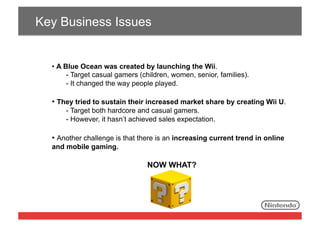
• A Blue Ocean was created by launching the Wii.
- Target casual gamers (children, women, senior, families).
- It changed the way people played.

• They tried to sustain their increased market share by creating Wii U.
- Target both hardcore and casual gamers.
- However, it hasn’t achieved sales expectation.

• Another challenge is that there is an increasing current trend in online
and mobile gaming.

NOW WHAT?
INTERNAL OVERVIEW
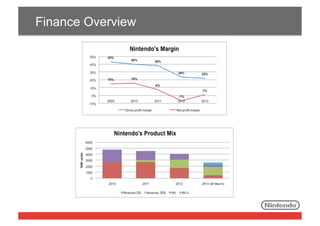
Finance Overview
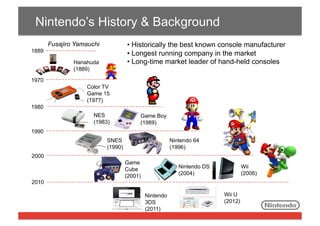
Nintendo’s History & Background
Fusajiro Yamauchi

• Historically the best known console manufacturer
• Longest running company in the market
• Long-time market leader of hand-held consoles

1889
Hanahuda
(1889)
1970
Color TV
Game 15
(1977)
1980
NES
(1983)

Game Boy
(1989)

1990
SNES
(1990)

Nintendo 64
(1996)

2000
Game
Cube
(2001)

Wii
(2006)

Nintendo DS
(2004)

2010
Nintendo
3DS
(2011)

Wii U
(2012)
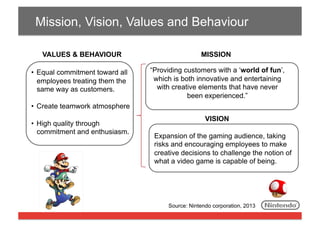
Mission, Vision, Values and Behaviour
VALUES & BEHAVIOUR
•  Equal commitment toward all
employees treating them the
same way as customers.

MISSION
“Providing customers with a ‘world of fun’,
which is both innovative and entertaining
with creative elements that have never
been experienced.”

•  Create teamwork atmosphere
•  High quality through
commitment and enthusiasm.

VISION
Expansion of the gaming audience, taking
risks and encouraging employees to make
creative decisions to challenge the notion of
what a video game is capable of being.

Source: Nintendo corporation, 2013
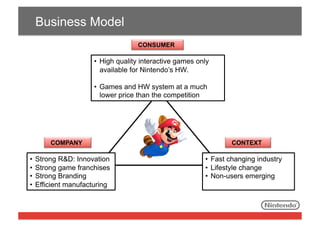
Business Model
CONSUMER

•  High quality interactive games only
available for Nintendo’s HW.
•  Games and HW system at a much
lower price than the competition

COMPANY

•  Strong R&D: Innovation
•  Strong game franchises
•  Strong Branding
•  Efficient manufacturing

CONTEXT

•  Fast changing industry
•  Lifestyle change
•  Non-users emerging
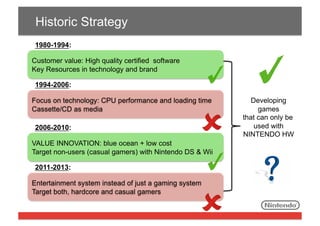
Historic Strategy
1980-1994:
Customer value: High quality certified software
Key Resources in technology and brand
1994-2006:
Focus on technology: CPU performance and loading time
Cassette/CD as media
2006-2010:
VALUE INNOVATION: blue ocean + low cost
Target non-users (casual gamers) with Nintendo DS & Wii
2011-2013:
Entertainment system instead of just a gaming system
Target both, hardcore and casual gamers

Developing
games
that can only be
used with
NINTENDO HW
EXTERNAL ANALYSIS
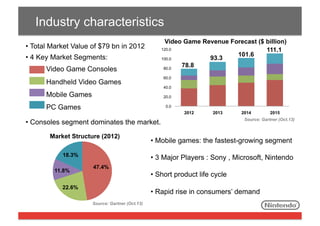
Industry characteristics
Video Game Revenue Forecast ($ billion)
120.0
111.1
101.6
93.3
100.0
78.8
80.0

• Total Market Value of $79 bn in 2012
• 4 Key Market Segments:
•  Video Game Consoles

60.0

•  Handheld Video Games

40.0

•  Mobile Games

20.0

•  PC Games

0.0

2012

2013

• Consoles segment dominates the market.
Market Structure (2012)
18.3%
11.8%

2014

2015

Source: Gartner (Oct.13)

• Mobile games: the fastest-growing segment
• 3 Major Players : Sony , Microsoft, Nintendo

47.4%

• Short product life cycle

22.6%

• Rapid rise in consumers’ demand
Source: Gartner (Oct.13)
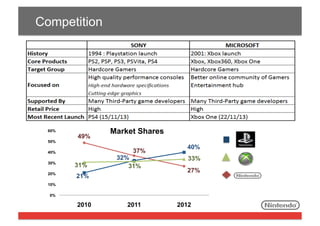
Competition

60%
50%

49%

37%

40%
30%
20%

Market Shares

31%

32%
31%

21%

40%
33%
27%

10%
0%

2010

2011

2012
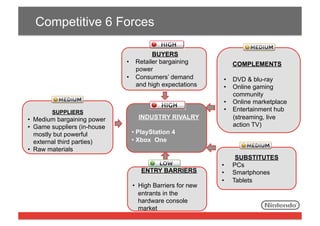
Competitive 6 Forces
BUYERS
•  Retailer bargaining
power
•  Consumers’ demand
and high expectations

SUPPLIERS

•  Medium bargaining power
•  Game suppliers (in-house
mostly but powerful
external third parties)
•  Raw materials

INDUSTRY RIVALRY

COMPLEMENTS
•  DVD & blu-ray
•  Online gaming
community
•  Online marketplace
•  Entertainment hub
(streaming, live
action TV)

• PlayStation 4
• Xbox One

ENTRY BARRIERS
•  High Barriers for new
entrants in the
hardware console
market

• 
• 
• 

SUBSTITUTES
PCs
Smartphones
Tablets
INTERNAL ANALYSIS
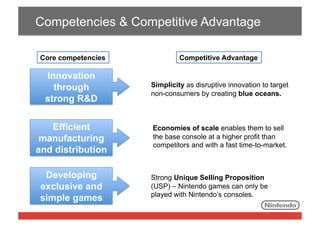
Competencies & Competitive Advantage
Core competencies

Competitive Advantage

Innovation
through
strong R&D

Simplicity as disruptive innovation to target
non-consumers by creating blue oceans.

Efficient
manufacturing
and distribution

Economies of scale enables them to sell
the base console at a higher profit than
competitors and with a fast time-to-market.

Developing
exclusive and
simple games

Strong Unique Selling Proposition
(USP) – Nintendo games can only be
played with Nintendo’s consoles.
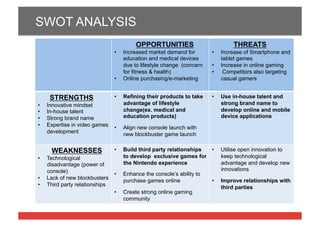
SWOT ANALYSIS
OPPORTUNITIES

THREATS

•  Increased market demand for
education and medical devices
due to lifestyle change (concern
for fitness & health)
•  Online purchasing/e-marketing

STRENGTHS
• 
• 
• 
• 

Innovative mindset
In-house talent
Strong brand name
Expertise in video games
development

WEAKNESSES
•  Technological
disadvantage (power of
console)
•  Lack of new blockbusters
•  Third party relationships

•  Increase of Smartphone and
tablet games
•  Increase in online gaming
•  Competitors also targeting
casual gamers

•  Refining their products to take
advantage of lifestyle
change(ex. medical and
education products)

•  Use in-house talent and
strong brand name to
develop online and mobile
device applications

•  Align new console launch with
new blockbuster game launch
•  Build third party relationships
•  Utilise open innovation to
to develop exclusive games for
keep technological
the Nintendo experience
advantage and develop new
innovations
•  Enhance the console’s ability to
purchase games online
•  Improve relationships with
third parties
•  Create strong online gaming
community
NEW STRATEGY?
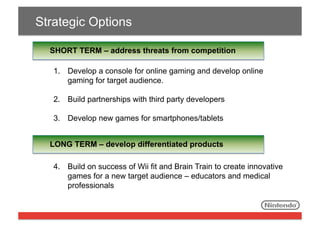
Strategic Options
SHORT TERM – address threats from competition
1.  Develop a console for online gaming and develop online
gaming for target audience.
2.  Build partnerships with third party developers
3.  Develop new games for smartphones/tablets
LONG TERM – develop differentiated products
4.  Build on success of Wii fit and Brain Train to create innovative
games for a new target audience – educators and medical
professionals
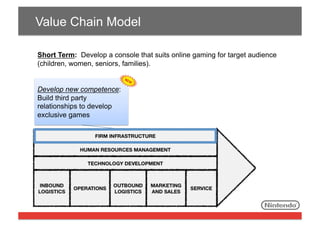
Value Chain Model
Short Term: Develop a console that suits online gaming for target audience
(children, women, seniors, families).

Develop new competence:
Build third party
relationships to develop
exclusive games
Value Chain Model
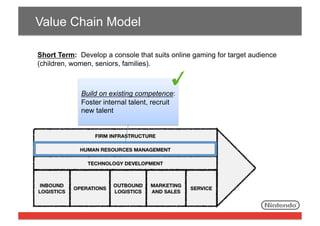
Short Term: Develop a console that suits online gaming for target audience
(children, women, seniors, families).

Build on existing competence:
Foster internal talent, recruit
new talent
Value Chain Model
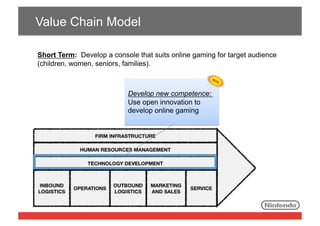
Short Term: Develop a console that suits online gaming for target audience
(children, women, seniors, families).

Develop new competence:
Use open innovation to
develop online gaming
Value Chain Model
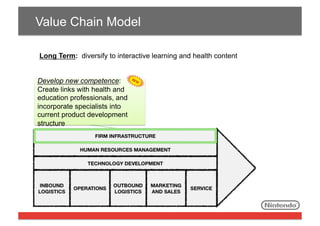
Long Term: diversify to interactive learning and health content
Develop new competence:
Create links with health and
education professionals, and
incorporate specialists into
current product development
structure
Value Chain Model
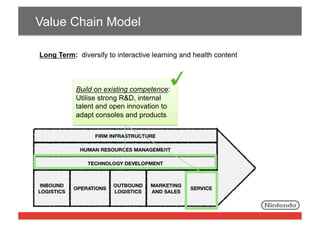
Long Term: diversify to interactive learning and health content

Build on existing competence:
Utilise strong R&D, internal
talent and open innovation to
adapt consoles and products
Value Chain Model
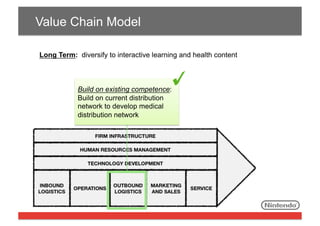
Long Term: diversify to interactive learning and health content

Build on existing competence:
Build on current distribution
network to develop medical
distribution network
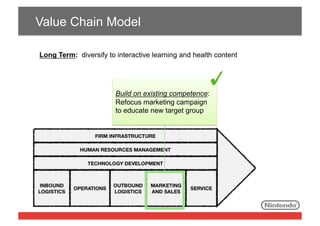
Value Chain Model
Long Term: diversify to interactive learning and health content

Build on existing competence:
Refocus marketing campaign
to educate new target group
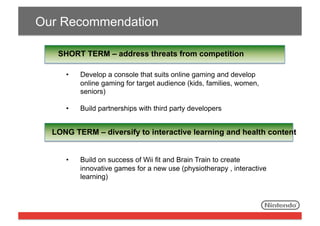
Our Recommendation
SHORT TERM – address threats from competition
• 

Develop a console that suits online gaming and develop
online gaming for target audience (kids, families, women,
seniors)

• 

Build partnerships with third party developers

LONG TERM – diversify to interactive learning and health content
• 

Build on success of Wii fit and Brain Train to create
innovative games for a new use (physiotherapy , interactive
learning)
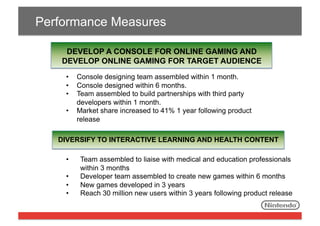
Performance Measures
DEVELOP A CONSOLE FOR ONLINE GAMING AND
DEVELOP ONLINE GAMING FOR TARGET AUDIENCE
•  Console designing team assembled within 1 month.
•  Console designed within 6 months.
•  Team assembled to build partnerships with third party
developers within 1 month.
•  Market share increased to 41% 1 year following product
release
DIVERSIFY TO INTERACTIVE LEARNING AND HEALTH CONTENT
• 
• 
• 
• 

Team assembled to liaise with medical and education professionals
within 3 months
Developer team assembled to create new games within 6 months
New games developed in 3 years
Reach 30 million new users within 3 years following product release
Conclusion
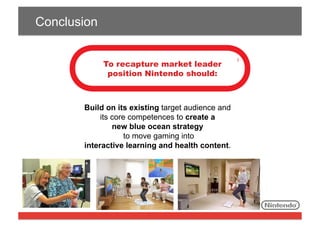
To recapture market leader
position Nintendo should:

Build on its existing target audience and
its core competences to create a
new blue ocean strategy
to move gaming into
interactive learning and health content.
THANK YOU

Strategy nintendo uebs

  • 1.
  • 2.
    AGENDA • Key business issues • Companyoverview • External analysis • Internal analysis • New strategy
  • 3.
    Key Business Issues • ABlue Ocean was created by launching the Wii. - Target casual gamers (children, women, senior, families). - It changed the way people played. • They tried to sustain their increased market share by creating Wii U. - Target both hardcore and casual gamers. - However, it hasn’t achieved sales expectation. • Another challenge is that there is an increasing current trend in online and mobile gaming. NOW WHAT?
  • 4.
  • 5.
  • 6.
    Nintendo’s History &Background Fusajiro Yamauchi • Historically the best known console manufacturer • Longest running company in the market • Long-time market leader of hand-held consoles 1889 Hanahuda (1889) 1970 Color TV Game 15 (1977) 1980 NES (1983) Game Boy (1989) 1990 SNES (1990) Nintendo 64 (1996) 2000 Game Cube (2001) Wii (2006) Nintendo DS (2004) 2010 Nintendo 3DS (2011) Wii U (2012)
  • 7.
    Mission, Vision, Valuesand Behaviour VALUES & BEHAVIOUR •  Equal commitment toward all employees treating them the same way as customers. MISSION “Providing customers with a ‘world of fun’, which is both innovative and entertaining with creative elements that have never been experienced.” •  Create teamwork atmosphere •  High quality through commitment and enthusiasm. VISION Expansion of the gaming audience, taking risks and encouraging employees to make creative decisions to challenge the notion of what a video game is capable of being. Source: Nintendo corporation, 2013
  • 8.
    Business Model CONSUMER •  Highquality interactive games only available for Nintendo’s HW. •  Games and HW system at a much lower price than the competition COMPANY •  Strong R&D: Innovation •  Strong game franchises •  Strong Branding •  Efficient manufacturing CONTEXT •  Fast changing industry •  Lifestyle change •  Non-users emerging
  • 9.
    Historic Strategy 1980-1994: Customer value:High quality certified software Key Resources in technology and brand 1994-2006: Focus on technology: CPU performance and loading time Cassette/CD as media 2006-2010: VALUE INNOVATION: blue ocean + low cost Target non-users (casual gamers) with Nintendo DS & Wii 2011-2013: Entertainment system instead of just a gaming system Target both, hardcore and casual gamers Developing games that can only be used with NINTENDO HW
  • 10.
  • 11.
    Industry characteristics Video GameRevenue Forecast ($ billion) 120.0 111.1 101.6 93.3 100.0 78.8 80.0 • Total Market Value of $79 bn in 2012 • 4 Key Market Segments: •  Video Game Consoles 60.0 •  Handheld Video Games 40.0 •  Mobile Games 20.0 •  PC Games 0.0 2012 2013 • Consoles segment dominates the market. Market Structure (2012) 18.3% 11.8% 2014 2015 Source: Gartner (Oct.13) • Mobile games: the fastest-growing segment • 3 Major Players : Sony , Microsoft, Nintendo 47.4% • Short product life cycle 22.6% • Rapid rise in consumers’ demand Source: Gartner (Oct.13)
  • 12.
  • 13.
    Competitive 6 Forces BUYERS • Retailer bargaining power •  Consumers’ demand and high expectations SUPPLIERS •  Medium bargaining power •  Game suppliers (in-house mostly but powerful external third parties) •  Raw materials INDUSTRY RIVALRY COMPLEMENTS •  DVD & blu-ray •  Online gaming community •  Online marketplace •  Entertainment hub (streaming, live action TV) • PlayStation 4 • Xbox One ENTRY BARRIERS •  High Barriers for new entrants in the hardware console market •  •  •  SUBSTITUTES PCs Smartphones Tablets
  • 14.
  • 15.
    Competencies & CompetitiveAdvantage Core competencies Competitive Advantage Innovation through strong R&D Simplicity as disruptive innovation to target non-consumers by creating blue oceans. Efficient manufacturing and distribution Economies of scale enables them to sell the base console at a higher profit than competitors and with a fast time-to-market. Developing exclusive and simple games Strong Unique Selling Proposition (USP) – Nintendo games can only be played with Nintendo’s consoles.
  • 16.
    SWOT ANALYSIS OPPORTUNITIES THREATS •  Increasedmarket demand for education and medical devices due to lifestyle change (concern for fitness & health) •  Online purchasing/e-marketing STRENGTHS •  •  •  •  Innovative mindset In-house talent Strong brand name Expertise in video games development WEAKNESSES •  Technological disadvantage (power of console) •  Lack of new blockbusters •  Third party relationships •  Increase of Smartphone and tablet games •  Increase in online gaming •  Competitors also targeting casual gamers •  Refining their products to take advantage of lifestyle change(ex. medical and education products) •  Use in-house talent and strong brand name to develop online and mobile device applications •  Align new console launch with new blockbuster game launch •  Build third party relationships •  Utilise open innovation to to develop exclusive games for keep technological the Nintendo experience advantage and develop new innovations •  Enhance the console’s ability to purchase games online •  Improve relationships with third parties •  Create strong online gaming community
  • 17.
  • 18.
    Strategic Options SHORT TERM– address threats from competition 1.  Develop a console for online gaming and develop online gaming for target audience. 2.  Build partnerships with third party developers 3.  Develop new games for smartphones/tablets LONG TERM – develop differentiated products 4.  Build on success of Wii fit and Brain Train to create innovative games for a new target audience – educators and medical professionals
  • 19.
    Value Chain Model ShortTerm: Develop a console that suits online gaming for target audience (children, women, seniors, families). Develop new competence: Build third party relationships to develop exclusive games
  • 20.
    Value Chain Model ShortTerm: Develop a console that suits online gaming for target audience (children, women, seniors, families). Build on existing competence: Foster internal talent, recruit new talent
  • 21.
    Value Chain Model ShortTerm: Develop a console that suits online gaming for target audience (children, women, seniors, families). Develop new competence: Use open innovation to develop online gaming
  • 22.
    Value Chain Model LongTerm: diversify to interactive learning and health content Develop new competence: Create links with health and education professionals, and incorporate specialists into current product development structure
  • 23.
    Value Chain Model LongTerm: diversify to interactive learning and health content Build on existing competence: Utilise strong R&D, internal talent and open innovation to adapt consoles and products
  • 24.
    Value Chain Model LongTerm: diversify to interactive learning and health content Build on existing competence: Build on current distribution network to develop medical distribution network
  • 25.
    Value Chain Model LongTerm: diversify to interactive learning and health content Build on existing competence: Refocus marketing campaign to educate new target group
  • 26.
    Our Recommendation SHORT TERM– address threats from competition •  Develop a console that suits online gaming and develop online gaming for target audience (kids, families, women, seniors) •  Build partnerships with third party developers LONG TERM – diversify to interactive learning and health content •  Build on success of Wii fit and Brain Train to create innovative games for a new use (physiotherapy , interactive learning)
  • 27.
    Performance Measures DEVELOP ACONSOLE FOR ONLINE GAMING AND DEVELOP ONLINE GAMING FOR TARGET AUDIENCE •  Console designing team assembled within 1 month. •  Console designed within 6 months. •  Team assembled to build partnerships with third party developers within 1 month. •  Market share increased to 41% 1 year following product release DIVERSIFY TO INTERACTIVE LEARNING AND HEALTH CONTENT •  •  •  •  Team assembled to liaise with medical and education professionals within 3 months Developer team assembled to create new games within 6 months New games developed in 3 years Reach 30 million new users within 3 years following product release
  • 28.
    Conclusion To recapture marketleader position Nintendo should: Build on its existing target audience and its core competences to create a new blue ocean strategy to move gaming into interactive learning and health content.
  • 29.