To the rescue of


Analysis and Strategy for survival in the consoles
              video game industry
About the Industry
 $65bn worldwide revenue in 2011.
 High penetration in developed markets, low in emerging.
 Expansion towards all the global market.
 Target audience is getting broader: more women, adults, families.
 Change in the use of consoles: more and more people see consoles as home
   entertainment hubs, with a social purpose.

 Console makers sale their products with an implicit loss, but the revenue is
   recovered by the games, accessories, etc.

 Although it usually runs in 5 year cycles, the last consoles were launched
   more than 5 years ago.
Porter’s 5 forces
                                             Threat of Entry

    Heavy investment in product development, branding and marketing communications necessary


Suppliers                                      Competition                                     Consumers

Several external suppliers, from      3 main competitors in the video               Small cost of change
hardware providers to software          console market: Sony, with
programmers                           PlayStation 3, Microsoft, with X Very strong and loyal core market,
                                        Box 360 and Nintendo with
Risky and costly to change suppliers                                                  less likely to switch
                                     Small, but extremely competitive
                                                  market
    Substitutes

    PC

    Portable gaming devices, such as the Nintendo DS and the PSP

    Mobile phones
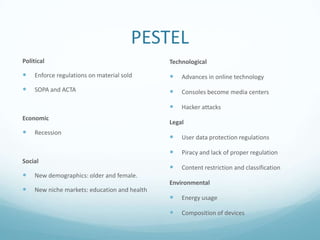
PESTEL
Political                                      Technological

    Enforce regulations on material sold         Advances in online technology
    SOPA and ACTA                                Consoles become media centers

                                                  Hacker attacks
Economic
                                               Legal
    Recession
                                                  User data protection regulations

                                                  Piracy and lack of proper regulation
Social
                                                  Content restriction and classification
    New demographics: older and female.
                                               Environmental
    New niche markets: education and health
                                                  Energy usage

                                                  Composition of devices
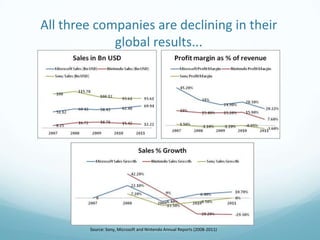
All three companies are declining in their
             global results...


        Source: Sony, Microsoft and Nintendo Annual Reports (2008-2011)
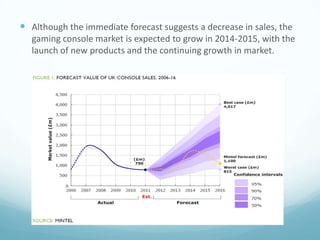
 Although the immediate forecast suggests a decrease in sales, the
  gaming console market is expected to grow in 2014-2015, with the
  launch of new products and the continuing growth in market.
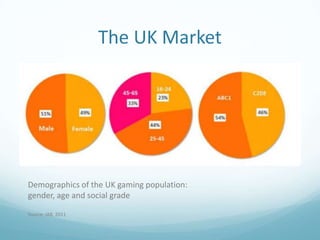
The UK Market


Demographics of the UK gaming population:
gender, age and social grade

Source: IAB, 2011
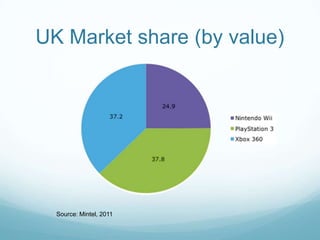
UK Market share (by value)


  Source: Mintel, 2011
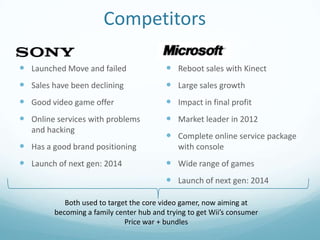
Competitors

 Launched Move and failed                 Reboot sales with Kinect
 Sales have been declining                Large sales growth
 Good video game offer                    Impact in final profit
 Online services with problems            Market leader in 2012
   and hacking
                                           Complete online service package
 Has a good brand positioning                with console
 Launch of next gen: 2014                 Wide range of games
                                           Launch of next gen: 2014

            Both used to target the core video gamer, now aiming at
         becoming a family center hub and trying to get Wii’s consumer
                              Price war + bundles
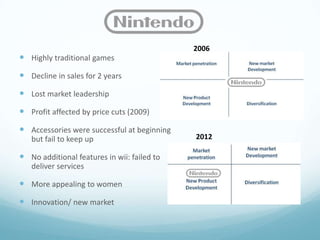
2006
 Highly traditional games
 Decline in sales for 2 years
 Lost market leadership
 Profit affected by price cuts (2009)
 Accessories were successful at beginning
   but fail to keep up                       2012

 No additional features in wii: failed to
   deliver services

 More appealing to women
 Innovation/ new market
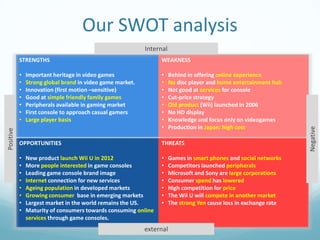
Our SWOT analysis
                                                           Internal
           STRENGTHS                                            WEAKNESS

           •   Important heritage in video games                •     Behind in offering online experience
           •   Strong global brand in video game market.        •     No disc player and home entertainment hub
           •   Innovation (first motion –sensitive)             •     Not good at services for console
           •   Good at simple friendly family games             •     Cut-price strategy
           •   Peripherals available in gaming market           •     Old product (Wii) launched in 2006
           •   First console to approach casual gamers          •     No HD display
           •   Large player basis                               •     Knowledge and focus only on videogames
                                                                •     Production in Japan: high cost


                                                                                                                   Negative
Positive


           OPPORTUNITIES                                        THREATS

           •   New product launch Wii U in 2012                 •     Games in smart phones and social networks
           •   More people interested in game consoles          •     Competitors launched peripherals
           •   Leading game console brand image                 •     Microsoft and Sony are large corporations
           •   Internet connection for new services             •     Consumer spend has lowered
           •   Ageing population in developed markets           •     High competition for price
           •   Growing consumer base in emerging markets        •     The Wii U will compete in another market
           •   Largest market in the world remains the US.      •     The strong Yen cause loss in exchange rate
           •   Maturity of consumers towards consuming online
               services through game consoles.
                                                           external
Our recommendation…
Focusing on the target’s wants and delivering
         through the new launch…
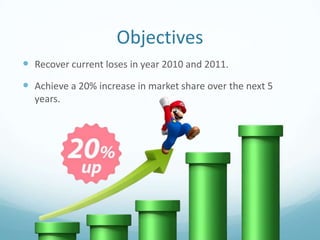
Objectives
 Recover current loses in year 2010 and 2011.
 Achieve a 20% increase in market share over the next 5
  years.
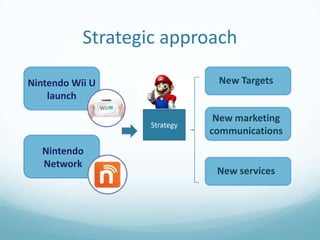
Strategic approach

Nintendo Wii U                New Targets
    launch

                              New marketing
                  Strategy
                             communications
  Nintendo
  Network
                              New services
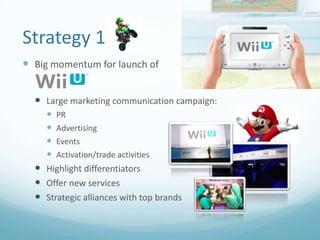
Strategy 1
 Big momentum for launch of


   Large marketing communication campaign:
     PR
     Advertising
     Events
     Activation/trade activities
   Highlight differentiators
   Offer new services
   Strategic alliances with top brands
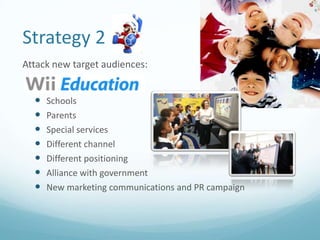
Strategy 2
Attack new target audiences:


     Schools
     Parents
     Special services
     Different channel
     Different positioning
     Alliance with government
     New marketing communications and PR campaign
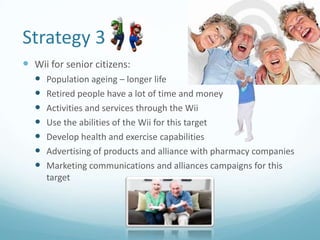
Strategy 3
 Wii for senior citizens:
     Population ageing – longer life
     Retired people have a lot of time and money
     Activities and services through the Wii
     Use the abilities of the Wii for this target
     Develop health and exercise capabilities
     Advertising of products and alliance with pharmacy companies
     Marketing communications and alliances campaigns for this
      target
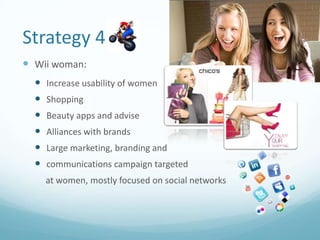
Strategy 4
 Wii woman:
   Increase usability of women
   Shopping
   Beauty apps and advise
   Alliances with brands
   Large marketing, branding and
   communications campaign targeted
    at women, mostly focused on social networks
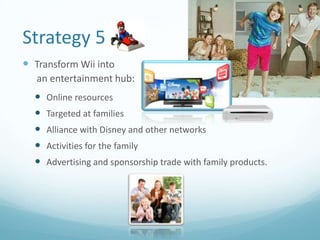
Strategy 5
 Transform Wii into
   an entertainment hub:
   Online resources
   Targeted at families
   Alliance with Disney and other networks
   Activities for the family
   Advertising and sponsorship trade with family products.
Questions?

Nintendo Marketing Strategy analysis and proposal

  • 1.
    To the rescueof Analysis and Strategy for survival in the consoles video game industry
  • 2.
    About the Industry $65bn worldwide revenue in 2011.  High penetration in developed markets, low in emerging.  Expansion towards all the global market.  Target audience is getting broader: more women, adults, families.  Change in the use of consoles: more and more people see consoles as home entertainment hubs, with a social purpose.  Console makers sale their products with an implicit loss, but the revenue is recovered by the games, accessories, etc.  Although it usually runs in 5 year cycles, the last consoles were launched more than 5 years ago.
  • 3.
    Porter’s 5 forces Threat of Entry Heavy investment in product development, branding and marketing communications necessary Suppliers Competition Consumers Several external suppliers, from 3 main competitors in the video Small cost of change hardware providers to software console market: Sony, with programmers PlayStation 3, Microsoft, with X Very strong and loyal core market, Box 360 and Nintendo with Risky and costly to change suppliers less likely to switch Small, but extremely competitive market Substitutes PC Portable gaming devices, such as the Nintendo DS and the PSP Mobile phones
  • 4.
    PESTEL Political Technological  Enforce regulations on material sold  Advances in online technology  SOPA and ACTA  Consoles become media centers  Hacker attacks Economic Legal  Recession  User data protection regulations  Piracy and lack of proper regulation Social  Content restriction and classification  New demographics: older and female. Environmental  New niche markets: education and health  Energy usage  Composition of devices
  • 5.
    All three companiesare declining in their global results... Source: Sony, Microsoft and Nintendo Annual Reports (2008-2011)
  • 6.
     Although theimmediate forecast suggests a decrease in sales, the gaming console market is expected to grow in 2014-2015, with the launch of new products and the continuing growth in market.
  • 7.
    The UK Market Demographicsof the UK gaming population: gender, age and social grade Source: IAB, 2011
  • 8.
    UK Market share(by value) Source: Mintel, 2011
  • 9.
    Competitors  Launched Moveand failed  Reboot sales with Kinect  Sales have been declining  Large sales growth  Good video game offer  Impact in final profit  Online services with problems  Market leader in 2012 and hacking  Complete online service package  Has a good brand positioning with console  Launch of next gen: 2014  Wide range of games  Launch of next gen: 2014 Both used to target the core video gamer, now aiming at becoming a family center hub and trying to get Wii’s consumer Price war + bundles
  • 10.
    2006  Highly traditionalgames  Decline in sales for 2 years  Lost market leadership  Profit affected by price cuts (2009)  Accessories were successful at beginning but fail to keep up 2012  No additional features in wii: failed to deliver services  More appealing to women  Innovation/ new market
  • 11.
    Our SWOT analysis Internal STRENGTHS WEAKNESS • Important heritage in video games • Behind in offering online experience • Strong global brand in video game market. • No disc player and home entertainment hub • Innovation (first motion –sensitive) • Not good at services for console • Good at simple friendly family games • Cut-price strategy • Peripherals available in gaming market • Old product (Wii) launched in 2006 • First console to approach casual gamers • No HD display • Large player basis • Knowledge and focus only on videogames • Production in Japan: high cost Negative Positive OPPORTUNITIES THREATS • New product launch Wii U in 2012 • Games in smart phones and social networks • More people interested in game consoles • Competitors launched peripherals • Leading game console brand image • Microsoft and Sony are large corporations • Internet connection for new services • Consumer spend has lowered • Ageing population in developed markets • High competition for price • Growing consumer base in emerging markets • The Wii U will compete in another market • Largest market in the world remains the US. • The strong Yen cause loss in exchange rate • Maturity of consumers towards consuming online services through game consoles. external
  • 12.
    Our recommendation… Focusing onthe target’s wants and delivering through the new launch…
  • 13.
    Objectives  Recover currentloses in year 2010 and 2011.  Achieve a 20% increase in market share over the next 5 years.
  • 14.
    Strategic approach Nintendo WiiU New Targets launch New marketing Strategy communications Nintendo Network New services
  • 15.
    Strategy 1  Bigmomentum for launch of  Large marketing communication campaign:  PR  Advertising  Events  Activation/trade activities  Highlight differentiators  Offer new services  Strategic alliances with top brands
  • 16.
    Strategy 2 Attack newtarget audiences:  Schools  Parents  Special services  Different channel  Different positioning  Alliance with government  New marketing communications and PR campaign
  • 17.
    Strategy 3  Wiifor senior citizens:  Population ageing – longer life  Retired people have a lot of time and money  Activities and services through the Wii  Use the abilities of the Wii for this target  Develop health and exercise capabilities  Advertising of products and alliance with pharmacy companies  Marketing communications and alliances campaigns for this target
  • 18.
    Strategy 4  Wiiwoman:  Increase usability of women  Shopping  Beauty apps and advise  Alliances with brands  Large marketing, branding and  communications campaign targeted at women, mostly focused on social networks
  • 19.
    Strategy 5  TransformWii into an entertainment hub:  Online resources  Targeted at families  Alliance with Disney and other networks  Activities for the family  Advertising and sponsorship trade with family products.
  • 20.

Editor's Notes

  • #2 Other companies have not survived.
  • #3 Other companies have not survived.
  • #4 Substitutes PC: main threat to video consoles. Better graphics and gameplay, though it lacks the interactive functions the multiplayer character and the ease of use of the gaming console Portable gaming devices, such as the Nintendo DS and the PlayStation Portable. Offer the same range of activities, with the advantage of mobility. Very limited compared to the fixed models, and consumers tend to see them more as a complement rather than a substitute.Mobile phones: technological advances in image quality and online access develop make it a serious threat (IAB, 2011)
  • #6 Companies results:Sony: decline in sales / not profitableNintendo: decrease in sale/profit Microsoft: increase sales but decrease in profit
  • #8 Largest in Europe, it presented a decrease in revenue from last year to this33 million people play video games, 21 million use consolesMost users describe themselves as “casual” gamers, who prefer to play in the company of friends and familyMost console owners use their devices for activities other than just gameplay, such as content streaming and internet access