What is your
strategy?
Question # 1
What is your purpose?
What is not your purpose?
Further inspiration
https://www.teacherspayteachers.com/Product/What-is-your-purpose-1438787
https://www.teacherspayteachers.com/Product/Examples-of-purpose-2350843
Question # 2
What values do you have?
What values do you not have?
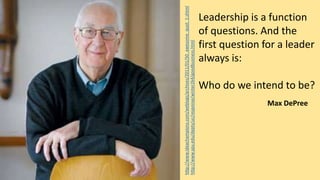
Max DePree
http://www.ideachampions.com/weblogs/archives/2011/01/50_awesome_quot_1.shtml
http://www.spu.edu/depts/uc/response/winter2k4/goodbusiness.html
Leadership is a function
of questions. And the
first question for a leader
always is:
Who do we intend to be?
Why do we do it this way?
A question to ask yourself and people you work with:
https://hbr.org/2015/09/5-strategy-questions-every-leader-should-make-time-for
Further inspiration
https://www.teacherspayteachers.com/Product/Questions-to-discover-your-values-1329394
https://www.teacherspayteachers.com/Product/Human-values-1633047
Question # 3
What do you do?
What do you not do?
Strategy is about
1. choosing what not to do.
2. combining what you do in a unique way.
https://hbr.org/1996/11/what-is-strategy
When you think about all the activities you have
moved into, to what extent do they make sense
together?
https://hbr.org/2015/09/5-strategy-questions-every-leader-should-make-time-for
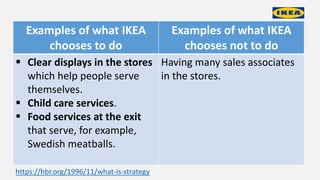
Examples of what IKEA
chooses to do
Examples of what IKEA
chooses not to do
 Clear displays in the stores
which help people serve
themselves.
 Child care services.
 Food services at the exit
that serve, for example,
Swedish meatballs.
Having many sales associates
in the stores.
https://hbr.org/1996/11/what-is-strategy
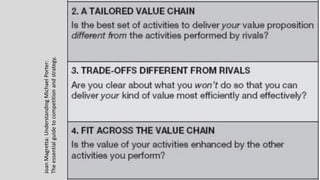
JoanMagretta:UnderstandingMichaelPorter:
Theessentialguidetocompetitionandstrategy.
Strategic positioning means performing
different activities from rivals’ or
performing activities in different ways.
https://hbr.org/1996/11/what-is-strategy
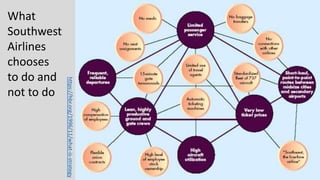
What
Southwest
Airlines
chooses
to do and
not to do
https://hbr.org/1996/11/what-is-strategy
Seeking out the new and unusual
should be the strategist’s aim.
http://www.mckinsey.com/insights/strategy/hidden_flaws_in_strategy
http://www.quicksprout.com/2011/01/20/my-5-favorite-but-often-ignored-marketing-tactics/
Let’s say you were starting over from scratch.
Are the tasks, you do today, the tasks you would you?
If yes, why?
https://hbr.org/2011/08/key-questions-for-leaders
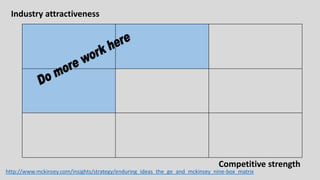
Industry attractiveness
Competitive strength
http://www.mckinsey.com/insights/strategy/enduring_ideas_the_ge_and_mckinsey_nine-box_matrix
The nature of the product is changing, with many
products transcending their roles as material
possessions that people own to become services
to which they buy access.
http://dupress.com/articles/future-of-manufacturing-industry/
Sources
http://www.mobility.ch
http://stadtrad.hamburg.de
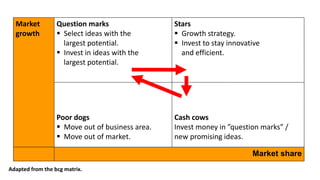
Market share
Cash cows
Invest money in ”question marks” /
new promising ideas.
Poor dogs
 Move out of business area.
 Move out of market.
Stars
 Growth strategy.
 Invest to stay innovative
and efficient.
Question marks
 Select ideas with the
largest potential.
 Invest in ideas with the
largest potential.
Market
growth
Adapted from the bcg matrix.
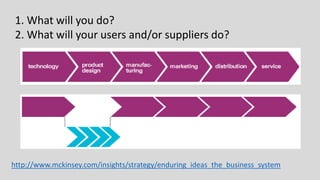
1. What will you do?
2. What will your users and/or suppliers do?
http://www.mckinsey.com/insights/strategy/enduring_ideas_the_business_system
Further inspiration
https://www.teacherspayteachers.com/Product/Stop-and-start-doing-exercise-1594003
Question # 4
What needs do users and
potential users have?
Southwest Airlines defined its target market to include
regular bus travelers - people who wanted to get
from point A to point B in the lowest-cost,
most convenient way.
http://www.strategy-business.com/article/cs00002?pg=all
http://www.slideshare.net/IanMcCarthy/when-customers-get-clever-managerial-approaches-to-dealing-with-creative-consumers
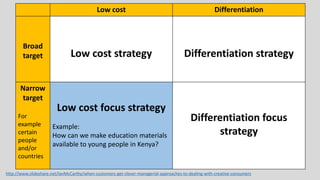
Low cost Differentiation
Broad
target Low cost strategy Differentiation strategy
Narrow
target
For
example
certain
people
and/or
countries
Low cost focus strategy
Example:
How can we make education materials
available to young people in Kenya?
Differentiation focus
strategy
Further inspiration
https://www.teacherspayteachers.com/Product/Needs-that-people-have-1530997
Question # 5
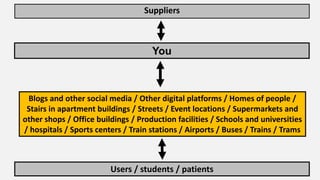
Which distribution channels
do you use?
Which do you not use?
Users / students / patients
Blogs and other social media / Other digital platforms / Homes of people /
Stairs in apartment buildings / Streets / Event locations / Supermarkets and
other shops / Office buildings / Production facilities / Schools and universities
/ hospitals / Sports centers / Train stations / Airports / Buses / Trains / Trams
Suppliers
You
Digital technologies are narrowing the
distance between manufacturer and
consumer, allowing manufacturers to
bypass traditional intermediaries.
http://dupress.com/articles/future-of-manufacturing-industry/
Instead of building large stocks of furniture, as its
competitors do, MyFab provides a catalog of potential
designs.
Customers vote on them, and the most popular
ones are put into production and shipped to
buyers directly from the manufacturing sites - with no
retail outlets, inventories, complicated distribution, or
logistics networks.
http://hbr.org/2011/05/how-to-build-risk-into-your-business-model
To reduce the time it takes to distribute
products to customers, Zara, Dell, and
Timbuk2 work with production facilities
that are close to end customers.
http://hbr.org/2011/05/how-to-build-risk-into-your-business-model
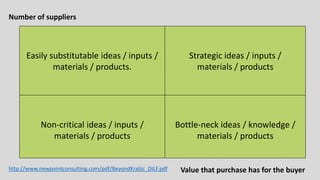
Bottle-neck ideas / knowledge /
materials / products
Non-critical ideas / inputs /
materials / products
Strategic ideas / inputs /
materials / products
Easily substitutable ideas / inputs /
materials / products.
http://www.newpointconsulting.com/pdf/BeyondKraljic_DILF.pdf
Number of suppliers
Value that purchase has for the buyer
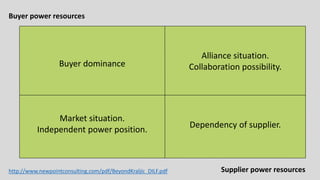
Dependency of supplier.
Market situation.
Independent power position.
Alliance situation.
Collaboration possibility.Buyer dominance
http://www.newpointconsulting.com/pdf/BeyondKraljic_DILF.pdf
Buyer power resources
Supplier power resources
Further inspiration
http://www.slideshare.net/frankcalberg/11-advantages-of-using-a-blog-for-teaching
http://www.slideshare.net/frankcalberg/channels-to-deliver-health-services
Question # 6
In which markets do you work?
In which markets do you
not work?
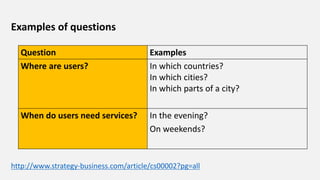
Question Examples
Where are users? In which countries?
In which cities?
In which parts of a city?
When do users need services? In the evening?
On weekends?
http://www.strategy-business.com/article/cs00002?pg=all
Examples of questions
80% of growth is explained by
decisions about where to work.
http://www.mckinsey.com/insights/strategy/the_art_of_strategy
Management’s overriding goal is to position a
company and its products where the market
opportunity is highest.
http://ww2.cfo.com/strategy/2004/02/best-practice-doesnt-equal-best-strategy/
Make choices about where you will play,
and where you won’t.
https://hbr.org/2013/01/the-two-choices-to-make-in-str.html
Joan Magretta: Understanding Michael Porter: The essential guide to competition and strategy”, location 2550.
When you go to a foreign market, remember that you
are not trying to serve the whole market.
You are looking for people who value what you do.
Question # 7
Which types of capital / assets /
resources / competencies
do you have / need?
Which do you not need?
Further inspiration
https://www.teacherspayteachers.com/Product/What-types-of-capital-are-you-developing-2244992
Question # 8
How are you rewarded / paid /
compensated / praised /
financed / funded?
How are you not rewarded?
Further inspiration
https://www.teacherspayteachers.com/Product/How-can-people-pay-2384341
https://www.teacherspayteachers.com/Product/How-should-people-be-paid-1374105
Question # 9
What external changes
are happening that you
need to adapt to?
2 questions for you
1. What changes are lasting?
2. What changes are not lasting?
http://edgeperspectives.typepad.com/edge_perspectives/2014/12/the-big-shift-in-strategy-part-1.html
Further inspiration
http://www.slideshare.net/frankcalberg/pestel
Question # 10
How will you learn and
adapt to changes?
In a world of accelerating change, one of our
greatest imperatives is to unlearn - to
challenge and ultimately abandon some of
our most basic beliefs about how the world
works and what is required for success.
http://edgeperspectives.typepad.com/edge_perspectives/2015/01/the-big-shift-in-strategy-part-2.html
In a time of accelerating change, learning
is essential to success.
Whatever we know today is depreciating in
value at an increasing rate.
http://edgeperspectives.typepad.com/edge_perspectives/2015/01/the-big-shift-in-strategy-part-2.html
http://www.fastcompany.com/3043056/at-this-fake-hospital-linen-schlepping-droids-robo-patients-and-the-future-of-medicine
Kaiser Permanente is testing new ways of
curing people at a fake hospital.
Further inspiration
https://www.teacherspayteachers.com/Product/Learning-strategies-1487708
https://twitter.com/frankcalberg

What is your strategy?