CONTEXT CLUES
BY
Mrs.
Evans
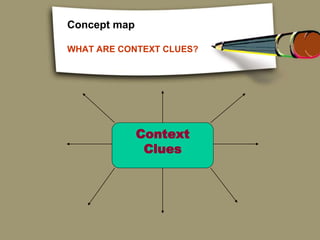
Concept map
WHAT ARE CONTEXT CLUES?
Context
Clues
How Do You Guess The
Meaning Of An
Unfamiliar Word?
There are words or phrases around an
unfamiliar word that can help you
understand the meaning of a new word.
These words and phrases are called
context clues.
If you learn how to use these clues,
you can save yourself a trip to the
dictionary, increase your vocabulary, and
improve your reading comprehension.
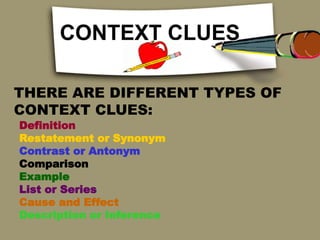
CONTEXT CLUES
THERE ARE DIFFERENT TYPES OF
CONTEXT CLUES:
Definition
Restatement or Synonym
Contrast or Antonym
Comparison
Example
List or Series
Cause and Effect
Description or Inference
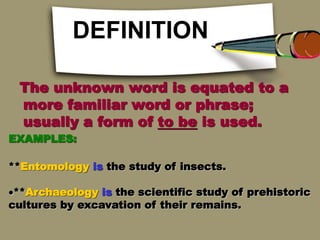
DEFINITION
The unknown word is equated to a
more familiar word or phrase;
usually a form of to be is used.
EXAMPLES:
**Entomology is the study of insects.
**Archaeology is the scientific study of prehistoric
cultures by excavation of their remains.
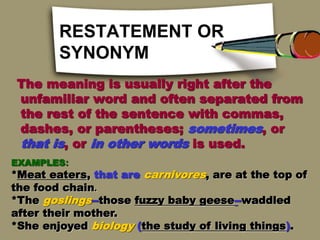
RESTATEMENT OR
SYNONYM
The meaning is usually right after the
unfamiliar word and often separated from
the rest of the sentence with commas,
dashes, or parentheses; sometimes, or
that is, or in other words is used.
EXAMPLES:
*Meat eaters, that are carnivores, are at the top of
the food chain.
*The goslings--those fuzzy baby geese--waddled
after their mother.
*She enjoyed biology (the study of living things).
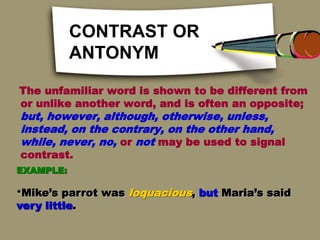
CONTRAST OR
ANTONYM
The unfamiliar word is shown to be different from
or unlike another word, and is often an opposite;
but, however, although, otherwise, unless,
instead, on the contrary, on the other hand,
while, never, no, or not may be used to signal
contrast.
EXAMPLE:
*Mike’s parrot was loquacious, but Maria’s said
very little.
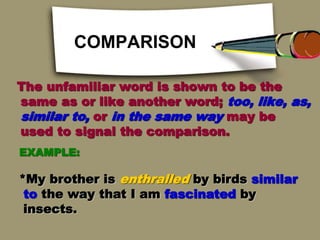
COMPARISON
The unfamiliar word is shown to be the
same as or like another word; too, like, as,
similar to, or in the same way may be
used to signal the comparison.
EXAMPLE:
*My brother is enthralled by birds similar
to the way that I am fascinated by
insects.
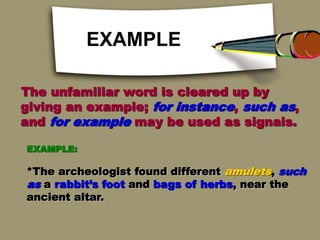
EXAMPLE
The unfamiliar word is cleared up by
giving an example; for instance, such as,
and for example may be used as signals.
EXAMPLE:
*The archeologist found different amulets, such
as a rabbit’s foot and bags of herbs, near the
ancient altar.
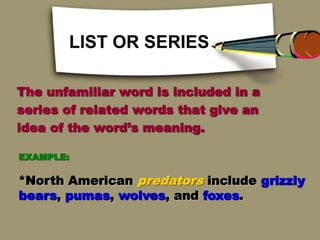
LIST OR SERIES
The unfamiliar word is included in a
series of related words that give an
idea of the word’s meaning.
EXAMPLE:
*North American predators include grizzly
bears, pumas, wolves, and foxes.
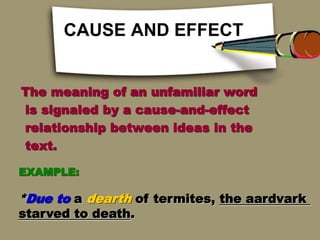
CAUSE AND EFFECT
The meaning of an unfamiliar word
is signaled by a cause-and-effect
relationship between ideas in the
text.
EXAMPLE:
*Due to a dearth of termites, the aardvark
starved to death.
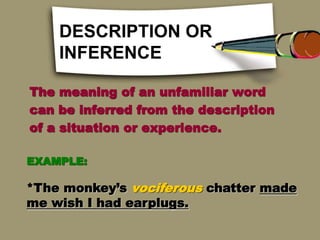
DESCRIPTION OR
INFERENCE
The meaning of an unfamiliar word
can be inferred from the description
of a situation or experience.
EXAMPLE:
*The monkey’s vociferous chatter made
me wish I had earplugs.
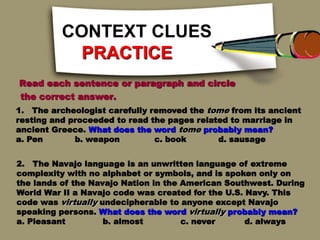
CONTEXT CLUES
PRACTICE
Read each sentence or paragraph and circle
the correct answer.
1. The archeologist carefully removed the tome from its ancient
resting and proceeded to read the pages related to marriage in
ancient Greece. What does the word tome probably mean?
a. Pen b. weapon c. book d. sausage
2. The Navajo language is an unwritten language of extreme
complexity with no alphabet or symbols, and is spoken only on
the lands of the Navajo Nation in the American Southwest. During
World War II a Navajo code was created for the U.S. Navy. This
code was virtually undecipherable to anyone except Navajo
speaking persons. What does the word virtually probably mean?
a. Pleasant b. almost c. never d. always
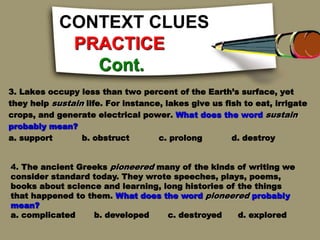
CONTEXT CLUES
PRACTICE
Cont.
3. Lakes occupy less than two percent of the Earth’s surface, yet
they help sustain life. For instance, lakes give us fish to eat, irrigate
crops, and generate electrical power. What does the word sustain
probably mean?
a. support b. obstruct c. prolong d. destroy
4. The ancient Greeks pioneered many of the kinds of writing we
consider standard today. They wrote speeches, plays, poems,
books about science and learning, long histories of the things
that happened to them. What does the word pioneered probably
mean?
a. complicated b. developed c. destroyed d. explored
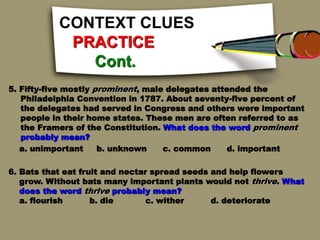
CONTEXT CLUES
PRACTICE
Cont.
5. Fifty-five mostly prominent, male delegates attended the
Philadelphia Convention in 1787. About seventy-five percent of
the delegates had served in Congress and others were important
people in their home states. These men are often referred to as
the Framers of the Constitution. What does the word prominent
probably mean?
a. unimportant b. unknown c. common d. important
6. Bats that eat fruit and nectar spread seeds and help flowers
grow. Without bats many important plants would not thrive. What
does the word thrive probably mean?
a. flourish b. die c. wither d. deteriorate
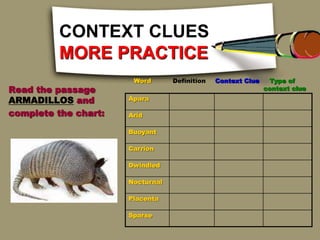
CONTEXT CLUES
MORE PRACTICE
Read the passage
ARMADILLOS and
complete the chart:
Apara
Arid
Buoyant
Carrion
Dwindled
Nocturnal
Placenta
Sparse
Word Definition Context Clue Type of
context clue
THE END
QUESTIONS?

14 Context Clues.ppt

  • 1.
  • 2.
    Concept map WHAT ARECONTEXT CLUES? Context Clues
  • 3.
    How Do YouGuess The Meaning Of An Unfamiliar Word? There are words or phrases around an unfamiliar word that can help you understand the meaning of a new word. These words and phrases are called context clues. If you learn how to use these clues, you can save yourself a trip to the dictionary, increase your vocabulary, and improve your reading comprehension.
  • 4.
    CONTEXT CLUES THERE AREDIFFERENT TYPES OF CONTEXT CLUES: Definition Restatement or Synonym Contrast or Antonym Comparison Example List or Series Cause and Effect Description or Inference
  • 5.
    DEFINITION The unknown wordis equated to a more familiar word or phrase; usually a form of to be is used. EXAMPLES: **Entomology is the study of insects. **Archaeology is the scientific study of prehistoric cultures by excavation of their remains.
  • 6.
    RESTATEMENT OR SYNONYM The meaningis usually right after the unfamiliar word and often separated from the rest of the sentence with commas, dashes, or parentheses; sometimes, or that is, or in other words is used. EXAMPLES: *Meat eaters, that are carnivores, are at the top of the food chain. *The goslings--those fuzzy baby geese--waddled after their mother. *She enjoyed biology (the study of living things).
  • 7.
    CONTRAST OR ANTONYM The unfamiliarword is shown to be different from or unlike another word, and is often an opposite; but, however, although, otherwise, unless, instead, on the contrary, on the other hand, while, never, no, or not may be used to signal contrast. EXAMPLE: *Mike’s parrot was loquacious, but Maria’s said very little.
  • 8.
    COMPARISON The unfamiliar wordis shown to be the same as or like another word; too, like, as, similar to, or in the same way may be used to signal the comparison. EXAMPLE: *My brother is enthralled by birds similar to the way that I am fascinated by insects.
  • 9.
    EXAMPLE The unfamiliar wordis cleared up by giving an example; for instance, such as, and for example may be used as signals. EXAMPLE: *The archeologist found different amulets, such as a rabbit’s foot and bags of herbs, near the ancient altar.
  • 10.
    LIST OR SERIES Theunfamiliar word is included in a series of related words that give an idea of the word’s meaning. EXAMPLE: *North American predators include grizzly bears, pumas, wolves, and foxes.
  • 11.
    CAUSE AND EFFECT Themeaning of an unfamiliar word is signaled by a cause-and-effect relationship between ideas in the text. EXAMPLE: *Due to a dearth of termites, the aardvark starved to death.
  • 12.
    DESCRIPTION OR INFERENCE The meaningof an unfamiliar word can be inferred from the description of a situation or experience. EXAMPLE: *The monkey’s vociferous chatter made me wish I had earplugs.
  • 13.
    CONTEXT CLUES PRACTICE Read eachsentence or paragraph and circle the correct answer. 1. The archeologist carefully removed the tome from its ancient resting and proceeded to read the pages related to marriage in ancient Greece. What does the word tome probably mean? a. Pen b. weapon c. book d. sausage 2. The Navajo language is an unwritten language of extreme complexity with no alphabet or symbols, and is spoken only on the lands of the Navajo Nation in the American Southwest. During World War II a Navajo code was created for the U.S. Navy. This code was virtually undecipherable to anyone except Navajo speaking persons. What does the word virtually probably mean? a. Pleasant b. almost c. never d. always
  • 14.
    CONTEXT CLUES PRACTICE Cont. 3. Lakesoccupy less than two percent of the Earth’s surface, yet they help sustain life. For instance, lakes give us fish to eat, irrigate crops, and generate electrical power. What does the word sustain probably mean? a. support b. obstruct c. prolong d. destroy 4. The ancient Greeks pioneered many of the kinds of writing we consider standard today. They wrote speeches, plays, poems, books about science and learning, long histories of the things that happened to them. What does the word pioneered probably mean? a. complicated b. developed c. destroyed d. explored
  • 15.
    CONTEXT CLUES PRACTICE Cont. 5. Fifty-fivemostly prominent, male delegates attended the Philadelphia Convention in 1787. About seventy-five percent of the delegates had served in Congress and others were important people in their home states. These men are often referred to as the Framers of the Constitution. What does the word prominent probably mean? a. unimportant b. unknown c. common d. important 6. Bats that eat fruit and nectar spread seeds and help flowers grow. Without bats many important plants would not thrive. What does the word thrive probably mean? a. flourish b. die c. wither d. deteriorate
  • 16.
    CONTEXT CLUES MORE PRACTICE Readthe passage ARMADILLOS and complete the chart: Apara Arid Buoyant Carrion Dwindled Nocturnal Placenta Sparse Word Definition Context Clue Type of context clue
  • 17.