The document discusses the concepts of dynamic capabilities and the resource-based view of the firm. It explains that dynamic capabilities allow firms to adapt their resource configurations to changing market conditions in order to gain and maintain competitive advantages. Specifically, dynamic capabilities help firms rearrange and develop their resources to create new value through activities like product development, strategic decision-making, and alliance-building. The document also discusses how dynamic capabilities differ based on the level of dynamism in a market and how firms can develop and improve their dynamic capabilities over time through processes like repeated practice, codification of procedures, and learning from failures.
Dynamic Capabilities Srini Kumar Marketing Strategy MBA 260G based on the paper: Dynamic Capabilities – What Are They? (Eisenhardt/Martin: Strategic Management Journal , 2000)
2.
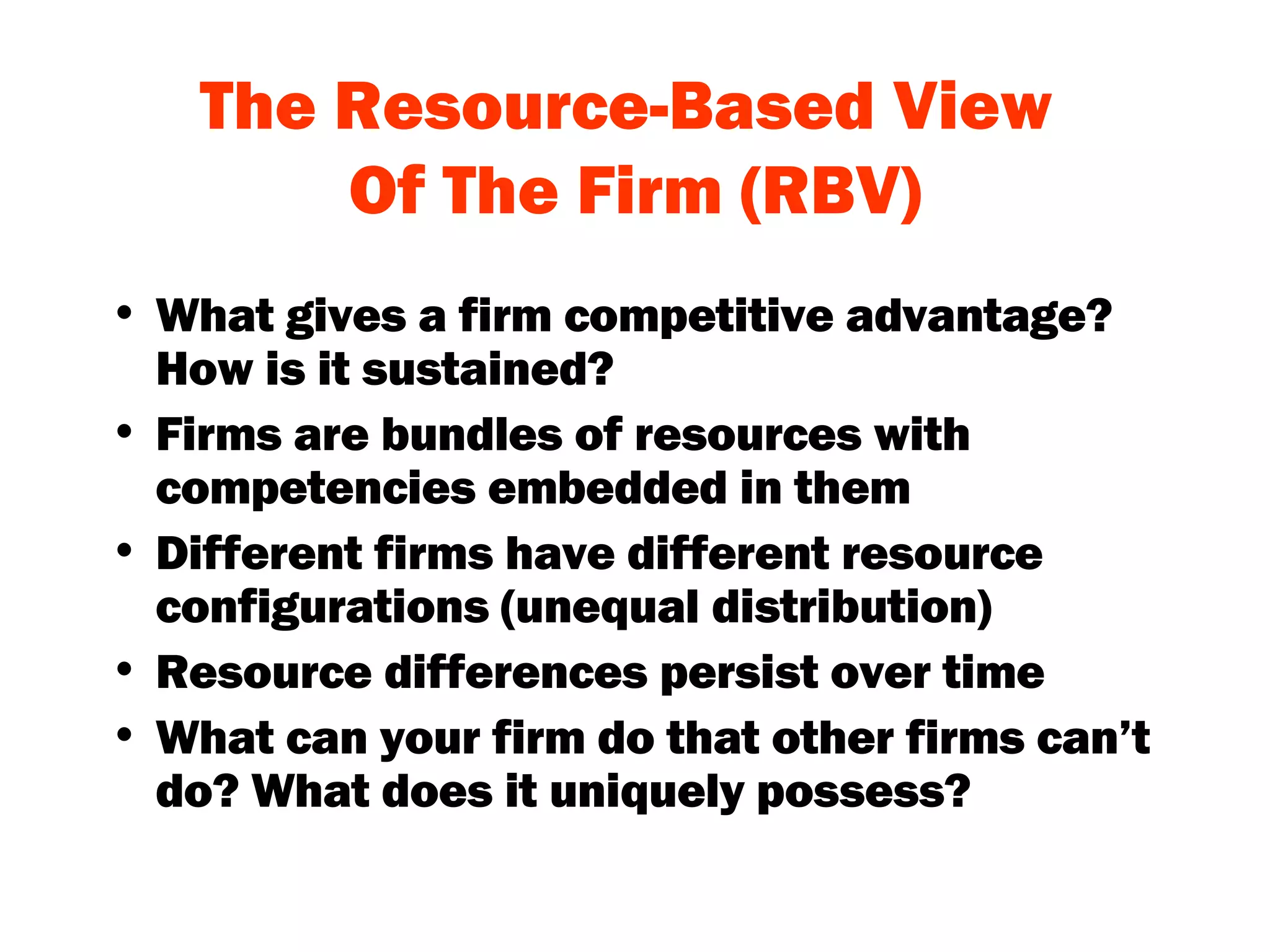
The Resource-Based View Of The Firm (RBV) What gives a firm competitive advantage? How is it sustained? Firms are bundles of resources with competencies embedded in them Different firms have different resource configurations (unequal distribution) Resource differences persist over time What can your firm do that other firms can’t do? What does it uniquely possess?
3.
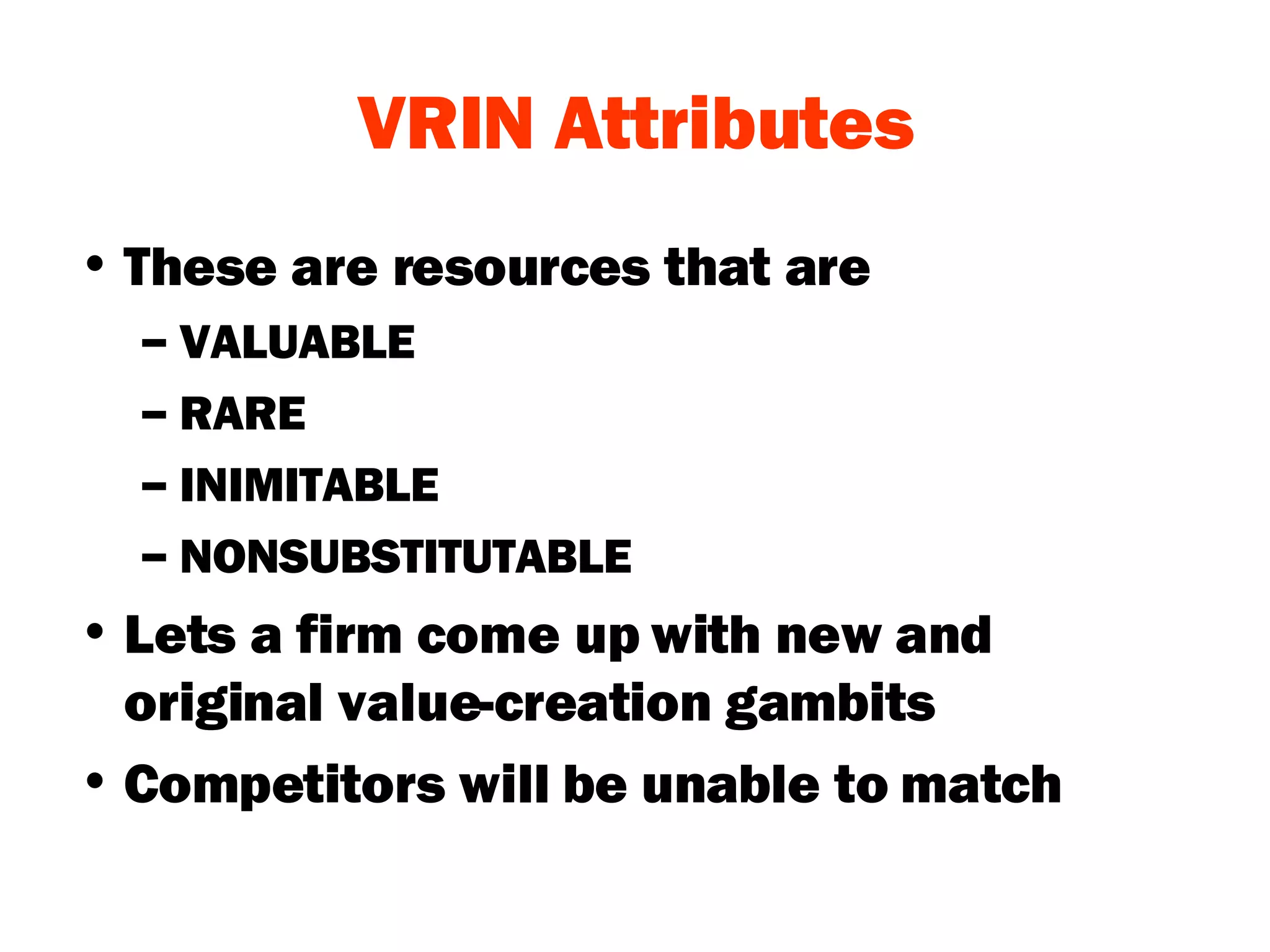
VRIN Attributes Theseare resources that are VALUABLE RARE INIMITABLE NONSUBSTITUTABLE Lets a firm come up with new and original value-creation gambits Competitors will be unable to match
4.
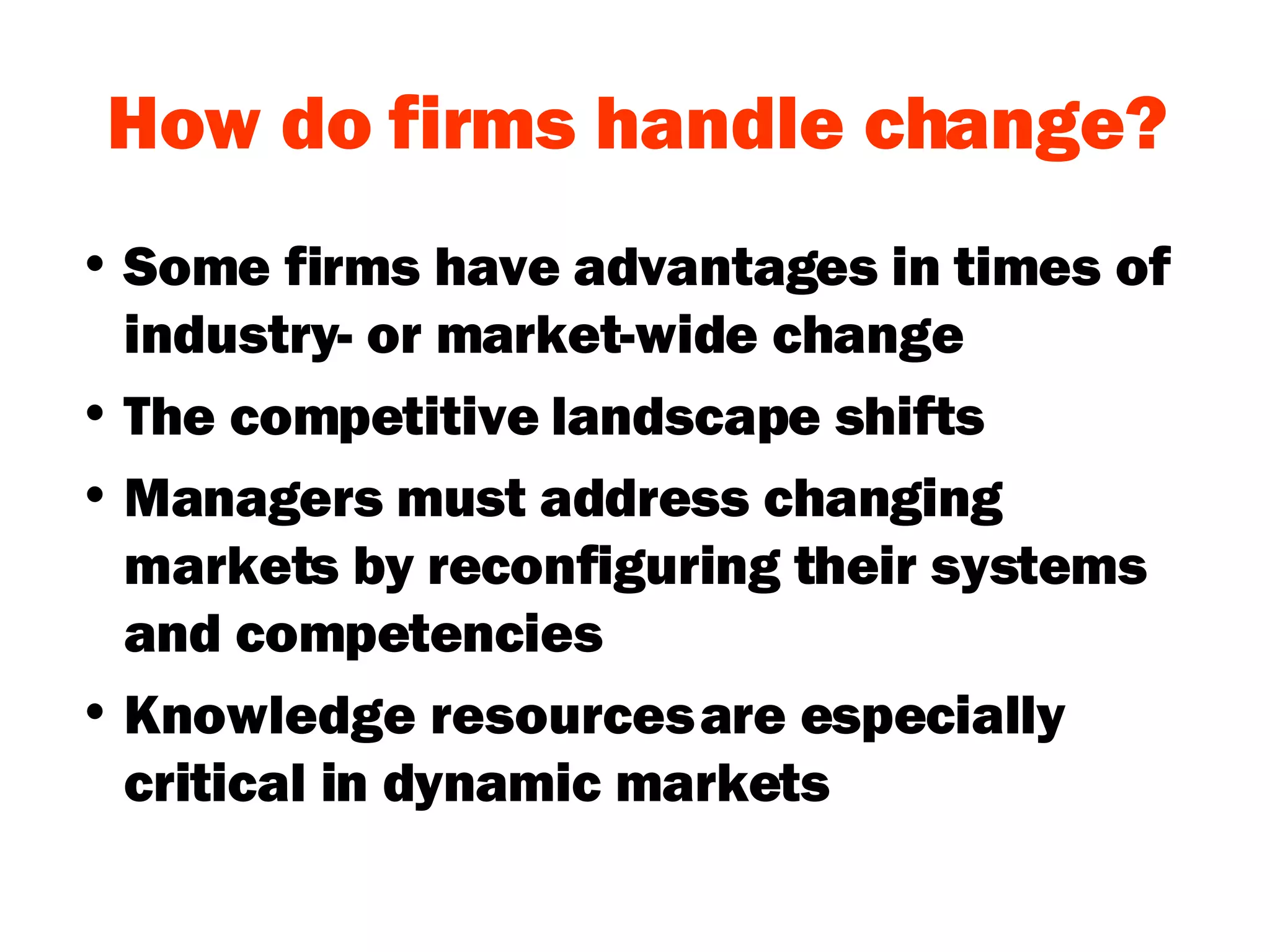
How do firmshandle change? Some firms have advantages in times of industry- or market-wide change The competitive landscape shifts Managers must address changing markets by reconfiguring their systems and competencies Knowledge resources are especially critical in dynamic markets
5.
Types of DynamicCapabilities A dynamic capability lets a firm arrange and develop its resources to create new value Product Development Alliance-Building Strategic Decisionmaking “ Rock-star” Cool -> Hiring Advantage -> PR Hype These capabilities are common across successful firms in varied industries Learning mechanisms help firms evolve and improve their dynamic capabilities over time
6.
Market Dynamism Ifthere is change but the industry’s fundamental structure stays stable: Dynamic Capabilities can be routinized Complicated, detailed, analytic processes Existing knowledge; linear execution Predictable outcomes If industry structure is BLURRING: Dynamic Capabilities are unstable, creative, experiential processes Adaptive, unpredictable outcomes
7.
Two RBV LogicsTwo main ways that firms can shore up their competitive advantages: The Logic Of Leverage Enhance existing resource configurations The Logic Of Opportunity Pursue temporary advantage Flexibility in reconfiguring resources
8.
Some Resource TypesPhysical Resources specialized equipment geographical location Human Resources expertise in critical topics network effects and fan bases lots of yummy options for new hires Organizational Resources a superior sales force
9.
Dynamic Capabilities AndResource Optimization Dynamic Capabilities help managers alter the Resource Base to create value acquire and shed resources integrate disparate resources recombine resources in new ways generate new value-creation strategies create new Competitive Advantages relative to competition or substitutes create new barriers to entry mirror the dynamism of markets as they evolve
10.
Recombining Resources ProductDevelopment Cross-functional teams and management Create new services from combining classic services in new ways Get the community to help you develop it Strategic Decisionmaking Managers pool their expertise Choices are made and execution planned These choices shape future choices
11.
Reconfiguring Resources Knowledge-basedResources Transferring knowledge internally Replicating processes and best practices Altering the corporate culture Using energy or leftover ideas from current or previous projects to fuel the future Blatant copying of the competition Human Resources Reconnect webs of collaboration across various parts of the firm to make synergy Harness productivity of other stakeholders (customers, employees’ families, government)
12.
Knowledge Creation Howdo managers and others create and spread new ways of thinking within the firm to spark change? Cutting-edge knowledge is essential Alliance and acquisition can bring new resources into the firm Exit routines for resources that are unnecessary for value creation
13.
Superior Performance Whydo some firms outperform others? First step of analysis: OBSERVATION What is the measure of the firm’s success? Second step: ATTRIBUTION What are the unique resources the firm has that generate its relative success? Third step: ANALYSIS What path did the firm take that let it develop these resources?
14.
“ BEST PRACTICES”There are archetypal frameworks for dynamic capabilities across firms For instance, no matter what the industry, it pays to invest in intellectual property and to build barriers to entry Another example: cross-functional teams for product development Also: increase access to information Finally: R&D staff with external linkages
15.
Equifinality: ManyRoads To Greatness There are many paths to the same Best Practices and Dynamic Capabilities. Firms begin with different initial conditions and predispositions for adoption of Dynamic Capabilities Firms take different adoption paths Dynamic Capabilities can be transferred between industries by analogy
16.
High-Velocity Markets Existingknowledge may be an obstacle if managers overgeneralize from past experience rather than being creative Impossible to specify future outcomes Successful business models are unclear and industry structure is blurred Dynamic Capabilities are SIMPLE so managers can stay broadly focused
17.
Boundary Conditions Managersare given great autonomy but are encouraged to execute within boundaries Google management can make non-exclusive alliances with almost any FREE service This lets them create new offerings and opportunities based on the creativity of product developers at a variety of firms Flexible resource allocation to adjust for temporary conditions and create cumulative short-term advantages
18.
Product Development ProcessSuccessful Practices: Limited routines for priority setting A business vision that sets possiblity boundaries so mgmt stays focused Creation of situation-specific knowledge enables re-use of knowledge if situation recurs Prototyping, early testing, feedback cycle rapid learning through small losses cycle through improvement process (iterative)
19.
Inputs To DynamicCapabilities Real-time information Flexibility to alter actions or strategy Partial implementation of multiple options Provides fallback positions in case the situation changes Intuition about the marketplace Emotional ability to cope with uncertainty and risk
20.
Creating Multiple AlternativesQuality strategic decisionmaking charts out various scenarios and determines optimal firm tactics for each Real-time information is critical as is experimentation and cross-functional teams Contrasts with analytical and sequential firm planning in lower-velocity markets More and earlier testing & prototypes create alternative development paths
21.
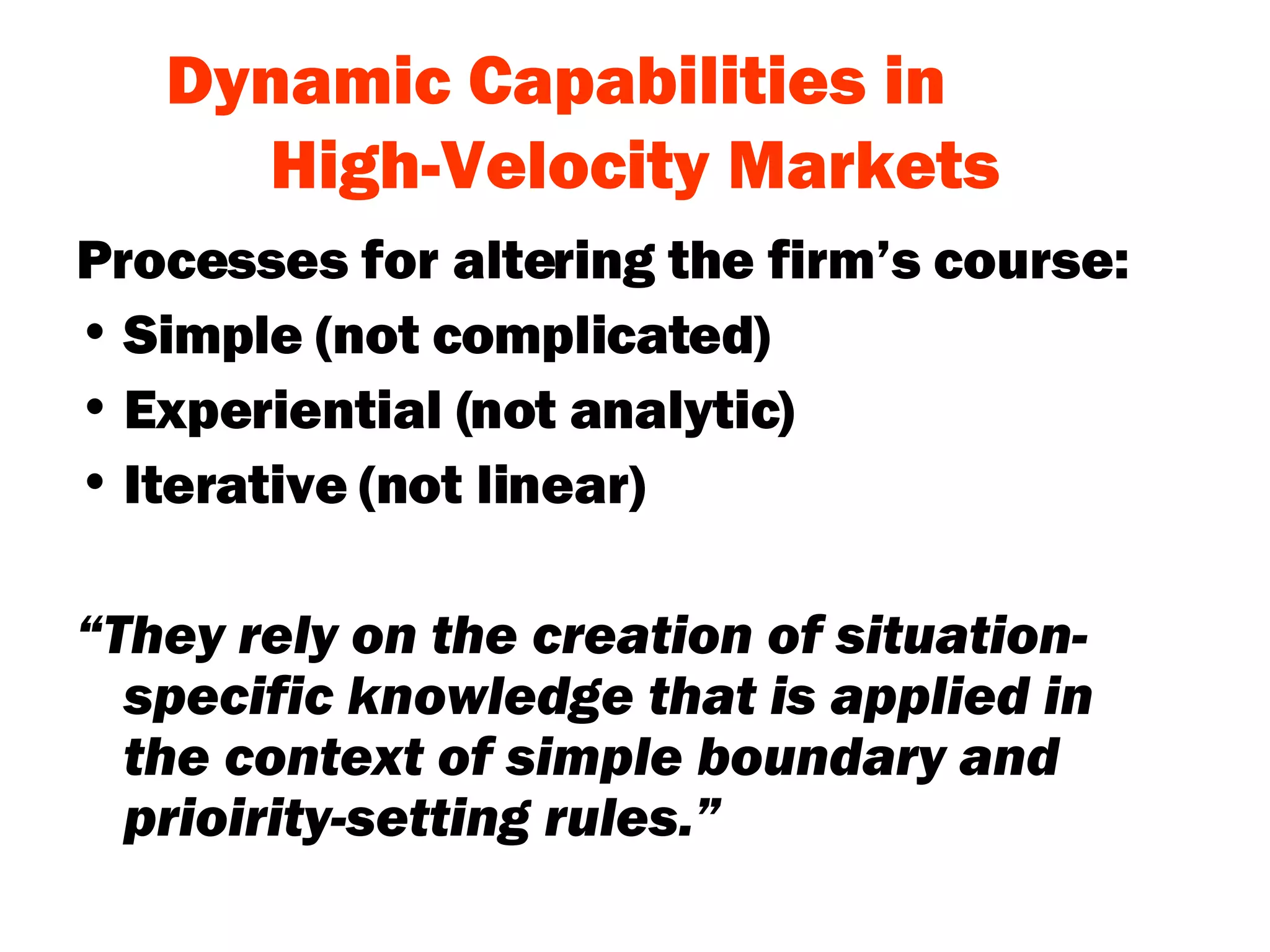
Dynamic Capabilities in High-Velocity Markets Processes for altering the firm’s course: Simple (not complicated) Experiential (not analytic) Iterative (not linear) “ They rely on the creation of situation-specific knowledge that is applied in the context of simple boundary and prioirity-setting rules.”
22.
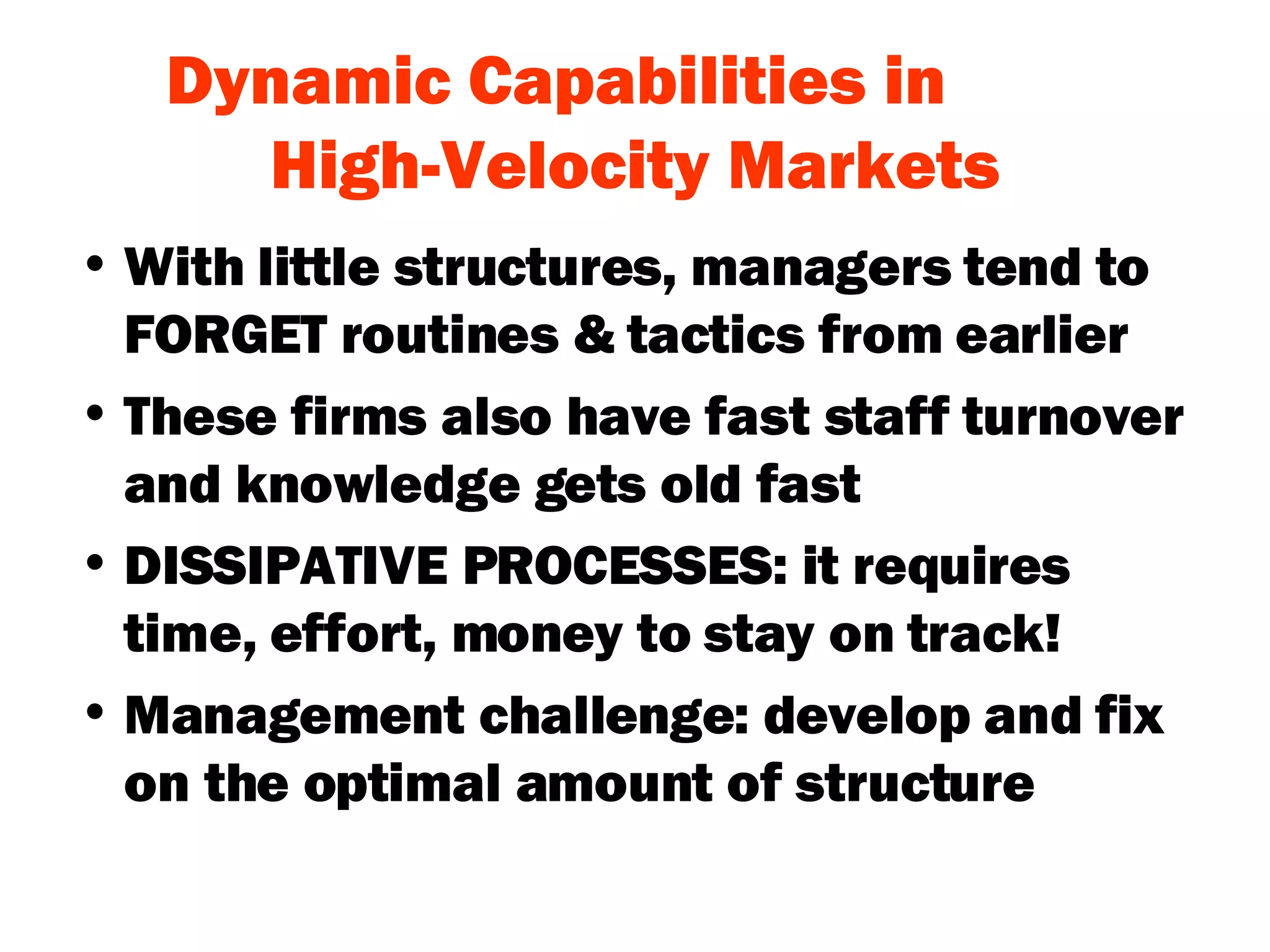
Dynamic Capabilities in High-Velocity Markets With little structures, managers tend to FORGET routines & tactics from earlier These firms also have fast staff turnover and knowledge gets old fast DISSIPATIVE PROCESSES: it requires time, effort, money to stay on track! Management challenge: develop and fix on the optimal amount of structure
23.
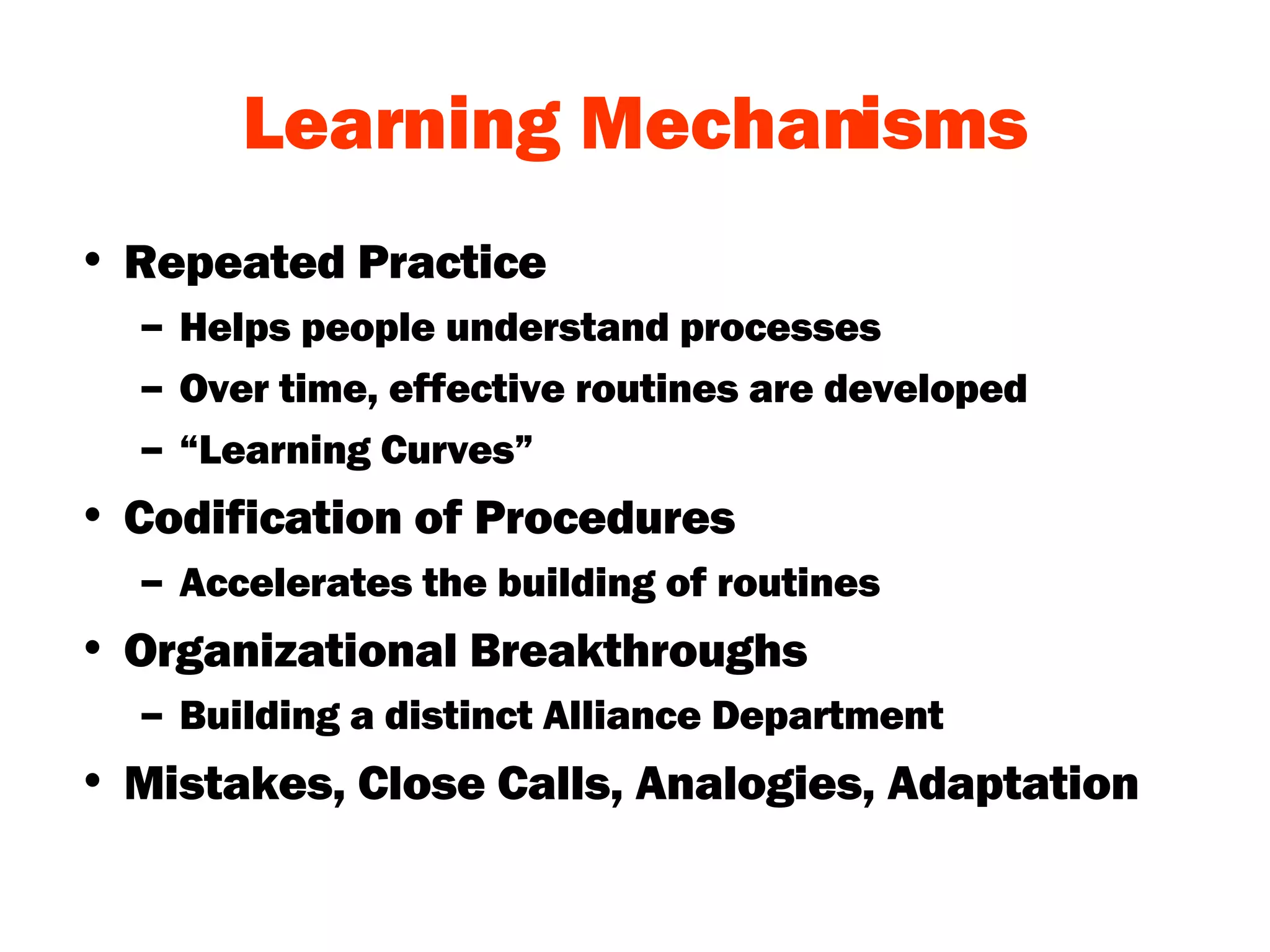
Learning Mechanisms RepeatedPractice Helps people understand processes Over time, effective routines are developed “ Learning Curves” Codification of Procedures Accelerates the building of routines Organizational Breakthroughs Building a distinct Alliance Department Mistakes, Close Calls, Analogies, Adaptation
24.
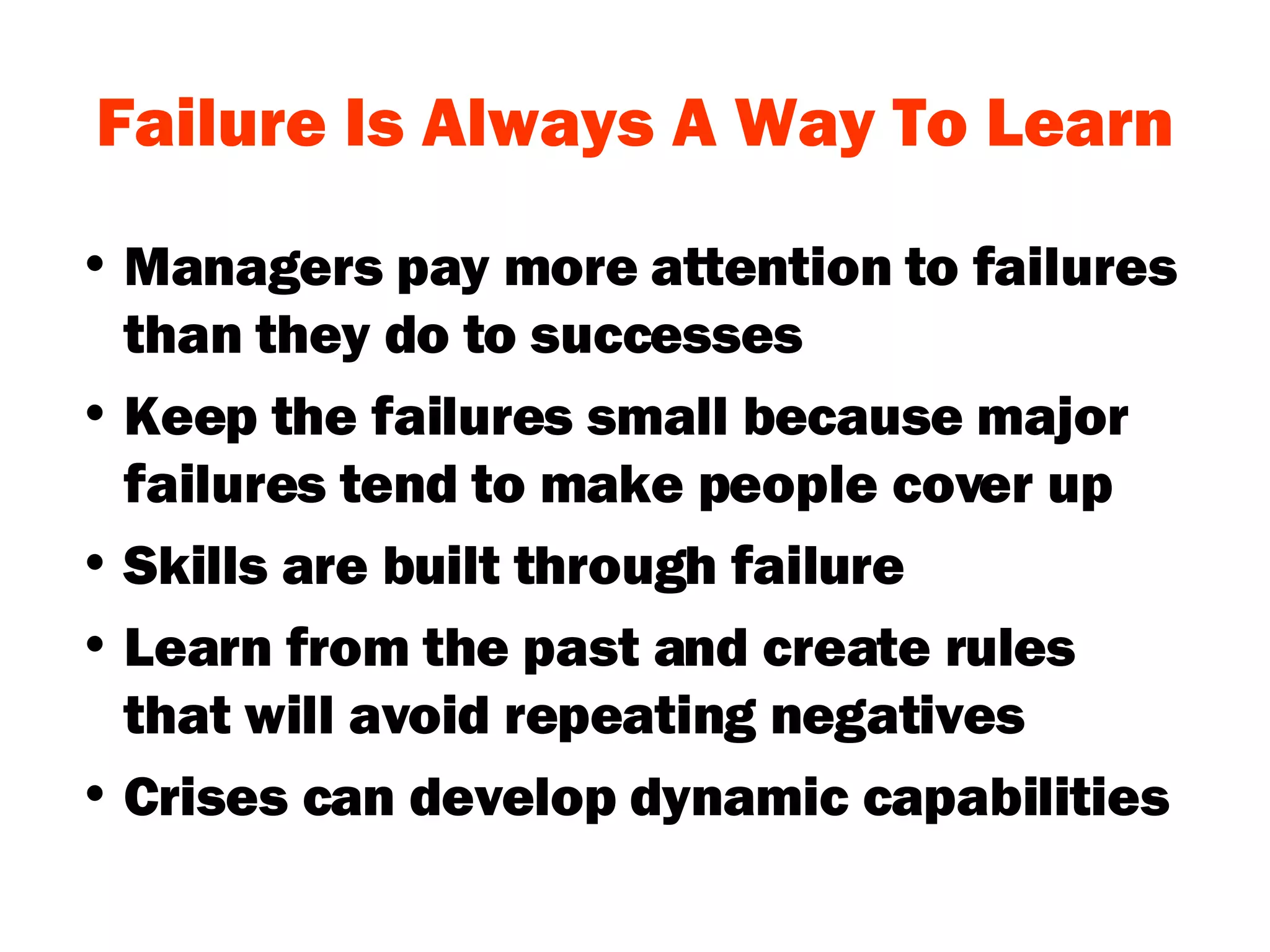
Failure Is AlwaysA Way To Learn Managers pay more attention to failures than they do to successes Keep the failures small because major failures tend to make people cover up Skills are built through failure Learn from the past and create rules that will avoid repeating negatives Crises can develop dynamic capabilities
25.
The Pacing OfExperience Experience must be transformed into learning but lessons must be absorbed Experience that comes too fast can be overwhelming for managers If there isn’t enough experience, then managers may forget it Knowledge accumulates over time, but so do unaddressed deficits
26.
The Pacing OfExperience Experience in similar or analogous situations can be very helpful Frequent, small variations in responsibility can keep management sharp and deepen their capacities The goal: efficient, robust creative routines that can help management lead the ship even through turbulence
27.
The Pacing OfExperience “ Managers with extensive experience were able to discern similarities and differences between current and previous acquisitions, and so apply their acquisition skills in a more discriminatory manner that was associated with superior performance.” Which experiences should be canonized and which ones are best forgotten?
28.
Dynamic Capability DevelopmentDynamic Capabilities are often combinations of simpler capabilities These simpler capabilities must be learned first and then combined For instance, the Dynamic Capability of Multiple Product Development involves: Single Product Development capability Probing The Future capability Linking Routines between each project
29.
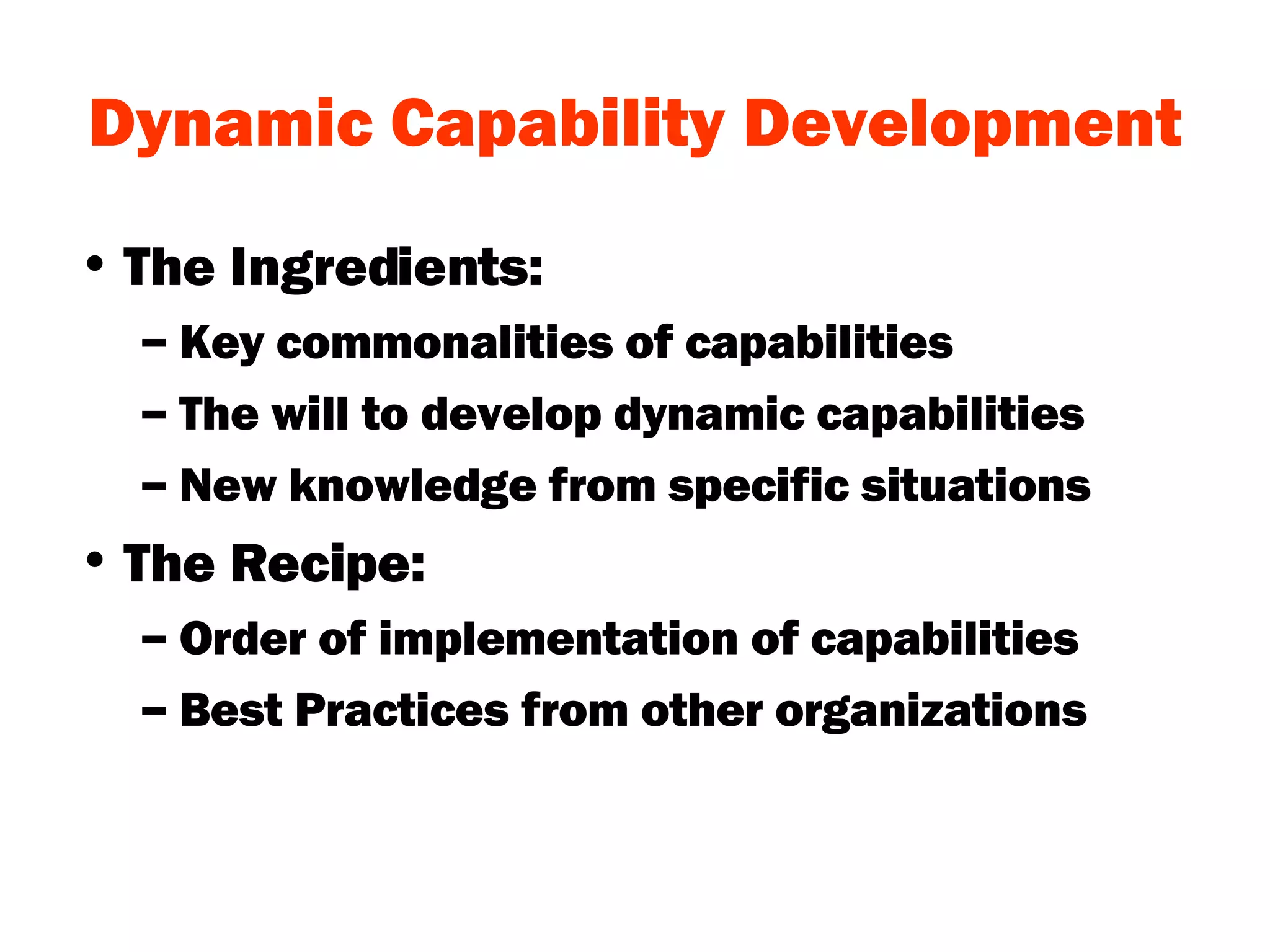
Dynamic Capability DevelopmentThe Ingredients: Key commonalities of capabilities The will to develop dynamic capabilities New knowledge from specific situations The Recipe: Order of implementation of capabilities Best Practices from other organizations
30.
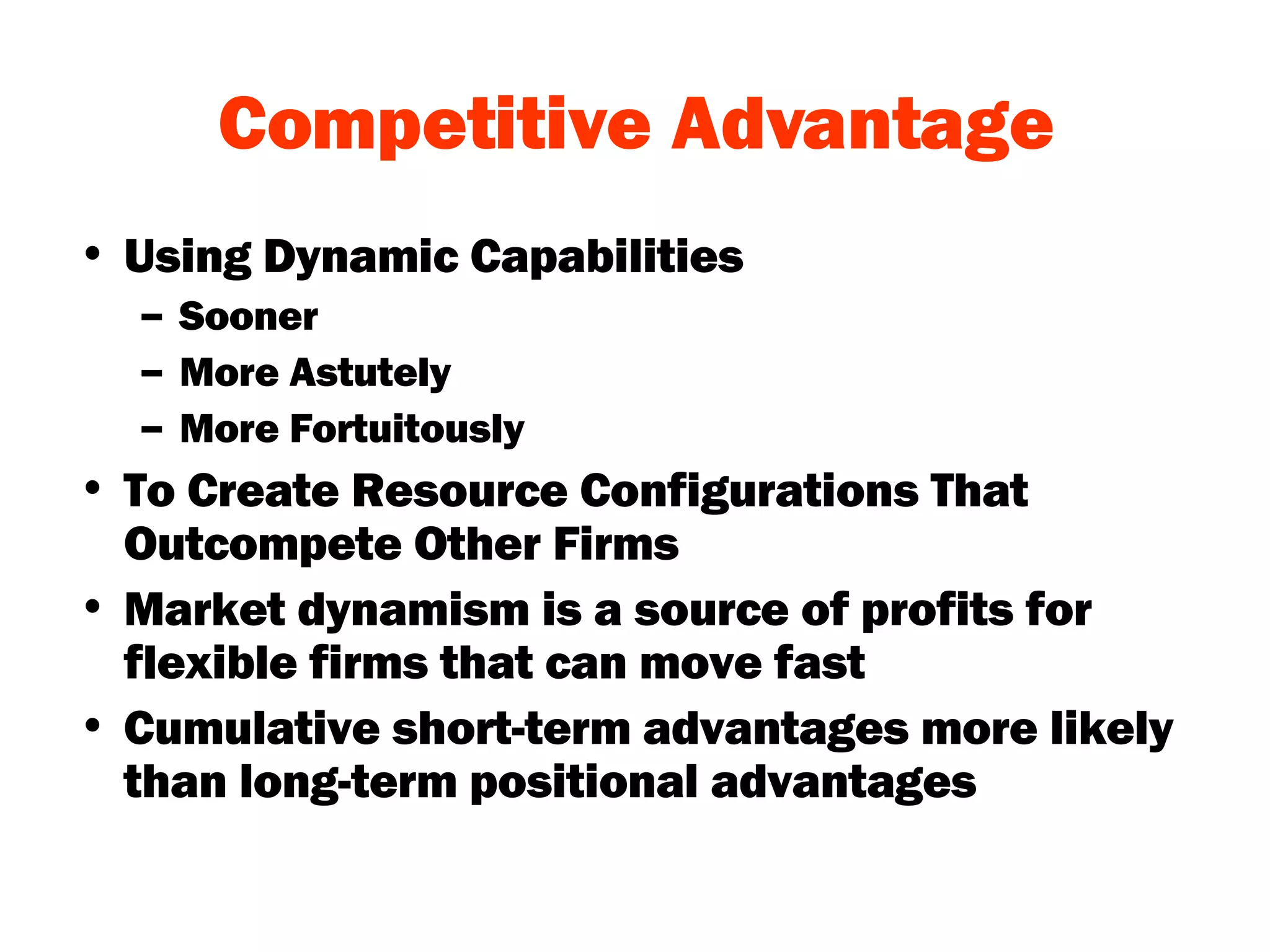
Competitive Advantage UsingDynamic Capabilities Sooner More Astutely More Fortuitously To Create Resource Configurations That Outcompete Other Firms Market dynamism is a source of profits for flexible firms that can move fast Cumulative short-term advantages more likely than long-term positional advantages