Jon C. Stuart
CEO, Big Guy,
Head Honcho,
Benevolent &
All Knowing
Exalted Ruler
theNMB Inc
If we don’t
know we
make it up.
What do You Know
About Your Competition
Industry and
Competitor
Analysis
Bruce R. Barringer
R. Duane Ireland
Chapter
5
What is Industry Analysis?
• Industry
• A group of firms producing a
similar product or service, such as
airlines, fitness drinks, furniture, or
electronic games.
• Industry Analysis
• Business research that focuses on
the potential of an industry.
• In-depth detail understanding
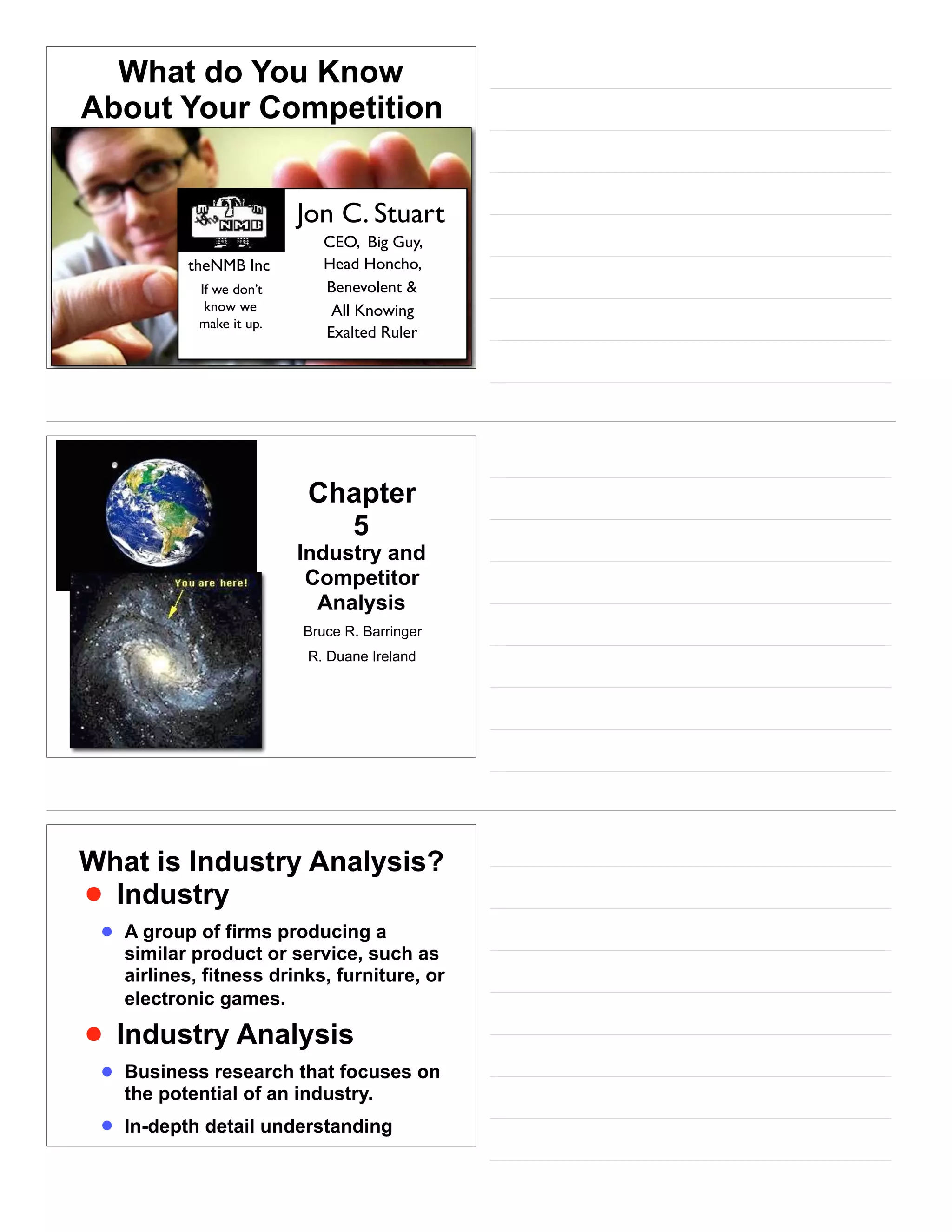
• Economic
• Social
• Technological
• Political
• Legal &
Regulatory
• International
• Profit margins
• Innovation
accelerating
or waning
• Input costs
rising or
falling?
Environmental
Trends
Business
Trends
Study Environmental
& Business Trends
Is it an
accessible
Industry that
is realistic
for a new
venture to
enter?
Question 1
Are there
potential
positions in the
industry that
avoid some of
the negative
attributes of the
industry as a
whole?
Question 3
Does it have
markets that
are ripe for
innovation
and are there
underserved
market(s)?
Question 2
Key Questions
•Threat of new entrants
•Rivalry among existing
firms
•Bargaining power of
buyers
•Other related factors
Industry Level Factors
• Assets
• Products
• Culture
• Employee teamwork
• Reputation
• Other resource
Firm Level Factors
How Industry &
Firm-Level Factors Affect Performance
In various studies, researchers have found
that from 8% to 30% of the variation in firm
profitability is directly attributable to the
industry in which a firm competes.
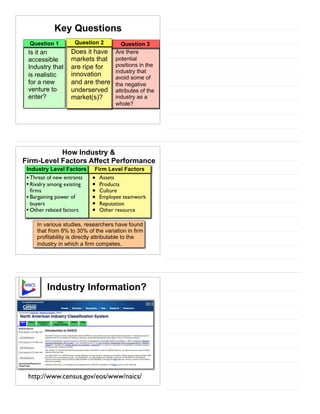
http://www.census.gov/eos/www/naics/
Industry Information?
Study
Environmental
& Business
Trends
Michael
Porter’s Five
Forces
Competitive
Model
Techniques Available
to Assess Industry Attractiveness
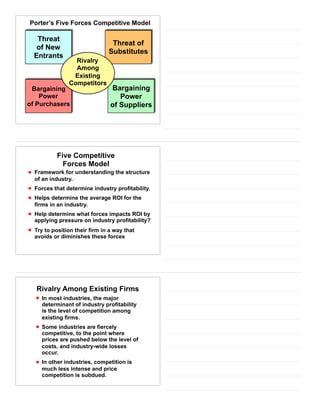
Threat of
Substitutes
Threat
of New
Entrants
Bargaining
Power
of Purchasers
Bargaining
Power
of Suppliers
Porter’s Five Forces Competitive Model
Rivalry
Among
Existing
Competitors
Five Competitive
Forces Model
• Framework for understanding the structure
of an industry.
• Forces that determine industry profitability.
• Helps determine the average ROI for the
firms in an industry.
• Help determine what forces impacts ROI by
applying pressure on industry profitability?
• Try to position their firm in a way that
avoids or diminishes these forces
Rivalry Among Existing Firms
• In most industries, the major
determinant of industry profitability
is the level of competition among
existing firms.
• Some industries are fiercely
competitive, to the point where
prices are pushed below the level of
costs, and industry-wide losses
occur.
• In other industries, competition is
much less intense and price
competition is subdued.
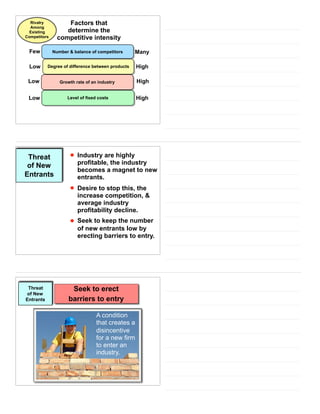
Factors that
determine the
competitive intensity
Rivalry
Among
Existing
Competitors
Degree of difference between products HighLow
Growth rate of an industry HighLow
Level of fixed costs HighLow
Number & balance of competitors ManyFew
• Industry are highly
profitable, the industry
becomes a magnet to new
entrants.
• Desire to stop this, the
increase competition, &
average industry
profitability decline.
• Seek to keep the number
of new entrants low by
erecting barriers to entry.
Threat
of New
Entrants
Threat
of New
Entrants
A condition
that creates a
disincentive
for a new firm
to enter an
industry.
Seek to erect
barriers to entry
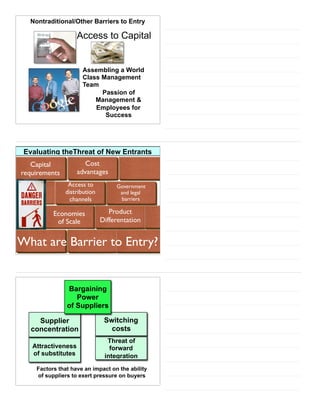
Nontraditional/Other Barriers to Entry
Access to Capital
Assembling a World
Class Management
Team
Passion of
Management &
Employees for
Success
Economies
of Scale
Capital
requirements
Government
and legal
barriers
Access to
distribution
channels
Cost
advantages
Product
Differentation
What are Barrier to Entry?
Evaluating theThreat of New Entrants
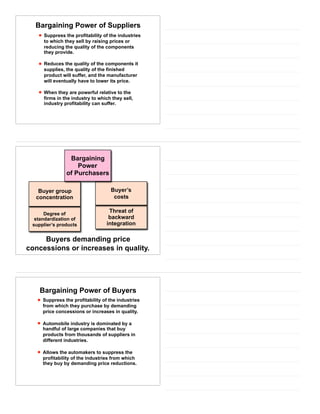
Factors that have an impact on the ability
of suppliers to exert pressure on buyers
Attractiveness
of substitutes
Threat of
forward
integration
Supplier
concentration
Switching
costs
Bargaining
Power
of Suppliers
Bargaining Power of Suppliers
• Suppress the profitability of the industries
to which they sell by raising prices or
reducing the quality of the components
they provide.
• Reduces the quality of the components it
supplies, the quality of the finished
product will suffer, and the manufacturer
will eventually have to lower its price.
• When they are powerful relative to the
firms in the industry to which they sell,
industry profitability can suffer.
Degree of
standardization of
supplier’s products
Threat of
backward
integration
Buyer group
concentration
Buyer’s
costs
Bargaining
Power
of Purchasers
Buyers demanding price
concessions or increases in quality.
Bargaining Power of Buyers
• Suppress the profitability of the industries
from which they purchase by demanding
price concessions or increases in quality.
• Automobile industry is dominated by a
handful of large companies that buy
products from thousands of suppliers in
different industries.
• Allows the automakers to suppress the
profitability of the industries from which
they buy by demanding price reductions.
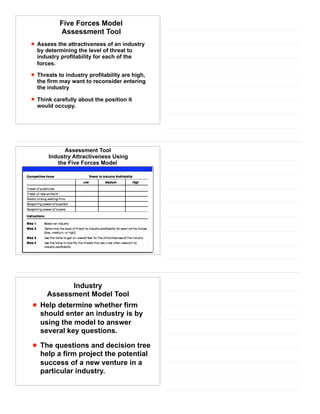
Five Forces Model
Assessment Tool
• Assess the attractiveness of an industry
by determining the level of threat to
industry profitability for each of the
forces.
• Threats to industry profitability are high,
the firm may want to reconsider entering
the industry
• Think carefully about the position it
would occupy.
Assessment Tool
Industry Attractiveness Using
the Five Forces Model
Industry
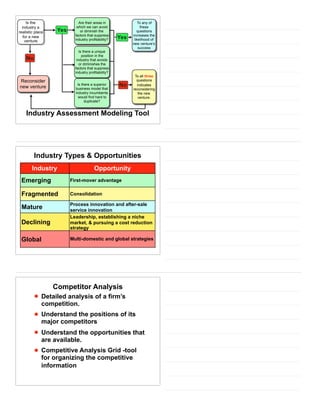
Assessment Model Tool
• Help determine whether firm
should enter an industry is by
using the model to answer
several key questions.
• The questions and decision tree
help a firm project the potential
success of a new venture in a
particular industry.
To any of
these
questions
increases the
likelihood of
new venture’s
success
Yes
No
Are their areas in
which we can avoid
or diminish the
factors that suppress
industry profitability?
Is there a unique
position in the
industry that avoids
or diminishes the
factors that suppress
industry profitability?
Is there a superior
business model that
industry incumbents
would find hard to
duplicate?
Reconsider
new venture
No
Is the
industry a
realistic place
for a new
venture
Industry Assessment Modeling Tool

Yes
To all three
questions
indicates
reconsidering
the new
venture.
Industry Opportunity
Emerging First-mover advantage
Fragmented Consolidation
Mature Process innovation and after-sale
service innovation
Declining
Leadership, establishing a niche
market, & pursuing a cost reduction
strategy
Global Multi-domestic and global strategies
Industry Types & Opportunities
Competitor Analysis
• Detailed analysis of a firm’s
competition.
• Understand the positions of its
major competitors
• Understand the opportunities that
are available.
• Competitive Analysis Grid -tool
for organizing the competitive
information
Business
offering the
same or
similar
products/
services
Businesses
that do not
currently offer
competitive
products/
service but
could in the
future.
Businesses
that offer
products/
services that
are
considered
close
substitutes
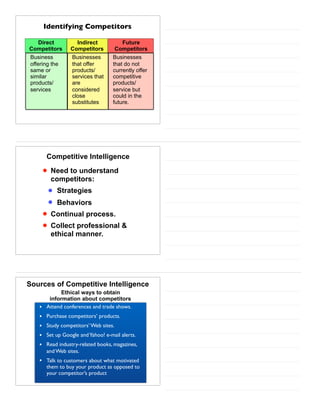
Direct
Competitors
Future
Competitors
Indirect
Competitors
Identifying Competitors
Competitive Intelligence
• Need to understand
competitors:
• Strategies
• Behaviors
• Continual process.
• Collect professional &
ethical manner.
• Attend conferences and trade shows.
• Purchase competitors’ products.
• Study competitors’ Web sites.
• Set up Google andYahoo! e-mail alerts.
• Read industry-related books, magazines,
and Web sites.
• Talk to customers about what motivated
them to buy your product as opposed to
your competitor’s product
Ethical ways to obtain
information about competitors
Sources of Competitive Intelligence
• See how it stacks up
against its competitors.
• Provide ideas for markets
to pursue.
• Identify its primary sources
of competitive advantage.
Tool for organizing the
information a firm collects
about its competitors.
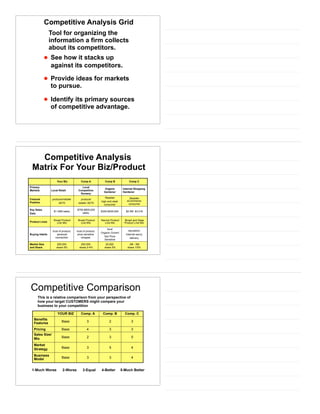
Competitive Analysis Grid
Competitive Analysis
Matrix For Your Biz/Product
Your Biz Comp A Comp B Comp C
Primary
Markets Local Retail
Local
Competitive
Nursery
Organic
Gardener
Internet Shopping
Gardener
Channel
Position
producer/retailer
30/70
produce/
retailer 30/70
Reseller
high end retail
consumer
Reseller
eCommerce
consumer
Key Sales
Data
$1-30M sales;
$750-$800,000
sales;
$350-$400,000 $2.5M- $3.0 M
Product Lines
Broad Product
Line Mix
Broad Product
Line Mix
Narrow Product
Line Mix
Broad and Deep
Product Line Mix
Buying Habits
trust of product;
personal
connection
trust of product;
price sensitive
shopper
local
Organic Grown/
Not Price
Sensitive
reputation;
Internet savvy
delivery
Market Size
and Share
200,000
share 5%
200,000
share 2-4%
20,000
share 5%
2M - 5M
share 1/5%
Competitive Comparison
YOUR BIZ Comp. A Comp. B Comp. C
Benefits
Features Base 3 2 3
Pricing Base 4 3 3
Sales Size/
Mix Base 2 3 5
Market
Strategy Base 3 5 4
Business
Model Base 3 3 4
This is a relative comparison from your perspective of
how your target CUSTOMERS might compare your
business to your competition
1-Much Worse 2-Worse 3-Equal 4-Better 5-Much Better
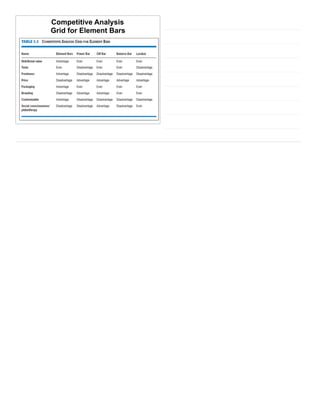
Competitive Analysis
Grid for Element Bars

Lect ch 05

  • 1.
    Jon C. Stuart CEO,Big Guy, Head Honcho, Benevolent & All Knowing Exalted Ruler theNMB Inc If we don’t know we make it up. What do You Know About Your Competition Industry and Competitor Analysis Bruce R. Barringer R. Duane Ireland Chapter 5 What is Industry Analysis? • Industry • A group of firms producing a similar product or service, such as airlines, fitness drinks, furniture, or electronic games. • Industry Analysis • Business research that focuses on the potential of an industry. • In-depth detail understanding
  • 2.
    • Economic • Social •Technological • Political • Legal & Regulatory • International • Profit margins • Innovation accelerating or waning • Input costs rising or falling? Environmental Trends Business Trends Study Environmental & Business Trends
  • 3.
    Is it an accessible Industrythat is realistic for a new venture to enter? Question 1 Are there potential positions in the industry that avoid some of the negative attributes of the industry as a whole? Question 3 Does it have markets that are ripe for innovation and are there underserved market(s)? Question 2 Key Questions •Threat of new entrants •Rivalry among existing firms •Bargaining power of buyers •Other related factors Industry Level Factors • Assets • Products • Culture • Employee teamwork • Reputation • Other resource Firm Level Factors How Industry & Firm-Level Factors Affect Performance In various studies, researchers have found that from 8% to 30% of the variation in firm profitability is directly attributable to the industry in which a firm competes. http://www.census.gov/eos/www/naics/ Industry Information?
  • 4.
  • 5.
    Threat of Substitutes Threat of New Entrants Bargaining Power ofPurchasers Bargaining Power of Suppliers Porter’s Five Forces Competitive Model Rivalry Among Existing Competitors Five Competitive Forces Model • Framework for understanding the structure of an industry. • Forces that determine industry profitability. • Helps determine the average ROI for the firms in an industry. • Help determine what forces impacts ROI by applying pressure on industry profitability? • Try to position their firm in a way that avoids or diminishes these forces Rivalry Among Existing Firms • In most industries, the major determinant of industry profitability is the level of competition among existing firms. • Some industries are fiercely competitive, to the point where prices are pushed below the level of costs, and industry-wide losses occur. • In other industries, competition is much less intense and price competition is subdued.
  • 6.
    Factors that determine the competitiveintensity Rivalry Among Existing Competitors Degree of difference between products HighLow Growth rate of an industry HighLow Level of fixed costs HighLow Number & balance of competitors ManyFew • Industry are highly profitable, the industry becomes a magnet to new entrants. • Desire to stop this, the increase competition, & average industry profitability decline. • Seek to keep the number of new entrants low by erecting barriers to entry. Threat of New Entrants Threat of New Entrants A condition that creates a disincentive for a new firm to enter an industry. Seek to erect barriers to entry
  • 7.
    Nontraditional/Other Barriers toEntry Access to Capital Assembling a World Class Management Team Passion of Management & Employees for Success Economies of Scale Capital requirements Government and legal barriers Access to distribution channels Cost advantages Product Differentation What are Barrier to Entry? Evaluating theThreat of New Entrants Factors that have an impact on the ability of suppliers to exert pressure on buyers Attractiveness of substitutes Threat of forward integration Supplier concentration Switching costs Bargaining Power of Suppliers
  • 8.
    Bargaining Power ofSuppliers • Suppress the profitability of the industries to which they sell by raising prices or reducing the quality of the components they provide. • Reduces the quality of the components it supplies, the quality of the finished product will suffer, and the manufacturer will eventually have to lower its price. • When they are powerful relative to the firms in the industry to which they sell, industry profitability can suffer. Degree of standardization of supplier’s products Threat of backward integration Buyer group concentration Buyer’s costs Bargaining Power of Purchasers Buyers demanding price concessions or increases in quality. Bargaining Power of Buyers • Suppress the profitability of the industries from which they purchase by demanding price concessions or increases in quality. • Automobile industry is dominated by a handful of large companies that buy products from thousands of suppliers in different industries. • Allows the automakers to suppress the profitability of the industries from which they buy by demanding price reductions.
  • 9.
    Five Forces Model AssessmentTool • Assess the attractiveness of an industry by determining the level of threat to industry profitability for each of the forces. • Threats to industry profitability are high, the firm may want to reconsider entering the industry • Think carefully about the position it would occupy. Assessment Tool Industry Attractiveness Using the Five Forces Model Industry Assessment Model Tool • Help determine whether firm should enter an industry is by using the model to answer several key questions. • The questions and decision tree help a firm project the potential success of a new venture in a particular industry.
  • 10.
    To any of these questions increasesthe likelihood of new venture’s success Yes No Are their areas in which we can avoid or diminish the factors that suppress industry profitability? Is there a unique position in the industry that avoids or diminishes the factors that suppress industry profitability? Is there a superior business model that industry incumbents would find hard to duplicate? Reconsider new venture No Is the industry a realistic place for a new venture Industry Assessment Modeling Tool
 Yes To all three questions indicates reconsidering the new venture. Industry Opportunity Emerging First-mover advantage Fragmented Consolidation Mature Process innovation and after-sale service innovation Declining Leadership, establishing a niche market, & pursuing a cost reduction strategy Global Multi-domestic and global strategies Industry Types & Opportunities Competitor Analysis • Detailed analysis of a firm’s competition. • Understand the positions of its major competitors • Understand the opportunities that are available. • Competitive Analysis Grid -tool for organizing the competitive information
  • 11.
    Business offering the same or similar products/ services Businesses thatdo not currently offer competitive products/ service but could in the future. Businesses that offer products/ services that are considered close substitutes Direct Competitors Future Competitors Indirect Competitors Identifying Competitors Competitive Intelligence • Need to understand competitors: • Strategies • Behaviors • Continual process. • Collect professional & ethical manner. • Attend conferences and trade shows. • Purchase competitors’ products. • Study competitors’ Web sites. • Set up Google andYahoo! e-mail alerts. • Read industry-related books, magazines, and Web sites. • Talk to customers about what motivated them to buy your product as opposed to your competitor’s product Ethical ways to obtain information about competitors Sources of Competitive Intelligence
  • 12.
    • See howit stacks up against its competitors. • Provide ideas for markets to pursue. • Identify its primary sources of competitive advantage. Tool for organizing the information a firm collects about its competitors. Competitive Analysis Grid Competitive Analysis Matrix For Your Biz/Product Your Biz Comp A Comp B Comp C Primary Markets Local Retail Local Competitive Nursery Organic Gardener Internet Shopping Gardener Channel Position producer/retailer 30/70 produce/ retailer 30/70 Reseller high end retail consumer Reseller eCommerce consumer Key Sales Data $1-30M sales; $750-$800,000 sales; $350-$400,000 $2.5M- $3.0 M Product Lines Broad Product Line Mix Broad Product Line Mix Narrow Product Line Mix Broad and Deep Product Line Mix Buying Habits trust of product; personal connection trust of product; price sensitive shopper local Organic Grown/ Not Price Sensitive reputation; Internet savvy delivery Market Size and Share 200,000 share 5% 200,000 share 2-4% 20,000 share 5% 2M - 5M share 1/5% Competitive Comparison YOUR BIZ Comp. A Comp. B Comp. C Benefits Features Base 3 2 3 Pricing Base 4 3 3 Sales Size/ Mix Base 2 3 5 Market Strategy Base 3 5 4 Business Model Base 3 3 4 This is a relative comparison from your perspective of how your target CUSTOMERS might compare your business to your competition 1-Much Worse 2-Worse 3-Equal 4-Better 5-Much Better
  • 13.