Chapter 3
Strategic Planning in Retailing
RETAIL
MANAGEMENT:
A STRATEGIC
APPROACH,
9th Edition
BERMAN EVANS
3-2
Chapter Objectives
To show the value of strategic planning
for all types of retailers
To explain the steps in strategic
planning for retailers: situation analysis,
objectives, identification of consumers,
overall strategy, specific activities,
control, and feedback
3-3
Chapter Objectives_2
To examine the individual controllable
and uncontrollable elements of a retail
strategy
To present strategic planning as a series
of integrated steps
3-4
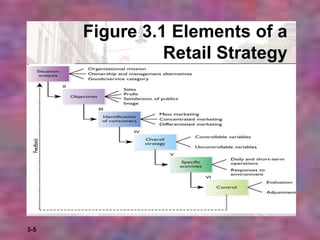
Retail Strategy
The overall plan or framework of action
that guides a retailer
One year in duration
Outlines mission, goals, consumer
market, overall and specific activities,
and control mechanisms
3-5
Figure 3.1 Elements of a
Retail Strategy
3-6
Benefits of Strategic Retail
Planning
Provides thorough analysis of the
requirements for doing business for different
types of retailers
Outlines retailer goals
Allows retailer to determine how to
differentiate itself from competitors
Allows retailer to develop an offering that
appeals to a group of customers
3-7
Benefits of Strategic Retail
Planning_2
Offers an analysis of the legal, economic,
and competitive environment
Provides for the coordination of the firm’s
total efforts
Encourages the anticipation and avoidance
of crises
3-8
Organizational Mission
Retailer’s commitment
to a type of business
and to a
distinctive role in the marketplace.
3-9
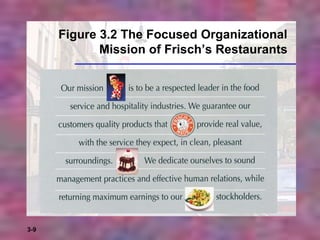
Figure 3.2 The Focused Organizational
Mission of Frisch’s Restaurants
3-10
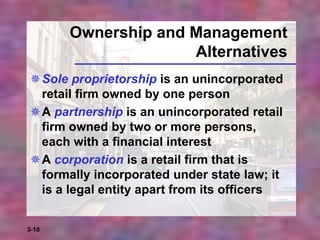
Ownership and Management
Alternatives
Sole proprietorship is an unincorporated
retail firm owned by one person
A partnership is an unincorporated retail
firm owned by two or more persons,
each with a financial interest
A corporation is a retail firm that is
formally incorporated under state law; it
is a legal entity apart from its officers
3-11
Figure 3.3
Checklist to
Consider When
Starting a New
Business
3-12
Figure 3.4
Checklist for
Purchasing an
Existing Retail
Business
3-13
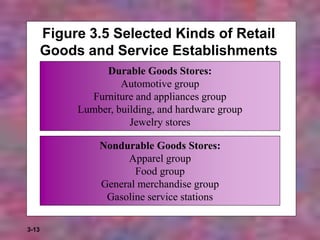
Figure 3.5 Selected Kinds of Retail
Goods and Service Establishments
Durable Goods Stores:
Automotive group
Furniture and appliances group
Lumber, building, and hardware group
Jewelry stores
Nondurable Goods Stores:
Apparel group
Food group
General merchandise group
Gasoline service stations
3-14
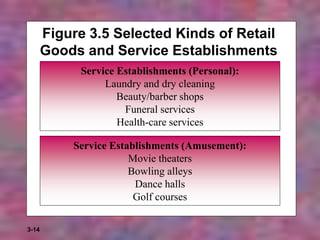
Figure 3.5 Selected Kinds of Retail
Goods and Service Establishments
Service Establishments (Personal):
Laundry and dry cleaning
Beauty/barber shops
Funeral services
Health-care services
Service Establishments (Amusement):
Movie theaters
Bowling alleys
Dance halls
Golf courses
3-15
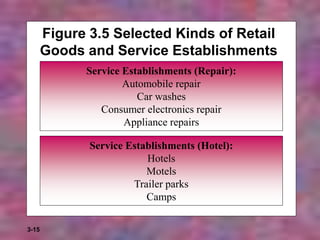
Figure 3.5 Selected Kinds of Retail
Goods and Service Establishments
Service Establishments (Repair):
Automobile repair
Car washes
Consumer electronics repair
Appliance repairs
Service Establishments (Hotel):
Hotels
Motels
Trailer parks
Camps
3-16
Kroger’s Goals
Increase its identical food store sales growth
target
Reduce operating and administrative costs by
more than $500 million
Further leverage its size to achieve even
greater economies of scale
Reinvest in its core business to increase sales
and market share
3-17
Image and Positioning
An image represents
how a given retailer is
perceived
by consumers and others.
3-18
Positioning Approaches
Mass merchandising is a positioning
approach whereby retailers offer a discount
or value-oriented image, a wide or deep
merchandise selection, and large store
facilities
Niche retailing occurs when retailers identify
specific customer segments and deploy
unique strategies to address the desires of
those segments rather than the mass market
3-19
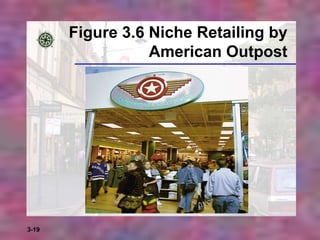
Figure 3.6 Niche Retailing by
American Outpost
3-20
Figure 3.7 Selected Retail
Positioning Strategies
3-21
Target Market Selection
• Three techniques
Mass marketing
Concentrated marketing
Differentiated marketing
3-22
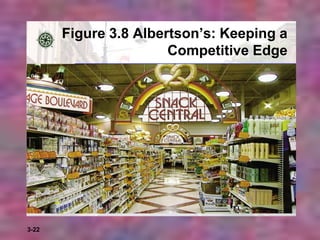
Figure 3.8 Albertson’s: Keeping a
Competitive Edge
3-23
Strategic Implications of Target
Market Techniques
Retailer’s location
Goods and service mix
Promotion efforts
Price orientation
Strategy
3-24
Figure 3.9 Developing an Overall
Retail Strategy
Controllable
Variables:
•Store location
•Managing business
•Merchandise
management
and pricing
•Communicating
with customer
Uncontrollable
Variables:
•Consumers
•Competition
•Technology
•Economic
conditions
•Seasonality
•Legal restrictions
Retail
Strategy
3-25
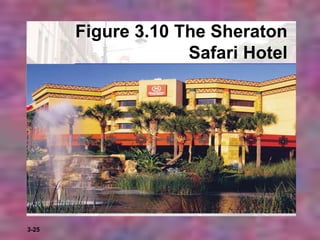
Figure 3.10 The Sheraton
Safari Hotel
3-26
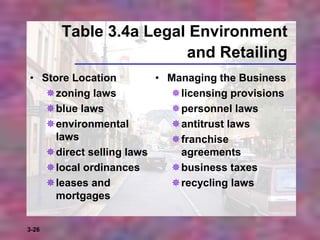
Table 3.4a Legal Environment
and Retailing
• Store Location
zoning laws
blue laws
environmental
laws
direct selling laws
local ordinances
leases and
mortgages
• Managing the Business
licensing provisions
personnel laws
antitrust laws
franchise
agreements
business taxes
recycling laws
3-27
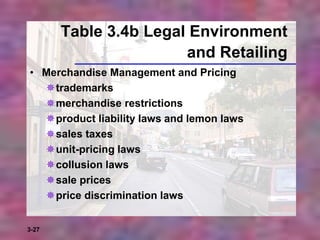
Table 3.4b Legal Environment
and Retailing
• Merchandise Management and Pricing
trademarks
merchandise restrictions
product liability laws and lemon laws
sales taxes
unit-pricing laws
collusion laws
sale prices
price discrimination laws
3-28
Table 3.4c Legal Environment
and Retailing
• Communicating with the Customer
truth-in-advertising and selling laws
truth-in-credit laws
telemarketing laws
bait-and-switch laws
inventory laws
labeling laws
cooling-off laws
3-29
Additional Concerns for
Global Retailing
In addition to the strategic planning process:
assess your international potential
get expert advice and counseling
select your countries
develop, implement, and review an
international retailing strategy
3-30
Factors Affecting the Success of a
Global Retailing Strategy
Timing
A balanced international program
A growing middle class
Matching concept to market
Solo or partnering
Store location and facilities
Product selection
3-31
Figure A3.1 Factors to Consider When
Engaging in Global Retailing

strategic plng (1).ppt

  • 1.
    Chapter 3 Strategic Planningin Retailing RETAIL MANAGEMENT: A STRATEGIC APPROACH, 9th Edition BERMAN EVANS
  • 2.
    3-2 Chapter Objectives To showthe value of strategic planning for all types of retailers To explain the steps in strategic planning for retailers: situation analysis, objectives, identification of consumers, overall strategy, specific activities, control, and feedback
  • 3.
    3-3 Chapter Objectives_2 To examinethe individual controllable and uncontrollable elements of a retail strategy To present strategic planning as a series of integrated steps
  • 4.
    3-4 Retail Strategy The overallplan or framework of action that guides a retailer One year in duration Outlines mission, goals, consumer market, overall and specific activities, and control mechanisms
  • 5.
    3-5 Figure 3.1 Elementsof a Retail Strategy
  • 6.
    3-6 Benefits of StrategicRetail Planning Provides thorough analysis of the requirements for doing business for different types of retailers Outlines retailer goals Allows retailer to determine how to differentiate itself from competitors Allows retailer to develop an offering that appeals to a group of customers
  • 7.
    3-7 Benefits of StrategicRetail Planning_2 Offers an analysis of the legal, economic, and competitive environment Provides for the coordination of the firm’s total efforts Encourages the anticipation and avoidance of crises
  • 8.
    3-8 Organizational Mission Retailer’s commitment toa type of business and to a distinctive role in the marketplace.
  • 9.
    3-9 Figure 3.2 TheFocused Organizational Mission of Frisch’s Restaurants
  • 10.
    3-10 Ownership and Management Alternatives Soleproprietorship is an unincorporated retail firm owned by one person A partnership is an unincorporated retail firm owned by two or more persons, each with a financial interest A corporation is a retail firm that is formally incorporated under state law; it is a legal entity apart from its officers
  • 11.
    3-11 Figure 3.3 Checklist to ConsiderWhen Starting a New Business
  • 12.
    3-12 Figure 3.4 Checklist for Purchasingan Existing Retail Business
  • 13.
    3-13 Figure 3.5 SelectedKinds of Retail Goods and Service Establishments Durable Goods Stores: Automotive group Furniture and appliances group Lumber, building, and hardware group Jewelry stores Nondurable Goods Stores: Apparel group Food group General merchandise group Gasoline service stations
  • 14.
    3-14 Figure 3.5 SelectedKinds of Retail Goods and Service Establishments Service Establishments (Personal): Laundry and dry cleaning Beauty/barber shops Funeral services Health-care services Service Establishments (Amusement): Movie theaters Bowling alleys Dance halls Golf courses
  • 15.
    3-15 Figure 3.5 SelectedKinds of Retail Goods and Service Establishments Service Establishments (Repair): Automobile repair Car washes Consumer electronics repair Appliance repairs Service Establishments (Hotel): Hotels Motels Trailer parks Camps
  • 16.
    3-16 Kroger’s Goals Increase itsidentical food store sales growth target Reduce operating and administrative costs by more than $500 million Further leverage its size to achieve even greater economies of scale Reinvest in its core business to increase sales and market share
  • 17.
    3-17 Image and Positioning Animage represents how a given retailer is perceived by consumers and others.
  • 18.
    3-18 Positioning Approaches Mass merchandisingis a positioning approach whereby retailers offer a discount or value-oriented image, a wide or deep merchandise selection, and large store facilities Niche retailing occurs when retailers identify specific customer segments and deploy unique strategies to address the desires of those segments rather than the mass market
  • 19.
    3-19 Figure 3.6 NicheRetailing by American Outpost
  • 20.
    3-20 Figure 3.7 SelectedRetail Positioning Strategies
  • 21.
    3-21 Target Market Selection •Three techniques Mass marketing Concentrated marketing Differentiated marketing
  • 22.
    3-22 Figure 3.8 Albertson’s:Keeping a Competitive Edge
  • 23.
    3-23 Strategic Implications ofTarget Market Techniques Retailer’s location Goods and service mix Promotion efforts Price orientation Strategy
  • 24.
    3-24 Figure 3.9 Developingan Overall Retail Strategy Controllable Variables: •Store location •Managing business •Merchandise management and pricing •Communicating with customer Uncontrollable Variables: •Consumers •Competition •Technology •Economic conditions •Seasonality •Legal restrictions Retail Strategy
  • 25.
    3-25 Figure 3.10 TheSheraton Safari Hotel
  • 26.
    3-26 Table 3.4a LegalEnvironment and Retailing • Store Location zoning laws blue laws environmental laws direct selling laws local ordinances leases and mortgages • Managing the Business licensing provisions personnel laws antitrust laws franchise agreements business taxes recycling laws
  • 27.
    3-27 Table 3.4b LegalEnvironment and Retailing • Merchandise Management and Pricing trademarks merchandise restrictions product liability laws and lemon laws sales taxes unit-pricing laws collusion laws sale prices price discrimination laws
  • 28.
    3-28 Table 3.4c LegalEnvironment and Retailing • Communicating with the Customer truth-in-advertising and selling laws truth-in-credit laws telemarketing laws bait-and-switch laws inventory laws labeling laws cooling-off laws
  • 29.
    3-29 Additional Concerns for GlobalRetailing In addition to the strategic planning process: assess your international potential get expert advice and counseling select your countries develop, implement, and review an international retailing strategy
  • 30.
    3-30 Factors Affecting theSuccess of a Global Retailing Strategy Timing A balanced international program A growing middle class Matching concept to market Solo or partnering Store location and facilities Product selection
  • 31.
    3-31 Figure A3.1 Factorsto Consider When Engaging in Global Retailing