‘ Strategic Management for Tourism’ L-303 ,Unit – 3   Group 3 Sec – B PGDM (TL) 2010-12
Students Involved Shuvojyoti Shishir Shashank Shipra  Sreetama  Stephy Seema Srinivas Sawan
Context Formulation of Strategies Modernization Diversification Integration Definition of takeover Takeover Strategies Advantages of Takeover Disadvantages of Takeover Case Study Definition of Joint Strategies Advantage & Disadvantage Case Study Divestment & Liquidation  Strategy Divestment Reasons to Divest Implementation of Divestment strategy Example Liquidation Strategy Process of Strategic choice and the factors affecting it. Corporate Portfolio Analysis Product Life Cycle (PLC) Boston Consultancy Group (BCG) matrix. Its implementation Conclution
Strategy Formulation strategy formulation refers to the process of choosing the most appropriate course of action for the realization of organizational goals and objectives and thereby achieving the organizational vision.
Process of Strategy Formulation The process of strategy formulation basically involves six main steps, Setting Organizations objectives Evaluating the organizational environment Setting Quantitative Targets Aiming in context with the divisional plans Performance Analysis Choice of Strategy
Setting Organization’s objectives :-  The key component of any strategy statement is  to set the long-term objectives of the organization.  It is known that strategy is generally a medium  for realization of organizational objectives. strategy is a wider term which believes in the manner of deployment of resources so as to achieve the objectives
Evaluating the Organizational Environment:- The next step is to evaluate the general economic and industrial environment in which the organization operates. This includes a review of the organizations competitive position. It is essential to conduct a qualitative and quantitative review of an organizations existing product line
Setting Quantitative Targets –  In this step, an organization must practically fix the quantitative target values for some of the organizational objectives. The idea behind this is to compare with long term customers, so as to evaluate the contribution that might be made by various product zones or operating departments.
Aiming in context with the divisional plans  In this step, the contributions made by each department or division or product category within the organization  strategic planning is done for each sub-unit. This requires a careful analysis of macroeconomic trends.
Performance Analysis :- Performance analysis includes discovering and analyzing the gap between the planned or desired performance A critical evaluation of the organizations past performance, present condition and the desired future conditions must be done by the organization
Choice of Strategy This is the ultimate step in Strategy Formulation. The best course of action is actually chosen after considering organizational goals, organizational strengths, potential and limitations as well as the external opportunities.
Formulation of Strategies MODERNIZATION, DIVERSIFICATION, INTEGRATION
MODERNIZATION Meaning “Bridging an organization's past, present, and future” Once modernization is defined at the very highest level as making improvements to current business processes, all other sub-categories of modernization fall semi-neatly into place
Business-centric View  The definition of modernization must be business-centric and cares about business process that help:- -increase revenue -reduce costs -increase share price.  So the definition of modernization that excites business leaders is: "Improving current business processes to better support organizational objectives."
 
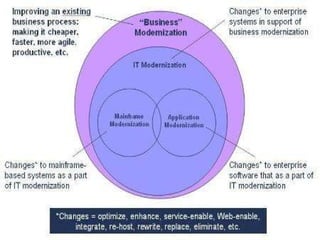
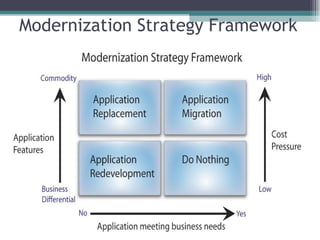
Modernization Strategy Framework
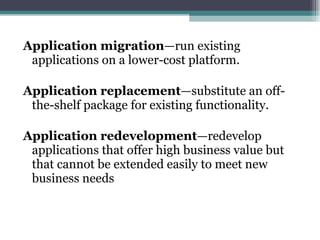
Application migration —run existing applications on a lower-cost platform. Application replacement —substitute an off-the-shelf package for existing functionality. Application redevelopment —redevelop applications that offer high business value but that cannot be extended easily to meet new business needs
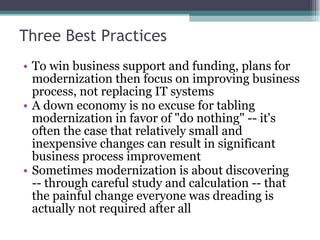
Three Best Practices To win business support and funding, plans for modernization then focus on improving business process, not replacing IT systems A down economy is no excuse for tabling modernization in favor of "do nothing" -- it's often the case that relatively small and inexpensive changes can result in significant business process improvement Sometimes modernization is about discovering -- through careful study and calculation -- that the painful change everyone was dreading is actually not required after all
DIVERSIFICATION
Introduction Used to expand firm’s operations by adding markets, products, services, or stages of production to the existing business.  Purpose is to allow the company to enter lines of business that are different from current operations.
TYPES On the basis of growth strategies Concentric Diversification-When a firm adds related products. Conglomerate Diversification- When a firm diversifies into areas that are unrelated to its current line of business
GROW OR BUY? INTERNAL DIVERSIFICATION, expanding a firm's product or market base two TYPES are,  1.Market existing products in new markets 2.Market new products in existing markets EXTERNAL DIVERSIFICATION, when a firm looks outside of its current operations and buys access to new products or markets
VERTICAL OR HORIZONTAL? Based on the direction VERTICAL DIVERSIFICATION- When firms undertake operations at different stages of production. HORIZONTAL DIVERSIFICATION- When a firm enters a new business (related or unrelated) at the same stage of production as its current operations.
Guidelines for Conglomerate Diversification Declining annual sales and profits  Capital and managerial talent to compete successfully in a new industry Financial synergy between the acquired and acquiring firms  Exiting markets for present products are saturated 
Guidelines for Horizontal Diversification   Revenues from current products/services would increase significantly by adding the new unrelated  products  Highly competitive and/or no-growth industry w/low margins and returns  Present distribution channels can be used to market new products to current customers  New products have counter cyclical sales patterns compared to existing products 
INTEGRATION
 
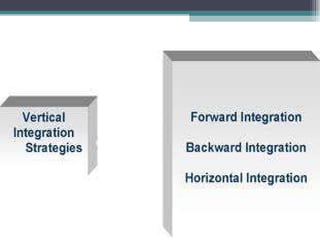
Benefits of vertical integration  Distributors (forward integration)  Gaining ownership or increased control over distributors or retailers  Suppliers (backward integration)  Competitors (horizontal integration)
Takeover and Joint Strategies
Takeover Definition  :  In business, a  takeover  is the purchase of one company (the  target ) by another (the  acquirer , or  bidder ). It can also termed as the acquisition of a company whose shares are listed on a stock exchange. It can be willingly or unwillingly of the target company.
Types of Takeover Friendly takeovers  - Before making a bid offer for another company, it usually first informs the company's board of directors. Hostile takeovers -  A hostile takeover is a take over to a target company whose management is unwilling to agree to a takeover. Reverse takeovers  - Type of takeover where a private company acquires a public company.
Takeover Strategies Mainly there are two types of Strategy Opportunistic  –  Its mainly the acquiring company use the target company as the future money maker for long run. Strategic  -  Its not only earning money from target company but also use the target companies earned market and relations for profitability.  Actually it depends upon the acquiring company how they want to implement their takeover strategy. How they want to use the target company.
Advantages Increase in sales/revenues. Venture into new businesses and markets. Profitability of target company. Increase market share. Decrease competition. Enlarge brand portfolio. Increase in product publicity into the target market.
Disadvantage Goodwill, often paid in excess for the acquisition. Job cuts. Cultural integration/conflict with new management Hidden liabilities of target entity. The monetary cost to the company. Lack of motivation for employees in the company being bought up.
The takeover of Cadbury (UK) by the US based Kraft Food Inc.
Takeover of Cadbury by The Kraft foods Inc.  Background of Two Companies Cadbury The origins of  Cadbury  was in 1824,  John Cadbury , a Quaker, opened a shop in Birmingham, central England.  Cadbury was the second biggest confectionery group in the world, UK based. Kraft Food Inc. Kraft was the world's second largest food company in  the world, US based . Product line Packaged food products, including snacks, beverage, cheese, meals, and packaged grocery products e.g., Oreo  cookies , Philadelphia cream cheese etc.
Important Case Details It was held on February 2010 It was the that year’s biggest overseas takeover. Cadbury–Kraft planed for join portfolio for more than 40 brands each with expected yearly sale of US $100 million. The takeover offer was US $19.7 billion. Kraft paid 850 pence/share where 500 pence was in cash and rest was in share.
Positives for Kraft Food & Cadbury Both the companies will become a global confectionery giant. It help Kraft in increasing its market share and overseas growth It also helps Cadbury to reach new markets and establish its presence in the US confectionery market. It would create a global powerhouse with annual sales of around US$ 50 billion yearly.
The Negatives hits Cadbury Cadbury lost its crown of being 2 nd  largest confectionary group. Its was reported that 120 managers and executives of 170 quite Cadbury after that takeover. Cadbury also lost its independent reputation in global chocolate market.
Joint Strategies(JS) it is the merging of two (or more) companies, enterprise or organization towards a more profitable, mutually beneficial and stronger entity in the market. The parties agree to create a new entity by both contributing equity, and they then share in the revenues, expenses, and control of the enterprise.
Advantages of JS Increase the ability to work with rivalries. Decrease the threat of Competition. Help organization to cut down there failure rate. Easy to remove most common mistakes. Develop a strong relationship chain into the industries
Disadvantages of JS It takes time and effort to build the right relationship and partnering with another business can be challenging. There is an imbalance in levels of expertise, investment or assets brought into the venture by the different partners. The partners don't provide enough leadership and support in the early stages. Success in a joint venture depends on thorough research and analysis of the objectives.
Joint Strategy of Addidas & Reebok to pull down Nike International Inc.
Joint Strategy of Addidas & Reebok  The story of Adidas started back to the year 1920 when  Adolf Dassler (Adi)  produced a handmade shoe fitted with black spikes.  In 1924, Adi and his brother  Rudolf Dassler  (Rudolf) started a company under the name  "Dassler Brothers OHG".   By 1949, Adidas was registered as a company - 'Adi' from Adolf and 'Das' from Dassler.  Adi registered the "Three Stripes" as his official logo. The company launched its first jogging shoe called, "Achille" in 1968. The "Trefoil Logo" was introduced in 1972.
Important Case Details   On August, 2005, Adidas-Salomon AG (Adidas), Germany's largest sporting goods maker announced acquisition of the US-based Reebok International Limited (Reebok) for $3.8 billion. August , 2005 the share price of Adidas increased by 7.4% from €147.52 to €158.45 on the Frankfurt stock exchange, while Reebok's share price at the New York Stock Exchange rose to $57.14 an increase of 30% share price of $43.95. There main goal was to take down the share of Nike International Inc.  in US sports market.
The Market US is the biggest market of sports goods in all over the world. 33% of athletic footwear purchased every year for fitness and sports activities. 40% of the consumers of sports apparel lay in the age group 12-24. Sports apparel retail sales in the US were worth $38.8 billion and increasing. Athletic footwear retail sales were $16.4 billion and growing.
JS of Addidas & Reebok The JS planed on August 2005 As per the JS Addidas gave $59/share. They will use same retail shops to sell their sports goods. Addidas is known for comfort goods, where as Reebok is mainly on the Style of product. They plan to exchange the ideas to create a totally satisfactory sports product
Positive Side of the JS They some extend successful to their plan of take down the share of NIKE in US sports market. Some analysis of data of the case denotes that the Addidas-Reebok JS could beat Nike to become leader. The biggest benefit is Addidas has removed a competitor as Reebok. By this JS Addidas has got the chance to enter a vast market of US sports arena.
Divestment & Liquidation  Strategy
DIVESTMENT Divestment is a form of retrenchment strategy used by businesses when they downsize the scope of their business activities Firms may elect to sell, close or spin-off a strategic business unit, major operating division or product line This move often is the final decision to eliminate unrelated, unprofitable or unmanageable operations
Reasons to Divest Market share too small Firms may divest when their market share is too small for  them to be competitive or when the market is too small to provide the expected rates of return
Availability of better alternatives Firms may also decide to divest because they see better investment opportunities. Organizations have limited resources. They are often able to divert resources from a marginally profitable line of business to one where the same resources can be used to achieve a greater rate of return
Need for increased investment Firms sometimes reach a point where continuing to  maintain an operation is going to require large investments in equipment, advertising, research and development, and so forth to remain viable. Rather than invest the monetary and management resources, firms may elect to divest that portion of the business
Lack of strategic fit A common reason for divesting is that the acquired business is not consistent with the image and strategies of the firm. This can be the result of acquiring a diversified business. It may also result from decisions to restructure and refocus the existing business
Legal pressures to divest  Firms may be forced to divest operations to avoid penalties for restraint of trade. Service Corporation Inc., a large funeral home chain acquired so many of its competitors in some areas that it created a regional monopoly. The Federal Trade Commission required the firm to divest some of its operations to avoid charges of restraint of trade
Implementation of Divestment Strategy Firms may pursue a divestment strategy by spinning off a portion of the business and allowing it to operate as an independent business entity Firms may also divest by selling a portion of the business to another organization(Kelvinator India-spin-off-Avanti scooters–high production cost) Firms may also close a portion of its operations
Example   F aced with a decline in its market share of almost half in the 14 to 19 male age group and no introduction of a successful new product in years, and rising manufacturing costs, Levi Strauss found it necessary to divest some of its operations. Since 1997 the company has announced plans to shut twenty-nine factories in North America and Europe and to eliminate 16,310 jobs
Liquidation Strategy Grand strategy, firm typically sold in parts, only occasionally as a whole Less attractive of all the grand strategies as it brings great hardships to the business and the employees Columbia Corporation, a $130 million diversified firm, liquidated its assets for more cash per share than the market value of its stock
Reasons for Liquidation A company being unable to repay its debts, making it insolvent Company directors wanting the business to avoid trading while insolvent There being no purpose or benefit to be gained by the company continuing
Liquidation: Difficult/Undesirable The management may hesitate to liquidate due to fear of  failure The trade unions would naturally resist the loss of employment of workers Moreover inadequate compensation for most unusable assets as they will be considered as scrap Also it creates a bad impact on the company or the Business group
Effects of Liquidation When appointed, liquidators take control of all of the company’s assets; if it is still trading, this includes the business itself The liquidator has the authority to sell any business in the name of the company Director(s) of a company lose their power when a liquidator is appointed The company’s assets will be disposed of by the liquidator who will ensure that the proceeds of the sale are provided to creditors
Legal issues of Liquidation Under the Companies Act , 1956, liquidation is termed as winding-up . The Act defines winding-up of a company as the process whereby it’s life is ended and it’s property administered for the benefit of it’s creditors and members At the end of winding up, the company will have no assets or liabilities When the affairs of a company are completely winded up, the dissolution of the company takes place
Process of Strategic choice and the factors affecting it
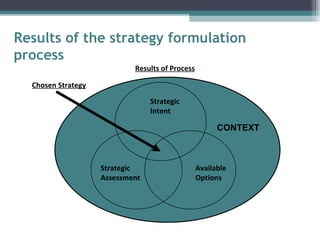
Results of the strategy formulation process Results of Process Strategic Intent Strategic Assessment Available Options Chosen Strategy CONTEXT
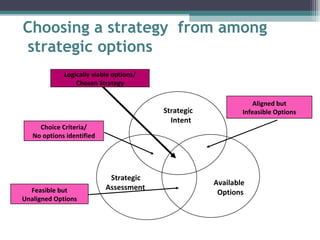
Choosing a strategy  from among strategic options Choice Criteria/ No options identified Strategic Intent Strategic Assessment Available  Options Logically viable options/ Chosen Strategy Feasible but Unaligned Options Aligned but Infeasible Options
Importance Of Choice in Strategy Strategic Choice is the third logical element of strategic formulation process If there are no choices to be made, there can of little value of thinking the strategy. When considering choice it is necessary to make a perspective view
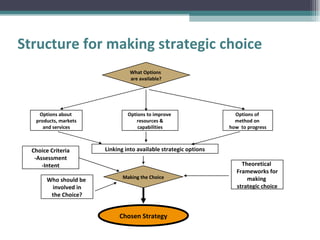
What Options  are available? Structure for making strategic choice Options of  method on  how  to progress Options about  products, markets and services Options to improve  resources & capabilities Making the Choice Choice Criteria -Assessment -Intent Theoretical  Frameworks for making  strategic choice Who should be  involved in the Choice? Linking into available strategic options Chosen Strategy
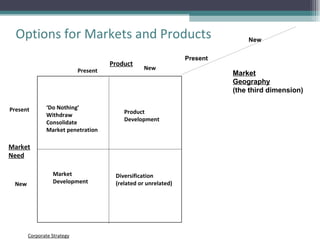
Options for Markets and Products Market Need Present New Present New Product Product Development Diversification (related or unrelated) Market Development Corporate Strategy Market Geography (the third dimension) New Present ‘ Do Nothing’ Withdraw Consolidate Market penetration
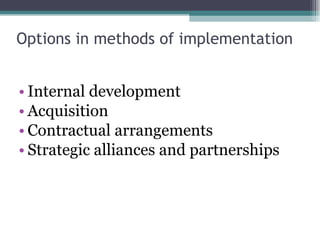
Options in methods of implementation Internal development Acquisition Contractual arrangements Strategic alliances and partnerships
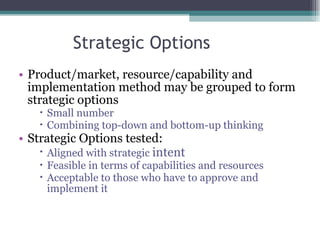
Strategic Options Product/market, resource/capability and implementation method may be grouped to form strategic options Small number Combining top-down and bottom-up thinking Strategic Options tested: Aligned with strategic  intent Feasible in terms of capabilities and resources Acceptable to those who have to approve and implement it
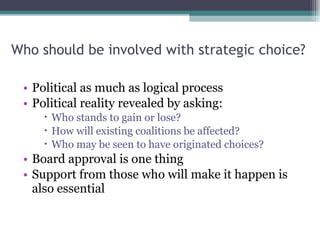
Who should be involved with strategic choice? Political as much as logical process Political reality revealed by asking: Who stands to gain or lose? How will existing coalitions be affected? Who may be seen to have originated choices? Board approval is one thing Support from those who will make it happen is also essential
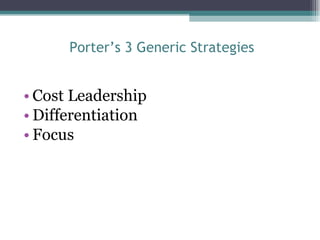
Porter’s 3 Generic Strategies Cost Leadership Differentiation Focus
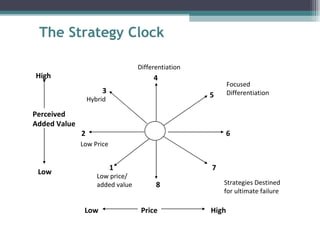
The Strategy Clock High Low Low High Price Perceived Added Value Low price/ added value 1 2 3 4 5 6 7 8 Low Price Hybrid Differentiation Focused Differentiation Strategies Destined for ultimate failure
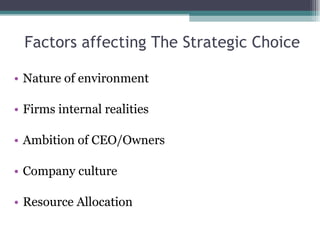
Factors affecting The Strategic Choice Nature of environment Firms internal realities Ambition of CEO/Owners Company culture Resource Allocation
Corporate Portfolio Analysis
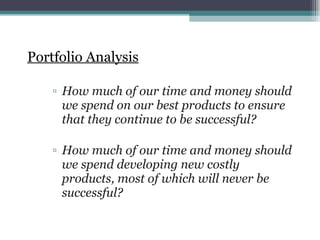
Portfolio Analysis How much of our time and money should we spend on our best products to ensure that they continue to be successful? How much of our time and money should we spend developing new costly products, most of which will never be successful?
“ Strategic market planning is concerned with adapting the organisation to a changing environment The organisation will prosper when it meets customer needs better than the competition Success is achieved when a strategy is developed for an organisation which fits the environment within which it operates
BUT customer needs change competitors develop new products and technologies which add value Corporate failure is often due to management inability to adapt to change Environmental changes may be  continuous  (changes are slow and reasonably predictable, giving time to adapt) or  discontinuous  (sudden, dramatic and unpredictable, making it difficult to plan)
Sudden environmental changes can trigger shocks or  strategic windows  or  paradigm shifts Existing market leaders often ill-equipped to match the new circumstances and new contenders go through the window and displace the current players Can current leaders close the strategic window before new contenders can get established? New contenders need to get through the window fast before it closes
Major causes of strategic windows opening: New technology can rapidly make obsolete the major strengths of current market leaders (e.g. Ever Ready zinc batteries displaced by Duracel lithium batteries) New segments  New channels of distribution (e.g. Direct Line) Market redefinition (nature of demand changes) New legislation (e.g. privatisations) Environmental shocks (sudden unpredicted changes in currencies, commodity prices or political events)
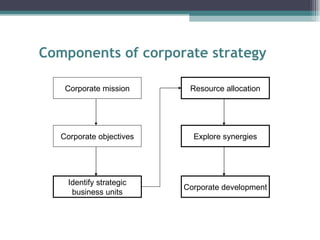
Corporate mission Resource allocation Corporate objectives Identify strategic business units Explore synergies Corporate development Components of corporate strategy
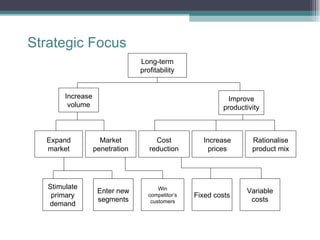
Long-term profitability Increase volume Improve productivity Expand market Market penetration Cost reduction Increase prices Rationalise product mix Stimulate primary demand Enter new segments Win competitor’s customers Fixed costs Variable costs Strategic Focus
Defining strategic business units Beyond a certain size a company needs to divide into SBUs to promote managerial performance Each SBU needs a definition of its business, specifying the competitive arena in which it will compete Often define business in product terms but perhaps should define by customer needs served
Can define the business in terms of: Customer group dimension  (how many market segments will the business seek to serve?) Customer need dimension  (how many customer needs will it meet?) Technology dimension  (what technologies will it seek to master?)
An SBU must be a clear, sensible management entity Must be capable of being run as an independent business SBU management must consider the best growth direction It should serve an external market, with distinct customers and competitors A major strand of technique development is to consider the business  as a portfolio of investments This can give added insight, highlight potential problems and offer some strategic guidance
A company has a portfolio of SBUs Some SBUs offer much more attractive growth and profit opportunities than others SBUs will be targeted for  build ,  growth ,  maintain ,  harvest  or  divestment SBUs will differ also in cash flow characteristics An SBU with a major new product or pursuing new market opportunities is likely to require net cash investment An SBU with strong market share in a mature market may be a strong cash generator
SBU objectives and resourcing decisions depends on: Attractiveness of the market (function of market size, growth, competitive intensity, profit levels, government regulations, sensitivity to economic fluctuations) Relative competitive strength of the SBU (function of market share, product positioning, cost competitiveness, technical skills, marketing and distribution capabilities, organisational flexibility) SBUs in attractive markets  with competitive advantage  should be set ambitious objectives and resources priority
Portfolio analysis enables a business to: Assess the balance of its portfolio (between cash use and cash generation) Have a framework for strategic market planning; successful SBUs follow a life cycle Develop a clear objective appropriate to its portfolio position - growth, maintenance, harvest, divestment
Portfolio Analysis Advantages: Top management evaluates each of firm’s businesses individually Use of externally-oriented data to supplement management judgment Raises issue of cash flow availability Facilitates communication
Portfolio Analysis Disadvantages: Difficult to define product/market segments Standard strategies can miss opportunities Illusion of scientific rigor Value-laden terms
Experience Curve
Introduction Models of the  learning curve effect  and the closely related  experience curve effect  express the relationship between equations for experience and efficiency or between efficiency gains and investment in the effort.  The rule used for representing the  learning curve effect  states that the more times a task has been performed, the less time will be required on each subsequent iteration.  This relationship was probably first quantified in 1936 where it was determined that every time total aircraft production doubled, the required labour time decreased by 10 to 15 %. The experience curve effect is broader in scope than the learning curve effect encompassing far more than just labour time.
Learning Curve The experience of "learning curves" was first observed by the 19th century German psychologist Hermann Ebbinghaus. The rule used for representing the  learning curve effect  states that the more times a task has been performed, the less time will be required on each subsequent iteration.  Learning curve theory states that as the quantity of items produced doubles, costs decrease at a predictable rate.  The learning curve describes the observed reduction in the number of required direct labour hours as workers learn their jobs.
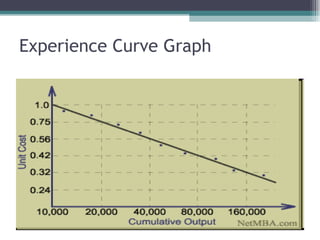
The Experience Curve In the late 1960s  Bruce Henderson of the Boston Consulting Group (BCG)  began to emphasize the implications of the experience curve for strategy.  The experience curve effect is broader in scope than the learning curve effect encompassing far more than just labor time.  It states that the more often a task is performed, the lower will be the cost of doing it. The task can be the production of any good or service.  Each time cumulative volume doubles, value added costs fall by a constant and predictable percentage.
Reasons for the effect Labour efficiency Standardization, specialization, and methods improvements   Technology-Driven Learning   Better use of equipment   Changes in the resource mix   Product redesign   Network-building and use-cost reductions   Shared experience effects
Experience Curve Discontinuities The experience curve effect can on occasion come to an abrupt stop when : Competitors introduce new products or processes that you must respond to  Key suppliers have much bigger customers that determine the price of products and services, and that becomes the main cost driver for the product  Technological change requires that you or your suppliers change processes  The experience curve strategies must be re-evaluated because  they are leading to  price wars   they are not producing a  marketing mix  that the market values
Strategic Consequences  The BCG strategists examined the consequences of the experience effect for businesses.  The reasoning is increased activity leads to increased learning, which leads to lower costs, which can lead to lower prices, which can lead to increased market share, which can lead to increased profitability and market dominance.  One consequence of the experience curve effect is that cost savings should be passed on as price decreases rather than kept as profit margin increases.  Relatively low cost of operations is a very powerful strategic advantage, firms should capitalize on these learning and experience effects.
Implications If a firm is able to gain market share over its competitors, it can develop a cost advantage.  Penetration pricing strategies and a significant investment in advertising, sales personnel, production capacity, etc. can be justified to increase market share and gain a competitive advantage.  When evaluating strategies based on the experience curve, a firm must consider the reaction of competitors who also understand the concept.
Criticisms Some authors claim that in most organizations it is impossible to quantify the effects.  They claim that experience effects are so closely intertwined with economies of scale that it is impossible to separate the two.  Economies of scale should be considered one of the reasons why experience effects exist.  Likewise, experience effects are one of the reasons why economies of scale exist.
Experience Curve Graph
Life-Cycle Strategies
Learning Goals Know the stages of the product life cycle Realize how marketing strategies change during the product’s life cycle
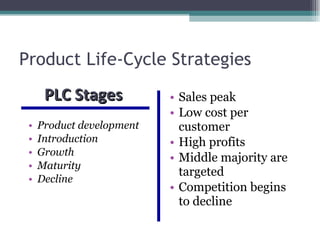
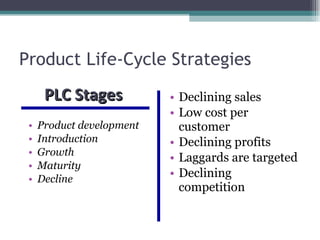
Product Life-Cycle Strategies The Product Life Cycle (PLC) has Five Stages Product Development, Introduction, Growth, Maturity, Decline Not all products follow this cycle:  Fads Styles Fashions
Product Life-Cycle Strategies The product life cycle concept can be applied to a: Product class (soft drinks) Product form (diet colas) Brand (Diet Dr. Pepper) Using the PLC to forecast brand performance or to develop marketing strategies is problematic
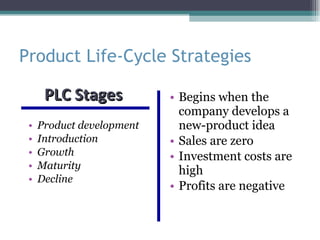
Product Life-Cycle Strategies Product development Introduction Growth Maturity Decline Begins when the company develops a new-product idea Sales are zero Investment costs are high Profits are negative PLC Stages
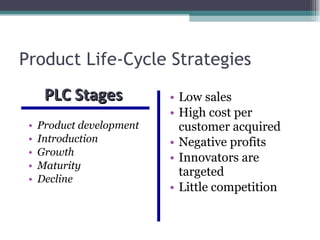
Product Life-Cycle Strategies Product development Introduction Growth Maturity Decline Low sales High cost per customer acquired Negative profits Innovators are targeted Little competition PLC Stages
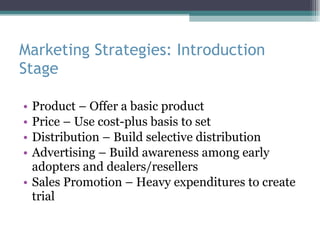
Marketing Strategies: Introduction Stage Product – Offer a basic product Price – Use cost-plus basis to set Distribution – Build selective distribution Advertising – Build awareness among early adopters and dealers/resellers Sales Promotion – Heavy expenditures to create trial
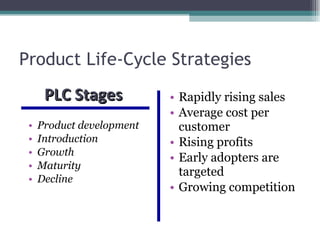
Product Life-Cycle Strategies Product development Introduction Growth Maturity Decline Rapidly rising sales Average cost per customer Rising profits Early adopters are targeted Growing competition PLC Stages
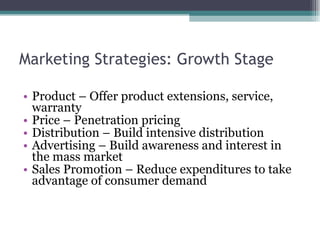
Marketing Strategies: Growth Stage Product – Offer product extensions, service, warranty Price – Penetration pricing Distribution – Build intensive distribution Advertising – Build awareness and interest in the mass market Sales Promotion – Reduce expenditures to take advantage of consumer demand
Product Life-Cycle Strategies Product development Introduction Growth Maturity Decline Sales peak Low cost per customer High profits Middle majority are targeted Competition begins to decline PLC Stages
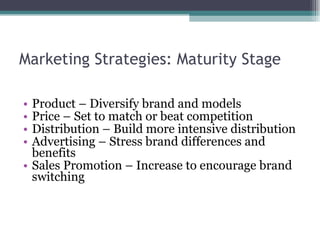
Marketing Strategies: Maturity Stage Product – Diversify brand and models Price – Set to match or beat competition Distribution – Build more intensive distribution Advertising – Stress brand differences and benefits Sales Promotion – Increase to encourage brand switching
Product Life-Cycle Strategies Product development Introduction Growth Maturity Decline Declining sales Low cost per customer Declining profits Laggards are targeted Declining competition PLC Stages
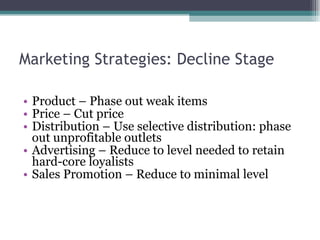
Marketing Strategies: Decline Stage Product – Phase out weak items Price – Cut price Distribution – Use selective distribution: phase out unprofitable outlets Advertising – Reduce to level needed to retain hard-core loyalists Sales Promotion – Reduce to minimal level
BOSTON CONSULTING GROUP   MATRIX
INTRODUCTION BOSTON CONSULTING GROUP (BCG) MATRIX  is developed by  BRUCE HENDERSON  for the  BOSTON CONSULTING GROUP IN 1968 According to this technique, businesses or products are classified as low or high performers depending upon their market growth rate and relative market share.
Relative Market Share and Market Growth   To understand the  Boston Matrix  you need to understand how market share and market growth interrelate.   
MARKET SHARE Market share  is the percentage of the total market that is being serviced by your company, measured either in revenue terms or unit volume terms.  RELATIVE MARKET SHARE RMS =  Business unit sales this year Leading rival sales this year The higher your market share, the higher proportion of the market you control.
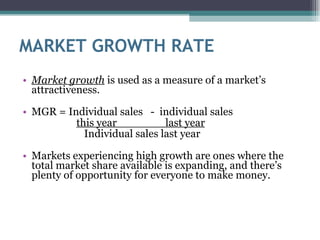
MARKET GROWTH RATE Market growth  is used as a measure of a market’s attractiveness.  MGR = Individual sales  -  individual sales this year  last year Individual sales last year  Markets experiencing high growth are ones where the total market share available is expanding, and there’s plenty of opportunity for everyone to make money.
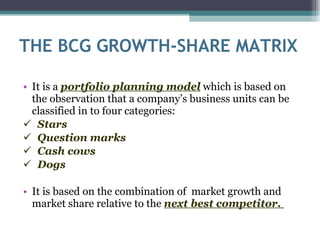
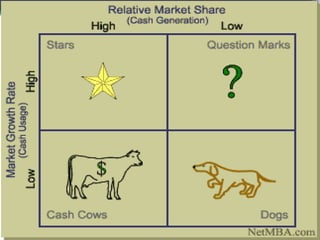
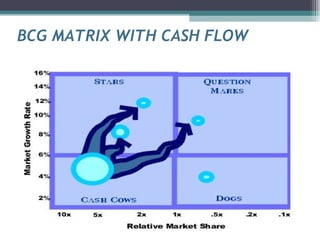
THE BCG GROWTH-SHARE MATRIX It is a  portfolio planning model  which is based on the observation that a company’s business units can be classified in to four categories: Stars  Question marks  Cash cows Dogs It is based on the combination of  market growth and market share relative to the  next best competitor.
 
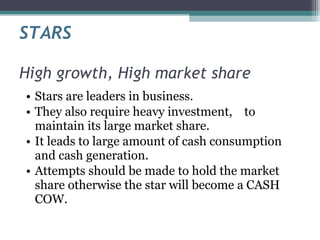
STARS High growth, High market share Stars are leaders in business. They also require heavy investment,  to maintain its large market share. It leads to large amount of cash consumption and cash generation. Attempts should be made to hold the market share otherwise the star will become a CASH COW.
CASH COWS Low growth , High market share They are foundation of the company and often the stars of yesterday.  They generate more cash than required. They extract the profits by investing as little cash as possible They are located in an industry that is mature, not growing or declining.
DOGS Low growth, Low market share Dogs are the cash traps. Dogs do not have potential to bring in much cash. Number of dogs in the company should be minimized. Business is situated at a declining stage.
QUESTION MARKS High growth , Low market share Most businesses start of as question marks. They will absorb great amounts of cash if the market share remains unchanged, (low). Why question marks? Question marks have potential to become star and eventually cash cow but can also become a dog. Investments should be high for question marks.
WHY BCG MATRIX  ? To assess : Profiles of products/businesses  The cash demands of products  The development cycles of products Resource allocation and divestment decisions
BCG MATRIX WITH CASH FLOW
BENEFITS BCG MATRIX  is simple and easy to understand. It helps you to quickly and simply screen the opportunities open to you, and helps you think about how you can make the most of them. It is used to identify how corporate cash resources can best be used to maximize a company’s future growth and profitability.
LIMITATIONS BCG MATRIX uses only two dimensions, Relative market share and market growth rate. Problems of getting data on market share and market growth. High market share does not mean profits all the time. Business with low market share can be profitable too.
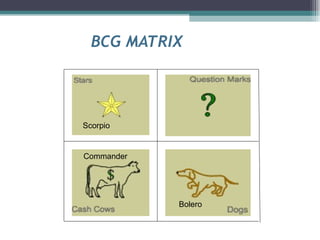
PRACTICAL USE MAHINDRA & MAHINDRA
BCG MATRIX  Scorpio Commander Bolero
CONCLUSION Though BCG MATRIX has its limitations it is one of the most FAMOUS AND SIMPLE portfolio planning matrix ,used by large companies having multi-products.

Strategic management

  • 1.
    ‘ Strategic Managementfor Tourism’ L-303 ,Unit – 3 Group 3 Sec – B PGDM (TL) 2010-12
  • 2.
    Students Involved ShuvojyotiShishir Shashank Shipra Sreetama Stephy Seema Srinivas Sawan
  • 3.
    Context Formulation ofStrategies Modernization Diversification Integration Definition of takeover Takeover Strategies Advantages of Takeover Disadvantages of Takeover Case Study Definition of Joint Strategies Advantage & Disadvantage Case Study Divestment & Liquidation Strategy Divestment Reasons to Divest Implementation of Divestment strategy Example Liquidation Strategy Process of Strategic choice and the factors affecting it. Corporate Portfolio Analysis Product Life Cycle (PLC) Boston Consultancy Group (BCG) matrix. Its implementation Conclution
  • 4.
    Strategy Formulation strategyformulation refers to the process of choosing the most appropriate course of action for the realization of organizational goals and objectives and thereby achieving the organizational vision.
  • 5.
    Process of StrategyFormulation The process of strategy formulation basically involves six main steps, Setting Organizations objectives Evaluating the organizational environment Setting Quantitative Targets Aiming in context with the divisional plans Performance Analysis Choice of Strategy
  • 6.
    Setting Organization’s objectives:- The key component of any strategy statement is to set the long-term objectives of the organization. It is known that strategy is generally a medium for realization of organizational objectives. strategy is a wider term which believes in the manner of deployment of resources so as to achieve the objectives
  • 7.
    Evaluating the OrganizationalEnvironment:- The next step is to evaluate the general economic and industrial environment in which the organization operates. This includes a review of the organizations competitive position. It is essential to conduct a qualitative and quantitative review of an organizations existing product line
  • 8.
    Setting Quantitative Targets– In this step, an organization must practically fix the quantitative target values for some of the organizational objectives. The idea behind this is to compare with long term customers, so as to evaluate the contribution that might be made by various product zones or operating departments.
  • 9.
    Aiming in contextwith the divisional plans In this step, the contributions made by each department or division or product category within the organization strategic planning is done for each sub-unit. This requires a careful analysis of macroeconomic trends.
  • 10.
    Performance Analysis :-Performance analysis includes discovering and analyzing the gap between the planned or desired performance A critical evaluation of the organizations past performance, present condition and the desired future conditions must be done by the organization
  • 11.
    Choice of StrategyThis is the ultimate step in Strategy Formulation. The best course of action is actually chosen after considering organizational goals, organizational strengths, potential and limitations as well as the external opportunities.
  • 12.
    Formulation of StrategiesMODERNIZATION, DIVERSIFICATION, INTEGRATION
  • 13.
    MODERNIZATION Meaning “Bridgingan organization's past, present, and future” Once modernization is defined at the very highest level as making improvements to current business processes, all other sub-categories of modernization fall semi-neatly into place
  • 14.
    Business-centric View  Thedefinition of modernization must be business-centric and cares about business process that help:- -increase revenue -reduce costs -increase share price. So the definition of modernization that excites business leaders is: "Improving current business processes to better support organizational objectives."
  • 15.
  • 16.
  • 17.
    Application migration —runexisting applications on a lower-cost platform. Application replacement —substitute an off-the-shelf package for existing functionality. Application redevelopment —redevelop applications that offer high business value but that cannot be extended easily to meet new business needs
  • 18.
    Three Best PracticesTo win business support and funding, plans for modernization then focus on improving business process, not replacing IT systems A down economy is no excuse for tabling modernization in favor of "do nothing" -- it's often the case that relatively small and inexpensive changes can result in significant business process improvement Sometimes modernization is about discovering -- through careful study and calculation -- that the painful change everyone was dreading is actually not required after all
  • 19.
  • 20.
    Introduction Used toexpand firm’s operations by adding markets, products, services, or stages of production to the existing business. Purpose is to allow the company to enter lines of business that are different from current operations.
  • 21.
    TYPES On thebasis of growth strategies Concentric Diversification-When a firm adds related products. Conglomerate Diversification- When a firm diversifies into areas that are unrelated to its current line of business
  • 22.
    GROW OR BUY?INTERNAL DIVERSIFICATION, expanding a firm's product or market base two TYPES are, 1.Market existing products in new markets 2.Market new products in existing markets EXTERNAL DIVERSIFICATION, when a firm looks outside of its current operations and buys access to new products or markets
  • 23.
    VERTICAL OR HORIZONTAL?Based on the direction VERTICAL DIVERSIFICATION- When firms undertake operations at different stages of production. HORIZONTAL DIVERSIFICATION- When a firm enters a new business (related or unrelated) at the same stage of production as its current operations.
  • 24.
    Guidelines for ConglomerateDiversification Declining annual sales and profits  Capital and managerial talent to compete successfully in a new industry Financial synergy between the acquired and acquiring firms  Exiting markets for present products are saturated 
  • 25.
    Guidelines for HorizontalDiversification   Revenues from current products/services would increase significantly by adding the new unrelated  products  Highly competitive and/or no-growth industry w/low margins and returns  Present distribution channels can be used to market new products to current customers  New products have counter cyclical sales patterns compared to existing products 
  • 26.
  • 27.
  • 28.
    Benefits of verticalintegration Distributors (forward integration) Gaining ownership or increased control over distributors or retailers  Suppliers (backward integration)  Competitors (horizontal integration)
  • 29.
  • 30.
    Takeover Definition : In business, a takeover is the purchase of one company (the target ) by another (the acquirer , or bidder ). It can also termed as the acquisition of a company whose shares are listed on a stock exchange. It can be willingly or unwillingly of the target company.
  • 31.
    Types of TakeoverFriendly takeovers - Before making a bid offer for another company, it usually first informs the company's board of directors. Hostile takeovers - A hostile takeover is a take over to a target company whose management is unwilling to agree to a takeover. Reverse takeovers - Type of takeover where a private company acquires a public company.
  • 32.
    Takeover Strategies Mainlythere are two types of Strategy Opportunistic – Its mainly the acquiring company use the target company as the future money maker for long run. Strategic - Its not only earning money from target company but also use the target companies earned market and relations for profitability. Actually it depends upon the acquiring company how they want to implement their takeover strategy. How they want to use the target company.
  • 33.
    Advantages Increase insales/revenues. Venture into new businesses and markets. Profitability of target company. Increase market share. Decrease competition. Enlarge brand portfolio. Increase in product publicity into the target market.
  • 34.
    Disadvantage Goodwill, oftenpaid in excess for the acquisition. Job cuts. Cultural integration/conflict with new management Hidden liabilities of target entity. The monetary cost to the company. Lack of motivation for employees in the company being bought up.
  • 35.
    The takeover ofCadbury (UK) by the US based Kraft Food Inc.
  • 36.
    Takeover of Cadburyby The Kraft foods Inc. Background of Two Companies Cadbury The origins of Cadbury was in 1824, John Cadbury , a Quaker, opened a shop in Birmingham, central England. Cadbury was the second biggest confectionery group in the world, UK based. Kraft Food Inc. Kraft was the world's second largest food company in the world, US based . Product line Packaged food products, including snacks, beverage, cheese, meals, and packaged grocery products e.g., Oreo cookies , Philadelphia cream cheese etc.
  • 37.
    Important Case DetailsIt was held on February 2010 It was the that year’s biggest overseas takeover. Cadbury–Kraft planed for join portfolio for more than 40 brands each with expected yearly sale of US $100 million. The takeover offer was US $19.7 billion. Kraft paid 850 pence/share where 500 pence was in cash and rest was in share.
  • 38.
    Positives for KraftFood & Cadbury Both the companies will become a global confectionery giant. It help Kraft in increasing its market share and overseas growth It also helps Cadbury to reach new markets and establish its presence in the US confectionery market. It would create a global powerhouse with annual sales of around US$ 50 billion yearly.
  • 39.
    The Negatives hitsCadbury Cadbury lost its crown of being 2 nd largest confectionary group. Its was reported that 120 managers and executives of 170 quite Cadbury after that takeover. Cadbury also lost its independent reputation in global chocolate market.
  • 40.
    Joint Strategies(JS) itis the merging of two (or more) companies, enterprise or organization towards a more profitable, mutually beneficial and stronger entity in the market. The parties agree to create a new entity by both contributing equity, and they then share in the revenues, expenses, and control of the enterprise.
  • 41.
    Advantages of JSIncrease the ability to work with rivalries. Decrease the threat of Competition. Help organization to cut down there failure rate. Easy to remove most common mistakes. Develop a strong relationship chain into the industries
  • 42.
    Disadvantages of JSIt takes time and effort to build the right relationship and partnering with another business can be challenging. There is an imbalance in levels of expertise, investment or assets brought into the venture by the different partners. The partners don't provide enough leadership and support in the early stages. Success in a joint venture depends on thorough research and analysis of the objectives.
  • 43.
    Joint Strategy ofAddidas & Reebok to pull down Nike International Inc.
  • 44.
    Joint Strategy ofAddidas & Reebok The story of Adidas started back to the year 1920 when Adolf Dassler (Adi) produced a handmade shoe fitted with black spikes. In 1924, Adi and his brother Rudolf Dassler (Rudolf) started a company under the name "Dassler Brothers OHG". By 1949, Adidas was registered as a company - 'Adi' from Adolf and 'Das' from Dassler. Adi registered the "Three Stripes" as his official logo. The company launched its first jogging shoe called, "Achille" in 1968. The "Trefoil Logo" was introduced in 1972.
  • 45.
    Important Case Details On August, 2005, Adidas-Salomon AG (Adidas), Germany's largest sporting goods maker announced acquisition of the US-based Reebok International Limited (Reebok) for $3.8 billion. August , 2005 the share price of Adidas increased by 7.4% from €147.52 to €158.45 on the Frankfurt stock exchange, while Reebok's share price at the New York Stock Exchange rose to $57.14 an increase of 30% share price of $43.95. There main goal was to take down the share of Nike International Inc. in US sports market.
  • 46.
    The Market USis the biggest market of sports goods in all over the world. 33% of athletic footwear purchased every year for fitness and sports activities. 40% of the consumers of sports apparel lay in the age group 12-24. Sports apparel retail sales in the US were worth $38.8 billion and increasing. Athletic footwear retail sales were $16.4 billion and growing.
  • 47.
    JS of Addidas& Reebok The JS planed on August 2005 As per the JS Addidas gave $59/share. They will use same retail shops to sell their sports goods. Addidas is known for comfort goods, where as Reebok is mainly on the Style of product. They plan to exchange the ideas to create a totally satisfactory sports product
  • 48.
    Positive Side ofthe JS They some extend successful to their plan of take down the share of NIKE in US sports market. Some analysis of data of the case denotes that the Addidas-Reebok JS could beat Nike to become leader. The biggest benefit is Addidas has removed a competitor as Reebok. By this JS Addidas has got the chance to enter a vast market of US sports arena.
  • 49.
  • 50.
    DIVESTMENT Divestment isa form of retrenchment strategy used by businesses when they downsize the scope of their business activities Firms may elect to sell, close or spin-off a strategic business unit, major operating division or product line This move often is the final decision to eliminate unrelated, unprofitable or unmanageable operations
  • 51.
    Reasons to DivestMarket share too small Firms may divest when their market share is too small for them to be competitive or when the market is too small to provide the expected rates of return
  • 52.
    Availability of betteralternatives Firms may also decide to divest because they see better investment opportunities. Organizations have limited resources. They are often able to divert resources from a marginally profitable line of business to one where the same resources can be used to achieve a greater rate of return
  • 53.
    Need for increasedinvestment Firms sometimes reach a point where continuing to maintain an operation is going to require large investments in equipment, advertising, research and development, and so forth to remain viable. Rather than invest the monetary and management resources, firms may elect to divest that portion of the business
  • 54.
    Lack of strategicfit A common reason for divesting is that the acquired business is not consistent with the image and strategies of the firm. This can be the result of acquiring a diversified business. It may also result from decisions to restructure and refocus the existing business

  • 55.
    Legal pressures todivest Firms may be forced to divest operations to avoid penalties for restraint of trade. Service Corporation Inc., a large funeral home chain acquired so many of its competitors in some areas that it created a regional monopoly. The Federal Trade Commission required the firm to divest some of its operations to avoid charges of restraint of trade
  • 56.
    Implementation of DivestmentStrategy Firms may pursue a divestment strategy by spinning off a portion of the business and allowing it to operate as an independent business entity Firms may also divest by selling a portion of the business to another organization(Kelvinator India-spin-off-Avanti scooters–high production cost) Firms may also close a portion of its operations
  • 57.
    Example F aced with a decline in its market share of almost half in the 14 to 19 male age group and no introduction of a successful new product in years, and rising manufacturing costs, Levi Strauss found it necessary to divest some of its operations. Since 1997 the company has announced plans to shut twenty-nine factories in North America and Europe and to eliminate 16,310 jobs
  • 58.
    Liquidation Strategy Grandstrategy, firm typically sold in parts, only occasionally as a whole Less attractive of all the grand strategies as it brings great hardships to the business and the employees Columbia Corporation, a $130 million diversified firm, liquidated its assets for more cash per share than the market value of its stock
  • 59.
    Reasons for LiquidationA company being unable to repay its debts, making it insolvent Company directors wanting the business to avoid trading while insolvent There being no purpose or benefit to be gained by the company continuing
  • 60.
    Liquidation: Difficult/Undesirable Themanagement may hesitate to liquidate due to fear of failure The trade unions would naturally resist the loss of employment of workers Moreover inadequate compensation for most unusable assets as they will be considered as scrap Also it creates a bad impact on the company or the Business group
  • 61.
    Effects of LiquidationWhen appointed, liquidators take control of all of the company’s assets; if it is still trading, this includes the business itself The liquidator has the authority to sell any business in the name of the company Director(s) of a company lose their power when a liquidator is appointed The company’s assets will be disposed of by the liquidator who will ensure that the proceeds of the sale are provided to creditors
  • 62.
    Legal issues ofLiquidation Under the Companies Act , 1956, liquidation is termed as winding-up . The Act defines winding-up of a company as the process whereby it’s life is ended and it’s property administered for the benefit of it’s creditors and members At the end of winding up, the company will have no assets or liabilities When the affairs of a company are completely winded up, the dissolution of the company takes place
  • 63.
    Process of Strategicchoice and the factors affecting it
  • 64.
    Results of thestrategy formulation process Results of Process Strategic Intent Strategic Assessment Available Options Chosen Strategy CONTEXT
  • 65.
    Choosing a strategy from among strategic options Choice Criteria/ No options identified Strategic Intent Strategic Assessment Available Options Logically viable options/ Chosen Strategy Feasible but Unaligned Options Aligned but Infeasible Options
  • 66.
    Importance Of Choicein Strategy Strategic Choice is the third logical element of strategic formulation process If there are no choices to be made, there can of little value of thinking the strategy. When considering choice it is necessary to make a perspective view
  • 67.
    What Options are available? Structure for making strategic choice Options of method on how to progress Options about products, markets and services Options to improve resources & capabilities Making the Choice Choice Criteria -Assessment -Intent Theoretical Frameworks for making strategic choice Who should be involved in the Choice? Linking into available strategic options Chosen Strategy
  • 68.
    Options for Marketsand Products Market Need Present New Present New Product Product Development Diversification (related or unrelated) Market Development Corporate Strategy Market Geography (the third dimension) New Present ‘ Do Nothing’ Withdraw Consolidate Market penetration
  • 69.
    Options in methodsof implementation Internal development Acquisition Contractual arrangements Strategic alliances and partnerships
  • 70.
    Strategic Options Product/market,resource/capability and implementation method may be grouped to form strategic options Small number Combining top-down and bottom-up thinking Strategic Options tested: Aligned with strategic intent Feasible in terms of capabilities and resources Acceptable to those who have to approve and implement it
  • 71.
    Who should beinvolved with strategic choice? Political as much as logical process Political reality revealed by asking: Who stands to gain or lose? How will existing coalitions be affected? Who may be seen to have originated choices? Board approval is one thing Support from those who will make it happen is also essential
  • 72.
    Porter’s 3 GenericStrategies Cost Leadership Differentiation Focus
  • 73.
    The Strategy ClockHigh Low Low High Price Perceived Added Value Low price/ added value 1 2 3 4 5 6 7 8 Low Price Hybrid Differentiation Focused Differentiation Strategies Destined for ultimate failure
  • 74.
    Factors affecting TheStrategic Choice Nature of environment Firms internal realities Ambition of CEO/Owners Company culture Resource Allocation
  • 75.
  • 76.
    Portfolio Analysis Howmuch of our time and money should we spend on our best products to ensure that they continue to be successful? How much of our time and money should we spend developing new costly products, most of which will never be successful?
  • 77.
    “ Strategic marketplanning is concerned with adapting the organisation to a changing environment The organisation will prosper when it meets customer needs better than the competition Success is achieved when a strategy is developed for an organisation which fits the environment within which it operates
  • 78.
    BUT customer needschange competitors develop new products and technologies which add value Corporate failure is often due to management inability to adapt to change Environmental changes may be continuous (changes are slow and reasonably predictable, giving time to adapt) or discontinuous (sudden, dramatic and unpredictable, making it difficult to plan)
  • 79.
    Sudden environmental changescan trigger shocks or strategic windows or paradigm shifts Existing market leaders often ill-equipped to match the new circumstances and new contenders go through the window and displace the current players Can current leaders close the strategic window before new contenders can get established? New contenders need to get through the window fast before it closes
  • 80.
    Major causes ofstrategic windows opening: New technology can rapidly make obsolete the major strengths of current market leaders (e.g. Ever Ready zinc batteries displaced by Duracel lithium batteries) New segments New channels of distribution (e.g. Direct Line) Market redefinition (nature of demand changes) New legislation (e.g. privatisations) Environmental shocks (sudden unpredicted changes in currencies, commodity prices or political events)
  • 81.
    Corporate mission Resourceallocation Corporate objectives Identify strategic business units Explore synergies Corporate development Components of corporate strategy
  • 82.
    Long-term profitability Increasevolume Improve productivity Expand market Market penetration Cost reduction Increase prices Rationalise product mix Stimulate primary demand Enter new segments Win competitor’s customers Fixed costs Variable costs Strategic Focus
  • 83.
    Defining strategic businessunits Beyond a certain size a company needs to divide into SBUs to promote managerial performance Each SBU needs a definition of its business, specifying the competitive arena in which it will compete Often define business in product terms but perhaps should define by customer needs served
  • 84.
    Can define thebusiness in terms of: Customer group dimension (how many market segments will the business seek to serve?) Customer need dimension (how many customer needs will it meet?) Technology dimension (what technologies will it seek to master?)
  • 85.
    An SBU mustbe a clear, sensible management entity Must be capable of being run as an independent business SBU management must consider the best growth direction It should serve an external market, with distinct customers and competitors A major strand of technique development is to consider the business as a portfolio of investments This can give added insight, highlight potential problems and offer some strategic guidance
  • 86.
    A company hasa portfolio of SBUs Some SBUs offer much more attractive growth and profit opportunities than others SBUs will be targeted for build , growth , maintain , harvest or divestment SBUs will differ also in cash flow characteristics An SBU with a major new product or pursuing new market opportunities is likely to require net cash investment An SBU with strong market share in a mature market may be a strong cash generator
  • 87.
    SBU objectives andresourcing decisions depends on: Attractiveness of the market (function of market size, growth, competitive intensity, profit levels, government regulations, sensitivity to economic fluctuations) Relative competitive strength of the SBU (function of market share, product positioning, cost competitiveness, technical skills, marketing and distribution capabilities, organisational flexibility) SBUs in attractive markets with competitive advantage should be set ambitious objectives and resources priority
  • 88.
    Portfolio analysis enablesa business to: Assess the balance of its portfolio (between cash use and cash generation) Have a framework for strategic market planning; successful SBUs follow a life cycle Develop a clear objective appropriate to its portfolio position - growth, maintenance, harvest, divestment
  • 89.
    Portfolio Analysis Advantages:Top management evaluates each of firm’s businesses individually Use of externally-oriented data to supplement management judgment Raises issue of cash flow availability Facilitates communication
  • 90.
    Portfolio Analysis Disadvantages:Difficult to define product/market segments Standard strategies can miss opportunities Illusion of scientific rigor Value-laden terms
  • 91.
  • 92.
    Introduction Models ofthe learning curve effect and the closely related experience curve effect express the relationship between equations for experience and efficiency or between efficiency gains and investment in the effort. The rule used for representing the learning curve effect states that the more times a task has been performed, the less time will be required on each subsequent iteration. This relationship was probably first quantified in 1936 where it was determined that every time total aircraft production doubled, the required labour time decreased by 10 to 15 %. The experience curve effect is broader in scope than the learning curve effect encompassing far more than just labour time.
  • 93.
    Learning Curve Theexperience of "learning curves" was first observed by the 19th century German psychologist Hermann Ebbinghaus. The rule used for representing the learning curve effect states that the more times a task has been performed, the less time will be required on each subsequent iteration. Learning curve theory states that as the quantity of items produced doubles, costs decrease at a predictable rate. The learning curve describes the observed reduction in the number of required direct labour hours as workers learn their jobs.
  • 94.
    The Experience CurveIn the late 1960s Bruce Henderson of the Boston Consulting Group (BCG) began to emphasize the implications of the experience curve for strategy. The experience curve effect is broader in scope than the learning curve effect encompassing far more than just labor time. It states that the more often a task is performed, the lower will be the cost of doing it. The task can be the production of any good or service. Each time cumulative volume doubles, value added costs fall by a constant and predictable percentage.
  • 95.
    Reasons for theeffect Labour efficiency Standardization, specialization, and methods improvements Technology-Driven Learning Better use of equipment Changes in the resource mix Product redesign Network-building and use-cost reductions Shared experience effects
  • 96.
    Experience Curve DiscontinuitiesThe experience curve effect can on occasion come to an abrupt stop when : Competitors introduce new products or processes that you must respond to Key suppliers have much bigger customers that determine the price of products and services, and that becomes the main cost driver for the product Technological change requires that you or your suppliers change processes The experience curve strategies must be re-evaluated because they are leading to price wars they are not producing a marketing mix that the market values
  • 97.
    Strategic Consequences The BCG strategists examined the consequences of the experience effect for businesses. The reasoning is increased activity leads to increased learning, which leads to lower costs, which can lead to lower prices, which can lead to increased market share, which can lead to increased profitability and market dominance. One consequence of the experience curve effect is that cost savings should be passed on as price decreases rather than kept as profit margin increases. Relatively low cost of operations is a very powerful strategic advantage, firms should capitalize on these learning and experience effects.
  • 98.
    Implications If afirm is able to gain market share over its competitors, it can develop a cost advantage. Penetration pricing strategies and a significant investment in advertising, sales personnel, production capacity, etc. can be justified to increase market share and gain a competitive advantage. When evaluating strategies based on the experience curve, a firm must consider the reaction of competitors who also understand the concept.
  • 99.
    Criticisms Some authorsclaim that in most organizations it is impossible to quantify the effects. They claim that experience effects are so closely intertwined with economies of scale that it is impossible to separate the two. Economies of scale should be considered one of the reasons why experience effects exist. Likewise, experience effects are one of the reasons why economies of scale exist.
  • 100.
  • 101.
  • 102.
    Learning Goals Knowthe stages of the product life cycle Realize how marketing strategies change during the product’s life cycle
  • 103.
    Product Life-Cycle StrategiesThe Product Life Cycle (PLC) has Five Stages Product Development, Introduction, Growth, Maturity, Decline Not all products follow this cycle: Fads Styles Fashions
  • 104.
    Product Life-Cycle StrategiesThe product life cycle concept can be applied to a: Product class (soft drinks) Product form (diet colas) Brand (Diet Dr. Pepper) Using the PLC to forecast brand performance or to develop marketing strategies is problematic
  • 105.
    Product Life-Cycle StrategiesProduct development Introduction Growth Maturity Decline Begins when the company develops a new-product idea Sales are zero Investment costs are high Profits are negative PLC Stages
  • 106.
    Product Life-Cycle StrategiesProduct development Introduction Growth Maturity Decline Low sales High cost per customer acquired Negative profits Innovators are targeted Little competition PLC Stages
  • 107.
    Marketing Strategies: IntroductionStage Product – Offer a basic product Price – Use cost-plus basis to set Distribution – Build selective distribution Advertising – Build awareness among early adopters and dealers/resellers Sales Promotion – Heavy expenditures to create trial
  • 108.
    Product Life-Cycle StrategiesProduct development Introduction Growth Maturity Decline Rapidly rising sales Average cost per customer Rising profits Early adopters are targeted Growing competition PLC Stages
  • 109.
    Marketing Strategies: GrowthStage Product – Offer product extensions, service, warranty Price – Penetration pricing Distribution – Build intensive distribution Advertising – Build awareness and interest in the mass market Sales Promotion – Reduce expenditures to take advantage of consumer demand
  • 110.
    Product Life-Cycle StrategiesProduct development Introduction Growth Maturity Decline Sales peak Low cost per customer High profits Middle majority are targeted Competition begins to decline PLC Stages
  • 111.
    Marketing Strategies: MaturityStage Product – Diversify brand and models Price – Set to match or beat competition Distribution – Build more intensive distribution Advertising – Stress brand differences and benefits Sales Promotion – Increase to encourage brand switching
  • 112.
    Product Life-Cycle StrategiesProduct development Introduction Growth Maturity Decline Declining sales Low cost per customer Declining profits Laggards are targeted Declining competition PLC Stages
  • 113.
    Marketing Strategies: DeclineStage Product – Phase out weak items Price – Cut price Distribution – Use selective distribution: phase out unprofitable outlets Advertising – Reduce to level needed to retain hard-core loyalists Sales Promotion – Reduce to minimal level
  • 114.
  • 115.
    INTRODUCTION BOSTON CONSULTINGGROUP (BCG) MATRIX is developed by BRUCE HENDERSON for the BOSTON CONSULTING GROUP IN 1968 According to this technique, businesses or products are classified as low or high performers depending upon their market growth rate and relative market share.
  • 116.
    Relative Market Shareand Market Growth To understand the Boston Matrix you need to understand how market share and market growth interrelate.   
  • 117.
    MARKET SHARE Marketshare is the percentage of the total market that is being serviced by your company, measured either in revenue terms or unit volume terms. RELATIVE MARKET SHARE RMS = Business unit sales this year Leading rival sales this year The higher your market share, the higher proportion of the market you control.
  • 118.
    MARKET GROWTH RATEMarket growth is used as a measure of a market’s attractiveness. MGR = Individual sales - individual sales this year last year Individual sales last year Markets experiencing high growth are ones where the total market share available is expanding, and there’s plenty of opportunity for everyone to make money.
  • 119.
    THE BCG GROWTH-SHAREMATRIX It is a portfolio planning model which is based on the observation that a company’s business units can be classified in to four categories: Stars Question marks Cash cows Dogs It is based on the combination of market growth and market share relative to the next best competitor.
  • 120.
  • 121.
    STARS High growth,High market share Stars are leaders in business. They also require heavy investment, to maintain its large market share. It leads to large amount of cash consumption and cash generation. Attempts should be made to hold the market share otherwise the star will become a CASH COW.
  • 122.
    CASH COWS Lowgrowth , High market share They are foundation of the company and often the stars of yesterday. They generate more cash than required. They extract the profits by investing as little cash as possible They are located in an industry that is mature, not growing or declining.
  • 123.
    DOGS Low growth,Low market share Dogs are the cash traps. Dogs do not have potential to bring in much cash. Number of dogs in the company should be minimized. Business is situated at a declining stage.
  • 124.
    QUESTION MARKS Highgrowth , Low market share Most businesses start of as question marks. They will absorb great amounts of cash if the market share remains unchanged, (low). Why question marks? Question marks have potential to become star and eventually cash cow but can also become a dog. Investments should be high for question marks.
  • 125.
    WHY BCG MATRIX ? To assess : Profiles of products/businesses The cash demands of products The development cycles of products Resource allocation and divestment decisions
  • 126.
    BCG MATRIX WITHCASH FLOW
  • 127.
    BENEFITS BCG MATRIX is simple and easy to understand. It helps you to quickly and simply screen the opportunities open to you, and helps you think about how you can make the most of them. It is used to identify how corporate cash resources can best be used to maximize a company’s future growth and profitability.
  • 128.
    LIMITATIONS BCG MATRIXuses only two dimensions, Relative market share and market growth rate. Problems of getting data on market share and market growth. High market share does not mean profits all the time. Business with low market share can be profitable too.
  • 129.
  • 130.
    BCG MATRIX Scorpio Commander Bolero
  • 131.
    CONCLUSION Though BCGMATRIX has its limitations it is one of the most FAMOUS AND SIMPLE portfolio planning matrix ,used by large companies having multi-products.