Asa Cox Founder genericlicensing.com Strategic Portfolio Planning  for Generic Drugs May 12, 2010
- 13 years in generics Manufacturing, Development, Licensing, Consulting - International projects - Online networker - Web business 2.0 believer About me
Overview of typical generic portfolio’s - Specifics of portfolio planning for generics - Why strategic planning is important for generic companies Introduction to sourcing generic products from 3rd parties Aim:  To understand why strategy and planning for generic portfolio’s is required! Topics
Does typical exist?! Country variables: Demographic  Population Market development Local players Drug provision policy Generic incentives Economy Overview of typical generic portfolio’s
Does typical exist?! Typical category portfolio’s? e.g  United Kingdom Overview of typical generic portfolio’s
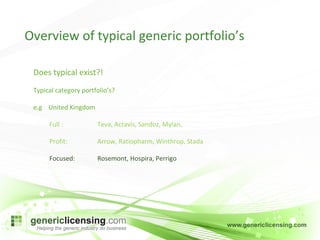
Does typical exist?! Typical category portfolio’s? e.g  United Kingdom Full : Teva, Actavis, Sandoz, Mylan Overview of typical generic portfolio’s
Does typical exist?! Typical category portfolio’s? e.g  United Kingdom Full : Teva, Actavis, Sandoz, Mylan Profit: Arrow, Ratiopharm, Winthrop, Stada Overview of typical generic portfolio’s
Does typical exist?! Typical category portfolio’s? e.g  United Kingdom Full : Teva, Actavis, Sandoz, Mylan, Profit: Arrow, Ratiopharm, Winthrop, Stada Focused: Rosemont, Hospira, Perrigo Overview of typical generic portfolio’s
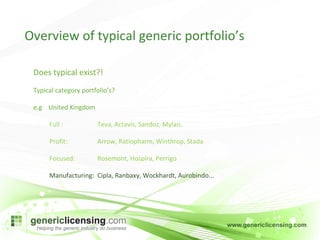
Does typical exist?! Typical category portfolio’s? e.g  United Kingdom Full : Teva, Actavis, Sandoz, Mylan, Profit: Arrow, Ratiopharm, Winthrop, Stada Focused: Rosemont, Hospira, Perrigo Manufacturing: Cipla, Ranbaxy, Wockhardt, Aurobindo... Overview of typical generic portfolio’s
If you were creating a portfolio from scratch... where would you start?! Specifics of portfolio planning for generics
If you were creating a portfolio from scratch... where would you start?! Cash vs Profit Business plan/strategy Cost of entry Available technology Risk of competition Supply chain Specifics of portfolio planning for generics
If you were creating a portfolio from scratch... where would you start?! Cash vs Profit IMS top down Value or volume Level of competition - Same data as everyone! Manufacturing capability Specifics of portfolio planning for generics
If you were creating a portfolio from scratch... where would you start?! Cash vs Profit IMS top down Patent expiries Originator tactics Timing -  First in reaps rewards At risk vs late to the party - Legal costs & expertise COGS vs ASP - Stock vs cash - Loss vs market share Specifics of portfolio planning for generics
If you were creating a portfolio from scratch... where would you start?! Cash vs Profit IMS top down Patent expiries Manufacturing capability Dose forms Biologics Capacity Dedicated units Supply chain Cost Specifics of portfolio planning for generics
If you were creating a portfolio from scratch... where would you start?! Cash vs Profit IMS top down Patent expiries Manufacturing capability Marketing & Distribution Rx or OTC -  Branded or Private Label - Standard or Generic+ Hospital or retail - Wholesale, Multiples, Independent, Online   Positioning - Service, Price, Depth, Speciality, Product Type Specifics of portfolio planning for generics
If you were creating a portfolio from scratch... where would you start?! Cash vs Profit IMS top down Patent expiries Manufacturing capability Marketing & Distribution Copy Competition Which one?! Response Attainability Specifics of portfolio planning for generics
Specifics of portfolio planning for generics Using IMS – Top Generics Top 200 All over $400m Very long tail
Specifics of portfolio planning for generics 1. Fentanyl Launched: January 2005,  2008 sales: $800 million Branded equivalent: Duragesic, by Janssen 2008 sales of $250 million (from $1.1 billion) 2. Amlodipine besylate and benazepril hydrochloride* Launched: July 2007, 2008 sales: $779 million Branded equivalent: Norvasc, by Pfizer 2008 sales <$150m ($1.5 billion) 3. Metoprolol succinate Launched: May 2008, 2008 sales: $675 million Branded equivalent: Toprol, by AstraZeneca 2008 sales <$150m ($807 million) 4. Lamotrigine Launched: February 2005, 2008 sales: $671 million Branded equivalent: Lamictal, by GlaxoSmithKline 2008 sales $1.6 billion  (peak) Using IMS – Top Generics
Specifics of portfolio planning for generics 5. Risperidone Launched: September 2008, 2008 sales: $610 million,  Branded equivalent: Risperdal, by Janssen, 2008 sales $1.5b ($2.1 billion) 6. Omeprazole* Launched: July 2008, 2008 sales: $609.8 million Branded equivalent: Prilosec, by AstraZeneca, 2008 sales $185m ($1.1 billion) 7. Azithromycin Launched: November 2005, 2008 sales: $599 million,  Branded equivalent: Zithromax, by Pfizer, 2008 sales <$150m ($1.7 billion) 8. Bupropion Launched: December 2006, 2008 sales: $521 million Branded equivalent: Wellbutrin, by Biovail, 2008 sales $579 million ($1.7 billion) Using IMS – Top Generics
Specifics of portfolio planning for generics Using IMS – Top Generics Why difference in generic success?  Brand tactics Price match Alternative formulations Effective anti-generic messages Doctor perspective Long term use Activity limits
EXAMPLE : OMEPRAZOLE – US vs UK US - $300m value erosion (25%) UK -  Specifics of portfolio planning for generics
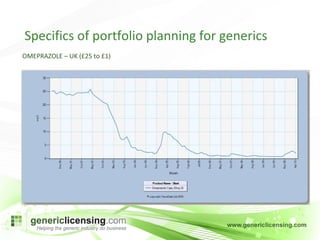
OMEPRAZOLE – UK (£25 to £1) Specifics of portfolio planning for generics
Specifics of portfolio planning for generics Targeting patent expiry of a blockbuster?!
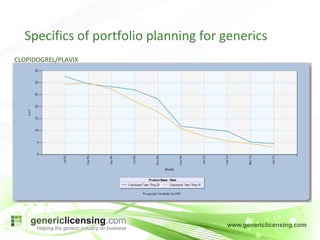
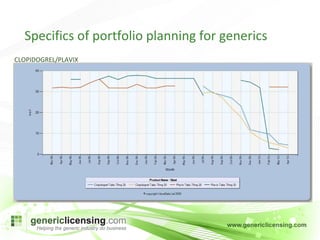
Specifics of portfolio planning for generics CLOPIDOGREL/PLAVIX
Specifics of portfolio planning for generics If you were creating a portfolio from scratch... where would you start?! SUMMARY: Commercial strategy Profit or volume Market strategy Distribution channels Classification type Manufacturing capability Product type Legal & Regulatory expertise Patent expiry vs long tail
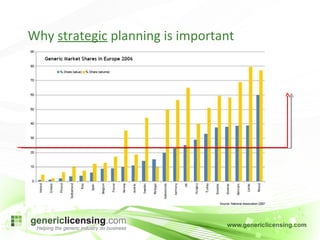
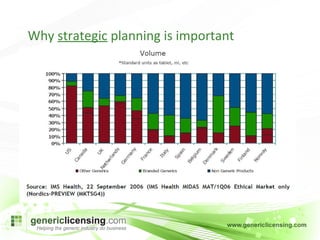
Why  strategic  planning is important
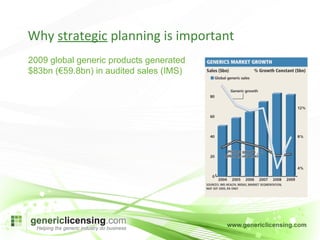
Why  strategic  planning is important 2009 global generic products generated $83bn (€59.8bn) in audited sales (IMS)
Why  strategic  planning is important 2009 global generic products generated $83bn (€59.8bn) in audited sales (IMS)  In the $59bn global generics market in  developed  countries, Japan only accounts for 6%, while the US holds 42%, and five major European national markets account for 23%.  BCC estimates the global market to reach $129.3bn by 2014, representing a 9% annual growth rate.
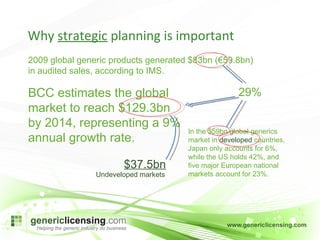
Why  strategic  planning is important 2009 global generic products generated $83bn (€59.8bn) in audited sales, according to IMS.  In the $59bn global generics market in  developed  countries, Japan only accounts for 6%, while the US holds 42%, and five major European national markets account for 23%.  BCC estimates the global market to reach $129.3bn by 2014, representing a 9% annual growth rate. 29% $37.5bn Undeveloped markets
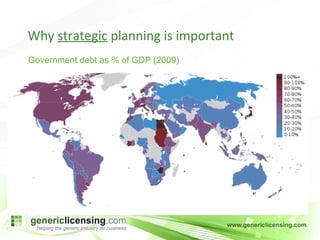
Why  strategic  planning is important Government debt as % of GDP (2009)
Why  strategic  planning is important
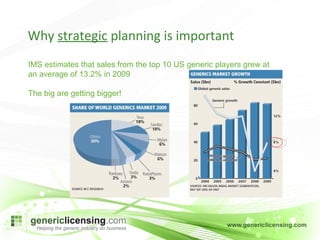
Why  strategic  planning is important IMS estimates that sales from the top 10 US generic players grew at an average of 13.2% in 2009 The big are getting bigger!
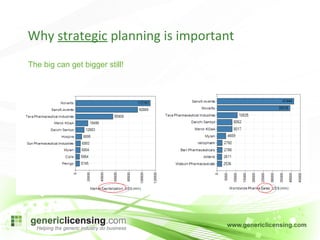
Why  strategic  planning is important The big can get bigger still!
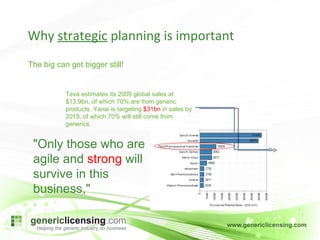
Why  strategic  planning is important The big can get bigger still! &quot;Only those who are agile and  strong  will survive in this business,&quot; said Teva president and CEO Shlomo Yanai during the company's investor meeting last month in Jerusalem.  &quot;About 15% of our business will come from  acquisitions . We are taking the necessary steps and building our infrastructure by getting assets and know-how either internally, through acquisition or partnerships.&quot; Teva estimates its 2009 global sales at $13.9bn, of which 70% are from generic products. Yanai is targeting  $31bn in sales by 2015 , of which 70% will still come from generics.
Why  strategic  planning is important The big can get bigger still! Teva estimates its 2009 global sales at $13.9bn, of which 70% are from generic products. Yanai is targeting  $31bn  in sales by 2015, of which 70% will still come from generics. &quot;Only those who are agile and  strong  will survive in this business,&quot;
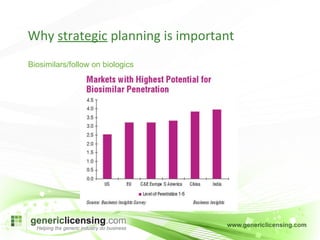
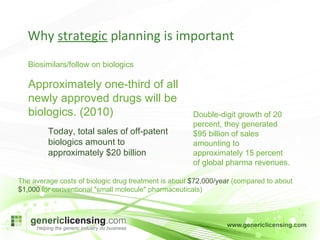
Why  strategic  planning is important Biosimilars/follow on biologics Approximately one-third of all newly approved drugs will be biologics. (2010)  Double-digit growth of 20 percent, they generated $95 billion of sales amounting to approximately 15 percent of global pharma revenues. Today, total sales of off-patent biologics amount to approximately $20 billion The average costs of biologic drug treatment is about  $72,000/year  (compared to about  $1,000  for conventional &quot;small molecule&quot; pharmaceuticals)
Why  strategic  planning is important
Why  strategic  planning is important Biosimilars/follow on biologics
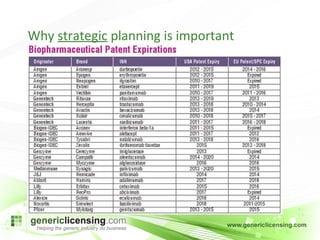
Why  strategic  planning is important The patent cliff: 2010-15  Of total pharmaceutical sales in 2008 of $643.6bn, a staggering  30%  were derived from patented products which are  “at risk”  from generic competition within five years, almost double the percentage at risk in 2000 of 17%. Whilst the industry has already started its slide, the patent cliff becomes seriously precipitous in 2010 when  9%, or $57.5bn , of total market sales are expected to lose patent protection within the space of  12 months
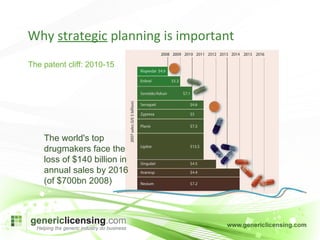
Why  strategic  planning is important The patent cliff: 2010-15  The world's top drugmakers face the loss of $140 billion in annual sales by 2016 (of $700bn 2008)
Why  strategic  planning is important The patent cliff: 2010-15  Inhalation market Approximately  50% of the current $32 billion  global market segment for asthma and COPD medicines is expected to  lose patent  protection by the  end of 2016 , according to industry analysts IMS Health. The asthma and COPD market segment is projected to grow significantly faster than the pharmaceutical market, driven by factors including a significant level of under-diagnosis, and Novartis/Sandoz will hope this acquisition will gain them a large market share in the future. Sandoz has signed a definitive agreement to acquire Oriel Therapeutics, a privately held US pharmaceuticals company, gaining exclusive rights to a portfolio of generic drug candidates and related technologies targeting medicines in the inhalable respiratory drug market.  Holzkirchen, Germany, April 19, 2010
Why  strategic  planning is important The patent cliff: 2010-15  &quot;There is still room to grow in generics,&quot; says Yanai (TEVA). &quot; Almost $150bn of branded drugs are going to be off patent in the next five years . This does not include the expiration of  biologics , which is an additional  $50bn  potential.”
Overview of typical generic portfolio’s The patent cliff: 2010-15 Whats the big pharma plan? More investment in R&D? Clever anti-generic tactics? Switch out before expiry strategies? Increase legal spend on ever-greening patents? Big budget advertising in BRIC markets?
The patent cliff: 2010-15.  Whats the big pharma plan? Astra Zeneca  announced today that it has agreed to market 18 of Torrent Pharmaceuticals Ltd.’s  branded generic drugs in 9 emerging markets , marking the U.K. drugmaker’s first generic-drug partnership. Unlike some its competitors, Astra Zeneca is very vulnerable to generic competition as many of its best selling products such as Nexium for ulcers, the antipsychotic Seroquel and Crestor for cholesterol. are near patent expiry. Industry analysts expect the company to  lose as much as 25% of its sales revenue to generic encroachment by 2014. Why  strategic  planning is important
The patent cliff: 2010-15.  Whats the big pharma plan? Sanofi-Aventis  bought  Zentiva  NV of the Czech Republic,  Helvepharm  AG of Switzerland,  Medley  SA of Brazil and Laboratorios  Kendrick  SA of Mexico to bolster its  branded generics  portfolio.  Why  strategic  planning is important
The patent cliff: 2010-15.  Whats the big pharma plan? “ Generics are an important part of the health care system.  ?????  believes that when there is a direct generic equivalent to the prescribed brand name drug, it should be used provided the doctor agrees it is best for the patient.” Why  strategic  planning is important
The patent cliff: 2010-15.  Whats the big pharma plan? “ Generics are an important part of the health care system.  Pfizer  believes that when there is a direct generic equivalent to the prescribed brand name drug, it should be used provided the doctor agrees it is best for the patient.” http://www.pfizer.com/about/public_policy/generics.jsp Why  strategic  planning is important
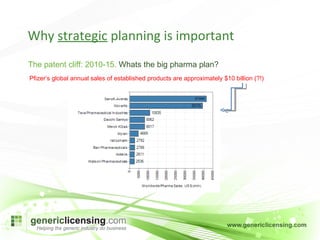
The patent cliff: 2010-15.  Whats the big pharma plan? NEW YORK, March 18 (Reuters) -  Pfizer  Inc ( PFE.N ) may still be eager to buy  generic  drugmakers, after being outbid for Germany's  Ratiopharm  in an effort to shore up revenue as it braces for evaporating sales of its blockbuster Lipitor cholesterol treatment. Pfizer’s expanded agreements with  Aurobindo  Pharma Ltd. will grow its  generic  product portfolio within emerging markets to reflect the diverse and often unique market dynamics and commercial interests of more than 70 countries. Pfizer entered into agreements with  Claris  Lifesciences Ltd. (“Claris”) to commercialize sterile injectable medicines after the products are  no longer patent protected , and have lost market exclusivity in North America, Europe, Australia and New Zealand. The Claris agreements advance Pfizer’s Established Products strategy, which focuses on the commercialization of products where market exclusivity has been lost.  Pfizer’s global annual sales of established products are approximately $10 billion. Why  strategic  planning is important
The patent cliff: 2010-15.  Whats the big pharma plan? Pfizer’s global annual sales of established products are approximately $10 billion (?!) Why  strategic  planning is important
The patent cliff: 2010-15.  Whats the big pharma plan? Last year,  GlaxoSmithKline  entered into joint ventures with the  generic  manufacturers  Dr. Reddy’s Laboratories  (India) and  Aspen Pharmacare  Ltd (South Africa).  Also, the company paid $246.5 million for Bristol-Myers Squibb’s Pakistan and Egypt drug units and acquired UCB’s drug portfolio in Africa, the Middle East, Asia Pacific and Latin America for $702 million; clearing signaling its intention to more aggressively pursue  emerging global markets . Why  strategic  planning is important
Why strategic planning is important SUMMARY : What is the future going to look like?! 5 year high growth window Major player strength & depth Biologics Big pharma entering generics
Introduction to sourcing from 3rd parties Creating the portfolio – why look outside Manufacturing constraints Development capability Time to revenue  Financial status Product mix Country/region specific products Tactical & strategic relationships Strong and agile Teva in-licenses 30% of products!
Introduction to sourcing from 3rd parties Creating the portfolio –  where to look Emerging markets EU ascension states High Tech Far East (Korea, Taiwan) Well developed Latin America Online New databases Forums and discussion groups Virtual partnering events
Introduction to sourcing from 3rd parties Creating the portfolio –  considerations Partner Selection Commercial relationship model Quality and consistency of supply Long term cost position Partner’s ambitions Beware… Regulatory expertise  Number of dossiers/licenses sold IP ownership and supply chain flexibility
Summary What type of portfolio do you want? - Selecting generic products isn’t easy - Why strategic planning is important for generic companies The other option; in-license & partner That is why strategy and planning for generic portfolio’s is required!

Strategic generic portfolio selection may 12th 2010

  • 1.
    Asa Cox Foundergenericlicensing.com Strategic Portfolio Planning for Generic Drugs May 12, 2010
  • 2.
    - 13 yearsin generics Manufacturing, Development, Licensing, Consulting - International projects - Online networker - Web business 2.0 believer About me
  • 3.
    Overview of typicalgeneric portfolio’s - Specifics of portfolio planning for generics - Why strategic planning is important for generic companies Introduction to sourcing generic products from 3rd parties Aim: To understand why strategy and planning for generic portfolio’s is required! Topics
  • 4.
    Does typical exist?!Country variables: Demographic Population Market development Local players Drug provision policy Generic incentives Economy Overview of typical generic portfolio’s
  • 5.
    Does typical exist?!Typical category portfolio’s? e.g United Kingdom Overview of typical generic portfolio’s
  • 6.
    Does typical exist?!Typical category portfolio’s? e.g United Kingdom Full : Teva, Actavis, Sandoz, Mylan Overview of typical generic portfolio’s
  • 7.
    Does typical exist?!Typical category portfolio’s? e.g United Kingdom Full : Teva, Actavis, Sandoz, Mylan Profit: Arrow, Ratiopharm, Winthrop, Stada Overview of typical generic portfolio’s
  • 8.
    Does typical exist?!Typical category portfolio’s? e.g United Kingdom Full : Teva, Actavis, Sandoz, Mylan, Profit: Arrow, Ratiopharm, Winthrop, Stada Focused: Rosemont, Hospira, Perrigo Overview of typical generic portfolio’s
  • 9.
    Does typical exist?!Typical category portfolio’s? e.g United Kingdom Full : Teva, Actavis, Sandoz, Mylan, Profit: Arrow, Ratiopharm, Winthrop, Stada Focused: Rosemont, Hospira, Perrigo Manufacturing: Cipla, Ranbaxy, Wockhardt, Aurobindo... Overview of typical generic portfolio’s
  • 10.
    If you werecreating a portfolio from scratch... where would you start?! Specifics of portfolio planning for generics
  • 11.
    If you werecreating a portfolio from scratch... where would you start?! Cash vs Profit Business plan/strategy Cost of entry Available technology Risk of competition Supply chain Specifics of portfolio planning for generics
  • 12.
    If you werecreating a portfolio from scratch... where would you start?! Cash vs Profit IMS top down Value or volume Level of competition - Same data as everyone! Manufacturing capability Specifics of portfolio planning for generics
  • 13.
    If you werecreating a portfolio from scratch... where would you start?! Cash vs Profit IMS top down Patent expiries Originator tactics Timing - First in reaps rewards At risk vs late to the party - Legal costs & expertise COGS vs ASP - Stock vs cash - Loss vs market share Specifics of portfolio planning for generics
  • 14.
    If you werecreating a portfolio from scratch... where would you start?! Cash vs Profit IMS top down Patent expiries Manufacturing capability Dose forms Biologics Capacity Dedicated units Supply chain Cost Specifics of portfolio planning for generics
  • 15.
    If you werecreating a portfolio from scratch... where would you start?! Cash vs Profit IMS top down Patent expiries Manufacturing capability Marketing & Distribution Rx or OTC - Branded or Private Label - Standard or Generic+ Hospital or retail - Wholesale, Multiples, Independent, Online Positioning - Service, Price, Depth, Speciality, Product Type Specifics of portfolio planning for generics
  • 16.
    If you werecreating a portfolio from scratch... where would you start?! Cash vs Profit IMS top down Patent expiries Manufacturing capability Marketing & Distribution Copy Competition Which one?! Response Attainability Specifics of portfolio planning for generics
  • 17.
    Specifics of portfolioplanning for generics Using IMS – Top Generics Top 200 All over $400m Very long tail
  • 18.
    Specifics of portfolioplanning for generics 1. Fentanyl Launched: January 2005, 2008 sales: $800 million Branded equivalent: Duragesic, by Janssen 2008 sales of $250 million (from $1.1 billion) 2. Amlodipine besylate and benazepril hydrochloride* Launched: July 2007, 2008 sales: $779 million Branded equivalent: Norvasc, by Pfizer 2008 sales <$150m ($1.5 billion) 3. Metoprolol succinate Launched: May 2008, 2008 sales: $675 million Branded equivalent: Toprol, by AstraZeneca 2008 sales <$150m ($807 million) 4. Lamotrigine Launched: February 2005, 2008 sales: $671 million Branded equivalent: Lamictal, by GlaxoSmithKline 2008 sales $1.6 billion (peak) Using IMS – Top Generics
  • 19.
    Specifics of portfolioplanning for generics 5. Risperidone Launched: September 2008, 2008 sales: $610 million, Branded equivalent: Risperdal, by Janssen, 2008 sales $1.5b ($2.1 billion) 6. Omeprazole* Launched: July 2008, 2008 sales: $609.8 million Branded equivalent: Prilosec, by AstraZeneca, 2008 sales $185m ($1.1 billion) 7. Azithromycin Launched: November 2005, 2008 sales: $599 million, Branded equivalent: Zithromax, by Pfizer, 2008 sales <$150m ($1.7 billion) 8. Bupropion Launched: December 2006, 2008 sales: $521 million Branded equivalent: Wellbutrin, by Biovail, 2008 sales $579 million ($1.7 billion) Using IMS – Top Generics
  • 20.
    Specifics of portfolioplanning for generics Using IMS – Top Generics Why difference in generic success? Brand tactics Price match Alternative formulations Effective anti-generic messages Doctor perspective Long term use Activity limits
  • 21.
    EXAMPLE : OMEPRAZOLE– US vs UK US - $300m value erosion (25%) UK - Specifics of portfolio planning for generics
  • 22.
    OMEPRAZOLE – UK(£25 to £1) Specifics of portfolio planning for generics
  • 23.
    Specifics of portfolioplanning for generics Targeting patent expiry of a blockbuster?!
  • 24.
    Specifics of portfolioplanning for generics CLOPIDOGREL/PLAVIX
  • 25.
    Specifics of portfolioplanning for generics CLOPIDOGREL/PLAVIX
  • 26.
    Specifics of portfolioplanning for generics If you were creating a portfolio from scratch... where would you start?! SUMMARY: Commercial strategy Profit or volume Market strategy Distribution channels Classification type Manufacturing capability Product type Legal & Regulatory expertise Patent expiry vs long tail
  • 27.
    Why strategic planning is important
  • 28.
    Why strategic planning is important 2009 global generic products generated $83bn (€59.8bn) in audited sales (IMS)
  • 29.
    Why strategic planning is important 2009 global generic products generated $83bn (€59.8bn) in audited sales (IMS) In the $59bn global generics market in developed countries, Japan only accounts for 6%, while the US holds 42%, and five major European national markets account for 23%. BCC estimates the global market to reach $129.3bn by 2014, representing a 9% annual growth rate.
  • 30.
    Why strategic planning is important 2009 global generic products generated $83bn (€59.8bn) in audited sales, according to IMS. In the $59bn global generics market in developed countries, Japan only accounts for 6%, while the US holds 42%, and five major European national markets account for 23%. BCC estimates the global market to reach $129.3bn by 2014, representing a 9% annual growth rate. 29% $37.5bn Undeveloped markets
  • 31.
    Why strategic planning is important Government debt as % of GDP (2009)
  • 32.
    Why strategic planning is important
  • 33.
    Why strategic planning is important
  • 34.
    Why strategic planning is important IMS estimates that sales from the top 10 US generic players grew at an average of 13.2% in 2009 The big are getting bigger!
  • 35.
    Why strategic planning is important The big can get bigger still!
  • 36.
    Why strategic planning is important The big can get bigger still! &quot;Only those who are agile and strong will survive in this business,&quot; said Teva president and CEO Shlomo Yanai during the company's investor meeting last month in Jerusalem. &quot;About 15% of our business will come from acquisitions . We are taking the necessary steps and building our infrastructure by getting assets and know-how either internally, through acquisition or partnerships.&quot; Teva estimates its 2009 global sales at $13.9bn, of which 70% are from generic products. Yanai is targeting $31bn in sales by 2015 , of which 70% will still come from generics.
  • 37.
    Why strategic planning is important The big can get bigger still! Teva estimates its 2009 global sales at $13.9bn, of which 70% are from generic products. Yanai is targeting $31bn in sales by 2015, of which 70% will still come from generics. &quot;Only those who are agile and strong will survive in this business,&quot;
  • 38.
    Why strategic planning is important Biosimilars/follow on biologics Approximately one-third of all newly approved drugs will be biologics. (2010)  Double-digit growth of 20 percent, they generated $95 billion of sales amounting to approximately 15 percent of global pharma revenues. Today, total sales of off-patent biologics amount to approximately $20 billion The average costs of biologic drug treatment is about $72,000/year (compared to about $1,000 for conventional &quot;small molecule&quot; pharmaceuticals)
  • 39.
    Why strategic planning is important
  • 40.
    Why strategic planning is important Biosimilars/follow on biologics
  • 41.
    Why strategic planning is important The patent cliff: 2010-15 Of total pharmaceutical sales in 2008 of $643.6bn, a staggering 30% were derived from patented products which are “at risk” from generic competition within five years, almost double the percentage at risk in 2000 of 17%. Whilst the industry has already started its slide, the patent cliff becomes seriously precipitous in 2010 when 9%, or $57.5bn , of total market sales are expected to lose patent protection within the space of 12 months
  • 42.
    Why strategic planning is important The patent cliff: 2010-15 The world's top drugmakers face the loss of $140 billion in annual sales by 2016 (of $700bn 2008)
  • 43.
    Why strategic planning is important The patent cliff: 2010-15 Inhalation market Approximately 50% of the current $32 billion global market segment for asthma and COPD medicines is expected to lose patent protection by the end of 2016 , according to industry analysts IMS Health. The asthma and COPD market segment is projected to grow significantly faster than the pharmaceutical market, driven by factors including a significant level of under-diagnosis, and Novartis/Sandoz will hope this acquisition will gain them a large market share in the future. Sandoz has signed a definitive agreement to acquire Oriel Therapeutics, a privately held US pharmaceuticals company, gaining exclusive rights to a portfolio of generic drug candidates and related technologies targeting medicines in the inhalable respiratory drug market. Holzkirchen, Germany, April 19, 2010
  • 44.
    Why strategic planning is important The patent cliff: 2010-15 &quot;There is still room to grow in generics,&quot; says Yanai (TEVA). &quot; Almost $150bn of branded drugs are going to be off patent in the next five years . This does not include the expiration of biologics , which is an additional $50bn potential.”
  • 45.
    Overview of typicalgeneric portfolio’s The patent cliff: 2010-15 Whats the big pharma plan? More investment in R&D? Clever anti-generic tactics? Switch out before expiry strategies? Increase legal spend on ever-greening patents? Big budget advertising in BRIC markets?
  • 46.
    The patent cliff:2010-15. Whats the big pharma plan? Astra Zeneca announced today that it has agreed to market 18 of Torrent Pharmaceuticals Ltd.’s branded generic drugs in 9 emerging markets , marking the U.K. drugmaker’s first generic-drug partnership. Unlike some its competitors, Astra Zeneca is very vulnerable to generic competition as many of its best selling products such as Nexium for ulcers, the antipsychotic Seroquel and Crestor for cholesterol. are near patent expiry. Industry analysts expect the company to lose as much as 25% of its sales revenue to generic encroachment by 2014. Why strategic planning is important
  • 47.
    The patent cliff:2010-15. Whats the big pharma plan? Sanofi-Aventis bought Zentiva NV of the Czech Republic, Helvepharm AG of Switzerland, Medley SA of Brazil and Laboratorios Kendrick SA of Mexico to bolster its branded generics portfolio. Why strategic planning is important
  • 48.
    The patent cliff:2010-15. Whats the big pharma plan? “ Generics are an important part of the health care system. ????? believes that when there is a direct generic equivalent to the prescribed brand name drug, it should be used provided the doctor agrees it is best for the patient.” Why strategic planning is important
  • 49.
    The patent cliff:2010-15. Whats the big pharma plan? “ Generics are an important part of the health care system. Pfizer believes that when there is a direct generic equivalent to the prescribed brand name drug, it should be used provided the doctor agrees it is best for the patient.” http://www.pfizer.com/about/public_policy/generics.jsp Why strategic planning is important
  • 50.
    The patent cliff:2010-15. Whats the big pharma plan? NEW YORK, March 18 (Reuters) - Pfizer Inc ( PFE.N ) may still be eager to buy generic drugmakers, after being outbid for Germany's Ratiopharm in an effort to shore up revenue as it braces for evaporating sales of its blockbuster Lipitor cholesterol treatment. Pfizer’s expanded agreements with Aurobindo Pharma Ltd. will grow its generic product portfolio within emerging markets to reflect the diverse and often unique market dynamics and commercial interests of more than 70 countries. Pfizer entered into agreements with Claris Lifesciences Ltd. (“Claris”) to commercialize sterile injectable medicines after the products are no longer patent protected , and have lost market exclusivity in North America, Europe, Australia and New Zealand. The Claris agreements advance Pfizer’s Established Products strategy, which focuses on the commercialization of products where market exclusivity has been lost. Pfizer’s global annual sales of established products are approximately $10 billion. Why strategic planning is important
  • 51.
    The patent cliff:2010-15. Whats the big pharma plan? Pfizer’s global annual sales of established products are approximately $10 billion (?!) Why strategic planning is important
  • 52.
    The patent cliff:2010-15. Whats the big pharma plan? Last year, GlaxoSmithKline entered into joint ventures with the generic manufacturers Dr. Reddy’s Laboratories (India) and Aspen Pharmacare Ltd (South Africa). Also, the company paid $246.5 million for Bristol-Myers Squibb’s Pakistan and Egypt drug units and acquired UCB’s drug portfolio in Africa, the Middle East, Asia Pacific and Latin America for $702 million; clearing signaling its intention to more aggressively pursue emerging global markets . Why strategic planning is important
  • 53.
    Why strategic planningis important SUMMARY : What is the future going to look like?! 5 year high growth window Major player strength & depth Biologics Big pharma entering generics
  • 54.
    Introduction to sourcingfrom 3rd parties Creating the portfolio – why look outside Manufacturing constraints Development capability Time to revenue Financial status Product mix Country/region specific products Tactical & strategic relationships Strong and agile Teva in-licenses 30% of products!
  • 55.
    Introduction to sourcingfrom 3rd parties Creating the portfolio – where to look Emerging markets EU ascension states High Tech Far East (Korea, Taiwan) Well developed Latin America Online New databases Forums and discussion groups Virtual partnering events
  • 56.
    Introduction to sourcingfrom 3rd parties Creating the portfolio – considerations Partner Selection Commercial relationship model Quality and consistency of supply Long term cost position Partner’s ambitions Beware… Regulatory expertise Number of dossiers/licenses sold IP ownership and supply chain flexibility
  • 57.
    Summary What typeof portfolio do you want? - Selecting generic products isn’t easy - Why strategic planning is important for generic companies The other option; in-license & partner That is why strategy and planning for generic portfolio’s is required!