grk
Welcome
To a Presentation on
Strategic Financial
Management
GRKMurty
grk
Financial Management:
Objectives
• Maximization of shareholder
value
–Maximization of value added
–Maximization of return on
investment
grk
Strategy
• Top Managements Plans to attain
outcomes consistent with the
organization’s missions and goals
• “a pattern in a stream of
decisions”
• Formulation & reformulation is a
continuous process
grk
Strategy: Its Five “Ps”
• It is a Plan
• It is a Pattern
• It is a Position
• It is a Perspective
• It is a Ploy
grk
Strategy: Advantages &
Disadvantages
• Sets Direction
• Focuses effort
• Defines the Organization
• Provides Consistency
grk
Strategy:Areas of agreement
• Strategy concerns both organizations and
environment
• The substance of strategy is complex
• Affects overall welfare of the organization
• Involves issues of both content and process
• Not purely deliberate
• Exist on different levels
• Involves various thought processes
grk
The Five Forces Model
grk
New Entrants
• What are the barriers to entry?
– Can it be raised ?
– What is tending to lower the barriers?
• Who are the potential new entrants?
– What are their Characteristics?
• What could be their competitive
strategies?
– How are they likely to reshape the industry?
• When will they enter?
grk
Suppliers
• Are Suppliers concentrated ?
• How concentrated are the buyers?
• Can suppliers be switched freely?
• How large are their productions?
• How important the product is for the output
quality?
• Percentage cost ?
• What is their bargaining power?
grk
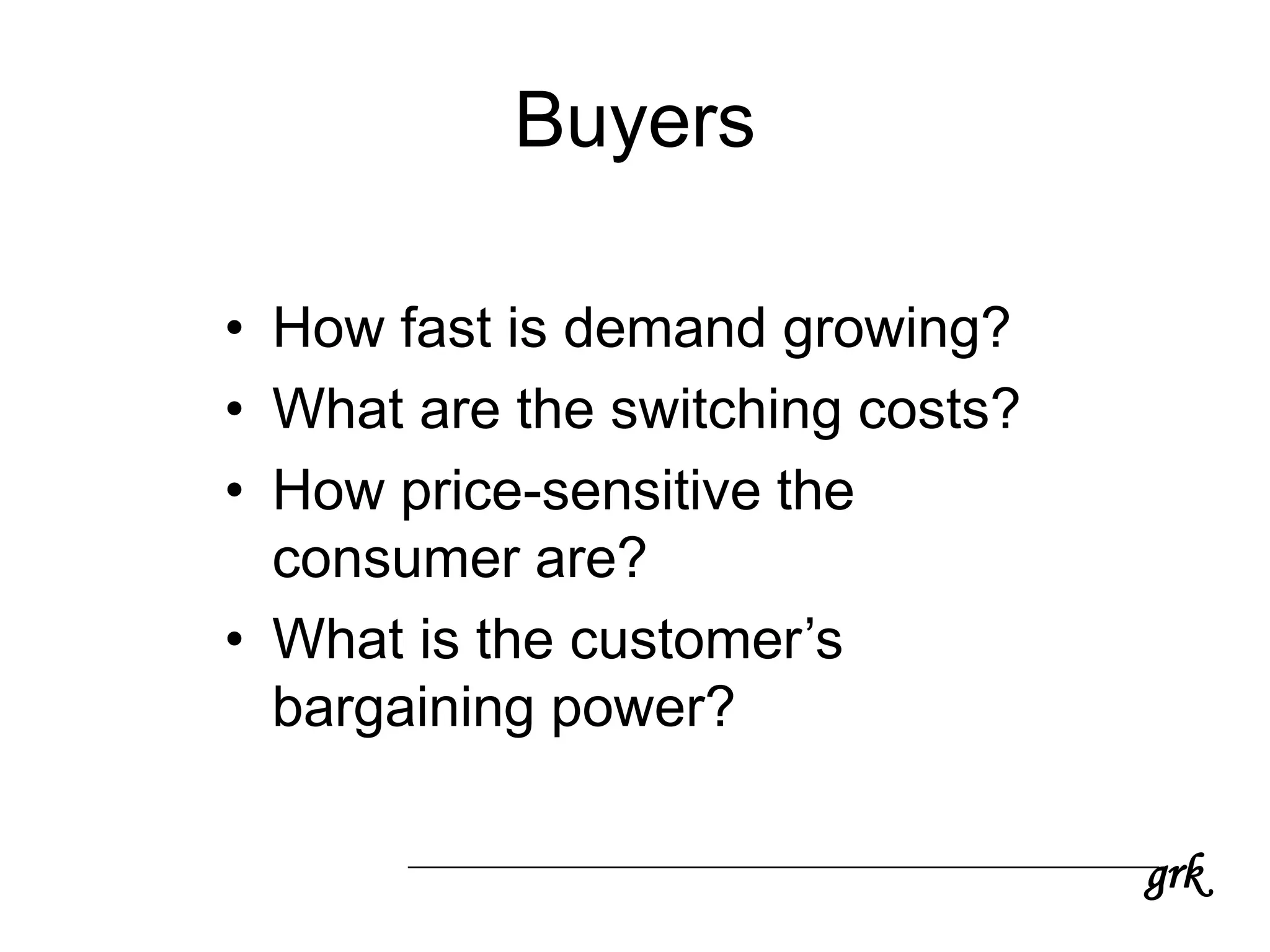
Buyers
• How fast is demand growing?
• What are the switching costs?
• How price-sensitive the
consumer are?
• What is the customer’s
bargaining power?
grk
Substitutes
• What are the alternatives?
• What could be their impact?
• How quickly they can penetrate?
• Are there any players in the
industry, who considers substitute
as an opportunity for diversification?
grk
Industry Competitors
• Who are the major competitors?
• What are their basic characteristics?
• Relative Positions?
• What is the competitive advantage of each of
them?
• How do they compete?
• What form does competition take?
• How is product differentiation achieved?
• How competitive is the industry?
grk
Porter’s “Structure-conduct-
performance”
• Structure will impact conduct or
competitive behaviour
• Conduct of firms will influence average
performance of firms
• As intensity of forces increases,
environment becomes more hostile &
overall industry profit will decline.
grk
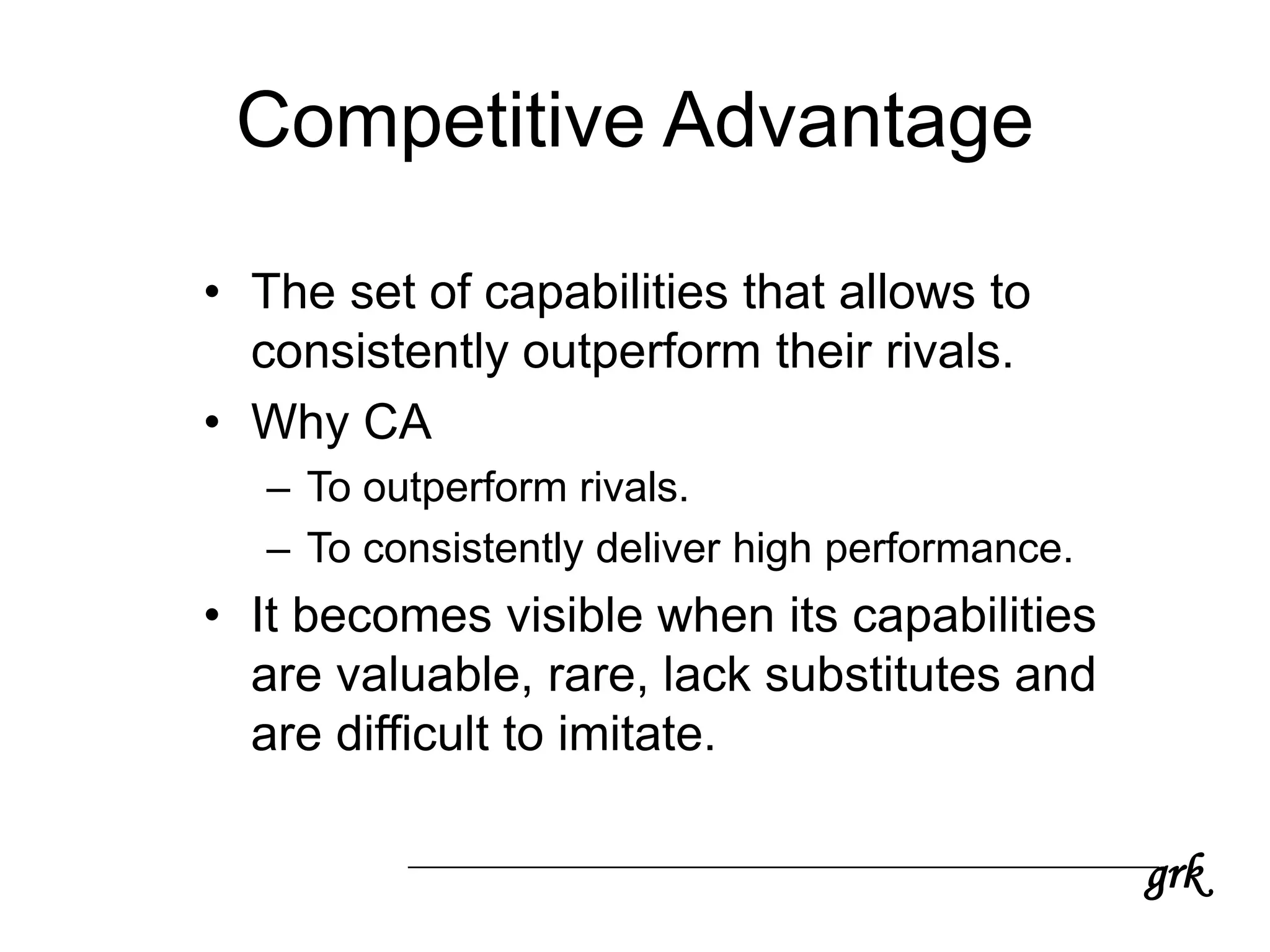
Competitive Advantage
• The set of capabilities that allows to
consistently outperform their rivals.
• Why CA
– To outperform rivals.
– To consistently deliver high performance.
• It becomes visible when its capabilities
are valuable, rare, lack substitutes and
are difficult to imitate.
grk
Factors that Build Competitive
Advantage
• Time
• Building on Fast success
• Interconnectedness of
capabilities.
• Investment
• Causal Ambiguity
grk
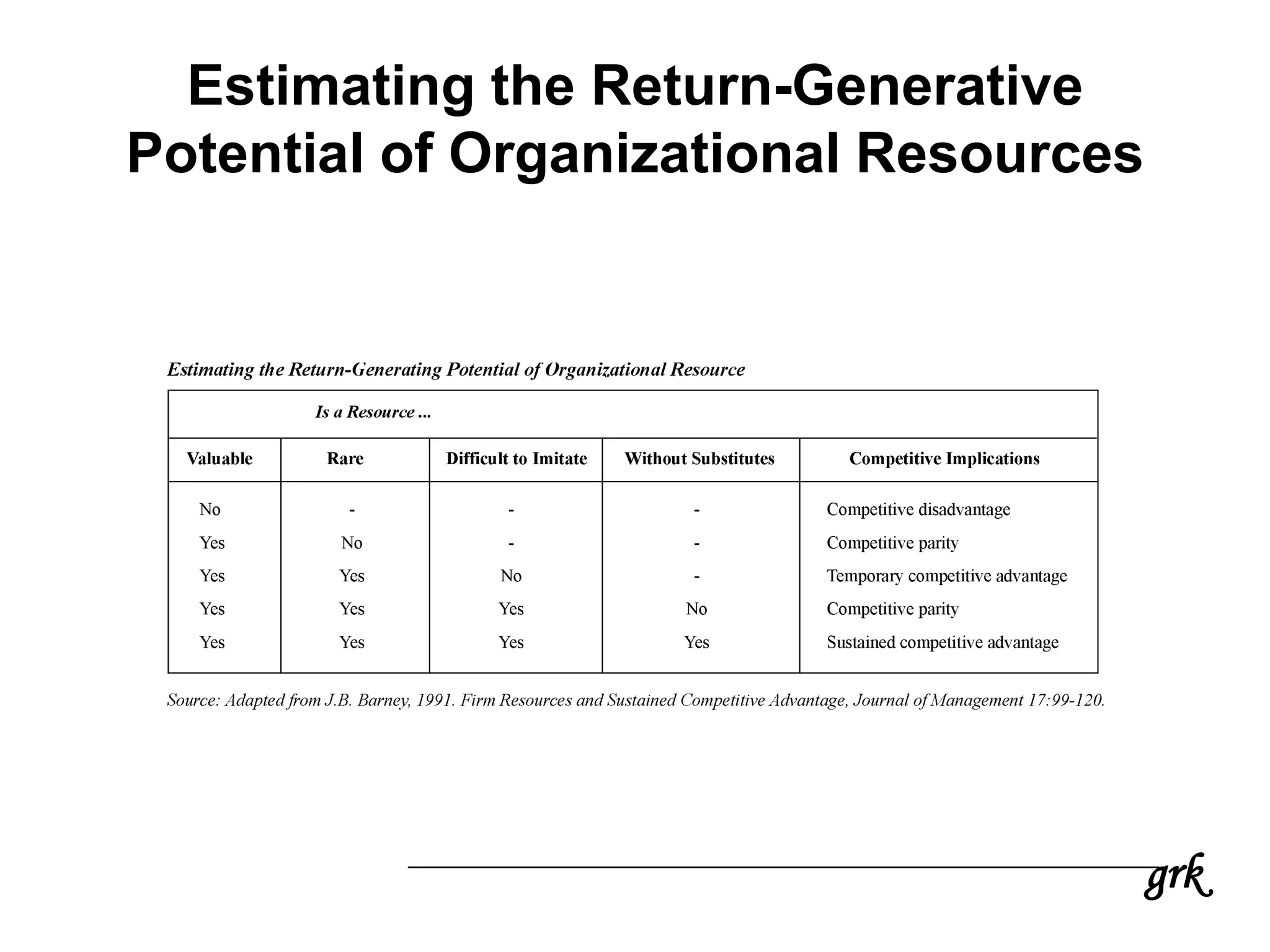
Estimating the Return-Generative
Potential of Organizational Resources
grk
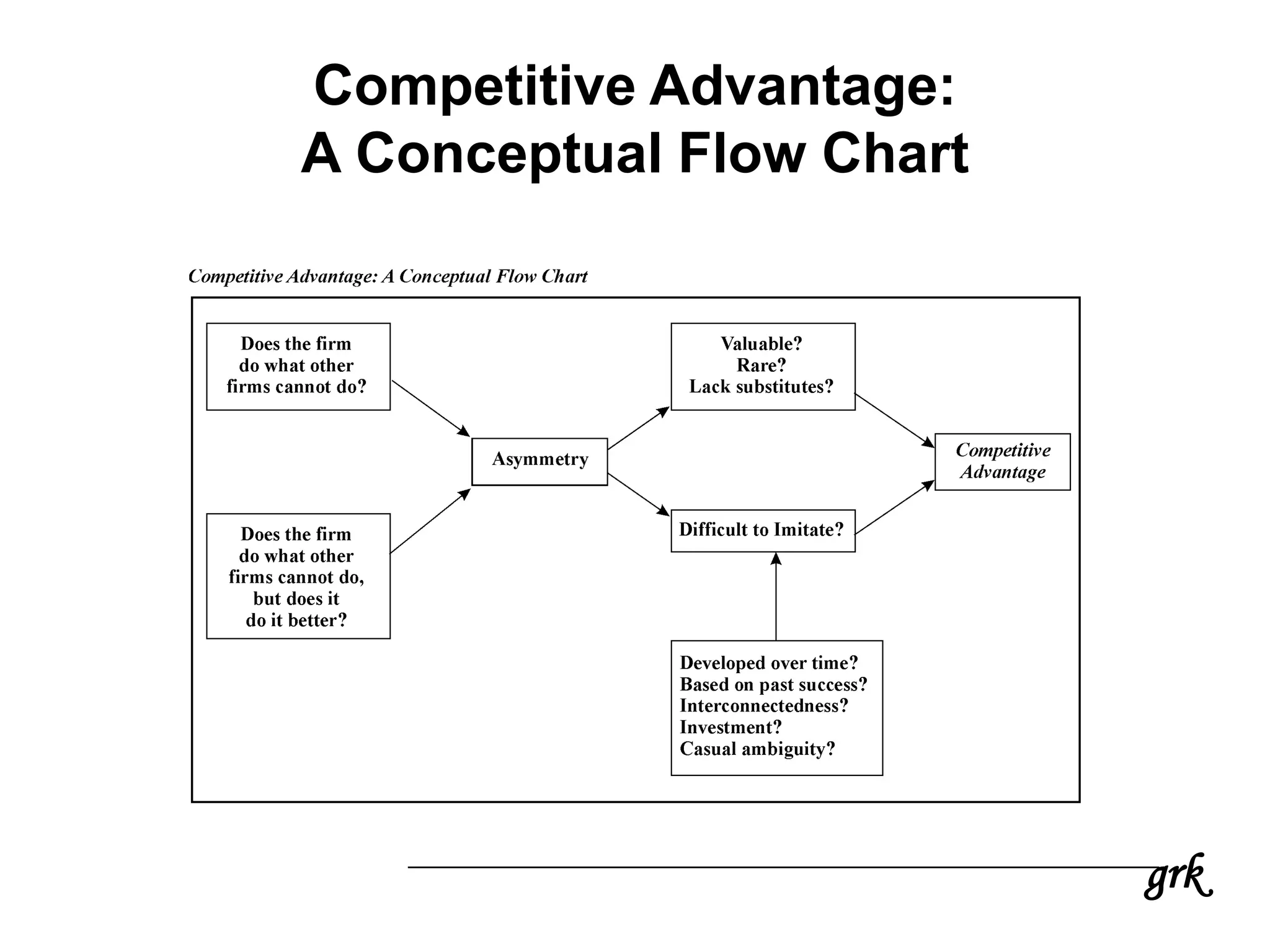
Competitive Advantage:
A Conceptual Flow Chart
grk
Distinction Between Content
and Process
• Strategy – What?
• Process – How?
• What – It is visible to rivals
• How – It is not Visible to
outsiders?
grk
Value Innovation Strategy
• Creation of a blue ocean and a break from the
competition
• Pursues differentiation and low cost simultaneously
• It is a whole system approach which affects both its
cost structure and its value preposition to buyers
• The whole system of firm’s activities are aligned to
the pursuit of differentiation and low cost
• Thus creates uncontested market space
• Makes competition irrelevant
grk
Principles of Blue Ocean Strategy
• Formulation principles
– Reconstruct market boundaries
– Focus on the big picture, not the numbers
– Reach beyond existing demand
– Get the strategic sequence right
• Execution principles
– Overcome key organizational hurdles
– Build execution into strategy
grk
Principles of Blue Ocean Strategy
• Risk Factor each principle attenuates
Search risk
Planning risk
Scale risk
Business model risk
• Risk factor each principle attenuates
Organizational risk
Management risk
grk
Strategic Financial Management
• Mergers and acquisitions
– Risky
– Valuations
– Integration
• Financial risk management
– Credit risk
– Market risk
• Interest rate risk
• Currency risk
• Equity risk
– Liquidity risk
• Linking financial performance with corporate strategy
– EVA
– Strategic cost management
grk
Elements of Financial Policy
• Mix of classes of capital
• Maturity structure of the capital
• Basis of the firm’s coupon and
dividend payments
• Currency
• Exotica
• External control
• Distribution
grk
Diagnosing FP Opportunities and
Problems
• Were these the right choices?
– Does it create value?
– Does it create competitive advantage?
– Does it sustain the vision?
grk
Diagnosing FP Opportunities and
Problems
Elements of
Financial
Structure
Current
Structure
Investor
View
Competito
r view
Internal
view
Evaluation
Mix
Maturity
Basis
Currency
Exotica
External
Control
Distribution
grk
Analysis from Investor’s View
• Investor’s expectations should define
decisions
• Leverage that simultaneously
minimizes the weighted-average cost
of capital and maximizes the share
price and value of the enterprise.
grk
Think like an Investor
• Cost of debt
• Cost of Equity
• Debt/Equity mix
• P/E ratio
• M/Book ratio
• EBIT multiple
• Bond rating
• Ownership
• Short portion
grk
From a Competitor’s Perspective
• Standard Practice
• Strategic Position
– Define the universe of competitors
– Financial ratios
– Identify similarities and differences
– Foreign companies data
– Historical Normalization
– Deliberate
grk
Important Measures for Comparison
• Size
• ROA
• Shareholder Wealth
• Predictability
• Growth
• Financial Flexibility
• Others
grk
From an Internal Perspective
• Financial Flexibility
– Excess cash + (Debt at minimum rating – Current
Debt outstanding)
• Sustainability
– ROE x (1-DPO)
• De Pont system of ratios
– ROE = P/S x S/A x A/E
• Financial-leverage equation
– ROE = [ROTC + (ROTC – Ka) x (D/E)]
• Feasibility
grk
What is Best?
• Flexibility
• Risk
• Income
• Control
• Timing
grk
Developing Financial Strategy
Developing a Strategy
Investor view Competitor view Internal View
Current & Idealized
Financial Policies
Influences regarding Financial
Policy (through FRICT)
Identification of Opportunities to
improve current Financial Structure

Strategic Financial Management

  • 1.
    grk Welcome To a Presentationon Strategic Financial Management GRKMurty
  • 2.
    grk Financial Management: Objectives • Maximizationof shareholder value –Maximization of value added –Maximization of return on investment
  • 3.
    grk Strategy • Top ManagementsPlans to attain outcomes consistent with the organization’s missions and goals • “a pattern in a stream of decisions” • Formulation & reformulation is a continuous process
  • 4.
    grk Strategy: Its Five“Ps” • It is a Plan • It is a Pattern • It is a Position • It is a Perspective • It is a Ploy
  • 5.
    grk Strategy: Advantages & Disadvantages •Sets Direction • Focuses effort • Defines the Organization • Provides Consistency
  • 6.
    grk Strategy:Areas of agreement •Strategy concerns both organizations and environment • The substance of strategy is complex • Affects overall welfare of the organization • Involves issues of both content and process • Not purely deliberate • Exist on different levels • Involves various thought processes
  • 7.
  • 8.
    grk New Entrants • Whatare the barriers to entry? – Can it be raised ? – What is tending to lower the barriers? • Who are the potential new entrants? – What are their Characteristics? • What could be their competitive strategies? – How are they likely to reshape the industry? • When will they enter?
  • 9.
    grk Suppliers • Are Suppliersconcentrated ? • How concentrated are the buyers? • Can suppliers be switched freely? • How large are their productions? • How important the product is for the output quality? • Percentage cost ? • What is their bargaining power?
  • 10.
    grk Buyers • How fastis demand growing? • What are the switching costs? • How price-sensitive the consumer are? • What is the customer’s bargaining power?
  • 11.
    grk Substitutes • What arethe alternatives? • What could be their impact? • How quickly they can penetrate? • Are there any players in the industry, who considers substitute as an opportunity for diversification?
  • 12.
    grk Industry Competitors • Whoare the major competitors? • What are their basic characteristics? • Relative Positions? • What is the competitive advantage of each of them? • How do they compete? • What form does competition take? • How is product differentiation achieved? • How competitive is the industry?
  • 13.
    grk Porter’s “Structure-conduct- performance” • Structurewill impact conduct or competitive behaviour • Conduct of firms will influence average performance of firms • As intensity of forces increases, environment becomes more hostile & overall industry profit will decline.
  • 14.
    grk Competitive Advantage • Theset of capabilities that allows to consistently outperform their rivals. • Why CA – To outperform rivals. – To consistently deliver high performance. • It becomes visible when its capabilities are valuable, rare, lack substitutes and are difficult to imitate.
  • 15.
    grk Factors that BuildCompetitive Advantage • Time • Building on Fast success • Interconnectedness of capabilities. • Investment • Causal Ambiguity
  • 16.
  • 17.
  • 18.
    grk Distinction Between Content andProcess • Strategy – What? • Process – How? • What – It is visible to rivals • How – It is not Visible to outsiders?
  • 19.
    grk Value Innovation Strategy •Creation of a blue ocean and a break from the competition • Pursues differentiation and low cost simultaneously • It is a whole system approach which affects both its cost structure and its value preposition to buyers • The whole system of firm’s activities are aligned to the pursuit of differentiation and low cost • Thus creates uncontested market space • Makes competition irrelevant
  • 20.
    grk Principles of BlueOcean Strategy • Formulation principles – Reconstruct market boundaries – Focus on the big picture, not the numbers – Reach beyond existing demand – Get the strategic sequence right • Execution principles – Overcome key organizational hurdles – Build execution into strategy
  • 21.
    grk Principles of BlueOcean Strategy • Risk Factor each principle attenuates Search risk Planning risk Scale risk Business model risk • Risk factor each principle attenuates Organizational risk Management risk
  • 22.
    grk Strategic Financial Management •Mergers and acquisitions – Risky – Valuations – Integration • Financial risk management – Credit risk – Market risk • Interest rate risk • Currency risk • Equity risk – Liquidity risk • Linking financial performance with corporate strategy – EVA – Strategic cost management
  • 23.
    grk Elements of FinancialPolicy • Mix of classes of capital • Maturity structure of the capital • Basis of the firm’s coupon and dividend payments • Currency • Exotica • External control • Distribution
  • 24.
    grk Diagnosing FP Opportunitiesand Problems • Were these the right choices? – Does it create value? – Does it create competitive advantage? – Does it sustain the vision?
  • 25.
    grk Diagnosing FP Opportunitiesand Problems Elements of Financial Structure Current Structure Investor View Competito r view Internal view Evaluation Mix Maturity Basis Currency Exotica External Control Distribution
  • 26.
    grk Analysis from Investor’sView • Investor’s expectations should define decisions • Leverage that simultaneously minimizes the weighted-average cost of capital and maximizes the share price and value of the enterprise.
  • 27.
    grk Think like anInvestor • Cost of debt • Cost of Equity • Debt/Equity mix • P/E ratio • M/Book ratio • EBIT multiple • Bond rating • Ownership • Short portion
  • 28.
    grk From a Competitor’sPerspective • Standard Practice • Strategic Position – Define the universe of competitors – Financial ratios – Identify similarities and differences – Foreign companies data – Historical Normalization – Deliberate
  • 29.
    grk Important Measures forComparison • Size • ROA • Shareholder Wealth • Predictability • Growth • Financial Flexibility • Others
  • 30.
    grk From an InternalPerspective • Financial Flexibility – Excess cash + (Debt at minimum rating – Current Debt outstanding) • Sustainability – ROE x (1-DPO) • De Pont system of ratios – ROE = P/S x S/A x A/E • Financial-leverage equation – ROE = [ROTC + (ROTC – Ka) x (D/E)] • Feasibility
  • 31.
    grk What is Best? •Flexibility • Risk • Income • Control • Timing
  • 32.
    grk Developing Financial Strategy Developinga Strategy Investor view Competitor view Internal View Current & Idealized Financial Policies Influences regarding Financial Policy (through FRICT) Identification of Opportunities to improve current Financial Structure