What is ‘Risk’All About
• ‘Risk’ is derived from an Italian word ‘risicare’
which means ‘to dare’.
• It is more a ‘choice’ than a ‘fate’
• a degree of variability of possible outcomes for a
particular outcome
• is always associated with loss that is expected to be
incurred due to the happening or non-happening of
certain events or activities.
• It arises as a deviation between what happens and
what was expected to happen.
Peril and Hazard
• Peril is defined as ‘cause of loss’.e.g.
fire,earthquake etc.
• Hazard is the condition that
creates/increases the chance of loss arising
out of a given peril.
Risk Vs. Uncertainty
• ‘Uncertainty’ radically differs from ‘risk’
• uncertainty means “not known or not certainly
knowing”.
• “I don’t know” (What is going to happen)
• ‘risk’ means “a chance or possibility of
danger/loss/injury or other adverse consequences”.
• Risk is that portion of uncertainty, which is
measurable.
• uncertainty converted into risk by using subjective
probabilities.
Risk Vs. Time
• Risk is always in the future
• Risk always pertains to what can
happen but not what has happened
• Risk being the function of time
continues to remain as risk till it
happens.
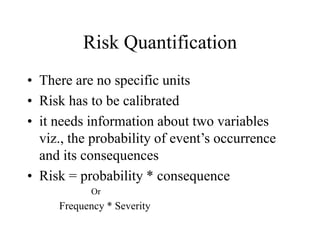
Risk Quantification
• There are no specific units
• Risk has to be calibrated
• it needs information about two variables
viz., the probability of event’s occurrence
and its consequences
• Risk = probability * consequence
Or
Frequency * Severity
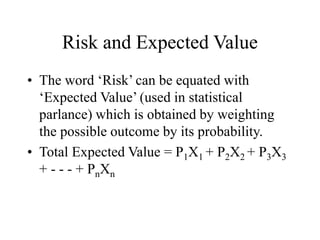
Risk and Expected Value
• The word ‘Risk’ can be equated with
‘Expected Value’ (used in statistical
parlance) which is obtained by weighting
the possible outcome by its probability.
• Total Expected Value = P1X1 + P2X2 + P3X3
+ - - - + PnXn
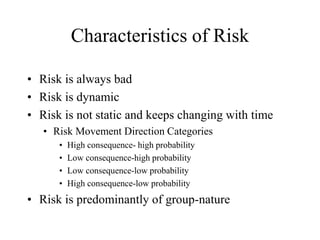
Characteristics of Risk
• Risk is always bad
• Risk is dynamic
• Risk is not static and keeps changing with time
• Risk Movement Direction Categories
• High consequence- high probability
• Low consequence-high probability
• Low consequence-low probability
• High consequence-low probability
• Risk is predominantly of group-nature
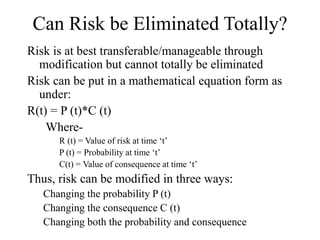
Can Risk be Eliminated Totally?
Risk is at best transferable/manageable through
modification but cannot totally be eliminated
Risk can be put in a mathematical equation form as
under:
R(t) = P (t)*C (t)
Where-
R (t) = Value of risk at time ‘t’
P (t) = Probability at time ‘t’
C(t) = Value of consequence at time ‘t’
Thus, risk can be modified in three ways:
Changing the probability P (t)
Changing the consequence C (t)
Changing both the probability and consequence

What is risk all about

  • 1.
    What is ‘Risk’AllAbout • ‘Risk’ is derived from an Italian word ‘risicare’ which means ‘to dare’. • It is more a ‘choice’ than a ‘fate’ • a degree of variability of possible outcomes for a particular outcome • is always associated with loss that is expected to be incurred due to the happening or non-happening of certain events or activities. • It arises as a deviation between what happens and what was expected to happen.
  • 2.
    Peril and Hazard •Peril is defined as ‘cause of loss’.e.g. fire,earthquake etc. • Hazard is the condition that creates/increases the chance of loss arising out of a given peril.
  • 3.
    Risk Vs. Uncertainty •‘Uncertainty’ radically differs from ‘risk’ • uncertainty means “not known or not certainly knowing”. • “I don’t know” (What is going to happen) • ‘risk’ means “a chance or possibility of danger/loss/injury or other adverse consequences”. • Risk is that portion of uncertainty, which is measurable. • uncertainty converted into risk by using subjective probabilities.
  • 4.
    Risk Vs. Time •Risk is always in the future • Risk always pertains to what can happen but not what has happened • Risk being the function of time continues to remain as risk till it happens.
  • 5.
    Risk Quantification • Thereare no specific units • Risk has to be calibrated • it needs information about two variables viz., the probability of event’s occurrence and its consequences • Risk = probability * consequence Or Frequency * Severity
  • 6.
    Risk and ExpectedValue • The word ‘Risk’ can be equated with ‘Expected Value’ (used in statistical parlance) which is obtained by weighting the possible outcome by its probability. • Total Expected Value = P1X1 + P2X2 + P3X3 + - - - + PnXn
  • 7.
    Characteristics of Risk •Risk is always bad • Risk is dynamic • Risk is not static and keeps changing with time • Risk Movement Direction Categories • High consequence- high probability • Low consequence-high probability • Low consequence-low probability • High consequence-low probability • Risk is predominantly of group-nature
  • 8.
    Can Risk beEliminated Totally? Risk is at best transferable/manageable through modification but cannot totally be eliminated Risk can be put in a mathematical equation form as under: R(t) = P (t)*C (t) Where- R (t) = Value of risk at time ‘t’ P (t) = Probability at time ‘t’ C(t) = Value of consequence at time ‘t’ Thus, risk can be modified in three ways: Changing the probability P (t) Changing the consequence C (t) Changing both the probability and consequence