http://ontopic.io 1
Storm Crawler
A real-time distributed web crawling and
monitoring framework
Jake Dodd, co-founder
http://ontopic.io
jake@ontopic.io
ApacheCon North America 2015
http://ontopic.io
§  Overview
§  Continuous vs. Batch
§  Storm-Crawler Components
§  Integration
§  Use Cases
§  Demonstration
§  Q&A
2
Agenda
http://ontopic.io 3
Storm-Crawler overview
§  Software Development Kit (SDK) for building web
crawlers on Apache Storm
§  https://github.com/DigitalPebble/storm-crawler
§  Apache License v2
§  Project Director: Julien Nioche (DigitalPebble Ltd)
§  + 3 committers
http://ontopic.io 4
Facts overview
§  Powered by the Apache Storm framework
§  Real-time, distributed, continuous crawling
§  Discovery to indexing with low latency
§  Java API
§  Available as a Maven dependency
http://ontopic.io 5
The Old Way continuous vs.
batch
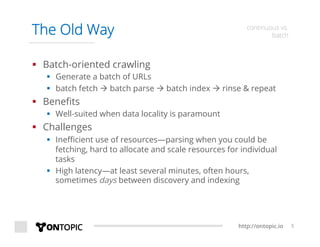
§  Batch-oriented crawling
§  Generate a batch of URLs
§  batch fetch à batch parse à batch index à rinse & repeat
§  Benefits
§  Well-suited when data locality is paramount
§  Challenges
§  Inefficient use of resources—parsing when you could be
fetching, hard to allocate and scale resources for individual
tasks
§  High latency—at least several minutes, often hours,
sometimes days between discovery and indexing
http://ontopic.io 6
Continuous Crawl continuous vs.
batch
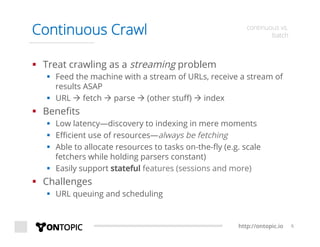
§  Treat crawling as a streaming problem
§  Feed the machine with a stream of URLs, receive a stream of
results ASAP
§  URL à fetch à parse à (other stuff) à index
§  Benefits
§  Low latency—discovery to indexing in mere moments
§  Efficient use of resources—always be fetching
§  Able to allocate resources to tasks on-the-fly (e.g. scale
fetchers while holding parsers constant)
§  Easily support stateful features (sessions and more)
§  Challenges
§  URL queuing and scheduling
http://ontopic.io 7
The Static Web continuous vs.
batch
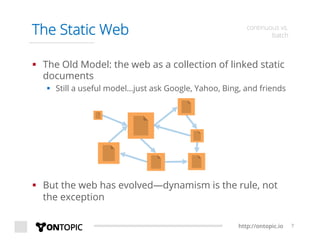
§  The Old Model: the web as a collection of linked static
documents
§  Still a useful model…just ask Google, Yahoo, Bing, and friends
§  But the web has evolved—dynamism is the rule, not
the exception
http://ontopic.io 8
The Web Stream continuous vs.
batch
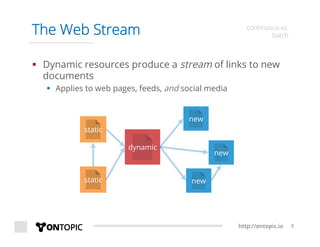
§  Dynamic resources produce a stream of links to new
documents
§  Applies to web pages, feeds, and social media
static
static
dynamic
new
new
new
http://ontopic.io 9
Can we do both? continuous vs.
batch
§  From a crawler’s perspective, there’s not much
difference between new and existing (but newly-
discovered) pages
§  Creating a web index from scratch can be modeled as
a streaming problem
§  Seed URLs à stream of discovered outlinks à rinse & repeat
§  Discovering and indexing new content is a streaming
problem
§  Batch vs. continuous: both methods work, but
continuous offers faster data availability
§  Often important for new content
http://ontopic.io 10
Conclusions continuous vs.
batch
§  A modern web crawler should:
§  Use resources efficiently
§  Leverage the elasticity of modern cloud infrastructures
§  Be responsive—fetch and index new documents with low
latency
§  Elegantly handle streams of new content
§  The dynamic web requires a dynamic crawler
http://ontopic.io 11
Storm-Crawler: What is it? storm-crawler
components
§  A Software Development Kit (SDK) for building and
configuring continuous web crawlers
§  Storm components (spouts & bolts) that handle
primary web crawling operations
§  Fetching, parsing, and indexing
§  Some of the code has been borrowed (with much
gratitude) from Apache Nutch
§  High level of maturity
§  Organized into two sub-projects
§  Core (sc-core): components and utilities needed by all crawler
apps
§  External (sc-external): components that depend on external
technologies (Elasticsearch and more)
http://ontopic.io 12
What is it not? storm-crawler
components
§  Storm-Crawler is not a full-featured, ready-to-use web
crawler application
§  We’re in the process of building that separately—will use the
Storm-Crawler SDK
§  No explicit link & content management (such as linkdb
and crawldb with Nutch)
§  But quickly adding components to support recursive crawls
§  No PageRank
http://ontopic.io 13
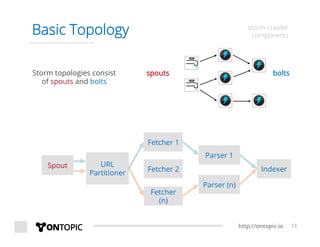
Basic Topology storm-crawler
components
spouts bolts
Spout URL
Partitioner
Fetcher 1
Fetcher 2
Fetcher
(n)
Parser 1
Parser (n)
Indexer
Storm topologies consist
of spouts and bolts
http://ontopic.io 14
Spouts storm-crawler
components
§  File spout
§  In sc-core
§  Reads URLs from a file
§  Elasticsearch spout
§  In sc-external
§  Reads URLs from an Elasticsearch index
§  Functioning, but we’re working on improvements
§  Other options (Redis, Kafka, etc.)
§  Will discuss later in presentation
http://ontopic.io 15
Bolts storm-crawler
components
§  The SDK includes several bolts that handle:
§  URL partitioning
§  Fetching
§  Parsing
§  Filtering
§  Indexing
§  We’ll briefly discuss each of these
http://ontopic.io 16
Bolts: URL Partitioner storm-crawler
components
§  Partitions incoming URLs by host, domain, or IP
address
§  Strategy is configurable in the topology configuration file
§  Creates a partition field in the tuple
§  Storm’s grouping feature can then be used to distribute
tuples according to requirements
§  localOrShuffle() to randomly distribute URLs to fetchers
§  or fieldsGrouping() to ensure all URLs with the same {host,
domain, IP} go to the same fetcher
http://ontopic.io 17
Bolts: Fetchers storm-crawler
components
§  Two fetcher bolts provided in sc-core
§  Both respect robots.txt
§  FetcherBolt
§  Multithreaded (configurable number of threads)
§  Use with fieldsGrouping() on the partition key and a
configurable crawl delay to ensure your crawler is polite
§  SimpleFetcherBolt
§  No internal queues
§  Concurrency configured using parallelism hint and # of tasks
§  Politeness must be handled outside of the topology
§  Easier to reason about; requires additional work to enforce
politeness
http://ontopic.io 18
Bolts: Parsers storm-crawler
components
§  Parser Bolt
§  Utilizes Apache Tika for parsing
§  Collects, filters, normalizes, and emits outlinks
§  Collects page metadata (HTTP headers, etc)
§  Parses the page’s content to a text representation
§  Sitemap Parser Bolt
§  Uses the Crawler-Commons sitemap parser
§  Collects, filters, normalizes, and emits outlinks
§  Requires a priori knowledge that a page is a sitemap
http://ontopic.io 19
Bolts: Indexing storm-crawler
components
§  Printer Bolt (in sc-core)
§  Prints output to stdout—useful for debugging
§  Elasticsearch Indexer Bolt (in sc-external)
§  Indexes parsed page content and metadata into Elasticsearch
§  Elasticsearch Status Bolt (in sc-external)
§  URLs and their status (discovered, fetched, error) are emitted
to a special status stream in the storm topology
§  This bolt indexes the URL, metadata, and its status into a
‘status’ Elasticsearch index
http://ontopic.io 20
Other components storm-crawler
components
§  URL Filters & Normalizers
§  Configurable with a JSON file
§  Regex filter & normalizer borrowed from Nutch
§  HostURLFilter enables you to ignore outlinks from outside
domains or hosts
§  Parse Filters
§  Useful for scraping and extracting info from pages
§  XPath-based parse filter, more to come
§  Filters & Normalizers are easily pluggable
http://ontopic.io 21
Integrating Storm-Crawler integration
§  Because Storm-Crawler is an SDK, it needs to be
integrated with other technologies to build a full-
featured web crawler
§  At the very least, a database
§  For URLs, metadata, and maybe content
§  Some search engines can double as your core data store
(beware…research ‘Jepsen tests’ for caveats)
§  Probably a search engine
§  Solr, Elasticsearch, etc.
§  sc-external provides basic integration with Elasticsearch
§  Maybe some distributed system technologies for
crawl control
§  Redis, Kafka, ZooKeeper, etc.
http://ontopic.io 22
Storm-Crawler at Ontopic integration
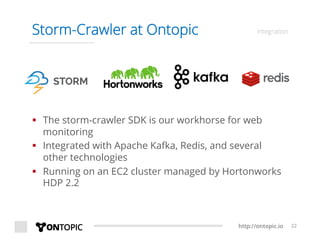
§  The storm-crawler SDK is our workhorse for web
monitoring
§  Integrated with Apache Kafka, Redis, and several
other technologies
§  Running on an EC2 cluster managed by Hortonworks
HDP 2.2
http://ontopic.io 23
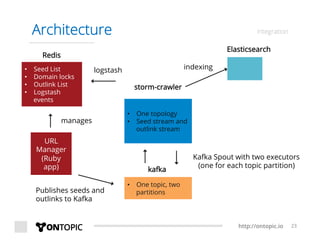
Architecture integration
•  Seed List
•  Domain locks
•  Outlink List
•  Logstash
events
Redis
URL
Manager
(Ruby
app)
manages
•  One topology
•  Seed stream and
outlink stream
storm-crawler
•  One topic, two
partitions
kafka
Publishes seeds and
outlinks to Kafka
Kafka Spout with two executors
(one for each topic partition)
Elasticsearch
indexinglogstash
http://ontopic.io 24
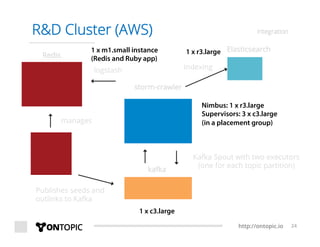
R&D Cluster (AWS) integration
Redis
manages
storm-crawler
kafka
Publishes seeds and
outlinks to Kafka
Kafka Spout with two executors
(one for each topic partition)
Elasticsearch
indexinglogstash
1 x r3.large1 x m1.small instance
(Redis and Ruby app)
Nimbus: 1 x r3.large
Supervisors: 3 x c3.large
(in a placement group)
1 x c3.large
http://ontopic.io 25
Integration Examples integration
§  Formal crawl metadata specification & serialization
with Avro
§  Kafka publishing bolt
§  Component to publish crawl data to Kafka (complex URL
status handling, for example, could be performed by another
topology)
§  Externally-stored transient crawl data
§  Components for storing shared crawl data (such as a
robots.txt cache) in a key-value store (Redis, Memcached, etc.)
http://ontopic.io 26
Use Cases & Users use cases
§  Processing streams of URLs
§  http://www.weborama.com
§  Continuous URL monitoring
§  http://www.shopstyle.com
§  http://www.ontopic.io
§  One-off non-recursive crawling
§  http://www.stolencamerafinder.com
§  Recursive crawling
§  http://www.shopstyle.com
§  More in development & stealth mode
http://ontopic.io 27
Demonstration demonstration
(live demo of Ontopic’s topology)
http://ontopic.io 28
Q&A q&a
Any questions?
http://ontopic.io 29
Resources q&a
§  Project page
§  https://github.com/DigitalPebble/storm-crawler
§  Project documentation
§  https://github.com/DigitalPebble/storm-crawler/wiki
§  Previous presentations
§  http://www.slideshare.net/digitalpebble/j-nioche-
bristoljavameetup20150310
§  http://www.slideshare.net/digitalpebble/storm-crawler-
ontopic20141113?related=1
§  Other resources
§  http://infolab.stanford.edu/~olston/publications/
crawling_survey.pdf
Thank you!

Storm crawler apachecon_na_2015

  • 1.
    http://ontopic.io 1 Storm Crawler Areal-time distributed web crawling and monitoring framework Jake Dodd, co-founder http://ontopic.io jake@ontopic.io ApacheCon North America 2015
  • 2.
    http://ontopic.io §  Overview §  Continuousvs. Batch §  Storm-Crawler Components §  Integration §  Use Cases §  Demonstration §  Q&A 2 Agenda
  • 3.
    http://ontopic.io 3 Storm-Crawler overview § Software Development Kit (SDK) for building web crawlers on Apache Storm §  https://github.com/DigitalPebble/storm-crawler §  Apache License v2 §  Project Director: Julien Nioche (DigitalPebble Ltd) §  + 3 committers
  • 4.
    http://ontopic.io 4 Facts overview § Powered by the Apache Storm framework §  Real-time, distributed, continuous crawling §  Discovery to indexing with low latency §  Java API §  Available as a Maven dependency
  • 5.
    http://ontopic.io 5 The OldWay continuous vs. batch §  Batch-oriented crawling §  Generate a batch of URLs §  batch fetch à batch parse à batch index à rinse & repeat §  Benefits §  Well-suited when data locality is paramount §  Challenges §  Inefficient use of resources—parsing when you could be fetching, hard to allocate and scale resources for individual tasks §  High latency—at least several minutes, often hours, sometimes days between discovery and indexing
  • 6.
    http://ontopic.io 6 Continuous Crawlcontinuous vs. batch §  Treat crawling as a streaming problem §  Feed the machine with a stream of URLs, receive a stream of results ASAP §  URL à fetch à parse à (other stuff) à index §  Benefits §  Low latency—discovery to indexing in mere moments §  Efficient use of resources—always be fetching §  Able to allocate resources to tasks on-the-fly (e.g. scale fetchers while holding parsers constant) §  Easily support stateful features (sessions and more) §  Challenges §  URL queuing and scheduling
  • 7.
    http://ontopic.io 7 The StaticWeb continuous vs. batch §  The Old Model: the web as a collection of linked static documents §  Still a useful model…just ask Google, Yahoo, Bing, and friends §  But the web has evolved—dynamism is the rule, not the exception
  • 8.
    http://ontopic.io 8 The WebStream continuous vs. batch §  Dynamic resources produce a stream of links to new documents §  Applies to web pages, feeds, and social media static static dynamic new new new
  • 9.
    http://ontopic.io 9 Can wedo both? continuous vs. batch §  From a crawler’s perspective, there’s not much difference between new and existing (but newly- discovered) pages §  Creating a web index from scratch can be modeled as a streaming problem §  Seed URLs à stream of discovered outlinks à rinse & repeat §  Discovering and indexing new content is a streaming problem §  Batch vs. continuous: both methods work, but continuous offers faster data availability §  Often important for new content
  • 10.
    http://ontopic.io 10 Conclusions continuousvs. batch §  A modern web crawler should: §  Use resources efficiently §  Leverage the elasticity of modern cloud infrastructures §  Be responsive—fetch and index new documents with low latency §  Elegantly handle streams of new content §  The dynamic web requires a dynamic crawler
  • 11.
    http://ontopic.io 11 Storm-Crawler: Whatis it? storm-crawler components §  A Software Development Kit (SDK) for building and configuring continuous web crawlers §  Storm components (spouts & bolts) that handle primary web crawling operations §  Fetching, parsing, and indexing §  Some of the code has been borrowed (with much gratitude) from Apache Nutch §  High level of maturity §  Organized into two sub-projects §  Core (sc-core): components and utilities needed by all crawler apps §  External (sc-external): components that depend on external technologies (Elasticsearch and more)
  • 12.
    http://ontopic.io 12 What isit not? storm-crawler components §  Storm-Crawler is not a full-featured, ready-to-use web crawler application §  We’re in the process of building that separately—will use the Storm-Crawler SDK §  No explicit link & content management (such as linkdb and crawldb with Nutch) §  But quickly adding components to support recursive crawls §  No PageRank
  • 13.
    http://ontopic.io 13 Basic Topologystorm-crawler components spouts bolts Spout URL Partitioner Fetcher 1 Fetcher 2 Fetcher (n) Parser 1 Parser (n) Indexer Storm topologies consist of spouts and bolts
  • 14.
    http://ontopic.io 14 Spouts storm-crawler components § File spout §  In sc-core §  Reads URLs from a file §  Elasticsearch spout §  In sc-external §  Reads URLs from an Elasticsearch index §  Functioning, but we’re working on improvements §  Other options (Redis, Kafka, etc.) §  Will discuss later in presentation
  • 15.
    http://ontopic.io 15 Bolts storm-crawler components § The SDK includes several bolts that handle: §  URL partitioning §  Fetching §  Parsing §  Filtering §  Indexing §  We’ll briefly discuss each of these
  • 16.
    http://ontopic.io 16 Bolts: URLPartitioner storm-crawler components §  Partitions incoming URLs by host, domain, or IP address §  Strategy is configurable in the topology configuration file §  Creates a partition field in the tuple §  Storm’s grouping feature can then be used to distribute tuples according to requirements §  localOrShuffle() to randomly distribute URLs to fetchers §  or fieldsGrouping() to ensure all URLs with the same {host, domain, IP} go to the same fetcher
  • 17.
    http://ontopic.io 17 Bolts: Fetchersstorm-crawler components §  Two fetcher bolts provided in sc-core §  Both respect robots.txt §  FetcherBolt §  Multithreaded (configurable number of threads) §  Use with fieldsGrouping() on the partition key and a configurable crawl delay to ensure your crawler is polite §  SimpleFetcherBolt §  No internal queues §  Concurrency configured using parallelism hint and # of tasks §  Politeness must be handled outside of the topology §  Easier to reason about; requires additional work to enforce politeness
  • 18.
    http://ontopic.io 18 Bolts: Parsersstorm-crawler components §  Parser Bolt §  Utilizes Apache Tika for parsing §  Collects, filters, normalizes, and emits outlinks §  Collects page metadata (HTTP headers, etc) §  Parses the page’s content to a text representation §  Sitemap Parser Bolt §  Uses the Crawler-Commons sitemap parser §  Collects, filters, normalizes, and emits outlinks §  Requires a priori knowledge that a page is a sitemap
  • 19.
    http://ontopic.io 19 Bolts: Indexingstorm-crawler components §  Printer Bolt (in sc-core) §  Prints output to stdout—useful for debugging §  Elasticsearch Indexer Bolt (in sc-external) §  Indexes parsed page content and metadata into Elasticsearch §  Elasticsearch Status Bolt (in sc-external) §  URLs and their status (discovered, fetched, error) are emitted to a special status stream in the storm topology §  This bolt indexes the URL, metadata, and its status into a ‘status’ Elasticsearch index
  • 20.
    http://ontopic.io 20 Other componentsstorm-crawler components §  URL Filters & Normalizers §  Configurable with a JSON file §  Regex filter & normalizer borrowed from Nutch §  HostURLFilter enables you to ignore outlinks from outside domains or hosts §  Parse Filters §  Useful for scraping and extracting info from pages §  XPath-based parse filter, more to come §  Filters & Normalizers are easily pluggable
  • 21.
    http://ontopic.io 21 Integrating Storm-Crawlerintegration §  Because Storm-Crawler is an SDK, it needs to be integrated with other technologies to build a full- featured web crawler §  At the very least, a database §  For URLs, metadata, and maybe content §  Some search engines can double as your core data store (beware…research ‘Jepsen tests’ for caveats) §  Probably a search engine §  Solr, Elasticsearch, etc. §  sc-external provides basic integration with Elasticsearch §  Maybe some distributed system technologies for crawl control §  Redis, Kafka, ZooKeeper, etc.
  • 22.
    http://ontopic.io 22 Storm-Crawler atOntopic integration §  The storm-crawler SDK is our workhorse for web monitoring §  Integrated with Apache Kafka, Redis, and several other technologies §  Running on an EC2 cluster managed by Hortonworks HDP 2.2
  • 23.
    http://ontopic.io 23 Architecture integration • Seed List •  Domain locks •  Outlink List •  Logstash events Redis URL Manager (Ruby app) manages •  One topology •  Seed stream and outlink stream storm-crawler •  One topic, two partitions kafka Publishes seeds and outlinks to Kafka Kafka Spout with two executors (one for each topic partition) Elasticsearch indexinglogstash
  • 24.
    http://ontopic.io 24 R&D Cluster(AWS) integration Redis manages storm-crawler kafka Publishes seeds and outlinks to Kafka Kafka Spout with two executors (one for each topic partition) Elasticsearch indexinglogstash 1 x r3.large1 x m1.small instance (Redis and Ruby app) Nimbus: 1 x r3.large Supervisors: 3 x c3.large (in a placement group) 1 x c3.large
  • 25.
    http://ontopic.io 25 Integration Examplesintegration §  Formal crawl metadata specification & serialization with Avro §  Kafka publishing bolt §  Component to publish crawl data to Kafka (complex URL status handling, for example, could be performed by another topology) §  Externally-stored transient crawl data §  Components for storing shared crawl data (such as a robots.txt cache) in a key-value store (Redis, Memcached, etc.)
  • 26.
    http://ontopic.io 26 Use Cases& Users use cases §  Processing streams of URLs §  http://www.weborama.com §  Continuous URL monitoring §  http://www.shopstyle.com §  http://www.ontopic.io §  One-off non-recursive crawling §  http://www.stolencamerafinder.com §  Recursive crawling §  http://www.shopstyle.com §  More in development & stealth mode
  • 27.
  • 28.
  • 29.
    http://ontopic.io 29 Resources q&a § Project page §  https://github.com/DigitalPebble/storm-crawler §  Project documentation §  https://github.com/DigitalPebble/storm-crawler/wiki §  Previous presentations §  http://www.slideshare.net/digitalpebble/j-nioche- bristoljavameetup20150310 §  http://www.slideshare.net/digitalpebble/storm-crawler- ontopic20141113?related=1 §  Other resources §  http://infolab.stanford.edu/~olston/publications/ crawling_survey.pdf Thank you!