

<Insert Picture Here>


Impact of the rise of the Cloud on Enterprise
Architecture
Tim Rubin
Enterprise Architect
Impact of the Cloud on EA
 Agenda

• What is Cloud Computing?
• Why should Enterprise Architecture care?

Open Space Workshop
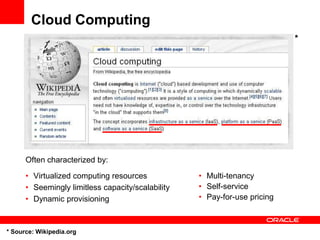
Cloud Computing
                                                                           *


      Often characterized by:

      • Virtualized computing resources            • Multi-tenancy
      • Seemingly limitless capacity/scalability   • Self-service
      • Dynamic provisioning                       • Pay-for-use pricing


* Source: Wikipedia.org
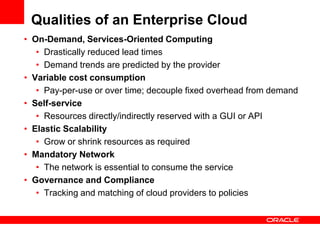
Qualities of an Enterprise Cloud
• On-Demand, Services-Oriented Computing
   • Drastically reduced lead times
   • Demand trends are predicted by the provider
• Variable cost consumption
   • Pay-per-use or over time; decouple fixed overhead from demand
• Self-service
   • Resources directly/indirectly reserved with a GUI or API
• Elastic Scalability
   • Grow or shrink resources as required
• Mandatory Network
   • The network is essential to consume the service
• Governance and Compliance
   • Tracking and matching of cloud providers to policies
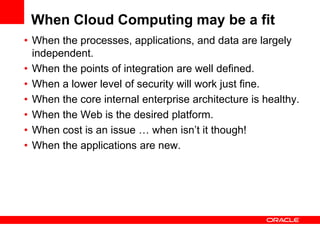
When Cloud Computing may be a fit
• When the processes, applications, and data are largely
  independent.
• When the points of integration are well defined.
• When a lower level of security will work just fine.
• When the core internal enterprise architecture is healthy.
• When the Web is the desired platform.
• When cost is an issue … when isn’t it though!
• When the applications are new.
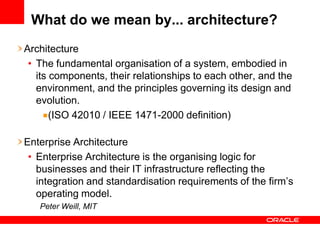
What do we mean by... architecture?
Architecture
 • The fundamental organisation of a system, embodied in
   its components, their relationships to each other, and the
   environment, and the principles governing its design and
   evolution.
       (ISO 42010 / IEEE 1471-2000 definition)

Enterprise Architecture
 • Enterprise Architecture is the organising logic for
   businesses and their IT infrastructure reflecting the
   integration and standardisation requirements of the firm’s
   operating model.
   Peter Weill, MIT
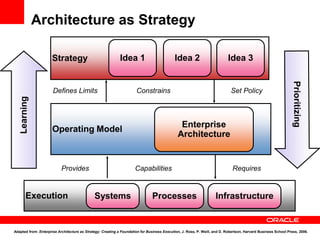
Architecture as Strategy

                      Strategy                               Idea 1                         Idea 2                         Idea 3


                      Defines Limits                                  Constrains                                             Set Policy
   Learning


                                                                                               Enterprise
                      Operating Model
                                                                                              Architecture


                           Provides                                   Capabilities                                            Requires


        Execution                             Systems                          Processes                            Infrastructure


Adapted from: Enterprise Architecture as Strategy: Creating a Foundation for Business Execution, J. Ross, P. Weill, and D. Robertson, Harvard Business School Press, 2006.
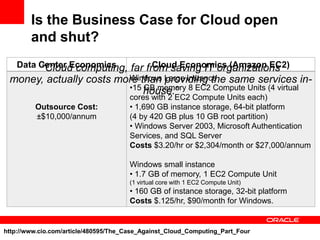
Is the Business Case for Cloud open
        and shut?

    “Cloud computing, far from saving IT organizations money,
  actually costs more than providing the same services in-house.”


http://www.cio.com/article/480595/The_Case_Against_Cloud_Computing_Part_Four
Is the Business Case for Cloud open
        and shut?
    Data Center Economics                    Cloud Economics (Amazon EC2)
                                      Windows Large instance
                                      •15 GB memory 8 EC2 Compute Units (4 virtual
                                      cores with 2 EC2 Compute Units each)
         Outsource Cost:              • 1,690 GB instance storage, 64-bit platform
         ±$10,000/annum               (4 by 420 GB plus 10 GB root partition)
                                      • Windows Server 2003, Microsoft Authentication
                                      Services, and SQL Server
                                      Costs $3.20/hr or $2,304/month or $27,000/annum

                                      Windows small instance
                                      • 1.7 GB of memory, 1 EC2 Compute Unit
                                      (1 virtual core with 1 EC2 Compute Unit)
                                      • 160 GB of instance storage, 32-bit platform
                                      Costs $.125/hr, $90/month for Windows.


http://www.cio.com/article/480595/The_Case_Against_Cloud_Computing_Part_Four
Is Cloud Computing not just “old”
technology re-branded?
Is Cloud Computing not just “old”
technology re-branded?
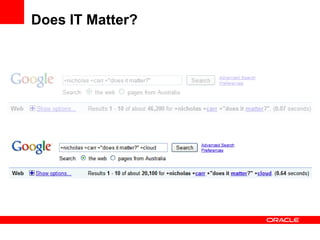
Does IT Matter?
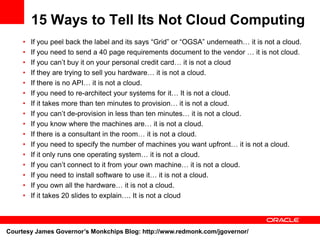
15 Ways to Tell Its Not Cloud Computing
     •   If you peel back the label and its says “Grid” or “OGSA” underneath… it is not a cloud.
     •   If you need to send a 40 page requirements document to the vendor … it is not cloud.
     •   If you can’t buy it on your personal credit card… it is not a cloud
     •   If they are trying to sell you hardware… it is not a cloud.
     •   If there is no API… it is not a cloud.
     •   If you need to re-architect your systems for it… It is not a cloud.
     •   If it takes more than ten minutes to provision… it is not a cloud.
     •   If you can’t de-provision in less than ten minutes… it is not a cloud.
     •   If you know where the machines are… it is not a cloud.
     •   If there is a consultant in the room… it is not a cloud.
     •   If you need to specify the number of machines you want upfront… it is not a cloud.
     •   If it only runs one operating system… it is not a cloud.
     •   If you can’t connect to it from your own machine… it is not a cloud.
     •   If you need to install software to use it… it is not a cloud.
     •   If you own all the hardware… it is not a cloud.
     •   If it takes 20 slides to explain…. It is not a cloud


Courtesy James Governor’s Monkchips Blog: http://www.redmonk.com/jgovernor/
15 Ways to Tell Its Not Cloud Computing
     •   If you peel back the label and its says “Grid” or “OGSA” underneath… it is not a cloud.
     •   If you need to send a 40 page requirements document to the vendor … it is not cloud.
     •   If you can’t buy it on your personal credit card… it is not a cloud
     •   If they are trying to sell you hardware… it is not a cloud.
     •   If there is no API… it is not a cloud.
     •   If you need to re-architect your systems for it… It is not a cloud.
     •   If it takes more than ten minutes to provision… it is not a cloud.
     •   If you can’t de-provision in less than ten minutes… it is not a cloud.
     •   If you know where the machines are… it is not a cloud.
     •   If there is a consultant in the room… it is not a cloud.
     •   If you need to specify the number of machines you want upfront… it is not a cloud.
     •   If it only runs one operating system… it is not a cloud.
     •   If you can’t connect to it from your own machine… it is not a cloud.
     •   If you need to install software to use it… it is not a cloud.
     •   If you own all the hardware… it is not a cloud.
     •   If it takes 20 slides to explain…. It is not a cloud


Courtesy James Governor’s Monkchips Blog: http://www.redmonk.com/jgovernor/
Open Space Workshop
    The Laws of Open Space
• Respect for others

•   Whoever comes is the right people
•   Whatever happens is the only thing that could have
•   Whenever it starts is the right time
•   When it's over it's over

• The law of two feet
Impact of the Cloud on EA
 Agenda

• What is Cloud Computing?
• Why should Enterprise Architecture care?

Open Space Workshop:
• Is the business case for Cloud Computing open & shut?
• Is Cloud Computing not merely an opportunity for vendors
  to rebrand “old” technologies?
• 2005 Revisited!!
  • Does IT Matter? And, if it does, for how long?
Tim Rubin
tim.rubin@oracle.com
19

AAF - Enterprise Architecture and Cloud Computing

  • 1.
    <Insert Picture Here> Impactof the rise of the Cloud on Enterprise Architecture Tim Rubin Enterprise Architect
  • 2.
    Impact of theCloud on EA Agenda • What is Cloud Computing? • Why should Enterprise Architecture care? Open Space Workshop
  • 3.
    Cloud Computing * Often characterized by: • Virtualized computing resources • Multi-tenancy • Seemingly limitless capacity/scalability • Self-service • Dynamic provisioning • Pay-for-use pricing * Source: Wikipedia.org
  • 4.
    Qualities of anEnterprise Cloud • On-Demand, Services-Oriented Computing • Drastically reduced lead times • Demand trends are predicted by the provider • Variable cost consumption • Pay-per-use or over time; decouple fixed overhead from demand • Self-service • Resources directly/indirectly reserved with a GUI or API • Elastic Scalability • Grow or shrink resources as required • Mandatory Network • The network is essential to consume the service • Governance and Compliance • Tracking and matching of cloud providers to policies
  • 5.
    When Cloud Computingmay be a fit • When the processes, applications, and data are largely independent. • When the points of integration are well defined. • When a lower level of security will work just fine. • When the core internal enterprise architecture is healthy. • When the Web is the desired platform. • When cost is an issue … when isn’t it though! • When the applications are new.
  • 6.
    What do wemean by... architecture? Architecture • The fundamental organisation of a system, embodied in its components, their relationships to each other, and the environment, and the principles governing its design and evolution. (ISO 42010 / IEEE 1471-2000 definition) Enterprise Architecture • Enterprise Architecture is the organising logic for businesses and their IT infrastructure reflecting the integration and standardisation requirements of the firm’s operating model. Peter Weill, MIT
  • 7.
    Architecture as Strategy Strategy Idea 1 Idea 2 Idea 3 Defines Limits Constrains Set Policy Learning Enterprise Operating Model Architecture Provides Capabilities Requires Execution Systems Processes Infrastructure Adapted from: Enterprise Architecture as Strategy: Creating a Foundation for Business Execution, J. Ross, P. Weill, and D. Robertson, Harvard Business School Press, 2006.
  • 8.
    Is the BusinessCase for Cloud open and shut? “Cloud computing, far from saving IT organizations money, actually costs more than providing the same services in-house.” http://www.cio.com/article/480595/The_Case_Against_Cloud_Computing_Part_Four
  • 9.
    Is the BusinessCase for Cloud open and shut? Data Center Economics Cloud Economics (Amazon EC2) Windows Large instance •15 GB memory 8 EC2 Compute Units (4 virtual cores with 2 EC2 Compute Units each) Outsource Cost: • 1,690 GB instance storage, 64-bit platform ±$10,000/annum (4 by 420 GB plus 10 GB root partition) • Windows Server 2003, Microsoft Authentication Services, and SQL Server Costs $3.20/hr or $2,304/month or $27,000/annum Windows small instance • 1.7 GB of memory, 1 EC2 Compute Unit (1 virtual core with 1 EC2 Compute Unit) • 160 GB of instance storage, 32-bit platform Costs $.125/hr, $90/month for Windows. http://www.cio.com/article/480595/The_Case_Against_Cloud_Computing_Part_Four
  • 10.
    Is Cloud Computingnot just “old” technology re-branded?
  • 11.
    Is Cloud Computingnot just “old” technology re-branded?
  • 12.
  • 13.
    15 Ways toTell Its Not Cloud Computing • If you peel back the label and its says “Grid” or “OGSA” underneath… it is not a cloud. • If you need to send a 40 page requirements document to the vendor … it is not cloud. • If you can’t buy it on your personal credit card… it is not a cloud • If they are trying to sell you hardware… it is not a cloud. • If there is no API… it is not a cloud. • If you need to re-architect your systems for it… It is not a cloud. • If it takes more than ten minutes to provision… it is not a cloud. • If you can’t de-provision in less than ten minutes… it is not a cloud. • If you know where the machines are… it is not a cloud. • If there is a consultant in the room… it is not a cloud. • If you need to specify the number of machines you want upfront… it is not a cloud. • If it only runs one operating system… it is not a cloud. • If you can’t connect to it from your own machine… it is not a cloud. • If you need to install software to use it… it is not a cloud. • If you own all the hardware… it is not a cloud. • If it takes 20 slides to explain…. It is not a cloud Courtesy James Governor’s Monkchips Blog: http://www.redmonk.com/jgovernor/
  • 14.
    15 Ways toTell Its Not Cloud Computing • If you peel back the label and its says “Grid” or “OGSA” underneath… it is not a cloud. • If you need to send a 40 page requirements document to the vendor … it is not cloud. • If you can’t buy it on your personal credit card… it is not a cloud • If they are trying to sell you hardware… it is not a cloud. • If there is no API… it is not a cloud. • If you need to re-architect your systems for it… It is not a cloud. • If it takes more than ten minutes to provision… it is not a cloud. • If you can’t de-provision in less than ten minutes… it is not a cloud. • If you know where the machines are… it is not a cloud. • If there is a consultant in the room… it is not a cloud. • If you need to specify the number of machines you want upfront… it is not a cloud. • If it only runs one operating system… it is not a cloud. • If you can’t connect to it from your own machine… it is not a cloud. • If you need to install software to use it… it is not a cloud. • If you own all the hardware… it is not a cloud. • If it takes 20 slides to explain…. It is not a cloud Courtesy James Governor’s Monkchips Blog: http://www.redmonk.com/jgovernor/
  • 15.
    Open Space Workshop The Laws of Open Space • Respect for others • Whoever comes is the right people • Whatever happens is the only thing that could have • Whenever it starts is the right time • When it's over it's over • The law of two feet
  • 16.
    Impact of theCloud on EA Agenda • What is Cloud Computing? • Why should Enterprise Architecture care? Open Space Workshop: • Is the business case for Cloud Computing open & shut? • Is Cloud Computing not merely an opportunity for vendors to rebrand “old” technologies? • 2005 Revisited!! • Does IT Matter? And, if it does, for how long?
  • 17.
  • 18.