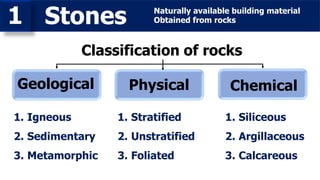
Geological Physical Chemical
Stones
1
1. Igneous
2. Sedimentary
3. Metamorphic
1. Stratified
2. Unstratified
3. Foliated
1. Siliceous
2. Argillaceous
3. Calcareous
Classification of rocks
Naturally available building material
Obtained from rocks
Igneous rocks
1
Formed by cooling of magma
Molten/pasty
rocky material
High
temperature
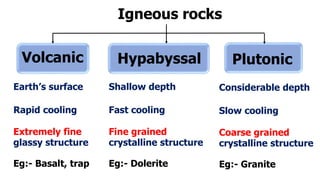
Volcanic Hypabyssal Plutonic
Igneous rocks
Earth’s surface Shallow depth Considerable depth
Rapid cooling Fast cooling Slow cooling
Extremely fine
glassy structure
Fine grained
crystalline structure
Coarse grained
crystalline structure
Eg:- Basalt, trap Eg:- Dolerite Eg:- Granite
Sedimentary rocks
2
Weathering  Transportation  Sedimentation
Sedimentation through agencies like
water, wind or glaciers
Examples
Chalk
Kankar
Limestone
Sandstone
Gravel
Gypsum
Residual
Types of Deposits
Sedimentary Organic
Chemical
fine weathered particles get washed away
weathered coarser particles
remains in the origin site and sets in layers
Parent rock
Residual
Types of Deposits
Sedimentary
insoluble fine
weathered agg
Parent rock
agents/rain
deposited as
layers
Organic
Chemical
Residual
Types of Deposits
Sedimentary
Deposited by physio-chemical process.
Eg:- Evaporation, precipitation
Tsunami, acid rain, etc.
Organic
Chemical
Residual
Types of Deposits
Sedimentary
Deposited through agency of organisms.
Organic
Chemical
Eg: Bacteria
Vegetable wastes, human Soil (Organic deposits)
Metamorphic rocks
3
Formed by the change in
character of pre-existing rocks.
Agents:
Heat, Pressure, Chemically acting fluids
Igneous
Sedimentary
agents
loss eqm
Change-in
character
re-establish
equilibrium
Metamorphic
rocks
Igneous
Sedimentary
agents
loss eqm
Change-in
character
re-establish
equilibrium
Metamorphic
rocks
Examples:-
Granite  Gneiss
Basalt  Laterite/Schist
Limestone  Marble
Mudstone  Slate
Siliceous sand  Quartzite
Igneous
Sedimentary
agents
loss eqm
Change-in
character
re-establish
equilibrium
Metamorphic
rocks
Examples:-
Granite  Gneiss
Basalt  Laterite/Schist
Limestone  Marble
Mudstone  Slate
Siliceous sand  Quartzite
(High compressive strength)
(Specific gravity = 2.72)
Thermal
Types of Metamorphism
Cataclastic
Heat
Plutonic
Dynamo-thermal
Pressure Heat + Stress Uni. Pressure
+ Heat
Stratified Unstratified Foliated
Physical classification
Can easily split along
planes of cleavage
Eg:-
Sedimentary rocks
Distinct layers
Compact crystalline
Can’t split in desired
layers.
No distinct layers
Eg:-
Igneous rocks
Layered structure
Split easily along
planes of foliation.
Eg:-
Metamorphic rocks
Sedi.rocks MetaMor
Siliceous Argillaceous Calcareous
Chemical classification
Eg:-
Granite, Quartzite
High silica content High clay/Alumina
content
Eg:-
Slate, Laterite
Clay minerals
- Kaolin, Illite
- Montmorillonite
High CaCO3 content
Eg:-
Limestone, Marble
High fire resistance
Classification of rocks
Geological Physical Chemical
1) Igneous rocks
2) Sedimentary rocks
3) Metamorphic rocks
1) Stratified rocks
2) Unstratified rocks
3) Foliated rocks
1) Siliceous rock
2) Argillaceous rocks
3) Calcareous rocks
- Formed by cooling of magma
- Eg:- Granite, Dolerite, Basalt
- Due to weathering action of
water, wind and frost
- Eg:- Gravel, Gypsum, limestone
- Formed by change in character
of existing rocks when subjected
to heat and pressure
- Eg:- Quartzite, slate, marble
- Have planes of cleavage
- Can split into layers
- Eg:- Sedimentary rocks
- No distinct layers
- Eg:- Igneous rocks
- Rocks having a tendency to split up
in a definite direction only
- Eg:- Metamorphic rocks
- High silica content
- Eg:- Granite, Quartzite
- High clay content
- Eg:- Slate, Laterite
- High CaCO3 content
- Eg:- Marble, Lime stone
- Durability depends on
surrounding materials
Plutonic, Hypabyssal, Volcanic
Note:
Shingle – decomposed laterite
Diamond – Kimberlite (Igneous rock) – Hardest rock
Talc – Softest rock
Gneiss is obtained from sedimentary metamorphic rocks
Crushing Strength
Characteristics of a good building stone
1 > 100 N/mm2
Appearance
2
Durability
3
Fracture
4
Hardness
5
Uniform colour
Long lasting in changing weather conditions
Sharp, even and clear fracture
 > 17 = Hard = used in roads
 14-17 = Medium hardness
 < 14 = Poor Hardness
Percentage wear
6 ≤ 3 %
Characteristics of a good building stone
Good Fire resistance
7
Specific gravity
8
Texture
9
> 2.7
 Have compact fine crystalline structure
 Should be free from cavities, cracks or patches
Seasoning
11 Upto 6-12 months
Toughness index
12
Water absorption
10 % absorption by weigth after 24 hours
should not exceed 0.60
 < 13 = not tough
 13-19 = Moderate
 >19 = High
- Impact test
Varieties of stones
Granite
• Igneous rock – Plutonic
• Composed of quartz + feldspar + Silica
• Available in colors: Grey, Green, Brown, Pink, Red
• Hard, durable, high resistance to weathering
• Specific gravity = 2.7
• Compressive strength = 700 – 1300 N/mm2.
• Uses: Ornamental works, flooring, walls etc
Varieties of stones
Trap rock
• Igneous rock - Volcanic
• Dark colour
• Specific gravity = 2.8 – 3.0
Eg:- Basalt
Uses : As crushed rocks,
railway ballast
Varieties of stones
Basalt
• Igneous rock - Volcanic
• Compact, Hard
• Colour: Red, Yellow, Grey, Blue
• Specific gravity = 3
• Compressive strength = 1530 – 1890 N/mm2.
• Uses: aggregates for concrete, ornamental works
Varieties of stones
Sand Stone
• Sedimentary rock
• Fine/coarse grained
• Specific gravity = 2.65 – 2.95
• Compressive strength = 650 N/mm2.
• Used for Ashlar works
Varieties of stones
Laterite
• Sedimentary rock
• Hard and durable
• Rich in Fe and Al
• Colour : Rusty red
(high iron oxide content)
• Uses: Building blocks
Load bearing capacities of stones
Quarrying of stones
Process of extracting or taking out stones
from natural rock beds.
Quarry – Exposed surface of a natural rock
Quarry Site – Site from where stones are taken
• Availability – tools, materials and labour
Selection of quarry site
• Quality of building stone should not vary with depth
• Distance should be min from transportation facilities
• Space for disposal of refuse and quarry wastes - near
• Geological information about the site
• Availability of water
• No health hazards at site
• Results of trial pits
Methods of quarrying
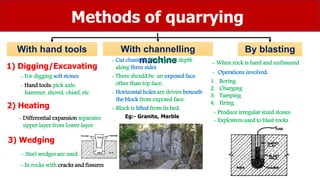
With hand tools With channelling
machine
By blasting
1) Digging/Excavating
2) Heating
3) Wedging
- For digging soft stones
- Hand tools: pick axle,
hammer, shovel, chisel, etc
- Differential expansion separates
upper layer from lower layer
- In rocks with cracks and fissures
- Steel wedges are used
- Cut channels of sufficient depth
along three sides
- There should be an exposed face
other than top face.
- Horizontal holes are driven beneath
the block from exposed face.
- Block is lifted from its bed.
Eg:- Granite, Marble
- Operations involved:
1. Boring
2. Charging
3. Tamping
4. Firing
- Produce irregular sized stones
- Explosives used to blast rocks
- When rock is hard and unfissured
Detonators Explosives Fuses
- Whose explosion
initiates explosion
of another
Materials for blasting
- To ignite explosives
- Used when dynamite
is used as explosive
- Fired either by fuse
or spark
- Dynamite and
Blasting powder
(Gun powder)
Charcoal
Saltpetre (KNO3)
Sulphur
Sandy powder (25%)
Nitro-glycerine (75 %)
- Use: Ordinary
quarrying works
- Uses: Tunnelling
Mining operations
Under water quarrying
- Small rope of cotton with
a core of continuous
thread of gun powder
Other explosives used in blasting:
1. Gelatine – 50 % more powerful than dynamite
2. Cordite – under water, no smoke
3. Gelignite – under water
4. Gun cotton
5. Liquid oxygen – large scale (mining, under water)
6. Rock-a-rock
• Quarried stones are cut into suitable size and shape
Dressing of stone
• To Provide pleasing appearance
• To provide good horizontal and vertical joints in masonry
• To make transportation easier
• To obtain good bonding
Types of dressing
1. Quarry dressing
2. Site dressing
Deterioration of stones
1. Alternate wetness and drying
2. Frost
3. Impurities in atmosphere
4. Living organisms
5. Movement of chemicals
6. Rain water
7. Temperature variations
8. Vegetable growth
9. Wind

Stone

  • 1.
    Geological Physical Chemical Stones 1 1.Igneous 2. Sedimentary 3. Metamorphic 1. Stratified 2. Unstratified 3. Foliated 1. Siliceous 2. Argillaceous 3. Calcareous Classification of rocks Naturally available building material Obtained from rocks
  • 2.
    Igneous rocks 1 Formed bycooling of magma Molten/pasty rocky material High temperature
  • 3.
    Volcanic Hypabyssal Plutonic Igneousrocks Earth’s surface Shallow depth Considerable depth Rapid cooling Fast cooling Slow cooling Extremely fine glassy structure Fine grained crystalline structure Coarse grained crystalline structure Eg:- Basalt, trap Eg:- Dolerite Eg:- Granite
  • 4.
    Sedimentary rocks 2 Weathering Transportation  Sedimentation Sedimentation through agencies like water, wind or glaciers
  • 5.
  • 6.
    Residual Types of Deposits SedimentaryOrganic Chemical fine weathered particles get washed away weathered coarser particles remains in the origin site and sets in layers Parent rock
  • 7.
    Residual Types of Deposits Sedimentary insolublefine weathered agg Parent rock agents/rain deposited as layers Organic Chemical
  • 8.
    Residual Types of Deposits Sedimentary Depositedby physio-chemical process. Eg:- Evaporation, precipitation Tsunami, acid rain, etc. Organic Chemical
  • 9.
    Residual Types of Deposits Sedimentary Depositedthrough agency of organisms. Organic Chemical Eg: Bacteria Vegetable wastes, human Soil (Organic deposits)
  • 10.
    Metamorphic rocks 3 Formed bythe change in character of pre-existing rocks. Agents: Heat, Pressure, Chemically acting fluids
  • 11.
  • 12.
    Igneous Sedimentary agents loss eqm Change-in character re-establish equilibrium Metamorphic rocks Examples:- Granite Gneiss Basalt  Laterite/Schist Limestone  Marble Mudstone  Slate Siliceous sand  Quartzite
  • 13.
    Igneous Sedimentary agents loss eqm Change-in character re-establish equilibrium Metamorphic rocks Examples:- Granite Gneiss Basalt  Laterite/Schist Limestone  Marble Mudstone  Slate Siliceous sand  Quartzite (High compressive strength) (Specific gravity = 2.72)
  • 14.
  • 15.
    Stratified Unstratified Foliated Physicalclassification Can easily split along planes of cleavage Eg:- Sedimentary rocks Distinct layers Compact crystalline Can’t split in desired layers. No distinct layers Eg:- Igneous rocks Layered structure Split easily along planes of foliation. Eg:- Metamorphic rocks Sedi.rocks MetaMor
  • 16.
    Siliceous Argillaceous Calcareous Chemicalclassification Eg:- Granite, Quartzite High silica content High clay/Alumina content Eg:- Slate, Laterite Clay minerals - Kaolin, Illite - Montmorillonite High CaCO3 content Eg:- Limestone, Marble High fire resistance
  • 17.
    Classification of rocks GeologicalPhysical Chemical 1) Igneous rocks 2) Sedimentary rocks 3) Metamorphic rocks 1) Stratified rocks 2) Unstratified rocks 3) Foliated rocks 1) Siliceous rock 2) Argillaceous rocks 3) Calcareous rocks - Formed by cooling of magma - Eg:- Granite, Dolerite, Basalt - Due to weathering action of water, wind and frost - Eg:- Gravel, Gypsum, limestone - Formed by change in character of existing rocks when subjected to heat and pressure - Eg:- Quartzite, slate, marble - Have planes of cleavage - Can split into layers - Eg:- Sedimentary rocks - No distinct layers - Eg:- Igneous rocks - Rocks having a tendency to split up in a definite direction only - Eg:- Metamorphic rocks - High silica content - Eg:- Granite, Quartzite - High clay content - Eg:- Slate, Laterite - High CaCO3 content - Eg:- Marble, Lime stone - Durability depends on surrounding materials Plutonic, Hypabyssal, Volcanic
  • 18.
    Note: Shingle – decomposedlaterite Diamond – Kimberlite (Igneous rock) – Hardest rock Talc – Softest rock Gneiss is obtained from sedimentary metamorphic rocks
  • 19.
    Crushing Strength Characteristics ofa good building stone 1 > 100 N/mm2 Appearance 2 Durability 3 Fracture 4 Hardness 5 Uniform colour Long lasting in changing weather conditions Sharp, even and clear fracture  > 17 = Hard = used in roads  14-17 = Medium hardness  < 14 = Poor Hardness Percentage wear 6 ≤ 3 %
  • 20.
    Characteristics of agood building stone Good Fire resistance 7 Specific gravity 8 Texture 9 > 2.7  Have compact fine crystalline structure  Should be free from cavities, cracks or patches Seasoning 11 Upto 6-12 months Toughness index 12 Water absorption 10 % absorption by weigth after 24 hours should not exceed 0.60  < 13 = not tough  13-19 = Moderate  >19 = High - Impact test
  • 21.
    Varieties of stones Granite •Igneous rock – Plutonic • Composed of quartz + feldspar + Silica • Available in colors: Grey, Green, Brown, Pink, Red • Hard, durable, high resistance to weathering • Specific gravity = 2.7 • Compressive strength = 700 – 1300 N/mm2. • Uses: Ornamental works, flooring, walls etc
  • 22.
    Varieties of stones Traprock • Igneous rock - Volcanic • Dark colour • Specific gravity = 2.8 – 3.0 Eg:- Basalt Uses : As crushed rocks, railway ballast
  • 23.
    Varieties of stones Basalt •Igneous rock - Volcanic • Compact, Hard • Colour: Red, Yellow, Grey, Blue • Specific gravity = 3 • Compressive strength = 1530 – 1890 N/mm2. • Uses: aggregates for concrete, ornamental works
  • 24.
    Varieties of stones SandStone • Sedimentary rock • Fine/coarse grained • Specific gravity = 2.65 – 2.95 • Compressive strength = 650 N/mm2. • Used for Ashlar works
  • 25.
    Varieties of stones Laterite •Sedimentary rock • Hard and durable • Rich in Fe and Al • Colour : Rusty red (high iron oxide content) • Uses: Building blocks
  • 26.
  • 27.
    Quarrying of stones Processof extracting or taking out stones from natural rock beds. Quarry – Exposed surface of a natural rock Quarry Site – Site from where stones are taken
  • 28.
    • Availability –tools, materials and labour Selection of quarry site • Quality of building stone should not vary with depth • Distance should be min from transportation facilities • Space for disposal of refuse and quarry wastes - near • Geological information about the site • Availability of water • No health hazards at site • Results of trial pits
  • 29.
    Methods of quarrying Withhand tools With channelling machine By blasting 1) Digging/Excavating 2) Heating 3) Wedging - For digging soft stones - Hand tools: pick axle, hammer, shovel, chisel, etc - Differential expansion separates upper layer from lower layer - In rocks with cracks and fissures - Steel wedges are used - Cut channels of sufficient depth along three sides - There should be an exposed face other than top face. - Horizontal holes are driven beneath the block from exposed face. - Block is lifted from its bed. Eg:- Granite, Marble - Operations involved: 1. Boring 2. Charging 3. Tamping 4. Firing - Produce irregular sized stones - Explosives used to blast rocks - When rock is hard and unfissured
  • 31.
    Detonators Explosives Fuses -Whose explosion initiates explosion of another Materials for blasting - To ignite explosives - Used when dynamite is used as explosive - Fired either by fuse or spark - Dynamite and Blasting powder (Gun powder) Charcoal Saltpetre (KNO3) Sulphur Sandy powder (25%) Nitro-glycerine (75 %) - Use: Ordinary quarrying works - Uses: Tunnelling Mining operations Under water quarrying - Small rope of cotton with a core of continuous thread of gun powder
  • 32.
    Other explosives usedin blasting: 1. Gelatine – 50 % more powerful than dynamite 2. Cordite – under water, no smoke 3. Gelignite – under water 4. Gun cotton 5. Liquid oxygen – large scale (mining, under water) 6. Rock-a-rock
  • 33.
    • Quarried stonesare cut into suitable size and shape Dressing of stone • To Provide pleasing appearance • To provide good horizontal and vertical joints in masonry • To make transportation easier • To obtain good bonding Types of dressing 1. Quarry dressing 2. Site dressing
  • 34.
    Deterioration of stones 1.Alternate wetness and drying 2. Frost 3. Impurities in atmosphere 4. Living organisms 5. Movement of chemicals 6. Rain water 7. Temperature variations 8. Vegetable growth 9. Wind