Engineering materials
Engineering materials:
•Engineering materials refers to the group of materials that are used in the
construction of manmade structures and components.
• The primary function of an engineering material is to withstand applied loading
without breaking and without exhibiting excessive deflection.
• The major classifications of engineering materials include metals, polymers,
ceramics, and composites.
Metals: Ferrous Alloys, Carbon Steel, Low-Alloy Steel, Tool Steel, Stainless Steel, Cast
Iron etc.
Polymers: Thermoplastic Polymers, Thermosetting Polymers, Elastomers etc.
Ceramics: Glass, Cements, Clay Products, Refractories, Abrasives etc.
Composites: Particulate Composites, Fibrous Composites, Laminated Composites etc.
Common civil engineering materials are stones, bricks, cement, mortar, timber,
metals/alloys, paints/varnishes, and asphalt/bitumen/tar.
Engineering materials
Engineering materialsdeals with the study of materials
• Sources, composition and properties.
• Manufacturing methods and testing
• Utility in the various fields of engineering
• Handling and using for economical and safer design.
• The major classifications of engineering materials include metals, polymers,
ceramics, and composites.
9.
Engineering materials
Metals: FerrousAlloys, Carbon Steel, Low-Alloy Steel, Tool Steel, Stainless
Steel, Cast Iron etc.
Polymers: Thermoplastic Polymers, Thermosetting Polymers, Elastomers etc.
Ceramics: Glass, Cements, Clay Products, Refractories, Abrasives etc.
Composites: Particulate Composites, Fibrous Composites, Laminated
Composites etc.
Common civil engineering materials are stones, bricks, cement, mortar,
timber, metals/alloys, paints/varnishes, and asphalt/bitumen/tar.
10.
Properties of buildingmaterials: physical,
chemical, mechanical and thermal.
• Physical properties
Observed or measured without changing the identity of the substance
measurable.
Density, melting point, conductivity, coefficient of expansion, electric
resistivity, specific resistivity, bulk density or unit weight, permeability,
hygroscopicity etc.
• Chemical property
Describes the ability of a substance to undergo a specific chemical
change.
Reactivity with other chemicals
Toxicity, Coordination number, Flammability, Enthalpy of formation,
Heat of combustion, Oxidation states, Chemical stability, acidity or
alkalinity, corrosion resistance, chemical composition etc.
11.
Properties of buildingmaterials…..
• Mechanical properties
Materials performs when different forces are applied to them.
Strength, ductility, elasticity, malleability, toughness, brittleness,
hardness, fatigue, creep, wears resistance, etc.
• Thermal properties
Properties of a material which is related to its conductivity of heat.
Properties that are exhibited by a material when the heat is passed
through it
Heat capacity, Thermal Expansion, Thermal conductivity, Thermal
stress.
12.
Stone
•Derived from rocks
•Mixtureof two or more minerals
Types, Characteristics, Composition>> Based on Classification
Classification>>Geological, Physical & Chemical
Geological Classification
(a) Igneous rocks
– Formed by cooling of molten magma.
– Basalts, traps, granite, dolerite, syenite, pegmatite,
gabbro.pumice etc.
– Igneous rock formed at earth crust is called intrusive rock or
Plutonic rock eg pegmatities, granite, diorite, syenite,
gabbro.
– Igneous rock formed due to cooling of magma at relatively
shallow depth is called hypabysal rocks eg. dolerite
– Igneous rock formed due to cooling of magma at the surface
of earth is called extrusive or volcanic rock eg basalt, trap
13.
Stone
(a) Sedimentary rock.
–Rock formed by deposition of debris, sand and silt and
subjected to enormous overburden pressure for million
of years.
– Eg. Gravel, sand stone, limestone, dolomite,
conglomerate, gypsum, magnesite, chalk, shale, tripoli,
diatomite, kankar, laterite.
(c)Metamorphic rock.
– Due to heat, pressure and chemically acting fluids
considerable changes in igneous and sedimentary rocks
occurs resulting a metromorhic rock.
– Eg. Gneiss, marble, slate, schist, quartzite, serpentine,
phyllite etc.
– Granite gneiss, sandstone quartzite, limestone
marble, shale slate, conglomerate – gneisss.
– Quartzite is most weather resisting metamorphic rock.
14.
Stone
Sedimentary rock.
– Rockformed by deposition of debris, sand and silt and
subjected to enormous overburden pressure for million of
years.
– Gravel, sand stone, limestone, dolomite, conglomerate,
gypsum, magnesite, chalk, shale, tripoli, diatomite,
kankar, laterite.
Metamorphic rock.
– Due to heat, pressure and chemically acting fluids
considerable changes in igneous and sedimentary rocks
occurs resulting a metromorhic rock.
– Gneiss, marble, slate, schist, quartzite, serpentine, phyllite
etc.
– Granite gneiss, sandstone quartzite, limestone
marble, shale slate, conglomerate – gneiss.
– Quartzite is most weather resisting metamorphic rock.
15.
Stone
Physical classification
• Stratifiedrock
If the rock can be split easily along distinct layer they are
called stratified rock.
Slate, marble, lime stone and all sedimentary rocks.
• Unstratified rock
If the rock shows no stratification and can not be split into
thin layers.
All igneous rock
• Foliated rock
The rocks having tendency to split in a certain direction is
called foliated rocks.
All metamorphic rock except marble and quartzite are
foliated rock
16.
Stone
Chemical classification
(i) Argillaceousrocks
– Principal constituent is clay.
– Laterite, slate, kaolin etc.
(ii) Siliceous rocks.
– Principal constituent is silica.
– Flint, quartzite, basalt, granite, trap, sandstone.
(iii) Calcareous rocks:
– Lime as principal constituent.
– Dolomite, limestone marble.
– Easily acted upon by hydrochloric acid.
17.
Quarrying of stone
•Process of taking out stone from its natural bed.
• Digging, heating, wedging, blasting are the method of quarrying.
• Wedging method is employed for rocks which are in the form of layers.
• Blasting method is suitable for quarrying the hard and compact stones.
• Blasting powder, dynamite, gun-cotton gelignite, cordite, Rock-a-rock is
commonly used explosives.
• Gun powder should not used under water where gelignite is commonly
used under water and wet conditions.
• Gun powder may be beastly destroyed by throwing in water.
18.
Uses of stoneand their selection
Use Name of the stone Reasons for selections
Construction of building exposed to
high wind blowing
Granite and sand
stone
Hardness due to presence of
silica
For general building construction Sand stone Hard and durable
For heavy construction work such as
docks, bridges
Granite and Gneiss Strong, durable
Building exposed to fire Compact sand stone Fire resisting properties
For road metal and railway ballast Granite and basalt Hard, tough and abrasion
resistance
Electrical switch boards Marble and slate Posses electrical resistance
Manufacture of lime Lime stone Decomposed into quick lime
on heating
Manufacture of iron Lime stone Special Characteristics.
19.
Practice Question
1. Therocks which are formed due to cooling of magma at a relatively shallow depth
from the earth’s surface are called
a) Plutonic rock b) Hypabyssal rocks
c) Volcanic rocks d) Igneous rock
2. In stone masonry, stones are so placed that the direction of pressure to the plane of
bedding is
d) Right angles b) 45° c) 60° d)
parallel
3. Good quality stone must be
a) be durable b) be free from clay
c) resist acid action d) all of the above
4. The important test to be conducted on a stone used in docks and harbors is
a) hardness test b) workability test
c) weight test d) toughness test
5. The porosity of good building stone should not be more than
a) 3% b) 5% c) 10% d) 20%
20.
Practice Question
6. Forcarving ornamental and architectural beauty, the stone should be
a) Hard b) Soft c) Light d)
Heavy
7. Tripoli is a type of
a) Igneous rock b) Sedimentary rock c) Metamorphic rock d)
None of above
8. The physical classification divides the rocks into
a) Calcareous, argillaceous and siliceous b) Organic, semi-organic and inorganic
c) Igneous, sedimentary and metamorphic d) Stratified, Unstratified and foliated
21.
Stone
Characteristic of goodbuilding stones
Weight
The stones used for the construction of dams,weir, barr,, docks and harbbass should be of
heavier weight.
Specific gravity of good building stones should be between 2.4 and 2.8.
Porosity and absorption
– A good gravity stone should absorb water less than 5% and rejected if absorbs more
than 10%.
– Seasoning– stone after quarrying should be left period of 6 to 12 months.
Strength
– Minimum crushing strength of building stone should be 100 kg/cm2
.
– Strength of stone in wet condition is (30 – 40) % less as compared to dry condition.
22.
Stone
Characteristic of goodbuilding stones
Hardness
– Hardness may be tested by scratching with a pen knife and expressed in terms of Moh’s
scale.
– Hardness in Moh’s scale Talc (1), hypium (2), calcite (3), Fluorite (4), Apatite (5),
arthoclase (6), Quartz (7, Topz (8)– carondum (9), Diamond (10).
– Hardness number of marble should not be less than 3.
Coal tar, linseed oil, Bartya solution, paraffin are used as preservatives for protection of
stones.
Testing of stones
– Acid test– used to find weathering quality.
– Attrition test– used to determine the rate of wear of stones in deval’s attrition testing
machine.
– Good rock should have abrasion value of not less than 17.
– Crushing test– use to determine the compressive strength– 3 stones sample of cube size
(40 × 40 × 40) mm is used.
23.
Stone
Hardness test
– Hardnessis determined with aid of Moh’s scale.
– If a stone scratch with aid of fingernails indicates a hardness of 2 and if can not scratch
by knife represents the hardness of 7.
– The co-efficient of hardness of stone used in road work should be greater than 17.
– Generally Dorry’s testing machine is used.
Impact test-Used to determine the toughness of stone.
Smith’s test-Used to find dirty material in stones.
Brad test -To find frost resistance.
Freezing and thawing test– placed in freezing mixture of – 12°C and thawing in
atmospheric temperatures.
24.
Quarrying of stone
Processof taking out stone from its natural bed.
– Digging, heating, wedging, blasting are the method of quarrying.
– Wedging method is employed for rocks which are in the form of layers.
– Blasting method is suitable for quarrying the hard and compact stones.
– Jumper are used to boring hole in rock during blasting and scraping spoon
is used to remove rock powder from boring hole.
– Dipper is used for drilling boring holes to required depth for putting in
explosives.
– Tamping bar is used for ramming material while refilling blast holes.
– Priming needle is used to maintain hole while tamping for insertion of fuse.
– Blasting powder, dynamite, gun-cotton gelignite, cordite, Rock-a-rock is
commonly used explosives.
– Gun powder should not used under water where gelignite is commonly used
under water and wet conditions.
– Gun powder may be beastly destroyed by throwing in water.
25.
Streak maybe defined as the color of rocks in powder form.
Lusture is the shine on the surface of a mineral and its appearance under
reflected light.
Compact sand stone has better fire resisting property.
Terrazzo is a mixture of marble chips and cement.
In stone masonry construction, all stones should be laid upon their natural bed,
so that pressure on each stone is right angles to its laminations.
Toothing should not be allowed in stone masonry.
The vertical joints should be staggered as far as possible.
The masonry should not be subjected to tensile stresses.
26.
Bricks
Chemical composition ofBrick earth
• Clay or Alumina: (20 – 30) % by weight.
• Silt: (20 – 35) % by weight.
• Sand or silica: (35 – 50) % by weight.
• Remaining ingredients (lron oxide, Magnesia, lime, sodium potash): (1 – 2) %
by weight.
• The total water-soluble material should not be more than one percent by
weight.
27.
Functions of constituentof brick earth
Alumina or clay
• Alumina makes brick earth plastic and lends the brick its hardness.
• If alumina is not mixed with sand, it will shrink, crack and warp in the
process of drying and burning.
• Excess of alumina in a brick earth causes cracking and warping on drying.
Silica or sand
• Prevents shrinkage, cracking and warping of bricks.
• Excess of silica makes the brick earth loss of cohesion and makes the brick
brittle.
• Silica also increases hardness, durability and resistance to heat.
Lime
• Help silica to melt at lower temperature and bind the particles of bricks
together.
• It reduces shrinkage of bricks.
• Excess of lime in clay makes the bricks to melt and distort during burning.
• Lime acts as fluxes.
28.
Functions of constituentof brick earth
Iron oxide
• Oxide act as fluxes and impart red colour to the brick but excess of it
makes the brick dark blue.
Magnesia
• Small quantities of magnesia in brick earth make the bricks of yellowish
color and reduce shrinkage..
• Excess of magnesia leads to decay of bricks.
• Consistency test is performed to know the properties of clay and sand in
the soil to be used for brick earth.
29.
Manufacture of bricks
1.Selection of site
2. Preparation of clay.
– Generally top layer of soil above 200 mm depth is removed to get the brick
earth.
– Winning is the process of obtaining brick earth from its natural deposits.
– Weathering of brick earth is done to impart plasticity and strength to the clay
generally through a monsoon.
3. Tempering of clay
– The process of mixing of ingredients of brick except water in suitable
proportion is called blending.
– Process of mixing, clay, water and other ingredients of brick is called pugging.
– Tempering can be done by manually called kneading and with the help of pug
mill called pugging.
– Quantity of water added may range from ¼-1/3 of the weight of soil.
30.
4. Moulding ofbricks
• Moulding may be either by hand or machine
• In Nepal generally bricks are sun-dried
• Bricks are burnt in clamps or kiln
• Hand moulding is done either by ground moulding or
table moulding
• Strike is used to remove the clay above the level of
mould, it maybe piece of wood or iron wire
• If fine sand or ash is sprinkled on the inner surface of
mould, the bricks are known as sand moulded and if
water is used then it is called slop moulded.
• Frog is an indentation mark left on the face of brick and
it serves the purposes as a) indicate name of
manufacturing firm (b) key for mortar.
31.
5. Drying ofbricks.
• Brick can be dried naturally or artificially.
• Natural drying is also called as hack drying.
• Sun dried bricks are also called as adobe brick.
6. Burning of bricks.
• Bricks are burnt in clamps (Pazawah) or kiln.
• Bricks are burnt in clamps are of poor quality compared to kiln burn bricks.
• When a temperature about 1100°c is reached, constituents of bricks bind
themselves together and small amount of fusible glass formed which binds
the coarse particles of clay.
• It takes (2– to 6) month to burn and cool the bricks in clamp burning.
• It takes 24 hrs for burning and time of cooling about 12 days in kiln burning.
• Normally 60% first class brick from clamp and 90% first class brick obtain
from kiln burning.
• Bull’s trench kiln is semi continuous and Haffman's kiln is continuous kiln.
• Bull’s trench kiln is constructed under the ground and Haffman’s kiln above
the ground.
32.
Classification of Bricks
a)First class bricks:
• Should not absorb water more than 20% by weight when immersed in water for
24 hrs [I.S] and 15% in [N.S.]
• Minimum compressive strength is 10.5 N/mm2
• Specific gravity of 1.8
• Well burnt and regular in shape and produce metallic sound.
b) Second class brick.
• Well-burnt but irregular in shape and size.
• Should not absorb water more than 22% [I.S] by weight and 20% [N.S].
• Minimum compressive strength of 7N/mm2
c) Third class bricks
• Not well-burnt and irregular shape and size.
• Also called as pilla bricks.
• Should not absorb water more than 25% by weight.
d) Over burnt or Jhamma bricks
• Over burnt, vitrified and distorted bricks.
33.
Some Points
• Standardsize of brick as per N.S is: 224 mm × 108 mm × 57 mm.
• Actual size of standard modular brick is 20cm × 10cm × 10cm.
• The density of common bricks varies from (1600 – 1920) kg/m3
.
• The number of bricks required per cubic metre of brick masonry is 500 [I.S]
• The number of machine made bricks required per cubic metre according to [N.S.] is 530.
• The number of bricks required per cubic metre for rat trap bond according to [N.S.] is
400
• Unskilled skilled labor and unskilled labor required per cubic metre according to [N.S.]
is 1.5 Man days and 2.2 Man days respectively.
• The number of hand made bricks (Pazawah Bricks, Chimney Made Bricks, भट्टाको ईट्टा)
required per cubic metre according to [N.S.] is 560.
• Weight of bricks normally lies in between (3.2 – 3.5) kg.
• No part of brick masonry wall should be constructed more than 1m one day in case of
one bricks or thicker walls and 0.6m in one day in case of half brick wall.
• Bricks should be soaked minimum one hour before use with cement mortar.
34.
• Water absorptionof refractory bricks is (4 – 10) %
• Refractory bricks are always set in a mortar of fire clay and not in lime or
cement mortar.
• The dry brick content moisture of about 6%.
• The thickness of joints shall be not more than 10mm in brick masonry.
• The mortar used in masonry work shall have the strength not less than 5
N/mm2 or 7.5 N/mm2 at 28 days as specified.
• Masonry work in cement mortar shall be kept constantly moist on all faces
for a minimum period of seven days.
35.
Practice Question
1. Theterms frogs means
a) an impression to lift the stone b) a depression of a face of the brick
c) vertical joint in a brick work d) soaking brick in water
2. The frog of a brick is normally made on its
a) top face b) bottom face c) longer face d) shorter side
3. The size of mould for bricks, is generally kept
a) a little larger to specified size b) a little small to specified size
c) equal to specified size d) 10% larger than specified size
4. The minimum compressive strength of 1st class bricks should be
a) 75 kg/cm2 b) 90 kg/cm2 c) 100 kg/cm2 d) 120
kg/cm2
5. Refractory bricks resist
a) high temperature b) chemical action
c) dampness d) all of the above
36.
5. Drying ofbricks.
• Brick can be dried naturally or artificially.
• Natural drying is also called as hack drying.
• Sun dried bricks are also called as adobe brick.
6. Burning of bricks.
• Bricks are burnt in clamps or kiln.
• Bricks are burnt in clamps are of poor quality compared to kiln burn
bricks.
• Bricks burnt to remove the moisture present on the clay in mixed state, to
impart hardness and strength to the bricks.
• When a temperature of about 650°c is attained in the kiln, which is known
as the temperature of dull red heat, the organic matter get oxidized and
combined water is removed.
• When a temperature about 1100°c is reached, constituents of bricks bind
themselves together and small amount of fusible glass formed which binds
the coarse particles of clay.
37.
• If thetemperature is above 1100°c, a greater amount of glassy mass is
formed and the brick is said to be vitrified.
• Clamp is not of permanent structure and slo of 15° is usually given to
ground.
• Clamp is also called as pazawah and suitable for burning only
ordinary bricks.
• Bull’s trench kiln is semi-continious and Haffman's kiln is continuous
kiln.
• Bull’s trench kiln is constructed under the ground and Haffman’s kiln
above the ground.
• It takes (2– to 6) month to burn and cool the bricks in clamp burning.
• It takes 24 hrs for burning and time of cooling about 12 days in kiln
burning.
• Normally 60% first class brick from clamp and 90% first class brick
obtain from kiln burning.
38.
Defects of bricks
a)Spot:
• It is due to iron sulphide in clay and makes the bricks unsuitable for external
surface.
b) Lamination
• Caused by entrapped air and makes the brick weak.
• Check or cracks
• Caused due to lumps of lime or excess of water.
c) Chuffs
• Due to falling of rain water (cool water) on hot bricks.
d) Black core
• Defect is found if brick clay contains bituminous matter or carbon.
e) Bloating
• Swelling of bricks is called bloating caused due to the presence of excess
carbonaceous matter and sulphur in brick-clay.
39.
Brick Masonry
1. Stretcherbond:
a) All the bricks when laid with their length in longitudinal direction’s called stretcher
bond.
b) Suitable for half brick walls.
2. Header bond:
a) All bricks when laid with their header towards the face of wall are called header board.
b) Suitable for one-brick wall only.
3 . English bond
a) The bond which contains alternate coarses of stretches and headers, is called English, is
called bond.
b)Stronger than Flemish bond.
4. Single Flemish board
a) The bond in which in front face header and stretches are laid alternately in the same
courses and back face is provided with English bond is called single Flemish bond.
5. Double Flemish bond.
a) If back and front both contain Flemish bond is called double Flemish bond
• Refractory brickscan withstand compressive strength of 1500 kg/cm2
to
2000 kg/cm2
and density of 2400 kg/m2
• Water absorption of refractory bricks is (4 – 10) %
• Refractory bricks are always set in a mortar of fire clay and not in lime or
cement mortar.
• The dry brick content moisture of about 6%.
• The thickness of joints shall be not more than 10mm in brick masonry.
• The mortar used in masonry work shall have the strength not less than 5
N/mm2 or 7.5 N/mm2 at 28 days as specified.
• Masonry work in cement mortar shall be kept constantly moist on all faces
for a minimum period of seven days.
45.
Building Tiles
• Thebest blue clay tiles are generally found feet below brick earth.
• Blunging process [process of getting fine clay] is adopted for manufacture of
superior tiles.
• Tiles are burnt in typical kiln, known as Sialkot kiln.
• Tiles are burnt in two stages, in first stages the green tiles burnt to temperature
of about 700°C and then it is taken out for a dip in glaze solution and again sent
to kiln for second stage burning to a temperature of 1250°C.
• War page should not exceed 2% along the edges and 1.5% along the diagonal in
case off flooring tiles and maximum of 1% in any direction in case of terracing
tiles.
• Maximum percentage of fine sand content in soil for making good tiles is about
40% and clay and silt content is 30%.
• Six tiles is carried out for water absorption test of tiles at a temperature of (30°C
– 24°C) for 24 hours
46.
Earthenware
• The clayproduct which is manufactured from ordinary clay mixed with sand, crushed pottery etc.
by burning at low temperature is earthenware.
Terro– cotta
• Tera–cotta is a kind of high quality earthenware, which is used as substitute for stone for
ornamentation of buildings.
• Made from mixture of refractory brick clay and shale and is of yellow to brownish-red color
generally unglazed.
Stone-ware
• It is clay product manufactured from refractory clay mixed with crushed pottery at high
temperature.
• If stoneware is to be sued for resisting acids, salt glazing is done.
• Sewer pipes, sanitary pipes, are made from stoneware.
Porcelain
• It is prepared from clay, felspar, quartz and minerals which is white, thin and semi-transparent.
• It is also called as white ware.
• Used for sanitary wares, lamp sockets, reactor chambers etc.
• A glaze is applied to surface of clay articles for: (a) improve the appearance (b) making the non-
absorbent (c) impart durability
• Salt glazing is transparent glazing useful for sanitary pipes whereas lead glazing is also a
transparent glazing used in terra-cotta, earthenware etc.
47.
Lime
CaCO3 (Lime stone)=CaO(Lime)+CO2>>Calcination
• Calcinations is the process of heating limestone to redness in contact with
air at a temperature of 880°C to obtain lime.
• Lime is basically calcium oxide (CaO) in natural association with
magnesium oxide (MgO).
• Lime obtained by Calcining pure limestone called quick lime and it is
amorphous (i.e. not crystalline) and has great affinity to water.
• Lump lime: It is the lime obtained in lumps after burning or calcinations
in kilns.
• Hydraulic Lime: Lime containing small quantities of silica, alumina and
iron oxide, set in the absence of oxygen under water.>>>Hydraulicity
• Slaked lime/Hydrated lime: A dry powder obtained by adding sufficient
water to quick lime is called hydrate lime (Just Sufficient to convert into
calcium hydroxide)>>>Lime Putty (sufficient quantity of water)>>milk of
lime (pourable suspension)
Calcination::Hydraulicity::Slaking
48.
Classifications of limes
Limeis classified into fat lime, hydraulic lime and poor lime
a) Fat lime
• Fat lime contains high calcium oxide (about 93%) and impurities less than 5%
• Set only in the presence of air from the atmosphere.
• Also called as rich, common, high calcium, air or pure lime.
• It is used in whitewashing and plastering walls.
b) Hydraulic lime.
• Hydraulic lime has calcium oxide chemically combined with silica and alumina.
• Can be set in the absence of air.
• Clay content in hydraulic lime (10 – 30) % by weight.
• Constituent responsible for setting of hydraulic lime is silica and clay is responsible
for hydraulic property.
• It is superior quality lime for lime mortar and under water construction.
49.
Poor lime
• Itcontains more than 30% of clay and slakes very slowly.
• It has poor binding properties.
50.
Practice Question
1. Quicklime is
a) calcium carbonate b) calcium oxide
c) calcium hydroxide d) none of the above
2. The limes which has high calcium oxide content and which sets only in the presence
of carbon dioxide is called
fat lime b) hydraulic lime c) hydrated lime d) quick lime
3. Due to which properties lime sets under the water
a) Calcination b) Slaking c) Hydraulicity d)
Hydration
51.
Few Points
• Balttest is performed to know the expansion and disintegration of ball of lime.
• Fat lime hardens in combination with air, while hydraulic lime hardens in
combination with water.
• If lime is not slaked properly, it is called dead lime.
• Lime is added to water not water to lime.
• Pure lime is sticky and stiff quickly called short lime.
• Theoretically 100 kg of pure lime requires 32 litres of water for hydration.
• Initial setting time of hydraulic lime and lime-pozzolana is 120 minutes.
• Normal curing period of lime mortar is 10 days.
• Lime is considered to be hydraulic lime when it sets under water within 7 to
30 days.
• Lime-cement mortar is also called as composite or gauge mortar.
• Addition of cement in lime mortar increases the Hydraulicity and strength.
52.
Cement
Cement is bindingmaterial with adhesive and cohesive properties obtained by
pulverizing clinker formed by Calcining raw materials primarily consisting of lime,
silicate, alumina and iron oxide.
Mixing of raw materials is done in ball mill
and burning is done in rotary kiln while
grinding is done in tube mill.
Cement
Cement is bindingmaterial with adhesive and cohesive properties obtained by
pulverizing clinker formed by Calcining raw materials primarily consisting of lime,
silicate, alumina and iron oxide.
Mixing of raw materials is done in ball mill and burning is done in
rotary kiln while grinding is done in tube mill.
56.
Cement
Cement is materialwith adhesive and cohesive properties obtained by pulverizing
clinker formed by Calcining raw materials primarily consisting of lime, silicate,
alumina and iron oxide.
Function of ingredients of cement
Lime (CaO)
• Combines with silica from clay and forms C3S and C2S.
• Lime in excess makes the cement unsound and causes the cement to expand and
disintegrate.
• Lime deficiency decreased the cement strength and sets quickly.
• If lime is in right proportion, it makes the cement sound and strong.
Silica (SiO2)
• Impart strength to cement due to formation of C3S and C2S.
• Silica in excess provides greater strength but retards the setting time.
57.
Alumina:
• It impartsquick setting quality to the cement.
• It acts as a flux while burning and lowering the clinkering temperature.
• Excess alumina reduces the strength and setting time decreases.
• Deficiency of lime affects setting time.
Calcium sulphate (CaSO4)
• Present in the form of gypsum.
• It helps in increasing the initial setting time of cement.
Iron Oxide
• It provides colour, hardness and strength to cement.
• It helps in fusion of raw materials during manufacture of cement.
Magnesium Oxide
• If present in small amount, imparts hardness and colour and excess amount
make the cement unsound.
• If it amount exceed 5%, it causes crakes in mortar and concrete.
58.
Bogue’s compound
Compound
1. Tricalciumsilicate (3CaO. SiO2) C3S 2. Dicalcium silicate C2S
3. Tricalcium aluminate C3A 4. Tetra calcium aluminium ferrite C4AF
Tricalcium silicate
• Generates heat more rapidly and develops early strength.
• Hydrates more rapidly and less resistance to chemical attack.
Dicalcium silicate
• Imparts ultimate strength and hydrate slowly.
• Hardens more slowly and more offer resistance to chemical attack.
Tri-calcium aluminate
• Weak against sulphate attack.
• First compound to react with water, generating large amount of heat.
• Doesn’t contribute to develop strength and causes initial setting.
• C3A is responsible for most of undesirable properties.
Tetraclacium aluminate ferrite
• Poor cementing value. lnactive compound
Some points
• C3Sand C2s constitute about (70 – 80) % of all portion of
Portland cements.
• C3A is the first to react with water and causes the initial set
• Lime saturation factor in cement should be between (1.02 –
066)
• Mixing of raw materials is done in ball mill and burning is done
in rotary kiln while grinding is done in tube mill.
• Burning of raw materials of cement is done at temperature of
(1300°C to 1900°C, resulting clinker.
• Clinker is dark greenish blue balls of diameter about (0.3–2.5)
cm.
• Generally (2.5 – 3) % by weight of cement, gypsum is added
during grinding to retard the setting time.
• Phenomenon by virtue of which the plastic cement changes
into solid mass is known as setting of cement.
61.
Some points
• Phenomenonby virtue of which the cement paste set and
develops strength is called hardening of cement.
• The rate of hardening governs the time Upto which form work
should kept in position and time after which structure should
be loaded.
• The setting and hardening of cement paste is mainly due to
hydration and hydrolysis of Bogue’s compounds
• C3s act as the best cementing materials and greater its
percentage in cement, the better cement it will make.
• Cement having low percentage of C3A exhibits less tendency
towards volume changes and formation of cracks, generates
less heat, possess high ultimate strength, and more resistance
to sulphate attack
62.
Types of Portlandcement
a) Ordinary port land cement (OPC)
• Nearly 60% of cement used is OPC.
• It has medium rate of strength and less resistance to chemical attack.
b) Portland Pozzolana cement:
• Manufactured by adding Pozzolana (10 – 25) % to ordinary cement clinker.
• Commonly used Pozzolana material in PPC cements are burnt clay, shale or fly ash.
• Properties of PPC are closely similar to OPC and it has same 7 days compressive strength
value as of OPC.
• PPC produces lower heat of hydration than OPC and greater resistance to chemical attack.
• PPC is mostly suitable in construction in sea water, hydraulic works and for mass concrete.
• Ultimate strength of PPC is higher than OPC.
c) Rapid hardening cement:
• It attains greater strength at on early stage than OPC.
• High early strength in R.H.C. is gained due to a) higher degree of fineness in grinding (b)
burning at high temperature and (c) Increased lime content in the composition.
• The strength development of R.H.C. at the age of 3 days and 7 days is same as respective 7
days and 28 days strength of OPC.
• R.H.C. can be used in pre-cast elements, road repair etc.
63.
d) Low heatcement:
• Percentage of C3S ad C3A is lower than OPC and R.H.C. while C2s is higher.
• Low heat cement is used in mass concrete and place where moderate sulphate attack is
likely to occur.
e) White or colored Portland cement.
• Colored cement consists of Portland cement with (5–10) % of pigment.
• Colored cement are also called as colourcrete.
• Ironxide –red color, chromium oxide-green, cobalt oxide-blue colour is used as pigment.
f) Sulphate resisting Portland cement:
• This cement contains C3A and C4AF is small amount.
• Maximum amount of C3A in this cement is 5%.
• This can be used in place where sulphate action is severe
g) Portland slag cement:
• PSC is obtained by mixing Portland cement clinker, gypsum and granulated blast furnace
slag.
• The quantity of granulated slag mixed with Portland clinker will range normally from (25 –
70).
• Slog is mixture of lime, silica and alumina; it is waste product in the manufacture of pig iron.
• It should not be used in construction of thin R.C.C. structures
64.
g) Quick settingcement:
• Quick setting cement contains aluminum
sulphate and is ground much finer than OPC.
• It can be used under water or running water.
I) High alumina cement:
• High alumina cement is manufactured by fusion
of bauxite and limestone.
• It has very high rate of strength development;
about 80% of the strength is developed in24 hrs.
• High alumina cement is used in under water
construction and for emergency repairs.
65.
L) Extra rapidhardening cement:
• Obtained by grinding calcium chloride (not greater than 2%) with rapid
hardening cement.
• The 90 days strength of extra rapid hardening cement is nearly same as
that of OPC.
• It strength is about 25% higher, than that of R.H.C. at 1 or 2 days and (10 –
20) percent higher at 7 days.
• It is suitable for cold weather concreting.
66.
Testing of Cement
Chemicalcomposition test:
a) Ratio of percentage of lime to percentage of silica, alumina, and
iron oxide when calculated by formula (lime saturation
factor/should lies between 1.02 and 0.66)
b) Ration of percentage of alumina to that of iron oxide should not
less than 0.66.
c) Weight of insoluble residue should not more than 1.5%.
d) Weight of magnesia should not more than 6%
e) Total loss on ignition should not be more than 4%
(Loss of ignition is defined as loss of weight of cement when 1 gram
of sample is heated about 15 minute at standard temperature
(generally 1000°C
67.
Chemical composition test
•Ratio of% of lime to % silica, alumina and iron oxide should not be greater than 1.02 and
less than 0.66.
• Ratio % of alumina to iron oxide should not exceed 2%.
• Weight of magnesia should not exceed 6%.
• Loss of ignition done at 900-1000 for about 15 minutes should not exceed 4%.
68.
Test of cement
Consistencytest:
• This test is conducted to determine the percentage of
water required for preparing cement paste of standard
consistency.
• The standard consistency of cement paste is define as that
consistency which will permit a Vicat plunger having
10mm diameter and 50 mm length to penetrate a depth of
(33 – 35) mm from top.
• Test is performed in temperature of (27° 2°C) and
humidity (90%)
• Water content is expressed as a percentage by weight of
cement and usual range is in between (26% – 33%)
• It is also called as normal consistency test.
• The standard consistency of cement test should be
performed as per IS code 4031 part 4
69.
Test of cement
SettingTime :
• During the test temperature should be 27 2°C and atmosphere of 90% relative
humidity.
• Vicat apparatus [A standard plunger 10 mm dia, 50 mm long and mould of 80 mm dia
and 40 mm depth] is used to find the setting time.
• Water required for setting time test is 0.85 times required for standard consistency.
• Initial setting time is defined as the period elapsing between the time when water is
added to the cement and time at which the needle of 1 mm square or 1.13 mm dia
section penetrates the test block to a depth equal to 33–35 mm from top of mould.
• Final setting time is defined as period elapsing between the time when water is added
to cement and time at which the needle of 1mm square section left only mark of top
surface
70.
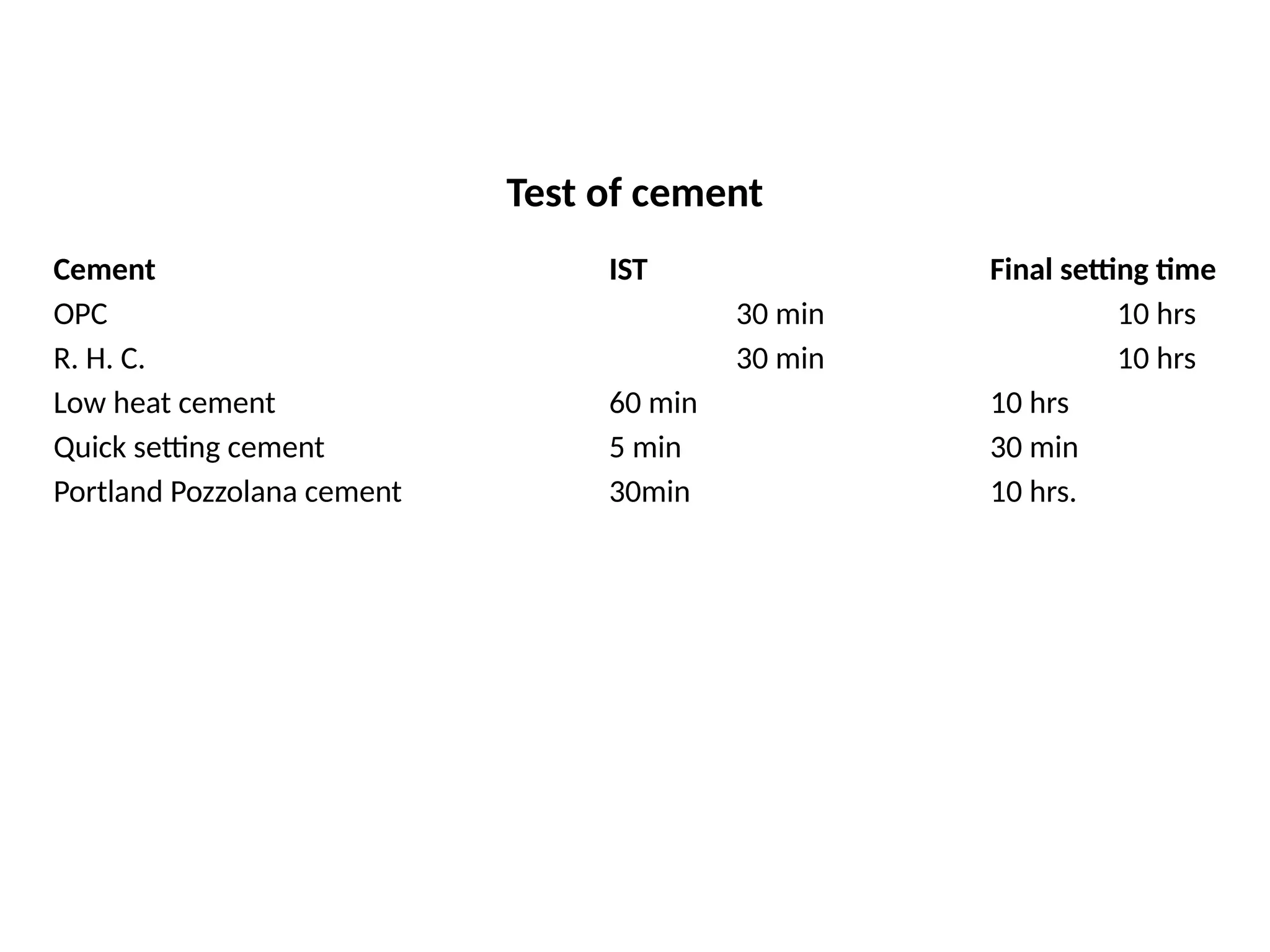
Test of cement
CementIST Final setting time
OPC 30 min 10 hrs
R. H. C. 30 min 10 hrs
Low heat cement 60 min 10 hrs
Quick setting cement 5 min 30 min
Portland Pozzolana cement 30min 10 hrs.
71.
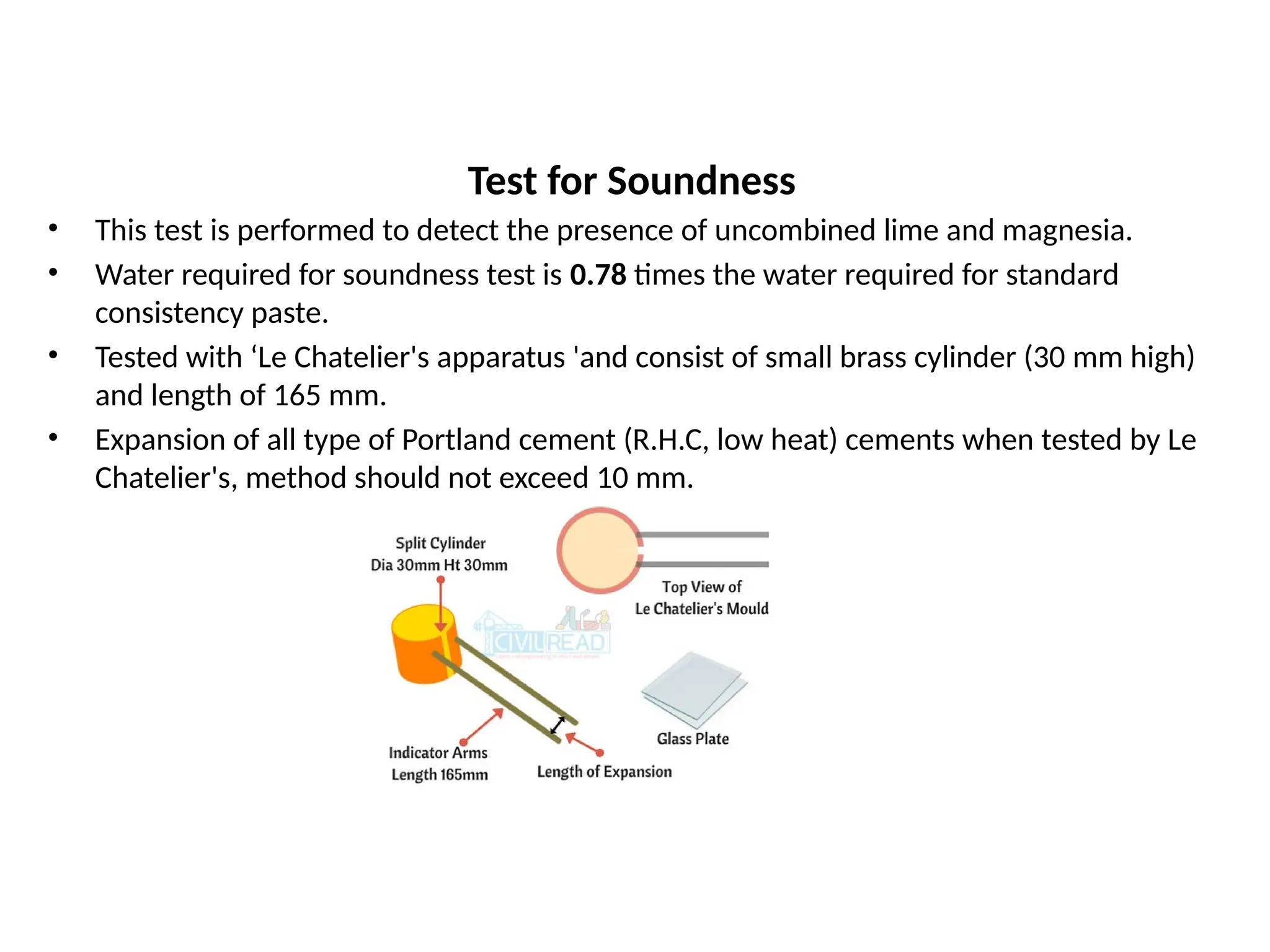
Test for Soundness
•This test is performed to detect the presence of uncombined lime and magnesia.
• Water required for soundness test is 0.78 times the water required for standard
consistency paste.
• Tested with ‘Le Chatelier's apparatus 'and consist of small brass cylinder (30 mm high)
and length of 165 mm.
• Expansion of all type of Portland cement (R.H.C, low heat) cements when tested by Le
Chatelier's, method should not exceed 10 mm.
72.
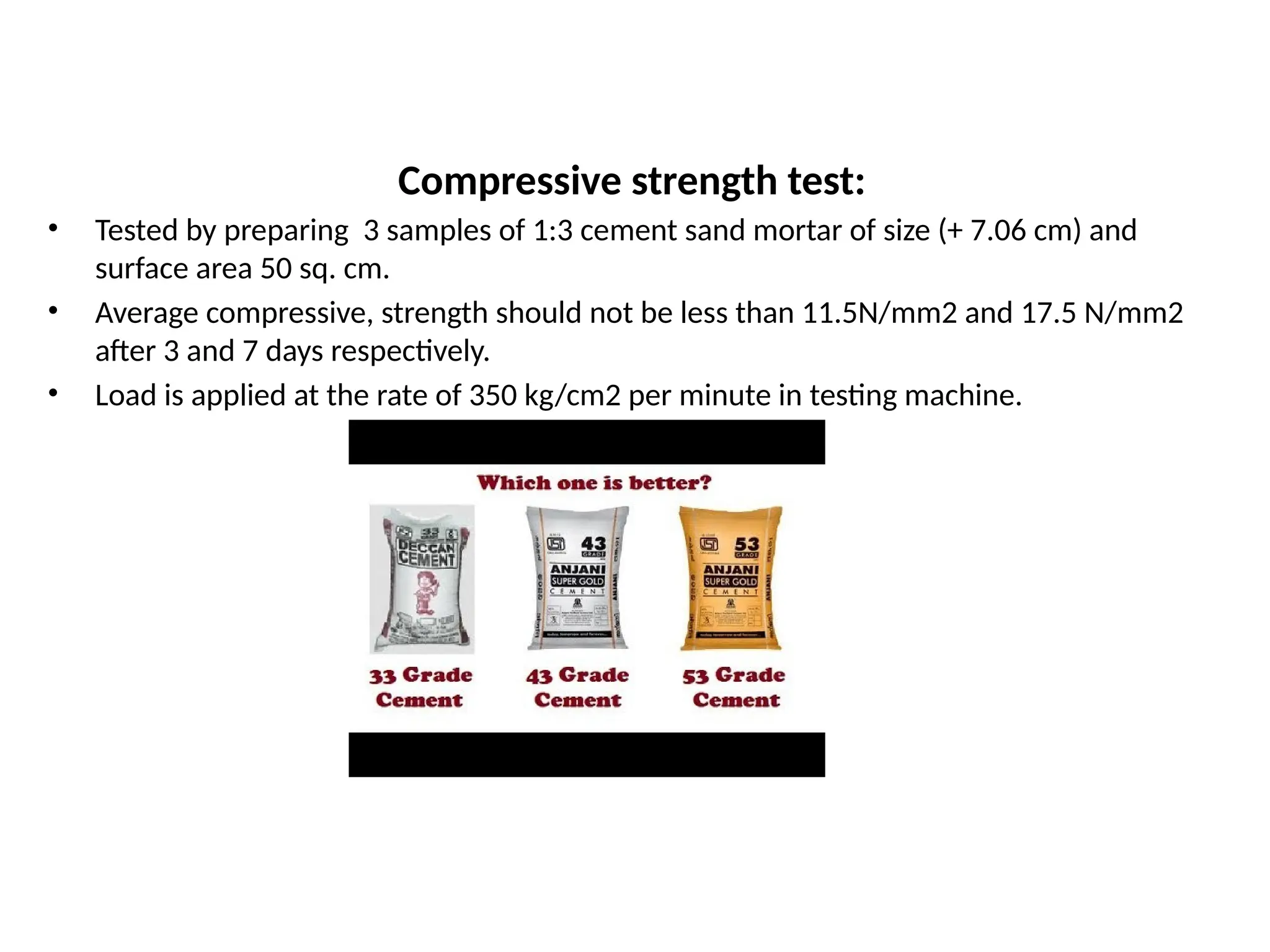
Compressive strength test:
•Tested by preparing 3 samples of 1:3 cement sand mortar of size (+ 7.06 cm) and
surface area 50 sq. cm.
• Average compressive, strength should not be less than 11.5N/mm2 and 17.5 N/mm2
after 3 and 7 days respectively.
• Load is applied at the rate of 350 kg/cm2 per minute in testing machine.
73.
Fineness of cement
•Finer the cement, greater the rate of hydration and strength development.
• Finer the cement, lesser they bleed and better workability.
• Finer the cement, higher the cost of grinding, more shrinkage and cracking.
• The weight of residue left after 15 minutes shaking using Standard IS Sieve no. 9 (90
micron) should not exceed 10% and 5% for OPC cement and rapid hardening cement
respectively.
74.
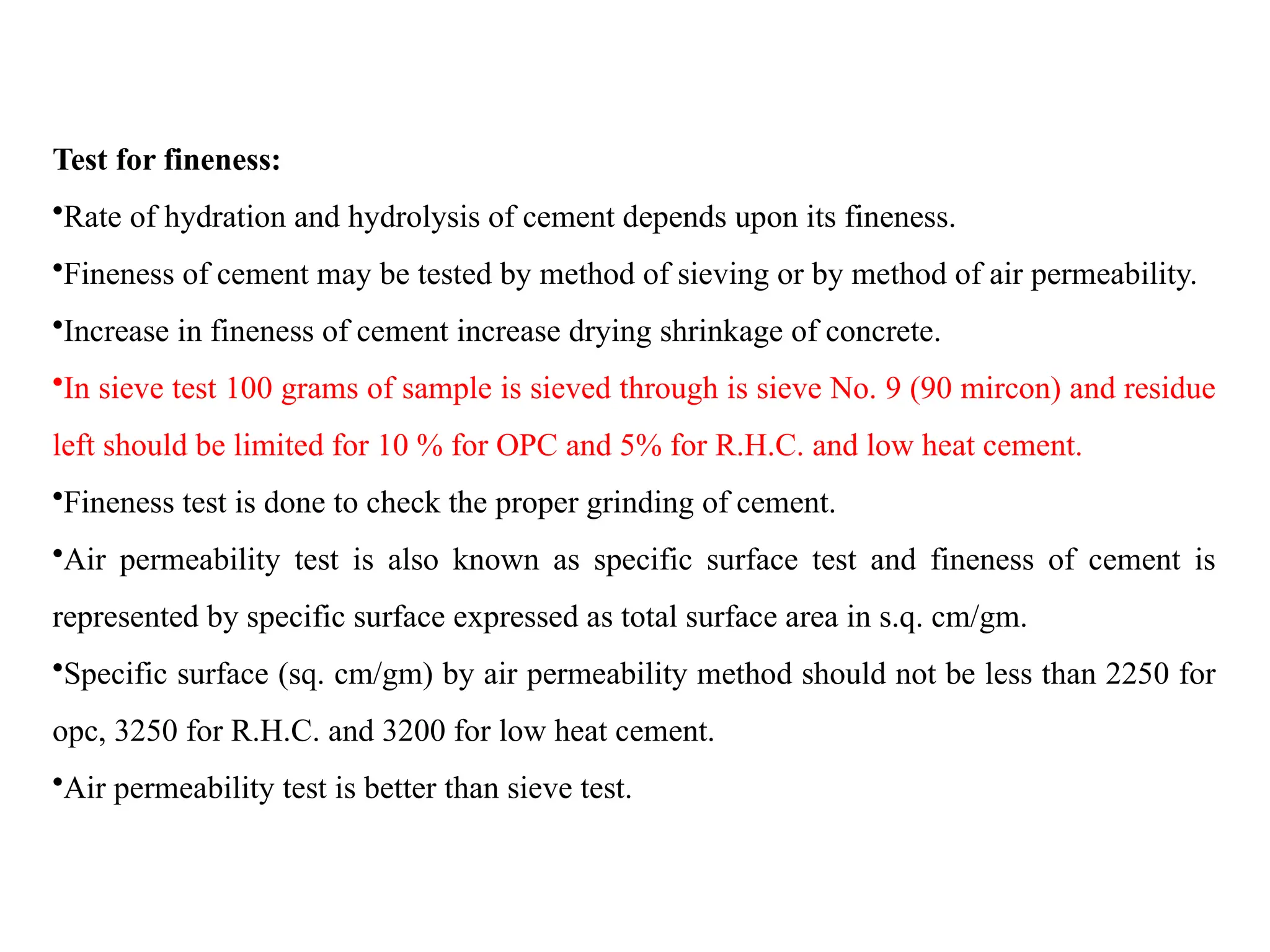
Test for fineness:
•Rateof hydration and hydrolysis of cement depends upon its fineness.
•Fineness of cement may be tested by method of sieving or by method of air permeability.
•Increase in fineness of cement increase drying shrinkage of concrete.
•In sieve test 100 grams of sample is sieved through is sieve No. 9 (90 mircon) and residue
left should be limited for 10 % for OPC and 5% for R.H.C. and low heat cement.
•Fineness test is done to check the proper grinding of cement.
•Air permeability test is also known as specific surface test and fineness of cement is
represented by specific surface expressed as total surface area in s.q. cm/gm.
•Specific surface (sq. cm/gm) by air permeability method should not be less than 2250 for
opc, 3250 for R.H.C. and 3200 for low heat cement.
•Air permeability test is better than sieve test.
75.
Some points
• C3Ais the first to react with water and causes the initial set
• Burning of raw materials of cement is done at temperature of (1300°C to
1900°C, resulting clinker.
• Clinker is dark greenish blue balls of diameter about (0.3–2.5) cm.
• Generally (2.5 – 3) % by weight of cement, gypsum is added during
grinding to retard the setting time.
76.
Practice Question
1. Initialsetting of cement is caused due to
a) C3S b) C2S c) C3A d)
C3AF
2. With storage strength of cement
a) increases b) decreases
c) remains the same d) none of these
3. The most commonly used retarder in cement is
b) gypsum b) calcium chloride c) calcium carbonate d) none
4. Loss on ignition on cement should not exceed
a) 1% b) 4% c) 8% d) 12%
77.
Mortar
Proper selection ofmortars for various uses depends upon the following factors:
Type of masonry, namely brick work, stone work, concrete block work, etc., and
strength of individual masonry unit.
Situation of use of the masonry, namely, whether in foundation, superstructure, etc.
Conditions of surrounding soil in the case of foundation work.
Load which the masonry will have to bear.
Conditions of exposure
Building material made of lime and cement mixed with sand and water that is spread
between bricks or stones so as to hold them together when it hardens
78.
Mud Mortar
Mudmortar is prepared by the mix of Mud/ Soil with water, and sand at the
ratio of 1:5, and 1:6.
Soil for mud mortar should have clay and silt content 60 to 70 percent and
sand content 40 to 30 percent. It should be free from vegetation, organic
matter, gravel, coarse sand and should not contain excessive quantities of
soluble salts.
To get better-plastered surface, small quantities of hydrated lime, bitumen
and cow dung is added.
79.
Lime Mortar
Fatlime mortar is used for plastering, and hydraulic lime mortar is for
masonry works.
Fat lime is used in whitewashing and plastering walls.
Lime mortar that is applied to cover internal walls and ceilings is generally
called "lime plaster".
Lime mortar that is applied to cover external or exposed walls is generally
called "lime render".
80.
Cement Mortar
Mixingshall be done preferably in a mechanical mixer.
If done by hand, the operation shall be carried out on a clean watertight platform.
Cement and sand shall be mixed dry in the required proportions to obtain a uniform
color.
The required quantity of water shall then be added and the mortar mixed to produce
a workable consistency.
In the case of mechanical mixing, the mortar shall be mixed for at least three
minutes after addition of water.
Grade of
Mortar
Minimum Compressive
strength at 28 days
(N/mm2)
Mix Proportion (By loose
volume)
H1 10 Cement:Sand 1:3
H2 6-7.5 C:S:1:4=7.5, C:S:1:4.5=6
M1 5-3 C:S:1:5=5, C:S:1:6=3
M2 2-3 C:S:1:6=3, C:S:1:9=2
M3 1.5 C:S:1:7=1.5
L1 0.7 C:S:1:8=0.7
L2 0.5
81.
Gauged Mortar
In gaugemortar combination of lime and cement is employed as a binder material, and
sand used as fine aggregate. Gauge mortar is, essentially, lime mortar which its strength
increased by adding cement.
Surkhi Mortar
In Surkhi mortar, lime is used as binder material and Surkhi is employed as fine
aggregate. The Surkhi is finely-powdered burnt clay which provides more strength than
sand and cheaply available.
82.
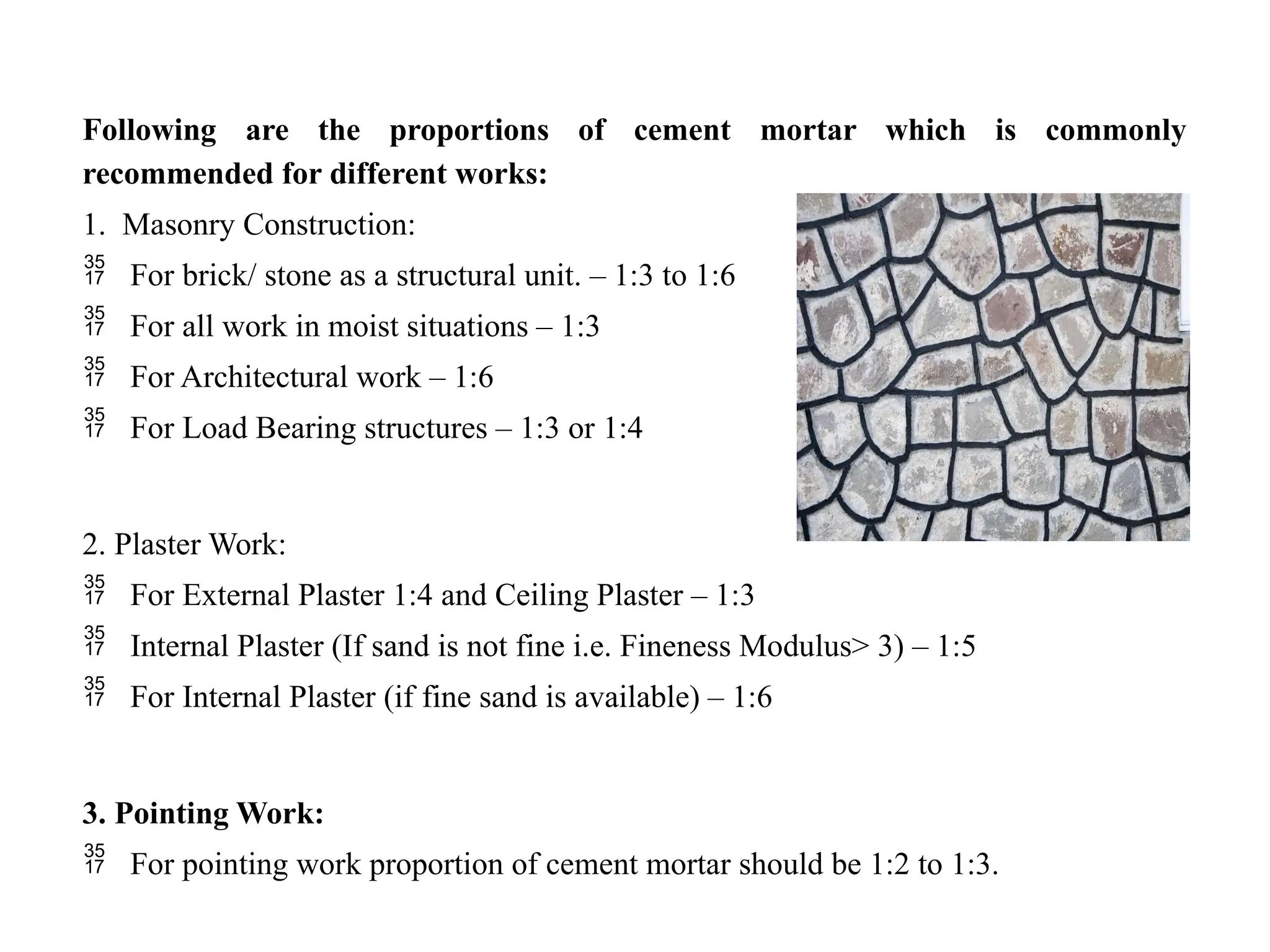
Following are theproportions of cement mortar which is commonly
recommended for different works:
1. Masonry Construction:
For brick/ stone as a structural unit. – 1:3 to 1:6
For all work in moist situations – 1:3
For Architectural work – 1:6
For Load Bearing structures – 1:3 or 1:4
2. Plaster Work:
For External Plaster 1:4 and Ceiling Plaster – 1:3
Internal Plaster (If sand is not fine i.e. Fineness Modulus> 3) – 1:5
For Internal Plaster (if fine sand is available) – 1:6
3. Pointing Work:
For pointing work proportion of cement mortar should be 1:2 to 1:3.
83.
Practice Question
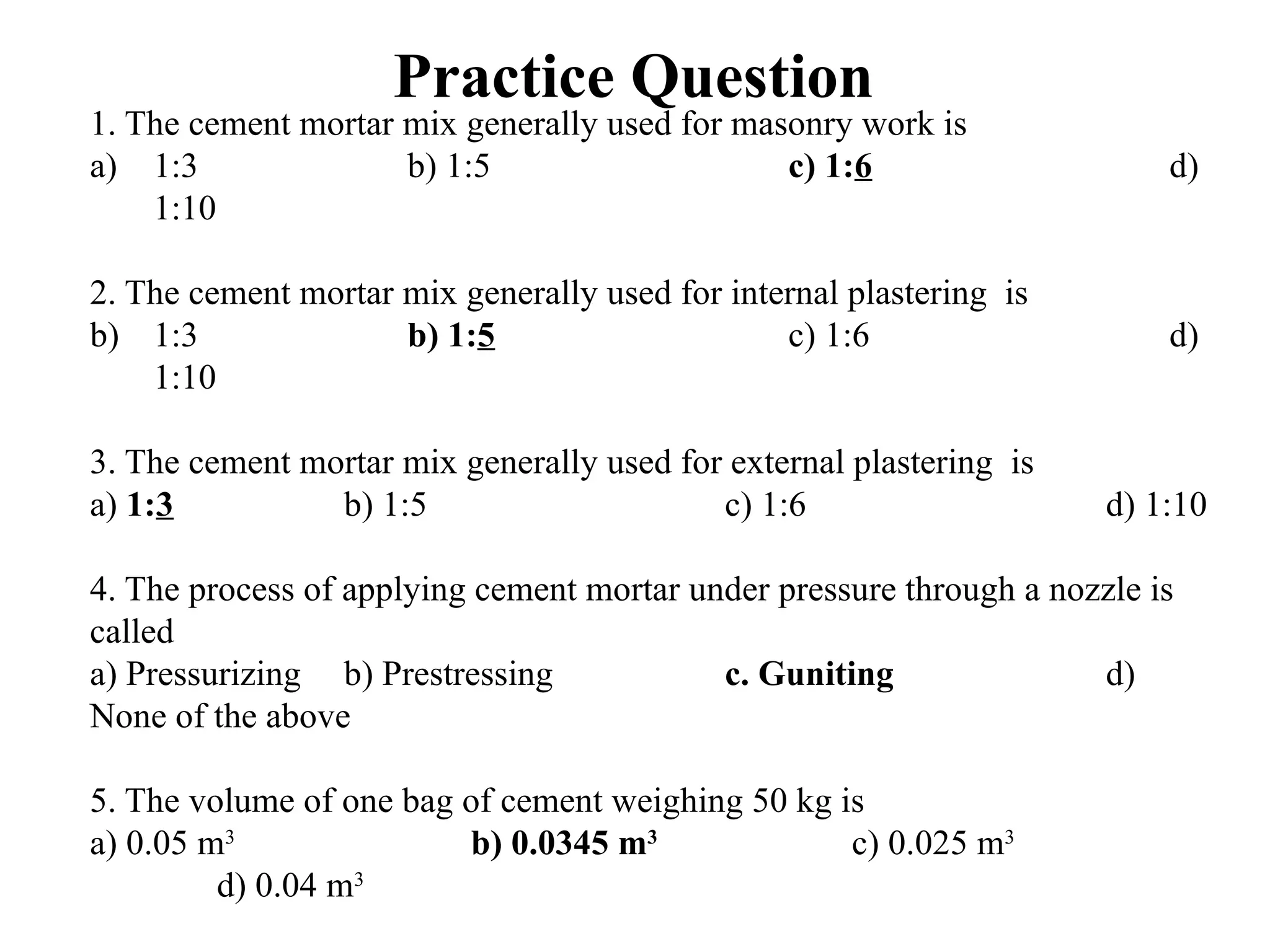
1. Thecement mortar mix generally used for masonry work is
a) 1:3 b) 1:5 c) 1:6 d)
1:10
2. The cement mortar mix generally used for internal plastering is
b) 1:3 b) 1:5 c) 1:6 d)
1:10
3. The cement mortar mix generally used for external plastering is
a) 1:3 b) 1:5 c) 1:6 d) 1:10
4. The process of applying cement mortar under pressure through a nozzle is
called
a) Pressurizing b) Prestressing c. Guniting d)
None of the above
5. The volume of one bag of cement weighing 50 kg is
a) 0.05 m3
b) 0.0345 m3
c) 0.025 m3
d) 0.04 m3
84.
Mortar
Proper selection ofmortars for various uses depends upon the following factors:
Type of masonry, namely brick work, stone work, concrete block work, etc., and strength of
individual masonry unit.
Situation of use of the masonry, namely, whether in foundation, superstructure, etc. Conditions
of surrounding soil in the case of foundation work.
Load which the masonry will have to bear.
Conditions of exposure to weather or soil conditions in the case of masonry buried below
ground level.
Type and grading of fine aggregates to be used in the mortar, namely, whether sand, burnt-clay
aggregate or cinder aggregate.
In the case of hydraulic structures weathering conditions under water contact and under water
head action; and
In case of use in storage of acidic or alkaline substances
a building material made of lime and cement mixed with sand and water
that is spread between bricks or stones so as to hold them together when it
hardens
85.
Mortar
Grade Compressive strengthat 28 days (N/mm2)
MM 0.5 0.5 to 0.7
MM 0.7 0.7 to 1.5
MM 1.5 1.5 to 2
MM 2 2 to 3
MM 3 3 to 5
MM 5 5 to 7.5
MM 7.5 7.5 and above
In the case of masonry exposed frequently to rains and where there is further
protection by way of plastering or rendering or other finishes, the grade of
mortar shall not be less than MM 0.7 but shall preferably be of grade MM 2.
Where no protection is provided, the grade of mortar for external walls shall
not be less than MM 2
86.
In thecase of load bearing internal walls, the grade of mortar shall
preferably be MM 0.7 or more for high durability but in no case less than
MM 0.5.
Where masonry foundation soil has little moisture, masonry mortar of
grade not less than MM 0.7 shall be used.
Where masonry foundation soil is very damp, masonry mortar of grade
preferably MM 2 or more shall be used. But in no case shall the grade of
mortar be less than MM 0.7.
Where masonry foundation soil is saturated with water, masonry mortar of
grade MM 3 shall be used but in no case shall the grade of mortar be less
than MM 2.
For masonry in buildings’ subject to vibration of machinery, the grade of
mortar shall not be less than MM 3.
87.
Mud Mortar
Mud formortar shall be free from organic materials. It shall also be free from pebbles
and other hard materials which would upset the mortar thickness. The sand content in the
mud shall not be more than 30 % in order that a satisfactory cohesiveness is attained.
Dry mud shall be thoroughly kneaded with water to achieve a dense paste.
Mud mortar is prepared by the mix of Mud/ Soil with water, and sand at the ratio of
1:5, and 1:6.
Soil for mud mortar should have clay and silt content 60 to 70 percent and sand
content 40 to 30 percent. It should be free from vegetation, organic matter, gravel,
coarse sand and should not contain excessive quantities of soluble salts.
To get better-plastered surface, small quantities of hydrated lime, bitumen and cow
dung is added.
88.
Lime Mortar
Fatlime mortar is used for plastering, and hydraulic lime mortar is for masonry
works. The flexible properties of cement mortar have completely replaced lime
mortar in the market.
Fat lime is used in whitewashing and plastering walls.
Lime mortar that is applied to cover internal walls and ceilings is generally called
"lime plaster".
Lime mortar that is applied to cover external or exposed walls is generally called
"lime render".
Lime mortar is of two types: air lime (non-hydraulic limes, those that set when
exposed to air, made with lime putty) and water lime (hydraulic limes, those that set
when immersed in water, made with Natural Hydraulic Lime).
89.
Cement Mortar
Mixing shallbe done preferably in a mechanical mixer. If done by hand, the operation
shall be carried out on a clean watertight platform. Cement and sand shall be mixed
dry in the required proportions to obtain a uniform color. The required quantity of
water shall then be added and the mortar mixed to produce a workable consistency. In
the case of mechanical mixing, the mortar shall be mixed for at least three minutes
after addition of water.
Masonry Unit Strength (N/mm2) Mortar Type
below 5 M2
5 to 14.9 M1
15 to 24.9 H2
25 or above H1
Grade of
Mortar
Minimum
Compressive
strength at 28 days
(N/mm2)
Mix Proportion (By
loose volume)
H1 10 Cement:Sand 1:3
H2 6-7.5 C:S:1:4=7.5,
C:S:1:4.5=6
M1 5-3 C:S:1:5=5, C:S:1:6=3
M2 2-3 C:S:1:6=3, C:S:1:9=2
M3 1.5 C:S:1:7=1.5
L1 0.7 C:S:1:8=0.7
L2 0.5
90.
Cement Mortar
Mixing shallbe done preferably in a mechanical mixer. If done by hand, the operation
shall be carried out on a clean watertight platform. Cement and sand shall be mixed
dry in the required proportions to obtain a uniform color. The required quantity of
water shall then be added and the mortar mixed to produce a workable consistency. In
the case of mechanical mixing, the mortar shall be mixed for at least three minutes
after addition of water.
Masonry Unit Strength (N/mm2) Mortar Type
below 5 M2
5 to 14.9 M1
15 to 24.9 H2
25 or above H1
Grade of
Mortar
Minimum
Compressive
strength at 28 days
(N/mm2)
Mix Proportion (By
loose volume)
H1 10 Cement:Sand 1:3
H2 6-7.5 C:S:1:4=7.5,
C:S:1:4.5=6
M1 5-3 C:S:1:5=5, C:S:1:6=3
M2 2-3 C:S:1:6=3, C:S:1:9=2
M3 1.5 C:S:1:7=1.5
L1 0.7 C:S:1:8=0.7
L2 0.5
91.
Gauged Mortar
In gaugemortar combination of lime and cement is employed as a binder material, and sand used as
fine aggregate. Gauge mortar is, essentially, lime mortar which its strength increased by adding
cement.
Surkhi Mortar
In Surkhi mortar, lime is used as binder material and Surkhi is employed as fine aggregate. The
Surkhi is finely-powdered burnt clay which provides more strength than sand and cheaply available.
Mortar Mix Type: N, O, S, or M
Type M Mortar
It is the highest strength mortar minimum 17.2 MPa. It is used for exterior masonry work and at or below grade application where
substantial gravity or lateral loads are exerted. Load bearing wall, footing, retaining wall are examples of below grade applications.
Type S Mortar
It is a medium-strength mortar minimum 12.4 MP with high bonding ability. it is used for grade applications with normal to
moderate loading. Type S mortar has great durability that is why it is highly suitable for locations where the masonry is in contact
with the ground, such as paving or shallow retaining walls.
Type N Mortar
It is medium strength with minimum 5.2 MPa and most common type of mortar. Type N mortar used for reinforced interior and
above-grade exterior load-bearing walls on which normal loads are imposed.
Type O Mortar
It is a low strength mortar with minimum 2.5 MPa. Type O mortar employed for interior non-load-bearing applications with very
limited exterior use. Added to that, it used for repointing where the structural integrity of the wall is intact.
92.
Following are theproportions of cement mortar which is commonly
recommended for different works:
1. Masonry Construction:
For brick/ stone as a structural unit. – 1:3 to 1:6
For all work in moist situations – 1:3
For Architectural work – 1:6
For Load Bearing structures – 1:3 or 1:4
1. Plaster Work:
For External Plaster 1:4 and Ceiling Plaster – 1:3
Internal Plaster (If sand is not fine i.e. Fineness Modulus> 3) – 1:5
For Internal Plaster (if fine sand is available) – 1:6
1. Pointing Work:
For pointing work proportion of cement mortar should be 1:2 to 1:3.
93.
• Which ofthe following reasons is not a type of mortar?
a) Cement mortar b) Lime mortar c) Lemon mortar d) Cement-lime mortar
• Minimum compressive strength in N/mm² for H1 type mortar used for masonry is
a) 3 b) 5 c) 7.5 d) 10
• Cement mortars richer than 1: 3 are not used in masonry because
(i) There is no gain in strength of masonry
(ii) There is high shrinkage
(iii) They are prone to segregation
a) Only (ii) is correct b) (i) and (ii) are correct
c) (ii) and (iii) are correct d) (i), (ii) and (iii) are correct
• MM 1.5 means:
a) Masonry Mortar of cement content 1.5 bags
b) Mild Mortar of cement content 1.5 bags
c) Masonry Mortar of compressive strength 1.5N/mm2.
d) Mild Mortar of compressive strength 1.5N/mm2.
• For pointing works, the ratio of mortar used is:
a) 1:3 – 1:4 b) 1:2 – 1:3 c) 1:7 – 1:8 d) 1:5 – 1:6
• Which of the following is not a type of mortar mix?
a) Type M b) Type S c) Type P d) Type N
• In Surkhi mortar _________ is used as binding material.
a) Lime b) Cement c) Surkhi d) Sand
• The most common type of mortars used in the present day is
a) Gauged Mortar b) Surkhi Mortar c) Rich Mortard) Cement Mortar
94.
Timber and wood
Standingtimber: It is the timber available in a living tree
Green timber: It is the freshly felled tree which has not lost much
of its moisture or the timber which still contains free water in its cells.
Rough timber: It is the timber obtained after felling a tree
Clear timber: It is the timber free from defects and stains.
95.
Timber and wood
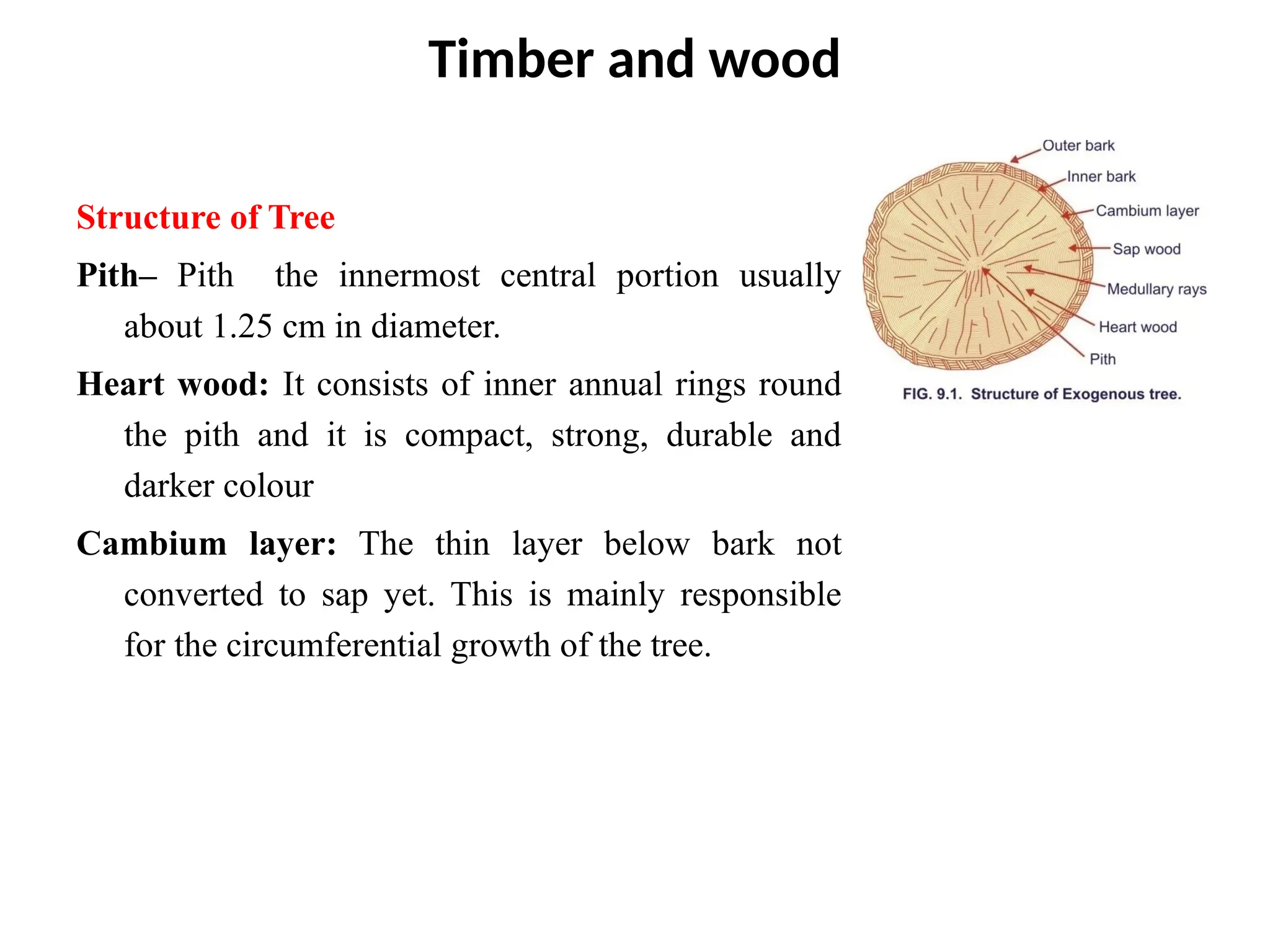
Structureof Tree
Pith– Pith the innermost central portion usually
about 1.25 cm in diameter.
Heart wood: It consists of inner annual rings round
the pith and it is compact, strong, durable and
darker colour
Cambium layer: The thin layer below bark not
converted to sap yet. This is mainly responsible
for the circumferential growth of the tree.
96.
Annual rings/growth rings:
Annualring consists of cellular tissue and woody fibre
arranged in distinct concentric circular rings. Number of
annual rings indicates the age of the tree.
Medullary rays: These are the thin radial fibers extending
from pith to cambium layer.
Defects in Timbers
Knots: Knots are the roots of small branches of the tree.
Wind cracks: These are shaker or craps on the outside of log
due to the shrinkage of the exterior surface caused
by atmospheric influences.
Rind galls: The abnormal growth of bark due to wound left
after branches have been improperly cut off.
97.
Upset or rupture:This is a crushing of the fibers caused by excessive
compression due to bending or shocks during the growth of the tree.
Heart shake: This is a crack starting at the heart and extends in radial
direction due to over maturity and shrinkage of heat wood.
Ring/cup shake: It is a crack developed between the annual rings either over
the whole circumference or part of it.
98.
Star shake: Theseare radial splits or cracks widest at the
circumference and get diminishing towards the centre of three.
This is mostly confined to sapwood.
Burrs or excrescences: This defect is due to unsuccessful attempts
at the formation of branches, dormant buds grew.
Sap stain: It is the discoloration of sapwood mainly due to fungi;
Honey combing: It is separation of the fibers in the interior due to
drying stresses.
Druxiness: This defect is indicated by white spots which are due to
access of fungi, probably through a broken branch.
Foxiness: This defect is indicated by reddish or yellow brown
stains, caused by over maturity and bad ventilation.
99.
Seasoning of Timber
•It is the process of drying timber or removing moisture or sap.
• A well seasoned piece of wood may contain about (10 – 12) % moisture and
will be in equilibrium with atmospheric humidity.
Methods of seasoning
1. Natural seasoning (a) Air seasoning (b) Water seasoning
2. Artificial seasoning (a) Kiln seasoning (b) Chemical seasoning (c)
Electrical seasoning.
Kiln seasoning
• Quick and moisture contents can be kept under control condition.
Chemical seasoning
• This is also known as salt seasoning.
• Urea/common salt is generally used for chemical seasoning.
Electrical seasoning
• In this method due to electric induction effect, the moisture contents in the
wood evaporate.
100.
Diseases of wood
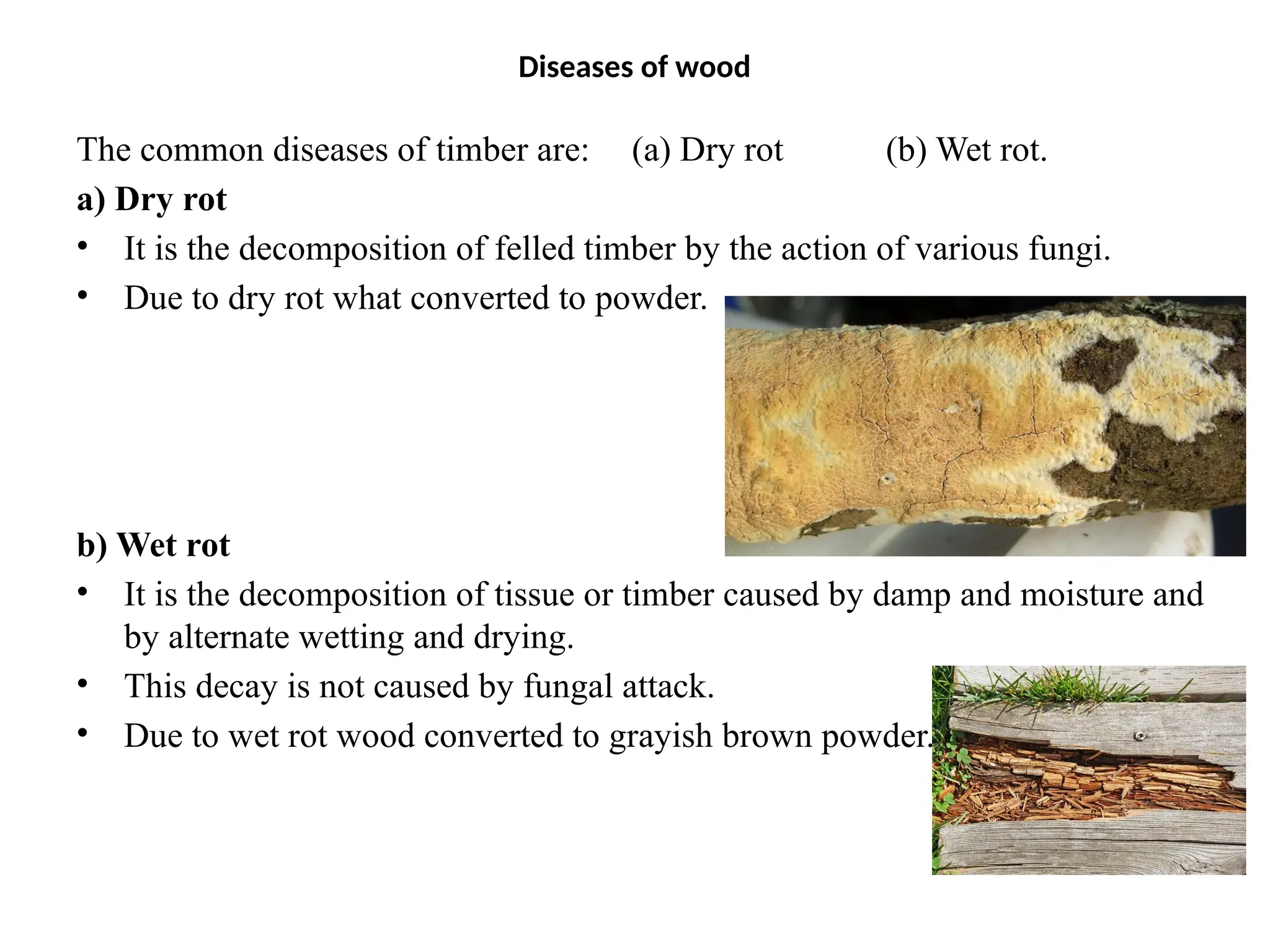
Thecommon diseases of timber are: (a) Dry rot (b) Wet rot.
a) Dry rot
• It is the decomposition of felled timber by the action of various fungi.
• Due to dry rot what converted to powder.
b) Wet rot
• It is the decomposition of tissue or timber caused by damp and moisture and
by alternate wetting and drying.
• This decay is not caused by fungal attack.
• Due to wet rot wood converted to grayish brown powder.
101.
Diseases of wood
Preservationof Timber
a) Tarring: It consists in applying a coat of tar or tar mixed with pitch and
employed for rough types of works.
b) Charring: It is done to prevent from dry rot and attacks of insects and is
charred (burned) out at lower end of posts.
c) Painting
Creosoting: Creosote oil is obtained by distillation of coal tar or wood tar. It
preserves the timber from rot and attacks by white ant
Wolman salt: It consists of creosote and sodium fluoride dissolved in
water. It makes the timber fire resistant and free from Fungai attack.
102.
d) Ascue treatment
e)Fire proofing: Ammonium sulphate, ammonium chloride, ammonia
phosphate, sodium arsenate and zinc chloride is used as fire proofing
materials.
f) Abel’s process: In this process, the surface of the timber is first painted with
dilute solution of sodium silicate, then with a cream like paste or slaked fat
lime and finally with a concentrated solution of soda.
103.
Methods of SawingTimber
a) Ordinary sawing
• Also called as bastard, flat or slab
sawing.
• Most economical method and wastage
are minimum.
b) Tangential sawing:
• Also called plain sawing.
• Boards or planks are sawn out of the log
of wood tangentially to the annual rings.
c) Radial sawing:
• Sawn is done parallels to medullar ray
104.
Some Points
• Battenis the timber whose cross-sectional dimensions do not exceed 5cm
in either direction.
• Plank is the timber, whose thickness doesn’t exceed 5 cm but width
exceeds 5 cm.
• Board is a thin plank generally under 5 cm thick and 10 cm or more in
width.
• Bulk is the cut timber cross-sectional dimensions exceed 5cm in one
direction and 20 cm in other.
105.
Some Points
• Scantingis a piece of timber, the cross-sectional dimensions of which
exceeds 5 cm in both the directions but do not exceed 20 cm.
• Strip is a piece of timber under 5 cm thickness and less than 10 cm width.
• Deal is the timber whose thickness varies from 5cm to 10cm and width
about 22 cm.
• Log is the trunk of tree left after cutting all the branches.
• Bole is the main stem of a tree.
• Bolt is a short log 1.25 m or less in length.
106.
• The minimumcompressive strength of the timber shall be 70 kg/cm2.
• All timber shall be seasoned to moisture content of not more than 22% for frames
and 15% for shutter.
The state of wood which has no capillary water but contains hygroscopic water
only is known as fiber saturation point.
By air drying the moisture content of wood can be reduced upto 20%.
The shrinking of wood, from green to over dry conditions is maximum in tangential
direction.
Softwood-Deodar, Kails, Chir, Simul (Cotton tree) etc.
Hard wood- Teak, shisham, sal, Babuli, Siris etc.
Points
107.
Wood- Based Products
Veneersare thin sheets or slices of wood of superior quality having thickness
varying from 0.4 to 6mm or more.
Ply wood
• It is made by glueing together veneers.
• The number of veneers is plywood is always kept odd and placed
perpendicular to each other.
• The usual range of pressure and heat applied for the fabrication of plies are
pressed at 7 bar and 150° to250° C respectively.
• The thickness of 3 ply is (3 – 6) m, 5 ply is (5 – 9) mm, 7 ply is (9 – 16)
mm, 9 ply is (12 – 19) mm
108.
Lamin board: ALamin board is a board having a core of strips,
each not exceeding 7 mm in thickness, glued together.
Batten board: A batten board is a board having core made up of
strips of wood usually 80 mm each laid separately or glued or
otherwise joined to form a slab.
Fibre boards
• Also called as pressed wood or reconstructed word or impreg
timber.
• They are varying in thickness from3 mm to 12 mm.
109.
Metals/alloys
Cast irons, wroughtiron and steel are the three general categories of ferrous metal
obtained from ping iron after various metallorgical processes.
Cast Iron
• Manufactured by re-melting the pig iron in a furnace called cupola.
• Contais (2 – 5) % carbon.
• It has crystaline, coarse granular structure.
• It can not be magnetized.
• It can be hardened by heating and sudden cooling but can not be tempered,
forged or welded.
• Cast iron has a high compressive strength and low tensile strength.
• It is used in structural works and cast iron pipes.
Wrough iron
• It is purest form of iron, containing carbon (0.05 to 0.15%)
• Fibrous structure of bluish colour.
• Tough and more elastic than cast iron.
• It can neither be hardened nor tempered but it can be forged and welded.
• It is malleable and ductile.
110.
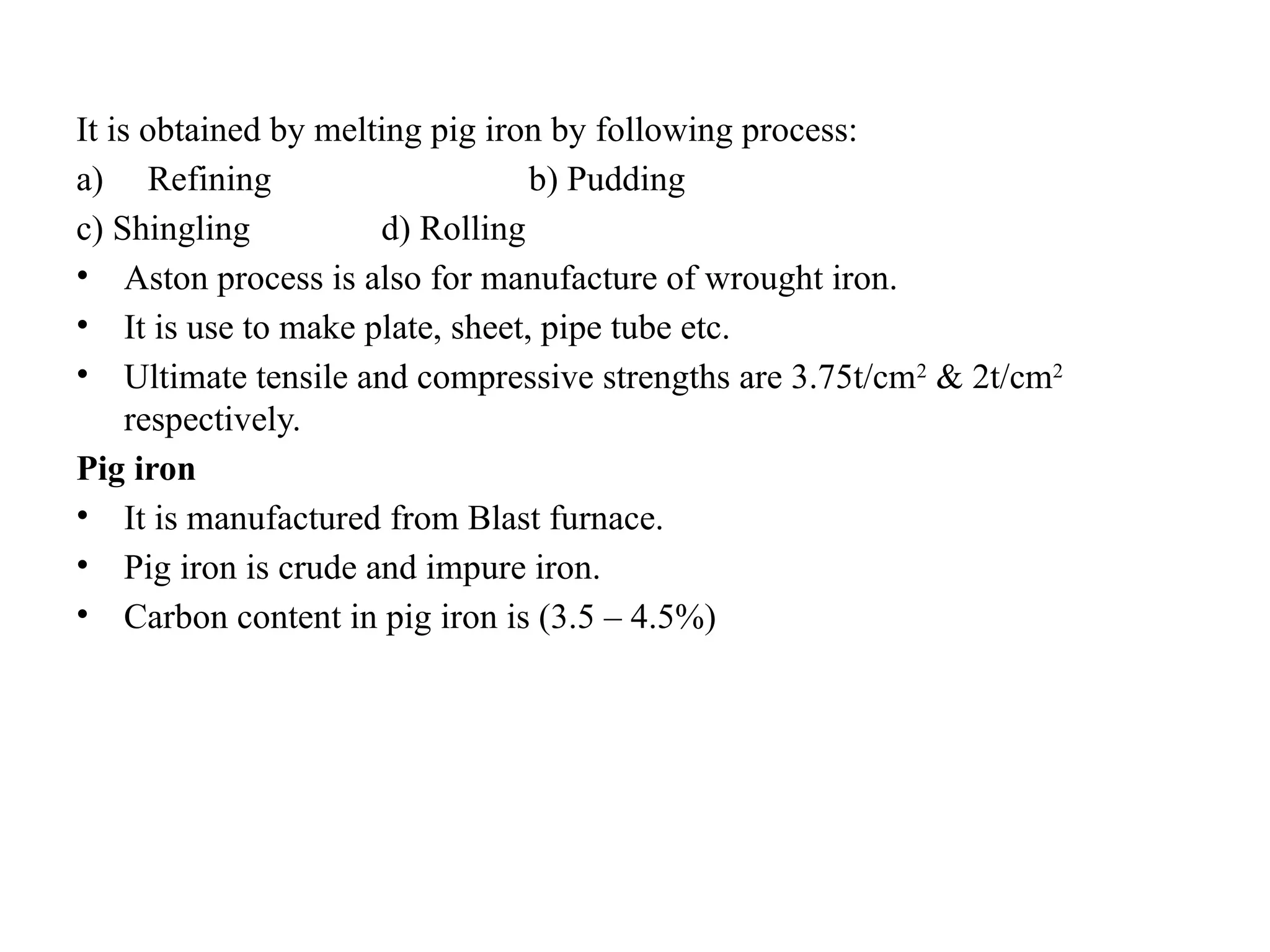
It is obtainedby melting pig iron by following process:
a) Refining b) Pudding
c) Shingling d) Rolling
• Aston process is also for manufacture of wrought iron.
• It is use to make plate, sheet, pipe tube etc.
• Ultimate tensile and compressive strengths are 3.75t/cm2
& 2t/cm2
respectively.
Pig iron
• It is manufactured from Blast furnace.
• Pig iron is crude and impure iron.
• Carbon content in pig iron is (3.5 – 4.5%)
111.
Steels
This is analloy of iron and carbon with traces of other elements present as impurities. Carbon
contain in steel is (0.15 – 1.5) % and present in the form of cementite.
Methods of manufacture of steel
1. Cementation process 2. Crucible process 3. Bessmer process
4. Open health process 5. Electric process 6. L.D. process
7. Duplex process 8. Kadlo process
• The process of decarburizing the pig iron completely and then adding proper percentage of
carbon for manufacturing steel, is called cementation process.
• The process of manufacturing steel by heating short length of wrought iron bars mixed with
charcoal in fire clay crucibles and collecting the molten iron into moulds, is known as crucible
process.
• Bessemer process produces inferior quality and softer variety of steel.
• Types of steel Carbon content
• Low carbon steel (Mid steel) (0.15– 0.3)%
• Medium carbon steel (0.3 – 0.8)%
• High carbon steel (0.8 –1.5 %)
• Tool steel > 1%
• Dead mild steel < 0.15 %
112.
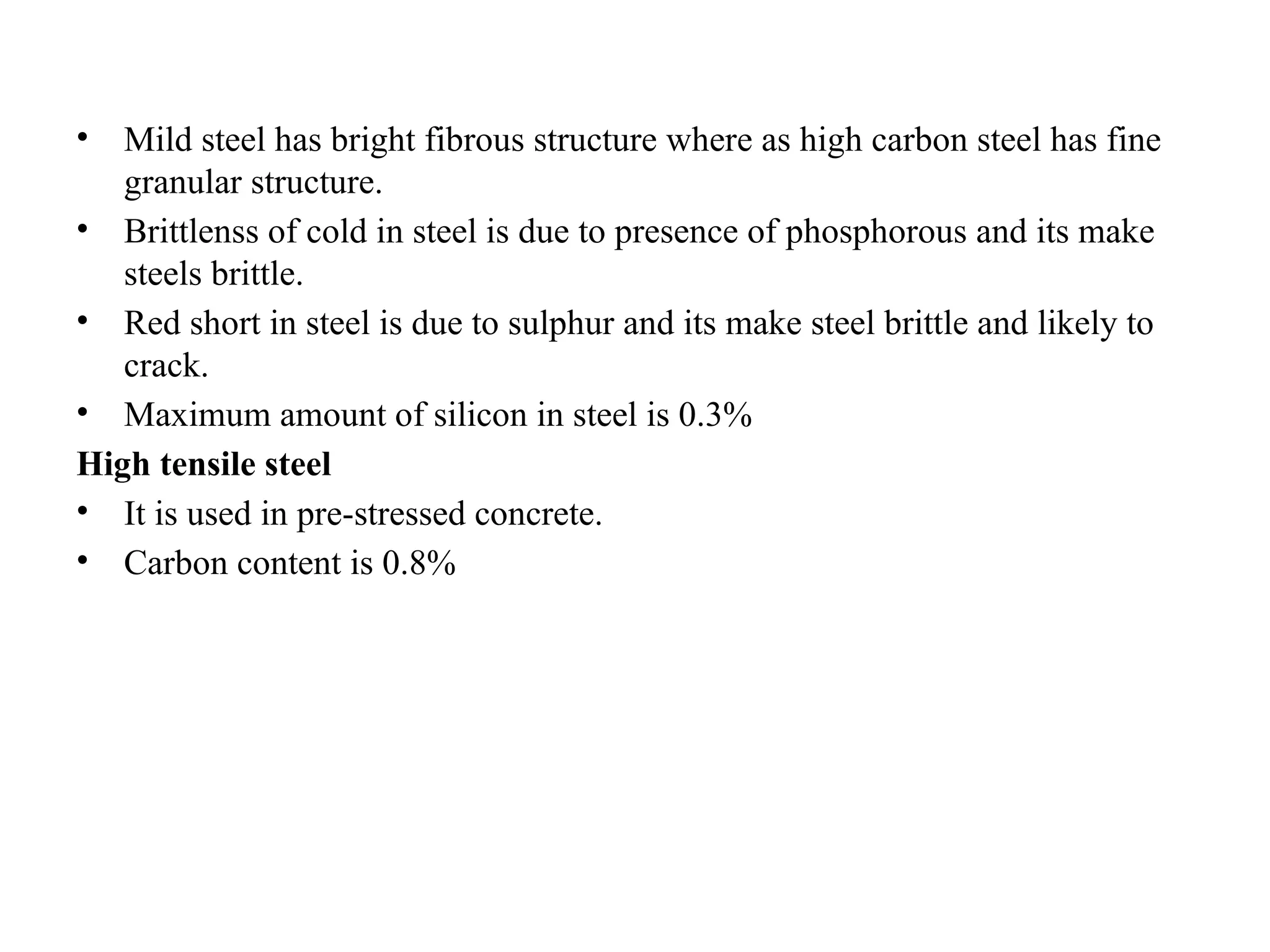
• Mild steelhas bright fibrous structure where as high carbon steel has fine
granular structure.
• Brittlenss of cold in steel is due to presence of phosphorous and its make
steels brittle.
• Red short in steel is due to sulphur and its make steel brittle and likely to
crack.
• Maximum amount of silicon in steel is 0.3%
High tensile steel
• It is used in pre-stressed concrete.
• Carbon content is 0.8%
114.
Alloy
1. Bronze –copoer (90%), Tin (10%)
2.Brass– copper (60%), zinc (40%)
3. Invar– steel (64%), Nickel (36%)
4. Monel metal– Copper (60%), Nickel (40%)
5. Solder – Lead, Tin.
6. German silver– copper, zinc, nickel
7. Gun metal (Red brass) – Copper (85%), Tin (5%), lead (5%),
and zinc (5%)
8. Stainless steel– Chromium (18%), Nickel (8%)
9. Nichrome– Nickel (60%), Chomium (15%), Iron (20%)
Expanded metal is used for reinforcing concrete in foundations, roads,
floors, bridges, temporary fencing etc.
115.
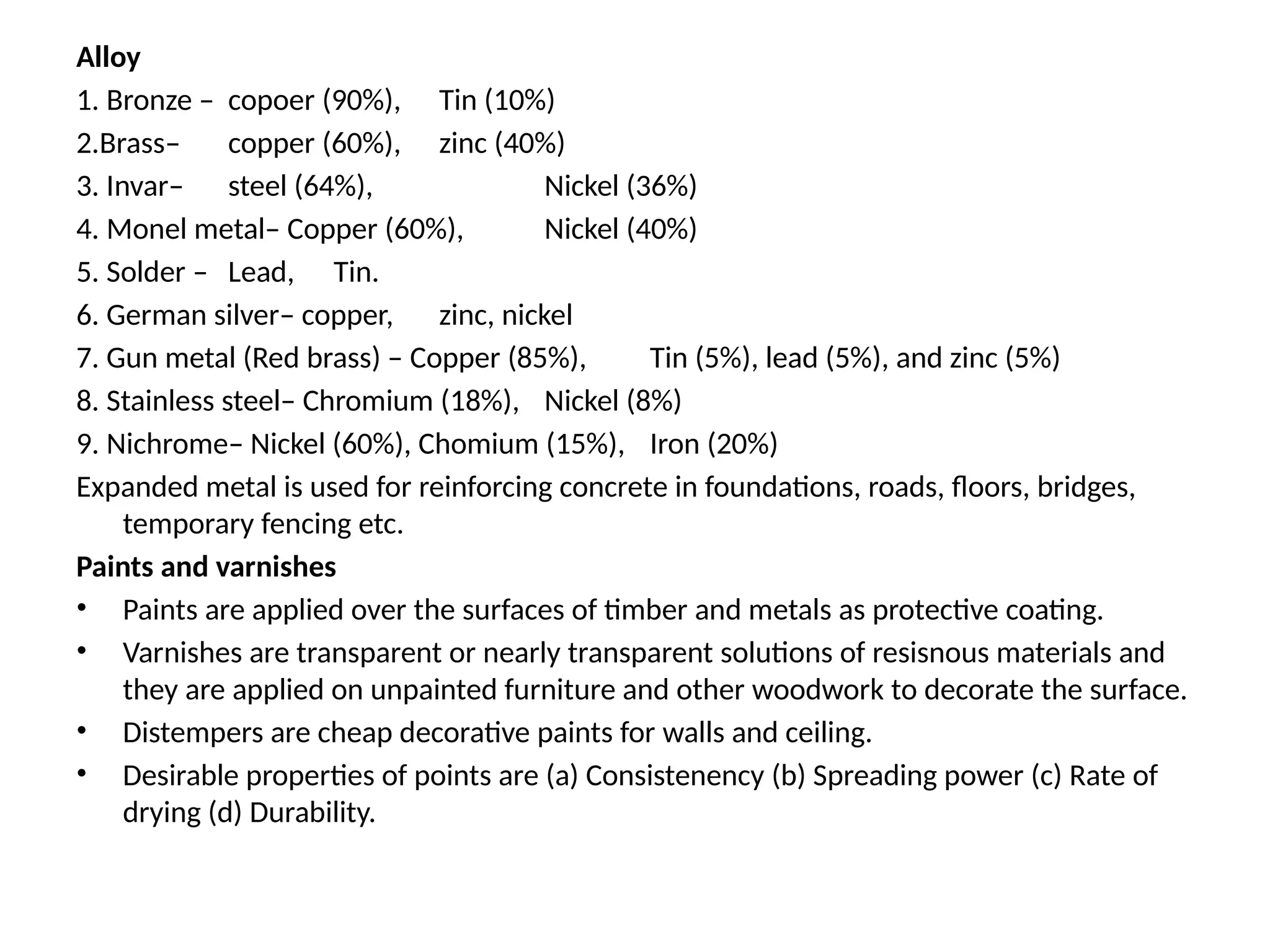
Alloy
1. Bronze –copoer (90%), Tin (10%)
2.Brass– copper (60%), zinc (40%)
3. Invar– steel (64%), Nickel (36%)
4. Monel metal– Copper (60%), Nickel (40%)
5. Solder – Lead, Tin.
6. German silver– copper, zinc, nickel
7. Gun metal (Red brass) – Copper (85%), Tin (5%), lead (5%), and zinc (5%)
8. Stainless steel– Chromium (18%), Nickel (8%)
9. Nichrome– Nickel (60%), Chomium (15%), Iron (20%)
Expanded metal is used for reinforcing concrete in foundations, roads, floors, bridges,
temporary fencing etc.
Paints and varnishes
• Paints are applied over the surfaces of timber and metals as protective coating.
• Varnishes are transparent or nearly transparent solutions of resisnous materials and
they are applied on unpainted furniture and other woodwork to decorate the surface.
• Distempers are cheap decorative paints for walls and ceiling.
• Desirable properties of points are (a) Consistenency (b) Spreading power (c) Rate of
drying (d) Durability.
116.
Ingredients of paints
1.Base
• It is a principal constituent of paint and possesses the binding properties.
• It is generally a metallic oxide and used in the form of powder. Commonly
used base are:
a) White lead – suitable for wood surfaces & is very poisonous.
b) Zinc white -wood surfaces
c) Red lead – Suitable for both iron surfaces, wooden surface
d) Titanium oxide – cane be used with all types of vehicle oils.
e) Lithopene
2. Vehicle/drying oil:
• Vehicle or carrier is the liquid which carries solid materials of base and
helps them to spread evenly on the surface to be painted.
• Linseed oil is commonly used vehicles.
• Tung, perilla, soyabean, sunflower, tobacco seeds are also used as vehicle.
117.
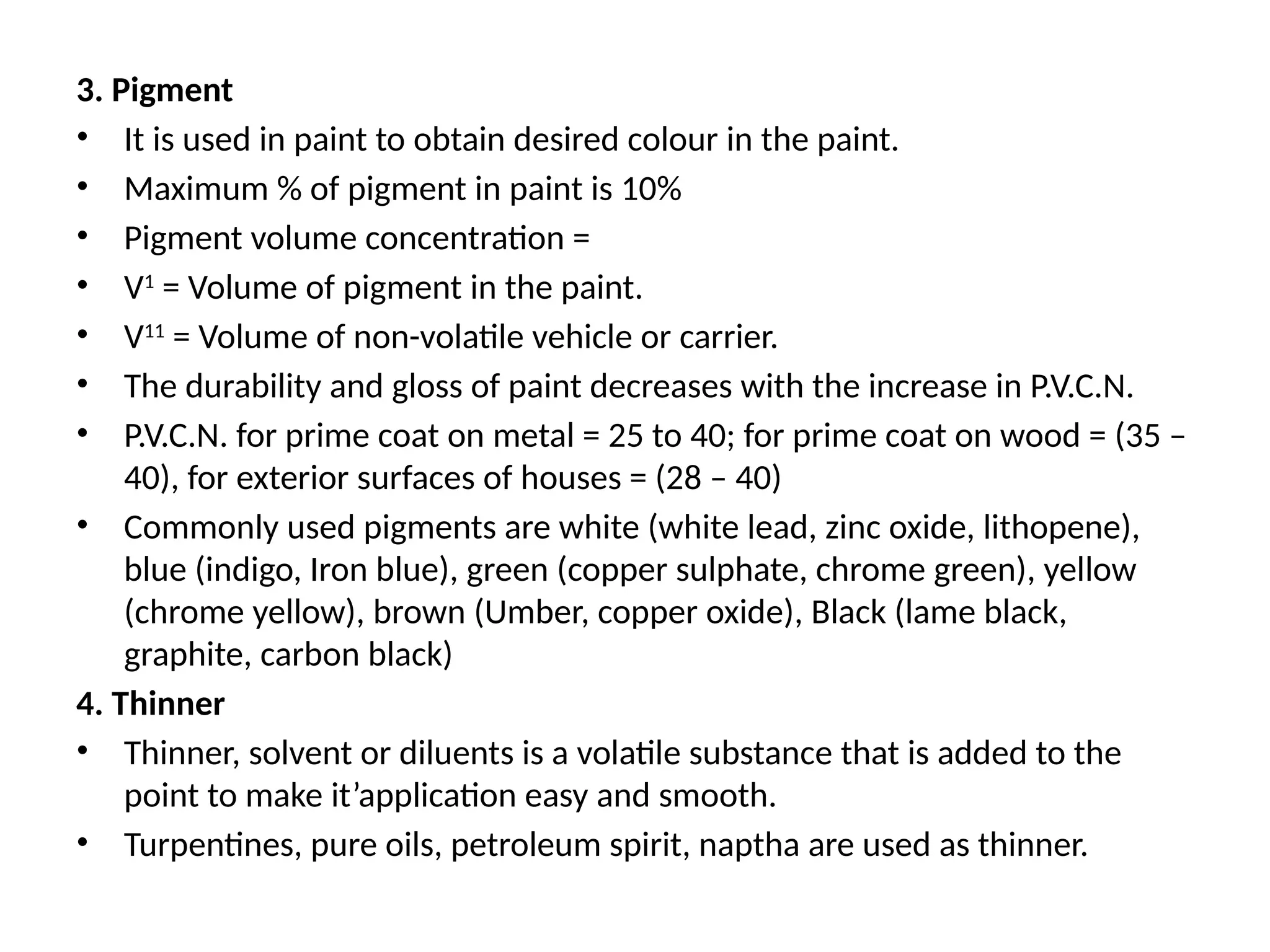
3. Pigment
• Itis used in paint to obtain desired colour in the paint.
• Maximum % of pigment in paint is 10%
• Pigment volume concentration =
• V1
= Volume of pigment in the paint.
• V11
= Volume of non-volatile vehicle or carrier.
• The durability and gloss of paint decreases with the increase in P.V.C.N.
• P.V.C.N. for prime coat on metal = 25 to 40; for prime coat on wood = (35 –
40), for exterior surfaces of houses = (28 – 40)
• Commonly used pigments are white (white lead, zinc oxide, lithopene),
blue (indigo, Iron blue), green (copper sulphate, chrome green), yellow
(chrome yellow), brown (Umber, copper oxide), Black (lame black,
graphite, carbon black)
4. Thinner
• Thinner, solvent or diluents is a volatile substance that is added to the
point to make it’application easy and smooth.
• Turpentines, pure oils, petroleum spirit, naptha are used as thinner.
118.
• Turpentine isa spirit obtained by distilling balsam, which is the resin or
gum obtained from pine tree
5. Drier
• A drier is substance which acts as catalyst and quickness the drying of the
vehicle used in the paint.
• It is used in very little amount.
• Hevy metallic soaps are used as drier.
• 6. Innert filler/adulterant/extenders
• It is an adulterant usually mixed in oil point (i) to modify its weight (ii) to
improve its durability (iii) To economize the paint.
• Chalk, gypsum, silica, charcoal are commonly used.
7. Antiskinning agent: They are generally polyhydroxy phenols used to
prevent gelling and skinning of paints.
8. Plasticizers: It is used to give elasticity and minimize the cracking.
119.
Types of Paints
1.Oil paint (Ordinary paint, cheap and easy to apply)
2. Aluminum paint
• Consists of aluminium powder suspended in spirit varnish or oil varnish or oil varnish
• Heat resisting, visible in darkness.
• Used for painting radiators, hot water pipes, gas tanks metal roofs.
3. Asbestos paint:
• Most fire resistant point.
• Suitable for patch work or stopping leakage in metal roof.
4. Bitumen's paint:
• Consist of asphalt, bitumen in mineral spirit or naptha or petroleum.
• Used for painting iron work under water, painting exterior brick work and plastered
surfaces.
5. Cellulose paints:
• Can be cleaned easily.
• Used in automobiles and aeroplanes.
6. Bronze paint:
• Commonly applied on radiators.
• Aluminum, copper powder is used as pigments and nitro cellulose lacquer as vehicle
120.
7. Enamel paints:
•Enamel paint made by adding pigments like white lend or zinc white to
a vehicle petroleum spirit and resinious matter.
• Commonly used for wood-based products.
• Varnish is used as vehicle in enamel paint.
8. Emulsion paints:
• Consists of polyvinyal acetate and synthetic resin as binding material.
• Mostly employed for painting steel and woodwork which is to be built in
masonry.
9. Cement paint:
• Cement paint consists of cement and hydrated lime mixed along with a
coloring pigment.
• Applied to exposed or plastered brick masonry and concrete work.
10. Luminous paint:
• It contains calcium sulphide with varnish.
121.
Varnish
• A transparentor semi-transparent solution of resinous substance either in
linseed oil, turpentine or alcohol is called varnish.
• Varnishes are modified form of paints and differ from paints in the following
two aspects:
a) Varnishes have no pigments.
b) In varnishes a part or whole of the oil is substituted by resin.
Functions of Varnish
a) Protect the painted surface.
b) Brighten the appearance of the grain in wood.
c) Provide brilliancy to painted surface.
Ingredients of varnishes
1) Resin
• Act as a base and provides bydy to varnish.
• Copal, Lac or shellac and Resin (obtained from pine) are commonly used resin.
2) Solvent
• Acts as vehicle of the varnish.
• Solvent for different resins are:
122.
Resins Solvents
• Capalamber Boiled linseed oil.
• Lac or shellac Methylated spirit.
• Mastic, Rosin, Gum Turpentine
• Other cheap resins Wood naptha.
• 3. Drier:
– Added in small proportions.
– Lithrage, white copper and lead acetate are commonly used.
Types of Varnishes
1. Oils varnishes:
• Consist of resin like copal and amber, dissolved in linseed oil.
• Suitable for exterior and interior works.
2. Spirit varnishes:
• It is not durable and easily affected by weathering actions and dry quickly.
• Mostly employed for furniture and interior work.
• French polish, Lacquer and shellac varnish fall in this category.
3. Turpentine varnishes:
• Not durable and dry quickly.
123.
4. Flat varnish:
•Varnish for dull appearance (no gloss) by adding material as wax,
metallic soap and silica.
5. Spar varnish– generally used in ship.
6. Asphalt varnish:
• Used mostly in steel products.
• Made by dissolving asphalt in linseed oil and thinned with
turpentine or petroleum spirit.
7. Water varnishes:
• Consist of lac dissolved in hot water.
• Used for pictures, varnishing maps etc.
124.
Lacquer
• It isa coating consisting of simple solution of performed binder (polymer) in volatile
solvents.
• Film forming basic materials (cellulose, phenol etc.), pigments (as in paints), solvents
(Ethers, alcohols), diluents (naptha, petroleum naptha), plasticizers (caster oil) are
onstituents.
• It is used for preparing artificial leather, finish to automobiles body, interior decoration etc
• Lacquer is oil paint.
Distempers
• Distemper is defined as water paints consisting of whiting as base (powdered chalk),
colouring pigment (if desired), carrier (water) and size (glue).
• Distempers may be of washable (oil bound distempers) and non-washable (dry
distempers) types.
• Washable distemper contains water resistant binder usually an emulsing drying oil or
varnish.
• One kg distemper requires o.6kg of water.
125.
Defects of Paint
•Bittiness– Appearance of small pimples on the surface of new paintwork caused by
dust, on the surface or on the painting tools.
• Blistering– It is the swelling of the paint film resulting in loss of adhesion. If selling is
due to oil, it is called blistering and if due to moisture, it is called peeling.
• Bleeding– staining by a soluble and coloured substance underneath the paint finish
• Checking– checking is formation of cracks: If a crack present in a surface area of
point enclose small area, it is called as crazy ad if it enclose large area called
crocodiling/checkin.
• Flaking– Detachment of paint film from the surface.
• Aligatoring– When on layer of paint film slide over the another one, when a hard
paint is applied over a soft one or vice-versa is called aligatoring.
• Chalking– Chalking is conversion of paint film into powder.
• Blooming– It is loss of gloss of paints.
• Cissing is the shrinkage of the paint film into craters or gathering into blobs.
• Saponification– Formation of soft, sticky masses on paints.
126.
Asphaltic materials (asphalt,bitumen and tar)
Asphalt
• It is natural or mechanical mixture which bitumen is associated with inert mineral
matter.
• It is solid or semi-solid sticky product, formed by partial evaporation or distillation of
crude petroleum.
• It is soluble in carbon disulphide.
• It is elastic and good conductor of heat, sound and electricity.
Constituents of Asphalt
1. Asphaltenes– Soluble in resins and provide hardness.
2. Resins– enhance binding properties.
3. Oil– imparts viscosity
Types of Asphalt
1. Natural asphalt:
– Lake asphalt: (Contain (40 – 70) % bitumen) (Used for road and pavement)
– Rockasphalt (Contain (4 – 20) % bitumen and remaining calcarious material (Used in
pavements, roofing and paving)
2. Residual or petroleum Asphalt:
– Also known as artificial asphalt.
– Obtained by the fractional distillation of crude petroleum oils.
127.
Forms of Asphalt
1.Cut– back asphalt.
• Liquid asphalt obtained by dissolving asphalt in volatile solvent.
• Used for preparing bituminous paints, reparing roofs etc.
2. Mastic asphalt:
• It is produced by heating natural asphalt with sand and mineral fillers.
• Used for damp and water proffing.
3. Asphaltic cement:
• Prepared by blowing air through melted asphalt at high temperature.
• Used for roofing, flooring and as filler for expansion joints in concrete
4. Asphaltic emulsion:
• Prepared by mixing asphalt with 50 to 60% water in presence of 1 %
of emulsifying agent.
• Can be used in cold condition.
128.
Bitumen
• It maybe defined as a solid or semisolid substance obtained by distillation of crude
petroleum.
• Bitumen is known as petroleum in the fluid state, mineral tar in semifluid state and asphalt
in solid state.
• Asphalt and bitumen are used synomymously, asphalt is natural product and bitumen is
refined product.
• Soluble in carbon disulphide.
• Specific gravity is 1.09.
Forms of Bitumen
1. Cut–back bitumen– used in bitumen paint.
2. Plastic bitumen:
• Comprises bitumen thinner and suitable inert filler (40 – 45%)
• Used for stooping leakage and filling cracks in masonry.
3. Blown bitumen/oxidized bitumen.
• It is obtained by passing air under pressure at high temperature.
• Used as insulting materials, as roofing and damp-proofing.
4. Straight run bitumen /rut bitumen.
• It is bitumen which is being distilled to a definite viscosity or penetration without further
treatment.
5. Bitumen emulsion:
• Bitumen in very finely divided state is suspended in acquous medium.
129.
Tar
• Tar isviscous liquid obtained during destructive distillation of coal, peat, wood or other
organic material.
• Tar contains 75 to 95 % of bituminous contents.
• It contains more carbon than asphalt.
Types of Tar
a) Coal tar: It is produced by destructive distillation of coal or as a by-product in the
manufacture of coal gas.
• Coal tar is refined by distillation to get road tar.
• Road tar is available in 5 grades.
• Coal tar is used in preservation of timber.
b) Mineral tar: Produced by distillation of bituminous shales.
c) Wood tar: Produced by distillation of pure and resinous trees.
• Pitch: It is a residue obtained in distillation of organic materials.
– Used in roads and pavement.
Bitumen Felt/Tar felt
• – Bitumen tar is used to saturate felt paper and to coat craft paper to render it water-proof.
• – Saturated felt paper is used in roofing, water proofing and underlays for floors.
130.
Plastic/Organic Polymers
• Mostplastic are of organic nature composed of hydrogen, oxygen, carbon
and nitrogen
• Coal, petroleum, lime stone, salt, sulphur, air, water and cellulose are raw
materials used in manufacture of plastics.
• Binder (resin or cellulose), filler, plasticizers (Vegetable oils), pigments,
lubricants and catalysts are ingredients of plastic.
Plastic are classified as
• a) Thermoplastic b) Thermosetting plastic.
• Thermoplastic: Soften on the application of heat and can be recycled eg;
polythene, PVC, Polysterene acrylic etc.
• Thermosetting plastic can not be resoftened one they have set and
hardened.
– Eg Phenolics, Bakelite, polyesters, expoxides, slilicones etc.
131.
Polymers/polymerization
• When largenumber of repeating units (monomers) joined together to form a
large molecule (macro) called polymer.
• The process of connecting of monometers is called polymerization.
Types of polymerization
a) Addition polymerizations:
• When two or more than two monomers combined to form large molecule
without wastage is called addition polymerization.
• Eg. Polyethene, PVC, polypropylene, polystyrene, Teflon.
b) Co-polymerization:
• It is a type of addition polymerization in which two or more different monomers
combined to form large molecule without wastage.
• Eg; artificial rubber, styrene-butadiene.
c) Condensation polymerization:
– It is defined as process of linking together of unlike monomers with the
elimination of small molecule like water, HCl etc.
132.
– Eg; Phenonfermaldehyde (Bakelite), Nylon, vinyl chloride acetate.
• Vinylchloride are formed from HCL, limestone and natural gas or coal.
• Acrylics are manufactured by addition polymerization of methyl
methacrylate.
Glass
• Glass is amorphous (non-crystoline) with homogenous texture chiefly
compound of silica, combined with varying proportions of oxides of
sodium, potassium, magnesia, iron and other minerals.
• Magnese dioxide is also called ‘Glass maker’ soap used to maintain the
colour of glass.
• Cullect is a broken glass of same type as that intended to be prepared
act as body to the glass.
Types of glass
a) Soda lime or crown glass:
• Used in window, plate glass and container glass.
133.
b) Flint glass:
•Contains lead oxide– used in table wares and for optical glass.
c) Pyrex or heat resistant glass:
• Contains boron oxide.
• Used in cooking utensils and laboratory wares.
d) Ground glass:
• Also known as frosted glass or obscured glass.
• Used in window panel and both room ventilators etc.
e) Wire glass:
• It is glass with wire netting also known as reinforced glass.
• Used for skylight roof.
f) Bullet-proof glass:
• This glass is made of several layers of plate glass and alternate layers consist
of vinyl-resin plastic.
• Used in glazing bank teller, jewellery stores etc.
g) Foamglass:
• It is made from powdered glass with carbon.
• Used in air-conditioning of building.
134.
h) Glass-fibre orglass-wool
• It is heat insulating and sound absorbing medium.
• Elastometer commonly known as rubbers(can extend 10 times) is linear
polymer which postesses elasticity and good resistance to corrosive fluide.
• Abrasive is a class of mineral used to sharpen the edges of cutting tools,
polish metallic or other surface
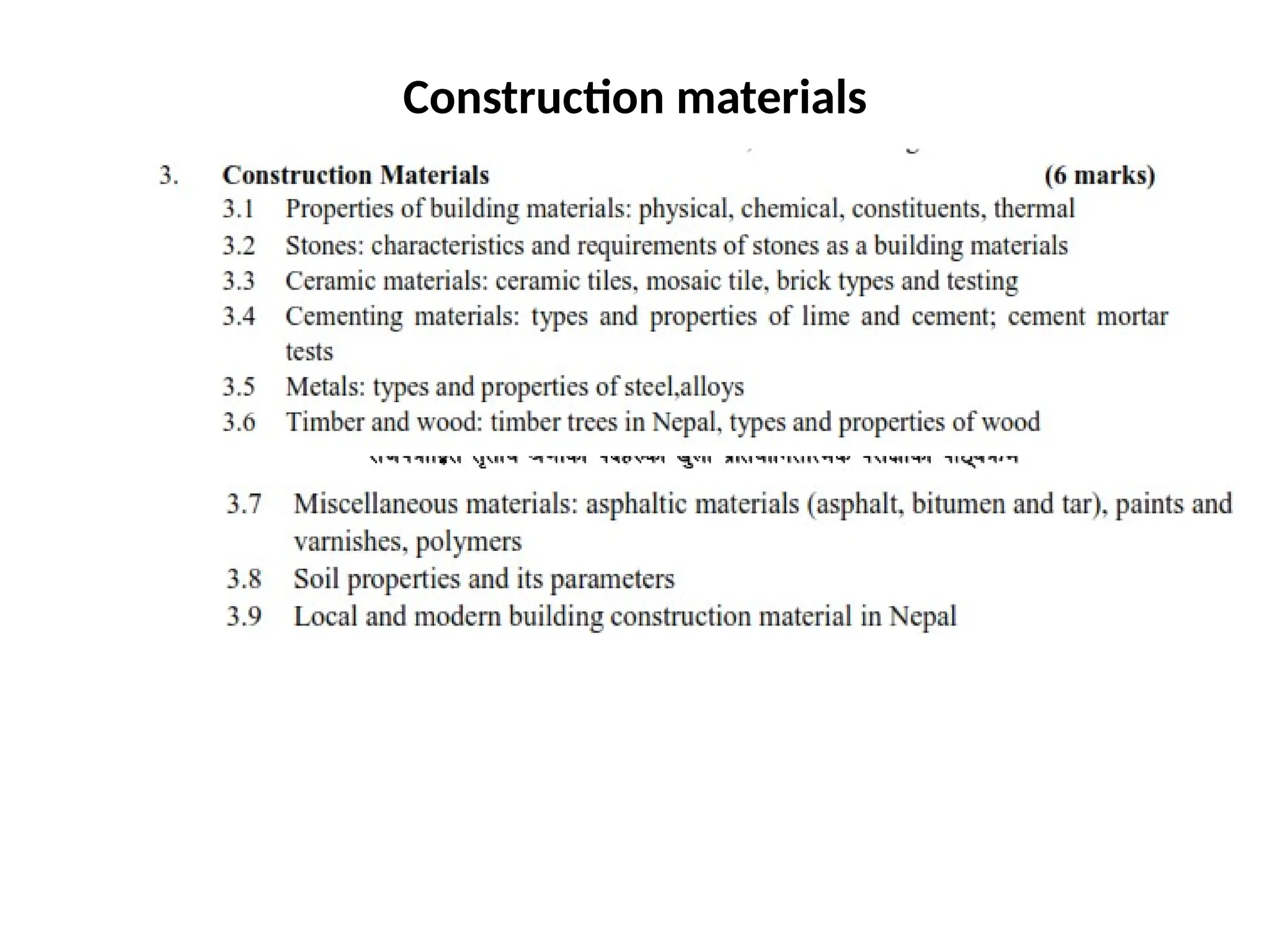
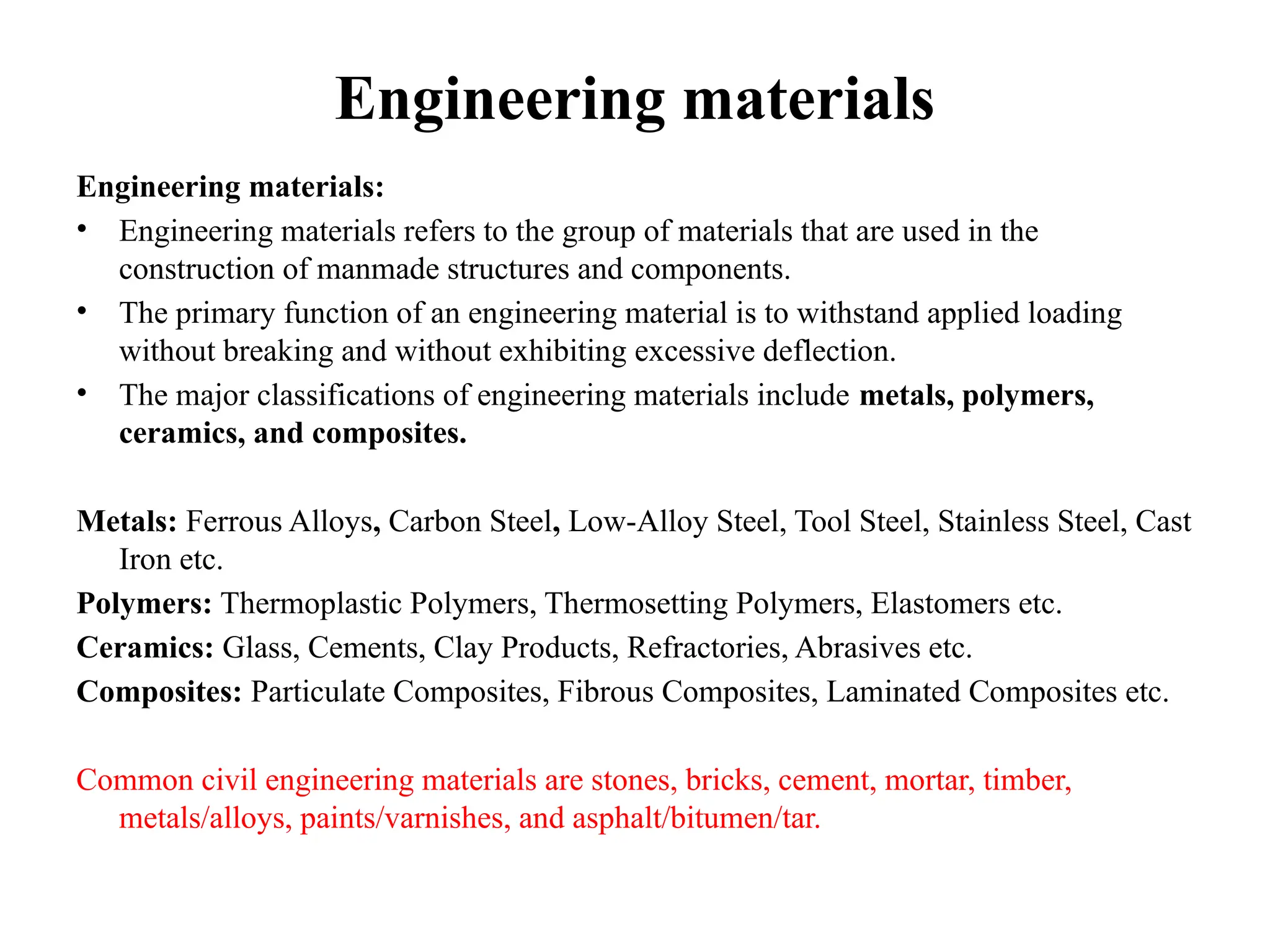
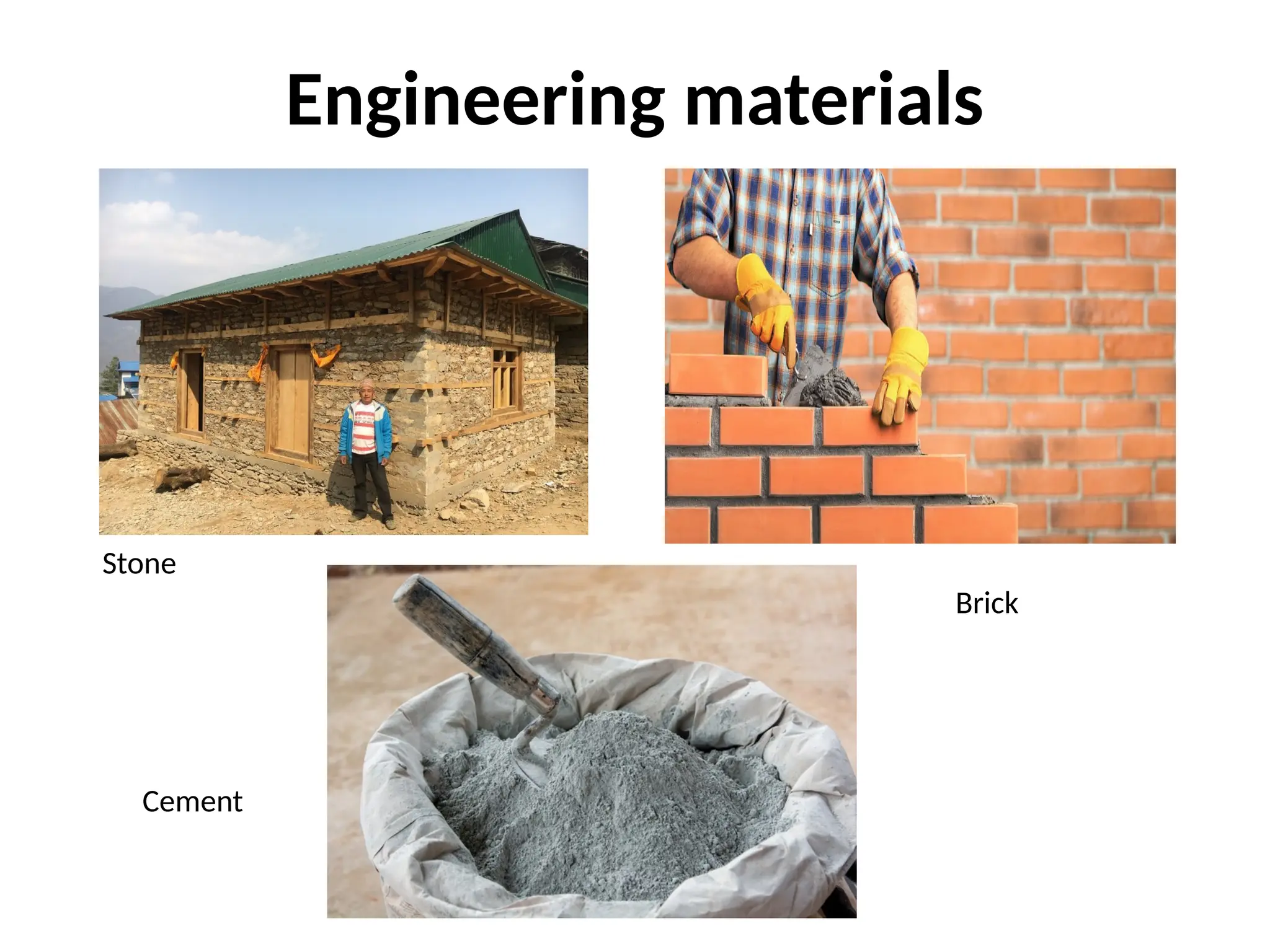
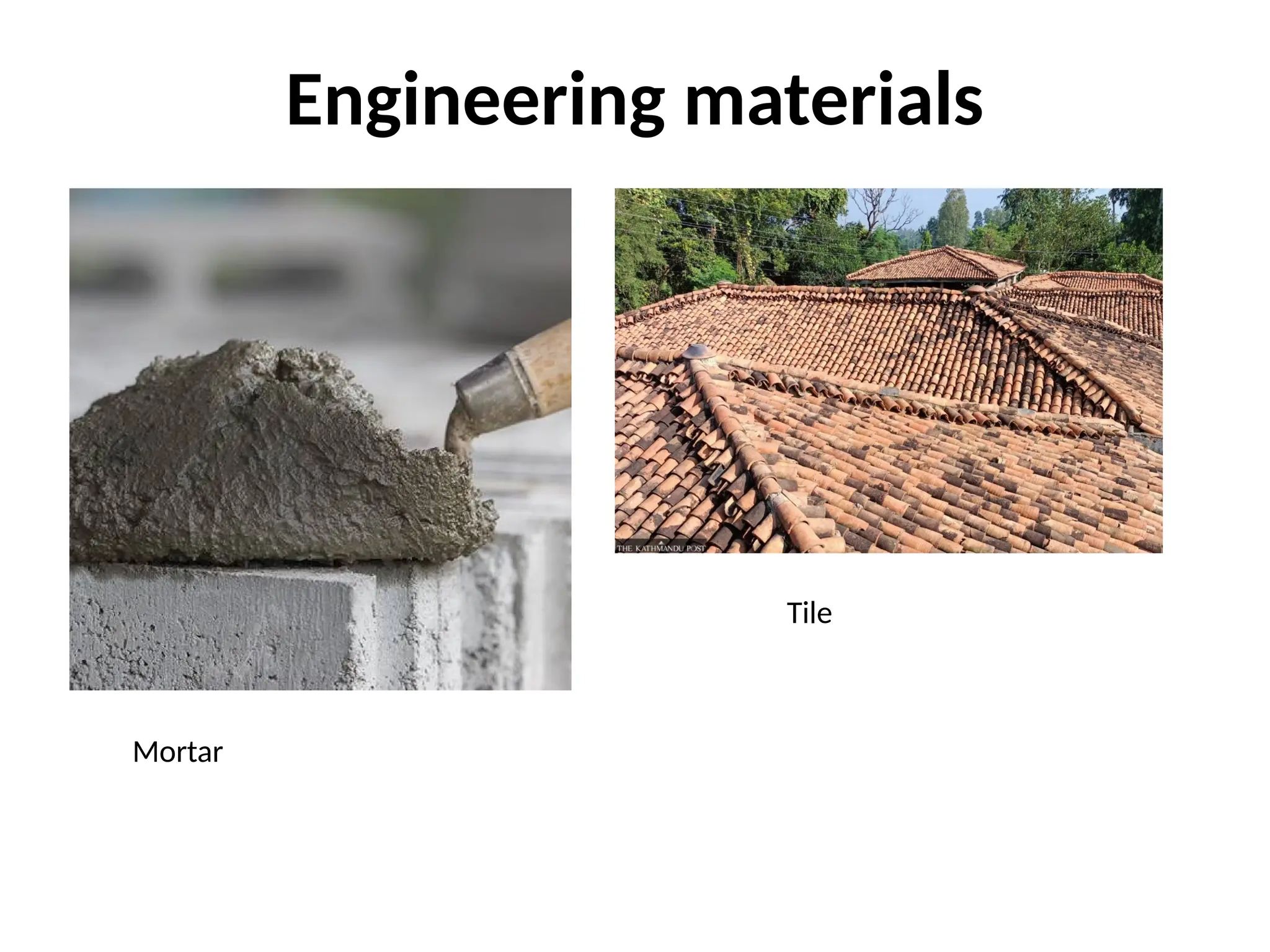
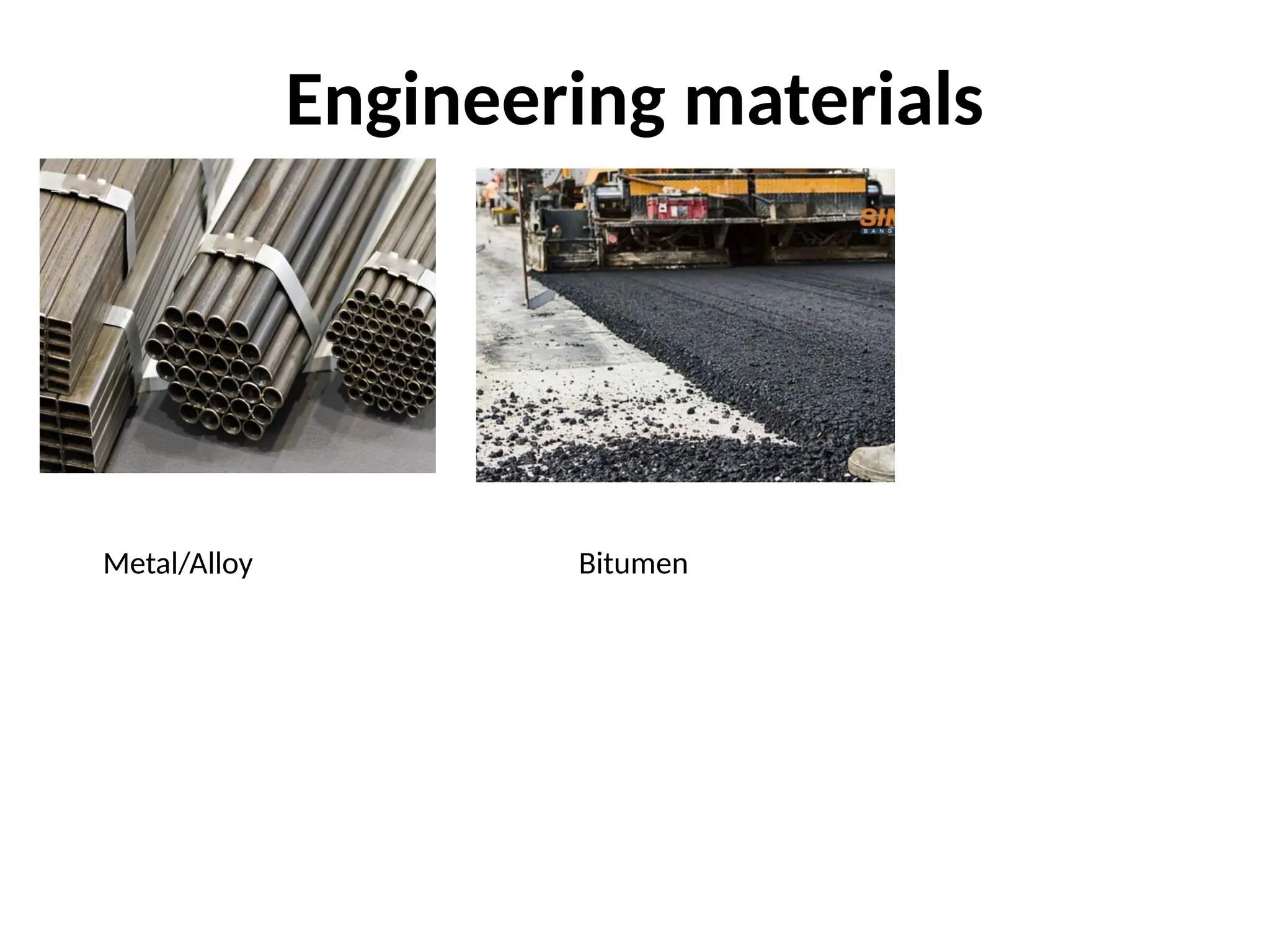


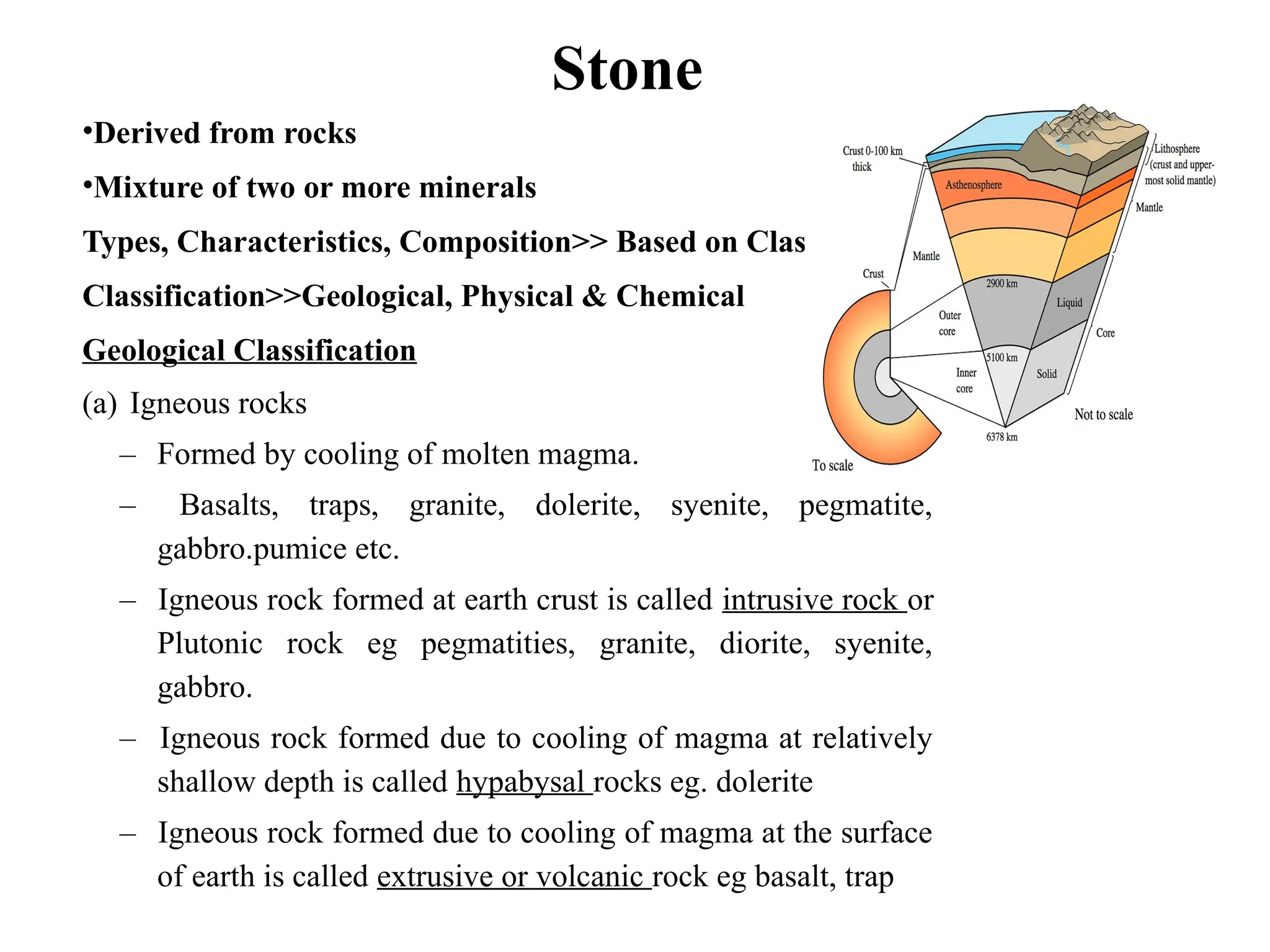

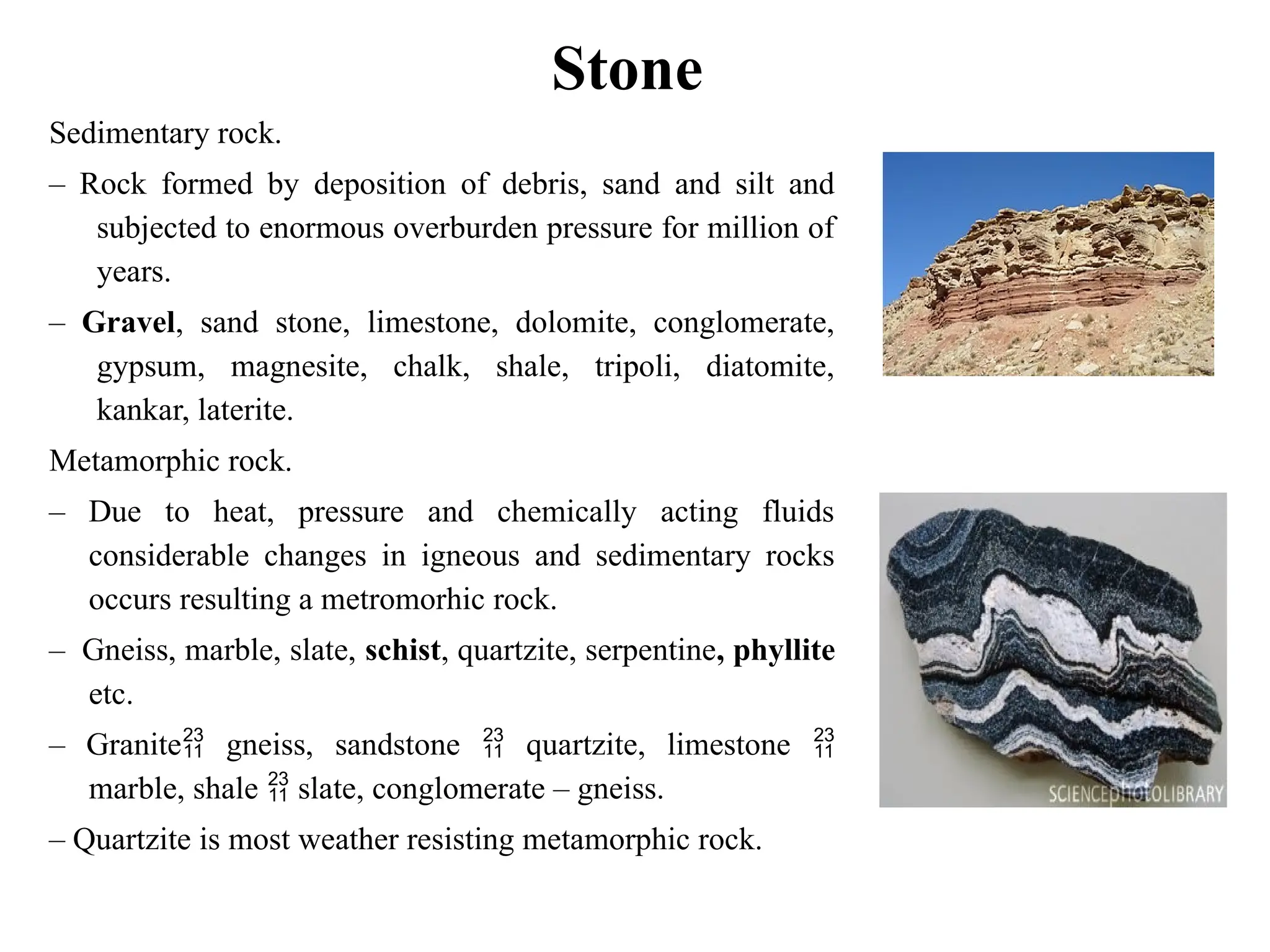





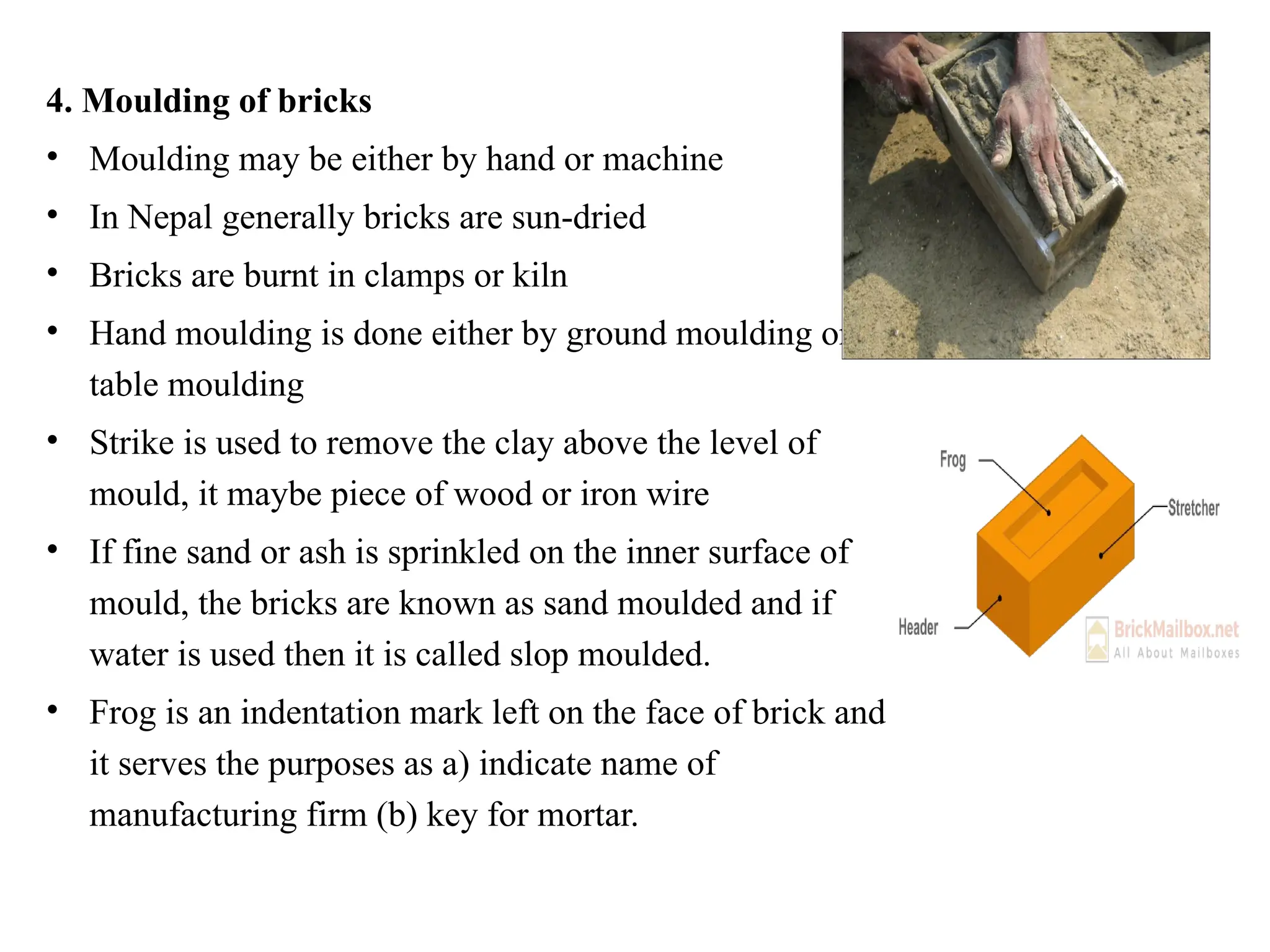

![Classification of Bricks
a) First class bricks:
• Should not absorb water more than 20% by weight when immersed in water for
24 hrs [I.S] and 15% in [N.S.]
• Minimum compressive strength is 10.5 N/mm2
• Specific gravity of 1.8
• Well burnt and regular in shape and produce metallic sound.
b) Second class brick.
• Well-burnt but irregular in shape and size.
• Should not absorb water more than 22% [I.S] by weight and 20% [N.S].
• Minimum compressive strength of 7N/mm2
c) Third class bricks
• Not well-burnt and irregular shape and size.
• Also called as pilla bricks.
• Should not absorb water more than 25% by weight.
d) Over burnt or Jhamma bricks
• Over burnt, vitrified and distorted bricks.](https://image.slidesharecdn.com/3constructionmaterial-251211152237-a45f7acc/75/3_Construction-Material-pptx-for-civil-engineering-32-2048.jpg)
![Some Points
• Standard size of brick as per N.S is: 224 mm × 108 mm × 57 mm.
• Actual size of standard modular brick is 20cm × 10cm × 10cm.
• The density of common bricks varies from (1600 – 1920) kg/m3
.
• The number of bricks required per cubic metre of brick masonry is 500 [I.S]
• The number of machine made bricks required per cubic metre according to [N.S.] is 530.
• The number of bricks required per cubic metre for rat trap bond according to [N.S.] is
400
• Unskilled skilled labor and unskilled labor required per cubic metre according to [N.S.]
is 1.5 Man days and 2.2 Man days respectively.
• The number of hand made bricks (Pazawah Bricks, Chimney Made Bricks, भट्टाको ईट्टा)
required per cubic metre according to [N.S.] is 560.
• Weight of bricks normally lies in between (3.2 – 3.5) kg.
• No part of brick masonry wall should be constructed more than 1m one day in case of
one bricks or thicker walls and 0.6m in one day in case of half brick wall.
• Bricks should be soaked minimum one hour before use with cement mortar.](https://image.slidesharecdn.com/3constructionmaterial-251211152237-a45f7acc/75/3_Construction-Material-pptx-for-civil-engineering-33-2048.jpg)


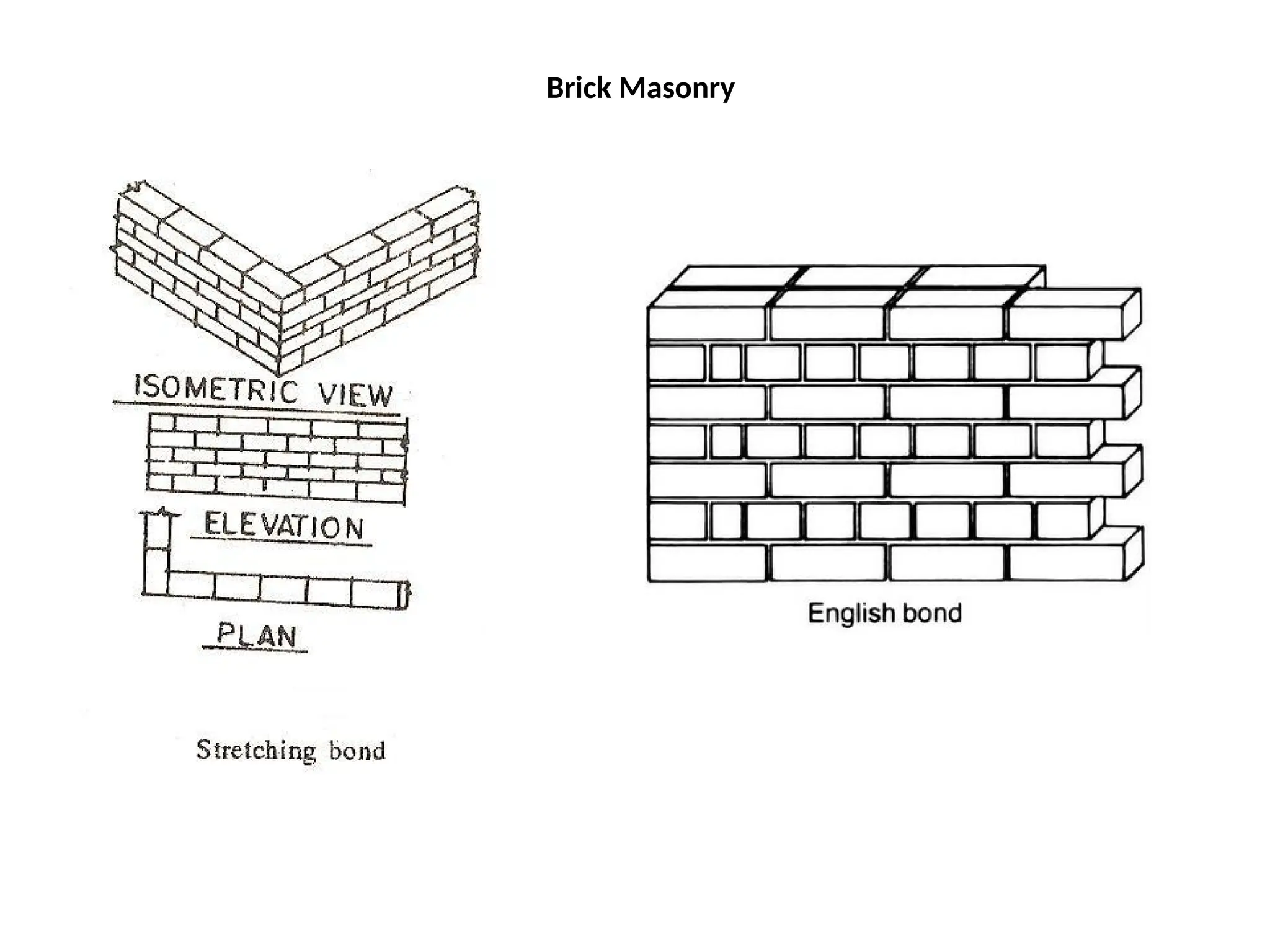
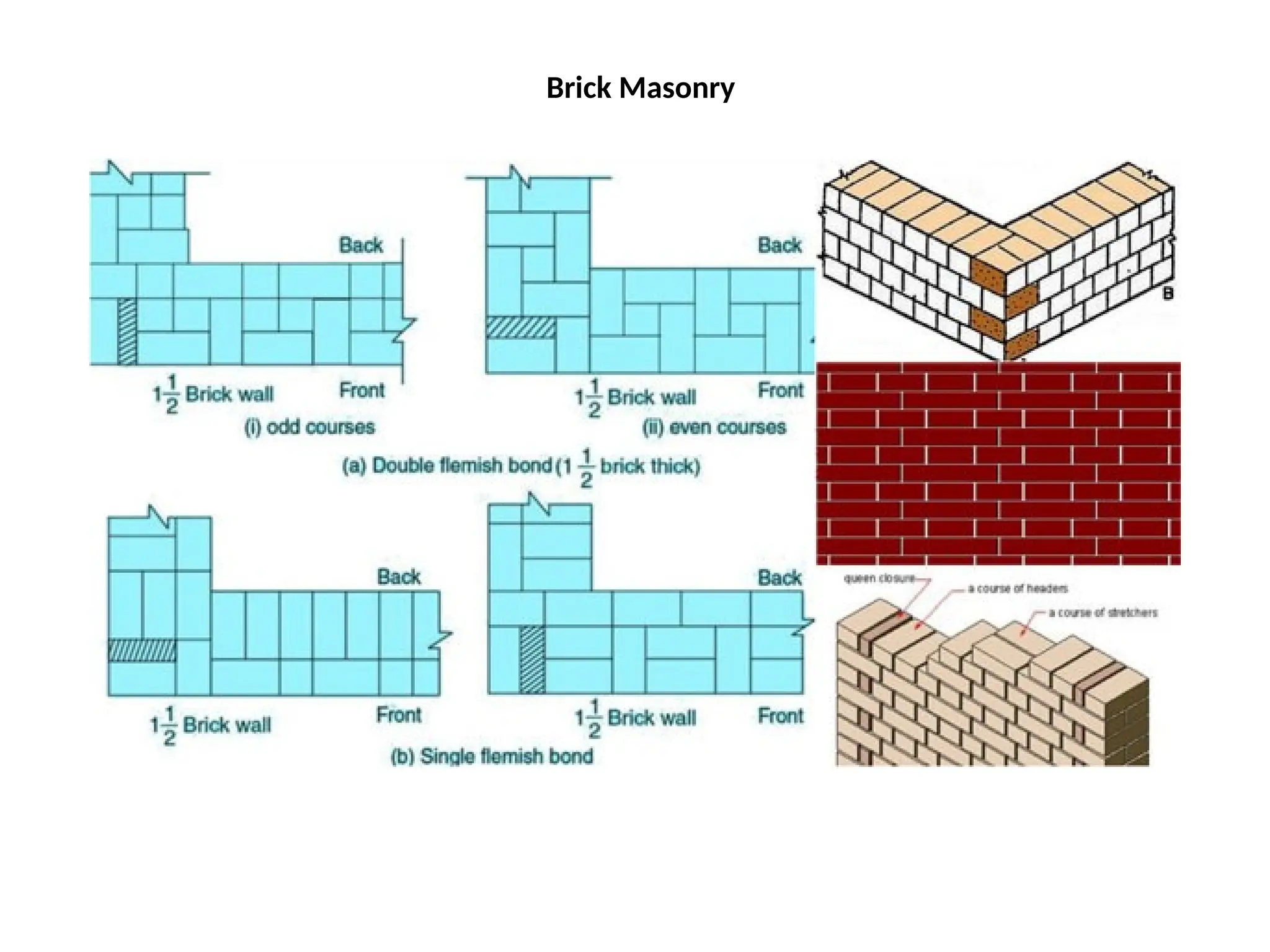

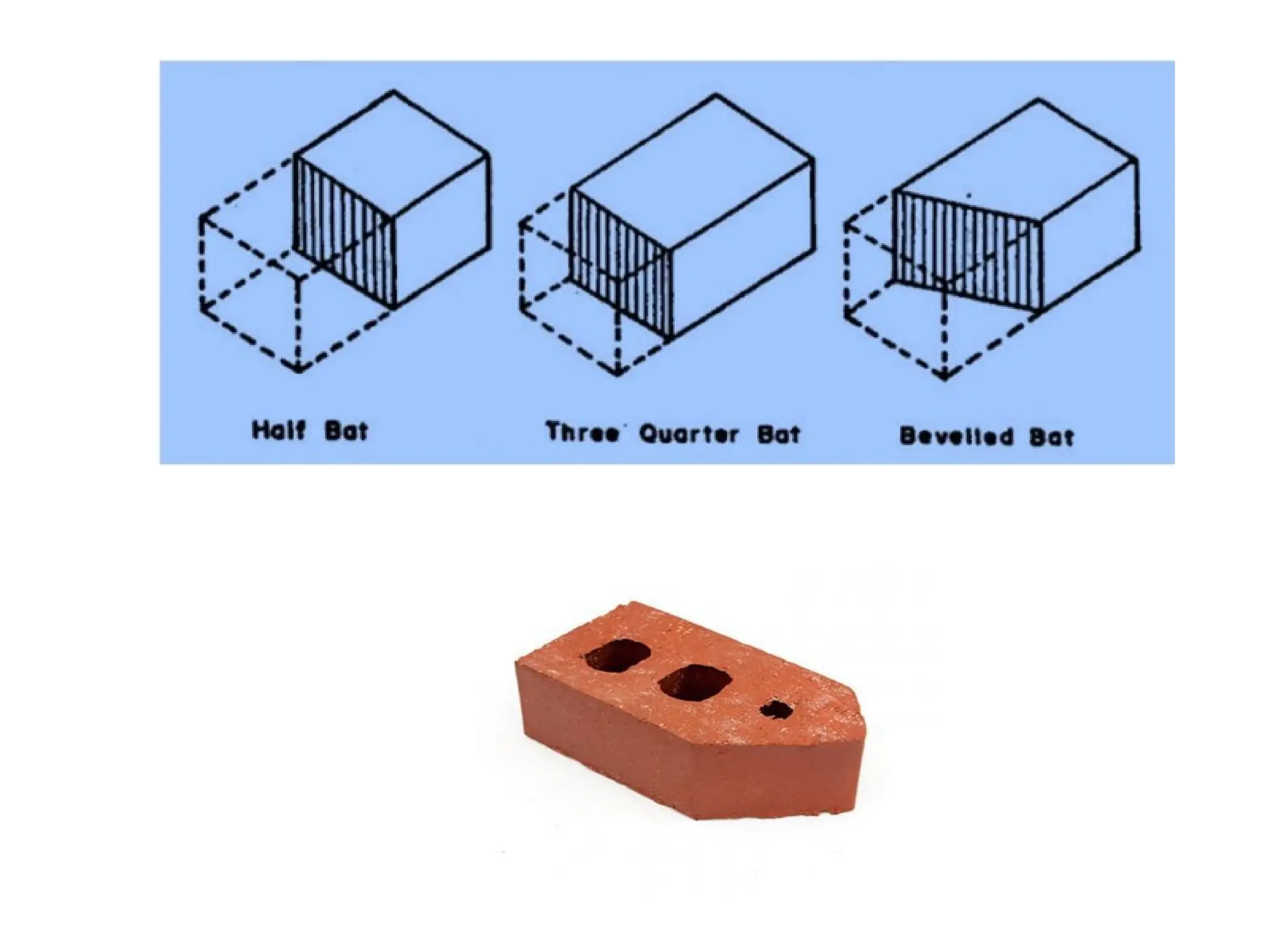

![Building Tiles
• The best blue clay tiles are generally found feet below brick earth.
• Blunging process [process of getting fine clay] is adopted for manufacture of
superior tiles.
• Tiles are burnt in typical kiln, known as Sialkot kiln.
• Tiles are burnt in two stages, in first stages the green tiles burnt to temperature
of about 700°C and then it is taken out for a dip in glaze solution and again sent
to kiln for second stage burning to a temperature of 1250°C.
• War page should not exceed 2% along the edges and 1.5% along the diagonal in
case off flooring tiles and maximum of 1% in any direction in case of terracing
tiles.
• Maximum percentage of fine sand content in soil for making good tiles is about
40% and clay and silt content is 30%.
• Six tiles is carried out for water absorption test of tiles at a temperature of (30°C
– 24°C) for 24 hours](https://image.slidesharecdn.com/3constructionmaterial-251211152237-a45f7acc/75/3_Construction-Material-pptx-for-civil-engineering-45-2048.jpg)


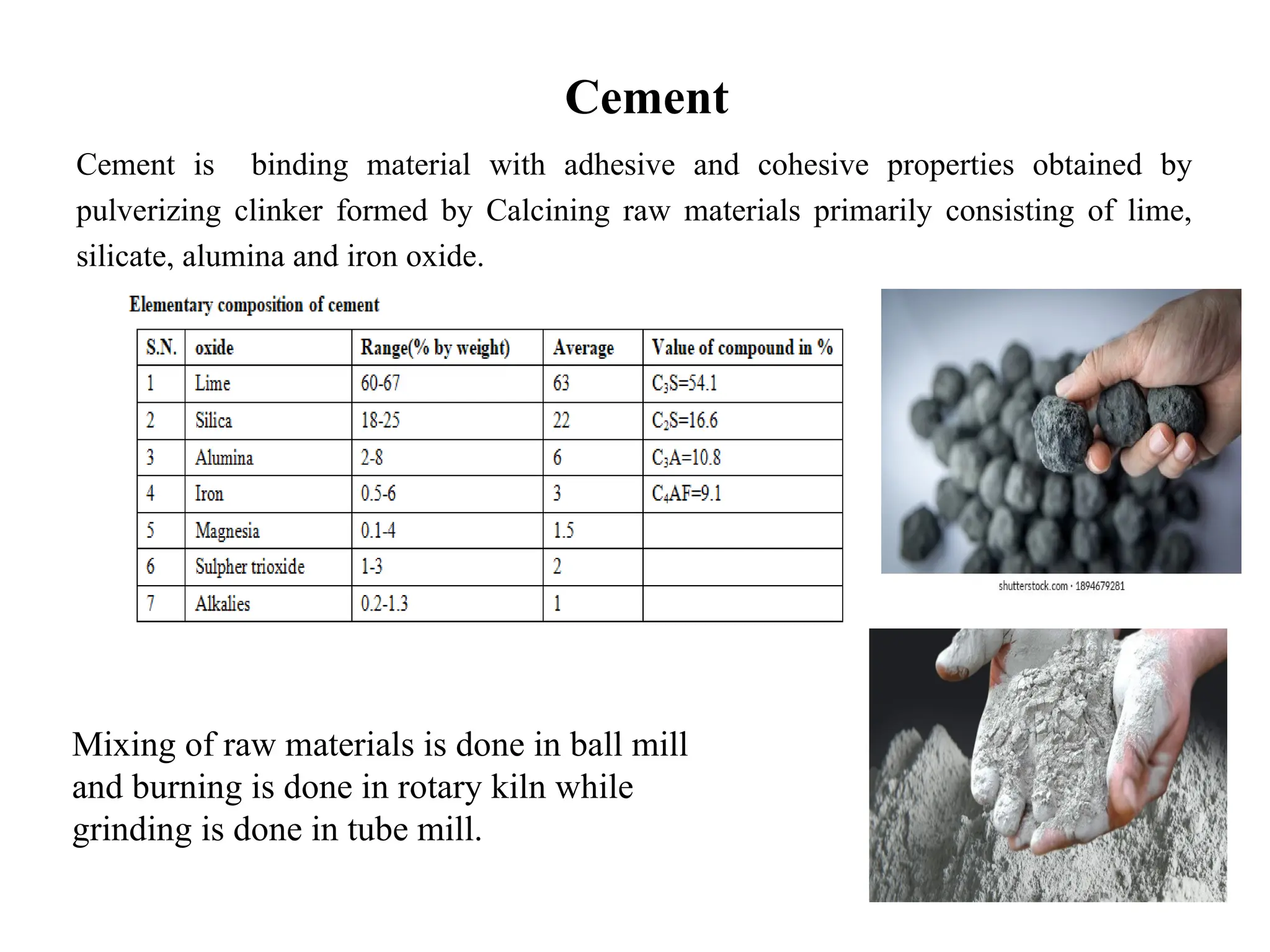







![Test of cement
Setting Time :
• During the test temperature should be 27 2°C and atmosphere of 90% relative
humidity.
• Vicat apparatus [A standard plunger 10 mm dia, 50 mm long and mould of 80 mm dia
and 40 mm depth] is used to find the setting time.
• Water required for setting time test is 0.85 times required for standard consistency.
• Initial setting time is defined as the period elapsing between the time when water is
added to the cement and time at which the needle of 1 mm square or 1.13 mm dia
section penetrates the test block to a depth equal to 33–35 mm from top of mould.
• Final setting time is defined as period elapsing between the time when water is added
to cement and time at which the needle of 1mm square section left only mark of top
surface](https://image.slidesharecdn.com/3constructionmaterial-251211152237-a45f7acc/75/3_Construction-Material-pptx-for-civil-engineering-69-2048.jpg)