Investlogg is a stock market
educational and analysis blog.
What is Technical analysis?
Assumptions & Indicators
A stock’s buying or selling is the most crucial
decision to make as an investor.
Stock analysis is carried out on two different
levels.
• Macro-level analysis
• Micro-level analysis
Both Fundamental and technical analysis contribute
to the strategic buying or selling decision of an
investor.
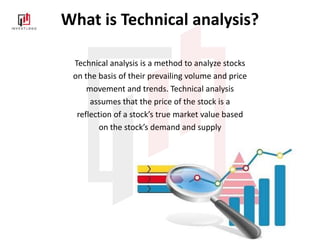
What is Technical analysis?
Technical analysis is a method to analyze stocks
on the basis of their prevailing volume and price
movement and trends. Technical analysis
assumes that the price of the stock is a
reflection of a stock’s true market value based
on the stock’s demand and supply
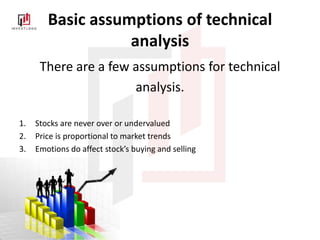
Basic assumptions of technical
analysis
There are a few assumptions for technical
analysis.
1. Stocks are never over or undervalued
2. Price is proportional to market trends
3. Emotions do affect stock’s buying and selling
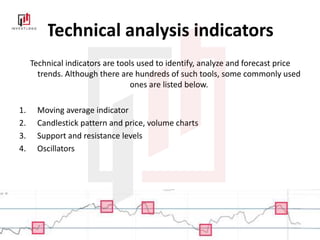
Technical analysis indicators
Technical indicators are tools used to identify, analyze and forecast price
trends. Although there are hundreds of such tools, some commonly used
ones are listed below.
1. Moving average indicator
2. Candlestick pattern and price, volume charts
3. Support and resistance levels
4. Oscillators
How to perform technical
analysis of stocks
A few steps to perform a technical analysis are given below.
1. Trend identification
2. Draw support and resistance points
3. Enter or exit the position
4. Manage risks
Technical analysis Vs.
Fundamental analysis
Technical and fundamental analyses of stocks both are relevant
techniques to analyze stocks
Technical analysis:
Technical analysis is specifically used by traders who enter stock for a short or
medium term and exit after a small profit is earned. Technical analysis also
uses only price and volume as an analysis factor which is acceptable in short-
term buying or selling
Fundamenta analysis:
Fundamental approach is a broader perspective to analyze stocks and is
mostly used by investors who take long-term stock positions. For the longer
term, it is essential for an investor to research a stock in detail. The
fundamental analysis not only includes a business analysis but also an industry
and overall economic analysis is important.

Stock technical analysis

  • 1.
    Investlogg is astock market educational and analysis blog.
  • 2.
    What is Technicalanalysis? Assumptions & Indicators A stock’s buying or selling is the most crucial decision to make as an investor. Stock analysis is carried out on two different levels. • Macro-level analysis • Micro-level analysis Both Fundamental and technical analysis contribute to the strategic buying or selling decision of an investor.
  • 3.
    What is Technicalanalysis? Technical analysis is a method to analyze stocks on the basis of their prevailing volume and price movement and trends. Technical analysis assumes that the price of the stock is a reflection of a stock’s true market value based on the stock’s demand and supply
  • 4.
    Basic assumptions oftechnical analysis There are a few assumptions for technical analysis. 1. Stocks are never over or undervalued 2. Price is proportional to market trends 3. Emotions do affect stock’s buying and selling
  • 5.
    Technical analysis indicators Technicalindicators are tools used to identify, analyze and forecast price trends. Although there are hundreds of such tools, some commonly used ones are listed below. 1. Moving average indicator 2. Candlestick pattern and price, volume charts 3. Support and resistance levels 4. Oscillators
  • 6.
    How to performtechnical analysis of stocks A few steps to perform a technical analysis are given below. 1. Trend identification 2. Draw support and resistance points 3. Enter or exit the position 4. Manage risks
  • 7.
    Technical analysis Vs. Fundamentalanalysis Technical and fundamental analyses of stocks both are relevant techniques to analyze stocks Technical analysis: Technical analysis is specifically used by traders who enter stock for a short or medium term and exit after a small profit is earned. Technical analysis also uses only price and volume as an analysis factor which is acceptable in short- term buying or selling Fundamenta analysis: Fundamental approach is a broader perspective to analyze stocks and is mostly used by investors who take long-term stock positions. For the longer term, it is essential for an investor to research a stock in detail. The fundamental analysis not only includes a business analysis but also an industry and overall economic analysis is important.