SHARE MARKET
FUNDAMENTALS
Presented By:
P.ADITHYA
What is a Share?
Share is nothing but the Ownership of the
company divided into small parts and each part is
called as Share or Stock.
Share Market
A Share market is the place where buying and
selling of shares takes place.
Basic Fact
• There is no official arbiter of stock prices, no
person or institution that “decides” a price.
• The market price of a stock is simply the price
at which a willing buyer and seller agree to
trade.
IMPORTANT ABBREVIATIONS
• NSE-National Stock Exchange
• BSE-Bombay Stock Exchange
• SENSEX-Stock Exchange Sensitive Index
• NIFTY -National Stock Exchange’s Fifty
• IPO-Initial Public Offering
• FPO-Follow-on Public Offering
• Two types of Indices
Nifty and
Sensex
• Stock exchanges
Mainly there are two exchanges in India.
NSE - Nifty is listed with NSE.
BSE - Sensex is listed with BSE.
Nifty - Nifty consist of a group of 50 shares.
Sensex - Sensex consist of a group of 30 shares.
CASH MARKET
• Cash market is a public financial market in
which financial instruments or commodities
are traded for immediate delivery. It contrasts
with a futures market, in which delivery is due
at a later date.
Type of Markets
Basically there are two types of markets.
1. Primary market
2. Secondary market
Primary Market
A primary market is a place where companies,
government and other corporate bodies sell
new shares and other financial products which
are also called as financial products.
• Secondary market
A market place where actual share trading
(buying and selling) takes place is called
secondary market.
Meaning of Bid and Ask price
• Bid Price
The bid price is the price at which buyers are
ready to buy shares.
The bid price is also called as buying price.
Ask Price
The Ask price is the price at which sellers are
ready to sell shares.
The ask price is also called as selling price or offer
price
Types of Investment
• Basically there are three types of investment methods.
i. Short term investment
ii. Mid term investment
iii. Long term investment
i) Short term investment
Investment done from couple of weeks to couple of months is
called short term investment.
It is done based on breaking news, or based on charts of technical
analysis.
ii) Mid term Investment
Investments done from couple of months to couple of years is
called mid tem investment.
It is done based on analysis of quarterly financial results or based
on fundamental analysis.
• iii) Long term investment
Investment done from one year to couple of
years like 3 years, 5 years, 10 years etc
Long term investment is basically done after
thoroughly analyzing the fundamentals of the
company and its future growth prospects.
'Market Capitalization'
• The total dollar market value of all of a company's
outstanding shares.
• Market capitalization is calculated by multiplying a
company's shares outstanding by the current market price
of one share.
• The investment community uses this figure to determine a
company's size, as opposed to sales or total asset figures.
Outstanding shares
Outstanding shares are common stock
authorized by the company, issued, purchased
and held by investors.
LARGE CAP,MID CAP,SMALL CAP
Large Cap - Big Cap'
• A term used by the investment community to refer to
companies with a market capitalization value of more
than $10 billion. Large cap is an abbreviation of the term
"large market capitalization".
'Small Cap'
Refers to stocks with a relatively small market capitalization.
The definition of small cap can vary among brokerages,
but generally it is a company with a market capitalization
of between $300 million and $2 billion.
MID CAP
• A company with a market capitalization
between $2 and $10 billion, which is
calculated by multiplying the number of a
company''''s shares outstanding by its stock
price.
• A listed company, either in BSE or NSE, declares their
performance every quarter through out the day.
• Based on the performance of quarterly results market judge
how the company is performing and if analysis shows that the
company is doing well then its share prices goes up and if
analysis found that company is not performing, as per
expectation, then its share prices falls.
• First quarter duration - April to June
Second quarter duration - July to September
Third quarter duration - October to December
Forth quarter duration - January to March
Results declaration in - April
Fourth quarter is considered as end of financial year end.
How does Share Price Changes
• Every time a stock is sold, the exchange
records the price at which it changes hands. If,
a few seconds or minutes later, another trade
takes place, the price at which that trade is
made becomes the new market price, and so
on.
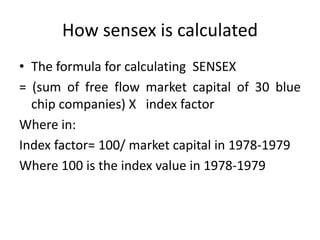
How sensex is calculated
• The formula for calculating SENSEX
= (sum of free flow market capital of 30 blue
chip companies) X index factor
Where in:
Index factor= 100/ market capital in 1978-1979
Where 100 is the index value in 1978-1979
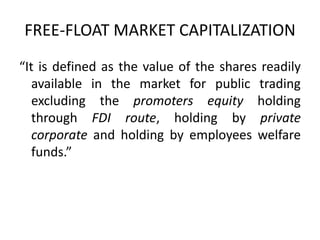
FREE-FLOAT MARKET CAPITALIZATION
“It is defined as the value of the shares readily
available in the market for public trading
excluding the promoters equity holding
through FDI route, holding by private
corporate and holding by employees welfare
funds.”
BENEFITS OF DEMAT ACCOUNT
• Easy and convenient way to hold securities
• Immediate transfer of securities
• No stamp duty on transfer of securities
• Safer than paper-shares (earlier risks associated
with physical certificates such as bad delivery,
fake securities, delays, thefts etc. are mostly
eliminated)
• Reduced paperwork for transfer of securities
• Reduced transaction cost
Fees Involved in DEMAT Account
• Account opening Fee
• Annual Maintenance Fee
• Custodian Fee
• Transaction Fee

Stock markets basics

  • 1.
  • 2.
    What is aShare? Share is nothing but the Ownership of the company divided into small parts and each part is called as Share or Stock. Share Market A Share market is the place where buying and selling of shares takes place.
  • 3.
    Basic Fact • Thereis no official arbiter of stock prices, no person or institution that “decides” a price. • The market price of a stock is simply the price at which a willing buyer and seller agree to trade.
  • 4.
    IMPORTANT ABBREVIATIONS • NSE-NationalStock Exchange • BSE-Bombay Stock Exchange • SENSEX-Stock Exchange Sensitive Index • NIFTY -National Stock Exchange’s Fifty • IPO-Initial Public Offering • FPO-Follow-on Public Offering
  • 5.
    • Two typesof Indices Nifty and Sensex • Stock exchanges Mainly there are two exchanges in India. NSE - Nifty is listed with NSE. BSE - Sensex is listed with BSE. Nifty - Nifty consist of a group of 50 shares. Sensex - Sensex consist of a group of 30 shares.
  • 6.
    CASH MARKET • Cashmarket is a public financial market in which financial instruments or commodities are traded for immediate delivery. It contrasts with a futures market, in which delivery is due at a later date.
  • 7.
    Type of Markets Basicallythere are two types of markets. 1. Primary market 2. Secondary market Primary Market A primary market is a place where companies, government and other corporate bodies sell new shares and other financial products which are also called as financial products.
  • 8.
    • Secondary market Amarket place where actual share trading (buying and selling) takes place is called secondary market.
  • 9.
    Meaning of Bidand Ask price • Bid Price The bid price is the price at which buyers are ready to buy shares. The bid price is also called as buying price. Ask Price The Ask price is the price at which sellers are ready to sell shares. The ask price is also called as selling price or offer price
  • 10.
    Types of Investment •Basically there are three types of investment methods. i. Short term investment ii. Mid term investment iii. Long term investment i) Short term investment Investment done from couple of weeks to couple of months is called short term investment. It is done based on breaking news, or based on charts of technical analysis. ii) Mid term Investment Investments done from couple of months to couple of years is called mid tem investment. It is done based on analysis of quarterly financial results or based on fundamental analysis.
  • 11.
    • iii) Longterm investment Investment done from one year to couple of years like 3 years, 5 years, 10 years etc Long term investment is basically done after thoroughly analyzing the fundamentals of the company and its future growth prospects.
  • 12.
    'Market Capitalization' • Thetotal dollar market value of all of a company's outstanding shares. • Market capitalization is calculated by multiplying a company's shares outstanding by the current market price of one share. • The investment community uses this figure to determine a company's size, as opposed to sales or total asset figures.
  • 13.
    Outstanding shares Outstanding sharesare common stock authorized by the company, issued, purchased and held by investors.
  • 14.
    LARGE CAP,MID CAP,SMALLCAP Large Cap - Big Cap' • A term used by the investment community to refer to companies with a market capitalization value of more than $10 billion. Large cap is an abbreviation of the term "large market capitalization". 'Small Cap' Refers to stocks with a relatively small market capitalization. The definition of small cap can vary among brokerages, but generally it is a company with a market capitalization of between $300 million and $2 billion.
  • 15.
    MID CAP • Acompany with a market capitalization between $2 and $10 billion, which is calculated by multiplying the number of a company''''s shares outstanding by its stock price.
  • 16.
    • A listedcompany, either in BSE or NSE, declares their performance every quarter through out the day. • Based on the performance of quarterly results market judge how the company is performing and if analysis shows that the company is doing well then its share prices goes up and if analysis found that company is not performing, as per expectation, then its share prices falls. • First quarter duration - April to June Second quarter duration - July to September Third quarter duration - October to December Forth quarter duration - January to March Results declaration in - April Fourth quarter is considered as end of financial year end.
  • 17.
    How does SharePrice Changes • Every time a stock is sold, the exchange records the price at which it changes hands. If, a few seconds or minutes later, another trade takes place, the price at which that trade is made becomes the new market price, and so on.
  • 18.
    How sensex iscalculated • The formula for calculating SENSEX = (sum of free flow market capital of 30 blue chip companies) X index factor Where in: Index factor= 100/ market capital in 1978-1979 Where 100 is the index value in 1978-1979
  • 19.
    FREE-FLOAT MARKET CAPITALIZATION “Itis defined as the value of the shares readily available in the market for public trading excluding the promoters equity holding through FDI route, holding by private corporate and holding by employees welfare funds.”
  • 20.
    BENEFITS OF DEMATACCOUNT • Easy and convenient way to hold securities • Immediate transfer of securities • No stamp duty on transfer of securities • Safer than paper-shares (earlier risks associated with physical certificates such as bad delivery, fake securities, delays, thefts etc. are mostly eliminated) • Reduced paperwork for transfer of securities • Reduced transaction cost
  • 21.
    Fees Involved inDEMAT Account • Account opening Fee • Annual Maintenance Fee • Custodian Fee • Transaction Fee