NAME:. JAYDEB SAHA
M.COM 2ND SEMESTER
ROLL:. 29
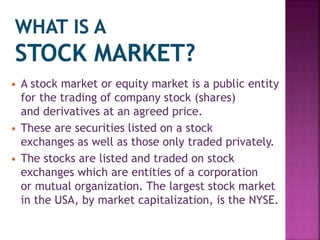
 A stock market or equity market is a public entity
for the trading of company stock (shares)
and derivatives at an agreed price.
 These are securities listed on a stock
exchanges as well as those only traded privately.
 The stocks are listed and traded on stock
exchanges which are entities of a corporation
or mutual organization. The largest stock market
in the USA, by market capitalization, is the NYSE.
At some point, just about every
company needs to raise money
In each case, they have two choices:
Borrow the money, or
Raise it from investors by selling
them a stake (issuing shares of
stock) in the company
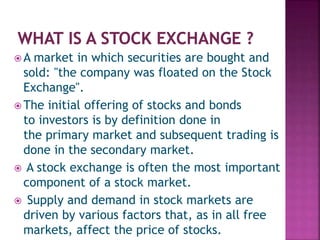
 A market in which securities are bought and
sold: "the company was floated on the Stock
Exchange".
 The initial offering of stocks and bonds
to investors is by definition done in
the primary market and subsequent trading is
done in the secondary market.
 A stock exchange is often the most important
component of a stock market.
 Supply and demand in stock markets are
driven by various factors that, as in all free
markets, affect the price of stocks.
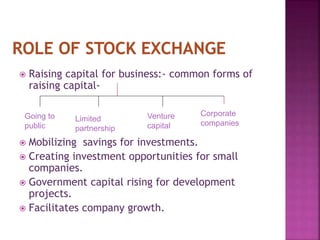
 Raising capital for business:- common forms of
raising capital-
 Mobilizing savings for investments.
 Creating investment opportunities for small
companies.
 Government capital rising for development
projects.
 Facilitates company growth.
Going to
public
Limited
partnership
Venture
capital
Corporate
companies
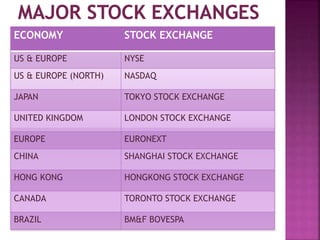
ECONOMY STOCK EXCHANGE
US & EUROPE NYSE
US & EUROPE (NORTH) NASDAQ
JAPAN TOKYO STOCK EXCHANGE
UNITED KINGDOM LONDON STOCK EXCHANGE
EUROPE EURONEXT
CHINA SHANGHAI STOCK EXCHANGE
HONG KONG HONGKONG STOCK EXCHANGE
CANADA TORONTO STOCK EXCHANGE
BRAZIL BM&F BOVESPA
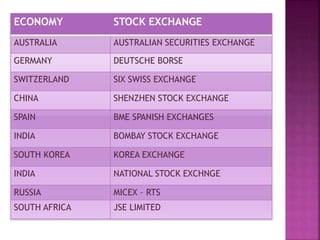
ECONOMY STOCK EXCHANGE
AUSTRALIA AUSTRALIAN SECURITIES EXCHANGE
GERMANY DEUTSCHE BORSE
SWITZERLAND SIX SWISS EXCHANGE
CHINA SHENZHEN STOCK EXCHANGE
SPAIN BME SPANISH EXCHANGES
INDIA BOMBAY STOCK EXCHANGE
SOUTH KOREA KOREA EXCHANGE
INDIA NATIONAL STOCK EXCHNGE
RUSSIA MICEX – RTS
SOUTH AFRICA JSE LIMITED
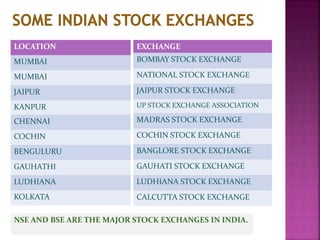
EXCHANGE
BOMBAY STOCK EXCHANGE
NATIONAL STOCK EXCHANGE
JAIPUR STOCK EXCHANGE
UP STOCK EXCHANGE ASSOCIATION
MADRAS STOCK EXCHANGE
COCHIN STOCK EXCHANGE
BANGLORE STOCK EXCHANGE
GAUHATI STOCK EXCHANGE
LUDHIANA STOCK EXCHANGE
CALCUTTA STOCK EXCHANGE
LOCATION
MUMBAI
MUMBAI
JAIPUR
KANPUR
CHENNAI
COCHIN
BENGULURU
GAUHATHI
LUDHIANA
KOLKATA
NSE AND BSE ARE THE MAJOR STOCK EXCHANGES IN INDIA.
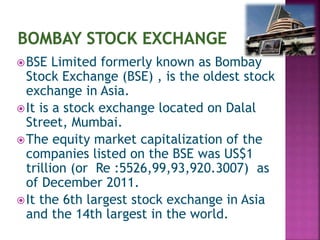
BSE Limited formerly known as Bombay
Stock Exchange (BSE) , is the oldest stock
exchange in Asia.
It is a stock exchange located on Dalal
Street, Mumbai.
The equity market capitalization of the
companies listed on the BSE was US$1
trillion (or Re :5526,99,93,920.3007) as
of December 2011.
It the 6th largest stock exchange in Asia
and the 14th largest in the world.
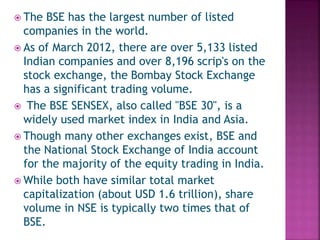
 The BSE has the largest number of listed
companies in the world.
 As of March 2012, there are over 5,133 listed
Indian companies and over 8,196 scrip's on the
stock exchange, the Bombay Stock Exchange
has a significant trading volume.
 The BSE SENSEX, also called "BSE 30", is a
widely used market index in India and Asia.
 Though many other exchanges exist, BSE and
the National Stock Exchange of India account
for the majority of the equity trading in India.
 While both have similar total market
capitalization (about USD 1.6 trillion), share
volume in NSE is typically two times that of
BSE.
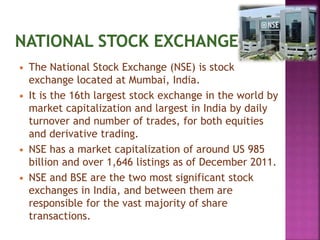
 The National Stock Exchange (NSE) is stock
exchange located at Mumbai, India.
 It is the 16th largest stock exchange in the world by
market capitalization and largest in India by daily
turnover and number of trades, for both equities
and derivative trading.
 NSE has a market capitalization of around US 985
billion and over 1,646 listings as of December 2011.
 NSE and BSE are the two most significant stock
exchanges in India, and between them are
responsible for the vast majority of share
transactions.
 Stock trading is not just buying and selling
stocks at the stock market, there are so many
other factors that need to be taken care of for
successful stock trading.
 Anyone who invests in the stock market wishes
to make profit from the investments. To ensure
that you get significant return from your
investment you have to pick up the right stocks
at the right time.
 If we have decided to trade in stocks the first
thing that we need to decide is the stock
market where we will trade.
 An agent that charges a fee or commission
for executing buy and sell orders submitted
by an investor. (OR)
 The firm that acts as an agent for a
customer, charging the customer a
commission for its services.
 You can either opt for a conventional broker
or you can choose to trade online.
 If you are trading online you can get the
broking service from the banking or non
banking organisations offering online trading
facilities who will provide you with the DP
account and act as your broker.
 A demat account is opened on the same lines
as that of a Bank Account.
 Prescribed Account opening forms are
available with the DP, needs to be filled in.
 Standard Agreements are to be signed by the
Client and the DP.
 In case of Corporate clients, additional
attachments required are - true copy of the
resolution for Demat a/c opening along with
signatories to operate the account and true
copy of the Memorandum and Articles of
Association is to be attached
 1. Never chase a stock.
 2. Buy when markets are in the grip of panic.
 3. Only buy fundamentally strong stocks, which
are undervalued.
 4. Buy stocks grown in top line and bottom line
over the past years.
 5. Invest in companies with proven
management.
 6. Avoid loss-making companies.
 7. PE Ratio and Growth in earnings per share
are the key.
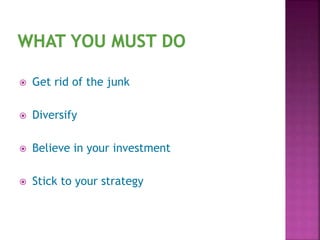
 Get rid of the junk
 Diversify
 Believe in your investment
 Stick to your strategy
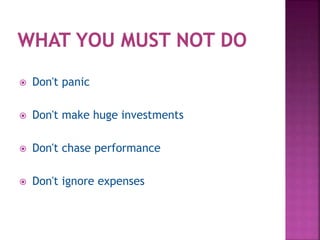
 Don't panic
 Don't make huge investments
 Don't chase performance
 Don't ignore expenses
Stock Market

Stock Market

  • 1.
    NAME:. JAYDEB SAHA M.COM2ND SEMESTER ROLL:. 29
  • 3.
     A stockmarket or equity market is a public entity for the trading of company stock (shares) and derivatives at an agreed price.  These are securities listed on a stock exchanges as well as those only traded privately.  The stocks are listed and traded on stock exchanges which are entities of a corporation or mutual organization. The largest stock market in the USA, by market capitalization, is the NYSE.
  • 4.
    At some point,just about every company needs to raise money In each case, they have two choices: Borrow the money, or Raise it from investors by selling them a stake (issuing shares of stock) in the company
  • 5.
     A marketin which securities are bought and sold: "the company was floated on the Stock Exchange".  The initial offering of stocks and bonds to investors is by definition done in the primary market and subsequent trading is done in the secondary market.  A stock exchange is often the most important component of a stock market.  Supply and demand in stock markets are driven by various factors that, as in all free markets, affect the price of stocks.
  • 6.
     Raising capitalfor business:- common forms of raising capital-  Mobilizing savings for investments.  Creating investment opportunities for small companies.  Government capital rising for development projects.  Facilitates company growth. Going to public Limited partnership Venture capital Corporate companies
  • 7.
    ECONOMY STOCK EXCHANGE US& EUROPE NYSE US & EUROPE (NORTH) NASDAQ JAPAN TOKYO STOCK EXCHANGE UNITED KINGDOM LONDON STOCK EXCHANGE EUROPE EURONEXT CHINA SHANGHAI STOCK EXCHANGE HONG KONG HONGKONG STOCK EXCHANGE CANADA TORONTO STOCK EXCHANGE BRAZIL BM&F BOVESPA
  • 8.
    ECONOMY STOCK EXCHANGE AUSTRALIAAUSTRALIAN SECURITIES EXCHANGE GERMANY DEUTSCHE BORSE SWITZERLAND SIX SWISS EXCHANGE CHINA SHENZHEN STOCK EXCHANGE SPAIN BME SPANISH EXCHANGES INDIA BOMBAY STOCK EXCHANGE SOUTH KOREA KOREA EXCHANGE INDIA NATIONAL STOCK EXCHNGE RUSSIA MICEX – RTS SOUTH AFRICA JSE LIMITED
  • 9.
    EXCHANGE BOMBAY STOCK EXCHANGE NATIONALSTOCK EXCHANGE JAIPUR STOCK EXCHANGE UP STOCK EXCHANGE ASSOCIATION MADRAS STOCK EXCHANGE COCHIN STOCK EXCHANGE BANGLORE STOCK EXCHANGE GAUHATI STOCK EXCHANGE LUDHIANA STOCK EXCHANGE CALCUTTA STOCK EXCHANGE LOCATION MUMBAI MUMBAI JAIPUR KANPUR CHENNAI COCHIN BENGULURU GAUHATHI LUDHIANA KOLKATA NSE AND BSE ARE THE MAJOR STOCK EXCHANGES IN INDIA.
  • 10.
    BSE Limited formerlyknown as Bombay Stock Exchange (BSE) , is the oldest stock exchange in Asia. It is a stock exchange located on Dalal Street, Mumbai. The equity market capitalization of the companies listed on the BSE was US$1 trillion (or Re :5526,99,93,920.3007) as of December 2011. It the 6th largest stock exchange in Asia and the 14th largest in the world.
  • 11.
     The BSEhas the largest number of listed companies in the world.  As of March 2012, there are over 5,133 listed Indian companies and over 8,196 scrip's on the stock exchange, the Bombay Stock Exchange has a significant trading volume.  The BSE SENSEX, also called "BSE 30", is a widely used market index in India and Asia.  Though many other exchanges exist, BSE and the National Stock Exchange of India account for the majority of the equity trading in India.  While both have similar total market capitalization (about USD 1.6 trillion), share volume in NSE is typically two times that of BSE.
  • 12.
     The NationalStock Exchange (NSE) is stock exchange located at Mumbai, India.  It is the 16th largest stock exchange in the world by market capitalization and largest in India by daily turnover and number of trades, for both equities and derivative trading.  NSE has a market capitalization of around US 985 billion and over 1,646 listings as of December 2011.  NSE and BSE are the two most significant stock exchanges in India, and between them are responsible for the vast majority of share transactions.
  • 13.
     Stock tradingis not just buying and selling stocks at the stock market, there are so many other factors that need to be taken care of for successful stock trading.  Anyone who invests in the stock market wishes to make profit from the investments. To ensure that you get significant return from your investment you have to pick up the right stocks at the right time.  If we have decided to trade in stocks the first thing that we need to decide is the stock market where we will trade.
  • 14.
     An agentthat charges a fee or commission for executing buy and sell orders submitted by an investor. (OR)  The firm that acts as an agent for a customer, charging the customer a commission for its services.  You can either opt for a conventional broker or you can choose to trade online.  If you are trading online you can get the broking service from the banking or non banking organisations offering online trading facilities who will provide you with the DP account and act as your broker.
  • 15.
     A demataccount is opened on the same lines as that of a Bank Account.  Prescribed Account opening forms are available with the DP, needs to be filled in.  Standard Agreements are to be signed by the Client and the DP.  In case of Corporate clients, additional attachments required are - true copy of the resolution for Demat a/c opening along with signatories to operate the account and true copy of the Memorandum and Articles of Association is to be attached
  • 16.
     1. Neverchase a stock.  2. Buy when markets are in the grip of panic.  3. Only buy fundamentally strong stocks, which are undervalued.  4. Buy stocks grown in top line and bottom line over the past years.  5. Invest in companies with proven management.  6. Avoid loss-making companies.  7. PE Ratio and Growth in earnings per share are the key.
  • 17.
     Get ridof the junk  Diversify  Believe in your investment  Stick to your strategy
  • 18.
     Don't panic Don't make huge investments  Don't chase performance  Don't ignore expenses