A Report on
An Overview of Indian Stock Market
Submitted by
SUSHANKA MALAKAR
March 2020
1 | P a g e
Introduction:
The stock market refers to the collection of markets and exchanges where regular activities of buying,
selling, and issuance of shares of publicly-held companies take place. Such financial activities are
conducted through institutionalized formal exchanges or over-the-counter (OTC) marketplaces which
operate under a defined set of regulations. There can be multiple stock trading venues in a country or a
region which allow transactions in stocks and other forms of securities.
While both terms - stock market and stock exchange - are used interchangeably, the latter term is
generally a subset of the former. If one says that she trades in the stock market, it means that she buys
and sells shares/equities on one (or more) of the stock exchange(s) that are part of the overall stock
market. The leading stock exchanges in the U.S. include the New York Stock Exchange
(NYSE), Nasdaq, and the Chicago Board Options Exchange (CBOE). These leading national
exchanges, along with several other exchanges operating in the country, form the stock market of the
U.S.
History:
It was in 12th century France that the ‘Courretiers de change’ took on the task of managing and
regulating agricultural communities’ debt. This was on behalf of the French banks of that time. This
group of men traded the debts and became known as first brokers. It was in the middle of the thirteenth
century in Venice, bankers started to trade in government of Venice Spreading Stories. The idea behind
this was to decreased the cost of Venetian government funds. In the large cities of Italy, including Pisa,
Genoa, Florence and Verona, bankers started to trade. This happened around the fourteenth century.
Business and organisations in Italy were also the first to sell shares on the stock market. It was not until
the sixteenth century that business in the United Kingdom were able to sell shares. Many other countries
then followed. Today, there are stock markets all over the world, the most well-known stock markets,
and the world’s largest are in the United States of America, as well as in the United Kingdom, China,
Canada, India, Japan, Germany, France, Netherlands and South Korea.
Indian stock market
Indian Stock Markets is one of the old.t in Asia. Its history dates back to nearly 200 years ago. The
earliest records of security dealings in India are meagre and obscure. The East India Company was the
dominant institution in those days and business in its loan securities used to be transacted towards the
close of the eighteenth century.
2 | P a g e
By 1830's business on corporate stocks and shares in Bank and Cotton presses took place in Bombay.
Though the trading list was broader in 1839, there were only half a dozen brokers recognized by banks
and merchants during 1840 and 1850. The 1850's witnessed a rapid development of commercial
enterprise and brokerage business attracted many men into the field and by 1860 the number of brokers
increased into 60. In 1860-61 the American Civil War broke out and cotton supply from United States
to Europe was stopped; thus, the 'Share Mania' in India began. The number of brokers increased to about
200 to 250.
At the end of the American Civil War, the brokers who thrived out of Civil War in 1874, found a place
in a street (now appropriately cal. as Dalai Street) where they would conveniently assemble and transact
business. In 1887, they formally established in Bombay, the "Native Share and Stock Brokers
'Association", which is alternatively known as "The Stock Exchange". In 1895, the Stock Exchange
acquired. a premise in the same street and it was inaugurated in 1899. Thus, the Stock Exchange at
Bombay was consolidated.
Indian stock market has been assigned an important place in financing the Indian corporate sector. The
principal factors of the stock market are
• Enabling mobilizing resources for investment directly from the investors.
• Providing liquidity for the investors and monitoring.
• Disciplining company management.
In India there are 9 official operating stock and commodity exchange in Listed by SEBI
• Bombay Stock Exchange (BSE) in Mumbai, one of the two principal large stock exchanges of India
• National Stock Exchange of India (NSE) in Mumbai, one of the two principal large stock exchanges
of India
• Calcutta Stock Exchange in Kolkata, a smaller stock exchange
• India International Exchange (India INX) in GIFT City
• Indian Commodity Exchange (ICEX) in Airoli, Navi Mumbai
• Metropolitan Stock Exchange of India Ltd. (MSE) in Mumbai
• Multi Commodity Exchange of India Ltd. (MCX) in Mumbai
• National Commodity & Derivatives Exchange Ltd. (NCDEX) in Mumbai
• NSE IFSC Ltd. (NSE International Exchange) in Gandhinagar
3 | P a g e
Bombay Stock Exchange:
The Bombay Stock Exchange (BSE) is the first and largest securities market in India and was
established in 1875 as the Native Share and Stock Brokers' Association. Based in Mumbai, India, the
BSE lists close to 6,000 companies and is one of the largest exchanges in the world, along with the New
York Stock Exchange (NYSE), NASDAQ, London Stock Exchange Group, Japan Exchange Group,
and Shanghai Stock Exchange.
Securities that the BSE lists include stocks, stock futures, stock options, index futures, index options,
and weekly options. The BSE's overall performance is measured by the Sensex, an index of 30 of the
BSE's largest stocks covering 12 sectors.
BSE SENSEX
S&P BSE SENSEX, first compiled in 1986, was calculated on a 'Market Capitalization-
Weighted' methodology of 30 component stocks representing large, well-established and
financially sound companies across key sectors. The base year of S&P BSE SENSEX was taken
as 1978-79. S&P BSE SENSEX today is widely reported in both domestic and international
markets through print as well as electronic media. It is scientifically designed and is based on
globally accepted construction and review methodology. Since September 1, 2003, S&P BSE
SENSEX is being calculated on a free-float market capitalization methodology. The 'free-float
market capitalization-weighted' methodology is a widely followed index construction
methodology on which majority of global equity indices are based; all major index providers
like MSCI, FTSE, STOXX, and Dow Jones use the free-float methodology.
The growth of the equity market in India has been phenomenal in the present decade. Right
from early nineties, the stock market witnessed heightened activity in terms of various bull and
bear runs. In the late nineties, the Indian market witnessed a huge frenzy in the 'TMT' sectors.
More recently, real estate caught the fancy of the investors. S&P BSE SENSEX has captured
all these happenings in the most judicious manner. One can identify the booms and busts of the
Indian equity market through S&P BSE SENSEX. As the oldest index in the country, it provides
the time series data over a fairly long period of time (from 1979 onwards). Small wonder, the
S&P BSE SENSEX has become one of the most prominent brands in the country.
Calculation Methodology:
S&P BSE SENSEX is calculated using the 'Free-float Market Capitalization' methodology,
wherein, the level of index at any point of time reflects the free-float market value of 30
component stocks relative to a base period. The market capitalization of a company is
determined by multiplying the price of its stock by the number of shares issued by the company.
4 | P a g e
This market capitalization is further multiplied by the free-float factor to determine the free-
float market capitalization.
The base period of S&P BSE SENSEX is 1978-79 and the base value is 100 index points. This
is often indicated by the notation 1978-79=100. The calculation of S&P BSE SENSEX involves
dividing the free-float market capitalization of 30 companies in the Index by a number called
the Index Divisor. The Divisor is the only link to the original base period value of the S&P BSE
SENSEX. It keeps the Index comparable over time and is the adjustment point for all Index
adjustments arising out of corporate actions, replacement of scrips etc. During market hours,
prices of the index scrips, at which latest trades are executed, are used by the trading system to
calculate S&P BSE SENSEX on a continuous basis.
National Stock Exchange:
The National Stock Exchange of India Limited (NSE) is India's largest financial market. Incorporated in
1992, the NSE has developed into a sophisticated, electronic market, which ranked fourth in the world
by equity trading volume in 2015. Trading commenced in 1994 with the launch of the wholesale debt
market and a cash market segment shortly thereafter.
The National Stock Exchange of India Limited was the first exchange in India to provide modern, fully
automated electronic trading. It was set up by a group of Indian financial institutions with the goal of
bringing greater transparency to the Indian capital market. As of March 2016, the National Stock
Exchange had accumulated $1.41 trillion in total market capitalization, making it the world's 12th-
largest stock exchange. The flagship index, the NIFTY 50, represents about 63% of total market
capitalization listed on the exchange.
The total traded value of stocks listed on the index makes up about 44% of the traded value of all stocks
on the NSE for the last six months. The index itself covers 12 sectors of the Indian economy across 50
stocks. Besides the NIFTY 50 Index, the National Stock Exchange maintains market indices that track
various market capitalizations, volatility, specific sectors, and factor strategies.
The National Stock Exchange has been a pioneer in Indian financial markets, being the first electronic
limit order book to trade derivatives and ETFs. The exchange supports more than
3,000 VSAT terminals, making the NSE the largest private wide-area network in the country. Ashok
Chawla is the Chairman of the Board of Directors and Vikram Limaye is the Managing Director and
CEO of the exchange.
5 | P a g e
NIFTY
The NIFTY 50 is the flagship index on the National Stock Exchange of India Ltd. (NSE). The
Index tracks the behaviour of a portfolio of blue-chip companies, the largest and most liquid
Indian securities. It includes 50 of the approximately 1600 companies listed on the NSE,
captures approximately 65% of its float-adjusted market capitalization and is a true reflection
of the Indian stock market.
The NIFTY 50 covers major sectors of the Indian economy and offers investment managers
exposure to the Indian market in one efficient portfolio. The Index has been trading since April
1996 and is well suited for benchmarking, index funds and index-based derivatives.
The NIFTY 50 is owned and managed by India Index Services and Products Ltd. (IISL). IISL
is India's first specialized company focused on an index as a core product
Calculation Methodology:
NIFTY 50 is computed using free float market capitalization weighted method, wherein the
level of the index reflects the total market value of all the stocks in the index relative to a
particular base period. The method also takes into account constituent changes in the index and
importantly corporate actions such as stock splits, rights, etc without affecting the index value.
The base period selected for NIFTY 50 index is the close of prices on November 3, 1995, which
marks the completion of one year of operations of NSE's Capital Market Segment. The base
value of the index has been set at 1000 and a base capital of Rs.2.06 trillion.
Stock Market Timings in India:
There are two major stock exchanges in India- Bombay stock exchange (BSE) and National stock
exchange (NSE). However, the timing of both BSE & NSE is the same. It is closed on weekends i.e.
Saturday and Sunday. It is also closed on the national holidays.
The normal trading time for equity market is between 9:15 am to 03:30 pm, Monday to Friday. The
trading time for commodity (MCX) market is between 10:00 AM to 11:30 PM, Monday to Friday.
The normal trading time for Agri-community (NCDEX) market is between 10:00 AM to 05:00 PM,
Monday to Friday.
There is no lunch break or tea break in the Indian stock market timings.
However, the timings of the Indian stock market are divided into three sessions:
• Normal session (also called continuous session)
• Pre-opening session
• Post-closing session
Normal Trading Session:
• This is the actual time where most of the trading takes place.
• Its duration is between 9:15 AM to 3:30 PM.
6 | P a g e
• You can buy and sell stocks in this session.
• The normal trading session follows bilateral matching session i.e. whenever buying price is
equal to the selling price, the transaction is complete. Here transactions are as per price and
time priority.
Pre-opening session:
The duration of the Pre-opening session is between 9:00 AM to 9:15 AM. This is further divided
into three sub-sessions.
• 9:00 AM to 9:08 AM:
• This is the order entry session.
• You can place an order to buy and sell stocks in this duration.
• One can also modify or cancel his orders during this period.
• 9:08 AM to 9:12 AM:
• This session is used for order matching and for calculating the opening price of the
normal session.
• You cannot modify or cancel buy/sell order during this time.
• 9:12 AM to 9:15 AM:
• This session is used as a buffer period.
• It is used for the smooth translation of pre-opening session to the normal session.
The opening price of the normal session is calculated using multilateral order matching system.
Earlier, the bilateral matching system was used which caused a lot of volatility when the market
opened. Later, this was changed to multilateral order matching system to reduce the volatility in the
market.
However, most people do not use the pre-opening session and only use the normal session for
trading. That’s why there is still huge volatility even in the normal session after the pre-opening
session.
The time between 3:30 PM to 3:40 PM is used for closing price calculation.
• The closing price of a stock is the weighted average of the prices between 3:00 PM to 3:30 PM.
• For the indexes like Sensex & nifty, its closing price is the weighted average of the constituent
stocks for the last 30 minutes i.e. Between 3:00 PM to 3:30 PM.
Post-closing session:
• The duration of the Post-closing session is between 3:40 PM to 4:00 PM.
• You can place orders to buy or sell stocks in the post-closing session at the closing price. If
buyers/sellers are available then your trade will be confirmed at the closing price.
Pre-opening session and the Post-closing session is only for the cash market. There are no such sessions
for future & options.
Types of Share Market:
• Primary Market
• Secondary Market
7 | P a g e
Primary Market
Primary Market is the market where investors can buy shares directly from the issuer company to
raise their capital.
When investors purchase securities on the primary capital market, the company offering the
securities has already hired an underwriting firm to review the offering and create a prospectus
outlining the price and other details of the securities to be issued.
Secondary Market
Secondary market is the market where stocks are traded after they are initially offered to the investor
in primary market and get listed to stock exchange.
Secondary market comprises of equity markets and the debt markets.
It is a platform to trade listed equities, while Primary market is the way for companies to enter in
to secondary market.
How It Works:
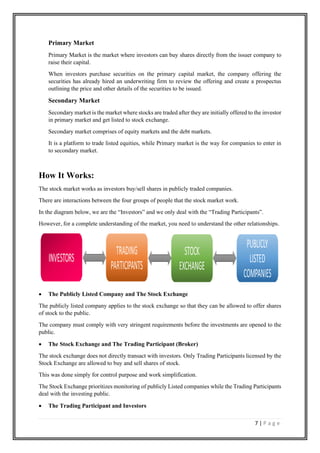
The stock market works as investors buy/sell shares in publicly traded companies.
There are interactions between the four groups of people that the stock market work.
In the diagram below, we are the “Investors” and we only deal with the “Trading Participants”.
However, for a complete understanding of the market, you need to understand the other relationships.
• The Publicly Listed Company and The Stock Exchange
The publicly listed company applies to the stock exchange so that they can be allowed to offer shares
of stock to the public.
The company must comply with very stringent requirements before the investments are opened to the
public.
• The Stock Exchange and The Trading Participant (Broker)
The stock exchange does not directly transact with investors. Only Trading Participants licensed by the
Stock Exchange are allowed to buy and sell shares of stock.
This was done simply for control purpose and work simplification.
The Stock Exchange prioritizes monitoring of publicly Listed companies while the Trading Participants
deal with the investing public.
• The Trading Participant and Investors
8 | P a g e
You will have to contact a trading participant (broker) if you want to buy or sell shares of a particular
company.
For this, the broker will charge a very small fee for the buying or selling transaction.
Broker also provide you with information on which companies are good to buy in addition to their
transaction services.
Bear Markets and Bull Markets:
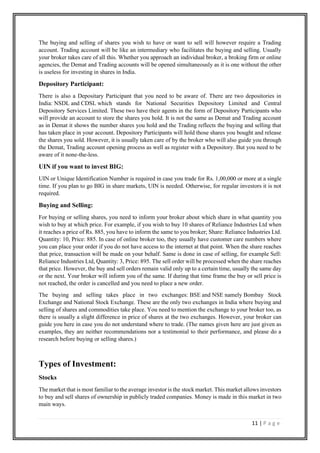
The terms bull and bear market are used to describe how stock markets are doing in general—that is,
whether they are appreciating or depreciating in value. At the same time, because the market is
determined by investors' attitudes, these terms also denote how investors feel about the market and the
ensuing trends.
A Bull market refers to a market that is on the rise. It is typified by a sustained increase in price, for
example in equity markets in the prices of companies' shares. In such times, investors often have faith
that the uptrend will continue over the long term. Typically, in this scenario, the country's economy is
strong and employment levels are high.
A Bear market is one that is in decline, typically having fallen 20% or more from recent highs. Share
prices are continuously dropping, resulting in a downward trend that investors believe will continue,
which, in turn, perpetuates the downward spiral. During a bear market, the economy will typically
slow down and unemployment will rise as companies begin laying off workers.
Regulatory Authority of Indian Capita Market:
The Ministry of Finance (MoF), the Securities & Exchange Board of India (SEBI) and the Reserve
Bank of India (RBI) are the three regulatory authorities governing Indian capital market.
Ministry of Finance (MoF)
The Department of Economic affairs directly manages the Capital Markets segment under the directions
of MoF. This segment formulates the rules for the efficient growth of the Stock Market which includes
derivatives, debt, and equity. It also formulates regulations for safeguarding the interest of the investors.
9 | P a g e
This segment regulates the Indian Capital Markets through the following laws:
• Depositories Act, 1996
• Securities Contract (Regulation) Act, 1956
• Securities and Exchange Board of India Act, 1992
Reserve Bank of India (RBI)
The Reserve Bank of India Act, 1934 governs policies framed by the Reserve Bank of India. The
functions of RBI in this regard are as follows:
• Implementation of Monetary and Credit policies
• Issuance of Currency Notes
• Government’s Banker
• Banking System Regulator
• Foreign Exchange through Foreign Exchange Management Act, 1999
• Managing payment & settlement system
• Apart from the above functions, RBI is also actively involved in developing the financial market.
Securities & Exchange Board of India (SEBI)
The Securities & Exchange Board of India (SEBI) Act, 1992 regulates the functioning of SEBI. SEBI
is the apex body governing the Indian stock exchanges.
The primary functions of SEBI are as follows:
Protective Functions
• It checks Price rigging.
• Prohibits insider trading.
• Prohibits fraudulent and Unfair Trade Practices.
Development Functions
• SEBI promotes training of intermediaries of the securities market.
• SEBI tries to promote activities of stock exchange by adopting a flexible and adaptable
approach
Regulatory Functions
• SEBI has framed rules and regulations and a code of conduct to regulate the intermediaries such
as merchant bankers, brokers, underwriters, etc.
• These intermediaries have been brought under the regulatory purview and private placement
has been made more restrictive.
• SEBI registers and regulates the working of stock brokers, sub-brokers, share-transfer agents,
trustees, merchant bankers and all those who are associated with stock exchange in any manner
• SEBI registers and regulates the working of mutual funds etc.
• SEBI regulates takeover of the companies
• SEBI conducts inquiries and audit of stock exchanges.
10 | P a g e
The participation in the Indian Stock Market of both the domestic or foreign financial intermediaries
are governed by the regulations framed by SEBI. Additionally, Foreign Portfolio Investors (FPIs) can
participate in Indian Stock Market after registering them with an authorized Depository Participant.
National Stock Exchange of India (NSE)
NSE is responsible for formulating and implementing the rules pertaining to:
• Registration of Members
• Listing of Securities
• Monitoring of Transactions
• Compliance
• Other additional functions related to the above functions
NSE itself is regulated by SEBI and is under regular vigilance for all regulatory compliances.
How to Invest in Share Market in India:
Get a PAN Card:
PAN or Permanent Account Number is a primary requirement for entering any financial transactions in
our country. It is unique 10-digit Alpha-Numeric number assigned to an individual by the Tax
Authorities for assessing their tax liabilities. PAN is however required for opening a bank account,
investing in mutual funds, filling Income Tax returns etc. Also, the first thing you will need to be able
to invest in shares in India is a PAN card, so get it first.
Get a Broker:
You and I cannot directly go the stock exchange and buy or sell stocks/shares like we would buy or sell
any other thing. People are authorized to buy and sell on the markets and they are called brokers.
Brokers can be individuals or companies and even online agencies that are registered and licensed
by SEBI or Securities and Exchanges Board of India, who regulates the share markets. Get a broker,
they can be individuals you know and are reliable, or you can approach various companies that are
licensed to trade and deal in securities in the markets.
If you are comfortable with internet and online stuff, you can even have online broking through
companies like ICICI Direct, Sharekhan, Kotak Securities, IndiaBulls etc.
(The names given here are just given as examples of well-known companies offering online broker
services, they are neither recommendations nor a testimonial to their performance, and please do a
research before selecting your broking firm.)
Get a Demat and Trading Account:
Once you have a broker, whether in form of a person, company or online, you will now need a Demat
and Trading account. Demat account will hold the stocks or shares in your name and the same will
reflect in your stock portfolio. You cannot hold shares in physical form or store them physically. They
have to in Dematerialized state or Demat state. A Demat account does that for you. It will store the
shares you buy from the markets through your brokers in your account in your name. The selling will
also be from here and it will reflect in your Demat statements that you receive from time to time. You
will never have a physical share certificate in your hands; it will be reflected in your Demat Account
Statement.
11 | P a g e
The buying and selling of shares you wish to have or want to sell will however require a Trading
account. Trading account will be like an intermediary who facilitates the buying and selling. Usually
your broker takes care of all this. Whether you approach an individual broker, a broking firm or online
agencies, the Demat and Trading accounts will be opened simultaneously as it is one without the other
is useless for investing in shares in India.
Depository Participant:
There is also a Depositary Participant that you need to be aware of. There are two depositories in
India: NSDL and CDSL which stands for National Securities Depository Limited and Central
Depository Services Limited. These two have their agents in the form of Depository Participants who
will provide an account to store the shares you hold. It is not the same as Demat and Trading account
as in Demat it shows the number shares you hold and the Trading reflects the buying and selling that
has taken place in your account. Depository Participants will hold those shares you bought and release
the shares you sold. However, it is usually taken care of by the broker who will also guide you through
the Demat, Trading account opening process as well as register with a Depository. But you need to be
aware of it none-the-less.
UIN if you want to invest BIG:
UIN or Unique Identification Number is required in case you trade for Rs. 1,00,000 or more at a single
time. If you plan to go BIG in share markets, UIN is needed. Otherwise, for regular investors it is not
required.
Buying and Selling:
For buying or selling shares, you need to inform your broker about which share in what quantity you
wish to buy at which price. For example, if you wish to buy 10 shares of Reliance Industries Ltd when
it reaches a price of Rs. 885, you have to inform the same to you broker; Share: Reliance Industries Ltd.
Quantity: 10, Price: 885. In case of online broker too, they usually have customer care numbers where
you can place your order if you do not have access to the internet at that point. When the share reaches
that price, transaction will be made on your behalf. Same is done in case of selling, for example Sell:
Reliance Industries Ltd, Quantity: 3, Price: 895. The sell order will be processed when the share reaches
that price. However, the buy and sell orders remain valid only up to a certain time, usually the same day
or the next. Your broker will inform you of the same. If during that time frame the buy or sell price is
not reached, the order is cancelled and you need to place a new order.
The buying and selling takes place in two exchanges: BSE and NSE namely Bombay Stock
Exchange and National Stock Exchange. These are the only two exchanges in India where buying and
selling of shares and commodities take place. You need to mention the exchange to your broker too, as
there is usually a slight difference in price of shares at the two exchanges. However, your broker can
guide you here in case you do not understand where to trade. (The names given here are just given as
examples, they are neither recommendations nor a testimonial to their performance, and please do a
research before buying or selling shares.)
Types of Investment:
Stocks
The market that is most familiar to the average investor is the stock market. This market allows investors
to buy and sell shares of ownership in publicly traded companies. Money is made in this market in two
main ways.
12 | P a g e
The first is through capital gains, in which the value of each share increases in value. The second is
through dividends, in which companies pass on income to investors.
Bonds
The debt market is used by governments, companies, and financial intermediaries to issue debt
instruments to raise capital. The debt issuers then make regular payments to debt holders in the form
of coupon payments and, once the debt matures, pay back the principal on the debt.
The most common type of financial instruments issued in this market are bonds, bills, notes, and
certificates of deposit. There are also more exotic types of debt including mortgage-backed
securities (MBS) and collateralized debt obligations (CDO).
Foreign Exchange (Forex)
The forex market allows investors to speculate on changes in the exchange rates between currencies.
Investors will purchase one currency by selling another in the hope that the currency they purchased
goes up in value compared to the one they sold.
In this market, because the moves between currencies are generally small and investments are shorter
term, a lot of leverage is used. Some forex brokers allow leverage as high as 500:1, which means that
you can control $500 for every $1 you invest.
Physical Assets
The investment in physical assets is essentially the purchase of assets such as metals, jewelry, real
estate, cattle, and much more. In this market, investors hope that the price for which they can sell an
asset is more than what they paid for it. The risks and costs associated with this type of investment will
differ with each type of physical asset. For example, there can be holding fees on gold, and if you own
cattle, the cost of caring for them is considerable.
Derivatives
The last major type of investment is an expansion of all of the above types of markets. Derivatives are
securities that derive their value from an underlying asset such as a stock, interest rate, currency, or
physical asset.
Investors in these types of securities can go long or short on the underlying asset and can purchase either
the right or obligation to purchase or sell it. As the value of the underlying asset changes, the value of
the derivative changes as well. The major types of derivatives are options, futures, or forwards.
Procedure for listing a company in Stock Exchange in India
A company intending to have its securities listed on BSE has to comply with the listing requirements
prescribed by it. Some of the requirements are as under:
• Minimum Listing Requirements for New Companies
The following eligibility criteria have been prescribed effective August 1, 2006 for listing of
companies on BSE, through Initial Public Offerings (IPOs) & Follow-on Public Offerings (FPOs):
Companies have been classified as large cap companies and small cap companies. A large cap
company is a company with a minimum issue size of Rs. 10 crore and market capitalization of not
less than Rs. 25 crore. A small cap company is a company other than a large cap company.
13 | P a g e
In respect of Large Cap Companies
The minimum post-issue paid-up capital of the applicant company (hereinafter referred to as "the
Company") shall be Rs. 3 crore; and
The minimum issue size shall be Rs. 10 crore; and
The minimum market capitalization of the Company shall be Rs. 25 crore (market capitalization
shall be calculated by multiplying the post-issue paid-up number of equity shares with the issue
price).
In respect of Small Cap Companies
The minimum post-issue paid-up capital of the Company shall be Rs. 3 crore; and
The minimum issue size shall be Rs. 3 crore; and
The minimum market capitalization of the Company shall be Rs. 5 crore (market capitalization shall
be calculated by multiplying the post-issue paid-up number of equity shares with the issue price);
and
The minimum income/turnover of the Company shall be Rs. 3 crore in each of the preceding three
12-months period; and
The minimum number of public shareholders after the issue shall be 1000.
A due diligence study may be conducted by an independent team of Chartered Accountants or
Merchant Bankers appointed by BSE, the cost of which will be borne by the company. The
requirement of a due diligence study may be waived if a financial institution or a scheduled
commercial bank has appraised the project in the preceding 12 months.
For all companies:
In respect of the requirement of paid-up capital and market capitalization, the issuers shall be
required to include in the disclaimer clause forming a part of the offer document that in the event
of the market capitalization (product of issue price and the post issue number of shares) requirement
of BSE not being met, the securities of the issuer would not be listed on BSE.
The applicant, promoters and/or group companies, shall not be in default in compliance of the listing
agreement.
The above eligibility criteria would be in addition to the conditions prescribed under SEBI
(Disclosure and Investor Protection) Guidelines, 2000.
• Minimum Listing Requirements for Companies already Listed on Other Stock Exchanges
The listing norms for companies already listed on other stock exchanges and seeking listing at BSE,
made effective from August 6, 2002, are as under:
The company shall have a minimum issued and paid up equity capital of Rs. 3 crore.
The company shall have a profit making track record for the preceding last three years. The
revenues/profits arising out of extra ordinary items or income from any source of non-recurring
nature shall be excluded while calculating the profit making track record.
Minimum net worth shall be Rs. 20 crore (net worth includes equity capital and free reserves
excluding revaluation reserves).
Minimum market capitalisation of the listed capital shall be at least two times of the paid up capital.
14 | P a g e
The company shall have a dividend paying track record for at least the last 3 consecutive years and
the dividend should be at least 10% in each year.
Minimum 25% of the company's issued capital shall be with Non-Promoter shareholders as per
Clause 35 of the Listing Agreement. Out of above Non-Promoter holding, no single shareholder
shall hold more than 0.5% of the paid-up capital of the company individually or jointly with others
except in case of Banks/Financial Institutions/Foreign Institutional Investors/Overseas Corporate
Bodies and Non-Resident Indians.
The company shall have at least two years listing record with any of the Regional Stock Exchanges.
The company shall sign an agreement with CDSL and NSDL for demat trading.
• Minimum Requirements for Companies Delisted by BSE seeking Relisting on BSE
Companies delisted by BSE and seeking relisting at BSE are required to make a fresh public offer
and comply with the extant guidelines of SEBI and BSE regarding initial public offerings.
• Permission to Use the Name of BSE in an Issuer Company's Prospectus
Companies desiring to list their securities offered through a public issue are required to obtain prior
permission of BSE to use the name of BSE in their prospectus or offer for sale documents before
filing the same with the concerned office of the Registrar of Companies.
BSE has a Listing Committee, comprising of market experts, which decides upon the matter of
granting permission to companies to use the name of BSE in their prospectus/offer documents. This
Committee evaluates the promoters, company, project, financials, risk factors and several other
aspects before taking a decision in this regard.
Decision with regard to some types/sizes of companies has been delegated to the Internal
Committee of BSE.
• Submission of Letter of Application
As per Section 73 of the Companies Act, 1956, a company seeking listing of its securities on BSE
is required to submit a Letter of Application to all the stock exchanges where it proposes to have
its securities listed before filing the prospectus with the Registrar of Companies.
• Allotment of Securities
As per the Listing Agreement, a company is required to complete the allotment of securities offered
to the public within 30 days of the date of closure of the subscription list and approach the
Designated Stock Exchange for approval of the basis of allotment.
In case of Book Building issues, allotment shall be made not later than 15 days from the closure of
the issue, failing which interest at the rate of 15% shall be paid to the investors.
• Trading Permission
As per SEBI Guidelines, an issuer company should complete the formalities for trading at all the
stock exchanges where the securities are to be listed within 7 working days of finalization of the
basis of allotment.
A company should scrupulously adhere to the time limit specified in SEBI (Disclosure and Investor
Protection) Guidelines 2000 for allotment of all securities and dispatch of allotment letters/share
certificates/credit in depository accounts and refund orders and for obtaining the listing permissions
of all the exchanges whose names are stated in its prospectus or offer document. In the event of
15 | P a g e
listing permission to a company being denied by any stock exchange where it had applied for listing
of its securities, the company cannot proceed with the allotment of shares. However, the company
may file an appeal before SEBI under Section 22 of the Securities Contracts (Regulation) Act, 1956.
• Requirement of 1% Security
Companies making public/rights issues are required to deposit 1% of the issue amount with the
Designated Stock Exchange before the issue opens. This amount is liable to be forfeited in the event
of the company not resolving the complaints of investors regarding delay in sending refund
orders/share certificates, non-payment of commission to underwriters, brokers, etc.
• Payment of Listing Fees
All companies listed on BSE are required to pay to BSE the Annual Listing Fees by 30th April of
every financial year as per the Schedule of Listing Fees prescribed from time to time.
The schedule of Listing Fees for the year 2010-11, is given here under:
Sr. No. Particulars Amount (Rs.)
1 Initial Listing Fees 20,000.00
2
Annual Listing Fees
(i) Companies with listed capital* upto Rs. 5 crore
(ii) Above Rs. 5 crore and upto Rs. 10 crore
(iii)Above Rs. 10 crore and upto Rs. 20 crore
Companies which have a listed capital* of more than Rs. 20 crore are required
to pay an additional
fee @ Rs. 750 for every additional Rs. 1 crore or part thereof.
10,000.00
15,000.00
30,000.00
Privately Placed Debt Securities
Sl. No. Particulars Amount (Rs.)
1 Initial Listing Fees NIL
2
Annual Listing Fees
(i) Issue size up to Rs.5 crore
(ii) Above Rs.5 crore and up to
Rs.10 crore
(iii) Above Rs.10 crore and up to
Rs.20 crore
Above Rs.20 crore
Rs.2,500.00
Rs.3,750.00
Rs.7,500.00
Additional fee of Rs.200.00 for every additional Rs.1 crore
or part thereof
Subject to a maximum of Rs.30,000.00 per instrument.
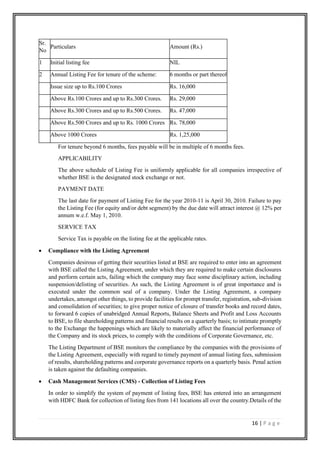
Mutual Funds
16 | P a g e
Sr.
No
Particulars Amount (Rs.)
1 Initial listing fee NIL
2 Annual Listing Fee for tenure of the scheme: 6 months or part thereof
Issue size up to Rs.100 Crores Rs. 16,000
Above Rs.100 Crores and up to Rs.300 Crores. Rs. 29,000
Above Rs.300 Crores and up to Rs.500 Crores. Rs. 47,000
Above Rs.500 Crores and up to Rs. 1000 Crores Rs. 78,000
Above 1000 Crores Rs. 1,25,000
For tenure beyond 6 months, fees payable will be in multiple of 6 months fees.
APPLICABILITY
The above schedule of Listing Fee is uniformly applicable for all companies irrespective of
whether BSE is the designated stock exchange or not.
PAYMENT DATE
The last date for payment of Listing Fee for the year 2010-11 is April 30, 2010. Failure to pay
the Listing Fee (for equity and/or debt segment) by the due date will attract interest @ 12% per
annum w.e.f. May 1, 2010.
SERVICE TAX
Service Tax is payable on the listing fee at the applicable rates.
• Compliance with the Listing Agreement
Companies desirous of getting their securities listed at BSE are required to enter into an agreement
with BSE called the Listing Agreement, under which they are required to make certain disclosures
and perform certain acts, failing which the company may face some disciplinary action, including
suspension/delisting of securities. As such, the Listing Agreement is of great importance and is
executed under the common seal of a company. Under the Listing Agreement, a company
undertakes, amongst other things, to provide facilities for prompt transfer, registration, sub-division
and consolidation of securities; to give proper notice of closure of transfer books and record dates,
to forward 6 copies of unabridged Annual Reports, Balance Sheets and Profit and Loss Accounts
to BSE, to file shareholding patterns and financial results on a quarterly basis; to intimate promptly
to the Exchange the happenings which are likely to materially affect the financial performance of
the Company and its stock prices, to comply with the conditions of Corporate Governance, etc.
The Listing Department of BSE monitors the compliance by the companies with the provisions of
the Listing Agreement, especially with regard to timely payment of annual listing fees, submission
of results, shareholding patterns and corporate governance reports on a quarterly basis. Penal action
is taken against the defaulting companies.
• Cash Management Services (CMS) - Collection of Listing Fees
In order to simplify the system of payment of listing fees, BSE has entered into an arrangement
with HDFC Bank for collection of listing fees from 141 locations all over the country.Details of the
17 | P a g e
HDFC Bank branches are available on our website site www.bseindia.com as well as on the HDFC
Bank website www.hdfcbank.com This facility is being provided free of cost.
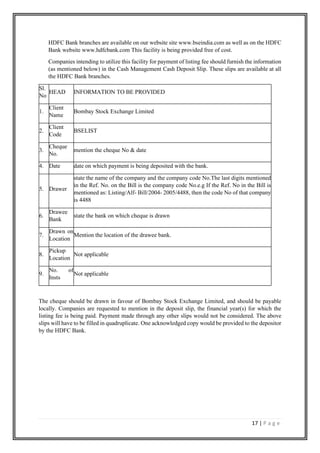
Companies intending to utilize this facility for payment of listing fee should furnish the information
(as mentioned below) in the Cash Management Cash Deposit Slip. These slips are available at all
the HDFC Bank branches.
Sl.
No
HEAD INFORMATION TO BE PROVIDED
1.
Client
Name
Bombay Stock Exchange Limited
2.
Client
Code
BSELIST
3.
Cheque
No.
mention the cheque No & date
4. Date date on which payment is being deposited with the bank.
5. Drawer
state the name of the company and the company code No.The last digits mentioned
in the Ref. No. on the Bill is the company code No.e.g If the Ref. No in the Bill is
mentioned as: Listing/Alf- Bill/2004- 2005/4488, then the code No of that company
is 4488
6.
Drawee
Bank
state the bank on which cheque is drawn
7.
Drawn on
Location
Mention the location of the drawee bank.
8.
Pickup
Location
Not applicable
9.
No. of
Insts
Not applicable
The cheque should be drawn in favour of Bombay Stock Exchange Limited, and should be payable
locally. Companies are requested to mention in the deposit slip, the financial year(s) for which the
listing fee is being paid. Payment made through any other slips would not be considered. The above
slips will have to be filled in quadruplicate. One acknowledged copy would be provided to the depositor
by the HDFC Bank.

Stock market

  • 1.
    A Report on AnOverview of Indian Stock Market Submitted by SUSHANKA MALAKAR March 2020
  • 2.
    1 | Pa g e Introduction: The stock market refers to the collection of markets and exchanges where regular activities of buying, selling, and issuance of shares of publicly-held companies take place. Such financial activities are conducted through institutionalized formal exchanges or over-the-counter (OTC) marketplaces which operate under a defined set of regulations. There can be multiple stock trading venues in a country or a region which allow transactions in stocks and other forms of securities. While both terms - stock market and stock exchange - are used interchangeably, the latter term is generally a subset of the former. If one says that she trades in the stock market, it means that she buys and sells shares/equities on one (or more) of the stock exchange(s) that are part of the overall stock market. The leading stock exchanges in the U.S. include the New York Stock Exchange (NYSE), Nasdaq, and the Chicago Board Options Exchange (CBOE). These leading national exchanges, along with several other exchanges operating in the country, form the stock market of the U.S. History: It was in 12th century France that the ‘Courretiers de change’ took on the task of managing and regulating agricultural communities’ debt. This was on behalf of the French banks of that time. This group of men traded the debts and became known as first brokers. It was in the middle of the thirteenth century in Venice, bankers started to trade in government of Venice Spreading Stories. The idea behind this was to decreased the cost of Venetian government funds. In the large cities of Italy, including Pisa, Genoa, Florence and Verona, bankers started to trade. This happened around the fourteenth century. Business and organisations in Italy were also the first to sell shares on the stock market. It was not until the sixteenth century that business in the United Kingdom were able to sell shares. Many other countries then followed. Today, there are stock markets all over the world, the most well-known stock markets, and the world’s largest are in the United States of America, as well as in the United Kingdom, China, Canada, India, Japan, Germany, France, Netherlands and South Korea. Indian stock market Indian Stock Markets is one of the old.t in Asia. Its history dates back to nearly 200 years ago. The earliest records of security dealings in India are meagre and obscure. The East India Company was the dominant institution in those days and business in its loan securities used to be transacted towards the close of the eighteenth century.
  • 3.
    2 | Pa g e By 1830's business on corporate stocks and shares in Bank and Cotton presses took place in Bombay. Though the trading list was broader in 1839, there were only half a dozen brokers recognized by banks and merchants during 1840 and 1850. The 1850's witnessed a rapid development of commercial enterprise and brokerage business attracted many men into the field and by 1860 the number of brokers increased into 60. In 1860-61 the American Civil War broke out and cotton supply from United States to Europe was stopped; thus, the 'Share Mania' in India began. The number of brokers increased to about 200 to 250. At the end of the American Civil War, the brokers who thrived out of Civil War in 1874, found a place in a street (now appropriately cal. as Dalai Street) where they would conveniently assemble and transact business. In 1887, they formally established in Bombay, the "Native Share and Stock Brokers 'Association", which is alternatively known as "The Stock Exchange". In 1895, the Stock Exchange acquired. a premise in the same street and it was inaugurated in 1899. Thus, the Stock Exchange at Bombay was consolidated. Indian stock market has been assigned an important place in financing the Indian corporate sector. The principal factors of the stock market are • Enabling mobilizing resources for investment directly from the investors. • Providing liquidity for the investors and monitoring. • Disciplining company management. In India there are 9 official operating stock and commodity exchange in Listed by SEBI • Bombay Stock Exchange (BSE) in Mumbai, one of the two principal large stock exchanges of India • National Stock Exchange of India (NSE) in Mumbai, one of the two principal large stock exchanges of India • Calcutta Stock Exchange in Kolkata, a smaller stock exchange • India International Exchange (India INX) in GIFT City • Indian Commodity Exchange (ICEX) in Airoli, Navi Mumbai • Metropolitan Stock Exchange of India Ltd. (MSE) in Mumbai • Multi Commodity Exchange of India Ltd. (MCX) in Mumbai • National Commodity & Derivatives Exchange Ltd. (NCDEX) in Mumbai • NSE IFSC Ltd. (NSE International Exchange) in Gandhinagar
  • 4.
    3 | Pa g e Bombay Stock Exchange: The Bombay Stock Exchange (BSE) is the first and largest securities market in India and was established in 1875 as the Native Share and Stock Brokers' Association. Based in Mumbai, India, the BSE lists close to 6,000 companies and is one of the largest exchanges in the world, along with the New York Stock Exchange (NYSE), NASDAQ, London Stock Exchange Group, Japan Exchange Group, and Shanghai Stock Exchange. Securities that the BSE lists include stocks, stock futures, stock options, index futures, index options, and weekly options. The BSE's overall performance is measured by the Sensex, an index of 30 of the BSE's largest stocks covering 12 sectors. BSE SENSEX S&P BSE SENSEX, first compiled in 1986, was calculated on a 'Market Capitalization- Weighted' methodology of 30 component stocks representing large, well-established and financially sound companies across key sectors. The base year of S&P BSE SENSEX was taken as 1978-79. S&P BSE SENSEX today is widely reported in both domestic and international markets through print as well as electronic media. It is scientifically designed and is based on globally accepted construction and review methodology. Since September 1, 2003, S&P BSE SENSEX is being calculated on a free-float market capitalization methodology. The 'free-float market capitalization-weighted' methodology is a widely followed index construction methodology on which majority of global equity indices are based; all major index providers like MSCI, FTSE, STOXX, and Dow Jones use the free-float methodology. The growth of the equity market in India has been phenomenal in the present decade. Right from early nineties, the stock market witnessed heightened activity in terms of various bull and bear runs. In the late nineties, the Indian market witnessed a huge frenzy in the 'TMT' sectors. More recently, real estate caught the fancy of the investors. S&P BSE SENSEX has captured all these happenings in the most judicious manner. One can identify the booms and busts of the Indian equity market through S&P BSE SENSEX. As the oldest index in the country, it provides the time series data over a fairly long period of time (from 1979 onwards). Small wonder, the S&P BSE SENSEX has become one of the most prominent brands in the country. Calculation Methodology: S&P BSE SENSEX is calculated using the 'Free-float Market Capitalization' methodology, wherein, the level of index at any point of time reflects the free-float market value of 30 component stocks relative to a base period. The market capitalization of a company is determined by multiplying the price of its stock by the number of shares issued by the company.
  • 5.
    4 | Pa g e This market capitalization is further multiplied by the free-float factor to determine the free- float market capitalization. The base period of S&P BSE SENSEX is 1978-79 and the base value is 100 index points. This is often indicated by the notation 1978-79=100. The calculation of S&P BSE SENSEX involves dividing the free-float market capitalization of 30 companies in the Index by a number called the Index Divisor. The Divisor is the only link to the original base period value of the S&P BSE SENSEX. It keeps the Index comparable over time and is the adjustment point for all Index adjustments arising out of corporate actions, replacement of scrips etc. During market hours, prices of the index scrips, at which latest trades are executed, are used by the trading system to calculate S&P BSE SENSEX on a continuous basis. National Stock Exchange: The National Stock Exchange of India Limited (NSE) is India's largest financial market. Incorporated in 1992, the NSE has developed into a sophisticated, electronic market, which ranked fourth in the world by equity trading volume in 2015. Trading commenced in 1994 with the launch of the wholesale debt market and a cash market segment shortly thereafter. The National Stock Exchange of India Limited was the first exchange in India to provide modern, fully automated electronic trading. It was set up by a group of Indian financial institutions with the goal of bringing greater transparency to the Indian capital market. As of March 2016, the National Stock Exchange had accumulated $1.41 trillion in total market capitalization, making it the world's 12th- largest stock exchange. The flagship index, the NIFTY 50, represents about 63% of total market capitalization listed on the exchange. The total traded value of stocks listed on the index makes up about 44% of the traded value of all stocks on the NSE for the last six months. The index itself covers 12 sectors of the Indian economy across 50 stocks. Besides the NIFTY 50 Index, the National Stock Exchange maintains market indices that track various market capitalizations, volatility, specific sectors, and factor strategies. The National Stock Exchange has been a pioneer in Indian financial markets, being the first electronic limit order book to trade derivatives and ETFs. The exchange supports more than 3,000 VSAT terminals, making the NSE the largest private wide-area network in the country. Ashok Chawla is the Chairman of the Board of Directors and Vikram Limaye is the Managing Director and CEO of the exchange.
  • 6.
    5 | Pa g e NIFTY The NIFTY 50 is the flagship index on the National Stock Exchange of India Ltd. (NSE). The Index tracks the behaviour of a portfolio of blue-chip companies, the largest and most liquid Indian securities. It includes 50 of the approximately 1600 companies listed on the NSE, captures approximately 65% of its float-adjusted market capitalization and is a true reflection of the Indian stock market. The NIFTY 50 covers major sectors of the Indian economy and offers investment managers exposure to the Indian market in one efficient portfolio. The Index has been trading since April 1996 and is well suited for benchmarking, index funds and index-based derivatives. The NIFTY 50 is owned and managed by India Index Services and Products Ltd. (IISL). IISL is India's first specialized company focused on an index as a core product Calculation Methodology: NIFTY 50 is computed using free float market capitalization weighted method, wherein the level of the index reflects the total market value of all the stocks in the index relative to a particular base period. The method also takes into account constituent changes in the index and importantly corporate actions such as stock splits, rights, etc without affecting the index value. The base period selected for NIFTY 50 index is the close of prices on November 3, 1995, which marks the completion of one year of operations of NSE's Capital Market Segment. The base value of the index has been set at 1000 and a base capital of Rs.2.06 trillion. Stock Market Timings in India: There are two major stock exchanges in India- Bombay stock exchange (BSE) and National stock exchange (NSE). However, the timing of both BSE & NSE is the same. It is closed on weekends i.e. Saturday and Sunday. It is also closed on the national holidays. The normal trading time for equity market is between 9:15 am to 03:30 pm, Monday to Friday. The trading time for commodity (MCX) market is between 10:00 AM to 11:30 PM, Monday to Friday. The normal trading time for Agri-community (NCDEX) market is between 10:00 AM to 05:00 PM, Monday to Friday. There is no lunch break or tea break in the Indian stock market timings. However, the timings of the Indian stock market are divided into three sessions: • Normal session (also called continuous session) • Pre-opening session • Post-closing session Normal Trading Session: • This is the actual time where most of the trading takes place. • Its duration is between 9:15 AM to 3:30 PM.
  • 7.
    6 | Pa g e • You can buy and sell stocks in this session. • The normal trading session follows bilateral matching session i.e. whenever buying price is equal to the selling price, the transaction is complete. Here transactions are as per price and time priority. Pre-opening session: The duration of the Pre-opening session is between 9:00 AM to 9:15 AM. This is further divided into three sub-sessions. • 9:00 AM to 9:08 AM: • This is the order entry session. • You can place an order to buy and sell stocks in this duration. • One can also modify or cancel his orders during this period. • 9:08 AM to 9:12 AM: • This session is used for order matching and for calculating the opening price of the normal session. • You cannot modify or cancel buy/sell order during this time. • 9:12 AM to 9:15 AM: • This session is used as a buffer period. • It is used for the smooth translation of pre-opening session to the normal session. The opening price of the normal session is calculated using multilateral order matching system. Earlier, the bilateral matching system was used which caused a lot of volatility when the market opened. Later, this was changed to multilateral order matching system to reduce the volatility in the market. However, most people do not use the pre-opening session and only use the normal session for trading. That’s why there is still huge volatility even in the normal session after the pre-opening session. The time between 3:30 PM to 3:40 PM is used for closing price calculation. • The closing price of a stock is the weighted average of the prices between 3:00 PM to 3:30 PM. • For the indexes like Sensex & nifty, its closing price is the weighted average of the constituent stocks for the last 30 minutes i.e. Between 3:00 PM to 3:30 PM. Post-closing session: • The duration of the Post-closing session is between 3:40 PM to 4:00 PM. • You can place orders to buy or sell stocks in the post-closing session at the closing price. If buyers/sellers are available then your trade will be confirmed at the closing price. Pre-opening session and the Post-closing session is only for the cash market. There are no such sessions for future & options. Types of Share Market: • Primary Market • Secondary Market
  • 8.
    7 | Pa g e Primary Market Primary Market is the market where investors can buy shares directly from the issuer company to raise their capital. When investors purchase securities on the primary capital market, the company offering the securities has already hired an underwriting firm to review the offering and create a prospectus outlining the price and other details of the securities to be issued. Secondary Market Secondary market is the market where stocks are traded after they are initially offered to the investor in primary market and get listed to stock exchange. Secondary market comprises of equity markets and the debt markets. It is a platform to trade listed equities, while Primary market is the way for companies to enter in to secondary market. How It Works: The stock market works as investors buy/sell shares in publicly traded companies. There are interactions between the four groups of people that the stock market work. In the diagram below, we are the “Investors” and we only deal with the “Trading Participants”. However, for a complete understanding of the market, you need to understand the other relationships. • The Publicly Listed Company and The Stock Exchange The publicly listed company applies to the stock exchange so that they can be allowed to offer shares of stock to the public. The company must comply with very stringent requirements before the investments are opened to the public. • The Stock Exchange and The Trading Participant (Broker) The stock exchange does not directly transact with investors. Only Trading Participants licensed by the Stock Exchange are allowed to buy and sell shares of stock. This was done simply for control purpose and work simplification. The Stock Exchange prioritizes monitoring of publicly Listed companies while the Trading Participants deal with the investing public. • The Trading Participant and Investors
  • 9.
    8 | Pa g e You will have to contact a trading participant (broker) if you want to buy or sell shares of a particular company. For this, the broker will charge a very small fee for the buying or selling transaction. Broker also provide you with information on which companies are good to buy in addition to their transaction services. Bear Markets and Bull Markets: The terms bull and bear market are used to describe how stock markets are doing in general—that is, whether they are appreciating or depreciating in value. At the same time, because the market is determined by investors' attitudes, these terms also denote how investors feel about the market and the ensuing trends. A Bull market refers to a market that is on the rise. It is typified by a sustained increase in price, for example in equity markets in the prices of companies' shares. In such times, investors often have faith that the uptrend will continue over the long term. Typically, in this scenario, the country's economy is strong and employment levels are high. A Bear market is one that is in decline, typically having fallen 20% or more from recent highs. Share prices are continuously dropping, resulting in a downward trend that investors believe will continue, which, in turn, perpetuates the downward spiral. During a bear market, the economy will typically slow down and unemployment will rise as companies begin laying off workers. Regulatory Authority of Indian Capita Market: The Ministry of Finance (MoF), the Securities & Exchange Board of India (SEBI) and the Reserve Bank of India (RBI) are the three regulatory authorities governing Indian capital market. Ministry of Finance (MoF) The Department of Economic affairs directly manages the Capital Markets segment under the directions of MoF. This segment formulates the rules for the efficient growth of the Stock Market which includes derivatives, debt, and equity. It also formulates regulations for safeguarding the interest of the investors.
  • 10.
    9 | Pa g e This segment regulates the Indian Capital Markets through the following laws: • Depositories Act, 1996 • Securities Contract (Regulation) Act, 1956 • Securities and Exchange Board of India Act, 1992 Reserve Bank of India (RBI) The Reserve Bank of India Act, 1934 governs policies framed by the Reserve Bank of India. The functions of RBI in this regard are as follows: • Implementation of Monetary and Credit policies • Issuance of Currency Notes • Government’s Banker • Banking System Regulator • Foreign Exchange through Foreign Exchange Management Act, 1999 • Managing payment & settlement system • Apart from the above functions, RBI is also actively involved in developing the financial market. Securities & Exchange Board of India (SEBI) The Securities & Exchange Board of India (SEBI) Act, 1992 regulates the functioning of SEBI. SEBI is the apex body governing the Indian stock exchanges. The primary functions of SEBI are as follows: Protective Functions • It checks Price rigging. • Prohibits insider trading. • Prohibits fraudulent and Unfair Trade Practices. Development Functions • SEBI promotes training of intermediaries of the securities market. • SEBI tries to promote activities of stock exchange by adopting a flexible and adaptable approach Regulatory Functions • SEBI has framed rules and regulations and a code of conduct to regulate the intermediaries such as merchant bankers, brokers, underwriters, etc. • These intermediaries have been brought under the regulatory purview and private placement has been made more restrictive. • SEBI registers and regulates the working of stock brokers, sub-brokers, share-transfer agents, trustees, merchant bankers and all those who are associated with stock exchange in any manner • SEBI registers and regulates the working of mutual funds etc. • SEBI regulates takeover of the companies • SEBI conducts inquiries and audit of stock exchanges.
  • 11.
    10 | Pa g e The participation in the Indian Stock Market of both the domestic or foreign financial intermediaries are governed by the regulations framed by SEBI. Additionally, Foreign Portfolio Investors (FPIs) can participate in Indian Stock Market after registering them with an authorized Depository Participant. National Stock Exchange of India (NSE) NSE is responsible for formulating and implementing the rules pertaining to: • Registration of Members • Listing of Securities • Monitoring of Transactions • Compliance • Other additional functions related to the above functions NSE itself is regulated by SEBI and is under regular vigilance for all regulatory compliances. How to Invest in Share Market in India: Get a PAN Card: PAN or Permanent Account Number is a primary requirement for entering any financial transactions in our country. It is unique 10-digit Alpha-Numeric number assigned to an individual by the Tax Authorities for assessing their tax liabilities. PAN is however required for opening a bank account, investing in mutual funds, filling Income Tax returns etc. Also, the first thing you will need to be able to invest in shares in India is a PAN card, so get it first. Get a Broker: You and I cannot directly go the stock exchange and buy or sell stocks/shares like we would buy or sell any other thing. People are authorized to buy and sell on the markets and they are called brokers. Brokers can be individuals or companies and even online agencies that are registered and licensed by SEBI or Securities and Exchanges Board of India, who regulates the share markets. Get a broker, they can be individuals you know and are reliable, or you can approach various companies that are licensed to trade and deal in securities in the markets. If you are comfortable with internet and online stuff, you can even have online broking through companies like ICICI Direct, Sharekhan, Kotak Securities, IndiaBulls etc. (The names given here are just given as examples of well-known companies offering online broker services, they are neither recommendations nor a testimonial to their performance, and please do a research before selecting your broking firm.) Get a Demat and Trading Account: Once you have a broker, whether in form of a person, company or online, you will now need a Demat and Trading account. Demat account will hold the stocks or shares in your name and the same will reflect in your stock portfolio. You cannot hold shares in physical form or store them physically. They have to in Dematerialized state or Demat state. A Demat account does that for you. It will store the shares you buy from the markets through your brokers in your account in your name. The selling will also be from here and it will reflect in your Demat statements that you receive from time to time. You will never have a physical share certificate in your hands; it will be reflected in your Demat Account Statement.
  • 12.
    11 | Pa g e The buying and selling of shares you wish to have or want to sell will however require a Trading account. Trading account will be like an intermediary who facilitates the buying and selling. Usually your broker takes care of all this. Whether you approach an individual broker, a broking firm or online agencies, the Demat and Trading accounts will be opened simultaneously as it is one without the other is useless for investing in shares in India. Depository Participant: There is also a Depositary Participant that you need to be aware of. There are two depositories in India: NSDL and CDSL which stands for National Securities Depository Limited and Central Depository Services Limited. These two have their agents in the form of Depository Participants who will provide an account to store the shares you hold. It is not the same as Demat and Trading account as in Demat it shows the number shares you hold and the Trading reflects the buying and selling that has taken place in your account. Depository Participants will hold those shares you bought and release the shares you sold. However, it is usually taken care of by the broker who will also guide you through the Demat, Trading account opening process as well as register with a Depository. But you need to be aware of it none-the-less. UIN if you want to invest BIG: UIN or Unique Identification Number is required in case you trade for Rs. 1,00,000 or more at a single time. If you plan to go BIG in share markets, UIN is needed. Otherwise, for regular investors it is not required. Buying and Selling: For buying or selling shares, you need to inform your broker about which share in what quantity you wish to buy at which price. For example, if you wish to buy 10 shares of Reliance Industries Ltd when it reaches a price of Rs. 885, you have to inform the same to you broker; Share: Reliance Industries Ltd. Quantity: 10, Price: 885. In case of online broker too, they usually have customer care numbers where you can place your order if you do not have access to the internet at that point. When the share reaches that price, transaction will be made on your behalf. Same is done in case of selling, for example Sell: Reliance Industries Ltd, Quantity: 3, Price: 895. The sell order will be processed when the share reaches that price. However, the buy and sell orders remain valid only up to a certain time, usually the same day or the next. Your broker will inform you of the same. If during that time frame the buy or sell price is not reached, the order is cancelled and you need to place a new order. The buying and selling takes place in two exchanges: BSE and NSE namely Bombay Stock Exchange and National Stock Exchange. These are the only two exchanges in India where buying and selling of shares and commodities take place. You need to mention the exchange to your broker too, as there is usually a slight difference in price of shares at the two exchanges. However, your broker can guide you here in case you do not understand where to trade. (The names given here are just given as examples, they are neither recommendations nor a testimonial to their performance, and please do a research before buying or selling shares.) Types of Investment: Stocks The market that is most familiar to the average investor is the stock market. This market allows investors to buy and sell shares of ownership in publicly traded companies. Money is made in this market in two main ways.
  • 13.
    12 | Pa g e The first is through capital gains, in which the value of each share increases in value. The second is through dividends, in which companies pass on income to investors. Bonds The debt market is used by governments, companies, and financial intermediaries to issue debt instruments to raise capital. The debt issuers then make regular payments to debt holders in the form of coupon payments and, once the debt matures, pay back the principal on the debt. The most common type of financial instruments issued in this market are bonds, bills, notes, and certificates of deposit. There are also more exotic types of debt including mortgage-backed securities (MBS) and collateralized debt obligations (CDO). Foreign Exchange (Forex) The forex market allows investors to speculate on changes in the exchange rates between currencies. Investors will purchase one currency by selling another in the hope that the currency they purchased goes up in value compared to the one they sold. In this market, because the moves between currencies are generally small and investments are shorter term, a lot of leverage is used. Some forex brokers allow leverage as high as 500:1, which means that you can control $500 for every $1 you invest. Physical Assets The investment in physical assets is essentially the purchase of assets such as metals, jewelry, real estate, cattle, and much more. In this market, investors hope that the price for which they can sell an asset is more than what they paid for it. The risks and costs associated with this type of investment will differ with each type of physical asset. For example, there can be holding fees on gold, and if you own cattle, the cost of caring for them is considerable. Derivatives The last major type of investment is an expansion of all of the above types of markets. Derivatives are securities that derive their value from an underlying asset such as a stock, interest rate, currency, or physical asset. Investors in these types of securities can go long or short on the underlying asset and can purchase either the right or obligation to purchase or sell it. As the value of the underlying asset changes, the value of the derivative changes as well. The major types of derivatives are options, futures, or forwards. Procedure for listing a company in Stock Exchange in India A company intending to have its securities listed on BSE has to comply with the listing requirements prescribed by it. Some of the requirements are as under: • Minimum Listing Requirements for New Companies The following eligibility criteria have been prescribed effective August 1, 2006 for listing of companies on BSE, through Initial Public Offerings (IPOs) & Follow-on Public Offerings (FPOs): Companies have been classified as large cap companies and small cap companies. A large cap company is a company with a minimum issue size of Rs. 10 crore and market capitalization of not less than Rs. 25 crore. A small cap company is a company other than a large cap company.
  • 14.
    13 | Pa g e In respect of Large Cap Companies The minimum post-issue paid-up capital of the applicant company (hereinafter referred to as "the Company") shall be Rs. 3 crore; and The minimum issue size shall be Rs. 10 crore; and The minimum market capitalization of the Company shall be Rs. 25 crore (market capitalization shall be calculated by multiplying the post-issue paid-up number of equity shares with the issue price). In respect of Small Cap Companies The minimum post-issue paid-up capital of the Company shall be Rs. 3 crore; and The minimum issue size shall be Rs. 3 crore; and The minimum market capitalization of the Company shall be Rs. 5 crore (market capitalization shall be calculated by multiplying the post-issue paid-up number of equity shares with the issue price); and The minimum income/turnover of the Company shall be Rs. 3 crore in each of the preceding three 12-months period; and The minimum number of public shareholders after the issue shall be 1000. A due diligence study may be conducted by an independent team of Chartered Accountants or Merchant Bankers appointed by BSE, the cost of which will be borne by the company. The requirement of a due diligence study may be waived if a financial institution or a scheduled commercial bank has appraised the project in the preceding 12 months. For all companies: In respect of the requirement of paid-up capital and market capitalization, the issuers shall be required to include in the disclaimer clause forming a part of the offer document that in the event of the market capitalization (product of issue price and the post issue number of shares) requirement of BSE not being met, the securities of the issuer would not be listed on BSE. The applicant, promoters and/or group companies, shall not be in default in compliance of the listing agreement. The above eligibility criteria would be in addition to the conditions prescribed under SEBI (Disclosure and Investor Protection) Guidelines, 2000. • Minimum Listing Requirements for Companies already Listed on Other Stock Exchanges The listing norms for companies already listed on other stock exchanges and seeking listing at BSE, made effective from August 6, 2002, are as under: The company shall have a minimum issued and paid up equity capital of Rs. 3 crore. The company shall have a profit making track record for the preceding last three years. The revenues/profits arising out of extra ordinary items or income from any source of non-recurring nature shall be excluded while calculating the profit making track record. Minimum net worth shall be Rs. 20 crore (net worth includes equity capital and free reserves excluding revaluation reserves). Minimum market capitalisation of the listed capital shall be at least two times of the paid up capital.
  • 15.
    14 | Pa g e The company shall have a dividend paying track record for at least the last 3 consecutive years and the dividend should be at least 10% in each year. Minimum 25% of the company's issued capital shall be with Non-Promoter shareholders as per Clause 35 of the Listing Agreement. Out of above Non-Promoter holding, no single shareholder shall hold more than 0.5% of the paid-up capital of the company individually or jointly with others except in case of Banks/Financial Institutions/Foreign Institutional Investors/Overseas Corporate Bodies and Non-Resident Indians. The company shall have at least two years listing record with any of the Regional Stock Exchanges. The company shall sign an agreement with CDSL and NSDL for demat trading. • Minimum Requirements for Companies Delisted by BSE seeking Relisting on BSE Companies delisted by BSE and seeking relisting at BSE are required to make a fresh public offer and comply with the extant guidelines of SEBI and BSE regarding initial public offerings. • Permission to Use the Name of BSE in an Issuer Company's Prospectus Companies desiring to list their securities offered through a public issue are required to obtain prior permission of BSE to use the name of BSE in their prospectus or offer for sale documents before filing the same with the concerned office of the Registrar of Companies. BSE has a Listing Committee, comprising of market experts, which decides upon the matter of granting permission to companies to use the name of BSE in their prospectus/offer documents. This Committee evaluates the promoters, company, project, financials, risk factors and several other aspects before taking a decision in this regard. Decision with regard to some types/sizes of companies has been delegated to the Internal Committee of BSE. • Submission of Letter of Application As per Section 73 of the Companies Act, 1956, a company seeking listing of its securities on BSE is required to submit a Letter of Application to all the stock exchanges where it proposes to have its securities listed before filing the prospectus with the Registrar of Companies. • Allotment of Securities As per the Listing Agreement, a company is required to complete the allotment of securities offered to the public within 30 days of the date of closure of the subscription list and approach the Designated Stock Exchange for approval of the basis of allotment. In case of Book Building issues, allotment shall be made not later than 15 days from the closure of the issue, failing which interest at the rate of 15% shall be paid to the investors. • Trading Permission As per SEBI Guidelines, an issuer company should complete the formalities for trading at all the stock exchanges where the securities are to be listed within 7 working days of finalization of the basis of allotment. A company should scrupulously adhere to the time limit specified in SEBI (Disclosure and Investor Protection) Guidelines 2000 for allotment of all securities and dispatch of allotment letters/share certificates/credit in depository accounts and refund orders and for obtaining the listing permissions of all the exchanges whose names are stated in its prospectus or offer document. In the event of
  • 16.
    15 | Pa g e listing permission to a company being denied by any stock exchange where it had applied for listing of its securities, the company cannot proceed with the allotment of shares. However, the company may file an appeal before SEBI under Section 22 of the Securities Contracts (Regulation) Act, 1956. • Requirement of 1% Security Companies making public/rights issues are required to deposit 1% of the issue amount with the Designated Stock Exchange before the issue opens. This amount is liable to be forfeited in the event of the company not resolving the complaints of investors regarding delay in sending refund orders/share certificates, non-payment of commission to underwriters, brokers, etc. • Payment of Listing Fees All companies listed on BSE are required to pay to BSE the Annual Listing Fees by 30th April of every financial year as per the Schedule of Listing Fees prescribed from time to time. The schedule of Listing Fees for the year 2010-11, is given here under: Sr. No. Particulars Amount (Rs.) 1 Initial Listing Fees 20,000.00 2 Annual Listing Fees (i) Companies with listed capital* upto Rs. 5 crore (ii) Above Rs. 5 crore and upto Rs. 10 crore (iii)Above Rs. 10 crore and upto Rs. 20 crore Companies which have a listed capital* of more than Rs. 20 crore are required to pay an additional fee @ Rs. 750 for every additional Rs. 1 crore or part thereof. 10,000.00 15,000.00 30,000.00 Privately Placed Debt Securities Sl. No. Particulars Amount (Rs.) 1 Initial Listing Fees NIL 2 Annual Listing Fees (i) Issue size up to Rs.5 crore (ii) Above Rs.5 crore and up to Rs.10 crore (iii) Above Rs.10 crore and up to Rs.20 crore Above Rs.20 crore Rs.2,500.00 Rs.3,750.00 Rs.7,500.00 Additional fee of Rs.200.00 for every additional Rs.1 crore or part thereof Subject to a maximum of Rs.30,000.00 per instrument. Mutual Funds
  • 17.
    16 | Pa g e Sr. No Particulars Amount (Rs.) 1 Initial listing fee NIL 2 Annual Listing Fee for tenure of the scheme: 6 months or part thereof Issue size up to Rs.100 Crores Rs. 16,000 Above Rs.100 Crores and up to Rs.300 Crores. Rs. 29,000 Above Rs.300 Crores and up to Rs.500 Crores. Rs. 47,000 Above Rs.500 Crores and up to Rs. 1000 Crores Rs. 78,000 Above 1000 Crores Rs. 1,25,000 For tenure beyond 6 months, fees payable will be in multiple of 6 months fees. APPLICABILITY The above schedule of Listing Fee is uniformly applicable for all companies irrespective of whether BSE is the designated stock exchange or not. PAYMENT DATE The last date for payment of Listing Fee for the year 2010-11 is April 30, 2010. Failure to pay the Listing Fee (for equity and/or debt segment) by the due date will attract interest @ 12% per annum w.e.f. May 1, 2010. SERVICE TAX Service Tax is payable on the listing fee at the applicable rates. • Compliance with the Listing Agreement Companies desirous of getting their securities listed at BSE are required to enter into an agreement with BSE called the Listing Agreement, under which they are required to make certain disclosures and perform certain acts, failing which the company may face some disciplinary action, including suspension/delisting of securities. As such, the Listing Agreement is of great importance and is executed under the common seal of a company. Under the Listing Agreement, a company undertakes, amongst other things, to provide facilities for prompt transfer, registration, sub-division and consolidation of securities; to give proper notice of closure of transfer books and record dates, to forward 6 copies of unabridged Annual Reports, Balance Sheets and Profit and Loss Accounts to BSE, to file shareholding patterns and financial results on a quarterly basis; to intimate promptly to the Exchange the happenings which are likely to materially affect the financial performance of the Company and its stock prices, to comply with the conditions of Corporate Governance, etc. The Listing Department of BSE monitors the compliance by the companies with the provisions of the Listing Agreement, especially with regard to timely payment of annual listing fees, submission of results, shareholding patterns and corporate governance reports on a quarterly basis. Penal action is taken against the defaulting companies. • Cash Management Services (CMS) - Collection of Listing Fees In order to simplify the system of payment of listing fees, BSE has entered into an arrangement with HDFC Bank for collection of listing fees from 141 locations all over the country.Details of the
  • 18.
    17 | Pa g e HDFC Bank branches are available on our website site www.bseindia.com as well as on the HDFC Bank website www.hdfcbank.com This facility is being provided free of cost. Companies intending to utilize this facility for payment of listing fee should furnish the information (as mentioned below) in the Cash Management Cash Deposit Slip. These slips are available at all the HDFC Bank branches. Sl. No HEAD INFORMATION TO BE PROVIDED 1. Client Name Bombay Stock Exchange Limited 2. Client Code BSELIST 3. Cheque No. mention the cheque No & date 4. Date date on which payment is being deposited with the bank. 5. Drawer state the name of the company and the company code No.The last digits mentioned in the Ref. No. on the Bill is the company code No.e.g If the Ref. No in the Bill is mentioned as: Listing/Alf- Bill/2004- 2005/4488, then the code No of that company is 4488 6. Drawee Bank state the bank on which cheque is drawn 7. Drawn on Location Mention the location of the drawee bank. 8. Pickup Location Not applicable 9. No. of Insts Not applicable The cheque should be drawn in favour of Bombay Stock Exchange Limited, and should be payable locally. Companies are requested to mention in the deposit slip, the financial year(s) for which the listing fee is being paid. Payment made through any other slips would not be considered. The above slips will have to be filled in quadruplicate. One acknowledged copy would be provided to the depositor by the HDFC Bank.