This paper discusses the stochastic analysis of a cold standby system with two identical units, focusing on potential failures of both the operative and standby units, as well as the serving server. It utilizes semi-Markov processes to derive various performance measures including mean time to system failure and steady state availability, illustrated through graphs for better understanding. The study concludes that system performance can be enhanced by reducing server failure and increasing repair and treatment rates.
![International Journal of Mathematics and Statistics Invention (IJMSI)
E-ISSN: 2321 – 4767 P-ISSN: 2321 - 4759
www.ijmsi.org Volume 4 Issue 6 || August. 2016 || PP-18-22
www.ijmsi.org 18 | Page
Stochastic Analysis of a Cold Standby System with Server Failure
Dhiraj Yadav*
and M.S.Barak
*
Department of Mathematics, Govt. college for women, Rewari
Department of Mathematics, I. G. Univeristy, Meerpur (Rewari)
ABSTRACT: This paper throws light on the stochastic analysis of a cold standby system having two identical
units. The operative unit may fail directly from normal mode and the cold standby unit can fail owing to remain
unused for a longer period of time. There is a single server, who may also follow as precedent unit happens to
be in the line of failure .After having treated, the operant unit for functional purposes, the server may eventually
perform the better service efficiently. The time to take treatment and repair activity follows negative exponential
distribution whereas the distributions of unit and server failure are taken as arbitrary with different probability
density functions. The expressions of various stochastic measures are analyzed in steady state using semi-
Markov process and regenerative point technique. The graphs are sketched for arbitrary values of the
parameters to delineate the behavior of some important performance measures to check the efficacy of the
system model under such situations.
KEYWORDS: Stochastic Analysis, Cold-standby, regenerative point, steady state and semi-Markov process
I. INTRODUCTION
Redundancy is a common approach to enrich the reliability and availability of a system. In literature, the
stochastic behavior of cold standby system has been widely discussed by many researchers [1-3]. Some of them
have generally imagined the server to be always in good condition and it never fails while working. But this
imagination seems to be quite impractical when a server has to work in varying environmental conditions. We
may observe many cases where the server fails during his performance. In a standby redundant system some
additional paths are created for proper functioning of the system. Standby unit is the assistance to increase the
reliability of the system.
In a cold standby redundant system as the operating unit fails, the standby unit takes its place and the failed unit
goes under treatment .But it may be the possibility that the standby unit is already damaged owing to remain
unused for a longer period of time or erosion etc. we may face a situation when the operating unit fails but the
standby unit is already damaged. So far, the cold standby systems with the possibility of server failure have
been discussed much[4-5] but the standby failure have not been researched so much .Though a two unit
redundant system with standby failure has been discussed by[6-8] while the concept of standby failure needs
more attention due to its significant contribution during study. So keeping this aspect in view we developed a
stochastic model of redundant system with standby and server failure. The model consists of two identical units;
one unit is in operative mode and other in cold standby mode. The cold standby unit becomes operative after
failure of the previous unit. The failure of the server during any service activity can produce undesirable results
in terms of safety as well as economic losses. There is single server for repair activity who may go for treatment
to increase his efficiency whenever required. The server works as afresh after taking treatment with full
efficiency. The time to take treatment and repair activity follows negative exponential distribution whereas the
distributions of unit and server failure are taken as arbitrary with different probability density functions. The
expression for various reliability measures such as transition probabilities, mean sojourn times, mean time to
system failure, steady state availability are deduced by using semi-Markov process and regenerative point
technique. The graphs are delineated for arbitrary values of the parameters to highlight the behavior of some
important performance measures to check the efficacy of the system model under such situations.
NOTATIONS
E : Set of regenerative states.
O / Cs : The unit is operative /cold standby
F / F : The failed unit is under repair/ under repair continuously from previous
state.
SFUt / SFUT : The server has failed and is under treatment /under treatment continuously from previous state.
F / : The unit is failed and waiting for repair/waiting for repair continuously
from previous state.
/ µ : Constant failure rate of unit /failure of server.
f(t) / F(t): p.d.f. / c.d.f. of repair rate of the failed unit.](https://image.slidesharecdn.com/c0406018022-160912072118/75/Stochastic-Analysis-of-a-Cold-Standby-System-with-Server-Failure-1-2048.jpg)
![Stochastic Analysis of a Cold Standby System with Server Failure
www.ijmsi.org 19 | Page
g(t) / G(t) : pdf / cdf of treatment time of the server.
(t) / (t) : pdf / cdf of direct transition time from a regenerative state i to a
regenerative state j without visiting any other regenerative state.
/ : pdf/cdf of first passage time from a regenerative state i to a regenerative
state j or to a failed state j visiting state k once in (0,t].
: pdf/cdf of first passage time from a regenerative state i to a regenerative
state j or to a failed state j visiting state k , r and s once in (0,t].
Mi (t) : Probability that the system is up initially in state ES i
is up at time t
without visiting to any other regenerative state .
Wi (t) : Probability that the system is busy in state Si up at time t without making
any transition to any other regenerative state or returning to the same state via
one or more non-regenerative states.
mij : Contribution to mean sojourn time (ui) in state Si when system transit directly to
state j so that µi = = -
Ⓢ : symbol for stieltjes convolution/ laplace convolution
Transition Probabilities
Simple probabilities considerations yield the following expressions for the non-zero elements
Pij = Qij(∞) = (1)
P01 = a , P03 = b , P10 = ,
12P P14
P21 = , P27 = , P31 = P41 = P61 = P81 =
P35 = P49 = P65 = P89 = , P56 = P78 = P98 = 1 , a + b = 1 (2)
For these transition probabilities, it can be verified that:
P01 + P03 = P10 + P12 + P14= P21 + P27= P31 + P35= P41 + P49= 1 (3)
P01,356
(n)
= b , P11,498
(n)
= . , P21,789
(n)
=
It can be verified that, P01 + P01,3+P01,356
(n)
= P01+P11,4 + P11,498
(n)
+P12 =P21+P21,789
(n)
= 1 (4)
Mean Sojourn Time
Let T denotes the time to system failure then the mean sojourn times ( ) in the state Si are given by
=
Hence,
(5)
Mean Time to System Failure
Let ϕi(t) be the c.d.f. of the passage time from regenerative state Si to a failed state .Regarding the failed state as
absorbing state ,we have the following recursive relations for ϕi(t)
ϕ0(t) = Q01(t)ⓢϕ01(t) + Q03(t)
ϕ1(t) = Q10(t) ⓢϕ0(t) + Q12(t) ⓢϕ2(t) + Q14(t)
ϕ2(t) = Q21(t) ⓢϕ1(t) + Q27(t) (6)
Taking L.S.T. of relation (6) and solving for (s), =
MTSF = = (7)
=
= (8)
Steady State Availability
Let Ai(t) be the probability that the system is in up-state at instant t ,given that the system entered the
regenerative state Si at t = 0.The recursive relations for Ai(t) are as follows :
A0(t) = M0(t) + q01(t)©A1(t) + q01,3(t) © A1(t) + q01,356
n
(t) © A1(t)
A1(t) = M1(t) + q10(t)©A0(t) + q12(t) © A2(t) + q11,4(t) © A1(t) + q11,498
n
(t) © A1(t)](https://image.slidesharecdn.com/c0406018022-160912072118/75/Stochastic-Analysis-of-a-Cold-Standby-System-with-Server-Failure-2-2048.jpg)
![Stochastic Analysis of a Cold Standby System with Server Failure
www.ijmsi.org 20 | Page
A2(t) = M2(t) + q21(t)©A1(t) + q21,789
n
(t) © A1(t) (9)
Mi(t) is the probability that the system is up initially in state at time t without visiting to any other
regenerative state where
M0(t) = , M1(t)= (t) , M2(t) = (t)
Taking Laplace transform of equation (9) and solving for A0
*
(s), the steady state availability is given by
A0(s) =
= (10)
Busy period of the server
Let Bi(t) be the probability that the server is busy at instant t ,given that the system entered the regenerative state
i at t = 0 .The recursive relations for Bi(t) are as follows :
(t) = © (t) + (t)© (t)+ q01,356
n
(t) © (t)
(t) = W1(t) + © (t) © (t) + (t)© (t) + q11,498
n
(t) © (t)
(t) = © (t) + q21,789
n
(t) © (t) (11)
Where Wi(t) is the probability that the server is busy in state Si due to repairing of unit up to time t without
making any transition to any other regenerative state or returning to the same via one or more non-regenerative
states so
W1 (t) = Ḡ(t) + Ḡ(t) © g(t) + Ḡ(t) ©µ (t)+-------up to n
Taking L.T. of relation (11) and solving for B0
*
(s), the time for which server is busy is given as
B0
R
= Bo
*
(s)
(12)
Expected Number of visits by the server
Let Ri(t) be the expected number of visits by the server in(0,t],given that the system entered the regenerative
state Si at t=0 .The recursive relations for Ri (t) are as follows :
Ro(t) = Q01(t)©R1(t) + Q01,3(t)©R1(t) + Q01,356
n
(t)©R1(t)
R1(t) = Q10(t)©[ 1+R0(t) ] + Q12(t)©[R2(t) +1] + Q11,4(t)©[ R1(t) +1 ] + Q11,498
n
(t)©[ R1(t) + 1]
R2(t) = Q21(t)©R1(t) + Q21,789
n
(t)© R1(t) (13)
Taking Laplace transform of the above relation and solving for R0
*
(s), the expected number of visits by the
server are given by
R0 = R0*(s) = (14)
Expected Number of treatments given to server
Let Ti(t) be the expected number of treatments given to server in (0,t] such that the system entered the
regenerative state at t = 0 .The recursive relations for Ti(t) are as follows:
T0(t) = Q01(t) ©T1(t) + Q01,3(t) ©T1(t) + Q01,356
n
(t) ©T1(t)
T1(t) = Q10(t) ©T0(t) + Q12(t) ©[1+T2(t)] + Q11,4(t) ©T1(t) + Q11,498
n
(t) ©[1+T1(t)]
T2(t) = Q21(t) ©T1(t) + Q01,3(t) ©T1(t) + Q21,789
n
(t) ©[1+T1(t)] (15)
Taking Laplace transform of the above relation and solving for T0
*
(s) , we get
T0 = (s)
= (16)
Cost -Benefit Analysis:
The profit occurred in the system model in steady state can be calculated as
P0 = K0A0 - K1B0
R
–K2R0 - K3T0 (17)
Where K0 = (5000); Revenue per unit up- time of the system
K1 = (650); Cost per unit time for which server is busy
K2 = (450 ); Cost per unit visits by the server
K3 = (350); Cost per unit time treatment given to server
Particular Case:
Let us take f(t) = θ e- θt
, f(t) = ϕ e-ϕt
MTSF = (18)](https://image.slidesharecdn.com/c0406018022-160912072118/75/Stochastic-Analysis-of-a-Cold-Standby-System-with-Server-Failure-3-2048.jpg)
![Stochastic Analysis of a Cold Standby System with Server Failure
www.ijmsi.org 21 | Page
Availability = A0
= (19)
Busy Period of the server due to Repair =B0
R
= (20)
Expected number of visits due to Repair = R0
(21)
Expected Number of Treatments given to Server =T0
= (22)
II. CONCLUSION
In this exploration, the effect of various parameters on system model is visualized. Graphs are penned down
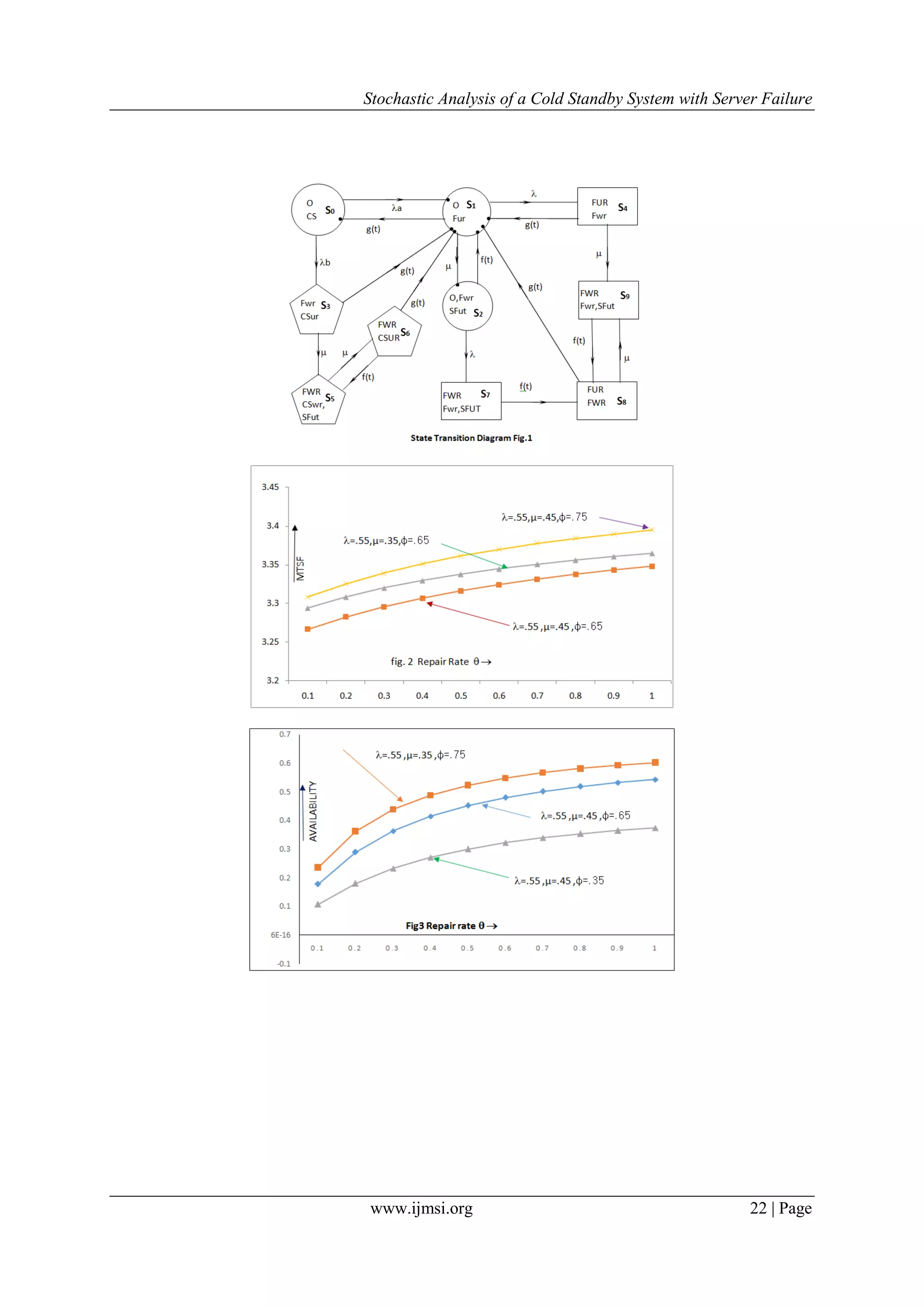
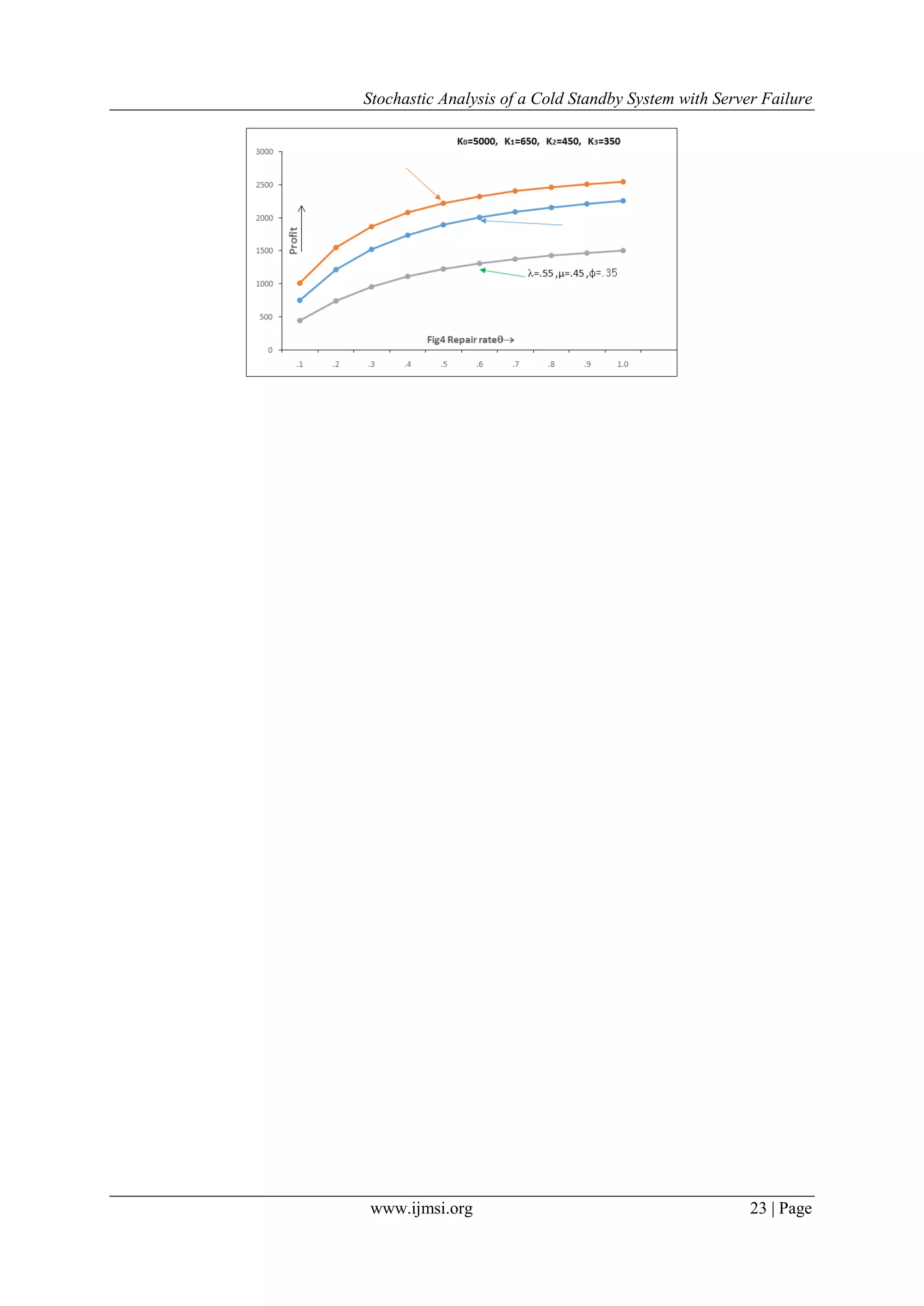
by assigning particular values to various parameters and costs shown in figure 2-4.
Fig.2. The pictorial behavior of MTSF w.r.t repair rate explains that the increase rate in treatment causes
increment in MTSF also. It also shows that as the rate of server failure decreases, MTSF increases
Fig.3 expose Availability Vs Repair rate having increasing pattern. The curve indicates that as the rate of
treatment decreases, graph declines having still increasing pattern .But as the rate of server failure decrease and
treatment rate is increased, slop rises rapidly.
Fig.4 demonstrate Profit Vs Repair rate having same nature as the case of availability. Hence the system
performance can be increased by providing service facility of lower failure rate and by increasing treatment rate.
It is analyzed that mean time to system failure(MTSF) , Availability , profit function go on increasing w.r.t.
Repair rate .This study winds up that the system performance can be enriched by decreasing server failure rate ,
increasing repair rate and treatment rate .The applied approach of this undertaken model has its utility in
variegated industrial and other setups.
About the Authors:
M.S.Barak is presently working as a Assistant Professor, Department of Mathematics, Indira Gandhi Univeristy,
Meerpur, Rewari, India. He has been actively engaged in the research area of Reliability as well as theoretical
seismology for many years. He has been visited many academic institutions working in India and abroad to
present his research work at the conferences/ symposium of international repute. He is a member of various
academic/professional bodies
Dhiraj is presently working as a Assistant professor in Mathematics, Govt. college for women Rewari and
research scholar in Department of Mathematics, Indira Gandhi University, Meerpur, Rewari. She has the
research interest in the area of Reliability modeling of repairable systems.
REFERENCES
[1] Nakagawa T. Osaki , ”Stochastic behavior of a two-unit Priority Standby Redundant system with repair”, Microelectronics
Reliability.14(3),309-313(1975) .
[2] Gopalan M.N. and Nagarwalla H.E.(1985) .Cost-benefit analysis of a one server Two unit Cold standby System with Repair and
Age Replacement . Microelectronics Reliability. Vol.25 , pg. 977-990 .
[3] Singh S.K., Sriniwas B,” Stochastic analysis of a two unit cold standby system with preparation time for repair”Microelectronics
Reliability 27(1) 55-60(1987)
[4] Bhardwaj , R.K.Singh ,Ravinder “Semi Markov Approach for Asymptotic Performance Analysis of a Standby system with server
failure “.International journal of computer Applications 98(3) , 9-14(2014) .
[5] Bhardwaj, R. K . Singh , Ravinder “Steady state Behavior of a cold-standby system with Server failure and Arbitrary Repair,
Replacement and treatment ”.International journal of Applied Engineering Research 9(24),26563-26578(2014) .
[6] Osaki , S. Nakagawa T,” on A two-unit standby redundant system with Standby failure ”.Operation Research, 19(2),510-
523(1971).
[7] Subramanian R. Venkatakrishan , K.S.Kistner , K.P., Reliability of a repairability system with standby failure , Operation
Research24(1) ,169-176(1976) .
[8] S.C. Malik, R.K.Bharwaj , Komaldeep Kaur, “Performance Analysis of a Stochastic System with Standby Failure and
Maintenance”, International journal of computer Applications Vol.125-No.1(2015).
[9] S.C.Aggrawal ,Mamta Sahani &Shakha Bansal , Reliability Characteristics of a cold-standby Redundant system, LJRRAS 3(2) ,
2010 .
[10] S.C.Malik and Sudesh K.Barak , Profit Analysis of a System Reliability Model Under Preventing Maintenance and Repair ,
International Journal of Reliability, Quality and Safety Engineering Vol.20, No. 6 (2013) 1350022](https://image.slidesharecdn.com/c0406018022-160912072118/75/Stochastic-Analysis-of-a-Cold-Standby-System-with-Server-Failure-4-2048.jpg)