1Precarious Work in the
Gap Global Value Chain
Asia Floor Wage Alliance (AFWA) was officially
formed in 2006 and includes up to 71
organizations, which constitute a network from
17 countries across Asia, Europe and North
America to represent garment industry trade
unions, NGOs, consumer groups and research
institutes.
The Center for Alliance of Labor & Human
Rights (CENTRAL) is a local Cambodian NGO.
The organization empowers Cambodian working
people to demand transparent and accountable
governance for labor and human rights through
legal aid and other appropriate means.
Sedane Labour Resource Centre/Lembaga
Informasi Perburuhan Sedane (LIPS) is a non
governmental organization in labor studies. LIPS
works to strengthen the labor movement by
documenting knowledge through participatory
research and developing methods of popular
education in labor groups and unions.
SLD is a Delhi-based labour rights organisation,
that believes in equitable development through
social and economic well-being of labour,
migrants, and women workers; and through
cultural renewal among disenfranchised people.
SLD is a national organisation that originated
with a focus on the National Capital Region and
works with partners in Uttar Pradesh, Bihar,
Jharkhand, and Kerala.
The National Centre for Development
Cooperation, or CNCD-11.11.11, includes
nearly 80 development NGOs, trade unions and
associations engaged in continuing education
for international solidarity in the French
Community and Community of Belgium.
The United Workers Congress (UWC) is a
strategic alliance of workers that are either
by law or by practice excluded from the right
to organize in the United States. This national
network represents a base of workers, and also
regional networks and individual organizations
in industries where there is no national
network.
2 3
4 5
EXECUTIVE SUMMARY
In March 2014, U.S. President Barack Obama
made headlines by ceremoniously shopping
at a Gap store on East 42nd and Third Avenue.
Obama’s decision to visit the store followed an
announcement by Gap that they would raise
minimum wages for U.S. workers to USD 10 per
hour by 2015. Gap’s decision to raise minimum
hourly wages broke with U.S. retailers and
business groups that urged lawmakers to maintain
the federal minimum wage at USD 7.25 an hour
(Banjo 2014).
Gap—the parent company of Gap, Banana
Republic and Old Navy—has committed to raising
wages for U.S. workers but this commitment
does not extend to establishing living wages for
garment workers in overseas production hubs.
Although Gap has also publicly announced a
commitment to set humane working conditions,
just months before Gap announced an increase
in wages for U.S. workers, the Institute for Global
Labour and Human Rights exposed sweatshop
conditions in Gap supplier factory run by the
Ha-Meem Group in Bangladesh—where together
Gap and Old Navy account for 70% of production
(Boyer 2014). The 3,750-worker Next Collections
factory in Ashulia, Bangladesh, on the outskirts
of Dhaka, routinely forced workers into 14-17
hour shifts, seven days a week amounting to
workweeks of over 100 hours. Workers were paid
poverty level wages: just USD .20 - .24 per hour.
Workers in the Next Collections factory reported
that physical punishment and illegal termination—
especially of pregnant women who were also
denied maternity benefits—were normal
occurrences (IGLHR 2013).
Working conditions like those reported in Next
Collections are far from isolated incidents. Gap
lags far behind other brands in their commitments
to decent work and safe workplaces. For instance,
more than 200 brands signed the legally binding
Accord on Fire and Building Safety following the
collapse of the Rana Plaza Building in Bangladesh,
killing 1,127 workers. Instead of signing the
Accord, Gap together with Walmart, founded the
Alliance for Bangladesh Worker Safety. Unlike
the legally binding Accord on Fire and Building
Safety, the Alliance for Bangladesh Worker Safety
is a voluntary measure rather than a contractual
commitment. To date, Gap has refused to make
a contractual commitment to work with their
suppliers and local and international trade unions
to ensure that repairs are made and workers have
the right to refuse dangerous work.
Due in no small part to this egregious refusal to
join the Accord, in 2014 Gap earned the Public
Eye Jury Award from the Berne Declaration and
Greenpeace Switzerland—an award that aims
to shine a light on the current and most serious
cases of human rights violations and disregard for
environmental protection and sustainability (CCC
2014a).
Gap currently operates 3,300 stores and employs
more than 150,000 employees across their
global production network. (ILO 2014; Donaldson
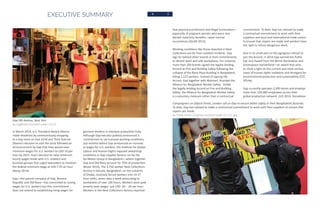
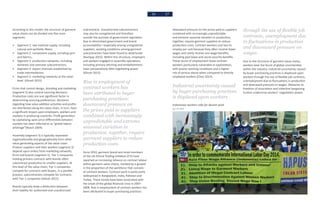
Gap 5th Avenue, New York
by Ingfbruno licensed under CC3.0
Campaigners on Oxford Street, London call on Gap to ensure better safety in their Bangladeshi factories.
To date, Gap has refused to make a contractual commitment to work with their suppliers to ensure that
repairs are made.
by Trade Union Congress licensed under CC 2.0. jpg
6 7
2016a). Brands like Gap wield the potential to
transform working conditions through their
supply chains. Gap has not, however, committed
to ensuring a living wage for workers beyond U.S.
employees and fails to disclose their suppliers—
creating significant barriers to allowing labour
rights groups, the government and other parties
to monitor labour rights in their direct supplier
and subcontractor factories. Rather than
upholding rights and work for garment workers
overseas, Gap maintains high pressure sourcing
models within the garment global production
network that create overwhelming incentives for
factories to reduce costs and speed production by
ignoring labour standards.
In recent years, the status of Gap commitments
to human rights at work has been the subject
of numerous studies by labour unions, human
rights organizations and their allies—ranging
from Human Rights Watch to the Institute for
Global Labour and Human Rights. In the lead up
to the 105th Session of the International Labour
Conference, focused for the first time on decent
work in global supply chains, this report revisits
the status of Gap’s commitments to decent work
through the lens of rights at work as they are
protected under International Labour Organization
(ILO) conventions and other instruments.
Shedding light on the gaps in implementation of
Gap commitments, violations of international
labour standards and challenges Gap may face
in upholding commitments to decent work,
this report contributes new research collected
through interviews with 150 workers in India
and Indonesia engaged in Gap supply chains.
These recent findings, collected between August
and October 2015, are situated in context of
both previous studies on Gap supply chains in
Cambodia, India and Indonesia and the broader
context of the global production network.
Section one provides a brief overview of global
production networks in general and the garment
global production network in particular. It
outlines key shifts in employment relationships
as production processes evolve to include several
companies across multiple countries. This section
also traces the concentration and distribution of
control over production processes across various
actors in the garment global production network.
Section two reviews Gap public commitments to
promoting decent work in their supply chains,
including through the Gap Code of Conduct and
partnership programs. Where possible, it includes
discussions and research on the efficacy of these
initiatives to date.
Section three provides a brief overview of the
market share of Asian garment value chains and
more focused country profiles on the Cambodian,
Indian and Indonesian garment industries. These
sections aim to contextualize empirical findings on
working conditions presented in the final section
of the report.
Section four discusses, in detail, the intensive
labour exploitation and abuse faced by workers
in Gap supply chains in Cambodia, India and
Indonesia. Recent empirical findings are
supplemented with evidence of rights violations
drawn from existing studies. In this section the
human rights violations and consequences of
precarious work in the Gap supply chain are
articulated thematically in order to surface the
pattern of rights violations across Cambodia, India
and Indonesia.
Recommendations
for the ILO at the
International Labour
Conference, 2016
The ILO—the only global
tripartite institution—has a
unique role to play in setting
standards for all of the actors
that impact fundamental
principles and rights at work.
As detailed in this report on the garment global
production network (GPN), due to the scale
of global trade accounted for by Global Value
Chains (GVCs) there is an urgent need for global
mechanisms to monitor and regulate GVCs
and GPNs. The ILO—the only global tripartite
institution—has a unique role to play in setting
standards for all of the actors that impact
fundamental principles and rights at work.
Transnational Corporations (TNCs) and their
suppliers have a duty to obey national laws and
respect international standards—especially those
pertaining to realization of the fundamental
principles and rights at work. A number of
ILO core labor standards, such as the Forced
Labour Convention, 1930 (No. 29), Protocol
to the Forced Labour Convention, 2014 and
accompanying Recommendation, already protect
workers in value chains. However, as this report
details, changes in the modern workplace and
globalization of value chains has opened up new
gaps in the protection of fundamental principles
and rights at work. In addition to clarifying the
application of existing standards in global value
chains, the ILO should set new standards and
enforcement mechanisms and encourage national
governments to do the same.
The ILO Tripartite declaration of principles
concerning multinational enterprises and social
policy (MNE Declaration), 2006 provides a
good starting point. However, within the MNE
Declaration, MNE refers only to subsidiaries or
franchises. Accordingly, GVCs and GPNs in their
current form are not covered by this Declaration.
The need of the hour is for the ILO to clarify and
update its standards and mechanisms to protect
workers employed by transnational corporations
(TNCs) across vast GPNs.
The following recommendations emerge from
our experience promoting rights at work in global
value chains.
1. Given the well-documented and rampant
exploitation of workers and resources by MNEs
operating through GVCs, and noting the limits on
regulation under national legal regimes, the ILO
should move towards a binding legal convention
regulating GVCs.
1.1. Standards under this convention must
be at least as effective and comprehensive
as the UN Guiding Principle on Business and
Human Rights and existing OECD mechanisms,
including the 2011 OECD Guidelines for
Multinational Enterprises.
1.2. The Convention should include the
following components, among others:
1.2.1. Imposition of liability and sustainable
contracting, capitalization and/or other
requirements on lead firms to ensure
accountability throughout the GVC.
1.2.2. Establishment of a Global Labour
Inspectorate with monitoring and
enforcement powers.
1.2.3. Publicly accessible transparency and
8 9
traceability provisions.
1.2.4. Specific provisions that address the
special vulnerability of migrant workers in
GVCs.
1.2.5. Specific provisions that address the
special vulnerability of women workers in
GVCs.
1.2.6. Limits on the use of temporary,
outsourced, self-employed, or other forms
of contract labor that limit employer
liability for worker protections.
2. Pursue a Recommendation on human rights
due diligence that takes into account and builds
upon existing due diligence provisions that are
evolving under the United Nations Guiding
Principles on Business and Human Rights and
the 2011 OECD Guidelines for Multinational
Enterprises.
3. Take the following complementary measures
to protect workers employed in global value
chains:
3.1. Recognize the right to living wage as a
human right and establish living wage criteria
and mechanisms.
3.2. Promote sector-based and transnational
collective bargaining and urge countries to
remove national legal barriers to these forms of
collective action.
3.3. Expand work towards the elimination
of forced labour, including promoting
ratification and implementation of the Forced
Labour Convention, 1930 (No. 29), Protocol
to the Forced Labour Convention 1930 and
accompanying Recommendation, 2014.
3.4. Continue programs to ensure social
protection, fair wages and health and safety at
every level of GVCs.
4. Convene research to inform ILO global supply
chain programming, including:
4.1. Research on adverse impacts of TNC
purchasing practices upon
4.1.1. Core labour standards for all
categories of workers across value chains.
4.1.2. Wages and benefits for all categories
of value chain workers. This research should
aim to satisfy basic needs of workers and
their families.
4.1.3. Access to fundamental rights to food,
housing, and education for all categories of
value chain workers and their families.
4.2. Research into the range of global actors
that may have leverage over GVCs including
investors, hedge funds, pension funds and GVC
networks that define industry standards such as
Free on Board (FOB) prices.
4.3.  Research into the types of technical
advice needed by OECD government
participants taking a multi-stakeholder
approach to address risks of adverse impacts
associated with products.
4.4. Research into mechanisms deployed
by authoritative actors within GVCs that
contribute to violations of fundamental
principles and rights at work, including but not
limited to attacks on freedom of association,
collective bargaining, forced overtime, wage
theft and forced labour.
4.5. Since women represent the greatest
majority of garment workers, the situation
of women should be urgently included in
monitoring programmes to assess the spectrum
of their clinical, social and personal risks.
4.6. Require an urgent, epidemiological study
into deaths and disabilities resulting from
conditions of work and life of garment workers.
This information should be made available
publicly and to international agencies.
5. Organize a Tripartite Conference on the
adverse impact of contracting and purchasing
practices upon migrant workers rights. This
conference should focus on:
5.1. Protection of migrant rights as conferred
under the UN International Convention on the
Protection of the Rights of all Migrant Workers
and Members of their Families.
5.2. The intersection of migrant rights and ILO
initiatives to promote Decent Work in Global
Supply Chains.
10 11 ABBREVIATIONS AND ACRONYMS
AFWA
AFWA-C
AFWA-I
CCAWDU
CCC
CENTRAL
GMAC
HRW
ILC
ILO
ILRF
MLVT
NCEUS
NCR
SLD
TATA
TCLF
USAS
WRC
Asia Floor Wage Alliance
Asia Floor Wage Cambodia
Asia Floor Wage Indonesia
Coalition of Cambodian Apparel Workers
Democratic Union
Clean Clothes Campaign
Center for Alliance of Labor and Human Rights
Garment Manufacturers Association in Cambodia
Human Rights Watch
International Labour Conference
International Labour Organization
International Labour Rights Forum
Ministry of Labour and Vocational Training
National Commission on Enterprises in the
Unorganized Sector
National Capital Region
Society for Labour and Development
Textiles and Apparel Trade Agreement
Textile, Clothing, Leather and Footwear
United Students Against Sweatshops
Worker Rights Consortium
ACKNOWLEDGMENTS
FIGURES
Figure 1: 	 Basic needs included in Asia Floor Wage calculations
Figure 2: 	 Asia Floor Wage calculations consider financial dependents and corresponding 			
		 responsibility of workers
Figure 3: 	 Progressive increase in Cambodian minimum wages, 2012-2016
TABLES
Table 1: 	 Overview of study respondents in Delhi-NCR, India
Table 2: 	 Overview of study respondents in Indonesia
Table 3: 	 2015 Asia Floor Wage Figure in local currencies
Table 4: 	 Asian countries’ share of global apparel exports, 2000-2013
Table 5: 	 Average minimum wage increase across sectors for selected provinces in Cambodia,
		 2010-2013
This report is one in of a series of reports,
entitled Workers Voices from the Global Supply
Chain: A Report to the ILO 2016. Investigation of
production conditions in Gap factories in India
and Indonesia was coordinated by the Society for
Labour and Development (SLD).
Desk research and writing was completed by
Ananya Basu and Shikha Silliman Bhattacharjee,
JD. Data analysis was conducted by Ananya Basu
and Vismay Basu. Primary data collection was
undertaken by Syarif Arifin, Lembaga Informasi
Perburuhan Sedane (LIPS), in Bogor Indonesia;
Vismay Basu, Delhi-NCR based Society for Labour
and Development (SLD) in India; and Joel Preston,
Center for Alliance of Labor & Human Rights
(CENTRAL) in Cambodia.
This report was edited by Anannya Bhattacharjee.
Recommendations for the ILO at the International
Labour Conference, 2016 were formulated by a
group of organizations, including the international
Asia Floor Wage Alliance, Jobs with Justice (USA),
National Guestworkers Alliance (USA), and Society
for Labour and Development (India).
We extend gratitude to the workers who shared
their time, experience and materials for the
purpose of this study.
Interviews with workers were conducted at worker housing colonies such as this one in Gurgaon, India.
Society for Labour and Development
12 13
Analysis of structured interviews aimed to identify
violations of rights at work protected under
International Labour Organization standards,
national laws and the Gap Code of Vendor
Conduct.
These findings have been situated in context
of the global garment production networks
and previous research on Gap supply chains.
Secondary sources included reports on production
conditions in the garment industry, academic
articles and newspaper reports.
India
In India, research included investigation
of working conditions in four Gap supplier
companies (Table 2). In order to protect the
identity of workers interviewed for this study, in
some cases the names of particular production
units have been withheld. In total, we interviewed
50 workers engaged in producing Gap garments
within the Delhi, National Capital Region (NCR).
Table 1: Overview of study respondents in Delhi-
NCR, India
Supplier No. of respondents
Orient Craft 20
Pearl Global 12
Pyoginam 8
Tets N Rai 10
Total: 50
Indonesia
In Indonesia, research included investigation of
working conditions in 4 Gap supplier companies
(Table 2). In order to protect the identity of
workers interviewed for this study, in some cases,
names of particular production units have been
withheld.
In total, we interviewed 100 workers engaged in
producing Gap garments within Indonesia and
surrounding areas.
Table 2: Overview of study respondents in
Indonesia
Supplier No. of respondents
Panca Prima 30
Putra Pilar Sejati 30
Sandrafine 20
Tainan Enterprises
Indonesia
20
Total: 100
METHODOLOGY
This report is based upon 150 structured
interviews conducted between August and
October 2015 with garment workers in Phnom
Penh, Cambodia; Bogor, Indonesia; and the Delhi,
National Capital Region (NCR), India. Structured
interviews were conducted by Sedane Labour
Resource Centre/Lembaga Informasi Perburuhan
Sedane (LIPS) in Indonesia and the Delhi-based
Society for Labour and Development (SLD) in
India. Investigative fieldwork was conducted
in Cambodia by Center for Alliance of Labor &
Human Rights (CENTRAL). This information was
contextualized through further interviews with
workers and trade union activists.
New empirical findings on working conditions
in Gap factories are based upon data collection
and analysis of working conditions in 8 Gap
supplier factories, including 4 supplier factories
in Indonesia and 4 supplier factories in the Delhi-
NCR, India.
Interviews lasted between 30 and 65 minutes. All
worker interviews were conducted in person with
full consent from workers. Interviews took place in
workers’ residences, after working hours or during
time off. In order to protect the identity of workers
who participated in this study, all individual names
have been changed. To ensure that workers
cannot be identified based upon identifying case
information, factories are referenced by company
name but in some cases locations of particular
production units have been removed. In India,
interviews were conducted in Hindi. In Indonesia,
interviews were conducted in Bahasa.
Documenting rights violations in Gap factories is particularly challenging because Gap refuses to disclose
basic information about its suppliers.
Asia Floor Wage Alliance
14 15
Part 1Global garment production
This section aims to situate new empirical findings
on working conditions in Gap factories in India,
Indonesia and Cambodia within the broader
context of global production networks in general
and the garment global production network
in particular. This basic overview outlines key
shifts in employment relationships as production
processes evolve to include several companies
across multiple countries. It also identifies trends
in concentration and distribution of control over
production processes across various actors in the
garment global production network.
Global production
networks
The Global Production Network (GPN) is a
term that describes contemporary production
systems, characterized by production processes
that involve several companies across multiple
countries. Companies linked through GPNs
are related through various legal forms, with
exchanges between firms structured so that
transnational corporations (TNCs) do not legally
own overseas subsidiaries or franchisees but
only outsource production to them. The UNCTAD
World Investment Report 2013 notes the structure
and prevalence of this mode of production:
Today’s global economy is characterized
by global value chains (GVCs), in which
intermediate goods and services are traded
in fragmented and internationally dispersed
production processes. GVCs are typically
coordinated by TNCs, with cross-border trade
of inputs and outputs taking place within their
networks of affiliates, contractual partners and
arm’s-length suppliers. TNC-coordinated GVCs
account for some 80 per cent of global trade.
(UNCTAD 2013)
TNC-coordinated GVCs
account for some 80 percent
of global trade.
As described by UNCTAD, GPNs shift market
relationships between firms from trade
relationships to quasi-production relationships
without the risks of ownership. Within this model,
TNCs drive coordinated production of goods while
disbursing risk associated with market fluctuations
across global value chains.
Garment global
production networks
As described by the International Labour
Organization (ILO), the Textile, Clothing,
Leather and Footwear (TCLF) is characterized
by geographically dispersed production and
rapid market-driven changes (ILO 2016). Brands
engage in high value market research, design,
sales, marketing and financial services. They
typically outsource garment production to Tier
1 companies. Tier 1 companies may, in turn,
subcontract some or all of the garment production
process to manufacturing companies known as
suppliers. This production structure allows brands
and retailers to drive coordinated production
of goods by capitalizing upon new technology,
relaxed regulatory frameworks and a supply of
low wage labour in developing countries (Ghosh
2015). While brands and retailers do not carry out
production, they drive sourcing and production
patterns overseas. This production model has
been characterized as a buyer-driven value chain
(Barria 2014).
Indonesian workers rally for decent work
by AFWA
16 17
through the use of flexible job
contracts, unemployment due
to fluctuations in production
and downward pressure on
wages.
Due to the structure of garment value chains,
workers bear the brunt of global uncertainties
within the industry. Industrial uncertainty caused
by buyer purchasing practices is displaced upon
workers through the use of flexible job contracts,
unemployment due to fluctuations in production
and downward pressure on wages. Obstacles to
freedom of association and collective bargaining
further undermine workers’ negotiation power.
According to this model, the structure of garment
value chains can be divided into five main
segments:
•	 Segment 1: raw material supply, including
natural and synthetic fibers;
•	 Segment 2: component supply, including yarn
and fabrics;
•	 Segment 3: production networks, including
domestic and overseas subcontractors;
•	 Segment 4: export channels established by
trade intermediaries;
•	 Segment 5: marketing networks at the retail
level. (Ghosh 2015)
Firms that control design, branding and marketing
(segment 5) also control sourcing decisions.
Production costs are one significant factor in
determining sourcing preferences. Decisions
regarding how value addition activities and profits
are distributed along the value chain, in turn, have
a significant impact upon employers, workers and
markets in producing countries. Profit generation
by capitalizing upon price differentials between
markets has been referred to as “global labour
arbitrage”(Roach 2004).
Assembly (segment 3) is typically separated
organizationally and geographically from other
value generating aspects of the value chain.
Product suppliers and their workers (segment 3)
depend upon orders from marketing networks,
firms and brands (segment 5). Tier 1 companies
holding primary contracts with brands often
subcontract production to smaller suppliers. At
this level of the value chain, Tier 1 companies
compete for contracts with buyers. In a parallel
process, subcontractors compete for contracts
with Tier 1 companies (Ghosh 2015).
Brands typically draw a distinction between
their liability for authorized and unauthorized
subcontracts. Unauthorized subcontractors
may also be unregistered and therefore
outside the purview of government regulation.
Due to diminished government and brand
accountability—especially among unregistered
suppliers, working conditions among garment
subcontractors have been found to deteriorate
(Kashyap 2015). Within this structure, employers
and workers engaged in assembly operations,
including primary stitching and embellishment,
have comparatively little negotiating power
(Ghosh 2015).
Rise in employment of
contract workers has
been attributed to buyer
purchasing practices:
downward pressure on
the prices paid to suppliers
combined with increasingly
unpredictable and extreme
seasonal variation in
production, together, require
garment suppliers to reduce
production costs.
Since 2010, garment brand and retail members
of the UK Ethical Trading Initiative (ETI) have
reported an increasing reliance on contract labour
within garment value chains, marked by a growth
in the proportion of the workforce that consists
of contract workers. Contract work is particularly
widespread in Bangladesh, India, Pakistan and
Turkey. These trends have been associated with
the onset of the global financial crisis in 2007-
2008. Rise in employment of contract workers has
been attributed to buyer purchasing practices:
downward pressure on the prices paid to suppliers
combined with increasingly unpredictable
and extreme seasonal variation in production,
together, require garment suppliers to reduce
production costs. Contract workers cost less to
employ per unit because they often receive lower
wages and rarely receive non-wage benefits,
including paid leave and social security benefits.
These terms of employment leave contract
workers particularly vulnerable to exploitation,
with poorer working conditions and a higher
risk of serious abuse when compared to directly
employed workers (Chan 2013).
Industrial uncertainty caused
by buyer purchasing practices
is displaced upon workers
18 19
Part 2Overview of Gap initiatives to promote
decent work
Brand and retail codes of conduct establishing
social and environmental principles have
developed in response to anti-sweatshop and
consumer-driven accountability movements in
Europe and the United States. In some cases,
these codes of conduct have been developed
through multi-stakeholder initiatives, including
corporate, non-governmental organization, trade
union, state and academic representatives (Barria
2014).
Gap has committed to several initiatives for
improving the lives of employees worldwide. Their
public commitment to promoting decent work
has been announced in the Gap Code of Conduct,
Gap Human Rights Policy, Alliance for Bangladesh
Worker Safety and partnerships with the ILO
and other industry stakeholders. While codes of
conduct and other measures described in this
report constitute declarations of intent they do
not generate binding legal obligations.
This section reviews Gap’s public commitments
to promoting decent work in their supply chains.
Where possible, it includes discussions and
research on the efficacy of these initiatives to
date.
GAP Principles and
Standards of Work
Our team talks extensively with workers at
factories where our clothes are made, and we
follow up on the issues we find. We focus much
of our time on complex issues such as tackling
the use of unauthorized subcontracting, fire
and safety issues inside factories, freedom of
association and excessive overtime. –Gap 2016
Gap outlines its principles and standards of work
in two documents, the Gap Human Rights Policy, a
broad framework containing principles governing
Gap work spaces and employment relationships;
and the Code of Vendor Conduct, that establishes
standards that supplier factories need to meet
in order to work with Gap. According to the Gap
Human Rights Policy, these principles are binding
for all direct employees and global suppliers.
The Gap Code of Vendor Conduct details model
guideline for business with suppliers across
continents. As a rule, Gap claims to engage
in business with only suppliers that are in
compliance with all guidelines outlined in the
document. Suppliers are also explicitly required
to invest in building monitoring systems that
facilitate assessment of sourcing factories. The
document also spells out requirements for decent
working conditions that must be followed by
suppliers and applied to all workers, including
those hired on contracts. Further analysis of the
Code of Conduct and enforcement of the same
informs the section on rights violation.
Gap support for
California Transparency
in Supply Chains Act
In January 2012, Gap supported the California
Transparency in Supply Chains Act. The Act seeks
to abolish child, bonded labour and human
trafficking in global supply chains. It requires
companies to publicly disclose the steps they are
taking to identify and eradicate forced labour in
their supply chains.
To uphold the clauses in the Act, Gap has publicly
declared stringent monitoring mechanisms,
20 21
including periodic social audits and review
processes for each of their sourcing factories
aimed at ensuring the absence of trafficking and
bonded labour.
Gap has outlined several steps designed to
protect contract workers. These include locally-
hired Social Responsibility Specialists tasked
with monitoring Gap commitments to decent
work for contract workers. According to Gap
reports accessed in 2016, in 2012, the team
monitored more than 923 active, full-year
factories, allegedly through announced and
unannounced audits—96.4 percent of the active,
full-year garment factories produce Gap Inc.
branded apparel. Gap also claims to require
that vendors certify that materials incorporated
into the product comply with laws regarding
slavery and human trafficking in the country of
business. Finally, Gap claims to provide training to
employees and management with responsibility
for supply chain management (Gap 2016a).
This approach has significant shortcomings:
•	 Monitoring year-round factories neither
accounts for working conditions for contract
workers in factories that do not produce year
round nor for production units that receive
subcontracts from Gap full time factories.
Given the structure of the garment global
value chain, these types of production
processes are both highly significant and also
the site of the most significant rights abuses.
•	 Based upon a 2016 search, no monitoring
reports have been released for 2013, 2014 or
2015.
•	 Monitoring is conducted by an internal set of
Social Responsibility Specialists hired by Gap.
This monitoring structure does not produce
external evaluations.
•	 Monitoring reports are impossible to verify
since Gap does not disclose factory locations
or particular violations disaggregated by
factory.
Wage standards
In a survey conducted by the Clean Clothes
Campaign, Gap declared that their conception of
a living wage varies from the standard definition
used globally.
We remain committed to the principle that
wages for a standard working week should
meet the basic needs of factory workers and
provide them with discretionary income. Our
approach to wages is aligned with international
legal standards set by the ILO and in accordance
with the ETI’s Base Code, as well as with SAI’s
principles (CCC 2014).
Gap has not, however, released a formula or
methodology for determining living wage rates.
Filling this conceptual Gap, the Asia Floor Wage
Alliance (AFWA), a global coalition of trade unions,
workers’ rights and human rights organizations,
provides a detailed formula for calculating living
wages across national contexts. The AFWA
definition of a living wage specifies that living
wage calculations must include support for all
family members, basic nutritional needs of a
worker and other basic needs, including housing,
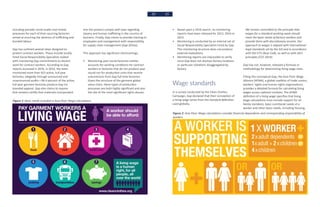
Figure 1: Basic needs included in Asia Floor Wage calculations
Figure 2: Asia Floor Wage calculations consider financial dependents and corresponding responsibility of
workers
22 23
healthcare, education and some basic savings.
The Asia Floor Wage Alliance bases their
calculations on the following considerations:
•	 A worker needs to support themselves
and two other consumption units. [One
consumption unit supports either one adult or
two children.] (Figure 2)
•	 An adult requires 3000 calories a day in order
to carry out physically demanding work in
good health.
•	 Within Asia, food costs amount for half of a
worker’s monthly expenditure.
Based upon these assumptions, the Asia Floor
Wage is calculated in Purchasing Power Parity $
(PPP$). This fictitious World Bank currency is built
upon consumption of goods and services, allowing
standard of living between countries to be
compared regardless of the national currency. In
order to calculate annual Asia Floor Wage figures,
the AFWA carries out regular and ongoing food
basket research (AFWA 2016a).
Accounting for high inflation, Asia Floor Wage
figures are calculated annually. As explained by
AFWA Coordinator, Anannya Bhattacharjee:
The gap between the minimum wage and the
cost of living has widened in recent years. High
inflation has sent the cost of living soaring in
many Asian countries, but starting salaries
remain unchanged—often for several years.
(Pasariello 2013)
AFW annual PPP$ wage figures are therefore
calculated annually based upon up to date
national food basket research. For instance,
the 2015 Asia Floor Wage figure is PPP$ 1021.
These wage figures are then converted into local
currency (Table 3)(AFWA 2016b).
Table 3: 2015 Asia Floor Wage Figure in local
currencies
Country Asia Floor Wage in
local currency
Cambodia 1,630,045 Riel
India 18,727 Rupees (INR)
Indonesia 4,684,570 Rupiah
Sri Lanka 48,608 Rupees (SLR)
The AFW wage calculation method provides an
instructive model for Gap and other brands in
setting living wages that correspond to workers
needs and consider rising costs of living.
Initiatives on working
conditions
Gap has partnered with Verite, a U.S. based non-
governmental organization with the articulated
objective of improving working conditions. This
initiative claims to measure and improve how
much workers feel valued and engaged at work.
The collaboration allegedly aims to focus on
workers and their voices in order to improve their
experience of work.
With similar claims to attending to workers’
needs, in 2011, Gap Inc. created a Brand
Integration and Vendor Performance project team.
Gap declared that the efforts would be directed
towards gathering data on vendors for effecting
change at the level of management in the supplier
factories. Stated initiatives include:
•	 meeting with leaders in the Gap Inc. Sourcing
Department to examine any issues related to
working conditions that may have stemmed
from decisions at headquarters;
•	 meeting regularly with strategic and
low-performing vendors to assess their
performance against Gap’s Code of Vendor
Conduct and discuss how the timing and
planning of Gap’s orders are affecting their
workers;
•	 training all new hires in inventory
management, merchandising, production, and
sourcing on the importance of responsible
purchasing practices; and
•	 highlighting case studies and tools to ensure
that factory orders are made with a full
understanding of their potential impact on
workers.
The espoused aims of these initiaves, however,
are in stark contrast to Gap responses to worker-
led initiaitves to engage the brand in improving
working conditions. For instance, Gap was invited
to engage with workers at the People’s Tribunal on
Living Wage as a fundmantal right of Sri Lankan
garment workers, held from March 17-28, 2011 in
Colombo; Cambodian garment workers, held from
February 5-8, 2012 in Phnom Penh, Cambodia;
Indian garment workers, held from November
22-25, 2012 in Bangalore; and Indonesian garment
workers, held from June 21-24, 2014 in Jakarta.
Gap denied invitations to engage with workers
at each of these tribunals, despite being notified
of persistent rights violations in their supplier
factories (Butler 2012; Barria 2014).
Garment workers in India protest against Gap for unfair labour practices.
Society for Labour and Development
24 25
Better Work
Programme
Gap first engaged with the ILO in 2001 at the start
of the Better Factories Cambodia programme.
This initiative led to the creation of the ILO Better
Work Programme in 2007, which Gap joined as
a partner. This partnership between the ILO and
the International Finance Corporation (IFC) seeks
to help governments, workers and companies
achieve compliance with the ILO’s core labor
standards as well as national labor laws.
In countries where Better Work programs are
established, Gap subscribes to Better Work
assessment reports and has stopped their own
monitoring. In 2011-12 Gap Inc. claims to have
collaborated with Better Work in Cambodia,
Haiti, Indonesia, Jordan, Lesotho, Nicaragua, and
Vietnam to monitor more than 90 factories.
The extent to which Gap engages with the Better
Work assessment module varies according to
countries. For instance all registered branded
apparel suppliers in Cambodia, Haiti, Jordan and
Lesotho are legally required to participate in the
Better Work program. However, in Vietnam, Better
Work monitored approximately 30 percent of
the factories sourced from over that time period
(2016b).
Better Work Programmes play an important role in
monitoring working conditions in export-oriented
factories, including by producing factory reports,
providing technical guidance and supporting
remediation of labour rights violations when
factories engage their services.
However, workers and labour rights activists
have voiced concerns about factory monitoring
methods, coverage and transparency. For
instance, Human Rights Watch revealed that in
Cambodia, workers reported being coached by
factory management and being unable to engage
with brand representatives, external monitors,
government officials or Better Factory Cambodia
(BFC) monitors. As one worker reported to Human
Rights Watch:
Before ILO comes to check, the factory arranges
everything. They reduce the quota for us so
there are fewer pieces on our desks. ILO came
in the afternoon and we all found out in the
morning they were coming. They told us to
take all the materials and hide it in the stock
room. We are told not to tell them the factory
makes us do overtime work for so long. They
also tell us that is [we] say anything we will lose
business.
Workers in Cambodia called for mechanisms to
report violations of rights at work to BFC monitors
off site wihtout fear of surveillance or retaliation
by management. Confirming this narrative, BFC
experts reported to Human Rights Watch that
their monitors were aware of factories coaching
workers and that they attempted to mitigate the
impact of coaching as much as possible. Labour
rights activists reported that the efficacy of BFC is
further undermined because factory inspection
reports are made available to managers and
brands but not to workers or unions without prior
factory authorization (Kashyap 2015).
Finally, since Better Work Programmes are limited
to monitoring and advisory services and lack
enforcement authority, labour rights activists
have critique the programme on the grounds that
lack of transparency and failure to release brand
names reduces brand accountability for rights
violations in their supply chains (Kashyap 2015).
Personal Advancement
& Career Enhancement
(P.A.C.E)
In 2014, Gap Inc. became the first Fortune 500
Company to announce that it pays female and
male employees equally for equal work around
the world. Currently women make up more than
70% of Gap Inc.’s worldwide employee base,
including in sourcing factories. Additionally,
women currently lead four out of five Gap Inc.
brands.
In order to meet articulated commitments to
gender equality, Gap initiated the Personal
Advancement and Career Enhancement
programme. The P.A.C.E programme aims to
secure skill enhancement for women employees.
According to Gap, this programme is currently
active in 7 countries and more than 25,000
women have participated in the program since
its inception in 2007. Gap Inc. has made a
commitment to scale and expand the program to
reach one million women by the end of 2020 (Gap
2016c).
According to a report by the International Center
for Research on Women (ICRW), conducted
by ICRW from 2009 - 2013 at six factory sites
where P.A.C.E. is implemented - two in India and
one each in Cambodia, Vietnam, Bangladesh
and China, P.A.C.E. is an effective, sustainable
and scalable model that yields high returns for
women, their families and the businesses where
they work (ICRW 2013). 
It is significant to note, however, that the number
of women reached by this programme represents
a tiny fraction of the number of women supply
chain workers employed by Gap worldwide.
For context, within the Gurgaon-Kapashera
production area of India’s Delhi-National Capital
Region (NCR) just one garment factory may
employ up to 7,000 workers. Put another way, this
programme in aggregate reaches approximately
the number of workers in four Gap supplier
factories.
Alliance for Bangladesh
Worker Safety
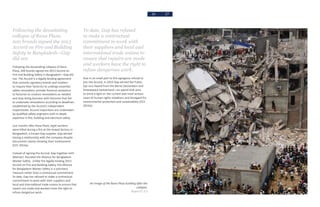
On April 24, 2013, the Rana Plaza, an eight-story
commercial building, collapsed in Savar sub-
district in the Greater Area of Dhaka, Bangladesh.
The Rana Plaza industrial factory fire that
killed 1,139 workers and injured 2,500 more is
considered the most serious fatal accident to have
occurred in a textile factory in modern history.
Thousands of garment workers and their unions
rally on the one-year anniversary of the Rana
Plaza collapse that killed more than 1,100
garment workers.
licensed by the Solidarity Center under CC 2.0
26 27
Following the devastating
collapse of Rana Plaza,
200 brands signed the 2013
Accord on Fire and Building
Safety in Bangladesh—Gap
did not.
Following the devastating collapse of Rana
Plaza, 200 brands signed the 2013 Accord on
Fire and Building Safety in Bangladesh—Gap did
not. The Accord is a legally-binding agreement
that commits signatory brands and retailers
to require their factories to undergo essential
safety renovation, provide financial assistance
to factories to conduct renovations as needed
and stop doing business with factories that fail
to undertake renovations according to deadlines
established by the Accord’s independent
inspectorate. Accord inspections are undertaken
by qualified safety engineers with in-depth
expertise in fire, building and electrical safety.
Just months after Rana Plaza, eight workers
were killed during a fire at the Aswad factory in
Bangladesh, a known Gap supplier. Gap denied
having a relationship with the company despite
documents clearly showing their involvement
(CCC 2014a).
Instead of signing the Accord, Gap together with
Walmart, founded the Alliance for Bangladesh
Worker Safety. Unlike the legally binding 2013
Accord on Fire and Building Safety, the Alliance
for Bangladesh Worker Safety is a voluntary
measure rather than a contractual commitment.
To date, Gap has refused to make a contractual
commitment to work with their suppliers and
local and international trade unions to ensure that
repairs are made and workers have the right to
refuse dangerous work.
To date, Gap has refused
to make a contractual
commitment to work with
their suppliers and local and
international trade unions to
ensure that repairs are made
and workers have the right to
refuse dangerous work.
Due in no small part to this egregious refusal to
join the Accord, in 2014 Gap earned the Public
Eye Jury Award from the Berne Declaration and
Greenpeace Switzerland—an award that aims
to shine a light on the current and most serious
cases of human rights violations and disregard fro
environmental protection and sustainability (CCC
2014a).
An image of the Rana Plaza building after the
collapse.
Rijans CC 2.0
2000 2003 2008 2013
TOTAL (in billion
US$)
197.64 233.23 363.87 460.27
China 18.25 22.32 33.09 38.55
Bangladesh 2.56 2.42 3.21 5.11
Hong Kong, China 12.25 9.93 7.67 4.77
Viet Nam 0.92 1.49 2.40 3.74
India 3.02 2.71 3.01 3.66
Indonesia 2.40 1.74 1.73 1.67
Cambodia 0.49 0.69 0.83 1.11
Malasia 1.14 0.88 1.00 1.00
Pakistan 1.08 1.16 1.07 0.99
Srilanka 1.42 1.08 0.94 0.98
Export Share of top
10 Asians
43.54 44.41 54.95 61.57
Export Value of top
10 Asians
86.06 103.59 199.94 283.38
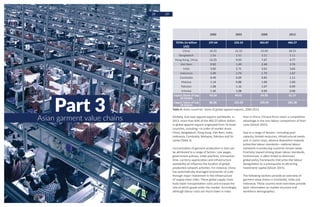
Table 4: Asian countries’ share of global apparel exports, 2000-2013
28 29
Part 3Asian garment value chains Globally, Asia tops apparel exports worldwide. In
2013, more than 60% of the 460.27 billion dollars
in global apparel exports originated from 10 Asian
countries, including—in order of market share:
China, Bangladesh, Hong Kong, Viet Nam, India,
Indonesia, Cambodia, Malaysia, Pakistan and Sri
Lanka (Table 3).
Concentration of garment production in Asia can
be attributed to a range of factors. Low wages,
government policies, trade practices, transaction
time, currency appreciation and infrastructure
availability all influence the location of global
production network activities. For instance, China
has systematically leveraged economies of scale
through major investment in the infrastructure
of supply-chain cities. These global supply chain
hubs lower transportation costs and increase the
rate at which goods enter the market. Accordingly,
although labour costs are much lower in India
than in China, Chinese firms retain a competitive
advantage in the non-labour components of their
costs (Ghosh 2015).
Due to a range of factors—including poor
capacity, limited resources, infrastructural needs
and, in some cases, adverse disposition towards
protective labour standards—national labour
standards in producing countries remain weak.
Proclivity toward driving down labour standards,
furthermore, is often linked to dominant
global policy frameworks that prescribe labour
deregulation as a prerequisite to attracting
investment capital (Ghosh 2015).
The following sections provide an overview of
garment value chains in Cambodia, India and
Indonesia. These country-level overviews provide
basic information on market structure and
workforce demographics.
Cambodia
Cambodia entered the export-oriented global
garment and textile industry in the 1990s with the
passage of the 1993 Constitution of the Kingdom
of Cambodia which established a free market in
Cambodia (CCC 2016a; CCHR 2014). Between
1995 and 2006, bilateral trade agreements with
the United States, the European Union and
Canada spurred growth in the garment industry.
With the exception of a downturn in 2008 during
the global economic crisis, the industry has show
consistent growth (Kashyap 2015). Between 1995
and 2014, the sector grew 200-fold (ILO 2015).
At the time of writing,
top brands sourcing from
Cambodia include H&M, GAP,
Levi Strauss & Co., Adidas
and Target (CCC 2016a).
Today, garment and textile exports are critical
to the Cambodian economy. In 2013, garments
accounted for 13% of the Cambodian GDP (CCC
2016a). Cambodian global exports amounted to
roughly USD 6.48 billion, of which garment and
textile exports accounted for USD 4.96 billon. By
2014, garment exports totaled USD 5.7 billion.
The US, EU, Canada and Japan are the largest
importers of Cambodian garments, textiles and
shoes (Kashyap 2015). At the time of writing, top
brands sourcing from Cambodia included H&M,
GAP, Levi Strauss & Co., Adidas and Target (CCC
2016a).
The Cambodian garment industry is largely
foreign-owned, with Cambodians owning
less than 10% of factories (Kashyap 2015). An
estimated 85% of garment factories located in
Cambodia are foreign controlled, predominantly
by investors from China, Hong Kong, Malaysia,
Singapore, South Korea and Taiwan (Kashyap
2015; CCC 2016). Foreign owned companies have
kept the production processes within Cambodia
limited. The majority of factories undertake “cut-
make-trim” production functions—manufacturing
clothes from imported textiles based upon designs
provided by international buyers. This exclusive
focus on producing garments circumscribes the
range of employment available to firms and
workers in Cambodia (Ghosh 2015).
Phnom Penh is a hub for garment factories.
However, garment production has expanded
to other areas, including the adjoining Kandal
province. In these areas, factories vary in size and
operations, ranging from export licensed factories
with up to 8,000 workers to small, unmarked
factories employing fewer than 100 workers.
These smaller factories largely fill subcontracts
for larger suppliers. Outsourcing of production
to smaller factories may be either authorized or
unauthorized by apparel brands (Kashyap 2015).
Women between the ages
of 18 and 35 dominate
the Cambodian garment
production sector, comprising
an estimated 90-95% of the
industry’s estimated 700,000
workers
Women between the ages of 18 and 35 dominate
the Cambodian garment production sector,
comprising an estimated 90-95% of the industry’s
estimated 700,000 workers (Barria 2014; Kashyap
2015). These numbers do not, however, include
women engaged in seasonal, home-based
garment work (Finster 2015; Kashyap 2015).
Cambodian garment workers
were found to intake an
average of 1598 calories
per day, around half the
recommended amount for
a woman working in an
industrial context
The garment industry has been a major source
of employment for young women from rural
areas who migrate for employment to garment
production hubs (McMullen 2013). In a February
30 31
Women dominate the Cambodian garment production sector, comprising an estimated 90-92% of the
industry’s 700,000 workers.
Cambodian garment workers, exact location undisclosed, by Asia Floor Wage Alliance.
2012 hearing before the Permanent People’s
Tribunal held in Phnom Penh Cambodia, Asia
Floor Wage Alliance-Cambodia (AFWA-C) reported
that these internal migrants work far from their
families and communities and are thereby cut off
from traditional support networks. Despite their
numerical majority within the garment sector,
they remain within low skill level employment and
rarely reach leadership positions in their unions
(Barria 2014).
Malnutrition is also prevalent among Cambodian
garment workers. Data gathered by tracking
monthly food purchases by 95 workers employed
in a range of garment factories in Cambodia,
compared with recommended amounts and
workers’ Body Mass Index (BMI), revealed that
workers were found to intake an average of 1598
calories per day, around half the recommended
amount for a woman working in an industrial
context (McMullen 2013).
Sexual harassment is a significant concern
for women workers but due to lack of legal
awareness, women rarely if ever seek access to
justice in cases of abuse (Barria 2014).
Labour protections
Article 36 of the 1993 Constitution of Cambodia
provides for basic labour rights, including the right
to freely chose employment, equal pay for equal
work, recognition of household work, the right
to obtain social security and other social benefits
and the right to form and to be members of trade
unions.
The Cambodian Labour Ministry is responsible
for establishing policy standards and engaging in
monitoring and compliance. The 1997 Cambodian
Labour Law governs all garment factories.
Irrespective of their size. Provisions of the 1997
law regulate working conditions in factories,
including protection against discrimination,
wages, overtime work, minimum age, pregnancy
entitlements, leave and occupational health and
safety standards. The Labour Ministry has also
issued model internal factory regulations. Despite
these protective measures, enforcement of these
standards is weak. This is due in part to inefficient
labour inspections, corruption and rapid
expansion of the number of factories in Cambodia
(Kashyap 2015).
A 2011 government regulation outlines a set of
permission and notifications for suppliers engaged
in subcontracting. The government also set up an
inter-ministerial commission comprising members
drawn from Labour, Commerce and Interior
Ministeries to trace unregistered subcontractor
factories and ensure labour compliance. Under
these guidelines, factories with export licenses
subcontracting to unregistered factories can face
temporary suspension of their export licenses and
repeat offenders may have their licenses evoked
(Kashyap 2015).
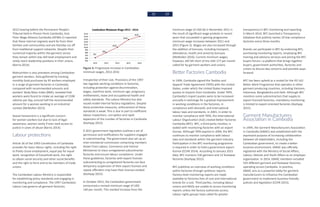
In October 2015, the Cambodian government
announced a revised minimum wage of USD
140 per month. This marked increase from the
minimum wage of USD 66 in November 2011 is
the result of significant wage protests in recent
years that succeeded in gaining progressive
minimum wage increases between 2011 and
2015 (Figure 3). Wages are also increased through
the addition of bonuses, including transport,
attendance, health and seniority bonuses
(McMullen 2016). Current minimum wages,
however, still fall short of the USD 177 per month
called for by garment workers and unions.
Better Factories Cambodia
In 1999, Cambodia signed the Textiles and
Apparel Trade Agreement (TATA) with the United
States, under which the United States imposed
quotas to imports from Cambodia. Under TATA,
Cambodia’s import quotes were to be increased
annually in exchange for a gradual improvement
in working conditions in the factories, in
compliance with domestic and international
labour laws and standards. In 2001, in order to
monitor compliance with TATA, the International
Labour Organization (ILO) created Better Factories
Cambodia (BFC). BFC, a third-party monitor, is
tasked with monitoring factories with an export
license. Although TATA expired in 2004, the BFC
continues to monitor compliance with labour
laws and standards within the garment industry.
Participation in the BFC monitoring programme
is required in order to hold a government export
license (CCHR 2014). According to January 2015
data, BFC monitors 536 garment and 12 footwear
factories (Kashyap 2015).
BFC publishes an overview of working conditions
within factories through synthesis reports.
Factory-level monitoring reports are made
available to factories free of cost and international
brands for a cost. Third parties, including labour
unions and NGOs are unable to access monitoring
reports unless the factory authorizes access.
Labour rights groups have called for greater
Figure 3: Progressive increase in Cambodian
minimum wages, 2012-2016
transparency in BFC monitoring and reporting.
In March 2014, BFC launched a Transparency
Database that publicly names 10 low compliance
factories every three months.
Brands can participate in BFC by endorsing BFC,
purchasing monitoring reports, employing BFC
training and advisory services and joining the BFC
buyers forum—a platform that brings together
buyers, government authorities, factories and
unions to discuss key concerns and possible ways
forward.
BFC has been upheld as a model for the IFC-ILO
Better Work Programme that operates in other
garment producing countries, including Vietnam,
Indonesia, Bangladesha and Haiti. Although BFC
monitors some subcontractors that supply to
export licensed factories, mandatory monitoring
is limited to export-oriented factories (Kashyap
2015).
Garment Manufacturers
Association in Cambodia
In 1999, the Garment Manufacturers Association
in Cambodia (GMAC) was established with the
expressed purpose of increasing collaboration
between all stakeholders, including the
Cambodian government, to create a better
business environment. GMAC was officially
registered with the Ministry of Social Affairs,
Labour, Veteran and Youth Affairs as an employer
organization. In 2014, GMAC members included
593 different garment and footwear factories
operating across Cambodia. In practice,
GMAC acts as a powerful lobby for garment
manufacturers to influence the Cambodian
government to implement business friendly
policies and legislation (CCHR 2015).
32 33
34 35
India
In 2014, the Indian textile and
garment industry employed
45 million workers.
Since the adoption of liberalized economic policies
during the economic reforms of 1991, the Indian
export garment industry has emerged as one
of the leading industrial segments in the Indian
economy. Export earnings of the apparel industry
alone were valued at USD 15.7 billon in 2014 and
combined textile and apparel export earnings
were valued at USD 40 billion. In 2013, textiles
and clothing contributed 4% to the gross domestic
product. In 2014, the Indian textile and garment
industry employed 45 million workers. Despite the
significant segment of Indian workers employed
in the garment industry, national level data
on economic and social profile of the garment
workforce remain alarmingly thin (Kane 2015).
Today, the major hubs of
garment manufacturing
are located in the industrial
clusters of the Delhi-National
Capital Region (NCR),
Bangalore in Karnataka,
Ludhiana in Punjab, Mumbai
in Maharashtra, Jaipur in
Rajasthan, Kolkata in West
Bengal and Tirupur in Tamil
Nadu (Roy 2015).
A majority of workers are migrants who migrate
to the industrial clusters from Andhra Pradesh,
Bihar, Jharkhand, Karnataka, Madhya Pradesh,
Maharashtra, Tamil Nadu, Uttar Pradesh and
West Bengal (ICN 2016). For instance, up to 80%
of garment workers in Bangalore are believed
to be migrant workers (Bain 2016). Despite the
staggering presence of low wage migrant workers
in the unorganized sector and their significant
economic contributions, there are large gaps in
government and civil society services to protect
their rights. For instance, India’s Inter-State
Migrant Workmen Act, 1979, aims to regulate
working conditions but is inadequate and
unimplemented, with no gender perspective (Roy
2015).
Modernization of the Indian textile industry has
been pursued vigorously since the mid-1980s with
the elimination of the licensing regime, quotas,
and quantitative restrictions in an attempt to
attract state-of-the-art machinery and technology,
know-how and skill sets from abroad. The massive
drive towards modernizing the textile industry
has gone hand-in-hand with firms resorting to
widespread informalization of the workforce.
Within the textile industry, this trend has been
most apparent in the ready-made garment
industry, which has become a leading outsourcing
destination for TNCs over the past two decades
(Sridhar 2014).
Approximately 60% of garment workers in India
are women, although workplace demographics
shift depending upon the region (Kane 2015). Long
working hours, hazardous working conditions,
lack of basic services such as first aid, drinking
water and sanitation affect women workers more
severely than men (Chen 2007). Women workers
are also particularly vulnerable to lewd comments,
sexist taunts and other forms of harassment
from supervisors and male employees. Extended
hours in the informal garment sector also
places women workers in extremely unsafe and
precarious scenarios. They must travel at night
through poorly lit areas where they face growing
incidences of rape, sexual assault and physical
violence. Women workers are also rarely given
sick leave and denied pay during maternity leave
in violation of the Maternity Benefit Act, 1961.
The vulnerability of unorganized sector women
garment workers is heightened since most are
from socially weaker or marginalized sections of
the society. Their ability to bargain collectively
is further undermined by high levels of labour
mobility within the garment sector.
Labour law changes
Proliferation of unorganized work within India’s
garment sector has led to a sharp increase in
the number of precarious workers engaged
in work that was once protected. Common
employment practices to transform protected
work into precarious work include use of short-
term contracts, casualization, use of labour supply
agencies and employment of foreign and domestic
migrant workers. These employment strategies
are also used to restrict collective bargaining
and reduce the bargaining power of unions. As
a result, jobs that were once associated with
regulated wages and labour standards governing
paid leave, maternity benefits, workplace safety,
retirement and other non-wage benefits are now
uncertain, unpredictable and risky for workers.
In 2015, the Indian government proposed a
series of labour laws changes that would further
weaken protection for workers in the garment
industry. The proposed 2015 Draft Code on Wages
dilutes protective standards, including minimum
wage standards, prohibitions on gender-based
discrimination in remuneration and protected
bonuses; opens the door to rights abuses,
including arbitrary and illegal wage deductions
and forced labour; and undermines accountability
by dismantling labour law inspection and
accountability mechanisms, restricting the
functioning of workers organizations and trade
unions and systematically undermining access to
justice (Bhattacharjee 2016).
The proposed 2015 Draft Code on Industrial
Relations undermines the rights of trade unions
by creating barriers to registration, imposing
restrictions on union governance structures,
reducing obstacles to canceling union registration
and prohibiting strikes and lockouts. Workers are
also increasingly vulnerable to retrenchment and
changes in service without prior notice. The 2015
Draft Code on Industrial Relations simultaneously
weakens accountability for upholding labour
standards by diluting government inspection
authority, removing existing arbitration forums
and appeals mechanisms and lowering incentives
to speedily resolve industrial disputes. Finally,
standing orders—establishing conditions and
regulations—no longer apply to establishments
with less than 100 workers. Standing orders,
36 37
moreover, can now be established without
workers’ input as previously required under the
principle act (Bhattacharjee 2016).
Indonesia
Encompassing production of fabric, apparel and
leather goods, the Indonesian textile and clothing
industry accounted for almost 2% of national
GDP and more than 7% of the total exports in
2013 (GBG 2016). More than 170 foreign brands
and companies are active in Indonesia’s garment
industry. In 2014, Indonesia accounted for 2.9%
of the world market for garment export, placing
Indonesia among the top ten garment supplier
companies globally (CCC 2015a). While the
industry is projected to remain slow through 2016,
forecasts predict that by 2030, textiles will emerge
as Indonesia’s largest export sector (GBG 2016).
Indonesia’s garment industry exemplifies regional
integration. Indonesia sources cotton, exports
yarn, imports fabrics and exports garments.
Indonesia is ranked 9th for global cotton
consumption but produces less than 2% of the
domestic cotton demand. This deficit is filled
through raw cotton imports from Brazil, the US
and Australia that is then spun in Indonesia and
either exported as yarn or further processed into
cloth and garments (GBG 2016). The principle
buyers of yarn from Indonesia are China and
Japan. Indonesia sources the majority of fabric
used in garment production from China and
South Korea (CCC 2015a). This integrated textile
manufacturing base is a draw for brands and
investors (GBG 2016).
In 2014, the Indonesian garment, footwear
and textile productions industries employed an
estimated 2 million workers (AFWI-2015). Due
to an economic slowdown in Indonesia in 2015,
many smaller garment producers closed down
or fired considerable portions of workers. In
September 2015, the jobs of around 36,000 textile
and garment employees were under threat from
weak sales—adding to the 45,000 workers who
had already been let go from factories.
90% of garment production is concentrated
on Java Island, with 55% in the western end of
Java Island. Central and eastern Java, however,
are increasingly significant production hubs.
The Ministry of Industry plans greater onshore
warehousing of cotton and is promoting the
Central Java province as a new textile hub, with
a dedicated industrial estate planned on its
northern coast. In order to promote the industry,
the Economic Ministry is overseeing policy
changes to promote special economic zones, new
tax holidays, lower nighttime electricity costs, and
incentives to buy new machinery (GBG 2016).
According to the Better Work Indonesia Report,
2013, garment, textile and footwear industries
have very low levels of compliance with ILO
core conventions and national laws. Better work
Indonesia also reports an industry-wide low level
of compliance with laws governing overtime pay,
provision of social security benefits and short-
term contractual employment relationships.
Labour law changes
On October 23, 2015, the Indonesian Government
issued Government Regulation No. 78 of 2015
(hereinafter “PP78”). PP78 is applicable for at least
40 million formal workers. It regulated a range of
wages, including minimum wage, overtime wage,
taxes and wage fines. While some articles codify
existing wage regulations—including overtime,
piece rate and casual worker remuneration; others
introduce a new wage system—including a new
minimum wage formulation and a new mandatory
wage scale structure.
At the same time, the Indonesian Government
issued a range of services and amenities for
investors and businesses. These include a Special
Desk for Textile and Footwear Investments
and Economic Policy Package Volume 6. This
economic package encourages the operation of
Special Economic Zones (SEZs) through income
tax reductions for 15-25 years, tax allowances for
6 years and compensation for losses for 5 to 10
years, freedom from paying import and export
taxes and authority to issue land use permits
and building rights. Within SEZs, labour unions
are restricted and only labour union forums are
allowed.
Labour unions in Indonesia have rejected PP78 on
the grounds that it facilitates flexible employment,
institutes a minimum wage formula that erases
workers’ needs and eliminates the opportunity
to negotiate before the Minimum Wage Council.
In protest, labour unions held demonstrations
and strikes in front of administrative centers and
industrial estates. They mobilized international
support, including through a petition signed
by one million people rejecting PP78. They
also submitted a call for judicial review to the
Constitutional Court of the Republic of Indonesia.
On October 30, 2015, demonstrations against
PP78 were violently repressed by security forces.
Labour union officials were beaten, kicked and
dragged. 23 labour union officials and 2 public
attorneys were detained for resisting the state
(AFWA-I 2015).
Part 4Precarious work in Gap garment supply chains
Campaigners on Oxford Street,
London call on Gap to ensure better
safety in their Bangladeshi factories
by Trade Union Congress CC 2.0
38 39
On Thursday, December 10, 2015, 6000 garment
workers in Phnom Penh, Kampong Speu and
Kampong Som organized to protest employment
practices in global value chains headed by Gap
and other key international retailers. Supported
by the Coalition of Cambodian Apparel Workers
Democratic Union (CCAWDU), Cambodian workers
sought fair wages and working conditions. In
India, garment workers from six factories that
produce for brands including Gap rallied in
solidarity. From diverse sites across the garment
global production network (GPN), workers and
their allies called upon brands, including Gap, to
ensure their rights to earn a living wage, unionize
without dismissal and resist labour law changes
that undermine freedom of association, maintain
poverty level minimum wages and facilitate
flexible employment relations (Finster 2015).
The growth of global
production networks (GPNs)
within the garment industry
is an important source
of employment in many
countries. Jobs for workers
at the base of the garment
global value chain, however,
typically entail precarious
employment relationships,
low wages, excessive working
hours and poor working
conditions (Ghosh 2015).
The term precarious work refers to employment
that is uncertain, unpredictable and risky from
the perspective of the worker (Kalleberg 2009).
As employers within the Gap supply chain seek
to easily adjust their workforce in response to
supply and demand conditions, they generate
more non-standard work. Suppliers, in turn, adjust
to increased risk through precarious employment
relationships characterized by low wages and
temporary work.
Proliferation of precarious work has a far-reaching
impact upon the nature of work and workplaces
and the gender-based distribution of work.
Consequences of precarious work include greater
economic inequality, insecurity and instability
among workers. These forces have severe impacts
on workers lives and their roles within their
families and communities (Kalleberg 2009).
This study identifies persistent violations of rights
at work within Gap value chains in Cambodia,
India and Indonesia. It draws upon evidence of
rights violations collected through 150 structured
interviews conducted between August and
October 2015 with garment workers in the Java
area of Indonesia and the Gurgaon, National
Capital Region (NCR). Information from these
interviews is supplemented by evidence of rights
violations documented in recent studies and news
reports. Documentation of rights violations in
Gap sourcing factories in Cambodia is comprised
primarily of case studies and secondary research,
including news media articles and recent human
rights reports.
Within this section, human rights violations
and violations of rights at work are articulated
thematically in order to surface the pattern of
rights violations across Cambodia, India and
Indonesia. As the lex specialis or specialized law
in this area, this study uses ILO labour standards
protecting workers as a primary benchmark to
identify rights violations. The iteration of these
rights violations across Cambodia, Indonesia
and India suggests the structural nature of these
40 41
abuses, reproduced across contexts and integrally
linked to the structure of the garment GVC.
Documenting rights violations in Gap factories
is particularly challenging because Gap refuses
to disclose basic information about its suppliers.
In a context where rampant rights abuse are
structurally embedded within supply chains, the
importance of full public disclosure cannot be
underestimated. In response to an
October 2014 inquiry by Human Rights Watch,
Gap cited commercial interests and feasibility as
grounds for refusing to disclose suppliers:
We currently do not disclose our supplier lists.
There are commercial reasons—we feel that we
have invested a lot in our supply chain—some
are our strategic partners and we don’t know
the implication of disclosing. And we are still
understanding the supplier side of this—how
can we manage and update the list? How can
we maintain an accurate and current list? I’m
not saying we will never disclose but we don’t
disclose now (Kashyap 2015).
Gap’s concern with feasibility is far from
compelling since numerous brands do disclose
suppliers. H&M, for instance, started publicly
disclosing of suppliers in 2013 and updates
supplier lists annually. In 2014, H&M expanded
their supplier lists to include factories that are
approved to perform subcontracted or designated
outsourced work (Donaldson 2015). Lists of
suppliers and designated subcontractors are
available on the H&M website.
According to an April 2014 letter from H&M to
Human Rights Watch, within Cambodia, H&M has
even distributed a translated copy of its suppliers’
list to local unions and labour rights groups to
encourage whistleblowing in cases of abusive
labour practices (Kashyap 2015). Public disclosure
of suppliers provides a step toward accountability
by allowing labour rights groups, the government
and other parties to monitor labour rights in
their direct supplier and subcontractor factories.
Gap’s reluctance to facilitate monitoring further
undermines accountability for the rights violations
detailed in this section.
Temporary and contract
workers
The ILO Termination of Employment Convention,
1982 (No. 158) and Termination of Employment
Recommendation, 1982 (No. 166) govern the use
of short-term contracts. These instruments call
upon states to ensure that contracts for specific
periods are not used to diminish protection
against unfair termination. Instead, fixed term
contracts should be limited to conditions where
the nature of work, circumstances or interests
of the worker require them. In instances where
short-term contracts are renewed one or more
times, or when they are not required, states are
instructed to consider fixed term contracts as
contracts of indeterminate duration (R166, Art. 3).
In order to curb arbitrary dismissals, states are
required to implement safeguards including
written warning followed by a reasonable
period for improvement. Where an employer
needs to terminate a worker due to economic,
technological, structural or other like
considerations, these decisions should be made
according to pre-defined criteria that consider the
interests of the worker as well as the employer
(R166, Arts. 8, 23). Although neither Cambodia,
India nor Indonesia has ratified Convention
No. 158, this convention and corresponding
recommendation provide significant guidance
on emerging international norms governing
termination of employment.
Departing from international standards, the
Gap Code of Vendor Conduct—containing the
standards for sourcing factories set by Gap—does
not explicitly address hiring non-permanent
workers. The document does contain guidelines
for use of fixed duration contracts for employing
foreign migrants engaged in contract labour in a
destination country. Gap has no direct standards
governing employment of contract and casual
workers.
Temporary and contract employment relations
are common modes of maintaining a precarious
workforce across global production networks.
Short-term contracts make it easier to hire and
fire workers. Precarious employment relationships
with workers engaged in labour intensive
processes have allowed employers within the
garment global production network to ensure that
labour costs are not expended during cycles when
production wanes.
Threats of non-renewal
undermine workers’ ability
to demand safe workplaces,
exercise their rights to
freedom of association and
refuse overtime work.
Illegal use of short-term contracts is common in
the garment industries of all three countries—
including in Gap supply chains. Threats of non-
renewal undermine workers’ ability to demand
safe workplaces, exercise their rights to freedom
of association and refuse overtime work. As
a result, illegal use of short-term contracts
undermines ILO core labour standards protected
under the Declaration on Fundamental Principles
and Rights at Work, including the Freedom
of Association and Protection of the Right to
Organize Convention, 1948 (No. 87) and Right to
Organize and Collective Bargaining Contention,
1949 (No. 98).
Cambodia
Under Cambodian labour law, factory owners can
either engage workers on undetermined duration
contracts (UDCs) or on fixed duration contracts
(FDCs) that specify a contract end date. Factory
managers can issue FDCs and renew them one
or more times for up to two years. If an FDC is
extended so that the total period of the contract
is more than two years, then the contract will
automatically turn into a UDC.
FDCs and UDCs confer workers with distinct
benefits upon termination:
•	 An FDC terminates on a specific end date, or
earlier with the agreement of both parties
or in cases of serious misconduct or “acts of
god.” If an employer prematurely terminates
an FDC for any other reason, the employee is
entitled to remuneration equal to the wages
she would have received until the natural end
of the contract. If the period of an FDC is more
than six months, employees are entitled to
notice prior to termination.
•	 UDCs can be terminated at will by the
employer or employee, but are subjected
to specific notice periods based upon the
length of time the employee worked. During
these prescribed notice periods, the worker is
entitled to two days of leave per week, with
full payment, to search for new employment.
If a UDC is terminated without notice or
without compliance within specified notice
periods, the employee is entitled to receive
wages and benefits equal to those they would
42 43
have received during the notice period.
The UDC is distinct from the FDC because it
fundamentally safeguards employees against
unemployment by providing supported transition
to alternate employment.
According to Better Factories Cambodia (BFC),
however, factories persist in using FDCs beyond
the two-year duration. BFC reported a drop in
factory compliance with the two-year rule on FDCs
from 76% of factories surveyed in 2011 to 67% of
factories surveyed in 2013-2014. Since 2011, BFC
has also consistently found that nearly one third
of all factories in each survey period used FDCs to
avoid paying maternity and seniority benefits (BFC
2014). Employers also use threats of nonrenewal
of such agreements to pressure workers into non-
voluntary overtime (CCHR 2014).
Cambodian workers have challenged the abusive
use of FDCs in collective disputes before the
Arbitration Council. The Council has consistently
ruled that according to article 67 of the 1997
Labour Law, factories cannot engage workers on
FDCs beyond two years and that if they do, such
workers are entitled to the same benefits and
protections as workers on UDCs. The Garment
Manufacturers Association in Cambodia (GMAC)
has contested this interpretation of the 1997
Labour Law.
In response to inquiries from Human Rights
Watch in 2014, Gap did not provide any specific
information about the use of FDCs in its supplier
factories in Cambodia; or how the brand’s 700
performance indicators integrated these in factory
audits. However, Gap confirmed that “FDCs are
a common practice in Cambodia” and reiterated
its commitment to the Arbitration Council’s
ruling limiting use of short-term contracts. This
statement from Gap refuses to take responsibility
for company purchasing practices that create
a fertile ground for the proliferation of FDCs.
Instead, Gap shifts responsibility to suppliers
without attending to the needs of workers
engaged in producing Gap products.
Workers unions, however, consistently cited
short-term duration of contracts as a significant
workplace challenge. According to a case study
done by HRW in a small subcontractor factory
in Cambodia that produces garments for Gap,
frequent rights violations were associated with
short-duration contracts including absence of
benefits received by long-term workers. Workers
reported working for more than two years
but always on short-term contracts that were
repeatedly renewed. The management would
issue new identity cards with a new start date
for each term. Workers from this factory also
reported a hostility of the management towards
union activities (Kashyap 2015).
India
According to India’s National Commission on
Enterprises in the Unorganized Sector (NCEUS),
within the garment industry, hiring workers
on a regular contract is on decline while short-
term and irregular contracts are emerging as
the basis of most new recruitment in the sector.
These employment trends have led NCEUS
to characterize garment workers as “informal
workers in the formal sector,” appropriately
accounting for home-based work, daily wage work
and contractual labour. (Pratap 2015; Sridhar
2014).
Use of contract labour is most pervasive in Delhi-
NCR with an estimated 60-80% of the garment
workforce employed as contract workers. Casual
and contract workers lack job security, social
Use of contract labour is most
pervasive in Delhi-NCR with
an estimated 60-80% of the
garment workforce employed
as contract workers.
security benefits and freedom of association. This
facilitates the sidestepping of statutory obligations
by employers and creates a constant state of
insecurity for workers (Chan 2013).
Both large labour contractors and small sub
contractors supply workers to garment factories
in Gurgaon. Casual and contract workers, hired
with ambiguous terms of employment, most often
cannot produce contract documents. Absent clear
contracts, workers face significant challenges
seeking relief in cases of abuse. Interviews with
trade union leadres in the garment industry in
the NCR further revealed that the practice of
making workers sign on blank sheets during hiring
is common. These signed sheets are later used
to establish legal conditions that justify illegal
termination.
All four factories producing for Gap that were
investigated for this study employed a non-
standard workforce, including short-term contract
workers, daily wage workers and workers who
work on piece-rate. Conditions of work varied for
the different categories of workers:
•	 Contract and casual workers reported working
longer hours and receiving fewer leaves when
compared to permanent workers;
•	 Contract and casual workers reported
receiving single rather than double overtime
payment;
•	 Contract and daily wage workers reported that
a deduction of the Provident Fund amount
was taken from their wages while piece-rate
workers did not receive this social security
benefit.
In addition to differential treatment, contract
workers also reported loss of seniority and
barriers to unionization as a common issue during
renewal of contracts. For instance, the Manesar
unit of Tets N Rai (Sector 4, Plot 42) produces
only for Gap. With a total of 700 workers in 16
production lines, almost all of these workers are
contracted from Balaji Enterprises, a contractor
operating from Gurgaon. Balaji ensures that no
worker is employed for a continuous period of
five years to avoid payment of gratuity. Instead
contracts are terminated upon reaching four years
and then renewed, making workers rejoin with a
new start date. Loss of seniority impacts workers’
right to receive social security benefits.
Use of subcontracted labour at Tets N Rai also
impacts workers’ engagement with unions as
a platform for negotiation by leaving workers
vulnerable to termination for exercising their
right to freedom of association. Workers and
union organizers report that Balaji and Tets N Rai
use short-term contracts to undermine freedom
of association. By hiring workers on short-term
contracts, Balaji and Tets N Rai can easily fire
workers in retaliation for engaging in union
activities.
Indonesia
Under Indonesia’s Manpower Act, 2003, non-
permanent work agreements can only be used for
four types of work:
•	 Work that is to be performed and completed
at once or that is temporary by nature;
•	 Work in which the estimated time for
completion is no longer than three years;
•	 Work that is dependent or seasonal; or
•	 Work that is related to a new product, new
44 45
activity or an additional product that is still in
the experimental stage.
Under this scheme, Indonesia’s garment industry
has been classified as an industry that is seasonal
and relates to manufacturing new products.
Accordingly, garment enterprises are permitted
to recruit workers under non-permanent work
agreements.
This initial non-permanent work agreement,
however, can be made for up to only two years—
with the possibility of extension of up to one year.
Following this window that can be a maximum of
three years, a worker must be employed under a
permanent work contract (BWI 2012).
Non-permanent work agreements facilitate
termination and changes in employment status
based upon employer demand. For instance,
in June 2014, Indonesian Workers formerly
employed at PT Olympic—a Gap supplier—
testified to mass layoffs and changes in their
status from permanent to fixed term workers at
the Hearing of the Indonesian People’s Tribunal
on Living Wage and Decent Working Conditions
for Garment Workers as a Fundamental right.
Herdiansyah Latief, gave the following testimony
before the tribunal:
PT Olympic Garment International produces
apparel for women to supply Gap, JC Penney,
J.Crew and dan B Three. Gap and JC Penney had
more orders than other brands. . . Gap has been
produced here from 1997 until today.
I began working here since January 2001 as
an operator in Accessories Warehouse—as a
permanent worker.
Until 2013, the total number of workers of PT
Olympic were more or less 800 permanent
workers. In April 2013, PT Olympic laid off all its
workers. The company offered two schemes of
compensation. First, workers who would accept
severance as much as half of the amount set
by the law would be re-employed as contract
workers. Second, workers who would only accept
severance set by the law would not be re-
employed. . .
Out of 800 workers, 700 accepted the first scheme
of compensation payment. Subsequent to that, the
laid off workers were re-employed and worked in
the same section . . . Employment Agreements for
Certain Time only applied for three months, from
May – July 2013. Since May 2013, women contract
workers were not allowed to take menstruation
leave and did not receive health benefits . . .
Workers who were considered ineligible and
unqualified such as old sick and those who could
not reach targeted production were terminated.
They were considered as having zero years of
service as they had only been working for three
months on the new contract. (Latief 2014).
Terminated workers sought relief by approaching
management, using legal channels and seeking
government intervention. Although Gap was
called upon to attend the Indonesian People’s
Tribunal on Living Wage and Decent Working
Conditions for Garment Workers, from June 21-
24, 2014 in Jakarta, Gap refused to attend the
hearing and engage workers on the issue of unjust
termination.
Wage related rights
abuses
The ILO Protection of Wages Convention, 1949
(No. 95) aims to guarantee payment of wages
in a full and timely manner, whether fixed by
mutual agreement, national law or regulation; or
payable under a written or unwritten employment
contract. The Convention applies to all persons
to whom wages are paid or payable. Workers
have to be informed of the conditions of their
employment with respect to wages and the
conditions under which their wages are subject to
change.
The ILO Minimum Wage Fixing Convention,
1970 (No. 131) and Minimum Wage Fixing
Recommendation, 1970 (No. 135) call for
a minimum sum payable to workers that is
guaranteed by law and fixed to cover the
minimum needs of workers and their families.
Under the Minimum Wage Fixing Convention,
1970 (No. 131) minimum wages should be
established for groups of wage earners in
consultation with employers’ and workers’
organizations and enforced by law. Lack of
inclusion of wage standards in ILO core labour
standards constitutes a serious gap in protections.
The Gap Code of Vendor Conduct, urges suppliers
to provide wages and benefits that meet the basic
needs of a worker and some other discretionary
income. The Code of Vendor Conduct requires
payment of wages that meet set legal minimum
wages or the local industry standards—whichever
is greater. Gap does not, however, subscribe to
global living wage definitions and limits wage
requirements to minimum wages. The Code
of Vendor Conduct also fails to explain the
ambiguous term “discretionary income.”
In response to a 2014 Human Rights Watch
inquiry on supply chain management practices,
Gap assured Human Rights Watch that wherever
sourcing factories terminate workers they ensure
due processes and payment of appropriate wages
or severance packages by the vendor.
This study found that across Cambodia, India and
Indonesia, workers surveyed received minimum
wages according to national legal standards.
Many did not, however, receive regular overtime
payments consistent with national standards.
Accordingly, while minimum wages were met, due
to denial of legal overtime rates, workers routinely
reported underpayment of total earned wages.
Moreover, wages for workers producing Gap
garments in these production hubs consistently
fell far short of living wages.
Cambodia
The Cambodian Labour Law 1997 guarantees a
minimum wage that will ensure workers a decent
standard of living compatible with human dignity
(Article 104) and equal pay for equal work (Article
106).
At the time of writing, Cambodian minimum
wages were USD 140 per month—short of the
USD 160-177 per month demanded as a statutory
minimum by garment workers and their unions
(AFW-Cambodia 2015). While statutory minimum
wages in Cambodia fell below workers demands,
workers did earn concessions allowing them to
increase their wages through addition of bonuses
(McMullen 2016).
According to 2015 AFW annual PPP$ wage figures,
calculated based upon up to date national food
basket research, a living wage sufficient for
workers in Cambodia amounts to 1,630,045 Riel or
USD 326—more than double the wages afforded a
46 47
A living wage sufficient for
workers in India amounts to
INR 18,727 [USD 282.78] per
month—more than double
the wages afforded workers
under the current Haryana
minimum wage.
worker under the current Cambodian minimum
wage. This rate includes support for all family
members, basic nutritional needs of a worker and
other basic needs, including housing, healthcare,
education and some basic savings.
Despite appeals to Gap from Cambodian labour
unions and international allies to ensure living
wages for Cambodian garment workers, Gap
did not intervene to secure living wages for
Cambodian workers. Instead, as discussed in detail
in context of freedom of association, workers
who mobilized to demand a living wage met with
violent suppression, including deadly use of force.
Indonesia
Under Indonesia’s Manpower Act, 2003 and
Government Regulation on Wages Protection,
1981, minimum wages are defined as the lowest
minimum wages that consist of basic wage and
fixed allowances. Within Indonesia, minimum
wage rates differ across groups of workers, sectors
of economic activity and by geographical location.
The Manpower Act, 2003 also requires workers
who are paid on piece rates to be paid at least
minimum wage for ordinary hours of work (BWI
2012).
Provincial and District Wage Councils formulate
regulations specifying minimum wages. While
organizations of workers and employers were
previously represented on these councils,
Government Regulation No. 78 of 2015 (PP78)
eliminates worker opportunities to negotiate
before the wage council. PP78 also introduces
a new minimum wage formula that stipulates
a measured annual wage increase that takes
into account the current fiscal year inflation.
As previously mentioned, labour unions in
Indonesia have rejected PP78 on the grounds
that it facilitates flexible employment, institutes
a minimum wage formula that erases workers’
needs and eliminates the opportunity to negotiate
before the Minimum Wage Council (AFWA-I).
In December 2015, the minimum wage in
Greater Jakarta—including Jakarta, Bogor, Depok,
Tangerang and dan Bekasi—has been determined,
on average, as three million rupiahs (AFWA-I). All
workers in Indonesia interviewed for this study
reported receiving minimum wages.
These wages, however, are far from adequate
to meet the needs of a worker and their family.
Minimum wages in Indonesia have been defined
based upon the needs of an individual worker and
not a family. According to 2015 AFW annual PPP$
wage figures, calculated based upon up to date
national food basket research, a living wage for
workers in Indonesia is 4,684,570 Rupiah.
Consistent with these figures, in a hearing before
the Permanent People’s Tribunal held in Colombo,
Sri Lanka in December 2015, workers from
Indonesia reported that living needs in greater
Jakarta for a single worker reaches four million
rupiahs per month. For a worker with a family, this
amount can reach five-six million rupiahs a month.
In the Tribunal on Living Wage as a Fundmantal
Right of Indonesian Garment Workers, held from
held from June 21-24, 2014 in Jakarta, Indonesian
workers reported that inadequate wages had
a significant impact upon their health. Forced
to work overtime to earn more, pressure to
complete targets that prevent workers from taking
breaks to even go to the toilet, and inability to
afford health insurance together, take a long term
toll on the health of workers and their families.
Garment production companies in Indonesia have
strategically resisted increases in minimum wages.
For instance, in response to a weeklong struggle
by unions across industries, workers succeeded
in winning significant minimum wage increases
across sectors in 2013 (Table 5).
In response, employers across sectors sought
relief from paying increased minimum wages.
Under the Indonesia Manpower Ministerial
Decree no. 231/2003, companies may apply
to local, provincial or regional authorities for
suspension of minimum wage increases on the
grounds that their economic situation does not
allow them to pay the increase. In 2013, 949
companies submitted applications for exemption
and 669 companies, including garment-
manufacturing companies, were accepted.
Provinces 2011 2012
% increase
from
previous
year
2013
% from
previous
year
US $ (*)
Banten 1,000,000 1,042,000 4.20% 1,170,000 12.28% 106.36
Jakarta 1,290,000 1,529,150 18.54 2,200,000 43.87% 200
West Java 732,000 780,000 6.56% 850,000 8.97% 77.27
Central Java 675,000 765,000 13.33% 830,000 8.50% 75.45
East Java 705,000 745,000 5.67% 866,250 16.28 78.75
National
(avg)
988,829.39 1,088,902.64 10.12% 1,296,908.48 19.10% 117.90
Table 5: Average minimum wage increase across sectors for selected provinces, 2010-2013
Note: Exchange rate: 1US$ = Rp 11.000
Companies responded to labour resistance
against suspended wage increases with threats
of retaliation, including threats of layoffs and
relocation—both to other provinces and to other
countries. When workers appealed to brands to
call for enforcement of minimum wages, brands
including Gap refused to intervene on their behalf
(Barria 2014).
Hours of work
The ILO prohibits excessive hours of work and
inadequate periods of rest on the grounds that
such conditions damage workers’ health and
increase the risk of workplace accidents. Long
working hours also prohibit workers attending to
family and participating in the community. ILO
standards on working time provide a framework
for regulating hours of work. Relevant standards
include: the Hours of Work (Industry) Convention,
1919 (No.1); Weekly Rest (Industry) Convention,
1921 (No. 14); Holidays with Pay Convention
(Revised), 1970 (No. 32); Night Work Convention,
1990 (No. 171); and Part-Time Work Convention,
1994 (No. 175).
48 49
The Gap Code of Vendor Conduct requires
factories to follow either the national standards
for work hours or the international standard of a
48 hour work week with overtime not exceeding
12 hours in a week, whichever is lesser. However
the phrasing of this guideline is ambiguous,
leaving space for subjective interpretation.
Except in extraordinary business circumstances,
the maximum allowable working hours in any
week shall be lesser of a) what is permitted
by national law or b) a regular work week of
48 hours plus overtime hours not excess of 12
hours.
The ambiguity in Gap’s
guidelines facilitates these
abusive practices.
The term extraordinary business circumstance
provides significant room for interpretation by
factory management. As explained in previous
sections of this report, the garment global
production network shifts uncertainty onto
workers at the base of global value chains through
seasonal production cycles and target-oriented
work processes. The ambiguity in Gap’s guidelines
facilitates these abusive practices.
Use of production targets and piece rate wages
create sustained pressure among workers to meet
targets at the expense of taking breaks to rest,
use restrooms and even drink water. Across Asian
global value chains, workers in divisions ranging
from sewing, trimming excess thread, quality
checking and packaging are routinely assigned
production targets.
Encouraging violation of international labour
standards governing hours of work, production
targets and piece rate systems also incentivize
excessive hours of work and inadequate periods
of rest. These conditions damage workers’ health,
increase the risk of workplace accidents and
infringe on freedom of association.
Cambodia
The Cambodian Labour Law, 1997 defines
overtime work as work beyond the regular
eight-hour day. Regulations governing overtime
require that it be limited to exceptional or urgent
work and limited to twelve hours per week—or
approximately two hours per day. Regulations
also stipulate that overtime should be voluntary
and employers should not penalize workers who
refuse overtime work. Required overtime rates
differ based upon whether overtime is performed
during the week, a weekly day off (typically
Sunday) or on a public holiday (Articles 137, 139,
146, 166).
Almost all garment workers in Cambodia exceed
the 48-hour work week, often without taking paid
evening breaks during overtime shifts. According
to a 2015 survey of Consumption Expenditure
of Garment and Footwear workers in Cambodia,
prepared by the Cambodian Organization for
Research and Development and the Solidarity
Center, 87% of garment workers surveyed
engaged in overtime work in order to meet their
basic needs (Finster 2015).
In 2014, Human Rights Watch reported
documenting extreme overtime abuses. For
instance, in an unnamed Gap sourcing factory in
Cambodia, Human Rights Watch spoke to workers
who reported working continuously from 12:30
p.m. until closing time without a break. They were
also forced into working overtime based upon
threats of termination. Workers reported that
these threats were very real since a colleague had
been fired for refusing overtime work (Kashyap
2015).
While overtime work is sought out by many
workers voluntarily, the financial imperative
of working overtime due to the persistence of
minimum wage standards below living wage
standards can be viewed as a form of economic
coercion that leads to involuntary or forced
overtime.
India
Under the Indian Factories Act, 1948, a worker
that works in a factory for more than 9 hours a
day or more than 48 hours a week is entitled to
overtime pay at the rate of twice the ordinary
wage rate.
Working conditions in the unorganized
garment sector in the NCR frequently amount
to sweatshop conditions. Workers engaged in
tailoring operations are required to complete
nearly 50-60 pieces per hour on an average while
piece-rate workers need to process 100-150
pieces hourly (Achanta 2015). Failure to adhere to
production targets engenders verbal abuse from
managers or supervisors.
All casual and contract workers interviewed for
this study worked between a minimum of 9 and
a maximum of 17 hours per day. In 2 of the 4
factories surveyed, piece rate workers reported
that their work was not measured in time but in
pieces. Accordingly, they had no mechanisms to
account for overtime.
Furthermore, compensation for overtime in the
factories surveyed is not commensurate with
legally required rates. Contract and casual workers
in all four factories reported receiving double
over time payment for the first two hours of
overtime work but only single overtime payment
for additional overtime hours worked. Regular
workers reported receiving 1.5 times payment—
higher than contract and casual workers but still
below the legal standard. In most cases, workers
reported working significantly longer than two
overtime hours a day.
In Tets N Rai, for instance, overtime hours for most
workers amount to a minimum of 3 hours per day
and are routinely stretched till late at night. If they
are given Sunday off, workers report being made
to work till 4 am on Saturday night. In the event of
a working Sunday, workers are required to work
till 2 a.m. on Saturday and then come to work at
9 a.m. the next day. While legal standards require
workers to be given compensation for food during
overtime work hours, Tets N Rai provides a mere
Rs. 30 [USD .45] to workers who engaged in
overtime late into the night.
In all four factories investigated for this study,
workers reported that they are forced to do
overtime—that they cannot refuse it. Reported
penalties for refusing overtime include dismissal
from work and physical and verbal abuse.
Indonesia
Under Indonesia’s Manpower Act, 2003, workers
who work overtime—beyond 40 hours per
week—are to be paid 1.5 times hourly for the
first hour of overtime and 2 times the hourly
pay for each additional hour worked. Workers
paid by piece rate are also entitled to overtime
pay rates. Forcing workers to work against their
will under threat of penalty can indicate forced
labour regardless of whether involuntary work
is performed during regular hours or overtime.
Accordingly, Indonesian law requires employees to
provide written consent to all overtime work (BWI
2012).
50 51
In each of the four factories surveyed for this
study, workers reported being required to work
overtime hours beyond 40 hours per week. In
each of these factories, workers reported that
they could not refuse overtime hours.
Unauthorized
subcontracting
Tier 1 companies routinely engage subcontractors
to complete orders from brands. Subcontracting
funnels work from regulated facilities to
unregulated contractors where employees
typically work longer, for less and usually in worse
conditions.
Subcontracting practices make chains of
accountability more difficult to establish. Brands
typically establish contracts with Tier 1 or parent
companies and list these companies exclusively
when disclosing production units. In instances
where brand labels are sewn in by the parent
company, workers in subcontracting facilities may
not even know the brand they are producing for
(Finster 2015).
As explained by C.CAWDU Vice President,
Athit Kong, a former garment worker: “It is the
multinational brands who extract by far the
largest profits from the labour of Cambodian
garment workers, yet they hide behind 	
layers of outsourcing and subcontracting to avoid
responsibility” (Finster 2015).
Gap has acknowledged the impact of
subcontracting upon workers rights in global
supply chains. When asked by Human Rights
Watch to explain Gap policies on addressing
unauthorized subcontracting, Gap responded:
If we find a case of unauthorized
subcontracting (UAS), the Monitoring and
Remediation Specialist (MRS) escalates
the incident to the Vendor Engagement &
Monitoring manager and director in accordance
with our Issue Escalation Policy for High Risk
Incidents. The local MRS advises the
factory to immediately stop production and
ensures all goods (finished or unfinished) are
returned to an approved Gap Inc. factory,
segregated and held until the issue is resolved.
An investigation is conducted at the factory to
determine whether there are any critical issues.
While Gap reported dealing with cases of
unauthorized subcontracting on a case by case
basis, Gap did not report any mechanisms to
protect whistle blowers or ensure that reporting
mechanisms were accessible to workers.
In recent years, however, researchers have
identified cases in which Gap has not taken
action to defend the rights of workers producing
Gap products in facilities that subcontract from
Tier 1 companies. While Gap has blacklisted
unauthorized contractors, this approach does
not constructively address the violations faced by
workers.
Within India, for instance, production processes
are routinely contracted from large suppliers to
subcontractors commonly known as fabricators.
Subcontracting to fabricators is frequently
associated with rights violations that remain
largely undocumented and unaddressed.
This study also found that management in large
supplier factories uses the threat of available
subcontracting to coerce workers into unfair
working conditions. For instance, in the Udyog
Vihar unit (Plot 446, Phase 5) of Pearl Global, a
Gap supplier, piece-rate workers were being paid
Rs.1.20, lower than the prevailing rate of Rs. 1.50
per collar. Workers refusal to work at a lower rate
was met with a threat of giving away the work
entirely to a subcontractor.
Workplace safety
The ILO addresses occupational health and
safety in the Occupational Safety and Health
Convention, 1981 (No. 155) and its Protocol
of 2002, as well as in more than 40 standards
that deal with occupational safety and health.
Convention No. 155 requires each member state,
in consultation with workers and employers, to
formulate, implement and periodically review
a coherent national policy on occupational
safety, occupational health and the working
environment. While neither Cambodia nor India
has ratified Convention No. 155, this instrument
provides meaningful guidance on international
standards governing occupational health and
safety.
Sexual harassment at work—including physical,
verbal and non-verbal harassment—directly
undermines workplace safety. Women garment
workers engaged in employment relationships
characterized by unequal power are particularly
vulnerable to abuse.
The Gap Code of Vendor Conduct sets forth a
14-point standard for compliance by source
factories. This includes rules on fire safety and
accidents, sanitation, lighting and ventilation.
The Code of Vendor Conduct also prohibits any
form of abuse, whether physical or non physical,
including threats of violence, sexual harassment
and any other verbal abuse.
Cambodia
Health risks associated with unsafe
working environments
The Cambodian Labour Law 1997 incorporates
standards of workplace safety, hygiene and
cleanliness, with criminal sanctions for failing to
implement health and safety measures in the
workplace (Articles 80, 229, 230).
Working conditions in garment factories and
the impact on the health of garment workers is
a pressing concern within the garment industry
in Cambodia. The BFC Thirtieth synthesis report
on working conditions in Cambodia’s garment
sector (November 2012 to April 2013) reported
significant health and safety concerns. 15% of the
factories monitored kept emergency doors locked
during work hours, putting workers at risk of
death in the event of a fire. 45% failed to conduct
emergency fire drills every six months and 53%
had obstructed access paths (CCHR 2014)
In a February 2012 hearing before the Permanent
People’s Tribunal held in Phnom Penh Cambodia,
Asia Floor Wage Alliance-Cambodia (AFWA-C)
reported health problems associated with
poor working environments. Workers and their
representatives testified to working conditions
described as “humid and hot, noisy, poorly lit,
with scarce if any ventilation, the uncontrolled
and uninformed use of chemicals, excessive
dust, lack of preventative education and little
availability of personal protective equipment.”
These conditions, they reported, are exacerbated
by poverty-level wages:
Women workers are forced to base their nutrition
on food with a totally insufficient caloric content,
many hours of overtime work become practically
mandatory, thus making much worse the chronic
52 53
Cambodian garment workers were found to intake an average of 1598 calories per day, around half the
recommended among for a woman working in an industrial context.
Asia Floor Wage Alliance
exposure to the harmful environment (Barria
2014).
Due to exposure to high temperatures and high
levels of chemical substances, exacerbated
by poor ventilation systems and nutrition
among workers, episodes of mass fainting are
a regular occurrence in Cambodian garment
factories. According to reports by the Cambodian
government, in 2015 1,806 workers fainted in
garment and footwear factories—the same
number as in 2014 (Kunthear 2016). These 2014
and 2015 numbers mark a 109% increase in the
number of people who fainted in 2013 (David
2015).
As early as 2002, the Union of Needletrades,
Industrial and Textile Employees (UNITE) released
a study on working conditions in Gap factories,
highlighting health and safety conditions and
linking these to wages insufficient to make ends
meet (Vance 2006). This initial report has been
followed by numerous widely publicised reports,
of fainting in Gap production units:
•	 In 2011, Gap began receiving reports of
workers fainting in their factories. In October
2011, 32 workers at Sangwoo Cambodia
Co. Ltd.—a Gap supplier—fainted in quick
succession. Then Provincial health director
Or Vanthen confirmed that the 32 workers
fainted because of a combination of factors
including hunger, exhaustion, poor health and
working in a building with poor ventilation
(Yuthana 2011).
•	 In 2012, Clean Clothes Campaign highlighted
the serious health impacts associated with
inability to afford adequate nutrition. For
instance, Rom Sokha, a 33-year old woman
who, at the time, worked at Yung Wah
Industrial Co.—a Singaporean-owned factory
that manufactured shirts, jackets and pants for
Gap, Old Navy and Banana Republic—reported
that she suffers from serious stomach, colon
and heart problems due to malnutrition
(Zimmer 2012).
•	 In 2014, two workers employed at factories
outside Phnom Penh died at the end of July in
the Korean-owned Sangwoo factory where she
had spent four years making clothes for Gap
and Old Navy (Chua 2014).
Investigation by the UK-based Labour Behind
the Label and the Cambodian Community Legal
Education Center (CLEC) proposed a more
scientific explanation: malnutrition, prevalent
among Cambodian garment workers makes
them more susceptible to exposure to harmful
environments. Data gathered by tracking monthly
food purchases by 95 workers employed in a range
of garment factories in Cambodia, compared with
recommended amounts and workers’ Body Mass
Index (BMI), revealed that workers were found to
intake an average of 1598 calories per day, around
half the recommended amont for a woman
working in an industrial context (McMullen 2013).
Despite these significant occupational health
and safety concerns, Gap refused to attend the
People’s Tribunal on Living Wage as a fundamental
right of Cambodian Garment Workers, held from
February 5th-8th, 2012in Phnom Penh.
Sexual harassment in the workplace
Cambodia’s Labour Law, 1997 prohibits sexual
harassment (Article 172). Cambodia does not,
however, have specific legal provisions outlining
complaint procedures or promoting safe working
environments.
Workers, union representatives and researchers
report that sexual harassment in garment factories
is common. According to some estimates, one
in five garment workers experiences sexual
harassment, leading to a threatening work
environment. Forms of sexual harassment include
sexual comments and advances, inappropriate
touching, pinching and bodily contact initiated
by both managers and male co-workers (Kashyap
2015).
In 2012, for instance, six workers in Ocean
Garment Factory in Phnom Penh—a Gap
supplier—accused their manager of sexual
harassment. These allegations precipitated
weeks of extended protests by more than 2,500
protestors, including workers. In response, Gap
issued a statement that demanded an immediate
investigation, declared “sexual harassment is
absolutely unacceptable” and emphasized that
sexual harassment was a serious violation of their
vendor code of conduct.
Extensive follow up research, including newspaper
articles and the Gap website, do not, however
turn up reports of any further action taken by Gap
to remedy the alleged violations.
54 55
India
Health risks associated with unsafe
working environments
India’s Factories Act, 1948 regulates conditions
of work in manufacturing establishments to
ensure adequate safety, sanitation, health,
welfare measures, hours of work and leave
parameters for workers employed in factories.
The 1987 amendment to the Factories Act, 1948
gave workers the right to information about the
nature and extent of workplace hazards and
held directors of companies responsible for risks
imposed by hazardous waste and other dangers.
Under proposed labour law changes, factories
employing 10-40 workers will be governed by
the Small Factories (Regulation of Employment
and Conditions of Services) Bill, 2014. The 2014
Small Factories Bill suspends application of 14
labour laws to small units1
. The Bill also reduces
standards for health and safety established under
the Factories Act, 1948. The Bill does not contain
provisions relating to maintenance of cleanliness,
adequate ventilation, suitable temperature,
measures to contain dust and fumes, and the
safety of persons working on machines. It also
does not contain any provisions relating to
provision of personal protective equipment,
1	 The following labour laws are not applicable to
small factories under the 2014 Bill: Factories Act, 1947;
Industrial Disputes Act, 1947; Industrial Employment
(Standing Orders) Act, 1946); Minimum Wages Act, 1948;
Payment of Wages Act, 1936; Payment of Bonus Act, 1965;
Employees State Insurance Act, 1948; Employees Provident
Funds and Miscellaneous Provisions Act, 1952; Maternity
Benefit Act, 1961; Employees Compensation Act, 1923;
Inter-state Migrant Workmen (Regulation of Employment
and Conditions of Service) Act, 1979; (State) Shops and
Establishments Acts, Equal Remuneration Act, 1976 and
Child Labour (Prohibition and Regulation) Act, 1986.
periodic medical testing of workers, reporting
of work-related accidents and injuries and
occupational diseases to the labour authorities.
In short, these proposed provisions based upon
health and safety are entirely inadequate.
Defining a factory as small based only upon the
number of workers employed in the factory
does not adequately account for variation in
capital investment, turnover and volume of
output. Further, size based classification provides
incentives to employers to spread manufacturing
work over more than one factory to seek
exemptions under the Act. It is unclear what law
will apply to industrial units with 1-9 workers
(Bhattacharjee 2016).
Health consequences faced
by workers in India’s
garment industry include
respiratory illnesses—
including silicosis from
sand blasting, tuberculosis,
ergonomic issues such as back
pain, reproductive health
issues (irregular period
and excessive bleeding) and
mental health problems
including depression and
anxiety.
Health consequences faced by workers in India’s
garment industry include respiratory illnesses—
including silicosis from sand blasting, tuberculosis,
ergonomic issues such as back pain, reproductive
health issues (irregular period and excessive
bleeding) and mental health problems including
depression and anxiety. While major accidents are
not common, minor incidents such as puncture
wounds from needles are a daily occurrence.
Other hazards include extended exposure to
heat, noise, dust and chemicals; and biological
vulnerability due to poor nutrition. For instance,
exposure to cotton dust irritates the upper
respiratory tract and bronchi. With prolonged
exposure, this slowly progresses to chronic,
obstructive pulmonary disease.
According to findings of a randomised survey
conducted by the Employees State Insurance
Corporation in 2014, 60.6% of garment workers
surveyed were anemic and 80% of all tuberculosis
cases registered in 2009 were from garment
workers. Garment workers, largely internal
migrants between the ages of 18 and 45 years
with lower socioeconomic status, face particular
disadvantages in dealing with health-related
challenges, including difficulties in accessing
medical attention and lack of employment
mobility (Ceresna-Chaturvedi 2015).
None of the 50 workers interviewed in India
had received any safety training, despite risks
associated with their employment.
Discussions with workers and union organizers,
verified through desk research, revealed
occupational hazards, including a series of
workers who faced electric shocks in Orient
Craft production facilities—in one instance, even
resulting in death. For instance:
•	 In 2012, in an Orient Craft production unit in
Gurgaon2
three workers were electrocuted.
Their bodies where secretly removed from the
factory premises by the management. Workers
who gathered to receive their bodies were
disbursed with tear gas.
•	 In 2014, 35-year old Sunil Pushkar, also
2	 Plot 7D, Sector 18, Sarhol
employed by Orient Craft, died suddenly
while working at his sewing machine. Workers
alleged that he too had been electrocuted
while management released post-mortem
reports that he had died of cardiac failure
(Yadav 2015).
•	 In 2015, Pawan Kumar who worked in Orient
Craft, attaching price tags to garments,
received severe electric shocks leading other
workers to believe he had died (Yadav 2015).
Kumar, however, survived the incident.
According to union leaders working in Gurgaon,
it is common prac ce for factory management
in collusion with private hospitals to conceal
occupa onal injuries. India’s Workmen’s Compensa
on Act, 1923, requires employers to 2 Plot 7D,
Sector 18, Sarhol compensate workers and their
dependants for loss of earning capacity when a
worker is injured or killed during the course of
work. The Workmen’s Compensa on Act provides
compensa on for a worker injured in the course
of employment even when there is no negligence
on the part of the employer or anyone else.
Accordingly, factories have incen ve to conceal
workplace injuries and deaths.
Disputes between workers and factory
management regarding cause of death has led
to violent outbreaks. For instance, in the 2015
Orient Craft incident mentioned above, more than
3,000 factory workers set fire to the fabric store
inside the plant, as well as vehicles in and around
the unit in response to rumour that four workers
had been electrocuted in the plant that morning.
It later became clear that Pawan Kumar had
survived the electric shocks (Yadav 2015).
These incidents reveal deep distrust between
workers and management based upon trends
of management concealing worker injuries and
deaths. Despite extensive knowledge of these
56 57
incidents, in each instance mentioned above, Gap
failed to intervene and ensure that either Orient
Craft or Gap, Inc. took responsibility for worker
injuries. Instead, Gap has tacitly accepted and
endorsed the practice of concealing occupational
injuries and even deaths by continuing to contract
production of Gap products to Orient Craft.
Sexual harassment in the workplace
Women garment workers routinely face violence
in the workplace, including sexual harassment
and physical and sexual violence. India’s
Sexual Harassment of Work Place (Prevention,
Prohibition and Redressal) Act, 2013, mandates
employers institute sexual harassment
committees to provide clear and accessible
grievance mechanisms. Most committees,
however, exist only in formal records and fall
short of achieving their objective of safeguarding
women workers.
According to Right To Information petitions filed
by the Gurgaon-based Nari Shakti Manch—an
organization of women workers in the Delhi-
NCR—Pearl Global, Plots No. 208 and 274; Orient
Fashion Exports, Plots No. 488/3 and 68; and
Pyognam Plot No. 273 all report having sexual
harassment committees as legally mandated.
However, according to Elizabeth Khumallambam,
Programme Coordinator for Nari Shakti
Manch—while most factories have established
sexual harassment committees on paper these
committees have not materialized in practice.
“The names of committee members are not
posted, positions are not elected, we don’t know
if there is an external member and meetings
are not held,” Khumallambam explained. “The
composition of these committees is entirely
unknown.”
Indonesia
Health risks associated with unsafe
working environments
Under Indonesia’s Manpower Act, 2003,
enterprises that employ 100 people or more
and have the potential for danger posed by
material processes of production are required to
apply an Occupational Safety and Health (OSH)
Management System. The OSH Management
system requires organizational structures,
procedures and processes to address risks
associated with production activities and establish
safe workplaces.
In 2013, Greenpeace released Toxic Threads:
Polluting Paradise, a report exposing the use
of toxic chemicals in garment manufacturing
processes in Indonesia by Gap Inc., including in
production of Old Navy, Gap and Banana Republic
clothing lines. In a 2013 letter from Greenpeace
South Asia to Glenn Murphy, the Chief Executive
Director of Gap, Inc. Greenpeace exposed the use
of toxic chemicals in manufacturing processes and
dumping of toxic waste into the Citarum River,
West Java. Greenpeace researchers identified a
wide range of hazardous substances, including
nonylphenol and tributyl phosphate, in water
samples taken from the PT Gistex facility—a
producer for Gap Inc. According to Greenpeace
investigations, these chemicals have also been
found to be in use in Gap factories in China and
Mexico (Greenpeace 2013).
Despite numerous calls for accountability, at
the time of writing, Gap has taken no known
significant action to address exposure of workers
to toxic substances or contamination of local
water supplies.
Freedom of Association
The ILO Declaration on Fundamental Principles
and Rights at Work recognizes the right to
organize as one of four fundamental rights to
be upheld by ILO member states. Together, the
Freedom of Association and Protection of the
Right to Organize Convention, 1948 (No. 87)
and Right to Organize and Collective Bargaining
Convention, 1949 (No.98) outline the right to join
a trade union and the right to organize.
The Freedom of Association and Protection of
the Right to Organize Convention, 1948 (No. 87)
calls upon states to prevent discrimination against
trade unions; protect employers’ and workers’
organizations against mutual interference; and
undertake measures to promote collective
bargaining. The Right to Organize and Collective
Bargaining Convention, 1949 (No. 98), protects
workers who are exercising the right to organize;
upholds the principle of non-interference
between workers’ and employers’ organizations;
and promotes voluntary collective bargaining.
Freedom of association and collective bargaining
are integral to the protection of other labour
rights.
The Gap Code of Vendor Conduct explicitly
upholds workers’ rights to join associations and
Garment workers in Haryana, India, including Gap supply chain workers, demand implementation
of minimum wages and an end to contract labour.
Society for Labour and Development
58 59
platforms for collective bargaining. Wherever such
associations are not legally permitted, the Code of
Vendor Conduct contains parameters for allowing
workers to form parallel associations towards the
same end. Sourcing factories are prohibited from
threatening or penalising workers for exercising
their right to freedom of association and
collective bargaining. Suppliers are also required
to implement their own freedom of association
policy and to communicate this policy to workers
in their own language. Gap has also made public
commitments to take swift and decisive action to
ensure that rights to freedom of association and
collective bargaining are protected.
Cambodia
Cambodia’s Constitution guarantees the right to
strike and the right to non-violent demonstration.
The 1997 Labour Law guarantees workers the
right to form unions of their choice and protects
workers against interference from employers and
discrimination on the basis of union membership.
Although union membership is significantly higher
in the garment industry than in other industries
in Cambodia, with at least 37 garment union
federations in existence as of 2014, many garment
workers remain unrepresented. Union leaders are
often targeted by factory owners, and violently
beaten by law enforcement officials while striking
outside the workplace. Many have faced dismissal
or have been fired due to their activities (CCHR
2014).
In late December 2013 and early January 2014,
more than 200,000 Cambodian garment workers
took to the streets to demand a new minimum
wage of $160/month. The strike closed the
industry for one week and cost manufacturers
more than USD 200 million. In response, armed
soldiers chased and attacked workers with
slingshots, batons, and metal pipes in front of
a garment factory in Phnom Penh. During the
violence, the soldiers detained ten union leaders
and protesters, severely beating some and holding
them all overnight at a military base without
access to adequate medical treatment.
38 people were hospitalized
during the attack, 25 suffering
from bullet wounds, and 13
more were arrested.
The following day, on January 3, 2014, police and
military personnel shot and killed at least five
striking workers during a renewed mobilization
using live ammunition at the Canadia Industrial
Park, in southwest Phnom Penh. Those killed by
the Cambodian security forces were employed
at factories producing clothing for several major
multinational corporations, including Puma and
Adidas. An additional 38 people were hospitalized
during the attack, 25 suffering from bullet
wounds, and 13 more were arrested.
In response to this use of deadly force, on January
7, Gap together with a number of brands including
Puma, H&M, Adidas, Inditex, Levi Strauss and
Columbia signed a letter to the Cambodian
government, the union federations and GMAC on
January 7, 2014, “calling on all parties to exercise
maximum restraint and refrain from the use of
force or violence.” The letter, however, did not
condemn the Cambodian governments violation
of workers’ human rights. Rather, it referenced
two causes for concern: “widespread civil
unrest” and “government use of deadly force”—
suggesting a shared responsibility for the death
of the four garment workers between protestors
and military personnel that used excessive force in
response to demonstrations (WRC 2014).
Also on January 7, the South Korean Embassy
called upon the Cambodian government to
protect South Korean investments in garment
manufacturing factories. Korean factories,
including Yakjin, a producer that supplies to
American Eagle, Gap and Walmart, received
special protection as a result of these efforts.
Subsequently, ten days later, on January 17,
Gap joined numerous brands, along with three
international labour bodies—ITUC, Global Union
Federation and IndustriALL—in sending a stronger
letter condemning excessive use of force in
response to demonstration. This letter expressed
“grave concern at the killing and wounding of
workers and bystanders by security forces” and
called on the Cambodian government to respect
the rights of detainees and freedom of association
(WRC 2014).
On February 19, the ITUC, IndustriALL and
UNI, along with Gap and other brands, met
with Cambodian government representatives
concerning setting minimum wages, developing
legislation regulating trade unions and the status
of the 21 detainees. In a subsequent letter on
March 14, the same group of global unions and
brands called on the government to respect the
rights of the 21 detainees (WRC 2014).
Police storm a building occupied by protesting garment workers. This image was taken on the night
leading up to the fatal shooting of 4-6 protestors who were advocating for wage increases in the garment
sectors.
By Luc Forsythe: http://portfolio.lucforsyth.com/index
60 61
After a five-month campaign spanning more than
20 countries, and 40 major cities around the
world, the 23 were released from prison.
The government has failed to thoroughly and
transparently investigate the deaths, injuries and
disappearances that resulted from this violent
suppression. Three weeks after the shooting, the
government announced that an investigation
into the violence had been completed. The
report, however, has not yet been made public
and high-ranking officials stated that the focus
of investigation was to determine responsibility
for initiating the violence and not to determine
responsibility for causing the death and injury of
protesters.
Immediately following the strike, the government
instituted an interim ban on freedom of assembly
prohibiting gatherings of 10 people of more
which lasted around three months. Further, the
government instituted an interim ban on union
registration that lasted for most of 2014.
India
The regulatory framework undergirding industrial
relations in present-day India was introduced
during the 1920’s. Significant legislation included
the Trade Unions Act, 1926 and Trade Disputes
Act, 1929. The Trade Unions Act, 1926, provided
for registration of trade unions, gave unions
legal status and extended some protection
against civil and criminal liability in the course
of industrial disputes. However, both the Trade
Unions Act, 1926 and Trade Disputes Act, 1929
remained limited in their protection of freedom of
association and collective bargaining. Unregistered
unions were excluded from protection and the
legislation did not obligate employers to bargain
with registered unions. The Trade Disputes
Act, 1929, severely limited the right to strike
and required referral of industrial disputes to a
conciliation board or court of enquiry—although
the outcomes of a referral were not binding upon
the parties.
The Industrial Disputes Act, 1947 applied
conditions under which workers were allowed to
strike and distinguished between legal and illegal
strikes. The Act also designated no procedures
to determine the representative union in a
particular bargaining unit. Since employers were
under no legal obligation to bargain with unions,
there was no incentive for collective bargaining.
Instead, privileging strong state intervention in
industrial disputes, compulsory arbitration lies
at the core of the Industrial Disputes Act, 1947,
permitting the state to force any conflict into
compulsory arbitration and to declare any strike
or lockout illegal. These provisions allowed the
state to intervene in industrial disputes and direct
industrial relationships through civil dispute
mechanisms. For the most part, under these
provisions, disputes were referred to conciliation,
then to the labour commissioner—and if these
mechanisms failed, disputes were settled in
industrial courts, labour courts or through binding
arbitration.
In context of global marketization, India’s labour
laws have been critiqued for facilitating the
rising power of unions and protecting rights
at work. In particular, criticism was leveled
against inefficiency in India’s state machinery
for adjudicating industrial disputes and the 1982
amendments to the Industrial Disputes Act, 1947
that were seen as curtailing employers’ rights and
enhancing bargaining power of unions.
Such critiques have been mobilized to advocate
for labour law reforms that increase workforce
flexibility, decrease the bargaining authority
of trade unions and diminish the reach of
India’s state labour regulatory apparatus.
While dejure labour law reforms have been
slower to materialize, over the last twenty-five
years, industrial relations have been defacto
restructured along these lines.
The 1991 reform climate prompted systematic
downsizing of the organized workforce. Micro-
level studies of this period have documented
large-scale employment adjustments in response
to adverse demand shocks. For instance, due to
the collapse of Ahmedabad’s textile factories in
the 1980s and 1990s, 36,000 workers lost their
jobs between 1983 and 1984. Other systematic
measures to achieve labour flexibility during
this period have included illegal closures,
increased use of contract labour, outsourcing and
subcontracting. As a result of such systematic
downsizing of the organized sector, workers were
increasingly channeled into delivering flexible,
labour intensive production activities at low cost
and without wage, job or social security.
Reducing the bargaining power of what remains of
the organized industrial sector, 2001 amendments
to the Trade Unions Act, 1926 required unions
to have at least 100 members or to represent
at least 10 percent of the workforce in order to
register under the Act—making the formation
and registration of unions far more challenging
than had previously been the case (Bhattacharjee
2016).
Consistent with the systematic attack on freedom
of association, all 50 workers interviewed stated
that trade unions did not exist in their factories.
However they were all aware of the existence of
trade unions.
Union busting mechanisms are common in all
garment producing factories in Haryana. In all
of the four suppliers studied, workers and trade
union representatives reported hostility from
management toward trade unions. Tactics include
use of short-term contracts as a mechanism
of maintaining employment instability and
discouraging workers from joining unions.
For instance, in Pyoginam production units,
No. 268 and 262, workers and union organizers
explained that high turnover prevents workers
from forming a union. Within these production
units, no worker is allowed to hold continuous
employment for more than a year. Workers
report being terminated for a period of one
month before being rehired. The constant threat
of termination, trade union leaders explained,
creates a significant barrier to organizing.
Another tactic to prevent workers from
interacting with union leaders or participating
in union activities include preventing workers
from engaging with anyone outside the factory
during breaks in the workday. For example in
the Manesar unit of Tets N Rai, workers are not
allowed to leave factory premises—even during
their tea and lunch breaks—and are required
instead to eat at the canteen inside the unit.
Prohibitions on leaving the factory for breaks
during working hours, combined with extended
working hours—at times up to 17 hours a day—
functionally eclipses the potential for workers to
exercise their fundamental rights to freedom of
association and collective bargaining.
Maternity benefits
Recognizing that pregnancy and maternity can be
an especially vulnerable time for working women
and their families, the ILO Maternity Protection
Convention, 2000 (No. 183) calls for benefits
including 14 weeks of maternity leave and cash
benefits to ensure that a woman can maintain
herself and her child. In order to ensure that a
62 63
woman can maintain proper conditions of health
and a suitable standard of living, Convention
No. 183 specifies that earnings shall be no less
than two-thirds or her previous earnings or a
comparable amount. The convention also requires
states to protect women and nursing mothers
from work that has been determined to be
harmful to her health or the health of her child.
Finally, under this convention, employers are
prohibited from discriminating against women
on the basis of maternity and prevented from
terminating a woman’s employment during
pregnancy or absence on maternity leave or
during a period following her return to work—
except on grounds unrelated to pregnancy,
childbirth and related consequences.
The Code of Vendor Conduct drawn up by Gap
does not mention any standards on Maternity
Benefits. However it does include prohibition on
discrimination with regard to maternity in both
hiring and termination of workers.
Cambodia
Cambodia’s Labour Law 1997 guarantees 90
calendar days of paid maternity leave that can be
taken either before or after delivery (Article 182).
Women are also guaranteed 50% wages during
maternity leave (Article 183). However, these
benefits are only applicable for women who have
worked continuously for a minimum of one year
at the factory. The requirement of uninterrupted
service disadvantages women hired under FDCs
who are unlikely to have continuous employment.
(CCHR 2014).
Since garment factory workers in Cambodia are
predominantly women, lack of access to adequate
reproductive and maternal health services is
a significant issue. As early as 2012, workers
organizations began reporting that pregnant
women were regularly threatened with dismissal
from garment manufacturing jobs. This led many
women to terminate pregnancies in order to keep
their jobs, Women also force themselves to work
until the very last day before the delivery, putting
their own lives at risk. Most women on FDCs do
not get their contracts renewed after they go on
maternity leave (CCHR 2014; Nuon 2011).
In a 2015 report, “Work Faster or Get Out”:
Labour Rights Abuses in Cambodia’s Garment
Industry, Human Rights Watch documented
reports of discrimination in hiring based on
maternity and denial of maternity benefits to
workers—even though they had been employed
for more than one year—within a Gap sourcing
factory in Cambodia. In order to protect the
identity of workers, identifying information for the
factory was not disclosed (Kashyap 2015).
Factories employing more than 100 female
workers are also required by law to set up
a nursing room and day care center (Article
186). Women are also legally allowed one hour
off a day, in addition to regular breaks, for
breastfeeding during the first year following
delivery (Article 184). However, according to
BFC, 67% of factories monitored do not comply
with this provision. Many women are required
to choose between leaving their jobs in order to
breastfeed—thereby losing their only income; or
to take them to private day-care centers where
they are fed with low-quality formula milk.
India
India’s Maternity Benefits Act, 1961 protects
employment of women in establishments and
provides for maternity and other related benefits.
Female workers are entitled to a maximum of
12 weeks of maternity leave. Out of these 12
weeks, six weeks leave is post-natal leave. In
case of miscarriage or medical termination of
pregnancy, a worker is entitled to six weeks of
paid maternity leave. Employees are also entitled
to one additional month of paid leave in case of
complications arising due to pregnancy, delivery,
premature birth, miscarriage, medical termination
or a tubectomy operation (two weeks in this case)
(Sections 6-10).
The maternity leave is awarded with full pay on
completion of at least 80 days in an establishment
in the 12 months prior to her expected date of
delivery. The maternity benefit is awarded at the
rate of the average daily wage for the period of a
worker’s actual absence from work. Apart from 12
weeks of salary, a female worker is entitled to a
medical bonus of 3,500 Indian rupees (Section 5).
A pregnant woman worker is entitled to a
maternity benefit (in the form of medical
bonus) of one thousand rupees if no prenatal
confinement and post-natal care is provided by
the employer free of charge. It can be increased to
a maximum limit of twenty thousand rupees. The
Central Government is authorized to increase the
basic amount every three years. In August 2008,
the amount of medical bonus was 2500 Indian
rupees which has been later raised in 2011 to
3500 Indian rupees (Section 8).
In all 4 factories surveyed
for this study, all 50 workers
reported that women are fired
from their jobs during their
pregnancy.
In all 4 factories surveyed for this study, all 50
workers reported that women are fired from their
jobs during their pregnancy. Permanent workers
report being forced to take leaves without pay for
the period of their pregnancy. Contract, piece rate
and casual workers reported that although most
of the time they are reinstated in their jobs after
pregnancy, they receive completely new contracts
that cause them to lose seniority.
Indonesia
Indonesian law prevents employers from
terminating or forcing employees to resign
because they are pregnant, on maternity leave, or
based upon their marital status. Under the Labour
Social Security Act, 1992 and Manpower Act,
2003, women are entitled to compensation on the
basis of reduced earnings during pregnancy (BWI
2012).
All 100 workers interviewed in Indonesia reported
that only permanent workers receive maternity
leave. The trend toward precarious work in the
Indonesia garment sector, facilitated by PP78,
leaves an increasing number of women garment
workers vulnerable to discrimination and
reduced earnings during pregnancy and refusal of
maternity beneits.
Recommendations
for the ILO at the
International Labour
Conference, 2016
As detailed in this report on the Gap supply
chains in Cambodia and India, there is an urgent
need for global mechanisms to monitor and
regulate GVCs and GPNs. The ILO—the only global
tripartite institution—has a unique role to play in
setting standards for all of the actors that impact
fundamental principles and rights at work.
64 65
The ILO Tripartite declaration of principles
concerning multinational enterprises and social
policy (MNE Declaration), 2006 provides a
good starting point. However, within the MNE
Declaration, MNE refers only to subsidiaries or
franchises. Accordingly, GVCs and GPNs in their
current form are not covered by this Declaration.
The need of the hour is for the ILO to clarify and
update its standards and mechanisms to protect
workers employed by transnational corporations
(TNCs) across vast GPNs.
TNCs and their suppliers have a duty to
obey national laws and respect international
standards—especially those pertaining to
realization of the fundamental principles and
rights at work. A number of ILO core labor
standards, such as the Forced Labour Convention,
1930 (No. 29), 2014 Protocol to the Forced
Labour Convention 1930 and accompanying
Recommendation, already protect workers
in value chains. However, as this report
details, changes in the modern workplace and
globalization of value chains has opened up new
gaps in the protection of fundamental principles
and rights at work. In addition to clarifying the
application of existing standards in global value
chains, the ILO should set new standards and
enforcement mechanisms and encourage national
governments to do the same.
The following recommendations emerge from our
experience promoting the rights of workings in
global value chains.
1. Given the well-documented and rampant
exploitation of workers and resources by MNEs
operating through GVCs, and noting the limits on
regulation under national legal regimes, the ILO
should move towards a binding legal convention
regulating GVCs.
1.1. Standards under this convention must
be at least as effective and comprehensive
as the UN Guiding Principle on Business and
Human Rights and existing OECD mechanisms,
including the 2011 OECD Guidelines for
Multinational Enterprises.
1.2. The Convention should include the
following components, among others:
1.2.1. Imposition of liability and sustainable
contracting, capitalization and/or other
requirements on lead firms to ensure
accountability throughout the GVC.
1.2.2. Establishment of a Global Labour
Inspectorate with monitoring and
enforcement powers.
1.2.3. Publicly accessible transparency and
traceability provisions.
1.2.4. Specific provisions that address the
special vulnerability of migrant workers on
GVCs.
1.2.5. Specific provisions that address the
special vulnerability of women workers on
GVCs.
1.2.6. Limits on the use of temporary,
outsourced, self-employed, or other forms
of contract labor that limit employer
liability for worker protections.
2. Pursue a Recommendation on human rights
due diligence that takes into account and builds
upon existing due diligence provisions that
are evolving under the United Nations Guiding
Principles on Business and Human Rights and
the 2011 OECD Guidelines for Multinational
Enterprises.
3. Take the following complementary measures
to protect workers employed in global value
chains:
3.1. Recognize the right to living wage as a
human right and establish living wage criteria
and mechanisms.
3.2. Promote sector-based and transnational
collective bargaining and urge countries to
remove national legal barriers to these forms of
collective action.
3.3. Expand work towards the elimination of
forced labour, including promoting ratification
and implementation of the Forced Labour
Convention, 1930 (No. 29), 2014 Protocol
to the Forced Labour Convention 1930 and
accompanying Recommendation.
3.4. Continue programs to ensure social
protection, fair wages and health and safety at
every level of GVCs.
4. Convene research to inform ILO global
supply chain programming, including:
4.1. Research on adverse impacts of TNC
purchasing practices upon
4.1.1. Core labour standards for all
categories of workers across value chains.
4.1.2. Wages and benefits for all categories
of value chain workers. This research should
aim to satisfy basic needs of workers and
their families.
4.1.3. Access to fundamental rights to food,
housing, and education for all categories of
value chain workers and their families.
4.2. Research into the range of global actors
that may have leverage over GVCs including
investors, hedge funds, pension funds and GVC
networks that define industry standards such as
Free on Board (FOB) prices.
4.3.  Research into the types of technical
advice needed by OECD government
participants taking a multi-stakeholder
approach to address risks of adverse impacts
associated with products.
4.4. Research into mechanisms deployed
by authoritative actors within GVCs that
contribute to violations of fundamental
principles and rights at work, including but not
limited to attacks on freedom of association,
collective bargaining, forced overtime, wage
theft and forced labour.
4.5. Since women represent the greatest
majority of garment workers, the situation
of women should be urgently included in
monitoring programmes to assess the spectrum
of their clinical, social and personal risks.
4.6. Require an urgent, epidemiological study
into deaths and disabilities resulting from
conditions of work and life of garment workers.
This information should be made available
publicly and to international agencies.
5. Organize a Tripartite Conference on the
adverse impact of contracting and purchasing
practices upon migrant workers rights. This
conference should focus on:
5.1. Protection of migrants rights as conferred
under the UN International Convention on the
Protection of the Rights of all Migrant Workers.
and Members of their Families.
5.2. The intersection of migrant rights and ILO
initiatives to promote Decent Work in Global
Supply Chains.
66 67
BIBLIOGRAPHY
Achanta, P. (2015). “Women garment workers
organize against inhumane conditions in India.”
Waging Non Violence: People-Powered News
and Analysis, January 12, 2015, accessed April
30, 2016: http://wagingnonviolence.org/feature/
women-garment-workers-organize-inhumane-
conditions-northwest-india/.
Asia Floor Wage-Cambodia (AFW-Cambodia).
(2015). “Submission of Asia Floor Wage-Cambodia
to Session of the Permanent People’s Tribunal as
a Conclusion of National Peoples’ Tribunals in Asia
on Living Wage as a fundamental Human Rights
and Role of International Institutions.” December
17, 2016. Submission on file with author.
Asia Floor Wage Alliance (AFWA). (2016a).
“Calculating a Living Wage,” accessed April 30,
2016: http://asia.floorwage.org/calculating-a-
living-wage.
—(2016b). “Asia floor wage in local currency,”
accessed April 30, 2016: http://asia.floorwage.
org/asia-floor-wage-in-local-currency.
Bacchi, U. (2016). “Cambodia: Walmart, Nike
Slammed over Garment Workers Deaths Silence.”
International Business Times, May 18, 2016:
http://www.ibtimes.co.uk/cambodia-walmart-
nike-bashed-silence-over-garment-workers-
killings-1431677.
Banjo, S. (2014). “Gap to Raise Minimum Wage
for U.S. Workers: Move Comes Amid National
Debate About Raising Minimum Wage.” The Wall
Street Journal, February 19, 2014, accessed May
14, 2016: http://www.wsj.com/news/articles/SB1
000142405270230491420457939347132397547
0.
Barria, S. (2014). National People’s Tribunal on
Living Wage for Garment Workers in Asia, Asia
Floor Wage Campaign: Delhi.
Better Factories Cambodia (BFC). 2014. Synthesis
Report.
Bhattacharjee, S. (2016). India’s Labour Law
Changes: Toward advancing principles of rights,
inclusion and employment security. Delhi: Books
for Change.
Butler, S. (2012). “Cambodian workers hold
‘people’s tribunal’ to look at factory conditions:
H&M and GAP criticised for not agreeing to attend
hearings next week investigating pay, working
hours and ‘mass faintings.’” The Guardian,
February 2, 2012, accessed May 9, 2016: http://
www.theguardian.com/world/2012/feb/02/
cambodian-workers-peoples-tribunal-factory.
Cambodian Center for Human Rights (CCHR).
(2014). Workers Rights are Human Rights;
Policy Brief: The Garment Industry in Cambodia,
accessed May 9, 2016: http://cchrcambodia.org/
admin/media/analysis/analysis/english/CCHR_
Policy%20Brief%20on%20Garment%20Industry_
(January%202014)_eng.pdf.
Ceresna-Chaturvedi, L. (2015). A Study of
Occupational Health and Safety in the Garment
Industry in Bangalore, October 2015, accessed
May 9, 2016: http://cividep.org/backdoor/wp-
content/uploads/2016/02/25-2-Occupational-
health-safety.pdf.
Chan, M. (2013). Contract Labou in Global
Garment Supply Chains: Key Characteristics and
Recent Trends, Wiego 2013, accessed April 30,
2016: http://wiego.org/sites/wiego.org/files/
publications/files/Chan_Contract_Labour_Report_
final_2013.pdf.
Chua, J. (2011). “Cambodian Garment Workers
are Working Themselves to Death.” Ecouterre,
accessed May 18, 2016: htt://www.ecouterre.
com/cambodian-garment-workers-are-working-
themselves-to-death.
Clean Clothes Campaign (CCC). (2016a).
“Cambodia,” accessed online May 8, 2016: http://
www.cleanclothes.org/livingwage/cambodia.
	 —(2015a). “Facts on Indonesia’s Garment
Industry,” accessed May 10, 2016: http://www.
cleanclothes.org/resources/publications/
factsheets/indonesia-factsheet-2-2015.pdf/view.
	 --(2014). “Gap submission Clean Clothes
Campaign Wage Survey,” accessed online May 15,
2016: https://www.cleanclothes.org/livingwage/
tailoredwages/company-submissions/gap-
submission.pdf.
	 —(2015a). “Global brands leave
Cambodian workers fainting over fashion,”
accessed May 9, 2016: Ministry of Labour and
Vocational Training (MLVT).
Fair Wage Network (FWN). (2016). “Definition of
Fair Wages,” accessed April 29, 2016: http://www.
fair-wage.com/en/fair-wage-approach-menu/
definition-of-fair-wages.html.
Gap. (2016). “Improving Factory Working
Conditions: A commitment to safety, fairness,
dignity and respect.” Gap Global Sustainability,
accessed May 14, 2016: http://www.
gapincsustainability.com/people/improving-
factory-working-conditions.
	 —(2016a). “California transparency in
supply chains act.” Gap Global Sustainability
Report, 2011-2012, accessed May 15,
2016: http://www.gapinc.com/content/
csr/html/company-overview/california-
transparencyinsupplychainsact.html.
—(2016c). “It’s not a dream if you can do it,”
accessed February 15, 2016: http://www.gap.
com/products/pace-program.jsp.
	 —(2016b). “Working with factories.” Gap
Social and Environmental Responsibility Report
2011-2012, accessed May 15, 2016: http://www.
gapinc.com/content/csr/html/human-rights/
working-with-factories.html.
Ghosh, S. (2015). “Global Value Chains and
the Garment Sector in India,” Towards an Asia
Floor Wage: A Global South Labour Initiative for
Garment Workers (Bangalore: Books for Change).
Global Business Guide (GBG). (2016).
“Manufacturing: Indonesia’s Textile and
Clothing Industry,” access May 11, 2016: http://
www.gbgindonesia.com/en/manufacturing/
article/2014/indonesia_s_textile_and_clothing_
industry.php.
Greenpeace. (2013). Toxic Threads: Polluting
Paradise, A story of big brands and water pollution
in Indonesia, accessed May 18, 2016: http://www.
greenpeace.org/international/polluting-paradise/.
Institute for Global Labour and Human
Rights (IGLHR). 2013. Gap and Old Navy in
Bangladesh: cheating the poorest workers in
the world, accessed May 14, 2016: http://www.
globallabourrights.org/reports/gap-and-old-navy-
in-bangladesh-cheating-the-poorest-workers-in-
the-world
International Center for Research on Women
(ICRW). (2013). Advancing Women, Changing
Lives: A Comprehensive Evaluation of the Gap
Inc. P.A.C.E. programme, accessed May 15, 2016:
http://www.icrw.org/publications/advancing-
women-changing-lives.
68 69
International Labour Organization (ILO). (2015).
“Growth continues for Cambodia’s garment
and footwear sector,” July 2015, accessed May
8, 2016: http://www.ilo.org/wcmsp5/groups/
public/---asia/---ro-bangkok/---sro-bangkok/
documents/publication/wcms_383562.pdf
	
	 — Termination of Employment Convention
(No. 158), 1982, adopted June 22, 1982, entered
into force November 23, 1995: http://www.ilo.
org/dyn/normlex/en/f?p=NORMLEXPUB:12100:0:
:NO::P12100 _ILO_CODE: C158.
	
	 —Termination of Employment Convention
Recommendation No. 166, http://www.ilo.org/
dyn/normlex/en/f?p=NORMLEXPUB:12100:
0::NO:12 100:P12 100_ ILO _CODE:R166 (accessed
July 23, 2014), art. 3(2)(a).
	 —(2016). “Textiles, clothing, leather and
footwear sector,” accessed online, May 7, 2016:
http://www.ilo.org/global/industries-and-sectors/
textiles-clothing-leather-footwear/lang--en/index.
htm.
	 —Tripartite declaration of principles
concerning multinational enterprises and social
policy (MNE Declaration), 2006, accessed online
March 1, 2016, http://www.ilo.org/wcmsp5/
groups/public/---ed_emp/---emp_ent/---multi/
documents/publication/wcms_094386.pdf.
Kalleberg, A. (2009). Precarious Work, Insecure
Work: Employment Relations in Transition, 74
American Sociological Rev. 2009, 2.
Kane, G. (2015). “Facts on India’s Garment
Industry.” Clean Clothes Campaign, February 2015,
accessed May 8, 2016: http://www.cleanclothes.
org/resources/publications/factsheets/india-
factsheet-february-2015.pdf/view
Kashyap, A. (2014). “’Work Faster or Get Out:
Labour Rights Abuses in Cambodia’s Garment
Industry,” Human Rights Watch.
Passariello, C. (2013). “H&M Aims to Pay Living
Wage for Garment Workers: Retailer to Assess
Gap Between Pay and Local Food, Housing Costs.”
Wall Street Journal, November 25, 2013, accessed
April 30, 2016: http://www.wsj.com/articles/SB10
001424052702304281004579219911549411936.
Roach, S. (2004). “How Global Labour Arbitrage
will Shape the World Economy,” accessed April 28,
2016: http://ecocritique.free.fr/roachglo.pdf.
Roy, A. (2015). “Report from India to the
Concluding Hearing to Four National People’s
Tribunals: Living Wage as a Fundamental Right
and the Role on International Institutions.”
Presentation on file with author.
Sridhar, V. (2014). “The curse of cheap labour:
A society that systematically shortchanges its
workforce will have to pay dearly.” Frontline,
October 29, 2014, accessed online November
1, 2014: http://www.frontline.in/cover-story/
the-curse-of-cheap-labour/article6540760.
ece?homepage=true&css=print.
United Nations Conference on Trade and
Development (UNCTAD). (2013). World
Investment Report, 2013-Global Value Chains:
Investment and Trade for Development, x,
accessed March 1, 2016, http://unctad.or.
Vance, C. and Paik, Y. (2006). Managing a Global
Workforce: Challenges and Opportunities in
International Human Resource Management.
Routledge.
Worker Rights Consortium (WRC). (2014).
Crackdown in Cambodia: Workers Seeking Higher
Wages Meet Violent Repression, accessed May
18, 2016: http://www.workersrights.org/freports/
WRC%20Report%20-%20Crackdown%20in%20
Cambodia%203.24.14.pdf.
Yadav, A. “Workers riot at two work-sites, in
Himachal Pradesh and Haryana,” Scroll.in,
accessed, May 18, 2016:
Zimmer, L. (2012). “Activists Stage Flash ‘Faint-Ins’
at H&M, Gap to Protest Sweatshop Conditions,”
Ecouterre, accessed May 18, 2016: http://www.
ecouterre.com/activists-stage-flash-faint-ins-at-
hm-gap-to-protest-sweatshop-conditions/.
70

AFWA Gap

  • 1.
    1Precarious Work inthe Gap Global Value Chain
  • 2.
    Asia Floor WageAlliance (AFWA) was officially formed in 2006 and includes up to 71 organizations, which constitute a network from 17 countries across Asia, Europe and North America to represent garment industry trade unions, NGOs, consumer groups and research institutes. The Center for Alliance of Labor & Human Rights (CENTRAL) is a local Cambodian NGO. The organization empowers Cambodian working people to demand transparent and accountable governance for labor and human rights through legal aid and other appropriate means. Sedane Labour Resource Centre/Lembaga Informasi Perburuhan Sedane (LIPS) is a non governmental organization in labor studies. LIPS works to strengthen the labor movement by documenting knowledge through participatory research and developing methods of popular education in labor groups and unions. SLD is a Delhi-based labour rights organisation, that believes in equitable development through social and economic well-being of labour, migrants, and women workers; and through cultural renewal among disenfranchised people. SLD is a national organisation that originated with a focus on the National Capital Region and works with partners in Uttar Pradesh, Bihar, Jharkhand, and Kerala. The National Centre for Development Cooperation, or CNCD-11.11.11, includes nearly 80 development NGOs, trade unions and associations engaged in continuing education for international solidarity in the French Community and Community of Belgium. The United Workers Congress (UWC) is a strategic alliance of workers that are either by law or by practice excluded from the right to organize in the United States. This national network represents a base of workers, and also regional networks and individual organizations in industries where there is no national network. 2 3
  • 3.
    4 5 EXECUTIVE SUMMARY InMarch 2014, U.S. President Barack Obama made headlines by ceremoniously shopping at a Gap store on East 42nd and Third Avenue. Obama’s decision to visit the store followed an announcement by Gap that they would raise minimum wages for U.S. workers to USD 10 per hour by 2015. Gap’s decision to raise minimum hourly wages broke with U.S. retailers and business groups that urged lawmakers to maintain the federal minimum wage at USD 7.25 an hour (Banjo 2014). Gap—the parent company of Gap, Banana Republic and Old Navy—has committed to raising wages for U.S. workers but this commitment does not extend to establishing living wages for garment workers in overseas production hubs. Although Gap has also publicly announced a commitment to set humane working conditions, just months before Gap announced an increase in wages for U.S. workers, the Institute for Global Labour and Human Rights exposed sweatshop conditions in Gap supplier factory run by the Ha-Meem Group in Bangladesh—where together Gap and Old Navy account for 70% of production (Boyer 2014). The 3,750-worker Next Collections factory in Ashulia, Bangladesh, on the outskirts of Dhaka, routinely forced workers into 14-17 hour shifts, seven days a week amounting to workweeks of over 100 hours. Workers were paid poverty level wages: just USD .20 - .24 per hour. Workers in the Next Collections factory reported that physical punishment and illegal termination— especially of pregnant women who were also denied maternity benefits—were normal occurrences (IGLHR 2013). Working conditions like those reported in Next Collections are far from isolated incidents. Gap lags far behind other brands in their commitments to decent work and safe workplaces. For instance, more than 200 brands signed the legally binding Accord on Fire and Building Safety following the collapse of the Rana Plaza Building in Bangladesh, killing 1,127 workers. Instead of signing the Accord, Gap together with Walmart, founded the Alliance for Bangladesh Worker Safety. Unlike the legally binding Accord on Fire and Building Safety, the Alliance for Bangladesh Worker Safety is a voluntary measure rather than a contractual commitment. To date, Gap has refused to make a contractual commitment to work with their suppliers and local and international trade unions to ensure that repairs are made and workers have the right to refuse dangerous work. Due in no small part to this egregious refusal to join the Accord, in 2014 Gap earned the Public Eye Jury Award from the Berne Declaration and Greenpeace Switzerland—an award that aims to shine a light on the current and most serious cases of human rights violations and disregard for environmental protection and sustainability (CCC 2014a). Gap currently operates 3,300 stores and employs more than 150,000 employees across their global production network. (ILO 2014; Donaldson Gap 5th Avenue, New York by Ingfbruno licensed under CC3.0 Campaigners on Oxford Street, London call on Gap to ensure better safety in their Bangladeshi factories. To date, Gap has refused to make a contractual commitment to work with their suppliers to ensure that repairs are made. by Trade Union Congress licensed under CC 2.0. jpg
  • 4.
    6 7 2016a). Brandslike Gap wield the potential to transform working conditions through their supply chains. Gap has not, however, committed to ensuring a living wage for workers beyond U.S. employees and fails to disclose their suppliers— creating significant barriers to allowing labour rights groups, the government and other parties to monitor labour rights in their direct supplier and subcontractor factories. Rather than upholding rights and work for garment workers overseas, Gap maintains high pressure sourcing models within the garment global production network that create overwhelming incentives for factories to reduce costs and speed production by ignoring labour standards. In recent years, the status of Gap commitments to human rights at work has been the subject of numerous studies by labour unions, human rights organizations and their allies—ranging from Human Rights Watch to the Institute for Global Labour and Human Rights. In the lead up to the 105th Session of the International Labour Conference, focused for the first time on decent work in global supply chains, this report revisits the status of Gap’s commitments to decent work through the lens of rights at work as they are protected under International Labour Organization (ILO) conventions and other instruments. Shedding light on the gaps in implementation of Gap commitments, violations of international labour standards and challenges Gap may face in upholding commitments to decent work, this report contributes new research collected through interviews with 150 workers in India and Indonesia engaged in Gap supply chains. These recent findings, collected between August and October 2015, are situated in context of both previous studies on Gap supply chains in Cambodia, India and Indonesia and the broader context of the global production network. Section one provides a brief overview of global production networks in general and the garment global production network in particular. It outlines key shifts in employment relationships as production processes evolve to include several companies across multiple countries. This section also traces the concentration and distribution of control over production processes across various actors in the garment global production network. Section two reviews Gap public commitments to promoting decent work in their supply chains, including through the Gap Code of Conduct and partnership programs. Where possible, it includes discussions and research on the efficacy of these initiatives to date. Section three provides a brief overview of the market share of Asian garment value chains and more focused country profiles on the Cambodian, Indian and Indonesian garment industries. These sections aim to contextualize empirical findings on working conditions presented in the final section of the report. Section four discusses, in detail, the intensive labour exploitation and abuse faced by workers in Gap supply chains in Cambodia, India and Indonesia. Recent empirical findings are supplemented with evidence of rights violations drawn from existing studies. In this section the human rights violations and consequences of precarious work in the Gap supply chain are articulated thematically in order to surface the pattern of rights violations across Cambodia, India and Indonesia. Recommendations for the ILO at the International Labour Conference, 2016 The ILO—the only global tripartite institution—has a unique role to play in setting standards for all of the actors that impact fundamental principles and rights at work. As detailed in this report on the garment global production network (GPN), due to the scale of global trade accounted for by Global Value Chains (GVCs) there is an urgent need for global mechanisms to monitor and regulate GVCs and GPNs. The ILO—the only global tripartite institution—has a unique role to play in setting standards for all of the actors that impact fundamental principles and rights at work. Transnational Corporations (TNCs) and their suppliers have a duty to obey national laws and respect international standards—especially those pertaining to realization of the fundamental principles and rights at work. A number of ILO core labor standards, such as the Forced Labour Convention, 1930 (No. 29), Protocol to the Forced Labour Convention, 2014 and accompanying Recommendation, already protect workers in value chains. However, as this report details, changes in the modern workplace and globalization of value chains has opened up new gaps in the protection of fundamental principles and rights at work. In addition to clarifying the application of existing standards in global value chains, the ILO should set new standards and enforcement mechanisms and encourage national governments to do the same. The ILO Tripartite declaration of principles concerning multinational enterprises and social policy (MNE Declaration), 2006 provides a good starting point. However, within the MNE Declaration, MNE refers only to subsidiaries or franchises. Accordingly, GVCs and GPNs in their current form are not covered by this Declaration. The need of the hour is for the ILO to clarify and update its standards and mechanisms to protect workers employed by transnational corporations (TNCs) across vast GPNs. The following recommendations emerge from our experience promoting rights at work in global value chains. 1. Given the well-documented and rampant exploitation of workers and resources by MNEs operating through GVCs, and noting the limits on regulation under national legal regimes, the ILO should move towards a binding legal convention regulating GVCs. 1.1. Standards under this convention must be at least as effective and comprehensive as the UN Guiding Principle on Business and Human Rights and existing OECD mechanisms, including the 2011 OECD Guidelines for Multinational Enterprises. 1.2. The Convention should include the following components, among others: 1.2.1. Imposition of liability and sustainable contracting, capitalization and/or other requirements on lead firms to ensure accountability throughout the GVC. 1.2.2. Establishment of a Global Labour Inspectorate with monitoring and enforcement powers. 1.2.3. Publicly accessible transparency and
  • 5.
    8 9 traceability provisions. 1.2.4. Specificprovisions that address the special vulnerability of migrant workers in GVCs. 1.2.5. Specific provisions that address the special vulnerability of women workers in GVCs. 1.2.6. Limits on the use of temporary, outsourced, self-employed, or other forms of contract labor that limit employer liability for worker protections. 2. Pursue a Recommendation on human rights due diligence that takes into account and builds upon existing due diligence provisions that are evolving under the United Nations Guiding Principles on Business and Human Rights and the 2011 OECD Guidelines for Multinational Enterprises. 3. Take the following complementary measures to protect workers employed in global value chains: 3.1. Recognize the right to living wage as a human right and establish living wage criteria and mechanisms. 3.2. Promote sector-based and transnational collective bargaining and urge countries to remove national legal barriers to these forms of collective action. 3.3. Expand work towards the elimination of forced labour, including promoting ratification and implementation of the Forced Labour Convention, 1930 (No. 29), Protocol to the Forced Labour Convention 1930 and accompanying Recommendation, 2014. 3.4. Continue programs to ensure social protection, fair wages and health and safety at every level of GVCs. 4. Convene research to inform ILO global supply chain programming, including: 4.1. Research on adverse impacts of TNC purchasing practices upon 4.1.1. Core labour standards for all categories of workers across value chains. 4.1.2. Wages and benefits for all categories of value chain workers. This research should aim to satisfy basic needs of workers and their families. 4.1.3. Access to fundamental rights to food, housing, and education for all categories of value chain workers and their families. 4.2. Research into the range of global actors that may have leverage over GVCs including investors, hedge funds, pension funds and GVC networks that define industry standards such as Free on Board (FOB) prices. 4.3.  Research into the types of technical advice needed by OECD government participants taking a multi-stakeholder approach to address risks of adverse impacts associated with products. 4.4. Research into mechanisms deployed by authoritative actors within GVCs that contribute to violations of fundamental principles and rights at work, including but not limited to attacks on freedom of association, collective bargaining, forced overtime, wage theft and forced labour. 4.5. Since women represent the greatest majority of garment workers, the situation of women should be urgently included in monitoring programmes to assess the spectrum of their clinical, social and personal risks. 4.6. Require an urgent, epidemiological study into deaths and disabilities resulting from conditions of work and life of garment workers. This information should be made available publicly and to international agencies. 5. Organize a Tripartite Conference on the adverse impact of contracting and purchasing practices upon migrant workers rights. This conference should focus on: 5.1. Protection of migrant rights as conferred under the UN International Convention on the Protection of the Rights of all Migrant Workers and Members of their Families. 5.2. The intersection of migrant rights and ILO initiatives to promote Decent Work in Global Supply Chains.
  • 6.
    10 11 ABBREVIATIONSAND ACRONYMS AFWA AFWA-C AFWA-I CCAWDU CCC CENTRAL GMAC HRW ILC ILO ILRF MLVT NCEUS NCR SLD TATA TCLF USAS WRC Asia Floor Wage Alliance Asia Floor Wage Cambodia Asia Floor Wage Indonesia Coalition of Cambodian Apparel Workers Democratic Union Clean Clothes Campaign Center for Alliance of Labor and Human Rights Garment Manufacturers Association in Cambodia Human Rights Watch International Labour Conference International Labour Organization International Labour Rights Forum Ministry of Labour and Vocational Training National Commission on Enterprises in the Unorganized Sector National Capital Region Society for Labour and Development Textiles and Apparel Trade Agreement Textile, Clothing, Leather and Footwear United Students Against Sweatshops Worker Rights Consortium ACKNOWLEDGMENTS FIGURES Figure 1: Basic needs included in Asia Floor Wage calculations Figure 2: Asia Floor Wage calculations consider financial dependents and corresponding responsibility of workers Figure 3: Progressive increase in Cambodian minimum wages, 2012-2016 TABLES Table 1: Overview of study respondents in Delhi-NCR, India Table 2: Overview of study respondents in Indonesia Table 3: 2015 Asia Floor Wage Figure in local currencies Table 4: Asian countries’ share of global apparel exports, 2000-2013 Table 5: Average minimum wage increase across sectors for selected provinces in Cambodia, 2010-2013 This report is one in of a series of reports, entitled Workers Voices from the Global Supply Chain: A Report to the ILO 2016. Investigation of production conditions in Gap factories in India and Indonesia was coordinated by the Society for Labour and Development (SLD). Desk research and writing was completed by Ananya Basu and Shikha Silliman Bhattacharjee, JD. Data analysis was conducted by Ananya Basu and Vismay Basu. Primary data collection was undertaken by Syarif Arifin, Lembaga Informasi Perburuhan Sedane (LIPS), in Bogor Indonesia; Vismay Basu, Delhi-NCR based Society for Labour and Development (SLD) in India; and Joel Preston, Center for Alliance of Labor & Human Rights (CENTRAL) in Cambodia. This report was edited by Anannya Bhattacharjee. Recommendations for the ILO at the International Labour Conference, 2016 were formulated by a group of organizations, including the international Asia Floor Wage Alliance, Jobs with Justice (USA), National Guestworkers Alliance (USA), and Society for Labour and Development (India). We extend gratitude to the workers who shared their time, experience and materials for the purpose of this study.
  • 7.
    Interviews with workerswere conducted at worker housing colonies such as this one in Gurgaon, India. Society for Labour and Development 12 13 Analysis of structured interviews aimed to identify violations of rights at work protected under International Labour Organization standards, national laws and the Gap Code of Vendor Conduct. These findings have been situated in context of the global garment production networks and previous research on Gap supply chains. Secondary sources included reports on production conditions in the garment industry, academic articles and newspaper reports. India In India, research included investigation of working conditions in four Gap supplier companies (Table 2). In order to protect the identity of workers interviewed for this study, in some cases the names of particular production units have been withheld. In total, we interviewed 50 workers engaged in producing Gap garments within the Delhi, National Capital Region (NCR). Table 1: Overview of study respondents in Delhi- NCR, India Supplier No. of respondents Orient Craft 20 Pearl Global 12 Pyoginam 8 Tets N Rai 10 Total: 50 Indonesia In Indonesia, research included investigation of working conditions in 4 Gap supplier companies (Table 2). In order to protect the identity of workers interviewed for this study, in some cases, names of particular production units have been withheld. In total, we interviewed 100 workers engaged in producing Gap garments within Indonesia and surrounding areas. Table 2: Overview of study respondents in Indonesia Supplier No. of respondents Panca Prima 30 Putra Pilar Sejati 30 Sandrafine 20 Tainan Enterprises Indonesia 20 Total: 100 METHODOLOGY This report is based upon 150 structured interviews conducted between August and October 2015 with garment workers in Phnom Penh, Cambodia; Bogor, Indonesia; and the Delhi, National Capital Region (NCR), India. Structured interviews were conducted by Sedane Labour Resource Centre/Lembaga Informasi Perburuhan Sedane (LIPS) in Indonesia and the Delhi-based Society for Labour and Development (SLD) in India. Investigative fieldwork was conducted in Cambodia by Center for Alliance of Labor & Human Rights (CENTRAL). This information was contextualized through further interviews with workers and trade union activists. New empirical findings on working conditions in Gap factories are based upon data collection and analysis of working conditions in 8 Gap supplier factories, including 4 supplier factories in Indonesia and 4 supplier factories in the Delhi- NCR, India. Interviews lasted between 30 and 65 minutes. All worker interviews were conducted in person with full consent from workers. Interviews took place in workers’ residences, after working hours or during time off. In order to protect the identity of workers who participated in this study, all individual names have been changed. To ensure that workers cannot be identified based upon identifying case information, factories are referenced by company name but in some cases locations of particular production units have been removed. In India, interviews were conducted in Hindi. In Indonesia, interviews were conducted in Bahasa. Documenting rights violations in Gap factories is particularly challenging because Gap refuses to disclose basic information about its suppliers. Asia Floor Wage Alliance
  • 8.
    14 15 Part 1Globalgarment production This section aims to situate new empirical findings on working conditions in Gap factories in India, Indonesia and Cambodia within the broader context of global production networks in general and the garment global production network in particular. This basic overview outlines key shifts in employment relationships as production processes evolve to include several companies across multiple countries. It also identifies trends in concentration and distribution of control over production processes across various actors in the garment global production network. Global production networks The Global Production Network (GPN) is a term that describes contemporary production systems, characterized by production processes that involve several companies across multiple countries. Companies linked through GPNs are related through various legal forms, with exchanges between firms structured so that transnational corporations (TNCs) do not legally own overseas subsidiaries or franchisees but only outsource production to them. The UNCTAD World Investment Report 2013 notes the structure and prevalence of this mode of production: Today’s global economy is characterized by global value chains (GVCs), in which intermediate goods and services are traded in fragmented and internationally dispersed production processes. GVCs are typically coordinated by TNCs, with cross-border trade of inputs and outputs taking place within their networks of affiliates, contractual partners and arm’s-length suppliers. TNC-coordinated GVCs account for some 80 per cent of global trade. (UNCTAD 2013) TNC-coordinated GVCs account for some 80 percent of global trade. As described by UNCTAD, GPNs shift market relationships between firms from trade relationships to quasi-production relationships without the risks of ownership. Within this model, TNCs drive coordinated production of goods while disbursing risk associated with market fluctuations across global value chains. Garment global production networks As described by the International Labour Organization (ILO), the Textile, Clothing, Leather and Footwear (TCLF) is characterized by geographically dispersed production and rapid market-driven changes (ILO 2016). Brands engage in high value market research, design, sales, marketing and financial services. They typically outsource garment production to Tier 1 companies. Tier 1 companies may, in turn, subcontract some or all of the garment production process to manufacturing companies known as suppliers. This production structure allows brands and retailers to drive coordinated production of goods by capitalizing upon new technology, relaxed regulatory frameworks and a supply of low wage labour in developing countries (Ghosh 2015). While brands and retailers do not carry out production, they drive sourcing and production patterns overseas. This production model has been characterized as a buyer-driven value chain (Barria 2014).
  • 9.
    Indonesian workers rallyfor decent work by AFWA 16 17 through the use of flexible job contracts, unemployment due to fluctuations in production and downward pressure on wages. Due to the structure of garment value chains, workers bear the brunt of global uncertainties within the industry. Industrial uncertainty caused by buyer purchasing practices is displaced upon workers through the use of flexible job contracts, unemployment due to fluctuations in production and downward pressure on wages. Obstacles to freedom of association and collective bargaining further undermine workers’ negotiation power. According to this model, the structure of garment value chains can be divided into five main segments: • Segment 1: raw material supply, including natural and synthetic fibers; • Segment 2: component supply, including yarn and fabrics; • Segment 3: production networks, including domestic and overseas subcontractors; • Segment 4: export channels established by trade intermediaries; • Segment 5: marketing networks at the retail level. (Ghosh 2015) Firms that control design, branding and marketing (segment 5) also control sourcing decisions. Production costs are one significant factor in determining sourcing preferences. Decisions regarding how value addition activities and profits are distributed along the value chain, in turn, have a significant impact upon employers, workers and markets in producing countries. Profit generation by capitalizing upon price differentials between markets has been referred to as “global labour arbitrage”(Roach 2004). Assembly (segment 3) is typically separated organizationally and geographically from other value generating aspects of the value chain. Product suppliers and their workers (segment 3) depend upon orders from marketing networks, firms and brands (segment 5). Tier 1 companies holding primary contracts with brands often subcontract production to smaller suppliers. At this level of the value chain, Tier 1 companies compete for contracts with buyers. In a parallel process, subcontractors compete for contracts with Tier 1 companies (Ghosh 2015). Brands typically draw a distinction between their liability for authorized and unauthorized subcontracts. Unauthorized subcontractors may also be unregistered and therefore outside the purview of government regulation. Due to diminished government and brand accountability—especially among unregistered suppliers, working conditions among garment subcontractors have been found to deteriorate (Kashyap 2015). Within this structure, employers and workers engaged in assembly operations, including primary stitching and embellishment, have comparatively little negotiating power (Ghosh 2015). Rise in employment of contract workers has been attributed to buyer purchasing practices: downward pressure on the prices paid to suppliers combined with increasingly unpredictable and extreme seasonal variation in production, together, require garment suppliers to reduce production costs. Since 2010, garment brand and retail members of the UK Ethical Trading Initiative (ETI) have reported an increasing reliance on contract labour within garment value chains, marked by a growth in the proportion of the workforce that consists of contract workers. Contract work is particularly widespread in Bangladesh, India, Pakistan and Turkey. These trends have been associated with the onset of the global financial crisis in 2007- 2008. Rise in employment of contract workers has been attributed to buyer purchasing practices: downward pressure on the prices paid to suppliers combined with increasingly unpredictable and extreme seasonal variation in production, together, require garment suppliers to reduce production costs. Contract workers cost less to employ per unit because they often receive lower wages and rarely receive non-wage benefits, including paid leave and social security benefits. These terms of employment leave contract workers particularly vulnerable to exploitation, with poorer working conditions and a higher risk of serious abuse when compared to directly employed workers (Chan 2013). Industrial uncertainty caused by buyer purchasing practices is displaced upon workers
  • 10.
    18 19 Part 2Overviewof Gap initiatives to promote decent work Brand and retail codes of conduct establishing social and environmental principles have developed in response to anti-sweatshop and consumer-driven accountability movements in Europe and the United States. In some cases, these codes of conduct have been developed through multi-stakeholder initiatives, including corporate, non-governmental organization, trade union, state and academic representatives (Barria 2014). Gap has committed to several initiatives for improving the lives of employees worldwide. Their public commitment to promoting decent work has been announced in the Gap Code of Conduct, Gap Human Rights Policy, Alliance for Bangladesh Worker Safety and partnerships with the ILO and other industry stakeholders. While codes of conduct and other measures described in this report constitute declarations of intent they do not generate binding legal obligations. This section reviews Gap’s public commitments to promoting decent work in their supply chains. Where possible, it includes discussions and research on the efficacy of these initiatives to date. GAP Principles and Standards of Work Our team talks extensively with workers at factories where our clothes are made, and we follow up on the issues we find. We focus much of our time on complex issues such as tackling the use of unauthorized subcontracting, fire and safety issues inside factories, freedom of association and excessive overtime. –Gap 2016 Gap outlines its principles and standards of work in two documents, the Gap Human Rights Policy, a broad framework containing principles governing Gap work spaces and employment relationships; and the Code of Vendor Conduct, that establishes standards that supplier factories need to meet in order to work with Gap. According to the Gap Human Rights Policy, these principles are binding for all direct employees and global suppliers. The Gap Code of Vendor Conduct details model guideline for business with suppliers across continents. As a rule, Gap claims to engage in business with only suppliers that are in compliance with all guidelines outlined in the document. Suppliers are also explicitly required to invest in building monitoring systems that facilitate assessment of sourcing factories. The document also spells out requirements for decent working conditions that must be followed by suppliers and applied to all workers, including those hired on contracts. Further analysis of the Code of Conduct and enforcement of the same informs the section on rights violation. Gap support for California Transparency in Supply Chains Act In January 2012, Gap supported the California Transparency in Supply Chains Act. The Act seeks to abolish child, bonded labour and human trafficking in global supply chains. It requires companies to publicly disclose the steps they are taking to identify and eradicate forced labour in their supply chains. To uphold the clauses in the Act, Gap has publicly declared stringent monitoring mechanisms,
  • 11.
    20 21 including periodicsocial audits and review processes for each of their sourcing factories aimed at ensuring the absence of trafficking and bonded labour. Gap has outlined several steps designed to protect contract workers. These include locally- hired Social Responsibility Specialists tasked with monitoring Gap commitments to decent work for contract workers. According to Gap reports accessed in 2016, in 2012, the team monitored more than 923 active, full-year factories, allegedly through announced and unannounced audits—96.4 percent of the active, full-year garment factories produce Gap Inc. branded apparel. Gap also claims to require that vendors certify that materials incorporated into the product comply with laws regarding slavery and human trafficking in the country of business. Finally, Gap claims to provide training to employees and management with responsibility for supply chain management (Gap 2016a). This approach has significant shortcomings: • Monitoring year-round factories neither accounts for working conditions for contract workers in factories that do not produce year round nor for production units that receive subcontracts from Gap full time factories. Given the structure of the garment global value chain, these types of production processes are both highly significant and also the site of the most significant rights abuses. • Based upon a 2016 search, no monitoring reports have been released for 2013, 2014 or 2015. • Monitoring is conducted by an internal set of Social Responsibility Specialists hired by Gap. This monitoring structure does not produce external evaluations. • Monitoring reports are impossible to verify since Gap does not disclose factory locations or particular violations disaggregated by factory. Wage standards In a survey conducted by the Clean Clothes Campaign, Gap declared that their conception of a living wage varies from the standard definition used globally. We remain committed to the principle that wages for a standard working week should meet the basic needs of factory workers and provide them with discretionary income. Our approach to wages is aligned with international legal standards set by the ILO and in accordance with the ETI’s Base Code, as well as with SAI’s principles (CCC 2014). Gap has not, however, released a formula or methodology for determining living wage rates. Filling this conceptual Gap, the Asia Floor Wage Alliance (AFWA), a global coalition of trade unions, workers’ rights and human rights organizations, provides a detailed formula for calculating living wages across national contexts. The AFWA definition of a living wage specifies that living wage calculations must include support for all family members, basic nutritional needs of a worker and other basic needs, including housing, Figure 1: Basic needs included in Asia Floor Wage calculations Figure 2: Asia Floor Wage calculations consider financial dependents and corresponding responsibility of workers
  • 12.
    22 23 healthcare, educationand some basic savings. The Asia Floor Wage Alliance bases their calculations on the following considerations: • A worker needs to support themselves and two other consumption units. [One consumption unit supports either one adult or two children.] (Figure 2) • An adult requires 3000 calories a day in order to carry out physically demanding work in good health. • Within Asia, food costs amount for half of a worker’s monthly expenditure. Based upon these assumptions, the Asia Floor Wage is calculated in Purchasing Power Parity $ (PPP$). This fictitious World Bank currency is built upon consumption of goods and services, allowing standard of living between countries to be compared regardless of the national currency. In order to calculate annual Asia Floor Wage figures, the AFWA carries out regular and ongoing food basket research (AFWA 2016a). Accounting for high inflation, Asia Floor Wage figures are calculated annually. As explained by AFWA Coordinator, Anannya Bhattacharjee: The gap between the minimum wage and the cost of living has widened in recent years. High inflation has sent the cost of living soaring in many Asian countries, but starting salaries remain unchanged—often for several years. (Pasariello 2013) AFW annual PPP$ wage figures are therefore calculated annually based upon up to date national food basket research. For instance, the 2015 Asia Floor Wage figure is PPP$ 1021. These wage figures are then converted into local currency (Table 3)(AFWA 2016b). Table 3: 2015 Asia Floor Wage Figure in local currencies Country Asia Floor Wage in local currency Cambodia 1,630,045 Riel India 18,727 Rupees (INR) Indonesia 4,684,570 Rupiah Sri Lanka 48,608 Rupees (SLR) The AFW wage calculation method provides an instructive model for Gap and other brands in setting living wages that correspond to workers needs and consider rising costs of living. Initiatives on working conditions Gap has partnered with Verite, a U.S. based non- governmental organization with the articulated objective of improving working conditions. This initiative claims to measure and improve how much workers feel valued and engaged at work. The collaboration allegedly aims to focus on workers and their voices in order to improve their experience of work. With similar claims to attending to workers’ needs, in 2011, Gap Inc. created a Brand Integration and Vendor Performance project team. Gap declared that the efforts would be directed towards gathering data on vendors for effecting change at the level of management in the supplier factories. Stated initiatives include: • meeting with leaders in the Gap Inc. Sourcing Department to examine any issues related to working conditions that may have stemmed from decisions at headquarters; • meeting regularly with strategic and low-performing vendors to assess their performance against Gap’s Code of Vendor Conduct and discuss how the timing and planning of Gap’s orders are affecting their workers; • training all new hires in inventory management, merchandising, production, and sourcing on the importance of responsible purchasing practices; and • highlighting case studies and tools to ensure that factory orders are made with a full understanding of their potential impact on workers. The espoused aims of these initiaves, however, are in stark contrast to Gap responses to worker- led initiaitves to engage the brand in improving working conditions. For instance, Gap was invited to engage with workers at the People’s Tribunal on Living Wage as a fundmantal right of Sri Lankan garment workers, held from March 17-28, 2011 in Colombo; Cambodian garment workers, held from February 5-8, 2012 in Phnom Penh, Cambodia; Indian garment workers, held from November 22-25, 2012 in Bangalore; and Indonesian garment workers, held from June 21-24, 2014 in Jakarta. Gap denied invitations to engage with workers at each of these tribunals, despite being notified of persistent rights violations in their supplier factories (Butler 2012; Barria 2014). Garment workers in India protest against Gap for unfair labour practices. Society for Labour and Development
  • 13.
    24 25 Better Work Programme Gapfirst engaged with the ILO in 2001 at the start of the Better Factories Cambodia programme. This initiative led to the creation of the ILO Better Work Programme in 2007, which Gap joined as a partner. This partnership between the ILO and the International Finance Corporation (IFC) seeks to help governments, workers and companies achieve compliance with the ILO’s core labor standards as well as national labor laws. In countries where Better Work programs are established, Gap subscribes to Better Work assessment reports and has stopped their own monitoring. In 2011-12 Gap Inc. claims to have collaborated with Better Work in Cambodia, Haiti, Indonesia, Jordan, Lesotho, Nicaragua, and Vietnam to monitor more than 90 factories. The extent to which Gap engages with the Better Work assessment module varies according to countries. For instance all registered branded apparel suppliers in Cambodia, Haiti, Jordan and Lesotho are legally required to participate in the Better Work program. However, in Vietnam, Better Work monitored approximately 30 percent of the factories sourced from over that time period (2016b). Better Work Programmes play an important role in monitoring working conditions in export-oriented factories, including by producing factory reports, providing technical guidance and supporting remediation of labour rights violations when factories engage their services. However, workers and labour rights activists have voiced concerns about factory monitoring methods, coverage and transparency. For instance, Human Rights Watch revealed that in Cambodia, workers reported being coached by factory management and being unable to engage with brand representatives, external monitors, government officials or Better Factory Cambodia (BFC) monitors. As one worker reported to Human Rights Watch: Before ILO comes to check, the factory arranges everything. They reduce the quota for us so there are fewer pieces on our desks. ILO came in the afternoon and we all found out in the morning they were coming. They told us to take all the materials and hide it in the stock room. We are told not to tell them the factory makes us do overtime work for so long. They also tell us that is [we] say anything we will lose business. Workers in Cambodia called for mechanisms to report violations of rights at work to BFC monitors off site wihtout fear of surveillance or retaliation by management. Confirming this narrative, BFC experts reported to Human Rights Watch that their monitors were aware of factories coaching workers and that they attempted to mitigate the impact of coaching as much as possible. Labour rights activists reported that the efficacy of BFC is further undermined because factory inspection reports are made available to managers and brands but not to workers or unions without prior factory authorization (Kashyap 2015). Finally, since Better Work Programmes are limited to monitoring and advisory services and lack enforcement authority, labour rights activists have critique the programme on the grounds that lack of transparency and failure to release brand names reduces brand accountability for rights violations in their supply chains (Kashyap 2015). Personal Advancement & Career Enhancement (P.A.C.E) In 2014, Gap Inc. became the first Fortune 500 Company to announce that it pays female and male employees equally for equal work around the world. Currently women make up more than 70% of Gap Inc.’s worldwide employee base, including in sourcing factories. Additionally, women currently lead four out of five Gap Inc. brands. In order to meet articulated commitments to gender equality, Gap initiated the Personal Advancement and Career Enhancement programme. The P.A.C.E programme aims to secure skill enhancement for women employees. According to Gap, this programme is currently active in 7 countries and more than 25,000 women have participated in the program since its inception in 2007. Gap Inc. has made a commitment to scale and expand the program to reach one million women by the end of 2020 (Gap 2016c). According to a report by the International Center for Research on Women (ICRW), conducted by ICRW from 2009 - 2013 at six factory sites where P.A.C.E. is implemented - two in India and one each in Cambodia, Vietnam, Bangladesh and China, P.A.C.E. is an effective, sustainable and scalable model that yields high returns for women, their families and the businesses where they work (ICRW 2013).  It is significant to note, however, that the number of women reached by this programme represents a tiny fraction of the number of women supply chain workers employed by Gap worldwide. For context, within the Gurgaon-Kapashera production area of India’s Delhi-National Capital Region (NCR) just one garment factory may employ up to 7,000 workers. Put another way, this programme in aggregate reaches approximately the number of workers in four Gap supplier factories. Alliance for Bangladesh Worker Safety On April 24, 2013, the Rana Plaza, an eight-story commercial building, collapsed in Savar sub- district in the Greater Area of Dhaka, Bangladesh. The Rana Plaza industrial factory fire that killed 1,139 workers and injured 2,500 more is considered the most serious fatal accident to have occurred in a textile factory in modern history. Thousands of garment workers and their unions rally on the one-year anniversary of the Rana Plaza collapse that killed more than 1,100 garment workers. licensed by the Solidarity Center under CC 2.0
  • 14.
    26 27 Following thedevastating collapse of Rana Plaza, 200 brands signed the 2013 Accord on Fire and Building Safety in Bangladesh—Gap did not. Following the devastating collapse of Rana Plaza, 200 brands signed the 2013 Accord on Fire and Building Safety in Bangladesh—Gap did not. The Accord is a legally-binding agreement that commits signatory brands and retailers to require their factories to undergo essential safety renovation, provide financial assistance to factories to conduct renovations as needed and stop doing business with factories that fail to undertake renovations according to deadlines established by the Accord’s independent inspectorate. Accord inspections are undertaken by qualified safety engineers with in-depth expertise in fire, building and electrical safety. Just months after Rana Plaza, eight workers were killed during a fire at the Aswad factory in Bangladesh, a known Gap supplier. Gap denied having a relationship with the company despite documents clearly showing their involvement (CCC 2014a). Instead of signing the Accord, Gap together with Walmart, founded the Alliance for Bangladesh Worker Safety. Unlike the legally binding 2013 Accord on Fire and Building Safety, the Alliance for Bangladesh Worker Safety is a voluntary measure rather than a contractual commitment. To date, Gap has refused to make a contractual commitment to work with their suppliers and local and international trade unions to ensure that repairs are made and workers have the right to refuse dangerous work. To date, Gap has refused to make a contractual commitment to work with their suppliers and local and international trade unions to ensure that repairs are made and workers have the right to refuse dangerous work. Due in no small part to this egregious refusal to join the Accord, in 2014 Gap earned the Public Eye Jury Award from the Berne Declaration and Greenpeace Switzerland—an award that aims to shine a light on the current and most serious cases of human rights violations and disregard fro environmental protection and sustainability (CCC 2014a). An image of the Rana Plaza building after the collapse. Rijans CC 2.0
  • 15.
    2000 2003 20082013 TOTAL (in billion US$) 197.64 233.23 363.87 460.27 China 18.25 22.32 33.09 38.55 Bangladesh 2.56 2.42 3.21 5.11 Hong Kong, China 12.25 9.93 7.67 4.77 Viet Nam 0.92 1.49 2.40 3.74 India 3.02 2.71 3.01 3.66 Indonesia 2.40 1.74 1.73 1.67 Cambodia 0.49 0.69 0.83 1.11 Malasia 1.14 0.88 1.00 1.00 Pakistan 1.08 1.16 1.07 0.99 Srilanka 1.42 1.08 0.94 0.98 Export Share of top 10 Asians 43.54 44.41 54.95 61.57 Export Value of top 10 Asians 86.06 103.59 199.94 283.38 Table 4: Asian countries’ share of global apparel exports, 2000-2013 28 29 Part 3Asian garment value chains Globally, Asia tops apparel exports worldwide. In 2013, more than 60% of the 460.27 billion dollars in global apparel exports originated from 10 Asian countries, including—in order of market share: China, Bangladesh, Hong Kong, Viet Nam, India, Indonesia, Cambodia, Malaysia, Pakistan and Sri Lanka (Table 3). Concentration of garment production in Asia can be attributed to a range of factors. Low wages, government policies, trade practices, transaction time, currency appreciation and infrastructure availability all influence the location of global production network activities. For instance, China has systematically leveraged economies of scale through major investment in the infrastructure of supply-chain cities. These global supply chain hubs lower transportation costs and increase the rate at which goods enter the market. Accordingly, although labour costs are much lower in India than in China, Chinese firms retain a competitive advantage in the non-labour components of their costs (Ghosh 2015). Due to a range of factors—including poor capacity, limited resources, infrastructural needs and, in some cases, adverse disposition towards protective labour standards—national labour standards in producing countries remain weak. Proclivity toward driving down labour standards, furthermore, is often linked to dominant global policy frameworks that prescribe labour deregulation as a prerequisite to attracting investment capital (Ghosh 2015). The following sections provide an overview of garment value chains in Cambodia, India and Indonesia. These country-level overviews provide basic information on market structure and workforce demographics.
  • 16.
    Cambodia Cambodia entered theexport-oriented global garment and textile industry in the 1990s with the passage of the 1993 Constitution of the Kingdom of Cambodia which established a free market in Cambodia (CCC 2016a; CCHR 2014). Between 1995 and 2006, bilateral trade agreements with the United States, the European Union and Canada spurred growth in the garment industry. With the exception of a downturn in 2008 during the global economic crisis, the industry has show consistent growth (Kashyap 2015). Between 1995 and 2014, the sector grew 200-fold (ILO 2015). At the time of writing, top brands sourcing from Cambodia include H&M, GAP, Levi Strauss & Co., Adidas and Target (CCC 2016a). Today, garment and textile exports are critical to the Cambodian economy. In 2013, garments accounted for 13% of the Cambodian GDP (CCC 2016a). Cambodian global exports amounted to roughly USD 6.48 billion, of which garment and textile exports accounted for USD 4.96 billon. By 2014, garment exports totaled USD 5.7 billion. The US, EU, Canada and Japan are the largest importers of Cambodian garments, textiles and shoes (Kashyap 2015). At the time of writing, top brands sourcing from Cambodia included H&M, GAP, Levi Strauss & Co., Adidas and Target (CCC 2016a). The Cambodian garment industry is largely foreign-owned, with Cambodians owning less than 10% of factories (Kashyap 2015). An estimated 85% of garment factories located in Cambodia are foreign controlled, predominantly by investors from China, Hong Kong, Malaysia, Singapore, South Korea and Taiwan (Kashyap 2015; CCC 2016). Foreign owned companies have kept the production processes within Cambodia limited. The majority of factories undertake “cut- make-trim” production functions—manufacturing clothes from imported textiles based upon designs provided by international buyers. This exclusive focus on producing garments circumscribes the range of employment available to firms and workers in Cambodia (Ghosh 2015). Phnom Penh is a hub for garment factories. However, garment production has expanded to other areas, including the adjoining Kandal province. In these areas, factories vary in size and operations, ranging from export licensed factories with up to 8,000 workers to small, unmarked factories employing fewer than 100 workers. These smaller factories largely fill subcontracts for larger suppliers. Outsourcing of production to smaller factories may be either authorized or unauthorized by apparel brands (Kashyap 2015). Women between the ages of 18 and 35 dominate the Cambodian garment production sector, comprising an estimated 90-95% of the industry’s estimated 700,000 workers Women between the ages of 18 and 35 dominate the Cambodian garment production sector, comprising an estimated 90-95% of the industry’s estimated 700,000 workers (Barria 2014; Kashyap 2015). These numbers do not, however, include women engaged in seasonal, home-based garment work (Finster 2015; Kashyap 2015). Cambodian garment workers were found to intake an average of 1598 calories per day, around half the recommended amount for a woman working in an industrial context The garment industry has been a major source of employment for young women from rural areas who migrate for employment to garment production hubs (McMullen 2013). In a February 30 31 Women dominate the Cambodian garment production sector, comprising an estimated 90-92% of the industry’s 700,000 workers. Cambodian garment workers, exact location undisclosed, by Asia Floor Wage Alliance.
  • 17.
    2012 hearing beforethe Permanent People’s Tribunal held in Phnom Penh Cambodia, Asia Floor Wage Alliance-Cambodia (AFWA-C) reported that these internal migrants work far from their families and communities and are thereby cut off from traditional support networks. Despite their numerical majority within the garment sector, they remain within low skill level employment and rarely reach leadership positions in their unions (Barria 2014). Malnutrition is also prevalent among Cambodian garment workers. Data gathered by tracking monthly food purchases by 95 workers employed in a range of garment factories in Cambodia, compared with recommended amounts and workers’ Body Mass Index (BMI), revealed that workers were found to intake an average of 1598 calories per day, around half the recommended amount for a woman working in an industrial context (McMullen 2013). Sexual harassment is a significant concern for women workers but due to lack of legal awareness, women rarely if ever seek access to justice in cases of abuse (Barria 2014). Labour protections Article 36 of the 1993 Constitution of Cambodia provides for basic labour rights, including the right to freely chose employment, equal pay for equal work, recognition of household work, the right to obtain social security and other social benefits and the right to form and to be members of trade unions. The Cambodian Labour Ministry is responsible for establishing policy standards and engaging in monitoring and compliance. The 1997 Cambodian Labour Law governs all garment factories. Irrespective of their size. Provisions of the 1997 law regulate working conditions in factories, including protection against discrimination, wages, overtime work, minimum age, pregnancy entitlements, leave and occupational health and safety standards. The Labour Ministry has also issued model internal factory regulations. Despite these protective measures, enforcement of these standards is weak. This is due in part to inefficient labour inspections, corruption and rapid expansion of the number of factories in Cambodia (Kashyap 2015). A 2011 government regulation outlines a set of permission and notifications for suppliers engaged in subcontracting. The government also set up an inter-ministerial commission comprising members drawn from Labour, Commerce and Interior Ministeries to trace unregistered subcontractor factories and ensure labour compliance. Under these guidelines, factories with export licenses subcontracting to unregistered factories can face temporary suspension of their export licenses and repeat offenders may have their licenses evoked (Kashyap 2015). In October 2015, the Cambodian government announced a revised minimum wage of USD 140 per month. This marked increase from the minimum wage of USD 66 in November 2011 is the result of significant wage protests in recent years that succeeded in gaining progressive minimum wage increases between 2011 and 2015 (Figure 3). Wages are also increased through the addition of bonuses, including transport, attendance, health and seniority bonuses (McMullen 2016). Current minimum wages, however, still fall short of the USD 177 per month called for by garment workers and unions. Better Factories Cambodia In 1999, Cambodia signed the Textiles and Apparel Trade Agreement (TATA) with the United States, under which the United States imposed quotas to imports from Cambodia. Under TATA, Cambodia’s import quotes were to be increased annually in exchange for a gradual improvement in working conditions in the factories, in compliance with domestic and international labour laws and standards. In 2001, in order to monitor compliance with TATA, the International Labour Organization (ILO) created Better Factories Cambodia (BFC). BFC, a third-party monitor, is tasked with monitoring factories with an export license. Although TATA expired in 2004, the BFC continues to monitor compliance with labour laws and standards within the garment industry. Participation in the BFC monitoring programme is required in order to hold a government export license (CCHR 2014). According to January 2015 data, BFC monitors 536 garment and 12 footwear factories (Kashyap 2015). BFC publishes an overview of working conditions within factories through synthesis reports. Factory-level monitoring reports are made available to factories free of cost and international brands for a cost. Third parties, including labour unions and NGOs are unable to access monitoring reports unless the factory authorizes access. Labour rights groups have called for greater Figure 3: Progressive increase in Cambodian minimum wages, 2012-2016 transparency in BFC monitoring and reporting. In March 2014, BFC launched a Transparency Database that publicly names 10 low compliance factories every three months. Brands can participate in BFC by endorsing BFC, purchasing monitoring reports, employing BFC training and advisory services and joining the BFC buyers forum—a platform that brings together buyers, government authorities, factories and unions to discuss key concerns and possible ways forward. BFC has been upheld as a model for the IFC-ILO Better Work Programme that operates in other garment producing countries, including Vietnam, Indonesia, Bangladesha and Haiti. Although BFC monitors some subcontractors that supply to export licensed factories, mandatory monitoring is limited to export-oriented factories (Kashyap 2015). Garment Manufacturers Association in Cambodia In 1999, the Garment Manufacturers Association in Cambodia (GMAC) was established with the expressed purpose of increasing collaboration between all stakeholders, including the Cambodian government, to create a better business environment. GMAC was officially registered with the Ministry of Social Affairs, Labour, Veteran and Youth Affairs as an employer organization. In 2014, GMAC members included 593 different garment and footwear factories operating across Cambodia. In practice, GMAC acts as a powerful lobby for garment manufacturers to influence the Cambodian government to implement business friendly policies and legislation (CCHR 2015). 32 33
  • 18.
    34 35 India In 2014,the Indian textile and garment industry employed 45 million workers. Since the adoption of liberalized economic policies during the economic reforms of 1991, the Indian export garment industry has emerged as one of the leading industrial segments in the Indian economy. Export earnings of the apparel industry alone were valued at USD 15.7 billon in 2014 and combined textile and apparel export earnings were valued at USD 40 billion. In 2013, textiles and clothing contributed 4% to the gross domestic product. In 2014, the Indian textile and garment industry employed 45 million workers. Despite the significant segment of Indian workers employed in the garment industry, national level data on economic and social profile of the garment workforce remain alarmingly thin (Kane 2015). Today, the major hubs of garment manufacturing are located in the industrial clusters of the Delhi-National Capital Region (NCR), Bangalore in Karnataka, Ludhiana in Punjab, Mumbai in Maharashtra, Jaipur in Rajasthan, Kolkata in West Bengal and Tirupur in Tamil Nadu (Roy 2015). A majority of workers are migrants who migrate to the industrial clusters from Andhra Pradesh, Bihar, Jharkhand, Karnataka, Madhya Pradesh, Maharashtra, Tamil Nadu, Uttar Pradesh and West Bengal (ICN 2016). For instance, up to 80% of garment workers in Bangalore are believed to be migrant workers (Bain 2016). Despite the staggering presence of low wage migrant workers in the unorganized sector and their significant economic contributions, there are large gaps in government and civil society services to protect their rights. For instance, India’s Inter-State Migrant Workmen Act, 1979, aims to regulate working conditions but is inadequate and unimplemented, with no gender perspective (Roy 2015). Modernization of the Indian textile industry has been pursued vigorously since the mid-1980s with the elimination of the licensing regime, quotas, and quantitative restrictions in an attempt to attract state-of-the-art machinery and technology, know-how and skill sets from abroad. The massive drive towards modernizing the textile industry has gone hand-in-hand with firms resorting to widespread informalization of the workforce. Within the textile industry, this trend has been most apparent in the ready-made garment industry, which has become a leading outsourcing destination for TNCs over the past two decades (Sridhar 2014). Approximately 60% of garment workers in India are women, although workplace demographics shift depending upon the region (Kane 2015). Long working hours, hazardous working conditions, lack of basic services such as first aid, drinking water and sanitation affect women workers more severely than men (Chen 2007). Women workers are also particularly vulnerable to lewd comments, sexist taunts and other forms of harassment from supervisors and male employees. Extended hours in the informal garment sector also places women workers in extremely unsafe and precarious scenarios. They must travel at night through poorly lit areas where they face growing incidences of rape, sexual assault and physical violence. Women workers are also rarely given sick leave and denied pay during maternity leave in violation of the Maternity Benefit Act, 1961. The vulnerability of unorganized sector women garment workers is heightened since most are from socially weaker or marginalized sections of the society. Their ability to bargain collectively is further undermined by high levels of labour mobility within the garment sector. Labour law changes Proliferation of unorganized work within India’s garment sector has led to a sharp increase in the number of precarious workers engaged in work that was once protected. Common employment practices to transform protected work into precarious work include use of short- term contracts, casualization, use of labour supply agencies and employment of foreign and domestic migrant workers. These employment strategies are also used to restrict collective bargaining and reduce the bargaining power of unions. As a result, jobs that were once associated with regulated wages and labour standards governing paid leave, maternity benefits, workplace safety, retirement and other non-wage benefits are now uncertain, unpredictable and risky for workers. In 2015, the Indian government proposed a series of labour laws changes that would further weaken protection for workers in the garment industry. The proposed 2015 Draft Code on Wages dilutes protective standards, including minimum wage standards, prohibitions on gender-based discrimination in remuneration and protected bonuses; opens the door to rights abuses, including arbitrary and illegal wage deductions and forced labour; and undermines accountability by dismantling labour law inspection and accountability mechanisms, restricting the functioning of workers organizations and trade unions and systematically undermining access to justice (Bhattacharjee 2016). The proposed 2015 Draft Code on Industrial Relations undermines the rights of trade unions by creating barriers to registration, imposing restrictions on union governance structures, reducing obstacles to canceling union registration and prohibiting strikes and lockouts. Workers are also increasingly vulnerable to retrenchment and changes in service without prior notice. The 2015 Draft Code on Industrial Relations simultaneously weakens accountability for upholding labour standards by diluting government inspection authority, removing existing arbitration forums and appeals mechanisms and lowering incentives to speedily resolve industrial disputes. Finally, standing orders—establishing conditions and regulations—no longer apply to establishments with less than 100 workers. Standing orders,
  • 19.
    36 37 moreover, cannow be established without workers’ input as previously required under the principle act (Bhattacharjee 2016). Indonesia Encompassing production of fabric, apparel and leather goods, the Indonesian textile and clothing industry accounted for almost 2% of national GDP and more than 7% of the total exports in 2013 (GBG 2016). More than 170 foreign brands and companies are active in Indonesia’s garment industry. In 2014, Indonesia accounted for 2.9% of the world market for garment export, placing Indonesia among the top ten garment supplier companies globally (CCC 2015a). While the industry is projected to remain slow through 2016, forecasts predict that by 2030, textiles will emerge as Indonesia’s largest export sector (GBG 2016). Indonesia’s garment industry exemplifies regional integration. Indonesia sources cotton, exports yarn, imports fabrics and exports garments. Indonesia is ranked 9th for global cotton consumption but produces less than 2% of the domestic cotton demand. This deficit is filled through raw cotton imports from Brazil, the US and Australia that is then spun in Indonesia and either exported as yarn or further processed into cloth and garments (GBG 2016). The principle buyers of yarn from Indonesia are China and Japan. Indonesia sources the majority of fabric used in garment production from China and South Korea (CCC 2015a). This integrated textile manufacturing base is a draw for brands and investors (GBG 2016). In 2014, the Indonesian garment, footwear and textile productions industries employed an estimated 2 million workers (AFWI-2015). Due to an economic slowdown in Indonesia in 2015, many smaller garment producers closed down or fired considerable portions of workers. In September 2015, the jobs of around 36,000 textile and garment employees were under threat from weak sales—adding to the 45,000 workers who had already been let go from factories. 90% of garment production is concentrated on Java Island, with 55% in the western end of Java Island. Central and eastern Java, however, are increasingly significant production hubs. The Ministry of Industry plans greater onshore warehousing of cotton and is promoting the Central Java province as a new textile hub, with a dedicated industrial estate planned on its northern coast. In order to promote the industry, the Economic Ministry is overseeing policy changes to promote special economic zones, new tax holidays, lower nighttime electricity costs, and incentives to buy new machinery (GBG 2016). According to the Better Work Indonesia Report, 2013, garment, textile and footwear industries have very low levels of compliance with ILO core conventions and national laws. Better work Indonesia also reports an industry-wide low level of compliance with laws governing overtime pay, provision of social security benefits and short- term contractual employment relationships. Labour law changes On October 23, 2015, the Indonesian Government issued Government Regulation No. 78 of 2015 (hereinafter “PP78”). PP78 is applicable for at least 40 million formal workers. It regulated a range of wages, including minimum wage, overtime wage, taxes and wage fines. While some articles codify existing wage regulations—including overtime, piece rate and casual worker remuneration; others introduce a new wage system—including a new minimum wage formulation and a new mandatory wage scale structure. At the same time, the Indonesian Government issued a range of services and amenities for investors and businesses. These include a Special Desk for Textile and Footwear Investments and Economic Policy Package Volume 6. This economic package encourages the operation of Special Economic Zones (SEZs) through income tax reductions for 15-25 years, tax allowances for 6 years and compensation for losses for 5 to 10 years, freedom from paying import and export taxes and authority to issue land use permits and building rights. Within SEZs, labour unions are restricted and only labour union forums are allowed. Labour unions in Indonesia have rejected PP78 on the grounds that it facilitates flexible employment, institutes a minimum wage formula that erases workers’ needs and eliminates the opportunity to negotiate before the Minimum Wage Council. In protest, labour unions held demonstrations and strikes in front of administrative centers and industrial estates. They mobilized international support, including through a petition signed by one million people rejecting PP78. They also submitted a call for judicial review to the Constitutional Court of the Republic of Indonesia. On October 30, 2015, demonstrations against PP78 were violently repressed by security forces. Labour union officials were beaten, kicked and dragged. 23 labour union officials and 2 public attorneys were detained for resisting the state (AFWA-I 2015).
  • 20.
    Part 4Precarious workin Gap garment supply chains Campaigners on Oxford Street, London call on Gap to ensure better safety in their Bangladeshi factories by Trade Union Congress CC 2.0 38 39 On Thursday, December 10, 2015, 6000 garment workers in Phnom Penh, Kampong Speu and Kampong Som organized to protest employment practices in global value chains headed by Gap and other key international retailers. Supported by the Coalition of Cambodian Apparel Workers Democratic Union (CCAWDU), Cambodian workers sought fair wages and working conditions. In India, garment workers from six factories that produce for brands including Gap rallied in solidarity. From diverse sites across the garment global production network (GPN), workers and their allies called upon brands, including Gap, to ensure their rights to earn a living wage, unionize without dismissal and resist labour law changes that undermine freedom of association, maintain poverty level minimum wages and facilitate flexible employment relations (Finster 2015). The growth of global production networks (GPNs) within the garment industry is an important source of employment in many countries. Jobs for workers at the base of the garment global value chain, however, typically entail precarious employment relationships, low wages, excessive working hours and poor working conditions (Ghosh 2015). The term precarious work refers to employment that is uncertain, unpredictable and risky from the perspective of the worker (Kalleberg 2009). As employers within the Gap supply chain seek to easily adjust their workforce in response to supply and demand conditions, they generate more non-standard work. Suppliers, in turn, adjust to increased risk through precarious employment relationships characterized by low wages and temporary work. Proliferation of precarious work has a far-reaching impact upon the nature of work and workplaces and the gender-based distribution of work. Consequences of precarious work include greater economic inequality, insecurity and instability among workers. These forces have severe impacts on workers lives and their roles within their families and communities (Kalleberg 2009). This study identifies persistent violations of rights at work within Gap value chains in Cambodia, India and Indonesia. It draws upon evidence of rights violations collected through 150 structured interviews conducted between August and October 2015 with garment workers in the Java area of Indonesia and the Gurgaon, National Capital Region (NCR). Information from these interviews is supplemented by evidence of rights violations documented in recent studies and news reports. Documentation of rights violations in Gap sourcing factories in Cambodia is comprised primarily of case studies and secondary research, including news media articles and recent human rights reports. Within this section, human rights violations and violations of rights at work are articulated thematically in order to surface the pattern of rights violations across Cambodia, India and Indonesia. As the lex specialis or specialized law in this area, this study uses ILO labour standards protecting workers as a primary benchmark to identify rights violations. The iteration of these rights violations across Cambodia, Indonesia and India suggests the structural nature of these
  • 21.
    40 41 abuses, reproducedacross contexts and integrally linked to the structure of the garment GVC. Documenting rights violations in Gap factories is particularly challenging because Gap refuses to disclose basic information about its suppliers. In a context where rampant rights abuse are structurally embedded within supply chains, the importance of full public disclosure cannot be underestimated. In response to an October 2014 inquiry by Human Rights Watch, Gap cited commercial interests and feasibility as grounds for refusing to disclose suppliers: We currently do not disclose our supplier lists. There are commercial reasons—we feel that we have invested a lot in our supply chain—some are our strategic partners and we don’t know the implication of disclosing. And we are still understanding the supplier side of this—how can we manage and update the list? How can we maintain an accurate and current list? I’m not saying we will never disclose but we don’t disclose now (Kashyap 2015). Gap’s concern with feasibility is far from compelling since numerous brands do disclose suppliers. H&M, for instance, started publicly disclosing of suppliers in 2013 and updates supplier lists annually. In 2014, H&M expanded their supplier lists to include factories that are approved to perform subcontracted or designated outsourced work (Donaldson 2015). Lists of suppliers and designated subcontractors are available on the H&M website. According to an April 2014 letter from H&M to Human Rights Watch, within Cambodia, H&M has even distributed a translated copy of its suppliers’ list to local unions and labour rights groups to encourage whistleblowing in cases of abusive labour practices (Kashyap 2015). Public disclosure of suppliers provides a step toward accountability by allowing labour rights groups, the government and other parties to monitor labour rights in their direct supplier and subcontractor factories. Gap’s reluctance to facilitate monitoring further undermines accountability for the rights violations detailed in this section. Temporary and contract workers The ILO Termination of Employment Convention, 1982 (No. 158) and Termination of Employment Recommendation, 1982 (No. 166) govern the use of short-term contracts. These instruments call upon states to ensure that contracts for specific periods are not used to diminish protection against unfair termination. Instead, fixed term contracts should be limited to conditions where the nature of work, circumstances or interests of the worker require them. In instances where short-term contracts are renewed one or more times, or when they are not required, states are instructed to consider fixed term contracts as contracts of indeterminate duration (R166, Art. 3). In order to curb arbitrary dismissals, states are required to implement safeguards including written warning followed by a reasonable period for improvement. Where an employer needs to terminate a worker due to economic, technological, structural or other like considerations, these decisions should be made according to pre-defined criteria that consider the interests of the worker as well as the employer (R166, Arts. 8, 23). Although neither Cambodia, India nor Indonesia has ratified Convention No. 158, this convention and corresponding recommendation provide significant guidance on emerging international norms governing termination of employment. Departing from international standards, the Gap Code of Vendor Conduct—containing the standards for sourcing factories set by Gap—does not explicitly address hiring non-permanent workers. The document does contain guidelines for use of fixed duration contracts for employing foreign migrants engaged in contract labour in a destination country. Gap has no direct standards governing employment of contract and casual workers. Temporary and contract employment relations are common modes of maintaining a precarious workforce across global production networks. Short-term contracts make it easier to hire and fire workers. Precarious employment relationships with workers engaged in labour intensive processes have allowed employers within the garment global production network to ensure that labour costs are not expended during cycles when production wanes. Threats of non-renewal undermine workers’ ability to demand safe workplaces, exercise their rights to freedom of association and refuse overtime work. Illegal use of short-term contracts is common in the garment industries of all three countries— including in Gap supply chains. Threats of non- renewal undermine workers’ ability to demand safe workplaces, exercise their rights to freedom of association and refuse overtime work. As a result, illegal use of short-term contracts undermines ILO core labour standards protected under the Declaration on Fundamental Principles and Rights at Work, including the Freedom of Association and Protection of the Right to Organize Convention, 1948 (No. 87) and Right to Organize and Collective Bargaining Contention, 1949 (No. 98). Cambodia Under Cambodian labour law, factory owners can either engage workers on undetermined duration contracts (UDCs) or on fixed duration contracts (FDCs) that specify a contract end date. Factory managers can issue FDCs and renew them one or more times for up to two years. If an FDC is extended so that the total period of the contract is more than two years, then the contract will automatically turn into a UDC. FDCs and UDCs confer workers with distinct benefits upon termination: • An FDC terminates on a specific end date, or earlier with the agreement of both parties or in cases of serious misconduct or “acts of god.” If an employer prematurely terminates an FDC for any other reason, the employee is entitled to remuneration equal to the wages she would have received until the natural end of the contract. If the period of an FDC is more than six months, employees are entitled to notice prior to termination. • UDCs can be terminated at will by the employer or employee, but are subjected to specific notice periods based upon the length of time the employee worked. During these prescribed notice periods, the worker is entitled to two days of leave per week, with full payment, to search for new employment. If a UDC is terminated without notice or without compliance within specified notice periods, the employee is entitled to receive wages and benefits equal to those they would
  • 22.
    42 43 have receivedduring the notice period. The UDC is distinct from the FDC because it fundamentally safeguards employees against unemployment by providing supported transition to alternate employment. According to Better Factories Cambodia (BFC), however, factories persist in using FDCs beyond the two-year duration. BFC reported a drop in factory compliance with the two-year rule on FDCs from 76% of factories surveyed in 2011 to 67% of factories surveyed in 2013-2014. Since 2011, BFC has also consistently found that nearly one third of all factories in each survey period used FDCs to avoid paying maternity and seniority benefits (BFC 2014). Employers also use threats of nonrenewal of such agreements to pressure workers into non- voluntary overtime (CCHR 2014). Cambodian workers have challenged the abusive use of FDCs in collective disputes before the Arbitration Council. The Council has consistently ruled that according to article 67 of the 1997 Labour Law, factories cannot engage workers on FDCs beyond two years and that if they do, such workers are entitled to the same benefits and protections as workers on UDCs. The Garment Manufacturers Association in Cambodia (GMAC) has contested this interpretation of the 1997 Labour Law. In response to inquiries from Human Rights Watch in 2014, Gap did not provide any specific information about the use of FDCs in its supplier factories in Cambodia; or how the brand’s 700 performance indicators integrated these in factory audits. However, Gap confirmed that “FDCs are a common practice in Cambodia” and reiterated its commitment to the Arbitration Council’s ruling limiting use of short-term contracts. This statement from Gap refuses to take responsibility for company purchasing practices that create a fertile ground for the proliferation of FDCs. Instead, Gap shifts responsibility to suppliers without attending to the needs of workers engaged in producing Gap products. Workers unions, however, consistently cited short-term duration of contracts as a significant workplace challenge. According to a case study done by HRW in a small subcontractor factory in Cambodia that produces garments for Gap, frequent rights violations were associated with short-duration contracts including absence of benefits received by long-term workers. Workers reported working for more than two years but always on short-term contracts that were repeatedly renewed. The management would issue new identity cards with a new start date for each term. Workers from this factory also reported a hostility of the management towards union activities (Kashyap 2015). India According to India’s National Commission on Enterprises in the Unorganized Sector (NCEUS), within the garment industry, hiring workers on a regular contract is on decline while short- term and irregular contracts are emerging as the basis of most new recruitment in the sector. These employment trends have led NCEUS to characterize garment workers as “informal workers in the formal sector,” appropriately accounting for home-based work, daily wage work and contractual labour. (Pratap 2015; Sridhar 2014). Use of contract labour is most pervasive in Delhi- NCR with an estimated 60-80% of the garment workforce employed as contract workers. Casual and contract workers lack job security, social Use of contract labour is most pervasive in Delhi-NCR with an estimated 60-80% of the garment workforce employed as contract workers. security benefits and freedom of association. This facilitates the sidestepping of statutory obligations by employers and creates a constant state of insecurity for workers (Chan 2013). Both large labour contractors and small sub contractors supply workers to garment factories in Gurgaon. Casual and contract workers, hired with ambiguous terms of employment, most often cannot produce contract documents. Absent clear contracts, workers face significant challenges seeking relief in cases of abuse. Interviews with trade union leadres in the garment industry in the NCR further revealed that the practice of making workers sign on blank sheets during hiring is common. These signed sheets are later used to establish legal conditions that justify illegal termination. All four factories producing for Gap that were investigated for this study employed a non- standard workforce, including short-term contract workers, daily wage workers and workers who work on piece-rate. Conditions of work varied for the different categories of workers: • Contract and casual workers reported working longer hours and receiving fewer leaves when compared to permanent workers; • Contract and casual workers reported receiving single rather than double overtime payment; • Contract and daily wage workers reported that a deduction of the Provident Fund amount was taken from their wages while piece-rate workers did not receive this social security benefit. In addition to differential treatment, contract workers also reported loss of seniority and barriers to unionization as a common issue during renewal of contracts. For instance, the Manesar unit of Tets N Rai (Sector 4, Plot 42) produces only for Gap. With a total of 700 workers in 16 production lines, almost all of these workers are contracted from Balaji Enterprises, a contractor operating from Gurgaon. Balaji ensures that no worker is employed for a continuous period of five years to avoid payment of gratuity. Instead contracts are terminated upon reaching four years and then renewed, making workers rejoin with a new start date. Loss of seniority impacts workers’ right to receive social security benefits. Use of subcontracted labour at Tets N Rai also impacts workers’ engagement with unions as a platform for negotiation by leaving workers vulnerable to termination for exercising their right to freedom of association. Workers and union organizers report that Balaji and Tets N Rai use short-term contracts to undermine freedom of association. By hiring workers on short-term contracts, Balaji and Tets N Rai can easily fire workers in retaliation for engaging in union activities. Indonesia Under Indonesia’s Manpower Act, 2003, non- permanent work agreements can only be used for four types of work: • Work that is to be performed and completed at once or that is temporary by nature; • Work in which the estimated time for completion is no longer than three years; • Work that is dependent or seasonal; or • Work that is related to a new product, new
  • 23.
    44 45 activity oran additional product that is still in the experimental stage. Under this scheme, Indonesia’s garment industry has been classified as an industry that is seasonal and relates to manufacturing new products. Accordingly, garment enterprises are permitted to recruit workers under non-permanent work agreements. This initial non-permanent work agreement, however, can be made for up to only two years— with the possibility of extension of up to one year. Following this window that can be a maximum of three years, a worker must be employed under a permanent work contract (BWI 2012). Non-permanent work agreements facilitate termination and changes in employment status based upon employer demand. For instance, in June 2014, Indonesian Workers formerly employed at PT Olympic—a Gap supplier— testified to mass layoffs and changes in their status from permanent to fixed term workers at the Hearing of the Indonesian People’s Tribunal on Living Wage and Decent Working Conditions for Garment Workers as a Fundamental right. Herdiansyah Latief, gave the following testimony before the tribunal: PT Olympic Garment International produces apparel for women to supply Gap, JC Penney, J.Crew and dan B Three. Gap and JC Penney had more orders than other brands. . . Gap has been produced here from 1997 until today. I began working here since January 2001 as an operator in Accessories Warehouse—as a permanent worker. Until 2013, the total number of workers of PT Olympic were more or less 800 permanent workers. In April 2013, PT Olympic laid off all its workers. The company offered two schemes of compensation. First, workers who would accept severance as much as half of the amount set by the law would be re-employed as contract workers. Second, workers who would only accept severance set by the law would not be re- employed. . . Out of 800 workers, 700 accepted the first scheme of compensation payment. Subsequent to that, the laid off workers were re-employed and worked in the same section . . . Employment Agreements for Certain Time only applied for three months, from May – July 2013. Since May 2013, women contract workers were not allowed to take menstruation leave and did not receive health benefits . . . Workers who were considered ineligible and unqualified such as old sick and those who could not reach targeted production were terminated. They were considered as having zero years of service as they had only been working for three months on the new contract. (Latief 2014). Terminated workers sought relief by approaching management, using legal channels and seeking government intervention. Although Gap was called upon to attend the Indonesian People’s Tribunal on Living Wage and Decent Working Conditions for Garment Workers, from June 21- 24, 2014 in Jakarta, Gap refused to attend the hearing and engage workers on the issue of unjust termination. Wage related rights abuses The ILO Protection of Wages Convention, 1949 (No. 95) aims to guarantee payment of wages in a full and timely manner, whether fixed by mutual agreement, national law or regulation; or payable under a written or unwritten employment contract. The Convention applies to all persons to whom wages are paid or payable. Workers have to be informed of the conditions of their employment with respect to wages and the conditions under which their wages are subject to change. The ILO Minimum Wage Fixing Convention, 1970 (No. 131) and Minimum Wage Fixing Recommendation, 1970 (No. 135) call for a minimum sum payable to workers that is guaranteed by law and fixed to cover the minimum needs of workers and their families. Under the Minimum Wage Fixing Convention, 1970 (No. 131) minimum wages should be established for groups of wage earners in consultation with employers’ and workers’ organizations and enforced by law. Lack of inclusion of wage standards in ILO core labour standards constitutes a serious gap in protections. The Gap Code of Vendor Conduct, urges suppliers to provide wages and benefits that meet the basic needs of a worker and some other discretionary income. The Code of Vendor Conduct requires payment of wages that meet set legal minimum wages or the local industry standards—whichever is greater. Gap does not, however, subscribe to global living wage definitions and limits wage requirements to minimum wages. The Code of Vendor Conduct also fails to explain the ambiguous term “discretionary income.” In response to a 2014 Human Rights Watch inquiry on supply chain management practices, Gap assured Human Rights Watch that wherever sourcing factories terminate workers they ensure due processes and payment of appropriate wages or severance packages by the vendor. This study found that across Cambodia, India and Indonesia, workers surveyed received minimum wages according to national legal standards. Many did not, however, receive regular overtime payments consistent with national standards. Accordingly, while minimum wages were met, due to denial of legal overtime rates, workers routinely reported underpayment of total earned wages. Moreover, wages for workers producing Gap garments in these production hubs consistently fell far short of living wages. Cambodia The Cambodian Labour Law 1997 guarantees a minimum wage that will ensure workers a decent standard of living compatible with human dignity (Article 104) and equal pay for equal work (Article 106). At the time of writing, Cambodian minimum wages were USD 140 per month—short of the USD 160-177 per month demanded as a statutory minimum by garment workers and their unions (AFW-Cambodia 2015). While statutory minimum wages in Cambodia fell below workers demands, workers did earn concessions allowing them to increase their wages through addition of bonuses (McMullen 2016). According to 2015 AFW annual PPP$ wage figures, calculated based upon up to date national food basket research, a living wage sufficient for workers in Cambodia amounts to 1,630,045 Riel or USD 326—more than double the wages afforded a
  • 24.
    46 47 A livingwage sufficient for workers in India amounts to INR 18,727 [USD 282.78] per month—more than double the wages afforded workers under the current Haryana minimum wage. worker under the current Cambodian minimum wage. This rate includes support for all family members, basic nutritional needs of a worker and other basic needs, including housing, healthcare, education and some basic savings. Despite appeals to Gap from Cambodian labour unions and international allies to ensure living wages for Cambodian garment workers, Gap did not intervene to secure living wages for Cambodian workers. Instead, as discussed in detail in context of freedom of association, workers who mobilized to demand a living wage met with violent suppression, including deadly use of force. Indonesia Under Indonesia’s Manpower Act, 2003 and Government Regulation on Wages Protection, 1981, minimum wages are defined as the lowest minimum wages that consist of basic wage and fixed allowances. Within Indonesia, minimum wage rates differ across groups of workers, sectors of economic activity and by geographical location. The Manpower Act, 2003 also requires workers who are paid on piece rates to be paid at least minimum wage for ordinary hours of work (BWI 2012). Provincial and District Wage Councils formulate regulations specifying minimum wages. While organizations of workers and employers were previously represented on these councils, Government Regulation No. 78 of 2015 (PP78) eliminates worker opportunities to negotiate before the wage council. PP78 also introduces a new minimum wage formula that stipulates a measured annual wage increase that takes into account the current fiscal year inflation. As previously mentioned, labour unions in Indonesia have rejected PP78 on the grounds that it facilitates flexible employment, institutes a minimum wage formula that erases workers’ needs and eliminates the opportunity to negotiate before the Minimum Wage Council (AFWA-I). In December 2015, the minimum wage in Greater Jakarta—including Jakarta, Bogor, Depok, Tangerang and dan Bekasi—has been determined, on average, as three million rupiahs (AFWA-I). All workers in Indonesia interviewed for this study reported receiving minimum wages. These wages, however, are far from adequate to meet the needs of a worker and their family. Minimum wages in Indonesia have been defined based upon the needs of an individual worker and not a family. According to 2015 AFW annual PPP$ wage figures, calculated based upon up to date national food basket research, a living wage for workers in Indonesia is 4,684,570 Rupiah. Consistent with these figures, in a hearing before the Permanent People’s Tribunal held in Colombo, Sri Lanka in December 2015, workers from Indonesia reported that living needs in greater Jakarta for a single worker reaches four million rupiahs per month. For a worker with a family, this amount can reach five-six million rupiahs a month. In the Tribunal on Living Wage as a Fundmantal Right of Indonesian Garment Workers, held from held from June 21-24, 2014 in Jakarta, Indonesian workers reported that inadequate wages had a significant impact upon their health. Forced to work overtime to earn more, pressure to complete targets that prevent workers from taking breaks to even go to the toilet, and inability to afford health insurance together, take a long term toll on the health of workers and their families. Garment production companies in Indonesia have strategically resisted increases in minimum wages. For instance, in response to a weeklong struggle by unions across industries, workers succeeded in winning significant minimum wage increases across sectors in 2013 (Table 5). In response, employers across sectors sought relief from paying increased minimum wages. Under the Indonesia Manpower Ministerial Decree no. 231/2003, companies may apply to local, provincial or regional authorities for suspension of minimum wage increases on the grounds that their economic situation does not allow them to pay the increase. In 2013, 949 companies submitted applications for exemption and 669 companies, including garment- manufacturing companies, were accepted. Provinces 2011 2012 % increase from previous year 2013 % from previous year US $ (*) Banten 1,000,000 1,042,000 4.20% 1,170,000 12.28% 106.36 Jakarta 1,290,000 1,529,150 18.54 2,200,000 43.87% 200 West Java 732,000 780,000 6.56% 850,000 8.97% 77.27 Central Java 675,000 765,000 13.33% 830,000 8.50% 75.45 East Java 705,000 745,000 5.67% 866,250 16.28 78.75 National (avg) 988,829.39 1,088,902.64 10.12% 1,296,908.48 19.10% 117.90 Table 5: Average minimum wage increase across sectors for selected provinces, 2010-2013 Note: Exchange rate: 1US$ = Rp 11.000 Companies responded to labour resistance against suspended wage increases with threats of retaliation, including threats of layoffs and relocation—both to other provinces and to other countries. When workers appealed to brands to call for enforcement of minimum wages, brands including Gap refused to intervene on their behalf (Barria 2014). Hours of work The ILO prohibits excessive hours of work and inadequate periods of rest on the grounds that such conditions damage workers’ health and increase the risk of workplace accidents. Long working hours also prohibit workers attending to family and participating in the community. ILO standards on working time provide a framework for regulating hours of work. Relevant standards include: the Hours of Work (Industry) Convention, 1919 (No.1); Weekly Rest (Industry) Convention, 1921 (No. 14); Holidays with Pay Convention (Revised), 1970 (No. 32); Night Work Convention, 1990 (No. 171); and Part-Time Work Convention, 1994 (No. 175).
  • 25.
    48 49 The GapCode of Vendor Conduct requires factories to follow either the national standards for work hours or the international standard of a 48 hour work week with overtime not exceeding 12 hours in a week, whichever is lesser. However the phrasing of this guideline is ambiguous, leaving space for subjective interpretation. Except in extraordinary business circumstances, the maximum allowable working hours in any week shall be lesser of a) what is permitted by national law or b) a regular work week of 48 hours plus overtime hours not excess of 12 hours. The ambiguity in Gap’s guidelines facilitates these abusive practices. The term extraordinary business circumstance provides significant room for interpretation by factory management. As explained in previous sections of this report, the garment global production network shifts uncertainty onto workers at the base of global value chains through seasonal production cycles and target-oriented work processes. The ambiguity in Gap’s guidelines facilitates these abusive practices. Use of production targets and piece rate wages create sustained pressure among workers to meet targets at the expense of taking breaks to rest, use restrooms and even drink water. Across Asian global value chains, workers in divisions ranging from sewing, trimming excess thread, quality checking and packaging are routinely assigned production targets. Encouraging violation of international labour standards governing hours of work, production targets and piece rate systems also incentivize excessive hours of work and inadequate periods of rest. These conditions damage workers’ health, increase the risk of workplace accidents and infringe on freedom of association. Cambodia The Cambodian Labour Law, 1997 defines overtime work as work beyond the regular eight-hour day. Regulations governing overtime require that it be limited to exceptional or urgent work and limited to twelve hours per week—or approximately two hours per day. Regulations also stipulate that overtime should be voluntary and employers should not penalize workers who refuse overtime work. Required overtime rates differ based upon whether overtime is performed during the week, a weekly day off (typically Sunday) or on a public holiday (Articles 137, 139, 146, 166). Almost all garment workers in Cambodia exceed the 48-hour work week, often without taking paid evening breaks during overtime shifts. According to a 2015 survey of Consumption Expenditure of Garment and Footwear workers in Cambodia, prepared by the Cambodian Organization for Research and Development and the Solidarity Center, 87% of garment workers surveyed engaged in overtime work in order to meet their basic needs (Finster 2015). In 2014, Human Rights Watch reported documenting extreme overtime abuses. For instance, in an unnamed Gap sourcing factory in Cambodia, Human Rights Watch spoke to workers who reported working continuously from 12:30 p.m. until closing time without a break. They were also forced into working overtime based upon threats of termination. Workers reported that these threats were very real since a colleague had been fired for refusing overtime work (Kashyap 2015). While overtime work is sought out by many workers voluntarily, the financial imperative of working overtime due to the persistence of minimum wage standards below living wage standards can be viewed as a form of economic coercion that leads to involuntary or forced overtime. India Under the Indian Factories Act, 1948, a worker that works in a factory for more than 9 hours a day or more than 48 hours a week is entitled to overtime pay at the rate of twice the ordinary wage rate. Working conditions in the unorganized garment sector in the NCR frequently amount to sweatshop conditions. Workers engaged in tailoring operations are required to complete nearly 50-60 pieces per hour on an average while piece-rate workers need to process 100-150 pieces hourly (Achanta 2015). Failure to adhere to production targets engenders verbal abuse from managers or supervisors. All casual and contract workers interviewed for this study worked between a minimum of 9 and a maximum of 17 hours per day. In 2 of the 4 factories surveyed, piece rate workers reported that their work was not measured in time but in pieces. Accordingly, they had no mechanisms to account for overtime. Furthermore, compensation for overtime in the factories surveyed is not commensurate with legally required rates. Contract and casual workers in all four factories reported receiving double over time payment for the first two hours of overtime work but only single overtime payment for additional overtime hours worked. Regular workers reported receiving 1.5 times payment— higher than contract and casual workers but still below the legal standard. In most cases, workers reported working significantly longer than two overtime hours a day. In Tets N Rai, for instance, overtime hours for most workers amount to a minimum of 3 hours per day and are routinely stretched till late at night. If they are given Sunday off, workers report being made to work till 4 am on Saturday night. In the event of a working Sunday, workers are required to work till 2 a.m. on Saturday and then come to work at 9 a.m. the next day. While legal standards require workers to be given compensation for food during overtime work hours, Tets N Rai provides a mere Rs. 30 [USD .45] to workers who engaged in overtime late into the night. In all four factories investigated for this study, workers reported that they are forced to do overtime—that they cannot refuse it. Reported penalties for refusing overtime include dismissal from work and physical and verbal abuse. Indonesia Under Indonesia’s Manpower Act, 2003, workers who work overtime—beyond 40 hours per week—are to be paid 1.5 times hourly for the first hour of overtime and 2 times the hourly pay for each additional hour worked. Workers paid by piece rate are also entitled to overtime pay rates. Forcing workers to work against their will under threat of penalty can indicate forced labour regardless of whether involuntary work is performed during regular hours or overtime. Accordingly, Indonesian law requires employees to provide written consent to all overtime work (BWI 2012).
  • 26.
    50 51 In eachof the four factories surveyed for this study, workers reported being required to work overtime hours beyond 40 hours per week. In each of these factories, workers reported that they could not refuse overtime hours. Unauthorized subcontracting Tier 1 companies routinely engage subcontractors to complete orders from brands. Subcontracting funnels work from regulated facilities to unregulated contractors where employees typically work longer, for less and usually in worse conditions. Subcontracting practices make chains of accountability more difficult to establish. Brands typically establish contracts with Tier 1 or parent companies and list these companies exclusively when disclosing production units. In instances where brand labels are sewn in by the parent company, workers in subcontracting facilities may not even know the brand they are producing for (Finster 2015). As explained by C.CAWDU Vice President, Athit Kong, a former garment worker: “It is the multinational brands who extract by far the largest profits from the labour of Cambodian garment workers, yet they hide behind layers of outsourcing and subcontracting to avoid responsibility” (Finster 2015). Gap has acknowledged the impact of subcontracting upon workers rights in global supply chains. When asked by Human Rights Watch to explain Gap policies on addressing unauthorized subcontracting, Gap responded: If we find a case of unauthorized subcontracting (UAS), the Monitoring and Remediation Specialist (MRS) escalates the incident to the Vendor Engagement & Monitoring manager and director in accordance with our Issue Escalation Policy for High Risk Incidents. The local MRS advises the factory to immediately stop production and ensures all goods (finished or unfinished) are returned to an approved Gap Inc. factory, segregated and held until the issue is resolved. An investigation is conducted at the factory to determine whether there are any critical issues. While Gap reported dealing with cases of unauthorized subcontracting on a case by case basis, Gap did not report any mechanisms to protect whistle blowers or ensure that reporting mechanisms were accessible to workers. In recent years, however, researchers have identified cases in which Gap has not taken action to defend the rights of workers producing Gap products in facilities that subcontract from Tier 1 companies. While Gap has blacklisted unauthorized contractors, this approach does not constructively address the violations faced by workers. Within India, for instance, production processes are routinely contracted from large suppliers to subcontractors commonly known as fabricators. Subcontracting to fabricators is frequently associated with rights violations that remain largely undocumented and unaddressed. This study also found that management in large supplier factories uses the threat of available subcontracting to coerce workers into unfair working conditions. For instance, in the Udyog Vihar unit (Plot 446, Phase 5) of Pearl Global, a Gap supplier, piece-rate workers were being paid Rs.1.20, lower than the prevailing rate of Rs. 1.50 per collar. Workers refusal to work at a lower rate was met with a threat of giving away the work entirely to a subcontractor. Workplace safety The ILO addresses occupational health and safety in the Occupational Safety and Health Convention, 1981 (No. 155) and its Protocol of 2002, as well as in more than 40 standards that deal with occupational safety and health. Convention No. 155 requires each member state, in consultation with workers and employers, to formulate, implement and periodically review a coherent national policy on occupational safety, occupational health and the working environment. While neither Cambodia nor India has ratified Convention No. 155, this instrument provides meaningful guidance on international standards governing occupational health and safety. Sexual harassment at work—including physical, verbal and non-verbal harassment—directly undermines workplace safety. Women garment workers engaged in employment relationships characterized by unequal power are particularly vulnerable to abuse. The Gap Code of Vendor Conduct sets forth a 14-point standard for compliance by source factories. This includes rules on fire safety and accidents, sanitation, lighting and ventilation. The Code of Vendor Conduct also prohibits any form of abuse, whether physical or non physical, including threats of violence, sexual harassment and any other verbal abuse. Cambodia Health risks associated with unsafe working environments The Cambodian Labour Law 1997 incorporates standards of workplace safety, hygiene and cleanliness, with criminal sanctions for failing to implement health and safety measures in the workplace (Articles 80, 229, 230). Working conditions in garment factories and the impact on the health of garment workers is a pressing concern within the garment industry in Cambodia. The BFC Thirtieth synthesis report on working conditions in Cambodia’s garment sector (November 2012 to April 2013) reported significant health and safety concerns. 15% of the factories monitored kept emergency doors locked during work hours, putting workers at risk of death in the event of a fire. 45% failed to conduct emergency fire drills every six months and 53% had obstructed access paths (CCHR 2014) In a February 2012 hearing before the Permanent People’s Tribunal held in Phnom Penh Cambodia, Asia Floor Wage Alliance-Cambodia (AFWA-C) reported health problems associated with poor working environments. Workers and their representatives testified to working conditions described as “humid and hot, noisy, poorly lit, with scarce if any ventilation, the uncontrolled and uninformed use of chemicals, excessive dust, lack of preventative education and little availability of personal protective equipment.” These conditions, they reported, are exacerbated by poverty-level wages: Women workers are forced to base their nutrition on food with a totally insufficient caloric content, many hours of overtime work become practically mandatory, thus making much worse the chronic
  • 27.
    52 53 Cambodian garmentworkers were found to intake an average of 1598 calories per day, around half the recommended among for a woman working in an industrial context. Asia Floor Wage Alliance exposure to the harmful environment (Barria 2014). Due to exposure to high temperatures and high levels of chemical substances, exacerbated by poor ventilation systems and nutrition among workers, episodes of mass fainting are a regular occurrence in Cambodian garment factories. According to reports by the Cambodian government, in 2015 1,806 workers fainted in garment and footwear factories—the same number as in 2014 (Kunthear 2016). These 2014 and 2015 numbers mark a 109% increase in the number of people who fainted in 2013 (David 2015). As early as 2002, the Union of Needletrades, Industrial and Textile Employees (UNITE) released a study on working conditions in Gap factories, highlighting health and safety conditions and linking these to wages insufficient to make ends meet (Vance 2006). This initial report has been followed by numerous widely publicised reports, of fainting in Gap production units: • In 2011, Gap began receiving reports of workers fainting in their factories. In October 2011, 32 workers at Sangwoo Cambodia Co. Ltd.—a Gap supplier—fainted in quick succession. Then Provincial health director Or Vanthen confirmed that the 32 workers fainted because of a combination of factors including hunger, exhaustion, poor health and working in a building with poor ventilation (Yuthana 2011). • In 2012, Clean Clothes Campaign highlighted the serious health impacts associated with inability to afford adequate nutrition. For instance, Rom Sokha, a 33-year old woman who, at the time, worked at Yung Wah Industrial Co.—a Singaporean-owned factory that manufactured shirts, jackets and pants for Gap, Old Navy and Banana Republic—reported that she suffers from serious stomach, colon and heart problems due to malnutrition (Zimmer 2012). • In 2014, two workers employed at factories outside Phnom Penh died at the end of July in the Korean-owned Sangwoo factory where she had spent four years making clothes for Gap and Old Navy (Chua 2014). Investigation by the UK-based Labour Behind the Label and the Cambodian Community Legal Education Center (CLEC) proposed a more scientific explanation: malnutrition, prevalent among Cambodian garment workers makes them more susceptible to exposure to harmful environments. Data gathered by tracking monthly food purchases by 95 workers employed in a range of garment factories in Cambodia, compared with recommended amounts and workers’ Body Mass Index (BMI), revealed that workers were found to intake an average of 1598 calories per day, around half the recommended amont for a woman working in an industrial context (McMullen 2013). Despite these significant occupational health and safety concerns, Gap refused to attend the People’s Tribunal on Living Wage as a fundamental right of Cambodian Garment Workers, held from February 5th-8th, 2012in Phnom Penh. Sexual harassment in the workplace Cambodia’s Labour Law, 1997 prohibits sexual harassment (Article 172). Cambodia does not, however, have specific legal provisions outlining complaint procedures or promoting safe working environments. Workers, union representatives and researchers report that sexual harassment in garment factories is common. According to some estimates, one in five garment workers experiences sexual harassment, leading to a threatening work environment. Forms of sexual harassment include sexual comments and advances, inappropriate touching, pinching and bodily contact initiated by both managers and male co-workers (Kashyap 2015). In 2012, for instance, six workers in Ocean Garment Factory in Phnom Penh—a Gap supplier—accused their manager of sexual harassment. These allegations precipitated weeks of extended protests by more than 2,500 protestors, including workers. In response, Gap issued a statement that demanded an immediate investigation, declared “sexual harassment is absolutely unacceptable” and emphasized that sexual harassment was a serious violation of their vendor code of conduct. Extensive follow up research, including newspaper articles and the Gap website, do not, however turn up reports of any further action taken by Gap to remedy the alleged violations.
  • 28.
    54 55 India Health risksassociated with unsafe working environments India’s Factories Act, 1948 regulates conditions of work in manufacturing establishments to ensure adequate safety, sanitation, health, welfare measures, hours of work and leave parameters for workers employed in factories. The 1987 amendment to the Factories Act, 1948 gave workers the right to information about the nature and extent of workplace hazards and held directors of companies responsible for risks imposed by hazardous waste and other dangers. Under proposed labour law changes, factories employing 10-40 workers will be governed by the Small Factories (Regulation of Employment and Conditions of Services) Bill, 2014. The 2014 Small Factories Bill suspends application of 14 labour laws to small units1 . The Bill also reduces standards for health and safety established under the Factories Act, 1948. The Bill does not contain provisions relating to maintenance of cleanliness, adequate ventilation, suitable temperature, measures to contain dust and fumes, and the safety of persons working on machines. It also does not contain any provisions relating to provision of personal protective equipment, 1 The following labour laws are not applicable to small factories under the 2014 Bill: Factories Act, 1947; Industrial Disputes Act, 1947; Industrial Employment (Standing Orders) Act, 1946); Minimum Wages Act, 1948; Payment of Wages Act, 1936; Payment of Bonus Act, 1965; Employees State Insurance Act, 1948; Employees Provident Funds and Miscellaneous Provisions Act, 1952; Maternity Benefit Act, 1961; Employees Compensation Act, 1923; Inter-state Migrant Workmen (Regulation of Employment and Conditions of Service) Act, 1979; (State) Shops and Establishments Acts, Equal Remuneration Act, 1976 and Child Labour (Prohibition and Regulation) Act, 1986. periodic medical testing of workers, reporting of work-related accidents and injuries and occupational diseases to the labour authorities. In short, these proposed provisions based upon health and safety are entirely inadequate. Defining a factory as small based only upon the number of workers employed in the factory does not adequately account for variation in capital investment, turnover and volume of output. Further, size based classification provides incentives to employers to spread manufacturing work over more than one factory to seek exemptions under the Act. It is unclear what law will apply to industrial units with 1-9 workers (Bhattacharjee 2016). Health consequences faced by workers in India’s garment industry include respiratory illnesses— including silicosis from sand blasting, tuberculosis, ergonomic issues such as back pain, reproductive health issues (irregular period and excessive bleeding) and mental health problems including depression and anxiety. Health consequences faced by workers in India’s garment industry include respiratory illnesses— including silicosis from sand blasting, tuberculosis, ergonomic issues such as back pain, reproductive health issues (irregular period and excessive bleeding) and mental health problems including depression and anxiety. While major accidents are not common, minor incidents such as puncture wounds from needles are a daily occurrence. Other hazards include extended exposure to heat, noise, dust and chemicals; and biological vulnerability due to poor nutrition. For instance, exposure to cotton dust irritates the upper respiratory tract and bronchi. With prolonged exposure, this slowly progresses to chronic, obstructive pulmonary disease. According to findings of a randomised survey conducted by the Employees State Insurance Corporation in 2014, 60.6% of garment workers surveyed were anemic and 80% of all tuberculosis cases registered in 2009 were from garment workers. Garment workers, largely internal migrants between the ages of 18 and 45 years with lower socioeconomic status, face particular disadvantages in dealing with health-related challenges, including difficulties in accessing medical attention and lack of employment mobility (Ceresna-Chaturvedi 2015). None of the 50 workers interviewed in India had received any safety training, despite risks associated with their employment. Discussions with workers and union organizers, verified through desk research, revealed occupational hazards, including a series of workers who faced electric shocks in Orient Craft production facilities—in one instance, even resulting in death. For instance: • In 2012, in an Orient Craft production unit in Gurgaon2 three workers were electrocuted. Their bodies where secretly removed from the factory premises by the management. Workers who gathered to receive their bodies were disbursed with tear gas. • In 2014, 35-year old Sunil Pushkar, also 2 Plot 7D, Sector 18, Sarhol employed by Orient Craft, died suddenly while working at his sewing machine. Workers alleged that he too had been electrocuted while management released post-mortem reports that he had died of cardiac failure (Yadav 2015). • In 2015, Pawan Kumar who worked in Orient Craft, attaching price tags to garments, received severe electric shocks leading other workers to believe he had died (Yadav 2015). Kumar, however, survived the incident. According to union leaders working in Gurgaon, it is common prac ce for factory management in collusion with private hospitals to conceal occupa onal injuries. India’s Workmen’s Compensa on Act, 1923, requires employers to 2 Plot 7D, Sector 18, Sarhol compensate workers and their dependants for loss of earning capacity when a worker is injured or killed during the course of work. The Workmen’s Compensa on Act provides compensa on for a worker injured in the course of employment even when there is no negligence on the part of the employer or anyone else. Accordingly, factories have incen ve to conceal workplace injuries and deaths. Disputes between workers and factory management regarding cause of death has led to violent outbreaks. For instance, in the 2015 Orient Craft incident mentioned above, more than 3,000 factory workers set fire to the fabric store inside the plant, as well as vehicles in and around the unit in response to rumour that four workers had been electrocuted in the plant that morning. It later became clear that Pawan Kumar had survived the electric shocks (Yadav 2015). These incidents reveal deep distrust between workers and management based upon trends of management concealing worker injuries and deaths. Despite extensive knowledge of these
  • 29.
    56 57 incidents, ineach instance mentioned above, Gap failed to intervene and ensure that either Orient Craft or Gap, Inc. took responsibility for worker injuries. Instead, Gap has tacitly accepted and endorsed the practice of concealing occupational injuries and even deaths by continuing to contract production of Gap products to Orient Craft. Sexual harassment in the workplace Women garment workers routinely face violence in the workplace, including sexual harassment and physical and sexual violence. India’s Sexual Harassment of Work Place (Prevention, Prohibition and Redressal) Act, 2013, mandates employers institute sexual harassment committees to provide clear and accessible grievance mechanisms. Most committees, however, exist only in formal records and fall short of achieving their objective of safeguarding women workers. According to Right To Information petitions filed by the Gurgaon-based Nari Shakti Manch—an organization of women workers in the Delhi- NCR—Pearl Global, Plots No. 208 and 274; Orient Fashion Exports, Plots No. 488/3 and 68; and Pyognam Plot No. 273 all report having sexual harassment committees as legally mandated. However, according to Elizabeth Khumallambam, Programme Coordinator for Nari Shakti Manch—while most factories have established sexual harassment committees on paper these committees have not materialized in practice. “The names of committee members are not posted, positions are not elected, we don’t know if there is an external member and meetings are not held,” Khumallambam explained. “The composition of these committees is entirely unknown.” Indonesia Health risks associated with unsafe working environments Under Indonesia’s Manpower Act, 2003, enterprises that employ 100 people or more and have the potential for danger posed by material processes of production are required to apply an Occupational Safety and Health (OSH) Management System. The OSH Management system requires organizational structures, procedures and processes to address risks associated with production activities and establish safe workplaces. In 2013, Greenpeace released Toxic Threads: Polluting Paradise, a report exposing the use of toxic chemicals in garment manufacturing processes in Indonesia by Gap Inc., including in production of Old Navy, Gap and Banana Republic clothing lines. In a 2013 letter from Greenpeace South Asia to Glenn Murphy, the Chief Executive Director of Gap, Inc. Greenpeace exposed the use of toxic chemicals in manufacturing processes and dumping of toxic waste into the Citarum River, West Java. Greenpeace researchers identified a wide range of hazardous substances, including nonylphenol and tributyl phosphate, in water samples taken from the PT Gistex facility—a producer for Gap Inc. According to Greenpeace investigations, these chemicals have also been found to be in use in Gap factories in China and Mexico (Greenpeace 2013). Despite numerous calls for accountability, at the time of writing, Gap has taken no known significant action to address exposure of workers to toxic substances or contamination of local water supplies. Freedom of Association The ILO Declaration on Fundamental Principles and Rights at Work recognizes the right to organize as one of four fundamental rights to be upheld by ILO member states. Together, the Freedom of Association and Protection of the Right to Organize Convention, 1948 (No. 87) and Right to Organize and Collective Bargaining Convention, 1949 (No.98) outline the right to join a trade union and the right to organize. The Freedom of Association and Protection of the Right to Organize Convention, 1948 (No. 87) calls upon states to prevent discrimination against trade unions; protect employers’ and workers’ organizations against mutual interference; and undertake measures to promote collective bargaining. The Right to Organize and Collective Bargaining Convention, 1949 (No. 98), protects workers who are exercising the right to organize; upholds the principle of non-interference between workers’ and employers’ organizations; and promotes voluntary collective bargaining. Freedom of association and collective bargaining are integral to the protection of other labour rights. The Gap Code of Vendor Conduct explicitly upholds workers’ rights to join associations and Garment workers in Haryana, India, including Gap supply chain workers, demand implementation of minimum wages and an end to contract labour. Society for Labour and Development
  • 30.
    58 59 platforms forcollective bargaining. Wherever such associations are not legally permitted, the Code of Vendor Conduct contains parameters for allowing workers to form parallel associations towards the same end. Sourcing factories are prohibited from threatening or penalising workers for exercising their right to freedom of association and collective bargaining. Suppliers are also required to implement their own freedom of association policy and to communicate this policy to workers in their own language. Gap has also made public commitments to take swift and decisive action to ensure that rights to freedom of association and collective bargaining are protected. Cambodia Cambodia’s Constitution guarantees the right to strike and the right to non-violent demonstration. The 1997 Labour Law guarantees workers the right to form unions of their choice and protects workers against interference from employers and discrimination on the basis of union membership. Although union membership is significantly higher in the garment industry than in other industries in Cambodia, with at least 37 garment union federations in existence as of 2014, many garment workers remain unrepresented. Union leaders are often targeted by factory owners, and violently beaten by law enforcement officials while striking outside the workplace. Many have faced dismissal or have been fired due to their activities (CCHR 2014). In late December 2013 and early January 2014, more than 200,000 Cambodian garment workers took to the streets to demand a new minimum wage of $160/month. The strike closed the industry for one week and cost manufacturers more than USD 200 million. In response, armed soldiers chased and attacked workers with slingshots, batons, and metal pipes in front of a garment factory in Phnom Penh. During the violence, the soldiers detained ten union leaders and protesters, severely beating some and holding them all overnight at a military base without access to adequate medical treatment. 38 people were hospitalized during the attack, 25 suffering from bullet wounds, and 13 more were arrested. The following day, on January 3, 2014, police and military personnel shot and killed at least five striking workers during a renewed mobilization using live ammunition at the Canadia Industrial Park, in southwest Phnom Penh. Those killed by the Cambodian security forces were employed at factories producing clothing for several major multinational corporations, including Puma and Adidas. An additional 38 people were hospitalized during the attack, 25 suffering from bullet wounds, and 13 more were arrested. In response to this use of deadly force, on January 7, Gap together with a number of brands including Puma, H&M, Adidas, Inditex, Levi Strauss and Columbia signed a letter to the Cambodian government, the union federations and GMAC on January 7, 2014, “calling on all parties to exercise maximum restraint and refrain from the use of force or violence.” The letter, however, did not condemn the Cambodian governments violation of workers’ human rights. Rather, it referenced two causes for concern: “widespread civil unrest” and “government use of deadly force”— suggesting a shared responsibility for the death of the four garment workers between protestors and military personnel that used excessive force in response to demonstrations (WRC 2014). Also on January 7, the South Korean Embassy called upon the Cambodian government to protect South Korean investments in garment manufacturing factories. Korean factories, including Yakjin, a producer that supplies to American Eagle, Gap and Walmart, received special protection as a result of these efforts. Subsequently, ten days later, on January 17, Gap joined numerous brands, along with three international labour bodies—ITUC, Global Union Federation and IndustriALL—in sending a stronger letter condemning excessive use of force in response to demonstration. This letter expressed “grave concern at the killing and wounding of workers and bystanders by security forces” and called on the Cambodian government to respect the rights of detainees and freedom of association (WRC 2014). On February 19, the ITUC, IndustriALL and UNI, along with Gap and other brands, met with Cambodian government representatives concerning setting minimum wages, developing legislation regulating trade unions and the status of the 21 detainees. In a subsequent letter on March 14, the same group of global unions and brands called on the government to respect the rights of the 21 detainees (WRC 2014). Police storm a building occupied by protesting garment workers. This image was taken on the night leading up to the fatal shooting of 4-6 protestors who were advocating for wage increases in the garment sectors. By Luc Forsythe: http://portfolio.lucforsyth.com/index
  • 31.
    60 61 After afive-month campaign spanning more than 20 countries, and 40 major cities around the world, the 23 were released from prison. The government has failed to thoroughly and transparently investigate the deaths, injuries and disappearances that resulted from this violent suppression. Three weeks after the shooting, the government announced that an investigation into the violence had been completed. The report, however, has not yet been made public and high-ranking officials stated that the focus of investigation was to determine responsibility for initiating the violence and not to determine responsibility for causing the death and injury of protesters. Immediately following the strike, the government instituted an interim ban on freedom of assembly prohibiting gatherings of 10 people of more which lasted around three months. Further, the government instituted an interim ban on union registration that lasted for most of 2014. India The regulatory framework undergirding industrial relations in present-day India was introduced during the 1920’s. Significant legislation included the Trade Unions Act, 1926 and Trade Disputes Act, 1929. The Trade Unions Act, 1926, provided for registration of trade unions, gave unions legal status and extended some protection against civil and criminal liability in the course of industrial disputes. However, both the Trade Unions Act, 1926 and Trade Disputes Act, 1929 remained limited in their protection of freedom of association and collective bargaining. Unregistered unions were excluded from protection and the legislation did not obligate employers to bargain with registered unions. The Trade Disputes Act, 1929, severely limited the right to strike and required referral of industrial disputes to a conciliation board or court of enquiry—although the outcomes of a referral were not binding upon the parties. The Industrial Disputes Act, 1947 applied conditions under which workers were allowed to strike and distinguished between legal and illegal strikes. The Act also designated no procedures to determine the representative union in a particular bargaining unit. Since employers were under no legal obligation to bargain with unions, there was no incentive for collective bargaining. Instead, privileging strong state intervention in industrial disputes, compulsory arbitration lies at the core of the Industrial Disputes Act, 1947, permitting the state to force any conflict into compulsory arbitration and to declare any strike or lockout illegal. These provisions allowed the state to intervene in industrial disputes and direct industrial relationships through civil dispute mechanisms. For the most part, under these provisions, disputes were referred to conciliation, then to the labour commissioner—and if these mechanisms failed, disputes were settled in industrial courts, labour courts or through binding arbitration. In context of global marketization, India’s labour laws have been critiqued for facilitating the rising power of unions and protecting rights at work. In particular, criticism was leveled against inefficiency in India’s state machinery for adjudicating industrial disputes and the 1982 amendments to the Industrial Disputes Act, 1947 that were seen as curtailing employers’ rights and enhancing bargaining power of unions. Such critiques have been mobilized to advocate for labour law reforms that increase workforce flexibility, decrease the bargaining authority of trade unions and diminish the reach of India’s state labour regulatory apparatus. While dejure labour law reforms have been slower to materialize, over the last twenty-five years, industrial relations have been defacto restructured along these lines. The 1991 reform climate prompted systematic downsizing of the organized workforce. Micro- level studies of this period have documented large-scale employment adjustments in response to adverse demand shocks. For instance, due to the collapse of Ahmedabad’s textile factories in the 1980s and 1990s, 36,000 workers lost their jobs between 1983 and 1984. Other systematic measures to achieve labour flexibility during this period have included illegal closures, increased use of contract labour, outsourcing and subcontracting. As a result of such systematic downsizing of the organized sector, workers were increasingly channeled into delivering flexible, labour intensive production activities at low cost and without wage, job or social security. Reducing the bargaining power of what remains of the organized industrial sector, 2001 amendments to the Trade Unions Act, 1926 required unions to have at least 100 members or to represent at least 10 percent of the workforce in order to register under the Act—making the formation and registration of unions far more challenging than had previously been the case (Bhattacharjee 2016). Consistent with the systematic attack on freedom of association, all 50 workers interviewed stated that trade unions did not exist in their factories. However they were all aware of the existence of trade unions. Union busting mechanisms are common in all garment producing factories in Haryana. In all of the four suppliers studied, workers and trade union representatives reported hostility from management toward trade unions. Tactics include use of short-term contracts as a mechanism of maintaining employment instability and discouraging workers from joining unions. For instance, in Pyoginam production units, No. 268 and 262, workers and union organizers explained that high turnover prevents workers from forming a union. Within these production units, no worker is allowed to hold continuous employment for more than a year. Workers report being terminated for a period of one month before being rehired. The constant threat of termination, trade union leaders explained, creates a significant barrier to organizing. Another tactic to prevent workers from interacting with union leaders or participating in union activities include preventing workers from engaging with anyone outside the factory during breaks in the workday. For example in the Manesar unit of Tets N Rai, workers are not allowed to leave factory premises—even during their tea and lunch breaks—and are required instead to eat at the canteen inside the unit. Prohibitions on leaving the factory for breaks during working hours, combined with extended working hours—at times up to 17 hours a day— functionally eclipses the potential for workers to exercise their fundamental rights to freedom of association and collective bargaining. Maternity benefits Recognizing that pregnancy and maternity can be an especially vulnerable time for working women and their families, the ILO Maternity Protection Convention, 2000 (No. 183) calls for benefits including 14 weeks of maternity leave and cash benefits to ensure that a woman can maintain herself and her child. In order to ensure that a
  • 32.
    62 63 woman canmaintain proper conditions of health and a suitable standard of living, Convention No. 183 specifies that earnings shall be no less than two-thirds or her previous earnings or a comparable amount. The convention also requires states to protect women and nursing mothers from work that has been determined to be harmful to her health or the health of her child. Finally, under this convention, employers are prohibited from discriminating against women on the basis of maternity and prevented from terminating a woman’s employment during pregnancy or absence on maternity leave or during a period following her return to work— except on grounds unrelated to pregnancy, childbirth and related consequences. The Code of Vendor Conduct drawn up by Gap does not mention any standards on Maternity Benefits. However it does include prohibition on discrimination with regard to maternity in both hiring and termination of workers. Cambodia Cambodia’s Labour Law 1997 guarantees 90 calendar days of paid maternity leave that can be taken either before or after delivery (Article 182). Women are also guaranteed 50% wages during maternity leave (Article 183). However, these benefits are only applicable for women who have worked continuously for a minimum of one year at the factory. The requirement of uninterrupted service disadvantages women hired under FDCs who are unlikely to have continuous employment. (CCHR 2014). Since garment factory workers in Cambodia are predominantly women, lack of access to adequate reproductive and maternal health services is a significant issue. As early as 2012, workers organizations began reporting that pregnant women were regularly threatened with dismissal from garment manufacturing jobs. This led many women to terminate pregnancies in order to keep their jobs, Women also force themselves to work until the very last day before the delivery, putting their own lives at risk. Most women on FDCs do not get their contracts renewed after they go on maternity leave (CCHR 2014; Nuon 2011). In a 2015 report, “Work Faster or Get Out”: Labour Rights Abuses in Cambodia’s Garment Industry, Human Rights Watch documented reports of discrimination in hiring based on maternity and denial of maternity benefits to workers—even though they had been employed for more than one year—within a Gap sourcing factory in Cambodia. In order to protect the identity of workers, identifying information for the factory was not disclosed (Kashyap 2015). Factories employing more than 100 female workers are also required by law to set up a nursing room and day care center (Article 186). Women are also legally allowed one hour off a day, in addition to regular breaks, for breastfeeding during the first year following delivery (Article 184). However, according to BFC, 67% of factories monitored do not comply with this provision. Many women are required to choose between leaving their jobs in order to breastfeed—thereby losing their only income; or to take them to private day-care centers where they are fed with low-quality formula milk. India India’s Maternity Benefits Act, 1961 protects employment of women in establishments and provides for maternity and other related benefits. Female workers are entitled to a maximum of 12 weeks of maternity leave. Out of these 12 weeks, six weeks leave is post-natal leave. In case of miscarriage or medical termination of pregnancy, a worker is entitled to six weeks of paid maternity leave. Employees are also entitled to one additional month of paid leave in case of complications arising due to pregnancy, delivery, premature birth, miscarriage, medical termination or a tubectomy operation (two weeks in this case) (Sections 6-10). The maternity leave is awarded with full pay on completion of at least 80 days in an establishment in the 12 months prior to her expected date of delivery. The maternity benefit is awarded at the rate of the average daily wage for the period of a worker’s actual absence from work. Apart from 12 weeks of salary, a female worker is entitled to a medical bonus of 3,500 Indian rupees (Section 5). A pregnant woman worker is entitled to a maternity benefit (in the form of medical bonus) of one thousand rupees if no prenatal confinement and post-natal care is provided by the employer free of charge. It can be increased to a maximum limit of twenty thousand rupees. The Central Government is authorized to increase the basic amount every three years. In August 2008, the amount of medical bonus was 2500 Indian rupees which has been later raised in 2011 to 3500 Indian rupees (Section 8). In all 4 factories surveyed for this study, all 50 workers reported that women are fired from their jobs during their pregnancy. In all 4 factories surveyed for this study, all 50 workers reported that women are fired from their jobs during their pregnancy. Permanent workers report being forced to take leaves without pay for the period of their pregnancy. Contract, piece rate and casual workers reported that although most of the time they are reinstated in their jobs after pregnancy, they receive completely new contracts that cause them to lose seniority. Indonesia Indonesian law prevents employers from terminating or forcing employees to resign because they are pregnant, on maternity leave, or based upon their marital status. Under the Labour Social Security Act, 1992 and Manpower Act, 2003, women are entitled to compensation on the basis of reduced earnings during pregnancy (BWI 2012). All 100 workers interviewed in Indonesia reported that only permanent workers receive maternity leave. The trend toward precarious work in the Indonesia garment sector, facilitated by PP78, leaves an increasing number of women garment workers vulnerable to discrimination and reduced earnings during pregnancy and refusal of maternity beneits. Recommendations for the ILO at the International Labour Conference, 2016 As detailed in this report on the Gap supply chains in Cambodia and India, there is an urgent need for global mechanisms to monitor and regulate GVCs and GPNs. The ILO—the only global tripartite institution—has a unique role to play in setting standards for all of the actors that impact fundamental principles and rights at work.
  • 33.
    64 65 The ILOTripartite declaration of principles concerning multinational enterprises and social policy (MNE Declaration), 2006 provides a good starting point. However, within the MNE Declaration, MNE refers only to subsidiaries or franchises. Accordingly, GVCs and GPNs in their current form are not covered by this Declaration. The need of the hour is for the ILO to clarify and update its standards and mechanisms to protect workers employed by transnational corporations (TNCs) across vast GPNs. TNCs and their suppliers have a duty to obey national laws and respect international standards—especially those pertaining to realization of the fundamental principles and rights at work. A number of ILO core labor standards, such as the Forced Labour Convention, 1930 (No. 29), 2014 Protocol to the Forced Labour Convention 1930 and accompanying Recommendation, already protect workers in value chains. However, as this report details, changes in the modern workplace and globalization of value chains has opened up new gaps in the protection of fundamental principles and rights at work. In addition to clarifying the application of existing standards in global value chains, the ILO should set new standards and enforcement mechanisms and encourage national governments to do the same. The following recommendations emerge from our experience promoting the rights of workings in global value chains. 1. Given the well-documented and rampant exploitation of workers and resources by MNEs operating through GVCs, and noting the limits on regulation under national legal regimes, the ILO should move towards a binding legal convention regulating GVCs. 1.1. Standards under this convention must be at least as effective and comprehensive as the UN Guiding Principle on Business and Human Rights and existing OECD mechanisms, including the 2011 OECD Guidelines for Multinational Enterprises. 1.2. The Convention should include the following components, among others: 1.2.1. Imposition of liability and sustainable contracting, capitalization and/or other requirements on lead firms to ensure accountability throughout the GVC. 1.2.2. Establishment of a Global Labour Inspectorate with monitoring and enforcement powers. 1.2.3. Publicly accessible transparency and traceability provisions. 1.2.4. Specific provisions that address the special vulnerability of migrant workers on GVCs. 1.2.5. Specific provisions that address the special vulnerability of women workers on GVCs. 1.2.6. Limits on the use of temporary, outsourced, self-employed, or other forms of contract labor that limit employer liability for worker protections. 2. Pursue a Recommendation on human rights due diligence that takes into account and builds upon existing due diligence provisions that are evolving under the United Nations Guiding Principles on Business and Human Rights and the 2011 OECD Guidelines for Multinational Enterprises. 3. Take the following complementary measures to protect workers employed in global value chains: 3.1. Recognize the right to living wage as a human right and establish living wage criteria and mechanisms. 3.2. Promote sector-based and transnational collective bargaining and urge countries to remove national legal barriers to these forms of collective action. 3.3. Expand work towards the elimination of forced labour, including promoting ratification and implementation of the Forced Labour Convention, 1930 (No. 29), 2014 Protocol to the Forced Labour Convention 1930 and accompanying Recommendation. 3.4. Continue programs to ensure social protection, fair wages and health and safety at every level of GVCs. 4. Convene research to inform ILO global supply chain programming, including: 4.1. Research on adverse impacts of TNC purchasing practices upon 4.1.1. Core labour standards for all categories of workers across value chains. 4.1.2. Wages and benefits for all categories of value chain workers. This research should aim to satisfy basic needs of workers and their families. 4.1.3. Access to fundamental rights to food, housing, and education for all categories of value chain workers and their families. 4.2. Research into the range of global actors that may have leverage over GVCs including investors, hedge funds, pension funds and GVC networks that define industry standards such as Free on Board (FOB) prices. 4.3.  Research into the types of technical advice needed by OECD government participants taking a multi-stakeholder approach to address risks of adverse impacts associated with products. 4.4. Research into mechanisms deployed by authoritative actors within GVCs that contribute to violations of fundamental principles and rights at work, including but not limited to attacks on freedom of association, collective bargaining, forced overtime, wage theft and forced labour. 4.5. Since women represent the greatest majority of garment workers, the situation of women should be urgently included in monitoring programmes to assess the spectrum of their clinical, social and personal risks. 4.6. Require an urgent, epidemiological study into deaths and disabilities resulting from conditions of work and life of garment workers. This information should be made available publicly and to international agencies. 5. Organize a Tripartite Conference on the adverse impact of contracting and purchasing practices upon migrant workers rights. This conference should focus on: 5.1. Protection of migrants rights as conferred under the UN International Convention on the Protection of the Rights of all Migrant Workers. and Members of their Families. 5.2. The intersection of migrant rights and ILO initiatives to promote Decent Work in Global Supply Chains.
  • 34.
    66 67 BIBLIOGRAPHY Achanta, P.(2015). “Women garment workers organize against inhumane conditions in India.” Waging Non Violence: People-Powered News and Analysis, January 12, 2015, accessed April 30, 2016: http://wagingnonviolence.org/feature/ women-garment-workers-organize-inhumane- conditions-northwest-india/. Asia Floor Wage-Cambodia (AFW-Cambodia). (2015). “Submission of Asia Floor Wage-Cambodia to Session of the Permanent People’s Tribunal as a Conclusion of National Peoples’ Tribunals in Asia on Living Wage as a fundamental Human Rights and Role of International Institutions.” December 17, 2016. Submission on file with author. Asia Floor Wage Alliance (AFWA). (2016a). “Calculating a Living Wage,” accessed April 30, 2016: http://asia.floorwage.org/calculating-a- living-wage. —(2016b). “Asia floor wage in local currency,” accessed April 30, 2016: http://asia.floorwage. org/asia-floor-wage-in-local-currency. Bacchi, U. (2016). “Cambodia: Walmart, Nike Slammed over Garment Workers Deaths Silence.” International Business Times, May 18, 2016: http://www.ibtimes.co.uk/cambodia-walmart- nike-bashed-silence-over-garment-workers- killings-1431677. Banjo, S. (2014). “Gap to Raise Minimum Wage for U.S. Workers: Move Comes Amid National Debate About Raising Minimum Wage.” The Wall Street Journal, February 19, 2014, accessed May 14, 2016: http://www.wsj.com/news/articles/SB1 000142405270230491420457939347132397547 0. Barria, S. (2014). National People’s Tribunal on Living Wage for Garment Workers in Asia, Asia Floor Wage Campaign: Delhi. Better Factories Cambodia (BFC). 2014. Synthesis Report. Bhattacharjee, S. (2016). India’s Labour Law Changes: Toward advancing principles of rights, inclusion and employment security. Delhi: Books for Change. Butler, S. (2012). “Cambodian workers hold ‘people’s tribunal’ to look at factory conditions: H&M and GAP criticised for not agreeing to attend hearings next week investigating pay, working hours and ‘mass faintings.’” The Guardian, February 2, 2012, accessed May 9, 2016: http:// www.theguardian.com/world/2012/feb/02/ cambodian-workers-peoples-tribunal-factory. Cambodian Center for Human Rights (CCHR). (2014). Workers Rights are Human Rights; Policy Brief: The Garment Industry in Cambodia, accessed May 9, 2016: http://cchrcambodia.org/ admin/media/analysis/analysis/english/CCHR_ Policy%20Brief%20on%20Garment%20Industry_ (January%202014)_eng.pdf. Ceresna-Chaturvedi, L. (2015). A Study of Occupational Health and Safety in the Garment Industry in Bangalore, October 2015, accessed May 9, 2016: http://cividep.org/backdoor/wp- content/uploads/2016/02/25-2-Occupational- health-safety.pdf. Chan, M. (2013). Contract Labou in Global Garment Supply Chains: Key Characteristics and Recent Trends, Wiego 2013, accessed April 30, 2016: http://wiego.org/sites/wiego.org/files/ publications/files/Chan_Contract_Labour_Report_ final_2013.pdf. Chua, J. (2011). “Cambodian Garment Workers are Working Themselves to Death.” Ecouterre, accessed May 18, 2016: htt://www.ecouterre. com/cambodian-garment-workers-are-working- themselves-to-death. Clean Clothes Campaign (CCC). (2016a). “Cambodia,” accessed online May 8, 2016: http:// www.cleanclothes.org/livingwage/cambodia. —(2015a). “Facts on Indonesia’s Garment Industry,” accessed May 10, 2016: http://www. cleanclothes.org/resources/publications/ factsheets/indonesia-factsheet-2-2015.pdf/view. --(2014). “Gap submission Clean Clothes Campaign Wage Survey,” accessed online May 15, 2016: https://www.cleanclothes.org/livingwage/ tailoredwages/company-submissions/gap- submission.pdf. —(2015a). “Global brands leave Cambodian workers fainting over fashion,” accessed May 9, 2016: Ministry of Labour and Vocational Training (MLVT). Fair Wage Network (FWN). (2016). “Definition of Fair Wages,” accessed April 29, 2016: http://www. fair-wage.com/en/fair-wage-approach-menu/ definition-of-fair-wages.html. Gap. (2016). “Improving Factory Working Conditions: A commitment to safety, fairness, dignity and respect.” Gap Global Sustainability, accessed May 14, 2016: http://www. gapincsustainability.com/people/improving- factory-working-conditions. —(2016a). “California transparency in supply chains act.” Gap Global Sustainability Report, 2011-2012, accessed May 15, 2016: http://www.gapinc.com/content/ csr/html/company-overview/california- transparencyinsupplychainsact.html. —(2016c). “It’s not a dream if you can do it,” accessed February 15, 2016: http://www.gap. com/products/pace-program.jsp. —(2016b). “Working with factories.” Gap Social and Environmental Responsibility Report 2011-2012, accessed May 15, 2016: http://www. gapinc.com/content/csr/html/human-rights/ working-with-factories.html. Ghosh, S. (2015). “Global Value Chains and the Garment Sector in India,” Towards an Asia Floor Wage: A Global South Labour Initiative for Garment Workers (Bangalore: Books for Change). Global Business Guide (GBG). (2016). “Manufacturing: Indonesia’s Textile and Clothing Industry,” access May 11, 2016: http:// www.gbgindonesia.com/en/manufacturing/ article/2014/indonesia_s_textile_and_clothing_ industry.php. Greenpeace. (2013). Toxic Threads: Polluting Paradise, A story of big brands and water pollution in Indonesia, accessed May 18, 2016: http://www. greenpeace.org/international/polluting-paradise/. Institute for Global Labour and Human Rights (IGLHR). 2013. Gap and Old Navy in Bangladesh: cheating the poorest workers in the world, accessed May 14, 2016: http://www. globallabourrights.org/reports/gap-and-old-navy- in-bangladesh-cheating-the-poorest-workers-in- the-world International Center for Research on Women (ICRW). (2013). Advancing Women, Changing Lives: A Comprehensive Evaluation of the Gap Inc. P.A.C.E. programme, accessed May 15, 2016: http://www.icrw.org/publications/advancing- women-changing-lives.
  • 35.
    68 69 International LabourOrganization (ILO). (2015). “Growth continues for Cambodia’s garment and footwear sector,” July 2015, accessed May 8, 2016: http://www.ilo.org/wcmsp5/groups/ public/---asia/---ro-bangkok/---sro-bangkok/ documents/publication/wcms_383562.pdf — Termination of Employment Convention (No. 158), 1982, adopted June 22, 1982, entered into force November 23, 1995: http://www.ilo. org/dyn/normlex/en/f?p=NORMLEXPUB:12100:0: :NO::P12100 _ILO_CODE: C158. —Termination of Employment Convention Recommendation No. 166, http://www.ilo.org/ dyn/normlex/en/f?p=NORMLEXPUB:12100: 0::NO:12 100:P12 100_ ILO _CODE:R166 (accessed July 23, 2014), art. 3(2)(a). —(2016). “Textiles, clothing, leather and footwear sector,” accessed online, May 7, 2016: http://www.ilo.org/global/industries-and-sectors/ textiles-clothing-leather-footwear/lang--en/index. htm. —Tripartite declaration of principles concerning multinational enterprises and social policy (MNE Declaration), 2006, accessed online March 1, 2016, http://www.ilo.org/wcmsp5/ groups/public/---ed_emp/---emp_ent/---multi/ documents/publication/wcms_094386.pdf. Kalleberg, A. (2009). Precarious Work, Insecure Work: Employment Relations in Transition, 74 American Sociological Rev. 2009, 2. Kane, G. (2015). “Facts on India’s Garment Industry.” Clean Clothes Campaign, February 2015, accessed May 8, 2016: http://www.cleanclothes. org/resources/publications/factsheets/india- factsheet-february-2015.pdf/view Kashyap, A. (2014). “’Work Faster or Get Out: Labour Rights Abuses in Cambodia’s Garment Industry,” Human Rights Watch. Passariello, C. (2013). “H&M Aims to Pay Living Wage for Garment Workers: Retailer to Assess Gap Between Pay and Local Food, Housing Costs.” Wall Street Journal, November 25, 2013, accessed April 30, 2016: http://www.wsj.com/articles/SB10 001424052702304281004579219911549411936. Roach, S. (2004). “How Global Labour Arbitrage will Shape the World Economy,” accessed April 28, 2016: http://ecocritique.free.fr/roachglo.pdf. Roy, A. (2015). “Report from India to the Concluding Hearing to Four National People’s Tribunals: Living Wage as a Fundamental Right and the Role on International Institutions.” Presentation on file with author. Sridhar, V. (2014). “The curse of cheap labour: A society that systematically shortchanges its workforce will have to pay dearly.” Frontline, October 29, 2014, accessed online November 1, 2014: http://www.frontline.in/cover-story/ the-curse-of-cheap-labour/article6540760. ece?homepage=true&css=print. United Nations Conference on Trade and Development (UNCTAD). (2013). World Investment Report, 2013-Global Value Chains: Investment and Trade for Development, x, accessed March 1, 2016, http://unctad.or. Vance, C. and Paik, Y. (2006). Managing a Global Workforce: Challenges and Opportunities in International Human Resource Management. Routledge. Worker Rights Consortium (WRC). (2014). Crackdown in Cambodia: Workers Seeking Higher Wages Meet Violent Repression, accessed May 18, 2016: http://www.workersrights.org/freports/ WRC%20Report%20-%20Crackdown%20in%20 Cambodia%203.24.14.pdf. Yadav, A. “Workers riot at two work-sites, in Himachal Pradesh and Haryana,” Scroll.in, accessed, May 18, 2016: Zimmer, L. (2012). “Activists Stage Flash ‘Faint-Ins’ at H&M, Gap to Protest Sweatshop Conditions,” Ecouterre, accessed May 18, 2016: http://www. ecouterre.com/activists-stage-flash-faint-ins-at- hm-gap-to-protest-sweatshop-conditions/.
  • 36.