Skills, skills, Functional Skills and You John Pallister
By the end of this session: You will understand why skills are important to you and to the UK; You will know something about Functional Skills;  You will have worked with other students to solve a problem.
What are skills?   “ the ability to do an activity or job well”;  http://dictionary.cambridge.org/define.asp?key=74139&dict=CALD  something you've learned how to do;  something you have practised to develop; standing on one leg making paper aeroplanes writing riding a bicycle delivering a presentation  ?
Skills are valuable if: They help you to survive/live They help you to learn They help you to earn your living  They help you to …
Skills and jobs  Every employer will want their employees to have the set of skills that will enable them to do the ‘job’.  Different jobs need different sets of skills; There are some common skills that you will need whatever job you do.
employers want young people:  who are literate, numerate and communicate well.  to turn up on time and show enthusiasm and commitment. Who have positive attitudes.
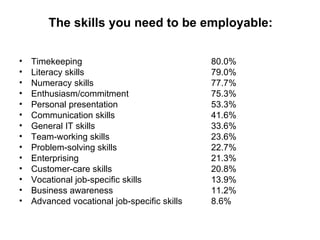
The skills you need to be employable:   Timekeeping  80.0% Literacy skills  79.0% Numeracy skills  77.7% Enthusiasm/commitment  75.3% Personal presentation  53.3% Communication skills  41.6% General IT skills  33.6% Team-working skills  23.6% Problem-solving skills  22.7% Enterprising  21.3% Customer-care skills  20.8% Vocational job-specific skills  13.9% Business awareness  11.2% Advanced vocational job-specific skills  8.6%
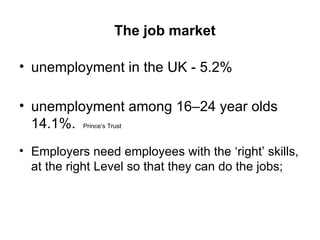
The job market Adult unemployment in the UK  7.8%  http://www.statistics.gov.uk/cci/nugget.asp?ID=12   unemployment among 16–24 year olds  19.1%.  http://www.guardian.co.uk/society/2009/aug/12/youth-unemployment-rate-bristol Employers need employees with the ‘right’ skills, at the right Level so that they can do the jobs;
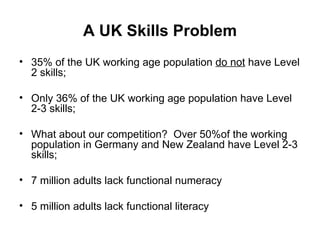
A UK Skills Problem 35% of the UK working age population  do not  have Level 2 skills; Only 36% of the UK working age population have Level 2-3 skills; What about our competition?  Over 50%of the working population in Germany and New Zealand have Level 2-3 skills; 7 million adults lack functional numeracy  5 million adults lack functional literacy
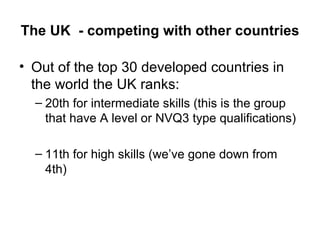
The UK  - competing with other countries Out of the top 30 developed countries in the world the UK ranks: 20th for intermediate skills (this is the group that have A level or NVQ3 type qualifications) 11th for high skills (we’ve gone down from 4th)
New jobs require higher level skills The basic skills required for most jobs in manufacturing and services are likely to rise.   by 2010 [Next Year!] around 95% of all new jobs will require Level 2 skills or higher .  (Level 2 is 5 A*-C qualifications or NVQ2)   Work Skills In Britain, DfES
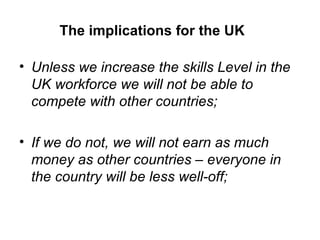
The implications for the UK  Unless we increase the skills Level in the UK workforce we will not be able to compete with other countries; If we do not, we will not earn as much money as other countries – everyone in the country will be less well-off;
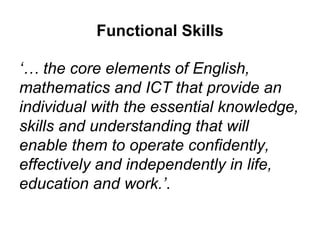
Functional Skills “ The skills are learning tools that enable people:  To apply their knowledge and understanding to everyday life  To engage competently and confidently with others  To solve problems in both familiar and unfamiliar situations  To develop personally and professionally as positive citizens who can actively contribute to society.”   http://www.qcda.gov.uk/libraryAssets/media/Support_for_AOs_preparing_for_FS_accreditation.pdf
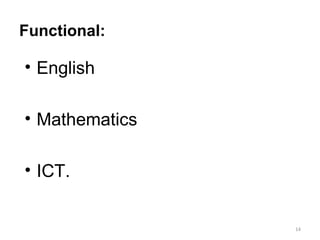
Functional: English Mathematics ICT.
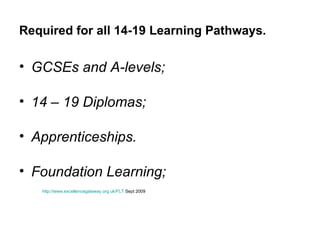
Required for all 14-19 Learning Pathways. GCSEs and A-levels;  14 – 19 Diplomas;  Apprenticeships. Foundation Learning; http://www.excellencegateway.org.uk/FLT  Sept 2009
Most importantly: To get the most out of you education; To survive in your everyday life; To be able to get a job; To be able to do your job; You will need Functional Skills
Functional ICT Use ICT Systems Find and select information Develop, present and communicate information
Functional Maths Representing (making sense of situations and representing them) Analysing (processing and using maths) Interpreting (interpreting and communicating the results of analysis)
Functional English Speaking and listening Reading Writing
Nothing new!  - You are already ‘doing’ Functional Skills
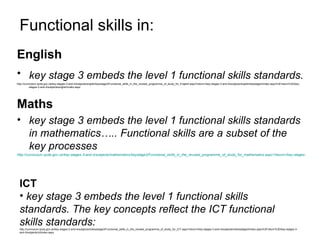
Functional skills in: English key stage 3 embeds the level 1 functional skills standards.   http://curriculum.qcda.gov.uk/key-stages-3-and-4/subjects/english/keystage3/Functional_skills_in_the_revised_programme_of_study_for_English.aspx?return=/key-stages-3-and-4/subjects/english/keystage3/index.aspx%3Freturn%3D/key-stages-3-and-4/subjects/english/index.aspx Maths key stage 3 embeds the level 1 functional skills standards in mathematics….. Functional skills are a subset of the key processes http://curriculum.qcda.gov.uk/key-stages-3-and-4/subjects/mathematics/keystage3/Functional_skills_in_the_revised_programme_of_study_for_mathematics.aspx?return=/key-stages-3-and-4/subjects/mathematics/keystage3/index.aspx ICT key stage 3 embeds the level 1 functional skills standards. The key concepts reflect the ICT functional skills standards:   http://curriculum.qcda.gov.uk/key-stages-3-and-4/subjects/ict/keystage3/Functional_skills_in_the_revised_programme_of_study_for_ICT.aspx?return=/key-stages-3-and-4/subjects/ict/keystage3/index.aspx%3Freturn%3D/key-stages-3-and-4/subjects/ict/index.aspx
Solving Problems You need to develop the Functional Skills that will let you solve a wide range of ‘real life’ problems, independently; To develop skills you must practise them!
Today’s problem:

Functional Skills Year 8 Introduction 2009

  • 1.
    Skills, skills, FunctionalSkills and You John Pallister
  • 2.
    By the endof this session: You will understand why skills are important to you and to the UK; You will know something about Functional Skills; You will have worked with other students to solve a problem.
  • 3.
    What are skills? “ the ability to do an activity or job well”; http://dictionary.cambridge.org/define.asp?key=74139&dict=CALD something you've learned how to do; something you have practised to develop; standing on one leg making paper aeroplanes writing riding a bicycle delivering a presentation ?
  • 4.
    Skills are valuableif: They help you to survive/live They help you to learn They help you to earn your living They help you to …
  • 5.
    Skills and jobs Every employer will want their employees to have the set of skills that will enable them to do the ‘job’. Different jobs need different sets of skills; There are some common skills that you will need whatever job you do.
  • 6.
    employers want youngpeople: who are literate, numerate and communicate well. to turn up on time and show enthusiasm and commitment. Who have positive attitudes.
  • 7.
    The skills youneed to be employable: Timekeeping 80.0% Literacy skills 79.0% Numeracy skills 77.7% Enthusiasm/commitment 75.3% Personal presentation 53.3% Communication skills 41.6% General IT skills 33.6% Team-working skills 23.6% Problem-solving skills 22.7% Enterprising 21.3% Customer-care skills 20.8% Vocational job-specific skills 13.9% Business awareness 11.2% Advanced vocational job-specific skills 8.6%
  • 8.
    The job marketAdult unemployment in the UK 7.8% http://www.statistics.gov.uk/cci/nugget.asp?ID=12 unemployment among 16–24 year olds 19.1%. http://www.guardian.co.uk/society/2009/aug/12/youth-unemployment-rate-bristol Employers need employees with the ‘right’ skills, at the right Level so that they can do the jobs;
  • 9.
    A UK SkillsProblem 35% of the UK working age population do not have Level 2 skills; Only 36% of the UK working age population have Level 2-3 skills; What about our competition? Over 50%of the working population in Germany and New Zealand have Level 2-3 skills; 7 million adults lack functional numeracy 5 million adults lack functional literacy
  • 10.
    The UK - competing with other countries Out of the top 30 developed countries in the world the UK ranks: 20th for intermediate skills (this is the group that have A level or NVQ3 type qualifications) 11th for high skills (we’ve gone down from 4th)
  • 11.
    New jobs requirehigher level skills The basic skills required for most jobs in manufacturing and services are likely to rise. by 2010 [Next Year!] around 95% of all new jobs will require Level 2 skills or higher . (Level 2 is 5 A*-C qualifications or NVQ2) Work Skills In Britain, DfES
  • 12.
    The implications forthe UK Unless we increase the skills Level in the UK workforce we will not be able to compete with other countries; If we do not, we will not earn as much money as other countries – everyone in the country will be less well-off;
  • 13.
    Functional Skills “The skills are learning tools that enable people: To apply their knowledge and understanding to everyday life To engage competently and confidently with others To solve problems in both familiar and unfamiliar situations To develop personally and professionally as positive citizens who can actively contribute to society.” http://www.qcda.gov.uk/libraryAssets/media/Support_for_AOs_preparing_for_FS_accreditation.pdf
  • 14.
  • 15.
    Required for all14-19 Learning Pathways. GCSEs and A-levels; 14 – 19 Diplomas; Apprenticeships. Foundation Learning; http://www.excellencegateway.org.uk/FLT Sept 2009
  • 16.
    Most importantly: Toget the most out of you education; To survive in your everyday life; To be able to get a job; To be able to do your job; You will need Functional Skills
  • 17.
    Functional ICT UseICT Systems Find and select information Develop, present and communicate information
  • 18.
    Functional Maths Representing(making sense of situations and representing them) Analysing (processing and using maths) Interpreting (interpreting and communicating the results of analysis)
  • 19.
    Functional English Speakingand listening Reading Writing
  • 20.
    Nothing new! - You are already ‘doing’ Functional Skills
  • 21.
    Functional skills in:English key stage 3 embeds the level 1 functional skills standards. http://curriculum.qcda.gov.uk/key-stages-3-and-4/subjects/english/keystage3/Functional_skills_in_the_revised_programme_of_study_for_English.aspx?return=/key-stages-3-and-4/subjects/english/keystage3/index.aspx%3Freturn%3D/key-stages-3-and-4/subjects/english/index.aspx Maths key stage 3 embeds the level 1 functional skills standards in mathematics….. Functional skills are a subset of the key processes http://curriculum.qcda.gov.uk/key-stages-3-and-4/subjects/mathematics/keystage3/Functional_skills_in_the_revised_programme_of_study_for_mathematics.aspx?return=/key-stages-3-and-4/subjects/mathematics/keystage3/index.aspx ICT key stage 3 embeds the level 1 functional skills standards. The key concepts reflect the ICT functional skills standards: http://curriculum.qcda.gov.uk/key-stages-3-and-4/subjects/ict/keystage3/Functional_skills_in_the_revised_programme_of_study_for_ICT.aspx?return=/key-stages-3-and-4/subjects/ict/keystage3/index.aspx%3Freturn%3D/key-stages-3-and-4/subjects/ict/index.aspx
  • 22.
    Solving Problems Youneed to develop the Functional Skills that will let you solve a wide range of ‘real life’ problems, independently; To develop skills you must practise them!
  • 23.