MULTIMEDIA
SIGNAL PROCESSING
MMSP
SGN-5016
Irek Defée
Tietotalo TF 316
irek.defee@tut.fi
Course info
• Lectures: Room TB 214
Tue ja Wed 10.15-12
• Exercises mandatory
• Exam written
Course info
• Course Web page
http:/www.cs.tut.fi/~defee/mulsp.html
• Course material is regulary updated,
please use only the updated material
Petri Hirvonen
petri.hirvonen@tut.fi
http://www.cs.tut.fi/~hirvone2/5016_exercises.htm
Exercises for SGN-5016
Multimedia Signal Processing
Exercises
• TC303
• Group1: 8:15-10:00, TC 303 28.10
• Group2: 8:15-10:00, TC 303 29.10
• You can participate in one or both of the exercise groups
if there is space, is not attend one group
• A written report is returned by e-mail after each exercise.
• The details about the report are included in the exercise
material.
WHAT IS THIS COURSE ABOUT???
1. WHAT IS MULTIMEDIA (MM) ?
2. WHAT IS THE TOPIC OF MULTIMEDIA
SIGNAL PROCESSING?
(THIS AREA IS NOT WELL DEFINED YET)
MULTIMEDIA SIGNAL PROCESSING
WHAT IS MULTIMEDIA?
• COMPOSED OF MULTI+MEDIA
MEDIA = MEDIUM OF COMMUNICATION
WE COMMUNICATE NATURALLY:
VISUALLY, BY SPEECH, BY TOUCH…
WE COMMUNICATE BY TECHNOLOGY:
RADIO (MOBILE PHONES), TV, PRESS,
CINEMA, BOOKS
• PEOPLE USE VARIOUSCOMMUNICATION
MEDIA: SPEECH, VISION, TOUCH….
IN THE PAST WHEN PEOPLE
COMMUNICATED THEY HAD TO USE
THOSE MEDIA DIRECTLY.
IN PRESENT CIVILISATION THERE ARE
MANY TECHNOLOGIES WHICH
EXTEND HUMAN COMMUNICATION
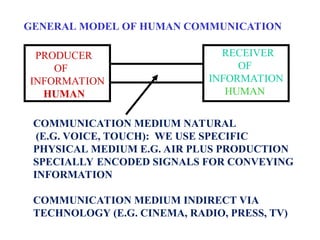
PRODUCER
OF
INFORMATION
HUMAN
RECEIVER
OF
INFORMATION
HUMAN
COMMUNICATION MEDIUM NATURAL
(E.G. VOICE, TOUCH): WE USE SPECIFIC
PHYSICAL MEDIUM E.G. AIR PLUS PRODUCTION
SPECIALLY ENCODED SIGNALS FOR CONVEYING
INFORMATION
COMMUNICATION MEDIUM INDIRECT VIA
TECHNOLOGY (E.G. CINEMA, RADIO, PRESS, TV)
GENERAL MODEL OF HUMAN COMMUNICATION
• MORE RECENT IS A MODEL OF
HUMAN – MACHINE
COMMUNICATION, OR EVEN
MACHINE-MACHINE COMMUNICATION
WHEN WE USE COMPUTERS, WE
COMMUNICATE WITH MACHINE,
THE COMMUNICATION MEDIA ARE:
TOUCH/GESTURE <-> KEYBOARD, MOUSE
VISION <-> DISPLAY
HEARING <-> SOUND
• HUMANS CAN USE SEVERAL DIFFERENT
MEDIA FOR COMMUNICATION
E.G. SPEECH, TOUCH, VISUAL SYSTEM
HUMANS OFTEN USE SEVERAL
MEDIA SIMULTANEOUSLY OR IN OTHER
WORDS MULTIPLE MEDIA =MULTIMEDIA
FOR EXAMPLE: WHEN WE TALK WITH
SOMEBODY WE USE GESTURES, FACE
EXPRESSIONS
• IN FACT PEOPLE PREFER TO USE
MULTIPLE MEDIA = MULTIMEDIA
- WE CAN USE SINGLE MEDIA, E.G. SPEECH
WHEN TALKING ON THE PHONE
BUT SEEING EACH OTHER WHEN
TALKING ”ENHANCES” THE CONTACT
- WE CAN LISTEN TO THE RADIO, E.G.
NEWS, BUT TV IS PREFERRED EVEN IF WE
JUST SEE A PERSON READING THE NEWS
- MULTIMEDIA IS MORE NATURAL FOR
PEOPLE
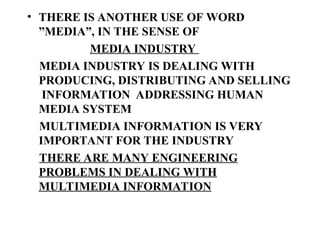
• THERE IS ANOTHER USE OF WORD
”MEDIA”, IN THE SENSE OF
MEDIA INDUSTRY
MEDIA INDUSTRY IS DEALING WITH
PRODUCING, DISTRIBUTING AND SELLING
INFORMATION ADDRESSING HUMAN
MEDIA SYSTEM
MULTIMEDIA INFORMATION IS VERY
IMPORTANT FOR THE INDUSTRY
THERE ARE MANY ENGINEERING
PROBLEMS IN DEALING WITH
MULTIMEDIA INFORMATION
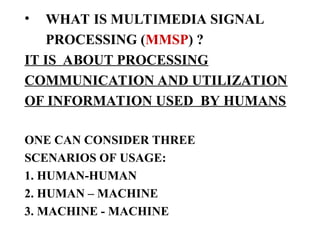
• WHAT IS MULTIMEDIA SIGNAL
PROCESSING (MMSP) ?
IT IS ABOUT PROCESSING
COMMUNICATION AND UTILIZATION
OF INFORMATION USED BY HUMANS
ONE CAN CONSIDER THREE
SCENARIOS OF USAGE:
1. HUMAN-HUMAN
2. HUMAN – MACHINE
3. MACHINE - MACHINE
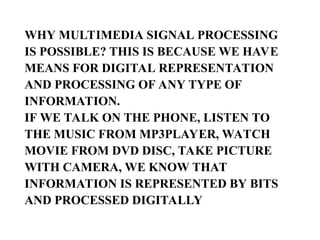
WHY MULTIMEDIA SIGNAL PROCESSING
IS POSSIBLE? THIS IS BECAUSE WE HAVE
MEANS FOR DIGITAL REPRESENTATION
AND PROCESSING OF ANY TYPE OF
INFORMATION.
IF WE TALK ON THE PHONE, LISTEN TO
THE MUSIC FROM MP3PLAYER, WATCH
MOVIE FROM DVD DISC, TAKE PICTURE
WITH CAMERA, WE KNOW THAT
INFORMATION IS REPRESENTED BY BITS
AND PROCESSED DIGITALLY
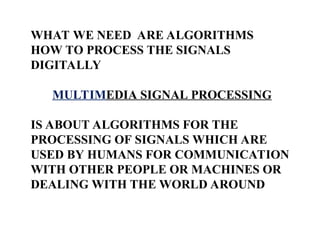
WHAT WE NEED ARE ALGORITHMS
HOW TO PROCESS THE SIGNALS
DIGITALLY
MULTIMEDIA SIGNAL PROCESSING
IS ABOUT ALGORITHMS FOR THE
PROCESSING OF SIGNALS WHICH ARE
USED BY HUMANS FOR COMMUNICATION
WITH OTHER PEOPLE OR MACHINES OR
DEALING WITH THE WORLD AROUND
• WHAT ARE THE MEDIA SIGNALS?
MEDIA SIGNALS ARE THOSE SIGNALS
WHICH ARE ACCESSIBLE TO THE HUMAN
INFORMATION PROCESSING SYSTEM
ONE OF THE ISSUES IN MULTIMEDIA
SIGNAL PROCESSING IS WHAT TYPE OF
SIGNALS AND WHAT KIND OF
COMBINATIONS OF SIGNALS CAN BE USED.
FOR EXAMPLE: ACOUSTICAL SIGNALS:
SOUNDS, SPEECH-LANGUAGE, MUSIC
WE CONVERT THOSE SIGNALS TO DIGITAL
FORMAT AND USE
• EXAMPLE: DIGITAL MUSIC (CD, MP3, DVD,
INTERNET RADIO)
• EXAMPLE: DIGITAL VIDEO (DVD, BLUE RAY,
INTERNET TV)
THESE ARE SYSTEMS FOR TRANSFERRING
CONTENT PRODUCED BY ARTISTS TO
PEOPLE. THESE SYSTEMS USE SPECIFIC
DIGITAL ENCODING AND COMPRESSION
OF INFORMATION TO RECORD THE
CONTENT.
THE QUESTION IS HOW TO MAKE THIS.
BUT HAVING SUCH SYSTEMS A NEW
PROBLEM EMERGES:
HOW TO PROTECT MEDIA INFORMATION
UNAUTHORIZED USE?
(FOR EXAMPLE ILLEGAL COPYING?)
How to represent media information in
most pleasing way?
Examples are High Definition technologies:
- Flat Displays
- HD DVD, Blue Ray discs, HDTV
• THE SECOND MAIN ASPECT OF MMSP
2. HUMAN-MACHINE COMMUNICATION
HOW TO MAKE INTERACTION WITH
COMPUTERS (AND OTHER MACHINES)
MORE NATURAL? NATURAL MEANS E.G. MORE
SIMILAR TO HUMAN-HUMAN INTERACTION,
MORE INTUITIVE, MORE PLEASING,
ATTRACTIVE….
THAT INCLUDE ALSO HOW TO MAKE
MACHINES MORE INTELLIGENT:
• FOR EXAMPLE , INSTEAD OF TYPING WE
COULD TALK TO COMPUTERS AND
INSTEAD OF COMPUTERS PRINTING ON
SCREEN ANSWERS THEY WOULD TALK
TO US.
OR, IF COMPUTERS WOULD SEE US
USING CAMERAS, THEY POSSIBLY
COULD REACT MORE LIKE PEOPLE.
BUT TODAY WE STILL USE KEYBOARD
AND MOUSE, WHY?
• WE USE KEYBOARD AND MOUSE
BECAUSE WE DO NOT HAVE BETTER
TECHNOLOGY: WE DO NOT KNOW HOW TO
PROCESS SPEECH AND VISUAL
INFORMATION AS EFFECTIVELY AS
PEOPLE ARE ABLE TO DO
• BUT WE MAY THINK OF COMPUTERS WITH
CAMERAS AND MICROPHONES
WHICH WILL BE ABLE TO DO SO
• THIS MAY BECOME POSSIBLE BECAUSE
OF FAST PROGRESS IN DEVELOPMENT OF
ALGORITHMS AND PROCESSORS
• THIS PROGRESS CAN BE ILLUSTRATED ON
MANY EXAMPLES
- COMPARE PC TODAY AND 10 years AGO
(TODAY WE HAVE MULTICORE
PROCESSORS AND THE NUMBER OF CORES
IS GROWING FAST)
- COMPARE MOBILE DEVICE TODAY AND
MOBILE PHONE 10 years AGO
(TODAY THE TELEPHONE FUNCTION IS
JUST ONE ADDITION TO MULTIPLE MEDIA
PROCESSING: MUSIC, VIDEO, CAMERA,
TOUCH, ORIENTATION)
EXTRAPOLATE THIS TO THE NEXT 10 years!
WE CAN EXPECT IN THE FUTURE:
• COMPUTERS, MOBILE, AND ALL KIND
OF OTHER DEVICES WILL BE MORE AND
MORE CLEVER (=INTELLIGENT?)
• THESE SYSTEMS WILL BE RELYING
ON INCREASINGLY SOPHISTICATED
MULTIMEDIA SIGNAL PROCESSING
CAPABILITIES
• WE HAVE THUS TWO MAIN AREAS TO
COVER IN MMSP:
1. MEDIA INFORMATION PROCESSING
IN MULTIMEDIA SYSTEMS
2. MEDIA COMPUTER INTERFACE FOR
HUMAN-COMPUTER INTERACTION
THESE ARE THE TOPICS OF
THE MMSP COURSE
• Please note however that our Multimedia Signal
Processing course is matched to the study program
at TUT, especially to the Multimedia Major
• We have many courses specialized in single media
processing: Digital Audio, Image Processing, Video
Processing, Video Compression, Pattern
Recognition
• We avoid overlapping with those courses. We are
also not going into algorithms which were proposed
by researchers but they are not in wider use yet,
this is covered in other courses and seminars
• In other universities they may not have so many
specialized courses, the course content is different
• There is one absolutely basic observation:
• MANY MULTIMEDIA SIGNAL PROCESSING
TASKS ARE ALREADY IMPLEMENTED IN
BIOLOGICAL SYSTEMS, ESPECIALLY IN
THE HUMAN INFORMATION PROCESSING
SYSTEM
• FOR EXAMPLE: VISUAL AND ACOUSTICAL
COMMUNICATION BETWEEN PEOPLE,
USING VISUAL INFORMATION IN
RECOGINIZING OBJECTS. BIOLOGICAL
SYSTEMS DO IT PERFECTLY BUT WE DO
NOT KNOW HOW, THAT IS ALGORITHMS
IN THE FIRST PART OF THIS COURSE
WE SHALL COVER BASIC KNOWLEDGE
RELATED TO
HUMAN INFORMATION PROCESSING
THIS SYSTEM PROCESSESS MEDIA
INFORMATION AND IT DOES IT IN
FANTASTIC WAY. IF WOULD KNOW HOW
IT MAKES IT, IT COULD HELP US TO
MAKE BETTER MEDIA INFORMATION
PROCESSING (BETTER MMSP ALGORITHMS)
BUT BEFORE WE GO FURTHER LET US MAKE
SOME MEDIA TECHNOLOGY OVERVIEW,
WHERE MULTIMEDIA SIGNAL PROCESSING
WILL BE USEFUL IN THE FUTURE
MULTIMEDIA SIGNAL PROCESSING
ALLOWS FOR NEW CLASSESS OF DEVICES
AND SYSTEMS:
MORE SOPHISTICATED COMMUNICATION,
MORE ADVANCED INTERFACES
THEY ARE ILLUSTRATED NEXT
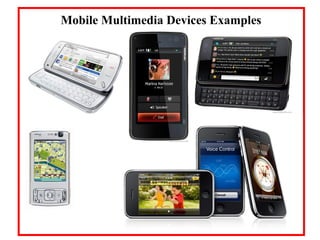
Mobile Multimedia Devices Examples
WHAT THESE MOBILE DEVICE EXAMPLES
SHOW TO US?
-DEVICES HAVE MULTIPLE SENSORS AND
MULITPLE MEDIA PROCESSING CAPABILITIES
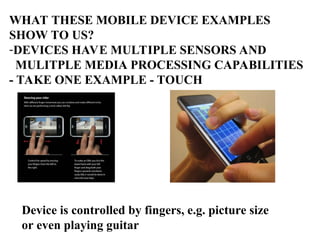
- TAKE ONE EXAMPLE - TOUCH
Device is controlled by fingers, e.g. picture size
or even playing guitar
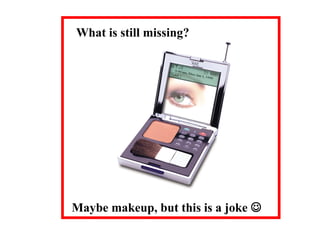
What is still missing?
Maybe makeup, but this is a joke 
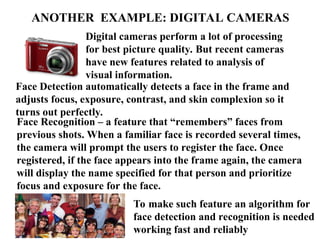
ANOTHER EXAMPLE: DIGITAL CAMERAS
Digital cameras perform a lot of processing
for best picture quality. But recent cameras
have new features related to analysis of
visual information.
Face Detection automatically detects a face in the frame and
adjusts focus, exposure, contrast, and skin complexion so it
turns out perfectly.
Face Recognition – a feature that “remembers” faces from
previous shots. When a familiar face is recorded several times,
the camera will prompt the users to register the face. Once
registered, if the face appears into the frame again, the camera
will display the name specified for that person and prioritize
focus and exposure for the face.
To make such feature an algorithm for
face detection and recognition is needed
working fast and reliably
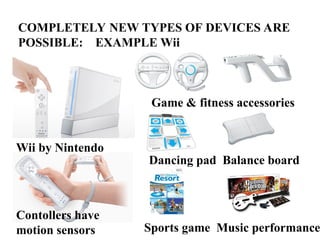
COMPLETELY NEW TYPES OF DEVICES ARE
POSSIBLE: EXAMPLE Wii
Wii by Nintendo
Contollers have
motion sensors
Game & fitness accessories
Dancing pad Balance board
Sports game Music performance
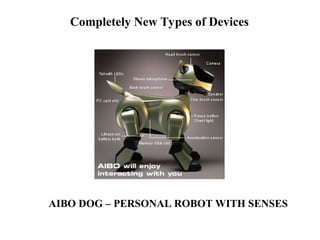
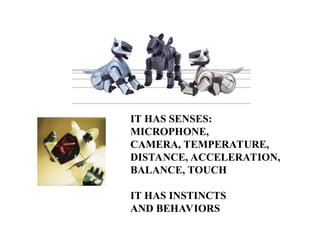
AIBO DOG – PERSONAL ROBOT WITH SENSES
Completely New Types of Devices
IT HAS SENSES:
MICROPHONE,
CAMERA, TEMPERATURE,
DISTANCE, ACCELERATION,
BALANCE, TOUCH
IT HAS INSTINCTS
AND BEHAVIORS
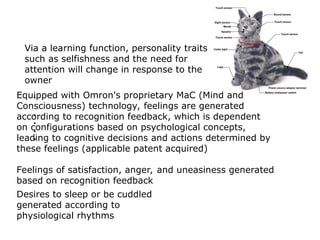
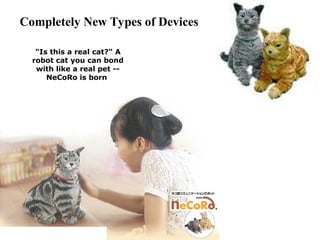
"Is this a real cat?" A
robot cat you can bond
with like a real pet --
NeCoRo is born
Completely New Types of Devices
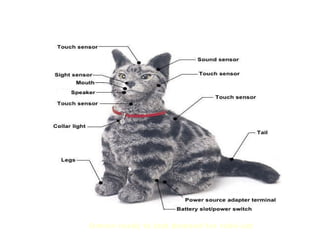
Omron ready to test demand for robo-cat
Equipped with Omron's proprietary MaC (Mind and
Consciousness) technology, feelings are generated
according to recognition feedback, which is dependent
on configurations based on psychological concepts,
leading to cognitive decisions and actions determined by
these feelings (applicable patent acquired)
Feelings of satisfaction, anger, and uneasiness generated
based on recognition feedback
Desires to sleep or be cuddled
generated according to
physiological rhythms
Via a learning function, personality traits
such as selfishness and the need for
attention will change in response to the
owner
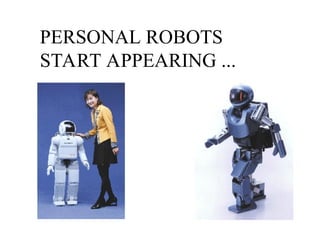
PERSONAL ROBOTS
START APPEARING ...
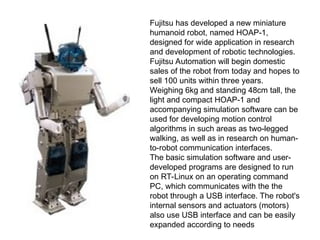
Fujitsu has developed a new miniature
humanoid robot, named HOAP-1,
designed for wide application in research
and development of robotic technologies.
Fujitsu Automation will begin domestic
sales of the robot from today and hopes to
sell 100 units within three years.
Weighing 6kg and standing 48cm tall, the
light and compact HOAP-1 and
accompanying simulation software can be
used for developing motion control
algorithms in such areas as two-legged
walking, as well as in research on human-
to-robot communication interfaces.
The basic simulation software and user-
developed programs are designed to run
on RT-Linux on an operating command
PC, which communicates with the the
robot through a USB interface. The robot's
internal sensors and actuators (motors)
also use USB interface and can be easily
expanded according to needs
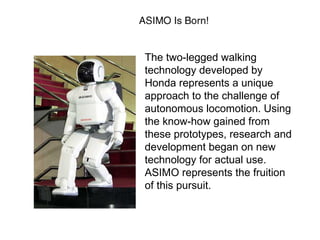
The two-legged walking
technology developed by
Honda represents a unique
approach to the challenge of
autonomous locomotion. Using
the know-how gained from
these prototypes, research and
development began on new
technology for actual use.
ASIMO represents the fruition
of this pursuit.
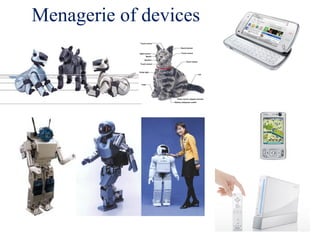
Menagerie of devicesDEVICES
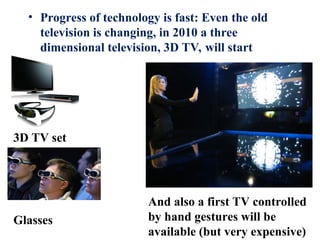
• Progress of technology is fast: Even the old
television is changing, in 2010 a three
dimensional television, 3D TV, will start
3D TV set
Glasses
And also a first TV controlled
by hand gestures will be
available (but very expensive)
What we see from these examples?
• We can see that devices are developing to have
- More complexity
- More intelligence
- More natural interaction with people
To add even more such features one needs
algorithms for multimedia signal processing,
many of these algorithms should have
capabilities similar to biological systems.

Steps for Multimedia Signal Processesing.ppt

  • 1.
  • 2.
    Course info • Lectures:Room TB 214 Tue ja Wed 10.15-12 • Exercises mandatory • Exam written
  • 3.
    Course info • CourseWeb page http:/www.cs.tut.fi/~defee/mulsp.html • Course material is regulary updated, please use only the updated material
  • 4.
  • 5.
    Exercises • TC303 • Group1:8:15-10:00, TC 303 28.10 • Group2: 8:15-10:00, TC 303 29.10 • You can participate in one or both of the exercise groups if there is space, is not attend one group • A written report is returned by e-mail after each exercise. • The details about the report are included in the exercise material.
  • 6.
    WHAT IS THISCOURSE ABOUT??? 1. WHAT IS MULTIMEDIA (MM) ? 2. WHAT IS THE TOPIC OF MULTIMEDIA SIGNAL PROCESSING? (THIS AREA IS NOT WELL DEFINED YET) MULTIMEDIA SIGNAL PROCESSING
  • 7.
    WHAT IS MULTIMEDIA? •COMPOSED OF MULTI+MEDIA MEDIA = MEDIUM OF COMMUNICATION WE COMMUNICATE NATURALLY: VISUALLY, BY SPEECH, BY TOUCH… WE COMMUNICATE BY TECHNOLOGY: RADIO (MOBILE PHONES), TV, PRESS, CINEMA, BOOKS
  • 8.
    • PEOPLE USEVARIOUSCOMMUNICATION MEDIA: SPEECH, VISION, TOUCH…. IN THE PAST WHEN PEOPLE COMMUNICATED THEY HAD TO USE THOSE MEDIA DIRECTLY. IN PRESENT CIVILISATION THERE ARE MANY TECHNOLOGIES WHICH EXTEND HUMAN COMMUNICATION
  • 9.
    PRODUCER OF INFORMATION HUMAN RECEIVER OF INFORMATION HUMAN COMMUNICATION MEDIUM NATURAL (E.G.VOICE, TOUCH): WE USE SPECIFIC PHYSICAL MEDIUM E.G. AIR PLUS PRODUCTION SPECIALLY ENCODED SIGNALS FOR CONVEYING INFORMATION COMMUNICATION MEDIUM INDIRECT VIA TECHNOLOGY (E.G. CINEMA, RADIO, PRESS, TV) GENERAL MODEL OF HUMAN COMMUNICATION
  • 10.
    • MORE RECENTIS A MODEL OF HUMAN – MACHINE COMMUNICATION, OR EVEN MACHINE-MACHINE COMMUNICATION WHEN WE USE COMPUTERS, WE COMMUNICATE WITH MACHINE, THE COMMUNICATION MEDIA ARE: TOUCH/GESTURE <-> KEYBOARD, MOUSE VISION <-> DISPLAY HEARING <-> SOUND
  • 11.
    • HUMANS CANUSE SEVERAL DIFFERENT MEDIA FOR COMMUNICATION E.G. SPEECH, TOUCH, VISUAL SYSTEM HUMANS OFTEN USE SEVERAL MEDIA SIMULTANEOUSLY OR IN OTHER WORDS MULTIPLE MEDIA =MULTIMEDIA FOR EXAMPLE: WHEN WE TALK WITH SOMEBODY WE USE GESTURES, FACE EXPRESSIONS
  • 12.
    • IN FACTPEOPLE PREFER TO USE MULTIPLE MEDIA = MULTIMEDIA - WE CAN USE SINGLE MEDIA, E.G. SPEECH WHEN TALKING ON THE PHONE BUT SEEING EACH OTHER WHEN TALKING ”ENHANCES” THE CONTACT - WE CAN LISTEN TO THE RADIO, E.G. NEWS, BUT TV IS PREFERRED EVEN IF WE JUST SEE A PERSON READING THE NEWS - MULTIMEDIA IS MORE NATURAL FOR PEOPLE
  • 13.
    • THERE ISANOTHER USE OF WORD ”MEDIA”, IN THE SENSE OF MEDIA INDUSTRY MEDIA INDUSTRY IS DEALING WITH PRODUCING, DISTRIBUTING AND SELLING INFORMATION ADDRESSING HUMAN MEDIA SYSTEM MULTIMEDIA INFORMATION IS VERY IMPORTANT FOR THE INDUSTRY THERE ARE MANY ENGINEERING PROBLEMS IN DEALING WITH MULTIMEDIA INFORMATION
  • 14.
    • WHAT ISMULTIMEDIA SIGNAL PROCESSING (MMSP) ? IT IS ABOUT PROCESSING COMMUNICATION AND UTILIZATION OF INFORMATION USED BY HUMANS ONE CAN CONSIDER THREE SCENARIOS OF USAGE: 1. HUMAN-HUMAN 2. HUMAN – MACHINE 3. MACHINE - MACHINE
  • 15.
    WHY MULTIMEDIA SIGNALPROCESSING IS POSSIBLE? THIS IS BECAUSE WE HAVE MEANS FOR DIGITAL REPRESENTATION AND PROCESSING OF ANY TYPE OF INFORMATION. IF WE TALK ON THE PHONE, LISTEN TO THE MUSIC FROM MP3PLAYER, WATCH MOVIE FROM DVD DISC, TAKE PICTURE WITH CAMERA, WE KNOW THAT INFORMATION IS REPRESENTED BY BITS AND PROCESSED DIGITALLY
  • 16.
    WHAT WE NEEDARE ALGORITHMS HOW TO PROCESS THE SIGNALS DIGITALLY MULTIMEDIA SIGNAL PROCESSING IS ABOUT ALGORITHMS FOR THE PROCESSING OF SIGNALS WHICH ARE USED BY HUMANS FOR COMMUNICATION WITH OTHER PEOPLE OR MACHINES OR DEALING WITH THE WORLD AROUND
  • 17.
    • WHAT ARETHE MEDIA SIGNALS? MEDIA SIGNALS ARE THOSE SIGNALS WHICH ARE ACCESSIBLE TO THE HUMAN INFORMATION PROCESSING SYSTEM ONE OF THE ISSUES IN MULTIMEDIA SIGNAL PROCESSING IS WHAT TYPE OF SIGNALS AND WHAT KIND OF COMBINATIONS OF SIGNALS CAN BE USED. FOR EXAMPLE: ACOUSTICAL SIGNALS: SOUNDS, SPEECH-LANGUAGE, MUSIC WE CONVERT THOSE SIGNALS TO DIGITAL FORMAT AND USE
  • 18.
    • EXAMPLE: DIGITALMUSIC (CD, MP3, DVD, INTERNET RADIO) • EXAMPLE: DIGITAL VIDEO (DVD, BLUE RAY, INTERNET TV) THESE ARE SYSTEMS FOR TRANSFERRING CONTENT PRODUCED BY ARTISTS TO PEOPLE. THESE SYSTEMS USE SPECIFIC DIGITAL ENCODING AND COMPRESSION OF INFORMATION TO RECORD THE CONTENT. THE QUESTION IS HOW TO MAKE THIS.
  • 19.
    BUT HAVING SUCHSYSTEMS A NEW PROBLEM EMERGES: HOW TO PROTECT MEDIA INFORMATION UNAUTHORIZED USE? (FOR EXAMPLE ILLEGAL COPYING?) How to represent media information in most pleasing way? Examples are High Definition technologies: - Flat Displays - HD DVD, Blue Ray discs, HDTV
  • 20.
    • THE SECONDMAIN ASPECT OF MMSP 2. HUMAN-MACHINE COMMUNICATION HOW TO MAKE INTERACTION WITH COMPUTERS (AND OTHER MACHINES) MORE NATURAL? NATURAL MEANS E.G. MORE SIMILAR TO HUMAN-HUMAN INTERACTION, MORE INTUITIVE, MORE PLEASING, ATTRACTIVE….
  • 21.
    THAT INCLUDE ALSOHOW TO MAKE MACHINES MORE INTELLIGENT: • FOR EXAMPLE , INSTEAD OF TYPING WE COULD TALK TO COMPUTERS AND INSTEAD OF COMPUTERS PRINTING ON SCREEN ANSWERS THEY WOULD TALK TO US. OR, IF COMPUTERS WOULD SEE US USING CAMERAS, THEY POSSIBLY COULD REACT MORE LIKE PEOPLE. BUT TODAY WE STILL USE KEYBOARD AND MOUSE, WHY?
  • 22.
    • WE USEKEYBOARD AND MOUSE BECAUSE WE DO NOT HAVE BETTER TECHNOLOGY: WE DO NOT KNOW HOW TO PROCESS SPEECH AND VISUAL INFORMATION AS EFFECTIVELY AS PEOPLE ARE ABLE TO DO • BUT WE MAY THINK OF COMPUTERS WITH CAMERAS AND MICROPHONES WHICH WILL BE ABLE TO DO SO • THIS MAY BECOME POSSIBLE BECAUSE OF FAST PROGRESS IN DEVELOPMENT OF ALGORITHMS AND PROCESSORS
  • 23.
    • THIS PROGRESSCAN BE ILLUSTRATED ON MANY EXAMPLES - COMPARE PC TODAY AND 10 years AGO (TODAY WE HAVE MULTICORE PROCESSORS AND THE NUMBER OF CORES IS GROWING FAST) - COMPARE MOBILE DEVICE TODAY AND MOBILE PHONE 10 years AGO (TODAY THE TELEPHONE FUNCTION IS JUST ONE ADDITION TO MULTIPLE MEDIA PROCESSING: MUSIC, VIDEO, CAMERA, TOUCH, ORIENTATION) EXTRAPOLATE THIS TO THE NEXT 10 years!
  • 24.
    WE CAN EXPECTIN THE FUTURE: • COMPUTERS, MOBILE, AND ALL KIND OF OTHER DEVICES WILL BE MORE AND MORE CLEVER (=INTELLIGENT?) • THESE SYSTEMS WILL BE RELYING ON INCREASINGLY SOPHISTICATED MULTIMEDIA SIGNAL PROCESSING CAPABILITIES
  • 25.
    • WE HAVETHUS TWO MAIN AREAS TO COVER IN MMSP: 1. MEDIA INFORMATION PROCESSING IN MULTIMEDIA SYSTEMS 2. MEDIA COMPUTER INTERFACE FOR HUMAN-COMPUTER INTERACTION THESE ARE THE TOPICS OF THE MMSP COURSE
  • 26.
    • Please notehowever that our Multimedia Signal Processing course is matched to the study program at TUT, especially to the Multimedia Major • We have many courses specialized in single media processing: Digital Audio, Image Processing, Video Processing, Video Compression, Pattern Recognition • We avoid overlapping with those courses. We are also not going into algorithms which were proposed by researchers but they are not in wider use yet, this is covered in other courses and seminars • In other universities they may not have so many specialized courses, the course content is different
  • 27.
    • There isone absolutely basic observation: • MANY MULTIMEDIA SIGNAL PROCESSING TASKS ARE ALREADY IMPLEMENTED IN BIOLOGICAL SYSTEMS, ESPECIALLY IN THE HUMAN INFORMATION PROCESSING SYSTEM • FOR EXAMPLE: VISUAL AND ACOUSTICAL COMMUNICATION BETWEEN PEOPLE, USING VISUAL INFORMATION IN RECOGINIZING OBJECTS. BIOLOGICAL SYSTEMS DO IT PERFECTLY BUT WE DO NOT KNOW HOW, THAT IS ALGORITHMS
  • 28.
    IN THE FIRSTPART OF THIS COURSE WE SHALL COVER BASIC KNOWLEDGE RELATED TO HUMAN INFORMATION PROCESSING THIS SYSTEM PROCESSESS MEDIA INFORMATION AND IT DOES IT IN FANTASTIC WAY. IF WOULD KNOW HOW IT MAKES IT, IT COULD HELP US TO MAKE BETTER MEDIA INFORMATION PROCESSING (BETTER MMSP ALGORITHMS)
  • 29.
    BUT BEFORE WEGO FURTHER LET US MAKE SOME MEDIA TECHNOLOGY OVERVIEW, WHERE MULTIMEDIA SIGNAL PROCESSING WILL BE USEFUL IN THE FUTURE
  • 30.
    MULTIMEDIA SIGNAL PROCESSING ALLOWSFOR NEW CLASSESS OF DEVICES AND SYSTEMS: MORE SOPHISTICATED COMMUNICATION, MORE ADVANCED INTERFACES THEY ARE ILLUSTRATED NEXT
  • 31.
  • 32.
    WHAT THESE MOBILEDEVICE EXAMPLES SHOW TO US? -DEVICES HAVE MULTIPLE SENSORS AND MULITPLE MEDIA PROCESSING CAPABILITIES - TAKE ONE EXAMPLE - TOUCH Device is controlled by fingers, e.g. picture size or even playing guitar
  • 33.
    What is stillmissing? Maybe makeup, but this is a joke 
  • 34.
    ANOTHER EXAMPLE: DIGITALCAMERAS Digital cameras perform a lot of processing for best picture quality. But recent cameras have new features related to analysis of visual information. Face Detection automatically detects a face in the frame and adjusts focus, exposure, contrast, and skin complexion so it turns out perfectly. Face Recognition – a feature that “remembers” faces from previous shots. When a familiar face is recorded several times, the camera will prompt the users to register the face. Once registered, if the face appears into the frame again, the camera will display the name specified for that person and prioritize focus and exposure for the face. To make such feature an algorithm for face detection and recognition is needed working fast and reliably
  • 35.
    COMPLETELY NEW TYPESOF DEVICES ARE POSSIBLE: EXAMPLE Wii Wii by Nintendo Contollers have motion sensors Game & fitness accessories Dancing pad Balance board Sports game Music performance
  • 36.
    AIBO DOG –PERSONAL ROBOT WITH SENSES Completely New Types of Devices
  • 37.
    IT HAS SENSES: MICROPHONE, CAMERA,TEMPERATURE, DISTANCE, ACCELERATION, BALANCE, TOUCH IT HAS INSTINCTS AND BEHAVIORS
  • 38.
    "Is this areal cat?" A robot cat you can bond with like a real pet -- NeCoRo is born Completely New Types of Devices
  • 39.
    Omron ready totest demand for robo-cat
  • 40.
    Equipped with Omron'sproprietary MaC (Mind and Consciousness) technology, feelings are generated according to recognition feedback, which is dependent on configurations based on psychological concepts, leading to cognitive decisions and actions determined by these feelings (applicable patent acquired) Feelings of satisfaction, anger, and uneasiness generated based on recognition feedback Desires to sleep or be cuddled generated according to physiological rhythms Via a learning function, personality traits such as selfishness and the need for attention will change in response to the owner
  • 41.
  • 42.
    Fujitsu has developeda new miniature humanoid robot, named HOAP-1, designed for wide application in research and development of robotic technologies. Fujitsu Automation will begin domestic sales of the robot from today and hopes to sell 100 units within three years. Weighing 6kg and standing 48cm tall, the light and compact HOAP-1 and accompanying simulation software can be used for developing motion control algorithms in such areas as two-legged walking, as well as in research on human- to-robot communication interfaces. The basic simulation software and user- developed programs are designed to run on RT-Linux on an operating command PC, which communicates with the the robot through a USB interface. The robot's internal sensors and actuators (motors) also use USB interface and can be easily expanded according to needs
  • 43.
    The two-legged walking technologydeveloped by Honda represents a unique approach to the challenge of autonomous locomotion. Using the know-how gained from these prototypes, research and development began on new technology for actual use. ASIMO represents the fruition of this pursuit.
  • 44.
  • 45.
    • Progress oftechnology is fast: Even the old television is changing, in 2010 a three dimensional television, 3D TV, will start 3D TV set Glasses And also a first TV controlled by hand gestures will be available (but very expensive)
  • 46.
    What we seefrom these examples? • We can see that devices are developing to have - More complexity - More intelligence - More natural interaction with people To add even more such features one needs algorithms for multimedia signal processing, many of these algorithms should have capabilities similar to biological systems.