Science, Technology, Engineering and
Mathematics Enrichment
8/2/13
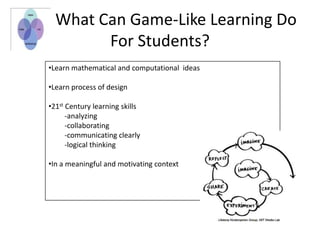
What Can Game-Like Learning Do
For Students?
•Learn mathematical and computational ideas
•Learn process of design
•21st Century learning skills
-analyzing
-collaborating
-communicating clearly
-logical thinking
•In a meaningful and motivating context
What Can Game-Like Learning Do For Students?
Perspective Description
expressing realizing that computation is a
medium of creation
“I can create.”
connecting recognizing the power of
creating with and for others
“I can do different things
when I have access to others.”
feeling empowered to ask
questions about the world
questioning “I can (use computation to)
ask questions to make sense
of (computational things in)
the world.”
Scratch by MIT
Scratch by MIT
Introduction Students are introduced to creative computing and
Scratch, through sample projects and hands-on
experiences.
Arts Students explore the arts by creating projects that include
elements of music, design, drawing, and dance.
The computational concepts of sequence and loops, and
the computational practices of being iterative and
incremental are highlighted.
Stories Students explore storytelling by creating projects that
include characters, scenes, and narrative.
The computational concepts of parallelism and events and
the computational practices of reusing and remixing are
highlighted.
Games Students explore games by creating projects that define
goals and rules.
The computational concepts of conditionals, operators,
and data, and the computational practices of testing and
debugging are highlighted.
The standards emphasize understanding of concepts
and hands-on practices such as defining problems,
asking questions, designing investigations, analyzing
data and using evidence to draw conclusions.
Next Generation Science Standards for
Today’s Students
STEM is critical for economic
growth, innovation, and
employment.
Our future demands STEM!

Stem principal pitch_v1

  • 1.
    Science, Technology, Engineeringand Mathematics Enrichment 8/2/13
  • 2.
    What Can Game-LikeLearning Do For Students? •Learn mathematical and computational ideas •Learn process of design •21st Century learning skills -analyzing -collaborating -communicating clearly -logical thinking •In a meaningful and motivating context
  • 3.
    What Can Game-LikeLearning Do For Students? Perspective Description expressing realizing that computation is a medium of creation “I can create.” connecting recognizing the power of creating with and for others “I can do different things when I have access to others.” feeling empowered to ask questions about the world questioning “I can (use computation to) ask questions to make sense of (computational things in) the world.”
  • 4.
  • 5.
    Scratch by MIT IntroductionStudents are introduced to creative computing and Scratch, through sample projects and hands-on experiences. Arts Students explore the arts by creating projects that include elements of music, design, drawing, and dance. The computational concepts of sequence and loops, and the computational practices of being iterative and incremental are highlighted. Stories Students explore storytelling by creating projects that include characters, scenes, and narrative. The computational concepts of parallelism and events and the computational practices of reusing and remixing are highlighted. Games Students explore games by creating projects that define goals and rules. The computational concepts of conditionals, operators, and data, and the computational practices of testing and debugging are highlighted.
  • 6.
    The standards emphasizeunderstanding of concepts and hands-on practices such as defining problems, asking questions, designing investigations, analyzing data and using evidence to draw conclusions. Next Generation Science Standards for Today’s Students
  • 7.
    STEM is criticalfor economic growth, innovation, and employment. Our future demands STEM!