
17/06/2013
Guarding sustainability
Stella Vanassche, Philip Marynissen, An Vercalsteren
17/06/2013 2
© 2013, VITO NV
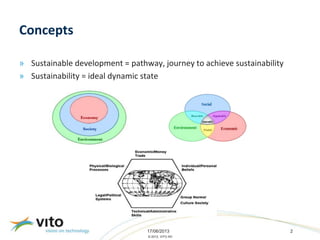
Concepts
» Sustainable development = pathway, journey to achieve sustainability
» Sustainability = ideal dynamic state
17/06/2013 3
© 2013, VITO NV
Sustainable Materials Management
OECD:
approach to promote sustainable materials use, integrating actions targeted
at reducing negative environmental impacts and preserving natural capital
throughout the life-cycle of materials, taking into account economic
efficiency and social equity
17/06/2013 4
© 2013, VITO NV
SMM IN VITO: PRINCIPLES
17/06/2013 5
© 2013, VITO NV
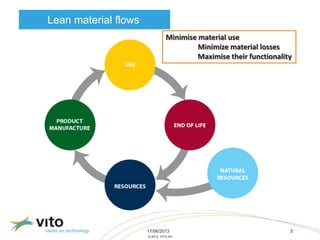
Lean material flows
Minimise material use
Minimize material losses
Maximise their functionality
17/06/2013 6
© 2013, VITO NV
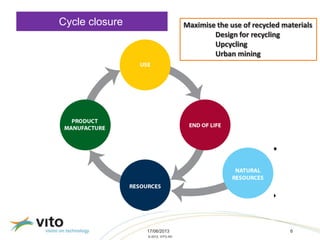
Cycle closure Maximise the use of recycled materials
Design for recycling
Upcycling
Urban mining
17/06/2013 7
© 2013, VITO NV
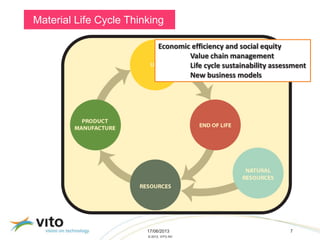
Material Life Cycle Thinking
Economic efficiency and social equity
Value chain management
Life cycle sustainability assessment
New business models
17/06/2013 8
© 2013, VITO NV
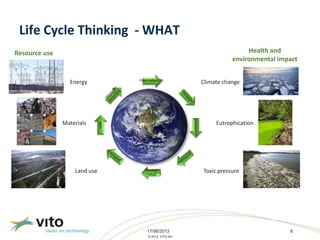
Life Cycle Thinking - WHAT
raw materials
production
storage
retail
use
Resource use Health and
environmental impact
Energy
Materials
Land use Toxic pressure
Eutrophication
Climate change
17/06/2013 9
© 2013, VITO NV
Life Cycle Thinking - WHY
» Businesses:
» improve efficiency to boost margins and competitiveness, while
contributing to a sustainable society
» Identify hot spots in a product’s life cycle to promote material and
economic efficiency
» Achieve closer cooperation with suppliers and customers regarding
product risks, development and marketing
» Foster better relations with authorities, environmental groups and
with other stakeholders
» Improve the company’s image
17/06/2013 10
© 2013, VITO NV
Life Cycle Thinking - HOW
» Life Cycle Assessment (LCA)
» Carbon footprinting (CF)
» Ecological footprinting (EF)
» Environmental Input-Output Analysis
» Material Flow Analysis (MFA)
» Life Cycle Costing (LCC)
A global assessment of environmental impacts, caused by a
product, material, process or system over its entire life cycle
17/06/2013 11
© 2013, VITO NV
Life Cycle Thinking - HOW
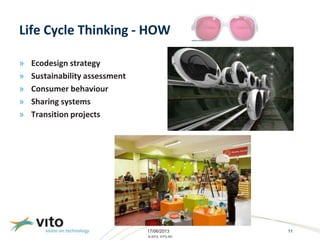
» Ecodesign strategy
» Sustainability assessment
» Consumer behaviour
» Sharing systems
» Transition projects
17/06/2013 12
© 2013, VITO NV
Does additive manufacturing contribute to
sustainable materials management?
17/06/2013 13
© 2013, VITO NV
YES, IT CAN! (cfr. ‘Atkins-project’, Loughborough university)
» PLANET: clean production
» less raw material, and less waste
» less consumable materials (cooling liquids, lubricants, ...)
» light weight products
» (in quite some cases) less energy over complete life cycle
» (opportunities for) shortening/closing material life cycles
» PROFIT: robust, competitive manufacturing
» one (contactless) tool
» JIT production (instead of JIT delivery)
» no stock
» digital, dematerialised supply chains (bits & bytes instead of materials)
» new & more sustainable business models
» improved performance of products
» PEOPLE: safe & healthy jobs for skilled workforce
» Through
» skilled workforce
» local production of customized products (mass customisation)
17/06/2013 14
© 2013, VITO NV
Golf, a green hobby…
17/06/2013 15
© 2013, VITO NV
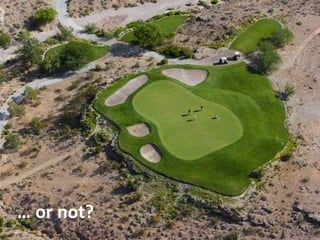
… or not?
17/06/2013 16
© 2013, VITO NV
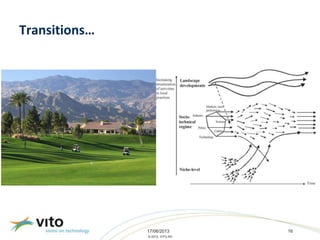
Transitions…
17/06/2013 17
© 2013, VITO NV
Increased efficiency and increased
consumption
» Jevons Paradox:
» technological progress that increases the efficiency with which a resource
is used tends to increase (rather than decrease) the rate of consumption
of that resource
» Example: flat panel TVs
» AM as the example of Jevon’s effect for materials
management?
Alcott, Blake (July 2005). "Jevons' paradox". Ecological Economics 54 (1): 9–21
17/06/2013 18
© 2013, VITO NV
AM contribution to SMM
» Local production
» Mass customisation
» Closed material loops (?)
» Consumer becomes prosumer
» Collective model
» (Car) repair shops without stock
» Personal design of mass products
17/06/2013 19
© 2013, VITO NV
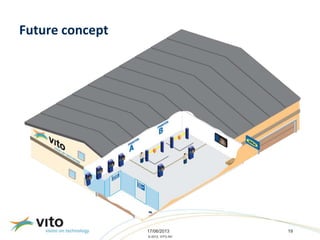
Future concept

Stella Vanassche: Duurzaamheidsbewaking binnen iMade

  • 1.
    17/06/2013 Guarding sustainability Stella Vanassche,Philip Marynissen, An Vercalsteren
  • 2.
    17/06/2013 2 © 2013,VITO NV Concepts » Sustainable development = pathway, journey to achieve sustainability » Sustainability = ideal dynamic state
  • 3.
    17/06/2013 3 © 2013,VITO NV Sustainable Materials Management OECD: approach to promote sustainable materials use, integrating actions targeted at reducing negative environmental impacts and preserving natural capital throughout the life-cycle of materials, taking into account economic efficiency and social equity
  • 4.
    17/06/2013 4 © 2013,VITO NV SMM IN VITO: PRINCIPLES
  • 5.
    17/06/2013 5 © 2013,VITO NV Lean material flows Minimise material use Minimize material losses Maximise their functionality
  • 6.
    17/06/2013 6 © 2013,VITO NV Cycle closure Maximise the use of recycled materials Design for recycling Upcycling Urban mining
  • 7.
    17/06/2013 7 © 2013,VITO NV Material Life Cycle Thinking Economic efficiency and social equity Value chain management Life cycle sustainability assessment New business models
  • 8.
    17/06/2013 8 © 2013,VITO NV Life Cycle Thinking - WHAT raw materials production storage retail use Resource use Health and environmental impact Energy Materials Land use Toxic pressure Eutrophication Climate change
  • 9.
    17/06/2013 9 © 2013,VITO NV Life Cycle Thinking - WHY » Businesses: » improve efficiency to boost margins and competitiveness, while contributing to a sustainable society » Identify hot spots in a product’s life cycle to promote material and economic efficiency » Achieve closer cooperation with suppliers and customers regarding product risks, development and marketing » Foster better relations with authorities, environmental groups and with other stakeholders » Improve the company’s image
  • 10.
    17/06/2013 10 © 2013,VITO NV Life Cycle Thinking - HOW » Life Cycle Assessment (LCA) » Carbon footprinting (CF) » Ecological footprinting (EF) » Environmental Input-Output Analysis » Material Flow Analysis (MFA) » Life Cycle Costing (LCC) A global assessment of environmental impacts, caused by a product, material, process or system over its entire life cycle
  • 11.
    17/06/2013 11 © 2013,VITO NV Life Cycle Thinking - HOW » Ecodesign strategy » Sustainability assessment » Consumer behaviour » Sharing systems » Transition projects
  • 12.
    17/06/2013 12 © 2013,VITO NV Does additive manufacturing contribute to sustainable materials management?
  • 13.
    17/06/2013 13 © 2013,VITO NV YES, IT CAN! (cfr. ‘Atkins-project’, Loughborough university) » PLANET: clean production » less raw material, and less waste » less consumable materials (cooling liquids, lubricants, ...) » light weight products » (in quite some cases) less energy over complete life cycle » (opportunities for) shortening/closing material life cycles » PROFIT: robust, competitive manufacturing » one (contactless) tool » JIT production (instead of JIT delivery) » no stock » digital, dematerialised supply chains (bits & bytes instead of materials) » new & more sustainable business models » improved performance of products » PEOPLE: safe & healthy jobs for skilled workforce » Through » skilled workforce » local production of customized products (mass customisation)
  • 14.
    17/06/2013 14 © 2013,VITO NV Golf, a green hobby…
  • 15.
    17/06/2013 15 © 2013,VITO NV … or not?
  • 16.
    17/06/2013 16 © 2013,VITO NV Transitions…
  • 17.
    17/06/2013 17 © 2013,VITO NV Increased efficiency and increased consumption » Jevons Paradox: » technological progress that increases the efficiency with which a resource is used tends to increase (rather than decrease) the rate of consumption of that resource » Example: flat panel TVs » AM as the example of Jevon’s effect for materials management? Alcott, Blake (July 2005). "Jevons' paradox". Ecological Economics 54 (1): 9–21
  • 18.
    17/06/2013 18 © 2013,VITO NV AM contribution to SMM » Local production » Mass customisation » Closed material loops (?) » Consumer becomes prosumer » Collective model » (Car) repair shops without stock » Personal design of mass products
  • 19.
    17/06/2013 19 © 2013,VITO NV Future concept

Editor's Notes

  • #6 Principle 1: Minimize the use of materials(lean material flows)This principle calls for prevention, as materials that are not used will remain available. At the same time, those functionalities necessary to satisfy our needs that are provided by the materials must be maintained or improved. To reduce material throughput without loss of functionalities, different strategies will be applied:Minimize material losses over the complete value chain of products and services (resource efficiency, re-use)Maximize the functionality of materials at every point in the value chain (resource effectiveness, ‘do more with less’, dematerialization, product service systems, material substitution)
  • #7 Principle 2: Maximize the use of recycled materials (cycle closure)The use of materials to satisfy our needs can be minimized (principle 1), but never completely avoided. However, resources from nature can be saved by minimizing the share of primary materials in the total requirement of materials that provide the functionality required to fulfill our needs. The corresponding strategy consists of:Increase the recycling of End-of-Life products into products or materials with similar or superior functionalities as those that are obtained from primary materials (recycling for loop closing and upcycling, urban mining, design for recycling)
  • #8  Principle 3: Minimize the impacts of value chains on the availability of natural resources, taking into account economic efficiency and social equity. (value chain management, life cycle sustainability assessment)A value chain with the leanest possible material flows (principle 1) and a maximum share of recycled products and materials (principle 2) might i) present avoidable impacts in its interaction with the use of other resources from nature, ii) lack economic efficiency or iii) provoke social inequity. Strategies to minimize value chain impacts include:Increase the awareness and engagement of value chain stakeholders and actors, applying a multidisciplinary approach (clustering, green business models)
  • #9 Life Cycle Thinking (LCT):Looks at environmental impacts of goods and services across all life cycle stagesSeeks to identify possible improvements to goods and services in the form of lower environmental impacts and reduced resource use Aims to avoid burden shiftingBetween different life cycle stagesBetween regionsBetween impact categories
  • #17 Afbeeld