By Patrick Remy
Age group: 15-19
*
*
*An STI is an infection passed from one person to another
person through sexual contact. An infection is when a
bacteria, virus, or parasite enters and grows in or on your
body. STIs are also called sexually transmitted diseases, or
STDs.
*Some STIs can be cured and some STIs cannot be cured. For
those STIs that cannot be cured, there are medicines to
manage the symptoms.
*
*More than 1 million sexually transmitted infections
(STIs) are acquired every day worldwide.
*Each year, there are an estimated 357 million new
infections with 1 of 4 STIs: chlamydia, gonorrhea,
syphilis and trichomoniasis.
*The majority of STIs have no symptoms or only mild
symptoms that may not be recognized as an STI.
*In some cases, STIs can have serious reproductive
health consequences beyond the immediate impact
of the infection itself (e.g., infertility or mother-to-
child transmission)
*
*
*Gonorrhea is caused by Neisseria gonorrhoeae,
a bacterium that can grow and multiply easily in
mucus membranes of the body. Gonorrhea
bacteria can grow in the warm, moist areas of
the reproductive tract.
* Gonorrhea passes from person to person
through unprotected oral, anal, or vaginal sex.
People with numerous sexual partners or those
who don’t use a condom are at greatest risk of
infection
*Greenish yellow or whitish
discharge from the vagina
*Lower abdominal or pelvic pain
*Burning when urinating
*Conjunctivitis (red, itchy eyes)
*Bleeding between periods
*Spotting after intercourse
*Swelling of the vulva
*Burning in the throat (due to
oral sex)
*Swollen glands in the throat (due
to oral sex)
*Greenish yellow or
whitish discharge from
the penis
*Burning when urinating
*Burning in the throat
(due to oral sex)
*Painful or swollen
testicles
*Swollen glands in the
throat (due to oral sex)
*
*
*To cure a gonorrhea infection, your doctor will give
you either an oral or injectable antibiotic. Your
partner should also be treated at the same time to
prevent reinfection and further spread of the disease.
*It is important to take all of your antibiotics even if
you feel better. Also, never take someone
else's medication to treat your illness. By doing so,
you may make the infection more difficult to treat. In
addition,
*Tell anyone you have had sex with recently that you
are infected. This is important because gonorrhea
may have no symptoms. Women, especially, may not
have symptoms and may not seek testing or
treatment unless alerted by their sex partners.
*Don't have sex until you have completed taking all of
your medicine.
*
*Chlamydia is an infection with
Chlamydia trachomatis bacteria. When
an infection is present, the bacteria
can be present in the cervix, urethra,
vagina, and rectum of an infected
person.
*It can also live in the throat. Any type
of sexual contact (vaginal, anal, or
oral) with an infected person can
spread the infection.
*Most women do not experience any
symptoms, but if symptoms are
present they may be minor.
Symptoms may include:
*vaginal discharge, or
*burning sensation during urination.
*If the infection spreads to the
fallopian tubes, women may
experience
*lower abdominal and lower back
pain,
*pain during intercourse,
*bleeding between menstrual
periods
*nausea or fever
*Men may be asymptomatic or
symptoms may be minor. When men
do have symptoms, they may
experience one or more of the
following:
*pus (thick yellow-white fluid) or
watery or milky discharge from the
penis
*pain or burning during urination
*pain or swelling of the testicle
*
*
*There are antibiotic treatments that are
effective in treating chlamydia.
*Whatever treatment is prescribed, there are
some important points about any treatment:
*The patient must take all medications as
directed.
*All partners should be examined and treated.
*The infected person should not have sex until
he or she and any partner or partners have
been treated and cured
*pelvic inflammatory disease
*may damage the fallopian
tubes
*Infertility
*Ectopic Pregnancy
*Fertilized egg develops
outside the uterus
*May spread through blood or
joints
*Epididymitis
*Painful condition of the
testicles may lead to
infertility
*May also affect the prostate
*Lead to scarring to the
urethra
*May spread through blood or
joints
*
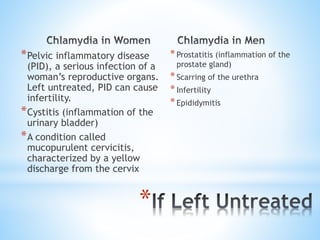
*Pelvic inflammatory disease
(PID), a serious infection of a
woman’s reproductive organs.
Left untreated, PID can cause
infertility.
*Cystitis (inflammation of the
urinary bladder)
*A condition called
mucopurulent cervicitis,
characterized by a yellow
discharge from the cervix
*Prostatitis (inflammation of the
prostate gland)
*Scarring of the urethra
*Infertility
*Epididymitis
*
*
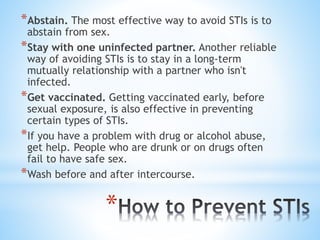
*Abstain. The most effective way to avoid STIs is to
abstain from sex.
*Stay with one uninfected partner. Another reliable
way of avoiding STIs is to stay in a long-term
mutually relationship with a partner who isn't
infected.
*Get vaccinated. Getting vaccinated early, before
sexual exposure, is also effective in preventing
certain types of STIs.
*If you have a problem with drug or alcohol abuse,
get help. People who are drunk or on drugs often
fail to have safe sex.
*Wash before and after intercourse.
*
*Chlamydia - American Sexual Health Association. (n.d.). Retrieved
March 15, 2016, from
http://www.ashasexualhealth.org/stdsstis/chlamydia/
*Gonorrhea Causes, Diagnosis, and Symptoms in Men and Women.
(n.d.). Retrieved March 15, 2016, from
http://www.webmd.com/sexual-
conditions/guide/gonorrhea?page=2#4
*Preventing Sexually Transmitted Diseases (STDs). (n.d.). Retrieved
March 15, 2016, from http://www.webmd.com/sex-
relationships/understanding-stds-prevention
*Sexually transmitted infections (STIs). (n.d.). Retrieved March 15,
2016, from
http://www.who.int/mediacentre/factsheets/fs110/en/

Sexually transmitted infections

  • 1.
    By Patrick Remy Agegroup: 15-19 *
  • 2.
    * *An STI isan infection passed from one person to another person through sexual contact. An infection is when a bacteria, virus, or parasite enters and grows in or on your body. STIs are also called sexually transmitted diseases, or STDs. *Some STIs can be cured and some STIs cannot be cured. For those STIs that cannot be cured, there are medicines to manage the symptoms.
  • 3.
    * *More than 1million sexually transmitted infections (STIs) are acquired every day worldwide. *Each year, there are an estimated 357 million new infections with 1 of 4 STIs: chlamydia, gonorrhea, syphilis and trichomoniasis. *The majority of STIs have no symptoms or only mild symptoms that may not be recognized as an STI. *In some cases, STIs can have serious reproductive health consequences beyond the immediate impact of the infection itself (e.g., infertility or mother-to- child transmission)
  • 4.
  • 5.
    * *Gonorrhea is causedby Neisseria gonorrhoeae, a bacterium that can grow and multiply easily in mucus membranes of the body. Gonorrhea bacteria can grow in the warm, moist areas of the reproductive tract. * Gonorrhea passes from person to person through unprotected oral, anal, or vaginal sex. People with numerous sexual partners or those who don’t use a condom are at greatest risk of infection
  • 6.
    *Greenish yellow orwhitish discharge from the vagina *Lower abdominal or pelvic pain *Burning when urinating *Conjunctivitis (red, itchy eyes) *Bleeding between periods *Spotting after intercourse *Swelling of the vulva *Burning in the throat (due to oral sex) *Swollen glands in the throat (due to oral sex) *Greenish yellow or whitish discharge from the penis *Burning when urinating *Burning in the throat (due to oral sex) *Painful or swollen testicles *Swollen glands in the throat (due to oral sex) *
  • 7.
    * *To cure agonorrhea infection, your doctor will give you either an oral or injectable antibiotic. Your partner should also be treated at the same time to prevent reinfection and further spread of the disease. *It is important to take all of your antibiotics even if you feel better. Also, never take someone else's medication to treat your illness. By doing so, you may make the infection more difficult to treat. In addition, *Tell anyone you have had sex with recently that you are infected. This is important because gonorrhea may have no symptoms. Women, especially, may not have symptoms and may not seek testing or treatment unless alerted by their sex partners. *Don't have sex until you have completed taking all of your medicine.
  • 8.
    * *Chlamydia is aninfection with Chlamydia trachomatis bacteria. When an infection is present, the bacteria can be present in the cervix, urethra, vagina, and rectum of an infected person. *It can also live in the throat. Any type of sexual contact (vaginal, anal, or oral) with an infected person can spread the infection.
  • 9.
    *Most women donot experience any symptoms, but if symptoms are present they may be minor. Symptoms may include: *vaginal discharge, or *burning sensation during urination. *If the infection spreads to the fallopian tubes, women may experience *lower abdominal and lower back pain, *pain during intercourse, *bleeding between menstrual periods *nausea or fever *Men may be asymptomatic or symptoms may be minor. When men do have symptoms, they may experience one or more of the following: *pus (thick yellow-white fluid) or watery or milky discharge from the penis *pain or burning during urination *pain or swelling of the testicle *
  • 10.
    * *There are antibiotictreatments that are effective in treating chlamydia. *Whatever treatment is prescribed, there are some important points about any treatment: *The patient must take all medications as directed. *All partners should be examined and treated. *The infected person should not have sex until he or she and any partner or partners have been treated and cured
  • 11.
    *pelvic inflammatory disease *maydamage the fallopian tubes *Infertility *Ectopic Pregnancy *Fertilized egg develops outside the uterus *May spread through blood or joints *Epididymitis *Painful condition of the testicles may lead to infertility *May also affect the prostate *Lead to scarring to the urethra *May spread through blood or joints *
  • 12.
    *Pelvic inflammatory disease (PID),a serious infection of a woman’s reproductive organs. Left untreated, PID can cause infertility. *Cystitis (inflammation of the urinary bladder) *A condition called mucopurulent cervicitis, characterized by a yellow discharge from the cervix *Prostatitis (inflammation of the prostate gland) *Scarring of the urethra *Infertility *Epididymitis *
  • 13.
    * *Abstain. The mosteffective way to avoid STIs is to abstain from sex. *Stay with one uninfected partner. Another reliable way of avoiding STIs is to stay in a long-term mutually relationship with a partner who isn't infected. *Get vaccinated. Getting vaccinated early, before sexual exposure, is also effective in preventing certain types of STIs. *If you have a problem with drug or alcohol abuse, get help. People who are drunk or on drugs often fail to have safe sex. *Wash before and after intercourse.
  • 14.
    * *Chlamydia - AmericanSexual Health Association. (n.d.). Retrieved March 15, 2016, from http://www.ashasexualhealth.org/stdsstis/chlamydia/ *Gonorrhea Causes, Diagnosis, and Symptoms in Men and Women. (n.d.). Retrieved March 15, 2016, from http://www.webmd.com/sexual- conditions/guide/gonorrhea?page=2#4 *Preventing Sexually Transmitted Diseases (STDs). (n.d.). Retrieved March 15, 2016, from http://www.webmd.com/sex- relationships/understanding-stds-prevention *Sexually transmitted infections (STIs). (n.d.). Retrieved March 15, 2016, from http://www.who.int/mediacentre/factsheets/fs110/en/