,sx.dYs%; fndajk frda.


        jhs' tï' t,a' l=udr
      uyck fi!LH mÍlaIl
   ,sx.dY%s; frda. u¾Ok tallh
              r;akmqr
yeoskaùu


nelaàßhd wdidok

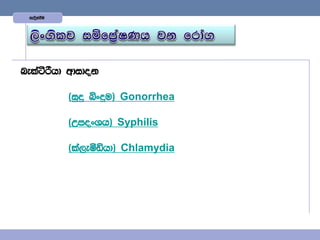
            ^iqÿ ìxÿu& Gonorrhea

            ^WmoxYh& Syphilis

            ^la,eóähd& Chlamydia
yeoskaùu


ffjria wdidok

  ^taâia& HIV (Human Immunodeficiency Virus)
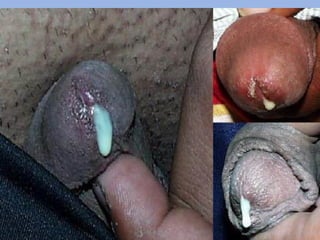
  ^y¾mSia& Genital Herpes

  ^,sx.sl bkakka& HPV (Human Papillomavirus)
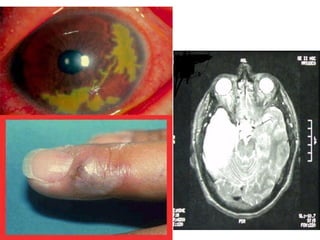
  ^fymghsáia& Hepatitis B
yeoskaùu


mrfmdaYs;$È,Sr wdidok

^g%hsfldfudkdisia& Trichomoniasis

^lekaâvhisia& Candidiasis (Yeast Infection)

^bksl=kd& Pubic Lice (Crabs)

^fydß& Scabies
yeoskaùu


frda.Ska jd¾;d ùu 2010

frda.Ska jd¾;d ùu 2011

ia;%s ¥IK yd <ud wmpdr

,sx.dYs%; frda. u¾Ok tallh

Ung l, yels foa
Introduction


     Sexually Transmitted Infections
     Toward effective prevention, diagnosis and treatment


Precautions

It is recommended that infected individuals and their sexual partner(s) abstain from
sexual activity until:

• treatment is complete (for treatable STIs)
• symptoms have subsided
• the infection is cured (for curable STIs, confirmed through follow-up
   testing, as appropriate).

In the case of viral STIs, a health care provider can offer safer-sex and risk-reduction
tips to prevent transmission.

Condoms are important to reduce the risk of transmission, even if other methods of
birth control are being used to prevent pregnancy.
Lelaàßhd


    ^la,eóähd& Chlamydia


hkq
 iq,n nelaàßhd wdidokhla (Chlamydia Trachomatis)

 .eíf., $ uq;%d ud¾.h l,d;=rlska .=o ud¾.h $ W.=r yd weia
wdidokh fõ'

fndajk l%u
wdidÈ;hl= iu. mj;ajk wkdrÌs; ,sx.sl weiqr ^uqL$fhdak$.=o&
                                                    s

ore m%iQ;sfha È orejdf.a fmky¿ fyda weia wdidokh úh yel
Lelaàßhd


    ^la,eóähd& Chlamydia


frda. ,laIK ^i;s 2)6 miq&
ia;%S
fndfyda úg frda. ,laIK rys; kuq;a

                fhdaks ud¾.fhka Y%dj msg ùu
                uq;%d my lsÍfï È fõokdj
                há nv m%foaYfha fõokdj
                ixi¾.fhka miq fyda udia Y=oaêhg wu;rj reêr jykh
                ixi¾.h w;r;=r fõokdj
                .=o ud¾.fha fõokdj $ leiSu $ Y%dj msgùu
Lelaàßhd


    ^la,eóähd& Chlamydia


frda. ,laIK ^i;s 2)6 miq&
mqreI
fndfyda úg Èk 2)7 È frda. ,laIK fmkajhs


           YsIaKh ;=,ska j;=r jeks lsß mdg Y%djhla msgùu

           uq;%d my lsÍfï È oeú,a, $ fõokdj

           jDIK fldaIj, fõokdj
Lelaàßhd


        ^la,eóähd& Chlamydia


ie,lsh hq;= lreKq yd ixl+,;d
ia;%S
 wdidokh" uq;dYh yd mef,damSh kd, olajd me;sÍu (Pelvic Inflammatory
              %
Disease)
 ksoka.; ;=káh fõokdj
 j| Ndjh
 .¾NdIfhka msg ms<siso .ekSï we;s ùfï wjodku

mqreI
 jDIK fldaI wdidokh
 m¿ u;=ùu$ yxÈ fõokdj
 l,d;=rlska j| Ndjh we;s ùu
Lelaàßhd


    iqÿ ìxÿu


hkq
iq,n nelaàßhd wdidokhla ^khsisÍhd f.dfkdaßfha&

.eíf.,$uq;%d ud¾.h$.=o ud¾.h$W.=r yd iuyr wjia:d j,os weia
wdidokh fõ


fndajk l%u
wdidÈ;hl= iu. mj;ajk wkdrÌs; ,sx.sl weiqr ^uqL $ fhdaks $ .=o&

ore m%iQ;sfha oS orejdg ^wlaIs wdidÈ; orefjla&
Lelaàßhd


    iqÿ ìxÿu


frda. ,laIK
ia;%S
fndfyda úg frda. ,laIK rys; kuq;a

                fhdaks ud¾.fhka Y%dj msg ùu
                uq;%d my lsÍfï È fõokdj
                há nv m%foaYfha fõokdj
                ixi¾.fhka miq fyda udia Y=oaêhg wu;rj reêr jykh
                ixi¾.h w;r;=r fõokdj
                .=o ud¾.fha fõokdj $ leiSu $ Y%dj msgùu
Lelaàßhd


   iqÿ ìxÿu


frda. ,laIK
mqreI
fndfyda úg Èk 2)7 È frda. ,laIK fmkajhs


           YSIaKh ;=,ska >k ly)fld< mdg Y%djhla msgùu

           uq;%d my lsÍfï È oeú,a, $ fõokdj

           jDIK fldIj, fõokdj fyda bÈuqu

           .=o ud¾.fha fõokdj $ leiSu $ Y%dj msgùu
Lelaàßhd


        iqÿ ìxÿu


ie,lsh hq;= lreKq yd ixl+,;d

 yÿkd fkd.;a yd m%;sldr fkd.;a fjk;a wdidok ;sìh yels nj
 taâia frda.h wdidokh ùfï yd me;sÍfï wjodku by, nj

ia;%S
 wdidokh" uq;%dYh yd mef,damSh kd, olajd me;sÍu (Pelvic Inflammatory Disease)
 ksoka.; ;=káh fõokdj
 j| Ndjh
 .¾NdIfhka msg ms<siso .ekSï we;s ùfï wjodku

mqreI
 jDIK fldaI wdidokh
 m¿ u;=ùu$ yxÈ fõokdj
 l,d;=rlska j| Ndjh we;s ùu
Lelaàßhd


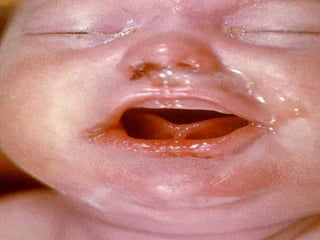
    WmoxYh


hkq
     fg%fmdksud me,svï keu;s nelaàßhdj u.ska wdidokh jk

     wjêlsysmhla mj;S

     • ,xldfõ mj;sk merKs;u ,sx.d.%s; frda.h

fndajk l%u

 wdidÈ;hl= iu. mj;ajk wkdrÌs; ,sx.sl weiqr ^uqL $ fhdaks $ .=o&

 reêr mdrú,hkh $ bÈ lgq $ isßkacia

 wdidÈ; ujf.ka l<,hg ^.íid$u,ore Wm;a& fyda orejdg iyc WmoxYh
Lelaàßhd


    WmoxYh


frda. ,laIK
Èk 9)90 ;a w;r ld,fha È frda. ,laIK fmkajhs


m<uq wjêh
 ia;%S yd mqreI ,sxf.akaøsh ;=< fyda wjg fõokd rys; ;=jd, u;= fõ

 bls<sj, jid .eg;s bÈóu

 m%;sldr .ekSulska f;drj bfí úh<S hhs

 frda. îc YÍrh ;=, j¾Okh fõ
Lelaàßhd


    WmoxYh


fojk wjêh
m<uq wjêfha ksis m%;dldr fkd,o úg i;s 6)24 fojk wjêh meñfKa


    ifï l=IaG we;s ùu ^weÕ $ w;a, $ m;=, $ msg &

    ysi flia .e, ú hdu

    jid .eg;s bÈóu

    WK yd ykaÈm;a fõokdj
Lelaàßhd


  WmoxYh


.=ma; wjêh

   frda. ,laIK msg;g fkdfmkajhs

   yDoh ) wksl=;a bkaøshka yd iakdhq moao;shg ydks muqKqjhs

   .=m; wjÈfha uq,a ld,h olajd frda.h fndal, yel
       a

   urKh
Lelaàßhd


    WmoxYh


WmoxYh yd .¾NkSNdjh
 .en ;=, isák ì<sod wdidokh ùu
 .íidùï
 fkdfïrE ore Wm;a
 u,ore Wm;a
 ixcdkkSh WmoxYh iys; orejl= ìys ùu^YrSrh mqrd l=IaG we;s ùu
         kdiamqvq j,ska Y%dj msg ùu $ ikaê bÈóu $ jid .eg;s bÈóu&
 idudkH f,i WmÈk orejd udi lsysmhlg miq frda. ,laIK fmkaùu
Lelaàßhd


  WmoxYh


WmoxYh yd .¾NkSNdjh
<ore m%;sldr

         frda. ,laIK we;s orejka

         ksis m%;sldr fkd,;a ujlg Wmka orejka

         m%iQ;shg i;s 4 fmr ksis m%;sldr fkd,;a ujlg Wmka orejka

         fmksis,Ska m%;sÔjlh fkd,;a ujlg Wmka orejka
ffjria


  y¾mSia
  nyq,j ,sx.sl m%foaYfha ;=jd, we;s lrkq ,nk frda.hls


hkq
 y¾mSia isïmaf,laia ffjri u.ska fnda jk

 1 uqLh wdY%S;j ;=jd, we; fõs' uqL ,sx.sl in|;dj,ska ,sx.sl
   m%foaYhg o fnda fõ

 2 ,sx.sl m%foaYh wdY%S;j ;=jd, we;s fõs uqLh wdYS%;j o ;=jd,
   we;s úh yel


 m,uq wdidokfhka miq kej; wdidok we;s fõ
ffjria


y¾mSia
nyq,j ,sx.sl m%foaYfha ;=jd, we;s lrkq ,nk frda.hls


kej; wdidok we;s jk wjia:d
          udisl Tima ùu
          udkisl wiykh
          frda.d ndo
          .¾NKs Ndjh
          ie;alï
          HIV wdidokh jeks m%;sYla;s W!K;d
          iuyr T!IO
ffjria


    y¾mSia
    nyq,j ,sx.sl m%foaYfha ;=jd, we;s lrkq ,nk frda.hls


fndajk l%u
 wdidÈ;hl= ^frda. ,laIK iys; $ rys;& iu. mj;ajk wkdrÌs;
      ,sx.sl weiqr ^uqL$fhdak$.=o&
                             s

 ism .ekSul È

 wdidÈ; ujf.ka ore m%iQ;sfha orejg

 fldkavï Ndú;fhka iïmQ¾K wdrlaIdjla fkd,efí
ffjria


  y¾mSia
  nyq,j ,sx.sl m%foaYfha ;=jd, we;s lrkq ,nk frda.hls


frda. ,laIK
  ish¿u wdidÈ;hka frda. ,laIK fkdfmkajhs
  Èk 2)21 w;r frda. ,laIK u;= fõ
  ffjri we;=¿ jQ ia:dkfha oeú,a, fõokdj we;s fõ
  Èhr msß l=vd ìì,s u;= ùu
  fõokdldÍ ;=jd,
  WK ) ysiro ) fldkafoa fõokdj
  jid .%kaÓ bÈóu
ffjria


  y¾mSia
  nyq,j ,sx.sl m%foaYfha ;=jd, we;s lrkq ,nk frda.hls


y¾mSia yd .¾NkSNdjh

   .eí .eksug ndOdjla fkd fõ

   m%i; wjia:dfõ ;=jd, u;= ù we;s fyda m<uqj
       Q

       wdidok ùu orejdg n,mdhs

   Y,Hl¾uh u.ska orejd ìys lsÍu

   m%;sffjri T!IO ,nd Èu
ffjria


    fymghsáia (Hepatitis B)
    A vaccine-preventable viral infection that affects the liver


hkq
wlaudj wdidokh lrk (Hepatitis B Virus)


reêrh" YÍr ;r," ,sx.sl ;r, j," uõ lsß yd fl<j, ffjria wvx.= fõ
wdidÈ;hska         90] m%;sfoay uÕska md,kh fõ
                    10] ksoka.; frda.Ska njg m;a fõ

fndajk l%u

 wdidÈ;hl= iu. mj;ajk wkdrÌs; ,sx.sl weiqr ^uqL$fhdak$.=o&
                                                      s

 reêr mdrú,hkh $ bÈ lgq $ isßkacia

 wdidÈ; ujf.ka orejdg
ffjria


    fymghsáia (Hepatitis B)


frda. ,laIK
fndfyda whg frda. ,laIK fkdfmkajhs

i;s 08 miq
               f;fyÜgqj
               Tlaldrh" juKh
               lEu reÑh wvq ùu
               m¿ u;= ùu
               yx¢ fõokdj
               iuyrúg weia yd yu ly mdg ùu
ffjria


   fymghsáia (Hepatitis B)


ie,lsh hq;= lreKq yd ixl+,;d
frda. wdYS;hska tkak;a lsÍu

ksoka.; ;;ajh wlaudj wdYS; frda. we;s lrhs
^Ysfrdaisia $ ms,sld &

m%;sffjri T!IO ,nd Èu
ffjria


  ^taâia& HIV (Human Immunodeficiency Virus)


hkq

 m%;sYla;s lrk moao;shg wod, ffi,
úkdYlrkq ,nkq

 m%;sYla;s lrk moO;sh ÿ¾j, ùu uÕska
Acquired Immunodeficiency Syndrome or AIDS
frda.shl= njg m;a lrkq ,nk
ffjria


    ^taâia& HIV (Human Immunodeficiency Virus)


frda. jHdma;sh
wdidê; mqoa.,hl=f.a
                     reêrh
                     ,sx.sl m%foaYfha we;s ;r,
                     Y=l% ;r,h
                     uõ lsß

 wkdrÌs; ,sx.sl weiqr ^uqL$fhdaks$.=o&
 bÈlgq yd wksl=;a T!IO WmlrK
 HIV wdidê; reêrh yd reêr.; ksIamdok
 wdidê; reêrh ;ejrekq o;a nqreiq f¾i¾
 .¾NkS wjia:dfõ oS yd uõ lsß oSfï oS
ffjria


   ^taâia& HIV (Human Immunodeficiency Virus)


frda. jHd;a;sh isÿ fkdjk wjia:d

                          u¥re oIagkh
                          wksl=;a lDñ i;=ka uÕska

wdidê; reêrh wvx.= fkdfõ kï
                  fl,
                  oyâh
                  l¥¿
                  uq;%d
                  wiQÑ uÕska
frda.h iïfm%aIKh fkdfõ
ffjria


    ^taâia& HIV (Human Immunodeficiency Virus)


frda. ,laIK
frda. îc YÍr .; ù i;s 2)4 ;=, oS ;o WK je, oS Èk lsysmhlska iqj ù
hhs

îfc!Ik iuh wjqreÿ 15)20 olajd mej;sh yel
m%;sYla;sh ÿ¾j, jQ úg
               ks;r WK yd oyäh oeóu
               nr wvq ùu
               yxÈ yd uiamsvq fõokdj
               m¿ u;= ùu
               jid .%ka;s bÈóu
               fikaf.ä
               f;fyÜgqj yd Yla;sh wvq ùu
               ysiroh
               Tlaldrh jukh mdpkh
ffjria


   ^taâia& HIV (Human Immunodeficiency Virus)


ie,lsh hq;= lreKq
 ljq¿ iuh ;=, È mÍlaIK j,ska yªkd .; fkdyel ^udi
                                 03la hk ;=re&

 frda.h iïmQ¾Kfhka iqj lsÍug m%;sldr fkdue;

 AIDS ;;Ajhg m;a fkdù isàug m%;sldr we;

 AIDS ;;Ajhg m;a jQ miq fjk;a wdidok j,g nyq,j
           Ndckh ù urKh isÿ úh yl
ffjria


hkq
 iq,n ffjhsria wdidokhla ^yshquka memsf,daud ffjhsria&
   ffjhsria j¾. 100 jvd we;'
   wvq wjodkï ffjhsria j¾. ,sx.sl wjhjj, bkakka we;s lrhs
   jeä wjodkï ffjhsria j¾. .eí f., ms,sld we;s lrhs
   iuyr j¾. i|yd je,elaùfï tkak;a we;


fndajk l%u
 wdidÈ;hl= iu. mj;ajk wkdrÌs; ,sx.sl weiqr ^uqL$fhdaks$.=o&
 wdidÈ;hl= iu. mj;ajk ,sx.sl l%shdldrlï
 ore m%iQ;sfha È orejdg
ffjria


frda. ,laIK
 leiSu

 ixi¾.h w;r;=r wmyiq;d oekSu
 ixi¾.h w;r;=r reêr jykh


 wvq wjodkï ffjhsria j¾. fndafyda úg frda. ,laIK fkdfmkajhs
 l=vd f.dajd u,a jeks r;= fyda frdai meyefhka hq;= bkakka fhdaks .=o
ud¾.fha fyda uqLfha we;s fõ
 m%udKh yd bkakka .kk fjkia fõ
 .¾Nks ld,h ;=, È bkakkaf.a m%udKh yd .kk jeä úh yelsh
 mqreI $ ia;%s frda. ,laIK
ffjria


ixl+,;d
 bkakka kej; kej; we;s ùu

 ms,sld
               •   .eí f.,
               •   fhdaks ud¾.h
               •   .=o ud¾.h
               •   YsIaKh
 wd;;sh

 uq;%d yd fhdaks ud¾.fha wjysr;d
mrfmdaYs;$È,Sr


     ^lekaävhisia& Candidiasis (Yeast Infection)
     A common fungal infection caused by overgrowth
     of the naturally occurring yeast Candida


hkq
hSÜia j¾.hg wh;a lekaävd we,aìlkaia kï È,Srfhka isÿ jk

     idudkHfhka ldka;djkaf.a fhdaks ud¾.fha mj;S
     w;sßla; f,i j¾Okh jQ úg lekaävhisia ;;ajhg meñfKa
     uqLh" .,kd,h" yu yd reêrh wdYS;j je, foa

w;sßla; jrOkhg n,mdk fy;=
           .¾NkS Ndjh
           Ⱦ> ld,Sk m%;sÔjl T!IO .ekSu
           Èhjeähdj
           m%;sYla;sh ySk ùu
mrfmdaYs;$È,Sr


        ^lekaävhisia& Candidiasis (Yeast Infection)


frda. ,laIK
iA;%S
                   fhdaks ud¾s.fha leiSu
                   iqÿ meye;s lsß leo,s jeks Èhrhla msg ùu
                   bÈó fyda r;= mdg iajNdjhla .ekSu
                   uq;%d lrk úg oeú,a,
mqreI
                   ,sx. uqKavh m%odyhg ,la ùu (Balanitis)
                   leiSu
                   YsIakh w. r;= mdg dots u;= ùu
                   fmriu úh,Su
mrfmdaYs;$È,Sr


     ^bksl=kd& Pubic Lice
     Infections caused by parasitic infestations


hkq
,sx.sl m%foaYfha ðj;a jk l=vd l=reñKs úfYaIhla (Phthirus
Pubis)

     weia msydgq lsys,, yd frdau wdYs%; m%foaY j, f,a Wrd
                      a
fndñka Ôj;a fõ


frda. iïfm%aIkh
         iam¾Yh uÕska
         wdidÈ; we;sß,s ;=jd yd NdKav ^Èk 02 mj;S&
         ,sx.sl l%shdldrlï
mrfmdaYs;$È,Sr


    ^bksl=kd& Pubic Lice

frda. ,laIK
i;s 3)4 miq
      leiSu yd yu m%odyhg ,la ùu yd r;= mdg ùu
      imd lE ia:dk j, ks,a mdg m¿ u;= ùu


ie,lsh hq;= lreKq

oaú;Sh nelaàßhd wdidok we;s ùu

           ish¿u wdYs;hka m%;sldr .ekSu
           frÈ we| we;sß,s fyd¢ka msßisÿ lsÍu
mrfmdaYs;$È,Sr


      ^fydß& Scabies


hkq
 l=vd mrfmdaYs;hl=f.ka (Sarcoptes Scabiei) yg .kakd

 ,sx.sl l%shdldrlï fyda iam¾Yfhka fnda jk^wdidÈ;
              we;sß,s" ;=jd yd NdKav Èk 03 mj;S&

 yu hg ì;a;r ouk yd WKqiqï l,dm j, jeämqr yg
.kakd ^j,Ælr" oKysia" weÕs,s" ;Ügï" mshhqre yd ,sx.sl
wjhj &
mrfmdaYs;$È,Sr


    ^fydß& Scabies


frda. ,laIK
i;s 3)4 miq

           leiSu úfYaIfhka rd;%S ld,hg

           r;= mdg m¿ u;= ùu

           úáka úg yg .ekSu
mrfmdaYs;$È,Sr


    ^fydß& Scabies

ie,lsh hq;= lreKq

oaú;Sh nelaàßhd wdidok we;s ùu


         ish¿u wdYs%;hka m%;sldr .ekSu

         frÈ we| we;sß,s fyd¢ka msßisÿ lsÍu
mrfmdaYs;$È,Sr


     ^g%hsfldfudkdisia& Trichomoniasis
     A sexually transmitted parasitic infection commonly referred to as trich


hkq
 tal ffi,l Ôúhl=f.ka ^Trichomonas vaginalis& yg
      .kakd frda.S ;;ajhla

uq;%d ud¾.h" fhdaks ud¾.h" .¾NdYh" fmriu hg yuq
       fõ'
mrfmdaYs;$È,Sr


        ^g%hsfldfudkdisia& Trichomoniasis


frda. ,laIK
ia;S%
             ly fld< mdgg yqre Y%dj msgùula

             leiSu
             uq;%d msg lrk úg oeú,a,


mqreI
             fndfyda úg frda. ,laIK fkdfmkajhs
             uq;%d újrh r;= mdg ùu fyda bß;e,Su
             uq;%d msg lrk úg oeú,a,
mrfmdaYs;$È,Sr


     ^g%hsfldfudkdisia& Trichomoniasis


ie,lsh hq;= lreKq


            fkdfïrE ore Wm;a

            nr wvq ore Wm;a
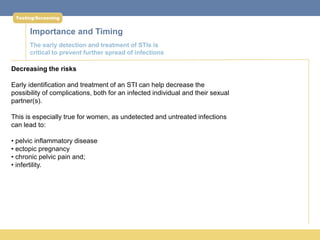
Testing/Screening


      Importance and Timing
      The early detection and treatment of STIs is
      critical to prevent further spread of infections

Decreasing the risks

Early identification and treatment of an STI can help decrease the
possibility of complications, both for an infected individual and their sexual
partner(s).

This is especially true for women, as undetected and untreated infections
can lead to:

• pelvic inflammatory disease
• ectopic pregnancy
• chronic pelvic pain and;
• infertility.
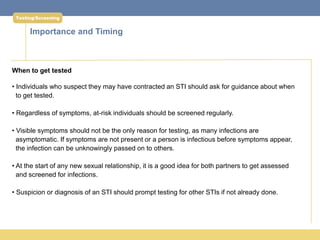
Testing/Screening


      Importance and Timing


When to get tested

• Individuals who suspect they may have contracted an STI should ask for guidance about when
  to get tested.

• Regardless of symptoms, at-risk individuals should be screened regularly.

• Visible symptoms should not be the only reason for testing, as many infections are
  asymptomatic. If symptoms are not present or a person is infectious before symptoms appear,
  the infection can be unknowingly passed on to others.

• At the start of any new sexual relationship, it is a good idea for both partners to get assessed
  and screened for infections.

• Suspicion or diagnosis of an STI should prompt testing for other STIs if not already done.
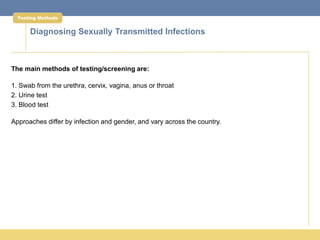
Testing Methods


      Diagnosing Sexually Transmitted Infections


The main methods of testing/screening are:

1. Swab from the urethra, cervix, vagina, anus or throat
2. Urine test
3. Blood test

Approaches differ by infection and gender, and vary across the country.
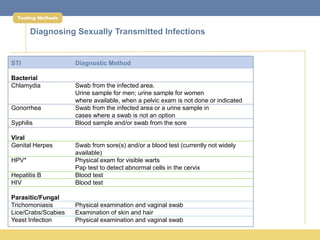
Testing Methods


       Diagnosing Sexually Transmitted Infections


STI                  Diagnostic Method

Bacterial
Chlamydia            Swab from the infected area.
                     Urine sample for men; urine sample for women
                     where available, when a pelvic exam is not done or indicated
Gonorrhea            Swab from the infected area or a urine sample in
                     cases where a swab is not an option
Syphilis             Blood sample and/or swab from the sore

Viral
Genital Herpes       Swab from sore(s) and/or a blood test (currently not widely
                     available)
HPV*                 Physical exam for visible warts
                     Pap test to detect abnormal cells in the cervix
Hepatitis B          Blood test
HIV                  Blood test

Parasitic/Fungal
Trichomoniasis       Physical examination and vaginal swab
Lice/Crabs/Scabies   Examination of skin and hair
Yeast Infection      Physical examination and vaginal swab
Prevention


      Barrier Methods
      Prevention approaches are important to decrease the transmission of STIs

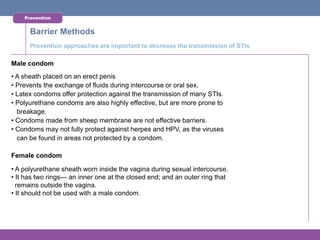
Male condom
• A sheath placed on an erect penis
• Prevents the exchange of fluids during intercourse or oral sex.
• Latex condoms offer protection against the transmission of many STIs.
• Polyurethane condoms are also highly effective, but are more prone to
  breakage.
• Condoms made from sheep membrane are not effective barriers.
• Condoms may not fully protect against herpes and HPV, as the viruses
  can be found in areas not protected by a condom.

Female condom

• A polyurethane sheath worn inside the vagina during sexual intercourse.
• It has two rings— an inner one at the closed end; and an outer ring that
  remains outside the vagina.
• It should not be used with a male condom.
Prevention


      Barrier Methods
      Prevention approaches are important to decrease the transmission of STIs

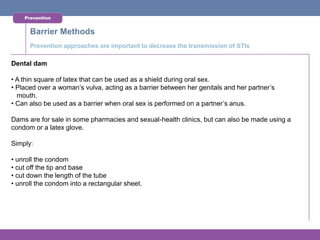
Dental dam

• A thin square of latex that can be used as a shield during oral sex.
• Placed over a woman’s vulva, acting as a barrier between her genitals and her partner’s
  mouth.
• Can also be used as a barrier when oral sex is performed on a partner’s anus.

Dams are for sale in some pharmacies and sexual-health clinics, but can also be made using a
condom or a latex glove.

Simply:

• unroll the condom
• cut off the tip and base
• cut down the length of the tube
• unroll the condom into a rectangular sheet.
Treatment


       Treatment Summary
                                                    Bacterial

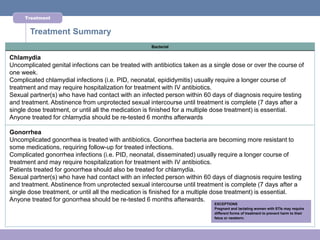
Chlamydia
Uncomplicated genital infections can be treated with antibiotics taken as a single dose or over the course of
one week.
Complicated chlamydial infections (i.e. PID, neonatal, epididymitis) usually require a longer course of
treatment and may require hospitalization for treatment with IV antibiotics.
Sexual partner(s) who have had contact with an infected person within 60 days of diagnosis require testing
and treatment. Abstinence from unprotected sexual intercourse until treatment is complete (7 days after a
single dose treatment, or until all the medication is finished for a multiple dose treatment) is essential.
Anyone treated for chlamydia should be re-tested 6 months afterwards

Gonorrhea
Uncomplicated gonorrhea is treated with antibiotics. Gonorrhea bacteria are becoming more resistant to
some medications, requiring follow-up for treated infections.
Complicated gonorrhea infections (i.e. PID, neonatal, disseminated) usually require a longer course of
treatment and may require hospitalization for treatment with IV antibiotics.
Patients treated for gonorrhea should also be treated for chlamydia.
Sexual partner(s) who have had contact with an infected person within 60 days of diagnosis require testing
and treatment. Abstinence from unprotected sexual intercourse until treatment is complete (7 days after a
single dose treatment, or until all the medication is finished for a multiple dose treatment) is essential.
Anyone treated for gonorrhea should be re-tested 6 months afterwards.
                                                                           EXCEPTIONS
                                                                           Pregnant and lactating women with STIs may require
                                                                           different forms of treatment to prevent harm to their
                                                                           fetus or newborn.
Treatment


     Treatment Summary
                                        Bacterial


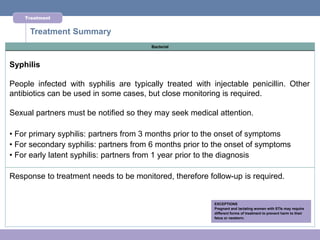
Syphilis

People infected with syphilis are typically treated with injectable penicillin. Other
antibiotics can be used in some cases, but close monitoring is required.

Sexual partners must be notified so they may seek medical attention.

• For primary syphilis: partners from 3 months prior to the onset of symptoms
• For secondary syphilis: partners from 6 months prior to the onset of symptoms
• For early latent syphilis: partners from 1 year prior to the diagnosis

Response to treatment needs to be monitored, therefore follow-up is required.


                                                          EXCEPTIONS
                                                          Pregnant and lactating women with STIs may require
                                                          different forms of treatment to prevent harm to their
                                                          fetus or newborn.
Treatment


      Treatment Summary
                                              Viral

Genital Herpes
Antiviral medications—acyclovir, famciclovir and valacyclovir—to be started as early as possible
following the onset of symptoms. Suppressive therapy can be considered for patients with
frequent outbreaks (six or more times per year).
Other considerations for management during an outbreak:
• Pain relievers and laxatives
• Hospitalization, should urine retention become a problem

Hepatitis B
There is no cure for hepatitis B, but a vaccine to prevent the infection is available.
Most individuals recover fully within about six months.
Individuals who are acutely infected with hepatitis B should abstain from sexual activity until
their partner(s) have been screened and immunized if needed. Household contacts should also
be screened and immunized if needed. If an individual is exposed, an injection of antibodies
may be given (up to 7 days after a needlestick injury and up to 14 days after sexual contact),
followed by the hepatitis B vaccine to help prevent infection. Infants born to infected mothers
should receive an injection of antibodies immediately after birth followed by the vaccine within
12 hours. Individuals with acute infections usually do not need antiviral medications. Those who
develop chronic hepatitis B require monitoring of their liver function and may benefit from
treatment with interferon or an anti-viral medication.
Treatment


       Treatment Summary
                                                Viral


HPV (Human Papillomavirus)
There is currently no cure for women and men infected with the virus. Vaccination is available to
prevent certain types of HPV.
Depending on their size, number and location, genital warts can be treated using several
different options, for example: strong acids and chemicals, topical cream, liquid nitrogen, electric
currents or laser therapy. Although partner notification is not required, patients are encouraged
to notify their partners that they have had genital warts or an abnormal Pap smear.


HIV (Human Immunodeficiency Virus)
No cure exists for HIV/AIDS. Treatments are continually evolving, helping people living with
HIV/AIDS control the virus and its symptoms.
Anti-retroviral therapy (ART) helps slow the progression of the infection and can help the
immune system restore itself. Though available HIV medications have lengthened the average
time from infection to progression to AIDS, there are significant side effects that may affect
quality of life. People on ART need to be monitored closely by a specialist for their response to
treatment and side effects.
Individuals diagnosed with HIV should inform sexual partners of their status. Failure to disclose
may have legal implications.
Treatment


     Treatment Summary
                                  Parasitic/Fungal

Trichomoniasis
Treated with medication, usually metronidazole. (No alcohol can be
consumed during treatment and for 24 hours following the completion of
treatment.)
Sexual partner(s) should be treated with metronidazole even if they do not
have symptoms. Testing is usually not recommended for male partners.

Pubic Lice/Scabies
Pubic lice:
The affected area should be washed and a lice-killing cream, lotion or
shampoo used (can be obtained directly at a pharmacy). Itchiness may last
for several weeks after treatment, which may be controlled with medication.
Repeat treatment recommendations should be followed closely.
Sexual partner(s) within the last month should be treated.
Clothes and bedding must be washed in hot water or drycleaned, and
mattresses should be vacuumed or, depending on the size, items may be
placed in a sealed plastic bag for 1 week.
Treatment


      Treatment Summary
                                           Parasitic/Fungal


Scabies:
Creams and lotions are available to treat scabies. These are typically applied and washed off in
a specified amount of time.
Clothes and bedding must be washed in hot water or drycleaned, and mattresses should be
vacuumed or, depending on the size, items may be placed in a sealed plastic bag for three
days to one week.
All household contacts and sexual partners within the month prior to infection should be
treated. Itching may continue for several weeks, so medication may be recommended. Repeat
treatment recommendations should be followed closely.

Candidiasis (Yeast Infection)
Several over-the-counter antifungal tablets, creams, ointments and suppositories are available.
These are inserted into the vagina for a period of 1 to 7 days. They can also be applied
externally to the vulva or penis.
In certain circumstances, oral medications are prescribed by a health care provider.
For problematic recurrent infections, maintenance therapy may be recommended.
Some medications used to treat yeast infections are harmful if used in pregnancy. All pregnant
women should seek medical advice prior to using any over-the-counter product.
Sexual partners do not need to be notified or clinically evaluated unless they have symptoms.
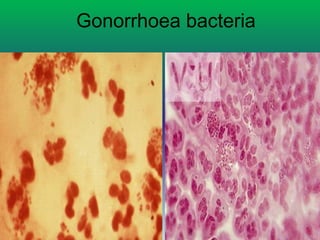
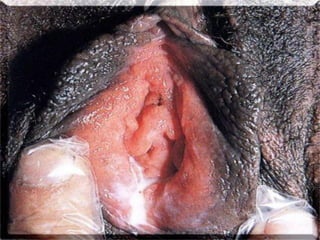
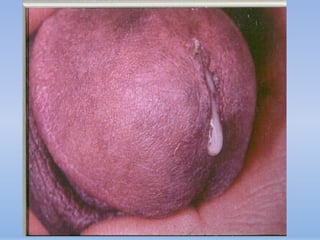
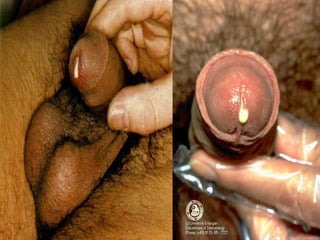
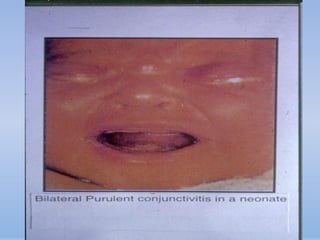
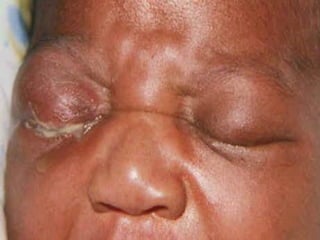
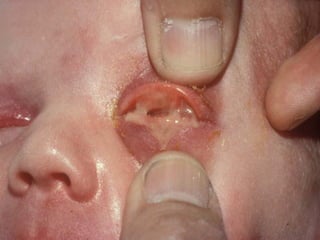
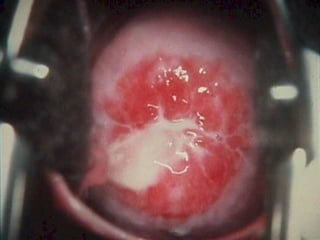
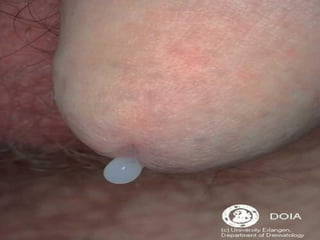
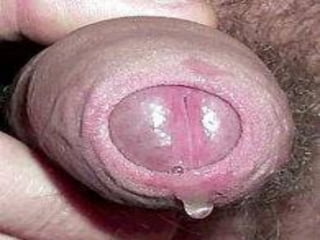
Gonorrhoea bacteria
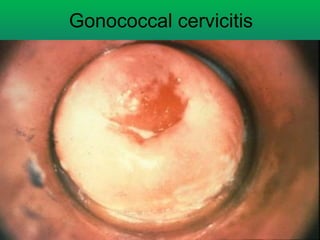
Gonococcal cervicitis
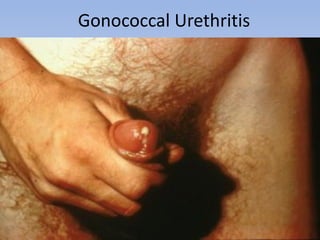
Gonococcal Urethritis
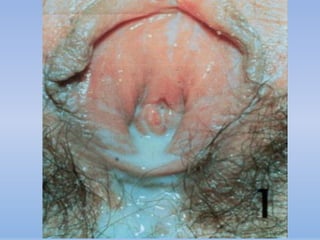
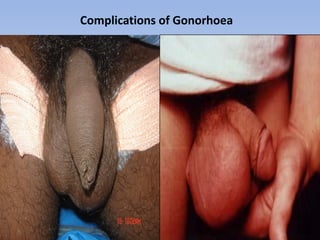
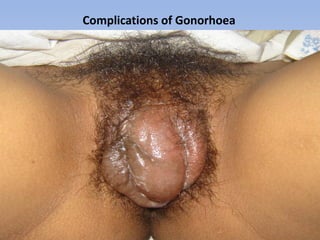
Complications of Gonorhoea
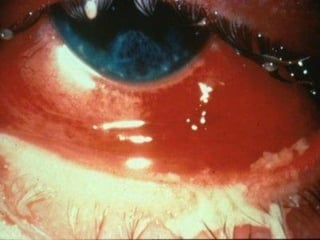
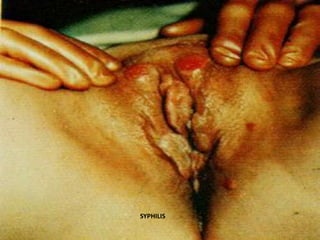
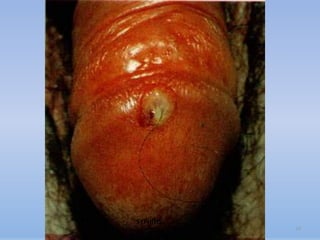
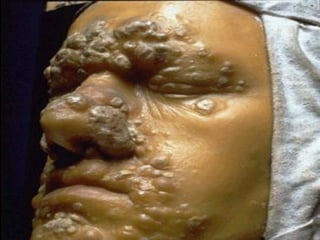
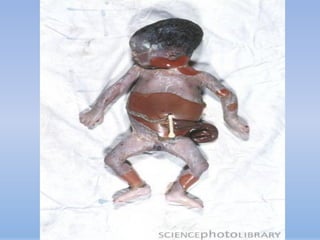
Syphilis photoes
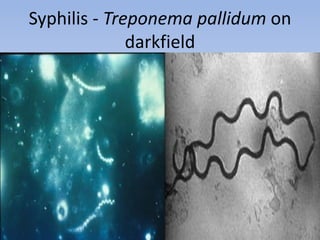
Syphilis - Treponema pallidum on
              darkfield
SYPHILIS
           76
SYPHILIS
           77
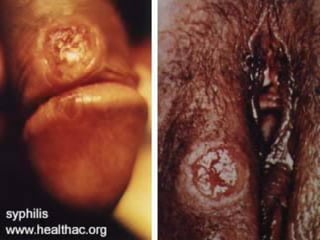
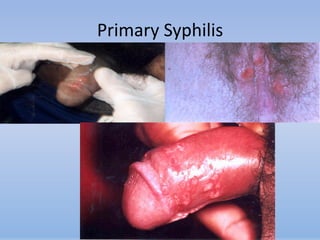
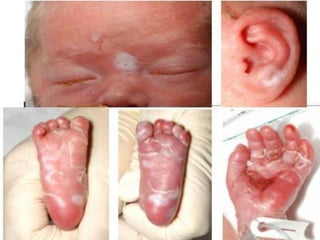
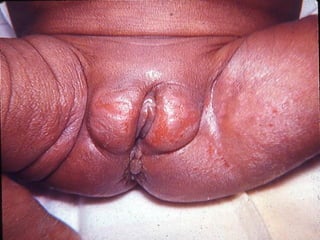
Primary Syphilis
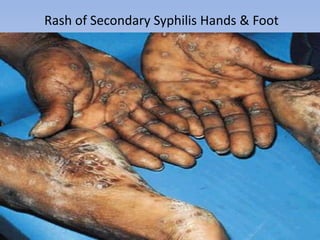
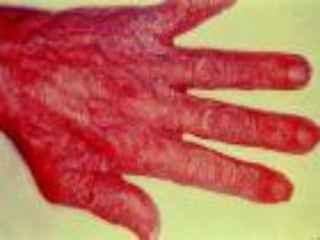
Rash of Secondary Syphilis Hands & Foot
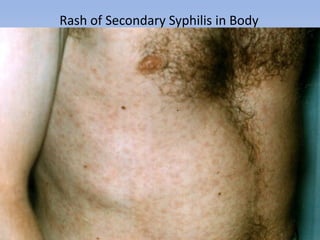
Rash of Secondary Syphilis in Body
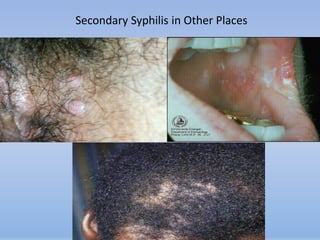
Secondary Syphilis in Other Places
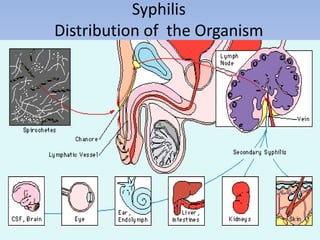
Syphilis
Distribution of the Organism
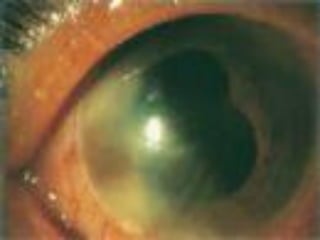
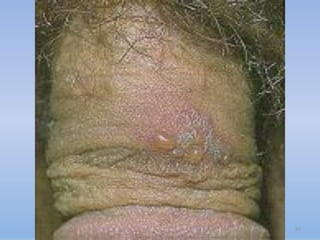
Herpes photos
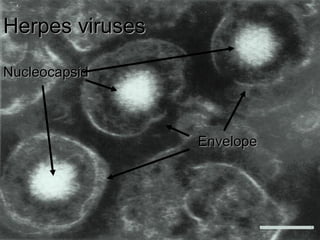
Herpes viruses

Nucleocapsid


                 Envelope
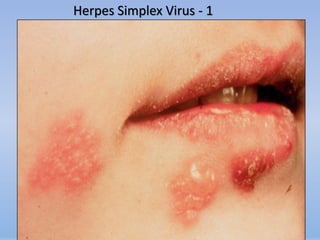
Herpes Simplex Virus - 1
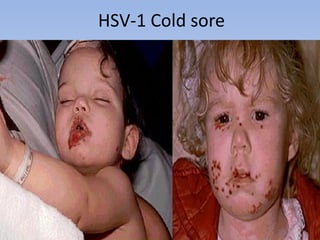
HSV-1 Cold sore
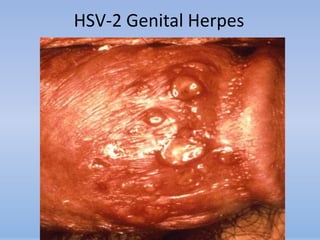
HSV-2 Genital Herpes
97
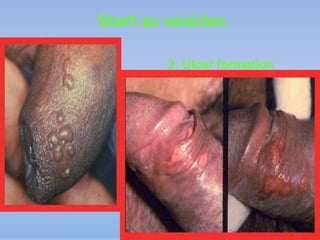
Start as vesicles

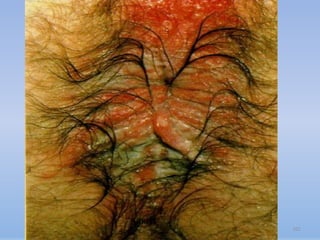
         2. Ulcer formation
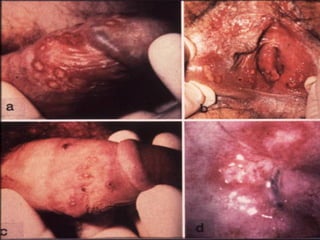
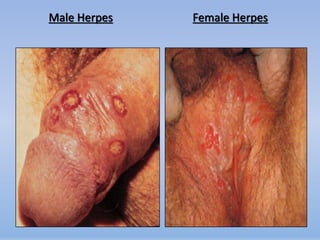
Male Herpes   Female Herpes
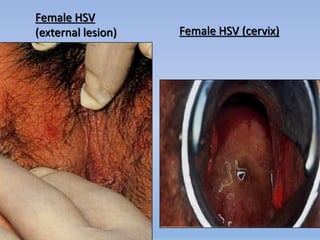
Female HSV
(external lesion)   Female HSV (cervix)
HERPES
         101
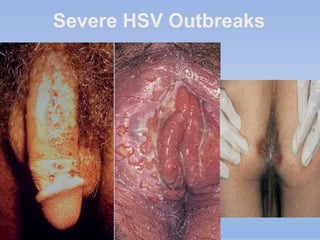
Severe HSV Outbreaks
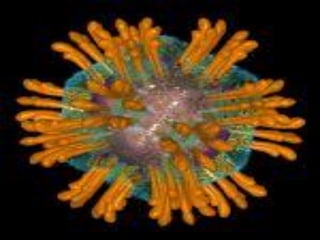
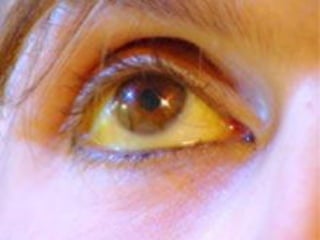
Hepatitis B photos
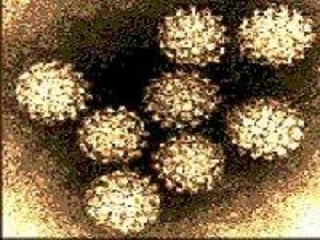
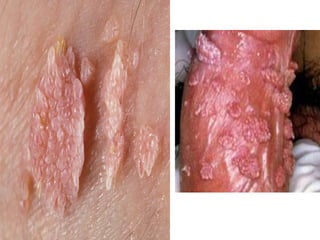
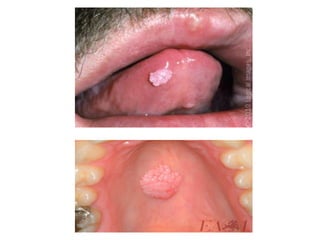
HPV
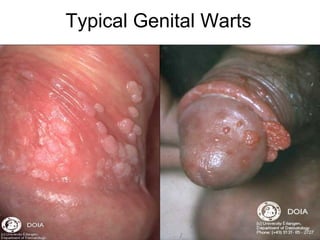
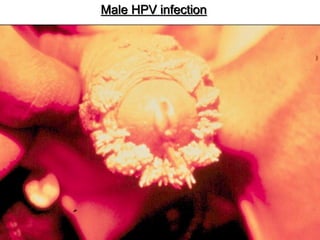
Typical Genital Warts
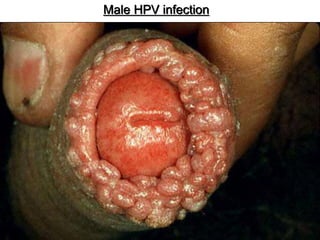
Male HPV infection
Male HPV infection
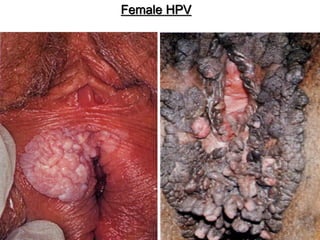
Female HPV
Scabies
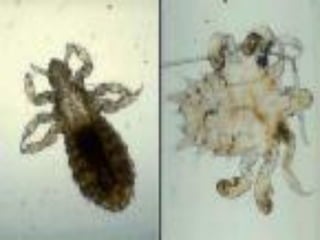
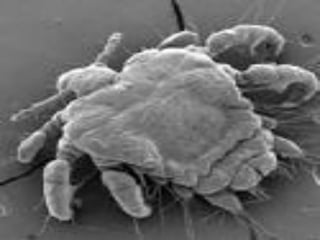
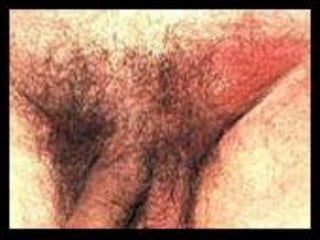
Pubic lies photoes
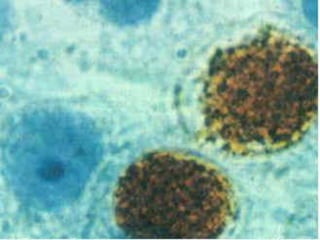
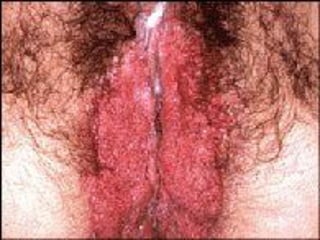
Trichomonasis photos
Clamedia Photos
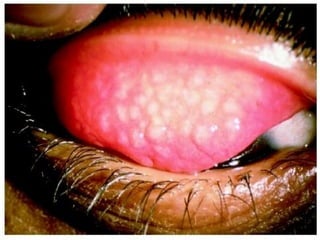
AIDS Photos
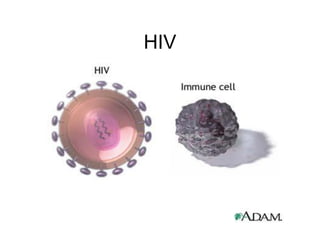
HIV
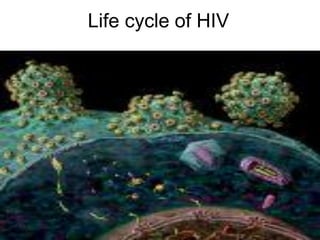
Life cycle of HIV
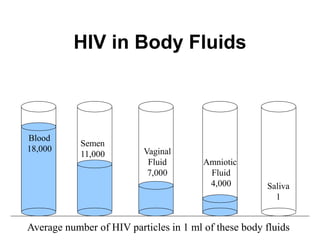
HIV in Body Fluids


Blood
            Semen
18,000                    Vaginal
            11,000
                           Fluid        Amniotic
                           7,000         Fluid
                                         4,000        Saliva
                                                        1


Average number of HIV particles in 1 ml of these body fluids
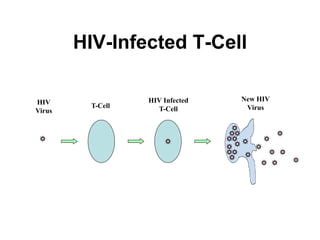
HIV-Infected T-Cell

HIV               HIV Infected   New HIV
         T-Cell     T-Cell        Virus
Virus
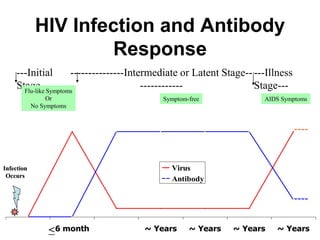
HIV Infection and Antibody
                     Response
     ---Initial        ---------------Intermediate or Latent Stage-- ---Illness
     Stage----
       Flu-like Symptoms
                                          ------------               Stage---
                 Or                         Symptom-free               AIDS Symptoms
            No Symptoms


                                                                                  ----


Infection                                     Virus
 Occurs
                                              Antibody

                                                                                  ----


                 < 6 month             ~ Years      ~ Years    ~ Years    ~ Years
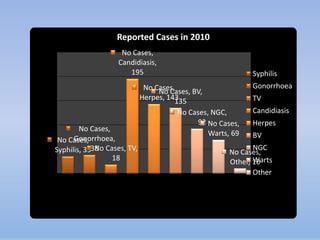
Reported Cases in 2010
                    No Cases,
                   Candidiasis,
                      195                                  Syphilis
                             No Cases,                     Gonorrhoea
                                 No Cases, BV,
                            Herpes, 143
                                      135                  TV
                                      No Cases, NGC,       Candidiasis
                                           92 No Cases,    Herpes
        No Cases,
                                               Warts, 69   BV
      Gonorrhoea,
 No Cases,
Syphilis, 3538 Cases, TV,
             No                                             NGC
                                                     No Cases,
                  18                                        Warts
                                                     Other, 10
                                                            Other
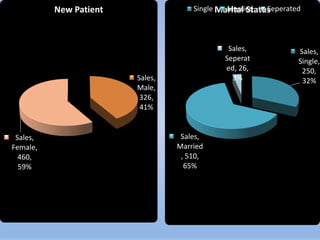
New Patient                Single Marital Status
                                              Married    Seperated


                                              Sales,             Sales,
                                             Seperat             Single,
                                             ed, 26,              250,
                        Sales,                 3%                 32%
                        Male,
                         326,
                         41%


 Sales,                           Sales,
Female,                          Married
  460,                            , 510,
  59%                              65%
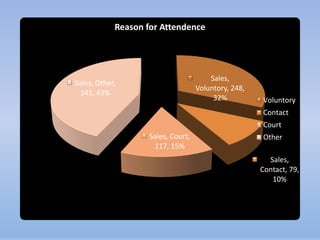
Reason for Attendence


                                        Sales,
Sales, Other,
                                    Voluntory, 248,
 341, 43%
                                         32%          Voluntory
                                                      Contact
                                                      Court
                    Sales, Court,                     Other
                     117, 15%
                                                        Sales,
                                                      Contact, 79,
                                                         10%
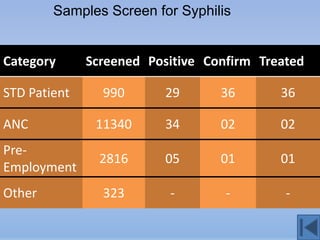
Samples Screen for Syphilis


Category      Screened Positive Confirm Treated

STD Patient     990       29      36       36

ANC            11340      34      02       02
Pre-
                2816      05      01       01
Employment
Other           323       -        -        -
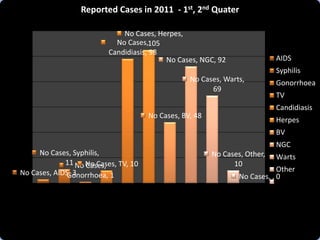
Reported Cases in 2011 - 1st, 2nd Quater

                              No Cases, Herpes,
                            No Cases,105
                          Candidiasis, 98
                                          No Cases, NGC, 92                 AIDS
                                                                            Syphilis
                                                  No Cases, Warts,          Gonorrhoea
                                                        69
                                                                            TV
                                                                            Candidiasis
                                      No Cases, BV, 48
                                                                            Herpes
                                                                            BV
                                                                            NGC
     No Cases, Syphilis,                                 No Cases, Other,   Warts
             11 No No Cases, TV, 10
                   Cases,                                      10
No Cases, AIDS, 3                                                            Other
              Gonorrhoea, 1                                      No Cases, , 0
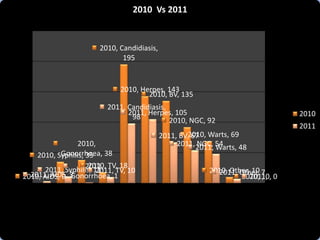
2010 Vs 2011


                       2010, Candidiasis,
                              195


                              2010, Herpes, 143
                                      2010, BV, 135
                          2011, Candidiasis,
                                2011, Herpes, 105                                 2010
                                 98          2010, NGC, 92
                                                                                  2011
                                            2011, BV,2010, Warts, 69
                                                      67
                2010,                            2011, 2011, 54
                                                       NGC, Warts, 48
    2010, Syphilis, 35 38
           Gonorrhoea,
                    2011, TV, 18
                     2010,
      2011, Syphilis, 11
                       2011, TV, 10                       2010, Other, 10 7
                                                            2011, Other,
2010, AIDS, 0 3
  2011, AIDS, Gonorrhoea, 1                                        2010, , 0, 0
                                                                      2011,
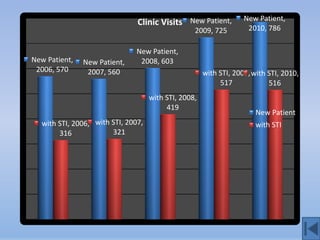
New Patient,
                               Clinic Visits New Patient,
                                                  2009, 725         2010, 786

                               New Patient,
New Patient,   New Patient,     2008, 603
 2006, 570      2007, 560                             with STI, 2009, with STI, 2010,
                                                           517             516
                                    with STI, 2008,
                                         419
                                                                       New Patient
  with STI, 2006, with STI, 2007,                                      with STI
       316             321
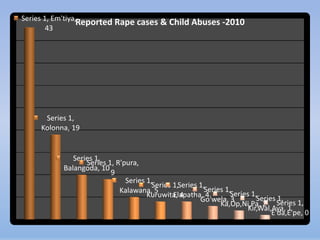
Series 1, Em'tiya,
                  Reported Rape cases & Child Abuses -2010
        43


      Series 1,
     Kolonna, 19


              Series 1,
                  Series 1, R'pura,
           Balangoda, 10
                          9
                               Series 1,
                                       Series 1,Series 1,
                             Kalawana, 5                Series 1,
                                      Kuruwita, 4
                                              Elapatha, 4       Series 1,
                                                       Go'wela, 3        Series 1,
                                                             Ka,Op,Ni,Pa, 2 Series 1,
                                                                      Kir,Wal,Aya, 1
                                                                              E'da,E'pe, 0
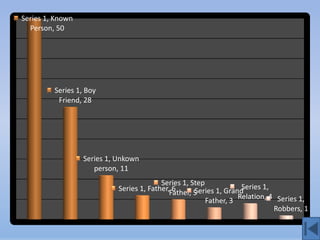
Series 1, Known
  Person, 50


         Series 1, Boy
          Friend, 28


                  Series 1, Unkown
                     person, 11
                                          Series 1, Step
                            Series 1, Father, 6                     Series 1,
                                                     Series 1, Grand
                                             Father, 5
                                                                   Relation, 4 Series 1,
                                                         Father, 3
                                                                              Robbers, 1
STD Clinic Rathanapura
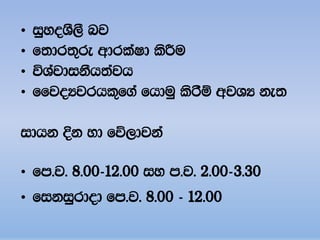
•   iqyoYS,S nj
•   f;dr;=re wdrlaId lsÍu
•   úYajdikSh;ajh
•   ffjoHjrhl=f.a fhduq lsrï wjYH ke;
                           S

idhk Èk yd fõ,djka

• fm'j' 8'00-12'00 iy m'j' 2'00-3'30
• fikiqrdod fm'j' 8'00 - 12'00
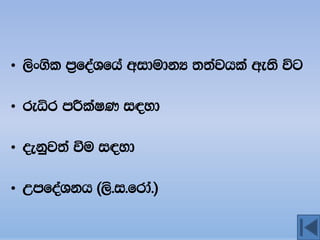
• ,sx.sl m%foaYfha widudkH ;;ajhla we;s úg

• reêr mÍlaIK i|yd

• ±kqj;a ùu i|yd

• WmfoaYkh ^,s'i'frda'&
,sx.dY%s; frda. u¾Ok tallh

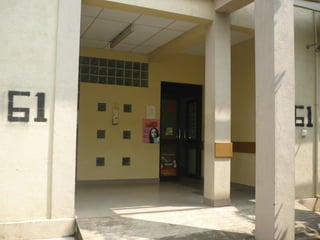
      ldur wxl 61
     m<d;a uy frday,
         r;akmqr

  ÿrl;k 045-2226165
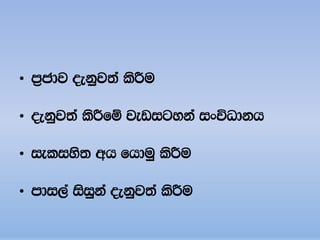
• m%cdj ±kqj;a lsÍu

• ±kqj;a lsÍfï jevigyka ixúOdkh

• ieliys; wh fhduq lsÍu

• mdi,a isiqka ±kqj;a lsÍu
References
• http://www.webmd.com/sex/sexually-
  transmitted-diseases?page=2
• http://www.2dix.com/ppt-2010
ia;+;shs
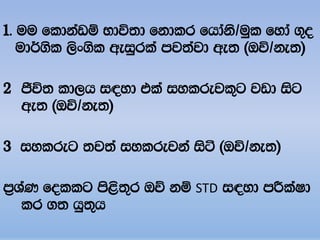
1' uu fldkavï Ndú;d fkdlr fhdaks$uql fyda .=o
   ud¾.sl ,sx.sl weiqrla mj;ajd we; ^Tú$ke;&

2 Ôú; ld,h i|yd tla iylrejl=g jvd isg
  we; ^Tú$ke;&

3 iylreg ;j;a iylrejka isà ^Tú$ke;&

m%YaK follg ms<s;=r Tõ kï STD i|yd mÍlaId
   lr .; hq;=h

Std prensentation

  • 1.
    ,sx.dYs%; fndajk frda. jhs' tï' t,a' l=udr uyck fi!LH mÍlaIl ,sx.dY%s; frda. u¾Ok tallh r;akmqr
  • 2.
    yeoskaùu nelaàßhd wdidok ^iqÿ ìxÿu& Gonorrhea ^WmoxYh& Syphilis ^la,eóähd& Chlamydia
  • 3.
    yeoskaùu ffjria wdidok ^taâia& HIV (Human Immunodeficiency Virus) ^y¾mSia& Genital Herpes ^,sx.sl bkakka& HPV (Human Papillomavirus) ^fymghsáia& Hepatitis B
  • 4.
    yeoskaùu mrfmdaYs;$È,Sr wdidok ^g%hsfldfudkdisia& Trichomoniasis ^lekaâvhisia&Candidiasis (Yeast Infection) ^bksl=kd& Pubic Lice (Crabs) ^fydß& Scabies
  • 5.
    yeoskaùu frda.Ska jd¾;d ùu2010 frda.Ska jd¾;d ùu 2011 ia;%s ¥IK yd <ud wmpdr ,sx.dYs%; frda. u¾Ok tallh Ung l, yels foa
  • 6.
    Introduction Sexually Transmitted Infections Toward effective prevention, diagnosis and treatment Precautions It is recommended that infected individuals and their sexual partner(s) abstain from sexual activity until: • treatment is complete (for treatable STIs) • symptoms have subsided • the infection is cured (for curable STIs, confirmed through follow-up testing, as appropriate). In the case of viral STIs, a health care provider can offer safer-sex and risk-reduction tips to prevent transmission. Condoms are important to reduce the risk of transmission, even if other methods of birth control are being used to prevent pregnancy.
  • 7.
    Lelaàßhd ^la,eóähd& Chlamydia hkq  iq,n nelaàßhd wdidokhla (Chlamydia Trachomatis)  .eíf., $ uq;%d ud¾.h l,d;=rlska .=o ud¾.h $ W.=r yd weia wdidokh fõ' fndajk l%u wdidÈ;hl= iu. mj;ajk wkdrÌs; ,sx.sl weiqr ^uqL$fhdak$.=o& s ore m%iQ;sfha È orejdf.a fmky¿ fyda weia wdidokh úh yel
  • 8.
    Lelaàßhd ^la,eóähd& Chlamydia frda. ,laIK ^i;s 2)6 miq& ia;%S fndfyda úg frda. ,laIK rys; kuq;a  fhdaks ud¾.fhka Y%dj msg ùu  uq;%d my lsÍfï È fõokdj  há nv m%foaYfha fõokdj  ixi¾.fhka miq fyda udia Y=oaêhg wu;rj reêr jykh  ixi¾.h w;r;=r fõokdj  .=o ud¾.fha fõokdj $ leiSu $ Y%dj msgùu
  • 9.
    Lelaàßhd ^la,eóähd& Chlamydia frda. ,laIK ^i;s 2)6 miq& mqreI fndfyda úg Èk 2)7 È frda. ,laIK fmkajhs  YsIaKh ;=,ska j;=r jeks lsß mdg Y%djhla msgùu  uq;%d my lsÍfï È oeú,a, $ fõokdj  jDIK fldaIj, fõokdj
  • 10.
    Lelaàßhd ^la,eóähd& Chlamydia ie,lsh hq;= lreKq yd ixl+,;d ia;%S  wdidokh" uq;dYh yd mef,damSh kd, olajd me;sÍu (Pelvic Inflammatory % Disease)  ksoka.; ;=káh fõokdj  j| Ndjh  .¾NdIfhka msg ms<siso .ekSï we;s ùfï wjodku mqreI  jDIK fldaI wdidokh  m¿ u;=ùu$ yxÈ fõokdj  l,d;=rlska j| Ndjh we;s ùu
  • 11.
    Lelaàßhd iqÿ ìxÿu hkq iq,n nelaàßhd wdidokhla ^khsisÍhd f.dfkdaßfha& .eíf.,$uq;%d ud¾.h$.=o ud¾.h$W.=r yd iuyr wjia:d j,os weia wdidokh fõ fndajk l%u wdidÈ;hl= iu. mj;ajk wkdrÌs; ,sx.sl weiqr ^uqL $ fhdaks $ .=o& ore m%iQ;sfha oS orejdg ^wlaIs wdidÈ; orefjla&
  • 12.
    Lelaàßhd iqÿ ìxÿu frda. ,laIK ia;%S fndfyda úg frda. ,laIK rys; kuq;a  fhdaks ud¾.fhka Y%dj msg ùu  uq;%d my lsÍfï È fõokdj  há nv m%foaYfha fõokdj  ixi¾.fhka miq fyda udia Y=oaêhg wu;rj reêr jykh  ixi¾.h w;r;=r fõokdj  .=o ud¾.fha fõokdj $ leiSu $ Y%dj msgùu
  • 13.
    Lelaàßhd iqÿ ìxÿu frda. ,laIK mqreI fndfyda úg Èk 2)7 È frda. ,laIK fmkajhs  YSIaKh ;=,ska >k ly)fld< mdg Y%djhla msgùu  uq;%d my lsÍfï È oeú,a, $ fõokdj  jDIK fldIj, fõokdj fyda bÈuqu  .=o ud¾.fha fõokdj $ leiSu $ Y%dj msgùu
  • 14.
    Lelaàßhd iqÿ ìxÿu ie,lsh hq;= lreKq yd ixl+,;d yÿkd fkd.;a yd m%;sldr fkd.;a fjk;a wdidok ;sìh yels nj taâia frda.h wdidokh ùfï yd me;sÍfï wjodku by, nj ia;%S  wdidokh" uq;%dYh yd mef,damSh kd, olajd me;sÍu (Pelvic Inflammatory Disease)  ksoka.; ;=káh fõokdj  j| Ndjh  .¾NdIfhka msg ms<siso .ekSï we;s ùfï wjodku mqreI  jDIK fldaI wdidokh  m¿ u;=ùu$ yxÈ fõokdj  l,d;=rlska j| Ndjh we;s ùu
  • 15.
    Lelaàßhd WmoxYh hkq  fg%fmdksud me,svï keu;s nelaàßhdj u.ska wdidokh jk  wjêlsysmhla mj;S  • ,xldfõ mj;sk merKs;u ,sx.d.%s; frda.h fndajk l%u  wdidÈ;hl= iu. mj;ajk wkdrÌs; ,sx.sl weiqr ^uqL $ fhdaks $ .=o&  reêr mdrú,hkh $ bÈ lgq $ isßkacia  wdidÈ; ujf.ka l<,hg ^.íid$u,ore Wm;a& fyda orejdg iyc WmoxYh
  • 16.
    Lelaàßhd WmoxYh frda. ,laIK Èk 9)90 ;a w;r ld,fha È frda. ,laIK fmkajhs m<uq wjêh  ia;%S yd mqreI ,sxf.akaøsh ;=< fyda wjg fõokd rys; ;=jd, u;= fõ  bls<sj, jid .eg;s bÈóu  m%;sldr .ekSulska f;drj bfí úh<S hhs  frda. îc YÍrh ;=, j¾Okh fõ
  • 17.
    Lelaàßhd WmoxYh fojk wjêh m<uq wjêfha ksis m%;dldr fkd,o úg i;s 6)24 fojk wjêh meñfKa  ifï l=IaG we;s ùu ^weÕ $ w;a, $ m;=, $ msg &  ysi flia .e, ú hdu  jid .eg;s bÈóu  WK yd ykaÈm;a fõokdj
  • 18.
    Lelaàßhd WmoxYh .=ma;wjêh  frda. ,laIK msg;g fkdfmkajhs  yDoh ) wksl=;a bkaøshka yd iakdhq moao;shg ydks muqKqjhs  .=m; wjÈfha uq,a ld,h olajd frda.h fndal, yel a  urKh
  • 19.
    Lelaàßhd WmoxYh WmoxYh yd .¾NkSNdjh  .en ;=, isák ì<sod wdidokh ùu  .íidùï  fkdfïrE ore Wm;a  u,ore Wm;a  ixcdkkSh WmoxYh iys; orejl= ìys ùu^YrSrh mqrd l=IaG we;s ùu kdiamqvq j,ska Y%dj msg ùu $ ikaê bÈóu $ jid .eg;s bÈóu&  idudkH f,i WmÈk orejd udi lsysmhlg miq frda. ,laIK fmkaùu
  • 20.
    Lelaàßhd WmoxYh WmoxYhyd .¾NkSNdjh <ore m%;sldr  frda. ,laIK we;s orejka  ksis m%;sldr fkd,;a ujlg Wmka orejka  m%iQ;shg i;s 4 fmr ksis m%;sldr fkd,;a ujlg Wmka orejka  fmksis,Ska m%;sÔjlh fkd,;a ujlg Wmka orejka
  • 21.
    ffjria y¾mSia nyq,j ,sx.sl m%foaYfha ;=jd, we;s lrkq ,nk frda.hls hkq y¾mSia isïmaf,laia ffjri u.ska fnda jk 1 uqLh wdY%S;j ;=jd, we; fõs' uqL ,sx.sl in|;dj,ska ,sx.sl m%foaYhg o fnda fõ 2 ,sx.sl m%foaYh wdY%S;j ;=jd, we;s fõs uqLh wdYS%;j o ;=jd, we;s úh yel m,uq wdidokfhka miq kej; wdidok we;s fõ
  • 22.
    ffjria y¾mSia nyq,j ,sx.sl m%foaYfha;=jd, we;s lrkq ,nk frda.hls kej; wdidok we;s jk wjia:d  udisl Tima ùu  udkisl wiykh  frda.d ndo  .¾NKs Ndjh  ie;alï  HIV wdidokh jeks m%;sYla;s W!K;d  iuyr T!IO
  • 23.
    ffjria y¾mSia nyq,j ,sx.sl m%foaYfha ;=jd, we;s lrkq ,nk frda.hls fndajk l%u  wdidÈ;hl= ^frda. ,laIK iys; $ rys;& iu. mj;ajk wkdrÌs; ,sx.sl weiqr ^uqL$fhdak$.=o& s  ism .ekSul È  wdidÈ; ujf.ka ore m%iQ;sfha orejg  fldkavï Ndú;fhka iïmQ¾K wdrlaIdjla fkd,efí
  • 24.
    ffjria y¾mSia nyq,j ,sx.sl m%foaYfha ;=jd, we;s lrkq ,nk frda.hls frda. ,laIK  ish¿u wdidÈ;hka frda. ,laIK fkdfmkajhs  Èk 2)21 w;r frda. ,laIK u;= fõ  ffjri we;=¿ jQ ia:dkfha oeú,a, fõokdj we;s fõ  Èhr msß l=vd ìì,s u;= ùu  fõokdldÍ ;=jd,  WK ) ysiro ) fldkafoa fõokdj  jid .%kaÓ bÈóu
  • 25.
    ffjria y¾mSia nyq,j ,sx.sl m%foaYfha ;=jd, we;s lrkq ,nk frda.hls y¾mSia yd .¾NkSNdjh  .eí .eksug ndOdjla fkd fõ  m%i; wjia:dfõ ;=jd, u;= ù we;s fyda m<uqj Q wdidok ùu orejdg n,mdhs  Y,Hl¾uh u.ska orejd ìys lsÍu  m%;sffjri T!IO ,nd Èu
  • 26.
    ffjria fymghsáia (Hepatitis B) A vaccine-preventable viral infection that affects the liver hkq wlaudj wdidokh lrk (Hepatitis B Virus) reêrh" YÍr ;r," ,sx.sl ;r, j," uõ lsß yd fl<j, ffjria wvx.= fõ wdidÈ;hska 90] m%;sfoay uÕska md,kh fõ 10] ksoka.; frda.Ska njg m;a fõ fndajk l%u  wdidÈ;hl= iu. mj;ajk wkdrÌs; ,sx.sl weiqr ^uqL$fhdak$.=o& s  reêr mdrú,hkh $ bÈ lgq $ isßkacia  wdidÈ; ujf.ka orejdg
  • 27.
    ffjria fymghsáia (Hepatitis B) frda. ,laIK fndfyda whg frda. ,laIK fkdfmkajhs i;s 08 miq  f;fyÜgqj  Tlaldrh" juKh  lEu reÑh wvq ùu  m¿ u;= ùu  yx¢ fõokdj  iuyrúg weia yd yu ly mdg ùu
  • 28.
    ffjria fymghsáia (Hepatitis B) ie,lsh hq;= lreKq yd ixl+,;d frda. wdYS;hska tkak;a lsÍu ksoka.; ;;ajh wlaudj wdYS; frda. we;s lrhs ^Ysfrdaisia $ ms,sld & m%;sffjri T!IO ,nd Èu
  • 29.
    ffjria ^taâia&HIV (Human Immunodeficiency Virus) hkq  m%;sYla;s lrk moao;shg wod, ffi, úkdYlrkq ,nkq  m%;sYla;s lrk moO;sh ÿ¾j, ùu uÕska Acquired Immunodeficiency Syndrome or AIDS frda.shl= njg m;a lrkq ,nk
  • 30.
    ffjria ^taâia& HIV (Human Immunodeficiency Virus) frda. jHdma;sh wdidê; mqoa.,hl=f.a  reêrh  ,sx.sl m%foaYfha we;s ;r,  Y=l% ;r,h  uõ lsß  wkdrÌs; ,sx.sl weiqr ^uqL$fhdaks$.=o&  bÈlgq yd wksl=;a T!IO WmlrK  HIV wdidê; reêrh yd reêr.; ksIamdok  wdidê; reêrh ;ejrekq o;a nqreiq f¾i¾  .¾NkS wjia:dfõ oS yd uõ lsß oSfï oS
  • 31.
    ffjria ^taâia& HIV (Human Immunodeficiency Virus) frda. jHd;a;sh isÿ fkdjk wjia:d u¥re oIagkh wksl=;a lDñ i;=ka uÕska wdidê; reêrh wvx.= fkdfõ kï  fl,  oyâh  l¥¿  uq;%d  wiQÑ uÕska frda.h iïfm%aIKh fkdfõ
  • 32.
    ffjria ^taâia& HIV (Human Immunodeficiency Virus) frda. ,laIK frda. îc YÍr .; ù i;s 2)4 ;=, oS ;o WK je, oS Èk lsysmhlska iqj ù hhs îfc!Ik iuh wjqreÿ 15)20 olajd mej;sh yel m%;sYla;sh ÿ¾j, jQ úg  ks;r WK yd oyäh oeóu  nr wvq ùu  yxÈ yd uiamsvq fõokdj  m¿ u;= ùu  jid .%ka;s bÈóu  fikaf.ä  f;fyÜgqj yd Yla;sh wvq ùu  ysiroh  Tlaldrh jukh mdpkh
  • 33.
    ffjria ^taâia& HIV (Human Immunodeficiency Virus) ie,lsh hq;= lreKq  ljq¿ iuh ;=, È mÍlaIK j,ska yªkd .; fkdyel ^udi 03la hk ;=re&  frda.h iïmQ¾Kfhka iqj lsÍug m%;sldr fkdue;  AIDS ;;Ajhg m;a fkdù isàug m%;sldr we;  AIDS ;;Ajhg m;a jQ miq fjk;a wdidok j,g nyq,j Ndckh ù urKh isÿ úh yl
  • 34.
    ffjria hkq  iq,n ffjhsriawdidokhla ^yshquka memsf,daud ffjhsria&  ffjhsria j¾. 100 jvd we;'  wvq wjodkï ffjhsria j¾. ,sx.sl wjhjj, bkakka we;s lrhs  jeä wjodkï ffjhsria j¾. .eí f., ms,sld we;s lrhs  iuyr j¾. i|yd je,elaùfï tkak;a we; fndajk l%u  wdidÈ;hl= iu. mj;ajk wkdrÌs; ,sx.sl weiqr ^uqL$fhdaks$.=o&  wdidÈ;hl= iu. mj;ajk ,sx.sl l%shdldrlï  ore m%iQ;sfha È orejdg
  • 35.
    ffjria frda. ,laIK  leiSu ixi¾.h w;r;=r wmyiq;d oekSu  ixi¾.h w;r;=r reêr jykh  wvq wjodkï ffjhsria j¾. fndafyda úg frda. ,laIK fkdfmkajhs  l=vd f.dajd u,a jeks r;= fyda frdai meyefhka hq;= bkakka fhdaks .=o ud¾.fha fyda uqLfha we;s fõ  m%udKh yd bkakka .kk fjkia fõ  .¾Nks ld,h ;=, È bkakkaf.a m%udKh yd .kk jeä úh yelsh  mqreI $ ia;%s frda. ,laIK
  • 36.
    ffjria ixl+,;d  bkakka kej;kej; we;s ùu  ms,sld • .eí f., • fhdaks ud¾.h • .=o ud¾.h • YsIaKh  wd;;sh  uq;%d yd fhdaks ud¾.fha wjysr;d
  • 37.
    mrfmdaYs;$È,Sr ^lekaävhisia& Candidiasis (Yeast Infection) A common fungal infection caused by overgrowth of the naturally occurring yeast Candida hkq hSÜia j¾.hg wh;a lekaävd we,aìlkaia kï È,Srfhka isÿ jk  idudkHfhka ldka;djkaf.a fhdaks ud¾.fha mj;S  w;sßla; f,i j¾Okh jQ úg lekaävhisia ;;ajhg meñfKa  uqLh" .,kd,h" yu yd reêrh wdYS;j je, foa w;sßla; jrOkhg n,mdk fy;=  .¾NkS Ndjh  Ⱦ> ld,Sk m%;sÔjl T!IO .ekSu  Èhjeähdj  m%;sYla;sh ySk ùu
  • 38.
    mrfmdaYs;$È,Sr ^lekaävhisia& Candidiasis (Yeast Infection) frda. ,laIK iA;%S  fhdaks ud¾s.fha leiSu  iqÿ meye;s lsß leo,s jeks Èhrhla msg ùu  bÈó fyda r;= mdg iajNdjhla .ekSu  uq;%d lrk úg oeú,a, mqreI  ,sx. uqKavh m%odyhg ,la ùu (Balanitis)  leiSu  YsIakh w. r;= mdg dots u;= ùu  fmriu úh,Su
  • 39.
    mrfmdaYs;$È,Sr ^bksl=kd& Pubic Lice Infections caused by parasitic infestations hkq ,sx.sl m%foaYfha ðj;a jk l=vd l=reñKs úfYaIhla (Phthirus Pubis) weia msydgq lsys,, yd frdau wdYs%; m%foaY j, f,a Wrd a fndñka Ôj;a fõ frda. iïfm%aIkh iam¾Yh uÕska wdidÈ; we;sß,s ;=jd yd NdKav ^Èk 02 mj;S& ,sx.sl l%shdldrlï
  • 40.
    mrfmdaYs;$È,Sr ^bksl=kd& Pubic Lice frda. ,laIK i;s 3)4 miq  leiSu yd yu m%odyhg ,la ùu yd r;= mdg ùu  imd lE ia:dk j, ks,a mdg m¿ u;= ùu ie,lsh hq;= lreKq oaú;Sh nelaàßhd wdidok we;s ùu  ish¿u wdYs;hka m%;sldr .ekSu  frÈ we| we;sß,s fyd¢ka msßisÿ lsÍu
  • 41.
    mrfmdaYs;$È,Sr ^fydß& Scabies hkq  l=vd mrfmdaYs;hl=f.ka (Sarcoptes Scabiei) yg .kakd  ,sx.sl l%shdldrlï fyda iam¾Yfhka fnda jk^wdidÈ; we;sß,s" ;=jd yd NdKav Èk 03 mj;S&  yu hg ì;a;r ouk yd WKqiqï l,dm j, jeämqr yg .kakd ^j,Ælr" oKysia" weÕs,s" ;Ügï" mshhqre yd ,sx.sl wjhj &
  • 42.
    mrfmdaYs;$È,Sr ^fydß& Scabies frda. ,laIK i;s 3)4 miq  leiSu úfYaIfhka rd;%S ld,hg  r;= mdg m¿ u;= ùu  úáka úg yg .ekSu
  • 43.
    mrfmdaYs;$È,Sr ^fydß& Scabies ie,lsh hq;= lreKq oaú;Sh nelaàßhd wdidok we;s ùu  ish¿u wdYs%;hka m%;sldr .ekSu  frÈ we| we;sß,s fyd¢ka msßisÿ lsÍu
  • 44.
    mrfmdaYs;$È,Sr ^g%hsfldfudkdisia& Trichomoniasis A sexually transmitted parasitic infection commonly referred to as trich hkq  tal ffi,l Ôúhl=f.ka ^Trichomonas vaginalis& yg .kakd frda.S ;;ajhla uq;%d ud¾.h" fhdaks ud¾.h" .¾NdYh" fmriu hg yuq fõ'
  • 45.
    mrfmdaYs;$È,Sr ^g%hsfldfudkdisia& Trichomoniasis frda. ,laIK ia;S%  ly fld< mdgg yqre Y%dj msgùula  leiSu  uq;%d msg lrk úg oeú,a, mqreI  fndfyda úg frda. ,laIK fkdfmkajhs  uq;%d újrh r;= mdg ùu fyda bß;e,Su  uq;%d msg lrk úg oeú,a,
  • 46.
    mrfmdaYs;$È,Sr ^g%hsfldfudkdisia& Trichomoniasis ie,lsh hq;= lreKq  fkdfïrE ore Wm;a  nr wvq ore Wm;a
  • 47.
    Testing/Screening Importance and Timing The early detection and treatment of STIs is critical to prevent further spread of infections Decreasing the risks Early identification and treatment of an STI can help decrease the possibility of complications, both for an infected individual and their sexual partner(s). This is especially true for women, as undetected and untreated infections can lead to: • pelvic inflammatory disease • ectopic pregnancy • chronic pelvic pain and; • infertility.
  • 48.
    Testing/Screening Importance and Timing When to get tested • Individuals who suspect they may have contracted an STI should ask for guidance about when to get tested. • Regardless of symptoms, at-risk individuals should be screened regularly. • Visible symptoms should not be the only reason for testing, as many infections are asymptomatic. If symptoms are not present or a person is infectious before symptoms appear, the infection can be unknowingly passed on to others. • At the start of any new sexual relationship, it is a good idea for both partners to get assessed and screened for infections. • Suspicion or diagnosis of an STI should prompt testing for other STIs if not already done.
  • 49.
    Testing Methods Diagnosing Sexually Transmitted Infections The main methods of testing/screening are: 1. Swab from the urethra, cervix, vagina, anus or throat 2. Urine test 3. Blood test Approaches differ by infection and gender, and vary across the country.
  • 50.
    Testing Methods Diagnosing Sexually Transmitted Infections STI Diagnostic Method Bacterial Chlamydia Swab from the infected area. Urine sample for men; urine sample for women where available, when a pelvic exam is not done or indicated Gonorrhea Swab from the infected area or a urine sample in cases where a swab is not an option Syphilis Blood sample and/or swab from the sore Viral Genital Herpes Swab from sore(s) and/or a blood test (currently not widely available) HPV* Physical exam for visible warts Pap test to detect abnormal cells in the cervix Hepatitis B Blood test HIV Blood test Parasitic/Fungal Trichomoniasis Physical examination and vaginal swab Lice/Crabs/Scabies Examination of skin and hair Yeast Infection Physical examination and vaginal swab
  • 51.
    Prevention Barrier Methods Prevention approaches are important to decrease the transmission of STIs Male condom • A sheath placed on an erect penis • Prevents the exchange of fluids during intercourse or oral sex. • Latex condoms offer protection against the transmission of many STIs. • Polyurethane condoms are also highly effective, but are more prone to breakage. • Condoms made from sheep membrane are not effective barriers. • Condoms may not fully protect against herpes and HPV, as the viruses can be found in areas not protected by a condom. Female condom • A polyurethane sheath worn inside the vagina during sexual intercourse. • It has two rings— an inner one at the closed end; and an outer ring that remains outside the vagina. • It should not be used with a male condom.
  • 52.
    Prevention Barrier Methods Prevention approaches are important to decrease the transmission of STIs Dental dam • A thin square of latex that can be used as a shield during oral sex. • Placed over a woman’s vulva, acting as a barrier between her genitals and her partner’s mouth. • Can also be used as a barrier when oral sex is performed on a partner’s anus. Dams are for sale in some pharmacies and sexual-health clinics, but can also be made using a condom or a latex glove. Simply: • unroll the condom • cut off the tip and base • cut down the length of the tube • unroll the condom into a rectangular sheet.
  • 53.
    Treatment Treatment Summary Bacterial Chlamydia Uncomplicated genital infections can be treated with antibiotics taken as a single dose or over the course of one week. Complicated chlamydial infections (i.e. PID, neonatal, epididymitis) usually require a longer course of treatment and may require hospitalization for treatment with IV antibiotics. Sexual partner(s) who have had contact with an infected person within 60 days of diagnosis require testing and treatment. Abstinence from unprotected sexual intercourse until treatment is complete (7 days after a single dose treatment, or until all the medication is finished for a multiple dose treatment) is essential. Anyone treated for chlamydia should be re-tested 6 months afterwards Gonorrhea Uncomplicated gonorrhea is treated with antibiotics. Gonorrhea bacteria are becoming more resistant to some medications, requiring follow-up for treated infections. Complicated gonorrhea infections (i.e. PID, neonatal, disseminated) usually require a longer course of treatment and may require hospitalization for treatment with IV antibiotics. Patients treated for gonorrhea should also be treated for chlamydia. Sexual partner(s) who have had contact with an infected person within 60 days of diagnosis require testing and treatment. Abstinence from unprotected sexual intercourse until treatment is complete (7 days after a single dose treatment, or until all the medication is finished for a multiple dose treatment) is essential. Anyone treated for gonorrhea should be re-tested 6 months afterwards. EXCEPTIONS Pregnant and lactating women with STIs may require different forms of treatment to prevent harm to their fetus or newborn.
  • 54.
    Treatment Treatment Summary Bacterial Syphilis People infected with syphilis are typically treated with injectable penicillin. Other antibiotics can be used in some cases, but close monitoring is required. Sexual partners must be notified so they may seek medical attention. • For primary syphilis: partners from 3 months prior to the onset of symptoms • For secondary syphilis: partners from 6 months prior to the onset of symptoms • For early latent syphilis: partners from 1 year prior to the diagnosis Response to treatment needs to be monitored, therefore follow-up is required. EXCEPTIONS Pregnant and lactating women with STIs may require different forms of treatment to prevent harm to their fetus or newborn.
  • 55.
    Treatment Treatment Summary Viral Genital Herpes Antiviral medications—acyclovir, famciclovir and valacyclovir—to be started as early as possible following the onset of symptoms. Suppressive therapy can be considered for patients with frequent outbreaks (six or more times per year). Other considerations for management during an outbreak: • Pain relievers and laxatives • Hospitalization, should urine retention become a problem Hepatitis B There is no cure for hepatitis B, but a vaccine to prevent the infection is available. Most individuals recover fully within about six months. Individuals who are acutely infected with hepatitis B should abstain from sexual activity until their partner(s) have been screened and immunized if needed. Household contacts should also be screened and immunized if needed. If an individual is exposed, an injection of antibodies may be given (up to 7 days after a needlestick injury and up to 14 days after sexual contact), followed by the hepatitis B vaccine to help prevent infection. Infants born to infected mothers should receive an injection of antibodies immediately after birth followed by the vaccine within 12 hours. Individuals with acute infections usually do not need antiviral medications. Those who develop chronic hepatitis B require monitoring of their liver function and may benefit from treatment with interferon or an anti-viral medication.
  • 56.
    Treatment Treatment Summary Viral HPV (Human Papillomavirus) There is currently no cure for women and men infected with the virus. Vaccination is available to prevent certain types of HPV. Depending on their size, number and location, genital warts can be treated using several different options, for example: strong acids and chemicals, topical cream, liquid nitrogen, electric currents or laser therapy. Although partner notification is not required, patients are encouraged to notify their partners that they have had genital warts or an abnormal Pap smear. HIV (Human Immunodeficiency Virus) No cure exists for HIV/AIDS. Treatments are continually evolving, helping people living with HIV/AIDS control the virus and its symptoms. Anti-retroviral therapy (ART) helps slow the progression of the infection and can help the immune system restore itself. Though available HIV medications have lengthened the average time from infection to progression to AIDS, there are significant side effects that may affect quality of life. People on ART need to be monitored closely by a specialist for their response to treatment and side effects. Individuals diagnosed with HIV should inform sexual partners of their status. Failure to disclose may have legal implications.
  • 57.
    Treatment Treatment Summary Parasitic/Fungal Trichomoniasis Treated with medication, usually metronidazole. (No alcohol can be consumed during treatment and for 24 hours following the completion of treatment.) Sexual partner(s) should be treated with metronidazole even if they do not have symptoms. Testing is usually not recommended for male partners. Pubic Lice/Scabies Pubic lice: The affected area should be washed and a lice-killing cream, lotion or shampoo used (can be obtained directly at a pharmacy). Itchiness may last for several weeks after treatment, which may be controlled with medication. Repeat treatment recommendations should be followed closely. Sexual partner(s) within the last month should be treated. Clothes and bedding must be washed in hot water or drycleaned, and mattresses should be vacuumed or, depending on the size, items may be placed in a sealed plastic bag for 1 week.
  • 58.
    Treatment Treatment Summary Parasitic/Fungal Scabies: Creams and lotions are available to treat scabies. These are typically applied and washed off in a specified amount of time. Clothes and bedding must be washed in hot water or drycleaned, and mattresses should be vacuumed or, depending on the size, items may be placed in a sealed plastic bag for three days to one week. All household contacts and sexual partners within the month prior to infection should be treated. Itching may continue for several weeks, so medication may be recommended. Repeat treatment recommendations should be followed closely. Candidiasis (Yeast Infection) Several over-the-counter antifungal tablets, creams, ointments and suppositories are available. These are inserted into the vagina for a period of 1 to 7 days. They can also be applied externally to the vulva or penis. In certain circumstances, oral medications are prescribed by a health care provider. For problematic recurrent infections, maintenance therapy may be recommended. Some medications used to treat yeast infections are harmful if used in pregnancy. All pregnant women should seek medical advice prior to using any over-the-counter product. Sexual partners do not need to be notified or clinically evaluated unless they have symptoms.
  • 59.
  • 60.
  • 61.
  • 70.
  • 71.
  • 73.
  • 74.
    Syphilis - Treponemapallidum on darkfield
  • 76.
  • 77.
  • 78.
  • 79.
    Rash of SecondarySyphilis Hands & Foot
  • 80.
    Rash of SecondarySyphilis in Body
  • 82.
  • 87.
  • 89.
  • 90.
  • 92.
  • 93.
  • 96.
  • 97.
  • 98.
    Start as vesicles 2. Ulcer formation
  • 99.
    Male Herpes Female Herpes
  • 100.
    Female HSV (external lesion) Female HSV (cervix)
  • 101.
  • 103.
  • 105.
  • 111.
  • 115.
  • 116.
  • 117.
  • 118.
  • 119.
  • 127.
  • 132.
  • 134.
  • 142.
  • 143.
  • 145.
  • 146.
    HIV in BodyFluids Blood Semen 18,000 Vaginal 11,000 Fluid Amniotic 7,000 Fluid 4,000 Saliva 1 Average number of HIV particles in 1 ml of these body fluids
  • 147.
    HIV-Infected T-Cell HIV HIV Infected New HIV T-Cell T-Cell Virus Virus
  • 148.
    HIV Infection andAntibody Response ---Initial ---------------Intermediate or Latent Stage-- ---Illness Stage---- Flu-like Symptoms ------------ Stage--- Or Symptom-free AIDS Symptoms No Symptoms ---- Infection Virus Occurs Antibody ---- < 6 month ~ Years ~ Years ~ Years ~ Years
  • 151.
    Reported Cases in2010 No Cases, Candidiasis, 195 Syphilis No Cases, Gonorrhoea No Cases, BV, Herpes, 143 135 TV No Cases, NGC, Candidiasis 92 No Cases, Herpes No Cases, Warts, 69 BV Gonorrhoea, No Cases, Syphilis, 3538 Cases, TV, No NGC No Cases, 18 Warts Other, 10 Other
  • 152.
    New Patient Single Marital Status Married Seperated Sales, Sales, Seperat Single, ed, 26, 250, Sales, 3% 32% Male, 326, 41% Sales, Sales, Female, Married 460, , 510, 59% 65%
  • 153.
    Reason for Attendence Sales, Sales, Other, Voluntory, 248, 341, 43% 32% Voluntory Contact Court Sales, Court, Other 117, 15% Sales, Contact, 79, 10%
  • 154.
    Samples Screen forSyphilis Category Screened Positive Confirm Treated STD Patient 990 29 36 36 ANC 11340 34 02 02 Pre- 2816 05 01 01 Employment Other 323 - - -
  • 155.
    Reported Cases in2011 - 1st, 2nd Quater No Cases, Herpes, No Cases,105 Candidiasis, 98 No Cases, NGC, 92 AIDS Syphilis No Cases, Warts, Gonorrhoea 69 TV Candidiasis No Cases, BV, 48 Herpes BV NGC No Cases, Syphilis, No Cases, Other, Warts 11 No No Cases, TV, 10 Cases, 10 No Cases, AIDS, 3 Other Gonorrhoea, 1 No Cases, , 0
  • 156.
    2010 Vs 2011 2010, Candidiasis, 195 2010, Herpes, 143 2010, BV, 135 2011, Candidiasis, 2011, Herpes, 105 2010 98 2010, NGC, 92 2011 2011, BV,2010, Warts, 69 67 2010, 2011, 2011, 54 NGC, Warts, 48 2010, Syphilis, 35 38 Gonorrhoea, 2011, TV, 18 2010, 2011, Syphilis, 11 2011, TV, 10 2010, Other, 10 7 2011, Other, 2010, AIDS, 0 3 2011, AIDS, Gonorrhoea, 1 2010, , 0, 0 2011,
  • 157.
    New Patient, Clinic Visits New Patient, 2009, 725 2010, 786 New Patient, New Patient, New Patient, 2008, 603 2006, 570 2007, 560 with STI, 2009, with STI, 2010, 517 516 with STI, 2008, 419 New Patient with STI, 2006, with STI, 2007, with STI 316 321
  • 158.
    Series 1, Em'tiya, Reported Rape cases & Child Abuses -2010 43 Series 1, Kolonna, 19 Series 1, Series 1, R'pura, Balangoda, 10 9 Series 1, Series 1,Series 1, Kalawana, 5 Series 1, Kuruwita, 4 Elapatha, 4 Series 1, Go'wela, 3 Series 1, Ka,Op,Ni,Pa, 2 Series 1, Kir,Wal,Aya, 1 E'da,E'pe, 0
  • 159.
    Series 1, Known Person, 50 Series 1, Boy Friend, 28 Series 1, Unkown person, 11 Series 1, Step Series 1, Father, 6 Series 1, Series 1, Grand Father, 5 Relation, 4 Series 1, Father, 3 Robbers, 1
  • 160.
  • 161.
    iqyoYS,S nj • f;dr;=re wdrlaId lsÍu • úYajdikSh;ajh • ffjoHjrhl=f.a fhduq lsrï wjYH ke; S idhk Èk yd fõ,djka • fm'j' 8'00-12'00 iy m'j' 2'00-3'30 • fikiqrdod fm'j' 8'00 - 12'00
  • 162.
    • ,sx.sl m%foaYfhawidudkH ;;ajhla we;s úg • reêr mÍlaIK i|yd • ±kqj;a ùu i|yd • WmfoaYkh ^,s'i'frda'&
  • 166.
    ,sx.dY%s; frda. u¾Oktallh ldur wxl 61 m<d;a uy frday, r;akmqr ÿrl;k 045-2226165
  • 167.
    • m%cdj ±kqj;alsÍu • ±kqj;a lsÍfï jevigyka ixúOdkh • ieliys; wh fhduq lsÍu • mdi,a isiqka ±kqj;a lsÍu
  • 168.
    References • http://www.webmd.com/sex/sexually- transmitted-diseases?page=2 • http://www.2dix.com/ppt-2010
  • 169.
  • 170.
    1' uu fldkavïNdú;d fkdlr fhdaks$uql fyda .=o ud¾.sl ,sx.sl weiqrla mj;ajd we; ^Tú$ke;& 2 Ôú; ld,h i|yd tla iylrejl=g jvd isg we; ^Tú$ke;& 3 iylreg ;j;a iylrejka isà ^Tú$ke;& m%YaK follg ms<s;=r Tõ kï STD i|yd mÍlaId lr .; hq;=h