Appendix 4C
                                                                                                   Page 1 of 10


                             Greater Mekong Sub-region (GMS):
                           STCF-9, 2-3 June 2009 Bangkok, Thailand


               Mr. Chaleun Sibounheuang
               National Authority of Posts and Telecommunications Lao PDR


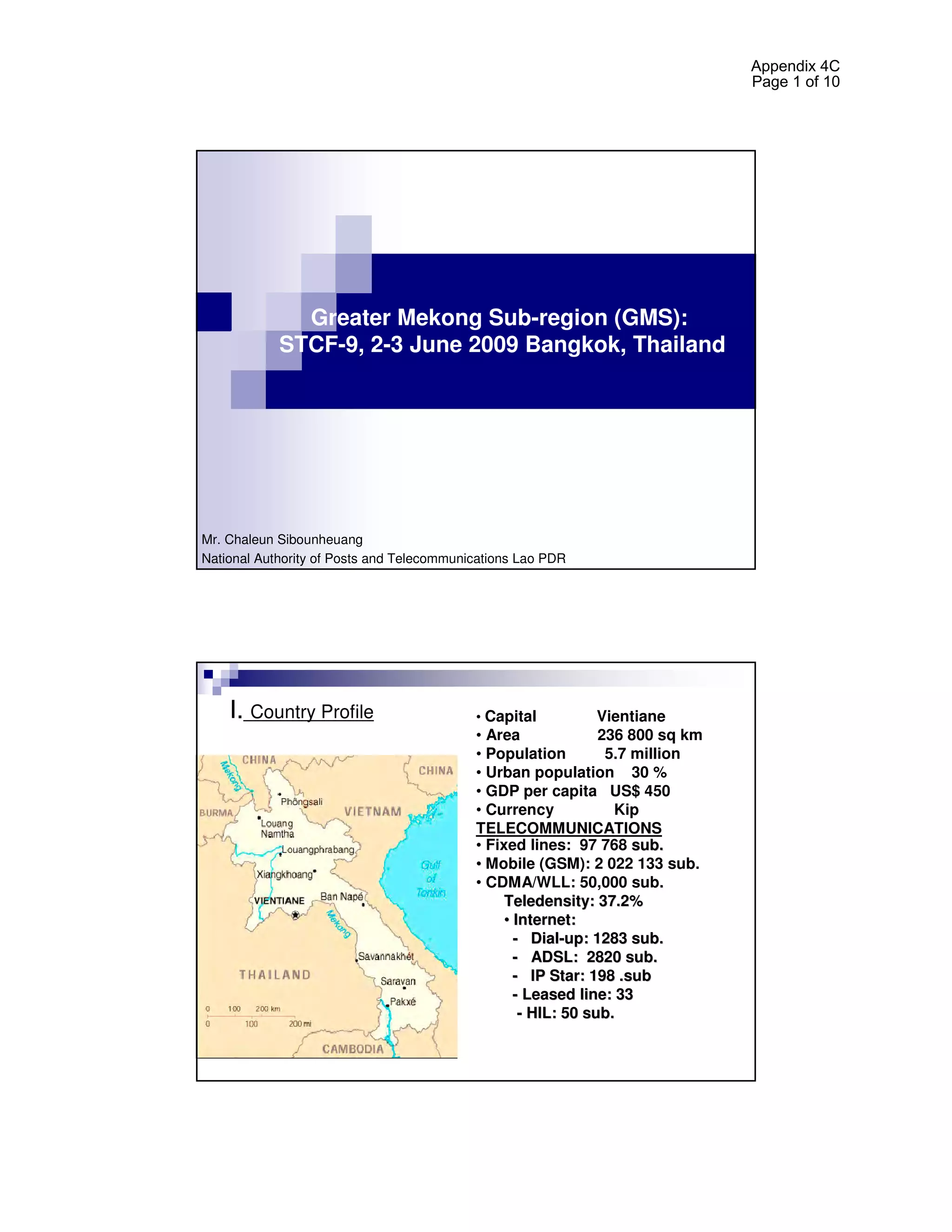
                   I. Country Profile                     • Capital           Vientiane
                                                          • Area              236 800 sq km
                                                          • Population         5.7 million
                                                          • Urban population 30 %
                                                          • GDP per capita US$ 450
                                                          • Currency            Kip
                                                          TELECOMMUNICATIONS
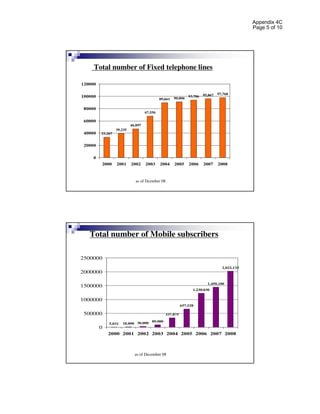
                                                          • Fixed lines: 97 768 sub.
                                                          • Mobile (GSM): 2 022 133 sub.
                                                          • CDMA/WLL: 50,000 sub.       .
                                                               Teledensity: 37.2%
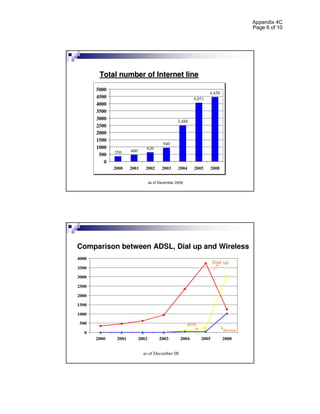
                                                               • Internet:
                                                                 - Dial-up: 1283 sub.
                                                                    Dial-
                                                                 - ADSL: 2820 sub.
                                                                 - IP Star: 198 .sub
                                                                 - Leased line: 33
                                                                  - HIL: 50 sub.


The views expressed in this paper/presentation are the views of the author and do not necessarily reflect the views or
policies of the Asian Development Bank (ADB), or its Board of Governors, or the governments they represent. ADB does
not guarantee the accuracy of the data included in this paper and accepts no responsibility for any consequence of
their use. Terminology used may not necessarily be consistent with ADB official terms.
Appendix 4C
                                                                                       Page 2 of 10


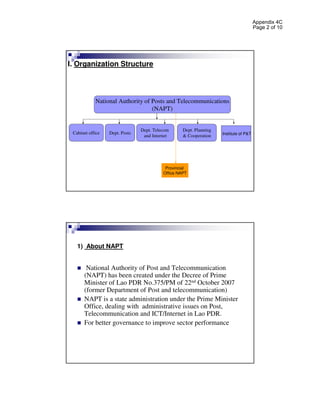
I. Organization Structure


            National Authority of Posts and Telecommunications
                                  (NAPT)


                                Dept. Telecom      Dept. Planning
 Cabinet office   Dept. Posts                                       Institute of P&T
                                 and Internet      & Cooperation


                                           Provincial
                                          Office NAPT


   1) About NAPT


       National Authority of Post and Telecommunication
      (NAPT) has been created under the Decree of Prime
      Minister of Lao PDR No.375/PM of 22nd October 2007
      (former Department of Post and telecommunication)
      NAPT is a state administration under the Prime Minister
      Office, dealing with administrative issues on Post,
      Telecommunication and ICT/Internet in Lao PDR.
      For better governance to improve sector performance
Appendix 4C
                                                                 Page 3 of 10


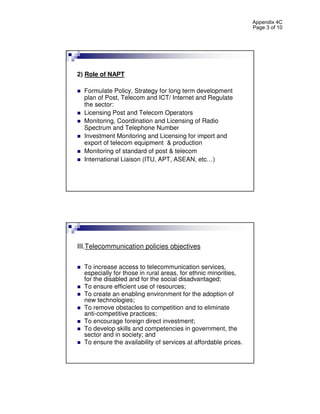
2) Role of NAPT

  Formulate Policy, Strategy for long term development
  plan of Post, Telecom and ICT/ Internet and Regulate
  the sector:
  Licensing Post and Telecom Operators
  Monitoring, Coordination and Licensing of Radio
  Spectrum and Telephone Number
  Investment Monitoring and Licensing for import and
  export of telecom equipment & production
  Monitoring of standard of post & telecom
  International Liaison (ITU, APT, ASEAN, etc…)


III.Telecommunication policies objectives


  To increase access to telecommunication services,
  especially for those in rural areas, for ethnic minorities,
  for the disabled and for the social disadvantaged;
  To ensure efficient use of resources;
  To create an enabling environment for the adoption of
  new technologies;
  To remove obstacles to competition and to eliminate
  anti-competitive practices;
  To encourage foreign direct investment;
  To develop skills and competencies in government, the
  sector and in society; and
  To ensure the availability of services at affordable prices.
Appendix 4C
                                                                   Page 4 of 10


IV. Regulatory Structure

     Under the Telecommunication law 2001, the regulatory
     was vested in Ministry of Communication Transport Post
     and Construction (MCTPC), several government
     agencies exercise regulatory influence in the
     telecommunication market.
     The telecommunication law states that the regulatory
     objective are to provide universal, good quality, accurate,
     clear, convenient, fast, safe and fair competition services
     to society, which contribute to the national defense and
     development and international cooperation.
     Decree No. 047/PMO, dated 16/2/2009 of the Prime
     Minister on the adoption and implementation of the
     policy on the Information and Communication
     Technology.


V. Telecommunications Operators

1.  Lao Telecom Co. Ltd (LTC):
      Fixed lines, Mobile telephone, Wireless Local Loop and
      Internet Service, International telephone
 2. Enterprise of Telecommunications Lao (ETL)
      Fixed lines, Mobile telephone, Internet Service and,
      International telephone
3. Star Telecom
      Fixed lines, Mobile telephone
4. Millicom Lao Co.Ltd (MLL)
      Prepaid Mobile telephone
5. Skytel & Net Co.Ltd
      Wireless Local Loop and Internet
Appendix 4C
                                                                                               Page 5 of 10


     Total number of Fixed telephone lines

120000

                                                                        95,867   97,768
100000                                                90,806   93,786
                                             89,661

 80000
                                    67,556

 60000
                           46,897
                  39,235
 40000   33,267


 20000

     0
         2000     2001     2002     2003     2004     2005     2006     2007     2008


                              as of Dcember 08


   Total number of Mobile subscribers

2500000
                                                                                   2,022,133
2000000

                                                                          1,450,100
1500000
                                                                 1,230,030


1000000
                                                           657,528

 500000                                          337,875

                                        89,000
             5,031   18,000 30,000
         0
             2000 2001 2002 2003 2004 2005 2006 2007 2008


                             as of December 08
Appendix 4C
                                                                                      Page 6 of 10


        Total number of Internet line
       5000
                                                                   4,450
       4500                                                4,051
       4000
       3500
       3000                                        2,488
       2500
       2000
       1500
                                           940
       1000                    620
              350     460
        500
          0
              2000    2001     2002       2003     2004    2005    2008


                                   as of December 2008


Comparison between ADSL, Dial up and Wireless
4000
                                                                       Dial up
3500

3000

2500

2000

1500

1000

 500                                                     ADSL
                                                                           Wireless
  0
       2000    2001         2002         2003       2004        2005       2008


                              as of December 08
Appendix 4C
                                                             Page 7 of 10


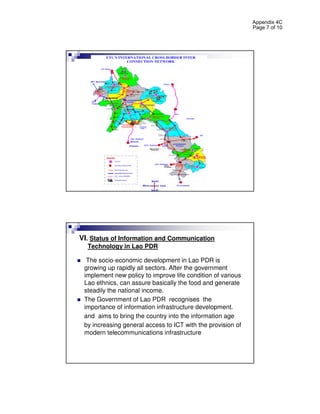
VI. Status of Information and Communication
  Technology in Lao PDR

  The socio-economic development in Lao PDR is
 growing up rapidly all sectors. After the government
 implement new policy to improve life condition of various
 Lao ethnics, can assure basically the food and generate
 steadily the national income.
 The Government of Lao PDR recognises the
 importance of information infrastructure development.
 and aims to bring the country into the information age
 by increasing general access to ICT with the provision of
 modern telecommunications infrastructure
Appendix 4C
                                                                           Page 8 of 10


  1) Expectation
     Promote the development of Information and
     Communication on Technology(ICT) especially
     Information Technology (IT) to become an advanced and
     intelligent tool in the administrative and service of the
     government and society of the nation.
     Promote the development of Information and
     Communication Technology for socio-economic
     development widely, build the condition to all sectors as
     well as all society know how to use and participate in the
     activity the development and application of Information
     and Communication Technology.
     Promote the development of Information and
     Communication Technology in the order to ensure the
     stability the security and expand good national culture.


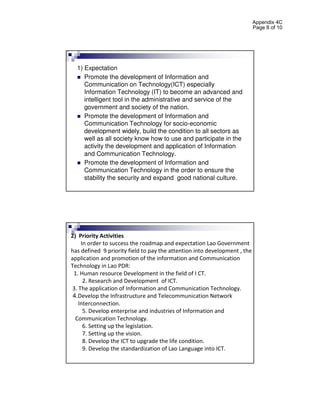
2) Priority Activities
    In order to success the roadmap and expectation Lao Government
has defined 9 priority field to pay the attention into development , the
application and promotion of the information and Communication
Technology in Lao PDR:
 1. Human resource Development in the field of I CT.
     2. Research and Development of ICT.
3. The application of Information and Communication Technology.
 4.Develop the Infrastructure and Telecommunication Network
   Interconnection.
     5. Develop enterprise and industries of Information and
  Communication Technology.
     6. Setting up the legislation.
     7. Setting up the vision.
     8. Develop the ICT to upgrade the life condition.
     9. Develop the standardization of Lao Language into ICT.
Appendix 4C
                                                                Page 9 of 10


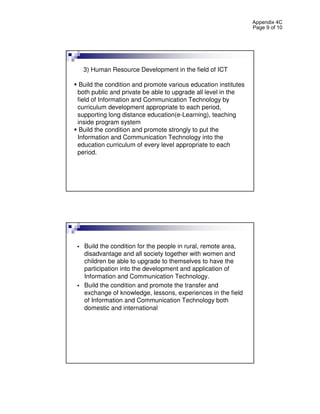
  3) Human Resource Development in the field of ICT

 Build the condition and promote various education institutes
both public and private be able to upgrade all level in the
field of Information and Communication Technology by
curriculum development appropriate to each period,
supporting long distance education(e-Learning), teaching
inside program system
 Build the condition and promote strongly to put the
Information and Communication Technology into the
education curriculum of every level appropriate to each
period.


  Build the condition for the people in rural, remote area,
  disadvantage and all society together with women and
  children be able to upgrade to themselves to have the
  participation into the development and application of
  Information and Communication Technology.
  Build the condition and promote the transfer and
  exchange of knowledge, lessons, experiences in the field
  of Information and Communication Technology both
  domestic and international
Appendix 4C
                                                                Page 10 of 10


VII. Conclusion
 In present era information and communication
 technology is one of the most advanced technology
 which has a tremendous important role in daily life to
 held the intelligence and human brain because this
 technology has been applied to the important tool in
 every sector of society in order to help the work on
 analysis research automatic mechanical control,
 administration and management, commerce, finance,
 services, education, health, and other to be stable
 system, efficiency, clear and fast.
 ICT in Lao PDR is still in the beginning (new) and a lot of
 works/efforts are needed for the successful of the
 development .
 Supporting from other advanced countries is very much
 welcome to assist Lao PDR in ICT activities.


                                                           20

Greater Mekong Sub-region (GMS): Laos Telecommunication

  • 1.
    Appendix 4C Page 1 of 10 Greater Mekong Sub-region (GMS): STCF-9, 2-3 June 2009 Bangkok, Thailand Mr. Chaleun Sibounheuang National Authority of Posts and Telecommunications Lao PDR I. Country Profile • Capital Vientiane • Area 236 800 sq km • Population 5.7 million • Urban population 30 % • GDP per capita US$ 450 • Currency Kip TELECOMMUNICATIONS • Fixed lines: 97 768 sub. • Mobile (GSM): 2 022 133 sub. • CDMA/WLL: 50,000 sub. . Teledensity: 37.2% • Internet: - Dial-up: 1283 sub. Dial- - ADSL: 2820 sub. - IP Star: 198 .sub - Leased line: 33 - HIL: 50 sub. The views expressed in this paper/presentation are the views of the author and do not necessarily reflect the views or policies of the Asian Development Bank (ADB), or its Board of Governors, or the governments they represent. ADB does not guarantee the accuracy of the data included in this paper and accepts no responsibility for any consequence of their use. Terminology used may not necessarily be consistent with ADB official terms.
  • 2.
    Appendix 4C Page 2 of 10 I. Organization Structure National Authority of Posts and Telecommunications (NAPT) Dept. Telecom Dept. Planning Cabinet office Dept. Posts Institute of P&T and Internet & Cooperation Provincial Office NAPT 1) About NAPT National Authority of Post and Telecommunication (NAPT) has been created under the Decree of Prime Minister of Lao PDR No.375/PM of 22nd October 2007 (former Department of Post and telecommunication) NAPT is a state administration under the Prime Minister Office, dealing with administrative issues on Post, Telecommunication and ICT/Internet in Lao PDR. For better governance to improve sector performance
  • 3.
    Appendix 4C Page 3 of 10 2) Role of NAPT Formulate Policy, Strategy for long term development plan of Post, Telecom and ICT/ Internet and Regulate the sector: Licensing Post and Telecom Operators Monitoring, Coordination and Licensing of Radio Spectrum and Telephone Number Investment Monitoring and Licensing for import and export of telecom equipment & production Monitoring of standard of post & telecom International Liaison (ITU, APT, ASEAN, etc…) III.Telecommunication policies objectives To increase access to telecommunication services, especially for those in rural areas, for ethnic minorities, for the disabled and for the social disadvantaged; To ensure efficient use of resources; To create an enabling environment for the adoption of new technologies; To remove obstacles to competition and to eliminate anti-competitive practices; To encourage foreign direct investment; To develop skills and competencies in government, the sector and in society; and To ensure the availability of services at affordable prices.
  • 4.
    Appendix 4C Page 4 of 10 IV. Regulatory Structure Under the Telecommunication law 2001, the regulatory was vested in Ministry of Communication Transport Post and Construction (MCTPC), several government agencies exercise regulatory influence in the telecommunication market. The telecommunication law states that the regulatory objective are to provide universal, good quality, accurate, clear, convenient, fast, safe and fair competition services to society, which contribute to the national defense and development and international cooperation. Decree No. 047/PMO, dated 16/2/2009 of the Prime Minister on the adoption and implementation of the policy on the Information and Communication Technology. V. Telecommunications Operators 1. Lao Telecom Co. Ltd (LTC): Fixed lines, Mobile telephone, Wireless Local Loop and Internet Service, International telephone 2. Enterprise of Telecommunications Lao (ETL) Fixed lines, Mobile telephone, Internet Service and, International telephone 3. Star Telecom Fixed lines, Mobile telephone 4. Millicom Lao Co.Ltd (MLL) Prepaid Mobile telephone 5. Skytel & Net Co.Ltd Wireless Local Loop and Internet
  • 5.
    Appendix 4C Page 5 of 10 Total number of Fixed telephone lines 120000 95,867 97,768 100000 90,806 93,786 89,661 80000 67,556 60000 46,897 39,235 40000 33,267 20000 0 2000 2001 2002 2003 2004 2005 2006 2007 2008 as of Dcember 08 Total number of Mobile subscribers 2500000 2,022,133 2000000 1,450,100 1500000 1,230,030 1000000 657,528 500000 337,875 89,000 5,031 18,000 30,000 0 2000 2001 2002 2003 2004 2005 2006 2007 2008 as of December 08
  • 6.
    Appendix 4C Page 6 of 10 Total number of Internet line 5000 4,450 4500 4,051 4000 3500 3000 2,488 2500 2000 1500 940 1000 620 350 460 500 0 2000 2001 2002 2003 2004 2005 2008 as of December 2008 Comparison between ADSL, Dial up and Wireless 4000 Dial up 3500 3000 2500 2000 1500 1000 500 ADSL Wireless 0 2000 2001 2002 2003 2004 2005 2008 as of December 08
  • 7.
    Appendix 4C Page 7 of 10 VI. Status of Information and Communication Technology in Lao PDR The socio-economic development in Lao PDR is growing up rapidly all sectors. After the government implement new policy to improve life condition of various Lao ethnics, can assure basically the food and generate steadily the national income. The Government of Lao PDR recognises the importance of information infrastructure development. and aims to bring the country into the information age by increasing general access to ICT with the provision of modern telecommunications infrastructure
  • 8.
    Appendix 4C Page 8 of 10 1) Expectation Promote the development of Information and Communication on Technology(ICT) especially Information Technology (IT) to become an advanced and intelligent tool in the administrative and service of the government and society of the nation. Promote the development of Information and Communication Technology for socio-economic development widely, build the condition to all sectors as well as all society know how to use and participate in the activity the development and application of Information and Communication Technology. Promote the development of Information and Communication Technology in the order to ensure the stability the security and expand good national culture. 2) Priority Activities In order to success the roadmap and expectation Lao Government has defined 9 priority field to pay the attention into development , the application and promotion of the information and Communication Technology in Lao PDR: 1. Human resource Development in the field of I CT. 2. Research and Development of ICT. 3. The application of Information and Communication Technology. 4.Develop the Infrastructure and Telecommunication Network Interconnection. 5. Develop enterprise and industries of Information and Communication Technology. 6. Setting up the legislation. 7. Setting up the vision. 8. Develop the ICT to upgrade the life condition. 9. Develop the standardization of Lao Language into ICT.
  • 9.
    Appendix 4C Page 9 of 10 3) Human Resource Development in the field of ICT Build the condition and promote various education institutes both public and private be able to upgrade all level in the field of Information and Communication Technology by curriculum development appropriate to each period, supporting long distance education(e-Learning), teaching inside program system Build the condition and promote strongly to put the Information and Communication Technology into the education curriculum of every level appropriate to each period. Build the condition for the people in rural, remote area, disadvantage and all society together with women and children be able to upgrade to themselves to have the participation into the development and application of Information and Communication Technology. Build the condition and promote the transfer and exchange of knowledge, lessons, experiences in the field of Information and Communication Technology both domestic and international
  • 10.
    Appendix 4C Page 10 of 10 VII. Conclusion In present era information and communication technology is one of the most advanced technology which has a tremendous important role in daily life to held the intelligence and human brain because this technology has been applied to the important tool in every sector of society in order to help the work on analysis research automatic mechanical control, administration and management, commerce, finance, services, education, health, and other to be stable system, efficiency, clear and fast. ICT in Lao PDR is still in the beginning (new) and a lot of works/efforts are needed for the successful of the development . Supporting from other advanced countries is very much welcome to assist Lao PDR in ICT activities. 20