National Seminar, Exposition And Corporate Talk On Civil Engineering 2003
PEKA, Faculty of Civil Engineering, Universiti Teknologi Malaysia
New Breakthrough In The History Of Pile Driving And Testing Industry On Driven Piles.
Page 1/13
New Breakthrough In The History Of Pile Driving And
Testing Industry On Driven Piles.
by
Yekong Wai, Chief Research Officer, Traswaja Pile Testing Sdn Bhd, Malaysia (Email: yekong@traswaja.com)
Md Nuri Salimin, Research Officer, Traswaja Pile Testing Sdn Bhd, Malaysia (Email: mnuri@traswaja.com)
(Address: No.10, Kenari Road 10, Puchong Jaya Business Centre, 47100 Puchong, Selangor, Malaysia)
Presented at NASEC 2003, Kuala Lumpur, May 2003
Abstract: This paper presents the history of technology advancement in the pile driving
and testing industry on driven piles. Importantly it presents a new testing method in
determination of pile bearing capacities of driven piles. The new method is employed from
the impact load theory in pile driving analysis. There is four major technology development
and advancement since centuries ago until now, i.e. pile as rigid body, pile as elastic body in
impulse-momentum theory, pile as elastic body in wave mechanic theory and pile as elastic
body in impact load theory.
HISTORY OF TECHNOLOGY DEVELOPMENT AND ADVANCEMENT
Introduction
Pile driving is a rather brutal method of foundation construction. A heavy mass impact the
pile until it is installed in the ground. There exist numerous ways of verifying the quality of
pile foundations. Pile testing may be conducted at several stages during construction. They
may be conveniently separated into pre-construction and construction control tests. A pre-
construction test is performed on specially driven piles well in advance of production to guide
the engineer in the selection of a proper type of pile, hammer and its load bearing capacity, or
to confirm the engineer’s assumptions. Static load tests or dynamic tests with measurements
on the first production piles are often used to establish a pile driving criteria. During
construction, some production piles may be designated as static test piles, or the engineer
may stipulate that a certain percentage of piles on a work site be dynamically tested (1).
The comprehensive description on the pile driving and testing on driven piles is well
documented in Reference (1). This paper does not attempt to discuss the test methods
proposed before year 2000. However, it discusses the history of technology development and
advancement in the pile testing industry on driven piles since centuries until now. Importantly
it presents a new testing method in determination of pile bearing capacities of driven piles.
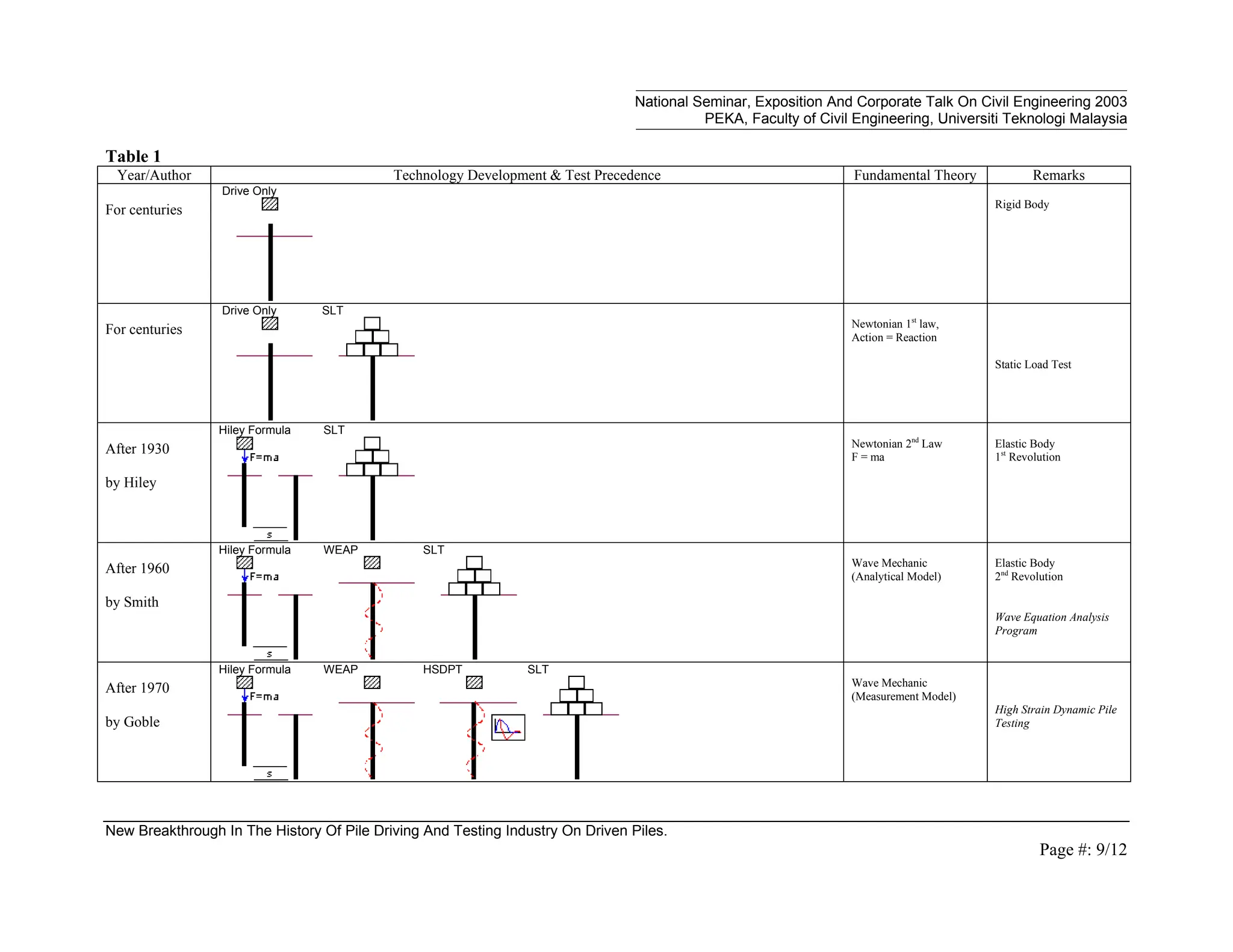
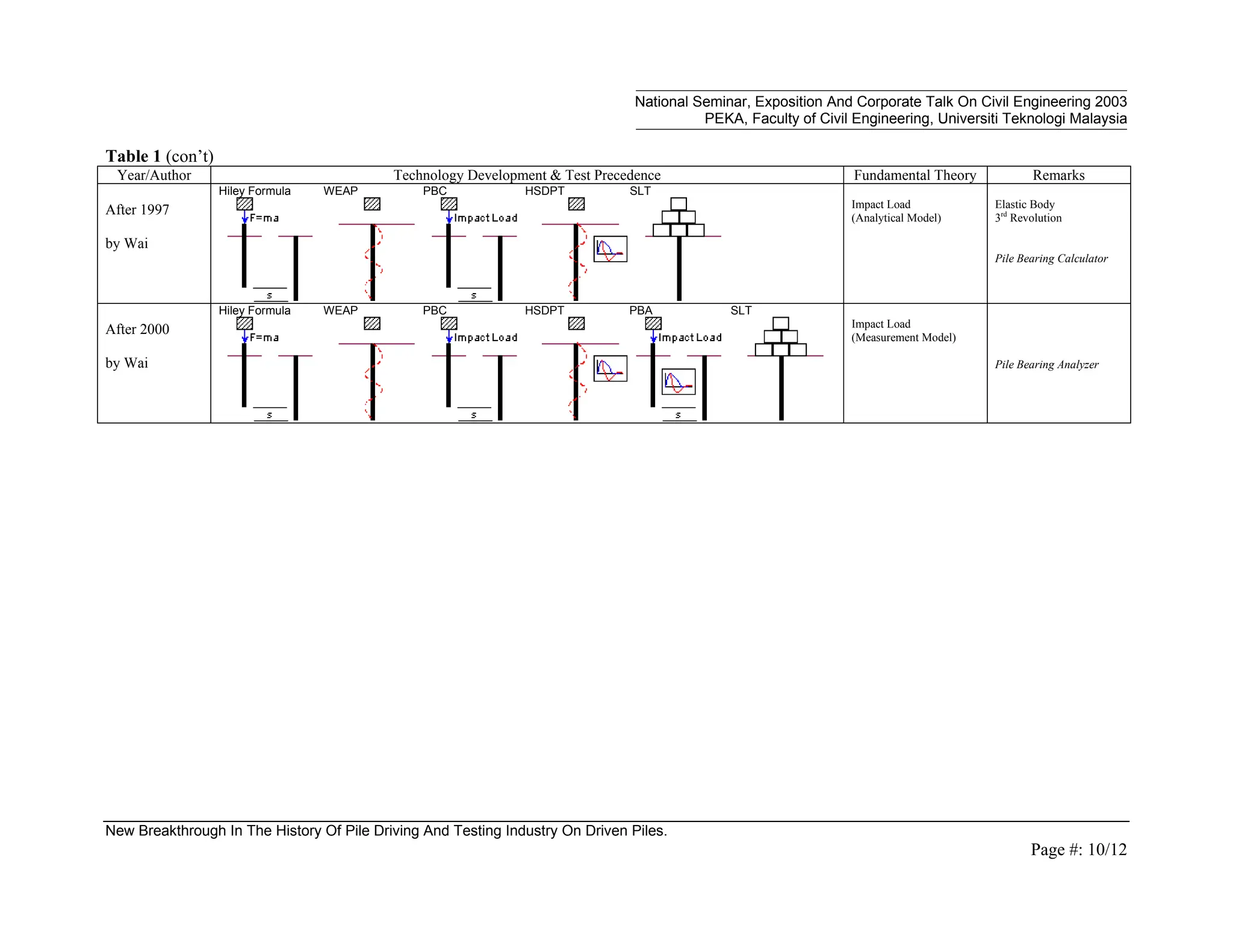
Table 1 is the summary of the technology development of testing methods on driven piles
since centuries ago until now. In the history of pile driving and testing, the advancement of
the technology can be classified into four (4) developments in terms of their fundamental
theories. The brief description on each technology development is discussed in next Section.
National Seminar, Exposition And Corporate Talk On Civil Engineering 2003
PEKA, Faculty of Civil Engineering, Universiti Teknologi Malaysia
New Breakthrough In The History Of Pile Driving And Testing Industry On Driven Piles.
Page 2/13
Development I: Pile as Rigid Body – the Conventional Theory in Pile Driving and
Testing
In very early days, the driven piles – the only kind of pile type at that moment, were deemed
as a rigid body and hammered down into the ground. The piles were small and short and
installed for low-rise structures. The piles were simply installed by using any kind of mass
such as woods and stones as the hammering devices. No tests were carried out on such piles.
The performances of piles were place at the hand of God. Any installations of piles were
based on trial and error concepts and remedial works would be carried out on “fail” piles. The
piles deemed to be failed when they could not sustain the weight of structures.
With the development of the knowledge of human kinds, some piles were tested by simply
putting on some dead weight on top of the piles to verify their carrying load bearing capacity.
The test was named as Static Load Test (SLT) presently. The tests were basically based on
the concept of Newtonian 1st
Law, i.e. “Action=Reaction”.
With modernization of the society, this SLT test had been modified and developed to become
the well known Maintained Load Test (MLT) and Constant Rate of Penetration Test (CRP).
Development II: Pile as Elastic Body based on Impulse-Momentum Theory – the 1st
Revolution in Modern Pile Driving and Testing
For centuries, the piles had been deemed as elastic body. This was because the piles were
relatively big and long for carrying medium size structures compared to very early days.
At this juncture, some means was needed in the field to determine when a pile had reached a
satisfactory bearing value other than by simply driving the pile in to some predetermined
depth. Driving the pile to a predetermined depth might or might not obtain the required
bearing value because normal soil variations both laterally and vertically (2).
There are many formulas used to determine the capacity of the piles driven into the soil.
Theoretical and semi-empirical formulas are derived to express this relationship between
energy and work. These equations are generally known as dynamic pile formulas, which are
derived from Impulse-Momentum Theory, i.e. “F=ma”. These dynamic pile formulas are also
termed as rational pile formulas.
The details of the formula derivations are beyond the scope of this paper and have been
reported elsewhere (2).
Presently, it is generally accepted that the dynamic pile formulas do not provide very reliable
results (2,3). Each of the formulas has their own respective advantages. The British Standard,
BS 8004:1986, Clause 7.5.2.1 cited the Hiley formula as one of the more reliable and is
probably the most commonly used (4).
National Seminar, Exposition And Corporate Talk On Civil Engineering 2003
PEKA, Faculty of Civil Engineering, Universiti Teknologi Malaysia
New Breakthrough In The History Of Pile Driving And Testing Industry On Driven Piles.
Page 3/13
Development III: Pile as Elastic Body based on Wave Mechanic Theory – the 2nd
Revolution in Modern Pile Driving and Testing
In the beginning of 20th
Century, it was recognized that pile driving was a phenomenon better
approximated by wave propagation theories. Solutions to the general partial differential
equation for one-dimensional propagation were developed with equations specifically
representing pile driving analyses (1).
In the 1950’s, digital computers made a discrete solution of wave propagation practical and
an algorithm and computer code were developed by Smith (5) for pile driving analysis. This
program is deemed to be the first computer program applied in civil engineering (1).
The wave equation analysis offers over the dynamic formulas is the ability to realistically
consider all important parts of the hammer-pile-soil system. The details of the theory is
documented in Reference (5).
The British Standard, BS 8004:1986, Clause 7.5.2.2 cited that the ultimate pile bearing
capacity of a pile shall be predicted by the analysis of the stress wave theory (4).
In the 1960’s, the advanced electronic measuring devices transformed the evaluation of pile
driving from an art to a science. The techniques most widely employed today for both
measurement and analysis of pile dynamics were developed under the direction of Professor
G.G. Goble at Case Western Reserve University, hence, collectively referred to as the Case
Method (6). The full release of Case Method and pile driving analyzer was in 1970s. The pile
driving analyzer is a state-of-the-art testing equipment used to collect pile driving response of
force and velocity for evaluation the pile bearing capacity using the Case Method.
Development IV: Pile as Elastic Body based on Impact Load Theory – the 3rd
Revolution in Modern Pile Driving and Testing
The new application in pile driving using Impact Load Theory was first presented in PDA
User’s Day 1997, Hong Kong (7) by the Author. Intensive research and development was
started in year 1998 and successfully ended in 2002 with two (2) Patents accorded by the
United States of Patent and Trademark Office (USPTO) in year 2001 and 2002.
The details of the theory will be fully described in the next Section.
National Seminar, Exposition And Corporate Talk On Civil Engineering 2003
PEKA, Faculty of Civil Engineering, Universiti Teknologi Malaysia
New Breakthrough In The History Of Pile Driving And Testing Industry On Driven Piles.
Page 4/13
NEW BREAKTHROUGH
Background
This paper concerns a new method for determination load bearing capacity of piles wherein
the method is based on a model which has been scaled-down to a size small enough for an
indoors facility measurement whereby the measurements is deployed in a mathematical
formula to calculate the load bearing capacity of a pile.
It is generally accepted that the dynamic formulas do not provide very reliable predictions but
are continued to be used for lack of a better method as described in previous Section.
There is therefore a need for a better method for accurately determining a pile’s load bearing
capacity. Due to the harsh external environment at foundation construction sites, it would be
desirable if the pile capacity instrumentation and measurement could be conducted within an
indoors facility such as in a geotechnical laboratory. The physical dimension limitations of an
indoors facility means that the actual dimensions of the pile is preferably be scaled-down so
that the pile and its requisite instrumentation or measurement means may be accommodated
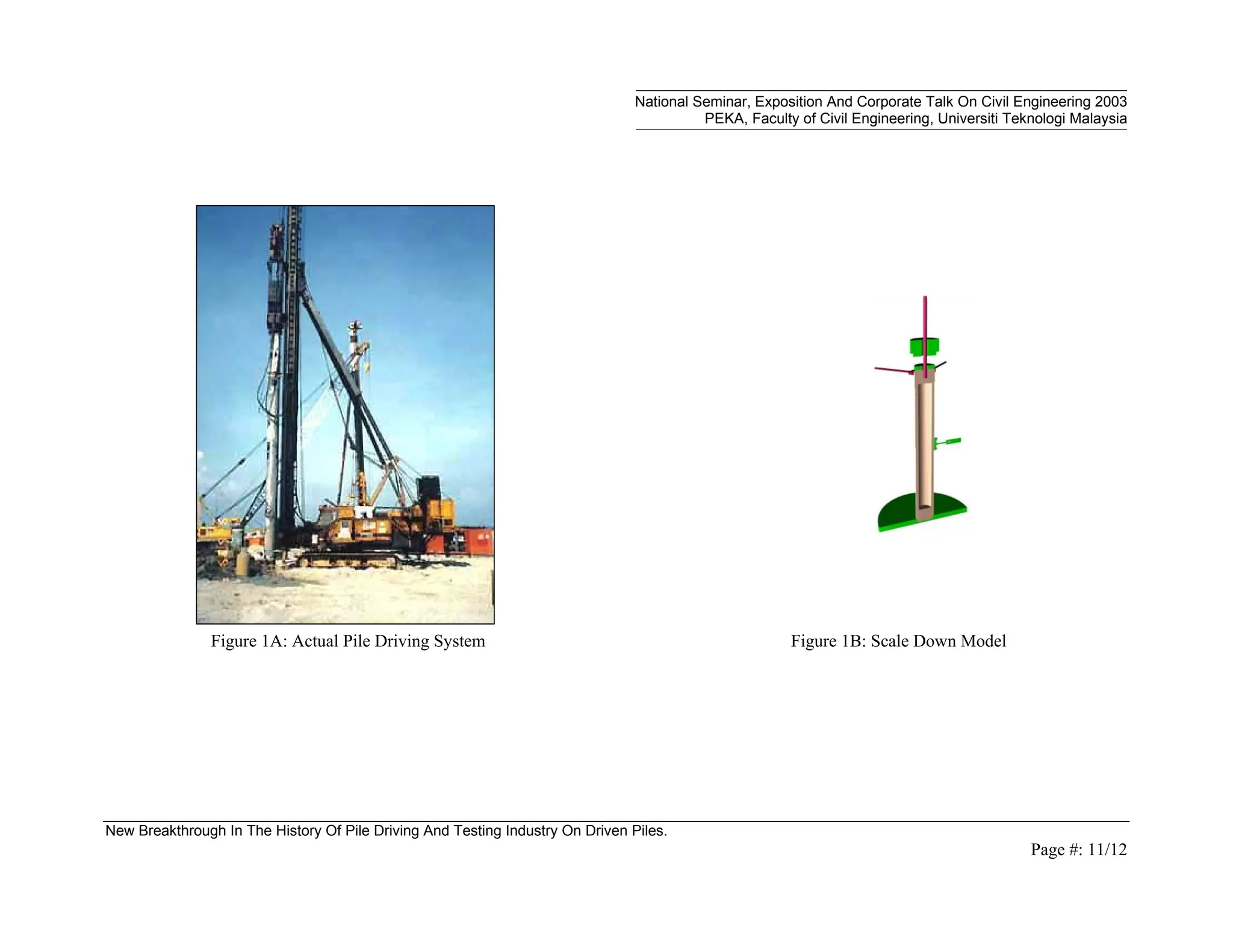
within the indoors facility as illustrated in Figure 1.
Such a proposed scaled-down pile model will need a mathematical relationship in order to
correlate its values to the pile's values so that the model may be used as a piling application in
determining the load bearing capacity of pile.
Scopes
There are few major categories of foundation piles, i.e. driven piles, cast-insitu bored piles,
injected piles, etc. This new method concerns only the first category, i.e. the piles installed by
pile driving hammer.
Foundation engineers are engaged to design and choose pile types as laid down by the design
requirements or standards. The foundation design is normally made after taking into
consideration the columnar transferred load weight, soil type and conditions, piling system
and pile design. Since soil type is an existing condition and the columnar transferred load has
been predetermined in the design, the engineer may only advise on the two remaining
variable factors, i.e. (i) pile design and (ii) piling system. In this article, the piling system is
the pile driving system.
Fundamental Theory
The formula employed in the revolutionary new method is the Impact Load Theory that is
commonly used in the structural analysis, such as a rod; which may be obtained from any
literature on structural analysis, as follows:-
National Seminar, Exposition And Corporate Talk On Civil Engineering 2003
PEKA, Faculty of Civil Engineering, Universiti Teknologi Malaysia
New Breakthrough In The History Of Pile Driving And Testing Industry On Driven Piles.
Page 5/13
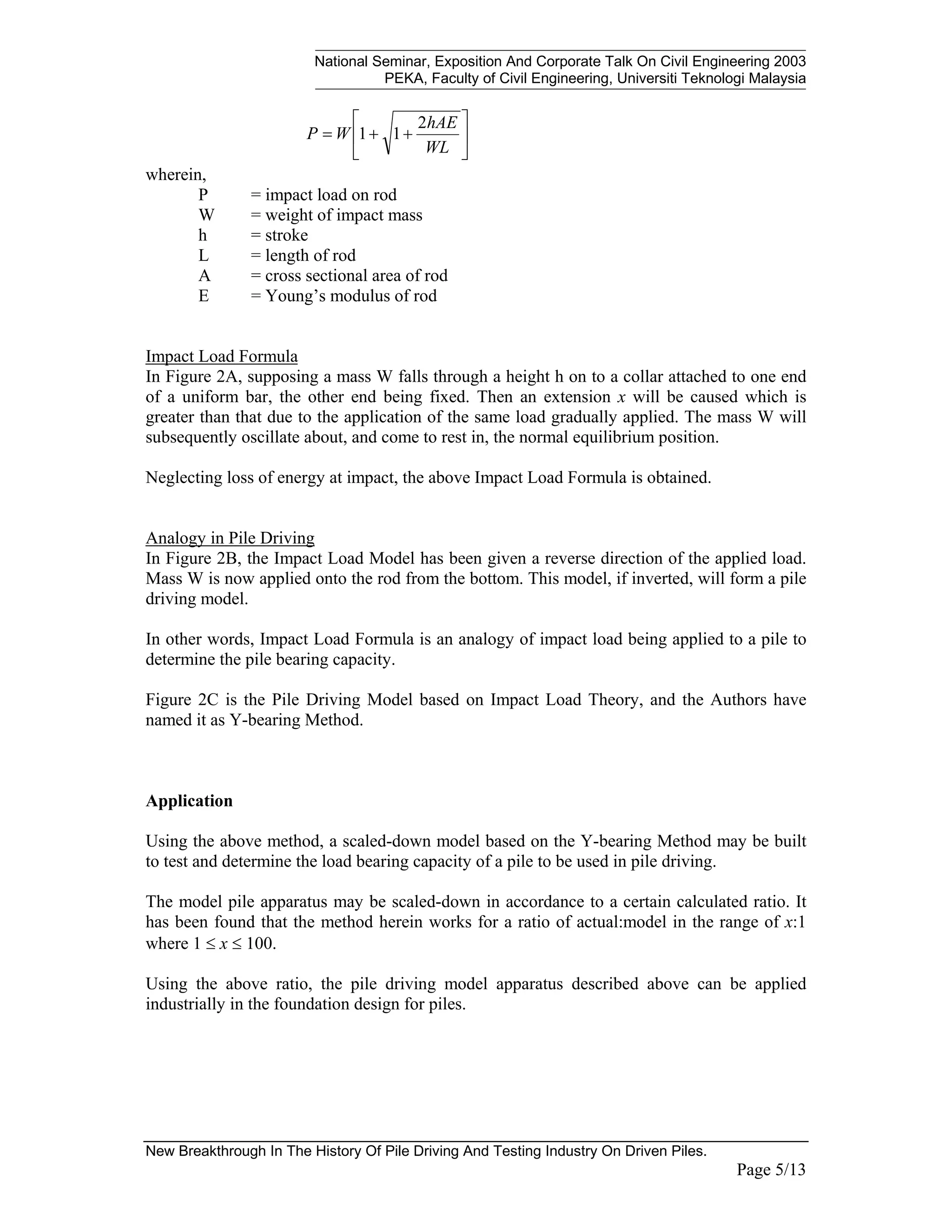






+
+
=
WL
hAE
W
P
2
1
1
wherein,
P = impact load on rod
W = weight of impact mass
h = stroke
L = length of rod
A = cross sectional area of rod
E = Young’s modulus of rod
Impact Load Formula
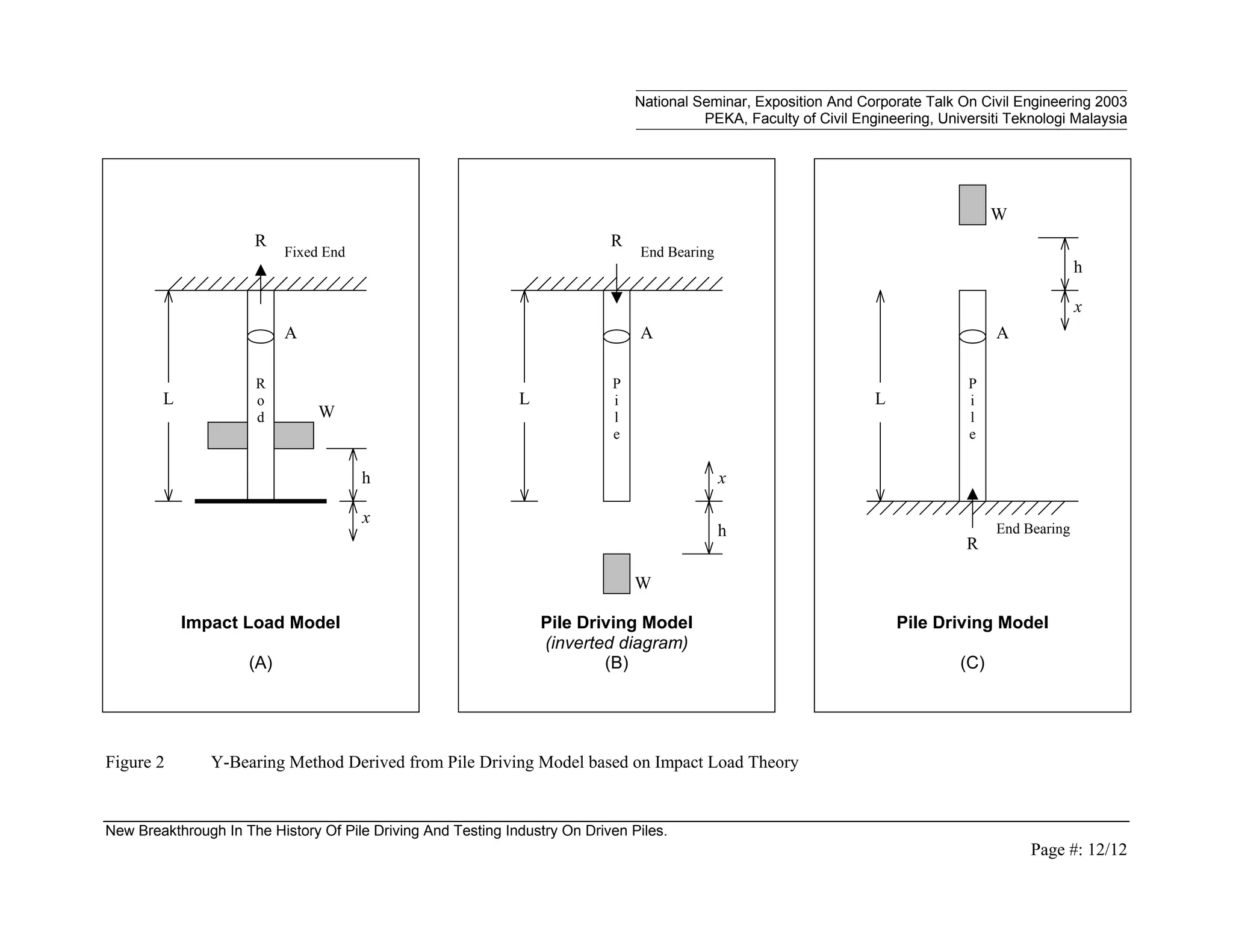
In Figure 2A, supposing a mass W falls through a height h on to a collar attached to one end
of a uniform bar, the other end being fixed. Then an extension x will be caused which is
greater than that due to the application of the same load gradually applied. The mass W will
subsequently oscillate about, and come to rest in, the normal equilibrium position.
Neglecting loss of energy at impact, the above Impact Load Formula is obtained.
Analogy in Pile Driving
In Figure 2B, the Impact Load Model has been given a reverse direction of the applied load.
Mass W is now applied onto the rod from the bottom. This model, if inverted, will form a pile
driving model.
In other words, Impact Load Formula is an analogy of impact load being applied to a pile to
determine the pile bearing capacity.
Figure 2C is the Pile Driving Model based on Impact Load Theory, and the Authors have
named it as Y-bearing Method.
Application
Using the above method, a scaled-down model based on the Y-bearing Method may be built
to test and determine the load bearing capacity of a pile to be used in pile driving.
The model pile apparatus may be scaled-down in accordance to a certain calculated ratio. It
has been found that the method herein works for a ratio of actual:model in the range of x:1
where 1 ≤ x ≤ 100.
Using the above ratio, the pile driving model apparatus described above can be applied
industrially in the foundation design for piles.
National Seminar, Exposition And Corporate Talk On Civil Engineering 2003
PEKA, Faculty of Civil Engineering, Universiti Teknologi Malaysia
New Breakthrough In The History Of Pile Driving And Testing Industry On Driven Piles.
Page 6/13
Example: Industry Application
Known properties of Grade J355 Steel:
Pile Modulus, E = 2100 T/cm2
Specific Weight, N = 7.85 T/m3
Yield Strength, y = 355 MPa
Allowable Driving Stress, σall = 213 MPa
Actual Pile:-
Hammer Type: 7-tonnes single acting hydraulic hammer @ ram stroke of 1.2m
with efficiency of 75%
Pile Type: 711mm diameter x 12mm wall thick steel pipe pile with length
of 25m
p
WL
hAE
W
Rp 





+
+
=
2
1
1 p: pile
Rp = 7*{1+[1+(2*(1.2*0.75)*263.52*2100)/(7*25)]1/2
} use h multiply efficiency
Rp = 535.17 T
Model Pile:-
m
WL
hAE
W
Rm 





+
+
=
2
1
1 m: model
Select a model with the dimensions,
W = 0.08 T = 80 kg
L = 5.00 m
E = 2100 T/cm2
N = 7.85 T/m3
A = 3.10 cm2
Maintaining the same driving stress for the actual and model piles,
Pile Stress, σ = Rm / Am = Rp / Ap
= 535.17 / 263.52
= 203 MPa < σall = 213 MPa (OK!)
=> Obtain Rm = 203 * 3.10
= 6.29 T
Based on this, the ratio of actual:model is,
actual : model
=> Rp : Rm
=> 535.17 : 6.29
=> 85 : 1
What is the drop height required if the above model is used?
Calculated, h = 0.247 m
≈ 0.25 m
National Seminar, Exposition And Corporate Talk On Civil Engineering 2003
PEKA, Faculty of Civil Engineering, Universiti Teknologi Malaysia
New Breakthrough In The History Of Pile Driving And Testing Industry On Driven Piles.
Page 7/13
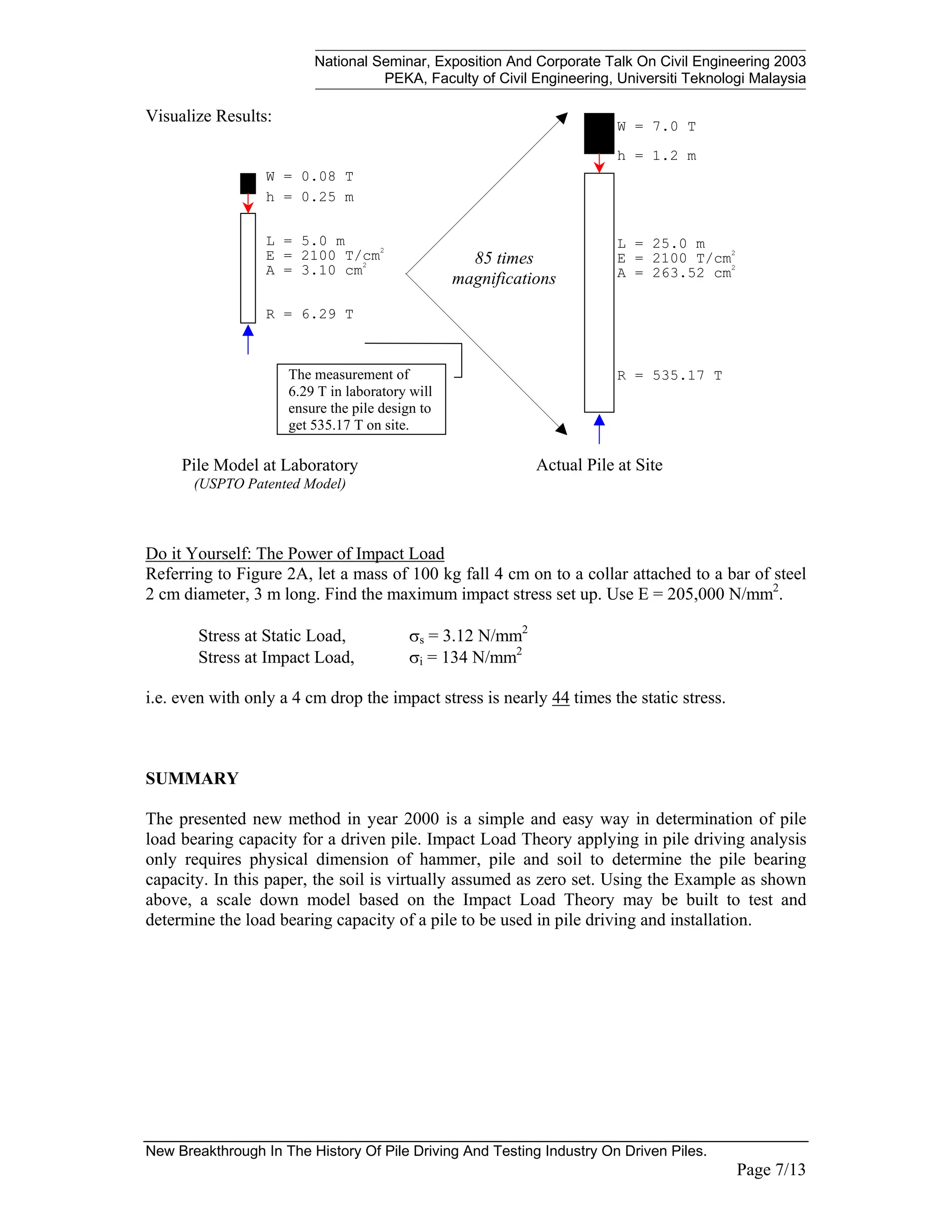
Visualize Results:
Do it Yourself: The Power of Impact Load
Referring to Figure 2A, let a mass of 100 kg fall 4 cm on to a collar attached to a bar of steel
2 cm diameter, 3 m long. Find the maximum impact stress set up. Use E = 205,000 N/mm2
.
Stress at Static Load, σs = 3.12 N/mm2
Stress at Impact Load, σi = 134 N/mm2
i.e. even with only a 4 cm drop the impact stress is nearly 44 times the static stress.
SUMMARY
The presented new method in year 2000 is a simple and easy way in determination of pile
load bearing capacity for a driven pile. Impact Load Theory applying in pile driving analysis
only requires physical dimension of hammer, pile and soil to determine the pile bearing
capacity. In this paper, the soil is virtually assumed as zero set. Using the Example as shown
above, a scale down model based on the Impact Load Theory may be built to test and
determine the load bearing capacity of a pile to be used in pile driving and installation.
W = 0.08 T
h = 0.25 m
L = 5.0 m
E = 2100 T/cm2
A = 3.10 cm2
R = 6.29 T
Pile Model at Laboratory
(USPTO Patented Model)
W = 7.0 T
h = 1.2 m
L = 25.0 m
E = 2100 T/cm2
A = 263.52 cm2
R = 535.17 T
Actual Pile at Site
85 times
magnifications
The measurement of
6.29 T in laboratory will
ensure the pile design to
get 535.17 T on site.
National Seminar, Exposition And Corporate Talk On Civil Engineering 2003
PEKA, Faculty of Civil Engineering, Universiti Teknologi Malaysia
New Breakthrough In The History Of Pile Driving And Testing Industry On Driven Piles.
Page 8/13
REFERENCES
1. Mohamad Hussein, Garland Likins, and Frank Rausche, “Testing Methods of
Driven Piles.” Handbook/Directory of the Pile Driving, Foundation and Marine
Construction Techniques, Engineers, Contractors, Manufacturers, Distributors and
Supplies, 1988.
2. Joseph E. Bowles, “Foundation Analysis and Design.” 4th Edition, McGraw-Hill
Company, 1988.
3. M.J. Tomlinson, “Pile Design and Construction Practice.” 4th Edition, E & FN
Spon, 1995.
4. BS8004:1986, “Foundations.” British Standard Institution.
5. Smith, E.A.L., “Pile Driving Analysis by the Wave Equation.” Journal of Soil
Mechanics and Foundations, ASCE, 86, pp. 36-61, 1960.
6. Goble, G.G., Likins, G.E., and Rausche, F., “Bearing Capacity of Piles From
Dynamic Measurements – Final Report.” Dept. of Civil Engineering, Case
Western Reserve University, Cleveland, Ohio, 1975.
7. Yekong Wai, “Impact Load Analogy in Pile Driving Analysis.” PDA User’s Day
Hong Kong, 1997.
8. Dr. Tatsunori Matsumoto, “Different Methods of Vertical Pile Load Tests and
Applications.” Associate Professor, Department of Civil Engineering, Kanazawa
University, 2-40-20 Kodatsuno, Kanazawa 920, Japan.
9. Samson, C.H., Hirch, T.L., and Lowery, L.L., “Computer Study of the Dynamic
Behaviour of Piling,” Journal of the Structural Division, ASCE, Paper No. 3608,
St4, 1963.
10. Forehand, P.W., and Reese, J.L., “Prediction of Pile Capacity by the Wave
Equation,” Proceeding of ASCE, Journal of Soil Mechanics and Foundation
Division, Vol. 90, No. SM2.
11. Fox, E.N., “Stress Phenomena Occurring in Pile Driving,” Engineering, 134, pp.
263-265, 1932.
12. ASTM D 1143, Standard Method of Testing Piles Under Static Axial
Compressive Loads.
13. Goble, G.G., Rausche, F., and Likins, G.E., “The Analysis of Pile Driving A
State-of-the-Art,” The 1st Seminar on the Application of Stress Wave Theory on
Piles, Stockholm, Sweden, 1980.
14. Rausche, F., Goble, G.G., and Likins, G.E., “Dynamic Determination of Pile
Capacity” Journal of Geotechnical Engineering, ASCE, 1985.
National Seminar, Exposition And Corporate Talk On Civil Engineering 2003
PEKA, Faculty of Civil Engineering, Universiti Teknologi Malaysia
New Breakthrough In The History Of Pile Driving And Testing Industry On Driven Piles.
Page #: 9/12
Table 1
Year/Author Technology Development & Test Precedence Fundamental Theory Remarks
For centuries
Drive Only
Rigid Body
For centuries
Drive Only SLT
Newtonian 1st
law,
Action = Reaction
Static Load Test
After 1930
by Hiley
Hiley Formula SLT
Newtonian 2nd
Law
F = ma
Elastic Body
1st
Revolution
After 1960
by Smith
Hiley Formula WEAP SLT
Wave Mechanic
(Analytical Model)
Elastic Body
2nd
Revolution
Wave Equation Analysis
Program
After 1970
by Goble
Hiley Formula WEAP HSDPT SLT
Wave Mechanic
(Measurement Model)
High Strain Dynamic Pile
Testing
National Seminar, Exposition And Corporate Talk On Civil Engineering 2003
PEKA, Faculty of Civil Engineering, Universiti Teknologi Malaysia
New Breakthrough In The History Of Pile Driving And Testing Industry On Driven Piles.
Page #: 10/12
Table 1 (con’t)
Year/Author Technology Development & Test Precedence Fundamental Theory Remarks
After 1997
by Wai
Hiley Formula WEAP PBC HSDPT SLT
Impact Load
(Analytical Model)
Elastic Body
3rd
Revolution
Pile Bearing Calculator
After 2000
by Wai
Hiley Formula WEAP PBC HSDPT PBA SLT
Impact Load
(Measurement Model)
Pile Bearing Analyzer
National Seminar, Exposition And Corporate Talk On Civil Engineering 2003
PEKA, Faculty of Civil Engineering, Universiti Teknologi Malaysia
New Breakthrough In The History Of Pile Driving And Testing Industry On Driven Piles.
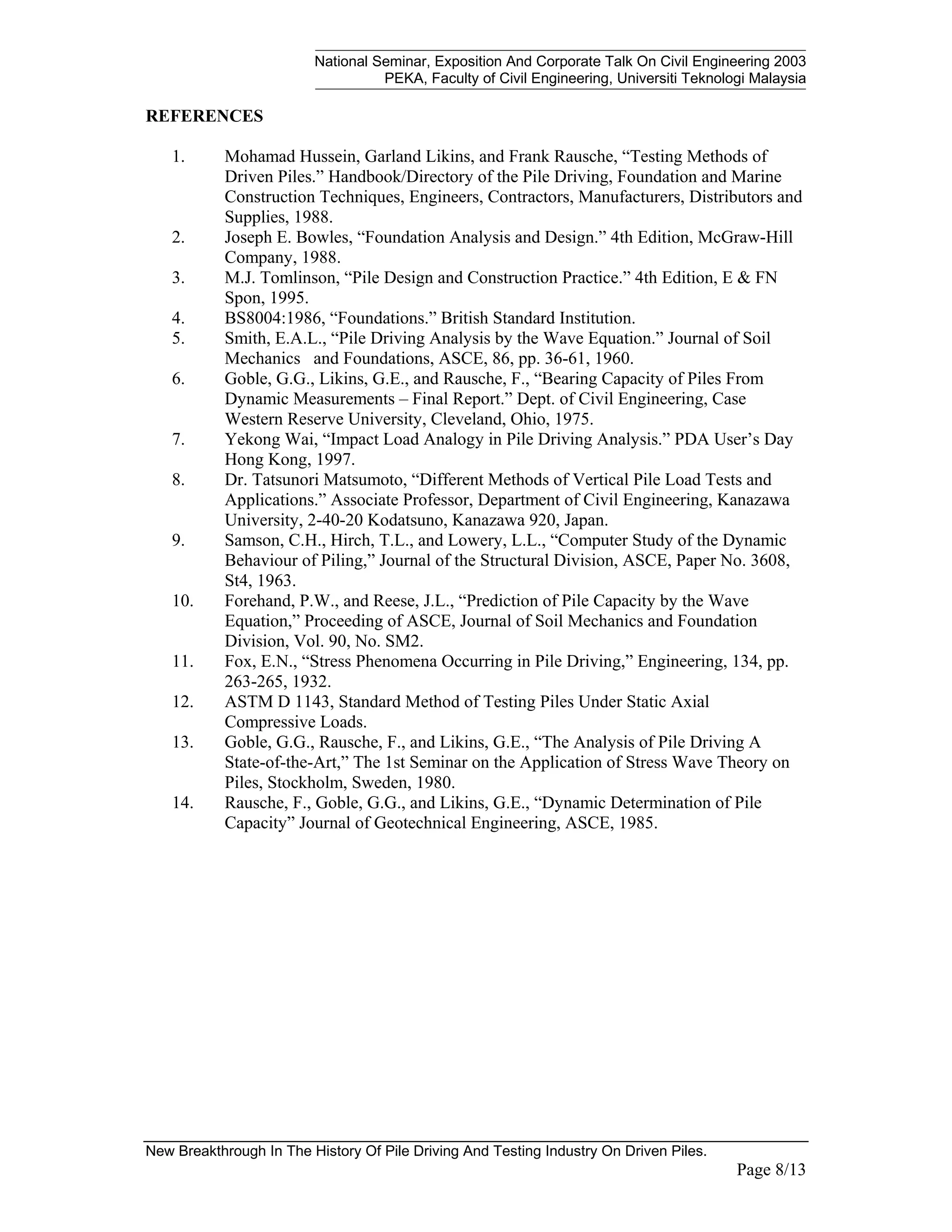
Page #: 11/12
Figure 1A: Actual Pile Driving System Figure 1B: Scale Down Model
National Seminar, Exposition And Corporate Talk On Civil Engineering 2003
PEKA, Faculty of Civil Engineering, Universiti Teknologi Malaysia
New Breakthrough In The History Of Pile Driving And Testing Industry On Driven Piles.
Page #: 12/12
Figure 2 Y-Bearing Method Derived from Pile Driving Model based on Impact Load Theory
L
R
P
i
l
e
W
h
x
End Bearing
Pile Driving Model
(C)
A
L
R
P
i
l
e
W
h
x
End Bearing
Pile Driving Model
(inverted diagram)
(B)
A
L
R
R
o
d W
h
x
Fixed End
Impact Load Model
(A)
A

YJACK | Impact Load Theory Tech Paper 2003 - PileTalk 2003 New Breakthrough in Testing.pdf

  • 1.
    National Seminar, ExpositionAnd Corporate Talk On Civil Engineering 2003 PEKA, Faculty of Civil Engineering, Universiti Teknologi Malaysia New Breakthrough In The History Of Pile Driving And Testing Industry On Driven Piles. Page 1/13 New Breakthrough In The History Of Pile Driving And Testing Industry On Driven Piles. by Yekong Wai, Chief Research Officer, Traswaja Pile Testing Sdn Bhd, Malaysia (Email: yekong@traswaja.com) Md Nuri Salimin, Research Officer, Traswaja Pile Testing Sdn Bhd, Malaysia (Email: mnuri@traswaja.com) (Address: No.10, Kenari Road 10, Puchong Jaya Business Centre, 47100 Puchong, Selangor, Malaysia) Presented at NASEC 2003, Kuala Lumpur, May 2003 Abstract: This paper presents the history of technology advancement in the pile driving and testing industry on driven piles. Importantly it presents a new testing method in determination of pile bearing capacities of driven piles. The new method is employed from the impact load theory in pile driving analysis. There is four major technology development and advancement since centuries ago until now, i.e. pile as rigid body, pile as elastic body in impulse-momentum theory, pile as elastic body in wave mechanic theory and pile as elastic body in impact load theory. HISTORY OF TECHNOLOGY DEVELOPMENT AND ADVANCEMENT Introduction Pile driving is a rather brutal method of foundation construction. A heavy mass impact the pile until it is installed in the ground. There exist numerous ways of verifying the quality of pile foundations. Pile testing may be conducted at several stages during construction. They may be conveniently separated into pre-construction and construction control tests. A pre- construction test is performed on specially driven piles well in advance of production to guide the engineer in the selection of a proper type of pile, hammer and its load bearing capacity, or to confirm the engineer’s assumptions. Static load tests or dynamic tests with measurements on the first production piles are often used to establish a pile driving criteria. During construction, some production piles may be designated as static test piles, or the engineer may stipulate that a certain percentage of piles on a work site be dynamically tested (1). The comprehensive description on the pile driving and testing on driven piles is well documented in Reference (1). This paper does not attempt to discuss the test methods proposed before year 2000. However, it discusses the history of technology development and advancement in the pile testing industry on driven piles since centuries until now. Importantly it presents a new testing method in determination of pile bearing capacities of driven piles. Table 1 is the summary of the technology development of testing methods on driven piles since centuries ago until now. In the history of pile driving and testing, the advancement of the technology can be classified into four (4) developments in terms of their fundamental theories. The brief description on each technology development is discussed in next Section.
  • 2.
    National Seminar, ExpositionAnd Corporate Talk On Civil Engineering 2003 PEKA, Faculty of Civil Engineering, Universiti Teknologi Malaysia New Breakthrough In The History Of Pile Driving And Testing Industry On Driven Piles. Page 2/13 Development I: Pile as Rigid Body – the Conventional Theory in Pile Driving and Testing In very early days, the driven piles – the only kind of pile type at that moment, were deemed as a rigid body and hammered down into the ground. The piles were small and short and installed for low-rise structures. The piles were simply installed by using any kind of mass such as woods and stones as the hammering devices. No tests were carried out on such piles. The performances of piles were place at the hand of God. Any installations of piles were based on trial and error concepts and remedial works would be carried out on “fail” piles. The piles deemed to be failed when they could not sustain the weight of structures. With the development of the knowledge of human kinds, some piles were tested by simply putting on some dead weight on top of the piles to verify their carrying load bearing capacity. The test was named as Static Load Test (SLT) presently. The tests were basically based on the concept of Newtonian 1st Law, i.e. “Action=Reaction”. With modernization of the society, this SLT test had been modified and developed to become the well known Maintained Load Test (MLT) and Constant Rate of Penetration Test (CRP). Development II: Pile as Elastic Body based on Impulse-Momentum Theory – the 1st Revolution in Modern Pile Driving and Testing For centuries, the piles had been deemed as elastic body. This was because the piles were relatively big and long for carrying medium size structures compared to very early days. At this juncture, some means was needed in the field to determine when a pile had reached a satisfactory bearing value other than by simply driving the pile in to some predetermined depth. Driving the pile to a predetermined depth might or might not obtain the required bearing value because normal soil variations both laterally and vertically (2). There are many formulas used to determine the capacity of the piles driven into the soil. Theoretical and semi-empirical formulas are derived to express this relationship between energy and work. These equations are generally known as dynamic pile formulas, which are derived from Impulse-Momentum Theory, i.e. “F=ma”. These dynamic pile formulas are also termed as rational pile formulas. The details of the formula derivations are beyond the scope of this paper and have been reported elsewhere (2). Presently, it is generally accepted that the dynamic pile formulas do not provide very reliable results (2,3). Each of the formulas has their own respective advantages. The British Standard, BS 8004:1986, Clause 7.5.2.1 cited the Hiley formula as one of the more reliable and is probably the most commonly used (4).
  • 3.
    National Seminar, ExpositionAnd Corporate Talk On Civil Engineering 2003 PEKA, Faculty of Civil Engineering, Universiti Teknologi Malaysia New Breakthrough In The History Of Pile Driving And Testing Industry On Driven Piles. Page 3/13 Development III: Pile as Elastic Body based on Wave Mechanic Theory – the 2nd Revolution in Modern Pile Driving and Testing In the beginning of 20th Century, it was recognized that pile driving was a phenomenon better approximated by wave propagation theories. Solutions to the general partial differential equation for one-dimensional propagation were developed with equations specifically representing pile driving analyses (1). In the 1950’s, digital computers made a discrete solution of wave propagation practical and an algorithm and computer code were developed by Smith (5) for pile driving analysis. This program is deemed to be the first computer program applied in civil engineering (1). The wave equation analysis offers over the dynamic formulas is the ability to realistically consider all important parts of the hammer-pile-soil system. The details of the theory is documented in Reference (5). The British Standard, BS 8004:1986, Clause 7.5.2.2 cited that the ultimate pile bearing capacity of a pile shall be predicted by the analysis of the stress wave theory (4). In the 1960’s, the advanced electronic measuring devices transformed the evaluation of pile driving from an art to a science. The techniques most widely employed today for both measurement and analysis of pile dynamics were developed under the direction of Professor G.G. Goble at Case Western Reserve University, hence, collectively referred to as the Case Method (6). The full release of Case Method and pile driving analyzer was in 1970s. The pile driving analyzer is a state-of-the-art testing equipment used to collect pile driving response of force and velocity for evaluation the pile bearing capacity using the Case Method. Development IV: Pile as Elastic Body based on Impact Load Theory – the 3rd Revolution in Modern Pile Driving and Testing The new application in pile driving using Impact Load Theory was first presented in PDA User’s Day 1997, Hong Kong (7) by the Author. Intensive research and development was started in year 1998 and successfully ended in 2002 with two (2) Patents accorded by the United States of Patent and Trademark Office (USPTO) in year 2001 and 2002. The details of the theory will be fully described in the next Section.
  • 4.
    National Seminar, ExpositionAnd Corporate Talk On Civil Engineering 2003 PEKA, Faculty of Civil Engineering, Universiti Teknologi Malaysia New Breakthrough In The History Of Pile Driving And Testing Industry On Driven Piles. Page 4/13 NEW BREAKTHROUGH Background This paper concerns a new method for determination load bearing capacity of piles wherein the method is based on a model which has been scaled-down to a size small enough for an indoors facility measurement whereby the measurements is deployed in a mathematical formula to calculate the load bearing capacity of a pile. It is generally accepted that the dynamic formulas do not provide very reliable predictions but are continued to be used for lack of a better method as described in previous Section. There is therefore a need for a better method for accurately determining a pile’s load bearing capacity. Due to the harsh external environment at foundation construction sites, it would be desirable if the pile capacity instrumentation and measurement could be conducted within an indoors facility such as in a geotechnical laboratory. The physical dimension limitations of an indoors facility means that the actual dimensions of the pile is preferably be scaled-down so that the pile and its requisite instrumentation or measurement means may be accommodated within the indoors facility as illustrated in Figure 1. Such a proposed scaled-down pile model will need a mathematical relationship in order to correlate its values to the pile's values so that the model may be used as a piling application in determining the load bearing capacity of pile. Scopes There are few major categories of foundation piles, i.e. driven piles, cast-insitu bored piles, injected piles, etc. This new method concerns only the first category, i.e. the piles installed by pile driving hammer. Foundation engineers are engaged to design and choose pile types as laid down by the design requirements or standards. The foundation design is normally made after taking into consideration the columnar transferred load weight, soil type and conditions, piling system and pile design. Since soil type is an existing condition and the columnar transferred load has been predetermined in the design, the engineer may only advise on the two remaining variable factors, i.e. (i) pile design and (ii) piling system. In this article, the piling system is the pile driving system. Fundamental Theory The formula employed in the revolutionary new method is the Impact Load Theory that is commonly used in the structural analysis, such as a rod; which may be obtained from any literature on structural analysis, as follows:-
  • 5.
    National Seminar, ExpositionAnd Corporate Talk On Civil Engineering 2003 PEKA, Faculty of Civil Engineering, Universiti Teknologi Malaysia New Breakthrough In The History Of Pile Driving And Testing Industry On Driven Piles. Page 5/13       + + = WL hAE W P 2 1 1 wherein, P = impact load on rod W = weight of impact mass h = stroke L = length of rod A = cross sectional area of rod E = Young’s modulus of rod Impact Load Formula In Figure 2A, supposing a mass W falls through a height h on to a collar attached to one end of a uniform bar, the other end being fixed. Then an extension x will be caused which is greater than that due to the application of the same load gradually applied. The mass W will subsequently oscillate about, and come to rest in, the normal equilibrium position. Neglecting loss of energy at impact, the above Impact Load Formula is obtained. Analogy in Pile Driving In Figure 2B, the Impact Load Model has been given a reverse direction of the applied load. Mass W is now applied onto the rod from the bottom. This model, if inverted, will form a pile driving model. In other words, Impact Load Formula is an analogy of impact load being applied to a pile to determine the pile bearing capacity. Figure 2C is the Pile Driving Model based on Impact Load Theory, and the Authors have named it as Y-bearing Method. Application Using the above method, a scaled-down model based on the Y-bearing Method may be built to test and determine the load bearing capacity of a pile to be used in pile driving. The model pile apparatus may be scaled-down in accordance to a certain calculated ratio. It has been found that the method herein works for a ratio of actual:model in the range of x:1 where 1 ≤ x ≤ 100. Using the above ratio, the pile driving model apparatus described above can be applied industrially in the foundation design for piles.
  • 6.
    National Seminar, ExpositionAnd Corporate Talk On Civil Engineering 2003 PEKA, Faculty of Civil Engineering, Universiti Teknologi Malaysia New Breakthrough In The History Of Pile Driving And Testing Industry On Driven Piles. Page 6/13 Example: Industry Application Known properties of Grade J355 Steel: Pile Modulus, E = 2100 T/cm2 Specific Weight, N = 7.85 T/m3 Yield Strength, y = 355 MPa Allowable Driving Stress, σall = 213 MPa Actual Pile:- Hammer Type: 7-tonnes single acting hydraulic hammer @ ram stroke of 1.2m with efficiency of 75% Pile Type: 711mm diameter x 12mm wall thick steel pipe pile with length of 25m p WL hAE W Rp       + + = 2 1 1 p: pile Rp = 7*{1+[1+(2*(1.2*0.75)*263.52*2100)/(7*25)]1/2 } use h multiply efficiency Rp = 535.17 T Model Pile:- m WL hAE W Rm       + + = 2 1 1 m: model Select a model with the dimensions, W = 0.08 T = 80 kg L = 5.00 m E = 2100 T/cm2 N = 7.85 T/m3 A = 3.10 cm2 Maintaining the same driving stress for the actual and model piles, Pile Stress, σ = Rm / Am = Rp / Ap = 535.17 / 263.52 = 203 MPa < σall = 213 MPa (OK!) => Obtain Rm = 203 * 3.10 = 6.29 T Based on this, the ratio of actual:model is, actual : model => Rp : Rm => 535.17 : 6.29 => 85 : 1 What is the drop height required if the above model is used? Calculated, h = 0.247 m ≈ 0.25 m
  • 7.
    National Seminar, ExpositionAnd Corporate Talk On Civil Engineering 2003 PEKA, Faculty of Civil Engineering, Universiti Teknologi Malaysia New Breakthrough In The History Of Pile Driving And Testing Industry On Driven Piles. Page 7/13 Visualize Results: Do it Yourself: The Power of Impact Load Referring to Figure 2A, let a mass of 100 kg fall 4 cm on to a collar attached to a bar of steel 2 cm diameter, 3 m long. Find the maximum impact stress set up. Use E = 205,000 N/mm2 . Stress at Static Load, σs = 3.12 N/mm2 Stress at Impact Load, σi = 134 N/mm2 i.e. even with only a 4 cm drop the impact stress is nearly 44 times the static stress. SUMMARY The presented new method in year 2000 is a simple and easy way in determination of pile load bearing capacity for a driven pile. Impact Load Theory applying in pile driving analysis only requires physical dimension of hammer, pile and soil to determine the pile bearing capacity. In this paper, the soil is virtually assumed as zero set. Using the Example as shown above, a scale down model based on the Impact Load Theory may be built to test and determine the load bearing capacity of a pile to be used in pile driving and installation. W = 0.08 T h = 0.25 m L = 5.0 m E = 2100 T/cm2 A = 3.10 cm2 R = 6.29 T Pile Model at Laboratory (USPTO Patented Model) W = 7.0 T h = 1.2 m L = 25.0 m E = 2100 T/cm2 A = 263.52 cm2 R = 535.17 T Actual Pile at Site 85 times magnifications The measurement of 6.29 T in laboratory will ensure the pile design to get 535.17 T on site.
  • 8.
    National Seminar, ExpositionAnd Corporate Talk On Civil Engineering 2003 PEKA, Faculty of Civil Engineering, Universiti Teknologi Malaysia New Breakthrough In The History Of Pile Driving And Testing Industry On Driven Piles. Page 8/13 REFERENCES 1. Mohamad Hussein, Garland Likins, and Frank Rausche, “Testing Methods of Driven Piles.” Handbook/Directory of the Pile Driving, Foundation and Marine Construction Techniques, Engineers, Contractors, Manufacturers, Distributors and Supplies, 1988. 2. Joseph E. Bowles, “Foundation Analysis and Design.” 4th Edition, McGraw-Hill Company, 1988. 3. M.J. Tomlinson, “Pile Design and Construction Practice.” 4th Edition, E & FN Spon, 1995. 4. BS8004:1986, “Foundations.” British Standard Institution. 5. Smith, E.A.L., “Pile Driving Analysis by the Wave Equation.” Journal of Soil Mechanics and Foundations, ASCE, 86, pp. 36-61, 1960. 6. Goble, G.G., Likins, G.E., and Rausche, F., “Bearing Capacity of Piles From Dynamic Measurements – Final Report.” Dept. of Civil Engineering, Case Western Reserve University, Cleveland, Ohio, 1975. 7. Yekong Wai, “Impact Load Analogy in Pile Driving Analysis.” PDA User’s Day Hong Kong, 1997. 8. Dr. Tatsunori Matsumoto, “Different Methods of Vertical Pile Load Tests and Applications.” Associate Professor, Department of Civil Engineering, Kanazawa University, 2-40-20 Kodatsuno, Kanazawa 920, Japan. 9. Samson, C.H., Hirch, T.L., and Lowery, L.L., “Computer Study of the Dynamic Behaviour of Piling,” Journal of the Structural Division, ASCE, Paper No. 3608, St4, 1963. 10. Forehand, P.W., and Reese, J.L., “Prediction of Pile Capacity by the Wave Equation,” Proceeding of ASCE, Journal of Soil Mechanics and Foundation Division, Vol. 90, No. SM2. 11. Fox, E.N., “Stress Phenomena Occurring in Pile Driving,” Engineering, 134, pp. 263-265, 1932. 12. ASTM D 1143, Standard Method of Testing Piles Under Static Axial Compressive Loads. 13. Goble, G.G., Rausche, F., and Likins, G.E., “The Analysis of Pile Driving A State-of-the-Art,” The 1st Seminar on the Application of Stress Wave Theory on Piles, Stockholm, Sweden, 1980. 14. Rausche, F., Goble, G.G., and Likins, G.E., “Dynamic Determination of Pile Capacity” Journal of Geotechnical Engineering, ASCE, 1985.
  • 9.
    National Seminar, ExpositionAnd Corporate Talk On Civil Engineering 2003 PEKA, Faculty of Civil Engineering, Universiti Teknologi Malaysia New Breakthrough In The History Of Pile Driving And Testing Industry On Driven Piles. Page #: 9/12 Table 1 Year/Author Technology Development & Test Precedence Fundamental Theory Remarks For centuries Drive Only Rigid Body For centuries Drive Only SLT Newtonian 1st law, Action = Reaction Static Load Test After 1930 by Hiley Hiley Formula SLT Newtonian 2nd Law F = ma Elastic Body 1st Revolution After 1960 by Smith Hiley Formula WEAP SLT Wave Mechanic (Analytical Model) Elastic Body 2nd Revolution Wave Equation Analysis Program After 1970 by Goble Hiley Formula WEAP HSDPT SLT Wave Mechanic (Measurement Model) High Strain Dynamic Pile Testing
  • 10.
    National Seminar, ExpositionAnd Corporate Talk On Civil Engineering 2003 PEKA, Faculty of Civil Engineering, Universiti Teknologi Malaysia New Breakthrough In The History Of Pile Driving And Testing Industry On Driven Piles. Page #: 10/12 Table 1 (con’t) Year/Author Technology Development & Test Precedence Fundamental Theory Remarks After 1997 by Wai Hiley Formula WEAP PBC HSDPT SLT Impact Load (Analytical Model) Elastic Body 3rd Revolution Pile Bearing Calculator After 2000 by Wai Hiley Formula WEAP PBC HSDPT PBA SLT Impact Load (Measurement Model) Pile Bearing Analyzer
  • 11.
    National Seminar, ExpositionAnd Corporate Talk On Civil Engineering 2003 PEKA, Faculty of Civil Engineering, Universiti Teknologi Malaysia New Breakthrough In The History Of Pile Driving And Testing Industry On Driven Piles. Page #: 11/12 Figure 1A: Actual Pile Driving System Figure 1B: Scale Down Model
  • 12.
    National Seminar, ExpositionAnd Corporate Talk On Civil Engineering 2003 PEKA, Faculty of Civil Engineering, Universiti Teknologi Malaysia New Breakthrough In The History Of Pile Driving And Testing Industry On Driven Piles. Page #: 12/12 Figure 2 Y-Bearing Method Derived from Pile Driving Model based on Impact Load Theory L R P i l e W h x End Bearing Pile Driving Model (C) A L R P i l e W h x End Bearing Pile Driving Model (inverted diagram) (B) A L R R o d W h x Fixed End Impact Load Model (A) A