Statistical Quality Control 7th Edition Montgomery Solutions Manual
1.
Statistical Quality Control7th Edition
Montgomery Solutions Manual install download
https://testbankfan.com/product/statistical-quality-control-7th-
edition-montgomery-solutions-manual/
Download more testbank from https://testbankfan.com
2.
We believe theseproducts will be a great fit for you. Click
the link to download now, or visit testbankfan.com
to discover even more!
Quality Control 8th Edition Besterfield Test Bank
https://testbankfan.com/product/quality-control-8th-edition-
besterfield-test-bank/
Applied Statistics and Probability for Engineers 7th
Edition Montgomery Solutions Manual
https://testbankfan.com/product/applied-statistics-and-
probability-for-engineers-7th-edition-montgomery-solutions-
manual/
Quality Management For Organizational Excellence
Introduction To Total Quality 7th Edition Goetsch
Solutions Manual
https://testbankfan.com/product/quality-management-for-
organizational-excellence-introduction-to-total-quality-7th-
edition-goetsch-solutions-manual/
Quality and Performance Excellence 7th Edition Evans
Solutions Manual
https://testbankfan.com/product/quality-and-performance-
excellence-7th-edition-evans-solutions-manual/
3.
Electrical Control forMachines 7th Edition Lobsiger
Solutions Manual
https://testbankfan.com/product/electrical-control-for-
machines-7th-edition-lobsiger-solutions-manual/
Introduction to Statistical Methods and Data Analysis
7th Edition Ott Solutions Manual
https://testbankfan.com/product/introduction-to-statistical-
methods-and-data-analysis-7th-edition-ott-solutions-manual/
Feedback Control of Dynamic Systems 7th Edition
Franklin Solutions Manual
https://testbankfan.com/product/feedback-control-of-dynamic-
systems-7th-edition-franklin-solutions-manual/
Computed Tomography Physical Principles Clinical
Applications and Quality Control 3rd Edition Seeram
Test Bank
https://testbankfan.com/product/computed-tomography-physical-
principles-clinical-applications-and-quality-control-3rd-edition-
seeram-test-bank/
Design and Analysis of Experiments 8th Edition
Montgomery Solutions Manual
https://testbankfan.com/product/design-and-analysis-of-
experiments-8th-edition-montgomery-solutions-manual/
4.
Chapter 7
Control Chartsfor Attributes
LEARNING OBJECTIVES
After completing this chapter you should be able to:
1. Understand the statistical basis of attributes control charts
2. Know how to design attributes control charts
3. Know how to set up and use the p chart for fraction nonconforming
4. Know how to set up and use the np control chart for the number of nonconforming items
5. Know how to set up and use the c control chart for defects
6. Know how to set up and use the u control chart for defects per unit
7. Use attributes control charts with variable sample size
8. Understand the advantages and disadvantages of attributes versus variables control charts
9. Understand the rational subgroup concept for attributes control charts
10. Determine the average run length for attributes control charts
IMPORTANT TERMS AND CONCEPTS
Attribute data Design of attributes control charts
Average run length for attributes control charts Fraction defective
Cause-and-effect diagram Fraction nonconforming
Choice between attributes and variables data Nonconformity
Control chart for defects or nonconformities per
unit or u chart
Operating characteristic curve for the c and u
charts
Control chart for fraction nonconforming or p
chart
Operating characteristic curve for the p chart
Control chart for nonconformities or c chart Pareto chart
Control chart for number nonconforming or np
chart
Standardized control charts
Defect Time between occurrence control charts
Defective Variable sample size for attributes control chart
Demerit systems for attribute data
5.
7-2 CHAPTER 7CONTROL CHARTS FOR ATTRIBUTES
EXERCISES
New exercises are denoted by “”.
Minitab® Notes:
1. The Minitab convention for determining whether a point is out of control is: (1) if a plot point is within the
control limits, it is in control, or (2) if a plot point is on or beyond the limits, it is out of control.
2. Minitab defines some sensitizing rules for control charts differently than the standard rules. In particular, a
run of n consecutive points on one side of the center line is defined as 9 points, not 8. This can be changed
in dialog boxes, or under Tools > Options > Control Charts and Quality Tools > Tests.
7.1.
A financial services company monitors loan applications. Every day 50 applications are assessed for the accuracy
of the information on the form. Results for 20 days are
20
1
46
i
i
D where Di is the number of loans on the ith
day that re determined to have at least one error. What are the center line and control limits on the fraction
nonconforming control chart?
20
1
1
46
50; 20; 46; 0.046
20(50)
(1 ) 0.046(1 0.046)
UCL 3 0.046 3 0.046 0.089 0.135
50
(1 ) 0.046(1 0.046)
LCL 3 0.046 3 0.046 0.089 0
50
m
i
i
i
i
p
p
D
n m D p
mn
p p
p
n
p p
p
n
7.2.
Do points that plot below the lower control limit on a fraction nonconforming control chart (assuming that the
LCL > 0) always mean that there has been an improvement in process quality? Discuss your answer in the
context of a specific situation.
No, points plotting below the lower control limit do not always indicate an improvement in process quality. As
with any sample exceeding control limits, they may be caused by inspection process errors related to calibration,
use of equipment, poor training, or inexperience. Points below the lower control limit may also result from
deliberate actions to pass nonconforming material or record fictitious data – this is a more subtle consequence
of categorizing product as conforming or nonconforming, versus identifying a characteristic for numerical
measurement.
6.
CHAPTER 7 CONTROLCHARTS FOR ATTRIBUTES 7-3
7.3.
Tale 7E.1 contains data on examination of medical insurance claims. Every day 50 claims were examined.
(a) Set up the fraction nonconforming control chart for this process. Plot the preliminary data in Table 7E.1 on
the chart. Is the process in statistical control?
20
1
1
107
50; 20; 107; 0.107
20(50)
(1 ) 0.107(1 0.107)
UCL 3 0.107 3 0.107 0.131 0.238
50
(1 ) 0.107(1 0.107)
LCL 3 0.107 3 0.107 0.131 0
50
m
i
i
i
i
p
p
D
n m D p
mn
p p
p
n
p p
p
n
MTB > Stat > Control Charts > Attributes Charts > P
For Subgroup sizes, enter 50
Test Results for P Chart of Ex7-3Num
TEST 1. One point more than 3.00 standard deviations from center line.
Test Failed at points: 16
The process is not in statistical control. Day 16 exceeds the upper control limit, signaling a potential assignable
cause.
7.
7-4 CHAPTER 7CONTROL CHARTS FOR ATTRIBUTES
7.3. continued
(b) Assume that assignable causes can be found for any out-of-control points on this chart. What center line
and control limits should be used for process monitoring in the next period?
MTB > Stat > Control Charts > Attributes Charts > P
Under P Chart Options, click on the Estimate tab, and Omit subgroup 16 when estimating parameters.
Test Results for P Chart of Ex7-3Num
TEST 1. One point more than 3.00 standard deviations from center line.
Test Failed at points: 16
No additional days signal out of control. Use UCL = 0.2139, CL = 0.0916 and LCL = 0 to monitor the process.
7.4.
The fraction nonconforming control chart in Exercise 7.3 has an LCL of zero. Assume that the revised control
chart in part (b) of that exercise has a reliable estimate of the process fraction nonconforming. What sample
size should be used if you want to ensure that the LCL > 0?
To choose n large enough so that the lower control limit is positive and assuming three-sigma control limits are
to be used:
2 2
(1 ) (1 0.1053)
3 76.47 75
0.1053
p
n L
p
8.
CHAPTER 7 CONTROLCHARTS FOR ATTRIBUTES 7-5
7.5.
The commercial loan operation of a financial institution has a standard for processing new loan applications in
24 hours. Table 7E.2 shows the number of applications processed each day for the last 20 days and the number
of applications that required more than 24 hours to complete.
(a) Set up the fraction nonconforming control chart for this process. Use the variable-width control limit
approach. Plot the preliminary data in table 7E.2 on the chart. Is the process in statistical control?
20
1
20
1
91
0.0182
4996
(1 ) 0.0182(1 0.0182) 0.0179 0.401
Control Limits 3 0.0182 3 0.0182 3 0.0182
i
i
i
i
i
i i i i
D
p
n
p p
p
n n n n
MTB > Stat > Control Charts > Attributes Charts > P
For Subgroup sizes, enter column with Number of Applications
Test Results for P Chart of Ex7-5Late
TEST 1. One point more than 3.00 standard deviations from center line.
Test Failed at points: 15
The process is not in statistical control, with Day 15 exceeding the upper control limit.
9.
7-6 CHAPTER 7CONTROL CHARTS FOR ATTRIBUTES
7.5. continued
(b) Assume that assignable causes can be found for any out-of-control points on this chart. What center line
should be used for process monitoring in the next period, and how should the control limits be calculated?
MTB > Stat > Control Charts > Attributes Charts > P
Under P Chart Options, click on the Estimate tab, and Omit subgroup 15 when estimating parameters.
Test Results for P Chart of Ex7-5Late
TEST 1. One point more than 3.00 standard deviations from center line.
Test Failed at points: 12, 15
Note that Day 12 now signals out of control. Assuming that an assignable cause can be found, also eliminate this
day when calculating control limits.
10.
CHAPTER 7 CONTROLCHARTS FOR ATTRIBUTES 7-7
7.5. continued
MTB > Stat > Control Charts > Attributes Charts > P
Under P Chart Options, click on the Estimate tab, and Omit subgroups 12 and 15 when estimating parameters.
Test Results for P Chart of Ex7-5Late
TEST 1. One point more than 3.00 standard deviations from center line.
Test Failed at points: 12, 15
No additional days signal out of control. Use UCL = 0.0349, CL = 0.0134 and LCL = 0 to monitor the process.
11.
7-8 CHAPTER 7CONTROL CHARTS FOR ATTRIBUTES
7.6.
Reconsider the loan application data in Table 7E.2. Set up the fraction nonconforming control chart for this
process. Use the average sample size control limit approach. Plot the preliminary data in Table 7E.2 on the
chart. Is the process in statistical control? Compare this control chart to the one based on variable-width
control limits in Exercise 7.5.
20 20
1 1
20
1
91 4996
0.0182; 249.8 250
4996 20 20
(1 ) 0.0182(1 0.0182)
Control Limits 3 0.0182 3 0.0182 0.0254 [0.0436,0]
250
i i
i i
i
i
i
D n
p n
n
p p
p
n
MTB > Stat > Control Charts > Attributes Charts > P
For Subgroup sizes, enter the average sample size of 250
Test Results for P Chart of Ex7-5Late
TEST 1. One point more than 3.00 standard deviations from center line.
Test Failed at points: 15
Similar to the control chart with variable-width limits, Day 15 signals out of control, with the remaining days in
statistical control
12.
CHAPTER 7 CONTROLCHARTS FOR ATTRIBUTES 7-9
7.7.
Reconsider the loan application data in Table 7E.2. Set up the fraction nonconforming control chart for this
process. Use the standardized control chart approach. Plot the preliminary data in Table 7E.2 on the chart. Is
the process in statistical control? Compare this control chart to the one based on variable-width control limits in
Exercise 7.5.
Use the process fraction nonconforming in the in-control state, 0.0134
p , and calculate
ˆ
(1 )
i
i
i
p p
Z
p p
n
MTB > Stat > Control Charts > Variables Charts for Individuals > Individuals
Under I Chart Options, on the Parameters tab, enter Mean = 0 and Standard deviation = 1
Test Results for I Chart of Ex7-7Zi
TEST 1. One point more than 3.00 standard deviations from center line.
Test Failed at points: 12, 15
Similar to the final control chart with variable-width limits, both Days 12 and 15 signal out of control, with the
remaining days in statistical control.
13.
7-10 CHAPTER 7CONTROL CHARTS FOR ATTRIBUTES
7.8.
Reconsider the insurance claim data in Table 7E.1. Set up an np control chart for this data and plot the data
from Table 7E.1 on this chart. Compare this to the fraction nonconforming control chart in Exercise 7.3.
MTB > Stat > Control Charts > Attributes Charts > NP
For Subgroup sizes, enter 50
Test Results for NP Chart of Ex7-3Num
TEST 1. One point more than 3.00 standard deviations from center line.
Test Failed at points: 16
Similar to the p chart, the process is not in statistical control. Day 16 exceeds the upper control limit, signaling a
potential assignable cause. Removing Day 16 from the control limit calculation gives 4.58
np and an UCL =
10.7, which can be used to monitor the process going forward.
MTB > Stat > Control Charts > Attributes Charts > NP
For Subgroup sizes, enter 50
To exclude Day 16, select NP Chart Options, Estimate tab, and Omit subgroup 16
14.
CHAPTER 7 CONTROLCHARTS FOR ATTRIBUTES 7-11
7.9.
The data in Table 7E.3 give the number of nonconforming bearing and seal assemblies in samples of size 100.
Construct a fraction nonconforming control chart for these data. If any points plot out of control, assume that
assignable causes can be found and determine the revised control limits.
1
1
117
100; 20; 117; 0.0585
20(100)
(1 ) 0.0585(1 0.0585)
UCL 3 0.0585 3 0.1289
100
(1 ) 0.0585(1 0.0585)
LCL 3 0.0585 3 0.0585 0.0704 0
100
m
i
m
i
i
i
p
p
D
n m D p
mn
p p
p
n
p p
p
n
MTB > Stat > Control Charts > Attributes Charts > P
For Subgroup sizes, enter 100
Test Results for P Chart of Ex7.1Num
TEST 1. One point more than 3.00 standard deviations from center line.
Test Failed at points: 12
15.
7-12 CHAPTER 7CONTROL CHARTS FOR ATTRIBUTES
7.9. continued
Sample 12 is out-of-control, so remove from control limit calculation:
1
1
102
100; 19; 102; 0.0537
19(100)
0.0537(1 0.0537)
UCL 0.0537 3 0.1213
100
0.0537(1 0.0537)
LCL 0.0537 3 0.0537 0.0676 0
100
m
i
m
i
i
i
p
p
D
n m D p
mn
MTB > Stat > Control Charts > Attributes Charts > P
For Subgroup sizes, enter 100
To exclude Sample 12, select P Chart Options, Estimate tab, and Omit subgroup 16
Test Results for P Chart of Ex7.1Num
TEST 1. One point more than 3.00 standard deviations from center line.
Test Failed at points: 12
No additional samples signal out of control. Use UCL = 0.1213, CL = 0.0537 and LCL = 0 to monitor the process.
16.
CHAPTER 7 CONTROLCHARTS FOR ATTRIBUTES 7-13
7.10.
The number of nonconforming switches in samples of size 150 are shown in Table 7E.4. Construct a fraction
nonconforming control chart for these data. Does the process appear to be in control? If not, assume that
assignable causes can be found for all points outside the control limits and calculate the revised control limits.
1
1
69
150; 20; 69; 0.0230
20(150)
(1 ) 0.0230(1 0.0230)
UCL 3 0.0230 3 0.0597
150
(1 ) 0.0230(1 0.0230)
LCL 3 0.0230 3 0.0230 0.0367 0
150
m
i
m
i
i
i
p
p
D
n m D p
mn
p p
p
n
p p
p
n
MTB > Stat > Control Charts > Attributes Charts > P
For Subgroup sizes, enter 150
Test Results for P Chart of Ex7.2Num
TEST 1. One point more than 3.00 standard deviations from center line.
Test Failed at points: 9, 17
Samples 9 and 17 are out of control, so re-calculate control limits without samples 9 and 17:
17.
7-14 CHAPTER 7CONTROL CHARTS FOR ATTRIBUTES
7.10. continued
MTB > Stat > Control Charts > Attributes Charts > P
For Subgroup sizes, enter 150
To exclude Sample 12, select P Chart Options, Estimate tab, and Omit subgroups 9 and 17
Test Results for P Chart of Ex7.2Num
TEST 1. One point more than 3.00 standard deviations from center line.
Test Failed at points: 1, 9, 17
Also remove sample 1 from control limits calculation:
1
1
36
150; 17; 36; 0.0141
17(150)
0.0141(1 0.0141)
UCL 0.0141 3 0.0430
150
0.0141(1 0.0141)
LCL 0.0141 3 0.0141 0.0289 0
150
m
i
m
i
i
i
p
p
D
n m D p
mn
18.
CHAPTER 7 CONTROLCHARTS FOR ATTRIBUTES 7-15
7.10. continued
MTB > Stat > Control Charts > Attributes Charts > P
For Subgroup sizes, enter 150
To exclude Sample 12, select P Chart Options, Estimate tab, and Omit subgroups 1, 9, 17
Test Results for P Chart of Ex7.2Num
TEST 1. One point more than 3.00 standard deviations from center line.
Test Failed at points: 1, 9, 17
No additional samples signal out of control. Use UCL = 0.0430, CL = 0.0141 and LCL = 0 to monitor the process.
19.
7-16 CHAPTER 7CONTROL CHARTS FOR ATTRIBUTES
7.11.
The data in Table 7E.5 represent the results of inspecting all units of a personal computer produced for the last
10 days. Does the process appear to be in control?
1 1 1 1
10; 1000; 60; 60 1000 0.06
m m m m
i i i i
i i i i
m n D p D n
UCL 3 (1 ) and LCL max{0, 3 (1 ) }
i i i i
p p p n p p p n
As an example, for n = 80:
1 1
1 1
UCL 3 (1 ) 0.06 3 0.06(1 0.06) 80 0.1397
LCL 3 (1 ) 0.06 3 0.06(1 0.06) 80 0.06 0.0797 0
p p p n
p p p n
MTB > Stat > Control Charts > Attributes Charts > P
For Subgroup sizes, enter column with Units Inspected
The process appears to be in statistical control.
20.
CHAPTER 7 CONTROLCHARTS FOR ATTRIBUTES 7-17
7.12.
A process that produces titanium forgings for automobile turbocharger wheels is to be controlled through use of
a fraction nonconforming chart. Initially one sample of size 150 is taken each day for 20 days, and the results
shown in Table 7E.6 are observed.
(a) Establish a control chart to monitor future production.
1 1
150; 20; 50; 50 20(150) 0.0167
UCL 3 (1 ) 0.0167 3 0.0167(1 0.0167) 150 0.0480
LCL 3 (1 ) 0.0167 3 0.0167(1 0.0167) 150 0.0167 0.0314 0
m m
i i
i i
n m D p D mn
p p p n
p p p n
MTB > Stat > Control Charts > Attributes Charts > P
For Subgroup sizes, enter 150
The process appears to be in statistical control.
21.
7-18 CHAPTER 7CONTROL CHARTS FOR ATTRIBUTES
7.12. continued
(b) What is the smallest sample size that could be sued for this process and still give a positive lower control
limit on the chart?
Using Equation 7.12,
2
2
(1 )
(1 0.0167)
(3)
0.0167
529.9 Select 530.
p
n L
p
n
22.
CHAPTER 7 CONTROLCHARTS FOR ATTRIBUTES 7-19
7.13.
A process produces rubber belts in lots of size 2500. Inspection records on the last 20 lots reveal the data in
Table 7E.7.
(a) Compute trial control limits for a fraction nonconforming control chart.
UCL 3 (1 ) 0.1228 3 0.1228(1 0.1228) 2500 0.1425
LCL 3 (1 ) 0.1228 3 0.1228(1 0.1228) 2500 0.1031
p p p n
p p p n
MTB > Stat > Control Charts > Attributes Charts > P
For Subgroup sizes, enter 2500
Test Results for P Chart of Ex7.5Num
TEST 1. One point more than 3.00 standard deviations from center line.
Test Failed at points: 1, 2, 3, 5, 11, 12, 15, 16, 17, 19, 20
(b) If you wanted to set up a control chart for controlling future production, how would you use these data to
obtain the center line and control limits for the chart?
So many subgroups are out of control (11 of 20) that the data should not be used to establish control limits for
future production. Instead, the process should be investigated for causes of the wild swings in p.
23.
7-20 CHAPTER 7CONTROL CHARTS FOR ATTRIBUTES
7.14.
Based on the data in Table 7E.8 if an np chart is to be established, what would you recommend as the center line
and control limits? Assume that n = 500.
UCL 3 (1 ) 4 3 4(1 0.008) 9.976
LCL 3 (1 ) 4 3 4(1 0.008) 4 5.976 0
np np p
np np p
MTB > Stat > Control Charts > Attributes Charts > NP
For Subgroup sizes, enter 500
Test Results for NP Chart of Ex7.6Num
TEST 1. One point more than 3.00 standard deviations from center line.
Test Failed at points: 6
24.
CHAPTER 7 CONTROLCHARTS FOR ATTRIBUTES 7-21
7.14. continued
Recalculate control limits without sample 6:
MTB > Stat > Control Charts > Attributes Charts > NP
For Subgroup sizes, enter 500
To exclude Sample 6, select NP Chart Options, Estimate tab, and Omit subgroup 6
Test Results for NP Chart of Ex7.6Num
TEST 1. One point more than 3.00 standard deviations from center line.
Test Failed at points: 6
Recommend using control limits from second chart (calculated less sample 6), with center line = 3.11 and
UCL = 8.39.
25.
7-22 CHAPTER 7CONTROL CHARTS FOR ATTRIBUTES
7.15.
A control chart indicates that the current process fraction nonconforming is 0.02. If 50 items are inspected each
day, what is the probability of detecting a shift in the fraction nonconforming to 0.04 on the first day after the
shift? By the end of the third day following the shift?
0.02; 50
UCL 3 (1 ) 0.02 3 0.02(1 0.02) 50 0.0794
LCL 3 (1 ) 0.02 3 0.02(1 0.02) 50 0.02 0.0594 0
p n
p p p n
p p p n
Since pnew = 0.04 < 0.1 and n = 50 is "large", use the Poisson approximation to the binomial with = npnew =
50(0.04) = 2.00.
Pr{detect|shift}
= 1 – Pr{not detect|shift}
= 1 –
= 1 – [Pr{D < nUCL | } – Pr{D nLCL | }]
= 1 – Pr{D < 50(0.0794) | 2} + Pr{D 50(0) | 2}
= 1 – POI(3,2) + POI(0,2) = 1 – 0.857 + 0.135 = 0.278
where POI() is the cumulative Poisson distribution.
Pr{detected by 3rd sample} = 1 – Pr{detected after 3rd} = 1 – (1 – 0.278)3 = 0.624
7.16.
A company purchases a small metal bracket in containers of 5,000 each. Ten containers have arrived at the
unloading facility, and 250 brackets are selected at random from each container. The fraction nonconforming in
each sample are 0, 0, 0, 0.004, 0.008, 0.020, 0.004, 0, 0, and 0.008. Do the data from this shipment indicate
statistical control?
10
1
0.0440
ˆ
10; 250; 0.0440; 0.0044
10
UCL 3 (1 ) 0.0044 3 0.0044(1 0.0044) 250 0.0170
UCL 3 (1 ) 0.0044 3 0.0044(1 0.0044) 250 0.0044 0.0126 0
i
i
m n p p
p p p n
p p p n
No. The data from the shipment do not indicate statistical control. From the 6th sample,
6
ˆ
( 0.020)
p > 0.0170,
the UCL.
26.
CHAPTER 7 CONTROLCHARTS FOR ATTRIBUTES 7-23
7.17.
Diodes used on printed circuit boards are produced in lots of size 1000. We wish to control the process
producing these diodes by taking samples of size 64 from each lot. If the nominal value of the fraction
nonconforming is p = 0.10, determine the parameters of the appropriate control chart. To what level must the
fraction nonconforming increase to make the β-risk equal to 0.50? What is the minimum sample size that would
give a positive lower control limit for this chart?
0.10; 64
UCL 3 (1 ) 0.10 3 0.10(1 0.10) 64 0.2125
LCL 3 (1 ) 0.10 3 0.10(1 0.10) 64 0.10 0.1125 0
p n
p p p n
p p p n
Pr{ UCL| } Pr{ LCL| }
Pr{ 64(0.2125)| } Pr{ 64(0)| }
Pr{ 13.6)| } Pr{ 0| }
D n p D n p
D p D p
D p D p
p Pr{D 13|p} Pr{D 0|p}
0.05 0.999999 0.037524 0.962475
0.10 0.996172 0.001179 0.994993
0.20 0.598077 0.000000 0.598077
0.21 0.519279 0.000000 0.519279
0.22 0.44154 0.000000 0.44154
0.215 0.480098 0.000000 0.480098
0.212 0.503553 0.000000 0.503553
Assuming L = 3 sigma control limits,
2
2
(1 )
(1 0.10)
(3)
0.10
81
p
n L
p
27.
7-24 CHAPTER 7CONTROL CHARTS FOR ATTRIBUTES
7.18.
A control chart for the number of nonconforming piston rings is maintained on a forging process with np = 16.0.
A sample of size 100 is taken each day and analyzed.
16.0; 100; 16 100 0.16
UCL 3 (1 ) 16 3 16(1 0.16) 27.00
LCL 3 (1 ) 16 3 16(1 0.16) 5.00
np n p
np np p
np np p
(a) What is the probability that a shift in the process average to np = 20.0 will be detected on the first day
following the shift? What is the probability that the shift will be detected by at least the end of the third day?
npnew = 20.0 > 15, so use normal approximation to binomial distribution.
Pr{detect shift on 1st sample} 1
1 [Pr{ UCL| } Pr{ LCL| }]
UCL 1/2 LCL 1/2
1
(1 ) (1 )
27 0.5 20 5 0.5 20
1
20(1 0.2) 20(1 0.2)
1 (1.875) ( 3.875)
1 0
D p D p
np np
np p np p
.970 0.000
0.030
Pr{detect by at least 3rd
}
= 1 – Pr{detected after 3rd}
= 1 – (1 – 0.030)3
= 0.0873
(b) Find the smallest sample size that will give a positive lower control limit.
Assuming L = 3 sigma control limits,
2
2
(1 )
(1 0.16)
(3)
0.16
47.25
p
n L
p
So, n = 48 is the minimum sample size for a positive LCL.
28.
CHAPTER 7 CONTROLCHARTS FOR ATTRIBUTES 7-25
7.19.
A control chart for the fraction nonconforming is to be established using a center line of p = 0.10. What sample
size is required if we wish to detect a shift in the process fraction nonconforming to 0.20 with probability 0.50?
2 2
0.10; 0.20; desire Pr{detect} 0.50; assume 3 sigma control limits
new
= 0.20 0.10 0.10
new
3
(1 ) (0.10)(1 0.10) 81
0.10
p p k
p p
k
n p p
7.20.
A process is controlled with a fraction nonconforming control chart with three-sigma limits, n = 100, UCL =
0.161, center line = 0.080, and LCL = 0.
(a) Find the equivalent control chart for the number nonconforming.
100(0.080) 8
UCL 3 (1 ) 8 3 8(1 0.080) 16.14
LCL 3 (1 ) 8 3 8(1 0.080) 8 8.1388 0
np
np np p
np np p
(b) Use the Poisson approximation to the binomial to find the probability of a type I error.
p = 0.080 < 0.1 and n =100 is large, so use Poisson approximation to the binomial.
Pr{type I error} =
= Pr{D < LCL | p} + Pr{D > UCL | p}
= Pr{D < LCL | p} + [1 – Pr{D UCL | p}]
= Pr{D < 0 | 8} + [1 – Pr{D 16 | 8}]
= 0 + [1 – POI(16,8)]
= 0 + [1 – 0.996]
= 0.004
where POI() is the cumulative Poisson distribution.
29.
7-26 CHAPTER 7CONTROL CHARTS FOR ATTRIBUTES
7.20.(c) continued
(c) Use the correct approximation to find the probability of a type II error if the process fraction nonconforming
shifts to 0.2.
npnew = 100(0.20) = 20 > 15, so use the normal approximation to the binomial.
new new
new new
Pr{type II error}
ˆ ˆ
Pr{ UCL| } Pr{ LCL| }
UCL LCL
(1 ) (1 )
0.161 0.20 0 0.20
0.08(1 0.08) 100 0.08(1 0.08) 100
( 1.44) ( 7.37)
0.07494 0
0.07
p p p p
p p
p p n p p n
494
(d) What is the probability of detecting the shift in part (c) by at most the fourth sample after the shift?
Pr{detect shift by at most 4th sample}
= 1 – Pr{not detect by 4th}
= 1 – (0.07494)4
= 0.99997
30.
CHAPTER 7 CONTROLCHARTS FOR ATTRIBUTES 7-27
7.21.
A process is being controlled with a fraction nonconforming control chart. The process average has been shown
to be 0.07. Three-sigma control limits are used, and the procedure calls for taking daily samples of 400 items.
(a) Calculate the upper and lower control limits.
0.07; 3 sigma control limits; 400
UCL 3 (1 ) 0.07 3 0.07(1 0.07) 400 0.108
LCL 3 (1 ) 0.07 3 0.07(1 0.07) 400 0.032
p k n
p p p n
p p p n
(b) If the process average should suddenly shift to 0.10, what is the probability that the shift would be detected
on the first subsequent sample?
npnew = 400(0.10) = > 40, so use the normal approximation to the binomial.
Pr{detect on 1st sample} 1 Pr{not detect on 1st sample}
1
ˆ ˆ
1 [Pr{ UCL| } Pr{ LCL| }]
UCL LCL
1
(1 ) (1 )
0.108 0.1 0.032 0.1
1
0.1(1 0.1) 400 0.1(1 0.1) 400
p p p p
p p
p p n p p n
1 (0.533) ( 4.533)
1 0.703 0.000
0.297
(c) What is the probability that the shift in part (b) would be detect on the first or second sample taken after the
shift?
Pr{detect on 1st or 2nd sample}
= Pr{detect on 1st} + Pr{not on 1st}Pr{detect on 2nd}
= 0.297 + (1 – 0.297)(0.297)
= 0.506
31.
7-28 CHAPTER 7CONTROL CHARTS FOR ATTRIBUTES
7.22.
In designing a fraction nonconforming chart with center line at p = 0.20 and three-sigma control limits, what is
the sample size required to yield a positive lower control limit? What is the value of n necessary to give a
probability of 0.50 of detecting a shift in the process to 0.26?
p = 0.20 and L = 3 sigma control limits
2
2
(1 )
(1 0.20)
(3)
0.20
36
p
n L
p
For Pr{detect} = 0.50 after a shift to pnew = 0.26,
new
2 2
= 0.26 0.20 0.06
3
(1 ) (0.20)(1 0.20) 400
0.06
p p
k
n p p
7.23.
A control chart is used to control the fraction nonconforming for a plastic part manufactured in an injection
molding process. Ten subgroups yield the data in Table 7E.9.
(a) Set up a control chart for the number nonconforming in samples of n = 100.
10 10
1 1
10; 100; 164; 164 10(100) 0.164; 16.4
UCL 3 (1 ) 16.4 3 16.4(1 0.164) 27.51
LCL 3 (1 ) 16.4 3 16.4(1 0.164) 5.292
i i
i i
m n D p D mn np
np np p
np np p
32.
CHAPTER 7 CONTROLCHARTS FOR ATTRIBUTES 7-29
7.23.(a) continued
MTB > Stat > Control Charts > Attributes Charts > NP
For Subgroup sizes, enter 100
Test Results for NP Chart of Ex7.15Num
TEST 1. One point more than 3.00 standard deviations from center line.
Test Failed at points: 3
Recalculate control limits without sample 3:
MTB > Stat > Control Charts > Attributes Charts > NP
For Subgroup sizes, enter 100
To exclude Sample 3, select NP Chart Options, Estimate tab, and Omit subgroup 3
Test Results for NP Chart of Ex7.15Num
TEST 1. One point more than 3.00 standard deviations from center line.
Test Failed at points: 3
Recommend using control limits from second chart (calculated less sample 3), with center line = 14.78 and
UCL = 25.42.
33.
7-30 CHAPTER 7CONTROL CHARTS FOR ATTRIBUTES
7.23. continued
(b) For the chart established in part (a), what is the probability of detecting a shift in the process fraction
nonconforming to 0.30 on the first sample after the shift has occurred?
pnew = 0.30. Since p = 0.30 is not too far from 0.50, and n = 100 > 10, the normal approximation to the binomial
can be used.
Pr{detect on 1st} 1 Pr{not detect on 1st}
1
1 [Pr{ UCL| } Pr{ LCL| }]
UCL 1/2 LCL 1/2
1
(1 ) (1 )
25.42 0.5 30 4.13 0.5 30
1
30(1 0.3) 30(1 0.3)
1 ( 0.
D p D p
np np
np p np p
8903) ( 5.7544)
1 (0.187) (0.000)
0.813
7.24.
A control chart for fraction nonconforming indicates that the current process average is 0.03. The sample size is
constant at 200 units.
(a) Find the three-sigma control limits for the control chart.
UCL 3 (1 ) 0.03 3 0.03(1 0.03) 200 0.0662
LCL 3 (1 ) 0.03 3 0.03(1 0.03) 200 0.03 0.0362 0
p
p
p p p n
p p p n
(b) What is the probability that a shift in the process average to 0.08 will be detected on the first subsequent
sample? What is the probability that this shift will be detected at least by the fourth sample following the shift?
pnew = 0.08. Since (pnew = 0.08) < 0.10 and n is large, use the Poisson approximation to the binomial.
Pr{detect on 1st sample| } 1 Pr{not detect| }
1
ˆ ˆ
1 [Pr{ UCL| } Pr{ LCL| }]
1 Pr{ UCL| } Pr{ LCL| }
1 Pr{ 200(0.0662)|200(0.08)} Pr{ 200(0)|200(0.08)}
1 POI(13,16) POI(0,16)
1 0.2745 0.000
p p
p p p p
D n np D n np
D D
0.7255
where POI() is the cumulative Poisson distribution.
Pr{detect by at least 4th} = 1 – Pr{detect after 4th} = 1 – (1 – 0.7255)4 = 0.9943
Plumage compact andimbricated on the back, blended on the head,
neck, and under parts. Orbital space bare. Wings long, second and
third quills longest. Tail long, wedge-shaped, of twelve, narrow,
tapering feathers.
Bill white. Iris hazel. Bare orbital space whitish. Feet pale flesh-
colour, claws dusky. Fore part of the head and the cheeks bright
scarlet, that colour extending over and behind the eye, the rest of
the head and the neck pure bright yellow; the edge of the wing
bright yellow, spotted with orange. The general colour of the other
parts is emerald-green, with light blue reflections, lighter beneath.
Primary coverts deep bluish-green; secondary coverts greenish-
yellow. Quills bluish-green on the outer web, brownish-red on the
inner, the primaries bright yellow at the base of the outer web. Two
middle tail-feathers deep green, the rest of the same colour
externally, their inner webs brownish-red. Tibial feathers yellow, the
lowest deep orange.
Length 14 inches, extent of wings 22; bill along the ridge 1 1
⁄12, gap,
measured from the tip of the lower mandible, ½; tarsus ⅚, middle
toe 1¼.
Adult Female. Plate XXVI. Fig. 2, 2, 2.
The female is similar to the male in colour. The upper figure
represents a kind of occasional variety, with fourteen tail-feathers.
The specimen from which the drawing was taken was shot at Bayou
Sara, in Louisiana.
Young Bird. Plate XXVI. Fig. 3.
The young bird is known by the comparative shortness of the tail,
and the uniform green colour of the head.
36.
The Cockle-bur.
Xanthium Strumarium,Willd. Sp. Pl. vol iv. p. 373. Pursh, Flor. Amer. vol. ii. p. 581.
Smith, Engl. Fl. vol. iv. p. 136.—Monœcia Pentandria, Linn. Corymbiferæ, Juss.
Root fibrous; stem solitary, erect, branched, from three to six feet
high, furrowed, downy; leaves on long petioles, cordate, lobed,
serrate, scabrous, three-nerved at the base; clusters axillar, of four
or five fertile, and one or two barren flowers, which are green; nuts
densely armed, and furnished with two beaks.
37.
THE RED-HEADED WOODPECKER.
Picuserythrocephalus, Linn.
PLATE XXVII. Male, Female, and Young.
You have now, kind reader, under consideration a family of
Woodpeckers, the general habits of which are so well known in our
United States, that, were I assured of your having traversed the
woods of America, I should feel disposed to say little about them.
The Red-heads (by which name this species is usually designated)
may be considered as residents of the United States, inasmuch as
many of them remain in the Southern Districts during the whole
winter, and breed there in summer. The greater number, however,
pass to countries farther south. Their migration takes place under
night, is commenced in the middle of September, and continues for a
month or six weeks. They then fly very high above the trees, far
apart, like a disbanded army, propelling themselves by reiterated
flaps of the wings, at the end of each successive curve which they
describe in their flight. The note which they emit at this time is
different from the usual one, sharp and easily heard from the
ground, although the birds may be out of sight. This note is
continued, as if it were necessary for keeping the straggling party in
good humour. At dawn of day, the whole alight on the tops of the
dead trees about the plantations, and remain in search of food until
the approach of sunset, when they again, one after another, mount
the air, and continue their journey.
38.
With the exceptionof the Mocking Bird, I know no species so gay
and frolicksome. Indeed, their whole life is one of pleasure. They
find a superabundance of food everywhere, as well as the best
facilities for raising their broods. The little labour which they perform
is itself a source of enjoyment, for it is undertaken either with an
assurance of procuring the nicest dainties, or for the purpose of
excavating a hole for the reception of themselves, their eggs, or
their families. They do not seem to be much afraid of man, although
they have scarcely a more dangerous enemy. When alighted on a
fence-stake by the road, or in a field, and one approaches them,
they gradually move sidewise out of sight, peeping now and then to
discover your intention; and when you are quite close and opposite,
lie still until you are past, when they hop to the top of the stake, and
rattle upon it with their bill, as if to congratulate themselves on the
success of their cunning. Should you approach within arm's length,
which may frequently be done, the Woodpecker flies to the next
stake or the second from you, bends his head to peep, and rattles
again, as if to provoke you to a continuance of what seems to him
excellent sport. He alights on the roof of the house, hops along it,
beats the shingles, utters a cry, and dives into your garden to pick
the finest strawberries which he can discover.
I would not recommend to any one to trust their fruit to the Red-
heads; for they not only feed on all kinds as they ripen, but destroy
an immense quantity besides. No sooner are the cherries seen to
redden, than these birds attack them. They arrive on all sides,
coming from a distance of miles, and seem the while to care little
about the satisfaction you might feel in eating some also. Trees of
this kind are stripped clean by them. When one has alighted and
tasted the first cherry, he utters his call-note, jerks his tail, nods his
head, and at it again in an instant. When fatigued, he loads his bill
with one or two, and away to his nest, to supply his young.
It is impossible to form any estimate of the number of these birds
seen in the United States during the summer months; but this much
I may safely assert, that an hundred have been shot upon a single
39.
cherry-tree in oneday. Pears, Peaches, Apples, Figs, Mulberries, and
even Pease, are thus attacked. I am not disposed to add to these
depredations those which they commit upon the Corn, either when
young and juicy, or when approaching maturity, lest I should seem
too anxious to heap accusations upon individuals, who, although
culprits, are possessed of many undeniably valuable qualities.
But to return:—They feed on apples as well as on other fruit, and
carry them off by thrusting into them their sharp bills when open,
with all their force, when they fly away to a fence-stake or a tree,
and devour them at leisure. They have another bad habit, which is
that of sucking the eggs of small birds. For this purpose, they
frequently try to enter the boxes of the Martins or Blue-birds, as well
as the pigeon-houses, and are often successful. The corn, as it
ripens, is laid bare by their bill, when they feed on the top parts of
the ear, and leave the rest either to the Grakles or the Squirrels, or
still worse, to decay, after a shower has fallen upon it.
All this while the Red-heads are full of gaiety. No sooner have they
satisfied their hunger, than small parties of them assemble on the
tops and branches of decayed trees, from which they chase different
insects that are passing through the air, launching after them for
eight or ten yards, at times performing the most singular
manœuvres, and, on securing their victim, return to the tree, where,
immediately after, a continued cry of exultation is uttered. They
chase each other on wing in a very amicable manner, in long,
beautifully curved sweeps, during which the remarkable variety of
their plumage becomes conspicuous, and is highly pleasing to the
eye. When passing from one tree to another, their flight resembles
the motion of a great swing, and is performed by a single opening of
the wings, descending at first, and rising towards the spot on which
they are going to alight with ease, and in the most graceful manner.
They move upwards, sidewise, or backwards, without apparent
effort, but seldom with the head downwards, as Nuthatches and
some smaller species of Woodpeckers are wont to do.
40.
Their curving fromone tree to another, in the manner just described,
is frequently performed as if they intended to attack a bird of their
own species; and it is amusing to see the activity with which the
latter baffles his antagonist, as he scrambles sidewise round the tree
with astonishing celerity, in the same manner in which one of these
birds, suspecting a man armed with a gun, will keep winding round
the trunk of a tree, until a good opportunity presents itself of sailing
off to another. In this manner a man may follow from one tree to
another over a whole field, without procuring a shot, unless he
watches his opportunity and fires while the bird is on wing. On the
ground, this species is by no means awkward, as it hops there with
ease, and secures beetles which it had espied whilst on the fence or
a tree.
It is seldom that a nest newly perforated by these birds is to be
found, as they generally resort to those of preceding years,
contenting themselves with working them a little deeper. These
holes are found not only in every decaying tree, but often to the
number of ten or a dozen in a single trunk, some just begun, others
far advanced, and others ready to receive the eggs. The great
number of these holes, thus left in different stages, depends upon
the difficulties which the bird may experience in finishing them; for
whenever it finds the wood hard and difficult to be bored, it tries
another spot. So few green or living trees are perforated by this
species, that I cannot at the present moment recollect having seen a
single instance of such an occurrence.
All Woodpeckers are extremely expert at discovering insects as they
lie under the bark of trees. No sooner have they alighted, than they
stand for a few moments motionless and listening. If no motion is
observed in the bark, the Woodpecker gives a smart rap with its bill,
and bending its neck sidewise lays its head close to it, when the
least crawling motion of a beetle or even a larva is instantly
discovered, and the bird forthwith attacks the tree, removes the
bark, and continues to dig until it reaches its prey, when it secures
and swallows it. This manner of obtaining food is observed
41.
particularly during thewinter, when few forest fruits are to be found.
Should they, at this season, discover a vine loaded with grapes, they
are seen hanging to the branches by their feet, and helping
themselves with their bill. At this time they also resort to the corn-
cribs, and feed on the corn gathered and laid up by the farmers.
In Louisiana and Kentucky, the Red-headed Woodpecker rears two
broods each year; in the Middle Districts more usually only one. The
female lays from two to six eggs, which are pure white and
translucent, sometimes in holes not more than six feet from the
ground, at other times as high as possible. The young birds have at
first the upper part of the head grey; but towards autumn the red
begins to appear. During the first winter, the red is seen richly
intermixed with the grey feathers, and, at the approach of spring,
scarcely any difference is perceptible between the sexes.
The Red-headed Woodpecker is found in all parts of the United
States. Its flesh is tough, and smells strongly of ants and other
insects, so as to be scarcely eatable.
A European friend of mine, on seeing some of these birds for the
first time, as he was crossing the Alleghanies, wrote me, on reaching
Pittsburg, that he had met with a beautiful species of Jay, the
plumage of which was red, black and white, and its manners so
gentle, that it suffered him to approach so near as the foot of a low
tree on which it was.
On being wounded in the wing, they cry as they fall, and continue to
do so for many minutes after being taken, pecking at their foe with
great vigour. If not picked up, they make to the nearest tree, and
are soon out of reach, as they can climb by leaps of considerable
length faster than can be imagined. The number of insects of all
sorts destroyed by this bird alone is incalculable, and it thus affords
to the husbandman a full return for the mischief which it commits in
his garden and fields.
42.
In Kentucky andthe Southern States, many of these birds are killed
in the following manner. As soon as the Red-heads have begun to
visit a Cherry or Apple tree, a pole is placed along the trunk of the
tree, passing up amongst the central branches, and extending six or
seven feet beyond the highest twigs. The Woodpeckers alight by
preference on the pole, and while their body is close to it, a man
standing at the foot of the pole gives it a smart blow with the head
of an axe, on the opposite side to that on which the Woodpecker is,
when, in consequence of the sudden and violent vibration produced
in the upper part, the bird is thrown off dead.
Picus erythrocephalus, Linn. Syst. Nat. vol. i. p. 174.—Lath. Ind. Ornith. vol. i. p.
227.—Ch. Bonaparte, Synops. of Birds of the United States, p. 45.
Red-headed Woodpecker, Picus erythrocephalus, Wilson, Amer. Ornith. vol i. p. 142. Pl.
ix. fig. i.—Lath. Synops. vol. ii. p. 561.
Adult Male. Plate XXVII. Fig. 1.
Bill longish, straight, strong, compressed toward the tip, which is
vertically acute; upper mandible with the dorsal outline nearly
straight, the edges acute and overlapping; under mandible with
acute, slightly inflected edges. Nostrils basal, elliptical, direct, open.
Head rather large; neck short; body robust. Feet short; tarsus and
toes scutellate; two toes before and two behind, the inner hind toe
shortest; claws strong, arched, acute.
Plumage glossy, generally blended, on the back and wings compact.
Wings longish, third and fourth quills longest. Tail much rounded, of
twelve decurved stiff feathers, worn by rubbing to an acute, ragged
point. Palpebral region bare.
Bill light blue, dark at the tip. Feet of the same colour. Iris dark
hazel, palpebral region bluish. Head and neck bright crimson. Back
wing-coverts, primaries and tail-feathers black, with blue reflections;
rump and secondaries white, the shafts of the latter black. Breast
and abdomen white, tinged with yellowish-brown; an irregular
43.
transverse narrow bandof black at the junction of the red of the
fore-neck and the white of the breast.
Length 9 inches, extent of wings 17; bill along the ridge 1, along the
gap 1⅓; tarsus 1.
Adult Female. Plate XXVII. Fig. 2.
The female differs from the male only in being smaller, and in having
the tints of the plumage somewhat less vivid.
Length 8½ inches.
Young Birds. Plate XXVII. Fig. 3, 3, 3.
The young when fully fledged have the bill and iris dark brown, the
feet bluish. The head and neck are dark brownish-grey, mottled with
small streaks of dark brown; the back and wing-coverts of the same
colour, spotted with darker; the primaries brownish-black, margined
with whitish, the secondaries yellowish-white, barred with black; the
tail brownish-black, tipped with white; the rump and under parts
greyish-white.
44.
THE SOLITARY FLY-CATCHER,OR VIREO.
Vireo solitarius, Vieill.
PLATE XXVIII. Male and Female.
This, reader, is one of the scarce birds that visit the United States
from the south, and I have much pleasure in being able to give you
an account of it, as hitherto little or nothing has been known of its
history.
It is an inhabitant of Louisiana during the spring and summer
months, when it resorts to the thick cane-brakes of the alluvial lands
near the Mississippi, and the borders of the numberless swamps that
lie in a direction parallel to that river. It is many years since I
discovered it, but as I am not at all anxious respecting priority of
names, I shall not insist upon this circumstance. In the month of
May 1809, I killed a male and a female of this species, near the
mouth of the Ohio, while on a shooting expedition after young
swans. The following spring, I killed a female near Henderson in
Kentucky. In 1821, I again procured a pair, with their nest and eggs,
near the mouth of Bayou La Fourche, on the Mississippi, and since
that period have killed eight or ten pairs.
The nest is prettily constructed, and fixed in a partially pensile
manner between two twigs of a low bush, on a branch running
horizontally from the main stem. It is formed externally of grey
lichens, slightly put together, and lined with hair, chiefly from the
deer and raccoon. The female lays four or five eggs, which are
45.
white, with astrong tinge of flesh-colour, and sprinkled with
brownish-red dots at the larger end. I am inclined to believe that the
bird raises only one brood in a season.
The manners of this bird are not those of the Titmouse, Fly-catcher,
or Warbler, but partake of those of all three. It has the want of
shyness exhibited in the Red-eyed and Yellow-throated Fly-catchers.
It hangs to bunches of small berries, feeding upon them as a
Titmouse does on buds of trees; and again searches amongst the
leaves and along the twigs of low bushes, like most of the Warblers.
On the other hand, it differs from all these in their principal habits.
Thus, it never snaps at insects on the wing, although it pursues
them; it never attacks small birds and kills them by breaking in their
skulls, as the Titmouse does; nor does it hold its prey under its foot
in the way of the Yellow-throated Fly-catcher or Vireo, a habit which
allies the latter to the Shrikes. On account of all these
circumstances, I look upon this bird as deserving the attention of
systematic writers, who probably will find its proper place in the
general arrangement.
The flight of this bird is performed by a continued tremor of the
wings, as if it were at all times angry. It seldom rises high above its
favourite cane-brakes, but is seen hopping up and down about the
stems of low bushes and the stalks of the canes, silently searching
for food, more in the manner of the Worm-eating Warbler than in
that of any other bird known to me. Their confidence at the
approach of man is very remarkable. They look on without moving
until you are within a few feet, and retire only in proportion as you
advance towards them. In this respect it resembles the White-eyed
Fly-catcher.
When wounded by a shot, it remains quite still on the ground, opens
its bill when you approach it, and bites with all its might when laid
hold of, although its strength is not sufficient to enable it to inflict a
wound. I have never heard it utter a note beyond that of a
querulous low murmuring sound, when chasing another bird from
the vicinity of its nest. The young all leave the nest, if once touched,
46.
and hide amongthe grass and weeds, where the parents continue to
feed them. I once attempted to feed some young birds of this
species, but they rejected the food, which consisted of flies, worms,
and hard-boiled eggs, and died in three days without ever uttering a
note. In 1829, I shot one of these birds, a fine male, in the Great
Pine Swamp. This was the only individual I ever saw to the eastward
of Henderson on the Ohio. As this happened in the beginning of
September, it is probable that some migrate to a considerable
distance north-east; but I am at the same time of opinion that very
few of these birds enter the United States.
I have represented a pair of them killed near a nest in a cane-brake.
A general description of the American Cane will be found in the
present volume.
Vireo solitarius, Ch. Bonaparte, Synops. of Birds of the United States, p. 70.
Solitary Fly-catcher, Muscicapa solitaria, Wils. Amer. Ornith. vol ii. p. 143. Pl. xvii.
fig. 6.
Adult Male. Plate XXVIII. Fig. 1.
Bill rather short, broad and depressed at the base, strong, nearly
straight; upper mandible with the sides convex, the edges
overlapping and notched near the tip, which is suddenly decurved;
lower mandible a little shorter, convex on the sides and back.
Nostrils basal, roundish. Head and neck large. Body ovate. Feet of
ordinary length, rather strong; tarsus compressed, covered anteriorly
with transverse scutella; toes free, scutellate above, the lateral ones
nearly equal; claws arched, compressed, acute.
Plumage blended, tufty. Bristle-pointed feathers at the base of the
bill. Wings of ordinary length, the third quill longest. Tail slightly
forked, of twelve feathers.
Bill black above, light blue beneath. Iris dark brown. Feet and claws
light blue. Head and back light olive-green; cheeks of the same
47.
colour. A bandof white on the forehead, passing over the eye, and
nearly encircling it, leaving the loral space dark green. Rump and
upper tail-coverts greenish-brown. Quills blackish-brown, margined
externally with brownish-yellow; two first rows of coverts blackish-
brown, largely tipped with white, forming two bands on the wing.
Tail brownish-black, margined externally with yellowish-white. Under
parts brownish-grey, fading posteriorly into white.
Length 5½ inches, extent of wings 8½; bill along the ridge 9
⁄12,
along the gap ½; tarsus ⅔.
Adult Female. Plate XXVIII. Fig. 2.
The female is considerably duller. The colouring is generally similar,
but the head is brownish-grey, and the band on the forehead and
round the eyes narrower and tinged with grey.
Length 5¼.
The American Cane.
Miegia macrosperma, Pursh, Fl. Amer. vol. i. p. 59. Arundinaria macrosperma, Mich. Fl.
Amer. vol. i. p. 74.—Triandria Monogynia, Linn. Gramineæ, Juss.
As the Cane is elsewhere described, it is unnecessary to speak
particularly of it here.
48.
THE TOWHE BUNTING.
Fringillaerythrophthalma, Linn.
PLATE XXIX. Male and Female.
The flight of the Towhe Bunting is short, low, and performed from
one bush or spot to another, in a hurried manner, with repeated
strong jerks of the tail, and such quick motions of the wings, that
one may hear their sound, although the bird should happen to be
out of sight. On the ground, where it is more usually to be seen, it
hops lightly, without moving the tail more than the Common
Sparrow of Europe. It is a diligent bird, spending its days in
searching for food and gravel, amongst the dried leaves and in the
earth, scratching with great assiduity, and every now and then
uttering the notes tow-hee, from which it has obtained its name. At
other times, it ascends to the top of a small tree, or its favourite low
bushes and briars, on which it sings very sweetly a few continued
mellow notes.
This species constructs a larger nest than birds of its size usually do,
and scoops out a place for its foundation in the earth, sometimes in
an open spot, more commonly at the foot of a small sapling or large
bunch of tall grass. The nest is sunk into the ground, so as to be
level with it at top, and is composed of dried leaves and the bark of
vines, lined with grasses of fine texture, as well as fibrous roots. The
female lays from four to six eggs, and rears two, sometimes three,
broods each season. If disturbed while sitting, she moves off
apparently in great agony, but with more celerity than most other
49.
birds, by whichmeans she generally prevents her nest being
discovered. Snakes, however, suck the eggs, as does the Crow. The
young leave the nest long before they are able to fly, and follow the
mother about on the ground for several days. Some of the nests of
this species are so well concealed, that in order to discover them,
one requires to stand quite still on the first appearance of the
mother. I have myself several times had to regret not taking this
precaution.
The favourite haunts of the Towhe Buntings are dry barren tracts,
but not, as others have said, low and swampy grounds, at least
during the season of incubation. In the Barrens of Kentucky they are
found in the greatest abundance.
Their migrations are performed by day, from bush to bush, and they
seem to be much at a loss when a large extent of forest is to be
traversed by them. They perform these journeys almost singly. The
females set out before the males in autumn, and the males before
the females in spring, the latter not appearing in the Middle Districts
until the end of April, a fortnight after the males have arrived. Many
of them pass the confines of the United States in their migrations
southward and northward.
Although these birds are abundant in all parts of the Union, they
never associate in flocks, but mingle during winter with several
species of Sparrow. They generally rest on the ground at night,
when many are caught by weasels and other small quadrupeds.
None of them breed in Louisiana, nor indeed in the State of
Mississippi, until they reach the open woods of the Choctaw Indian
Nation.
I have represented the male and female moving through the twigs
of the Common Briar, usually called the Black Briar. It is a plump
bird, and becomes very fat in winter, in consequence of which it is
named Grasset in Louisiana, where many are shot for the table by
the French planters.
50.
Fringilla erythrophthalma, Linn.Syst. Nat. vol. i. p. 318.—Ch. Bonaparte, Synops. of
Birds of the United States, p. 112.
Emberiza erythrophthalma, Lath. Ind. Ornith. vol. i. p. 413.
Towhe Bunting, Emberiza erythrophthalma, Wils. Amer. Ornith. vol. ii. p. 35. Pl. 10.
fig. 5, Male; vol. vi. p. 90. Pl. 53. fig. 5. Female.—Lath. Synops. vol. iii. p. 199.
Adult Male. Plate XXIX. Fig. 1.
Bill short, robust, narrower than the head, regularly conical, acute;
upper mandible almost straight in its dorsal outline, as is the lower,
both having inflected edges; the gap line nearly straight, a little
deflected at the base. Nostrils basal, roundish, open, partially
concealed by the feathers. Head rather large, neck shortish, body
robust. Legs of moderate length, rather robust; tarsus longer than
the middle toe, covered anteriorly with a few longish scutella; toes
scutellate above, free, the lateral ones nearly equal; claws slender,
arched, compressed, acute, that of the hind toe long.
Plumage rather compact above, soft and blended beneath. Wings of
ordinary length, the third and fourth quills longest, the first much
shorter, the secondaries short. Tail long, rounded, the lateral
feathers slightly curved outwards towards the tip.
Bill black. Iris bright red. Legs and claws pale yellowish-brown.
Head, neck, and upper parts generally, deep black. A white band
across the primaries, partly concealed by their coverts; outer edge of
first quill white; margins of the last secondaries brownish-white.
Lateral tail-feathers white, excepting at the base, and a longitudinal
streak towards the tip, on the outer web; the next two white on the
inner web, towards the end. Breast white, abdomen pale red; sides
and lateral parts of the breast brownish-red.
Length 8½ inches, extent of wings 12; beak along the ridge ½,
along the gap ⅔; tarsus 1⅓, middle toe 1, hind toe ⅚.
51.
Adult Female. PlateXXIX. Fig. 2.
The female is scarcely smaller, and differs from the male in having
the parts which in him are of a deep black, reddish-brown, excepting
the bill, which is almost entirely light blue, the ridge of the upper
mandible only being dark brown.
Length 8¼ inches.
In the adult bird the iris is bright red, but in the young it is
frequently brown, and sometimes yellowish-white. In some
instances, one eye is brown and the other red.
The Blackberry.
Rubus villosus, Willd. Sp. Pl. vol. ii. p. 1085. Pursh, Fl. Amer. vol. i. p. 346.—
Icosandria Polygynia, Linn. Rosaceæ, Juss.
Pubescent, prickly, with angular twigs; the leaves ternate or quinate,
with ovato-oblong, serrate, acuminate leaflets, downy on both sides;
the calycine leaves short, acuminate; and a loose raceme of white
flowers. The berry is black. This species grows abundantly in old
fields and by fences.
52.
VIGORS'S WARBLER.
Sylvia Vigorsii.
PLATEXXX. Male.
I regret that I am unable to give any account of the habits of a
species which I have honoured with the name of a naturalist whose
merits are so well known to the learned world. The individual
represented in the plate I shot upwards of twenty years ago, and
have never met with another of its kind. It was in the month of May,
on a small island of the Perkioming Creek, forming part of my farm
of Mill Grove, in the State of Pennsylvania. The bird was flittering
amongst grasses, uttering an often repeated cheep.
The plant on which it is represented is that on which it was perched
when I shot it, and is usually called Spider-wort. It grows in damp
and shady places, as well as sometimes in barren lands, near the
banks of brooks.
Sylvia Vigorsii.
Male. Plate XXX.
Bill of ordinary length, rather robust, depressed at the base, straight,
acute; upper mandible notched, slightly deflected at the tip; lower
shorter. Head of ordinary size, neck short, body ovate. Legs of
ordinary length, slender; tarsus compressed, anteriorly covered with
a few long scutella, toes free, the lateral ones nearly equal, the
53.
middle toe muchlonger; claws weak, much compressed, acute,
slightly arched.
Plumage soft, tufty, blended. Wings of ordinary size, the second quill
longest. Tail longish, a little forked, of twelve feathers. A few small
basirostral bristles.
Bill brownish-black. Iris dark brown. Feet flesh-coloured. Head and
back light greenish-brown. Wings blackish-brown, the first two rows
of coverts tipped with white. Tail of the same colour, the outer
feather white. Throat pale grey, lower neck and breast ochre-yellow,
abdomen yellowish-white.
Length 6 inches, extent of wings 9; bill along the ridge 5
⁄12, along
the gap 7
⁄12; tarsus ¾, middle toe ⅔.
The Virginian Spider-wort.
Tradescantia virginica, Willd. Sp. Pl. vol. ii. p. 16. Pursh, Fl. Amer. vol. i. p. 218.—
Hexandria Monogynia, Linn. Junci, Juss.
This species is distinguished by its erect, succulent stem; elongated,
lanceolate, smooth leaves; and umbellate, subsessile flowers, which
are of a deep purple colour, with yellow anthers.
54.
A FLOOD.
Many ofour larger streams, such as the Mississippi, the Ohio, the
Illinois, the Arkansas and the Red River, exhibit at certain seasons
the most extensive overflowings of their waters, to which the name
of floods is more appropriate than the term freshets, usually applied
to the sudden risings of smaller streams. If we consider the vast
extent of country through which an inland navigation is afforded by
the never-failing supply of water furnished by these wonderful rivers,
we cannot suppose them exceeded in magnitude by any other in the
known world. It will easily be imagined what a wonderful spectacle
must present itself to the eye of the traveller, who for the first time
views the enormous mass of waters, collected from the vast central
regions of our continent, booming along, turbid and swollen to
overflowing, in the broad channels of the Mississippi and Ohio, the
latter of which has a course of more than a thousand miles, and the
former of several thousands.
To give you some idea of a Booming Flood of these gigantic streams,
it is necessary to state the causes which give rise to it. These are,
the sudden melting of the snows on the mountains, and heavy rains
continued for several weeks. When it happens that, during a severe
winter, the Alleghany Mountains have been covered with snow to the
depth of several feet, and the accumulated mass has remained
unmelted for a length of time, the materials of a flood are thus
prepared. It now and then happens that the winter is hurried off by
a sudden increase of temperature, when the accumulated snows
melt away simultaneously over the whole country, and the south-
easterly wind which then usually blows, brings along with it a
continued fall of heavy rain, which, mingling with the dissolving
55.
snow, deluges thealluvial portions of the western country, filling up
the rivulets, ravines, creeks and small rivers. These delivering their
waters to the great streams, cause the latter not merely to rise to a
surprising height, but to overflow their banks, wherever the land is
low. On such occasions, the Ohio itself presents a splendid, and at
the same time an appalling spectacle; but when its waters mingle
with those of the Mississippi, then, kind reader, is the time to view
an American flood in all its astonishing magnificence.
At the foot of the Falls of the Ohio, the water has been known to rise
upwards of sixty feet above its lowest level. The river, at this point,
has already run a course of nearly seven hundred miles, from its
origin at Pittsburg, in Pennsylvania, during which it has received the
waters of its numberless tributaries, and overflowing all the bottom
lands or valleys, has swept along the fences and dwellings which
have been unable to resist its violence. I could relate hundreds of
incidents which might prove to you the dreadful effects of such an
inundation, and which have been witnessed by thousands besides
myself. I have known, for example, of a cow swimming through a
window, elevated at least seven feet from the ground, and sixty-two
feet above low-water mark. The house was then surrounded by
water from the Ohio, which runs in front of it, while the
neighbouring country was overflowed; yet the family did not remove
from it, but remained in its upper portion, having previously taken
off the sashes of the lower windows, and opened the doors. But let
us return to the Mississippi.
There the overflow is astonishing; for no sooner has the water
reached the upper part of the banks, than it rushes out and
overspreads the whole of the neighbouring swamps, presenting an
ocean overgrown with stupendous forest-trees. So sudden is the
calamity, that every individual, whether man or beast, has to exert
his utmost ingenuity to enable him to escape from the dreaded
element. The Indian quickly removes to the hills of the interior, the
cattle and game swim to the different stripes of land that remain
uncovered in the midst of the flood, or attempt to force their way
56.
through the watersuntil they perish from fatigue. Along the banks of
the river, the inhabitants have rafts ready made, on which they
remove themselves, their cattle and their provisions, and which they
then fasten with ropes or grape-vines to the larger trees, while they
contemplate the melancholy spectacle presented by the current, as it
carries off their houses and wood-yards piece by piece. Some who
have nothing to lose, and are usually known by the name of
Squatters, take this opportunity of traversing the woods in canoes,
for the purpose of procuring game, and particularly the skins of
animals, such as the deer and bear, which may be converted into
money. They resort to the low ridges surrounded by the waters, and
destroy thousands of deer, merely for their skins, leaving the flesh to
putrefy.
The river itself, rolling its swollen waters along, presents a spectacle
of the most imposing nature. Although no large vessel, unless
propelled by steam, can now make its way against the current, it is
seen covered by boats, laden with produce, which running out from
all the smaller streams, float silently towards the City of New
Orleans, their owners meanwhile not very well assured of finding a
landing-place even there. The water is covered with yellow foam and
pumice, the latter having floated from the Rocky Mountains of the
north-west. The eddies are larger and more powerful than ever. Here
and there tracts of forest are observed undermined, the trees
gradually giving way, and falling into the stream. Cattle, horses,
bears and deer are seen at times attempting to swim across the
impetuous mass of foaming and boiling water; whilst here and there
a Vulture or an Eagle is observed perched on a bloated carcass,
tearing it up in pieces, as regardless of the flood, as on former
occasions it would have been of the numerous sawyers and planters,
with which the surface of the river is covered, when the water is low.
Even the steamer is frequently distressed. The numberless trees and
logs that float along break its paddles and retard its progress.
Besides, it is on such occasions difficult to procure fuel to maintain
its fires; and it is only at very distant intervals that a wood-yard can
be found which the water has not carried off.
57.
Following the riverin your canoe, you reach those parts of the
shores that are protected against the overflowing of the waters, and
are called Levees. There you find the whole population of the district
at work repairing and augmenting those artificial barriers, which are
several feet above the level of the fields. Every person appears to
dread the opening of a crevasse, by which the waters may rush into
his fields. In spite of all exertions, however, the crevasse opens, the
water bursts impetuously over the plantations, and lays waste the
crops which so lately were blooming in all the luxuriance of spring. It
opens up a new channel, which, for aught I know to the contrary,
may carry its waters even to the Mexican Gulf.
I have floated on the Mississippi and Ohio when thus swollen, and
have in different places visited the submersed lands of the interior,
propelling a light canoe by the aid of a paddle. In this manner I have
traversed immense portions of the country overflowed by the waters
of these rivers, and, particularly whilst floating over the Mississippi
bottom-lands, I have been struck with awe at the sight. Little or no
current is met with, unless when the canoe passes over the bed of a
bayou. All is silent and melancholy, unless when the mournful
bleeting of the hemmed in Deer reaches your ear, or the dismal
scream of an Eagle or a Raven is heard, as the foul bird rises,
disturbed by your approach, from the carcass on which it was
allaying its craving appetite. Bears, Cougars, Lynxes, and all other
quadrupeds that can ascend the trees, are observed crouched
among their top branches. Hungry in the midst of abundance,
although they see floating around them the animals on which they
usually prey, they dare not venture to swim to them. Fatigued by the
exertions which they have made in reaching the dry land, they will
there stand the hunter's fire, as if to die by a ball were better than
to perish amid the waste of waters. On occasions like this, all these
animals are shot by hundreds.
Opposite the City of Natchez, which stands on a bluff bank of
considerable elevation, the extent of inundated land is immense, the
greater portion of the tract lying between the Mississippi and the
58.
Red River, whichis more than thirty miles in breadth, being under
water. The mail-bag has often been carried through the immersed
forests, in a canoe, for even a greater distance, in order to be
forwarded to Natchitochez.
But now, kind reader, observe this great flood gradually subsiding,
and again see the mighty changes which it has effected. The waters
have now been carried into the distant ocean. The earth is
everywhere covered by a deep deposit of muddy loam, which in
drying splits into deep and narrow chasms, presenting a reticulated
appearance, and from which, as the weather becomes warmer,
disagreeable, and at times noxious, exhalations arise, and fill the
lower stratum of the atmosphere as with a dense fog. The banks of
the river have almost everywhere been broken down in a greater or
less degree. Large streams are now found to exist, where none were
formerly to be seen, having forced their way in direct lines from the
upper parts of the bends. These are by the navigator called short-
cuts. Some of them have proved large enough to produce a change
in the navigation of the Mississippi. If I mistake not, one of these,
known by the name of the Grand Cut-off, and only a few miles in
length, has diverted the river from its natural course, and has
shortened it by fifty miles. The upper parts of the islands present a
bulwark consisting of an enormous mass of floated trees of all kinds,
which have lodged there. Large sand-banks have been completely
removed by the impetuous whirls of the waters, and have been
deposited in other places. Some appear quite new to the eye of the
navigator, who has to mark their situation and bearings in his log-
book. The trees on the margins of the banks have in many parts
given way. They are seen bending over the stream, like the
grounded arms of an overwhelmed army of giants. Everywhere are
heard the lamentations of the farmer and planter, whilst their
servants and themselves are busily employed in repairing the
damages occasioned by the floods. At one crevasse an old ship or
two, dismantled for the purpose are sunk, to obstruct the passage
opened by the still rushing waters, while new earth is brought to fill
up the chasms. The squatter is seen shouldering his rifle, and
59.
making his waythrough the morass, in search of his lost stock, to
drive the survivors home, and save the skins of the drowned. New
fences have everywhere to be formed; even new houses must be
erected, to save which from a like disaster, the settler places them
on an elevated platform supported by pillars made of the trunks of
trees. The lands must be ploughed anew, and if the season is not
too far advanced, a crop of corn and potatoes may yet be raised. But
the rich prospects of the planter are blasted. The traveller is
impeded in his journey, the creeks and smaller streams having
broken up their banks in a degree proportionate to their size. A bank
of sand, which seems firm and secure, suddenly gives way beneath
the traveller's horse, and the next moment the animal has sunk in
the quicksand, either to the chest in front, or over the crupper
behind, leaving its master in a situation not to be envied.
Unlike the mountain-torrents and small rivers of other parts of the
world, the Mississippi rises but slowly during these floods, continuing
for several weeks to increase at the rate of about an inch in the day.
When at its height, it undergoes little fluctuation for some days, and
after this subsides as slowly as it rose. The usual duration of a flood
is from four to six weeks, although, on some occasions, it is
protracted to two months.
Every one knows how largely the idea of floods and cataclysms
enters into the speculations of the geologist. If the streamlets of the
European Continent afford illustrations of the formation of strata,
how much more must the Mississippi, with its ever-shifting sand-
banks, its crumbling shores, its enormous masses of drift timber, the
source of future beds of coal, its extensive and varied alluvial
deposits, and its mighty mass of waters rolling sullenly along, like
the flood of eternity!
60.
THE WHITE-HEADED EAGLE.
Falcoleucocephalus, Linn.
PLATE XXXI. Male.
The figure of this noble bird is well known throughout the civilized
world, emblazoned as it is on our national standard, which waves in
the breeze of every clime, bearing to distant lands the remembrance
of a great people living in a state of peaceful freedom. May that
peaceful freedom last for ever!
The great strength, daring, and cool courage of the White-headed
Eagle, joined to his unequalled power of flight, render him highly
conspicuous among his brethren. To these qualities did he add a
generous disposition towards others, he might be looked up to as a
model of nobility. The ferocious, overbearing, and tyrannical temper
which is ever and anon displaying itself in his actions, is,
nevertheless, best adapted to his state, and was wisely given him by
the Creator to enable him to perform the office assigned to him.
To give you, kind reader, some idea of the nature of this bird, permit
me to place you on the Mississippi, on which you may float gently
along, while approaching winter brings millions of water-fowl on
whistling wings, from the countries of the north, to seek a milder
climate in which to sojourn for a season. The Eagle is seen perched,
in an erect attitude, on the highest summit of the tallest tree by the
margin of the broad stream. His glistening but stern eye looks over
the vast expanse. He listens attentively to every sound that comes to
61.
his quick earfrom afar, glancing now and then on the earth beneath,
lest even the light tread of the fawn may pass unheard. His mate is
perched on the opposite side, and should all be tranquil and silent,
warns him by a cry to continue patient. At this well known call, the
male partly opens his broad wings, inclines his body a little
downwards, and answers to her voice in tones not unlike the laugh
of a maniac. The next moment, he resumes his erect attitude, and
again all around is silent. Ducks of many species, the Teal, the
Wigeon, the Mallard and others, are seen passing with great rapidity,
and following the course of the current; but the Eagle heeds them
not: they are at that time beneath his attention. The next moment,
however, the wild trumpet-like sound of a yet distant but
approaching Swan is heard. A shriek from the female Eagle comes
across the stream,—for, kind reader, she is fully as alert as her mate.
The latter suddenly shakes the whole of his body, and with a few
touches of his bill, aided by the action of his cuticular muscles,
arranges his plumage in an instant. The snow-white bird is now in
sight: her long neck is stretched forward, her eye is on the watch,
vigilant as that of her enemy; her large wings seem with difficulty to
support the weight of her body, although they flap incessantly. So
irksome do her exertions seem, that her very legs are spread
beneath her tail, to aid her in her flight. She approaches, however.
The Eagle has marked her for his prey. As the Swan is passing the
dreaded pair, starts from his perch, in full preparation for the chase,
the male bird, with an awful scream, that to the Swan's ear brings
more terror than the report of the large duck-gun.
Now is the moment to witness the display of the Eagle's powers. He
glides through the air like a falling star, and, like a flash of lightning,
comes upon the timorous quarry, which now, in agony and despair,
seeks, by various manœuvres, to elude the grasp of his cruel talons.
It mounts, doubles, and willingly would plunge into the stream, were
it not prevented by the Eagle, which, long possessed of the
knowledge that by such a stratagem the Swan might escape him,
forces it to remain in the air by attempting to strike it with his talons
from beneath. The hope of escape is soon given up by the Swan. It




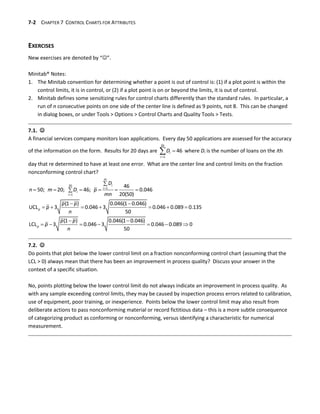
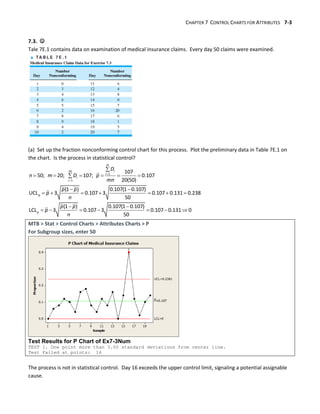
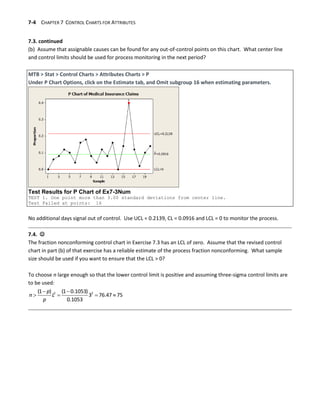
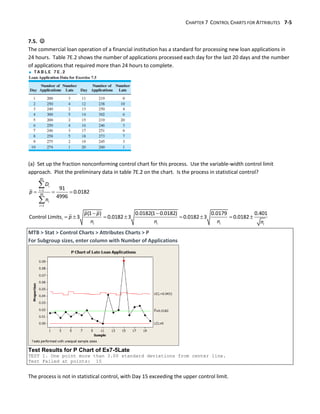
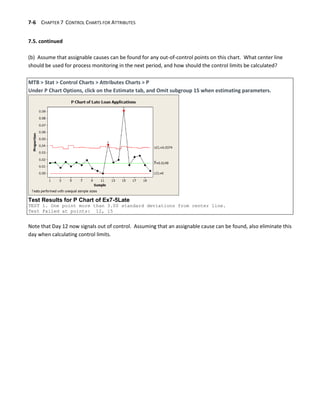
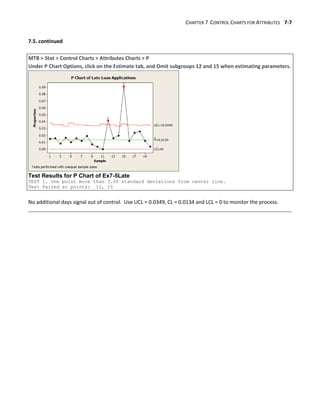
![7-8 CHAPTER 7 CONTROL CHARTS FOR ATTRIBUTES
7.6.
Reconsider the loan application data in Table 7E.2. Set up the fraction nonconforming control chart for this
process. Use the average sample size control limit approach. Plot the preliminary data in Table 7E.2 on the
chart. Is the process in statistical control? Compare this control chart to the one based on variable-width
control limits in Exercise 7.5.
20 20
1 1
20
1
91 4996
0.0182; 249.8 250
4996 20 20
(1 ) 0.0182(1 0.0182)
Control Limits 3 0.0182 3 0.0182 0.0254 [0.0436,0]
250
i i
i i
i
i
i
D n
p n
n
p p
p
n
MTB > Stat > Control Charts > Attributes Charts > P
For Subgroup sizes, enter the average sample size of 250
Test Results for P Chart of Ex7-5Late
TEST 1. One point more than 3.00 standard deviations from center line.
Test Failed at points: 15
Similar to the control chart with variable-width limits, Day 15 signals out of control, with the remaining days in
statistical control](https://image.slidesharecdn.com/5362-250421041938-9336621c/85/Statistical-Quality-Control-7th-Edition-Montgomery-Solutions-Manual-11-320.jpg)
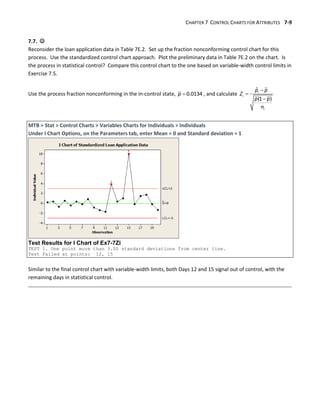
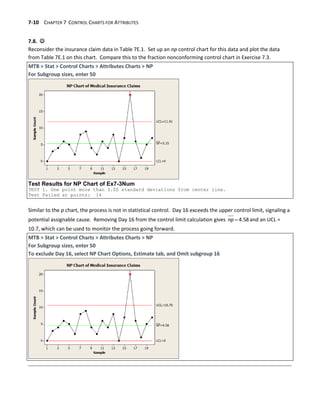
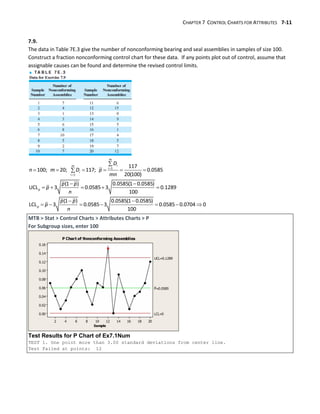
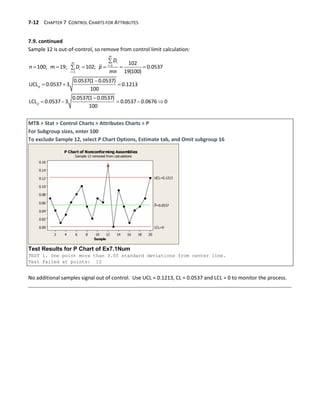
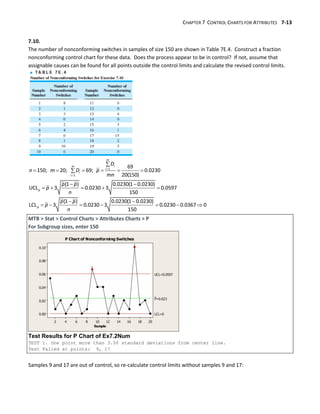
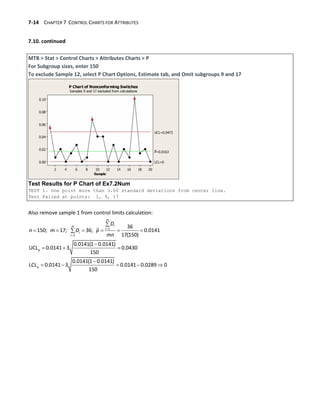
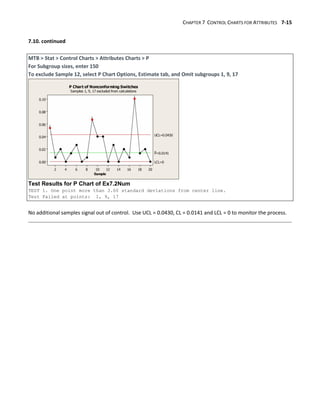
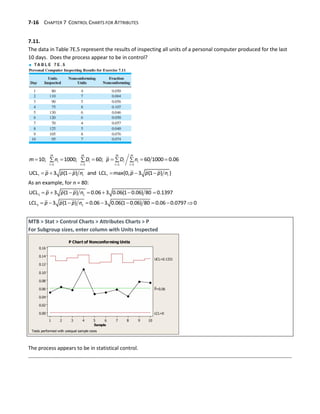
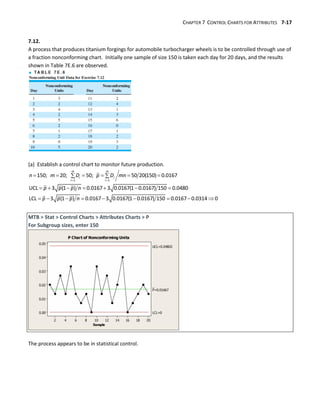
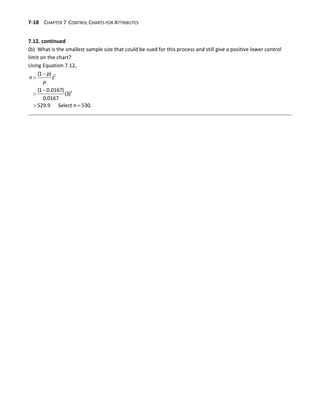
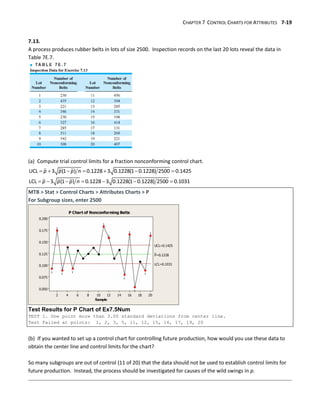
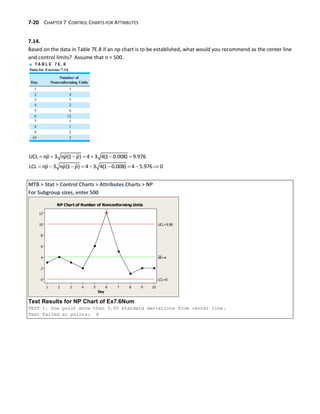
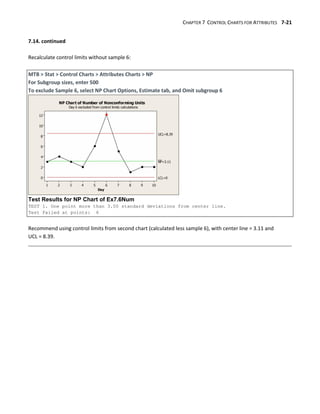
![7-22 CHAPTER 7 CONTROL CHARTS FOR ATTRIBUTES
7.15.
A control chart indicates that the current process fraction nonconforming is 0.02. If 50 items are inspected each
day, what is the probability of detecting a shift in the fraction nonconforming to 0.04 on the first day after the
shift? By the end of the third day following the shift?
0.02; 50
UCL 3 (1 ) 0.02 3 0.02(1 0.02) 50 0.0794
LCL 3 (1 ) 0.02 3 0.02(1 0.02) 50 0.02 0.0594 0
p n
p p p n
p p p n
Since pnew = 0.04 < 0.1 and n = 50 is "large", use the Poisson approximation to the binomial with = npnew =
50(0.04) = 2.00.
Pr{detect|shift}
= 1 – Pr{not detect|shift}
= 1 –
= 1 – [Pr{D < nUCL | } – Pr{D nLCL | }]
= 1 – Pr{D < 50(0.0794) | 2} + Pr{D 50(0) | 2}
= 1 – POI(3,2) + POI(0,2) = 1 – 0.857 + 0.135 = 0.278
where POI() is the cumulative Poisson distribution.
Pr{detected by 3rd sample} = 1 – Pr{detected after 3rd} = 1 – (1 – 0.278)3 = 0.624
7.16.
A company purchases a small metal bracket in containers of 5,000 each. Ten containers have arrived at the
unloading facility, and 250 brackets are selected at random from each container. The fraction nonconforming in
each sample are 0, 0, 0, 0.004, 0.008, 0.020, 0.004, 0, 0, and 0.008. Do the data from this shipment indicate
statistical control?
10
1
0.0440
ˆ
10; 250; 0.0440; 0.0044
10
UCL 3 (1 ) 0.0044 3 0.0044(1 0.0044) 250 0.0170
UCL 3 (1 ) 0.0044 3 0.0044(1 0.0044) 250 0.0044 0.0126 0
i
i
m n p p
p p p n
p p p n
No. The data from the shipment do not indicate statistical control. From the 6th sample,
6
ˆ
( 0.020)
p > 0.0170,
the UCL.](https://image.slidesharecdn.com/5362-250421041938-9336621c/85/Statistical-Quality-Control-7th-Edition-Montgomery-Solutions-Manual-25-320.jpg)
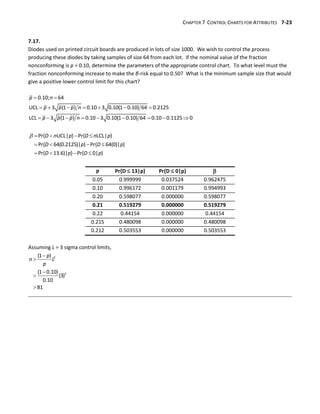
![7-24 CHAPTER 7 CONTROL CHARTS FOR ATTRIBUTES
7.18.
A control chart for the number of nonconforming piston rings is maintained on a forging process with np = 16.0.
A sample of size 100 is taken each day and analyzed.
16.0; 100; 16 100 0.16
UCL 3 (1 ) 16 3 16(1 0.16) 27.00
LCL 3 (1 ) 16 3 16(1 0.16) 5.00
np n p
np np p
np np p
(a) What is the probability that a shift in the process average to np = 20.0 will be detected on the first day
following the shift? What is the probability that the shift will be detected by at least the end of the third day?
npnew = 20.0 > 15, so use normal approximation to binomial distribution.
Pr{detect shift on 1st sample} 1
1 [Pr{ UCL| } Pr{ LCL| }]
UCL 1/2 LCL 1/2
1
(1 ) (1 )
27 0.5 20 5 0.5 20
1
20(1 0.2) 20(1 0.2)
1 (1.875) ( 3.875)
1 0
D p D p
np np
np p np p
.970 0.000
0.030
Pr{detect by at least 3rd
}
= 1 – Pr{detected after 3rd}
= 1 – (1 – 0.030)3
= 0.0873
(b) Find the smallest sample size that will give a positive lower control limit.
Assuming L = 3 sigma control limits,
2
2
(1 )
(1 0.16)
(3)
0.16
47.25
p
n L
p
So, n = 48 is the minimum sample size for a positive LCL.](https://image.slidesharecdn.com/5362-250421041938-9336621c/85/Statistical-Quality-Control-7th-Edition-Montgomery-Solutions-Manual-27-320.jpg)
![CHAPTER 7 CONTROL CHARTS FOR ATTRIBUTES 7-25
7.19.
A control chart for the fraction nonconforming is to be established using a center line of p = 0.10. What sample
size is required if we wish to detect a shift in the process fraction nonconforming to 0.20 with probability 0.50?
2 2
0.10; 0.20; desire Pr{detect} 0.50; assume 3 sigma control limits
new
= 0.20 0.10 0.10
new
3
(1 ) (0.10)(1 0.10) 81
0.10
p p k
p p
k
n p p
7.20.
A process is controlled with a fraction nonconforming control chart with three-sigma limits, n = 100, UCL =
0.161, center line = 0.080, and LCL = 0.
(a) Find the equivalent control chart for the number nonconforming.
100(0.080) 8
UCL 3 (1 ) 8 3 8(1 0.080) 16.14
LCL 3 (1 ) 8 3 8(1 0.080) 8 8.1388 0
np
np np p
np np p
(b) Use the Poisson approximation to the binomial to find the probability of a type I error.
p = 0.080 < 0.1 and n =100 is large, so use Poisson approximation to the binomial.
Pr{type I error} =
= Pr{D < LCL | p} + Pr{D > UCL | p}
= Pr{D < LCL | p} + [1 – Pr{D UCL | p}]
= Pr{D < 0 | 8} + [1 – Pr{D 16 | 8}]
= 0 + [1 – POI(16,8)]
= 0 + [1 – 0.996]
= 0.004
where POI() is the cumulative Poisson distribution.](https://image.slidesharecdn.com/5362-250421041938-9336621c/85/Statistical-Quality-Control-7th-Edition-Montgomery-Solutions-Manual-28-320.jpg)
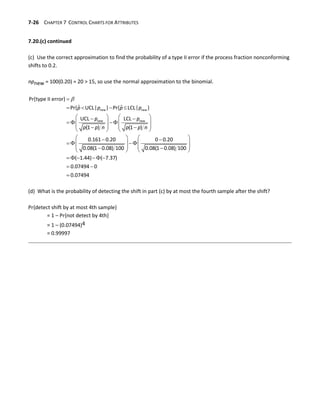
![CHAPTER 7 CONTROL CHARTS FOR ATTRIBUTES 7-27
7.21.
A process is being controlled with a fraction nonconforming control chart. The process average has been shown
to be 0.07. Three-sigma control limits are used, and the procedure calls for taking daily samples of 400 items.
(a) Calculate the upper and lower control limits.
0.07; 3 sigma control limits; 400
UCL 3 (1 ) 0.07 3 0.07(1 0.07) 400 0.108
LCL 3 (1 ) 0.07 3 0.07(1 0.07) 400 0.032
p k n
p p p n
p p p n
(b) If the process average should suddenly shift to 0.10, what is the probability that the shift would be detected
on the first subsequent sample?
npnew = 400(0.10) = > 40, so use the normal approximation to the binomial.
Pr{detect on 1st sample} 1 Pr{not detect on 1st sample}
1
ˆ ˆ
1 [Pr{ UCL| } Pr{ LCL| }]
UCL LCL
1
(1 ) (1 )
0.108 0.1 0.032 0.1
1
0.1(1 0.1) 400 0.1(1 0.1) 400
p p p p
p p
p p n p p n
1 (0.533) ( 4.533)
1 0.703 0.000
0.297
(c) What is the probability that the shift in part (b) would be detect on the first or second sample taken after the
shift?
Pr{detect on 1st or 2nd sample}
= Pr{detect on 1st} + Pr{not on 1st}Pr{detect on 2nd}
= 0.297 + (1 – 0.297)(0.297)
= 0.506](https://image.slidesharecdn.com/5362-250421041938-9336621c/85/Statistical-Quality-Control-7th-Edition-Montgomery-Solutions-Manual-30-320.jpg)
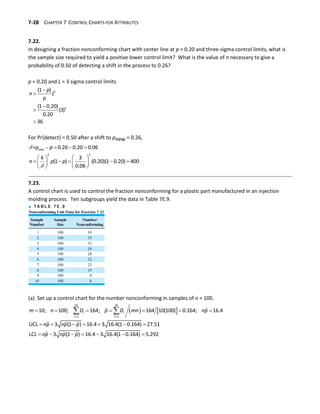
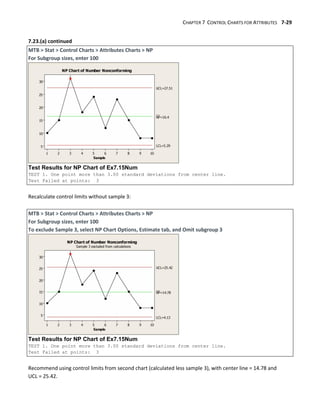
![7-30 CHAPTER 7 CONTROL CHARTS FOR ATTRIBUTES
7.23. continued
(b) For the chart established in part (a), what is the probability of detecting a shift in the process fraction
nonconforming to 0.30 on the first sample after the shift has occurred?
pnew = 0.30. Since p = 0.30 is not too far from 0.50, and n = 100 > 10, the normal approximation to the binomial
can be used.
Pr{detect on 1st} 1 Pr{not detect on 1st}
1
1 [Pr{ UCL| } Pr{ LCL| }]
UCL 1/2 LCL 1/2
1
(1 ) (1 )
25.42 0.5 30 4.13 0.5 30
1
30(1 0.3) 30(1 0.3)
1 ( 0.
D p D p
np np
np p np p
8903) ( 5.7544)
1 (0.187) (0.000)
0.813
7.24.
A control chart for fraction nonconforming indicates that the current process average is 0.03. The sample size is
constant at 200 units.
(a) Find the three-sigma control limits for the control chart.
UCL 3 (1 ) 0.03 3 0.03(1 0.03) 200 0.0662
LCL 3 (1 ) 0.03 3 0.03(1 0.03) 200 0.03 0.0362 0
p
p
p p p n
p p p n
(b) What is the probability that a shift in the process average to 0.08 will be detected on the first subsequent
sample? What is the probability that this shift will be detected at least by the fourth sample following the shift?
pnew = 0.08. Since (pnew = 0.08) < 0.10 and n is large, use the Poisson approximation to the binomial.
Pr{detect on 1st sample| } 1 Pr{not detect| }
1
ˆ ˆ
1 [Pr{ UCL| } Pr{ LCL| }]
1 Pr{ UCL| } Pr{ LCL| }
1 Pr{ 200(0.0662)|200(0.08)} Pr{ 200(0)|200(0.08)}
1 POI(13,16) POI(0,16)
1 0.2745 0.000
p p
p p p p
D n np D n np
D D
0.7255
where POI() is the cumulative Poisson distribution.
Pr{detect by at least 4th} = 1 – Pr{detect after 4th} = 1 – (1 – 0.7255)4 = 0.9943](https://image.slidesharecdn.com/5362-250421041938-9336621c/85/Statistical-Quality-Control-7th-Edition-Montgomery-Solutions-Manual-33-320.jpg)




![ch20[1].ppt](https://cdn.slidesharecdn.com/ss_thumbnails/ch201-230310224339-ed5e9422-thumbnail.jpg?width=640&height=640&fit=bounds)


![Production & Operation Management Chapter9[1]](https://cdn.slidesharecdn.com/ss_thumbnails/chapter91-140613051446-phpapp02-thumbnail.jpg?width=640&height=640&fit=bounds)
![Chapter9[1]](https://cdn.slidesharecdn.com/ss_thumbnails/chapter91-140613050946-phpapp02-thumbnail.jpg?width=640&height=640&fit=bounds)


