September 2024
Navigating the present and promise
of Generative AI
The State of AI
Private and Strictly Confidential
Copyright © 2024 ICONIQ Capital, LLC. All Rights Reserved
Private & Strictly Confidential 2
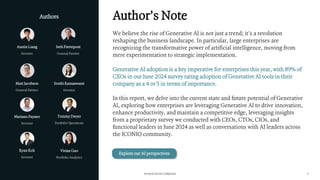
Author’s Note
Explore our AI perspectives
Authors
Vivian Guo
Portfolio Analytics
We believe the rise of Generative AI is not just a trend; it’s a revolution
reshaping the business landscape. In particular, large enterprises are
recognizing the transformative power of artificial intelligence, moving from
mere experimentation to strategic implementation.
Generative AI adoption is a key imperative for enterprises this year, with 89% of
CXOs in our June 2024 survey rating adoption of Generative AI tools in their
company as a 4 or 5 in terms of importance.
In this report, we delve into the current state and future potential of Generative
AI, exploring how enterprises are leveraging Generative AI to drive innovation,
enhance productivity, and maintain a competitive edge, leveraging insights
from a proprietary survey we conducted with CEOs, CTOs, CIOs, and
functional leaders in June 2024 as well as conversations with AI leaders across
the ICONIQ community.
Mariano Payano
Investor
Tommy Dwyer
Portfolio Operations
Austin Liang
Investor
Matt Jacobson
General Partner
Seth Pierrepont
General Partner
Sruthi Ramaswami
Investor
Ryan Koh
Investor
Vivian Guo
Portfolio Analytics
Katherine Dunn
Portfolio Analytics
Emre Garih
Portfolio Analytics
Claire Davis
Portfolio Analytics
Caroline Brand
Portfolio Analytics
Ani Reddy
Portfolio Data Analyst
Private & Strictly Confidential 3
Seeking to empower our portfolio with proprietary insights and advisory across business operations, hiring, and strategy
Sam O’Neill
Portfolio Data Manager
Contact us at ICONIQGrowthInsights@iconiqcapital.com
Christine Edmonds
Head of Portfolio Analytics
Meet the Team
ICONIQ Growth Analytics
Private & Strictly Confidential 4
Follow our research
SUBSCRIBE
Decoding the SaaS IPO Landscape
The metrics that matter and the market realities of 2024 and
beyond
The SaaS Glossary
A guide to understanding and tracking key SaaS metrics
The ICONIQ Growth Enterprise Five
Key performance indicators of Enterprise SaaS companies
2023 Growth & Efficiency Report
Explore our research on best-in-class SaaS growth and
efficiency
Hiring Your Next Marketing Leader
What to prioritize when hiring a Marketing executive from
$50M ARR to IPO
Go-To-Market Series
Guides to sales, customer success, marketing compensation
– and more
Table of Contents
Introduction
Data Sources & Methodology 6
Predictions for the Future 7
Executive Summary 8
5
Leading AI Goals for Enterprise 10
A Decision-Making Framework 11
Generative AI Budgets 12
AI Decision Makers 14
Vendor Preferences 15
Build vs Buy 16
Infrastructure vs Applications 17
Navigating
Generative AI
Purchasing
Decisions
Barriers to Adoption 19
Hiring 20
Use Cases 22
Estimated ROI 23
Measuring
ROI
Key Purchasing Criteria 25
Cloud Deployment Method 26
Proprietary vs Open Source 27
Models 29
Infrastructure Tooling 30
Deep Dive on
Infrastructure
AI Usage by Function 32
Spotlight: Product & Engineering 33
Spotlight: IT 34
Spotlight: Marketing 35
Spotlight: Sales 36
Spotlight: Finance 37
Spotlight: Operations 38
Deep Dive on
Applications
Private & Strictly Confidential 6
Data
Sources
& Methodology
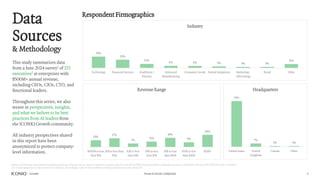
This study summarizes data
from a June 2024 survey1 of 215
executives2 at enterprises with
$500M+ annual revenue,
including CEOs, CIOs, CTO, and
functional leaders.
Throughout this series, we also
weave in perspectives, insights,
and what we believe to be best
practices from AI leaders from
the ICONIQ Growth community.
All industry perspectives shared
in this report have been
anonymized to protect company-
level information.
Respondent Firmographics
Notes: (1) This data was collected anonymously by an external survey. Survey responses include some but not all ICONIQ Growth portfolio companies as well as companies not part of ICONIQ Growth’s portfolio.
(2) Certain questions in the survey were optional. Accordingly, some N-Size numbers in this presentation are less than 215
33%
24%
12%
6% 6% 4% 3% 3%
11%
Technology Financial Services Healthcare /
Pharma
Advanced
Manufacturing
Consumer Goods System Integrators Marketing /
Advertising
Retail Other
Industry
13%
17%
7%
11%
18%
9%
24%
$500M to less
than $1B
$1B to less than
$2B
$2B to less
than $3B
$3B to less
than $5B
$5B to less
than $10B
$10B to less
than $20B
$20B+
Revenue Range
91%
7%
1% 1%
United States United
Kingdom
Canada Other
Headquarters
6 Predictions for the Future
Private & Strictly Confidential 7
Themes Predictions
6
5
3
2
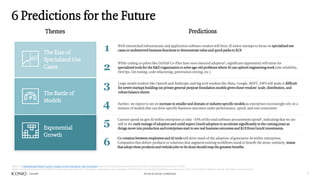
1 Well-entrenched infrastructure and application software vendors will force AI native startups to focus on specialized use
cases or underserved business functions to demonstrate value and quick paths to ROI
The Battle of
Models
The Rise of
Specialized Use
Cases
Exponential
Growth
While coding co-pilots like GitHub Co-Pilot have seen outsized adoption1, significant opportunity still exists for
specialized tools for the R&D organization to solve age-old problems where AI can uplevel engineering work (site reliability,
DevOps, QA testing, code refactoring, penetration testing, etc.)
4 Further, we expect to see an increase in smaller and domain or industry specific models as enterprises increasingly rely on a
mixture of models that can drive specific business outcomes under performance, speed, and cost constraints
Large model vendors like OpenAI and Anthropic and big tech vendors like Meta, Google, MSFT, AWS will make it difficult
for newer startups building out private general-purpose foundation models given those vendors’ scale, distribution, and
robust balance sheets
Current spend on gen AI within enterprises is only ~10% of the total software procurement spend2, indicating that we are
still in the early innings of adoption and could expect GenAI adoption to accelerate significantly in the coming years as
things move into production and enterprises start to see real business outcomes and ROI from GenAI investments.
Co-creation between employees and AI tools will drive much of the adoption of generative AI within enterprises.
Companies that deliver products or solutions that augment existing workflows stand to benefit the most; similarly, teams
that adopt these products and rethink jobs-to-be done should reap the greatest benefits
Notes: (1) Quantifying Github Copilot’s Impact in the Enterprise with Accenture (May 2024);(2) Perspectives from the ICONIQ Growth GenAI Survey (June 2024)
Source: Perspectives from the ICONIQ Growth team and network of AI leaders consisting of our community of CIO/CDOs overseeing AI initiatives in enterprises, CTOs, our Technical Advisory Board, and others in our network
Executive Summary
Private & Strictly Confidential 8
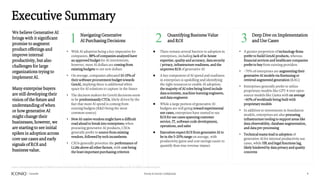
We believe Generative AI
brings with it significant
promise to augment
product offerings and
improve internal
productivity, but also
challenges for large
organizations trying to
implement AI.
Many enterprise buyers
are still developing their
vision of the future and
understanding of when
or how generative AI
might change their
businesses; however, we
are starting to see initial
spikes in adoption across
core use cases and early
signals of ROI and
business value.
• With AI adoption being a key imperative for
companies, 88% of companies analyzed have
an approved budget for AI investments;
however, most AI dollars are coming from
existing budgets vs net new dollars
• On average, companies allocated 10-15% of
their software procurement budget towards
GenAI, implying there is additional white
space for AI solutions to capture in the future
• The decision makers for GenAI decisions seem
to be predominantly CTOs, likely driven by the
fact that most AI spend is coming from
existing budgets (R&D being the most
common source)
• New AI-native vendors might have a difficult
road ahead to break into enterprises; when
procuring generative AI products, CXOs
generally prefer to source from existing
vendors, followed by tech incumbents
• CXOs generally prioritize the performance of
LLMs above all other factors, with cost being
the least important purchasing criterion
1 Navigating Generative
AI Purchasing Decisions 2 Quantifying Business Value
and ROI 3 Deep Dive on Implementation
and Use Cases
● There remain several barriers to adoption in
enterprises, including lack of in-house
expertise, quality and accuracy, data security
/ privacy, infrastructure readiness, and the
unproven ROI of generative AI
● A key component of AI spend and readiness
in enterprises is upskilling and identifying
the right resources to enable AI adoption;
the majority of AI roles being hired include
data scientists, machine learning engineers,
and data engineers
● While a large portion of generative AI
budgets are still going toward experimental
use cases, enterprises have started to see
ROI for use cases spanning customer
service, IT, software code development,
operations, and sales
● Executives expect ROI from generative AI to
be in the 5-20% range on average, with
productivity gains and cost savings easier to
quantify than true revenue impact
• A greater proportion of technology firms
prefer to build GenAI products, whereas
financial services and healthcare companies
prefer to buy from existing providers
• ~70% of enterprises are augmenting their
generative AI models via finetuning or
retrieval augmented generation (RAG)
• Enterprises generally prefer to utilize
proprietary models like GPT-4 over open-
source models like Llama with on average
~60%of workloads being built with
proprietary models
• In addition to investments in foundation
models, enterprises are also procuring
infrastructure tooling to support areas like
data observability, database augmentation,
and data pre-processing
• Technical teams lead in adoption of
generative AI for internal productivity use
cases, while HR and legal functions lag,
likely hindered by data privacy and quality
concerns
Source: Perspectives from the ICONIQ Growth GenAI Survey (June 2024) and perspectives from AI leaders in the ICONIQ Growth network
Private and Strictly Confidential
Copyright © 2024 ICONIQ Capital, LLC. All Rights Reserved
Navigating Generative AI Purchasing Decisions
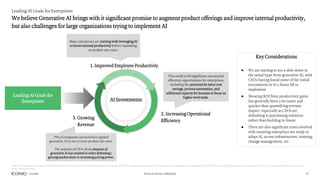
We believe Generative AI brings with it significant promise to augment product offerings and improve internal productivity,
but also challenges for large organizations trying to implement AI
Private & Strictly Confidential 10
Leading AI Goals for Enterprises
Many enterprises are starting with leveraging AI
to boost internal productivity before expanding
to product use cases.
3. Growing
Revenue
1. Improved Employee Productivity
2. Increasing Operational
Efficiency
AI Investments
This could yield significant operational
efficiency opportunities for enterprises,
including the potential for labor cost
savings, process automation, and
additional capacity for humans to focus on
higher-level tasks.
75% of companies surveyed have applied
generative AI to one or more product use cases.
The majority of CXOs think adoption of
generative AI has resulted in either defending /
gaining market share or increasing pricing power.
Leading AI Goals for
Enterprises
Key Considerations
● We are starting to see a slow down in
the initial hype from generative AI, with
CXOs having found some of the initial
investments in AI a heavy lift to
implement
● Showing ROI from productivity gains
has generally been a lot easier and
quicker than quantifying revenue
impact, especially as CXOs are
defaulting to purchasing solutions
rather than building in-house
● There are also significant costs involved
with ensuring enterprises are ready to
adopt AI, across infrastructure, training,
change management, etc.
Source: Perspectives from the ICONIQ Growth GenAI Survey (June 2024) and perspectives from the ICONIQ Growth team and network of AI leaders consisting of our community of CIO/CDOs overseeing AI initiatives in enterprises, CTOs, our Technical Advisory Board, and
others in our network
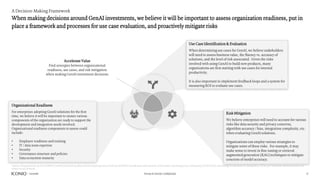
When making decisions around GenAI investments, we believe it will be important to assess organization readiness, put in
place a framework and processes for use case evaluation, and proactively mitigate risks
Private & Strictly Confidential 11
A Decision-Making Framework
Risk Mitigation
We believe enterprises will need to account for various
risks like data security and privacy concerns,
algorithm accuracy / bias, integration complexity, etc.
when evaluating GenAI solutions.
Organizations can employ various strategies to
mitigate some of these risks. For example, it may
make sense to invest in fine-tuning or retrieval
augmented generation (RAG) techniques to mitigate
concerns of model accuracy.
Use Case Identification & Evaluation
When determining use cases for GenAI, we believe stakeholders
will need to assess business value, the fluency vs. accuracy of
solutions, and the level of risk associated. Given the risks
involved with using GenAI to build new products, many
organizations are first starting with use cases for internal
productivity.
It is also important to implement feedback loops and a system for
measuring ROI to evaluate use cases.
Accelerate Value
Find synergies between organizational
readiness, use cases, and risk mitigation
when making GenAI investment decisions
Organizational Readiness
For enterprises adopting GenAI solutions for the first
time, we believe it will be important to ensure various
components of the organization are ready to support the
development and integration needs involved.
Organizational readiness components to assess could
include:
• Employee readiness and training
• IT / data team expertise
• Security
• Governance structure and policies
• Data ecosystem maturity
Source: Perspectives from the ICONIQ Growth GenAI Survey (June 2024) and perspectives from the ICONIQ Growth team and network of AI leaders consisting of our community of CIO/CDOs overseeing AI initiatives in enterprises, CTOs, our Technical Advisory Board, and
others in our network
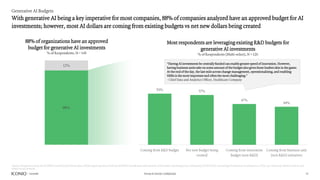
With generative AI being a key imperative for most companies, 88% of companies analyzed have an approved budget for AI
investments; however, most AI dollars are coming from existing budgets vs net new dollars being created
Private & Strictly Confidential 12
Generative AI Budgets
88% of organizations have an approved
budget for generative AI investments
% of Respondents, N = 143
Most respondents are leveraging existing R&D budgets for
generative AI investments
% of Respondents (Multi-select), N = 126
88%
12%
59% 57%
47%
44%
Coming from R&D budget Net new budget being
created
Coming from innovation
budget (non R&D)
Coming from business unit
(non R&D) initiatives
“Having AI investments be centrally funded can enable greater speed of innovation. However,
having business units take on some amount of the budget also gives those leaders skin in the game.
At the end of the day, the last mile across change management, operationalizing, and enabling
SMEs is the most important and often the most challenging.”
- Chief Data and Analytics Officer, Healthcare Company
Source: Perspectives from the ICONIQ Growth GenAI Survey (June 2024) and perspectives from the ICONIQ Growth team and network of AI leaders consisting of our community of CIO/CDOs overseeing AI initiatives in enterprises, CTOs, our Technical Advisory Board, and
others in our network
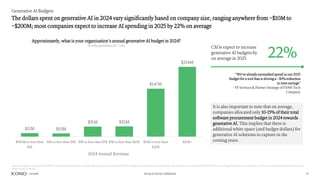
The dollars spent on generative AI in 2024 vary significantly based on company size, ranging anywhere from ~$10M to
~$200M; most companies expect to increase AI spending in 2025 by 22% on average
Private & Strictly Confidential 13
Generative AI Budgets
$11M $10M
$31M $32M
$147M
$214M
$500M to less than
$1B
$1B to less than $3B $3B to less than $5B $5B to less than $10B $10B to less than
$20B
$20B+
2024 Annual Revenue
Approximately, what is your organization’s annual generative AI budget in 2024?
% of Respondents (N = 143)
It is also important to note that on average,
companies allocated only 10-15% of their total
software procurement budget in 2024 towards
generative AI. This implies that there is
additional white space (and budget dollars) for
generative AI solutions to capture in the
coming years.
CXOs expect to increase
generative AI budgets by
on average in 2025
“We’ve already earmarked spend in our 2025
budget for a tool that is driving a ~30% reduction
in time savings”
- VP Services & Partner Strategy of F1000 Tech
Company
22%
Source: Perspectives from the ICONIQ Growth GenAI Survey (June 2024) and perspectives from the ICONIQ Growth team and network of AI leaders consisting of our community of CIO/CDOs overseeing AI initiatives in enterprises, CTOs, our Technical Advisory Board, and
others in our network
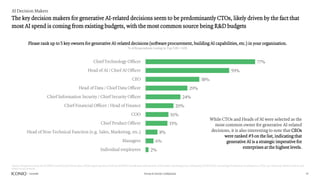
The key decision makers for generative AI-related decisions seem to be predominantly CTOs, likely driven by the fact that
most AI spend is coming from existing budgets, with the most common source being R&D budgets
Private & Strictly Confidential 14
AI Decision Makers
Please rank up to 5 key owners for generative AI-related decisions (software procurement, building AI capabilities, etc.) in your organization.
% of Respondents Listing in Top 3 (N = 143)
77%
59%
38%
29%
24%
20%
16%
15%
8%
6%
2%
Chief Technology Officer
Head of AI / Chief AI Officer
CEO
Head of Data / Chief Data Officer
Chief Information Security / Chief Security Officer
Chief Financial Officer / Head of Finance
COO
Chief Product Officer
Head of Non-Technical Function (e.g. Sales, Marketing, etc.)
Managers
Individual employees
While CTOs and Heads of AI were selected as the
most common owner for generative AI-related
decisions, it is also interesting to note that CEOs
were ranked #3 on the list, indicating that
generative AI is a strategic imperative for
enterprises at the highest levels.
Source: Perspectives from the ICONIQ Growth GenAI Survey (June 2024) and perspectives from the ICONIQ Growth team and network of AI leaders consisting of our community of CIO/CDOs overseeing AI initiatives in enterprises, CTOs, our Technical Advisory Board, and
others in our network
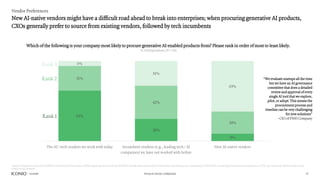
New AI-native vendors might have a difficult road ahead to break into enterprises; when procuring generative AI products,
CXOs generally prefer to source from existing vendors, followed by tech incumbents
Private & Strictly Confidential 15
Vendor Preferences
63%
28%
9%
31%
42%
28%
6%
31%
63%
The AI / tech vendors we work with today Incumbent vendors (e.g., leading tech / AI
companies) we have not worked with before
New AI-native vendors
Which of the following is your company most likely to procure generative AI-enabled products from? Please rank in order of most to least likely.
% of Respondents (N = 65)
Rank 1
Rank 2
Rank 3
“We evaluate startups all the time
but we have an AI governance
committee that does a detailed
review and approval of every
single AI tool that we explore,
pilot, or adopt. This means the
procurement process and
timeline can be very challenging
for new solutions”
- CIO of F500 Company
Source: Perspectives from the ICONIQ Growth GenAI Survey (June 2024) and perspectives from the ICONIQ Growth team and network of AI leaders consisting of our community of CIO/CDOs overseeing AI initiatives in enterprises, CTOs, our Technical Advisory Board, and
others in our network
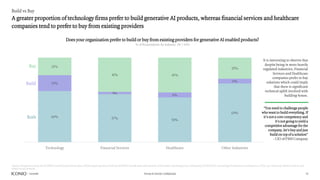
A greater proportion of technology firms prefer to build generative AI products, whereas financial services and healthcare
companies tend to prefer to buy from existing providers
Private & Strictly Confidential 16
Build vs Buy
Does your organization prefer to build or buy from existing providers for generative AI enabled products?
% of Respondents by Industry (N = 143)
60% 57% 53%
69%
19%
3%
6%
6%
21%
41% 41%
25%
Technology Financial Services Healthcare Other Industries
It is interesting to observe that
despite being in more heavily
regulated industries, Financial
Services and Healthcare
companies prefer to buy
solutions which could imply
that there is significant
technical uplift involved with
building-house.
Both
Build
Buy
“You need to challenge people
who want to build everything. If
it’s not a core competency and
it’s not going to yield a
competitive advantage for the
company, let’s buy and just
build on top of a solution”
- CIO of F500 Company
Source: Perspectives from the ICONIQ Growth GenAI Survey (June 2024) and perspectives from the ICONIQ Growth team and network of AI leaders consisting of our community of CIO/CDOs overseeing AI initiatives in enterprises, CTOs, our Technical Advisory Board, and
others in our network
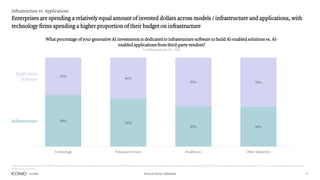
Enterprises are spending a relatively equal amount of invested dollars across models / infrastructure and applications, with
technology firms spending a higher proportion of their budget on infrastructure
Private & Strictly Confidential 17
Infrastructure vs. Applications
What percentage of your generative AI investments is dedicated to infrastructure software to build AI-enabled solutions vs. AI-
enabled applications from third-party vendors?
% of Respondents (N = 143)
58%
54%
45% 45%
42%
46%
55% 55%
Technology Financial Services Healthcare Other Industries
Application
Software
Infrastructure
Source: Perspectives from the ICONIQ Growth GenAI Survey (June 2024) and perspectives from the ICONIQ Growth team and network of AI leaders consisting of our community of CIO/CDOs overseeing AI initiatives in enterprises, CTOs, our Technical Advisory Board, and
others in our network
Private and Strictly Confidential
Copyright © 2024 ICONIQ Capital, LLC. All Rights Reserved
Measuring ROI
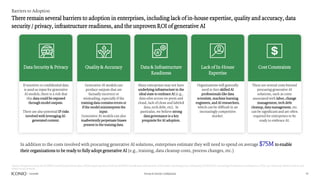
There remain several barriers to adoption in enterprises, including lack of in-house expertise, quality and accuracy, data
security / privacy, infrastructure readiness, and the unproven ROI of generative AI
Private & Strictly Confidential 19
Barriers to Adoption
19
Data Security & Privacy
If sensitive or confidential data
is used as input for generative
AI models, there is a risk that
this data could be exposed
through model outputs.
There are also potential IP risks
involved with leveraging AI-
generated content.
Quality & Accuracy
Generative AI models can
produce outputs that are
factually incorrect or
misleading, especially if the
training data contains errors or
if the model misinterprets the
input.
Generative AI models can also
inadvertently perpetuate biases
present in the training data.
Lack of In-House
Expertise
Organizations will generally
need to hire skilled AI
professionals like data
scientists, machine learning
engineers, and AI researchers,
which can be difficult in an
increasingly competitive
market.
Data & Infrastructure
Readiness
Many enterprises may not have
underlying infrastructure in the
ideal state to embrace AI (e.g.,
data silos across on-prem and
cloud, lack of clean and labeled
data, tech debt, etc). In
particular, we believe strong
data governance is a key
prequisite for AI adoption.
Cost Constraints
There are several costs beyond
procuring generative AI
solutions, such as costs
associated with labor, change
management, tech debt
cleanup, data management, etc.
can be significant and are often
required for enterprises to be
ready to embrace AI.
In addition to the costs involved with procuring generative AI solutions, enterprises estimate they will need to spend on average $75M to enable
their organizations to be ready to fully adopt generative AI (e.g., training, data cleanup costs, process changes, etc.)
Source: Perspectives from the ICONIQ Growth GenAI Survey (June 2024) and perspectives from the ICONIQ Growth team and network of AI leaders consisting of our community of CIO/CDOs overseeing AI initiatives in enterprises, CTOs, our Technical Advisory Board, and
others in our network
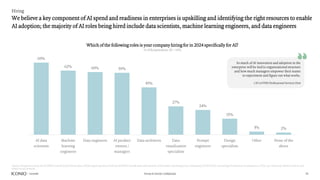
We believe a key component of AI spend and readiness in enterprises is upskilling and identifying the right resources to enable
AI adoption; the majority of AI roles being hired include data scientists, machine learning engineers, and data engineers
Private & Strictly Confidential 20
Hiring
Which of the following roles is your company hiring for in 2024 specifically for AI?
% of Respondents (N = 143)
69%
62% 60% 59%
45%
27%
24%
15%
3% 2%
AI data
scientists
Machine
learning
engineers
Data engineers AI product
owners /
managers
Data architects Data
visualization
specialists
Prompt
engineers
Design
specialists
Other None of the
above
So much of AI innovation and adoption in the
enterprise will be tied to organizational structure
and how much managers empower their teams
to experiment and figure out what works.
CIO of F500 Professional Services Firm
Source: Perspectives from the ICONIQ Growth GenAI Survey (June 2024) and perspectives from the ICONIQ Growth team and network of AI leaders consisting of our community of CIO/CDOs overseeing AI initiatives in enterprises, CTOs, our Technical Advisory Board, and
others in our network
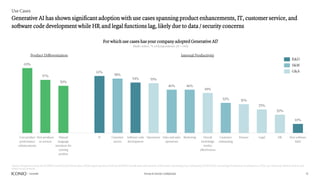
Generative AI has shown significant adoption with use cases spanning product enhancements, IT, customer service, and
software code development while HR and legal functions lag, likely due to data / security concerns
Private & Strictly Confidential 21
Use Cases
For which use cases has your company adopted Generative AI?
Multi-select, % of Respondents (N = 143)
69%
57%
50%
61%
58%
54% 53%
46% 46%
43%
32% 31%
25%
20%
10%
Core product
performance
enhancements
New products
or services
Natural
language
interfaces for
existing
product
IT Customer
service
Software code
development
Operations Sales and sales
operations
Marketing Overall
knowledge
worker
effectiveness
Customer
onboarding
Finance Legal HR Non-software
R&D
Product Differentiation Internal Productivity
G&A
S&M
R&D
Source: Perspectives from the ICONIQ Growth GenAI Survey (June 2024) and perspectives from the ICONIQ Growth team and network of AI leaders consisting of our community of CIO/CDOs overseeing AI initiatives in enterprises, CTOs, our Technical Advisory Board, and
others in our network
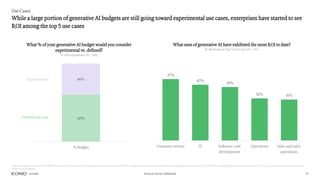
While a large portion of generative AI budgets are still going toward experimental use cases, enterprises have started to see
ROI among the top 5 use cases
Private & Strictly Confidential 22
Use Cases
What uses of generative AI have exhibited the most ROI to date?
% Mentions in Top 5 Use Case (N = 116)
What % of your generative AI budget would you consider
experimental vs. defined?
% of Respondents (N = 143)
60%
40%
% Budget
Defined use case
Experimental
47%
42%
41%
32% 31%
Customer service IT Software code
development
Operations Sales and sales
operations
Source: Perspectives from the ICONIQ Growth GenAI Survey (June 2024) and perspectives from the ICONIQ Growth team and network of AI leaders consisting of our community of CIO/CDOs overseeing AI initiatives in enterprises, CTOs, our Technical Advisory Board, and
others in our network
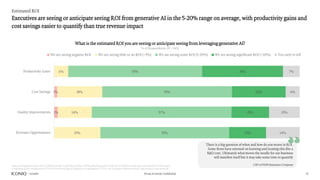
Executives are seeing or anticipate seeing ROI from generative AI in the 5-20% range on average, with productivity gains and
cost savings easier to quantify than true revenue impact
Private & Strictly Confidential 23
Estimated ROI
What is the estimated ROI you are seeing or anticipate seeing from leveraging generative AI?
% of Respondents (N = 143)
1%
1%
19%
14%
18%
6%
53%
57%
53%
55%
15%
15%
22%
33%
14%
13%
6%
7%
Revenue Opportunities
Quality Improvements
Cost Savings
Productivity Gains
We are seeing negative ROI We are seeing little to no ROI (<5%) We are seeing some ROI (5-20%) We are seeing significant ROI (>20%) Too early to tell
There is a big question of when and how do you weave in ROI.
Some firms have oriented on learning and treating this like a
R&D cost. Ultimately what moves the needle for our business
will manifest itself but it may take some time to quantify
CXO of F100 Insurance Company
Source: Perspectives from the ICONIQ Growth GenAI Survey (June 2024) and perspectives from the ICONIQ Growth team and network of AI leaders
consisting of our community of CIO/CDOs overseeing AI initiatives in enterprises, CTOs, our Technical Advisory Board, and others in our network
Private and Strictly Confidential
Copyright © 2024 ICONIQ Capital, LLC. All Rights Reserved
Deep Dive on Infrastructure
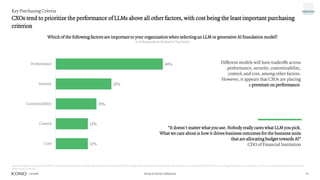
CXOs tend to prioritize the performance of LLMs above all other factors, with cost being the least important purchasing
criterion
Private & Strictly Confidential 25
Key Purchasing Criteria
Which of the following factors are important to your organization when selecting an LLM or generative AI foundation model?
% of Respondents Ranked as Top Factor
40%
21%
15%
12%
12%
Performance
Security
Customizability
Control
Cost
Infrastructure
“It doesn’t matter what you use. Nobody really cares what LLM you pick.
What we care about is how it drives business outcomes for the business units
that are allocating budget towards AI”
CDO of Financial Institution
Different models will have tradeoffs across
performance, security, customizability,
control, and cost, among other factors.
However, it appears that CXOs are placing
a premium on performance.
Source: Perspectives from the ICONIQ Growth GenAI Survey (June 2024) and perspectives from the ICONIQ Growth team and network of AI leaders consisting of our community of CIO/CDOs overseeing AI initiatives in enterprises, CTOs, our Technical Advisory Board, and
others in our network
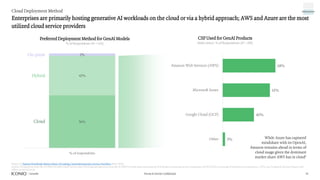
Enterprises are primarily hosting generative AI workloads on the cloud or via a hybrid approach; AWS and Azure are the most
utilized cloud service providers
Private & Strictly Confidential 26
Cloud Deployment Method
Preferred Deployment Method for GenAI Models
% of Respondents (N = 126)
68%
61%
40%
3%
Amazon Web Services (AWS)
Microsoft Azure
Google Cloud (GCP)
Other
56%
42%
2%
% of respondents
Cloud
Hybrid
On-prem
CSP Used for GenAI Products
Multi-Select, % of Respondents (N = 218)
Infrastructure
While Azure has captured
mindshare with its OpenAI,
Amazon remains ahead in terms of
cloud usage given the dominant
market share AWS has in cloud1
Notes: (1) Statista Worldwide Market Share of Leading Cloud Infrastructure Service Providers (May 2024)
Source: Perspectives from the ICONIQ Growth GenAI Survey (June 2024) and perspectives from the ICONIQ Growth team and network of AI leaders consisting of our community of CIO/CDOs overseeing AI initiatives in enterprises, CTOs, our Technical Advisory Board, and
others in our network
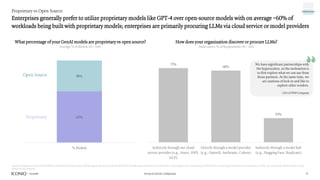
Enterprises generally prefer to utilize proprietary models like GPT-4 over open-source models with on average ~60% of
workloads being built with proprietary models; enterprises are primarily procuring LLMs via cloud service or model providers
Private & Strictly Confidential 27
Proprietary vs Open Source
What percentage of your GenAI models are proprietary vs open source?
Average % of Models (N = 143)
62%
38%
% Models
Proprietary
Open Source
How does your organization discover or procure LLMs?
Multi-select, % of Respondents (N = 143)
71%
68%
23%
Indirectly through our cloud
service provider (e.g., Azure, AWS,
GCP)
Directly through a model provider
(e.g., OpenAI, Anthropic, Cohere)
Indirectly through a model hub
(e.g., Hugging Face, Replicate)
Infrastructure
We have significant partnerships with
the hyperscalers, so the inclination is
to first explore what we can use from
those partners. At the same time, we
are cautious of lock-in and like to
explore other vendors.
CIO of F500 Company
Source: Perspectives from the ICONIQ Growth GenAI Survey (June 2024) and perspectives from the ICONIQ Growth team and network of AI leaders consisting of our community of CIO/CDOs overseeing AI initiatives in enterprises, CTOs, our Technical Advisory Board, and
others in our network
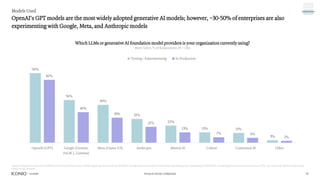
OpenAI’s GPT models are the most widely adopted generative AI models; however, ~30-50% of enterprises are also
experimenting with Google, Meta, and Anthropic models
Private & Strictly Confidential 28
Models Used
Which LLMs or generative AI foundation model providers is your organization currently using?
Multi-Select, % of Respondents (N = 126)
90%
56%
49%
31%
22%
13% 13%
3%
82%
40%
33%
21%
13%
7% 6%
2%
OpenAI (GPT) Google (Gemini,
PaLM 2, Gemma)
Meta (Llama 2/3) Anthropic Mistral AI Cohere Contextual AI Other
Testing / Experimenting In Production
Infrastructure
Source: Perspectives from the ICONIQ Growth GenAI Survey (June 2024) and perspectives from the ICONIQ Growth team and network of AI leaders consisting of our community of CIO/CDOs overseeing AI initiatives in enterprises, CTOs, our Technical Advisory Board, and
others in our network
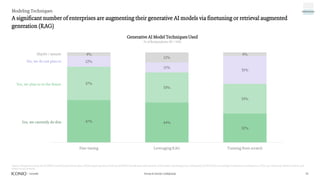
A significant number of enterprises are augmenting their generative AI models via finetuning or retrieval augmented
generation (RAG)
Private & Strictly Confidential 29
Modeling Techniques
Generative AI Model Techniques Used
% of Respondents (N = 143)
47% 44%
32%
37%
33%
33%
12%
11%
31%
4%
11%
4%
Fine-tuning Leveraging RAG Training from scratch
Yes, we currently do this
Yes, we plan to in the future
No, we do not plan to
Maybe / unsure
Infrastructure
Source: Perspectives from the ICONIQ Growth GenAI Survey (June 2024) and perspectives from the ICONIQ Growth team and network of AI leaders consisting of our community of CIO/CDOs overseeing AI initiatives in enterprises, CTOs, our Technical Advisory Board, and
others in our network
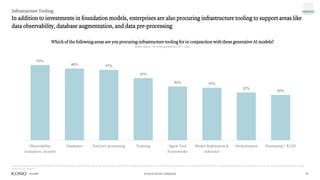
In addition to investments in foundation models, enterprises are also procuring infrastructure tooling to support areas like
data observability, database augmentation, and data pre-processing
Private & Strictly Confidential 30
Infrastructure Tooling
Which of the following areas are you procuring infrastructure tooling for in conjunction with these generative AI models?
Multi-select, % of Respondents (N = 126)
50%
48% 47%
41%
36% 35%
32%
30%
Observability,
evaluation, security
Databases Data pre-processing Training Agent Tool
Frameworks
Model deployment &
inference
Orchestration Finetuning + RLHF
Infrastructure
Source: Perspectives from the ICONIQ Growth GenAI Survey (June 2024) and perspectives from the ICONIQ Growth team and network of AI leaders consisting of our community of CIO/CDOs overseeing AI initiatives in enterprises, CTOs, our Technical Advisory Board, and
others in our network
Private and Strictly Confidential
Copyright © 2024 ICONIQ Capital, LLC. All Rights Reserved
Deep Dive on Applications
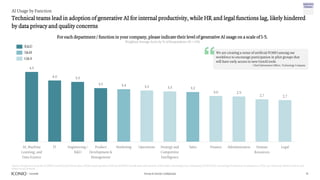
Technical teams lead in adoption of generative AI for internal productivity, while HR and legal functions lag, likely hindered
by data privacy and quality concerns
Private & Strictly Confidential 32
AI Usage by Function
For each department / function in your company, please indicate their level of generative AI usage on a scale of 1-5.
Weighted Average Score by % of Respondents (N = 143)
4.5
4.0 3.9
3.5 3.4 3.3 3.3 3.2
3.0 2.9
2.7 2.7
AI, Machine
Learning, and
Data Science
IT Engineering /
R&D
Product
Development &
Management
Marketing Operations Strategy and
Competitive
Intelligence
Sales Finance Administration Human
Resources
Legal
We are creating a sense of artificial FOMO among our
workforce to encourage participation in pilot groups that
will have early access to new GenAI tools
Chief Information Officer, Technology Company
Application
Software
G&A
S&M
R&D
Source: Perspectives from the ICONIQ Growth GenAI Survey (June 2024) and perspectives from the ICONIQ Growth team and network of AI leaders consisting of our community of CIO/CDOs overseeing AI initiatives in enterprises, CTOs, our Technical Advisory Board, and
others in our network
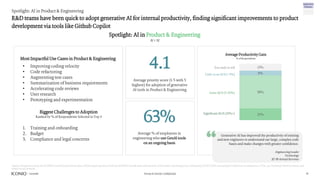
R&D teams have been quick to adopt generative AI for internal productivity, finding significant improvements to product
development via tools like Github Copilot
Private & Strictly Confidential 33
Spotlight: AI in Product & Engineering
Most Impactful Use Cases in Product & Engineering
4.1
Average priority score (1-5 with 5
highest) for adoption of generative
AI tools in Product & Engineering
63%
Average % of employees in
engineering who use GenAI tools
on an ongoing basis
• Improving coding velocity
• Code refactoring
• Augmenting test cases
• Summarization of business requirements
• Accelerating code reviews
• User research
• Prototyping and experimentation
Generative AI has improved the productivity of existing
and new engineers to understand our large, complex code
bases and make changes with greater confidence.
Engineering Leader
Technology
$2-3B Annual Revenue
Average Productivity Gain
% of Respondents
Significant ROI (20%+)
Some ROI (5-20%)
Little to no ROI (<5%)
Too early to tell
Spotlight: AI in Product & Engineering
N = 51
Application
Software
Biggest Challenges to Adoption
Ranked by % of Respondents Selected in Top 3
1. Training and onboarding
2. Budget
3. Compliance and legal concerns
21%
58%
8%
13%
Source: Perspectives from the ICONIQ Growth GenAI Survey (June 2024) and perspectives from the ICONIQ Growth team and network of AI leaders consisting of our community of CIO/CDOs overseeing AI initiatives in enterprises, CTOs, our Technical Advisory Board, and
others in our network
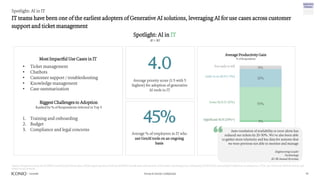
IT teams have been one of the earliest adopters of Generative AI solutions, leveraging AI for use cases across customer
support and ticket management
Private & Strictly Confidential 34
Spotlight: AI in IT
4.0
Average priority score (1-5 with 5
highest) for adoption of generative
AI tools in IT
45%
Average % of employees in IT who
use GenAI tools on an ongoing
basis
Spotlight: AI in IT
N = 50
Application
Software
Most Impactful Use Cases in IT
• Ticket management
• Chatbots
• Customer support / troubleshooting
• Knowledge management
• Case summarization
Biggest Challenges to Adoption
Ranked by % of Respondents Selected in Top 3
1. Training and onboarding
2. Budget
3. Compliance and legal concerns
Average Productivity Gain
% of Respondents
Significant ROI (20%+)
Some ROI (5-20%)
Little to no ROI (<5%)
Too early to tell
3%
59%
32%
6%
Auto-resolution of availability or error alerts has
reduced our tickets by 20-30%. We’ve also been able
to gather more telemetry and key data for systems that
we were previous not able to monitor and manage
Engineering Leader
Technology
$2-3B Annual Revenue
Source: Perspectives from the ICONIQ Growth GenAI Survey (June 2024) and perspectives from the ICONIQ Growth team and network of AI leaders consisting of our community of CIO/CDOs overseeing AI initiatives in enterprises, CTOs, our Technical Advisory Board, and
others in our network
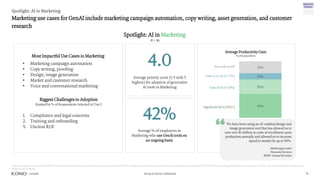
Marketing use cases for GenAI include marketing campaign automation, copy writing, asset generation, and customer
research
Private & Strictly Confidential 35
4.0
Average priority score (1-5 with 5
highest) for adoption of generative
AI tools in Marketing
42%
Average % of employees in
Marketing who use GenAI tools on
an ongoing basis
Spotlight: AI in Marketing
N = 36
Application
Software
Most Impactful Use Cases in Marketing
• Marketing campaign automation
• Copy writing, proofing
• Design, image generation
• Market and customer research
• Voice and conversational marketing
Biggest Challenges to Adoption
Ranked by % of Respondents Selected in Top 3
1. Compliance and legal concerns
2. Training and onboarding
3. Unclear ROI
Spotlight: AI in Marketing
Average Productivity Gain
% of Respondents
Significant ROI (20%+)
Some ROI (5-20%)
Little to no ROI (<5%)
Too early to tell
42%
26%
11%
21%
We have been using an AI-enabled design and
image generation tool that has allowed us to
save over $1 million in costs of enrollment asset
production annually and allowed us to increase
speed to market by up to 50%.
Marketing Leader
Financial Services
$20B+ Annual Revenue
Source: Perspectives from the ICONIQ Growth GenAI Survey (June 2024) and perspectives from the ICONIQ Growth team and network of AI leaders consisting of our community of CIO/CDOs overseeing AI initiatives in enterprises, CTOs, our Technical Advisory Board, and
others in our network
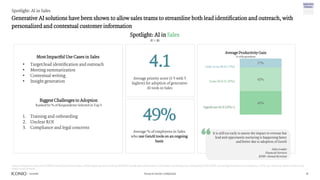
Generative AI solutions have been shown to allow sales teams to streamline both lead identification and outreach, with
personalized and contextual customer information
Private & Strictly Confidential 36
Spotlight: AI in Sales
4.1
Average priority score (1-5 with 5
highest) for adoption of generative
AI tools in Sales
49%
Average % of employees in Sales
who use GenAI tools on an ongoing
basis
Spotlight: AI in Sales
N = 36
Application
Software
Most Impactful Use Cases in Sales
• Target/lead identification and outreach
• Meeting summarization
• Contextual writing
• Insight generation
Biggest Challenges to Adoption
Ranked by % of Respondents Selected in Top 3
1. Training and onboarding
2. Unclear ROI
3. Compliance and legal concerns
Average Productivity Gain
% of Respondents
Significant ROI (20%+)
Some ROI (5-20%)
Little to no ROI (<5%)
42%
42%
17%
It is still too early to assess the impact to revenue but
lead and opportunity nurturing is happening faster
and better due to adoption of GenAI
Sales Leader
Financial Services
$20B+ Annual Revenue
Source: Perspectives from the ICONIQ Growth GenAI Survey (June 2024) and perspectives from the ICONIQ Growth team and network of AI leaders consisting of our community of CIO/CDOs overseeing AI initiatives in enterprises, CTOs, our Technical Advisory Board, and
others in our network
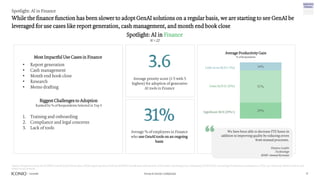
While the finance function has been slower to adopt GenAI solutions on a regular basis, we are starting to see GenAI be
leveraged for use cases like report generation, cash management, and month end book close
Private & Strictly Confidential 37
Spotlight: AI in Finance
3.6
Average priority score (1-5 with 5
highest) for adoption of generative
AI tools in Finance
31%
Average % of employees in Finance
who use GenAI tools on an ongoing
basis
Spotlight: AI in Finance
N = 22
Application
Software
Most Impactful Use Cases in Finance
• Report generation
• Cash management
• Month end book close
• Research
• Memo drafting
Biggest Challenges to Adoption
Ranked by % of Respondents Selected in Top 3
1. Training and onboarding
2. Compliance and legal concerns
3. Lack of tools
Average Productivity Gain
% of Respondents
Significant ROI (20%+)
Some ROI (5-20%)
Little to no ROI (<5%)
We have been able to decrease FTE hours in
addition to improving quality by reducing errors
from manual processes.
Finance Leader
Technology
$20B+ Annual Revenue
29%
57%
14%
Source: Perspectives from the ICONIQ Growth GenAI Survey (June 2024) and perspectives from the ICONIQ Growth team and network of AI leaders consisting of our community of CIO/CDOs overseeing AI initiatives in enterprises, CTOs, our Technical Advisory Board, and
others in our network
Private & Strictly Confidential 38
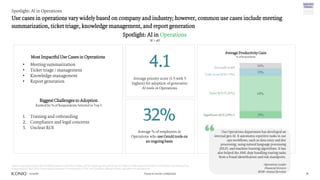
4.1
Average priority score (1-5 with 5
highest) for adoption of generative
AI tools in Operations
32%
Average % of employees in
Operations who use GenAI tools on
an ongoing basis
Spotlight: AI in Operations
N = 40
Application
Software
Most Impactful Use Cases in Operations
• Meeting summarization
• Ticket triage / management
• Knowledge management
• Report generation
Biggest Challenges to Adoption
Ranked by % of Respondents Selected in Top 3
1. Training and onboarding
2. Compliance and legal concerns
3. Unclear ROI
Average Productivity Gain
% of Respondents
Significant ROI (20%+)
Some ROI (5-20%)
Little to no ROI (<5%)
Too early to tell
13%
63%
13%
10%
Our Operations department has developed an
internal gen AI. It automates repetitive tasks in our
ops workflows, such as data entry and doc
processing, using natural language processing
(NLP). and machine learning algorithms. It has
also helped the AML dept handling routing tasks
from a Fraud identification and risk standpoint.
Operations Leader
Financial Services
$20B+ Annual Revenue
Use cases in operations vary widely based on company and industry; however, common use cases include meeting
summarization, ticket triage, knowledge management, and report generation
Spotlight: AI in Operations
Source: Perspectives from the ICONIQ Growth GenAI Survey (June 2024) and perspectives from the ICONIQ Growth team and network of AI leaders consisting of our
community of CIO/CDOs overseeing AI initiatives in enterprises, CTOs, our Technical Advisory Board, and others in our network
A global portfolio of category-defining businesses
Private & Strictly Confidential 39
These companies represent the full list of companies that ICONIQ Growth has invested in since inception through ICONIQ Strategic Partners funds as of the date these materials were published (except those subject to confidentiality obligations). Trademarks are the property of
their respective owners. None of the companies illustrated have endorsed or recommended the services of ICONIQ.
Disclosures
Unless otherwise indicated, the views expressed in this presentation are those of ICONIQ growth (“ICONIQ" or the “Firm"), are the result of proprietary research, may be subjective, and may not be relied upon in making an investment
decision. Information used in this presentation was obtained from numerous sources. Certain of these companies are portfolio companies of ICONIQ Growth. ICONIQ Growth does not make any representations or warranties as to the
accuracy of the information obtained from these sources.
This presentation is for educational purposes only and does not constitute investment advice or an offer to sell or a solicitation of an offer to buy any securities which will only be made pursuant to definitive offering documents and
subscription agreements, including, without limitation, any investment fund or investment product referenced herein.
Any reproduction or distribution of this presentation in whole or in part, or the disclosure of any of its contents, without the prior consent of ICONIQ, is prohibited.
This presentation may contain forward-looking statements based on current plans, estimates and projections. The recipient of this presentation ("you") are cautioned that a number of important factors could cause actual results or
outcomes to differ materially from those expressed in, or implied by, the forward-looking statements. The numbers, figures and case studies included in this presentation have been included for purposes of illustration only, and no
assurance can be given that the actual results of ICONIQ or any of its partners and affiliates will correspond with the results contemplated in the presentation. No information is contained herein with respect to conflicts of interest, which
may be significant. The portfolio companies and other parties mentioned herein may reflect a selective list of the prior investments made by ICONIQ.
Certain of the economic and market information contained herein may have been obtained from published sources and/or prepared by other parties. While such sources are believed to be reliable, none of ICONIQ or any of its affiliates
and partners, employees and representatives assume any responsibility for the accuracy of such information.
All of the information in the presentation is presented as of the date made available to you (except as otherwise specified),and is subject to change without notice, and may not be current or may have changed (possibly materially)
between the date made available to you and the date actually received or reviewed by you. ICONIQ assumes no obligation to update or otherwise revise any information, projections, forecasts or estimates contained in the presentation,
including any revisions to reflect changes in economic or market conditions or other circumstances arising after the date the items were made available to you or to reflect the occurrence of unanticipated events. Numbers or amounts
herein may increase or decrease as a result of currency fluctuations.
For avoidance of doubt, ICONIQ is not acting as an adviser or fiduciary in any respect in connection with providing this presentation and no relationship shall arise between you and ICONIQ as a result of this presentation being made
available to you.
ICONIQ is a diversified financial services firm and has direct client relationships with persons that may become limited partners of ICONIQ funds. Notwithstanding that a person may be referred to herein as a "client" of the firm, no limited
partner of any fund will, in its capacity as such, be a client of ICONIQ. There can be no assurance that the investments made by any ICONIQ fund will be profitable or will equal the performance of prior investments made by persons
described in this presentation.
These materials are provided for general information and discussion purposes only and may not be relied upon.
In the European Economic Area, this presentation is only available to recipients that meet the description of a ‘professional client’ under Directive 2014/65/EU (as amended). In the United Kingdom (the “UK”), this presentation is only
available to recipients that meet the description of a ‘professional client’ under Regulation (EU) 600/2014 as such Regulation forms part of UK domestic law, and who are (i) persons with professional experience in matters relating to
investments falling within article 19(5) of the Financial Services and Markets Act 2000 (Financial Promotion) Order 2005 (the “FPO Order”), (ii) high-net-worth entities falling within Article 49(2) of the FPO Order, or (iii) any other persons
to whom it may otherwise lawfully be communicated. Receipt, disclosure or publication of this presentation by or to any other person is strictly unauthorised. The information contained in this presentation does not constitute investment
research or a research report and should not be relied on as such. Recipients must not distribute, publish, reproduce, or disclose this material, in whole or in part, to any other person.
Copyright © 2024 ICONIQ Capital, LLC. All rights reserved.
Private & Strictly Confidential 40
Private & Strictly Confidential 41
San Francisco | Palo Alto | New York | London
Join our community 2023
YIR