Trends – ArtificialIntelligence (AI)
May 30, 2025
Mary Meeker / Jay Simons / Daegwon Chae / Alexander Krey
3.
2
Context
We set outto compile foundational trends related to AI. A starting collection of several disparate datapoints turned into this beast.
As soon as we updated one chart, we often had to update another – a data game of whack-a-mole…
a pattern that shows no sign of stopping…and will grow more complex as competition
among tech incumbents, emerging attackers and sovereigns accelerates.
Vint Cerf, one of the ‘Founders of the Internet,’ said in 1999, ‘…they say a year in the Internet business is like a dog year –
equivalent to seven years in a regular person's life.’ At the time, the pace of change catalyzed by the internet was unprecedented.
Consider now that AI user and usage trending is ramping materially faster…and the machines can outpace us.
The pace and scope of change related to the artificial intelligence technology evolution is indeed unprecedented,
as supported by the data. This document is filled with user, usage and revenue charts that go up-and-to-the-right…
often supported by spending charts that also go up-and-to-the right.
Creators / bettors / consumers are taking advantage of global internet rails that are accessible to 5.5B citizens via
connected devices; ever-growing digital datasets that have been in the making for over three decades;
breakthrough large language models (LLMs) that – in effect – found freedom with the November 2022 launch of
OpenAI’s ChatGPT with its extremely easy-to-use / speedy user interface.
In addition, relatively new AI company founders have been especially aggressive about innovation / product releases / investments /
acquisitions / cash burn and capital raises. At the same time, more traditional tech companies (often with founder involvement) have
increasingly directed more of their hefty free cash flows toward AI in efforts to drive growth and fend off attackers.
And global competition – especially related to China and USA tech developments – is acute.
The outline for our document is on the next page, followed by eleven charts that help illustrate observations that follow.
We hope this compilation adds to the discussion of the breadth of change at play – technical / financial / social / physical / geopolitical.
No doubt, people (and machines) will improve on the points as we all aim to adapt to this evolving journey
as knowledge – and its distribution – get leveled up rapidly in new ways.
Special thanks to Grant Watson and Keeyan Sanjasaz and BOND colleagues who helped steer ideas and bring this report to life.
And, to the many friends and technology builders who helped, directly or via your work, and are driving technology forward.
4.
• Seem LikeChange Happening Faster Than Ever?
Yes, It Is
• AI User + Usage + CapEx Growth =
Unprecedented
• AI Model Compute Costs High / Rising + Inference Costs Per Token Falling =
Performance Converging + Developer Usage Rising
• AI Usage + Cost + Loss Growth =
Unprecedented
• AI Monetization Threats =
Rising Competition + Open-Source Momentum + China’s Rise
• AI & Physical World Ramps =
Fast + Data-Driven
• Global Internet User Ramps Powered by AI from Get-Go =
Growth We Have Not Seen Likes of Before
• AI & Work Evolution =
Real + Rapid
3
1
2
3
4
5
6
7
8
9-51
52-128
129-152
153-247
248-298
299-307
308-322
#
323-336
Outline
5.
Weekly
Active
Users,
MM
4
Charts Paint Thousandsof Words…
Seem Like Change Happening Faster Than Ever?
Yes, It Is
AI User + Usage + CapEx Growth =
Unprecedented
Developers in Leading Chipmaker’s Ecosystem
1
2.1
Source: Leading Chipmaker
Details on
Page 38
AI User + Usage + CapEx Growth =
Unprecedented
2.2
Internet vs. Leading USA-Based LLM:
Total Current Users Outside North America
Note: LLM data is for monthly active mobile app users. App not available in select countries, including
China and Russia, as of 5/25.
Source: United Nations / International Telecommunications Union (3/25), Sensor Tower (5/25)
0
Years In
Share
of
Total
Current
Users,
%
Details on
Page 56
AI User + Usage + CapEx Growth =
Unprecedented
Leading USA-Based LLM Users
2
Source: Company disclosures
Details on
Page 55
6MM
2005 2025
Number
of
Developers,
MM
0%
50%
100%
Internet LLM 33
Years In
90%
@ Year 3
90%
@ Year 23
10/22 4/25
800MM
Big Six* USA Technology Company CapEx
*Apple, NVIDIA, Microsoft, Alphabet, Amazon (AWS only), & Meta Platforms
Source: Capital IQ (3/25), Morgan Stanley
2014 2024
CapEx,
$B
+63%
$212B
Details on
Page 97
6.
5
…Charts Paint Thousandsof Words…
AI Monetization Threats =
Rising Competition +
Open-Source Momentum + China’s Rise
5
Leading USA LLMs vs. China LLM
Desktop User Share
Note: Data is non-deduped. Share is relative, measured across six leading global LLMs.
Source: YipitData (5/25)
Desktop
User
Share,
%
2/24 2/25 4/25
75%
60%
10%
21%
15%
0%
Details on
Page 293
USA – LLM #1 China USA – LLM #2
AI Model Compute Costs High / Rising +
Inference Costs Per Token Falling =
Performance Converging + Developer Usage Rising
3
Cost of Key Technologies Relative to Launch Year
%
of
Original
Price
By
Year
(Indexed
to
Year
0)
Note: Per-token inference costs shown.
Source: Richard Hirsh; John McCallum; OpenAI
Details on
Page 138
0 Years 72 Years
Electric Power
Computer Memory
AI Inference
AI Monetization Threats =
Rising Competition +
Open-Source Momentum + China’s Rise
5.1
China vs. USA vs. Rest of World Industrial Robots Installed
Note: Data as of 2023.
Source: International Federation of Robotics
Industrial
Robots
Installed
Details on
Page 289
AI Usage + Cost + Loss Growth =
Unprecedented
4
Leading USA-Based AI LLM Revenue vs. Compute Expense
Note: Figures are estimates.
Source: The Information, public estimates
2022 2024
Revenue
(Blue)
&
Compute
Expense
(Red)
+$3.7B
-$5B
Details on
Page 173
2023
China
Rest of World
(excl. China & USA)
USA
2014 2023
7.
6
…Charts Paint Thousandsof Words
AI & Physical World Ramps =
Fast + Data-Driven
6
A Ride Share vs. Autonomous Taxi Provider,
San Francisco Operating Zone Market Share
Source: YipitData (4/25)
Global Internet User Ramps Powered by AI from Get-Go =
Growth We Have Not Seen Likes of Before
7
Leading USA-Based LLM App Users by Region
Note: Region definitions per World Bank definitions. China not included in East Asia figures.
Data for standalone app only. Source: Sensor Tower (5/25)
5/23 4/25
Mobile
App
Monthly
Active
Users,
MM
Details on
Page 315
AI & Work Evolution =
Real + Rapid
8
USA IT Jobs – AI vs. Non-AI
Details on
Page 302
+448%
-9%
1/18 4/25
Source: University of Maryland’s UMD-LinkUp AIMaps
(in collaboration with Outrigger Group) (5/25)
Change
in
USA
IT
Job
Postings,
Indexed
to
1/18
(AI
=
Blue,
Non-AI
=
Green)
Details on
Page 332
27%
19%
8/23 4/25
%
of
San
Francisco
Gross
Bookings
34%
0% East Asia & Pacific
Sub-Saharan Africa
South Asia
North America
Middle East & North Africa
Latin America & Caribbean
Europe & Central Asia
Ride Share Autonomous Taxi
Non-AI IT Jobs AI IT Jobs
8.
7
Overview…
To say theworld is changing at unprecedented rates is an understatement.
Rapid and transformative technology innovation / adoption represent key underpinnings of these changes.
As does leadership evolution for the global powers.
Google’s founding mission (1998) was to ‘organize the world’s information and make it universally accessible and useful.’
Alibaba’s founding mission (1999) was to ‘make it easy to do business anywhere.’
Facebook’s founding mission (2004) was ‘to give people the power to share and make the world more open and connected.’
Fast forward to today with the world’s organized, connected and accessible information being supercharged by
artificial intelligence, accelerating computing power, and semi-borderless capital…all driving massive change.
Sport provides a good analogy for AI’s constant improvements. As athletes continue to wow us and break records,
their talent is increasingly enhanced by better data / inputs / training.
The same is true for businesses, where computers are ingesting massive datasets to get smarter and more competitive.
Breakthroughs in large models, cost-per-token declines, open-source proliferation and chip performance improvements
are making new tech advances increasingly more powerful, accessible, and economically viable.
OpenAI’s ChatGPT – based on user / usage / monetization metrics – is history’s biggest ‘overnight’ success
(nine years post-founding). AI usage is surging among consumers, developers, enterprises and governments.
And unlike the Internet 1.0 revolution – where technology started in the USA and steadily diffused globally –
ChatGPT hit the world stage all at once, growing in most global regions simultaneously.
Meanwhile, platform incumbents and emerging challengers are racing to build and deploy the next layers of AI infrastructure:
agentic interfaces, enterprise copilots, real-world autonomous systems, and sovereign models.
Rapid advances in artificial intelligence, compute infrastructure, and global connectivity are fundamentally reshaping how
work gets done, how capital is deployed, and how leadership is defined – across both companies and countries.
At the same time, we have leadership evolution among the global powers, each of whom is challenging the other’s
competitive and comparative advantage. We see the world’s most powerful countries
revved up by varying degrees of economic / societal / territorial aspiration…
9.
8
…Overview
…Increasingly, two heftyforces – technological and geopolitical – are intertwining.
Andrew Bosworth (Meta Platforms CTO), on a recent ‘Possible’ podcast described the
current state of AI as our space race and the people we’re discussing, especially China, are highly capable…
there’s very few secrets. And there’s just progress. And you want to make sure that you’re never behind.
The reality is AI leadership could beget geopolitical leadership – and not vice-versa.
This state of affairs brings tremendous uncertainty…yet it leads us back to one of our favorite quotes –
Statistically speaking, the world doesn’t end that often, from former T. Rowe Price Chairman and CEO Brian Rogers.
As investors, we always assume everything can go wrong, but the exciting part is the consideration of what can go right.
Time and time again, the case for optimism is one of the best bets one can make.
The magic of watching AI do your work for you feels like the early days of email and web search –
technologies that fundamentally changed our world. The better / faster / cheaper impacts of
AI seem just as magical, but even quicker.
No doubt, these are also dangerous and uncertain times.
But a long-term case for optimism for artificial intelligence is based on the idea that intense competition and innovation…
increasingly-accessible compute…rapidly-rising global adoption of AI-infused technology…and thoughtful and
calculated leadership can foster sufficient trepidation and respect, that in turn, could lead to Mutually Assured Deterrence.
For some, the evolution of AI will create a race to the bottom; for others, it will create a race to the top.
The speculative and frenetic forces of capitalism and creative destruction are tectonic.
It’s undeniable that it’s ‘game on,’ especially with the USA and China and the tech powerhouses charging ahead.
In this document, we share data / research / benchmarks from third parties that use methodologies they deem to be effective –
we are thankful for the hard work so many are doing to illustrate trending during this uniquely dynamic time.
Our goal is to add to the discussion.
10.
• Seem LikeChange Happening Faster Than Ever?
Yes, It Is
• AI User + Usage + CapEx Growth =
Unprecedented
• AI Model Compute Costs High / Rising + Inference Costs Per Token Falling =
Performance Converging + Developer Usage Rising
• AI Usage + Cost + Loss Growth =
Unprecedented
• AI Monetization Threats =
Rising Competition + Open-Source Momentum + China’s Rise
• AI & Physical World Ramps =
Fast + Data-Driven
• Global Internet User Ramps Powered by AI from Get-Go =
Growth We Have Not Seen Likes of Before
• AI & Work Evolution =
Real + Rapid
9
1
2
3
4
5
6
7
8
Outline
11
Technology Compounding OverThousand-Plus Years =
Better + Faster + Cheaper → More…
Note: Chart expressed in trillions of real GDP as measured by 2011 ‘GK$’ on a logarithmic scale. GK$ (Gross Knowledge Dollars) is an informal term used to estimate the potential
business value of a specific insight, idea, or proprietary knowledge. It reflects how much that knowledge could be worth if applied effectively, even if it hasn’t yet generated revenue.
Source: Microsoft, ‘Governing AI: A Blueprint for the Future,’ Microsoft Report (5/23); Data via Maddison Project & Our World in Data
Technology Compounding = Numbers Behind The Momentum
Global GDP – Last 1,000+ Years, per Maddison Project
1100
1000 1300
1200 1400 1500 1600 1700 1800 1900 2000
Printing Press
Steam Engines
Telegraph
Electrification
Mass Steel Production
Mass Production & Assembly Lines
Internal Combustion Engine
Flight
Synthetic Fertilizer
Transistors
PCs
Internet
Smartphones
Cloud
13.
12
…Technology Compounding OverFifty-Plus Years =
Better + Faster + Cheaper → More
Note: PC units as of 2000. Desktop internet users as of 2005, installed base as of 2010. Mobile internet units are the installed based of smartphones & tablets in 2020. Cloud & data
center capex includes Google, Amazon, Microsoft, Meta, Alibaba, Apple, IBM, Oracle, Tencent, & Baidu for ten years ending 2022. ‘Tens of billions of units’ refers to the potential device
& user base that could end up using AI technology; this includes smartphones, IOT devices, robotics, etc. Source: Weiss et al. ‘AI Index: Mapping the $4 Trillion Enterprise Impact’ via
Morgan Stanley (10/23)
Enabling
Infrastructure
CPUs
Big Data / Cloud
GPUs
Computing Cycles Over Time – 1960s-2020s, per Morgan Stanley
Note: Axis is
logarithmic;
i.e., there are
expected to
be tens of
thousands
more AI Era
devices than
Mainframe
devices
1960 1970 1980 1990 2000 2010 2020 2030
1
100
10,000
1,000,000
Mainframe
Minicomputer
PC
Desktop
Internet
Mobile
Internet
AI Era
~1MM+
Units
~10MM+
Units
~300MM+
Units
~1B+
Units / Users
~4B+
Units
Tens of Billions
of Units
MM Units in Log Scale
Technology Compounding = Numbers Behind The Momentum
14
260% Annual GrowthOver Fifteen Years of…
Data to Train AI Models Led To…
Note: Only “notable” language models shown (per Epoch AI, includes state of the art improvement on a recognized benchmark, >1K citations, historically relevant, with significant use).
Source: Epoch AI (5/25)
Training Dataset Size (Number of Words) for Key AI Models – 1950-2025, per Epoch AI
Training
Dataset
Size
–
Number
of
Words
+260%
/ Year
AI Technology Compounding = Numbers Behind The Momentum
16.
15
…360% Annual GrowthOver Fifteen Years of…
Compute to Train AI Models Led To…
*A FLOP (floating point operation) is a basic unit of computation used to measure processing power, representing a single arithmetic calculation involving decimal numbers. In AI, total
FLOPs are often used to estimate the computational cost of training or running a model.
Note: Only language models shown (per Epoch AI, includes state of the art improvement on a recognized benchmark, >1K citations, historically relevant, with significant use). Source:
Epoch AI (5/25)
Training
Compute
–
FLOP*
Grok 3
+360%
/ Year
AI Technology Compounding = Numbers Behind The Momentum
Training Compute (FLOP) for Key AI Models – 1950-2025, per Epoch AI
17.
16
…200% Annual GrowthOver Nine Years of…
Compute Gains from Better Algorithms Led To…
Note: Estimates how much progress comes from bigger models versus smarter algorithms, based on how much computing power you'd need to reach top performance without any
improvements. Source: Epoch AI (3/24)
Impact of Improved Algorithms on AI Model Performance – 2014-2023, per Epoch AI
Effective
Compute
(Relative
to
2014)
+200% /
Year
AI Technology Compounding = Numbers Behind The Momentum
18.
17
…150% Annual GrowthOver Six Years of…
Performance Gains from Better AI Supercomputers Led To…
Source: Epoch AI (4/25)
AI Technology Compounding = Numbers Behind The Momentum
Performance,
16-bit
FLOP/s
+150% /
Year
Enabled by 1.6x annual
growth in chips per cluster
and 1.6x annual growth in
performance per chip
Performance of Leading AI Supercomputers (FLOP/s) – 2019-2025, per Epoch AI
19.
18
…167% Annual GrowthOver Four Years in…
Number of Powerful AI Models
*As of 4/25, ‘Large-Scale AI Models’ are generally defined as those with a training compute of 1023 FLOPs or greater, per Epoch AI.
Source: Epoch AI (5/25)
Number of New Large-Scale AI Models (Larger than 1023 FLOP*) – 2017-2024,
per Epoch AI
Number
of
New
Models
Released
Each
Year
AI Technology Compounding = Numbers Behind The Momentum
0
50
100
2017 2018 2019 2020 2021 2022 2023 2024
Includes models from
• xAI
• Anthropic
• Meta
• NVIDIA
• Mistral
• Arc Institute
• & Others…
+167% /
Year
Both models from
DeepMind (AlphaGo
Zero & Master)
Publication Date
20.
19
ChatGPT AI User+ Subscriber + Revenue Growth Ramps =
Hard to Match, Ever
Note: 4/25 user count estimate from OpenAI CEO Sam Altman’s 4/11/25 TED Talk disclosure. Revenue figures are estimates based off OpenAI disclosures. Source: OpenAI
disclosures (as of 4/25), The Information (4/25) (link, link, link & link)
ChatGPT User + Subscriber + Revenue Growth – 10/22-4/25,
per OpenAI & The Information
AI Technology Compounding = Numbers Behind The Momentum
ChatGPT
Weekly
Active
Users,
MM
0
400
800
10/22 8/23 6/24 4/25
Users (MM)
0
10
20
10/22 8/23 6/24 4/25
Subscribers (MM)
Subscribers
,
MM
Revenue ($B)
Revenue,
$B
$0
$2
$4
2022 2023 2024
21.
Time to 365BAnnual Searches =
ChatGPT 5.5x Faster vs. Google
Note: Dashed-line bars are for years where Google did not disclose annual search volumes. Source: Google public disclosures, OpenAI (12/24). ChatGPT figures are estimates per
company disclosures of ~1B daily queries
Annual Searches by Year (B) Since Public Launches of Google & ChatGPT – 1998-2025,
per Google & OpenAI
20
AI Technology Compounding = Numbers Behind The Momentum
Annual
Searches,
B
ChatGPT Hit 365B Annual
Searches in 2 Years (2024) vs.
Google’s 11 Years (2009)
0
2,500
5,000
1 2 3 4 5 6 7 8 9 10 11 12 13 14 15 16 17 18 19 20 21 22 23 24 25 26 27
Google Search ChatGPT
Years Since Public Launch (Google = 9/98, ChatGPT = 11/22)
22.
21
In 1998, tappingemerging Internet access, Google set out to
‘organize the world’s information and make it
universally accessible and useful.’
Nearly three decades later
– after some of the fastest change humankind has seen –
a lot of information is indeed digitized / accessible / useful.
The AI-driven evolution of how we
access and move information is happening much faster…
…AI is a compounder – on internet infrastructure, which allows
for wicked-fast adoption of easy-to-use broad-interest services.
AI Technology Compounding = Numbers Behind The Momentum
23
Knowledge Distribution –1440-1992 =
Static + Physical Delivery…
Source: Wikimedia Commons
Knowledge Distribution Evolution = Over ~Six Centuries
Printing Press – Invented 1440
25.
24
…Knowledge Distribution –1993-2021 =
Active + Digital Delivery…
*The internet is widely agreed to have been ‘publicly released’ in 1993 with release of the World Wide Web (WWW) into the public domain, which allowed users to create websites;
however, Tim Berners-Lee invented the World Wide Web in 1989, per CERN.
Source: Google, USA Department of Defense, CERN
Internet – Public Release 1993*
Knowledge Distribution Evolution = Over ~Six Centuries
26.
25
…Knowledge Distribution –2022+ =
Active + Digital + Generative Delivery
*We define the public launch of ChatGPT in November 2022 as the public release of Generative AI which we see as AI’s ‘iPhone Moment.’ ChatGPT saw the fastest user ramp ever for
a standalone product (5 days to secure 1MM users). Generative AI = AI that can create content – text, images, audio, or code – based on learned patterns.
Source: OpenAI
Generative AI – Public Launch of ChatGPT 2022*
Knowledge Distribution Evolution = Over ~Six Centuries
27.
26
Knowledge is aprocess of piling up facts;
wisdom lies in their simplification.
Martin H. Fischer, German-born American Physician / Teacher / Author (1879-1962)
Knowledge Distribution Evolution = Over ~Six Centuries
28
AI Milestone Timeline– 1950-2022, per Stanford University…
1: AI ‘Winter’ was a term used by Nils J. Nilsson, the Kumagai Professor of Engineering in computer science at Stanford University, to describe the period during which AI continued to
make conceptual progress but could boast no significant practical successes. This subsequently led to a drop in AI interest and funding. Includes data from sources beyond Stanford.
Source: Stanford University & Stanford Law School sources, iRobot, TechCrunch, BBC, OpenAI. Data aggregated by BOND.
10/50:
Alan Turing
creates his
Turing Test to
measure
computer
intelligence,
positing that
computers
could think like
humans
6/56:
Stanford
computer
scientist John
McCarthy
convenes the
Dartmouth
Conference on
‘Artificial
Intelligence,’ a
term he coined
1/62:
Arthur Samuel,
an IBM computer
scientist, creates
a self-learning
program that
proves capable
of defeating a
top USA
checkers
champion
AI
‘Winter1’
(1967-1996)
1/66:
Stanford
researchers
deploy
Shakey, the
first general-
purpose
mobile robot
that can
reason about
its own actions
5/97:
Deep Blue,
IBM’s chess-
playing
computer,
defeats Garry
Kasparov,
the world
chess
champion at
the time
9/02:
Roomba, the
first mass-
produced
autonomous
robotic
vacuum
cleaner that
can navigate
homes, is
launched
10/05:
A Stanford
team build a
driverless car
named Stanley;
it completes a
132-mile
course, winning
the DARPA
Grand
Challenge
4/10:
Apple
acquires
Siri voice
assistant &
integrates
it into
iPhone 4S
model one
year later
6/14:
Eugene
Goostman, a
chatbot,
passes the
Turing Test,
with 1/3 of
judges
believing that
Eugene is
human
6/18:
OpenAI
releases
GPT-1, the
first of their
large
language
models
6/20:
OpenAI
releases GPT-
3, an AI tool
for automated
conversations;
Microsoft
exclusively
licenses the
model
11/22:
OpenAI
releases
ChatGPT
to the
public
AI = Many Years Before Lift-Off
30.
29
…AI Milestone Timeline– 2023-2025, per Stanford University
*Multimodal = AI that can understand and process multiple data types (e.g., text, images, audio) together.
**Open-source = AI models and tools made publicly available for use, modification, and redistribution.
1) 4/25 estimate from OpenAI CEO Sam Altman’s 4/11/25 TED Talk disclosure.
Source: Aggregated by BOND from OpenAI, Microsoft, Google, Anthropic, Meta, Apple, Alibaba, Deepseek, UK Government, US Department of Homeland Security. China data may be
subject to informational limitations due to government restrictions.
3/23:
Microsoft
Integrates
Copilot into
its 365
product suite
3/23:
Anthropic
releases
Claude, its AI
assistant
focused on
safety & inter-
pretability
3/24:
USA
Department
of Homeland
Security
unveils its AI
Roadmap
Strategy
5/24:
OpenAI
releases
GPT-4o,
which has full
multimodality
across audio,
visual, & text
inputs
7/24:
Apple
releases
Apple
Intelligence,
an AI system
integrated
into its
devices, for
developers
12/24:
OpenAI
announces
o3, its
highest-ever
performing
model
1/25:
Alibaba unveils
Qwen2.5-Max,
which
surpasses the
performance of
other leading
models (GPT-
4o, Claude 3.5)
on some
reasoning tests
3/23:
OpenAI
releases
GPT-4, a
multimodal*
model capable
of processing
both text &
images
3/23:
Google
releases
Bard, its
ChatGPT
competitor
11/23:
28 countries,
including USA,
EU members &
China, sign
Bletchley
Declaration on
AI Safety
4/24:
Meta
Platforms
releases its
open-
source**
Llama 3
model with
70B
parameters
5/24:
Google
introduces AI
overviews to
augment its
search
functions
9/24:
Alibaba
releases 100
open-source
Qwen 2.5
models, with
performance in
line with
Western
competitors
1/25:
DeepSeek
releases its
R1 & R1-
Zero open-
source
reasoning
models
2/25:
OpenAI
releases
GPT-4.5,
Anthropic
releases
Claude 3.7
Sonnet, &
xAI
releases
Grok 3
4/25:
ChatGPT
reaches
800MM
weekly
users1
AI = Many Years Before Lift-Off
37
Machine-Learning Model* Trending= In 2015...
Industry Surpassed Academia as Data + Compute + Financial Needs Rose
*Machine Learning = A subset of AI where machines learn from patterns in data without being explicitly programmed.
Note: Academia includes models developed by one or more institutions, including government agencies. Industry-academia collaboration excludes government partnerships and only
captures partnerships between academic institutions and industry. Industry excludes models developed in partnership with any entity other than another company. Epoch AI, an AI
Index data provider, uses the term ‘notable machine learning models’ to designate particularly influential models within the AI/machine learning ecosystem. Epoch maintains a database
of 900 AI models released since the 1950s, selecting entries based on criteria such as state-of-the-art advancements, historical significance, or high citation rates. Since Epoch
manually curates the data, some models considered notable by some may not be included. A count of zero academic models does not mean that no notable models were produced by
academic institutions in 2023, but rather that Epoch AI has not identified any as notable. Additionally, academic publications often take longer to gain recognition, as highly cited papers
introducing significant architectures may take years to achieve prominence. China data may be subject to informational limitations due to government restrictions. Source: Nestor Maslej
et al., ‘The AI Index 2025 Annual Report,’ AI Index Steering Committee, Stanford HAI (4/25)
2003-2014:
Academia Era
2015-today:
Industry Era
Global Notable Machine Learning Models by Sector – 2003-2024, per Stanford HAI
Annual
New
Notable
Machine-Learning
Models
AI Development Trending = Unprecedented
39.
38
AI Developer Growth(NVIDIA Ecosystem as Proxy) =
+6x to 6MM Developers Over Seven Years
Number
of
Developers,
MM
0
3
6
2005 2007 2009 2011 2013 2015 2017 2019 2021 2023 2025
Note: We assume negligible developers in NVIDIA’s ecosystem in 2005 per this text from an 8/20 blog post titled ‘2 Million Registered Developers, Countless Breakthroughs’: ‘It took 13
years to reach 1 million registered developers, and less than two more to reach 2 million.’ Source: NVIDIA blog posts, press releases, & company overviews
+6x
AI Development Trending = Unprecedented
Global Developers in NVIDIA Ecosystem (MM) – 2005-2025, Per NVIDIA
40.
39
AI Developer Growth(Google Ecosystem as Proxy) =
+5x to 7MM Developers Y/Y
Developers
Building
with
Gemini,
MM
AI Development Trending = Unprecedented
Note: Per Google in 5/25, ‘Over 7 million developers are building with Gemini, five times more than this time last year.’ Source: Google, ‘Google I/O 2025: From research to reality’
(5/25)
1.4MM
7.0MM
0
5
10
1/24 1/25
5/24 5/25
+5x
Estimated Global Developers in Google Ecosystem (MM) – 5/24-5/25, Per Google
41.
40
Computing-Related Patent Grants,USA = Exploded…
Post-Netscape IPO (1995)...Again + Faster Post-ChatGPT Public Launch (2022)
USA Computing-Related* Patents Granted Annually – 1960-2024, per USPTO
*Uses Cooperative Patent Classification (CPC) code G06, which corresponds to computing, calculating or counting patents. Google patents data changes somewhat between each
query so numbers are rounded and should be viewed as directionally accurate. Source: USA Patent & Trademark Office (USPTO) via Google Patents (4/25)
0
5,000
10,000
15,000
1960 1964 1968 1972 1976 1980 1984 1988 1992 1996 2000 2004 2008 2012 2016 2020 2024
Number
of
USA
Computing-
Related
Patents
Granted
Per
Year
+6,300
more patents
granted in 2003 vs.
1995 (8 years)…
+1,000
more patents granted
in 2022 vs. 2004
(18 years)…
+6,000
more patents granted
in 2024 vs. 2023
(1 year)
AI Development Trending = Unprecedented
42.
41
AI Performance =In 2024…
Surpassed Human Levels of Accuracy & Realism, per Stanford HAI
AI System Performance on MMLU Benchmark Test – 2019-2024, per Stanford HAI
Note: The MMLU (Massive Multitask Language Understanding) benchmark evaluates a language model's performance across 57 academic and professional subjects, such as math,
law, medicine, and history. It measures both factual recall and reasoning ability, making it a standard for assessing general knowledge and problem-solving in large language models.
89.8% is the generally-accepted benchmark for human performance. Stats above show average accuracy of top-performing AI models in each calendar year. Source: Papers With Code
via Nestor Maslej et al., ‘The AI Index 2025 Annual Report,’ AI Index Steering Committee, Stanford HAI (4/25)
AI Development Trending = Unprecedented
43.
42
AI Performance =In Q1:25…
73% of Responses & Rising Mistaken as Human by Testers
Note: The Turing test, introduced in 1950, measures a machine’s ability to mimic human conversation. In this study, ~500 participants engaged in a three-party test format, interacting
with both a human and an AI. Most discussions leaned on emotional resonance and day-to-day topics over factual knowledge. Eliza was developed in the mid-1960s by MIT professor
Joseph Weizenbaum, It is considered the world's first chatbot. In January 2025, researchers successfully revived Eliza using its original code. Source: Cameron Jones and Benjamin
Bergen, ‘Large Language Models Pass the Turing Test’ (3/25) via UC San Diego
% of Testers Who Mistake AI Responses as Human-Generated – 3/25,
per Cameron Jones / Benjamin Bergen
Date Released
5/24
1/25
2/25
AI system performance
consistently improving
over time
AI Development Trending = Unprecedented
44.
43
AI Performance =
IncreasinglyRealistic Conversations Simulating Human Behaviors
Turing Test Conversation with GPT-4.5 – 3/25, per Cameron Jones / Benjamin Bergen
Source: Cameron Jones and Benjamin Bergen, ‘Large Language Models Pass the Turing Test’ (3/25) via UC San Diego
What Was Tested:
The Turing Test is a concept introduced by Alan
Turing in 1950 to evaluate a machine’s ability to
exhibit intelligent behavior indistinguishable from that
of a human. In the test, if a human evaluator cannot
reliably tell whether responses are coming from a
human or a machine during a conversation, the
machine is said to have passed. Here, participants
had to guess whether Witness A or Witness B was an
AI system.
Results:
The conversation on the left is an example Turing Test
carried out in 3/25 using GPT-4.5. During the test,
participants incorrectly identified the left image
(Witness A) as human with 87% certainty, saying ‘A
had human vibes. B had human imitation vibes.’ A
was actually AI-generated; B was human.
AI Development Trending = Unprecedented
45.
44
AI Performance =
IncreasinglyRealistic Image Generation…
Notes: Dates shown are the release dates of each Midjourney model. Source: Midjourney (4/25) & Gold Penguin, ‘How Midjourney Evolved Over Time (Comparing V1 to V6.1 Outputs)’
(9/24)
AI-Generated Image: ‘Women’s Necklace with a Sunflower Pendant’ – 2/22-4/25,
per Midjourney / Gold Penguin
Model v1 (2/22) Model v7 (4/25)
AI Development Trending = Unprecedented
46.
45
…AI Performance =
IncreasinglyRealistic Image Generation
AI-Generated Image (2024)
Source: Left – StyleGAN2 via ‘The New York Times,’ ‘Test Yourself: Which Faces Were Made by A.I.?’ (1/24); Right – Creative Commons
Real Image
AI-Generated vs. Real Image – 2024
AI Development Trending = Unprecedented
47.
AI Performance =
IncreasinglyRealistic Audio Translation / Generation…
46
Note: China data may be subject to informational limitations due to government restrictions.
Source: ElevenLabs (1/24 & 1/25), Similarweb (5/25)
ElevenLabs AI Voice Generator – 1/23-4/25, per ElevenLabs & Similarweb
When you create a new dubbing project, Dubbing Studio
automatically transcribes your content, translates it into the
new language, and generates a new audio track in that
language. Each speaker’s original voice is isolated and
cloned before generating the translation to make sure they
sound the same in every language.
- ElevenLabs Press Release, 1/24
Global
Mobile
&
Desktop
Website
Visits,
MM
0
10
20
1/23 4/23 7/23 10/23 1/24 4/24 7/24 10/24 1/25 4/25
In just two years, ElevenLabs’ millions of users have
generated 1,000 years of audio content and the company’s
tools have been adopted by employees at over 60% of
Fortune 500 companies.
- ElevenLabs Press Release, 1/25
AI Development Trending = Unprecedented
ElevenLabs Monthly Global Site Visits (MM),
per Similarweb – 1/23-4/25
48.
47
…AI Performance =
Evolvingto Mainstream Realistic Audio Translation / Generation
Note: Revenue annualized using Q1:25 results. Source: Spotify, ‘The New York Post,’ ‘Inside Spotify: CEO Daniel Ek on AI, Free Speech & the Future of Music’ (5/2/25); Spotify earnings
releases; eMarketer, ‘Spotify dominates Apple and Amazon in digital audio’ (4/25)
AI-Powered Audio Translation – 5/25, per Spotify
Imagine if you’re a creator and you’re the world expert at something…but you happen to be Indonesian.
Today, there’s a language barrier and it will be very hard if you don’t know English to be able to get to a world stage.
But with AI, it might be possible in the future where you speak in your native language,
and the AI will understand it and will actually real-time translate…
…What will that do for creativity? For knowledge sharing? For entertainment?
I think we’re in the very early innings of figuring that out…
…We want Spotify to be the place for all voices.
- Spotify Co-Founder & CEO Daniel Ek (5/25)
In Q1:25, Spotify had 678MM Monthly Active Users and 268MM Subscribers and supported
€16.8B in annualized revenue while hosting 100MM+ tracks, ~7MM podcast titles and ~1MM creative artists.
AI Development Trending = Unprecedented
2/25:
Spotify begins accepting
audiobooks AI-translated into
29 languages from ElevenLabs
49.
48
AI Performance =
EmergingApplications Accelerating
Emerging AI Applications – 11/24, per Morgan Stanley
Source: Morgan Stanley, ‘GenAI: Where are We Seeing Adoption and What Matters for ‘25?’ (11/24)
AI Development Trending = Unprecedented
50
AI Development =
Benefits& Risks
The widely-discussed benefits and risks of AI – top-of-mind for many – generate warranted excitement and trepidation,
further fueled by uncertainty over the rapid pace of change and intensifying global competition and saber rattling.
The pros Stuart Russell and Peter Norvig went deep on these topics in the
Fourth Edition (2020) of their 1,116-page classic ‘Artificial Intelligence: A Modern Approach’ (link here),
and their views still hold true.
Highlights follow…
…the benefits: put simply, our entire civilization is the product of our human intelligence.
If we have access to substantially greater machine intelligence, the [ceiling of our] ambitions is raised substantially.
The potential for AI and robotics to free humanity from menial repetitive work and to dramatically
increase the production of goods and services could presage an era of peace and plenty.
The capacity to accelerate scientific research could result in cures for disease and
solutions for climate change and resource shortages.
As Demis Hassabis, CEO of Google DeepMind, has suggested: ‘First we solve AI, then use AI to solve everything else.’
Long before we have an opportunity to ‘solve AI,’ however, we will incur risks from the misuse of AI,
inadvertent or otherwise.
Some of these are already apparent, while others seem likely based on current trends including
lethal autonomous weapons…surveillance and persuasion…biased decision making…
impact on employment…safety-critical applications…cybersecurity…
AI = Benefits & Risks
Source: Stuart Russell and Peter Norvig, ‘Artificial Intelligence: A Modern Approach’
52.
51
Success in creatingAI could be the biggest event in the
history of our civilization. But it could also be the last –
unless we learn how to avoid the risks.
Stephen Hawking, Theoretical Physicist / Cosmologist (1942-2018)
AI = Benefits & Risks
Source: University of Cambridge, Centre for the Future of Intelligence
53.
• Seem LikeChange Happening Faster Than Ever?
Yes, It Is
• AI User + Usage + CapEx Growth =
Unprecedented
• AI Model Compute Costs High / Rising + Inference Costs Per Token Falling =
Performance Converging + Developer Usage Rising
• AI Usage + Cost + Loss Growth =
Unprecedented
• AI Monetization Threats =
Rising Competition + Open-Source Momentum + China’s Rise
• AI & Physical World Ramps =
Fast + Data-Driven
• Global Internet User Ramps Powered by AI from Get-Go =
Growth We Have Not Seen Likes of Before
• AI & Work Evolution =
Real + Rapid
52
1
2
3
4
5
6
7
8
Outline
55
AI User Growth(ChatGPT as Foundational Indicator) =
+8x to 800MM in Seventeen Months
Note:OpenAI reports Weekly Active Users which are represented above. 4/25 estimate from OpenAI CEO Sam Altman’s 4/11/25 TED Talk disclosure. Source: OpenAI disclosures
0
400
800
ChatGPT
Weekly
Active
Users,
MM
Consumer / User AI Adoption = Unprecedented
+8x
ChatGPT User Growth (MM) – 10/22-4/25, per OpenAI
57.
56
AI Global Adoption(ChatGPT as Foundational Indicator) =
Have Not Seen Likes of This Around-the-World Spread Before
0%
25%
50%
75%
100%
1 2 3 4 5 6 7 8 9 10 11 12 13 14 15 16 17 18 19 20 21 22 23 24 25 26 27 28 29 30 31 32 33
Internet ChatGPT App
Share
of
Total
Current
Users,
%
Note: Year 1 for Internet = 1990; year 33 = 2022. Year 1 for ChatGPT app = 5/23; year 3 for ChatGPT app = 5/25. ChatGPT app monthly active users (MAUs) shown. Note that
ChatGPT is not available in China, Russia and select other countries as of 5/25. China data may be subject to informational limitations due to government restrictions. Includes only
Android, iPhone & iPad users. Figures may understate true ChatGPT user base (e.g., desktop or mobile webpage users). Regions per United Nations definitions. Figures show % of
total current users in that year – note that as year 3 for ChatGPT has not yet finished, percentages could move in coming months. Data for standalone ChatGPT app only. Country-level
data may be missing for select years, as per ITU. Source: United Nations / International Telecommunications Union (3/25), Sensor Tower (5/25)
Indexed Years (Internet @ 1 = 1990, ChatGPT App @ 1 = 2023)
90%
@ Year 23
90%
@ Year 3
Consumer / User AI Adoption = Unprecedented
Internet vs. ChatGPT Users – Percent Outside North America (1990-2025),
Per ITU & Sensor Tower
58.
57
AI User Adoption(ChatGPT as Proxy) =
Materially Faster vs. Internet Comparables…
Note: Netflix represents streaming business. Source: BOND, ‘AI & Universities’ (2024) via company filings, press
Years to Reach 100MM Users – 2000-2023
Consumer / User AI Adoption = Unprecedented
10.3
4.5
0.2
0 2 4 6 8 10 12
Netflix
LinkedIn
Pinterest
Uber
Twitter
Telegram
Spotify
Facebook
YouTube
Snapchat
WhatsApp
Instagram
Disney+
Fortnite
TikTok
ChatGPT
Year Launched: ’00-’05 ’05-’10 ’10-’15 ’15-’20 ’20+
59.
58
…AI User Adoption(ChatGPT as Proxy) =
Materially Faster + Cheaper vs. Other Foundational Technology Products
*Public launch of ChatGPT = first release to the public as a free research preview (11/22). Note: Per Ford Corporate, the Model T could be sold for between $260 and $850. We use
$850 in 1908 dollars for our figures above. For TiVo, we use the launch of consumer sales on 3/31/99, when TiVo charged $499 for its 14-hour box set. We do not count TiVo
subscription costs. We also use the iPhone 1’s 4GB entry level price of $499 in 2007. Source: Heartcore Capital, CNBC, Museum of American Speed, World Bank, Ford Corporate,
Gizmodo, Apple, Encyclopedia Britannica, Federal Reserve Bank of St. Louis, Wikimedia Commons, UBS
Days to Reach 1MM Customers / Users – 1908-2022
~2,500
~1,680
74 5
0
1,500
3,000
Ford Model T
(1908)
TiVo
(1999)
iPhone
(2007)
ChatGPT*
(2022)
Days
to
Reach
1MM
Customers
/
Users
Purchase
Price (2024 $)
$29,330 $945 $756 $0
Consumer / User AI Adoption = Unprecedented
60.
59
AI User Adoption– Time to 50% Household Penetration =
Each Cycle Ramps in ~Half-the-Time…AI Following Pattern
Note: 3 years for AI Era implies that the time to 50% USA Household Adoption is similarly cut in half from the previous cycle. Source: Morgan Stanley, ‘Google and Meta: AI vs.
Fundamental 2H Debates’ (7/23), Our World in Data, other web sources per MS
Years to 50% Adoption of Household Technologies in USA, per Morgan Stanley
Consumer / User AI Adoption = Unprecedented
42 Years
20 Years
12 Years
6 Years
3 Years?
0 25 50
Second Industrial Revolution
PC Era
Desktop Internet Era
Mobile Internet Era
AI Era
Years
61
NVIDIA AI EcosystemTells Over Four Years =
>100% Growth in Developers / Startups / Apps
Note: GPU = Graphics Processing Unit. Source: NVIDIA (2021 & 2025)
NVIDIA Computing Ecosystem – 2021-2025, per NVIDIA
2.5MM
6MM
0
3
6
Number of Developers (MM)
7K
27K
0
15
30
2021 2025
Number of AI Startups (K)
Number of Applications
Using GPUs (K)
1.7K
4K
0
2.5
5
+2.4x
+3.9x
+2.4x
Technology Ecosystem AI Adoption = Impressive
63
Tech Incumbent AIFocus =
Talking-the-Talk…
Source: Uptrends, ‘Top 15 Companies Mentioning AI on Earnings Calls’ (6/24), company earnings transcripts
Mentions of ‘AI’ in Corporate Earnings Transcripts – Q1:20-Q1:24, per Uptrends
Tech Incumbent AI Adoption = Top Priority
65.
64
…Tech Incumbent AIFocus =
Talking-the-Talk…
Source: Amazon (4/10/25), Google (4/9/25), Techradar
Generative AI is going to reinvent virtually every customer experience we
know and enable altogether new ones about which we’ve only fantasized.
The early AI workloads being deployed focus on productivity and cost avoidance…
…Increasingly, you’ll see AI change the norms in coding, search, shopping,
personal assistants, primary care, cancer and drug research, biology, robotics,
space, financial services, neighborhood networks – everything.
- Amazon CEO Andy Jassy in 2024 Amazon Shareholder Letter – 4/25
The chance to improve lives and reimagine things is why Google has
been investing in AI for more than a decade…
…We see it as the most important way we can advance our mission to organize the
world's information, make it universally accessible and useful...
…The opportunity with AI is as big as it gets.
- Google CEO Sundar Pichai @ Google Cloud Next 2025 – 4/25
Tech Incumbent AI Adoption = Top Priority
66.
65
…Tech Incumbent AIFocus =
Talking-the-Talk…
Note: On 3/28/25, Elon Musk announced that xAI had acquired X in an all-stock deal. The deal valued xAI at $80B and X at $33B ($45B less $12B debt). Source: Duolingo (5/1/25),
DeepMind, Elon Musk (5/2/25), Fox News
There’s three places where [GenAI is]…helping us:
data creation…creating new features that were just not possible…
efficiencies everywhere in the company…
…I should mention something amazing about [the new Duolingo curriculum in] chess is
that it really started with a team of two people, neither of whom knew how to
program…and they basically made prototypes and did the whole curriculum
of chess by just using AI. Also, neither of them knew how to play chess.
- Duolingo Co-Founder & CEO Luis von Ahn @ Q1:25 Earnings Call – 5/25
AI with Grok is getting very good…it’s important that AI be programmed with
good values, especially truth-seeking values. This is, I think, essential for AI safety…
…Remember these words: We must have a maximally truth-seeking AI.
- xAI Founder & CEO Elon Musk – 5/25
AI Going Full-Circle:
DeepMind’s AlphaGo (2014)
started with humans training
machines…Duolingo Chess now
has machines training humans…
Tech Incumbent AI Adoption = Top Priority
67.
66
…Tech Incumbent AIFocus =
Talking-the-Talk
Source: Roblox (5/1/25), NVIDIA (5/18/25)
We view AI as a human acceleration tool that will allow individuals to do more...
I believe long term, we will see people coupled with…
the AI they use as the overall output of that person.
- Roblox Co-Founder, President, CEO & Chair of Board David Baszucki
@ Q1:25 Earnings Call – 5/25
Tech Incumbent AI Adoption = Top Priority
I promise you, in ten years' time, you will look back and you will realize that AI has now
integrated into everything. And in fact, we need AI everywhere.
And every region, every industry, every country, every company, all needs AI.
AI [is] now part of infrastructure. And this infrastructure,
just like the internet, just like electricity, needs factories….
…And these AI data centers, if you will, are improperly described. They are, in fact,
AI factories. You apply energy to it, and it produces something incredibly valuable.
- NVIDIA Co-Founder & CEO Jensen Huang
@ COMPUTEX 2025 – 5/25
68
Enterprise AI Focus– S&P 500 Companies =
50% & Rising Talking-the-Talk
.
Source: Goldman Sachs Global Investment Research, ‘S&P Beige Book: 3 themes from 4Q 2024 conference calls: Tariffs, a stronger US dollar, and AI’ (2/25)
Quarterly Earnings Call Mentions of ‘AI’ – S&P 500 Companies (2015-2025),
per Goldman Sachs Research
%
of
S&P
500
Companies
Mentioning
‘AI’
‘Traditional’ Enterprise AI Adoption = Rising Priority
70.
69
Enterprise AI Focus– Global Enterprises =
Growth & Revenue…Not Cost Reduction
Note: Survey conducted 5/24, N=427. US-based companies = 43%, Japan 15%, UK 14%, France 14%, Germany 14%. Industry mix: 18% Technology, 18% Financial Services, 17%
Healthcare, 17% Manufacturing, 15% Industrials, 15% Consumer,. Revenue mix: 13% $500MM-$750MM, 25% $751MM-$1B, 36% $1B-$5B, 10% $5B-$10B, 8% $10B-$15B, 3% $15B-
$20B, 5% $20B+. ‘Revenue-Focused’ and ‘Cost-Focused’ categorizations per BOND, not Morgan Stanley. Source: AlphaWise, Morgan Stanley, ‘Quantifying the AI Opportunity’ (12/24)
GenAI Improvements Targeted for Global Enterprises over Next 2 Years – 2024,
per Morgan Stanley
%
of
Survey
Responses
0% 25% 50% 75%
Hiring Costs
Headcount
SG&A / Marketing
Manufacturing Costs
Admin Costs
Margins
Marketing Spend Effectivity
ROIC
Revenues
Sales Productivity
Customer Service
Production / Output
Revenue-Focused Cost-Focused
‘Traditional’ Enterprise AI Adoption = Rising Priority
71.
70
Enterprise AI Focus– Global CMOs =
75% Using / Testing AI Tools
%
of
Survey
Responses
0% 25% 50% 75%
Plan on Start Testing
Within 1-2 Years
Fully Implemented
Plan on Start Testing
Within 12 Months
Running Initial Tests /
Experiments
Note: Survey question asked about the extent to which marketing executives worldwide are using generative AI for marketing activities. Survey conducted 7/24, N = 300 marketing
executives at companies with 500+ employees worldwide. Survey geos: Australia, Belgium, Brazil, Canada, China, Denmark, Finland, France, Germany, Ireland, Italy, Japan,
Luxembourg, Mexico, Netherlands, Norway, Poland, Saudi Arabia, Spain, Sweden, UAE, UK, & USA. Source: eMarketer, Morgan Stanley, ‘Quantifying the AI Opportunity’ (12/24)
Global Chief Marketing Officer (CMO) GenAI Adoption Survey – 2024,
per Morgan Stanley
‘Traditional’ Enterprise AI Adoption = Rising Priority
72.
71
Enterprise AI Adoption= Rising Priority…
Bank of America – Erica Virtual Assistant (6/18)
Note: We assume a start at zero users from Erica’s launch in 6/18. Pilot users excluded. Source: Bank of America (2/21, 4/24, 2/25)
Bank of America Erica Virtual Assistant – 6/18-2/25,
per Bank of America
Erica acts as both a personal concierge and
mission control for our clients.
Our data science team has made more than 50,000 updates
to Erica’s performance since launch – adjusting, expanding
and fine-tuning natural language understanding capabilities,
ensuring answers and insights remain timely and relevant. 2
billion client interactions is a compelling milestone
though this is only the beginning for Erica.
- Head of Digital at Bank of America Nikki Katz, 4/24
Cumulative
Interactions,
MM
0
500
1,000
1,500
2,000
2,500
6/18
11/18
4/19
9/19
2/20
7/20
12/20
5/21
10/21
3/22
8/22
1/23
6/23
11/23
4/24
9/24
2/25
Cumulative Client Interactions with
Erica Virtual Assistant (MM)
Note: Erica is a conversational AI built into Bank of America’s mobile app that helps
customers manage their finances by providing real-time insights, transaction search,
bill reminders, and budgeting assistance. It has handled billions of interactions and
serves as a 24/7 digital financial concierge for over 40 million clients.
‘Traditional’ Enterprise AI Adoption = Rising Priority
73.
72
Enterprise AI Adoption= Rising Priority…
JP Morgan – End-to-End AI Modernization (2020)
Note: Superscript ‘2’, per JP Morgan, indicates ‘Value is described as benefit in revenue, lower expense, or avoidance of cost – majority is measured as the lift relative to prior analytical
techniques with the remainder relative to a random baseline or holdout control.’ We indicate 2020 as the start year for JP Morgan’s AI Modernization (2020 Letter to Shareholders: ‘We
already extensively use AI, quite successfully, in fraud and risk, marketing, prospecting, idea generation, operations, trading and in other areas—to great effect, but we are still at the
beginning of this journey’). Source: JP Morgan Investor Day (5/25)
JP Morgan End-to-End AI Modernization – 2023-2025E,
per JP Morgan
We have high hopes for the efficiency gains
we might get [from AI]…
…Certain key subsets of the users tell us they are gaining
several hours a week of productivity, and almost by definition,
the time savings is coming from less valuable tasks…
…We were early movers in AI.
But we’re still in the early stages of the journey.
- JP Morgan CFO Jeremy Barnum, 5/25
JP Morgan Estimated Value from AI / ML
‘Traditional’ Enterprise AI Adoption = Rising Priority
+35%
+65%
74.
73
Enterprise AI Adoption= Rising Priority…
Kaiser Permanente – Multimodal Ambient AI Scribe (10/23)
Source: Tierney, Aaron A. et al., ‘Ambient Artificial Intelligence Scribes to Alleviate the Burden of Clinical Documentation’ (3/24) & Tierney, Aaron A. et al., ‘Ambient Artificial Intelligence
Scribes: Learnings after 1 Year and over 2.5 Million Uses’ (3/25) via Nestor Maslej et al., ‘The AI Index 2025 Annual Report,’ AI Index Steering Committee, Stanford HAI (4/25)
Kaiser Permanente Ambient AI Scribe – 10/23-12/24,
per New England Journal of Medicine
Ambient artificial intelligence (AI) scribes, which use machine
learning applied to conversations to facilitate scribe-like
capabilities in real time, [have] great potential to reduce
documentation burden, enhance physician-patient
encounters, and augment clinicians’ capabilities.
The technology leverages a smartphone microphone to
transcribe encounters as they occur but does not retain audio
recordings. To address the urgent and growing burden of
data entry, in October 2023, The Permanente Medical Group
(TPMG) enabled ambient AI technology for 10,000 physicians
and staff to augment their clinical capabilities across
diverse settings and specialties.
- New England Journal of Medicine
Catalyst Research Report, 2/24
Unique Kaiser Permanente Physicians Ever Using
AI Scribe & Cumulative Number of Scribe Visits
‘Traditional’ Enterprise AI Adoption = Rising Priority
75.
74
Enterprise AI Adoption= Rising Priority…
Yum! Brands – Byte by Yum! (2/25)
Note: Yum! Brands names include KFC, Taco Bell, Pizza Hut, & The Habit. Byte by Yum! was officially launched in 2/25. While underlying technologies were previously in-use at
restaurants in Yum!’s portfolio, the Byte by Yum! product suite had not yet officially been launched; hence, we illustratively show zero users in 2/24. Source: Yum!, ‘Introducing Byte by
Yum! , an AI-driven restaurant technology platform powering customer and team member experiences worldwide’(2/25)
Yum! Brands Byte by Yum! – 2/24-2/25, per Yum! Brands
Backed by artificial intelligence, Byte by Yum! offers
franchisees leading technology capabilities with advantaged
economics made possible by the scale of Yum!.
The Byte by Yum! platform includes online and mobile app
ordering, point of sale, kitchen and delivery optimization,
menu management, inventory and labor management, and
team member tools.
- Yum! Press Release, 2/25
Number
of
Restaurants
Yum! Restaurants Using at Least One
Byte by Yum! Product
Byte is Yum! Brands' AI-powered restaurant management platform designed to
optimize store operations by automating repetitive tasks like inventory tracking,
scheduling, and food preparation alerts. It leverages machine learning to improve
decision-making at the restaurant level, enhancing efficiency, reducing waste, and
supporting staff productivity.
‘Traditional’ Enterprise AI Adoption = Rising Priority
0
25,000
0
5,000
10,000
15,000
20,000
25,000
2/24 2/25
76
Source: Arizona StateUniversity (8/23), Oxford University (3/25), University of Michigan (3/25), Launch Consulting (1/25) via AI Advantage Daily News, NPR (1/25)
Education & Government =
Increasingly Announcing AI Integrations
Arizona State University’s
‘AI Acceleration’ – 8/23
Oxford Partnership – 3/25 NextGenAI – 3/25
$50MM consortium with 15 research
universities (MIT, Harvard, Caltech, etc.)
5-Year Partnership on Research &
AI Literacy
New team of technologists creating
artificial intelligence (AI) tools
ChatGPT Gov – 1/25
ChatGPT tailored for USA federal agencies
USA National Laboratories – 1/25
Partnering on Nuclear, Cybersecurity, & Scientific Breakthroughs
Education / Government / Research AI Adoption = Rising Priority
78.
77
Source: NVIDIA (2/25& 5/25)
Government =
Increasingly Adopting Sovereign AI Policies
Education / Government / Research AI Adoption = Rising Priority
NVIDIA Sovereign AI Partners – 2/25, Per NVIDIA
Nations are investing in AI
infrastructure like they once
did for electricity and Internet.
- NVIDIA Co-Founder &
CEO Jensen Huang, 5/25
79.
78
Research =
Rapid Rampin FDA-Approved AI Medical Devices, per Stanford HAI
Note: FY21, FY22 & FY23 USA government budget figures are actuals. FY24 data is enacted but not actual, FY25 data is requested. NIH share of total budget is requested.
Source: Nestor Maslej et al., ‘The AI Index 2025 Annual Report,’ AI Index Steering Committee, Stanford HAI (4/25); USA Food & Drug Administration, ‘FDA Announces Completion of
First AI-Assisted Scientific Review Pilot and Aggressive Agency-Wide AI Rollout Timeline’ (5/25); NITRD.gov (5/25)
New AI-Enabled Medical Devices Approved by USA Food & Drug Administration –
1995-2023, per Stanford HAI & USA FDA
Number
of
AI
Medical
Devices
Approved
Education / Government / Research AI Adoption = Rising Priority
In a historic first for the [USA
FDA], FDA Commissioner Martin
A. Makary, M.D., M.P.H., today
announced an aggressive
timeline to scale use of artificial
intelligence (AI) internally across
all FDA centers by June 30,
2025…
…To reflect the urgency of this
effort, Dr. Makary has directed all
FDA centers to begin deployment
immediately, with the goal of full
integration by the end of June.
- USA FDA Press Release, 5/25
AI-Enabled Medical Devices Approved New USA FDA AI Policy (5/25)
1 0 1 1 0 0 1 0 0 1 1 0 0
5
0 2 2 3 3 6 6
18
26
64
80
114
129
160
223
0
125
250
1995 1999 2003 2007 2011 2015 2019 2023
Government R&D funding has been a key part of AI development
budgets, especially in healthcare:
- FY21-FY25 Federal USA AI Budget: $14.7B
- FY25 Share Requested by National Institutes of Health: 34%
80.
79
Research =
30%-80% Reductionin Medical R&D Timelines, per Insilico Medicine & Cradle
Note: Pre-Clinical Candidate Status marks the point at which a lead molecule (or biologic) has satisfied all discovery-stage gates and is officially handed off to the development
organization for work related to beginning human clinical trials. Figures collected from 2021-2024. Source: Cradle, Insilico Medicine via BioPharmaTrend, ‘Insilico Medicine Reports
Benchmarks for its AI-Designed Therapeutics’ (2/25)
AI-Driven Drug Discovery – 2021-2024, Per Insilico Medicine, Cradle & BioPharmaTrend
Months
to
Pre-Clinical
Candidate
Status
Education / Government / Research AI Adoption = Rising Priority
Pharma companies that use
Cradle are seeing a 1.5x to 12x
speedup in pre-clinical research
and development by using our
GenAI platform to engineer
biologics.
- Stef van Grieken, Co-Founder
& CEO of Cradle, 5/25
Months to Reach Pre-Clinical Candidate Status
0
25
50
Solid Tumors
(QPCTL)
Inflammatory Bowel
Disease
(PHD1/2)
Idiopathic Pulmonary
Fibrosis
(TNIK)
Traditional
Approaches
Traditional approaches
can take 2.5-4 years
AI Usage –ChatGPT =
Rising Rapidly Across Age Groups in USA, per Pew & Elon University
Note: 7/23 data per Pew Research study on ChatGPT use, n=10,133 USA adults. Those who did not give an answer are not shown. 1/25 data per Elon University study on use of any
AI models, n=500 USA adults,. Figures estimated based on overall AI tool usage adjusted for an average 72% usage rate of ChatGPT amongst respondents who use any AI tools.
Actual ChatGPT penetration may vary by cohort. Note that this chart aggregates data across survey providers and as such may not be directly comparable. Source: Pew Research
Center (3/26/24), Elon University (released 3/12/25), Sam Altman (5/12/25) via Fortune
% of USA Adults Who Say They Have Ever Used ChatGPT –
7/23 per Pew & 1/25 per Elon University
18%
33%
21%
13%
4%
37%
55%
44%
30%
20%
0%
50%
100%
All USA Adults Ages 18-29 Ages 30-49 Ages 50-64 Ages 65+
7/23 – Per Pew 1/25 – Estimates Per Elon University
%
of
USA
Adults
AI User + Usage + CapEx Growth = Unprecedented 81
A gross oversimplification is: Older people use ChatGPT as, like, a
Google replacement. People in their 20s and 30s use it like a life advisor.
- OpenAI Co-Founder & CEO Sam Altman (5/25)
83.
82
Minutes per Daythat USA Active Users Spend on ChatGPT App – 7/23-4/25,
per Sensor Tower
Note: Data represents USA App Store & Google Play Store monthly active users. Data for ChatGPT standalone app only. ChatGPT app not available in China, Russia and select other
countries as of 5/25. Source: Sensor Tower (5/25)
AI Engagement (ChatGPT App as Proxy) =
+202% Rise in Daily Time Spent Over Twenty-One Months…
Daily
Minutes
Spent
on
App,
USA
0
10
20
7/23 8/23 9/23 10/23 11/23 12/23 1/24 2/24 3/24 4/24 5/24 6/24 7/24 8/24 9/24 10/24 11/24 12/24 1/25 2/25 3/25 4/25
+202%
AI User + Usage + CapEx Growth = Unprecedented
84.
83
Note: Data representsUSA App Store & Google Play Store monthly active users. Data for ChatGPT standalone app only. ChatGPT app not available in China, Russia and select other
countries as of 5/25. Source: Sensor Tower (5/25)
…AI Engagement (ChatGPT App as Proxy) =
+106% Growth in Sessions & +47% Growth in Duration Over Twenty-One Months
Average
Minutes
/
Session,
USA
(Blue
Bars)
0
3
6
9
0
1
2
3
7/23 8/23 9/23 10/2311/2312/23 1/24 2/24 3/24 4/24 5/24 6/24 7/24 8/24 9/24 10/2411/2412/24 1/25 2/25 3/25 4/25
Average
Daily
Sessions
/
User,
USA
(Red
Line)
AI User + Usage + CapEx Growth = Unprecedented
Average USA Session Duration (Minutes) & Daily Sessions per User for ChatGPT App –
7/23-4/25, per Sensor Tower
85.
84
AI Retention (ChatGPTas Proxy) =
80% vs. 58% Over Twenty-Seven Months, per YipitData
Note: Retention Rate = Percentage of users from the immediately preceding week that were users again in the current week. Data measures several million global active desktop users’
clickstream data. Data consists of users’ web requests & is collected from web services / applications, such as VPNs and browser extensions. Users must have been part of the panel
for 2 consecutive months to be included. Panel is globally-representative, though China data may be subject to informational limitations due to government restrictions. Excludes
anomalies in w/c 12/24/23, 12/31/23, 12/22/24, 12/29/24, 1/5/25, potentially due to holiday breaks causing less enterprise usage. Source: YipitData (5/25)
Weekly
Retention,
%
Consumer ChatGPT & Google Search Global Desktop User Retention Rates (1/23-4/25),
per YipitData
50%
75%
100%
ChatGPT Retention Google Search Retention
+2,259 bps
AI User + Usage + CapEx Growth = Unprecedented
86.
85
AI Chatbots @Work Tells =
>72% Doing Things Quicker / Better
Note: N = 5,273 USA adults who are employed part time or full time and who have only one job or have more than one but consider one of them to be their primary job were surveyed.
Source: Pew Research Center (10/24)
% of Employed USA Adults Using AI Chatbots Who Say Tools Have Been ______
Helpful When It Comes to… – 10/24, per Pew
% of Employed USA Adults
AI User + Usage + CapEx Growth = Unprecedented
0% 25% 50% 75% 100%
Improving the Quality
of Their Work
Allowing Them to Do
Things More Quickly
Extremely / Very Somewhat Not Too / Not at All
87.
86
AI Chatbots @School Tells (ChatGPT as Proxy) =
Bias to Research / Problem Solving / Learning / Advice
OpenAI ChatGPT Usage Survey, USA Students Ages 18-24 – 12/24-1/25, per OpenAI
Note: Data per OpenAI survey (12/24), n = 1,299 USA college and graduate students across a mix of STEM and non-STEM disciplines; only answers from 18-24 year olds used.
Sample includes both AI users and non-users but excludes “AI rejectors” – defined as non-users with little to no interest in adopting AI within the next 12 months. Source: OpenAI,
‘Building an AI-Ready Workforce: A Look at College Student ChatGPT Adoption in the US’ (2/25)
AI User + Usage + CapEx Growth = Unprecedented
88.
87
AI Usage Expansion– Deep Research =
Automating Specialized Knowledge Work
Select AI Company Deep Research Capabilities – 12/24-2/25, per Google, OpenAI & xAI
Source: Google (5/25), OpenAI (2/25), xAI (2/25), Digital Trends (1/25)
Get up to speed on just about anything with
Deep Research, an agentic feature in
Gemini that can automatically browse up to
hundreds of websites on your behalf, think
through its findings, and create insightful
multi-page, reports that you can turn into
engaging podcast-style conversations…
…It’s a step towards more agentic AI that
can move beyond simple question-
answering to become a true collaborative
partner.
- Google Deep Research Overview,
launched 12/24
Google Gemini
Deep Research
Today we’re launching deep research in
ChatGPT, a new agentic capability that
conducts multi-step research on the
internet for complex tasks.
It accomplishes in tens of minutes what
would take a human many hours…
…Deep research marks a significant step
toward our broader goal of developing
AGI, which we have long
envisioned as capable of producing
novel scientific research.
- OpenAI Deep Research
Press Release, 2/25
OpenAI ChatGPT
Deep Research
xAI Grok
DeepSearch
To understand the universe, we must
interface Grok with the world…
…As a first step towards this vision, we are
rolling out DeepSearch – our first agent.
It's a lightning-fast AI agent built to
relentlessly seek the truth across the
entire corpus of human knowledge.
DeepSearch is designed to synthesize
key information, reason about
conflicting facts and opinions, and
distill clarity from complexity.
- xAI Grok 3 Beta Press Release, 2/25
AI User + Usage + CapEx Growth = Unprecedented
89
AI Agent Evolution= Chat Responses → Doing Work
A new class of AI is now emerging – less assistant, more service provider.
What began as basic conversational interfaces may now be evolving into something far more capable.
Traditional chatbots were designed to respond to user prompts, often within rigid scripts or narrow flows.
They could fetch answers, summarize text, or mimic conversation – but always in a reactive, limited frame.
AI agents represent a step-change forward. These are intelligent long-running processes
that can reason, act, and complete multi-step tasks on a user’s behalf. They don’t just answer questions –
they execute: booking meetings, submitting reports, logging into tools, or orchestrating workflows across platforms,
often using natural language as their command layer.
This shift mirrors a broader historical pattern in technology.
Just as the early 2000s saw static websites give way to dynamic web applications –
where tools like Gmail and Google Maps transformed the internet from a collection of pages into a set of utilities –
AI agents are turning conversational interfaces into functional infrastructure.
Whereas early assistants needed clear inputs and produced narrow outputs, agents promise to operate with goals,
autonomy and certain guardrails. They promise to interpret intent, manage memory, and coordinate across
apps to get real work done. It’s less about responding and more about accomplishing.
While we are early in the development of these agents, the implications are just starting to emerge.
AI agents could reshape how users interact with digital systems –
from customer support and onboarding to research, scheduling, and internal operations.
Enterprises are leading the charge; they’re not just experimenting with agents, but deploying them,
investing in frameworks and building ecosystems around autonomous execution.
What was once a messaging interface is becoming an action layer.
91.
90
Source: Google Trendsvia Glimpse (5/15/24), OpenAI (3/25)
AI Agent Interest (Google Searches) =
+1,088% Over Sixteen Months
0
250
500
1/24 2/24 3/24 4/24 5/24 6/24 7/24 7/24 8/24 9/24 10/24 11/24 12/24 12/24 1/25 2/25 3/25 4/25 5/25
Weekly
Google
Keyword
Searches,
K
3/11/25: OpenAI Introduces
Developer Tools for AI Agents
+1,088%
AI Agent Evolution = Chat Responses → Doing Work
Global Google Searches for ‘AI Agent’ (K) – 1/24-5/25, per Google Trends
92.
91
Source: Salesforce (10/24),Salesforce Ben, Anthropic (10/24), OpenAI (1/25), Amazon (3/25)
AI Agent Deployments =
AI Incumbent Product Launches Accelerating
OpenAI Operator
(1/25 = Research Preview Release)
Salesforce Agentforce
(10/24 = General Release)
Anthropic Claude 3.5 Computer Use
(10/24 = Research Preview Release)
Amazon Nova Act
(3/25 = Research Preview Release)
Agent Released Select Capabilities
• Automated customer support
• Case resolution
• Lead qualification
• Order tracking
• Control computer screen directly to perform tasks like
pulling data from websites, making online purchases, etc.
• Control computer screen directly to perform tasks like
pulling data from websites, making online purchases, etc.
• Home automation
• Information collection
• Purchasing
• Scheduling
AI Incumbent Agent Launches
AI Agent Evolution = Chat Responses → Doing Work
93
Artificial General Intelligence,or AGI, refers to systems capable of performing the full range of human intellectual tasks –
reasoning, planning, learning from small data samples, and generalizing knowledge across domains.
Unlike current AI models, which excel within specific (albeit broad) boundaries, AGI would be able to operate
fully flexibly across disciplines and solve unfamiliar problems without retraining.
It represents a major milestone in AI development – one that builds on recent
exponential gains in model scale, training data, and computational efficiency.
Timelines for AGI remain uncertain, but expert expectations have shifted forward meaningfully in recent years.
Sam Altman, CEO of OpenAI, remarked in January 2025, We are now confident we know how to build AGI as we have
traditionally understood it. This is a forecast, not a dictum, but it reflects how advances in model architecture,
inference* efficiency, and training scale are shortening the distance between research and frontier capability.
The broader thread is clear: AI development is trending at unprecedented speed, and
AGI is increasingly being viewed not as a hypothetical endpoint, but as a reachable threshold.
If / when achieved, AGI would redefine what software (and related hardware) can do. Rather than executing
pre-programmed tasks, AGI systems would understand goals, generate plans, and self-correct in real time.
They could drive research, engineering, education, and logistics workflows with little to no human oversight –
handling ambiguity and novelty with general-purpose reasoning. These systems wouldn’t require extensive
retraining to handle new problem domains – they would transfer learning and operate with context,
much like human experts. Additionally, humanoid robots powered by AGI would have the
power to reshape our physical environment and how we operate in it.
Still, the implications warrant a measured view. AGI is not a finish line, but a phase shift in capability – and how it
reshapes institutions, labor, and decision-making will depend on the safeguards and deployment
frameworks that accompany it. The productivity upside may be significant, but unevenly distributed.
The geopolitical, ethical, and economic implications may evolve gradually, not abruptly.
As with earlier transitions – from industrial to digital to algorithmic – the full consequences will be
shaped not just by what the technology can do, but by how society chooses to adopt and govern it.
*Inference = Fully-trained model generates predictions, answers, or content in response to user inputs. This phase is much faster and more efficient than training.
Next Frontier For AI = Artificial General Intelligence
95
To understand wheretechnology CapEx is heading, it helps to look at where it’s been.
Over the past two decades, tech CapEx has flexed upward at points through data’s long arc –
first toward storage / access, then toward distribution / scale, and now toward computation / intelligence.
The earliest wave saw CapEx pouring into building internet infrastructure –
massive server farms, undersea cables, and early data centers that enabled Amazon, Microsoft, Google and
others to lay the foundation for cloud computing. That was the first phase: store it, organize it, serve it.
The second wave – still unfolding – has been about supercharging compute for data-heavy AI workloads,
a natural evolution of cloud computing. Hyperscaler* CapEx budgets now tilt increasingly toward
specialized chips (GPUs, TPUs, AI accelerators…), liquid cooling, and frontier data center design.
In 2019, AI was a research feature; by 2023, it was a capital expenditure line item.
Microsoft Vice Chair and President Brad Smith put it well in a 4/25 blog post:
Like electricity and other general-purpose technologies in the past, AI and
cloud datacenters represent the next stage of industrialization.
The world's biggest tech companies are spending tens of billions annually – not just to gather data,
but to learn from it, reason with it and monetize it in real time. It’s still about data – but now,
the advantage goes to those who can train on it fastest, personalize it deepest, and deploy it widest.
*Hyperscalers (large data center operators) are Amazon Web Services (AWS), Microsoft Azure, Google Cloud Platform (GCP), Alibaba Cloud,
Oracle Cloud Infrastructure (OCI), IBM Cloud & Tencent Cloud.
AI User + Usage + CapEx Growth = Unprecedented
97.
96
CapEx Spend –Big Technology Companies =
On Rise for Years as
Data Use + Storage Exploded
98.
97
CapEx Spend @Big Six* Tech Companies (USA) =
+21% Annual Growth Over Ten Years
*Note: Big Six USA technology companies include Apple, Nvidia, Microsoft, Alphabet / Google, Amazon, & Meta Platforms / Facebook. Only AWS CapEx & revenue shown for Amazon
(i.e. excludes Amazon retail CapEx). AWS CapEx estimated per Morgan Stanley – equals AWS net additions to property & equipment less finance leases and obligations. Global data
generation figures for 2024 are estimates. Source: Capital IQ (3/25), Hinrich Foundation (3/25)
Global
Data
Generation,
Zettabytes
(Red
Line)
0
30
60
90
120
150
$0
$50
$100
$150
$200
$250
2014 2015 2016 2017 2018 2019 2020 2021 2022 2023 2024
CapEx
Spend,
$B
(Blue
Bars)
As data volumes rise, CapEx required
to build more hyperscale data
centers, faster network infrastructure,
& more compute capacity
CapEx: +21% / Year
Data: +28% / Year
CapEx Spend – Big Technology Companies = On Rise for Years as Data Use + Storage Exploded
Big Six* USA Public Technology Company CapEx Spend ($B) vs. Global Data
Generation (Zettabytes) – 2014-2024, per Capital IQ & Hinrich Foundation
99.
CapEx Spend forTech Hyperscalers = Mirrored by…
+37% Annual Cloud Revenue Growth Over Ten Years
98
Note: Companies do not report “hyperscaler cloud revenue” on like-for-like basis so data represents best estimates and may not align between companies. Oracle Cloud revenue
includes Cloud Services & License Support, as well as Cloud License & On-Premise License. IBM Cloud includes all ‘Infrastructure’ line items due to reporting standards. Alibaba &
Tencent Cloud revenues estimated per Morgan Stanley. Source: Company disclosures, Morgan Stanley (as of 4/25)
$0
$100
$200
$300
$400
2014 2015 2016 2017 2018 2019 2020 2021 2022 2023 2024
Amazon AWS Microsoft Intelligent Cloud Google Cloud Oracle Cloud IBM Cloud Alibaba Cloud Tencent Cloud
Revenue,
$B
+37% /
Year
CapEx Spend – Big Technology Companies = On Rise for Years as Data Use + Storage Exploded
Global Hyperscaler Cloud Revenue ($B) – 2014-2024,
per Company Disclosures & Morgan Stanley Estimates
100
AI Model TrainingDataset Size =
250% Annual Growth Over Fifteen Years, per Epoch AI
Note: In AI language models, tokens represent basic units of text (e.g., words or sub-words) used during training. Training dataset sizes are often measured in total tokens processed. A
larger token count typically reflects more diverse and extensive training data, which can lead to improved model performance – up to a point – before reaching diminishing returns.
Source: Epoch AI (5/25)
AI Model Training Dataset Size (Tokens) by Model Release Year – 6/10-5/25, per Epoch AI
Training
Dataset
Size,
Tokens
CapEx Spend – Big Technology Companies = Inflected With AI’s Rise
+250% /
Year
102.
101
CapEx Spend @Big Six* Tech Companies =
+63% Y/Y & Accelerated…
1ChatGPT WAU data as of 11/23 & 12/24 due to data availability.
*Note: Big Six USA technology companies include Apple, Nvidia, Microsoft, Alphabet / Google, Amazon, & Meta Platforms / Facebook. Only AWS CapEx & revenue shown for Amazon
(i.e. excludes Amazon retail CapEx). AWS CapEx estimated per Morgan Stanley – equals AWS net additions to property & equipment less finance leases and obligations. Source:
Capital IQ (3/25), OpenAI disclosures (3/25)
Global
ChatGPT
Weekly
Active
Users,
MM
(Red
Line)
0
70
140
210
280
350
$0
$50
$100
$150
$200
$250
2014 2015 2016 2017 2018 2019 2020 2021 2022 2023 2024
CapEx
Spend,
$B
(Blue
Bars)
2023-2024 Change:
Big Six CapEx = +63%
ChatGPT WAUs = +200%1
CapEx Spend – Big Technology Companies = Inflected With AI’s Rise
Big Six* USA Public Technology Company CapEx Spend ($B) vs. Global ChatGPT
Weekly Active Users (MM) – 2014-2024, per Capital IQ & OpenAI
103.
102
…CapEx Spend @Big Six* Tech Companies =
15% of Revenue & Accelerated vs. 8% Ten Years Ago
*Note: Big Six USA technology companies include Apple, Nvidia, Microsoft, Alphabet / Google, Amazon, & Meta Platforms / Facebook. Only AWS CapEx & revenue shown for Amazon
(i.e. excludes Amazon retail CapEx). AWS CapEx estimated per Morgan Stanley – equals AWS net additions to property & equipment less finance leases and obligations.
Source: Capital IQ (3/25), Morgan Stanley (5/25)
CapEx,
$B
(Blue
Bars)
CapEx
as
%
of
Revenue
(Red
Line)
0%
3%
6%
9%
12%
15%
$0
$50
$100
$150
$200
$250
2014 2015 2016 2017 2018 2019 2020 2021 2022 2023 2024
+21% / Year
CapEx Spend – Big Technology Companies = Inflected With AI’s Rise
Big Six* USA Public Technology Company – CapEx Spend ($B) vs. % of Revenue –
2014-2024, per Capital IQ & Morgan Stanley
104
CapEx as %of Revenue (AWS as Proxy) – AI vs. Cloud Buildouts =
49% (2024) vs. 4% (2018) vs. 27% (2013), per Morgan Stanley
Note: Figures shown represent AWS only. AWS CapEx estimated per Morgan Stanley – equals AWS net additions to property & equipment less finance leases and obligations.
Source: Amazon, Morgan Stanley (5/25)
Amazon AWS CapEx as % of Revenue – 2013-2024, Estimated per Morgan Stanley
CapEx
/
Revenue,
%
AI / ML Infrastructure
Build-Out
Initial Cloud Infrastructure
Build-Out
27%
4%
49%
0%
20%
40%
60%
2013 2014 2015 2016 2017 2018 2019 2020 2021 2022 2023 2024
AWS CapEx as % of revenue
decreased as upfront infrastructure
investments slowed & revenue grew…
will AI follow?
From 2020, AWS began rapidly
scaling CapEx (+30% Y/Y) to
build AI / ML infrastructure,
potentially restarting cycle
CapEx Spend @ Amazon AWS = Cloud vs. AI Patterns
106.
105
Tech CapEx SpendPartial Instigator =
Material Improvements in GPU Performance
107.
NVIDIA GPU Performance=
+225x Over Eight Years
106
1 GPT-MoE Inference Workload = A type of workload where a GPT-style model with a Mixture-of-Experts (MoE) architecture is used for inference (i.e., making predictions).
Note: Annual token revenue assumes a flat per-token cost. Source: NVIDIA (5/25)
Performance of NVIDIA GPU Series Over Time – 2016-2024, per NVIDIA
Tech CapEx Spend Partial Instigator = Material Improvements in GPU Performance
Pascal Volta Ampere Hopper Blackwell
2016 2018 2020 2022 2024
Number of GPUs 46K 43K 28K 16K 11K
+225x
Factory AI FLOPS 1EF 5EF 17EF 63EF 220EF
Annual Inference Tokens 50B 1T 5T 58T 1,375T
+30,000x
Annual Token Revenue $240K $3M $24M $300M $7B
DC Power 37MW 34MW 25MW 19MW 21MW
+50,000x
Token Per MW-Year 1.3B 2.9B 200B 3T 65T
…Performance +225x over eight years
while requiring 4x fewer GPUs…
$1B Data Center Comparison
GPT-MoE Inference Workload1
…Inference token capacity +27,500x over
eight years, implying +30,000x higher
theoretical token revenue…
…Data center power use down 43% over
eight years, leading to +50,000x greater
per-unit energy efficiency
For a Theoretical $1B-Scale Data Center…
108.
NVIDIA Installed GPUComputing Power =
100x+ Growth Over ~Six Years
107
Note: Analysis does not include TPUs or other specialized AI accelerators, for which less data is available. TPUs may provide comparable total computing power to NVIDIA chips.
Source: Epoch AI (2/25)
Simultaneous expansion of GPU /
computing-related CapEx alongside
rising performance-per-GPU =
Exponentially-greater computing
capacity
Total
Installed
Computing
Power,
FLOP/s
+130% / Year
Tech CapEx Spend Partial Instigator = Material Improvements in GPU Performance
Global Stock of NVIDIA GPU Computing Power (FLOP/s) – Q1:19-Q4:24, per Epoch AI
Key Tech CapExSpend Beneficiary = NVIDIA…
25% & Rising of Global Data Center CapEx, per NVIDIA
109
Note: NVIDIA data represents January FYE (e.g., 2024 = FY25 ending 1/25) vs calendar year for data center CapEx. Data presented by Jensen Huang at NVIDIA GTC 2025 (link).
Source: Dell’Oro Research for CapEx (3/25); NVIDIA for data center revenue (3/25)
0%
10%
20%
30%
$0
$200
$400
$600
2022 2023 2024
Global
Data
Center
CapEx,
$B
(Blue
Bar)
NVIDIA
Data
Center
Revenue
as
%
of
Global
Data
Center
CapEx
(Red
Line)
Tech CapEx Spend Beneficiary = NVIDIA
Global Data Center CapEx ($B) vs. NVIDIA’s Data Center Revenue as
Percent of Data Center CapEx (Global) – 2022-2024, per NVIDIA @ GTC
111
R&D Spend @Big Six* USA Public Tech Companies =
13% of Revenue…vs. 9% Ten Years Ago
*Note: Big Six USA technology companies include Apple, Nvidia, Microsoft, Alphabet / Google, Amazon, & Meta Platforms / Facebook. R&D expense shown for Amazon, not AWS, as
figures are not broken out in company financials; revenue therefore shown on like-for-like basis. Source: Capital IQ (3/25)
R&D
Expense,
$B
(Blue
Bars)
R&D
Expense
as
%
of
Revenue
(Red
Line)
0%
5%
10%
15%
$0
$100
$200
$300
2014 2015 2016 2017 2018 2019 2020 2021 2022 2023 2024
+20% / Year
Technology Company Spend = R&D Rising Along with CapEx
Big Six* USA Public Technology Company – R&D Spend ($B) vs. % of Revenue –
2014-2024, per Capital IQ
Big Six* GeneratingLoads of Cash =
+263% Growth in Free Cash Flow Over Ten Years to $389B…
113
*Note: Big Six USA technology companies include Apple, Nvidia, Microsoft, Alphabet / Google, Amazon, & Meta Platforms / Facebook. FCF calculated as cash flow from operations less
capex to standardize definitions, as only some companies subtract finance leases and Amazon adjusts FCF for gains on sale of equipment. FCF shown for Amazon, not AWS, as
figures are not broken out in company financials. Source: Capital IQ (3/25)
$0
$50
$100
Apple NVIDIA Microsoft Google Amazon Meta
2014 2019 2024
Free
Cash
Flow,
$B
Tech Big Six (USA) = Loaded With Cash to Spend on AI & CapEx
Big Six* Public Technology Companies – Free Cash Flow ($B) – 2014-2024, per Capital IQ
115.
…Big Six* GeneratingLoads of Cash =
+103% Growth in Cash Over Ten Years to $443B
114
*Note: Big Six USA technology companies include Apple, Nvidia, Microsoft, Alphabet / Google, Amazon, & Meta Platforms / Facebook. Figure measures cash and other equivalents
(e.g., short-term investments and marketable securities) on companies’ balance sheets. Source: Capital IQ (3/25)
$0
$50
$100
$150
Apple NVIDIA Microsoft Google Amazon Meta
2014 2019 2024
Cash
on
Balance
Sheet,
$B
Tech Big Six (USA) = Loaded With Cash to Spend on AI & CapEx
Big Six* USA Public Technology Company Cash on Balance Sheet ($B) – 2014-2024,
per Capital IQ
116
Tech CapEx SpendDriver = Compute Spend to Train & Run Models
To understand the evolution of AI computing economics, it’s constructive to look at where costs are concentrated –
And where they’re headed. The bulk of spending in AI large language model (LLM) development
is still dominated by compute – specifically, the compute needed to train and run models.
Training costs remain extraordinarily high and are rising fast,
often exceeding $100 million per model today. As Dario Amodei, CEO of Anthropic, noted in mid-2024,
Right now, [AI model training costs] $100 million. There are models in training today that are more like a billion…
I think that the training of…$10 billion models, yeah, could start sometime in 2025.
Around these core compute costs sit additional high-cost layers:
research, data acquisition and hosting, and a mix of salaries, general overhead, and go-to-market operations.
Even as the cost to train models climbs, a growing share of total AI spend is shifting toward inference –
the cost of running models at scale in real-time. Inference happens constantly,
across billions of prompts, queries, and decisions, whereas model training is episodic.
As Amazon CEO Andy Jassy noted in his April 2025 letter to shareholders,
While model training still accounts for a large amount of the total AI spend, inference…
will represent the overwhelming majority of future AI cost because customers
train their models periodically but produce inferences constantly.
NVIDIA Co-Founder & CEO Jensen Huang noted the same in NVIDIA’s FQ1:26 earnings call, saying
Inference is exploding. Reasoning AI agents require orders of magnitude more compute.
At scale, inference becomes a persistent cost center – one that grows in parallel with usage,
despite declines in unit inference costs.
The broader dynamic is clear: lower per-unit costs are fueling higher overall spend.
As inference becomes cheaper, AI gets used more.
And as AI gets used more, total infrastructure and compute demand rises – dragging costs up again.
The result is a flywheel of growth that puts pressure on cloud providers, chipmakers, and enterprise IT budgets alike.
The economics of AI are evolving quickly –
but for now, they remain driven by heavy capital intensity, large-scale infrastructure,
and a race to serve exponentially expanding usage.
118
Data Centers =Key Beneficiary of AI CapEx Spend
For one lens into the economics of AI infrastructure,
it’s useful to look at the pace and scale of data center construction.
The current wave of AI-driven demand has pushed data center spending to historic highs.
According to Dell’Oro Research, global IT company data center CapEx
reached $455 billion in 2024 and is accelerating.
Hyperscalers and AI-first companies alike are pouring billions into building out
compute-ready capacity – not just for storage, but for real-time inference and
model training workloads that require dense, high-power hardware.
As AI moves from experimental to essential, so too do data centers.
Per NVIDIA Co-Founder and CEO Jensen Huang, These AI data centers…are, in fact, AI factories.
That race is moving faster than many expected.
The most striking example may be xAI’s Colossus facility in Memphis, Tennessee which went
from a gutted factory to a fully operational AI data center in just 122 days.
As noted on page 122, at 750,000 square feet – roughly the size of 418 average USA homes –
it was built in half the time it typically takes to construct a single American house.
Per NVIDIA Co-Founder & CEO Jensen Huang,
What they achieved is singular, never been done before…That is, like, superhuman…
120.
119
Data Centers =Key Beneficiary of AI CapEx Spend
…These kinds of timelines are no longer the exception. With prefabricated modules, streamlined permitting,
and vertical integration across electrical, mechanical, and software systems, new data centers are
going up at speeds that resemble consumer tech cycles more than real estate development.
But beneath that velocity lies a capital model that’s anything but simple.
CapEx is driven by land, power provisioning, chips, and cooling infrastructure –
especially as AI workloads push thermal and power limits far beyond traditional enterprise compute.
OpEx, by contrast, is dominated by energy costs and systems maintenance,
particularly for high-density training clusters that operate near constant load.
Revenue is driven by compute sales – whether in the form of AI APIs, enterprise platform fees, or
internal productivity gains. But payback periods are often long, especially for vertically-integrated players
building ahead of demand. For newer entrants, monetization may lag build-out by quarters or even years.
And then there’s the supply chain. Power availability is becoming more of a gating factor.
Transformers, substations, turbines, GPUs, cables – these aren’t commodities
that can be spun up overnight. In this context, data centers aren’t just physical assets –
they are strategic infrastructure nodes. They sit at the intersection of real estate, power,
logistics, compute, and software monetization.
The companies that get this right may do more than run servers –
they will shape the geography of AI economics for the next decade.
121.
120
Data Center BuildoutConstruction Value, USA =
+49% & Accelerated Annual Growth Over Two Years
Note: All data are seasonally adjusted. Data obtained via USA Census Bureau’s Value of Construction Put in Place (VIP) Survey, which provides monthly estimates of the total dollar
value of construction work done in USA. Data is annualized to avoid seasonal fluctuations. Source: USA Census Bureau
$0
$10
$20
$30
$40
1/14 1/15 1/16 1/17 1/18 1/19 1/20 1/21 1/22 1/23 1/24
Annualized
Value
of
Private
Construction,
$B
12/24
+28% /
Year
+49% /
Year
Data Centers = Key Beneficiary of AI CapEx Spend
USA Data Center Annualized Private Construction Value ($B) – 1/14-12/24,
per USA Census Bureau
122.
121
Data Center NewConstruction vs. Existing Capacity, USA =
+16x in New vs. +5x in Existing Over Four Years
Note: Primary USA markets only (Northern Virginia, Atlanta, Chicago, Phoenix, Dallas-Ft. Worth, Hillsboro, Silicon Valley, New York Tri-State.)
Source: CBRE, ‘North America Data Center Trends H2 2024’ (2/25)
Data
center
Capacity,
Megawatts
0
4,000
8,000
12,000
2020 2021 2022 2023 2024
Net Absorption Pre-Leased or Under Construction
Existing capacity
but newly-filled
New capacity
+16x
+5x
Data Centers = Key Beneficiary of AI CapEx Spend
Data Center Capacity (Megawatts) by Real Estate Profile,
USA Primary Markets – 2020-2024, per CBRE
123.
122
Data Center BuildTime (xAI Colossus as Proxy) =
122 Days vs. 234 for a Home
Note: Median USA home size shown as of January 2025, per FRED. Colossus was built in a former Electrolux factory in Memphis, TN, USA. Average build time shown for single-unit
buildings. Measures time between start of onsite work & completion. Data reported in 2024 but measures build times for homes started in 2023.
Source: xAI, USA Census Bureau, Federal Reserve Bank of St. Louis, Wikimedia Commons
122 Days =
A Fully-Operational Data Center – 2024…
750,000 Sq. Ft = Size of 418 USA Homes
122 Days =
One Half-Built House – 2024
(Average Build Time = 234 Days)
750,000 Square Feet 1,792 Square Feet
We were told it would take 24 months to
build. So we took the project into our own
hands, questioned everything, removed
whatever was unnecessary, and
accomplished our goal in four months.
- xAI Website
Data Centers = Key Beneficiary of AI CapEx Spend
124.
123
Data Center Compute(xAI Colossus as Proxy) =
0 to 200,000 GPUs in Seven Months
Data Centers = Key Beneficiary of AI CapEx Spend
xAI Colossus GPUs – 4/24-11/24, per xAI
Note: We assume 200,000 GPUs as of 11/30/24 per xAI’s disclosure that ‘we doubled [GPU count] in 92 days to 200K GPUs.’ xAI Colossus ran its first job across 4 data halls on
8/30/24. We assume zero GPUs as of construction start date (122 days prior to assumed opening date of 8/30/24).
Source: xAI (5/25), Memphis Chamber of Commerce (12/24)
We’re running the world’s biggest supercomputer, Colossus.
Built in 122 days – outpacing every estimate –
it was the most powerful AI training system yet.
Then we doubled it in 92 days to 200k GPUs.
This is just the beginning…
…We doubled our compute at an unprecedented rate,
with a roadmap to 1M GPUs. Progress in AI is driven by
compute and no one has come close to building at this
magnitude and speed.
- xAI Website, 5/25
GPUs,
K
xAI Colossus GPUs (K)
0K
100K
200K
0
100
200
4/24 8/24 11/24
xAI ultimately plans on 1MM
GPUs, per Memphis Chamber
of Commerce
125
Data Centers =Electricity Guzzlers
AI and energy observations / quotes (in italics) here and the two pages that follow are from
‘World Energy Outlook Special Report –
Energy and AI’ (link) from IEA (International Energy Agency)* – 4/10/25
To understand where energy infrastructure is heading, it helps to examine the rising tension between AI
capability and electrical supply. The growing scale and sophistication of artificial intelligence
is demanding an extraordinary amount of computational horsepower, primarily from AI-focused data centers.
These facilities – purpose-built to train and serve models –
are starting to rival traditional heavy industry in their electricity consumption.
There is no AI without energy – specifically electricity (p. 3).
Data centers accounted for around 1.5% of the world’s
electricity consumption in 2024 (p. 14). Energy demand growth has been rapid:
Globally, data centre electricity consumption has grown by around 12% per year since 2017,
more than four times faster than the rate of total electricity consumption (p. 14).
As power demand rises, so too does its concentration:
The United States accounted for…[45% of global data centre electricity consumption],
followed by China (25%) and Europe (15%)…
nearly half of data centre capacity in the United States is in five regional clusters (p. 14).
The flipside is true as well: Emerging and developing economies other than China account for 50% of the
world’s internet users but less than 10% of global data centre capacity (p. 18)…
127.
126
Data Centers =Electricity Guzzlers
…AI’s power demands are increasing – and its progress is increasingly bottlenecked not by
data or algorithms, but by the grid and strains related to demand.
While AI presently places considerable demands on the energy sector,
it is also already unlocking major energy efficiency and operational gains…
AI is already being deployed by energy companies to transform and optimize energy and
mineral supply, electricity generation and transmission, and energy consumption (p. 16).
Current AI-driven demand is extremely high.
This is forecast to continue, especially as capital gushes into model providers that, in turn,
spend on more compute. At some point, these model builders
will need to turn a profit to be able to spend more.
While demand – for both compute and energy – will inevitably continue to rise as consumer and
business usage does the same, data centers will ultimately only serve those who pay their bills.
*IEA member countries include Australia, Austria, Belgium, Canada, Czech Republic, Denmark, Estonia, Finland, France, Germany, Greece, Hungary, Ireland, Italy, Japan, S. Korea, Latvia, Lithuania, Luxembourg, Mexico,
Netherlands, New Zealand, Norway, Poland, Portugal, Slovak Republic, Spain, Sweden, Switzerland, Republic of Türkiye, United Kingdom, and United States. IEA Association countries include Argentina, Brazil, China,
Egypt, India, Indonesia, Kenya, Morocco, Senegal, Singapore, S. Africa, Thailand, and Ukraine.
All data shown, unless otherwise specified, is global. Italicized text is directly quoted from the report.
128.
127
Data Center ElectricityConsumption, Global =
+3x Over Nineteen Years, per IEA
Data Center Energy Consumption by Data Center Type & Equipment, Global – 2005-2024,
per IEA
Source: International Energy Agency (IEA), ‘Energy and AI’ (4/25)
Data Centers = Electricity Guzzlers
129.
128
Data Center ElectricityConsumption by Region =
USA Leads, per IEA
Data Center Electricity Consumption by Region – 2005-2024, per IEA
Source: International Energy Agency (IEA), ‘Energy and AI’ (4/25)
Data Centers = Electricity Guzzlers
130.
• Seem LikeChange Happening Faster Than Ever?
Yes, It Is
• AI User + Usage + CapEx Growth =
Unprecedented
• AI Model Compute Costs High / Rising + Inference Costs Per Token Falling =
Performance Converging + Developer Usage Rising
• AI Usage + Cost + Loss Growth =
Unprecedented
• AI Monetization Threats =
Rising Competition + Open-Source Momentum + China’s Rise
• AI & Physical World Ramps =
Fast + Data-Driven
• Global Internet User Ramps Powered by AI from Get-Go =
Growth We Have Not Seen Likes of Before
• AI & Work Evolution =
Real + Rapid
129
1
2
3
4
5
6
7
8
Outline
131.
130
AI Model ComputeCosts High / Rising + Inference Costs Per Token Falling =
Performance Converging + Developer Usage Rising
To understand where AI model economics may be heading, one can look at the mounting tension between capabilities and costs.
Training the most powerful large language models (LLMs) has become one of the most expensive / capital-intensive
efforts in human history. As the frontier of performance pushes toward ever-larger parameter counts and
more complex architectures, model training costs are rising into the billions of dollars.
Ironically, this race to build the most capable general-purpose models may be accelerating commoditization and driving
diminishing returns, as output quality converges across players and differentiation becomes harder to sustain.
At the same time, the cost of applying/using these models – known as inference – is falling quickly.
Hardware is improving – for example, NVIDIA’s 2024 Blackwell GPU consumes 105,000x less energy per token
than its 2014 Kepler GPU predecessor. Couple that with breakthroughs in models’ algorithmic efficiency,
and the cost of inference is plummeting.
Inference represents a new cost curve, and – unlike training costs – it’s arcing down, not up.
As inference becomes cheaper and more efficient, the competitive pressure amongst LLM providers increases –
not on accuracy alone, but also on latency, uptime, and cost-per-token*. What used to cost dollars can now cost pennies.
And what cost pennies may soon cost fractions of a cent.
The implications are still unfolding. For users (and developers), this shift is a gift:
dramatically lower unit costs to access powerful AI.
And as end-user costs decline, creation of new products and services is flourishing, and user and usage adoption is rising.
For model providers, however, this raises real questions about monetization and profits.
Training is expensive, serving is getting cheap, and pricing power is slipping. The business model is in flux. And there are new
questions about the one-size-fits-all LLM approach, with smaller, cheaper models trained for custom use cases** now emerging.
Will providers try to build horizontal platforms? Will they dive into specialized applications? Only time will tell.
In the short term, it’s hard to ignore that the economics of general-purpose LLMs
look like commodity businesses with venture-scale burn.
*Cost-per-token = The expense incurred for processing or generating a single token (a word, sub-word, or character) during the operation of a language model. It is a key metric used to
evaluate the computational efficiency and cost-effectiveness of deploying AI models, particularly in applications like natural language processing.
**E.g., OpenEvidence
132.
131
AI Model ComputeCosts High / Rising
+
Inference Costs Per Token Falling
=
Performance Converging + Developer Usage Rising
133.
132
AI Model TrainingCompute Costs =
~2,400x Growth Over Eight Years, per Epoch AI & Stanford
Note: Costs are estimates. Excludes most Chinese models due to lack of reliable cost data. Source: Epoch AI via Nestor Maslej et al., ‘The AI Index 2025 Annual Report,’ AI Index
Steering Committee, Stanford HAI (4/25); In Good Company podcast (6/24)
Estimated Training Cost of Frontier AI Models – 2016-2024,
per Epoch AI & Stanford
Training
Cost,
USD
(Log
Scale)
Approx.
+2,400x
Right now, [AI model training costs]
$100 million. There are models in
training today that are more like a
billion. Right. I think if we go to $10 or
$100 billion, and I think that will
happen in 2025, 2026, maybe 2027…
…I think that the training of…$10
billion models, yeah, could start
sometime in 2025.
- Anthropic Co-Founder & CEO
Dario Amodei (6/24)
AI Model Compute Costs High / Rising + Inference Costs Per Token Falling =
Performance Converging + Developer Usage Rising
134.
133
AI Model ComputeCosts High / Rising
+
Inference Costs Per Token Falling
=
Performance Converging + Developer Usage Rising
135.
134
To understand thetrajectory of AI compute, it helps to revisit an idea from the early days of PC software.
‘Software is a gas…it expands to fill its container,’ said Nathan Myhrvold, then CTO of Microsoft in 1997.
AI is proving no different. As models get better, usage increases – and as usage increases, so does demand
for compute. We’re seeing it across every layer: more queries, more models, more tokens per task.
The appetite for AI isn't slowing down. It’s growing into every available resource –
just like software did in the age of desktop and cloud.
But infrastructure is not just standing still. In fact, it's advancing faster than almost any other layer in the stack,
and at unprecedented rates. As noted on page 136, NVIDIA’s 2024 Blackwell GPU
uses 105,000 times less energy to generate tokens than its 2014 Kepler predecessor.
It’s a staggering leap, and it tells a deeper story –
not just of cost reduction, but of architectural and materials innovation
that is reshaping what’s possible at the hardware level.
These improvements in hardware efficiency are critical to offset the strain of increasing
AI and internet usage on our grid. So far, though, they have not been enough.
This trend aligns with Jevons Paradox, first proposed back in 1865* –
that technological advancements that improve resource efficiency actually lead to increased overall usage
of those resources. This is driving new focus on expanding energy production capacity –
and new questions about the grid’s ability to manage.
Yet again, we see this as one of the perpetual ‘a-ha’s’ of technology:
costs fall, performance rises, and usage grows, all in tandem. This trend is repeating itself with AI.
*British economist William Stanley Jevons first observed this phenomenon in 19th-century Britain, where he noticed that improvements in the efficiency of coal-powered steam
engines were not reducing coal consumption but rather increasing it. In his book The Coal Question, he noted ‘It is wholly a confusion of ideas to suppose that the economical use
of fuel is equivalent to diminished consumption. The very contrary is the truth.’
AI Model Compute Costs High / Rising + Inference Costs Per Token Falling =
Performance Converging + Developer Usage Rising
136.
135
AI Inference ‘Currency’=
Tokens
*Assumes that the average ChatGPT interaction consumes 200 total tokens (input + output), or 150 words. Thus, 1MM tokens equates to roughly 5,000 ChatGPT responses.
Source: OpenAI (1/25)
Additional context: 1MM tokens =
~750,000 words…roughly
• 3,500 pages of a standard book
(12-point font, double-spaced)
• 5,000 ChatGPT responses*
AI Model Compute Costs High / Rising + Inference Costs Per Token Falling =
Performance Converging + Developer Usage Rising
137.
136
AI Inference Costs– NVIDIA GPUs =
-105,000x Decline in Energy Required to Generate Token Over Ten Years
Energy
Consumption
per
Token
(Joules)
AI Model Compute Costs High / Rising + Inference Costs Per Token Falling =
Performance Converging + Developer Usage Rising
0
25,000
50,000
Kepler
(2014)
Pascal
(2016)
Volta
(2018)
Ampere
(2020)
Hopper
(2022)
Blackwell
(2024)
-105,000x
Note: Kepler released in 2012. NVIDIA materials mark performance threshold shown above for Kepler as of 2014. Source: NVIDIA Company Overview (2/25)
Energy Required per LLM Token (Joules), NVIDIA GPUs – 2014-2024, per NVIDIA
138.
137
AI Inference Costs– Serving Models =
99.7% Lower Over Two Years, per Stanford HAI
Source: Nestor Maslej et al., ‘The AI Index 2025 Annual Report,’ AI Index Steering Committee, Stanford HAI (4/25)
AI Inference Price for Customers (per 1 Million Tokens) – 11/22-12/24, per Stanford HAI
Note: Axis is
logarithmic;
every axis tick
represents a
10x price
change
AI Model Compute Costs High / Rising + Inference Costs Per Token Falling =
Performance Converging + Developer Usage Rising
139.
138
AI Cost EfficiencyGains =
Happening Faster vs. Prior Technologies
Note: Price change in consumer goods and services in the United States is measured as the percentage change since 1997. Data is based on the consumer price index (CPI) for
national average urban consumer prices. Per OpenAI, 100 AI ‘tokens’ generates approximately 75 words in a large language model response; data shown indexes to this number of
tokens. ‘Year 0’ is not necessarily the year that the technology was introduced, but rather the first year of available data.
Source: Electricity Costs – Technology and Transformation in the American Electric Utility Industry, Richard Hirsh (1989); Computer Memory Storage Costs – John C. McCallum, with
data aggregated from 72 primary sources and historical company sales documents; OpenAI, Wikimedia Commons
Relative Cost of Key Technologies by Year Since Launch,
per OpenAI, John McCallum, & Richard Hirsh
0%
25%
50%
75%
100%
0 20 40 60 80
Electric Power Computer Memory ChatGPT: 75-Word Response
%
of
Original
Price
By
Year
(Indexed
to
Year
0)
AI Model Compute Costs High / Rising + Inference Costs Per Token Falling =
Performance Converging + Developer Usage Rising
140.
139
Tech’s Perpetual A-Ha=
Declining Costs + Improving Performance → Rising Adoption…
Note: FRED data shows ‘Consumer Price Index for All Urban Consumers: Information Technology, Hardware and Services in U.S. City Average.’ Source: USA Federal Reserve Bank of
St. Louis (FRED), International Telecommunications Union (via World Bank) (4/25)
0
25
50
75
100
0
100
200
300
400
1989
1990
1991
1992
1993
1994
1995
1996
1997
1998
1999
2000
2001
2002
2003
2004
2005
2006
2007
2008
2009
2010
2011
2012
2013
2014
2015
2016
2017
2018
2019
2020
2021
2022
2023
USA
Internet
Users,
MM
(Blue
Bars)
USA
Consumer
Price
Index:
Information
Technology,
1/1/89
=
100
(Red
Line)
AI Model Compute Costs High / Rising + Inference Costs Per Token Falling =
Performance Converging + Developer Usage Rising
USA Internet Users (MM) vs. Relative IT Cost – 1989-2023, per FRED & ITU
141.
1989
1990
1991
1992
1993
1994
1995
1996
1997
1998
1999
2000
2001
2002
2003
2004
2005
2006
2007
2008
2009
2010
2011
2012
2013
2014
2015
2016
2017
2018
2019
2020
2021
2022
2023
2024
0
10
20
30
40
50
60
70
80
90
100
140
…Tech’s Perpetual A-Ha=
Prices Fall + Performance Rises
Note: A petaFLOP/s-day represents the total computational work performed by a system operating at 1 petaFLOP/s (10¹⁵ floating-point operations per second) for 24 hours, equivalent
to approximately 8.64 × 10¹⁹ operations. This metric is commonly used to quantify the compute required for large-scale tasks like training machine learning models. FRED data shows
‘Consumer Price Index for All Urban Consumers: Information Technology, Hardware and Services in U.S. City Average.’ Note that, while training compute is not a direct measurement of
model performance, it is typically closely correlated with performance. Source: USA Federal Reserve Bank of St. Louis (FRED); Epoch AI (5/25)
Notable
AI
Model
Training
Compute,
FLOP
(Scatter
Plot)
USA
Consumer
Price
Index:
Information
Technology,
1/1/89
=
100
(Red
Line)
+360%
/ Year
AI Model Compute Costs High / Rising + Inference Costs Per Token Falling =
Performance Converging + Developer Usage Rising
AI Model Training Compute (FLOP) vs. Relative IT Cost – 1989-2024, per Epoch AI & FRED
142.
141
AI Model ComputeCosts High / Rising
+
Inference Costs Per Token Falling
=
Performance Converging + Developer Usage Rising
143.
142
AI Model Performance=
Converging Rapidly, per Stanford HAI
Performance of Top AI Models on LMSYS Chatbot Arena – 1/24-2/25, per Stanford HAI
Note: The LMSYS Chatbot Arena is a public website where people compare two AI chatbots by asking them the same question and voting on which answer is better. The results help
rank how well different language models perform based on human judgment. Only the highest-scoring model in any given month is shown in this comparison.
Source: Nestor Maslej et al., ‘The AI Index 2025 Annual Report,’ AI Index Steering Committee, Stanford HAI (4/25)
LMSYS
Arena
Score
AI Model Compute Costs High / Rising + Inference Costs Per Token Falling =
Performance Converging + Developer Usage Rising
144.
143
AI Model ComputeCosts High / Rising
+
Inference Costs Per Token Falling
=
Performance Converging + Developer Usage Rising
145.
144
To understand thesurge in AI developer activity, it’s instructive to look at the extraordinary drop in
inference costs and the growing accessibility of capable models.
Between 2022 and 2024, the cost-per-token to run language models fell by an estimated 99.7% –
a decline driven by massive improvements in both hardware and algorithmic efficiency.
What was once prohibitively expensive for all but the largest companies
is now within reach of solo developers,
independent app builders, researchers on a laptop, and mom-and-pop shop employees.
The cost collapse has made experimentation cheap, iteration fast,
and productization feasible for virtually anyone with an idea.
At the same time, performance convergence is shifting the calculus on model selection.
The gap between the top-performing frontier models and smaller, more efficient alternatives is narrowing.
For many use cases – summarization, classification, extraction, or routing –
the difference in real-world performance is negligible.
Developers are discovering they no longer need to pay
a premium for a top-tier model to get reliable outputs. Instead, they can run cheaper models locally or
via lower-cost API providers and achieve functionally similar results,
especially when fine-tuned on task-specific data.
This shift is weakening the pricing leverage of model incumbents
and leveling the playing field for AI development…
AI Model Compute Costs High / Rising + Inference Costs Per Token Falling =
Performance Converging + Developer Usage Rising
146.
145
AI Model ComputeCosts High / Rising + Inference Costs Per Token Falling =
Performance Converging + Developer Usage Rising
…At the platform level, a proliferation of foundation models has created a new kind of flexibility.
Developers can now choose between dozens of models – OpenAI’s ChatGPT, Meta’s Llama, Mistral’s
Mixtral, Anthropic’s Claude, Google’s Gemini, Microsoft’s Phi, and others –
each of which excels in different domains. Some are optimized for reasoning,
others for speed or code generation. The result is a move away from vendor lock-in.
Instead of consolidating under a single provider who can gate access or raise prices,
developers are distributing their efforts across multiple ecosystems. This plurality of options is
empowering a new wave of builders to choose the best-fit model for their technical or financial needs.
What’s emerging is a flywheel of developer-led infrastructure growth.
As more developers build AI-native apps,
they also create tools, wrappers and libraries that make it easier for others to follow.
New front-end frameworks, embedding pipelines, model routers, vector databases,
and serving layers are multiplying at an accelerating rate.
Each wave of developer activity reduces the friction for the next,
compressing the time from idea to prototype
and from prototype to product. In the process, the barrier to building with AI is collapsing –
not just in cost, but in complexity. This is no longer just a platform shift. It’s an explosion of creativity.
Technology history has shown – as memorialized by then-Microsoft President Steve Ballmer’s
repeat Developers! Developers! Developers… at a 2000 Microsoft Developers Conference (link)
– the platform that gets the most consistent developer user and usage momentum –
and can scale and steadily improve – wins.
147
AI Tool Adoptionby Developers =
63% vs. 44% Y/Y
Share of Developers Currently Using AI in Development Processes – 2023-2024,
per Stack Overflow
Note: 2023 N=89,184; 2024 N=65,437. Respondents are global. Source: Stack Overflow Developer Surveys (5/23 & 5/24-6/24)
Share
of
Developers,
%
0%
25%
50%
75%
Professional Developers Learning to Code
2023 2024
The AI Developer Next Door
149.
148
AI Developer Repositories– GitHub =
~175% Increase Over Sixteen Months
Number of AI Developer Repositories* on GitHub – 11/22-3/24, per Chip Hyuen
*A repository is an online storage space where developers share and manage code, models, data, and documentation related to artificial intelligence projects. These enable
collaboration, reuse, and distribution of AI tools and assets. Analysis shown includes GitHub repositories with 500+ stars. Infrastructure = tools for model serving, compute management,
vector search & databases. Model development = frameworks for modeling & training, inference optimization, dataset engineering, & model evaluation. Application development =
custom AI-powered applications (varied use cases). Source: Chip Hyuen via GitHub (3/24)
Cumulative
Number
of
AI
Repositories
The AI Developer Next Door
150.
149
AI Developer Ecosystem– Google =
+50x Monthly Tokens Processed Y/Y
Note: Token usage shown across Google products & APIs. Per Google in 5/25, ‘This time last year, we were processing 9.7 trillion tokens a month across our products and APIs. Now,
we’re processing over 480 trillion — that’s 50 times more…Over 7 million developers are building with Gemini, five times more than this time last year.’ Source: Google, ‘Google I/O
2025: From research to reality’ (5/25)
The AI Developer Next Door
This time last year, we were processing 9.7 trillion tokens a
month across our products and APIs. Now, we’re processing
over 480 trillion – that’s 50 times more.
- Google I/O 2025 Press Release, 5/25
Monthly
Tokens
Processed,
Trillions
Google Monthly Tokens Processed (T) – 5/24-5/25, per Google
10T
480T
0
250
500
5/24 5/25
151.
150
AI Developer Ecosystem– Microsoft Azure AI Foundry =
+5x Quarterly Tokens Processed Y/Y
Note: Source: Microsoft FQ3:25 earnings call (4/25)
Tokens
Processed,
Trillions
The AI Developer Next Door
[Microsoft Azure AI] Foundry is the agent and AI app factory.
It is now used by developers at over 70,000 enterprises and
digital natives – from Atomicwork, to Epic, Fujitsu, and
Gainsight, to H&R Block and LG Electronics – to design,
customize, and manage their AI apps and agents.
We processed over 100 trillion tokens this quarter, up 5x
year-over-year – including a record 50 trillion tokens last
month alone.
- Microsoft FQ3:25 Earnings Call, 4/25
Microsoft Azure AI Foundry Quarterly Tokens Processed (T) – Q1:24-Q1:25, per Microsoft
20T
100T
0
50
100
Q1:24 Q1:25
152.
151
AI Developer UseCases =
Broad & Varied
Note: CI / CD pipelines are continuous integration / continuous deployment pipelines.
Source: IBM, ‘AI in Software Development’ (2024); Anthropic; Katalon; AccelQ; Monday; Quill; Mintlify; Snyk; Ansible; UX Pilot; Ark Design AI
AI Developer Use Cases – 2024, per IBM
Code
Generation
Bug Detection &
Fixing
Testing
Automation
Project / Workflow
Management
Documentation
Refactoring &
Optimization
Security
Enhancement
DevOps & CI / CD
Pipelines
User Experience
Design
Architecture
Design
The AI Developer Next Door
153.
152
AI Model ComputeCosts High / Rising
+
Inference Costs Per Token Falling
=
Performance Converging + Developer Usage Rising
…(Likely) Long Way to Profitability
154.
• Seem LikeChange Happening Faster Than Ever?
Yes, It Is
• AI User + Usage + CapEx Growth =
Unprecedented
• AI Model Compute Costs High / Rising + Inference Costs Per Token Falling =
Performance Converging + Developer Usage Rising
• AI Usage + Cost + Loss Growth =
Unprecedented
• AI Monetization Threats =
Rising Competition + Open-Source Momentum + China’s Rise
• AI & Physical World Ramps =
Fast + Data-Driven
• Global Internet User Ramps Powered by AI from Get-Go =
Growth We Have Not Seen Likes of Before
• AI & Work Evolution =
Real + Rapid
153
1
2
3
4
5
6
7
8
Outline
155.
154
It’s different thistime, we'll make it up on volume, and we’ll figure out how to monetize our
users in the future are typically three of the biggest danger statements in business.
That said, in technology investing every once in awhile they can be gold –
Amazon, Alphabet (Google), Meta (Facebook), Tesla, Tencent, Alibaba, Palantir…
In AI, it may indeed be different this time, and the leader(s) will make it up on volume and be able to
monetize users in the future. Though now, ‘different this time’ also means that competition is unprecedented…
We have never seen so many founder-driven / assisted (ex. Apple) companies*
with market capitalizations in excess of $1 trillion – most with gross margins of +50% plus free cash flow –
attacking the same opportunity at the same time in a relatively transparent world, adding in
high stakes competition between global powers – China and the United States.
Ernest Hemingway’s phrase gradually, then suddenly from ‘The Sun Also Rises’ applies to technology tipping points.
The tipping point for personal computers was the introduction of Apple’s Macintosh (1984) and Microsoft’s Windows 3.0 (1990).
With the Internet it was Netscape’s IPO (1995). With the Mobile Internet it was Apple’s iPhone App Store launch (2008).
With Cloud Computing it was the launch of AWS (Amazon Web Services) foundational products (2006-2009).
With AI it was the launch of NVIDIA’s A100 GPU chip (2020) and OpenAI’s public version of ChatGPT (2022).
In effect, the global competition for AI kicked in with the launch of China’s DeepSeek (1/25) and
Jack Ma’s attendance at Chinese President Xi Jinping’s symposium of Chinese business leaders (2/25).
The money to fund AI’s growth (and losses) comes from big companies with big free cash flow and big balance sheets,
in addition to wealthy and ambitious capital providers from around the world.
No doubt, this dynamic combination of competition / capital / entrepreneurship will rapidly advance AI,
a riddle is determining which business models will be the last ones standing.
*Companies include NVIDIA, Microsoft, Amazon, Alphabet (Google), Meta (Facebook) & Tesla
AI Usage + Cost + Loss Growth = Unprecedented
156.
155
Technology Disruption PatternRecognition =
Hundreds of Years of Consistent Signals
AI Usage + Cost + Loss Growth = Unprecedented
Technology disruption has a long-repeating rhythm: early euphoria, break-neck capital formation,
bruising competition, and – eventually – clear-cut winners and losers.
Alasdair Nairn’s ‘Engines That Move Markets’ (link here) distills two centuries of such cycles,
and his observations are prescient for today’s AI boom.
Highlights of his observations follow…
There were several years of strong share-price growth when the railways were supplanting canals.
The bubble of the 1840s deflated under the weight of overheated expectations and changing economic conditions…
…Any technological advance which requires huge capital expenditure always runs a real risk of disappointing returns
in the early years, even if it is ultimately successful...
…Any technology that necessitates heavy capital expenditure and requires returns to be earned
over an extended period is always going to be a high-risk undertaking –
unless, that is, there is some form of protection against competition...
…The winners of these competitive struggles are not always those who have the best technology,
but those who can most clearly see the way that an industry or market is likely to develop…
…One of the clearest lessons of corporate and investment history is that without some barrier to entry,
first-mover advantage can be swiftly lost…
…A theme that recurs throughout this research is that while identifying the winners from any new technology
is often perilous and difficult, it is almost invariably simpler to identify who the ‘losers’ are going to be.
157
To understand theevolution of AI hardware strategy, we’ll look at how control over chip design
is shifting from traditional vendors to the platforms that rely on them.
For years, NVIDIA has been at the center of the AI hardware stack.
Its GPUs (graphics processing units) became the default engine for training and inference,
prized for their ability to handle highly parallel computations at scale. Its proprietary technology – and
unparalleled scale – has led to industry leadership.
This reliance – combined with outsized sudden demand – has created constraints.
Despite NVIDIA’s rapid – and impressive – scale-up, demand for NVIDIA GPUs
has outpaced supply amid industry fervor for accelerated computing. Hyperscalers and
cloud providers are moving to improve their supply chains to manage long lead times.
That shift is accelerating the rise of custom silicon – especially ASICs, or application-specific integrated
circuits. Unlike GPUs, which are designed to support a wide range of workloads, ASICs are purpose-built
to handle specific computational tasks with maximum efficiency. In AI, that means optimized silicon
for matrix multiplication, token generation, and inference acceleration.
Google’s TPU (Tensor Processing Unit) and Amazon’s Trainium chips are now core components
of their AI stacks. Amazon claims its Trainium2 chips offer 30-40% better price-performance than
standard GPU instances, unlocking more affordable inference at scale. These aren't side projects –
they’re foundational bets on performance, economics, and architectural control…
AI-Related Monetization = Very Robust Ramps
159.
158
…Custom chips alsoreflect a broader effort to manage the economics of AI infrastructure.
As Amazon CEO Andy Jassy noted in early 2025, AI does not have to be as expensive as it is
today, and it won’t be in the future. Custom silicon is one lever to control these expenses.
At the same time, a new ecosystem of infrastructure specialists is emerging to meet this demand.
CoreWeave has become one of the fastest-scaling cloud GPU providers, repurposing gaming and
Crypto hardware supply chains to serve enterprise AI customers.
Oracle, long seen as a legacy IT vendor, has repositioned itself as a GPU-rich cloud platform
with AI-specific offerings. Astera Labs, a lesser-known but critical player,
builds high-speed interconnects that move data between GPUs and memory systems
with minimal latency – an increasingly important performance constraint.
These firms aren’t building foundation models, but they’re building what foundation models depend on.
As compute demand compounds, they’re becoming essential infrastructure in a
market where speed, availability, and efficiency are important differentiators.
AI-Related Monetization = Very Robust Ramps
160
AI Monetization…Chips =
NVIDIAQuarterly Revenue +78% to $39B Y/Y…
NVIDIA
Quarterly
Revenue,
$MM
Note: Gaming includes PC & console gaming. Other includes Enterprise / Pro Vis, Auto, & OEM / Other. NVIDIA’s fiscal year ends January 31. The figures in the title compare FQ4:25
to FQ4:24. Source: NVIDIA (1/25) via Morgan Stanley
$0
$10,000
$20,000
$30,000
$40,000
Data Center Gaming Other
Fiscal Quarter Ending
AI Monetization = Chips
+78%
Y/Y
NVIDIA Quarterly Revenue by Business Line ($B) – 1/19-1/25, per NVIDIA
162.
161
…AI Monetization…Chips =
NVIDIARevenue +28x Over Ten Years…Big Six CapEx + R&D +6x
*Note: Big Six USA technology companies include Apple, Nvidia, Microsoft, Alphabet / Google, Amazon, & Meta Platforms / Facebook. Includes CapEx for Amazon AWS + Retail as
R&D expense is not regularly separated for those two business divisions. Source: Companies’ investor reports, Capital IQ (4/25)
Big
Six
R&D
+
CapEx
Spend,
$B
(Blue
Bar)
NVIDIA
Revenue,
$B
(Red
Line)
$0
$30
$60
$90
$120
$150
$0
$100
$200
$300
$400
$500
2014 2015 2016 2017 2018 2019 2020 2021 2022 2023 2024
AI Monetization = Chips
Big Six* USA Public Technology Company R&D + CapEx Spend ($B)
vs. NVIDIA Revenue ($B) – 2014-2024, per Capital IQ
163.
162
AI Monetization…Chips =
GoogleTPU Sales* +116% to $8.9B Y/Y, per Morgan Stanley
*Figures are estimates per Morgan Stanley research. Note: Relative to GPUs, ASICs are custom-designed for specific tasks (e.g., AI model training,) whereas GPUs are general-
purpose. Source: Google, Morgan Stanley, ‘GenAI Monetization – Assessing The ROI Equation’ (2/25)
TPUs were purpose-built specifically for AI. TPUs are an
application-specific integrated circuit (ASIC), a chip designed
for a single, specific purpose: running the unique matrix and
vector-based mathematics that’s needed for building and
running AI models.
Our first such chip, TPU v1, was deployed internally in 2015
and was instantly a hit across different parts of Google…
…‘We thought we'd maybe build under 10,000 of them,’ said
Andy Swing, principal engineer on our machine learning
hardware systems. ‘We ended up building over 100,000.’
- Google Press Release, 7/24
Estimated
Annual
Sales,
$B
$0
$5
$10
2021 2022 2023 2024
AI Monetization = Chips
Google TPU (Tensor Processing Unit) Estimated Sales – 2021-2024, per Morgan Stanley
Google TPU Estimated Sales ($B)
164.
163
AI Monetization…Chips =
AmazonAWS Trainium* Sales +216% to $3.6B Y/Y, per Morgan Stanley
Note: Relative to GPUs, ASICs are custom-designed for specific tasks (e.g., AI model training,) whereas GPUs are general-purpose. Figures are estimates per Morgan Stanley
research. Source: Amazon AWS, Morgan Stanley, ‘GenAI Monetization – Assessing The ROI Equation’ (2/25)
Amazon AWS Trainium Estimated Sales – 2024-2025, per Morgan Stanley
AWS Trainium chips are a family of AI chips purpose built by
AWS for AI training and inference to deliver high performance
while reducing costs…
AWS Trainium2 chip delivers up to 4x the performance of
first-generation Trainium…[and offers] 30-40% better price
performance than the current generation of GPU-based EC2
P5e and P5en instances.
- Amazon AWS Trainium Overview, Accessed 5/25
Estimated
Annual
Sales,
$B
AI Monetization = Chips
Amazon AWS Trainium Estimated Sales ($B)
$1.1B
$3.6B
$0
$2
$4
2024 2025
165
AI Monetization…Cloud Computing=
CoreWeave Revenue +730% to $1.9B Y/Y
CoreWeave Revenue – 2022-2024, per CoreWeave
Source: CoreWeave (as of 5/25)
We've delivered an outstanding start to 2025
on multiple fronts. Our strong first quarter financial
performance caps a string of milestones including
our IPO, our major strategic deal with OpenAI
as well as other customer wins, our acquisition of
Weights & Biases and many technical achievements…
…Demand for our platform is robust and accelerating
as AI leaders seek the highly performant AI cloud
infrastructure required for the most advanced applications.
We are scaling as fast as possible to capture
that demand. The future runs on CoreWeave.
- CoreWeave CEO Michael Intrator, 5/25
Revenue,
$B
AI Monetization = Compute Services
$0
$1
$2
2022 2023 2024
Q1:25 revenues
were $982MM:
+420% Y/Y growth
CoreWeave Revenue ($B)
167.
166
AI Monetization…AI Infrastructure=
Oracle Revenue +50x to $948MM Over Two Years
Oracle AI Infrastructure Revenue – F2022-F2024, per Oracle & Morgan Stanley Estimates
Source: Oracle, Morgan Stanley estimates, ‘What’s Ahead for the AI Infrastructure Cycle’ (8/24)
There are many, many [AI infrastructure] customers who have
come on and that haven't gotten capacity yet…
…We've got at least 40 new AI bookings that are over a
billion (dollars) that haven't come online yet.
- Oracle CEO Safra Catz, 3/24 Revenue,
$MM
AI Monetization = Compute Services
$0
$500
$1,000
F2022 F2023 F2024
Oracle AI Infrastructure Revenue ($MM),
Estimated per Morgan Stanley
168.
167
AI Monetization…Infrastructure Connectivity=
Astera Labs Revenue +242% to $396MM Y/Y
Astera Labs – 2022-2024, per Astera Labs
Source: Astera Labs financial results (as of 4/25)
Astera Labs delivered strong Q4 results, with revenue
growing 25% versus the previous quarter, and capped off a
stellar 2024 with 242% revenue growth year-over-year…
…We expect 2025 to be a breakout year as we enter a new
phase of growth driven by revenue from all four of our product
families to support a diverse set of customers and platforms.
This includes our flagship Scorpio Fabric products for
head-node PCIe connectivity and backend
AI accelerator scale-up clustering.
- Astera Labs CEO Jitendra Mohan, 2/25
Revenue,
$MM
AI Monetization = Compute Services
$0
$200
$400
2022 2023 2024
Astera Labs Revenue ($MM)
169.
168
AI Monetization…Data Collection+ Supercomputing =
Tesla AI Training Capacity +8.5x
Tesla Dojo Custom Supercomputer – 6/21-9/24, per Tesla
Note: Listing capacity in ‘H100-equivalent GPUs’ means Tesla converts the aggregate AI-training throughput of Dojo and its other accelerators into the number of NVIDIA Hopper H100
data-center GPUs that would deliver the same FP8/FP16 FLOPS, giving a single, industry-standard yard-stick for compute scale.
Source: Tesla Q1:23 earnings call, Tesla Q3:24 investor presentation, Data Center Dynamics, Wikimedia Commons
Tesla
AI
Training
Capacity,
H100
Equivalent
GPUs
We’re continuing to simultaneously make
significant purchases of GPUs and also putting a
lot of effort into Dojo [custom supercomputer],
which we believe has the potential for an order of
magnitude improvement in the cost of training…
…Dojo also has the potential to become a
sellable service that we would offer to other
companies, in the same way that Amazon Web
Services offers more web services, even though
it started out as a bookstore. So, I really think
that the Dojo potential is very significant.
- Tesla Co-Founder & CEO Elon Musk, 4/23
AI Monetization = Compute Services
Tesla AI Training Capacity (H100-Equivalent GPUs)
170
AI Monetization…Data Labeling& Evaluation =
Scale AI Revenue +160% to $870MM Y/Y
Scale AI Revenue – 2023-2024, per Scale AI
Note: 2023 figures are estimates based on Joe Osborne (Head of Corporate and Product Comms at Scale AI,) who indicated, ‘We saw 160% revenue growth in 2024 from the previous
year, and we secured more than $1.5 billion in new business.’ Source: Scale AI, The Information (4/25) (link)
Data abundance is not the default; it’s a choice.
It requires bringing together the best minds in engineering,
operations, and AI. Our vision is one of data abundance,
where we have the means of production to continue scaling
frontier LLMs many more orders of magnitude.
We should not be data-constrained in getting to GPT-10.
- Scale AI Co-Founder & CEO Alexandr Wang, 5/24 Revenue,
$MM
AI Monetization = Data Layer
We saw 160% revenue growth in 2024 from the previous
year, and we secured more than $1.5 billion in new business.
- Scale AI Head of Corporate and Product Comms Joe
Osborne, 4/25
Scale AI Revenue ($MM)
$335MM
$870MM
$0
$500
$1,000
2023 2024
172.
171
AI Monetization…Data Storage/ Management / Processing =
VAST Data Lifetime Sales From 0 to $2B in Just Over Six Years
VAST Data – 1/19-5/25, per VAST Data
Source: VAST Data, Silicon Angle
Everything is accelerating. The rate of AI progress is
constantly increasing as model builders build on
each other’s discoveries and push the boundaries
ever farther. While we’ve been talking about thinking
machines since early 2022, the advent of reasoning models
in the last 12 months means that the era of
thinking machines is actually now upon us…
…We at VAST believe that the path to the greatest potential
gain is to simplify and reduce the fundamental challenges
that need to be resolved. If we can build a simple approach
to encompass nearly all of the infrastructure layers
needed for AI, without compromise…
customers supremely benefit.
- VAST Data CEO Renen Hallak, 5/25
AI Monetization = Data Layer
Cumulative Lifetime Sales ($B)
Cumulative
Lifetime
Sales,
$B
$0B
$2B
$0
$1
$2
1/19 5/25
173
AI Monetization –OpenAI =
Revenue vs. Compute Expense, per The Information
Note: No compute expense data available in 2022. Figures are estimates based off public reports & The Information reporting.
Source: The Information (4/25 and prior) (link, link, link, link, link & link)
AI-Related Cost Ramps Relative to Revenue = Can Be Head-Turning
OpenAI
Revenue,
$B
(Blue
Line)
-$5
$0
$5
2022 2023 2024
OpenAI
Compute
Expense,
$B
(Red
Line)
OpenAI Revenue & Compute Expense ($B) by Year – 2022-2024, per The Information
175.
AI Monetization –Microsoft / Amazon / Alphabet / Meta =
CapEx Up…Free Cash Flow Margins Down
174
Capital Expenditure, Free Cash Flow Margin, Revenue Growth – C2023-C2024,
per Capital IQ
Note: FCF calculated as cash flow from operations less capex to standardize, as only some companies subtract finance leases and Amazon adjusts FCF for gains on sale of equipment.
Amazon statistics shown for both AWS & Retail; FCF not broken out across subsidiaries. Source: Capital IQ (5/25)
CapEx Free Cash Flow Margin Revenue
Microsoft
Amazon
Alphabet
(Google)
Meta Platforms
(Facebook)
$35B
$56B
+58%
$53B
$83B
+57%
$32B
$52B
+63%
$27B
$37B
+38%
vs.
30%
27%
-10%
6%
5%
-8%
23%
21%
-8%
33%
33%
<1%
$228B
$262B
+15%
$575B
$638B
+11%
$307B
$350B
+14%
$135B
$165B
+22%
C2023
C2024
Y/Y Change
C2023
C2024
Y/Y Change
C2023
C2024
Y/Y Change
C2023
C2024
Y/Y Change
AI-Related Cost Ramps Relative to Revenue = Can Be Head-Turning
176.
175
So…We Have…
High RevenueGrowth +
High Cash Burn +
High Valuations +
High Investment Levels =
Good News for Consumers…
Others TBD…
177.
176
*Select media reportshave xAI revenue being as high as $1B as of 4/25. Note: OpenAI annualized revenue estimated based upon full-year 2024 & 2025 revenue estimates as
published by The Information & Bloomberg, assuming linear revenue growth. Figures are rounded. Source: Source: Pitchbook (5/25), The Information (link), Bloomberg (link & link) &
CNBC (link & link)
Foundation Model Estimated Revenue & Capital Raised – 5/13/25,
per Pitchbook, The Information, Bloomberg, The Wall Street Journal & CNBC
Select Private AI Model Companies – 5/13/25 =
~$11B+ Annualized Revenue vs. ~$95B Raised…
So…We Have…High Revenue Growth + High Cash Burn + High Valuations + High Investment Levels =
Good News for Consumers…Others TBD…
Company
Annualized
Revenue ($MM)
Total Raised
To-Date ($MM)
9,200
(4/25 estimated)
2,000
(3/25)
120
(5/25)
63,920
(Last Raise: 3/25)
18,000
(Last Raise: 3/25)
1,410
(Last Raise: 5/25)
OpenAI
Anthropic
Perplexity
12,130
(Last Raise: 11/24)
xAI
Materially
North of 100*
(4/25)
178.
177
Foundation Model EstimatedRevenue Multiple – 5/13/25,
per Pitchbook, The Information, Bloomberg, The Wall Street Journal & CNBC
…Select Private AI Model Companies – 5/13/25 =
High Valuation-to-Revenue Multiples
So…We Have…High Revenue Growth + High Cash Burn + High Valuations + High Investment Levels =
Good News for Consumers…Others TBD…
*Select media reports have xAI revenue being as high as $1B as of 4/25. Note: OpenAI annualized revenue estimated based upon full-year 2024 & 2025 revenue estimates as
published by The Information & Bloomberg, assuming linear revenue growth. xAI valuation per Elon Musk. Figures are rounded. Perplexity was reported to be in advanced talks to raise
capital at a $14B post-money valuation as of 5/14/25; however, as this is not finalized at time of publication, we quote their last finalized funding round here. Source: Pitchbook (5/25),
The Information (link), Bloomberg (link & link) & CNBC (link & link)
Annualized
Revenue ($MM)
Revenue
Multiple
9,200
(4/25 estimated)
2,000
(3/25)
120
(5/25)
33x
31x
75x
Latest Valuation
($MM)
300,000
(3/25)
61,500
(3/25)
80,000
(3/25)
9,000
(12/24)
Company
OpenAI
Anthropic
xAI
Perplexity
N/A
Materially
North of 100*
(4/25)
179.
178
Note: OpenAI figuresare estimates. Next 12 months revenue multiples for companies other than OpenAI are consensus estimates per Capital IQ. OpenAI NTM revenue estimates are
as of 12/24 due to data availability. Source: Capital IQ (5/15/25), Bloomberg (link)
Valuation-to-Revenue Multiple – OpenAI =
Looks Expensive…
0x
5x
10x
15x
20x
25x
OpenAI Duolingo Meta Spotify Alphabet Pinterest
Enterprise
Value
/
Next
12
Months
Revenue
Estimated Enterprise Value / Next 12 Months Revenue Multiple – 5/25,
per Capital IQ & Bloomberg
Median = 6.9x
So…We Have…High Revenue Growth + High Cash Burn + High Valuations + High Investment Levels =
Good News for Consumers…Others TBD…
180.
179
…Revenue-per-User Multiple –OpenAI =
In-the-Range
Note: OpenAI figures are estimates as of 4/25. All other public-company figures are as of 12/31/24, using CY2024 data. OpenAI data uses WAUs due to data availability (conservatively
assumed as MAUs); other figures use MAUs. Here we assume average weekly active ChatGPT users of 300MM based off OpenAI’s 12/24 disclosure. We estimate 2024 ChatGPT
revenue of $3.7B, per company estimates. Monthly active user figures are estimates for Alphabet based off website traffic measurements & global internet user data. Meta last reported
MAPs for app family in Q4:23, we conservatively assume no growth since.
Source: Capital IQ (12/24), The Information (4/25 and prior) (link, link, link, link & link), Semrush (11/24), Morgan Stanley, ITU, company disclosures, BOND estimates
Annual
Revenue
per
User,
$
$0
$20
$40
$60
$80
OpenAI Alphabet Meta Spotify Pinterest Duolingo
Median = $23
So…We Have…High Revenue Growth + High Cash Burn + High Valuations + High Investment Levels =
Good News for Consumers…Others TBD…
OpenAI sees high
valuation despite mid-pack
annual revenue per user
Estimated Annual Revenue Per User ($) – 2024,
per Capital IQ, Morgan Stanley, Semrush, The Information & Company Disclosures
181.
180
So…We Have…High RevenueGrowth + High Cash Burn + High Valuations + High Investment Levels =
Good News for Consumers…Others TBD…
As global digital user bases have grown and potential rapidity of usage traction has risen in tandem,
areas of corporate investment (for companies new and old) have become
increasingly competitive and capital-intensive.
The AI tech cycle of creative disruption has historical analogs.
Head turners of the semi-recent past include Apple’s near bankruptcy in 1997
when its market capitalization was $1.7B*, now $3.2T.
Amazon.com’s near death moment happened in Q4:00 when it reported a net loss
of -$545MM on revenue of $972MM.
Founder and then-CEO Jeff Bezos noted in the 2000 Shareholder Report that
It’s been a brutal year for many in the capital markets and certainly for Amazon.com shareholders.
As of this writing, our shares are down more than 80% from when I wrote you last year.
At post-loss trough in Q3:01 its market cap was $2.2B while it supported 23MM active customer accounts.
The market cap is now $2.2T.
All in, Amazon lost -$3B in the twenty-seven quarters between its launch in Q2:97
and the end of its first net income-positive year (2003).
For its most recent twenty-seven most recent quarters (Q3:18-Q1:25),
Amazon’s cumulative net income was $176B.
Google’s IPO filing (April 2004) noted that in Q1:04, after having only raised a Series A funding round,
it spent 22% of revenue ($86MM of $390MM) on capital expenditures –
at the time it was an incomprehensibly high number.
It went public at a $23B market cap, now $2.0T…
*Market capitalization taken as of 7/1/97. Microsoft finalized its investment in Apple just over one month later, on 8/6/97.
Note: Present market capitalization figures are shown as of 5/14/25.
182.
181
So…We Have…High RevenueGrowth + High Cash Burn + High Valuations + High Investment Levels =
Good News for Consumers…Others TBD…
…Uber burned -$17B* between 2016 and 2022 (and materially more before that)
before its first free cash flow-positive year in 2023.
In 2022, it had 131MM monthly active platform consumers.
Uber’s last equity financing was a Series G.
Its fully-diluted IPO market cap was $82B, now $189B.
Tesla burned -$9.2B between 2009 and 2018 before becoming free cash flow positive in 2019.
In the ten years between 2009 and 2018, it lost a cumulative -$5.6B delivering ~540K vehicles.
It went public in 2010 at a market cap of $1.6B.
From 2019-2024, it then earned $40B delivering 6.7MM vehicles.
Its market cap is now $1.1T.
It is important to remember – most of the time, when all is said and done –
a business’s valuation should represent the present value of its future free cash flows.
The aforementioned companies – with aggressive cash burn –
tested this premise hard, built large-scale data-driven network effects
based on product excellence / constant improvement,
developed technology-driven competitive advantage and ultimately proved the naysayers wrong.
Only time will tell which side of the money-making equation the current AI aspirants will land.
*Measured as unlevered free cash flow.
Note: Present market capitalization figures are shown as of 5/14/25.
183.
182
Usage + Cost+ Loss Growth =
Unprecedented…
What About Future Monetization + Profits?
184
Consumer AI MonetizationPossibilities = New Entrants & / Or Tech Incumbents?
To understand where AI model economics may be heading, one can look at
the mounting tension between capabilities and costs.
Training the most powerful large language models (LLMs) has become one
of the most expensive / capital-intensive efforts in human history. As the frontier of performance
pushes toward ever-larger parameter counts and more complex architectures, model training costs
are rising into the billions of dollars.
Ironically, this race to build the most capable general-purpose models
may be accelerating commoditization and driving diminishing returns, as output quality converges
across players and differentiation becomes harder to sustain.
At the same time, the cost of applying/using these models – known as inference – is falling quickly.
Hardware is improving – for example, NVIDIA’s 2024 Blackwell GPU consumes 105,000x less energy
per token than its 2014 Kepler GPU predecessor. Couple that with breakthroughs in
models’ algorithmic efficiency, and the cost of inference is plummeting.
Inference represents a new cost curve, and – unlike training costs – it’s arcing down, not up.
As inference becomes cheaper and more efficient, the competitive pressure amongst LLM providers
increases – not on accuracy alone, but also on latency, uptime, and cost-per-token*.
What used to cost dollars can now cost pennies.
And what cost pennies may soon cost fractions of a cent…
*Cost-per-token = The expense incurred for processing or generating a single token (a word, sub-word, or character) during the operation of a language model. It is a key metric used to
evaluate the computational efficiency and cost-effectiveness of deploying AI models, particularly in applications like natural language processing.
186.
185
Consumer AI MonetizationPossibilities = New Entrants & / Or Tech Incumbents?
…The implications are still unfolding. For users (and developers), this shift is a gift:
dramatically lower unit costs to access powerful AI.
And as end-user costs decline, creation of new products and
services is flourishing, and user and usage adoption is rising.
For model providers, however, this raises real questions about monetization and profits.
Training is expensive, serving is getting cheap, and pricing power is slipping.
The business model is in flux. And there are new questions about the one-size-fits-all LLM approach,
with smaller, cheaper models trained for custom use cases* now emerging.
Additionally, traditional business moats are being disrupted. Look no further than Google.
The company launched AI Overviews in May of last year – they sit above many Google
search results. The company highlighted it had 1.5B AI Overviews MAUs as of 4/25…it’s
notable that in the last few weeks, Google began adding advertisements to select AI Overviews.
Will providers try to build horizontal platforms? Will they dive into specialized applications?
Will one or two leaders drive dominant user and usage share and related monetization,
be it subscriptions (easily enabled by digital payment providers), digital services, ads, etc.?
Only time will tell. In the short term, it’s hard to ignore that the economics of
general-purpose LLMs look like commodity businesses with venture-scale burn.
*E.g., OpenEvidence
187.
186
Specializations of TenLeading AI Companies – 4/25, per The Wall Street Journal
*Has a partnership with Oracle, SoftBank and MGX to build out the proposed Stargate data-center network.
Source: Wall Street Journal, ‘Here’s How Big the AI Revolution Really Is, in Four Charts’ (4/25)
Developing Models & Chatbots
All 10 of these companies are building generative-
AI tools that can create content including text,
images and video.
Building AI Infrastructure
These seven companies – both tech giants and AI
upstarts – are also building the hardware and data
centers that provide the power and infrastructure
needed to run AI systems.
Providing AI Cloud Services
The top cloud providers offer platforms that help
businesses leverage AI tech in their own products
and workflows.
Consumer AI Monetization Possibilities = New Entrants & / Or Tech Incumbents?
AI Company Landscape =
Varying Degrees of Vertical Integration
189
AI Monetization…Foundation Models=
Consumer Subscription Models Driving Monetization…
OpenAI ChatGPT, xAI Grok, Google Gemini, Anthropic Claude & Perplexity
Consumer Pricing – 5/25, per Companies
OpenAI ChatGPT
$0 (Free) / $20 (Plus) / $200 (Pro)
per Month
xAI Grok
$0 (Free) / $3 (Basic) / $8 (Premium) /
$40 (Premium+) per Month1
Google Gemini
$0 (Free) / $19.99 (AI Pro) /
$250 (AI Ultra) per Month
Note: Excludes enterprise plans. 1. Grok pricing is bundled with X premium subscriptions. X premium subscriptions include additional benefits beyond improvements to Grok usage
limits. 2. With annual discount. Source: OpenAI, X, Google, Anthropic, Perplexity websites (5/25)
Anthropic Claude
$0 (Free) / $172 (Plus) / $100 (Max)
per Month
Perplexity
$0 (Free) / $20 (Pro)
per Month
AI – New Entrants = Rapidly Laying Groundwork
191.
190
…AI Monetization…Foundation Models=
Developer API Fees Driving Monetization
OpenAI ChatGPT, xAI Grok, Google Gemini, Anthropic Claude & Perplexity
Developer API Pricing – 5/25, per Companies
OpenAI ChatGPT
From $0.40 (GPT-4.1 nano) to $40 (o3)
per 1MM Output Tokens
xAI Grok
$0.50 (grok-3-mini-beta) to $25 (grok-3-fast)
per 1MM Output Tokens
Google Gemini
$0.15 (1.5 Flash-8B) to $15 (2.5 Pro Preview)
per 1MM Output Tokens1
1. Gemini prices by prompt size. Gemini 1.5 Flash-8B = $0.15 per 1MM tokens for prompts ≤128K tokens; Gemini 2.5 Pro Preview = $15 per 1MM tokens for prompts >200K tokens.
Source: OpenAI, X, Google, Anthropic, Perplexity websites (5/25)
Anthropic Claude
From $1.25 (Claude 3 Haiku) to $75 (Claude 3 Opus)
per 1MM Output Tokens
Perplexity
$1 (Sonar) to $15 (Sonar Pro)
per 1MM Output Tokens
AI – New Entrants = Rapidly Laying Groundwork
192
AI Monetization –Foundation Models =
OpenAI Revenue +1,050% Annually to $3.7B
Source: OpenAI disclosures (as of 4/25), The Information (4/25) (link, link, link & link)
AI – New Entrants = Rapid Revenue Growth
0
10
20
10/22 8/23 6/24 4/25
ChatGPT
Paid
Subscribers
,
MM
+153% /
Year
Paid Subscribers
$0
$2
$4
2022 2023 2024
OpenAI
Revenue,
$B
1,050% /
Year
Revenue
ChatGPT Paid Subscribers (MM) & Revenue ($B) – 10/22-4/25,
per OpenAI & The Information
194.
193
AI Monetization –API & Generative Search =
Anthropic Annualized Revenue +20x to $2B in Eighteen Months
Anthropic: API & Generative Search – 9/23-3/25, per Reuters, Bloomberg & CNBC
Source: Anthropic; Reuters, ‘Anthropic forecasts more than $850 mln in annualized revenue rate by 2024-end – report’ (12/23) (link); Bloomberg, ‘Anthropic Finalizes Megaround at
$61.5 Billion Valuation’ (3/25) (link); CNBC, ‘Anthropic closes $2.5 billion credit facility as Wall Street continues plunging money into AI boom’ (5/25) (link)
We’ve developed Claude 3.7 Sonnet with a different
philosophy from other reasoning models on the market. Just
as humans use a single brain for both quick responses and
deep reflection, we believe reasoning should be an integrated
capability of frontier models rather than a separate model
entirely. This unified approach also creates a more
seamless experience for users…
…we’ve optimized somewhat less for math and computer
science competition problems, and instead shifted
focus towards real-world tasks that better reflect
how businesses actually use LLMs.
- Anthropic Press Release, 2/25
Annualized
Revenue,
$B
AI – New Entrants = Rapid Revenue Growth
$0
$1
$2
9/23 12/23 3/24 6/24 9/24 12/24 3/25
6.4x /
Year
Annualized Revenue ($B)
195.
194
AI Monetization –Generative Search =
Perplexity Annualized Revenue +7.6x to $120MM in Fourteen Months
Perplexity: Generative Search – 3/24-5/25, per Perplexity & Bloomberg
Note: 3/24 annualized revenue figure is an estimate per Perplexity Co-Founder & CEO Aravind Srinivas’s 3/25 LinkedIn post saying ‘Perplexity has crossed $100m in annualized
revenue…6.3x growth Y/Y and remains highly under monetized.’
Source: Lex Fridman Podcast (6/24), UC Berkeley (5/25), LinkedIn (3/25), Bloomberg, ‘AI Startup Perplexity Nears Funding at $14 Billion Value’ (5/25) (link)
Perplexity is best described as an answer engine.
You ask it a question, you get an answer. Except the
difference is, all the answers are backed by sources.
This is like how an academic writes a paper…What makes
humans special is that we are creatures of curiosity. We
need to expand on that and discover more knowledge using
the power of AI.
- Perplexity Co-Founder & CEO Aravind Srinivas, 6/24
Annualized Revenue ($MM)
Annualized
Revenue,
$MM
AI – New Entrants = Rapid Revenue Growth
What if accessing information felt like talking to a personal
research assistant?
- Perplexity Co-Founder & CEO Aravind Srinivas, 5/25
$0
$40
$80
$120
3/24 5/24 7/24 9/24 11/24 1/25 3/25 5/25
196.
AI Monetization –Enterprise Search + Agents =
Glean Annualized Revenue +10x to $100MM in Twenty-Four Months
195
We’re honored to help some of the world’s largest
companies adopt AI to transform their businesses.
To truly unlock new levels of creativity, productivity,
and operational efficiency, AI needs to draw on
the full picture of an organization’s knowledge –
and it needs to be accessible by everyone.
You shouldn’t have to be a prompt engineering expert
to find answers, generate content,
and automate work with AI.
- Glean Co-Founder & CEO Arvind Jain (9/24)
Note: Glean’s fiscal year ends in January. Source: Glean (2/25, 11/24)
Annual Recurring Revenue (ARR) ($MM)
Annual
Recurring
Revenue,
$MM
Glean – FQ4:23-FQ4:25, per Glean
$0
$50
$100
FQ4:23 FQ4:24 FQ4:25
AI – New Entrants = Rapid Revenue Growth
197.
196
AI Monetization –2024 vs. 2018 =
35% Faster Ramp to $5MM ARR vs. SaaS Comparables, per Stripe
Source: Stripe Annual Letter (2/25)
Top 100 AI Companies vs. Top 100 Saas Companies
Median Time to Annualized Revenue Milestone ($MM) – 2018 vs. 2024, per Stripe
AI – New Entrants = Rapid Revenue Growth
Annualized
Revenue,
$MM
$0
$1
$2
$3
$4
$5
0 10 20 30 40
Months
24 Months 37 Months
199
Tech Incumbents =
OptimizingProduct Distribution to Roll Out AI
*Meta includes Facebook, Instagram, WhatsApp, & Messenger. **Apple includes iPhones, iPads, Macs, & other Apple devices worldwide. ***As of 2021; no more recent company data
available. Note: Some figures are estimates based off past company disclosures & web traffic / purchase history analytics. Different companies may define ‘users’ differently based on
frequency. Source: Statcounter (2/25), Google (5/25), Meta 10Q (4/25), Apple (1/25), TikTok (7/21), LinkedIn (5/25), Microsoft (1/24), Spotify (5/25), Amazon (2/25 & 10/24), Elon Musk
via X (7/23), Canva (4/25), OpenAI disclosures (4/25), Wikimedia Commons
While ChatGPT Has 800MM+ Users
Via Its Website & App…
…Tech Incumbents Have Billions of Global
Users on Devices & Platforms With
Ongoing AI Product Rollouts
Meta Users*
3.4B+
Apple Devices**
2.35B
Google
4.9B Search Users, 3B+ Android Users, 1.5B
AI Overviews Users & 1B+ Assistant Devices
TikTok Users***
1B+
Amazon
600MM+ Alexa Devices &
200MM+ Prime Subscribers
X Users
500MM+
Canva Users
230MM+
AI – Tech Incumbents = Broad & Steady Product / Feature Rollouts
Spotify Users
678MM
Microsoft
1B LinkedIn Members &
400MM+ Office 365 Paid Seats
201.
200
Tech Incumbent AIRollouts =
Canva – Background Remover & Magic Media (12/19)
Source: Canva announcements & press releases (2022-2024)
Canva Background Remover & Magic Media – 2023-2024, per Canva
One of our community’s favorite Canva features has been the
one-click image Background Remover, launched in
December 2019...[to] wild success and community love.
- Canva Press Release, 9/22
Cumulative
Uses,
B
Magic Media lets you turn your imagination into reality by
watching your words transform into stunning, one-of-a-kind
images – and now videos and graphics, too…In less than a
year since launching Magic Media’s text to image, we’ve been
overwhelmed by our community’s enthusiastic response, with
almost 290 million images being created and applied to a
range of practical use cases from social media posts to
presentations, business flyers, and even logos.
- Canva Press Release, 10/24
AI – Tech Incumbents = Broad & Steady Product / Feature Rollouts
0
2
4
2023 2024
Background Remover Magic Media
Number of Tool Uses (B): Background
Remover & Magic Media
202.
201
Tech Incumbent AIRollouts =
Spotify – AI DJ (2/23)
Source: Company announcements (2/23, 5/23, 8/23, 11/24, 4,25, 5/25)
Spotify AI DJ – 2/23-5/25, per Spotify
AI DJ and music videos…are truly moving averages…
AI DJ, we’re seeing amazing results,
not just on quantitative metrics, but also on
quality metrics, how people feel about Spotify,
what they say they love about Spotify.
- Spotify Co-Founder & CEO Daniel Ek, 11/24
Global
Markets
with
AI
DJ
Available
AI – Tech Incumbents = Broad & Steady Product / Feature Rollouts
Global Markets with AI DJ Available
0
20
40
60
Back in 2018, we said something internally that still
holds true today: machine learning – what most people
called AI back then – was the product…
AI is really the next step in evolution,
where machine learning allows personalization,
AI also allows for real time interactivity and
reasoning on top of your data.
- Spotify Co-President, Chief Product &
Technology Officer Gustav Söderström, 4/25
203.
Tech Incumbent AIRollouts =
Microsoft – Copilot (2/23)
Note: We assume zero users in the launch month. We assume 15B cumulative chats as of 12/24 due to Microsoft’s 1/24 announcement of 5B cumulative chats, and 12/24
announcement of 10B more chats being held in 2024. We assume the Verge’s announcement of ‘There have also been over 1 billion chats on Bing Chat’ as of 8/23 is wholly inclusive
of Copilot chat volumes as of that date. Source: Microsoft announcements & earnings reports, The Verge citing Microsoft disclosures (8/23)
Microsoft: Copilot – 8/23-12/24, per Microsoft
To empower people to unlock the joy of discovery, feel the
wonder of creation and better harness the world’s knowledge,
today we’re improving how the world benefits from the web by
reinventing the tools billions of people use every day, the
search engine and the browser.
Today, we’re launching an all new, AI-powered Bing search
engine and Edge browser, available in preview now at
Bing.com, to deliver better search, more complete answers, a
new chat experience and the ability to generate content. We
think of these tools as an AI copilot for the web.
- Official Microsoft Blog, 2/23
Cumulative
Chats,
B
202
AI – Tech Incumbents = Broad & Steady Product / Feature Rollouts
0
5
10
15
8/23 12/23 4/24 8/24 12/24
Microsoft Copilot Cumulative Chats Held (B)
204.
Tech Incumbent AIRollouts =
Meta Platforms – Meta AI (9/23)
Note: We assume zero users in 11/23 per Meta’s 12/23 blog post noting, ‘To chat with our AIs, start a new message and select “Create an AI chat” on Instagram, Messenger or
WhatsApp. They’re now available to anyone in the US.’ Source: Meta Platforms announcements & earnings reports
Meta Platforms: Meta AI – 11/23-4/25, per Meta Platforms
I expect that this is going to be the year when a highly intelligent
and personalized AI assistant reaches more than
1 billion people, and I expect Meta AI to be that leading AI
assistant. Meta AI is already used by more
people than any other assistant…
…I also expect that 2025 will be the year when it becomes
possible to build an AI engineering agent that has
coding and problem-solving abilities of around a
good mid-level engineer…
…Whichever company builds [a high-skill AI engineering agent]
first, I think it's going to have a meaningful advantage in
deploying it to advance their AI research and shape the field.
- Meta Platforms CEO Mark Zuckerberg, 1/25
Meta
AI
Monthly
Active
Users,
MM
Meta AI Monthly Active Users (MM)
0
500
1,000
11/23 3/24 7/24 11/24 3/25
203
Q1:25 Earnings Call
(4/30/25):
Across our apps, there
are now almost a billion
monthly actives using
Meta AI
- Meta Platforms Cofounder
& CEO Mark Zuckerberg
AI – Tech Incumbents = Broad & Steady Product / Feature Rollouts
205.
Tech Incumbent AIRollouts =
X – Grok (11/23)
*Excludes X visits. China data may be subject to informational limitations due to government restrictions. Source: xAI announcements & investor filings; Elon Musk; Fox News;
Similarweb (5/25)
X: Grok – 12/24-4/25, per xAI & Similarweb
The mission of xAI and Grok is to understand the universe.
We want to answer the biggest questions.
- xAI Founder & CEO Elon Musk, 2/25
Global
Visits,
MM
Grok Global Desktop Visits* (MM)
0
50
100
150
12/24 1/25 2/25 3/25 4/25
AI with Grok is getting very good…it’s important that AI be
programmed with good values, especially truth-seeking
values. This is, I think, essential for AI safety…
…Remember these words: We must have a maximally truth-
seeking AI.
- xAI Founder & CEO Elon Musk, 5/25
2/17/25: Grok 3 is
released & desktop
visits jump 42x M/M
204
AI – Tech Incumbents = Broad & Steady Product / Feature Rollouts
206.
Tech Incumbent AIRollouts =
Google – Gemini & AI Overviews (12/23)
Note: Gemini launched 12/23…App launched 2/24. Data shown for apps in Gemini ecosystem. User counts may differ from those as measured by third-party data providers / panels like
Similarweb & Sensor Tower as they measure only visits to desktop sites and standalone mobile apps, respectively. Source: Google announcements (4/25 & 5/25) & Business Insider,
‘Google's Gemini usage is skyrocketing, but rivals like ChatGPT and Meta AI are still blowing it out of the water’ (4/25)
Alphabet: Gemini & AI Overviews – 3/25-5/25, per Alphabet & Business Insider
Our differentiated, full stack approach to AI continues to be
central to our growth. This quarter was super exciting as we
rolled out Gemini 2.5, our most intelligent AI model,
which is achieving breakthroughs in performance, and it’s
widely recognized as the best model in the industry.
- Alphabet CEO Sundar Pichai, 4/25
Gemini Chatbot Global MAUs (MM)
205
AI – Tech Incumbents = Broad & Steady Product / Feature Rollouts
Gemini
App
Ecosystem
Global
MAUs,
MM
AI Overviews
embedded in
Google Search;
@ 1.5B MAUs
(4/25)
Google Gemini is a family of multimodal AI models, capable of
understanding and generating various types of data including text,
code, audio, images, and video.
Source: Google Gemini
350MM
400MM
0
200
400
3/25 5/25
207.
Tech Incumbent AIRollouts =
Amazon – Rufus (2/24)
Source: Amazon; Morgan Stanley estimates
Amazon: Rufus – 12/22-3/25, per Amazon & Morgan Stanley Estimates
We have so many customers now who just use Rufus to help
them find a quick fact about a product. They also use Rufus to
figure out how to summarize customer reviews, so they don't
have to read 100 customer reviews to get a sense of what
people think about that product…the personalization
keeps getting much better…
…And so, we expect throughout 2025, that the number of
occasions where you're not sure what you want to buy and
you want help from Rufus are going to continue to increase
and be more and more helpful to customers.
- Amazon CEO Andy Jassy, 2/25
Last
Twelve
Months
Retail
GMV,
$B
Amazon North America Retail Estimated Gross
Merchandise Value ($B), Last 12 Months
Quarter Ending
2/24: Rufus announced
206
AI – Tech Incumbents = Broad & Steady Product / Feature Rollouts
$0
$200
$400
$600
208.
Tech Incumbent AIRollouts =
TikTok – Symphony AI Assistant (6/24)
Note: Includes both mobile & desktop website visits. China data may be subject to informational limitations due to government restrictions.
Source: TikTok; Similarweb (5/25)
TikTok: Symphony Assistant – 1/24-4/25, per TikTok & Similarweb
Creativity thrives on TikTok. When brands truly lean into
creative bravery and experimentation, they are able to speak
directly to their community and invite them to join in the
conversation. At TikTok World 2024 we launched Symphony,
our suite of ad solutions powered by generative AI…
…With Symphony, businesses of all sizes, creators and
agencies can blend human imagination with AI-powered
efficiency to help scale content development, creativity, and
productivity on TikTok. Research has proven that not only does
creating TikTok-first ads boost purchase intent by +37% and
brand favorability by +38%, but also 79% of TikTok users show
a preference for brands that demonstrate a clear understanding
of how to create content specifically for the platform.
- TikTok Press Release, 6/24
Website
Visits
to
TikTok.com,
B
Global Website Visits to TikTok.com (B)
(Where Symphony Assistant is Hosted)
0
1
2
3
1/24 4/24 7/24 10/24 1/25 4/25
207
AI – Tech Incumbents = Broad & Steady Product / Feature Rollouts
209.
Tech Incumbent AIRollouts =
Apple – Apple Intelligence (10/24)
Note: Counts sales of iPhone 15 Pro, iPhone 15 Pro Max, & iPhone 16 devices. Figures are estimates.
Source: Company announcements & investor filings; IDC via Morgan Stanley (4/25)
Apple: Apple Intelligence – 9/23-3/25, per Apple & IDC Estimates
Apple Intelligence builds on years of innovations we've made
across hardware and software to transform how users
experience our products. Apple Intelligence also empowers
users by delivering personal context that's relevant to them.
And importantly, Apple Intelligence is a breakthrough for
privacy and AI with innovations like private cloud compute…
…[in] the markets where we had rolled out Apple
Intelligence…year over year performance on the iPhone 16
family was stronger than those where Apple Intelligence
was not available.
- Apple CEO Tim Cook, 1/25
iPhone
Sales,
MM
Estimated Global Sales of iPhone 15 Pro /
Pro Max & iPhone 16 (MM) – 9/23-3/25
Apple Intelligence-Capable Devices
$0
$25
$50
$75
9/23 12/23 3/24 6/24 9/24 12/24 3/25
Quarter Ending
208
AI – Tech Incumbents = Broad & Steady Product / Feature Rollouts
210.
209
AI – TechIncumbents =
Rapid Revenue + Customer Growth
211.
210
AI Monetization –‘AI Product’ =
Microsoft AI Revenue +175% to $13B Y/Y
Microsoft AI Product Revenue – 2023-2024, per Microsoft
Note: Microsoft AI revenue likely includes Azure AI services, Microsoft 365 Copilot, GitHub Copilot, Dynamics 365 Copilot, Azure OpenAI Services, and others. Detailed breakdowns not
provided on earnings calls. Source: Microsoft Press Release, ‘Microsoft Cloud and AI strength drives second quarter results’ (1/25); & other Microsoft announcements
We are innovating across our tech stack and
helping customers unlock the full ROI of AI to
capture the massive opportunity ahead…
…Already, our AI business has surpassed an annual revenue
run rate of $13 billion, up 175% year-over-year.
- Microsoft CEO Satya Nadella, 1/25
Annual
Run-Rate
Revenue,
$B
Estimated Microsoft AI Product
Annual Run-Rate Revenue ($B)
AI – Tech Incumbents = Rapid Revenue + Customer Growth
~$5B
$13B
$0
$5
$10
$15
2023 2024
Q1:25 Earnings Call
(4/30/25):
Revenue from our AI
business was above
expectations.
Commercial bookings
increased 18%.
- Microsoft CFO Amy Hood
212.
211
AI Monetization –Generative Search =
xAI Annualized Revenue Up Materially in 2025
xAI: Generative Search, per xAI & The Wall Street Journal
*Select media reports have xAI revenue being as high as $1B as of 4/25. Source: xAI (2/25); The Wall Street Journal, ‘Elon Musk’s xAI Startup Is Valued at $50 Billion in New Funding
Round’ (11/24) (link); CNBC, ‘Musk says he’s looking to put ‘proper value’ on xAI during investor call, sources say’ (4/25) (link)
We are pleased to introduce Grok 3, our most advanced
model yet: blending strong reasoning with extensive
pretraining knowledge. Trained on our
Colossus supercluster with 10x the compute of previous
state-of-the-art models, Grok 3 displays significant
improvements in reasoning, mathematics, coding,
world knowledge, and instruction-following tasks.
- xAI Grok 3 Press Release, 2/25
Annualized Revenue ($B)
Annualized
Revenue,
$B
[Grok is a] maximally truth-seeking AI, even if that truth is
sometimes at odds with what is politically correct.
- xAI Founder & CEO Elon Musk, 2/25
AI – Tech Incumbents = Rapid Revenue + Customer Growth
$0.1B
$0.0
$0.5
$1.0
11/24 4/25
Revenue up
materially in 2025*
213.
212
AI Monetization –AI Services =
Palantir USA Commercial Customers +65% to 432 Y/Y
Palantir USA Commercial Customers – Q1:23-Q1:25, per Palantir
Source: Palantir
We achieved a $1 billion annual run rate in our US
commercial business for the first time as AIP [Artificial
Intelligence Platform] continues to drive both new customer
conversions and existing customer expansions in the US..
- Palantir CFO David Glazer , 5/25
Palantir
USA
Commercial
Customers
Palantir USA Commercial Customers
As AI models progress and improve, we continue enabling our
customers to maximally leverage these models in production,
capitalizing upon the rich context within the enterprise through
the Ontology. We remain differentiated in our elite execution to
deliver quantified exceptionalism for our customers, ever
widening their advantage over the AI have-nots.
- Palantir CRO & Chief Legal Officer Ryan Taylor, 5/25
AI – Tech Incumbents = Rapid Revenue + Customer Growth
0
250
500
Q1:23 Q1:24 Q1:25
214
To understand whereenterprise AI monetization is headed, it helps to ask
where software itself is consolidating.
For decades, business software followed a familiar pattern:
build a specialized tool, sell it to a narrow user base, and
scale up within a vertical. This was the age of vertical SaaS – Toast for restaurants,
Guidewire for insurance, Veeva for life sciences...Each tool solved a deep, narrow problem.
But with the rise of foundation models and generative AI, others are gunning for these prizes.
Enter the horizontal enterprise platforms – horizontal layers that combines
AI-native productivity, search, communication, and knowledge management into one unified interface.
Think of it as Slack meets Notion meets ChatGPT, all in one platform.
Horizontal enterprise platforms could usher in a new form of monetization:
not by selling siloed software licenses, but by charging for intelligence, embedded throughout the stack.
The value shifts from tools to outcomes – from CRMs to automated deal summaries,
from service desks to AI-powered resolution flows.
These horizontal capabilities are still early,
but they're already being harnessed by incumbents and upstarts alike.
Microsoft is integrating Copilot across the stack.
Zoom and Canva are layering GenAI into user-facing workflows,
while Databricks is infusing GenAI into its data and developer stack.
Meanwhile, startups like Glean are betting on AI-first workflows to challenge the suite model…
AI Monetization Possibilities – Enterprise = Horizontal Platform & / Or Specialized Software?
216.
215
…But specialist vendorsaren’t standing still. If anything, they’re absorbing AI faster –
embedding copilots, automating workflows, and
fine-tuning models on proprietary industry data. These platforms already have the workflows, the trust,
and the structured data that AI thrives on. That gives them a head start
in deploying domain-specific intelligence –
AI that doesn’t just summarize a meeting, but flags regulatory risks, optimizes pricing in real time,
or drafts FDA-compliant documentation. In many cases, their incumbency becomes their advantage:
they can roll out AI as a feature, not a product, and monetize it without changing the buying motion.
The next chapter of AI monetization may not be a winner-take-all battle, but a convergence.
Horizontal platforms will push breadth, stitching together knowledge across functions;
specialists will push depth, delivering AI that speaks the language of compliance,
contracts, and customer intent.
The question isn’t whether platforms or specialists win –
it’s who can abstract the right layer, own the interface, and capture the logic of work itself.
In the AI era, monetization won’t just follow usage – it will follow attention, context, and control.
AI Monetization Possibilities – Enterprise = Horizontal Platform & / Or Specialized Software?
218
Enterprise SaaS IncumbentAI Rollouts =
Broad & Steady Cadence
Source: Uptrends.ai (6/24), company announcements & investor filings
Number of Mentions of ‘AI’ on Corporate Earnings Calls – Q1:20-Q1:24, per Uptrends.ai
Horizontal Enterprise Platform = SaaS Incumbents Or Large Language Model Challengers?
220.
219
Enterprise SaaS IncumbentAI Rollouts =
Microsoft GitHub Copilot – 6/22
Note: GitHub revenue is disclosed irregularly; 3 datapoints are from company leadership’s disclosures. Public developer launch date shown. GitHub reports annualized revenue; here,
we translate this to quarterly revenue. Source: Company announcements & investor filings
Microsoft GitHub Copilot – 6/17-6/24, per GitHub, Microsoft & Wells Fargo
GitHub Copilot is by far the most widely adopted AI-powered
developer tool. Just over two years since its general
availability, more than 77,000 organizations – from BBVA,
FedEx, and H&M, to Infosys and Paytm –
have adopted Copilot, up 180% year-over-year.
- Microsoft CEO Satya Nadella, 7/24
Revenue,
$MM
$0
$250
$500
6/17 6/18 6/19 6/20 6/21 6/22 6/23 6/24
We have been delighted by the early response to GitHub
Copilot and vs. Code with more than 1 million sign-ups in just
the first week post launch. All up, GitHub now is home to 150
million developers, up 50% over the past two years.
- Microsoft CEO Satya Nadella, 1/25
GitHub
Copilot
Public
Launch
Quarter Ending
Horizontal Enterprise Platform = SaaS Incumbents Or Large Language Model Challengers?
GitHub Revenue ($MM)
221.
220
Enterprise SaaS IncumbentAI Rollouts =
Microsoft 365 Copilot – 3/23
Note: N=61 CIOs in the USA & EU. Microsoft 365 Copilot was announced in 3/23 but was not made generally available for enterprise customers until 11/23.
Source: Company announcements & investor filings, Morgan Stanley, ‘4Q24 Preview – Can Microsoft Add Clarity to the AI Monetization Question?’ (7/24)
Microsoft 365 Copilot – Q2:23-Q4:24, per Microsoft & Morgan Stanley
We are seeing accelerated customer adoption across all deal
sizes as we win new Microsoft 365 Copilot customers and
see the majority of existing enterprise customers come back
to purchase more seats. When you look at customers who
purchased Copilot during the first quarter of availability,
they have expanded their seat collectively by more than
10x over the past 18 months. And overall, the number of
people who use Copilot daily, again, more than
doubled quarter over quarter.
Employees are also engaging with Copilot more than ever.
Usage intensity increased more than 60% quarter over
quarter, and we are expanding our TAM with Copilot Chat,
which was announced earlier this month.
- Microsoft CEO Satya Nadella, 1/25
%
of
CIOs
% of CIOs Expecting to Use Microsoft
365 Copilot over Next 12 Months,
per Morgan Stanley Survey
0%
40%
80%
Q2:23 Q4:23 Q2:24 Q4:24
Horizontal Enterprise Platform = SaaS Incumbents Or Large Language Model Challengers?
222.
221
Enterprise SaaS IncumbentAI Rollouts =
Adobe Firefly – 3/23
Note: We assume zero users in the launch month. Adobe Firefly was released as a public beta in March 2023.
Source: Adobe announcements (9/23, 10/23, 3/24, 4/24, 10/24, 12/24, 2/25)
Adobe Firefly – 5/23-4/25, per Adobe
The release of the Adobe FireFly video model in February, a
commercially safe generative AI video model, has been very
positively received by brands and creative professionals…
…User engagement has been strong with over
90% of paid users generating videos…
…We're delighted with the early interest in these new
offerings. Other creative professional and creator highlights
include, continued strong adoption of GenAI in our products
with Photoshop GenAI monthly active users at approximately
35% and Lightroom GenAI monthly active users at 30%.
Users have generated over 20 billion assets with Firefly.
- Adobe President of Digital Media David Wadhwani, 3/25
Cumulative
Digital
Assets
Created,
B
Cumulative Number of Digital Assets
Generated Using Adobe Firefly (B)
0
5
10
15
20
25
5/23 8/23 11/23 2/24 5/24 8/24 11/24 2/25
Horizontal Enterprise Platform = SaaS Incumbents Or Large Language Model Challengers?
223.
222
Enterprise SaaS IncumbentAI Rollouts =
Atlassian Intelligence – 4/23
Note: 12/23 users includes beta users. We assume 20,000 users based on Atlassian’s disclosure that ‘Nearly 10% of Atlassian’s 265,000+ customers have already leveraged Atlassian
Intelligence through our beta program.’ Source: Atlassian announcements (4/23, 12/23, 12/24)
Atlassian Intelligence – 12/23-12/24, per Atlassian
Today, more than 1 million monthly active users are utilizing
our Atlassian intelligence features to unlock enterprise
knowledge, supercharge workflows, and accelerate their
team collaboration. These features are clearly delivering
value as we've seen a number of AI interactions
increase more than 25x year over year…
…Atlassian Intelligence [saw a] 25x improvement in the
number of features used over the last year.
- Atlassian Co-Founder & Co-CEO Michael Cannon, 2/25
Customers
Using
Atlassian
Intelligence,
K
Atlassian Intelligence Users (K)
Horizontal Enterprise Platform = SaaS Incumbents Or Large Language Model Challengers?
~20K
1,000K
0
500
1,000
12/23 12/24
224.
223
Enterprise SaaS IncumbentAI Rollouts =
Zoom AI Companion – 9/23
Note: AI Companion MAUs are estimates based on company disclosures. As of 7/30/24, Zoom disclosed they had 1.2MM accounts with AI Companion activated. In Q3 2024, they
disclosed 59% Q/Q growth in active accounts; in Q4 2024, they disclosed further 68% Q/Q growth. We assume zero users in the launch month.
Source: Zoom announcements (9/23. 10/23, 2/24, 5/24, 7/24, 9/24, 12/24)
Zoom AI Companion – 9/23-12/24, per Zoom
Growth in monthly active users of Zoom AI Companion
accelerated to 68% quarter over quarter, demonstrating the
real value AI is providing customers.
Zoom AI Companion has emerged as a driving force
behind our transformation into an AI-first company…
…As part of AI Companion 2.0, we added advanced agentic
capabilities, including memory, reasoning, orchestration, and
seamless integration with Microsoft and Google services.
- Zoom Founder & CEO Eric Yuan, 2/25
Active
Zoom
Accounts,
MM
Estimated Zoom Accounts with
AI Companion Activated (MM)
0
2
4
9/23 12/23 3/24 6/24 9/24 12/24
Horizontal Enterprise Platform = SaaS Incumbents Or Large Language Model Challengers?
225.
224
Enterprise SaaS IncumbentAI Rollouts =
Canva Magic Studio – 10/23
Note: We assume zero users in the launch month. Source: Canva announcements (10/23, 10/24, 5/25)
Canva Magic Studio – 10/23-5/25, per Canva
With Magic Studio there’s no need to toggle between multiple
AI tools or learn lots of different software – all the best of AI is
at your fingertips. Created for the 99% of the world without
complex design skills, Magic Studio is jam-packed with easy-
to-use AI-powered features across every part of
Canva to help you work smarter.
- Canva Press Release, 10/23
Cumulative
Uses,
B
Cumulative Canva Magic
Studio AI Tool Uses (B)
Magic Studio is designed to supercharge creativity across our
entire community – from enterprise teams to educators and
nonprofits. Its easy-to-use AI features are woven into every
part of Canva, enabling anyone to spark inspiration,
streamline workflows, and scale their content. In fact, our AI
tools have been used more than 10 billion times to date.
- Canva Press Release, 10/24
Horizontal Enterprise Platform = SaaS Incumbents Or Large Language Model Challengers?
0B
16B
0
10
20
10/23 5/25
226.
225
Enterprise SaaS IncumbentAI Rollouts =
Salesforce Agentforce – 9/24
Note: Agentforce was announced on 9/12/24 but became generally available on 10/29/24. We assume zero users in the launch month.
Source: Salesforce announcements (10/24, 12/24, 2/25)
Salesforce Agentforce – 12/24-2/25, per Salesforce
We ended this year with $900MM in Data Cloud and AI ARR.
It grew 120% year over year. We've never seen products grow
at these levels, especially Agentforce…
…Just 90 days after it went live, we've already had 3,000 paying
Agentforce customers who are experiencing unprecedented
levels of productivity, efficiency, and cost savings…
…Data Cloud is the fuel that powers Agentforce and our
customers are investing in it. And Data Cloud surpassed 50
trillion, that's trillion with a T, records, doubling year over year as
customers increase their consumption and
investment in our data platform.
- Salesforce Co-Founder & CEO Mark Benioff, 2/25
Paid
Agentforce
Deals
Number of Paid Agentforce Deals Signed
Horizontal Enterprise Platform = SaaS Incumbents Or Large Language Model Challengers?
1,000
3,000
0
1,500
3,000
12/24 2/25
227
Source: Microsoft (1/24),Office365 Pros, OpenAI, The Information (4/25) (link)
OpenAI ChatGPT =
Potential Horizontal Enterprise Platform?...
OpenAI = Next-Gen All-in-One Enterprise Platform?
Microsoft Office Suite
9 Applications
400MM Paid Users Over 34 Years
1990-2024
OpenAI ChatGPT
1 Application
20MM Paid Users Over 2.5 Years
11/22-4/25
Horizontal Enterprise Platform = SaaS Incumbents Or Large Language Model Challengers?
229.
228
…OpenAI ChatGPT =
PotentialHorizontal Enterprise Platform?
Note: We assume zero users in the launch month. Source: OpenAI announcements (12/23, 4/24, 9/24, 3/25), Bloomberg (4/24), Reuters (9/24), The Wall Street Journal (3/25)
ChatGPT Enterprise – 8/23-3/25, per OpenAI, Bloomberg, Reuters, & The Wall Street Journal
Since ChatGPT’s launch just nine months ago, we’ve seen
teams adopt it in over 80% of Fortune 500 companies. We’ve
heard from business leaders that they’d like a simple and safe
way of deploying it in their organization. Early users of
ChatGPT Enterprise…are redefining how they operate and are
using ChatGPT to craft clearer communications, accelerate
coding tasks, rapidly explore answers to complex business
questions, assist with creative work, and much more.
ChatGPT Enterprise removes all usage caps and performs
up to two times faster [vs. ChatGPT Free]…
…ChatGPT Enterprise also provides unlimited access to
advanced data analysis, previously known as Code Interpreter.
- ChatGPT Enterprise Release Statement, 8/23
Number
of
Business
Users,
MM
Horizontal Enterprise Platform = SaaS Incumbents Or Large Language Model Challengers?
0
1
2
8/23 2/24 8/24 2/25
Number of ChatGPT Business Users (MM)
(Includes Enterprise / Team / Education)
230
AI Monetization –Enterprise =
Specialized Software Opportunities in Fragmented Markets, per Prosus
USA Industries by Number of Companies & Market Share – 2024, per Prosus
Source: Prosus, ‘The Timeless Appeal of Vertical SaaS’ (3/24)
AI Monetization Possibilities – Enterprise = Horizontal Platform & / Or Specialized Software?
232.
231
AI-Enabled Specialized Software@
Large Service Industries =
Growing Very Quickly…
Software Engineering
Product Development
Healthcare
Legal
Customer Service
Financial Services
Specialized AI –Software Engineering (Code Editor) =
Anysphere Cursor AI ARR @ $1MM to $300MM in Twenty-Five Months
233
Something beautiful is happening to code…our aim with Cursor
is to continue to lead this shift, by building a magical tool that
will one day write all the world's software…
…Already, in Cursor, hours of hunting for the right primitives are
being replaced by instant answers. Mechanical refactors are
being reduced to single ‘tabs.’ Terse directives are getting
expanded into working source. And thousand-line changes are
rippling to life in seconds.
- Anysphere Press Release (8/24)
…We're delighted to report that Cursor is now used by millions
of programmers as their editor of choice. Our proprietary
models now generate more code than almost any LLMs in the
world and edit over a billion characters per day.
Our business is large and fast growing, having exceeded
$100MM in recurring revenue.
- Anysphere Team (8/24 & 1/25)
Anysphere Cursor AI – 3/23-4/25, per Anysphere
Annual Recurring Revenue (ARR) ($MM)
Note: Cursor launched in 4/23. We show 3/23 as the first datapoint with an assumed $0 in ARR. Source: Cursor / Anysphere (8/24, 11/24 & 1/25), Anysphere Co-Founder & CEO
Michael Truell via Lenny’s Newsletter, ‘The rise of Cursor: The $300M ARR AI tool that engineers can’t stop using’ (5/1/25)
Annual
Recurring
Revenue,
$MM
AI-Enabled Specialized Software Companies @ Large Service Industries =
Growing Very Quickly…Software Engineering
$0
$150
$300
3/23 8/23 1/24 6/24 11/24 4/25
235
Specialized AI –Product Development (No-Code Product-Building) =
Lovable ARR +13x to $50MM in Five Months
The opportunity here is immense. We are on the
verge of a paradigm shift where the barriers to building
software-based products disappear.
Now, anyone can become an entrepreneur,
launch a product and build a business in minutes.
- Frederik Cassel, Creandum,
‘Backing Lovable: Move Fast and Make Things,’ 2/25*
Annual
Recurring
Revenue,
$MM
*Per Creandum website. **From Lovable Co-Founder & CEO Anton Osika’s LinkedIn posts & podcast appearances. Source: Lovable (5/25), Creandum (2/25)
Note: Lovable is an AI-powered application development platform that enables users
to create full-stack web applications by describing their ideas in natural language.
The platform translates these descriptions into functional applications, handling
frontend and backend code generation, database integration, and deployment.
Lovable – 12/24-5/25
Annual Recurring Revenue (ARR)** ($MM)
$0
$25
$50
12/24 1/25 2/25 3/25 4/25 5/25
AI-Enabled Specialized Software Companies @ Large Service Industries =
Growing Very Quickly…Product Development
Specialized AI –Healthcare (Clinical Conversations) =
Abridge @ $50MM to $117MM CARR in ~Five Months
237
Yazdi Bagli, Kaiser’s EVP of IT and enterprise business services,
said he believes [Kaiser Permanente’s] Abridge partnership is
one of the largest generative AI deployments in health care…
…The national rollout includes more than 25,000 doctors and
clinicians, 40 hospitals, and north of 600 medical offices…
…The feedback from doctors has been effusive:
‘It saved my marriage.’ And:
‘You’d have to take it away from my cold, dying hands.’
- Fortune Magazine (2/25)
Contracted Annual Recurring
Revenue (CARR) ($MM)
Note: 3/25 figure is quoted as being as of Q1:25. We conservatively assume this maps to 3/25. Abridge’s CARR goes live within weeks of contracting. Source: Abridge (12/24 & 5/25),
Fortune (2/25), The Information (10/24 & 5/25) (link & link)
Abridge – 10/24-3/25, per Abridge & The Information
Contracted
Annual
Recurring
Revenue,
$MM
AI-Enabled Specialized Software Companies @ Large Service Industries =
Growing Very Quickly…Healthcare
We are incredibly proud of our partnership with Kaiser –
where a majority of Kaiser doctors are using Abridge to
summarize patient visits, with over 10 million completed to date.
As one of our earliest deployments, it is a great example
of how we are building alongside our many hospital partners
and helping them grow with Abridge.
- Abridge CFO Sagar Sanghvi (5/25)
$50MM
$117MM
$0
$40
$80
$120
10/24 3/25
Specialized AI –Legal (Workflows) =
Harvey @ $10MM to $70MM ARR in Fifteen Months, per The Information & Business Insider
239
In 2024, we saw 4x annual recurring revenue (ARR) growth and
expanded from 40 customers to 235 customers in 42 countries,
including the majority
of the top 10 USA law firms.
We’ve also seen the legal and professional services industry
shift faster than ever before. Lawyers are adopting technology
at an unprecedented rate,
centuries-old firms are experimenting with new business
models, and enterprises are driving significant savings with AI-
enabled workflows. The pace of change will
only accelerate in 2025.
- Harvey Co-Founder & CEO Winston Weinberg
& Co-Founder & President Gabe Pereyra (2/25)
Source: Harvey (2/25), The Information estimates (1/25) (link, link), & Business Insider (5/25) (link)
Annual Recurring Revenue (ARR) ($MM)
Harvey – 12/23-4/25, per The Information & Business Insider
Annual
Recurring
Revenue,
$MM
AI-Enabled Specialized Software Companies @ Large Service Industries =
Growing Very Quickly…Legal
$0
$25
$50
$75
12/23 3/24 6/24 9/24 12/24 3/25
Specialized AI –Customer Service (AI Support Agents) =
Decagon @ ~$1MM to $10MM ARR in One Year
241
AI is often seen as destroying jobs, but at Decagon,
we believe the opposite. Our AI agents are enhancing jobs,
not replacing them…
…In a few years, every company will have AI agents running
their customer experiences. Customer support staff are no
longer fielding routine tasks; they are now becoming AI
managers – configuring, training and overseeing the
AI agents that handle repetitive work.
- Decagon Co-Founder & CEO Jesse Zhang (10/24)
Note: Source: Decagon (12/23, 10/24, 12/24)
Annual Recurring Revenue (ARR) ($MM)
Annual
Recurring
Revenue,
$MM
Decagon – 2023-2024, per Decagon
AI-Enabled Specialized Software Companies @ Large Service Industries =
Growing Very Quickly…Customer Service
$1MM
$10MM
$0
$5
$10
2023 2024
ARR growth
accelerating in 2025
Specialized AI –Financial Services (Research & Analysis) =
AlphaSense @ ~$150MM to ~$420MM in Two Years
243
We are at a tipping point where AI-driven insights are no longer
a luxury but a necessity – every company’s
market value is the sum of the decisions it makes.
Surpassing $400 million in ARR and our rapid growth are clear
signals that businesses are recognizing the transformative
power of our end-to-end
market intelligence platform.
As we scale, our focus remains on product and
technology innovation, ensuring we deliver
high-value solutions and cutting-edge AI and
smart workflow capabilities to our customers.
- AlphaSense Co-Founder & CEO Jack Kokko (3/25)
Source: AlphaSense (3/25)
Annual Recurring Revenue (ARR) ($MM)
Annual
Recurring
Revenue,
$MM
AlphaSense – 2022-2024, per AlphaSense
AI-Enabled Specialized Software Companies @ Large Service Industries =
Growing Very Quickly…Financial Services
0
250
500
2022 2023 2024
245
Next AI UseCase Frontiers =
Broad & Varied
Note: List is not comprehensive. Source: Drug Development & Discovery = Insilico; Precision Manufacturing = Landing AI; Multi-Purpose Robotics = Figure AI; Autonomous Scientific
Research = IBM’s RoboRXN; Supply Chain Optimization = o9 Solutions; Cybersecurity & Threat Detection = Vectra AI; Personalized Education = Khanmigo; Autonomous Finance =
Kasisto; Environmental & Climate Monitoring = ClimateAI; Energy Grid Management = Uplight; BOND analysis
Next AI Use Case Frontiers – 5/25
Medical Discovery
& Development
Precision
Manufacturing
Multi-Purpose
Robotics
Autonomous
Scientific Research
Supply Chain
Optimization
Cybersecurity &
Threat Detection
Personalized
Education
Autonomous
Finance
Environmental &
Climate Monitoring
Energy Grid
Management
Next AI Use Case Frontiers = Broad & Varied
Highlights =
Pages 246-247
247.
246
Next AI UseCase Frontier – Protein Sequencing =
Model Size +290% Annually to 98 Billion Parameters Over Four Years
Note: List of models may not be comprehensive.
Source: Stanford RAISE Health via Nestor Maslej et al., ‘The AI Index 2025 Annual Report,’ AI Index Steering Committee, Stanford HAI (4/25)
Next AI Use Case Frontiers = Broad & Varied
Per Stanford HAI (4/25): The past year has witnessed remarkable progress in AI models applied to protein sequences.
Large-scale machine learning models have improved our ability to predict protein properties, accelerating research in structural biology and
molecular engineering…These AI-driven approaches have transformed protein science by minimizing reliance on costly,
time-intensive experimental methods, enabling rapid exploration of protein function and design.
Size of Major Protein Sequencing Models (B Parameters) – 2020-2024,
per Stanford RAISE Health
0
50
100
ProGen ProtBert ProGen 2 ProT5 ESM2 ESM3
+290%
/ Year
Number
of
Parameters,
B
2020 2022 2023 2024
248.
214MM
Predicted Protein Structures
inAFDB (2024)
247
Next AI Use Case Frontier – Protein Sequencing =
Synthetically Generated Protein Data Yields 1,000x Expansion via AlphaFold
Note: AFDB predicted protein structure counts may be higher as of year-end 2024. Source: Google DeepMind, RCSB Protein Data Bank (2024)
Next AI Use Case Frontiers = Broad & Varied
214,121
Protein Structures
in PDB (2024)
Experimentally
Determined
Expanded Coverage with
Structure Prediction
249.
• Seem LikeChange Happening Faster Than Ever?
Yes, It Is
• AI User + Usage + CapEx Growth =
Unprecedented
• AI Model Compute Costs High / Rising + Inference Costs Per Token Falling =
Performance Converging + Developer Usage Rising
• AI Usage + Cost + Loss Growth =
Unprecedented
• AI Monetization Threats =
Rising Competition + Open-Source Momentum + China’s Rise
• AI & Physical World Ramps =
Fast + Data-Driven
• Global Internet User Ramps Powered by AI from Get-Go =
Growth We Have Not Seen Likes of Before
• AI & Work Evolution =
Real + Rapid
248
1
2
3
4
5
6
7
8
Outline
251
On the backof Google’s ‘Attention is All You Need’ Transformers research paper in 2017,
the first wave of ‘modern AI’ (read: LLMs) focused on text: models such as OpenAI’s GPT-3 and Meta’s Llama-1
showed that teaching computers to finish sentences at scale could unlock broad reasoning abilities.
Yet human communication is rarely text-only, and often not even text-first.
Images, audio, video, and sensor readings carry context that words alone miss,
so researchers at the same companies –
and peers like Google, Anthropic, and xAI, among others –
began extending language models to handle additional signals.
Multimodal AI models are the result. They embed text, pictures, sound, and video
into a shared representation and generate outputs in any of those formats.
A single query can reference a paragraph and a diagram, and the model can respond
with a spoken summary or an annotated image – without switching systems.
Each new modality forces models to align meaning across formats rather than optimize for one.
The path to this capability unfolded stepwise: OpenAI’s CLIP paired vision and language in 2021;
Meta followed with ImageBind in 2023 and Chameleon in 2024;
and by 2024-2025, frontier systems such as GPT-4o, Claude 3, and Chameleon had become fully multimodal.
Each new modality forced the models to align meaning across formats rather than optimize for one.
The payoff is practical.
A field engineer can aim a phone camera at machinery and receive a plain-language fault diagnosis;
a clinician can attach an X-ray to a note and get a structured report draft;
and an analyst can combine charts, transcripts, and audio clips in a single query.
Compared with text-only models, multimodal systems cut context switching,
capture richer detail, and enable applications –
quality control, assistive tech, content creation – where visual or auditory information matters as much as words.
Rising Competition = AI Model Releases
253.
252
Large-Scale AI Multimodal*Model Competition =
+1,150% Rise in Models Released Over Two Years, per Epoch AI
*A multimodal AI model is one that can process and integrate multiple types of data, e.g., text, images, audio, or video, to understand and generate outputs across different modalities.
**Epoch AI defines large-scale as models where their training compute is confirmed to exceed 1023 floating-point operations. An AI system can operate in more than one domain and
may be double-counted across pages. Source: Epoch AI via Our World in Data (4/25), OpenAI, DeepSeek, Google
Multimodal Models –
Examples
Large-Scale** Multimodal Models –
Releases
Number
of
Systems
Released
per
Year
0
5
10
15
20
25
2017 2018 2019 2020 2021 2022 2023 2024 2025
(as of
5/25)
+1,150%
Rising Competition = AI Model Releases
254.
253
Large-Scale AI LanguageModel Competition =
+420% Increase in Models Released Over Two Years, per Epoch AI
*Epoch AI defines large-scale as models where their training compute is confirmed to exceed 1023 floating-point operations. An AI system can operate in more than one domain and
may be double-counted across pages. Many models shown are multimodal. Source: Epoch AI via Our World in Data (4/25), OpenAI, DeepSeek, Google
Language Models –
Examples
Large-Scale* Language Models –
Releases
Number
of
Systems
Released
per
Year
0
25
50
75
100
125
2017 2018 2019 2020 2021 2022 2023 2024 2025
(as of
5/25)
+420%
Rising Competition = AI Model Releases
255.
254
Large-Scale AI VisionModel Competition =
+109% Increase in Models Released Y/Y, per Epoch AI
*Epoch AI defines large-scale as models where their training compute is confirmed to exceed 1023 floating-point operations. An AI system can operate in more than one domain and
may be double-counted across pages. Many models shown are multimodal. Source: Epoch AI via Our World in Data (4/25), Meta, Alibaba
Vision Models* – Examples
Large-Scale* Image Models –
Releases
Meta Llama 3.2 – 9/24
Qwen2-VL – 12/24
0
10
20
30
2017 2018 2019 2020 2021 2022 2023 2024 2025
(as of
5/25)
+109%
Rising Competition = AI Model Releases
Number
of
Systems
Released
per
Year
256.
255
Large-Scale AI Speech/ Audio Model Competition =
+367% Increase in Models Released Y/Y, per Epoch AI
Note: An AI system can operate in more than one domain and may be double-counted across pages. Includes models without verified training compute. Many models shown are
multimodal. Source: Epoch AI (5/25), Microsoft (1/23), OpenAI (5/24), Amazon, Pinterest
Speech / Audio Models –
Examples Speech / Audio Models – Releases
0
5
10
15
2017 2018 2019 2020 2021 2022 2023 2024
+367%
Rising Competition = AI Model Releases
Number
of
Systems
Released
per
Year
OpenAI GPT 4o Speech – 5/24
Microsoft VALL-E – 1/23
257.
256
Large-Scale AI VideoModel Competition =
+120% Increase in Models Released Y/Y, per Epoch AI
*Epoch AI defines large-scale as models where their training compute is confirmed to exceed 1023 floating-point operations. An AI system can operate in more than one domain and
may be double-counted across pages. Many models shown are multimodal. Source: Epoch AI via Our World in Data (4/25), OpenAI, Amazon, Pinterest, Pinterest
Video Models – Examples
Large-Scale* Video Models –
Releases
OpenAI Sora – 12/24
Amazon Nova Reel – 12/24
0
5
10
15
2017 2018 2019 2020 2021 2022 2023 2024 2025
(as of
5/25)
+120%
Rising Competition = AI Model Releases
Number
of
Systems
Released
per
Year
According to academic studies, 50% of the human brain is
wired for visual processing. The ability for users to explore
their interest visually and take action on them…
is particularly relevant for Gen Z…
who have been raised on an internet of visual content
across images and video.
- Pinterest CEO Bill Ready (5/25)
258.
257
LLM Competition –Website Visits =
OpenAI ChatGPT Biggest @ 5.1B Site Visits…
OpenAI ChatGPT Global Website Visits (MM) – 5/24-4/25, per Similarweb
Note: Includes desktop & mobile (non-app) website visits. China data may be subject to informational limitations due to government restrictions. Source: Similarweb (5/25)
0
2,000
4,000
6,000
5/24 6/24 7/24 8/24 9/24 10/24 11/24 12/24 1/25 2/25 3/25 4/25
chatgpt.com (OpenAI)
Website
Visits,
MM
Rising Competition = AI Model Releases
259.
258
…LLM Competition –Website Visits =
DeepSeek & xAI Grok Also Rising @ 196-480MM Visits Each
DeepSeek, xAI Grok, Perplexity & Anthropic Claude Global Website Visits (MM) –
5/24-4/25, per Similarweb
Note: Includes desktop & mobile (non-app) website visits. China data may be subject to informational limitations due to government restrictions. Source: Similarweb (5/25)
0
250
500
750
5/24 6/24 7/24 8/24 9/24 10/24 11/24 12/24 1/25 2/25 3/25 4/25
deepseek.com (DeepSeek) grok.com (xAI) perplexity.ai (Perplexity) claude.ai (Anthropic)
Website
Visits,
MM
xAI Grok rose
rapidly as of 3/25
Rising Competition = AI Model Releases
260.
259
LLM Competition –Product Releases During Week of May 19, 2025 =
It Wasn't Just Google's Annual I/O Conference
Select AI Product Announcements – 5/19/25-5/23/25,
per Google, Microsoft, Anthropic & OpenAI
Note: Announcements include products that were made immediately-available and forthcoming products. List is non-exhaustive. Source: Google Microsoft, Anthropic, OpenAI (5/25)
Rising Competition = AI Model Releases
• Gemini Live camera & screen sharing
• Project Mariner computer use
• Updated Gemini 2.5 Flash
• Gemini 2.5 Pro
• Native audio output for 2.5 Flash & Pro
Previews
• Thinking Budgets for Gemini 2.5 Pro
• Deep Think
• Project Astra capabilities
• Gemini in Chrome
• Deep Research improvements
• Gemini Agent Mode
• Google AI Pro Subscription
• Google AI Ultra Subscription
• Google Beam
• Google Meet speech translation
• Personalized Smart Replies
• Jules
• Imagen 4
• Veo 3
• Lyria 2
• Flow TV
• Project Moohan
• Glasses with Android XR
• Magentic-UI
• Copilot Studio multi-agent orchestration
• GitHub Copilot asynchronous functioning
• Azure AI Foundry expansion
• NLWeb
• Model Context Protocol (MCP) integration
• Entra Agent ID
• SQL Server 2025
• Windows Subsystem for Linux Open-
Source
• GitHub Copilot Chat Extension
• Aurora AI-Powered Weather Forecasting
• Claude Opus 4
• Claude Sonnet 4
• Acquisition of io
• ‘Try on’ experiment
• Agentic checkout
• Gemini interactive quizzes
• Canvas Create menu
• LearnLM integration into Gemini 2.5
• SDK support for Model Context Protocol
(MCP) definitions in Gemini API
• Gemini Diffusion
• SynthID Detector
• Conversational tutor prototype
• Google Live API audiovisual input &
native audio out dialogue
• Gemma 3n
• AI studio enhancements
• Android Studio Journeys
• Android Studio Version Upgrade Agent
• Wear OS 6 Developer Preview
• Gemini Code Assist
• New Firebase features
• Google AI Edge Portal
• Google Vids
• Enhanced Audio Overviews
• Sparkify experiment
261
AI Monetization Threats= Rising Competition + Open-Source Momentum + China’s Rise
To understand where AI model development is headed, it helps to examine how two distinct approaches –
closed-source and open-source – have evolved and diverged.
In the early days of modern machine learning (2012-2018), most models were open-source,
rooted in academic and collaborative traditions.
But as AI systems became more powerful and commercially valuable, and as development shifted from academia to industry,
a parallel movement emerged – around 2019 (when GPT-2 launched with restricted weights), the development of proprietary
(closed-source) models, motivated by proprietary interests, competitive advantage, and safety concerns.
Closed models follow a centralized, capital-intensive arc. These models – like OpenAI’s GPT-4 or Anthropic’s Claude –
are trained within proprietary systems on massive proprietary datasets, requiring months of compute time and millions in spending.
They often deliver more capable performance and easier usability, and thus are preferred by enterprises and consumers,
and – increasingly – governments. However, the tradeoff is opacity: no access to weights, training data, or fine-tuning methods.
What began as a research frontier became a gated product experience, served via APIs, licensed to enterprises,
and defended by legal and commercial firewalls. Now, the AI race is coming full circle.
As LLMs mature – and competition intensifies – we are seeing resurgence of open-source models owing to their lower costs,
growing capabilities, and broader accessibility for developers and enterprises alike.
These are freely available for anyone to use, modify, and build upon, and thus are
generally preferred by early-stage startups, researchers / academics, and independent developers.
Platforms like Hugging Face have made it frictionless to download models like Meta’s Llama or Mistral’s Mixtral,
giving startups, academics, and governments access to frontier-level AI without billion-dollar budgets.
Open-source AI has become the garage lab of the modern tech era: fast, messy, global, and fiercely collaborative.
And China (as of Q2:25) – based on the number of large-scale AI models* released – is leading the open-source race,
with three large-scale models released in 2025 – DeepSeek-R1, Alibaba Qwen-32B and Baidu Ernie 4.5**.
The split has consequences. Open-source is fueling sovereign AI initiatives, local language models, and community-led innovation.
Closed models, meanwhile, are dominating consumer market share and large enterprise adoption.
We’re watching two philosophies unfold in parallel – freedom vs. control, speed vs. safety, openness vs. optimization –
each shaping not just how AI works, but who gets to wield it.
*Large-scale AI models = Models with training compute confirmed to exceed 1023 floating point operations.
**To be made open-source as of 6/30/25, per Baidu.
263.
262
Closed vs. Open-SourceModels – Monthly Active Users (MAUs) =
Closed Models Dominating With Consumers, per YipitData
Estimated Share of Global Monthly Active Users (MAUs) Across Six Leading LLMs – 4/25,
per YipitData
*xAI open-sourced the Grok-1 base model in March 2024, but newer versions and full chatbot features remain proprietary. Note: Data is a subset of global internet users and absolute
user data will be understated; however, given that the panel is globally-representative (with limitations on China-specific data), relative comparisons / trends are informative. Desktop
users only. Figures calculate the number of users on a given platform, divided by the number of users on all platforms combined. Figures are non-deduped (i.e., users using multiple
platforms may be counted twice). Data measures several million global active desktop users’ clickstream data. Data consists of users’ web requests & is collected from web services /
applications, such as VPNs and browser extensions. Panel is globally-representative (with limitations on China-specific data). Users must have been part of the panel for 2 consecutive
months to be included. Source: YipitData (5/25)
Share
of
Global
Consumer
Users,
%
0%
25%
50%
75%
OpenAI:
ChatGPT
Google:
Gemini
DeepSeek xAI:
Grok*
Perplexity Anthropic:
Claude
Closed Open
AI Monetization Threats = Rising Competition + Open-Source Momentum + China’s Rise
264.
263
Closed vs. Open-SourceModels – Compute Investment =
Closed Models Higher, per Epoch AI
Training Compute Resources for Open vs. Closed LLMs – 2/18-9/24, per Epoch AI
Source: Epoch AI (11/24)
AI Monetization Threats = Rising Competition + Open-Source Momentum + China’s Rise
265.
264
Closed vs. Open-SourceModels – Performance =
Gap Closing…China Rising, per Epoch AI…
Performance on MATH Level 5 Test, Open vs. Closed LLMs by Year Released – 6/23-4/25,
per Epoch AI
Note: MATH Level 5 pass@1 refers to the accuracy of an AI model on the MATH benchmark, a dataset of high school competition-level mathematics problems. Level 5 indicates the
most challenging problems in the benchmark. ‘pass@1’ measures whether the model correctly solves the problem on its first attempt. Source: Epoch AI (5/25)
DeepSeek R1 (1/25)
scored 93% vs. o3-
mini’s (1/25) score of
95%
Non-Downloadable
(Closed)
Downloadable
(Open)
AI Monetization Threats = Rising Competition + Open-Source Momentum + China’s Rise
266.
265
…Closed vs. Open-SourceModels – Performance =
Gap Closing…China Rising, per Artificial Analysis
AI Model Performance by Provider – 1/25, per Artificial Analysis
AI Monetization Threats = Rising Competition + Open-Source Momentum + China’s Rise
Artificial
Analysis
Quality
Index
Score
0
50
100
Coding Quantitative Reasoning Reasing & Knowledge Scientific Reasoning &
Knowledge
DeepSeek OpenAI Anthropic Meta Alibaba
Open Closed Closed Open Open
Note: Scores are out of 100. The models for each company that are measured: for OpenAI, o1; for Alibaba, Qwen 2.5 72B; for Meta, Llama 3.1 405B; for Anthropic, Claude 3.5 Sonnet.
The tests used are HumanEval, MATH-500, MMLU and GPQA Diamond. Source: Artificial Analysis via NBC News, ‘Why DeepSeek is different, in three charts’ (1/25)
267.
266
Rising Performance ofOpen-Source Models
+
Falling Token Costs
=
Explosion of Usage by Developers Using AI
268.
267
Rising Performance ofOpen-Source Models + Falling Token Costs = Explosion of Usage by Developers Using AI
Closed-source models – like GPT-4, Claude, or Gemini –
have dominated usage among consumers and large enterprises,
largely because of their early performance advantage, ease of use, and broader awareness.
These models came bundled in clean, productized interfaces and offered reliable outputs with minimal setup.
For enterprises, they promise security and ease-of-use for non-technical employees.
For consumers, they came with name recognition, fast onboarding, and polished UX.
That combination has kept closed models at the center of the AI mainstream.
But performance leadership is no longer a given. Open-source models are closing the gap – faster than many expected –
and doing so at a fraction of the cost to users. Models like Llama 3 and DeepSeek have demonstrated competitive reasoning,
coding, and multilingual abilities, while being fully downloadable, fine-tunable, and deployable on commodity infrastructure.
For developers, that matters. Unlike enterprise buyers or end-users,
developers care less about polish and more about raw capability, customization, and cost efficiency.
And it is developers – more than any other group –
who have historically been the leading edge of AI usage.
The recent trend appears increasingly clear: more developers are gravitating toward low-cost,
high-performance open models, using them to build
apps, agents, and pipelines that once required closed APIs.
Time will tell if that advantage scales beyond the developer ecosystem.
Many open-source tools still lack the brand power, plug-and-play user experience (UX),
and managed services that drive adoption among consumers and large organizations.
But as the cost-performance ratio of open models continues to improve –
and if the infrastructure to support them becomes more turnkey –
those advantages could start to spread beyond the developer community.
269.
268
Developer AI ModelActivity =
+3.4x Increase in Downloads of Meta Llama in Eight Months
Note: 12/24 disclosure counted downloads of Llama and its derivatives. Source: Meta Platforms (8/24, 12/24, 3/25, 4/25), Stratchery podcast (5/25)
Meta Llama – 8/24-4/25, per Meta Platforms
Rising Performance of Open-Source Models + Falling Token Costs = Explosion of Usage by Developers Using AI
I predicted that 2025 was going to be the year that open source
became the largest type of model that people are developing
with, and I think that’s probably going to be the case. That’s
kind of how we’re thinking about this overall.
- Meta Platforms CEO Mark Zuckerberg, 5/25
Meta
Llama
Downloads,
MM
Meta Llama Downloads (MM) – 8/24-4/25
0
400
800
1,200
8/24 10/24 12/24 2/25 4/25
The groundswell of support for Llama has been awesome.
We announced ten weeks ago a billion downloads after the
release of Llama 4. In just ten weeks, that number is now 1.2.
And if you look at Hugging Face (where the downloads are
happening), what’s cool is that most of these are derivatives.
We have thousands of developers contributing.
- Meta Platforms Chief Product Officer Chris Cox, 5/25
270.
269
Developer AI ModelActivity =
+33x Increase in AI Models on Hugging Face – 11/24 vs. 3/22
AI Models Available from Hugging Face – 3/22-11/24, per Hugging Face
Note: Hugging Face is an online platform that hosts and shares machine learning models, datasets, and tools – commonly used to access, test, and deploy AI models, including large
language models. It has become a central hub for the open-source AI community. May include open-source and closed models. Source: Hugging Face (5/25), Meta (3/25)
Number
of
AI
Models
Rising Performance of Open-Source Models + Falling Token Costs = Explosion of Usage by Developers Using AI
~35K
1.16MM
+33x
3/25: 100k
derivative models
built off Meta
Llama alone
271
As noted onpage 8, Meta CTO Andrew Bosworth referred to the current state of AI as
our space race and the people we’re discussing, especially China, are highly capable…
In this context, it is important to remember what the stakes of the Space Race were: proving which political system
could innovate faster and win the world’s trust in the process. Coming out on top in the Space Race
played a role in enhancing USA’s strategic deterrence and cementing the primacy of western democratic values.
The AI ‘space race,’ also has the potential to reshape the world order.
China certainly knows these stakes. Back in 2015, ‘Made in China 2025,’ a new Chinese government initiative
to shift the country from low-cost to high-value manufacturing in critical industries, seemed decades away.
Fast forward to today, and China has dramatically accelerated its capabilities in these strategic sectors
like robotics, electrification, and ‘information technology’ – best expressed by world-class artificial intelligence.
Chinese AI capabilities now underpin nationally strategic areas such as battlefield logistics, target recognition,
cyber operations, and autonomous decision-making platforms. In 2025, Chinese state media highlighted the
integration of AI into non-combat support functions (e.g., military hospitals), while the
Ministry of Science and Technology reinforced its commitment to ‘indigenous innovation’ in strategic technologies.
The implications of Chinese AI supremacy would be profound.
As OpenAI’s Sam Altman noted in a July 2024 Washington Post Op-Ed, If [authoritarian regimes] manage to
take the lead on AI, they will force U.S. companies and those of other nations to share user data, leveraging the technology to
develop new ways of spying on their own citizens or creating next-generation cyberweapons to use against other countries.
AI Monetization Threats = Rising Competition + Open-Source Momentum + China’s Rise
273.
272
…Meanwhile, alongside AI,broader economic trade tensions between the USA and China continue to escalate,
driven by competition for control over strategic technology inputs. China, for now, remains the dominant global supplier
of ‘rare earth elements’ – materials essential to advanced electronics, defense systems, and clean energy infrastructure –
an imbalance that the USA is working hard to counter. Simultaneously, the USA has prioritized the reshoring of semiconductor
manufacturing, supported by the CHIPS and Science Act, and bolstered its partnerships with allied nations
(including Japan, South Korea and the Netherlands) to reduce reliance on Chinese supply chains.
Taiwan continues to play a pivotal role in this dynamic. Despite American invention of core semiconductor technology
like transistors and EUV lithography, it is Taiwan’s TSMC – the world’s most advanced semiconductor foundry –
that drives global semiconductor production and is therefore central to both countries’ strategic calculations.
It has taken a long time for the USA to wake up, but after two decades of inaction,
both political parties are calling loudly for change. While each has taken a different approach (export controls in the
Biden administration, economic nationalism and reshoring in the Trump administration), the move towards
treating cutting-edge technology development as a core part of the national interest is a welcome adjustment.
As Senators John Cornyn and Mark Warner noted in 2020 regarding semiconductors,
America’s innovation in semiconductors undergirds our entire innovation economy…unfortunately,
our complacency has allowed our competitors – including adversaries – to catch up.
However, despite these measures, American intellectual property remains at risk; per OpenAI,
We know PRC (China) based companies – and others – are constantly trying to distill the models of leading
US AI companies…it is critically important that we are working closely with the US government to best
protect the most capable models from efforts by adversaries and competitors to take US technology.
What is clear, however, is that the American tone about Chinese technology has morphed since
the early 2000s enthusiasm around China’s entry into the World Trade Organization (WTO). AI, semiconductors, and
critical minerals, and technology developments in general, are no longer viewed solely as economic or technology assets –
they represent strategic levers of national resilience and geopolitical power, core to both the USA and China.
AI Monetization Threats = Rising Competition + Open-Source Momentum + China’s Rise
Global Public MarketCapitalization Leaders – May, 2025 =
83% (25 of 30) USA-Based…
274
Source: Capital IQ (as of 5/15/25)
Global Public Companies Ranked By Market Capitalization – 5/15/25, per Capital IQ
Rank
2025 Company HQ Country Sector
Market Cap
($B)
1 Microsoft USA Software / AI $3,368B
2 NVIDIA USA Semis / AI 3,288
3 Apple USA Hardware / AI 3,158
4 Amazon USA Internet / AI 2,178
5 Alphabet (Google) USA Internet / AI 1,997
6 Saudi Aramco Saudi Arabia Energy 1,686
7 Meta Platforms (Facebook) USA Internet / AI 1,619
8 Tesla USA Auto / AI 1,104
9 Broadcom USA Semis / AI 1,094
10 Berkshire Hathaway USA Finance 1,093
11 TSMC Taiwan Semis / AI 856
12 Walmart USA Consumer Products 771
13 JP Morgan Chase USA Finance 743
14 Visa USA Finance 678
15 Eli Lilly USA Healthcare 658
16 Tencent China Software / AI 591
17 Mastercard USA Finance 529
18 Netflix USA Internet / AI 501
19 Exxon Mobil USA Energy 468
20 Costco Wholesale USA Consumer Products 448
21 Oracle USA Hardware / AI 447
22 Procter & Gamble USA Consumer Products 381
23 Home Depot USA Consumer Products 376
24 Johnson & Johnson USA Consumer Products 360
25 SAP Germany Software / AI 343
26 Bank of America USA Finance 334
27 ICBC China Finance 330
28 AbbVie USA Healthcare 321
29 Coca-Cola USA Consumer Products 308
30 Palantir USA Software / AI 302
Public Market Capitalization Leader Tells of Last Thirty Years = Extraordinary USA Momentum…China Rising
276.
…Global Public MarketCapitalization Leaders – December, 1995 =
53% (16 of 30) USA-Based
275
Source: Bloomberg (as of 5/15/25)
Global Public Companies Ranked By Market Capitalization – 12/31/95, per Bloomberg
Rank
1995 Company HQ Country Sector
Market Cap
($B)
1 Nippon Telegraph Japan Telco $128B
2 General Electric USA Industrials 120
3 AT&T USA Telco 103
4 Exxon USA Energy 100
5 Coca-Cola USA Consumer Products 94
6 Merck USA Healthcare 81
7 Toyota Japan Automotive 79
8 Roche Switzerland Healthcare 78
9 Altria USA Consumer Products 75
10 Industrial Bank of Japan Japan Finance 71
11 MUFG Bank Japan Finance 68
12 Sumimoto Mitsui Japan Finance 66
13 Fuji Bank Japan Finance 64
14 Dai-Ichi Kangyo Bank Japan Finance 61
15 UFJ Bank Japan Finance 59
16 Novartis Switzerland Healthcare 57
17 Procter & Gamble USA Consumer Products 57
18 Johnson & Johnson USA Consumer Products 55
19 Microsoft USA Software 52
20 Walmart USA Consumer Products 51
21 IBM USA Hardware / Software 51
22 DirecTV USA Media 49
23 Intel USA Hardware 47
24 BP United Kingdom Energy 46
25 Nestle Switzerland Consumer Products 45
26 Mobil USA Energy 44
27 PepsiCo USA Consumer Products 44
28 AIG USA Finance 44
29 Shell United Kingdom Energy 44
30 Sakura Bank Japan Finance 43
Public Market Capitalization Leader Tells of Last Thirty Years = Extraordinary USA Momentum…China Rising
277.
Over the pastthirty years (1995 to 2025), just six companies remained on the
top 30 most highly valued publicly traded global companies –
Microsoft / Walmart / Exxon Mobil / Procter & Gamble /
Johnson & Johnson / Coca-Cola.
New entrants are NVIDIA / Apple / Amazon / Alphabet (Google) / Saudi Aramco /
Meta Platforms (Facebook) / Tesla / Broadcom / Berkshire Hathaway / TSMC / JP Morgan Chase /
Visa / Eli Lilly / Tencent / Mastercard / Netflix / Costco Wholesale / Oracle / Home Depot / SAP /
Bank of America / ICBC / AbbVie / Palantir.
In 1995, USA had 53% (16 of 30) of the most valuable companies and 83% (25 of 30) in 2025.
Japan came next with 9, now 0.
Switzerland followed with 3, now 0. UK had 2, now 0.
In 2025, new geographic entrants include
China with 2 and Saudi Arabia / Taiwan / Germany with 1 each.
276
Public Market Capitalization Leader Tells of Last Thirty Years = Extraordinary USA Momentum…China Rising
278.
277
Rank
2025 Company HQCountry Sector
Market Cap
($B)
1 Microsoft USA Software / AI $3,368B
2 NVIDIA USA Semis / AI 3,288
3 Apple USA Hardware / AI 3,158
4 Amazon USA Internet / AI 2,178
5 Alphabet (Google) USA Internet / AI 1,997
6 Meta Platforms (Facebook) USA Internet / AI 1,619
7 Tesla USA Auto / AI 1,104
8 Broadcom USA Semis / AI 1,094
9 TSMC Taiwan Semis / AI 856
10 Tencent China Software / AI 591
11 Netflix USA Internet / AI 501
12 Oracle USA Hardware / AI 447
13 SAP Germany Software / AI 343
14 Palantir USA Software / AI 302
15 ASML Netherlands Semis / AI 300
16 Alibaba China Internet / AI 281
17 Salesforce USA Software / AI 279
18 T-Mobile USA Telco 273
19 Samsung S. Korea Hardware / AI 268
20 Cisco USA Semis / AI 256
21 IBM USA Hardware / AI 243
22 China Mobile China Telco 241
23 Reliance India Telco 216
24 ServiceNow USA Software / AI 214
25 Intuitive Surgical USA Health Tech 201
26 AT&T USA Telco 197
27 Siemens Germany Hardware / AI 194
28 Uber USA Internet / AI 189
29 AMD USA Semis / AI 186
30 Intuit USA Software / AI 185
Global Technology Companies Ranked By Market Capitalization – 5/15/25, per Capital IQ
Source: Capital IQ (as of 5/15/25)
Global Public Technology Market Cap Leaders – May, 2025 =
70% (21 of 30) USA-Based…
Public Market Capitalization Leader Tells of Last Thirty Years = Extraordinary USA Momentum…China Rising
279.
278
Global Technology CompaniesRanked By Market Capitalization – 12/31/95, per Bloomberg
…Global Public Technology Market Cap Leaders – December, 1995 =
53% (16 of 30) USA-Based
Rank
1995 Company HQ Country Sector
Market Cap
($B)
1 Nippon Telegraph Japan Telco $128B
2 AT&T USA Telco 103
3 Microsoft USA Software 52
4 IBM USA Hardware / Software 51
5 Intel USA Hardware 47
6 BellSouth USA Telco 43
7 HP USA Hardware 43
8 GTE USA Telco 42
9 BT United Kingdom Telco 34
10 Panasonic Japan Hardware 34
11 SingTel Singapore Telco 34
12 Motorola USA Hardware 34
13 Hitachi Japan Hardware 33
14 Verizon USA Telco 29
15 Toshiba Japan Hardware 26
16 Peraton USA Software / Hardware 25
17 Nynex USA Telco 24
18 Sony Japan Hardware 22
19 Cisco USA Hardware 21
20 Fujitsu Japan Hardware 20
21 PCCW Hong Kong Telco 20
22 NEC Japan Software 19
23 Oracle USA Hardware 18
24 MCI USA Telco 18
25 Sharp Japan Hardware 18
26 TelMex Mexico Telco 17
27 KDDI Japan Telco 17
28 US West USA Telco 17
29 Cable & Wireless USA Telco 16
30 Telekom Malaysia Malaysia Telco 16
Source: Bloomberg (as of 5/15/25)
Public Market Capitalization Leader Tells of Last Thirty Years = Extraordinary USA Momentum…China Rising
280.
279
Over the pastthirty years (1995 to 2025), just five companies remained on the
top 30 most highly valued publicly traded global technology companies –
Microsoft / Oracle / Cisco / IBM / AT&T.
New entrants are NVIDIA / Apple / Amazon / Alphabet (Google) /
Meta Platforms (Facebook) / Tesla / Broadcom / TSMC / Tencent / Netflix / SAP / Palantir / ASML /
Alibaba / Salesforce / T-Mobile / Samsung / China Mobile / Reliance / ServiceNow /
Intuitive Surgical / Siemens / Uber / AMD / Intuit.
In 1995, USA had 53% (16 of 30) of the most valuable tech companies
and 70% (21 of 30) in 2025.
In 1995, Japan had 30% (9 of 30) of the top tech companies and 0 in 2025.
UK / Singapore / Hong Kong / Mexico / Malaysia had 1, now 0.
In 2025, new geographic entrants include China with 3, Germany with 2, Taiwan with 1,
Netherlands with 1, South Korea with 1 & India with 1.
Note that while Taiwan has only one company on the list – TSMC – the company
produces 80%-90% of the world’s most advanced semiconductors and
62%+ of global semiconductors as of Q2:24, per The Center for Strategic & International Studies &
Counterpoint Research.
It’s stunning how much can change in a generation…
the emergence of internet connectivity was foundational to most of the new adds.
The emergence of AI will have the same type of effect over the next three decades,
but likely faster.
Source: Center for Strategic & International Studies, ‘A Strategy for The United States to Regain its Position in Semiconductor Manufacturing’ (2/24); Counterpoint Research, ‘Global
Semiconductor Foundry Market Share: Quarterly’ (3/25)
Public Market Capitalization Leader Tells of Last Thirty Years = Extraordinary USA Momentum…China Rising
281.
280
USA vs. Chinain Technology =
China’s AI Response Time
Significantly Faster vs. Internet 1995
282.
281
AI Large LanguageModel (LLM) Leadership =
USA & China Outpacing Rest of World (RoW), per Epoch AI
*Hong Kong is a Special Administrative Region (SAR) of China, not an independent country. Note: Epoch AI defines AI models as ‘large-scale’ when their training compute is confirmed
to exceed 1023 floating-point operations. Source: Epoch AI via Our World In Data (5/25)
Cumulative Large-Scale AI Systems by Country* – 2017-2024,
per Epoch AI
Cumulative
Large-Scale
AI
Systems
USA vs. China in Technology = China’s AI Response Time Significantly Faster vs. Internet 1995
0
50
100
150
2017 2018 2019 2020 2021 2022 2023 2024
United States
China
Multinational
United Kingdom
France
Canada
Hong Kong
Germany
283.
282
China AI =Rapid Relevance…
DeepSeek R1 – 1/20/25…
Source: Reuters, ‘DeepSeek narrows China-US AI gap to three months, 01.AI founder Lee Kai-Fu says’ (3/25); China Talk Media (11/24)
We believe that as the economy develops,
China should gradually become a contributor
instead of freeriding. In the past 30+ years of
the IT wave, we basically didn’t participate in
real technological innovation. We’re used to
Moore’s Law falling out of the sky, lying at
home waiting 18 months for better hardware
and software to emerge. That’s how the
Scaling Law is being treated…
What we see is that Chinese AI can’t be in the
position of following forever. We often say that
there is a gap of one or two years between
Chinese AI and the United States, but the real
gap is the difference between originality and
imitation. If this doesn’t change,
China will always be only a follower – so some
exploration is inescapable.
- DeepSeek CEO Liang Wenfang, 11/24
USA vs. China in Technology = China’s AI Response Time Significantly Faster vs. Internet 1995
284.
283
…China AI =Rapid Relevance…
Alibaba Qwen 2.5-Max – 1/29/25…
Source: Mashable, ‘Meet Alibaba’s Qwen 2.5, an AI model claiming to beat both DeepSeek and OpenAI’s ChatGPT’ (1/25); Alibaba (1/25)
Qwen2.5-Max outperforms DeepSeek V3 in
benchmarks such as Arena-Hard, LiveBench,
LiveCodeBench, and GPQA-Diamond, while
also demonstrating competitive results in other
assessments, including MMLU-Pro.
Our base models have demonstrated
significant advantages across most
benchmarks, and we are optimistic that
advancements in post-training techniques will
elevate the next version of
Qwen2.5-Max to new heights.
The scaling of data and model size not only
showcases advancements in model
intelligence but also reflects our unwavering
commitment to pioneering research. We are
dedicated to enhancing the thinking and
reasoning capabilities of large language
models through the innovative application of
scaled reinforcement learning.
- Alibaba Qwen 2.5 Press Release, 1/25
USA vs. China in Technology = China’s AI Response Time Significantly Faster vs. Internet 1995
285.
284
…China AI =Rapid Relevance…
Baidu Ernie 4.5 Turbo – 4/25/25
Source: Reuters, ‘Baidu launches new AI model amid mounting competition’ (4/24/25); Baidu via X, ‘Supercharging AI Innovation with More Powerful and More Affordable New Models’
(4/24/25)
ERNIE 4.5 Turbo is the newest member of the
flagship ERNIE foundation model family.
Imagine an AI that's not just smart, but also
affordable and versatile. Here's why it's turning
heads:
- Multimodal Prowess: It excels in handling
text, images, and even videos, making it a
Swiss Army knife for developers.
- Cost-Effectiveness: Priced at just RMB 0.8
per million tokens for input and RMB 3.2 for
output, it's 80% cheaper than its predecessor –
and a fraction of the cost of leading
competitors. It costs only 40% of DeepSeek V3
and just 0.2% of GPT-4.5.
- High Performance: Benchmark tests show it
matches GPT-4.1 and outperforms GPT-4o in
most multimodal tasks – delivering high-impact
results with every run.
- Baidu Post on X, 4/24/25
USA vs. China in Technology = China’s AI Response Time Significantly Faster vs. Internet 1995
286.
285
China AI =
LLMPerformance Catching Up to USA Models, per Stanford HAI…
Note: The LMSYS Chatbot Arena is a public website where people compare two AI chatbots by asking them the same question and voting on which answer is better. The results help
rank how well different language models perform based on human judgment. Only the highest-scoring model in any given month is shown in this comparison.
Source: LMSYS via Nestor Maslej et al., ‘The AI Index 2025 Annual Report,’ AI Index Steering Committee, Stanford HAI (4/25)
Performance of Top-Scoring USA vs. Chinese AI Model
on LMSYS Chatbot Arena – 1/24-2/25, per Stanford HAI & LMSYS
USA vs. China in Technology = China’s AI Response Time Significantly Faster vs. Internet 1995
287.
286
…China AI =
LLMsAchieving Performance with Lower Training Costs, per Epoch AI…
Source: Epoch AI via NBC News, ‘Why DeepSeek is Different, in Three Charts’ (1/25)
LLM Training Cost by Year Released – 2022-2024, per Epoch AI & NBC News
USA vs. China in Technology = China’s AI Response Time Significantly Faster vs. Internet 1995
288.
287
…China AI =
LLMsIncreasingly Powered by Local Semiconductors…
Source: Financial Times, ‘Huawei delivers advanced AI chip ‘cluster’ to Chinese clients cut off from Nvidia’ (4/29/25)
Huawei has started the delivery of its
advanced artificial intelligence chip ‘cluster’ to
Chinese clients who are increasing orders after
being cut off from Nvidia’s semiconductors
because of Washington’s export restrictions…
- Financial Times, 4/29/25
USA vs. China in Technology = China’s AI Response Time Significantly Faster vs. Internet 1995
289.
288
…China AI =
IndustrialRobot Installed Base Higher vs. Rest of World…
Source: International Federation of Robotics (IFR) (2024) via Nestor Maslej et al., ‘The AI Index 2025 Annual Report,’ AI Index Steering Committee, Stanford HAI (4/25)
Number of Industrial Robots Installed (China vs. Rest of World) (K) – 2023, per IFR
USA vs. China in Technology = China’s AI Response Time Significantly Faster vs. Internet 1995
China
Rest of World
290.
289
…China AI =
IndustrialRobot Installed Base Higher vs. Rest of World
Source: International Federation of Robotics (IFR) (2024)
Number of Industrial Robots Installed (China vs. Rest of World) (K) – 2014-2023,
per IFR
USA vs. China in Technology = China’s AI Response Time Significantly Faster vs. Internet 1995
Rest of World
(excl. USA & China)
Number
of
Industrial
Robots
Installed,
K
0
100
200
300
2014 2015 2016 2017 2018 2019 2020 2021 2022 2023
China
USA
291.
290
Robots – Industrial& Humanoid =
Creating New Data @ New Scale
Source: The Wall Street Journal (2/18, 5/22, 9/22, 5/25)
Images of Industrial & Humanoid Robots, per The Wall Street Journal
USA vs. China in Technology = China’s AI Response Time Significantly Faster vs. Internet 1995
292
To understand howthe generative AI market is evolving, it helps to examine the divergence in provider usage across
regions, channels, and user preferences. At a global level, OpenAI’s ChatGPT remains the clear leader in both
desktop and mobile user share. But underneath the surface, the market is shifting.
Platforms like Anthropic’s Claude are gaining momentum, and Google’s Gemini continues to grow.
xAI’s Grok posted a staggering +294% increase in global website visits month-over-month
according to Similarweb – making it the fastest-growing AI assistant during the 2/25-3/25 window.
Geography is also playing an increasingly central role in shaping which models win. ChatGPT dominates in
most countries – excluding Russia and China, where ChatGPT cannot operate and DeepSeek is strong.
China users are turning to local models at scale. According to Roland Berger Consulting, the top 10 AI apps by monthly
active users in China are domestically developed…DeepSeek, Kimi, Nami AI, and ERNIE Bot are each racking up tens of
millions of users. The story is different outside China, where ChatGPT leads by a wide margin.
The bifurcation is clear: domestic champions are emerging in China, while global platforms dominate elsewhere.
This reflects differences in regulation, language, cultural alignment, and platform reach.
It’s foundational to remember how China has restricted platform access in its country.
Facebook, Twitter, Google and YouTube have been unavailable to Chinese citizens since 2010 or earlier.
Other restricted platforms include the likes of Instagram, WhatsApp, Wikipedia, Telegram and Spotify,
and more recently, the likes of ChatGPT, Google Gemini, Anthropic Claude, Meta AI and Microsoft Copilot.
Sentiment is varied too. According to Stanford HAI and Ipsos, China citizens are materially more optimistic
about AI’s net benefits than their USA counterparts. 83% of Chinese respondents in 2024 said AI products and
services have more benefits than drawbacks – up from 78% in 2022.
In contrast, only 39% of USA respondents shared that view, with little change over the two-year period.
It also reflects a deeper philosophical divide in how societies are adapting to AI: not just who builds it,
but how it’s perceived and embraced. In this environment, platform choice isn’t just about price or performance.
It may be increasingly shaped by national identity.
China Consumer AI Usage = DeepSeek Rose Quickly
294.
293
LLM User Share– Desktop Users =
OpenAI ChatGPT Leads…DeepSeek Rose Quickly, per YipitData…
Estimated Global Monthly Active Desktop User Share – 2/24-4/25, per YipitData
*Chatbot only. Does not include other places Gemini is integrated. Note: User share shown across these five providers; other LLMs’ user share not shown. Desktop users only. Figures
calculate the number of users on a given platform, divided by the number of users on all platforms combined. Figures are non-deduped (i.e., users using multiple platforms may be
counted twice). Data is a subset of global internet users and absolute user data will be understated; however, given that the panel is globally-representative (with limitations on China-
specific data), relative comparisons / trends are informative. Data measures several million global active desktop users’ clickstream data. Data consists of users’ web requests & is
collected from web services / applications, such as VPNs and browser extensions. Panel is globally-representative (with limitations on China-specific data). Users must have been part
of the panel for 2 consecutive months to be included. Data is non-deduped; i.e., some users may use multiple platforms. Source: YipitData (accessed 5/25)
Share
of
Global
Desktop
Users,
%
0%
50%
100%
OpenAI:
ChatGPT
Google:
Gemini*
DeepSeek xAI:
Grok
Perplexity Anthropic:
Claude
2/24 2/25 4/25
-1,504 bps
+1,007 bps
-619 bps
+845 bps
+198 bps
China Consumer AI Usage = DeepSeek Rose Quickly
+73 bps
295.
294
…LLM User Share– Mobile App Users =
OpenAI ChatGPT Leads…DeepSeek Rose Quickly, per Sensor Tower…
LLMs – Global Monthly Active Mobile App User Share – 2/24-4/25, per Sensor Tower
*Chatbot only. Does not include other places Gemini is integrated. Note: User share shown across these five providers; other LLMs’ user share not shown. China data may be
incomplete due to reporting gaps. ChatGPT app not available in China, Russia and select other countries as of 5/25. Data is non-deduped; i.e., some users may use multiple platforms.
Data for standalone apps only. Source: Sensor Tower (accessed 5/25)
Share
of
Global
App
Users,
%
0%
50%
100%
OpenAI:
ChatGPT
DeepSeek Google:
Gemini*
xAI:
Grok
Perplexity Anthropic:
Claude
2/24 2/25 4/25
-1,617 bps
+837 bps
+272 bps -9 bps +49 bps
China Consumer AI Usage = DeepSeek Rose Quickly
+469 bps
296.
…LLM User Share– Mobile App Downloads + Users =
ChatGPT Supporting Strong Momentum…
295
Global Statistics on Apple App Store + Google Play Store – 2/25-4/25, per Sensor Tower
Downloads (MM) MAUs (MM)
2/25 3/25 4/25 2/25 3/25 4/25
LLM
Apps
ChatGPT 56MM 80MM 124MM 378MM 432MM 530MM
DeepSeek 34 20 18 43 48 55
Grok 4 14 16 3 16 31
Gemini* 16 17 15 20 21 21
Perplexity 3 4 4 10 12 14
Claude 1 1 1 3 4 3
‘Traditional’
Apps
YouTube 13 10 9 2,799 2,805 2,809
Google Chrome 9 9 7 2,369 2,380 2,387
Facebook 46 47 45 2,104 2,110 2,103
China Consumer AI Usage = DeepSeek Rose Quickly
*Chatbot only. Does not include other places Gemini is integrated. Note: China data may be incomplete due to reporting gaps. ChatGPT app not available in China, Russia and select
other countries as of 5/25. Data is non-deduped; i.e., some users may use multiple platforms. Data for standalone apps only. Source: Sensor Tower (accessed 5/25)
297.
296
…LLM User Share– Query Volume =
OpenAI ChatGPT Leads, per Google
LLMs – Global Daily Query Volume (MM) – 3/28/25, per Google
*Chatbot only. Does not include other places Gemini is integrated. Note: DeepSeek data excludes China usage. Figures are rounded. Meta AI data quoted as ‘>200M.’ Source: Google
disclosed during testimony given in the remedies phase of ‘United States v. Google LLC’ (1/24/23-4/17/25). Data derived from company disclosures, Sensor Tower, AppAnnie,
Similarweb, & market intelligence estimates, as reported by Business Insider, ‘Google's Gemini usage is skyrocketing, but rivals like ChatGPT and Meta AI are still blowing it out of the
water’ (4/25) (link)
Global
Daily
Queries,
MM
0
400
800
1,200
OpenAI:
ChatGPT
Meta:
Meta AI
Google:
Gemini*
xAI:
Grok
DeepSeek Perplexity
China Consumer AI Usage = DeepSeek Rose Quickly
298.
Top Global AIPlatforms
297
China AI Users =
Using Local AI Platforms, per Roland Berger Consulting
Note: HQ = Headquarters. Axes for two charts are to different scales.
Source: Roland Berger via AICPB, ‘Five key trends in China's generative AI market in 2025’ (3/25); China National Bureau of Statistics (1/25); USA Census Bureau (4/25)
HQ HQ
China Consumer AI Usage = DeepSeek Rose Quickly
0 50 100
Mooxiang
Dreamina
xinye
ChatGLM
ERNIE Bot
Tencent Yuanbao
Nami AI
Kimi
DeepSeek
Doubao
Top Chinese AI Platforms
0 200 400
Gemini
Gemnius
ChatOn
Character AI
Talkie AI
Remini
DeepSeek
Nova
Doubao
ChatGPT
Monthly Active Users, MM Monthly Active Users, MM
AI Platforms – Monthly Active Users (MM), China vs. Global – 3/25,
per Roland Berger Consulting
299.
298
AI Benefits vs.Drawbacks – China vs. USA Citizens =
China Materially More Optimistic Regarding Benefits
Note: N = 19,504 online adults aged 16-74 across 28 countries.
Source: Ipsos, 'AI Monitor 2024' (6/24) as quoted in Nestor Maslej et al., ‘The AI Index 2025 Annual Report,’ AI Index Steering Committee, Stanford HAI (4/25)
‘Products & Services Using AI Have More Benefits than Drawbacks’ – 2022-2024,
per Stanford HAI & Ipsos
0%
50%
100%
China USA
2022 2024
%
of
Respondents
that
‘Agree’
China Consumer AI Usage = DeepSeek Rose Quickly
300.
• Seem LikeChange Happening Faster Than Ever?
Yes, It Is
• AI User + Usage + CapEx Growth =
Unprecedented
• AI Model Compute Costs High / Rising + Inference Costs Per Token Falling =
Performance Converging + Developer Usage Rising
• AI Usage + Cost + Loss Growth =
Unprecedented
• AI Monetization Threats =
Rising Competition + Open-Source Momentum + China’s Rise
• AI & Physical World Ramps =
Fast + Data-Driven
• Global Internet User Ramps Powered by AI from Get-Go =
Growth We Have Not Seen Likes of Before
• AI & Work Evolution =
Real + Rapid
299
1
2
3
4
5
6
7
8
Outline
301.
300
For the mostpart, we have focused on AI momentum and monetization of desktop / mobile software…
AI momentum and monetization in our physical world is, in some respects, even more head-turning.
We are entering an era where intelligence is not just embedded in digital applications,
but also in vehicles, machines, and defense systems.
Beyond the rise of digital agents, the world is increasingly experiencing the rise of physical agents.
Self-driving fleets like Waymo’s and Tesla’s Full Self-Driving (FSD) beta are no longer science projects
confined to test tracks – they’re revenue-generating deployments, logging millions of driverless miles
with increasingly autonomous software loops. The stack beneath them is getting smarter,
and the data is more vast and richer. Applied Intuition, for example, is building simulation platforms
and software-defined vehicle systems that abstract autonomy away from hardware –
so manufacturers can ship intelligence as easily as parts. Per Uber CEO Dara Khosrowshahi,
Fast forward 15, 20 years, I think that the autonomous driver is going to be a better driver
than the human driver. They will have trained on lifetimes of driving that no person can,
they’re not going to be distracted.
We are seeing the early architecture of AI-native infrastructure for the physical world.
In defense, companies like Anduril are redefining what defense looks like –
shipping autonomous drones and counter-intrusion systems with AI in every edge node, not just the
command center. In agriculture, companies like Carbon Robotics are
putting AI into the dirt – using computer vision to eliminate weeds without herbicides.
We believe that these are examples of a broader shift: a world where AI turns capital assets into
software endpoints. Intelligence, once confined to screens and dashboards, becomes kinetic.
AI & Physical World Ramps = Fast + Data-Driven
302.
301
Physical World AI– Vertically-Integrated Electric Vehicles (Tesla) =
~100x Increase in Fully Self-Driven Miles Over Thirty-Three Months
Tesla Vertically-Integrated Electric Vehicles
Source: Tesla Disclosures & Q1:25 Investor Deck
For full self-driving, we’ve released version 12, which is a
complete architectural rewrite compared to prior versions.
This is end-to-end artificial intelligence…
…And it really is…quite a profound difference…
…So, this is the first time AI is being used, not just for object
perception, but for path planning and vehicle controls. We
replaced 330,000 lines of C++ code with neural nets. It's
really quite remarkable. So, as a side note, I think Tesla is
probably the most probably the most efficient
company in the world for AI inference. Out of necessity.
- Tesla CEO Elon Musk, 1/24
Tesla
Cumulative
Full
Self-Driving
Miles
Driven,
MM
AI & Physical World Ramps = Fast + Data-Driven
0
2,000
4,000
6/22
9/22
12/22
3/23
6/23
9/23
12/23
3/24
6/24
9/24
12/24
3/25
Tesla Cumulative Fully Self-Driven Miles (MM) –
6/22-3/25, per Tesla
303.
302
Physical World AI– Fully-Autonomous Vehicles (Waymo) =
0% to 27% Share of San Francisco Rideshares Over Twenty Months, per YipitData
Waymo Fully-Autonomous Vehicles
Note: Data derived from USA-user email receipt panel composed of >1mm monthly transacting USA email accounts from all available domains. Paid rides only. Numbers are estimates
due to sample size. Source: Waymo, Tech Brew (1/25), Fast Company (3/25), YipitData (4/4/25)
[We are creating] an end-to-end, very, very robust, and
large end-to-end system that’s multi-modal in its foundation
so that perception planning and prediction…
can become even more robust than it is today.
- Waymo Co-CEO Tekedra Mawakana, 1/25
%
of
San
Francisco
Gross
Bookings
Estimated Market Share (Gross Bookings) – 8/23-4/25,
San Francisco Operating Zone, per YipitData
0%
25%
50%
75%
8/23 12/23 4/24 8/24 12/24 4/25
Waymo Uber Lyft
What we’ve done in San Francisco is prove to ourselves –
and to the world – that not only does autonomy work,
but it works at scale in a market and can
be a viable commercial product.
- Waymo Co-CEO Dmitri Dolgov, 3/25
AI & Physical World Ramps = Fast + Data-Driven
304.
303
Physical World AI–Vehicle Intelligence (Applied Intuition) =
Serving Automotive, Trucking, Construction & Defense
Applied Intuition Vehicle Intelligence
Note: OEM = Original Equipment Manufacturer.
Source: Applied Intuition
Number
of
Top
Auto
OEMs
Served
Applied Intuition Top Global Auto OEMs Served –
2016-2024, per Applied Intuition*
Within the last few years, we’ve seen massive advances in
artificial intelligence that will have groundbreaking impacts on
the industries that Applied Intuition serves. Our role as a
leader in the ecosystem is to bring the best of what Silicon
Valley has to offer to our global customer base.
- Applied Intuition Co-Founder & CEO Qasar Younis, 3/24
We've seen accelerating adoption of our AI-powered tools,
autonomy software, and vehicle operating system as
traditional OEMs are seeing strong ROI. The Defense sector
is also looking for vehicle intelligence solutions. We've
provided our off-road autonomy stack for defense for several
years, and have expanded our defense tech product portfolio
significantly over the past year.
- Applied Intuition Co-Founder & CTO Peter Ludwig, 5/25
AI & Physical World Ramps = Fast + Data-Driven
* Applied Intuition serves a broad base of customers in
different verticals, such as Porsche / Toyota (auto),
Traton / Isuzu (trucking), Caterpillar (construction) and
several US military branches (defense).
0
18
0
10
20
2016 2024
305.
304
Physical World AI– USA Defense (Anduril) =
+2x Y/Y Revenue Growth for Last Two Years
Anduril AI-Enabled Autonomous USA Defense Systems
Source: Anduril, Forbes, TechCrunch, CNBC
Annual
Revenue,
$MM
Anduril Estimated Revenue ($MM) –
F2020-F2024, per News Reports
$0
$500
$1,000
F2020 F2021 F2022 F2023 F2024
At Anduril, we firmly believe that today’s most pressing
national security challenges cannot be solved without AI-
enabled systems and autonomy at scale. These systems will
help to keep our service members safe and empower them to
make better decisions at the speed of modern warfare…
…When developed and deployed properly, [AI and
autonomous systems] can make warfare more proportional,
more precise, and less indiscriminate than it
has ever been before.
- Anduril Co-Founder & CEO Brian Schimpf, 12/23
AI & Physical World Ramps = Fast + Furious
306.
305
Physical World AI= AI-Driven Mining Exploration (KoBold Metals) =
Reversing Trend in Exploration Inefficiency
KoBold Metals AI-Driven Mining Exploration
Source: KoBold Metals, Wired (12/22)
Mineral Deposit Discoveries per $B of Exploration
Spend – 1975-2023, per KoBold Metals
We're looking to expand and diversify the supply of these
metals all over the world, but we're taking a totally different
approach [from conventional mining companies]. Two-thirds
of our team are software engineers or data scientists.
- KoBold Metals Co-Founder & CEO Kurt House, 12/22
KoBold’s Machine Prospector technology combines never before
used datasets with conventional geochemical, geophysical, &
geological data in statistical association models to identify
prospects. KoBold’s technology accelerates exploration by
efficiently screening large regions & makes our search more
effective by identifying the most promising locations.
- KoBold Metals Website
Discoveries
per
$B
of
Exploration
Spend
0
4
8
12
16
1975 1983 1991 1999 2007 2015 2023
AI & Physical World Ramps = Fast + Furious
KoBold Metals
Industry Average
307.
306
Physical World AI– Agricultural Modernization (Carbon Robotics) =
230K+ Acres Weeded / 100K+ Gallons of Glyphosate Prevented
Carbon Robotics AI-Driven Agricultural Modernization
Source: Carbon Robotics, Organic Produce Network (12/22), GeekWire (3/25)
The LaserWeeder leverages our sophisticated laserweeding
technology, driven by AI deep learning models and computer
vision software, to efficiently identify, target, and eliminate
weeds by zapping them at the meristem. The implement can
cover up to 2 acres per hour and shoot up to 200,000 weeds.
- Carbon Robotics Founder & CEO Paul Mikesell, 12/22
We learned from farmers that their biggest challenges
continue to be around labor and labor availability. If they
could, they would run everything 24/7. They would run
everything every minute of farming season to get as much
done as possible.
- Carbon Robotics Founder & CEO Paul Mikesell, 3/25
Carbon Robotics Cumulative Fleet Acres
Weeded (K) – 1/23-5/25, per Carbon Robotics
Cumulative
Fleet
Acres
Weeded,
K
0
50
100
150
200
250
AI & Physical World Ramps = Fast + Furious
308.
307
Physical World AI– Intelligent Grazing (Halter) =
+150% Net-New Livestock Collars Contracted Y/Y
Halter AI-Driven Intelligent Grazing
*2025 figures annualized as of Q1:25. Source: Halter (5/25)
We’ve seen firsthand the care and dedication ranchers have
for their land and animals. We’ve also seen how agriculture,
one of the oldest and most vital industries, has yet to receive
the full benefits of modern technology. This leaves enormous
opportunity for ranchers to unlock greater productivity and
sustainability across their operations.
We believe grazing management holds the key. Effective
rotational grazing enables more efficient use of natural
resources and increased productivity, while also enhancing
soil health and improving root structures to sequester more
carbon. We don’t believe more productivity needs to come at
the cost of sustainability. We can do good for ranchers, and
the planet.
- Halter (as of 5/25)
Halter Net New Collars Contracted (K) –
2023-2025*, per Halter
Net
New
Collars
Contracted,
K
AI & Physical World Ramps = Fast + Data-Driven
0
200
400
2023 2024 2025*
309.
• Seem LikeChange Happening Faster Than Ever?
Yes, It Is
• AI User + Usage + CapEx Growth =
Unprecedented
• AI Model Compute Costs High / Rising + Inference Costs Per Token Falling =
Performance Converging + Developer Usage Rising
• AI Usage + Cost + Loss Growth =
Unprecedented
• AI Monetization Threats =
Rising Competition + Open-Source Momentum + China’s Rise
• AI & Physical World Ramps =
Fast + Data-Driven
• Global Internet User Ramps Powered by AI from Get-Go =
Growth We Have Not Seen Likes of Before
• AI & Work Evolution =
Real + Rapid
308
1
2
3
4
5
6
7
8
Outline
310.
309
Thanks to therise in low-cost satellite-driven Internet connectivity / access,
the potential for the 2.6B (or 32% of the world’s population) that is not online to come online is increasing.
These new users will start from scratch with AI functionality. Wow!
When these new users come online, they likely won’t be met by browsers and search bars.
They’ll start with AI – and in their native language.
Imagine a ‘first experience’ of the internet that doesn’t involve typing
a query into a search engine but instead talking to a machine that talks back.
Imagine skipping the traditional application layer entirely, with an agent-driven interface
managing disparate tech platforms from one place while understanding
users’ local language, context, and intent. An agent-first internet experience could upend
existing tech hierarchies, disintermediating dominant platforms and redistributing value.
In this model, the winners wouldn’t be those who own the app, but those who own the interface.
Global Internet User Ramps Powered by AI from Get-Go = Growth We Have Not Seen Likes of Before
311.
310
Global Internet Users=
Epic Growth Over Past Thirty-Three Years, per ITU
Note: 2021 data interpolated due to data gaps for select nations. Regions are per United Nations definitions. Data is occasionally unavailable for select nations in select years, which
may lead to trendline choppiness or minor discrepancies vs. global user figures. Source: United Nations / International Telecommunications Union (3/25)
Internet Users by World Region (B) – 1990-2022, per ITU
0
2
4
6
1990 1994 1998 2002 2006 2010 2014 2018 2022
Internet
Users,
B
East Asia & Pacific
Sub-Saharan Africa
South Asia
North America
Middle East & North Africa
Latin America & Caribbean
Europe & Central Asia
Global Internet User Ramps Powered by AI from Get-Go = Growth We Have Not Seen Likes of Before
312.
311
Global Internet Penetration=
68% vs. 16% Nineteen Years Ago, per ITU
Source: United Nations / International Telecommunications Union (3/25)
Global Internet Penetration – 2005-2024, per ITU
16%
68%
0%
25%
50%
75%
100%
2005 2006 2007 2008 2009 2010 2011 2012 2013 2014 2015 2016 2017 2018 2019 2020 2021 2022 2023 2024
Internet
Penetration,
Global,
%
Global Internet User Ramps Powered by AI from Get-Go = Growth We Have Not Seen Likes of Before
313.
312
Global Internet Penetrationby Region @ +70% =
All Regions Except South Asia + Sub-Saharan Africa, per ITU
Note: Data unavailable for South Asia region for 2023. 2021 data interpolated due to data gaps for select nations. Regions are per United Nations definitions. Data is occasionally
unavailable for select nations in select years, which may lead to trendline choppiness. Source: United Nations / International Telecommunications Union (3/25)
Regional Internet Penetration – 2005-2023, per ITU
Global Internet User Ramps Powered by AI from Get-Go = Growth We Have Not Seen Likes of Before
Internet
Penetration
by
Region,
%
0%
25%
50%
75%
100%
2005 2007 2009 2011 2013 2015 2017 2019 2021 2023
North America
Europe & Central Asia
East Asia & Pacific
Latin America & Caribbean
Middle East & North Africa
South Asia
Sub-Saharan Africa
314.
313
Global Internet Penetrationby Population Density =
83% of Urban Dwellers Online vs. 48% Rural
Source: United Nations / International Telecommunications Union (3/25)
Internet Penetration By Urban Status – 2019-2024, per ITU
Internet
Penetration
by
Urban
Status,
%
Global Internet User Ramps Powered by AI from Get-Go = Growth We Have Not Seen Likes of Before
72%
83%
31%
48%
0%
25%
50%
75%
100%
2019 2020 2021 2022 2023 2024
Urban Rural
315.
314
Global Internet Users@ 5.5B =
+6% Y/Y & Accelerating, per ITU
Source: United Nations / International Telecommunications Union (3/25)
Global Internet Users (B) vs. Y/Y Growth – 2005-2024, per ITU
Global Internet User Ramps Powered by AI from Get-Go = Growth We Have Not Seen Likes of Before
0%
8%
16%
24%
0
2
4
6
2005 2006 2007 2008 2009 2010 2011 2012 2013 2014 2015 2016 2017 2018 2019 2020 2021 2022 2023 2024
Internet
Users,
Global,
B
(Blue
Bars)
Y/Y
Growth,
%
(Red
Line)
316.
315
ChatGPT Mobile App@ 530MM MAUs in Twenty-Three Months =
Global Growth We Have Not Seen Likes Of Before
Global Internet User Ramps Powered by AI from Get-Go = Growth We Have Not Seen Likes of Before
ChatGPT App Monthly Active Users (MAUs) (MM) – 5/23-4/25, per Sensor Tower
0
200
400
600
ChatGPT
App
Monthly
Active
Users,
MM
East Asia & Pacific
Sub-Saharan Africa
South Asia
North America
Middle East & North Africa
Latin America & Caribbean
Europe & Central Asia
Note: Regions are per United Nations definitions. ChatGPT app not available in China, Russia and select other countries as of 5/25. Includes only Android, iPhone & iPad users. Figures
may understate true ChatGPT user base (e.g., desktop or mobile webpage users). Data for standalone app only. Source: Sensor Tower (5/25)
317.
316
ChatGPT Mobile App– Top User Countries =
India @ 14%...USA @ 9%...Indonesia @ 6%, per Sensor Tower
Global Internet User Ramps Powered by AI from Get-Go = Growth We Have Not Seen Likes of Before
ChatGPT Mobile App Monthly Active Users (MM), Top 10 Countries – 5/23-4/25,
per Sensor Tower
Note: Regions are per United Nations definitions. ChatGPT app not available in China, Russia and select other countries as of 5/25. Includes only Android, iPhone & iPad users. Figures
may understate true ChatGPT user base (e.g., desktop or mobile webpage users). Data for standalone app only. Source: Sensor Tower (5/6/25)
ChatGPT
App
Monthly
Active
Users,
MM
0
100
200
300
5/23
6/23
7/23
8/23
9/23
10/23
11/23
12/23
1/24
2/24
3/24
4/24
5/24
6/24
7/24
8/24
9/24
10/24
11/24
12/24
1/25
2/25
3/25
4/25
India
Pakistan
Mexico
Egypt
Brazil
Indonesia
USA
Country
% of Global Users
(4/25)
13.5%
3.0%
3.5%
3.9%
5.4%
5.7%
8.9%
Germany 3.0%
France
Vietnam
2.9%
2.6%
318.
317
DeepSeek Mobile App@ 54MM MAUs in Four Months =
Growth Concentrated in China (34% Users) & Russia (9%)
Global Internet User Ramps Powered by AI from Get-Go = Growth We Have Not Seen Likes of Before
0
10
20
30
40
50
60
1/25 2/25 3/25 4/25
China
Egypt
Brazil
Indonesia
USA
India
Russia
Note: Regions are per United Nations definitions. Includes only Android, iPhone & iPad users. Figures may understate true DeepSeek user base (e.g., desktop or mobile webpage
users). Data for standalone app only. Data may be incomplete for China, Russia, and select other countries due to informational restrictions. Source: Sensor Tower (5/6/25)
Country
% of Global Users
(4/25)
33.9%
2.7%
3.1%
3.5%
4.4%
6.9%
9.2%
DeepSeek Mobile App Monthly Active Users (MAUs) (MM) – 1/25-4/25,
per Sensor Tower
DeepSeek
App
Monthly
Active
Users,
MM
Others 36.2%
Cold War /Space Race
(1957-1991)
Post-Cold War
(1992-2007)
Commercial + National
Renaissance
(2008-2024)
Orbital / Satellite Launch Market Share, Global =
SpaceX Rising
319
New Internet User Growth = Enabled by AI + Satellites
Orbital Launches by Year & Country – 1957-2025,
per SpaceX, Space Stats & USA FAA
Note: Orbital launches from other celestial bodies than Earth are not included (e.g., Apollo LM ascents from the Moon’s surface).
Source: SpaceX public announcements (1/25), Space Stats (3/25), USA Federal Aviation Administration (3/25)
0
100
200
300
SpaceX United States (Excluding SpaceX) China Russia Others
Launches
per
Year
321.
SpaceX Starlink @5MM+ Subscribers =
+202% Annual Growth Over 3.2 Years
320
Starlink Global Number of Subscribers (MM) – 2021-2024,
per SpaceX Announcements
Source: SpaceX public announcements
Starlink
Global
Subscribers,
MM
SpaceX: Announced 5MM+
subscribers on X (2/25)
New Internet User Growth = Enabled by AI + Satellites
0
1
2
3
4
5
2021 2022 2023 2024
322.
SpaceX Starlink Ecosystem=
Coverage Expanding Globally
321
Starlink Global Coverage – 5/25, per SpaceX
Source: SpaceX website (5/25)
New Internet User Growth = Enabled by AI + Satellites
323.
Starlink =
Unlocking Previously-InaccessibleInternet Access in AI Era
322
Select Global Starlink Use Cases – 4/25, per SpaceX
Coco, Monterrey, Mexico
Starlink's technology has enabled
Coco's operations, delivering high-
speed, reliable internet that bridges
the digital divide in rural Mexico.
Through our streamlined community
WiFi services, we're not just offering
connectivity, we're opening a window
to the world for hundreds in remote
areas. With Starlink, we've boosted
connection speeds and efficiency,
transforming disconnected regions
into digitally engaged communities.
Chile School District
[Our] school went from slow,
ineffective connectivity for even 2-3
computer stations, to having high-
speed internet where all 36 of our
children can have effective internet
connectivity simultaneously...a class-
changing event for our teachers and
students.
Brightline Trains, USA
Starlink gave us the new beginning
we were looking for. It gave us
connectivity we can be proud to
share with our guests. It gave us the
knowledge we needed to continue to
build better train connectivity beyond
the satellite [internet] itself…and,
most of all, it gave us a new
beginning for train enthusiasts to get
excited about because it is doable, it
is maintainable, [and] it is as exciting
as it seems.
Seaspan Corporation,
Global
Deploying SpaceX Starlink's low Earth
orbit, low-latency, high bandwidth
service across our fleet is a major
milestone in addressing connectivity
challenges in an industry with a global
and mobile workforce. It allows us to
treat our vessels no differently than
remote offices, supporting crew safety
and wellness – and it enables us to
develop new solutions that were
technically and financially unviable
just a few years ago.
Source: SpaceX website (4/25)
New Internet User Growth = Enabled by AI + Satellites
324.
• Seem LikeChange Happening Faster Than Ever?
Yes, It Is
• AI User + Usage + CapEx Growth =
Unprecedented
• AI Model Compute Costs High / Rising + Inference Costs Per Token Falling =
Performance Converging + Developer Usage Rising
• AI Usage + Cost + Loss Growth =
Unprecedented
• AI Monetization Threats =
Rising Competition + Open-Source Momentum + China’s Rise
• AI & Physical World Ramps =
Fast + Data-Driven
• Global Internet User Ramps Powered by AI from Get-Go =
Growth We Have Not Seen Likes of Before
• AI & Work Evolution =
Real + Rapid
323
1
2
3
4
5
6
7
8
Outline
325.
324
AI & WorkEvolution = Real + Rapid
AI is foundationally changing the way we work. Alongside growth in physical automation (think adoption of robots and drones),
we are now also seeing the rise of cognitive automation, where AI systems can reason, create, and solve problems.
The ramifications are widespread.
The pace of improvement in AI's cognitive ability is astounding.
In the three years since ChatGPT’s 11/22 public launch, we've gone from the reasoning capabilities of a high school student
to those of a PhD candidate. Professions centered on intaking large bodies of structured, historical data and
outputting rules-based decisions and judgement, fall squarely in the core competency of generative AI.
In this emerging landscape, a unit of labor could shift from human hours to computational power.
Data centers and foundation models – in many instances – could dictate the availability and quality of certain types of labor.
As a result, some tout an 'agentic future' where AI agents replace humans in many white-collar jobs.
Although possible, history and pattern recognition suggest the role of humans is enduring and compelling. Technology-forward
leaps have typically driven productivity and efficiency gains and more – but new – jobs. That said, this time it’s happening faster.
In an extreme, entirely agentic future, humans maintain a role in the system, pivoting towards oversight, guidance, and training.
Imagine facilities filled with humans teaching robots intricate movements or offices full of workers providing
reinforcement learning* human feedback (RLHF) to optimize algorithms. This is not conjecture.
Companies like Physical Intelligence and Scale AI, respectively, are
building powerful businesses based on this view of the world.
The idea of the human workforce re-configured to teach and refine machines as a primary function might sound dystopic.
But it’s worth remembering historical parallels. Fifty years ago, this prospect of rows of cubicles and uniformed office workers
sitting quietly in front of LED computers ten hours a day likely sounded equally dystopic. Yet here we are.
Technology has constantly redefined and evolved the nature of work and productivity…AI is no different.
*Reinforcement Learning = An ML approach where agents learn by receiving rewards or penalties for actions.
326.
325
AI Impact onBusiness =
Diverse & Broad
Note: Global data shown. Source: NVIDIA
Industries That Could Be Affected by AI, per NVIDIA
AI & Work Evolution = Real + Rapid
327.
326
AI In Workforce– Shopify =
Reflexive AI Usage Is Now a Baseline Expectation…
Source: Tobi Lutke via X (4/25), Shopify
AI & Work Evolution = Real + Rapid
We are entering a time where more merchants and entrepreneurs could be created than any other in history.
We often talk about bringing down the complexity curve to allow more people to choose this as a career.
Each step along the entrepreneurial path is rife with decisions requiring skill, judgement and knowledge.
Having AI alongside the journey and increasingly doing not just the consultation,
but also doing the work for our merchants is a mind-blowing step function change here.
Our task here at Shopify is to make our software unquestionably the best canvas on which to develop
the best businesses of the future. We do this by keeping everyone cutting edge and bringing all the best tools
to bear so our merchants can be more successful than they themselves used to imagine.
For that we need to be absolutely ahead.
Reflexive AI usage is now a baseline expectation at Shopify.
Maybe you are already there and find this memo puzzling. In that case you already use AI as a thought partner,
deep researcher, critic, tutor, or pair programmer. I use it all the time, but even I feel I'm only scratching the surface.
It’s the most rapid shift to how work is done that I’ve seen in my career…
…Using AI effectively is now a fundamental expectation of everyone at Shopify.
It's a tool of all trades today, and will only grow in importance. Frankly, I don't think it's feasible to opt out of learning the skill of
applying AI in your craft; you are welcome to try, but I want to be honest I cannot see this working out today,
and definitely not tomorrow.
Stagnation is almost certain, and stagnation is slow-motion failure. If you're not climbing, you're sliding…
Shopify Co-Founder & CEO Tobias Lütke in Internal Memo on AI – 3/25
328.
327
…AI In Workforce– Duolingo =
Duolingo Is Going to be AI-First
Source: Duolingo via LinkedIn (4/25)
AI & Work Evolution = Real + Rapid
I’ve said this in Q&As and many meetings, but I want to make it official: Duolingo is going to be AI-first.
AI is already changing how work gets done. It’s not a question of if or when. It’s happening now. When there’s a shift this
big, the worst thing you can do is wait. In 2012, we bet on mobile. While others were focused on mobile companion apps
for websites, we decided to build mobile-first because we saw it was the future. That decision helped us win the 2013
iPhone App of the Year and unlocked the organic word-of-mouth growth that followed…
…AI isn’t just a productivity boost. It helps us get closer to our mission. To teach well, we need to create a massive
amount of content, and doing that manually doesn’t scale. One of the best decisions we made recently was replacing a
slow, manual content creation process with one powered by AI. Without AI, it would take us decades to scale our content
to more learners. We owe it to our learners to get them this content ASAP…
…Being AI-first means we will need to rethink much of how we work. Making minor tweaks to systems designed for
humans won’t get us there…We can’t wait until the technology is 100% perfect. We’d rather move with urgency and take
occasional small hits on quality than move slowly and miss the moment.
We’ll be rolling out a few constructive constraints to help guide this shift…:
• …AI use will be part of what we look for in hiring
• AI use will be part of what we evaluate in performance reviews
• Headcount will only be given if a team cannot automate more of their work
• Most functions will have specific initiatives to fundamentally change how they work…
Duolingo Co-Founder & CEO Luis von Ahn in All-Hands Memo on AI – 4/25
329.
AI Adoption @USA Firms =
Rising…
328
Note: Question asked was ‘In the last six months, did this business use Artificial Intelligence (AI) in producing goods or services?’ BTOS data are representative of all employer
businesses in the USA economy, excluding farms. The BTOS sample consists of approximately 1.2MM businesses with biweekly data collection.
Source: Census Bureau’s BTOS (Business Trends & Outlook Survey) via Goldman Sachs Global Investment Research, ‘2025 Q1: Adoption Makes Modest Progress, Labor Impacts Still
Negligible’ (3/25)
% of USA Firms Using AI – 3/25, per USA Census Bureau & Goldman Sachs Research
AI & Work Evolution = Real + Rapid
330.
…AI Adoption @USA Firms =
+21% Q/Q @ ~7% of Companies (Q1:25)
329
Change in % of USA Firms Using AI – Q4:24-Q1:25,
per USA Census Bureau & Goldman Sachs Research
Note: Question asked was ‘In the last six months, did this business use Artificial Intelligence (AI) in producing goods or services?’ BTOS data are representative of all employer
businesses in the USA economy, excluding farms. The BTOS sample consists of approximately 1.2MM businesses with biweekly data collection.
Source: Census Bureau’s BTOS (Business Trends & Outlook Survey) via Goldman Sachs Global Investment Research, ‘2025Q1: Adoption Makes Modest Progress, Labor Impacts Still
Negligible’ (3/25)
AI & Work Evolution = Real + Rapid
331.
330
AI Impact onWorkforce =
Employers Adopting AI to Drive Productivity Improvements
Objectives of Corporate AI / LLM Initiatives – Q3:23-Q3:24,
per Morgan Stanley & AlphaWise
AI & Work Evolution = Real + Rapid
Source: Morgan Stanley, ‘GenAI: Where are We Seeing Adoption and What Matters for ‘25?’ (11/24)
%
of
Survey
Responses
0% 10% 20% 30%
Q3:23 Q2:24 Q3:24
Broader Internal Employee Productivity (e.g., CoPilot)
Specialized Worker Labor Savings / Productivity Improvement
(e.g., Contact Center, Financial Processes Simplification)
Customer-Facing Applications to Drive Additional Revenues
Customer-Facing Applications to Drive Better Customer
Satisfaction
Lower Risk Within the Organization
Faster Product Development (e.g., Drug Discovery, Model
Development, Software Development)
N/A, Not Evaluating Recent Innovations in Artificial Intelligence At
This Time
332.
331
AI Impact onWorkforce =
Seeing Productivity Gains, per Stanford HAI
Note: Left chart: N = 5,179 customer support agents. Right chart: N = 1,018 scientists.
Source: Erik Brynjolfsson et al., ‘Generative AI at Work’ (2/25) via Nestor Maslej et al., ‘The AI Index 2025 Annual Report,’ AI Index Steering Committee, Stanford HAI (4/25)
Impacts of AI on Worker Productivity – 4/23, per Stanford HAI
AI & Work Evolution = Real + Rapid
2.6
2.97
0
1
2
3
Did Not Use AI Used AI
Hourly
Chats
per
Customer
Support
Agent
+14%
333.
332
Employment Evolution –1/18-4/25 =
AI Job Postings +448% Over 7 Years While Non-AI IT Jobs -9%
Note: 'AI Job' refers to a job posting that requires AI skills. AI skills requirement in job postings determined using University of Maryland’s language processing model. USA-based jobs
only. Figures are rounded. Source: University of Maryland’s UMD-LinkUp AIMaps (in collaboration with Outrigger Group) (2/25)
Change
in
USA
Job
Postings,
Indexed
to
1/18,
%
-50%
150%
350%
550%
2018 2019 2020 2021 2022 2023 2024 2025
USA AI Job Postings (All) USA Non-AI IT Job Postings
Change in USA AI & Non-AI IT Job Postings – 1/18-4/25,
per University of Maryland & LinkUp
AI & Work Evolution = Real + Rapid
334.
333
Employment Evolution –Q2:22-Q2:24 =
AI-Related Job Titles +200% Over Two Years
Note: The data in this report is sourced from ZoomInfo’s proprietary professional contacts database – a leading platform that detects more than 1.5MM personnel changes per day. To
compile the trends in job titles, ZoomInfo’s data scientists analyzed announcements from hundreds of companies detailing their AI titles from 1/1/22 through 6/30/24. ZoomInfo’s
database includes 100MM companies, 340MM professionals, & 11MM C-Suite leaders. Source: ZoomInfo (8/24)
Cumulative # of New Global Job Titles With AI Terms Newly-Added – Q2:22-Q2:24,
per ZoomInfo
Cumulative
Job
Titles
0
60,000
120,000
Q2:22 Q3:22 Q4:22 Q1:23 Q2:23 Q3:23 Q4:23 Q1:24 Q2:24
‘Traditional’ Enterprise AI Adoption = Rising Priority
335.
334
Employment Evolution –Apple =
600+ Openings for Generative AI Jobs
Source: Apple (4/25)
Apple Job Postings Related to ‘Generative AI’ – 5/25
Example job description:
As a member of the team you will be responsible
for bringing innovative ideas and applying
modern machine learning methods to solve
problems that matter. From ideation to
productization, you will participate in the full
development cycle of core technologies,
including handwriting and text recognition,
handwriting synthesis, document understanding,
freeform drawing recognition and generation.
The ideal candidate should have experience in
computer vision, speech recognition, deep
learning, and/or other applications of machine
learning systems.
Tech Incumbent AI Adoption = Top Priority
336.
Note: Here wedefine the start of the PC Era as 1981 (launch of IBM PC). We define the start of the desktop internet era as 1995 (Netscape’s IPO). We define the start of the mobile
internet era as 2007 (the launch of Apple’s iPhone). We define the start of the AI Era as 2022 (the public launch of ChatGPT). Source: Federal Reserve Bank of St. Louis (2024)
Relative Change in USA Non-Farm Employment & Labor Productivity – 1947-2024,
per Federal Reserve Bank of St. Louis
Change
in
USA
Non-Farm
Employment
&
Labor
Productivity
Indexed
to
1947,
%
0
2.5
5
1947 1951 1955 1959 1963 1967 1971 1975 1979 1983 1987 1991 1995 1999 2003 2007 2011 2015 2019 2023
+31% since 2000
+89% since 2000
USA Nonfarm Labor Productivity USA Nonfarm Employment
Minicomputer / PC
Era
(1981-1994)
Desktop Internet
Era
(1995-2006)
Mobile Internet
Era
(2007-2021)
AI
Era
(2022+)
335
AI & Work Evolution = Real + Rapid
Technology
Cycles
USA Labor Productivity =
Has Happened Alongside Job Growth Over Seventy-Seven Years
337.
336
AI In Workforce– NVIDIA =
You’re Not Going to Lose…Your Job to an AI…[But] to Somebody Who Uses AI
Source: Milken Institute (5/25)
NVIDIA Co-Founder & CEO Jensen Huang @ Milken Institute Global Conference – 5/25
AI & Work Evolution = Real + Rapid
All of you have heard a lot about [AI] job displacement. Every job will be affected. Some jobs will be lost,
some jobs will be created, but every job will be affected. And immediately it is unquestionable,
you're not going to lose a job – your job to an AI, but you're going to lose your job to somebody who uses AI…
…But let me give you the two extremes that you might want to consider as well.
Computer technology, computer science has benefited about 30 million people.
There are about 30 million people in the world who know how to program and use this technology to its extreme…
…The other eight, seven and a half billion people don't. I'll put on the table that, in fact,
artificial intelligence is the greatest opportunity for us to close the technology divide.
And let me prove it to you. You know, if we just look in this room, it's very unlikely that more than a handful of people
know how to program with C++, and an equal number know how to program in C. And yet, 100 percent of you know
how to program in AI. And the reason for that is because the AI will speak whatever language you wanted to speak…
…The number of people who are using ChatGPT and Gemini Pro and these AIs kind of
demonstrate that, in fact, this is one of the easiest to use technologies in history…
…The other extreme that I will say is that, remember, we’re – we have a shortage of labor.
We have a shortage of workers.
We don't have an abundance of workers. We have a shortage of and for the very first time in history,
we actually have – we can imagine the opportunity to close that gap to put 30-40 million workers back into the workforce
that otherwise the world doesn't have. And so you could argue that artificial intelligence is probably our best
way to increase the GDP, the global GDP, and so those are two other ways to look at it.
In the meantime, I would recommend 100% of everybody you know take advantage of AI and
don't be that person who ignores this technology.
338.
337
Imagine, for amoment, how different your next week would look if there were no internet. Every facet of modern life –
how we work, how we communicate, how we govern, and more – would likely be turned on its head. The internet
has been woven into so many facets of life, big and small, that – for many – it is difficult to imagine a world without it.
In the next decade or two, imagining a world without AI will likely feel the same.
Artificial intelligence is reshaping the modern landscape at breakneck speed. What began as research has scaled into emerging
core infrastructure across industries – powering everything from customer support to software development, scientific discovery,
education, and manufacturing. This document has aimed to map the pace and breadth of AI’s expansion, with particular focus
on usage trends, cost dynamics, infrastructure buildout, and early monetization models.
The through-line is clear: AI is accelerating, touching more domains, and becoming more embedded in how work gets done.
Catalyzing this growth is the global availability of easy-to-use multimodal AI tools (like ChatGPT) on pervasive mobile devices,
augmented by a steep decline in inference costs and an explosion in model availability. Both closed and open-source tools are
now widely accessible and increasingly capable, enabling solo developers, startups, and enterprises alike to experiment and
deploy with minimal friction. Meanwhile, large tech incumbents are weaving AI deeper into their products – rolling out copilots,
assistants, and even agents that reframe how users engage with technology. Whether through embedded intelligence in SaaS
or agentic workflows in consumer apps, the interface layer is being rewritten in real time.
On the compute side, investment continues to scale dramatically. Capital expenditures across major cloud providers,
chipmakers, and hyperscalers have hit new highs, driven by the race to enable real-time, high-volume inference at scale. The
investment is not just in chips, but also in new data centers, networking infrastructure, and energy systems to support growing
demand. Whether this level of capital expenditure persists remains to be seen, but as AI moves closer to the edge – in vehicles,
farms, labs, and homes – the distinction between digital and physical infrastructure continues to blur.
The global race to build and deploy frontier AI systems is increasingly defined by the strategic rivalry between the United States
and China. While USA companies have led the charge in model innovation, custom silicon, and cloud-scale deployment to-date,
China is advancing quickly in open-source development, national infrastructure, and state-backed coordination.
Both nations view AI not only as an economic tailwind but also as a lever of geopolitical influence.
These competing AI ecosystems are amplifying the urgency for sovereignty, security, and speed…
Summary…
339.
338
…In this environment,innovation is not just a business advantage; it is national posture.
As Microsoft Vice Chair and President Brad Smith recently noted,
Given the nature of technology markets and their potential network effects, this race between the U.S. and China for
international influence likely will be won by the fastest first mover. Hence, the United States needs a smart international
strategy to rapidly support American AI around the world…
…The Chinese wisely recognize that if a country standardizes on China’s AI platform, it likely will continue to rely on that
platform in the future. The best response for the United States is not to complain about the competition but to ensure we win
the race ahead. This will require that we move quickly and effectively to promote American AI as a superior alternative.
And it will need the involvement and support of American allies and friends.
Lastly, AI is changing how we interact with the world around us. With affordable satellite connectivity expanding access to
remote and underserved regions, the next wave of internet users will likely come online through AI-native experiences –
skipping traditional app ecosystems and jumping straight into conversational, multimodal agents.
Similarly, AI uptake is accelerating in the workplace and has the potential to shape how people spend the
one third of their lives at work. As usage patterns evolve and unit costs decline, we may be witnessing the
early stages of an internet where intelligence is the default interface – accessible, contextual, and increasingly personal.
This is all amplified by the growing flow and transparency of information and capital –
and the increasing examples of weaponization.
It comes at a time when global powers are more openly asserting autocracy-versus-democracy agendas.
As technology and geopolitics increasingly intertwine, uncertainty is rising.
One thing is certain – it’s gametime for AI, and it’s only getting more intense…
and the genie is not going back in the bottle.
…Summary
340.
339
BOND is aglobal technology investment firm that supports visionary founders throughout their entire life cycle of innovation
and growth. BOND's founding partners have backed industry pioneers including Airbnb, AlphaSense, Applied Intuition, Canva,
DocuSign, DoorDash, KoBold Metals, Meta (Facebook), Instacart, Peloton, Plaid, Revolut, Slack, Spotify, Square,
Stripe, Twitter, Uber, & VAST Data.
This document, including the information contained herein, has been compiled for informational purposes only & does not
constitute an offer to sell or a solicitation of an offer to purchase any security. Such offer or solicitation shall only be
made pursuant to offering documents related to such security, if any.
The document relies on data + insights from a wide range of sources, including public + private companies, market research
firms + government agencies. We cite specific sources where data is public; the document is also informed by non-public
information + insights. We disclaim any + all warranties, express or implied, with respect to the document.
We do not take a view on the relative veracity of data sources or inconsistencies expressed or implied therefrom.
No document content should be construed as professional advice of any kind (including legal or investment advice).
We may post updates, revisions, or clarifications of this document on BOND’s website (www.bondcap.com).
BOND owns or has owned significant equity positions in certain of the companies referenced in this document.
Data Provided Under License to BOND



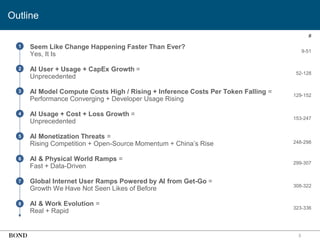
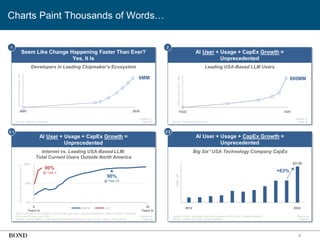
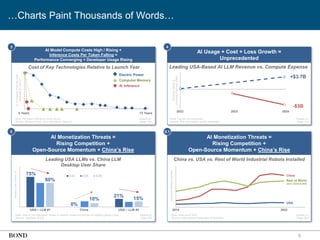
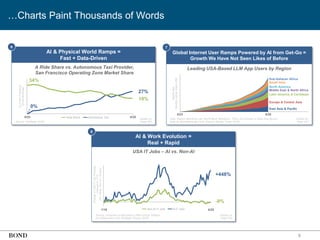
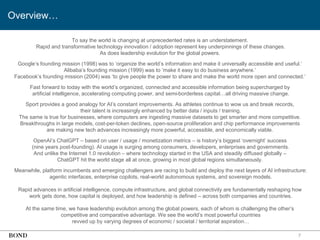
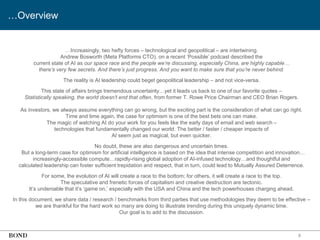
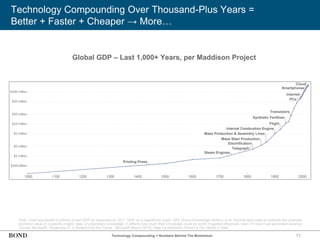
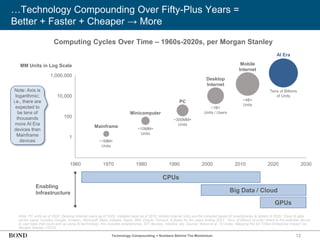
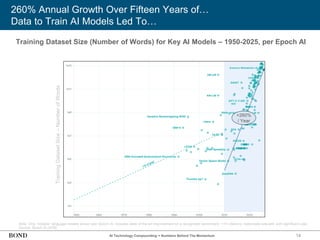
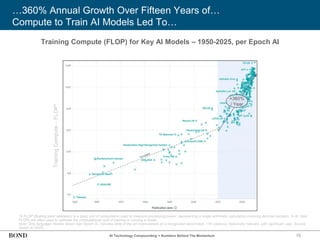
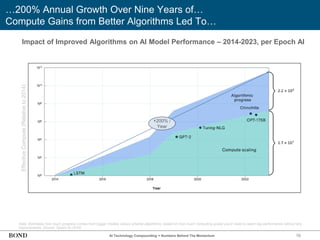
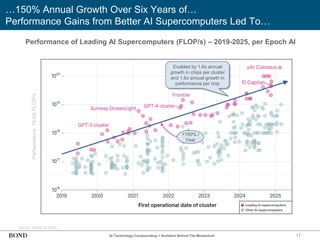
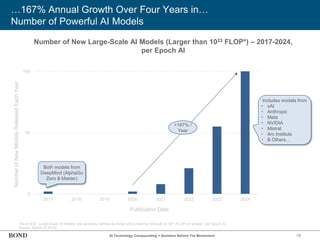
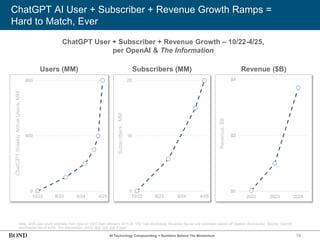
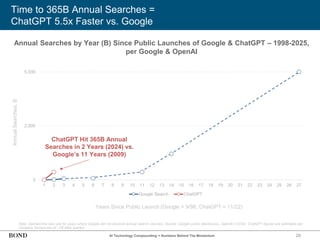
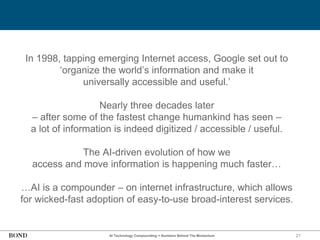
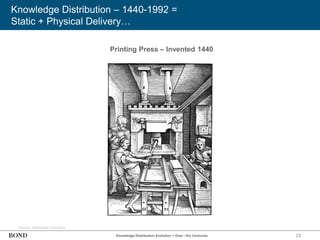
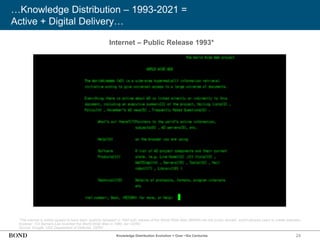
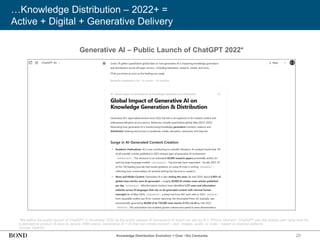
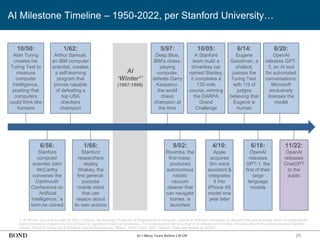
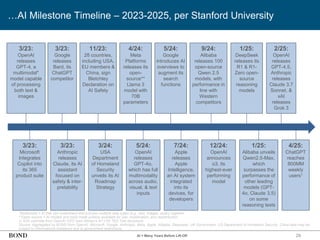
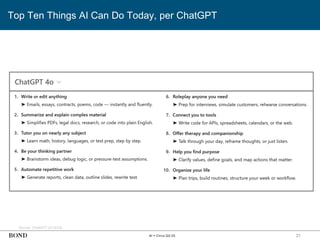
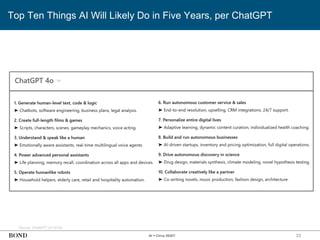
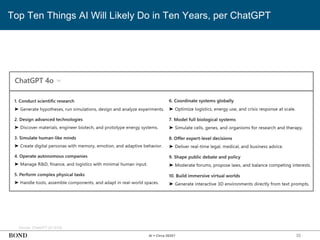
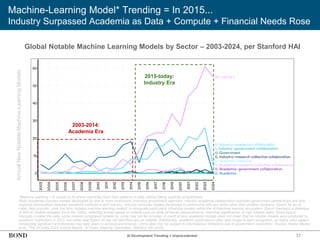
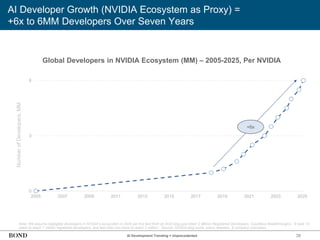
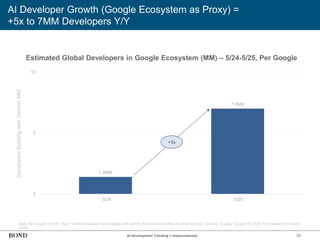

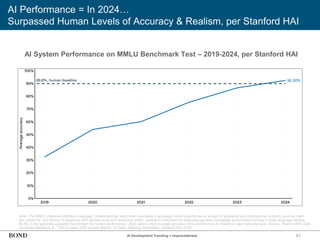
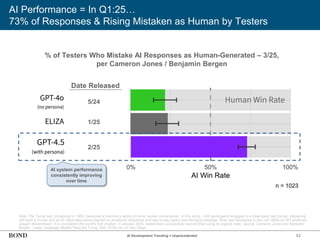
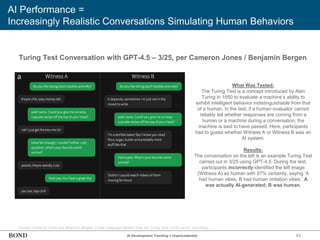

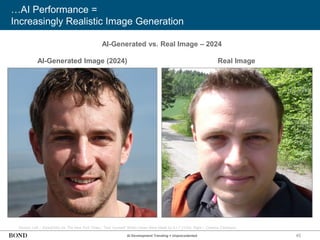
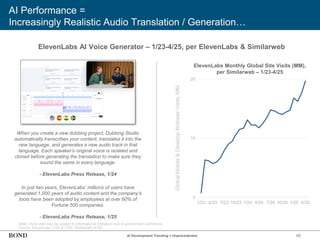
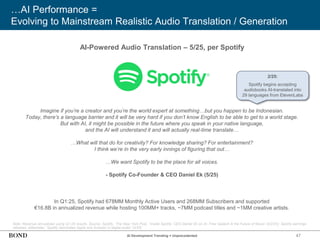
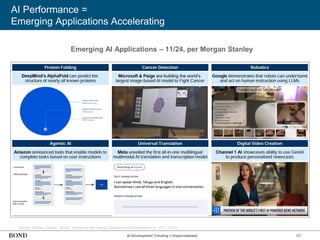
![50
AI Development =
Benefits & Risks
The widely-discussed benefits and risks of AI – top-of-mind for many – generate warranted excitement and trepidation,
further fueled by uncertainty over the rapid pace of change and intensifying global competition and saber rattling.
The pros Stuart Russell and Peter Norvig went deep on these topics in the
Fourth Edition (2020) of their 1,116-page classic ‘Artificial Intelligence: A Modern Approach’ (link here),
and their views still hold true.
Highlights follow…
…the benefits: put simply, our entire civilization is the product of our human intelligence.
If we have access to substantially greater machine intelligence, the [ceiling of our] ambitions is raised substantially.
The potential for AI and robotics to free humanity from menial repetitive work and to dramatically
increase the production of goods and services could presage an era of peace and plenty.
The capacity to accelerate scientific research could result in cures for disease and
solutions for climate change and resource shortages.
As Demis Hassabis, CEO of Google DeepMind, has suggested: ‘First we solve AI, then use AI to solve everything else.’
Long before we have an opportunity to ‘solve AI,’ however, we will incur risks from the misuse of AI,
inadvertent or otherwise.
Some of these are already apparent, while others seem likely based on current trends including
lethal autonomous weapons…surveillance and persuasion…biased decision making…
impact on employment…safety-critical applications…cybersecurity…
AI = Benefits & Risks
Source: Stuart Russell and Peter Norvig, ‘Artificial Intelligence: A Modern Approach’](https://image.slidesharecdn.com/trendsartificialintelligence-250531042211-e66b7928/85/AI-Trends-Mary-Meeker-51-320.jpg)
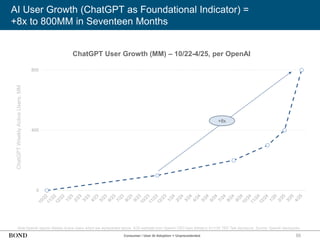
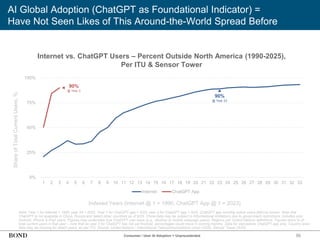
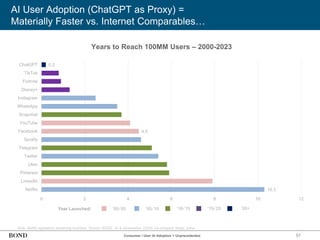
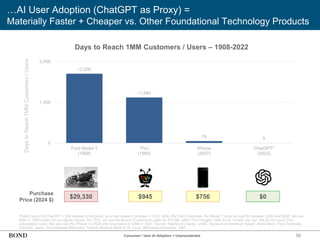
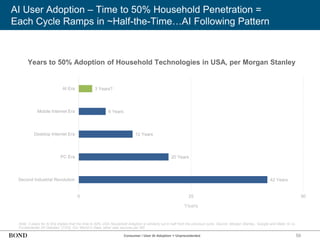
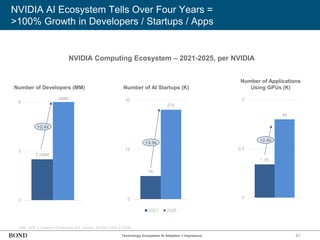
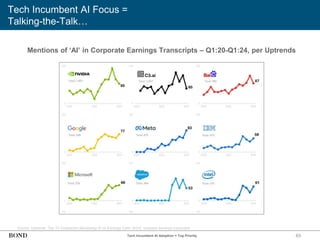
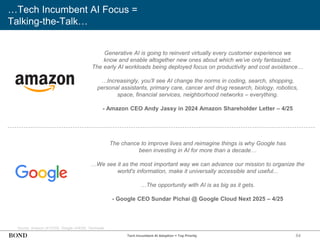
![65
…Tech Incumbent AI Focus =
Talking-the-Talk…
Note: On 3/28/25, Elon Musk announced that xAI had acquired X in an all-stock deal. The deal valued xAI at $80B and X at $33B ($45B less $12B debt). Source: Duolingo (5/1/25),
DeepMind, Elon Musk (5/2/25), Fox News
There’s three places where [GenAI is]…helping us:
data creation…creating new features that were just not possible…
efficiencies everywhere in the company…
…I should mention something amazing about [the new Duolingo curriculum in] chess is
that it really started with a team of two people, neither of whom knew how to
program…and they basically made prototypes and did the whole curriculum
of chess by just using AI. Also, neither of them knew how to play chess.
- Duolingo Co-Founder & CEO Luis von Ahn @ Q1:25 Earnings Call – 5/25
AI with Grok is getting very good…it’s important that AI be programmed with
good values, especially truth-seeking values. This is, I think, essential for AI safety…
…Remember these words: We must have a maximally truth-seeking AI.
- xAI Founder & CEO Elon Musk – 5/25
AI Going Full-Circle:
DeepMind’s AlphaGo (2014)
started with humans training
machines…Duolingo Chess now
has machines training humans…
Tech Incumbent AI Adoption = Top Priority](https://image.slidesharecdn.com/trendsartificialintelligence-250531042211-e66b7928/85/AI-Trends-Mary-Meeker-66-320.jpg)
![66
…Tech Incumbent AI Focus =
Talking-the-Talk
Source: Roblox (5/1/25), NVIDIA (5/18/25)
We view AI as a human acceleration tool that will allow individuals to do more...
I believe long term, we will see people coupled with…
the AI they use as the overall output of that person.
- Roblox Co-Founder, President, CEO & Chair of Board David Baszucki
@ Q1:25 Earnings Call – 5/25
Tech Incumbent AI Adoption = Top Priority
I promise you, in ten years' time, you will look back and you will realize that AI has now
integrated into everything. And in fact, we need AI everywhere.
And every region, every industry, every country, every company, all needs AI.
AI [is] now part of infrastructure. And this infrastructure,
just like the internet, just like electricity, needs factories….
…And these AI data centers, if you will, are improperly described. They are, in fact,
AI factories. You apply energy to it, and it produces something incredibly valuable.
- NVIDIA Co-Founder & CEO Jensen Huang
@ COMPUTEX 2025 – 5/25](https://image.slidesharecdn.com/trendsartificialintelligence-250531042211-e66b7928/85/AI-Trends-Mary-Meeker-67-320.jpg)
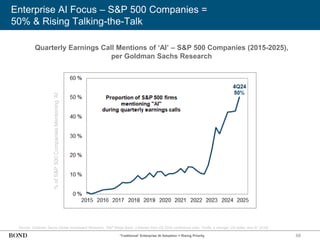
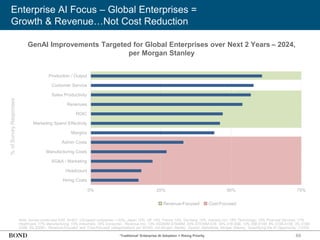
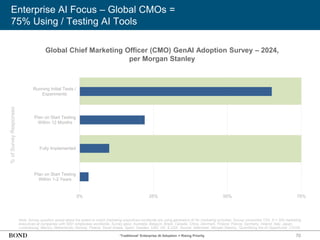
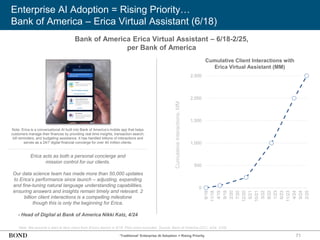
![72
Enterprise AI Adoption = Rising Priority…
JP Morgan – End-to-End AI Modernization (2020)
Note: Superscript ‘2’, per JP Morgan, indicates ‘Value is described as benefit in revenue, lower expense, or avoidance of cost – majority is measured as the lift relative to prior analytical
techniques with the remainder relative to a random baseline or holdout control.’ We indicate 2020 as the start year for JP Morgan’s AI Modernization (2020 Letter to Shareholders: ‘We
already extensively use AI, quite successfully, in fraud and risk, marketing, prospecting, idea generation, operations, trading and in other areas—to great effect, but we are still at the
beginning of this journey’). Source: JP Morgan Investor Day (5/25)
JP Morgan End-to-End AI Modernization – 2023-2025E,
per JP Morgan
We have high hopes for the efficiency gains
we might get [from AI]…
…Certain key subsets of the users tell us they are gaining
several hours a week of productivity, and almost by definition,
the time savings is coming from less valuable tasks…
…We were early movers in AI.
But we’re still in the early stages of the journey.
- JP Morgan CFO Jeremy Barnum, 5/25
JP Morgan Estimated Value from AI / ML
‘Traditional’ Enterprise AI Adoption = Rising Priority
+35%
+65%](https://image.slidesharecdn.com/trendsartificialintelligence-250531042211-e66b7928/85/AI-Trends-Mary-Meeker-73-320.jpg)
![73
Enterprise AI Adoption = Rising Priority…
Kaiser Permanente – Multimodal Ambient AI Scribe (10/23)
Source: Tierney, Aaron A. et al., ‘Ambient Artificial Intelligence Scribes to Alleviate the Burden of Clinical Documentation’ (3/24) & Tierney, Aaron A. et al., ‘Ambient Artificial Intelligence
Scribes: Learnings after 1 Year and over 2.5 Million Uses’ (3/25) via Nestor Maslej et al., ‘The AI Index 2025 Annual Report,’ AI Index Steering Committee, Stanford HAI (4/25)
Kaiser Permanente Ambient AI Scribe – 10/23-12/24,
per New England Journal of Medicine
Ambient artificial intelligence (AI) scribes, which use machine
learning applied to conversations to facilitate scribe-like
capabilities in real time, [have] great potential to reduce
documentation burden, enhance physician-patient
encounters, and augment clinicians’ capabilities.
The technology leverages a smartphone microphone to
transcribe encounters as they occur but does not retain audio
recordings. To address the urgent and growing burden of
data entry, in October 2023, The Permanente Medical Group
(TPMG) enabled ambient AI technology for 10,000 physicians
and staff to augment their clinical capabilities across
diverse settings and specialties.
- New England Journal of Medicine
Catalyst Research Report, 2/24
Unique Kaiser Permanente Physicians Ever Using
AI Scribe & Cumulative Number of Scribe Visits
‘Traditional’ Enterprise AI Adoption = Rising Priority](https://image.slidesharecdn.com/trendsartificialintelligence-250531042211-e66b7928/85/AI-Trends-Mary-Meeker-74-320.jpg)
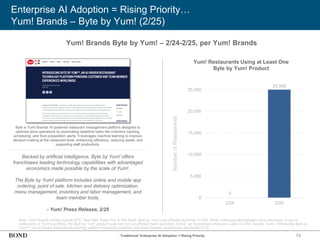
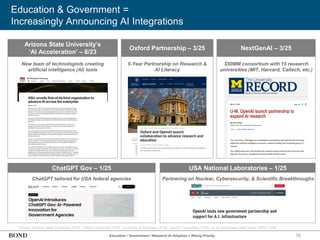
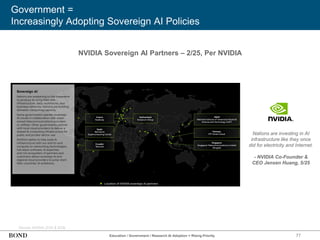
![78
Research =
Rapid Ramp in FDA-Approved AI Medical Devices, per Stanford HAI
Note: FY21, FY22 & FY23 USA government budget figures are actuals. FY24 data is enacted but not actual, FY25 data is requested. NIH share of total budget is requested.
Source: Nestor Maslej et al., ‘The AI Index 2025 Annual Report,’ AI Index Steering Committee, Stanford HAI (4/25); USA Food & Drug Administration, ‘FDA Announces Completion of
First AI-Assisted Scientific Review Pilot and Aggressive Agency-Wide AI Rollout Timeline’ (5/25); NITRD.gov (5/25)
New AI-Enabled Medical Devices Approved by USA Food & Drug Administration –
1995-2023, per Stanford HAI & USA FDA
Number
of
AI
Medical
Devices
Approved
Education / Government / Research AI Adoption = Rising Priority
In a historic first for the [USA
FDA], FDA Commissioner Martin
A. Makary, M.D., M.P.H., today
announced an aggressive
timeline to scale use of artificial
intelligence (AI) internally across
all FDA centers by June 30,
2025…
…To reflect the urgency of this
effort, Dr. Makary has directed all
FDA centers to begin deployment
immediately, with the goal of full
integration by the end of June.
- USA FDA Press Release, 5/25
AI-Enabled Medical Devices Approved New USA FDA AI Policy (5/25)
1 0 1 1 0 0 1 0 0 1 1 0 0
5
0 2 2 3 3 6 6
18
26
64
80
114
129
160
223
0
125
250
1995 1999 2003 2007 2011 2015 2019 2023
Government R&D funding has been a key part of AI development
budgets, especially in healthcare:
- FY21-FY25 Federal USA AI Budget: $14.7B
- FY25 Share Requested by National Institutes of Health: 34%](https://image.slidesharecdn.com/trendsartificialintelligence-250531042211-e66b7928/85/AI-Trends-Mary-Meeker-79-320.jpg)
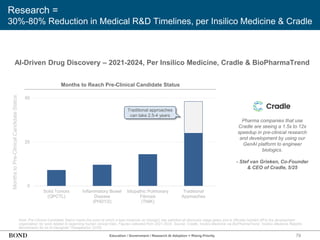
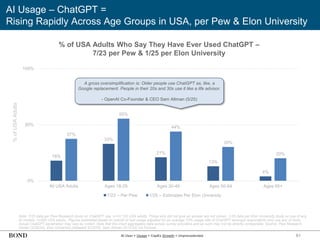
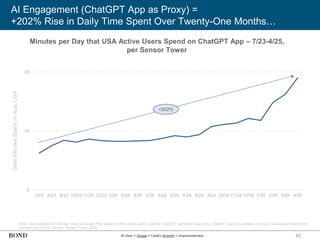
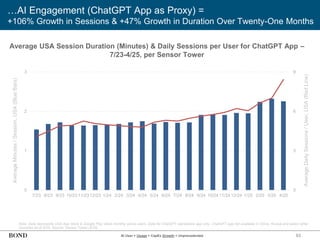
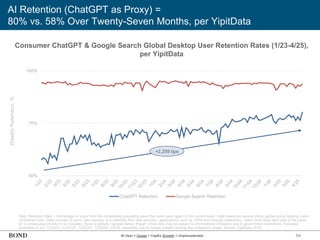
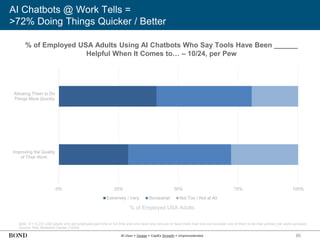
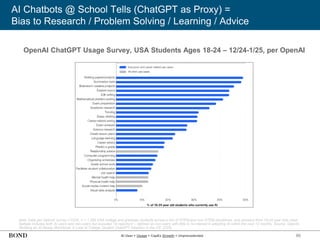
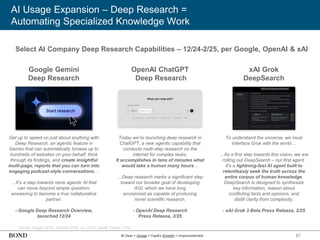
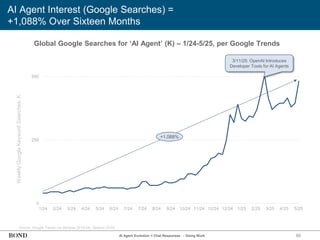
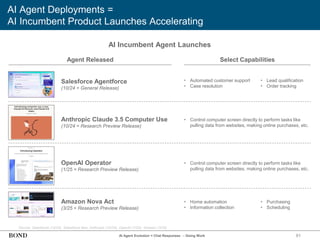
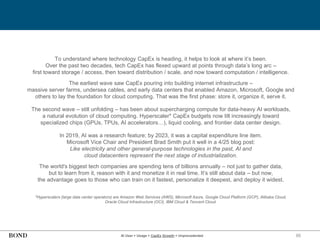
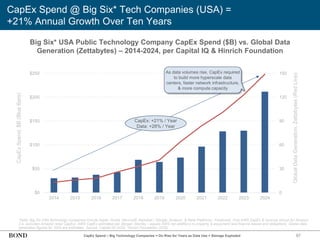
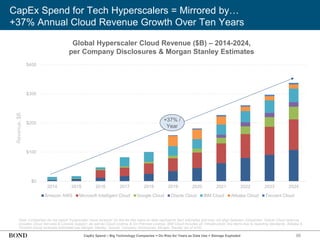
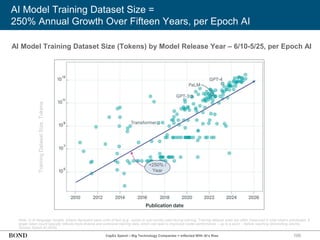
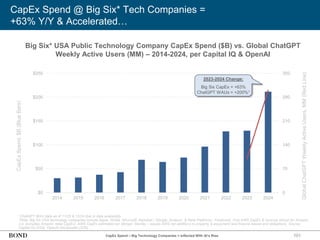
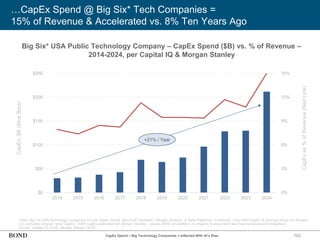
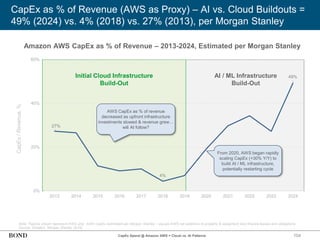
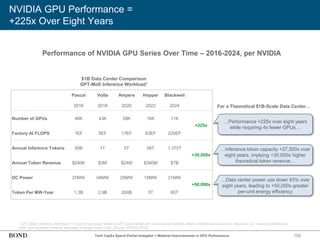
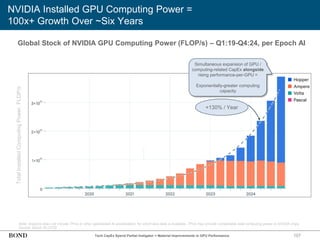
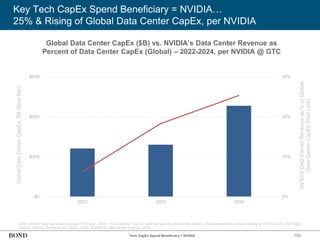
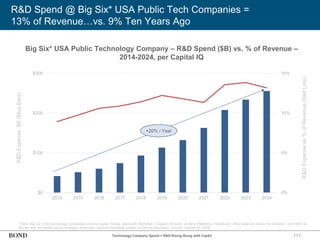
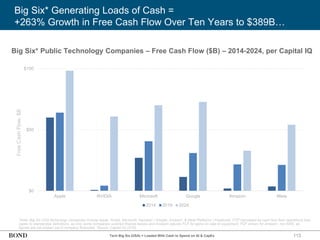
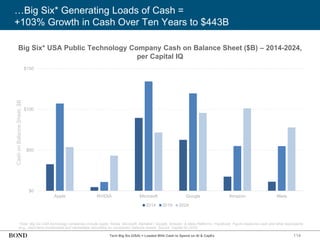
![116
Tech CapEx Spend Driver = Compute Spend to Train & Run Models
To understand the evolution of AI computing economics, it’s constructive to look at where costs are concentrated –
And where they’re headed. The bulk of spending in AI large language model (LLM) development
is still dominated by compute – specifically, the compute needed to train and run models.
Training costs remain extraordinarily high and are rising fast,
often exceeding $100 million per model today. As Dario Amodei, CEO of Anthropic, noted in mid-2024,
Right now, [AI model training costs] $100 million. There are models in training today that are more like a billion…
I think that the training of…$10 billion models, yeah, could start sometime in 2025.
Around these core compute costs sit additional high-cost layers:
research, data acquisition and hosting, and a mix of salaries, general overhead, and go-to-market operations.
Even as the cost to train models climbs, a growing share of total AI spend is shifting toward inference –
the cost of running models at scale in real-time. Inference happens constantly,
across billions of prompts, queries, and decisions, whereas model training is episodic.
As Amazon CEO Andy Jassy noted in his April 2025 letter to shareholders,
While model training still accounts for a large amount of the total AI spend, inference…
will represent the overwhelming majority of future AI cost because customers
train their models periodically but produce inferences constantly.
NVIDIA Co-Founder & CEO Jensen Huang noted the same in NVIDIA’s FQ1:26 earnings call, saying
Inference is exploding. Reasoning AI agents require orders of magnitude more compute.
At scale, inference becomes a persistent cost center – one that grows in parallel with usage,
despite declines in unit inference costs.
The broader dynamic is clear: lower per-unit costs are fueling higher overall spend.
As inference becomes cheaper, AI gets used more.
And as AI gets used more, total infrastructure and compute demand rises – dragging costs up again.
The result is a flywheel of growth that puts pressure on cloud providers, chipmakers, and enterprise IT budgets alike.
The economics of AI are evolving quickly –
but for now, they remain driven by heavy capital intensity, large-scale infrastructure,
and a race to serve exponentially expanding usage.](https://image.slidesharecdn.com/trendsartificialintelligence-250531042211-e66b7928/85/AI-Trends-Mary-Meeker-117-320.jpg)
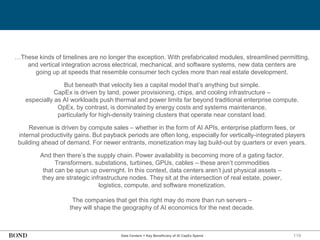
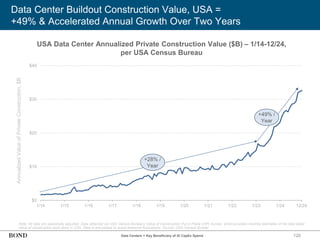
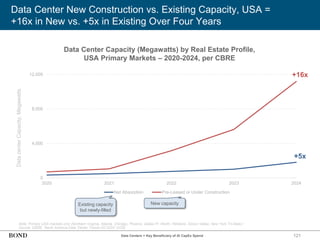
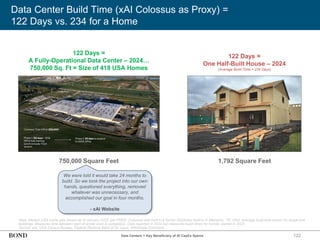
![123
Data Center Compute (xAI Colossus as Proxy) =
0 to 200,000 GPUs in Seven Months
Data Centers = Key Beneficiary of AI CapEx Spend
xAI Colossus GPUs – 4/24-11/24, per xAI
Note: We assume 200,000 GPUs as of 11/30/24 per xAI’s disclosure that ‘we doubled [GPU count] in 92 days to 200K GPUs.’ xAI Colossus ran its first job across 4 data halls on
8/30/24. We assume zero GPUs as of construction start date (122 days prior to assumed opening date of 8/30/24).
Source: xAI (5/25), Memphis Chamber of Commerce (12/24)
We’re running the world’s biggest supercomputer, Colossus.
Built in 122 days – outpacing every estimate –
it was the most powerful AI training system yet.
Then we doubled it in 92 days to 200k GPUs.
This is just the beginning…
…We doubled our compute at an unprecedented rate,
with a roadmap to 1M GPUs. Progress in AI is driven by
compute and no one has come close to building at this
magnitude and speed.
- xAI Website, 5/25
GPUs,
K
xAI Colossus GPUs (K)
0K
100K
200K
0
100
200
4/24 8/24 11/24
xAI ultimately plans on 1MM
GPUs, per Memphis Chamber
of Commerce](https://image.slidesharecdn.com/trendsartificialintelligence-250531042211-e66b7928/85/AI-Trends-Mary-Meeker-124-320.jpg)
![125
Data Centers = Electricity Guzzlers
AI and energy observations / quotes (in italics) here and the two pages that follow are from
‘World Energy Outlook Special Report –
Energy and AI’ (link) from IEA (International Energy Agency)* – 4/10/25
To understand where energy infrastructure is heading, it helps to examine the rising tension between AI
capability and electrical supply. The growing scale and sophistication of artificial intelligence
is demanding an extraordinary amount of computational horsepower, primarily from AI-focused data centers.
These facilities – purpose-built to train and serve models –
are starting to rival traditional heavy industry in their electricity consumption.
There is no AI without energy – specifically electricity (p. 3).
Data centers accounted for around 1.5% of the world’s
electricity consumption in 2024 (p. 14). Energy demand growth has been rapid:
Globally, data centre electricity consumption has grown by around 12% per year since 2017,
more than four times faster than the rate of total electricity consumption (p. 14).
As power demand rises, so too does its concentration:
The United States accounted for…[45% of global data centre electricity consumption],
followed by China (25%) and Europe (15%)…
nearly half of data centre capacity in the United States is in five regional clusters (p. 14).
The flipside is true as well: Emerging and developing economies other than China account for 50% of the
world’s internet users but less than 10% of global data centre capacity (p. 18)…](https://image.slidesharecdn.com/trendsartificialintelligence-250531042211-e66b7928/85/AI-Trends-Mary-Meeker-126-320.jpg)
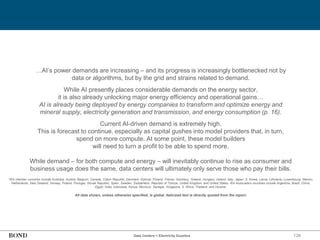
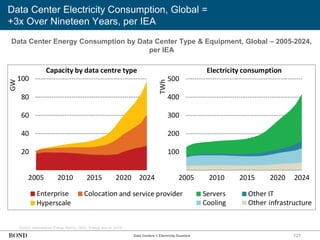
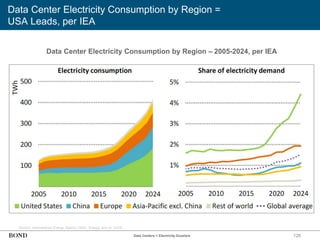
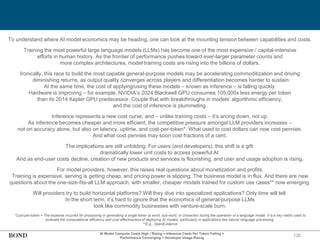
![132
AI Model Training Compute Costs =
~2,400x Growth Over Eight Years, per Epoch AI & Stanford
Note: Costs are estimates. Excludes most Chinese models due to lack of reliable cost data. Source: Epoch AI via Nestor Maslej et al., ‘The AI Index 2025 Annual Report,’ AI Index
Steering Committee, Stanford HAI (4/25); In Good Company podcast (6/24)
Estimated Training Cost of Frontier AI Models – 2016-2024,
per Epoch AI & Stanford
Training
Cost,
USD
(Log
Scale)
Approx.
+2,400x
Right now, [AI model training costs]
$100 million. There are models in
training today that are more like a
billion. Right. I think if we go to $10 or
$100 billion, and I think that will
happen in 2025, 2026, maybe 2027…
…I think that the training of…$10
billion models, yeah, could start
sometime in 2025.
- Anthropic Co-Founder & CEO
Dario Amodei (6/24)
AI Model Compute Costs High / Rising + Inference Costs Per Token Falling =
Performance Converging + Developer Usage Rising](https://image.slidesharecdn.com/trendsartificialintelligence-250531042211-e66b7928/85/AI-Trends-Mary-Meeker-133-320.jpg)
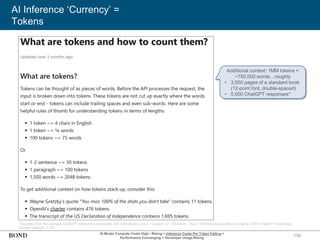
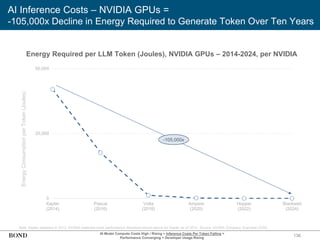
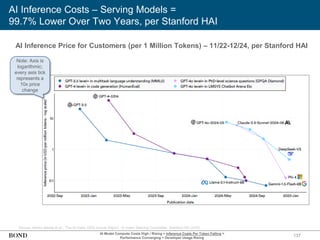
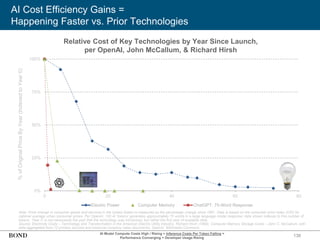
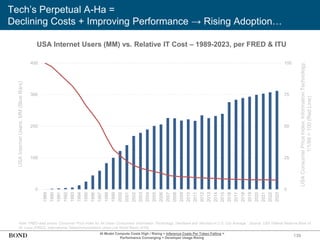
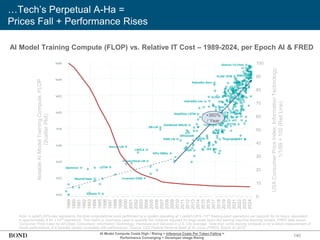
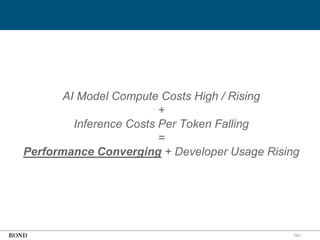
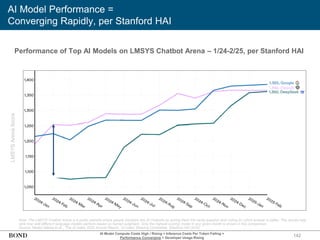
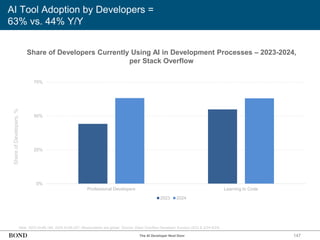
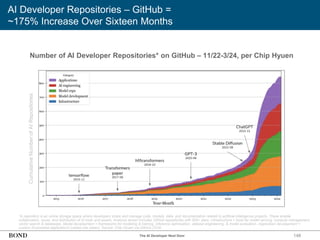
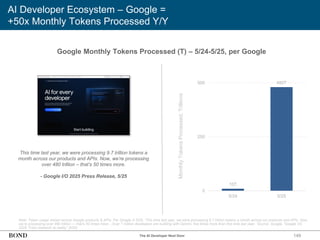
![150
AI Developer Ecosystem – Microsoft Azure AI Foundry =
+5x Quarterly Tokens Processed Y/Y
Note: Source: Microsoft FQ3:25 earnings call (4/25)
Tokens
Processed,
Trillions
The AI Developer Next Door
[Microsoft Azure AI] Foundry is the agent and AI app factory.
It is now used by developers at over 70,000 enterprises and
digital natives – from Atomicwork, to Epic, Fujitsu, and
Gainsight, to H&R Block and LG Electronics – to design,
customize, and manage their AI apps and agents.
We processed over 100 trillion tokens this quarter, up 5x
year-over-year – including a record 50 trillion tokens last
month alone.
- Microsoft FQ3:25 Earnings Call, 4/25
Microsoft Azure AI Foundry Quarterly Tokens Processed (T) – Q1:24-Q1:25, per Microsoft
20T
100T
0
50
100
Q1:24 Q1:25](https://image.slidesharecdn.com/trendsartificialintelligence-250531042211-e66b7928/85/AI-Trends-Mary-Meeker-151-320.jpg)
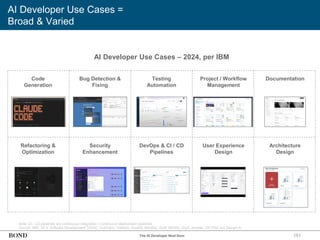
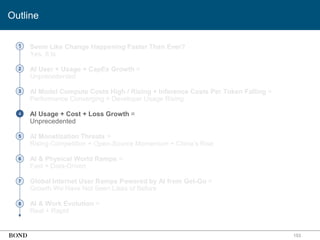
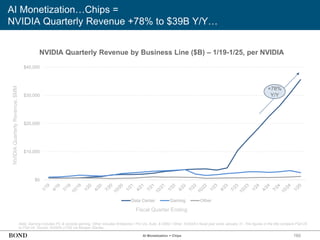
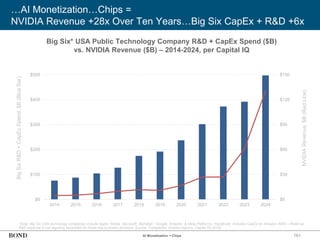
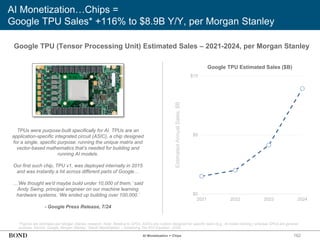
![163
AI Monetization…Chips =
Amazon AWS Trainium* Sales +216% to $3.6B Y/Y, per Morgan Stanley
Note: Relative to GPUs, ASICs are custom-designed for specific tasks (e.g., AI model training,) whereas GPUs are general-purpose. Figures are estimates per Morgan Stanley
research. Source: Amazon AWS, Morgan Stanley, ‘GenAI Monetization – Assessing The ROI Equation’ (2/25)
Amazon AWS Trainium Estimated Sales – 2024-2025, per Morgan Stanley
AWS Trainium chips are a family of AI chips purpose built by
AWS for AI training and inference to deliver high performance
while reducing costs…
AWS Trainium2 chip delivers up to 4x the performance of
first-generation Trainium…[and offers] 30-40% better price
performance than the current generation of GPU-based EC2
P5e and P5en instances.
- Amazon AWS Trainium Overview, Accessed 5/25
Estimated
Annual
Sales,
$B
AI Monetization = Chips
Amazon AWS Trainium Estimated Sales ($B)
$1.1B
$3.6B
$0
$2
$4
2024 2025](https://image.slidesharecdn.com/trendsartificialintelligence-250531042211-e66b7928/85/AI-Trends-Mary-Meeker-164-320.jpg)
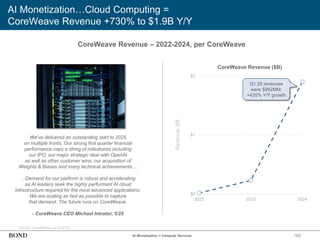
![166
AI Monetization…AI Infrastructure =
Oracle Revenue +50x to $948MM Over Two Years
Oracle AI Infrastructure Revenue – F2022-F2024, per Oracle & Morgan Stanley Estimates
Source: Oracle, Morgan Stanley estimates, ‘What’s Ahead for the AI Infrastructure Cycle’ (8/24)
There are many, many [AI infrastructure] customers who have
come on and that haven't gotten capacity yet…
…We've got at least 40 new AI bookings that are over a
billion (dollars) that haven't come online yet.
- Oracle CEO Safra Catz, 3/24 Revenue,
$MM
AI Monetization = Compute Services
$0
$500
$1,000
F2022 F2023 F2024
Oracle AI Infrastructure Revenue ($MM),
Estimated per Morgan Stanley](https://image.slidesharecdn.com/trendsartificialintelligence-250531042211-e66b7928/85/AI-Trends-Mary-Meeker-167-320.jpg)
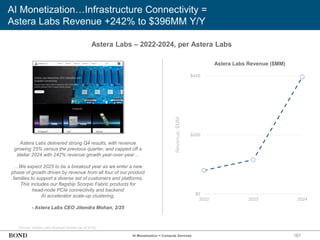
![168
AI Monetization…Data Collection + Supercomputing =
Tesla AI Training Capacity +8.5x
Tesla Dojo Custom Supercomputer – 6/21-9/24, per Tesla
Note: Listing capacity in ‘H100-equivalent GPUs’ means Tesla converts the aggregate AI-training throughput of Dojo and its other accelerators into the number of NVIDIA Hopper H100
data-center GPUs that would deliver the same FP8/FP16 FLOPS, giving a single, industry-standard yard-stick for compute scale.
Source: Tesla Q1:23 earnings call, Tesla Q3:24 investor presentation, Data Center Dynamics, Wikimedia Commons
Tesla
AI
Training
Capacity,
H100
Equivalent
GPUs
We’re continuing to simultaneously make
significant purchases of GPUs and also putting a
lot of effort into Dojo [custom supercomputer],
which we believe has the potential for an order of
magnitude improvement in the cost of training…
…Dojo also has the potential to become a
sellable service that we would offer to other
companies, in the same way that Amazon Web
Services offers more web services, even though
it started out as a bookstore. So, I really think
that the Dojo potential is very significant.
- Tesla Co-Founder & CEO Elon Musk, 4/23
AI Monetization = Compute Services
Tesla AI Training Capacity (H100-Equivalent GPUs)](https://image.slidesharecdn.com/trendsartificialintelligence-250531042211-e66b7928/85/AI-Trends-Mary-Meeker-169-320.jpg)
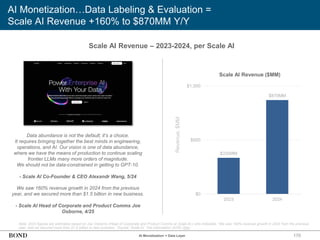
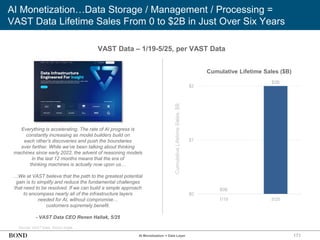
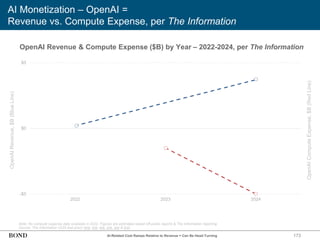
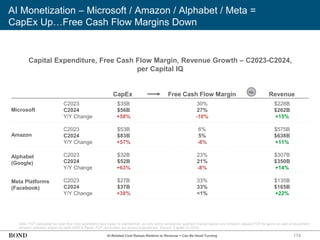
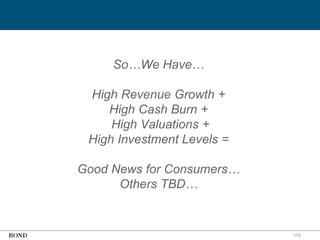
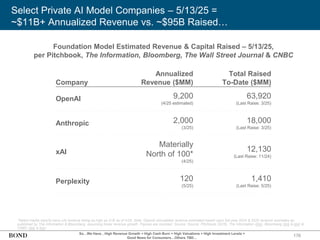
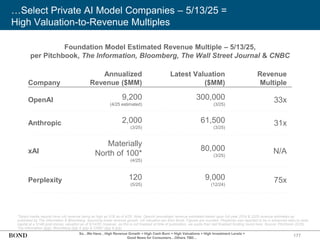
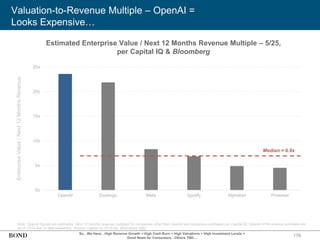
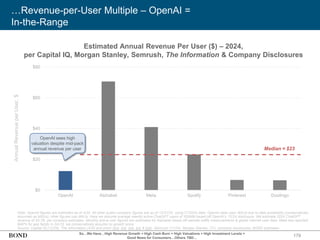
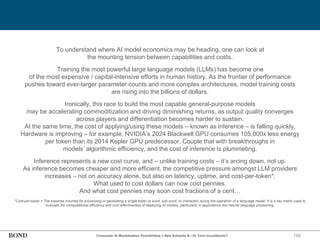
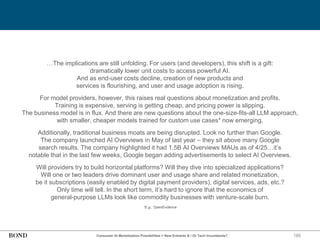
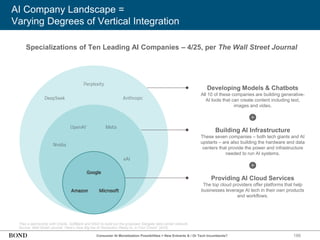
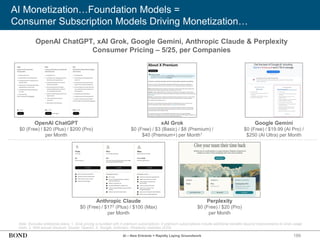
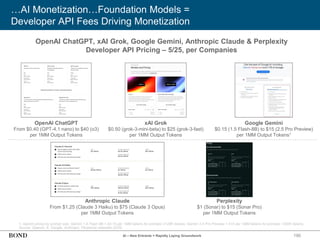
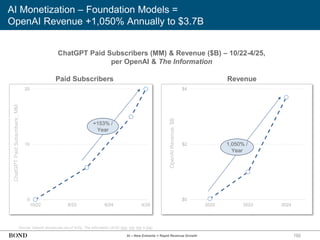
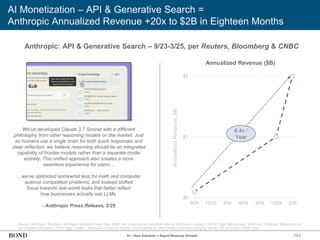
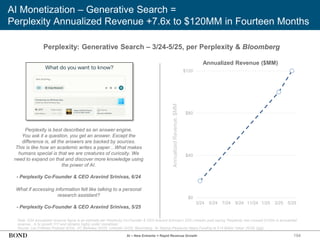
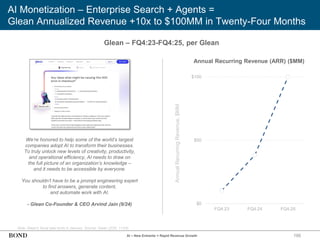
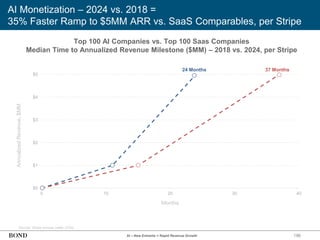
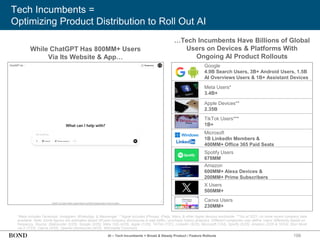
![200
Tech Incumbent AI Rollouts =
Canva – Background Remover & Magic Media (12/19)
Source: Canva announcements & press releases (2022-2024)
Canva Background Remover & Magic Media – 2023-2024, per Canva
One of our community’s favorite Canva features has been the
one-click image Background Remover, launched in
December 2019...[to] wild success and community love.
- Canva Press Release, 9/22
Cumulative
Uses,
B
Magic Media lets you turn your imagination into reality by
watching your words transform into stunning, one-of-a-kind
images – and now videos and graphics, too…In less than a
year since launching Magic Media’s text to image, we’ve been
overwhelmed by our community’s enthusiastic response, with
almost 290 million images being created and applied to a
range of practical use cases from social media posts to
presentations, business flyers, and even logos.
- Canva Press Release, 10/24
AI – Tech Incumbents = Broad & Steady Product / Feature Rollouts
0
2
4
2023 2024
Background Remover Magic Media
Number of Tool Uses (B): Background
Remover & Magic Media](https://image.slidesharecdn.com/trendsartificialintelligence-250531042211-e66b7928/85/AI-Trends-Mary-Meeker-201-320.jpg)
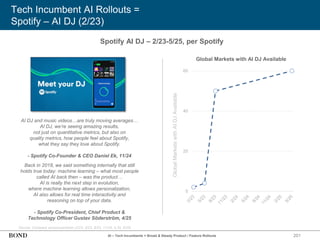
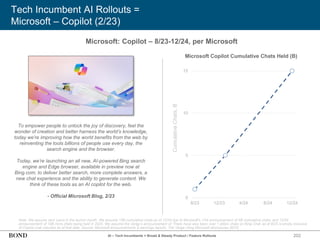
![Tech Incumbent AI Rollouts =
Meta Platforms – Meta AI (9/23)
Note: We assume zero users in 11/23 per Meta’s 12/23 blog post noting, ‘To chat with our AIs, start a new message and select “Create an AI chat” on Instagram, Messenger or
WhatsApp. They’re now available to anyone in the US.’ Source: Meta Platforms announcements & earnings reports
Meta Platforms: Meta AI – 11/23-4/25, per Meta Platforms
I expect that this is going to be the year when a highly intelligent
and personalized AI assistant reaches more than
1 billion people, and I expect Meta AI to be that leading AI
assistant. Meta AI is already used by more
people than any other assistant…
…I also expect that 2025 will be the year when it becomes
possible to build an AI engineering agent that has
coding and problem-solving abilities of around a
good mid-level engineer…
…Whichever company builds [a high-skill AI engineering agent]
first, I think it's going to have a meaningful advantage in
deploying it to advance their AI research and shape the field.
- Meta Platforms CEO Mark Zuckerberg, 1/25
Meta
AI
Monthly
Active
Users,
MM
Meta AI Monthly Active Users (MM)
0
500
1,000
11/23 3/24 7/24 11/24 3/25
203
Q1:25 Earnings Call
(4/30/25):
Across our apps, there
are now almost a billion
monthly actives using
Meta AI
- Meta Platforms Cofounder
& CEO Mark Zuckerberg
AI – Tech Incumbents = Broad & Steady Product / Feature Rollouts](https://image.slidesharecdn.com/trendsartificialintelligence-250531042211-e66b7928/85/AI-Trends-Mary-Meeker-204-320.jpg)
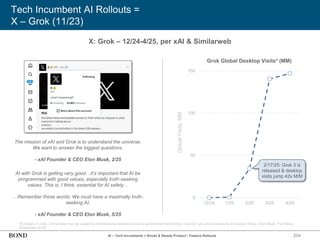
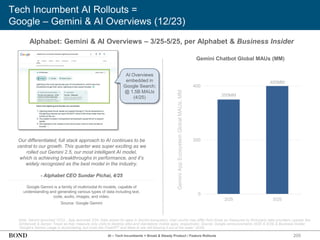
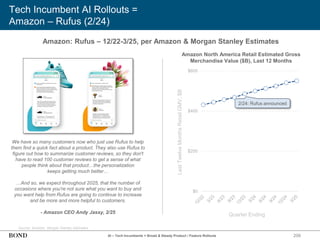
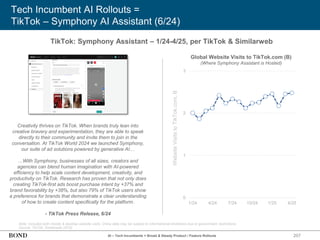
![Tech Incumbent AI Rollouts =
Apple – Apple Intelligence (10/24)
Note: Counts sales of iPhone 15 Pro, iPhone 15 Pro Max, & iPhone 16 devices. Figures are estimates.
Source: Company announcements & investor filings; IDC via Morgan Stanley (4/25)
Apple: Apple Intelligence – 9/23-3/25, per Apple & IDC Estimates
Apple Intelligence builds on years of innovations we've made
across hardware and software to transform how users
experience our products. Apple Intelligence also empowers
users by delivering personal context that's relevant to them.
And importantly, Apple Intelligence is a breakthrough for
privacy and AI with innovations like private cloud compute…
…[in] the markets where we had rolled out Apple
Intelligence…year over year performance on the iPhone 16
family was stronger than those where Apple Intelligence
was not available.
- Apple CEO Tim Cook, 1/25
iPhone
Sales,
MM
Estimated Global Sales of iPhone 15 Pro /
Pro Max & iPhone 16 (MM) – 9/23-3/25
Apple Intelligence-Capable Devices
$0
$25
$50
$75
9/23 12/23 3/24 6/24 9/24 12/24 3/25
Quarter Ending
208
AI – Tech Incumbents = Broad & Steady Product / Feature Rollouts](https://image.slidesharecdn.com/trendsartificialintelligence-250531042211-e66b7928/85/AI-Trends-Mary-Meeker-209-320.jpg)
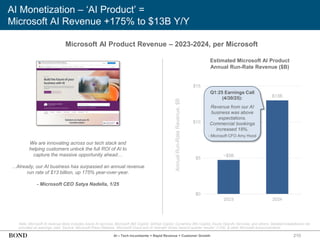
![211
AI Monetization – Generative Search =
xAI Annualized Revenue Up Materially in 2025
xAI: Generative Search, per xAI & The Wall Street Journal
*Select media reports have xAI revenue being as high as $1B as of 4/25. Source: xAI (2/25); The Wall Street Journal, ‘Elon Musk’s xAI Startup Is Valued at $50 Billion in New Funding
Round’ (11/24) (link); CNBC, ‘Musk says he’s looking to put ‘proper value’ on xAI during investor call, sources say’ (4/25) (link)
We are pleased to introduce Grok 3, our most advanced
model yet: blending strong reasoning with extensive
pretraining knowledge. Trained on our
Colossus supercluster with 10x the compute of previous
state-of-the-art models, Grok 3 displays significant
improvements in reasoning, mathematics, coding,
world knowledge, and instruction-following tasks.
- xAI Grok 3 Press Release, 2/25
Annualized Revenue ($B)
Annualized
Revenue,
$B
[Grok is a] maximally truth-seeking AI, even if that truth is
sometimes at odds with what is politically correct.
- xAI Founder & CEO Elon Musk, 2/25
AI – Tech Incumbents = Rapid Revenue + Customer Growth
$0.1B
$0.0
$0.5
$1.0
11/24 4/25
Revenue up
materially in 2025*](https://image.slidesharecdn.com/trendsartificialintelligence-250531042211-e66b7928/85/AI-Trends-Mary-Meeker-212-320.jpg)
![212
AI Monetization – AI Services =
Palantir USA Commercial Customers +65% to 432 Y/Y
Palantir USA Commercial Customers – Q1:23-Q1:25, per Palantir
Source: Palantir
We achieved a $1 billion annual run rate in our US
commercial business for the first time as AIP [Artificial
Intelligence Platform] continues to drive both new customer
conversions and existing customer expansions in the US..
- Palantir CFO David Glazer , 5/25
Palantir
USA
Commercial
Customers
Palantir USA Commercial Customers
As AI models progress and improve, we continue enabling our
customers to maximally leverage these models in production,
capitalizing upon the rich context within the enterprise through
the Ontology. We remain differentiated in our elite execution to
deliver quantified exceptionalism for our customers, ever
widening their advantage over the AI have-nots.
- Palantir CRO & Chief Legal Officer Ryan Taylor, 5/25
AI – Tech Incumbents = Rapid Revenue + Customer Growth
0
250
500
Q1:23 Q1:24 Q1:25](https://image.slidesharecdn.com/trendsartificialintelligence-250531042211-e66b7928/85/AI-Trends-Mary-Meeker-213-320.jpg)
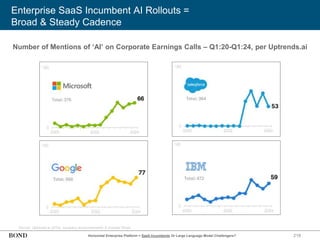
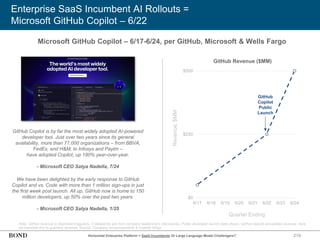
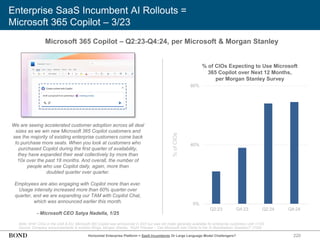
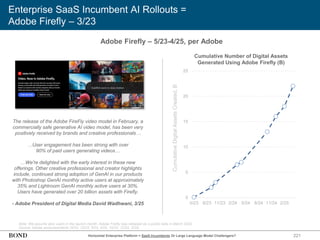
![222
Enterprise SaaS Incumbent AI Rollouts =
Atlassian Intelligence – 4/23
Note: 12/23 users includes beta users. We assume 20,000 users based on Atlassian’s disclosure that ‘Nearly 10% of Atlassian’s 265,000+ customers have already leveraged Atlassian
Intelligence through our beta program.’ Source: Atlassian announcements (4/23, 12/23, 12/24)
Atlassian Intelligence – 12/23-12/24, per Atlassian
Today, more than 1 million monthly active users are utilizing
our Atlassian intelligence features to unlock enterprise
knowledge, supercharge workflows, and accelerate their
team collaboration. These features are clearly delivering
value as we've seen a number of AI interactions
increase more than 25x year over year…
…Atlassian Intelligence [saw a] 25x improvement in the
number of features used over the last year.
- Atlassian Co-Founder & Co-CEO Michael Cannon, 2/25
Customers
Using
Atlassian
Intelligence,
K
Atlassian Intelligence Users (K)
Horizontal Enterprise Platform = SaaS Incumbents Or Large Language Model Challengers?
~20K
1,000K
0
500
1,000
12/23 12/24](https://image.slidesharecdn.com/trendsartificialintelligence-250531042211-e66b7928/85/AI-Trends-Mary-Meeker-223-320.jpg)
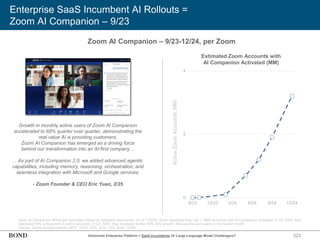
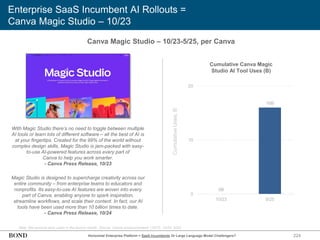
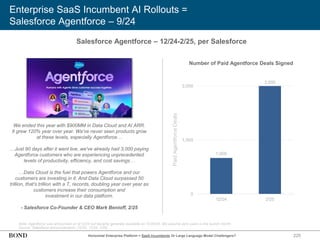
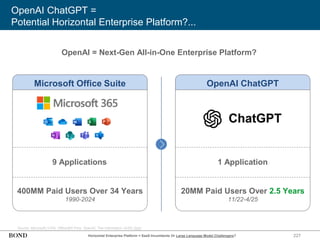
![228
…OpenAI ChatGPT =
Potential Horizontal Enterprise Platform?
Note: We assume zero users in the launch month. Source: OpenAI announcements (12/23, 4/24, 9/24, 3/25), Bloomberg (4/24), Reuters (9/24), The Wall Street Journal (3/25)
ChatGPT Enterprise – 8/23-3/25, per OpenAI, Bloomberg, Reuters, & The Wall Street Journal
Since ChatGPT’s launch just nine months ago, we’ve seen
teams adopt it in over 80% of Fortune 500 companies. We’ve
heard from business leaders that they’d like a simple and safe
way of deploying it in their organization. Early users of
ChatGPT Enterprise…are redefining how they operate and are
using ChatGPT to craft clearer communications, accelerate
coding tasks, rapidly explore answers to complex business
questions, assist with creative work, and much more.
ChatGPT Enterprise removes all usage caps and performs
up to two times faster [vs. ChatGPT Free]…
…ChatGPT Enterprise also provides unlimited access to
advanced data analysis, previously known as Code Interpreter.
- ChatGPT Enterprise Release Statement, 8/23
Number
of
Business
Users,
MM
Horizontal Enterprise Platform = SaaS Incumbents Or Large Language Model Challengers?
0
1
2
8/23 2/24 8/24 2/25
Number of ChatGPT Business Users (MM)
(Includes Enterprise / Team / Education)](https://image.slidesharecdn.com/trendsartificialintelligence-250531042211-e66b7928/85/AI-Trends-Mary-Meeker-229-320.jpg)
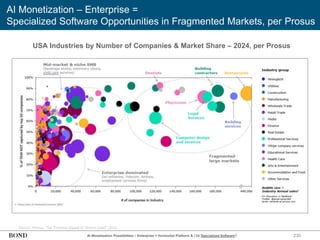
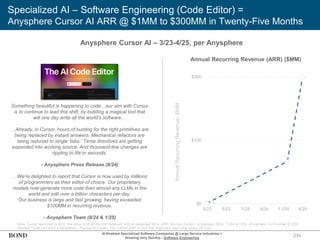
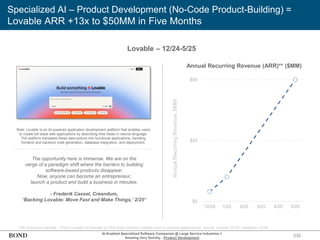
![Specialized AI – Healthcare (Clinical Conversations) =
Abridge @ $50MM to $117MM CARR in ~Five Months
237
Yazdi Bagli, Kaiser’s EVP of IT and enterprise business services,
said he believes [Kaiser Permanente’s] Abridge partnership is
one of the largest generative AI deployments in health care…
…The national rollout includes more than 25,000 doctors and
clinicians, 40 hospitals, and north of 600 medical offices…
…The feedback from doctors has been effusive:
‘It saved my marriage.’ And:
‘You’d have to take it away from my cold, dying hands.’
- Fortune Magazine (2/25)
Contracted Annual Recurring
Revenue (CARR) ($MM)
Note: 3/25 figure is quoted as being as of Q1:25. We conservatively assume this maps to 3/25. Abridge’s CARR goes live within weeks of contracting. Source: Abridge (12/24 & 5/25),
Fortune (2/25), The Information (10/24 & 5/25) (link & link)
Abridge – 10/24-3/25, per Abridge & The Information
Contracted
Annual
Recurring
Revenue,
$MM
AI-Enabled Specialized Software Companies @ Large Service Industries =
Growing Very Quickly…Healthcare
We are incredibly proud of our partnership with Kaiser –
where a majority of Kaiser doctors are using Abridge to
summarize patient visits, with over 10 million completed to date.
As one of our earliest deployments, it is a great example
of how we are building alongside our many hospital partners
and helping them grow with Abridge.
- Abridge CFO Sagar Sanghvi (5/25)
$50MM
$117MM
$0
$40
$80
$120
10/24 3/25](https://image.slidesharecdn.com/trendsartificialintelligence-250531042211-e66b7928/85/AI-Trends-Mary-Meeker-238-320.jpg)
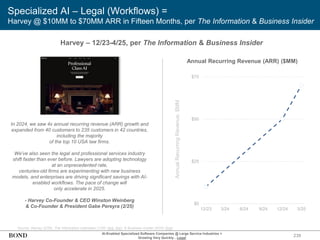
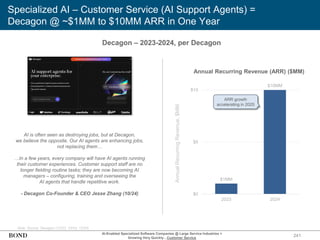
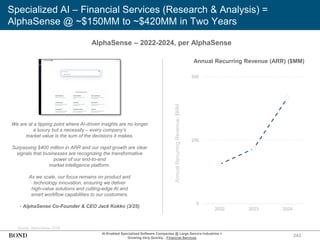
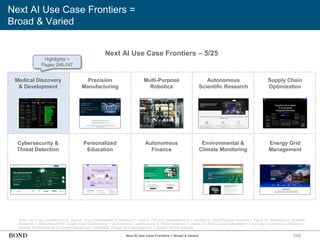
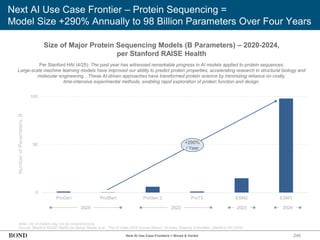
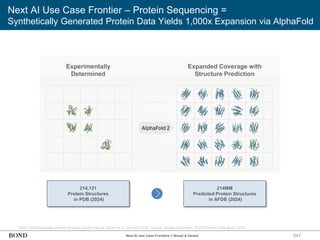
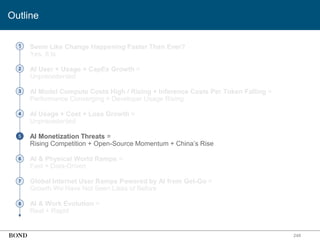
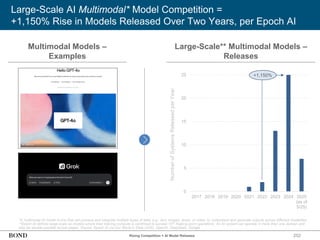
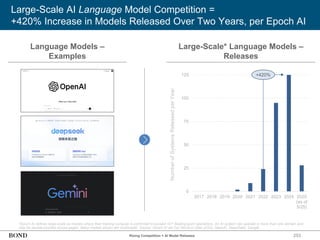
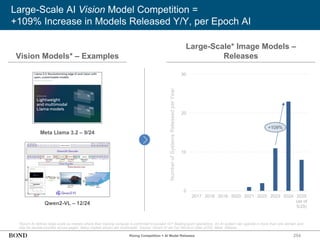
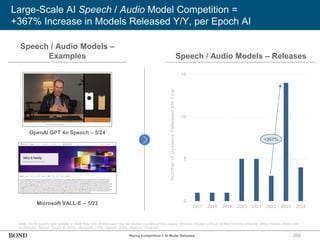
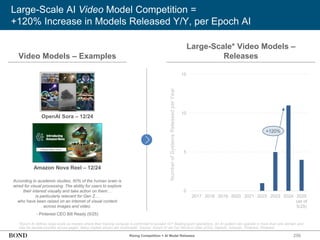
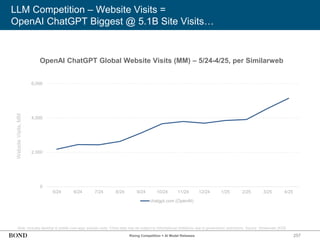
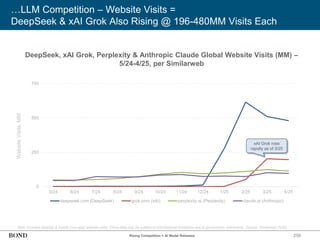
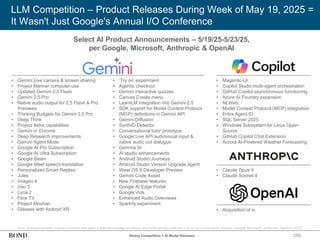
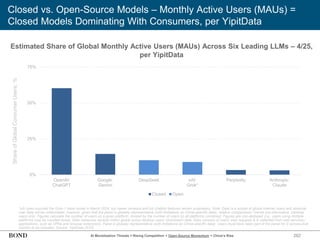
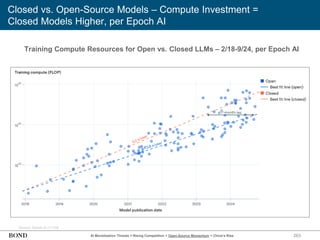
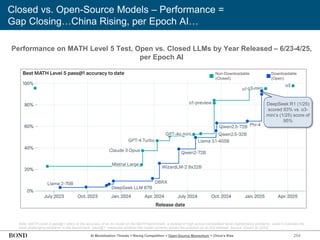
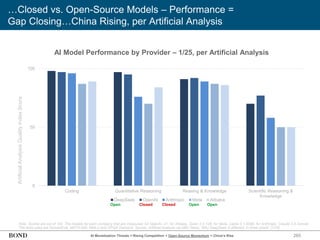
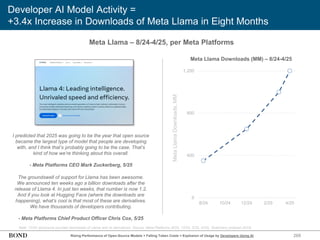
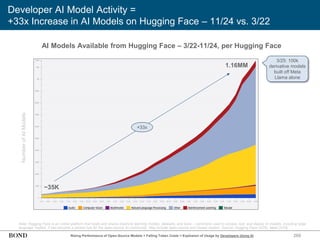
![271
As noted on page 8, Meta CTO Andrew Bosworth referred to the current state of AI as
our space race and the people we’re discussing, especially China, are highly capable…
In this context, it is important to remember what the stakes of the Space Race were: proving which political system
could innovate faster and win the world’s trust in the process. Coming out on top in the Space Race
played a role in enhancing USA’s strategic deterrence and cementing the primacy of western democratic values.
The AI ‘space race,’ also has the potential to reshape the world order.
China certainly knows these stakes. Back in 2015, ‘Made in China 2025,’ a new Chinese government initiative
to shift the country from low-cost to high-value manufacturing in critical industries, seemed decades away.
Fast forward to today, and China has dramatically accelerated its capabilities in these strategic sectors
like robotics, electrification, and ‘information technology’ – best expressed by world-class artificial intelligence.
Chinese AI capabilities now underpin nationally strategic areas such as battlefield logistics, target recognition,
cyber operations, and autonomous decision-making platforms. In 2025, Chinese state media highlighted the
integration of AI into non-combat support functions (e.g., military hospitals), while the
Ministry of Science and Technology reinforced its commitment to ‘indigenous innovation’ in strategic technologies.
The implications of Chinese AI supremacy would be profound.
As OpenAI’s Sam Altman noted in a July 2024 Washington Post Op-Ed, If [authoritarian regimes] manage to
take the lead on AI, they will force U.S. companies and those of other nations to share user data, leveraging the technology to
develop new ways of spying on their own citizens or creating next-generation cyberweapons to use against other countries.
AI Monetization Threats = Rising Competition + Open-Source Momentum + China’s Rise](https://image.slidesharecdn.com/trendsartificialintelligence-250531042211-e66b7928/85/AI-Trends-Mary-Meeker-272-320.jpg)


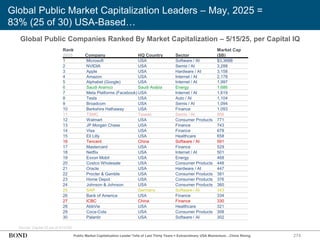
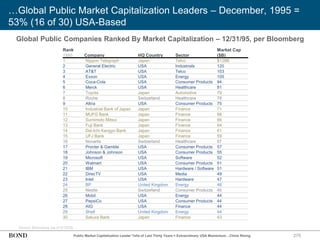
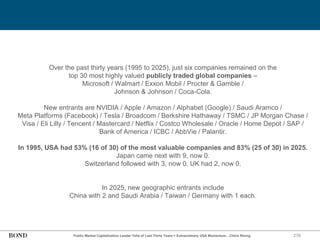
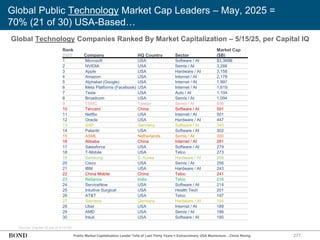
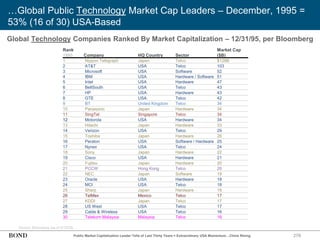
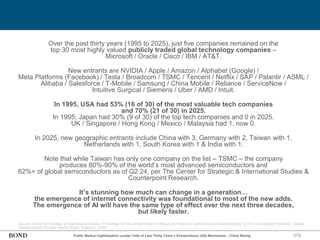
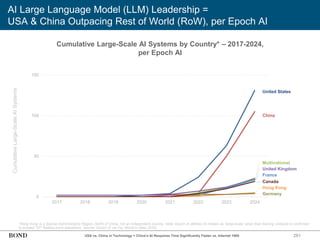
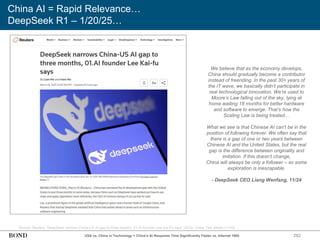
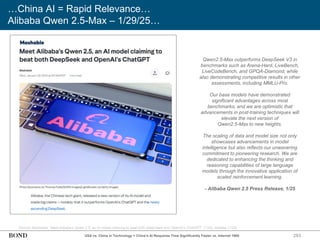
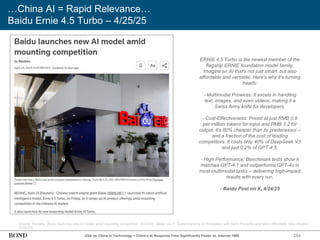
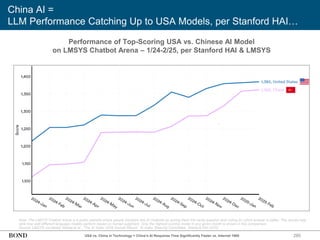
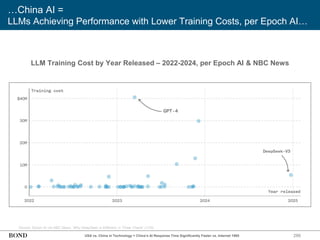
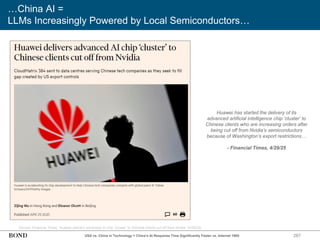
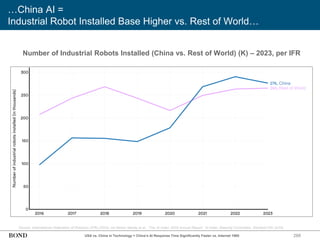
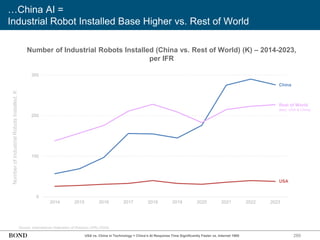
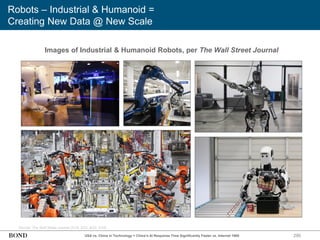
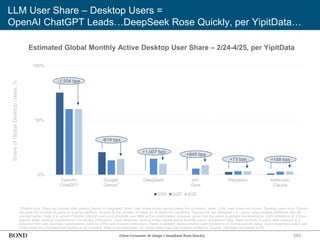
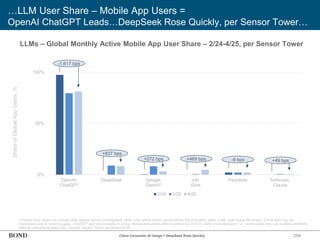
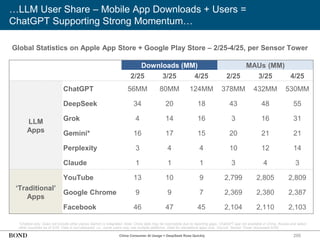
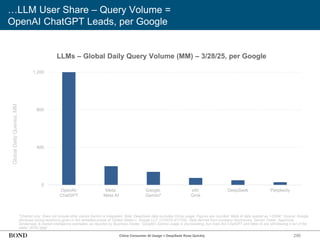
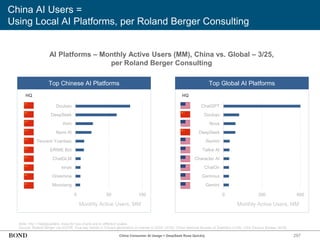
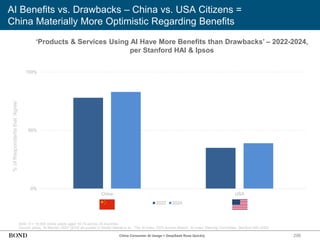
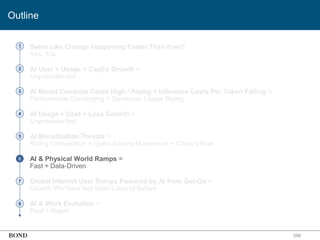
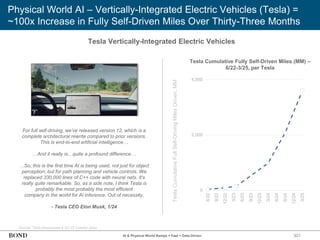
![302
Physical World AI – Fully-Autonomous Vehicles (Waymo) =
0% to 27% Share of San Francisco Rideshares Over Twenty Months, per YipitData
Waymo Fully-Autonomous Vehicles
Note: Data derived from USA-user email receipt panel composed of >1mm monthly transacting USA email accounts from all available domains. Paid rides only. Numbers are estimates
due to sample size. Source: Waymo, Tech Brew (1/25), Fast Company (3/25), YipitData (4/4/25)
[We are creating] an end-to-end, very, very robust, and
large end-to-end system that’s multi-modal in its foundation
so that perception planning and prediction…
can become even more robust than it is today.
- Waymo Co-CEO Tekedra Mawakana, 1/25
%
of
San
Francisco
Gross
Bookings
Estimated Market Share (Gross Bookings) – 8/23-4/25,
San Francisco Operating Zone, per YipitData
0%
25%
50%
75%
8/23 12/23 4/24 8/24 12/24 4/25
Waymo Uber Lyft
What we’ve done in San Francisco is prove to ourselves –
and to the world – that not only does autonomy work,
but it works at scale in a market and can
be a viable commercial product.
- Waymo Co-CEO Dmitri Dolgov, 3/25
AI & Physical World Ramps = Fast + Data-Driven](https://image.slidesharecdn.com/trendsartificialintelligence-250531042211-e66b7928/85/AI-Trends-Mary-Meeker-303-320.jpg)
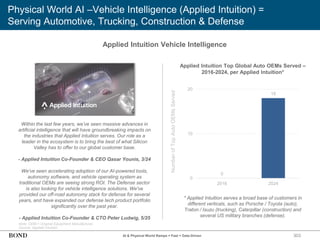
![304
Physical World AI – USA Defense (Anduril) =
+2x Y/Y Revenue Growth for Last Two Years
Anduril AI-Enabled Autonomous USA Defense Systems
Source: Anduril, Forbes, TechCrunch, CNBC
Annual
Revenue,
$MM
Anduril Estimated Revenue ($MM) –
F2020-F2024, per News Reports
$0
$500
$1,000
F2020 F2021 F2022 F2023 F2024
At Anduril, we firmly believe that today’s most pressing
national security challenges cannot be solved without AI-
enabled systems and autonomy at scale. These systems will
help to keep our service members safe and empower them to
make better decisions at the speed of modern warfare…
…When developed and deployed properly, [AI and
autonomous systems] can make warfare more proportional,
more precise, and less indiscriminate than it
has ever been before.
- Anduril Co-Founder & CEO Brian Schimpf, 12/23
AI & Physical World Ramps = Fast + Furious](https://image.slidesharecdn.com/trendsartificialintelligence-250531042211-e66b7928/85/AI-Trends-Mary-Meeker-305-320.jpg)
![305
Physical World AI = AI-Driven Mining Exploration (KoBold Metals) =
Reversing Trend in Exploration Inefficiency
KoBold Metals AI-Driven Mining Exploration
Source: KoBold Metals, Wired (12/22)
Mineral Deposit Discoveries per $B of Exploration
Spend – 1975-2023, per KoBold Metals
We're looking to expand and diversify the supply of these
metals all over the world, but we're taking a totally different
approach [from conventional mining companies]. Two-thirds
of our team are software engineers or data scientists.
- KoBold Metals Co-Founder & CEO Kurt House, 12/22
KoBold’s Machine Prospector technology combines never before
used datasets with conventional geochemical, geophysical, &
geological data in statistical association models to identify
prospects. KoBold’s technology accelerates exploration by
efficiently screening large regions & makes our search more
effective by identifying the most promising locations.
- KoBold Metals Website
Discoveries
per
$B
of
Exploration
Spend
0
4
8
12
16
1975 1983 1991 1999 2007 2015 2023
AI & Physical World Ramps = Fast + Furious
KoBold Metals
Industry Average](https://image.slidesharecdn.com/trendsartificialintelligence-250531042211-e66b7928/85/AI-Trends-Mary-Meeker-306-320.jpg)
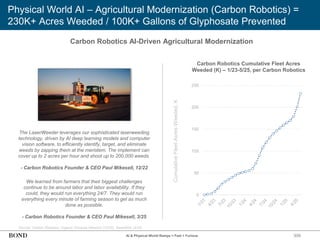
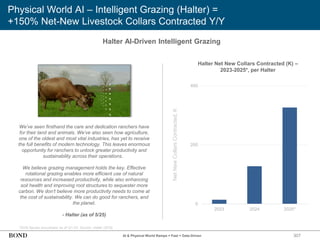
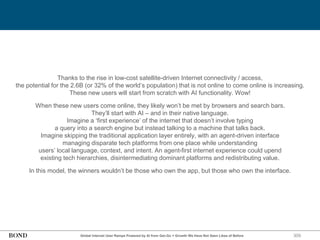
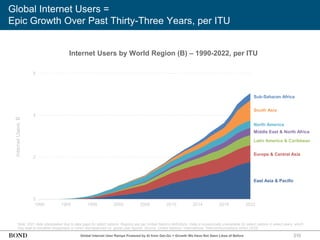
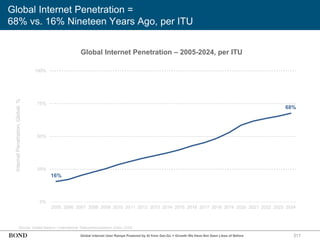
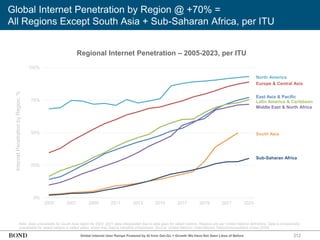
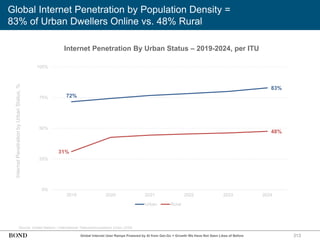
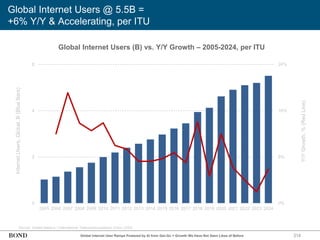
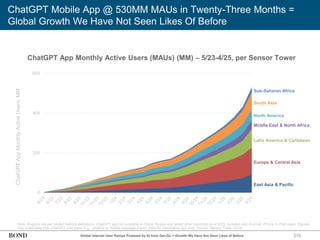
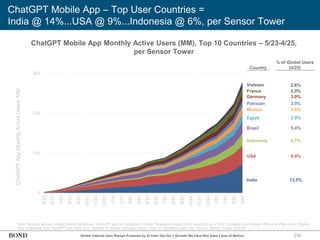
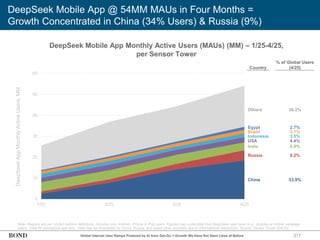
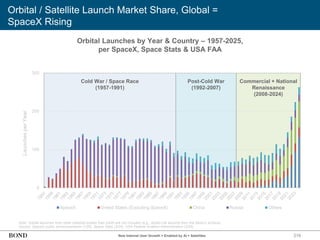

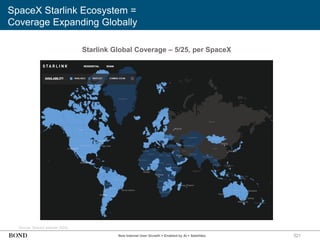
![Starlink =
Unlocking Previously-Inaccessible Internet Access in AI Era
322
Select Global Starlink Use Cases – 4/25, per SpaceX
Coco, Monterrey, Mexico
Starlink's technology has enabled
Coco's operations, delivering high-
speed, reliable internet that bridges
the digital divide in rural Mexico.
Through our streamlined community
WiFi services, we're not just offering
connectivity, we're opening a window
to the world for hundreds in remote
areas. With Starlink, we've boosted
connection speeds and efficiency,
transforming disconnected regions
into digitally engaged communities.
Chile School District
[Our] school went from slow,
ineffective connectivity for even 2-3
computer stations, to having high-
speed internet where all 36 of our
children can have effective internet
connectivity simultaneously...a class-
changing event for our teachers and
students.
Brightline Trains, USA
Starlink gave us the new beginning
we were looking for. It gave us
connectivity we can be proud to
share with our guests. It gave us the
knowledge we needed to continue to
build better train connectivity beyond
the satellite [internet] itself…and,
most of all, it gave us a new
beginning for train enthusiasts to get
excited about because it is doable, it
is maintainable, [and] it is as exciting
as it seems.
Seaspan Corporation,
Global
Deploying SpaceX Starlink's low Earth
orbit, low-latency, high bandwidth
service across our fleet is a major
milestone in addressing connectivity
challenges in an industry with a global
and mobile workforce. It allows us to
treat our vessels no differently than
remote offices, supporting crew safety
and wellness – and it enables us to
develop new solutions that were
technically and financially unviable
just a few years ago.
Source: SpaceX website (4/25)
New Internet User Growth = Enabled by AI + Satellites](https://image.slidesharecdn.com/trendsartificialintelligence-250531042211-e66b7928/85/AI-Trends-Mary-Meeker-323-320.jpg)
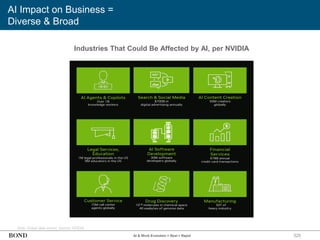
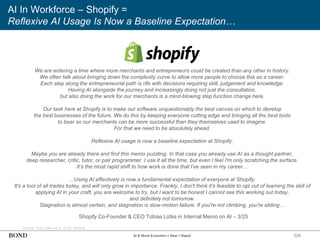
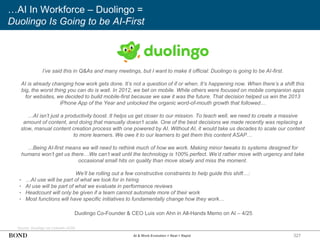
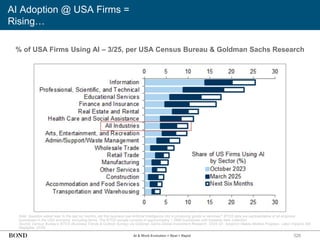
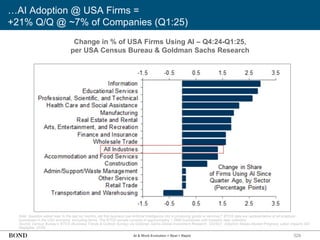
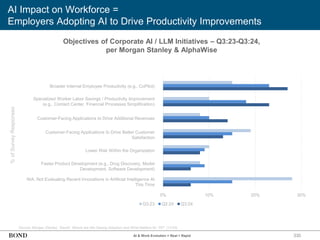
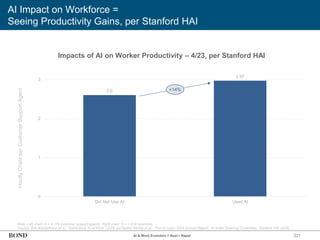
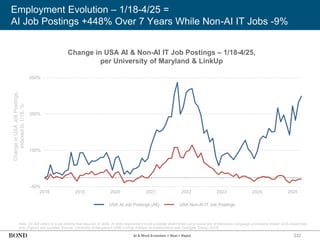
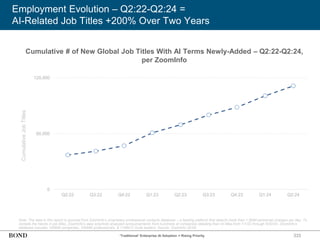
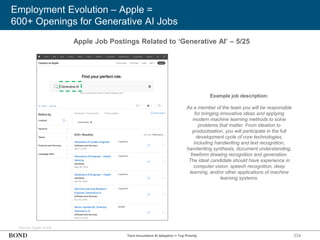
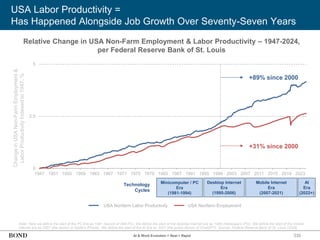
![336
AI In Workforce – NVIDIA =
You’re Not Going to Lose…Your Job to an AI…[But] to Somebody Who Uses AI
Source: Milken Institute (5/25)
NVIDIA Co-Founder & CEO Jensen Huang @ Milken Institute Global Conference – 5/25
AI & Work Evolution = Real + Rapid
All of you have heard a lot about [AI] job displacement. Every job will be affected. Some jobs will be lost,
some jobs will be created, but every job will be affected. And immediately it is unquestionable,
you're not going to lose a job – your job to an AI, but you're going to lose your job to somebody who uses AI…
…But let me give you the two extremes that you might want to consider as well.
Computer technology, computer science has benefited about 30 million people.
There are about 30 million people in the world who know how to program and use this technology to its extreme…
…The other eight, seven and a half billion people don't. I'll put on the table that, in fact,
artificial intelligence is the greatest opportunity for us to close the technology divide.
And let me prove it to you. You know, if we just look in this room, it's very unlikely that more than a handful of people
know how to program with C++, and an equal number know how to program in C. And yet, 100 percent of you know
how to program in AI. And the reason for that is because the AI will speak whatever language you wanted to speak…
…The number of people who are using ChatGPT and Gemini Pro and these AIs kind of
demonstrate that, in fact, this is one of the easiest to use technologies in history…
…The other extreme that I will say is that, remember, we’re – we have a shortage of labor.
We have a shortage of workers.
We don't have an abundance of workers. We have a shortage of and for the very first time in history,
we actually have – we can imagine the opportunity to close that gap to put 30-40 million workers back into the workforce
that otherwise the world doesn't have. And so you could argue that artificial intelligence is probably our best
way to increase the GDP, the global GDP, and so those are two other ways to look at it.
In the meantime, I would recommend 100% of everybody you know take advantage of AI and
don't be that person who ignores this technology.](https://image.slidesharecdn.com/trendsartificialintelligence-250531042211-e66b7928/85/AI-Trends-Mary-Meeker-337-320.jpg)


![[Datanest] AI startup in Indonesia - March 2018](https://cdn.slidesharecdn.com/ss_thumbnails/datanestaistartupinindonesia-march20181-180315041932-thumbnail.jpg?width=640&height=640&fit=bounds)


![State of the VC Market - Untapped Capital [Redacted]](https://cdn.slidesharecdn.com/ss_thumbnails/stateofthevcmarket-untappedcapitalredacted-251121032845-0feab568-thumbnail.jpg?width=640&height=640&fit=bounds)


![5G Explained! A High Level Overview [Introduction]](https://cdn.slidesharecdn.com/ss_thumbnails/5gexplainedahighleveloverview-260119165306-cc137a3e-thumbnail.jpg?width=640&height=640&fit=bounds)


