Startups and Product Management
The concept of Product Entropy


                            Amarpreet Kalkat
Why
Most technology startups started by engineers


Inherent strengths in engineering, not as much
     in product design or commercialization

       Does not apply to all engineers
Who Am I
Co-founder @ Ciafo. Co-creator of Frrole & Travelomy

   Have built 8+ internet products, 3 from scratch

Frrole pseudo-mentioned on WSJ, Forbes; TNW called
    Frrole top tweets better than Twitter top trends
#1
Product Definition
 Fluid vs Concrete
#2
Product Roadmap
  Exist || !Exist
#3
Product Thinking
 Input vs Output
 Effort vs Impact
#4
       Goal
 Maximizing overall
   business value,
given the constraints
#5
     Strategy
Product vs Brand vs
     Execution
#6
      Approach
Playing to your strength
#7
        Focus
Product you are building
           vs
  the solution you are
         creating
#8
    Catch
Not planning for
   execution
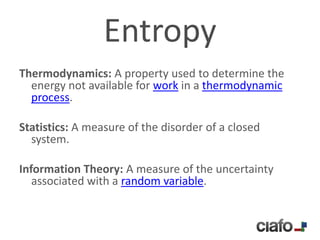
Entropy
Thermodynamics: A property used to determine the
  energy not available for work in a thermodynamic
  process.

Statistics: A measure of the disorder of a closed
  system.

Information Theory: A measure of the uncertainty
   associated with a random variable.
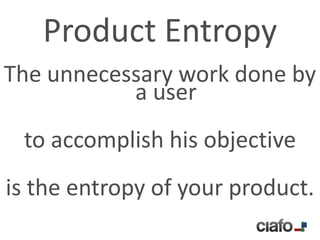
Product Entropy
The unnecessary work done by
           a user
 to accomplish his objective
is the entropy of your product.
Thanks.
@amarpreetkalkat
   @frrole
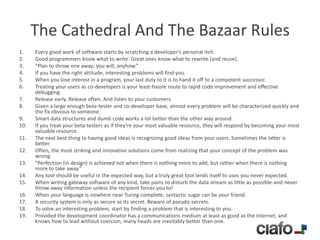
The Cathedral And The Bazaar Rules
1.    Every good work of software starts by scratching a developer’s personal itch.
2.    Good programmers know what to write. Great ones know what to rewrite (and reuse).
3.    “Plan to throw one away; you will, anyhow.”
4.    If you have the right attitude, interesting problems will find you.
5.    When you lose interest in a program, your last duty to it is to hand it off to a competent successor.
6.    Treating your users as co-developers is your least-hassle route to rapid code improvement and effective
      debugging.
7.    Release early. Release often. And listen to your customers.
8.    Given a large enough beta-tester and co-developer base, almost every problem will be characterized quickly and
      the fix obvious to someone.
9.    Smart data structures and dumb code works a lot better than the other way around.
10.   If you treat your beta-testers as if they’re your most valuable resource, they will respond by becoming your most
      valuable resource.
11.   The next best thing to having good ideas is recognizing good ideas from your users. Sometimes the latter is
      better.
12.   Often, the most striking and innovative solutions come from realizing that your concept of the problem was
      wrong.
13.   “Perfection (in design) is achieved not when there is nothing more to add, but rather when there is nothing
      more to take away.”
14.   Any tool should be useful in the expected way, but a truly great tool lends itself to uses you never expected.
15.   When writing gateway software of any kind, take pains to disturb the data stream as little as possible-and never
      throw away information unless the recipient forces you to!
16.   When your language is nowhere near Turing-complete, syntactic sugar can be your friend.
17.   A security system is only as secure as its secret. Beware of pseudo-secrets.
18.   To solve an interesting problem, start by finding a problem that is interesting to you.
19.   Provided the development coordinator has a communications medium at least as good as the Internet, and
      knows how to lead without coercion, many heads are inevitably better than one.

Startups & the Product Management Perspective

  • 1.
    Startups and ProductManagement The concept of Product Entropy Amarpreet Kalkat
  • 2.
    Why Most technology startupsstarted by engineers Inherent strengths in engineering, not as much in product design or commercialization Does not apply to all engineers
  • 3.
    Who Am I Co-founder@ Ciafo. Co-creator of Frrole & Travelomy Have built 8+ internet products, 3 from scratch Frrole pseudo-mentioned on WSJ, Forbes; TNW called Frrole top tweets better than Twitter top trends
  • 4.
  • 5.
    #2 Product Roadmap Exist || !Exist
  • 6.
    #3 Product Thinking Inputvs Output Effort vs Impact
  • 7.
    #4 Goal Maximizing overall business value, given the constraints
  • 8.
    #5 Strategy Product vs Brand vs Execution
  • 9.
    #6 Approach Playing to your strength
  • 10.
    #7 Focus Product you are building vs the solution you are creating
  • 11.
    #8 Catch Not planning for execution
  • 12.
    Entropy Thermodynamics: A propertyused to determine the energy not available for work in a thermodynamic process. Statistics: A measure of the disorder of a closed system. Information Theory: A measure of the uncertainty associated with a random variable.
  • 13.
    Product Entropy The unnecessarywork done by a user to accomplish his objective is the entropy of your product.
  • 14.
  • 15.
    The Cathedral AndThe Bazaar Rules 1. Every good work of software starts by scratching a developer’s personal itch. 2. Good programmers know what to write. Great ones know what to rewrite (and reuse). 3. “Plan to throw one away; you will, anyhow.” 4. If you have the right attitude, interesting problems will find you. 5. When you lose interest in a program, your last duty to it is to hand it off to a competent successor. 6. Treating your users as co-developers is your least-hassle route to rapid code improvement and effective debugging. 7. Release early. Release often. And listen to your customers. 8. Given a large enough beta-tester and co-developer base, almost every problem will be characterized quickly and the fix obvious to someone. 9. Smart data structures and dumb code works a lot better than the other way around. 10. If you treat your beta-testers as if they’re your most valuable resource, they will respond by becoming your most valuable resource. 11. The next best thing to having good ideas is recognizing good ideas from your users. Sometimes the latter is better. 12. Often, the most striking and innovative solutions come from realizing that your concept of the problem was wrong. 13. “Perfection (in design) is achieved not when there is nothing more to add, but rather when there is nothing more to take away.” 14. Any tool should be useful in the expected way, but a truly great tool lends itself to uses you never expected. 15. When writing gateway software of any kind, take pains to disturb the data stream as little as possible-and never throw away information unless the recipient forces you to! 16. When your language is nowhere near Turing-complete, syntactic sugar can be your friend. 17. A security system is only as secure as its secret. Beware of pseudo-secrets. 18. To solve an interesting problem, start by finding a problem that is interesting to you. 19. Provided the development coordinator has a communications medium at least as good as the Internet, and knows how to lead without coercion, many heads are inevitably better than one.