hurry up please it’s time K.G. Schneider [email_address] Acting Associate Director for Libraries and Technology Florida State University February, 2007
things important to me (a sampling) my family  my faith life libraries writing free speech the right to read standards gardening good food books
on my reading table (a sampling) Suite Francaise Two CLIR reports on technology Atlantic, Vanity Fair , and  People A  DLib  article on digital preservation An unpublished mss. by a writer friend
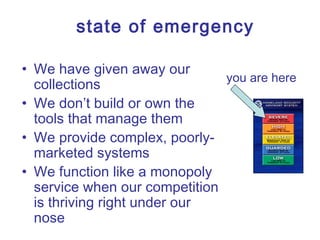
you are here We have given away our collections We don’t build or own the tools that manage them We provide complex, poorly-marketed systems  We function like a monopoly service when our competition is thriving right under our nose state of emergency
“ Every profession has a heartland of work over which it has complete, legally established control."  -- Andrew Abbott,  The System of Professions
memory work
5-3-1 rule Pick 5 issues you believe are important Focus on 3
now, make that 1 happen.
five things we can fix* digital preservation standards adoption the sucky state of most library software third-party library content hegemony scholarly awareness of key issues in LibraryLand * there are many more
three digital preservation the sucky state of most library catalog software scholarly awareness of key issues in LibraryLand
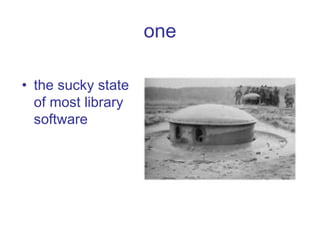
one the sucky state of most library software
4 nifty happenings with library software Evergreen Umlaut Scriblio The solr search engine you are all going to bolt on top of your geezy old ILS middleware as soon as you get home from code4lib
the renaissance of librarian-built software… Begins to restore the balance of power Reinstates the direction of our profession Puts the emphasis back on the library as memory organization Sends the message that we mean business
other outcomes Creative decoupling of components Interesting re-use of other tools, such as wordpress Resocialization of librarian artisans
my big “1” today: Evergreen Evergreen is big… really big Timing is perfect: an era of worrisome consolidation, even as… paradoxically… The centrality of the ILS is weakening
useful over-generalizations Nobody cares about open source Nobody cares about standards Nobody cares about usability Nobody cares about Evergreen
more useful generalizations The ARL body count continues to drive too many decisions IT directors do not have the resources to take on unfunded mandates Most libraries cannot provide developer time
how directors see the world how much does it cost, and what are we getting for the money? what are other directors doing? what problems will it create? why would I spend time/money on this rather than on X? Is this thing fully baked?
what directors “know” about open source One guy in a garage… probably in a torn Duran Duran tee-shirt One car accident away from orphan software No support model Cheesy “make-do” quality Arcane and developer-oriented Nobody else is doing it
quick take-aways that work well with directors The third-party vendor support model  Library administrators intuitively understand the value and ROI of third-party support High-participation projects can be very successful In a blind taste test, some open source always wins (e.g. Apache) They’re probably  already using  open source products
 
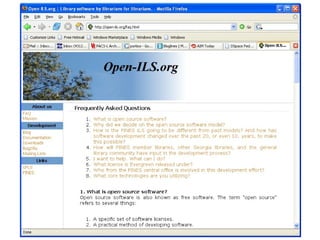
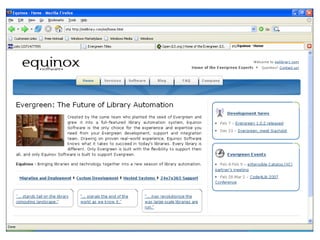
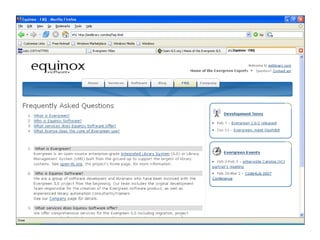
several flags “ This software can be downloaded for free, and anyone can contribute to development efforts.” Opening an FAQ with an explanation of open source software No special information for potential users who are not developers No timeline for activity discernable to the non-developer eye
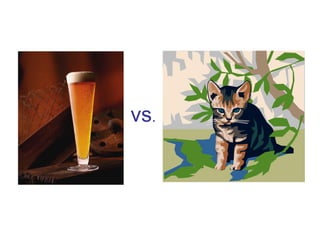
vs .
 
 
how not to sell Evergreen Start by saying “it’s open source!” Use the word “cool” Talk about benefits to the profession at large Describe it as software built by a volunteer community Express your interest in hiring lots of coders to help build Evergreen Hold back facts that will become evident as soon as the director phones a colleague
how to sell Evergreen Start with describing the fully-baked product you plan to deliver Your first sentence has to be the money line Focus on the short and long-term cost-effectiveness Point up the  ROI  and  smart value , particularly of the third-party vendor support model Tell success stories Provide a development timeline
5 strategies The riveting lede The elevator talk The pre-visit background investigation The well-versed acolyte The speed-dial for key stakeholders
biblio-creature-feep Some last-gen librarians love complex systems they have to teach people to use “ Our users need it” “ There’s no way to do X without it” “ We can’t migrate until X feature is delivered” “ It’s a loss of functionality”
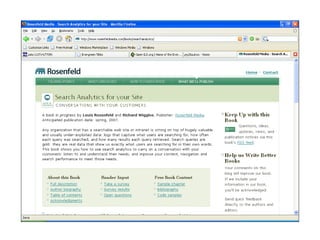
you know the cure Search log analyses Ethnographic studies Q&D usability tests “ Heuristic” evaluations Brute force Convincing people to do all of the above
 
every library needs a developer This will be as basic to our work as the ILL or reference librarian is today
every developer needs a library The rest of us are your avatars We keep you real
recap No less than the future of the profession is in your hands Remember Ranganathan!
contact K.G. Schneider [email_address] Associate Director for Technology and Research Florida State University

Code4Lib 2007: Hurry up please, it's time

  • 1.
    hurry up pleaseit’s time K.G. Schneider [email_address] Acting Associate Director for Libraries and Technology Florida State University February, 2007
  • 2.
    things important tome (a sampling) my family my faith life libraries writing free speech the right to read standards gardening good food books
  • 3.
    on my readingtable (a sampling) Suite Francaise Two CLIR reports on technology Atlantic, Vanity Fair , and People A DLib article on digital preservation An unpublished mss. by a writer friend
  • 4.
    you are hereWe have given away our collections We don’t build or own the tools that manage them We provide complex, poorly-marketed systems We function like a monopoly service when our competition is thriving right under our nose state of emergency
  • 5.
    “ Every professionhas a heartland of work over which it has complete, legally established control." -- Andrew Abbott, The System of Professions
  • 6.
  • 7.
    5-3-1 rule Pick5 issues you believe are important Focus on 3
  • 8.
    now, make that1 happen.
  • 9.
    five things wecan fix* digital preservation standards adoption the sucky state of most library software third-party library content hegemony scholarly awareness of key issues in LibraryLand * there are many more
  • 10.
    three digital preservationthe sucky state of most library catalog software scholarly awareness of key issues in LibraryLand
  • 11.
    one the suckystate of most library software
  • 12.
    4 nifty happeningswith library software Evergreen Umlaut Scriblio The solr search engine you are all going to bolt on top of your geezy old ILS middleware as soon as you get home from code4lib
  • 13.
    the renaissance oflibrarian-built software… Begins to restore the balance of power Reinstates the direction of our profession Puts the emphasis back on the library as memory organization Sends the message that we mean business
  • 14.
    other outcomes Creativedecoupling of components Interesting re-use of other tools, such as wordpress Resocialization of librarian artisans
  • 15.
    my big “1”today: Evergreen Evergreen is big… really big Timing is perfect: an era of worrisome consolidation, even as… paradoxically… The centrality of the ILS is weakening
  • 16.
    useful over-generalizations Nobodycares about open source Nobody cares about standards Nobody cares about usability Nobody cares about Evergreen
  • 17.
    more useful generalizationsThe ARL body count continues to drive too many decisions IT directors do not have the resources to take on unfunded mandates Most libraries cannot provide developer time
  • 18.
    how directors seethe world how much does it cost, and what are we getting for the money? what are other directors doing? what problems will it create? why would I spend time/money on this rather than on X? Is this thing fully baked?
  • 19.
    what directors “know”about open source One guy in a garage… probably in a torn Duran Duran tee-shirt One car accident away from orphan software No support model Cheesy “make-do” quality Arcane and developer-oriented Nobody else is doing it
  • 20.
    quick take-aways thatwork well with directors The third-party vendor support model Library administrators intuitively understand the value and ROI of third-party support High-participation projects can be very successful In a blind taste test, some open source always wins (e.g. Apache) They’re probably already using open source products
  • 21.
  • 22.
    several flags “This software can be downloaded for free, and anyone can contribute to development efforts.” Opening an FAQ with an explanation of open source software No special information for potential users who are not developers No timeline for activity discernable to the non-developer eye
  • 23.
  • 24.
  • 25.
  • 26.
    how not tosell Evergreen Start by saying “it’s open source!” Use the word “cool” Talk about benefits to the profession at large Describe it as software built by a volunteer community Express your interest in hiring lots of coders to help build Evergreen Hold back facts that will become evident as soon as the director phones a colleague
  • 27.
    how to sellEvergreen Start with describing the fully-baked product you plan to deliver Your first sentence has to be the money line Focus on the short and long-term cost-effectiveness Point up the ROI and smart value , particularly of the third-party vendor support model Tell success stories Provide a development timeline
  • 28.
    5 strategies Theriveting lede The elevator talk The pre-visit background investigation The well-versed acolyte The speed-dial for key stakeholders
  • 29.
    biblio-creature-feep Some last-genlibrarians love complex systems they have to teach people to use “ Our users need it” “ There’s no way to do X without it” “ We can’t migrate until X feature is delivered” “ It’s a loss of functionality”
  • 30.
    you know thecure Search log analyses Ethnographic studies Q&D usability tests “ Heuristic” evaluations Brute force Convincing people to do all of the above
  • 31.
  • 32.
    every library needsa developer This will be as basic to our work as the ILL or reference librarian is today
  • 33.
    every developer needsa library The rest of us are your avatars We keep you real
  • 34.
    recap No lessthan the future of the profession is in your hands Remember Ranganathan!
  • 35.
    contact K.G. Schneider[email_address] Associate Director for Technology and Research Florida State University

Editor's Notes

  • #2 Yes, I live in Florida, and I’ve gotten over it!