Interaction Design
“The intractability of the software construction process – particularly the high cost of programming and
the low quality of interaction – is simply not a technical problem”


                                                                                       Alan Cooper
software

• Why is most software bad? Frustrating to use, buggy.
• Not programmers fault – they are often the agents of bad software
  but not the cause

• They are not given sufficient time, clear enough direction or adequate
  designs to succeed
software


•   Providing these should be the job of the Executive and Product teams

•   But they aren’t delivering – why?

    •   Not (just) stupidity

    •   They don’t have the right tools
old methods


•   Businesses are structured & measured by a system born in
    mercantilism and refined in industry

•   It measures the wrong thing in the information age
old methods


•   In the industrial age products were manufactured from solid materials

•   The money it took to create them were dominated by variable costs

    •   Costs that varied with the amount of stuff made.
old methods

•   Software production is not like this

•   It does not consume raw materials – no manufacturing costs

    •   The variable costs that dominated manufacturing are non-existent in
        software production

•   Software production is not a fixed cost or a variable cost – and it is
    not R & D...
square peg, round hole

•   ...but in practice it is treated like a manufacturing process (a variable
    cost)

•   Businesses grow profits by increasing revenue or decreasing costs

•   Decreasing costs was quickest and easiest in the manufacturing age
square peg, round hole
•   But software production does not behave like a variable cost – trying
    to ‘reduce’ it doesn’t work

•   Worse, it cuts off the only other course of action – increasing revenue
    by increasing quality means increasing production effort.

•   Interaction design is the tool used to intelligently increase production
    effort

    •   Make sure all production effort contributes to quality and revenue
misdirected effort
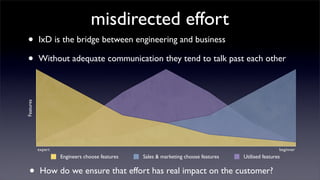
 •         IxD is the bridge between engineering and business

 •         Without adequate communication they tend to talk past each other
Features


           expert                                                                                   beginner
                    Engineers choose features   Sales & marketing choose features   Utilised features


   •        How do we ensure that effort has real impact on the customer?
principles
                               Good software promotes “flow”
                  A psychological state in which people can concentrate fully with out peripheral distraction


•   Reflects user’s mental model

•   It does not converse

•   Keeps tools close at hand

•   Provides modeless feedback

                         How do we design such software?
orchestration
                            Good software should be invisible

•   Orchestration is the process of ensuring all elements work
    harmoniously

    •   Less is more

    •   Don’t design for corner cases

    •   Reflect status – but don’t report normalcy

    •   Don’t interrogate
navigation
            Navigation is a chore even if it is in-line with the user’s flow


•   Keep the number of pages to a minimum – preferably one.

•   Keep the number of panes within a page to a minimum – no more than
    three.

•   Provide sign-posts: fixed persistent elements.

•   Provide overviews: thumbnails, bread-crumbs
exercise
Exercise is interaction that does not contribute to a user’s goal – eliminate it.


•   Don’t force the user to go to a different page – especially to do
    something that effects his current one

•   Don’t force the user to remember things

•   Try to allow input where you have output
inflection
        Organise the interface to minimise the most common navigation path


•   Organise layout according to three attributes

    •   Frequency of use

    •   Degree of dislocation

    •   Degree of risk
visuals
                         Beautiful things work better!

•   Masaaki Kurosu & Kaori Kashimuru

    •   ATM study

    •   Replicated by Noam Tractinsky

•   Usability and aesthetics strongly correlate

•   Emotion and cognition are interlinked – Norman ’04

•   Happy people are more effective in finding alternate solutions & are
    therefore tolerant of minor difficulties – Alice Isen
conclusion


                No more management by dead-line.

Know what you are building, who for, and know when you are finished
questions

IxD talk

  • 1.
  • 2.
    “The intractability ofthe software construction process – particularly the high cost of programming and the low quality of interaction – is simply not a technical problem” Alan Cooper
  • 3.
    software • Why ismost software bad? Frustrating to use, buggy. • Not programmers fault – they are often the agents of bad software but not the cause • They are not given sufficient time, clear enough direction or adequate designs to succeed
  • 4.
    software • Providing these should be the job of the Executive and Product teams • But they aren’t delivering – why? • Not (just) stupidity • They don’t have the right tools
  • 5.
    old methods • Businesses are structured & measured by a system born in mercantilism and refined in industry • It measures the wrong thing in the information age
  • 6.
    old methods • In the industrial age products were manufactured from solid materials • The money it took to create them were dominated by variable costs • Costs that varied with the amount of stuff made.
  • 7.
    old methods • Software production is not like this • It does not consume raw materials – no manufacturing costs • The variable costs that dominated manufacturing are non-existent in software production • Software production is not a fixed cost or a variable cost – and it is not R & D...
  • 8.
    square peg, roundhole • ...but in practice it is treated like a manufacturing process (a variable cost) • Businesses grow profits by increasing revenue or decreasing costs • Decreasing costs was quickest and easiest in the manufacturing age
  • 9.
    square peg, roundhole • But software production does not behave like a variable cost – trying to ‘reduce’ it doesn’t work • Worse, it cuts off the only other course of action – increasing revenue by increasing quality means increasing production effort. • Interaction design is the tool used to intelligently increase production effort • Make sure all production effort contributes to quality and revenue
  • 10.
    misdirected effort • IxD is the bridge between engineering and business • Without adequate communication they tend to talk past each other Features expert beginner Engineers choose features Sales & marketing choose features Utilised features • How do we ensure that effort has real impact on the customer?
  • 11.
    principles Good software promotes “flow” A psychological state in which people can concentrate fully with out peripheral distraction • Reflects user’s mental model • It does not converse • Keeps tools close at hand • Provides modeless feedback How do we design such software?
  • 12.
    orchestration Good software should be invisible • Orchestration is the process of ensuring all elements work harmoniously • Less is more • Don’t design for corner cases • Reflect status – but don’t report normalcy • Don’t interrogate
  • 13.
    navigation Navigation is a chore even if it is in-line with the user’s flow • Keep the number of pages to a minimum – preferably one. • Keep the number of panes within a page to a minimum – no more than three. • Provide sign-posts: fixed persistent elements. • Provide overviews: thumbnails, bread-crumbs
  • 14.
    exercise Exercise is interactionthat does not contribute to a user’s goal – eliminate it. • Don’t force the user to go to a different page – especially to do something that effects his current one • Don’t force the user to remember things • Try to allow input where you have output
  • 15.
    inflection Organise the interface to minimise the most common navigation path • Organise layout according to three attributes • Frequency of use • Degree of dislocation • Degree of risk
  • 16.
    visuals Beautiful things work better! • Masaaki Kurosu & Kaori Kashimuru • ATM study • Replicated by Noam Tractinsky • Usability and aesthetics strongly correlate • Emotion and cognition are interlinked – Norman ’04 • Happy people are more effective in finding alternate solutions & are therefore tolerant of minor difficulties – Alice Isen
  • 17.
    conclusion No more management by dead-line. Know what you are building, who for, and know when you are finished
  • 18.