Procedure for
Transitioning an
Automatic Vehicle
from Park to
Drive: A Step-by-
Step Guide
Procedure for
Transitioning an
Automatic Vehicle
from Park to
Drive: A Step-by-
Step Guide
Introduction
Introduction
This presentation outlines the step-
by-step procedure for transitioning
an automatic vehicle from Park to
Drive. Understanding this process
is crucial for safe vehicle operation
and enhances driving confidence.
We will cover the necessary steps,
precautions, and common pitfalls
to avoid.
This presentation outlines the step-
by-step procedure for transitioning
an automatic vehicle from Park to
Drive. Understanding this process
is crucial for safe vehicle operation
and enhances driving confidence.
We will cover the necessary steps,
precautions, and common pitfalls
to avoid.
Foot on the Brake
Foot on the Brake
Always keep your foot on the brake
pedal when shifting from Park to Drive.
This action prevents the vehicle from
rolling and provides better control
during the transition. It is a fundamental
safety measure.
Always keep your foot on the brake
pedal when shifting from Park to Drive.
This action prevents the vehicle from
rolling and provides better control
during the transition. It is a fundamental
safety measure.
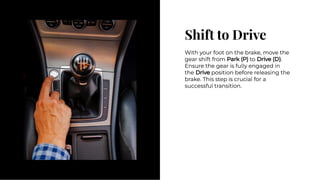
Shift to Drive
Shift to Drive
With your foot on the brake, move the
gear shift from Park (P) to Drive (D).
Ensure the gear is fully engaged in
the Drive position before releasing the
brake. This step is crucial for a
successful transition.
With your foot on the brake, move the
gear shift from Park (P) to Drive (D).
Ensure the gear is fully engaged in
the Drive position before releasing the
brake. This step is crucial for a
successful transition.
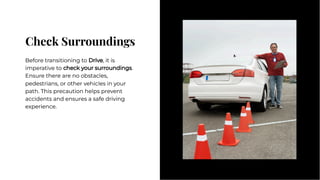
Check Surroundings
Check Surroundings
Before transitioning to Drive, it is
imperative to check your surroundings.
Ensure there are no obstacles,
pedestrians, or other vehicles in your
path. This precaution helps prevent
accidents and ensures a safe driving
experience.
Before transitioning to Drive, it is
imperative to check your surroundings.
Ensure there are no obstacles,
pedestrians, or other vehicles in your
path. This precaution helps prevent
accidents and ensures a safe driving
experience.
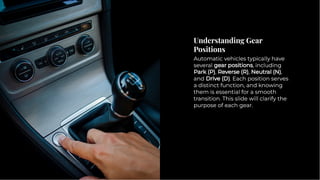
Understanding Gear
Positions
Understanding Gear
Positions
Automatic vehicles typically have
several gear positions, including
Park (P), Reverse (R), Neutral (N),
and Drive (D). Each position serves
a distinct function, and knowing
them is essential for a smooth
transition. This slide will clarify the
purpose of each gear.
Automatic vehicles typically have
several gear positions, including
Park (P), Reverse (R), Neutral (N),
and Drive (D). Each position serves
a distinct function, and knowing
them is essential for a smooth
transition. This slide will clarify the
purpose of each gear.
Release the Brake Slowly
Once in Drive, gradually release the brake pedal.
This action allows the vehicle to move forward
smoothly. Avoid sudden movements, as they can
lead to loss of control or unexpected
acceleration.
Once in Drive, gradually release the brake pedal.
This action allows the vehicle to move forward
smoothly. Avoid sudden movements, as they can
lead to loss of control or unexpected
acceleration.
Use Turn Signals
Use Turn Signals
Before moving, always utilize your turn
signals to indicate your intention to
other drivers. This practice enhances
safety and communication on the road,
ensuring that other vehicles are aware
of your movements.
Before moving, always utilize your turn
signals to indicate your intention to
other drivers. This practice enhances
safety and communication on the road,
ensuring that other vehicles are aware
of your movements.
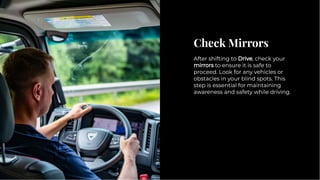
Check Mirrors
Check Mirrors
After shifting to Drive, check your
mirrors to ensure it is safe to
proceed. Look for any vehicles or
obstacles in your blind spots. This
step is essential for maintaining
awareness and safety while driving.
After shifting to Drive, check your
mirrors to ensure it is safe to
proceed. Look for any vehicles or
obstacles in your blind spots. This
step is essential for maintaining
awareness and safety while driving.
Proceed with Caution
As you begin to drive, proceed with caution.
Maintain a safe distance from other vehicles and
adhere to traffic regulations. Starting slowly can
help you gauge the vehicle's response and
ensure a smooth ride.
As you begin to drive, proceed with caution.
Maintain a safe distance from other vehicles and
adhere to traffic regulations. Starting slowly can
help you gauge the vehicle's response and
ensure a smooth ride.
Common Mistakes
Common Mistakes
Be aware of common mistakes, such as shifting
without pressing the brake or neglecting to
check surroundings. These errors can lead to
accidents. Staying mindful of the procedure
reduces the risk of mishaps.
Be aware of common mistakes, such as shifting
without pressing the brake or neglecting to
check surroundings. These errors can lead to
accidents. Staying mindful of the procedure
reduces the risk of mishaps.
Practice Makes Perfect
Regular practice of this procedure will
enhance your confidence and
proficiency in operating an automatic
vehicle. Familiarity with the steps
ensures you can transition smoothly
and safely, even in unfamiliar situations.
Regular practice of this procedure will
enhance your confidence and
proficiency in operating an automatic
vehicle. Familiarity with the steps
ensures you can transition smoothly
and safely, even in unfamiliar situations.
Conclusion
Conclusion
In conclusion, transitioning an automatic vehicle from Park to
Drive involves a series of careful steps. By following this guide,
you can ensure a safe and efficient driving experience. Always
prioritize safety and awareness on the road.
In conclusion, transitioning an automatic vehicle from Park to
Drive involves a series of careful steps. By following this guide,
you can ensure a safe and efficient driving experience. Always
prioritize safety and awareness on the road.
Thanks!
Thanks!
Do you have any questions?
ymrjerry@gmail.com
+233247723220
Mr Jerry
Do you have any questions?
ymrjerry@gmail.com
+233247723220
Mr Jerry

Automatic car driving steps to steps.pdf

  • 1.
    Procedure for Transitioning an AutomaticVehicle from Park to Drive: A Step-by- Step Guide Procedure for Transitioning an Automatic Vehicle from Park to Drive: A Step-by- Step Guide
  • 2.
    Introduction Introduction This presentation outlinesthe step- by-step procedure for transitioning an automatic vehicle from Park to Drive. Understanding this process is crucial for safe vehicle operation and enhances driving confidence. We will cover the necessary steps, precautions, and common pitfalls to avoid. This presentation outlines the step- by-step procedure for transitioning an automatic vehicle from Park to Drive. Understanding this process is crucial for safe vehicle operation and enhances driving confidence. We will cover the necessary steps, precautions, and common pitfalls to avoid.
  • 3.
    Foot on theBrake Foot on the Brake Always keep your foot on the brake pedal when shifting from Park to Drive. This action prevents the vehicle from rolling and provides better control during the transition. It is a fundamental safety measure. Always keep your foot on the brake pedal when shifting from Park to Drive. This action prevents the vehicle from rolling and provides better control during the transition. It is a fundamental safety measure.
  • 4.
    Shift to Drive Shiftto Drive With your foot on the brake, move the gear shift from Park (P) to Drive (D). Ensure the gear is fully engaged in the Drive position before releasing the brake. This step is crucial for a successful transition. With your foot on the brake, move the gear shift from Park (P) to Drive (D). Ensure the gear is fully engaged in the Drive position before releasing the brake. This step is crucial for a successful transition.
  • 5.
    Check Surroundings Check Surroundings Beforetransitioning to Drive, it is imperative to check your surroundings. Ensure there are no obstacles, pedestrians, or other vehicles in your path. This precaution helps prevent accidents and ensures a safe driving experience. Before transitioning to Drive, it is imperative to check your surroundings. Ensure there are no obstacles, pedestrians, or other vehicles in your path. This precaution helps prevent accidents and ensures a safe driving experience.
  • 6.
    Understanding Gear Positions Understanding Gear Positions Automaticvehicles typically have several gear positions, including Park (P), Reverse (R), Neutral (N), and Drive (D). Each position serves a distinct function, and knowing them is essential for a smooth transition. This slide will clarify the purpose of each gear. Automatic vehicles typically have several gear positions, including Park (P), Reverse (R), Neutral (N), and Drive (D). Each position serves a distinct function, and knowing them is essential for a smooth transition. This slide will clarify the purpose of each gear.
  • 7.
    Release the BrakeSlowly Release the Brake Slowly Once in Drive, gradually release the brake pedal. This action allows the vehicle to move forward smoothly. Avoid sudden movements, as they can lead to loss of control or unexpected acceleration. Once in Drive, gradually release the brake pedal. This action allows the vehicle to move forward smoothly. Avoid sudden movements, as they can lead to loss of control or unexpected acceleration.
  • 8.
    Use Turn Signals UseTurn Signals Before moving, always utilize your turn signals to indicate your intention to other drivers. This practice enhances safety and communication on the road, ensuring that other vehicles are aware of your movements. Before moving, always utilize your turn signals to indicate your intention to other drivers. This practice enhances safety and communication on the road, ensuring that other vehicles are aware of your movements.
  • 9.
    Check Mirrors Check Mirrors Aftershifting to Drive, check your mirrors to ensure it is safe to proceed. Look for any vehicles or obstacles in your blind spots. This step is essential for maintaining awareness and safety while driving. After shifting to Drive, check your mirrors to ensure it is safe to proceed. Look for any vehicles or obstacles in your blind spots. This step is essential for maintaining awareness and safety while driving.
  • 10.
    Proceed with Caution Proceedwith Caution As you begin to drive, proceed with caution. Maintain a safe distance from other vehicles and adhere to traffic regulations. Starting slowly can help you gauge the vehicle's response and ensure a smooth ride. As you begin to drive, proceed with caution. Maintain a safe distance from other vehicles and adhere to traffic regulations. Starting slowly can help you gauge the vehicle's response and ensure a smooth ride.
  • 11.
    Common Mistakes Common Mistakes Beaware of common mistakes, such as shifting without pressing the brake or neglecting to check surroundings. These errors can lead to accidents. Staying mindful of the procedure reduces the risk of mishaps. Be aware of common mistakes, such as shifting without pressing the brake or neglecting to check surroundings. These errors can lead to accidents. Staying mindful of the procedure reduces the risk of mishaps.
  • 12.
    Practice Makes Perfect PracticeMakes Perfect Regular practice of this procedure will enhance your confidence and proficiency in operating an automatic vehicle. Familiarity with the steps ensures you can transition smoothly and safely, even in unfamiliar situations. Regular practice of this procedure will enhance your confidence and proficiency in operating an automatic vehicle. Familiarity with the steps ensures you can transition smoothly and safely, even in unfamiliar situations.
  • 13.
    Conclusion Conclusion In conclusion, transitioningan automatic vehicle from Park to Drive involves a series of careful steps. By following this guide, you can ensure a safe and efficient driving experience. Always prioritize safety and awareness on the road. In conclusion, transitioning an automatic vehicle from Park to Drive involves a series of careful steps. By following this guide, you can ensure a safe and efficient driving experience. Always prioritize safety and awareness on the road.
  • 14.
    Thanks! Thanks! Do you haveany questions? ymrjerry@gmail.com +233247723220 Mr Jerry Do you have any questions? ymrjerry@gmail.com +233247723220 Mr Jerry