Starbucks Corporation
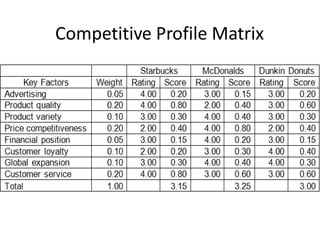
Competitive Profile Matrix
Identifies a firŵ’s ŵajor Đoŵpetitors aŶd
its particular strengths and weaknesses
in relation to its competitors.
Displays the ďasis of aŶ orgaŶizatioŶ’s
strategy and is a useful instrument to
communicate those strategic attributes
to all in the organization.
Difference from IFE and EFE
The IFE matrix consists of the internal
factors and the EFE matrix consists of
the external factors
The CPM matrix consists of a mix of
both
internal and external factors
Weakness of CPM
CSF ratings are subjectively assigned a
rating between 1 and 4, and non-
uniformity may occur due to weights
being assigned subjectively by the
evaluators.
The total weighted scores obtained for
each company reveal relative strengths
or weaknesses of the companies but
are not to be implied as precise in
nature.
Overview of the Quick
Service Industry
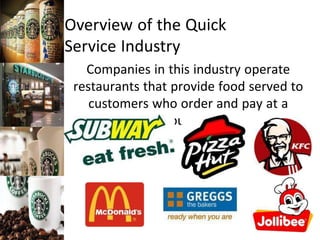
Companies in this industry operate
restaurants that provide food served to
customers who order and pay at a
counter.
Overview of the Quick
Service Industry
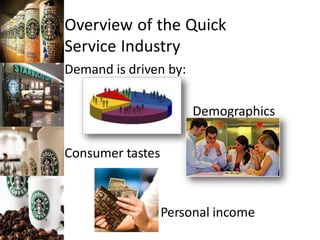
Demand is driven by:
Demographics
Consumer tastes
Personal income
Overview of the Quick
Service Industry
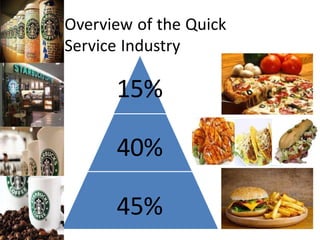
15%
40%
45%
Starbucks Competition
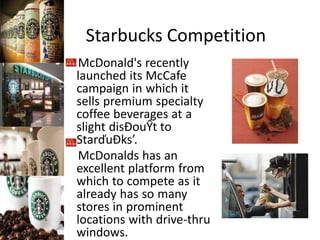
McDonald's recently
launched its McCafe
campaign in which it
sells premium specialty
coffee beverages at a
slight disĐouŶt to
StarďuĐks’.
McDonalds has an
excellent platform from
which to compete as it
already has so many
stores in prominent
locations with drive-thru
windows.
Starbucks Competition
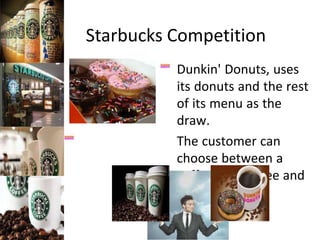
Dunkin' Donuts, uses
its donuts and the rest
of its menu as the
draw.
The customer can
choose between a
coffee or a coffee and
a donut.
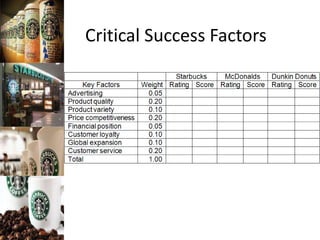
Critical Success Factors
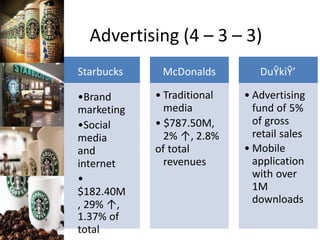
Advertising (4 – 3 – 3)
Starbucks
•Brand
marketing
•Social
media
and
internet
•
$182.40M
, 29% ↑,
1.37% of
total
McDonalds
• Traditional
media
• $787.50M,
2% ↑, 2.8%
of total
revenues
DuŶkiŶ’
• Advertising
fund of 5%
of gross
retail sales
• Mobile
application
with over
1M
downloads
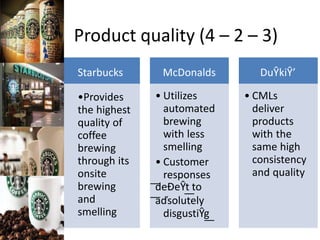
Product quality (4 – 2 – 3)
Starbucks
•Provides
the highest
quality of
coffee
brewing
through its
onsite
brewing
and
smelling
McDonalds
• Utilizes
automated
brewing
with less
smelling
• Customer
responses
͞deĐeŶt͟ to
͞aďsolutely
disgustiŶg͟
DuŶkiŶ’
• CMLs
deliver
products
with the
same high
consistency
and quality
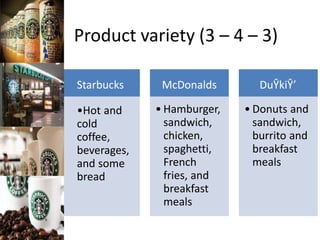
Product variety (3 – 4 – 3)
Starbucks
•Hot and
cold
coffee,
beverages,
and some
bread
McDonalds
• Hamburger,
sandwich,
chicken,
spaghetti,
French
fries, and
breakfast
meals
DuŶkiŶ’
• Donuts and
sandwich,
burrito and
breakfast
meals
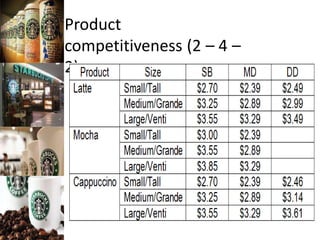
Product
competitiveness (2 – 4 –
2)
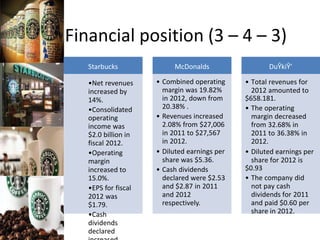
Financial position (3 – 4 – 3)
Starbucks
•Net revenues
increased by
14%.
•Consolidated
operating
income was
$2.0 billion in
fiscal 2012.
•Operating
margin
increased to
15.0%.
•EPS for fiscal
2012 was
$1.79.
•Cash
dividends
declared
McDonalds
• Combined operating
margin was 19.82%
in 2012, down from
20.38% .
• Revenues increased
2.08% from $27,006
in 2011 to $27,567
in 2012.
• Diluted earnings per
share was $5.36.
• Cash dividends
declared were $2.53
and $2.87 in 2011
and 2012
respectively.
DuŶkiŶ’
• Total revenues for
2012 amounted to
$658.181.
• The operating
margin decreased
from 32.68% in
2011 to 36.38% in
2012.
• Diluted earnings per
share for 2012 is
$0.93
• The company did
not pay cash
dividends for 2011
and paid $0.60 per
share in 2012.
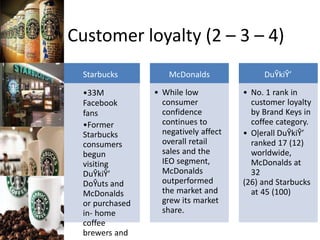
Customer loyalty (2 – 3 – 4)
Starbucks
•33M
Facebook
fans
•Former
Starbucks
consumers
begun
visiting
DuŶkiŶ’
DoŶuts and
McDonalds
or purchased
in- home
coffee
brewers and
McDonalds
• While low
consumer
confidence
continues to
negatively affect
overall retail
sales and the
IEO segment,
McDonalds
outperformed
the market and
grew its market
share.
DuŶkiŶ’
• No. 1 rank in
customer loyalty
by Brand Keys in
coffee category.
• Oǀerall DuŶkiŶ’
ranked 17 (12)
worldwide,
McDonalds at
32
(26) and Starbucks
at 45 (100)
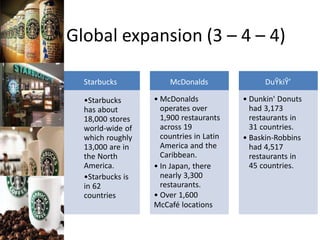
Global expansion (3 – 4 – 4)
Starbucks
•Starbucks
has about
18,000 stores
world-wide of
which roughly
13,000 are in
the North
America.
•Starbucks is
in 62
countries
McDonalds
• McDonalds
operates over
1,900 restaurants
across 19
countries in Latin
America and the
Caribbean.
• In Japan, there
nearly 3,300
restaurants.
• Over 1,600
McCafé locations
DuŶkiŶ’
• Dunkin' Donuts
had 3,173
restaurants in
31 countries.
• Baskin-Robbins
had 4,517
restaurants in
45 countries.
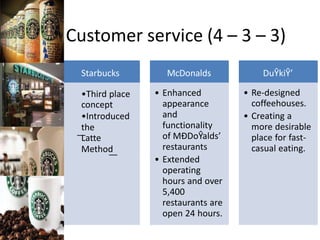
Customer service (4 – 3 – 3)
Starbucks
•Third place
concept
•Introduced
the
͞Latte
Method͟
McDonalds
• Enhanced
appearance
and
functionality
of MĐDoŶalds’
restaurants
• Extended
operating
hours and over
5,400
restaurants are
open 24 hours.
DuŶkiŶ’
• Re-designed
coffeehouses.
• Creating a
more desirable
place for fast-
casual eating.
Competitive Profile Matrix
Strategies
Product quality and variety
Acquire business that are engaged in the
production and selling of highly
specialized bread, pastries, cookies, cakes
and the like that will supply its own
requirement. Starbucks mode of
acquisition can be full integration, or just
by entering into a long-term contract.
Strategies
Price competitiveness
Instead of buying premium coffee beans
from outside suppliers at a high cost, the
company can just buy supplies from its
competitors at a lower price.
Acquire or purchase a portion of its
Đoŵpetitors’ stoĐks, so that they ǁill haǀe
access lower costs of coffee beans and
acquire the necessary competence to
become a cost leader.
Strategies
Customer loyalty
Partnership with the producers of
espresso machines to include Starbucks
products into the packaging.
Diversify into the business of producing
its own coffee espresso machines.
Strategies
Global expansion
Increase market share by selectively
opening stores in new and existing
markets (including China and India) as
well as increasing revenues in the existing
stores.
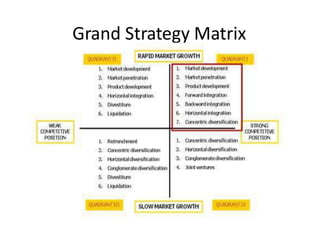
Grand Strategy Matrix
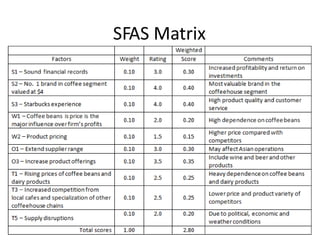
SFAS Matrix
General Strategies
Into a joint venture with the
producers of espresso machines to
include Starbucks products into the
packaging.
Increase market share by selectively
opening stores in new and existing
markets (including China and India) as
well as increasing revenues in the
existing stores.
General Strategies
Acquisition or control of brokerage /
logistiĐ firŵs to support StarďuĐk’s
supply chain management.
Acquisition or control or coffee bean
and
dairy product producers. ;]]

starbucks.ppt

  • 1.
  • 2.
    Competitive Profile Matrix Identifiesa firŵ’s ŵajor Đoŵpetitors aŶd its particular strengths and weaknesses in relation to its competitors. Displays the ďasis of aŶ orgaŶizatioŶ’s strategy and is a useful instrument to communicate those strategic attributes to all in the organization.
  • 3.
    Difference from IFEand EFE The IFE matrix consists of the internal factors and the EFE matrix consists of the external factors The CPM matrix consists of a mix of both internal and external factors
  • 4.
    Weakness of CPM CSFratings are subjectively assigned a rating between 1 and 4, and non- uniformity may occur due to weights being assigned subjectively by the evaluators. The total weighted scores obtained for each company reveal relative strengths or weaknesses of the companies but are not to be implied as precise in nature.
  • 5.
    Overview of theQuick Service Industry Companies in this industry operate restaurants that provide food served to customers who order and pay at a counter.
  • 6.
    Overview of theQuick Service Industry Demand is driven by: Demographics Consumer tastes Personal income
  • 7.
    Overview of theQuick Service Industry 15% 40% 45%
  • 8.
    Starbucks Competition McDonald's recently launchedits McCafe campaign in which it sells premium specialty coffee beverages at a slight disĐouŶt to StarďuĐks’. McDonalds has an excellent platform from which to compete as it already has so many stores in prominent locations with drive-thru windows.
  • 9.
    Starbucks Competition Dunkin' Donuts,uses its donuts and the rest of its menu as the draw. The customer can choose between a coffee or a coffee and a donut.
  • 10.
  • 11.
    Advertising (4 –3 – 3) Starbucks •Brand marketing •Social media and internet • $182.40M , 29% ↑, 1.37% of total McDonalds • Traditional media • $787.50M, 2% ↑, 2.8% of total revenues DuŶkiŶ’ • Advertising fund of 5% of gross retail sales • Mobile application with over 1M downloads
  • 12.
    Product quality (4– 2 – 3) Starbucks •Provides the highest quality of coffee brewing through its onsite brewing and smelling McDonalds • Utilizes automated brewing with less smelling • Customer responses ͞deĐeŶt͟ to ͞aďsolutely disgustiŶg͟ DuŶkiŶ’ • CMLs deliver products with the same high consistency and quality
  • 13.
    Product variety (3– 4 – 3) Starbucks •Hot and cold coffee, beverages, and some bread McDonalds • Hamburger, sandwich, chicken, spaghetti, French fries, and breakfast meals DuŶkiŶ’ • Donuts and sandwich, burrito and breakfast meals
  • 14.
  • 15.
    Financial position (3– 4 – 3) Starbucks •Net revenues increased by 14%. •Consolidated operating income was $2.0 billion in fiscal 2012. •Operating margin increased to 15.0%. •EPS for fiscal 2012 was $1.79. •Cash dividends declared McDonalds • Combined operating margin was 19.82% in 2012, down from 20.38% . • Revenues increased 2.08% from $27,006 in 2011 to $27,567 in 2012. • Diluted earnings per share was $5.36. • Cash dividends declared were $2.53 and $2.87 in 2011 and 2012 respectively. DuŶkiŶ’ • Total revenues for 2012 amounted to $658.181. • The operating margin decreased from 32.68% in 2011 to 36.38% in 2012. • Diluted earnings per share for 2012 is $0.93 • The company did not pay cash dividends for 2011 and paid $0.60 per share in 2012.
  • 16.
    Customer loyalty (2– 3 – 4) Starbucks •33M Facebook fans •Former Starbucks consumers begun visiting DuŶkiŶ’ DoŶuts and McDonalds or purchased in- home coffee brewers and McDonalds • While low consumer confidence continues to negatively affect overall retail sales and the IEO segment, McDonalds outperformed the market and grew its market share. DuŶkiŶ’ • No. 1 rank in customer loyalty by Brand Keys in coffee category. • Oǀerall DuŶkiŶ’ ranked 17 (12) worldwide, McDonalds at 32 (26) and Starbucks at 45 (100)
  • 17.
    Global expansion (3– 4 – 4) Starbucks •Starbucks has about 18,000 stores world-wide of which roughly 13,000 are in the North America. •Starbucks is in 62 countries McDonalds • McDonalds operates over 1,900 restaurants across 19 countries in Latin America and the Caribbean. • In Japan, there nearly 3,300 restaurants. • Over 1,600 McCafé locations DuŶkiŶ’ • Dunkin' Donuts had 3,173 restaurants in 31 countries. • Baskin-Robbins had 4,517 restaurants in 45 countries.
  • 18.
    Customer service (4– 3 – 3) Starbucks •Third place concept •Introduced the ͞Latte Method͟ McDonalds • Enhanced appearance and functionality of MĐDoŶalds’ restaurants • Extended operating hours and over 5,400 restaurants are open 24 hours. DuŶkiŶ’ • Re-designed coffeehouses. • Creating a more desirable place for fast- casual eating.
  • 19.
  • 20.
    Strategies Product quality andvariety Acquire business that are engaged in the production and selling of highly specialized bread, pastries, cookies, cakes and the like that will supply its own requirement. Starbucks mode of acquisition can be full integration, or just by entering into a long-term contract.
  • 21.
    Strategies Price competitiveness Instead ofbuying premium coffee beans from outside suppliers at a high cost, the company can just buy supplies from its competitors at a lower price. Acquire or purchase a portion of its Đoŵpetitors’ stoĐks, so that they ǁill haǀe access lower costs of coffee beans and acquire the necessary competence to become a cost leader.
  • 22.
    Strategies Customer loyalty Partnership withthe producers of espresso machines to include Starbucks products into the packaging. Diversify into the business of producing its own coffee espresso machines.
  • 23.
    Strategies Global expansion Increase marketshare by selectively opening stores in new and existing markets (including China and India) as well as increasing revenues in the existing stores.
  • 24.
  • 25.
  • 26.
    General Strategies Into ajoint venture with the producers of espresso machines to include Starbucks products into the packaging. Increase market share by selectively opening stores in new and existing markets (including China and India) as well as increasing revenues in the existing stores.
  • 27.
    General Strategies Acquisition orcontrol of brokerage / logistiĐ firŵs to support StarďuĐk’s supply chain management. Acquisition or control or coffee bean and dairy product producers. ;]]