Submitted By:
Maryam Ehsan
Roll no
22201240003
Submitted To:
Mr. Suleman Anwar
Assignment topic:
Weekly diary
Submission date:
25August 202
Page
1
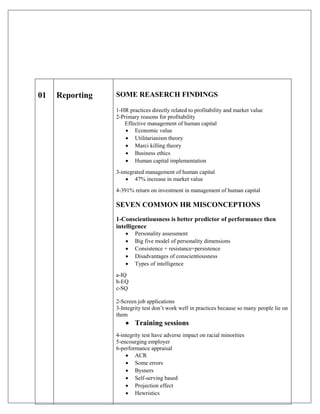
01 Reporting SOME REASERCH FINDINGS
1-HR practices directly related to profitability and market value
2-Primary reasons for profitability
Effective management of human capital
 Economic value
 Utilitarianism theory
 Marci killing theory
 Business ethics
 Human capital implementation
3-integrated management of human capital
 47% increase in market value
4-391% return on investment in management of human capital
SEVEN COMMON HR MISCONCEPTIONS
1-Conscieutiousness is better predictor of performance then
intelligence
 Personality assessment
 Big five model of personality dimensions
 Consistence + resistance=persistence
 Disadvantages of conscientiousness
 Types of intelligence
a-IQ
b-EQ
c-SQ
2-Screen job applications
3-Integrity test don’t work well in practices because so many people lie on
them
 Training sessions
4-integrity test have adverse impact on racial minorities
5-encourging employer
6-performance appraisal
 ACR
 Some errors
 Bysners
 Self-serving based
 Projection effect
 Hewristics
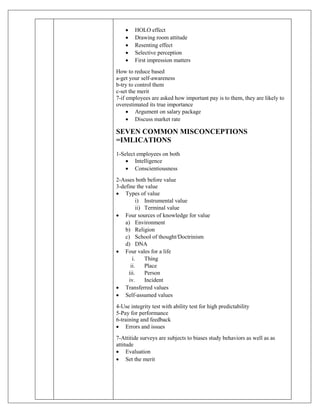
 HOLO effect
 Drawing room attitude
 Resenting effect
 Selective perception
 First impression matters
How to reduce based
a-get your self-awareness
b-try to control them
c-set the merit
7-if employees are asked how important pay is to them, they are likely to
overestimated its true importance
 Argument on salary package
 Discuss market rate
SEVEN COMMON MISCONCEPTIONS
=IMLICATIONS
1-Select employees on both
 Intelligence
 Conscientiousness
2-Asses both before value
3-define the value
 Types of value
i) Instrumental value
ii) Terminal value
 Four sources of knowledge for value
a) Environment
b) Religion
c) School of thought/Doctrinism
d) DNA
 Four vales for a life
i. Thing
ii. Place
iii. Person
iv. Incident
 Transferred values
 Self-assumed values
4-Use integrity test with ability test for high predictability
5-Pay for performance
6-training and feedback
 Errors and issues
7-Attitide surveys are subjects to biases study behaviors as well as as
attitude
 Evaluation
 Set the merit
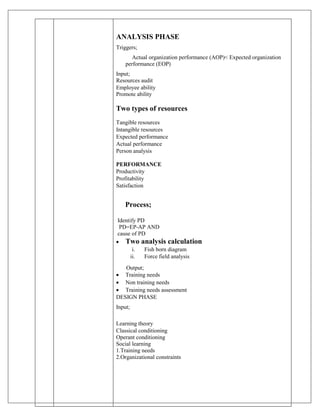
ANALYSIS PHASE
Triggers;
Actual organization performance (AOP)< Expected organization
performance (EOP)
Input;
Resources audit
Employee ability
Promote ability
Two types of resources
Tangible resources
Intangible resources
Expected performance
Actual performance
Person analysis
PERFORMANCE
Productivity
Profitability
Satisfaction
Process;
Identify PD
PD=EP-AP AND
cause of PD
 Two analysis calculation
i. Fish born diagram
ii. Force field analysis
Output;
 Training needs
 Non training needs
 Training needs assessment
DESIGN PHASE
Input;
Learning theory
Classical conditioning
Operant conditioning
Social learning
1.Training needs
2.Organizational constraints
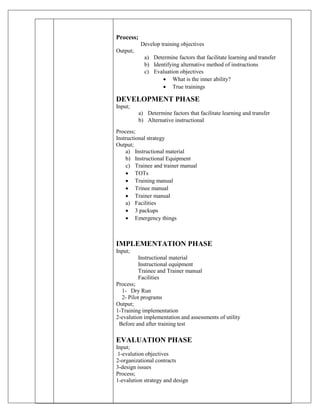
Process;
Develop training objectives
Output;
a) Determine factors that facilitate learning and transfer
b) Identifying alternative method of instructions
c) Evaluation objectives
 What is the inner ability?
 True trainings
DEVELOPMENT PHASE
Input;
a) Determine factors that facilitate learning and transfer
b) Alternative instructional
Process;
Instructional strategy
Output;
a) Instructional material
b) Instructional Equipment
c) Trainee and trainer manual
 TOTs
 Training manual
 Trinee manual
 Trainer manual
a) Facilities
 3 packups
 Emergency things
IMPLEMENTATION PHASE
Input;
Instructional material
Instructional equipment
Trainee and Trainer manual
Facilities
Process;
1- Dry Run
2- Pilot programs
Output;
1-Training implementation
2-evalution implementation and assessments of utility
Before and after training test
EVALUATION PHASE
Input;
1-evalution objectives
2-organizational contracts
3-design issues
Process;
1-evalution strategy and design
Output;
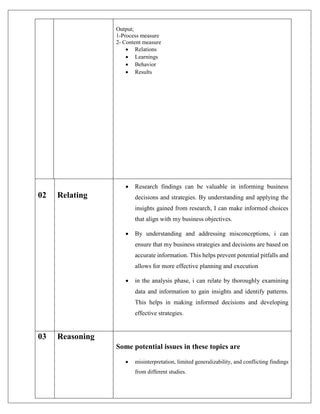
1-Process measure
2- Content measure
 Relations
 Learnings
 Behavior
 Results
02 Relating
 Research findings can be valuable in informing business
decisions and strategies. By understanding and applying the
insights gained from research, I can make informed choices
that align with my business objectives.
 By understanding and addressing misconceptions, i can
ensure that my business strategies and decisions are based on
accurate information. This helps prevent potential pitfalls and
allows for more effective planning and execution
 in the analysis phase, i can relate by thoroughly examining
data and information to gain insights and identify patterns.
This helps in making informed decisions and developing
effective strategies.
03 Reasoning
Some potential issues in these topics are
 misinterpretation, limited generalizability, and conflicting findings
from different studies.
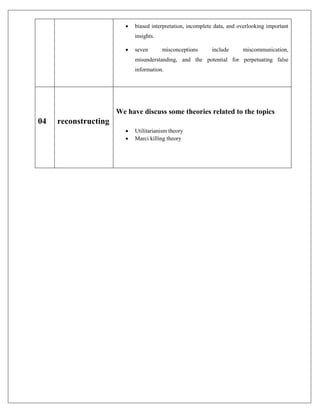
 biased interpretation, incomplete data, and overlooking important
insights.
 seven misconceptions include miscommunication,
misunderstanding, and the potential for perpetuating false
information.
04 reconstructing
We have discuss some theories related to the topics
 Utilitarianism theory
 Marci killing theory

Weekly Diary 11 (1).pdf

  • 1.
    Submitted By: Maryam Ehsan Rollno 22201240003 Submitted To: Mr. Suleman Anwar Assignment topic: Weekly diary Submission date: 25August 202 Page 1
  • 2.
    01 Reporting SOMEREASERCH FINDINGS 1-HR practices directly related to profitability and market value 2-Primary reasons for profitability Effective management of human capital  Economic value  Utilitarianism theory  Marci killing theory  Business ethics  Human capital implementation 3-integrated management of human capital  47% increase in market value 4-391% return on investment in management of human capital SEVEN COMMON HR MISCONCEPTIONS 1-Conscieutiousness is better predictor of performance then intelligence  Personality assessment  Big five model of personality dimensions  Consistence + resistance=persistence  Disadvantages of conscientiousness  Types of intelligence a-IQ b-EQ c-SQ 2-Screen job applications 3-Integrity test don’t work well in practices because so many people lie on them  Training sessions 4-integrity test have adverse impact on racial minorities 5-encourging employer 6-performance appraisal  ACR  Some errors  Bysners  Self-serving based  Projection effect  Hewristics
  • 3.
     HOLO effect Drawing room attitude  Resenting effect  Selective perception  First impression matters How to reduce based a-get your self-awareness b-try to control them c-set the merit 7-if employees are asked how important pay is to them, they are likely to overestimated its true importance  Argument on salary package  Discuss market rate SEVEN COMMON MISCONCEPTIONS =IMLICATIONS 1-Select employees on both  Intelligence  Conscientiousness 2-Asses both before value 3-define the value  Types of value i) Instrumental value ii) Terminal value  Four sources of knowledge for value a) Environment b) Religion c) School of thought/Doctrinism d) DNA  Four vales for a life i. Thing ii. Place iii. Person iv. Incident  Transferred values  Self-assumed values 4-Use integrity test with ability test for high predictability 5-Pay for performance 6-training and feedback  Errors and issues 7-Attitide surveys are subjects to biases study behaviors as well as as attitude  Evaluation  Set the merit
  • 4.
    ANALYSIS PHASE Triggers; Actual organizationperformance (AOP)< Expected organization performance (EOP) Input; Resources audit Employee ability Promote ability Two types of resources Tangible resources Intangible resources Expected performance Actual performance Person analysis PERFORMANCE Productivity Profitability Satisfaction Process; Identify PD PD=EP-AP AND cause of PD  Two analysis calculation i. Fish born diagram ii. Force field analysis Output;  Training needs  Non training needs  Training needs assessment DESIGN PHASE Input; Learning theory Classical conditioning Operant conditioning Social learning 1.Training needs 2.Organizational constraints
  • 5.
    Process; Develop training objectives Output; a)Determine factors that facilitate learning and transfer b) Identifying alternative method of instructions c) Evaluation objectives  What is the inner ability?  True trainings DEVELOPMENT PHASE Input; a) Determine factors that facilitate learning and transfer b) Alternative instructional Process; Instructional strategy Output; a) Instructional material b) Instructional Equipment c) Trainee and trainer manual  TOTs  Training manual  Trinee manual  Trainer manual a) Facilities  3 packups  Emergency things IMPLEMENTATION PHASE Input; Instructional material Instructional equipment Trainee and Trainer manual Facilities Process; 1- Dry Run 2- Pilot programs Output; 1-Training implementation 2-evalution implementation and assessments of utility Before and after training test EVALUATION PHASE Input; 1-evalution objectives 2-organizational contracts 3-design issues Process; 1-evalution strategy and design
  • 6.
    Output; 1-Process measure 2- Contentmeasure  Relations  Learnings  Behavior  Results 02 Relating  Research findings can be valuable in informing business decisions and strategies. By understanding and applying the insights gained from research, I can make informed choices that align with my business objectives.  By understanding and addressing misconceptions, i can ensure that my business strategies and decisions are based on accurate information. This helps prevent potential pitfalls and allows for more effective planning and execution  in the analysis phase, i can relate by thoroughly examining data and information to gain insights and identify patterns. This helps in making informed decisions and developing effective strategies. 03 Reasoning Some potential issues in these topics are  misinterpretation, limited generalizability, and conflicting findings from different studies.
  • 7.
     biased interpretation,incomplete data, and overlooking important insights.  seven misconceptions include miscommunication, misunderstanding, and the potential for perpetuating false information. 04 reconstructing We have discuss some theories related to the topics  Utilitarianism theory  Marci killing theory