carbon
neon
iron
nitrogen
silicon
magnesium
sulfur
argon
calcium
nickel
aluminum
sodium
chromium
manganese
phosphorus
titanium
potassium
cobalt
vanadium
chlorine
fluorine
zinc
germanium
copper
zirconium
strontium
krypton
selenium
scandium
xenon
rubidium
neodymium
lead
gallium
cerium
barium
tellurium
arsenic
yttrium
bromine
lithium
samarium
platinum
molybdenum
tin
ruthenium
osmium
ytterbium
praseodymium
palladium
niobium
lanthanum
iridium
gadolinium
erbium
dysprosium
cadmium
mercury
iodine
boron
beryllium
cesium
hafnium
bismuth
silver
rhodium
gold
tungsten
thallium
terbium
holmium
europium
thorium
antimony
indium
uranium
rhenium
thulium
lutetium
tantalum
0.5
0.13
0.11
0.1
0.07
0.06
0.05
0.02
0.007
0.006
0.005
0.002
0.0015
8×10⁻⁴
7×10⁻⁴
3×10⁻⁴
3×10⁻⁴
3×10⁻⁴
1×10⁻⁴
1×10⁻⁴
4×10⁻⁵
3×10⁻⁵
2×10⁻⁵
6×10⁻⁶
5×10⁻⁶
4×10⁻⁶
4×10⁻⁶
3×10⁻⁶
3×10⁻⁶
1×10⁻⁶
1×10⁻⁶
1×10⁻⁶
1×10⁻⁶
1×10⁻⁶
1×10⁻⁶
1×10⁻⁶
9×10⁻⁷
8×10⁻⁷
7×10⁻⁷
7×10⁻⁷
6×10⁻⁷
5×10⁻⁷
5×10⁻⁷
5×10⁻⁷
4×10⁻⁷
4×10⁻⁷
3×10⁻⁷
2×10⁻⁷
2×10⁻⁷
2×10⁻⁷
2×10⁻⁷
2×10⁻⁷
2×10⁻⁷
2×10⁻⁷
2×10⁻⁷
2×10⁻⁷
2×10⁻⁷
1×10⁻⁷
1×10⁻⁷
1×10⁻⁷
1×10⁻⁷
8×10⁻⁸
7×10⁻⁸
7×10⁻⁸
6×10⁻⁸
6×10⁻⁸
6×10⁻⁸
5×10⁻⁸
5×10⁻⁸
5×10⁻⁸
5×10⁻⁸
5×10⁻⁸
4×10⁻⁸
4×10⁻⁸
3×10⁻⁸
2×10⁻⁸
2×10⁻⁸
1×10⁻⁸
1×10⁻⁸
8×10⁻⁹
IMAGE CREDIT
NASA, ESA, and the Hubble Heritage Team (STScI/AURA)-ESA/Hubble Collaboration
DATA CREDIT
© Wolfram Alpha, www.wolframalpha.com
100% 75% 50% 25% 0%
ELEMENTS < 1%
ELEMENTS = 0% OR UNKNOWN
ELEMENTS > 1% PERCENTAGE OF ABUNDANCE LOCATION ON THE PERIODIC TABLE
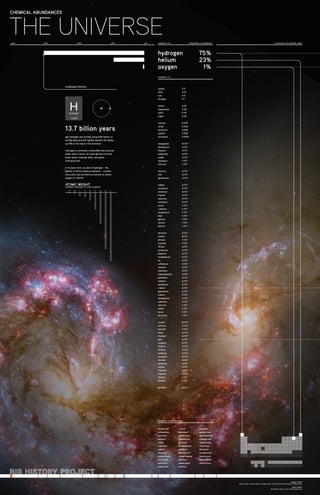
hydrogen
helium
oxygen
75%
23%
1%
THE UNIVERSE
CHEMICAL ABUNDANCES
technetium
promethium
polonium
astatine
radon
francium
radium
actinium
protactinium
neptunium
plutonium
americium
curium
berkelium
californium
einsteinium
fermium
mendelevium
nobelium
lawrencium
rutherfordium
dubnium
seaborgium
bohrium
hassium
meitnerium
darmstadtium
roentgenium
copernicium
ununtrium
flerovium
ununpentium
livermorium
ununseptium
ununoctium
HYDROGEN PROFILE
ATOMIC WEIGHT
HYDROGEN COMPARED TO OTHER ELEMENTS
H C O Al Fe Ag Au U
ago hydrogen was formed, along with helium, in
the Big Bang and this lightest element still makes
up 75% of the mass of the Universe.
Hydrogen is extremely combustible and produces
water when it burns. Its name derives from the
Greek hydro, meaning water, and genos,
indicating birth.
In its basic form, an atom of hydrogen - the
lightest of all the chemical elements - contains
one proton and one electron and has an atomic
weight of 1.00794.
Hhydrogen
1
1.0079
13.7 billion years
He

The Chemical Abundances of the Universe Infographic