The laboratory methodsused to isolate and identify microorganism
include :
1- Examining the microorganism microscopy .
2- Culturing (growing) the organisms in dishes or tubes containing the nutrients
required for microbial growth .
3- Identifying organisms by their biochemical reaction based on the enzymes and
metabolites they product .
4- Animal inculcation
5- In addition , there is serological test used for microbial diseases diagnosis .
3.
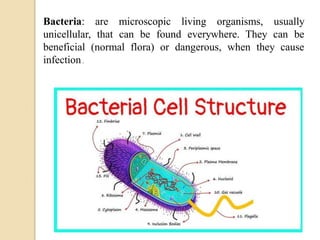
Bacteria: are microscopicliving organisms, usually
unicellular, that can be found everywhere. They can be
beneficial (normal flora) or dangerous, when they cause
infection .
4.
They are classifiedby their
Morphology, staining reaction, Cultural characteristic, Biochemical
reaction, Antigenic structure and increasing by their genetic composition
using specialized molecular biology techniques.
B. Classification of Bacteria depend Gram reaction:
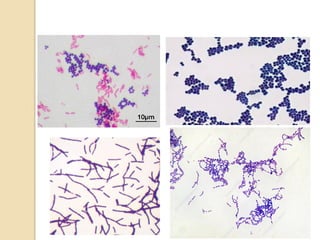
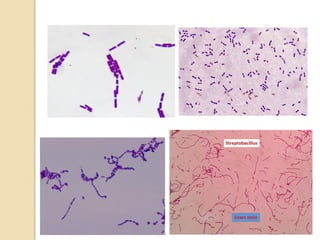
1. Gram positive: gram positive cocci & gram positive bacilli.
2. Gram negative: gram negative cocci & gram negative bacilli.
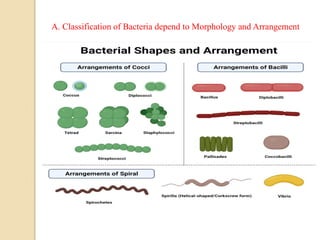
A- Classification of bacteria depend in morphology :
Cocci , bacilli , vibrio , spirochete , spiral
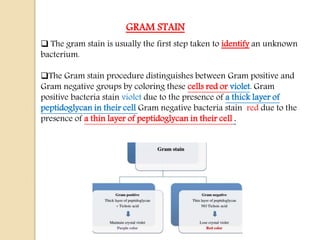
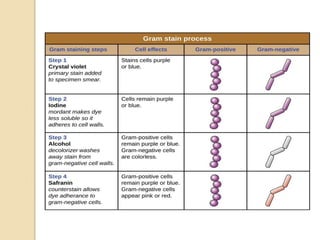
The gramstain is usually the first step taken to identify an unknown
bacterium.
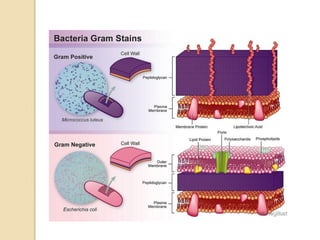
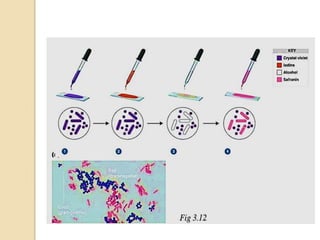
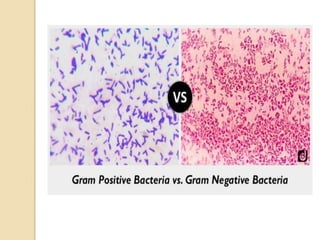
The Gram stain procedure distinguishes between Gram positive and
Gram negative groups by coloring these cells red or violet. Gram
positive bacteria stain violet due to the presence of a thick layer of
peptidoglycan in their cell Gram negative bacteria stain red due to the
presence of a thin layer of peptidoglycan in their cell .
GRAM STAIN
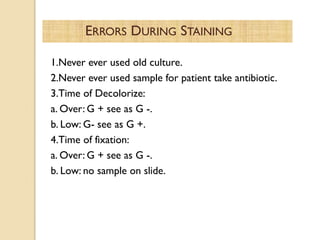
ERRORS DURING STAINING
1.Neverever used old culture.
2.Never ever used sample for patient take antibiotic.
3.Time of Decolorize:
a. Over: G + see as G -.
b. Low: G- see as G +.
4.Time of fixation:
a. Over: G + see as G -.
b. Low: no sample on slide.
16.
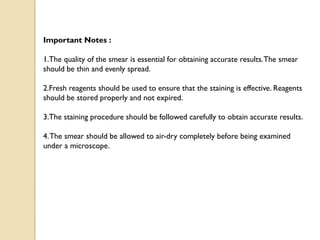
Important Notes :
1.Thequality of the smear is essential for obtaining accurate results.The smear
should be thin and evenly spread.
2.Fresh reagents should be used to ensure that the staining is effective. Reagents
should be stored properly and not expired.
3.The staining procedure should be followed carefully to obtain accurate results.
4.The smear should be allowed to air-dry completely before being examined
under a microscope.