Evolving Financial Supervision:
Familiar Faces in a Brave New World
Lecture Notes
Barbara C. Matthews
Stanford University
29 January 2018
Overview
• New Horizons in Financial Sector Supervision
• How is intermediation regulated? Let me count the ways….
• To regulate or not to regulate? This is NOT the FinTech policy question
• CryptoCurrencies – The brave new world
• International Regulatory Harmonization – have we peaked?
• Macroprudential Regulation – where is the boundary with monetary policy?
• Macroprudential Regulation – why the nation-state cannot yet die
(c) 2018 BCM International Regulatory Analytics LLC * all rights reserved
New Horizons
in
Financial Sector
Policy
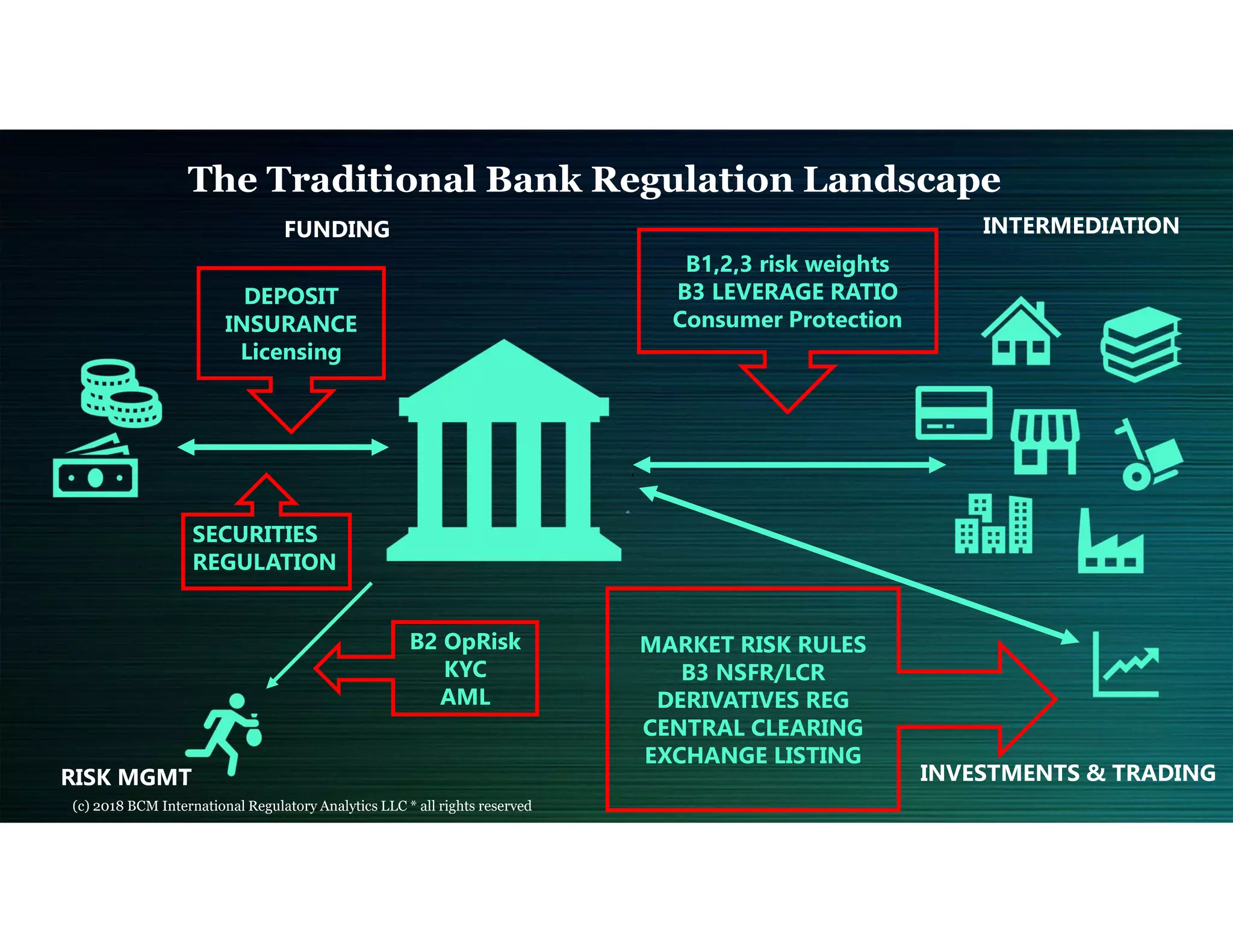
The Traditional Bank Regulation Landscape
FUNDING INTERMEDIATION
B1,2,3 risk weights
B3 LEVERAGE RATIO
Consumer Protection
INVESTMENTS & TRADING
DEPOSIT
INSURANCE
Licensing
SECURITIES
REGULATION
RISK MGMT
MARKET RISK RULES
B3 NSFR/LCR
DERIVATIVES REG
CENTRAL CLEARING
EXCHANGE LISTING
B2 OpRisk
KYC
AML
(c) 2018 BCM International Regulatory Analytics LLC * all rights reserved
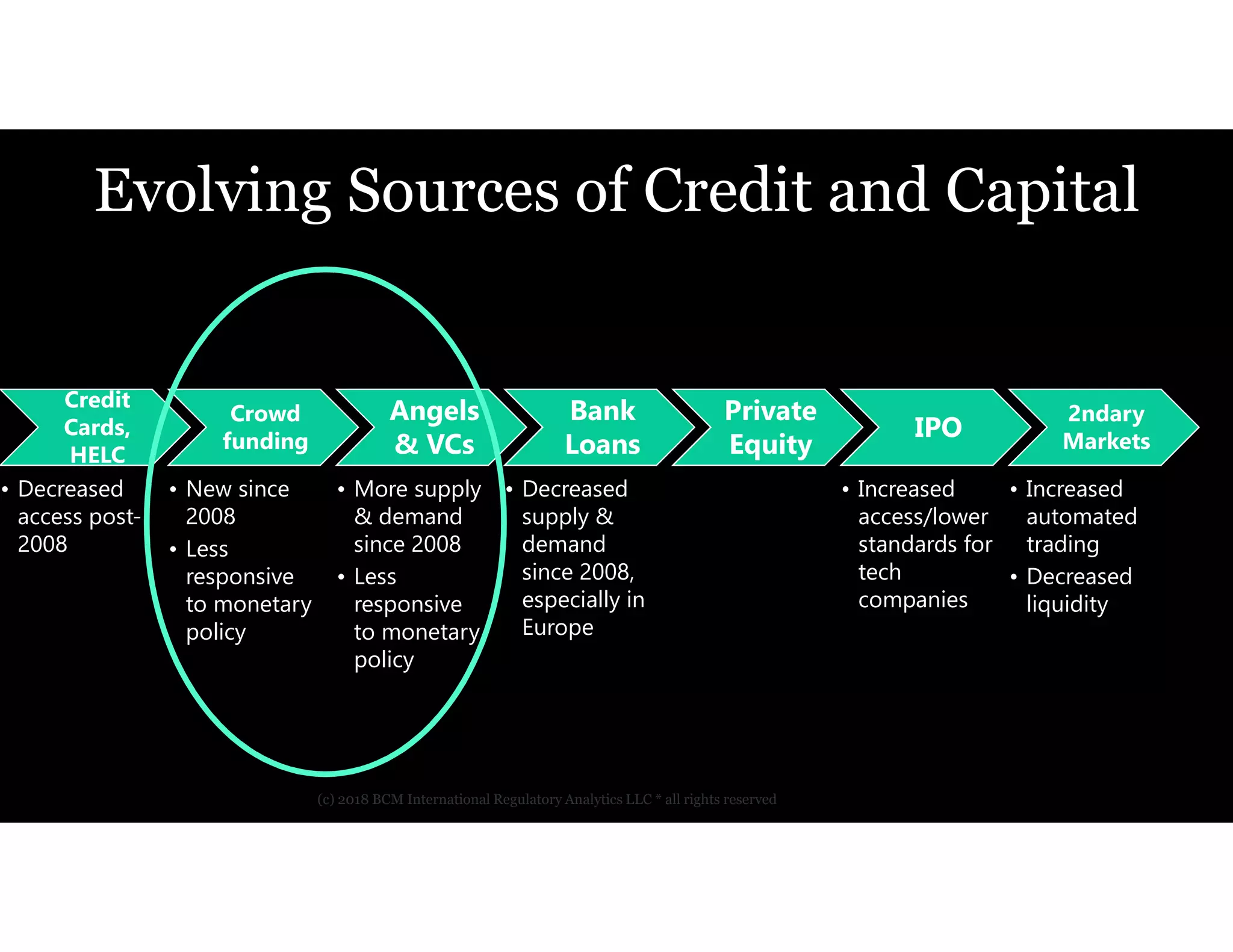
Evolving Sources of Credit and Capital
Credit
Cards,
HELC
• Decreased
access post-
2008
Crowd
funding
• New since
2008
• Less
responsive
to monetary
policy
Angels
& VCs
• More supply
& demand
since 2008
• Less
responsive
to monetary
policy
Bank
Loans
• Decreased
supply &
demand
since 2008,
especially in
Europe
Private
Equity
IPO
• Increased
access/lower
standards for
tech
companies
2ndary
Markets
• Increased
automated
trading
• Decreased
liquidity
(c) 2018 BCM International Regulatory Analytics LLC * all rights reserved
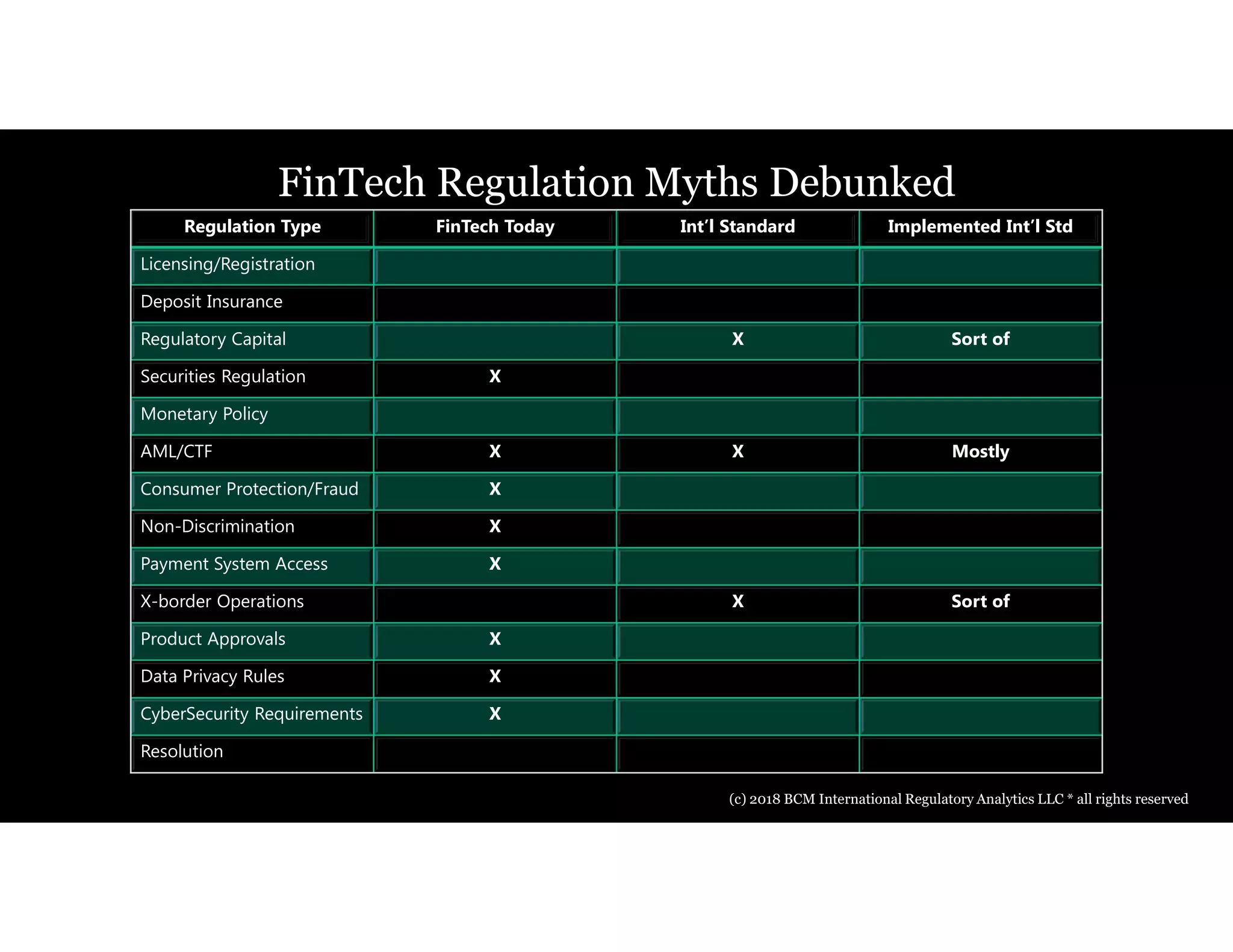
FinTech Regulation Myths Debunked
Regulation Type FinTech Today Int’l Standard Implemented Int’l Std
Licensing/Registration
Deposit Insurance
Regulatory Capital X Sort of
Securities Regulation X
Monetary Policy
AML/CTF X X Mostly
Consumer Protection/Fraud X
Non-Discrimination X
Payment System Access X
X-border Operations X Sort of
Product Approvals X
Data Privacy Rules X
CyberSecurity Requirements X
Resolution
(c) 2018 BCM International Regulatory Analytics LLC * all rights reserved
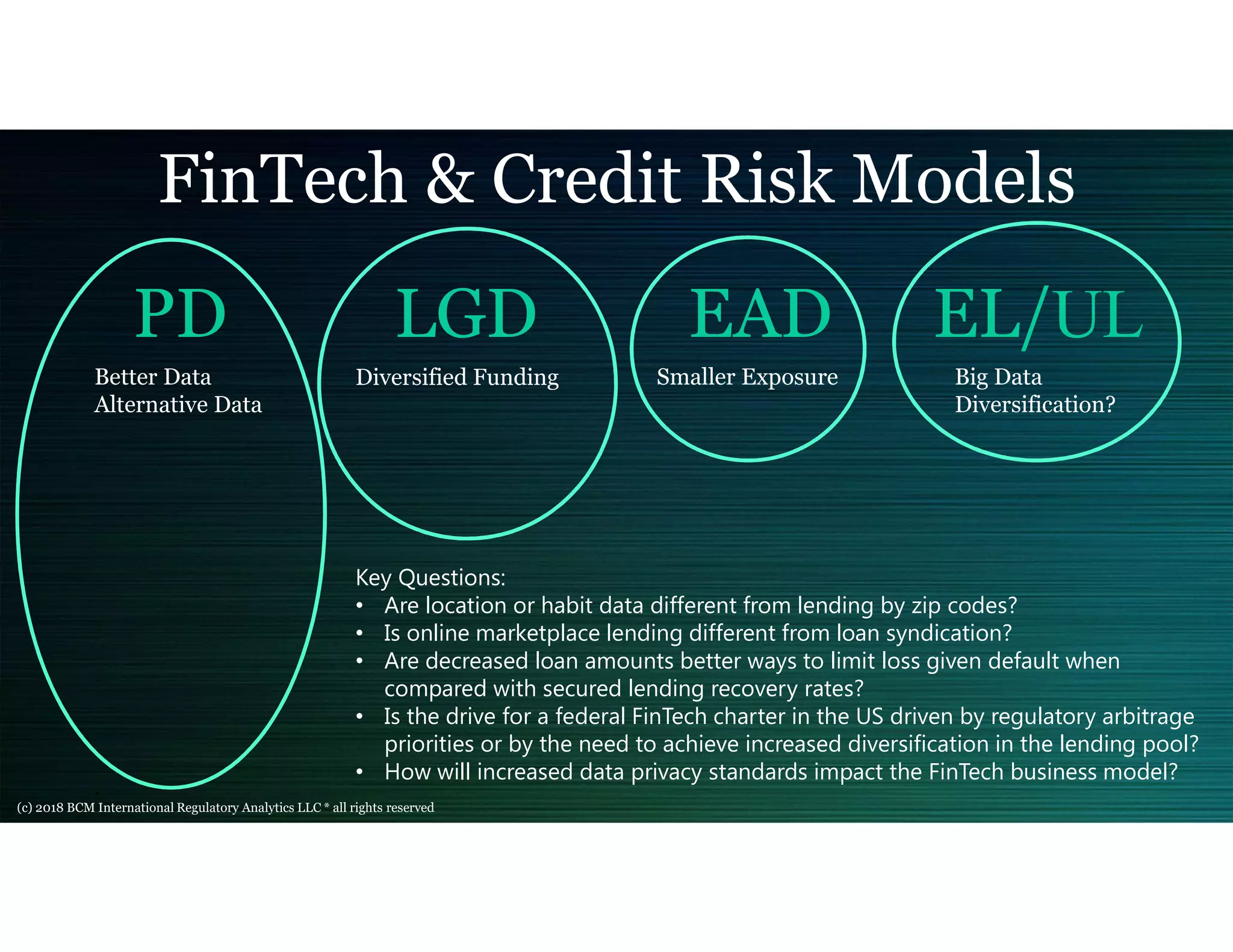
PD LGD EAD EL/UL
FinTech & Credit Risk Models
Better Data
Alternative Data
Diversified Funding Smaller Exposure
Key Questions:
• Are location or habit data different from lending by zip codes?
• Is online marketplace lending different from loan syndication?
• Are decreased loan amounts better ways to limit loss given default when
compared with secured lending recovery rates?
• Is the drive for a federal FinTech charter in the US driven by regulatory arbitrage
priorities or by the need to achieve increased diversification in the lending pool?
• How will increased data privacy standards impact the FinTech business model?
Big Data
Diversification?
(c) 2018 BCM International Regulatory Analytics LLC * all rights reserved
The Limits of
International
Regulatory
Harmonization
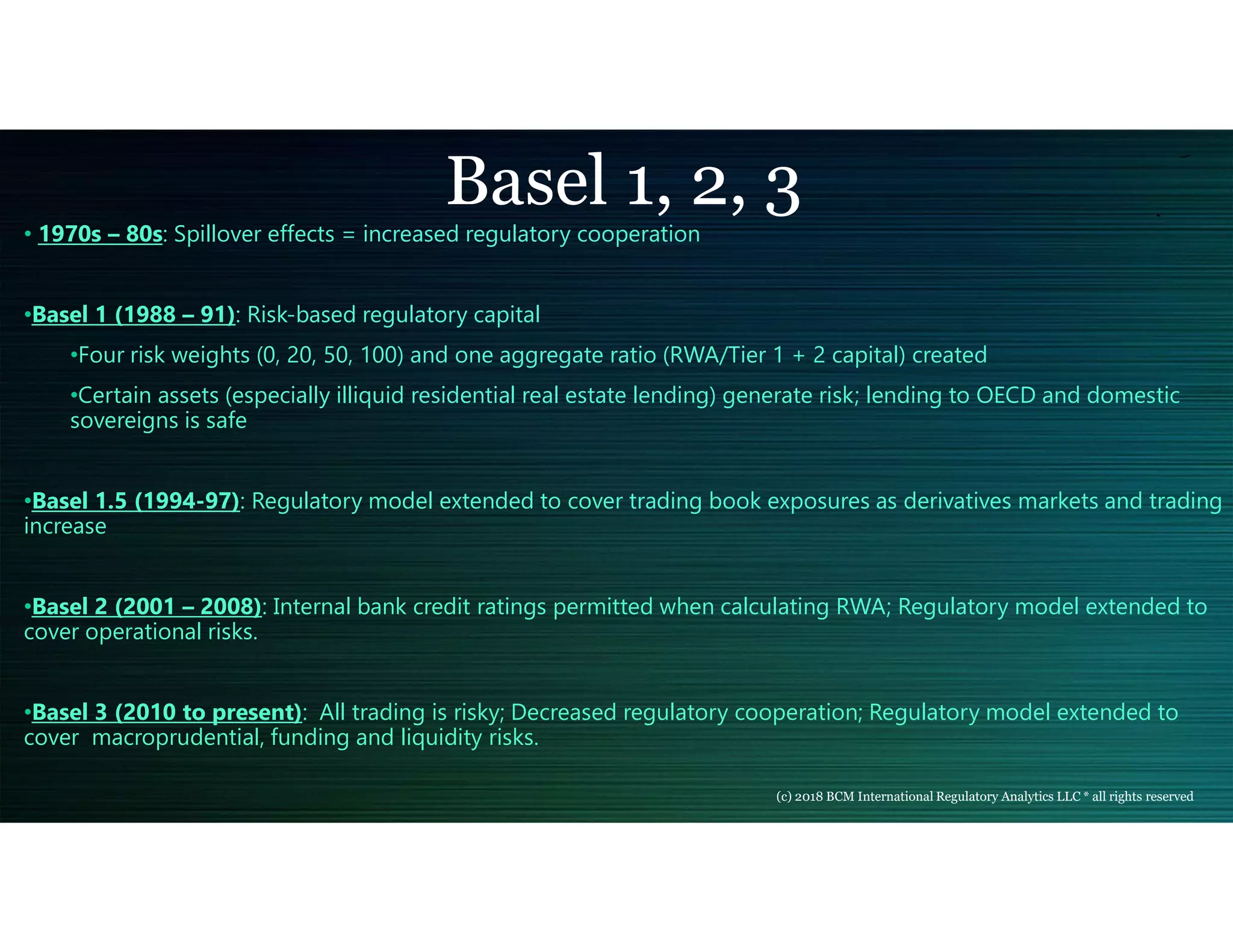
Basel 1, 2, 3
• 1970s – 80s: Spillover effects = increased regulatory cooperation
•Basel 1 (1988 – 91): Risk-based regulatory capital
•Four risk weights (0, 20, 50, 100) and one aggregate ratio (RWA/Tier 1 + 2 capital) created
•Certain assets (especially illiquid residential real estate lending) generate risk; lending to OECD and domestic
sovereigns is safe
•Basel 1.5 (1994-97): Regulatory model extended to cover trading book exposures as derivatives markets and trading
increase
•Basel 2 (2001 – 2008): Internal bank credit ratings permitted when calculating RWA; Regulatory model extended to
cover operational risks.
•Basel 3 (2010 to present): All trading is risky; Decreased regulatory cooperation; Regulatory model extended to
cover macroprudential, funding and liquidity risks.
(c) 2018 BCM International Regulatory Analytics LLC * all rights reserved
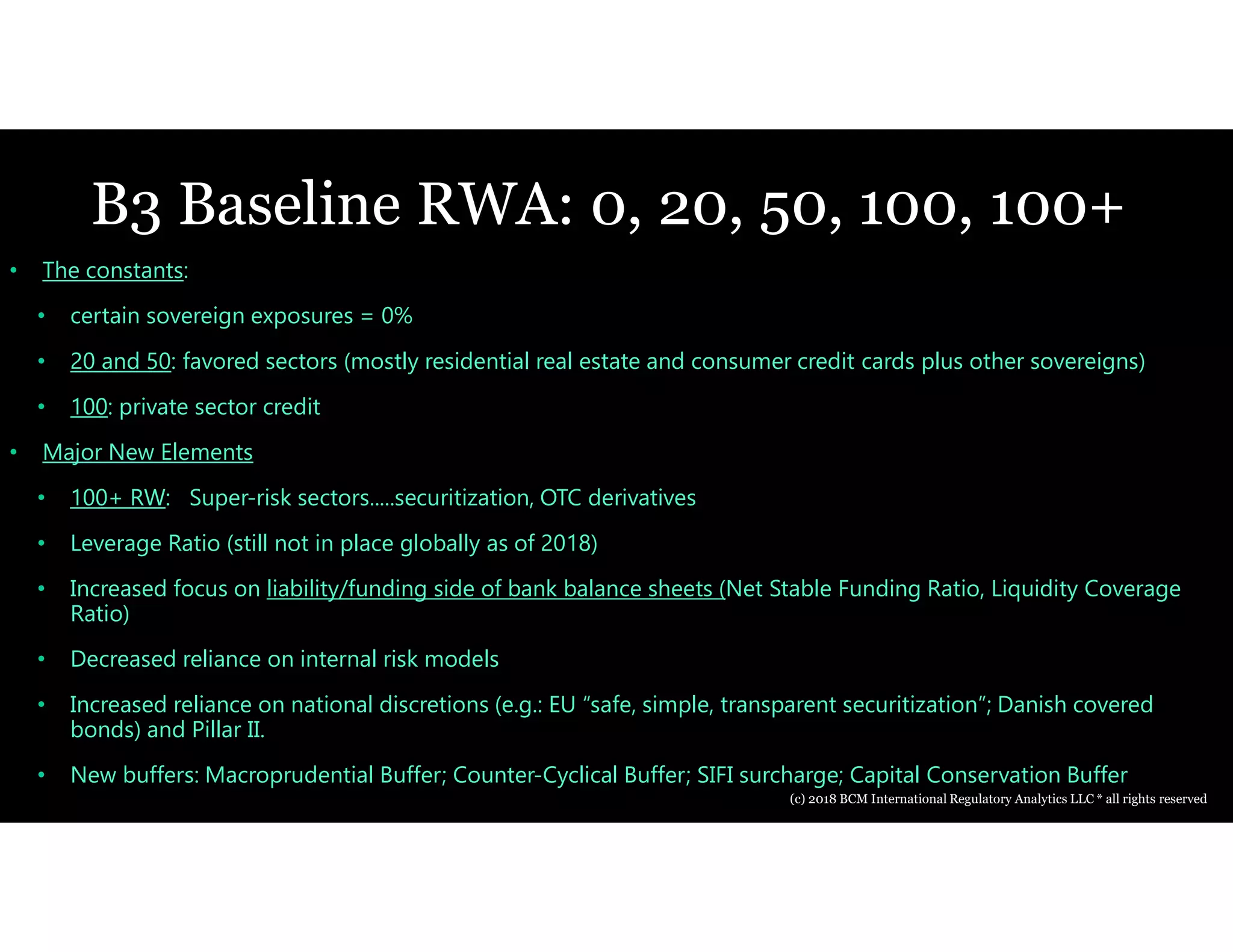
B3 Baseline RWA: 0, 20, 50, 100, 100+
• The constants:
• certain sovereign exposures = 0%
• 20 and 50: favored sectors (mostly residential real estate and consumer credit cards plus other sovereigns)
• 100: private sector credit
• Major New Elements
• 100+ RW: Super-risk sectors.....securitization, OTC derivatives
• Leverage Ratio (still not in place globally as of 2018)
• Increased focus on liability/funding side of bank balance sheets (Net Stable Funding Ratio, Liquidity Coverage
Ratio)
• Decreased reliance on internal risk models
• Increased reliance on national discretions (e.g.: EU “safe, simple, transparent securitization”; Danish covered
bonds) and Pillar II.
• New buffers: Macroprudential Buffer; Counter-Cyclical Buffer; SIFI surcharge; Capital Conservation Buffer
(c) 2018 BCM International Regulatory Analytics LLC * all rights reserved
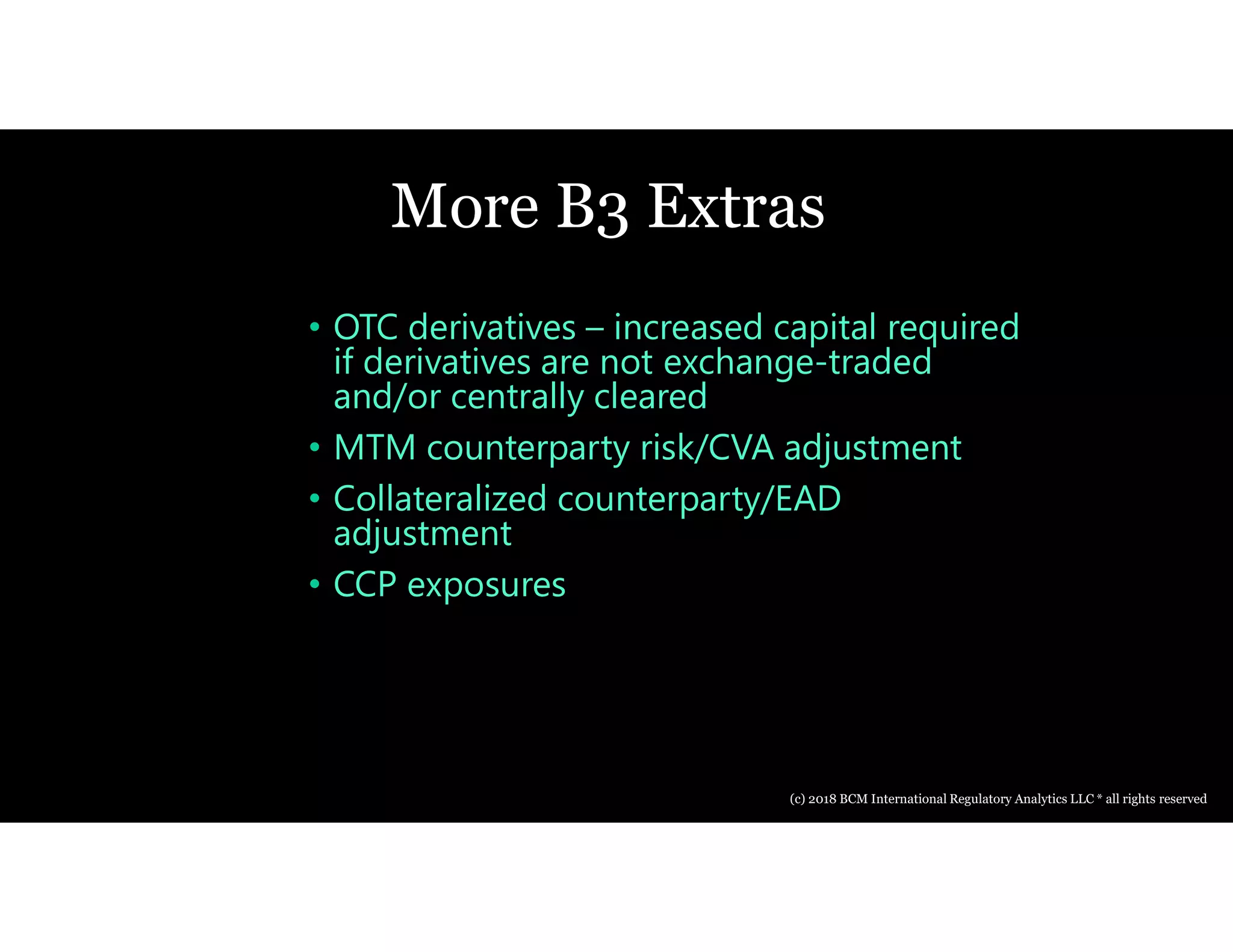
More B3 Extras
• OTC derivatives – increased capital required
if derivatives are not exchange-traded
and/or centrally cleared
• MTM counterparty risk/CVA adjustment
• Collateralized counterparty/EAD
adjustment
• CCP exposures
(c) 2018 BCM International Regulatory Analytics LLC * all rights reserved
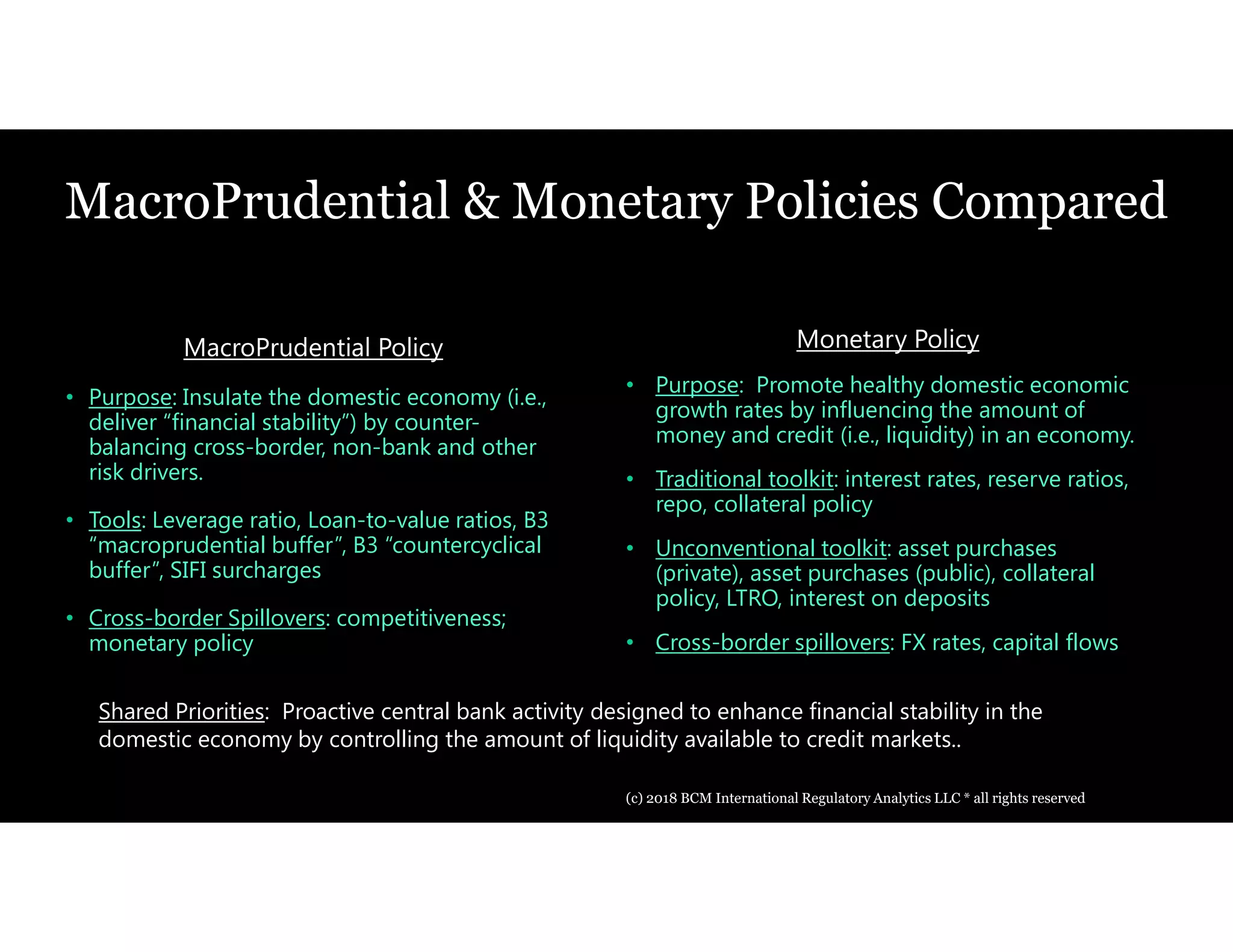
MacroPrudential & Monetary Policies Compared
MacroPrudential Policy
• Purpose: Insulate the domestic economy (i.e.,
deliver “financial stability”) by counter-
balancing cross-border, non-bank and other
risk drivers.
• Tools: Leverage ratio, Loan-to-value ratios, B3
“macroprudential buffer”, B3 “countercyclical
buffer”, SIFI surcharges
• Cross-border Spillovers: competitiveness;
monetary policy
Monetary Policy
• Purpose: Promote healthy domestic economic
growth rates by influencing the amount of
money and credit (i.e., liquidity) in an economy.
• Traditional toolkit: interest rates, reserve ratios,
repo, collateral policy
• Unconventional toolkit: asset purchases
(private), asset purchases (public), collateral
policy, LTRO, interest on deposits
• Cross-border spillovers: FX rates, capital flows
(c) 2018 BCM International Regulatory Analytics LLC * all rights reserved
Shared Priorities: Proactive central bank activity designed to enhance financial stability in the
domestic economy by controlling the amount of liquidity available to credit markets..
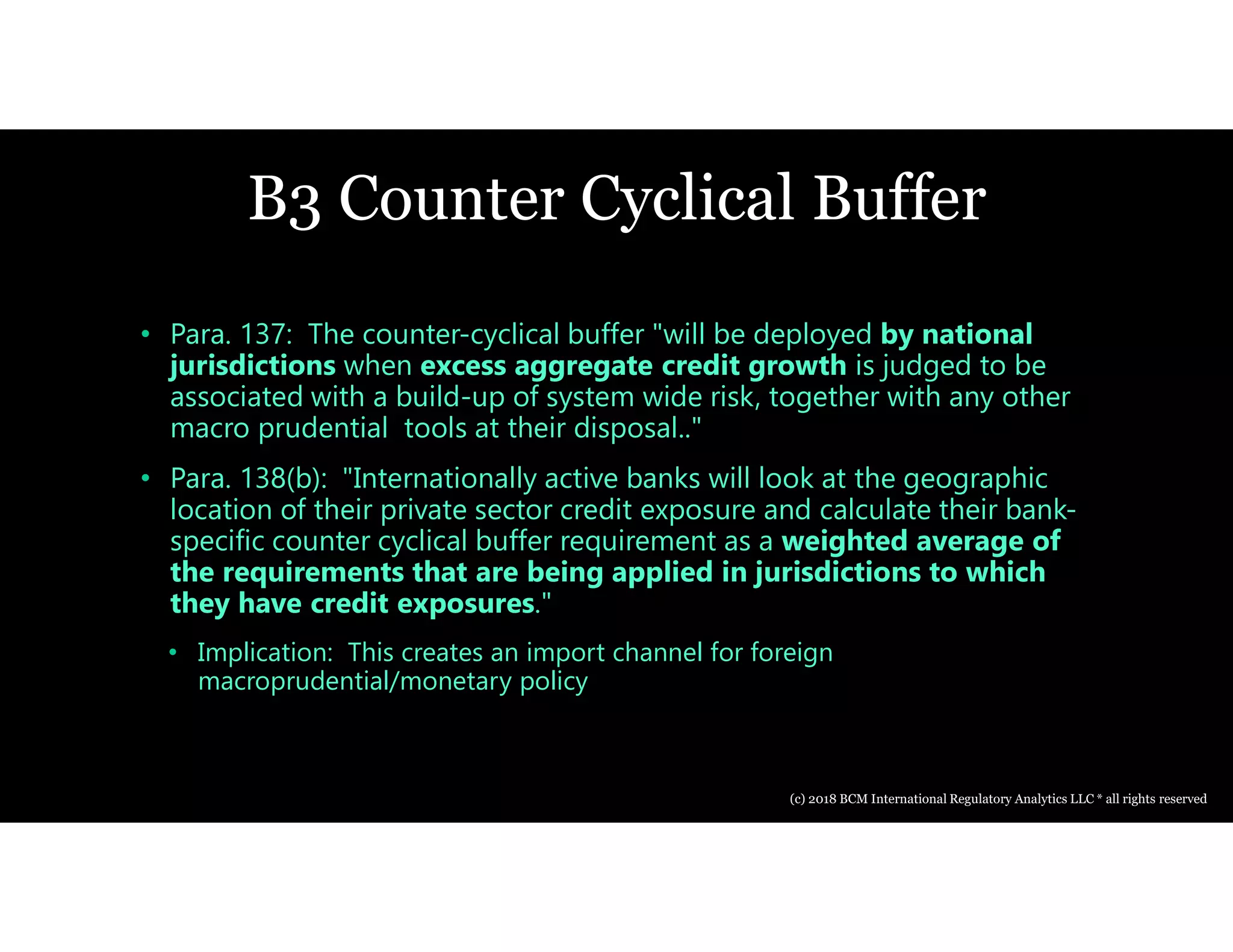
B3 Counter Cyclical Buffer
• Para. 137: The counter-cyclical buffer "will be deployed by national
jurisdictions when excess aggregate credit growth is judged to be
associated with a build-up of system wide risk, together with any other
macro prudential tools at their disposal.."
• Para. 138(b): "Internationally active banks will look at the geographic
location of their private sector credit exposure and calculate their bank-
specific counter cyclical buffer requirement as a weighted average of
the requirements that are being applied in jurisdictions to which
they have credit exposures."
• Implication: This creates an import channel for foreign
macroprudential/monetary policy
(c) 2018 BCM International Regulatory Analytics LLC * all rights reserved
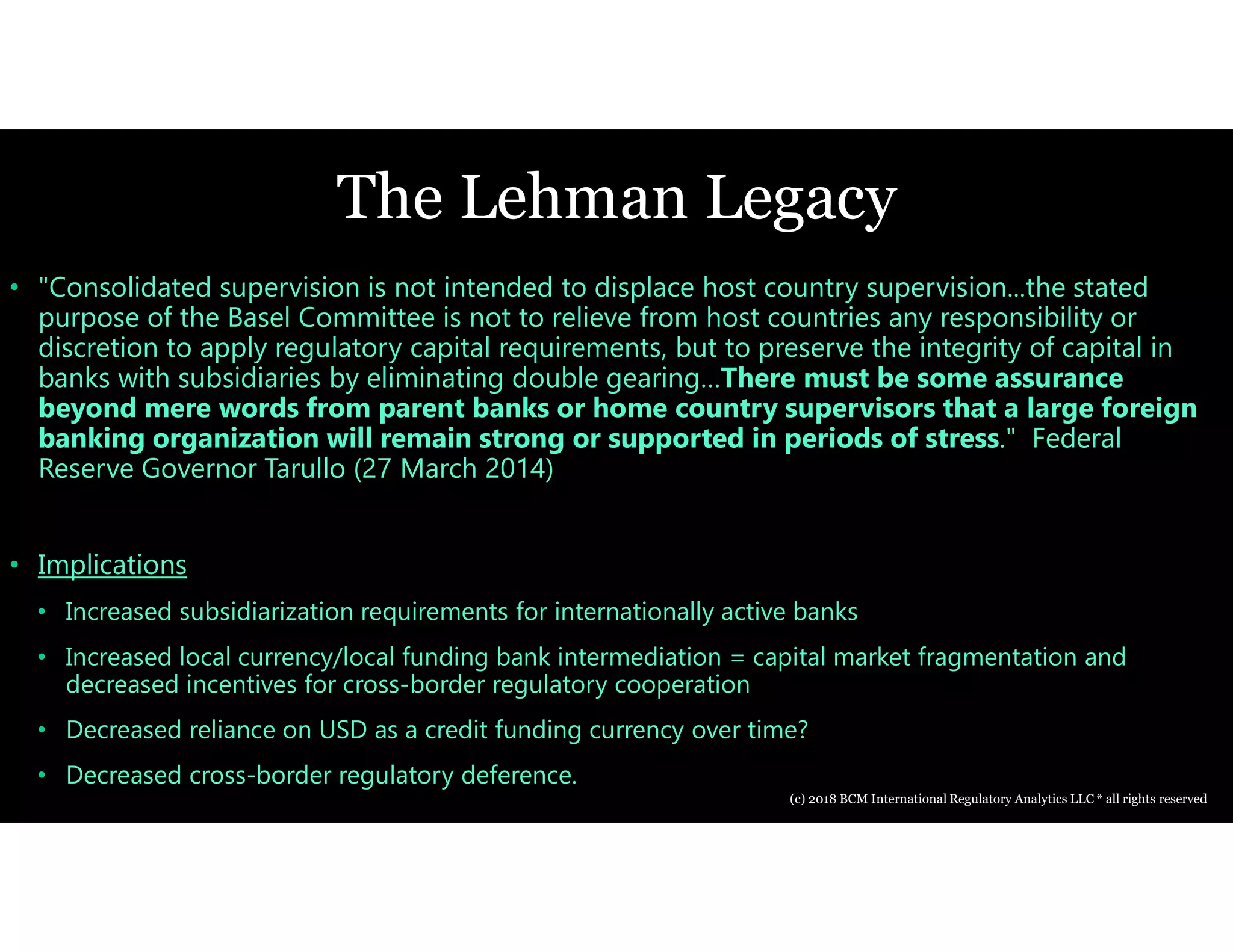
The Lehman Legacy
• "Consolidated supervision is not intended to displace host country supervision...the stated
purpose of the Basel Committee is not to relieve from host countries any responsibility or
discretion to apply regulatory capital requirements, but to preserve the integrity of capital in
banks with subsidiaries by eliminating double gearing…There must be some assurance
beyond mere words from parent banks or home country supervisors that a large foreign
banking organization will remain strong or supported in periods of stress." Federal
Reserve Governor Tarullo (27 March 2014)
• Implications
• Increased subsidiarization requirements for internationally active banks
• Increased local currency/local funding bank intermediation = capital market fragmentation and
decreased incentives for cross-border regulatory cooperation
• Decreased reliance on USD as a credit funding currency over time?
• Decreased cross-border regulatory deference.
(c) 2018 BCM International Regulatory Analytics LLC * all rights reserved
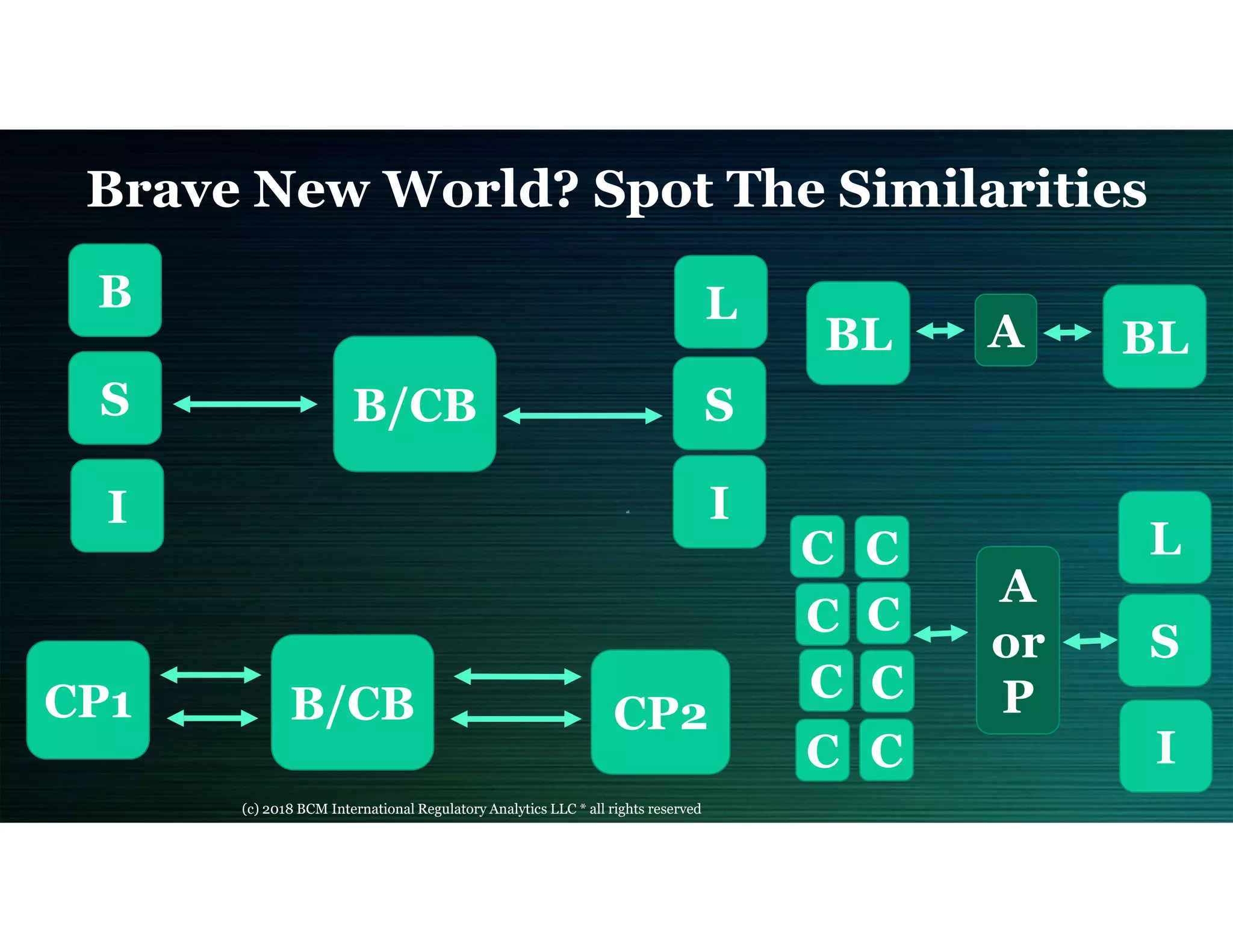
Brave New World? Spot The Similarities
B
S
I
B/CB
I
S
L
CP1 B/CB CP2
BL BLA
C
L
S
I
C
CC
CC
CC
A
or
P
(c) 2018 BCM International Regulatory Analytics LLC * all rights reserved
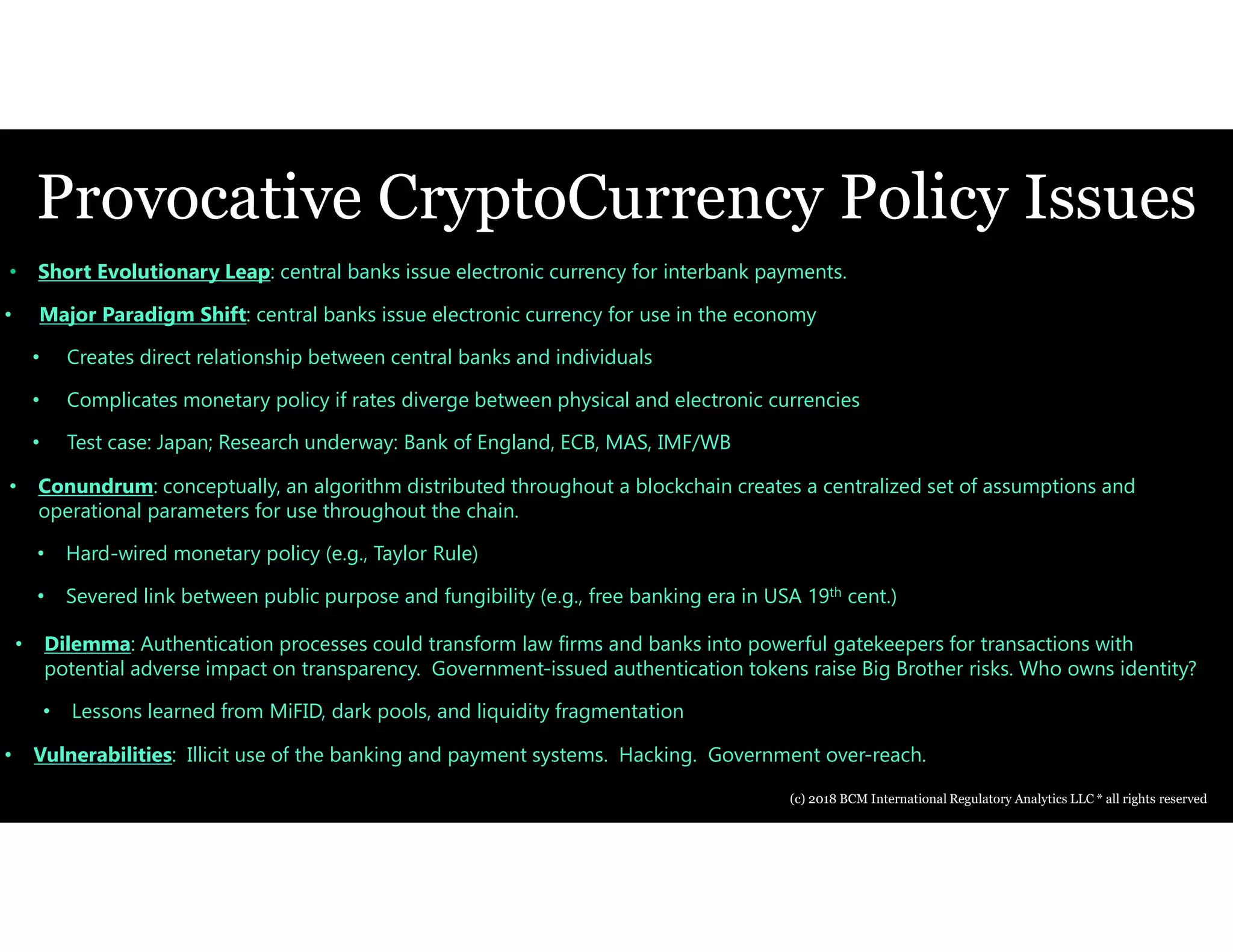
Provocative CryptoCurrency Policy Issues
• Short Evolutionary Leap: central banks issue electronic currency for interbank payments.
• Major Paradigm Shift: central banks issue electronic currency for use in the economy
• Creates direct relationship between central banks and individuals
• Complicates monetary policy if rates diverge between physical and electronic currencies
• Test case: Japan; Research underway: Bank of England, ECB, MAS, IMF/WB
• Conundrum: conceptually, an algorithm distributed throughout a blockchain creates a centralized set of assumptions and
operational parameters for use throughout the chain.
• Hard-wired monetary policy (e.g., Taylor Rule)
• Severed link between public purpose and fungibility (e.g., free banking era in USA 19th cent.)
• Dilemma: Authentication processes could transform law firms and banks into powerful gatekeepers for transactions with
potential adverse impact on transparency. Government-issued authentication tokens raise Big Brother risks. Who owns identity?
• Lessons learned from MiFID, dark pools, and liquidity fragmentation
• Vulnerabilities: Illicit use of the banking and payment systems. Hacking. Government over-reach.
(c) 2018 BCM International Regulatory Analytics LLC * all rights reserved
Appendix – Key Basel 3 Details
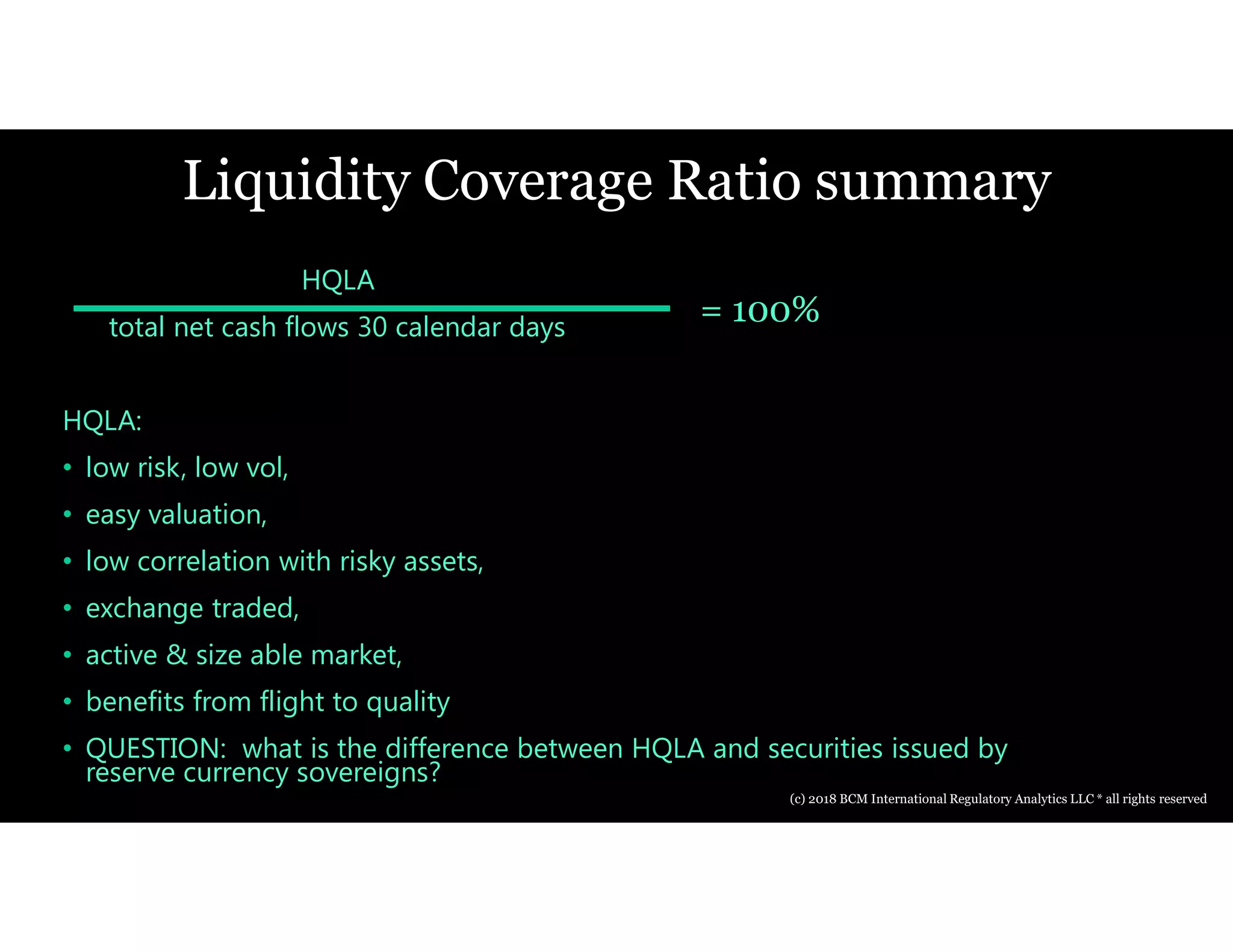
Liquidity Coverage Ratio summary
HQLA
total net cash flows 30 calendar days
HQLA:
• low risk, low vol,
• easy valuation,
• low correlation with risky assets,
• exchange traded,
• active & size able market,
• benefits from flight to quality
• QUESTION: what is the difference between HQLA and securities issued by
reserve currency sovereigns?
= 100%
(c) 2018 BCM International Regulatory Analytics LLC * all rights reserved
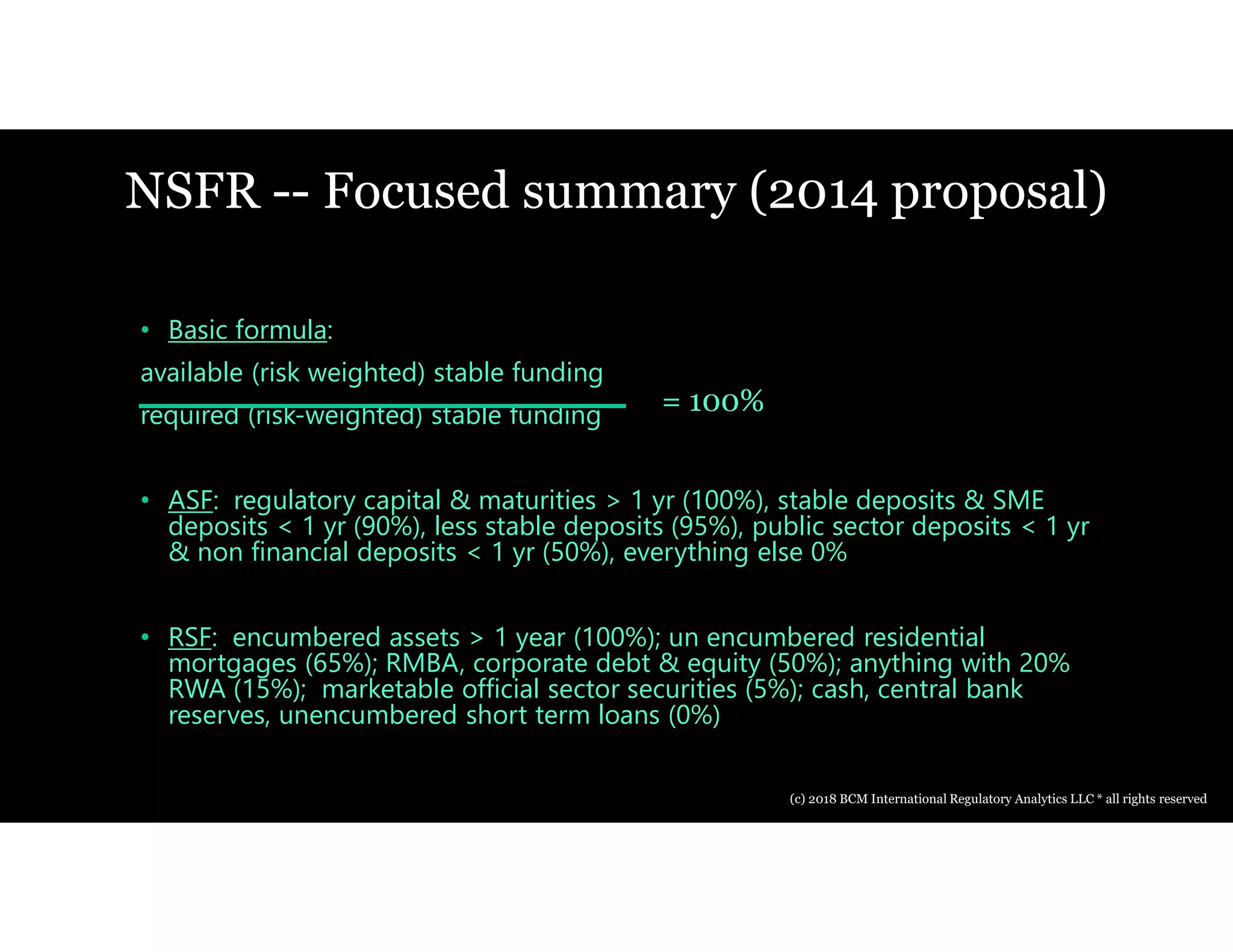
NSFR -- Focused summary (2014 proposal)
• Basic formula:
available (risk weighted) stable funding
required (risk-weighted) stable funding
• ASF: regulatory capital & maturities > 1 yr (100%), stable deposits & SME
deposits < 1 yr (90%), less stable deposits (95%), public sector deposits < 1 yr
& non financial deposits < 1 yr (50%), everything else 0%
• RSF: encumbered assets > 1 year (100%); un encumbered residential
mortgages (65%); RMBA, corporate debt & equity (50%); anything with 20%
RWA (15%); marketable official sector securities (5%); cash, central bank
reserves, unencumbered short term loans (0%)
= 100%
(c) 2018 BCM International Regulatory Analytics LLC * all rights reserved
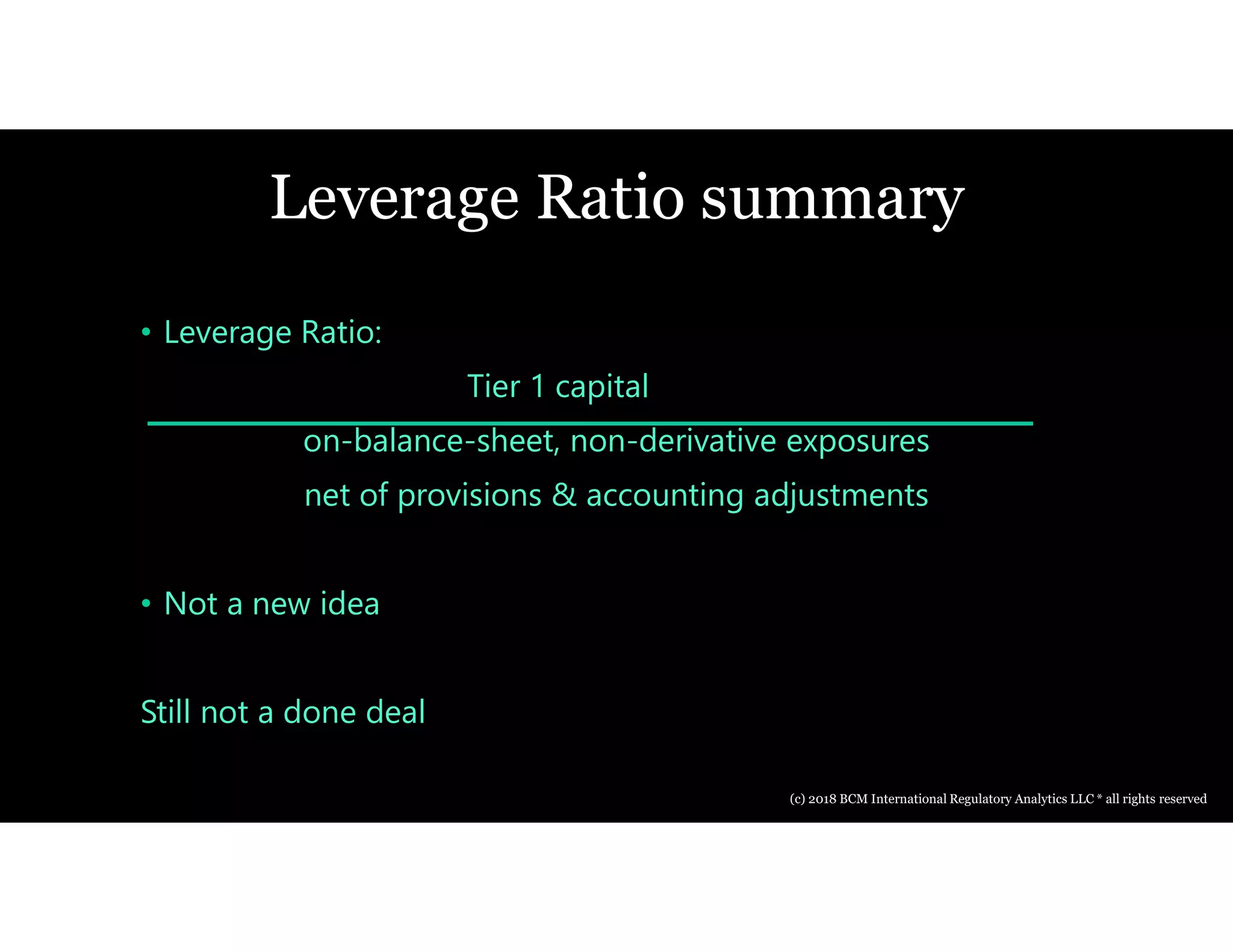
Leverage Ratio summary
• Leverage Ratio:
Tier 1 capital
on-balance-sheet, non-derivative exposures
net of provisions & accounting adjustments
• Not a new idea
Still not a done deal
(c) 2018 BCM International Regulatory Analytics LLC * all rights reserved

Stanford lecture jan 2018

  • 1.
    Evolving Financial Supervision: FamiliarFaces in a Brave New World Lecture Notes Barbara C. Matthews Stanford University 29 January 2018
  • 2.
    Overview • New Horizonsin Financial Sector Supervision • How is intermediation regulated? Let me count the ways…. • To regulate or not to regulate? This is NOT the FinTech policy question • CryptoCurrencies – The brave new world • International Regulatory Harmonization – have we peaked? • Macroprudential Regulation – where is the boundary with monetary policy? • Macroprudential Regulation – why the nation-state cannot yet die (c) 2018 BCM International Regulatory Analytics LLC * all rights reserved
  • 3.
  • 4.
    The Traditional BankRegulation Landscape FUNDING INTERMEDIATION B1,2,3 risk weights B3 LEVERAGE RATIO Consumer Protection INVESTMENTS & TRADING DEPOSIT INSURANCE Licensing SECURITIES REGULATION RISK MGMT MARKET RISK RULES B3 NSFR/LCR DERIVATIVES REG CENTRAL CLEARING EXCHANGE LISTING B2 OpRisk KYC AML (c) 2018 BCM International Regulatory Analytics LLC * all rights reserved
  • 5.
    Evolving Sources ofCredit and Capital Credit Cards, HELC • Decreased access post- 2008 Crowd funding • New since 2008 • Less responsive to monetary policy Angels & VCs • More supply & demand since 2008 • Less responsive to monetary policy Bank Loans • Decreased supply & demand since 2008, especially in Europe Private Equity IPO • Increased access/lower standards for tech companies 2ndary Markets • Increased automated trading • Decreased liquidity (c) 2018 BCM International Regulatory Analytics LLC * all rights reserved
  • 6.
    FinTech Regulation MythsDebunked Regulation Type FinTech Today Int’l Standard Implemented Int’l Std Licensing/Registration Deposit Insurance Regulatory Capital X Sort of Securities Regulation X Monetary Policy AML/CTF X X Mostly Consumer Protection/Fraud X Non-Discrimination X Payment System Access X X-border Operations X Sort of Product Approvals X Data Privacy Rules X CyberSecurity Requirements X Resolution (c) 2018 BCM International Regulatory Analytics LLC * all rights reserved
  • 7.
    PD LGD EADEL/UL FinTech & Credit Risk Models Better Data Alternative Data Diversified Funding Smaller Exposure Key Questions: • Are location or habit data different from lending by zip codes? • Is online marketplace lending different from loan syndication? • Are decreased loan amounts better ways to limit loss given default when compared with secured lending recovery rates? • Is the drive for a federal FinTech charter in the US driven by regulatory arbitrage priorities or by the need to achieve increased diversification in the lending pool? • How will increased data privacy standards impact the FinTech business model? Big Data Diversification? (c) 2018 BCM International Regulatory Analytics LLC * all rights reserved
  • 8.
  • 9.
    Basel 1, 2,3 • 1970s – 80s: Spillover effects = increased regulatory cooperation •Basel 1 (1988 – 91): Risk-based regulatory capital •Four risk weights (0, 20, 50, 100) and one aggregate ratio (RWA/Tier 1 + 2 capital) created •Certain assets (especially illiquid residential real estate lending) generate risk; lending to OECD and domestic sovereigns is safe •Basel 1.5 (1994-97): Regulatory model extended to cover trading book exposures as derivatives markets and trading increase •Basel 2 (2001 – 2008): Internal bank credit ratings permitted when calculating RWA; Regulatory model extended to cover operational risks. •Basel 3 (2010 to present): All trading is risky; Decreased regulatory cooperation; Regulatory model extended to cover macroprudential, funding and liquidity risks. (c) 2018 BCM International Regulatory Analytics LLC * all rights reserved
  • 10.
    B3 Baseline RWA:0, 20, 50, 100, 100+ • The constants: • certain sovereign exposures = 0% • 20 and 50: favored sectors (mostly residential real estate and consumer credit cards plus other sovereigns) • 100: private sector credit • Major New Elements • 100+ RW: Super-risk sectors.....securitization, OTC derivatives • Leverage Ratio (still not in place globally as of 2018) • Increased focus on liability/funding side of bank balance sheets (Net Stable Funding Ratio, Liquidity Coverage Ratio) • Decreased reliance on internal risk models • Increased reliance on national discretions (e.g.: EU “safe, simple, transparent securitization”; Danish covered bonds) and Pillar II. • New buffers: Macroprudential Buffer; Counter-Cyclical Buffer; SIFI surcharge; Capital Conservation Buffer (c) 2018 BCM International Regulatory Analytics LLC * all rights reserved
  • 11.
    More B3 Extras •OTC derivatives – increased capital required if derivatives are not exchange-traded and/or centrally cleared • MTM counterparty risk/CVA adjustment • Collateralized counterparty/EAD adjustment • CCP exposures (c) 2018 BCM International Regulatory Analytics LLC * all rights reserved
  • 12.
    MacroPrudential & MonetaryPolicies Compared MacroPrudential Policy • Purpose: Insulate the domestic economy (i.e., deliver “financial stability”) by counter- balancing cross-border, non-bank and other risk drivers. • Tools: Leverage ratio, Loan-to-value ratios, B3 “macroprudential buffer”, B3 “countercyclical buffer”, SIFI surcharges • Cross-border Spillovers: competitiveness; monetary policy Monetary Policy • Purpose: Promote healthy domestic economic growth rates by influencing the amount of money and credit (i.e., liquidity) in an economy. • Traditional toolkit: interest rates, reserve ratios, repo, collateral policy • Unconventional toolkit: asset purchases (private), asset purchases (public), collateral policy, LTRO, interest on deposits • Cross-border spillovers: FX rates, capital flows (c) 2018 BCM International Regulatory Analytics LLC * all rights reserved Shared Priorities: Proactive central bank activity designed to enhance financial stability in the domestic economy by controlling the amount of liquidity available to credit markets..
  • 13.
    B3 Counter CyclicalBuffer • Para. 137: The counter-cyclical buffer "will be deployed by national jurisdictions when excess aggregate credit growth is judged to be associated with a build-up of system wide risk, together with any other macro prudential tools at their disposal.." • Para. 138(b): "Internationally active banks will look at the geographic location of their private sector credit exposure and calculate their bank- specific counter cyclical buffer requirement as a weighted average of the requirements that are being applied in jurisdictions to which they have credit exposures." • Implication: This creates an import channel for foreign macroprudential/monetary policy (c) 2018 BCM International Regulatory Analytics LLC * all rights reserved
  • 14.
    The Lehman Legacy •"Consolidated supervision is not intended to displace host country supervision...the stated purpose of the Basel Committee is not to relieve from host countries any responsibility or discretion to apply regulatory capital requirements, but to preserve the integrity of capital in banks with subsidiaries by eliminating double gearing…There must be some assurance beyond mere words from parent banks or home country supervisors that a large foreign banking organization will remain strong or supported in periods of stress." Federal Reserve Governor Tarullo (27 March 2014) • Implications • Increased subsidiarization requirements for internationally active banks • Increased local currency/local funding bank intermediation = capital market fragmentation and decreased incentives for cross-border regulatory cooperation • Decreased reliance on USD as a credit funding currency over time? • Decreased cross-border regulatory deference. (c) 2018 BCM International Regulatory Analytics LLC * all rights reserved
  • 15.
    Brave New World?Spot The Similarities B S I B/CB I S L CP1 B/CB CP2 BL BLA C L S I C CC CC CC A or P (c) 2018 BCM International Regulatory Analytics LLC * all rights reserved
  • 16.
    Provocative CryptoCurrency PolicyIssues • Short Evolutionary Leap: central banks issue electronic currency for interbank payments. • Major Paradigm Shift: central banks issue electronic currency for use in the economy • Creates direct relationship between central banks and individuals • Complicates monetary policy if rates diverge between physical and electronic currencies • Test case: Japan; Research underway: Bank of England, ECB, MAS, IMF/WB • Conundrum: conceptually, an algorithm distributed throughout a blockchain creates a centralized set of assumptions and operational parameters for use throughout the chain. • Hard-wired monetary policy (e.g., Taylor Rule) • Severed link between public purpose and fungibility (e.g., free banking era in USA 19th cent.) • Dilemma: Authentication processes could transform law firms and banks into powerful gatekeepers for transactions with potential adverse impact on transparency. Government-issued authentication tokens raise Big Brother risks. Who owns identity? • Lessons learned from MiFID, dark pools, and liquidity fragmentation • Vulnerabilities: Illicit use of the banking and payment systems. Hacking. Government over-reach. (c) 2018 BCM International Regulatory Analytics LLC * all rights reserved
  • 17.
    Appendix – KeyBasel 3 Details
  • 18.
    Liquidity Coverage Ratiosummary HQLA total net cash flows 30 calendar days HQLA: • low risk, low vol, • easy valuation, • low correlation with risky assets, • exchange traded, • active & size able market, • benefits from flight to quality • QUESTION: what is the difference between HQLA and securities issued by reserve currency sovereigns? = 100% (c) 2018 BCM International Regulatory Analytics LLC * all rights reserved
  • 19.
    NSFR -- Focusedsummary (2014 proposal) • Basic formula: available (risk weighted) stable funding required (risk-weighted) stable funding • ASF: regulatory capital & maturities > 1 yr (100%), stable deposits & SME deposits < 1 yr (90%), less stable deposits (95%), public sector deposits < 1 yr & non financial deposits < 1 yr (50%), everything else 0% • RSF: encumbered assets > 1 year (100%); un encumbered residential mortgages (65%); RMBA, corporate debt & equity (50%); anything with 20% RWA (15%); marketable official sector securities (5%); cash, central bank reserves, unencumbered short term loans (0%) = 100% (c) 2018 BCM International Regulatory Analytics LLC * all rights reserved
  • 20.
    Leverage Ratio summary •Leverage Ratio: Tier 1 capital on-balance-sheet, non-derivative exposures net of provisions & accounting adjustments • Not a new idea Still not a done deal (c) 2018 BCM International Regulatory Analytics LLC * all rights reserved