Global Shadow Banking
Estimating the Size of an Amorphous System
Summary of Master‘s Thesis
Achim Braunsteffer
Otto-Friedrich-University Bamberg, Germany
1. Introduction
• System originated in the 1970s through money market mutual funds
(MMFs), circumventing Regulation Q
• Term shadow banking attributed to McCulley (2007)
• Modern shadow banking as web of specialized financial institutions,
engaging in the credit intermediation chain at different levels
• E.g. (some types of) investment funds, MMFs, SFVs, broker & dealers, (real
estate investment) trusts, hedge funds and fintechs
• Often aggregated as other financial intermediaries (OFIs)
There is nothing shadowy about these institutions, yet no encompassing and
irrefutable definition exists, not speaking of reliable and granular data.
Nevertheless, this system played a significant role in the global financial crisis
and is capable of posing systemic risks.
2. Theory (I)
• Two basic methods of calculating assets in the literature: (i) entity-
based approach and (ii) activity-based approach
• FSB (2015) regards shadow banking as “credit intermediation
involving entities and activites (fully or partially) outside the regular
banking system“
• Harutyunyan et al. (2015) introduce non-core liabilities, defined as
“nontraditional financial intermediation determined by the funding
source“
• Fiaschi et al. (2014) present new measure based on empirical power
law distributions, particularly Zipf‘s law
2. Theory (II)
• Zipf‘s law states that the frequency of an object is inversely
proportional to its rank and is said to hold for firm sizes as well
• However, asset size distributions of the largest firms in the world level
off at the top range and violate Zipf‘s law
• Fiaschi et al. conclude these “missing“ assets are due to the victory
march of the shadow banking system
 Is this measure capable of pinning down the true size of the system?
3. Data
1. Global Shadow Banking Monitoring Report by the FSB
Twofold exercise using entity-based approach coupled with an activity based
approach:
(i) OFI assets of $68.1 trillion in 2014 in a sample of 26 jurisdictions
(ii) whereof $35.9 trillion are risky shadow banking assets
2. Non-core liabilities by the IMF
Activity-based approach only available for some countries: USA and UK are
the largest jurisdictions with $18.8 trillion and $13.4 trillion in 2013
3. Forbes Global 2000
Global 2000 List by the Forbes Magazine can be used to create firm size
distributions as measured by their assets (across all economic sectors)
4. Results (I)
• Summing up the differences of
the actual and the hypothetical
distribution serves as proxy for
the shadow banking system
• See Braunsteffer (2016) for the
estimation technique and
further information
4. Results (II)
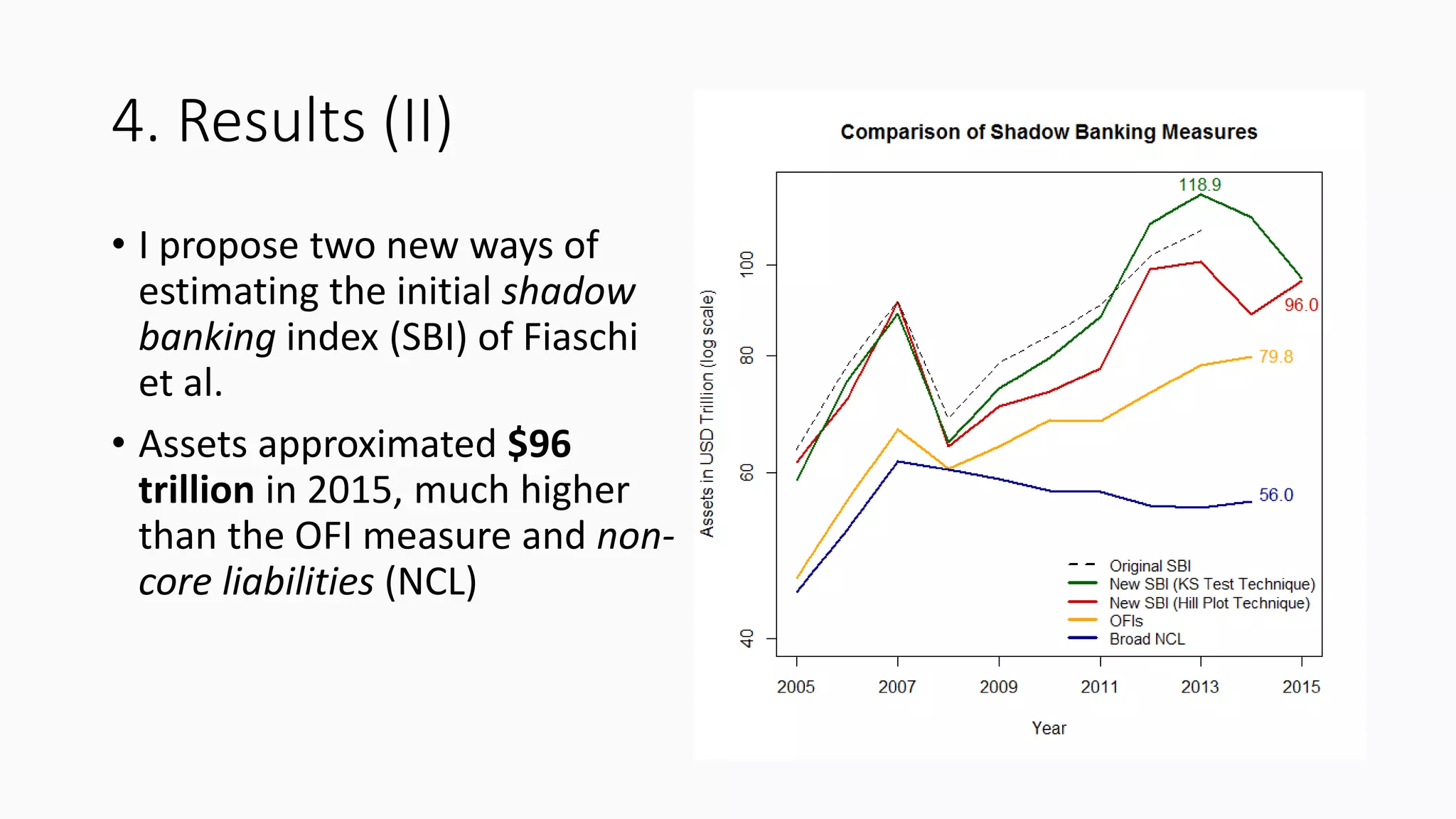
• I propose two new ways of
estimating the initial shadow
banking index (SBI) of Fiaschi
et al.
• Assets approximated $96
trillion in 2015, much higher
than the OFI measure and non-
core liabilities (NCL)
5. Discussion
• Empirical way of estimating shadow banking
• Findings suggest that the system shrank in the last two years, but its
true size is larger than previously assumed
• However, controversies surrounding the validity of Zipf‘s law
• Results sensitive to particular estimation techniques and some
parameters of the hypothetical distribution
In combination with other methods and statistics, these indices are
useful tools for central bankers, policymakers and regulators.
References
Braunsteffer, A. (2016) “The Elephant in the Regulator‘s Room: Estimating the Size of the Global Shadow
Banking System“, Master‘s Thesis at University of Bamberg.
Fiaschi, D., Kondor, I., Marsili, M. & Volpati, V. (2014) “The Interrupted Power Law and the Size of Shadow
Banking“ PloS one 9(4).
Financial Stability Board (2015) “Global Shadow Banking Monitoring Report 2015“
Harutyunyan, A., Massara, A., Ugazio, G., Amidzic, G. & Walton, R. (2015) “Shedding Light on Shadow Banking“
IMF Working Paper No. 15/1.
McCulley, P. (2007) “Teton Reflections“ PIMCO Global Central Bank Focus.

Global Shadow Banking - The Elephant in the Room

  • 1.
    Global Shadow Banking Estimatingthe Size of an Amorphous System Summary of Master‘s Thesis Achim Braunsteffer Otto-Friedrich-University Bamberg, Germany
  • 2.
    1. Introduction • Systemoriginated in the 1970s through money market mutual funds (MMFs), circumventing Regulation Q • Term shadow banking attributed to McCulley (2007) • Modern shadow banking as web of specialized financial institutions, engaging in the credit intermediation chain at different levels • E.g. (some types of) investment funds, MMFs, SFVs, broker & dealers, (real estate investment) trusts, hedge funds and fintechs • Often aggregated as other financial intermediaries (OFIs) There is nothing shadowy about these institutions, yet no encompassing and irrefutable definition exists, not speaking of reliable and granular data. Nevertheless, this system played a significant role in the global financial crisis and is capable of posing systemic risks.
  • 3.
    2. Theory (I) •Two basic methods of calculating assets in the literature: (i) entity- based approach and (ii) activity-based approach • FSB (2015) regards shadow banking as “credit intermediation involving entities and activites (fully or partially) outside the regular banking system“ • Harutyunyan et al. (2015) introduce non-core liabilities, defined as “nontraditional financial intermediation determined by the funding source“ • Fiaschi et al. (2014) present new measure based on empirical power law distributions, particularly Zipf‘s law
  • 4.
    2. Theory (II) •Zipf‘s law states that the frequency of an object is inversely proportional to its rank and is said to hold for firm sizes as well • However, asset size distributions of the largest firms in the world level off at the top range and violate Zipf‘s law • Fiaschi et al. conclude these “missing“ assets are due to the victory march of the shadow banking system  Is this measure capable of pinning down the true size of the system?
  • 5.
    3. Data 1. GlobalShadow Banking Monitoring Report by the FSB Twofold exercise using entity-based approach coupled with an activity based approach: (i) OFI assets of $68.1 trillion in 2014 in a sample of 26 jurisdictions (ii) whereof $35.9 trillion are risky shadow banking assets 2. Non-core liabilities by the IMF Activity-based approach only available for some countries: USA and UK are the largest jurisdictions with $18.8 trillion and $13.4 trillion in 2013 3. Forbes Global 2000 Global 2000 List by the Forbes Magazine can be used to create firm size distributions as measured by their assets (across all economic sectors)
  • 6.
    4. Results (I) •Summing up the differences of the actual and the hypothetical distribution serves as proxy for the shadow banking system • See Braunsteffer (2016) for the estimation technique and further information
  • 7.
    4. Results (II) •I propose two new ways of estimating the initial shadow banking index (SBI) of Fiaschi et al. • Assets approximated $96 trillion in 2015, much higher than the OFI measure and non- core liabilities (NCL)
  • 8.
    5. Discussion • Empiricalway of estimating shadow banking • Findings suggest that the system shrank in the last two years, but its true size is larger than previously assumed • However, controversies surrounding the validity of Zipf‘s law • Results sensitive to particular estimation techniques and some parameters of the hypothetical distribution In combination with other methods and statistics, these indices are useful tools for central bankers, policymakers and regulators.
  • 9.
    References Braunsteffer, A. (2016)“The Elephant in the Regulator‘s Room: Estimating the Size of the Global Shadow Banking System“, Master‘s Thesis at University of Bamberg. Fiaschi, D., Kondor, I., Marsili, M. & Volpati, V. (2014) “The Interrupted Power Law and the Size of Shadow Banking“ PloS one 9(4). Financial Stability Board (2015) “Global Shadow Banking Monitoring Report 2015“ Harutyunyan, A., Massara, A., Ugazio, G., Amidzic, G. & Walton, R. (2015) “Shedding Light on Shadow Banking“ IMF Working Paper No. 15/1. McCulley, P. (2007) “Teton Reflections“ PIMCO Global Central Bank Focus.