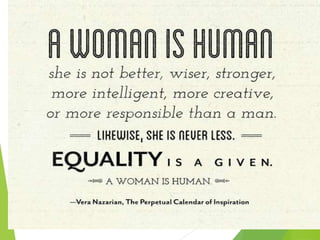
Gender Issues
Meaning
 Gender- the characteristics that a society or culture delineates as
masculine or feminine
gender role as a 'man' or a 'woman' in society can be quite different
cross culturally.
 Sex - either of the two main categories (male and
female) into which humans and most other living things
are divided on the basis of their reproductive functions.
 Issue - an important topic or problem for debate or
discussion
Gender issue
 Gender inequality refers to unequal treatment or
perceptions of individuals based on their gender. It
arises from differences in socially constructed
gender roles.
 Gender equality, also known as sex equality,
sexual equality, or equality of the genders, is the view
that everyone should receive equal treatment and not
be discriminated against based on their gender.
 Gender issue is not same as women’s issue….
Understanding gender mean understanding the
behavior, opportunities and constraint that affect both
men as well as women.
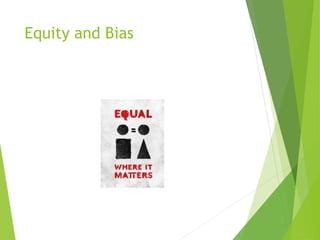
Equity and Bias
 Equality- the state of being equal, especially in status,
rights, or opportunities.
 Equity - the quality of being fair and impartial.
 Bias- inclination or prejudice for or against one person
or group, especially in a way considered to be unfair.
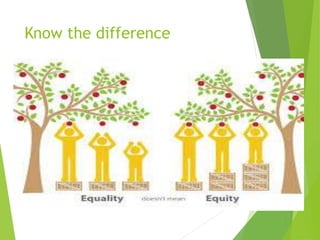
Know the difference
 Equity and equality are two strategies we can use in an
effort to produce fairness. Equity is giving everyone
what they need to be successful. Equality is treating
everyone the same. Equality aims to promote fairness,
but it can only work if everyone starts from the same
place and needs the same help
 Gender equality means equal treatment of women and
men in law and policies and equal access to resource
and service within families, communities and society at
large.
 Gender equity means fairness and justice in the
distribution of benefits and responsibilities between
women and men ,
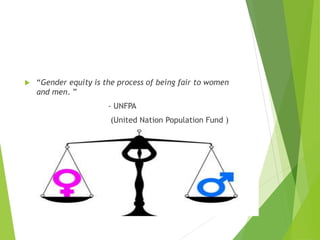
 “Gender equity is the process of being fair to women
and men. ”
- UNFPA
(United Nation Population Fund )
 In contrast to gender equality, gender equity refers to
the process of allocating resources based on the
particular requirements of a gender.
 For example, instead of making sure males and females
each receives 50 percent of the facilities of a sports
center, gender equity means that each gender receives
the right proportion and types of facilities according to
their interests, capacities and experiences.
 While gender equality focuses on providing the same starting
circumstances for everyone, the goal of gender equity is to provide both
genders with the same end results. In most cases, the concept of gender
equality is used in correlation with the empowerment of women, whereas
gender equity refers to the process of treating both men and women with
the same amount of fairness when it comes to the equality of chances
based on individual needs.
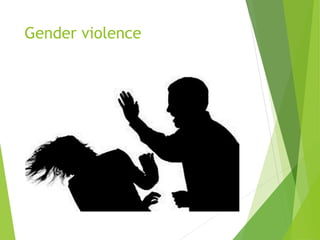
Gender violence
Gender violence
Meaning
Violence - behavior involving physical force intended to
hurt, damage, or kill someone or something.
 “Any act of gender-based violence that results in or is likely
to result in physical, sexual, or psychological harm or
suffering to women, including threats of such acts,
coercion or arbitrary deprivation of liberty, whether
occurring in public or private life."
 The nature and extent of specific types of GBV vary
across cultures, countries and religions. Examples
include rape, sexual exploitation and forced
prostitution; domestic violence; trafficking ; forced or
early marriage; and harmful traditional practices, such
as female genital mutilation and honor killing.
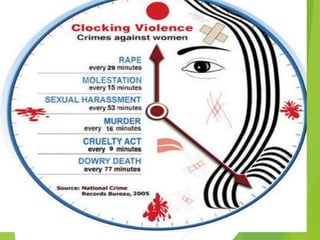
Magnitude of the problem( worldwide)
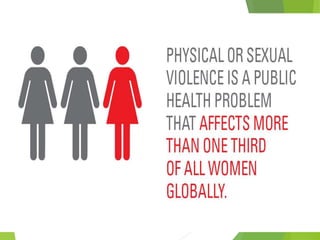
 Violence against women and girls is one of the most widespread violations
of human rights.
 Every year, about 5,000 women are murdered by family members in the
name of honor year worldwide
 Worldwide 2 million girls of age 5- 15 years are introduced into
commercial sex market
 Worldwide, one out of 5 pregnant women are abuse.
 Women’s are not dying because of the disease we
cannot treat, they are dying because society have yet to
make a decision that their life are worth saving.
- Dr. Mohammod Fatahalla
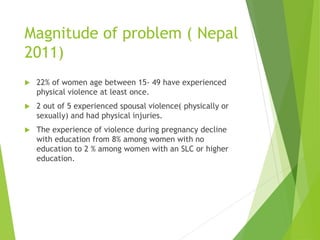
Magnitude of problem ( Nepal
2011)
 22% of women age between 15- 49 have experienced
physical violence at least once.
 2 out of 5 experienced spousal violence( physically or
sexually) and had physical injuries.
 The experience of violence during pregnancy decline
with education from 8% among women with no
education to 2 % among women with an SLC or higher
education.
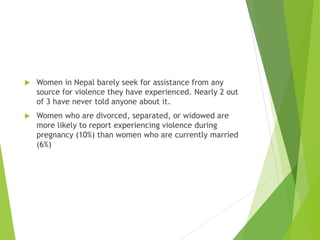
 Women in Nepal barely seek for assistance from any
source for violence they have experienced. Nearly 2 out
of 3 have never told anyone about it.
 Women who are divorced, separated, or widowed are
more likely to report experiencing violence during
pregnancy (10%) than women who are currently married
(6%)
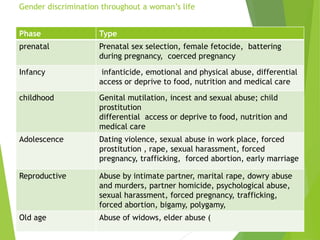
Gender discrimination throughout a woman’s life
Phase Type
prenatal Prenatal sex selection, female fetocide, battering
during pregnancy, coerced pregnancy
Infancy infanticide, emotional and physical abuse, differential
access or deprive to food, nutrition and medical care
childhood Genital mutilation, incest and sexual abuse; child
prostitution
differential access or deprive to food, nutrition and
medical care
Adolescence Dating violence, sexual abuse in work place, forced
prostitution , rape, sexual harassment, forced
pregnancy, trafficking, forced abortion, early marriage
Reproductive Abuse by intimate partner, marital rape, dowry abuse
and murders, partner homicide, psychological abuse,
sexual harassment, forced pregnancy, trafficking,
forced abortion, bigamy, polygamy,
Old age Abuse of widows, elder abuse (
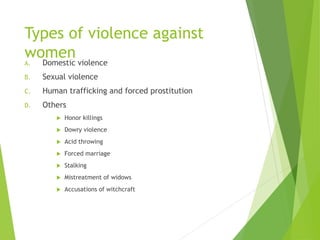
Types of violence against
women
A. Domestic violence
B. Sexual violence
C. Human trafficking and forced prostitution
D. Others
 Honor killings
 Dowry violence
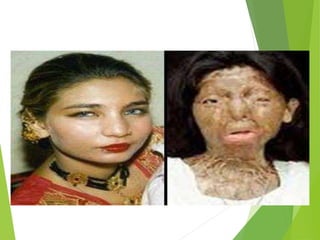
 Acid throwing
 Forced marriage
 Stalking
 Mistreatment of widows
 Accusations of witchcraft
Domestic violence
It is defined as the physical or mental torture given by a
member of the family to another member of the same
family.
It is the most common form of gender based violence.
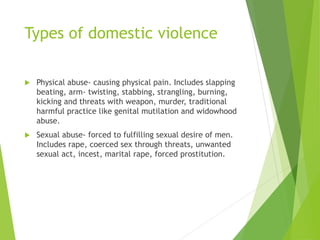
Types of domestic violence
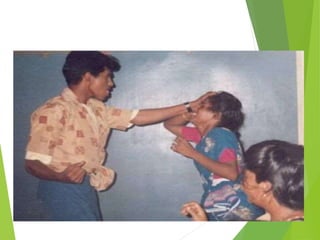
 Physical abuse- causing physical pain. Includes slapping
beating, arm- twisting, stabbing, strangling, burning,
kicking and threats with weapon, murder, traditional
harmful practice like genital mutilation and widowhood
abuse.
 Sexual abuse- forced to fulfilling sexual desire of men.
Includes rape, coerced sex through threats, unwanted
sexual act, incest, marital rape, forced prostitution.
 Psychological abuse – include threatening behavior,
harassment, threats of abandonment, confinement,
verbal abuse and other mental torture
 Emotional abuse – public embarrassment, humiliation,
fear, shame, isolation
 Economic abuse- denial funds, exploitation controlling
access to healthcare, food, basic necessities
Sexual violence
 Sexual violence is defined as a sexual act committed
against someone without that person's freely given
consent.
 It could be done by acquaintances or strangers
 Sexual violence is divided into the following types:
Completed or attempted forced penetration of a victim.
 It includes-
 Sexual exploitation and abuse
Sexual exploitation is the sexual abuse of children
and youth through the exchange of sex or sexual acts
for drugs, food, shelter, protection, other basics of life,
and/or money. Sexual exploitation includes involving
children and youth in creating pornography
and sexually explicit websites. incest, child abuse,
pornography
 Sexual harassment; sexual assault
the making of unwanted sexual advances or obscene
remarks.
 Rape / attempted rape:
Rape is the unlawful sexual activity and usually sexual
intercourse carried out forcibly or under threat
Rape attempted may include
Rape of adult female
Rape of minor
Gang rape
Marital rape
Trafficking
Trafficking is a crime against the person because of the
violation of the victim's rights of movement through –
 coercion ,
 of abduction,
 of fraud,
 of abuse of power or of position for the purpose of
exploitation.
Other violence
 Honor killings
 Dowry violence
 Acid throwing
 Forced marriage
 Stalking
 Mistreatment of widows
 Accusations of witchcraft
Consequences of violence
 Health effects of domestic and sexual abuse or
violence.
 Social and economic cost
 Added cost
 Effect on productivity and empowerment
 Health effects of domestic and sexual abuse or violence
 Non- fatal outcome
1. Physical health : injuries, functional impairment, physical symptoms,
poor subjective health, permanent disability, handicapped
2. Chronic condition: irritable bowel syndrome, gastrointestinal disorder,
somatic complain
3. Negative health behavior- smoking, alcohol, drug abuse, over eating
4. Mental health- Post- traumatic stress disorder( PSTD ), depression,
anxiety, phobia, sleep difficulties, eating disorder, low self- esteem
5. Reproductive – unwanted pregnancy, STDs,
gynecological disorder, unsafe abortion, pregnancy
complication, pelvic inflammatory disorder
 Fatal outcome: homicide, suicide, maternal mortality,
AIDs related death, female, infanticide
2. Social and economic costs
the social and economic costs of violence against
women are enormous.
Women may suffer isolation, inability to work, loss of
wages due to losses of women’s earning potential, lack
of participation in regular activities and limited ability
to care for themselves and their children, decrease
quality of life in family and community and low self-
esstem
3. Added cost
Include the cost of treatment, therapy , court and legal
services
4.Effect on productivity and employment:
Girls who are victims of sexual abuse at school by their
male teacher are likely to be depressed and stay away
from school. Elsewhere, parents who are fear that their
daughter will be sexually assaulted, may keep them at
home until they are safely married
 The consequences in every case, is a cutting of
education, a decreased chance of securing gainful
employment, quality of life and reduce contribution to
community as well as nation
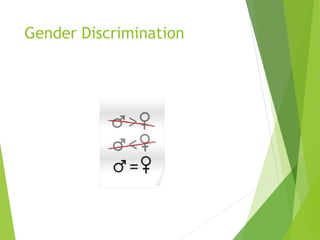
Gender Discrimination
Meaning
 Discrimination- the unjust or prejudicial treatment of
different categories of people, especially on the
grounds of race, age, or sex.
 Gender discrimination is the unfair treatment of a
person because of gender. Gender discrimination
affects both men and women. It is apparent in work
situations where one gender is given preferential
treatment or one gender receives less pay or job
responsibilities because of gender bias and unfair
stereotypes.
 The existing society has been such that no girl or
woman dares to go out in the evening. Even in broad
day light rapes, murders and eve teasing’s are rampant.
 Under social circumstances, a son is considered a
necessity while a daughter is considered a liability or
burden.
 Society teaches the girls from the very beginning to
speak slowly, do not laugh loudly, tolerate the torture
of others, accept injustice, obey, sacrifice and
cooperate, don’t assert, don’t argue and don’t violet
man’s orders.
 These are the characteristics of a good woman as per
the social norms.
Cause of Gender
Discrimination
 The causes of gender discrimination may be as
follows:
(1) Prejudice.
(2) Biological.
(3) Socio-cultural.
(4) Economic.
(5) Educational.
(6) Personal and Psychological.
(7) Adherance to traditional gender roles.
Prejudice.
 Men are so much biased against the qualities of a
woman that when a woman works excellently, men say
‘she is a man’.
 Prejudices indicate unfounded and unscientific
judgement. It is wrong to discriminate all women on the
behaviour of one woman.
Biological
 biological differences between man and woman play a
minor role in creating gender discrimination
 But women are considered as only birth giver
 Today women are taking part in athletics and sports like
cricket, hockey, football, volley-ball which were once
considered the monopoly of males. But the percentage
of women taking part in such games is quite small. It is
hoped that if women are encouraged by family, society
and government they can prove that they are also
physically stronger like men.
Socio-cultural.
 people are no more interested in a girl child and are
engaged in the abortion of the unborn female fetus,
parents and in laws feel sorry when a girl is born
because they considered A female child in our society is
not wanted because she is considered by her parents as
flower of someone else’s garden.
 Parents don’t bother to pay for education and her basic
needs, thinking her existence is their loss because they
have to give away dowry
Economic Causes
 Around the globe in almost all societies women
were/are economically dependent on men. Since they
had no education and expertise to do jobs outside and
since men did not allow those who were suitable for
jobs, women were financially weak. They were only
engaged in domestic work for which they were never
paid. One psychologist called women “unpaid maid
servants”.
Educational Causes
 Empowerment of women is possible through education in the first place. In
order to make women self-sufficient and reduce gender discrimination
women should be educated. Empowerment of women means improvement in
their political status, financial position, occupational status and legal
awareness etc., which can be achieved through education.
 Experience and observation shows that in general the status of women to-
day is very low, they are discriminated because of want of education.
Education is considered to be the most significant agent of basic change in
the status of women including economic and occupational status.
How to prevent GBV and GD
 All individual men, women, buys and girls are
accountable for practicing zero- tolerance of all form of
gender- based violence in home community
 Within household, ensuring that women and girls have
equal access to information, education and
participation in decision making
 Social- economic and legal right to children and women
or right to participate should be ensured in all issue
concerning them.
 Shelter, counseling service and legal aid are required in
communities for women.
 Legal law enforcement system , including polices and
security and armed forces must come to such a women
aid
 Health care workers can be informed about violence
against women and how to identify and treat sign of
gender based violence. Eg – bruise, fracture, internal
bleeding, malnourishment
 Empowering and mobilizing local civil society group to
influence the local government
 Since of the main cause of violence is illiteracy, primary
education should be meaningful and productive
 Awareness should be increased in legal and human right
of children and women.
 Caste and gender discrimination should be ended and
equal pay for equal amount of work should be applied
 Minimum age of marriage should be set at 20 year and implementation and
enforcement should be approached in a more sustained manner and directed
toward the market demand
 Poverty and lack of employment opportunities are the major contributing factors
of violence thus economic and employ opportunities, income- generating
activities should be provided to all women according to their capacity.
 Only heavy fines and previous legal punishment to the perpetrator and exploiters
is not sufficient to prevent the violence so legal punishment should be strong to
them
Meaning
 Mainstream - the ideas, attitudes, or activities that are
shared by most people and regarded as normal or
conventional.
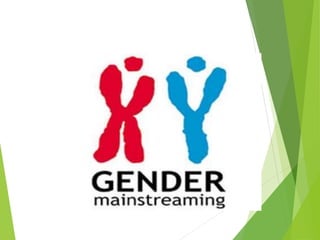
Gender mainstreaming
 Gender mainstreaming is the public policy concept of
assessing the different implications for women and men
of any planned policy action, including legislation and
programmes, in all areas and levels.
 Mainstreaming essentially offers a pluralistic approach
that values the diversity among both men and women.
 It is the process of assessing the implication for women
and men of any planned action, including legislation,
policies or programs in all area and at all levels.
 It is a strategy for making women’s as well as men’s
concerns and experiences an integral dimension of the
design, implementation, monitoring and evaluation of
policies and programs in all political, economical and
societal spheres so that women and men benefit equally
and inequality is not perpetuated.
Requirement and principles of Gender
mainstreaming
 Broad concept of gender equality
 Incorporation of gender perspective into the
mainstream of political agenda
 Inclusion and participation of women in decision making
 Prioritizing gender equality objectives and framing
policies of relevance of women
Transformation by
mainstreaming
 Mainstreaming is not about adding a “woman’s
component” or even a “gender equality component”
into a existing activity.
 It goes beyond increasing women’s participation ; it
means bringing the experience, knowledge and interests
of women and men to bear on the developmental
agenda.
Roles and responsibilities of nurse in gender
issue
According to the International Council of Nurse (ICN) code
of ethics for nurses the nurse is expected to provide
care for all patient with respect for his/ her human
dignity and uniqueness as an individual regardless of
rave, creed, gender, socio- economic status, or
the nature of illness.
 The nurse is responsible for safeguarding the patient’s
right to privacy by honoring the confidentiality of
information related to the patient. Because gender
based violence is sustained by silence, women’s voice
must be heard. Nurse should puts every effort into
enabling women to speak out against gender- based
violence, and to get help when they are victims of it
and also commit to keeping gender- bases violence in
the spotlight as a major health and human right
concern.
 Nurse should advocate for legislative reform and
enforcement of laws for the promotion and the
protection of women’ s right to reproductive health
choices and informed consent, including promotion of
women’s awareness of laws, regulations and policies
that affect their rights and responsibilities in family
life.
 Nurse should promote zero tolerance of all forms of
violence against women and works for the eradication
of traditional practices that are harmful to women’s
reproductive and sexual health, such as rituals
associated with puberty.
 Attention has been paid to involving communities and to
creating support network for gender- based violence
victims that include both police and health care
provider, along with counseling service
 Nurse also can held workshops for health providers on
recognizing the effects of gender- based violence on
women’s health, and on how to detect and prevent
abuse and assist victims.
 Nurse also can help to ensure emergency contraception
is available for victim for victims of sexual violence
 Nurse can strengthening advocacy on gender- based
violence in all country programmes, in conjunction with
other different NGOs and INGOs.
 Integrating message on the prevention of gender- based
violence into information, education and
communication projects.
 Conducting more research on gender- based violence
genderissue-genderissue-genderissue-181220174212.pptx

genderissue-genderissue-genderissue-181220174212.pptx

  • 1.
  • 2.
    Meaning  Gender- thecharacteristics that a society or culture delineates as masculine or feminine gender role as a 'man' or a 'woman' in society can be quite different cross culturally.
  • 3.
     Sex -either of the two main categories (male and female) into which humans and most other living things are divided on the basis of their reproductive functions.
  • 4.
     Issue -an important topic or problem for debate or discussion
  • 5.
    Gender issue  Genderinequality refers to unequal treatment or perceptions of individuals based on their gender. It arises from differences in socially constructed gender roles.  Gender equality, also known as sex equality, sexual equality, or equality of the genders, is the view that everyone should receive equal treatment and not be discriminated against based on their gender.
  • 6.
     Gender issueis not same as women’s issue…. Understanding gender mean understanding the behavior, opportunities and constraint that affect both men as well as women.
  • 7.
  • 8.
     Equality- thestate of being equal, especially in status, rights, or opportunities.  Equity - the quality of being fair and impartial.  Bias- inclination or prejudice for or against one person or group, especially in a way considered to be unfair.
  • 9.
  • 10.
     Equity andequality are two strategies we can use in an effort to produce fairness. Equity is giving everyone what they need to be successful. Equality is treating everyone the same. Equality aims to promote fairness, but it can only work if everyone starts from the same place and needs the same help
  • 11.
     Gender equalitymeans equal treatment of women and men in law and policies and equal access to resource and service within families, communities and society at large.  Gender equity means fairness and justice in the distribution of benefits and responsibilities between women and men ,
  • 12.
     “Gender equityis the process of being fair to women and men. ” - UNFPA (United Nation Population Fund )
  • 13.
     In contrastto gender equality, gender equity refers to the process of allocating resources based on the particular requirements of a gender.  For example, instead of making sure males and females each receives 50 percent of the facilities of a sports center, gender equity means that each gender receives the right proportion and types of facilities according to their interests, capacities and experiences.
  • 14.
     While genderequality focuses on providing the same starting circumstances for everyone, the goal of gender equity is to provide both genders with the same end results. In most cases, the concept of gender equality is used in correlation with the empowerment of women, whereas gender equity refers to the process of treating both men and women with the same amount of fairness when it comes to the equality of chances based on individual needs.
  • 15.
  • 16.
    Gender violence Meaning Violence -behavior involving physical force intended to hurt, damage, or kill someone or something.
  • 17.
     “Any actof gender-based violence that results in or is likely to result in physical, sexual, or psychological harm or suffering to women, including threats of such acts, coercion or arbitrary deprivation of liberty, whether occurring in public or private life."
  • 19.
     The natureand extent of specific types of GBV vary across cultures, countries and religions. Examples include rape, sexual exploitation and forced prostitution; domestic violence; trafficking ; forced or early marriage; and harmful traditional practices, such as female genital mutilation and honor killing.
  • 20.
    Magnitude of theproblem( worldwide)  Violence against women and girls is one of the most widespread violations of human rights.  Every year, about 5,000 women are murdered by family members in the name of honor year worldwide  Worldwide 2 million girls of age 5- 15 years are introduced into commercial sex market  Worldwide, one out of 5 pregnant women are abuse.
  • 22.
     Women’s arenot dying because of the disease we cannot treat, they are dying because society have yet to make a decision that their life are worth saving. - Dr. Mohammod Fatahalla
  • 23.
    Magnitude of problem( Nepal 2011)  22% of women age between 15- 49 have experienced physical violence at least once.  2 out of 5 experienced spousal violence( physically or sexually) and had physical injuries.  The experience of violence during pregnancy decline with education from 8% among women with no education to 2 % among women with an SLC or higher education.
  • 24.
     Women inNepal barely seek for assistance from any source for violence they have experienced. Nearly 2 out of 3 have never told anyone about it.  Women who are divorced, separated, or widowed are more likely to report experiencing violence during pregnancy (10%) than women who are currently married (6%)
  • 25.
    Gender discrimination throughouta woman’s life Phase Type prenatal Prenatal sex selection, female fetocide, battering during pregnancy, coerced pregnancy Infancy infanticide, emotional and physical abuse, differential access or deprive to food, nutrition and medical care childhood Genital mutilation, incest and sexual abuse; child prostitution differential access or deprive to food, nutrition and medical care Adolescence Dating violence, sexual abuse in work place, forced prostitution , rape, sexual harassment, forced pregnancy, trafficking, forced abortion, early marriage Reproductive Abuse by intimate partner, marital rape, dowry abuse and murders, partner homicide, psychological abuse, sexual harassment, forced pregnancy, trafficking, forced abortion, bigamy, polygamy, Old age Abuse of widows, elder abuse (
  • 26.
    Types of violenceagainst women A. Domestic violence B. Sexual violence C. Human trafficking and forced prostitution D. Others  Honor killings  Dowry violence  Acid throwing  Forced marriage  Stalking  Mistreatment of widows  Accusations of witchcraft
  • 27.
    Domestic violence It isdefined as the physical or mental torture given by a member of the family to another member of the same family. It is the most common form of gender based violence.
  • 28.
    Types of domesticviolence  Physical abuse- causing physical pain. Includes slapping beating, arm- twisting, stabbing, strangling, burning, kicking and threats with weapon, murder, traditional harmful practice like genital mutilation and widowhood abuse.  Sexual abuse- forced to fulfilling sexual desire of men. Includes rape, coerced sex through threats, unwanted sexual act, incest, marital rape, forced prostitution.
  • 30.
     Psychological abuse– include threatening behavior, harassment, threats of abandonment, confinement, verbal abuse and other mental torture  Emotional abuse – public embarrassment, humiliation, fear, shame, isolation  Economic abuse- denial funds, exploitation controlling access to healthcare, food, basic necessities
  • 31.
    Sexual violence  Sexualviolence is defined as a sexual act committed against someone without that person's freely given consent.  It could be done by acquaintances or strangers  Sexual violence is divided into the following types: Completed or attempted forced penetration of a victim.
  • 32.
     It includes- Sexual exploitation and abuse Sexual exploitation is the sexual abuse of children and youth through the exchange of sex or sexual acts for drugs, food, shelter, protection, other basics of life, and/or money. Sexual exploitation includes involving children and youth in creating pornography and sexually explicit websites. incest, child abuse, pornography
  • 33.
     Sexual harassment;sexual assault the making of unwanted sexual advances or obscene remarks.  Rape / attempted rape: Rape is the unlawful sexual activity and usually sexual intercourse carried out forcibly or under threat Rape attempted may include Rape of adult female Rape of minor Gang rape Marital rape
  • 34.
    Trafficking Trafficking is acrime against the person because of the violation of the victim's rights of movement through –  coercion ,  of abduction,  of fraud,  of abuse of power or of position for the purpose of exploitation.
  • 35.
    Other violence  Honorkillings  Dowry violence  Acid throwing  Forced marriage  Stalking  Mistreatment of widows  Accusations of witchcraft
  • 37.
    Consequences of violence Health effects of domestic and sexual abuse or violence.  Social and economic cost  Added cost  Effect on productivity and empowerment
  • 38.
     Health effectsof domestic and sexual abuse or violence  Non- fatal outcome 1. Physical health : injuries, functional impairment, physical symptoms, poor subjective health, permanent disability, handicapped 2. Chronic condition: irritable bowel syndrome, gastrointestinal disorder, somatic complain 3. Negative health behavior- smoking, alcohol, drug abuse, over eating 4. Mental health- Post- traumatic stress disorder( PSTD ), depression, anxiety, phobia, sleep difficulties, eating disorder, low self- esteem
  • 39.
    5. Reproductive –unwanted pregnancy, STDs, gynecological disorder, unsafe abortion, pregnancy complication, pelvic inflammatory disorder  Fatal outcome: homicide, suicide, maternal mortality, AIDs related death, female, infanticide
  • 40.
    2. Social andeconomic costs the social and economic costs of violence against women are enormous. Women may suffer isolation, inability to work, loss of wages due to losses of women’s earning potential, lack of participation in regular activities and limited ability to care for themselves and their children, decrease quality of life in family and community and low self- esstem
  • 41.
    3. Added cost Includethe cost of treatment, therapy , court and legal services
  • 42.
    4.Effect on productivityand employment: Girls who are victims of sexual abuse at school by their male teacher are likely to be depressed and stay away from school. Elsewhere, parents who are fear that their daughter will be sexually assaulted, may keep them at home until they are safely married  The consequences in every case, is a cutting of education, a decreased chance of securing gainful employment, quality of life and reduce contribution to community as well as nation
  • 43.
  • 44.
    Meaning  Discrimination- theunjust or prejudicial treatment of different categories of people, especially on the grounds of race, age, or sex.
  • 45.
     Gender discriminationis the unfair treatment of a person because of gender. Gender discrimination affects both men and women. It is apparent in work situations where one gender is given preferential treatment or one gender receives less pay or job responsibilities because of gender bias and unfair stereotypes.
  • 46.
     The existingsociety has been such that no girl or woman dares to go out in the evening. Even in broad day light rapes, murders and eve teasing’s are rampant.  Under social circumstances, a son is considered a necessity while a daughter is considered a liability or burden.
  • 47.
     Society teachesthe girls from the very beginning to speak slowly, do not laugh loudly, tolerate the torture of others, accept injustice, obey, sacrifice and cooperate, don’t assert, don’t argue and don’t violet man’s orders.  These are the characteristics of a good woman as per the social norms.
  • 48.
    Cause of Gender Discrimination The causes of gender discrimination may be as follows: (1) Prejudice. (2) Biological. (3) Socio-cultural. (4) Economic. (5) Educational. (6) Personal and Psychological. (7) Adherance to traditional gender roles.
  • 49.
    Prejudice.  Men areso much biased against the qualities of a woman that when a woman works excellently, men say ‘she is a man’.  Prejudices indicate unfounded and unscientific judgement. It is wrong to discriminate all women on the behaviour of one woman.
  • 50.
    Biological  biological differencesbetween man and woman play a minor role in creating gender discrimination  But women are considered as only birth giver  Today women are taking part in athletics and sports like cricket, hockey, football, volley-ball which were once considered the monopoly of males. But the percentage of women taking part in such games is quite small. It is hoped that if women are encouraged by family, society and government they can prove that they are also physically stronger like men.
  • 51.
    Socio-cultural.  people areno more interested in a girl child and are engaged in the abortion of the unborn female fetus, parents and in laws feel sorry when a girl is born because they considered A female child in our society is not wanted because she is considered by her parents as flower of someone else’s garden.  Parents don’t bother to pay for education and her basic needs, thinking her existence is their loss because they have to give away dowry
  • 52.
    Economic Causes  Aroundthe globe in almost all societies women were/are economically dependent on men. Since they had no education and expertise to do jobs outside and since men did not allow those who were suitable for jobs, women were financially weak. They were only engaged in domestic work for which they were never paid. One psychologist called women “unpaid maid servants”.
  • 53.
    Educational Causes  Empowermentof women is possible through education in the first place. In order to make women self-sufficient and reduce gender discrimination women should be educated. Empowerment of women means improvement in their political status, financial position, occupational status and legal awareness etc., which can be achieved through education.  Experience and observation shows that in general the status of women to- day is very low, they are discriminated because of want of education. Education is considered to be the most significant agent of basic change in the status of women including economic and occupational status.
  • 54.
    How to preventGBV and GD  All individual men, women, buys and girls are accountable for practicing zero- tolerance of all form of gender- based violence in home community  Within household, ensuring that women and girls have equal access to information, education and participation in decision making
  • 55.
     Social- economicand legal right to children and women or right to participate should be ensured in all issue concerning them.  Shelter, counseling service and legal aid are required in communities for women.  Legal law enforcement system , including polices and security and armed forces must come to such a women aid
  • 56.
     Health careworkers can be informed about violence against women and how to identify and treat sign of gender based violence. Eg – bruise, fracture, internal bleeding, malnourishment  Empowering and mobilizing local civil society group to influence the local government
  • 57.
     Since ofthe main cause of violence is illiteracy, primary education should be meaningful and productive  Awareness should be increased in legal and human right of children and women.  Caste and gender discrimination should be ended and equal pay for equal amount of work should be applied
  • 58.
     Minimum ageof marriage should be set at 20 year and implementation and enforcement should be approached in a more sustained manner and directed toward the market demand  Poverty and lack of employment opportunities are the major contributing factors of violence thus economic and employ opportunities, income- generating activities should be provided to all women according to their capacity.  Only heavy fines and previous legal punishment to the perpetrator and exploiters is not sufficient to prevent the violence so legal punishment should be strong to them
  • 60.
    Meaning  Mainstream -the ideas, attitudes, or activities that are shared by most people and regarded as normal or conventional.
  • 61.
    Gender mainstreaming  Gendermainstreaming is the public policy concept of assessing the different implications for women and men of any planned policy action, including legislation and programmes, in all areas and levels.  Mainstreaming essentially offers a pluralistic approach that values the diversity among both men and women.
  • 62.
     It isthe process of assessing the implication for women and men of any planned action, including legislation, policies or programs in all area and at all levels.  It is a strategy for making women’s as well as men’s concerns and experiences an integral dimension of the design, implementation, monitoring and evaluation of policies and programs in all political, economical and societal spheres so that women and men benefit equally and inequality is not perpetuated.
  • 63.
    Requirement and principlesof Gender mainstreaming  Broad concept of gender equality  Incorporation of gender perspective into the mainstream of political agenda  Inclusion and participation of women in decision making  Prioritizing gender equality objectives and framing policies of relevance of women
  • 64.
    Transformation by mainstreaming  Mainstreamingis not about adding a “woman’s component” or even a “gender equality component” into a existing activity.  It goes beyond increasing women’s participation ; it means bringing the experience, knowledge and interests of women and men to bear on the developmental agenda.
  • 65.
    Roles and responsibilitiesof nurse in gender issue According to the International Council of Nurse (ICN) code of ethics for nurses the nurse is expected to provide care for all patient with respect for his/ her human dignity and uniqueness as an individual regardless of rave, creed, gender, socio- economic status, or the nature of illness.
  • 66.
     The nurseis responsible for safeguarding the patient’s right to privacy by honoring the confidentiality of information related to the patient. Because gender based violence is sustained by silence, women’s voice must be heard. Nurse should puts every effort into enabling women to speak out against gender- based violence, and to get help when they are victims of it and also commit to keeping gender- bases violence in the spotlight as a major health and human right concern.
  • 67.
     Nurse shouldadvocate for legislative reform and enforcement of laws for the promotion and the protection of women’ s right to reproductive health choices and informed consent, including promotion of women’s awareness of laws, regulations and policies that affect their rights and responsibilities in family life.
  • 68.
     Nurse shouldpromote zero tolerance of all forms of violence against women and works for the eradication of traditional practices that are harmful to women’s reproductive and sexual health, such as rituals associated with puberty.
  • 69.
     Attention hasbeen paid to involving communities and to creating support network for gender- based violence victims that include both police and health care provider, along with counseling service
  • 70.
     Nurse alsocan held workshops for health providers on recognizing the effects of gender- based violence on women’s health, and on how to detect and prevent abuse and assist victims.
  • 71.
     Nurse alsocan help to ensure emergency contraception is available for victim for victims of sexual violence  Nurse can strengthening advocacy on gender- based violence in all country programmes, in conjunction with other different NGOs and INGOs.
  • 72.
     Integrating messageon the prevention of gender- based violence into information, education and communication projects.  Conducting more research on gender- based violence