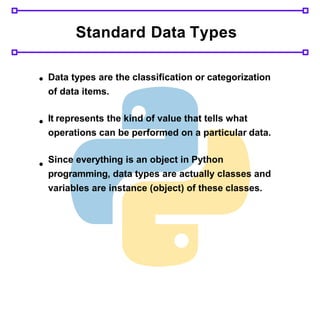
This document summarizes Python's standard data types including numbers, strings, lists, tuples, and dictionaries. It describes that in Python, data types are classes and variables are objects of those classes. It provides examples of how to define number variables and delete number object references. It also explains that strings can be defined using single or double quotes and how string slicing and concatenation works using indexes and operators.

![Python Numbers
Number data types store numeric values. Number
objects are created when you assign a value to
them.
For example −
var1 = 1
var2 = 10
You can also delete the reference to a number
object by using the del statement. The syntax of
the del statement is :-
del var1[,var2[,var3[....,varN]]]]
You can delete a single object or multiple objects
by using the del statement.
For example
del var
del var_a, var_b](https://image.slidesharecdn.com/standard-data-types-in-py-210929061550/85/Standard-data-types-in-py-4-320.jpg)
![Python Strings
Strings in Python are identified as a contiguous set of
characters represented in the quotation marks.
Python allows for either pairs of single or double
quotes. Subsets of strings can be taken using the slice
operator ([ ] and [:] ) with indexes starting at 0 in the
beginning of the string and working their way from -1 at
the end.](https://image.slidesharecdn.com/standard-data-types-in-py-210929061550/85/Standard-data-types-in-py-5-320.jpg)
![print str
print str[0]
print str[2:5]
print str[2:]
print str * 2
# Prints complete string
# Prints first character of the string
# Prints characters starting from 3rd to 5th #
Prints string starting from 3rd character #
Prints string two times
print str + "TEST" # Prints concatenated string
The plus (+) sign is the string concatenation
operator and the asterisk (*) is the repetition
operator.
For example
#!/usr/bin/python
str = 'Hello World!'](https://image.slidesharecdn.com/standard-data-types-in-py-210929061550/85/Standard-data-types-in-py-6-320.jpg)