GUJARAT INSTITUTE OF
EDUCATION AND
RESEARCH,AHMEDABAD.
MAJOR STAKE HOLDERS IN HEALTH CARE SYSTEM
PREPARED BY;
MS. Stephy Christian
F.Y. M.Sc. NURSING STUDENT
ROLL NO:20
GINERA
DEFINITION
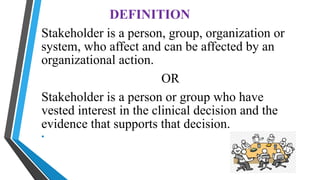
Stakeholder is a person, group, organization or
system, who affect and can be affected by an
organizational action.
OR
Stakeholder is a person or group who have
vested interest in the clinical decision and the
evidence that supports that decision.
•
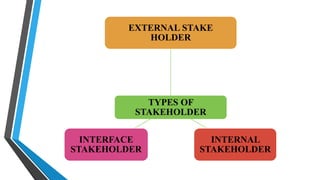
TYPES OF
STAKEHOLDER
EXTERNAL STAKE
HOLDER
INTERNAL
STAKEHOLDER
INTERFACE
STAKEHOLDER
EXTERNAL STAKEHOLDER: THEY
RESPOND TO LARGE NUMBER OF
EXTERNAL STAKEHOLDERS. THEY ARE
OF THREE TYPES.
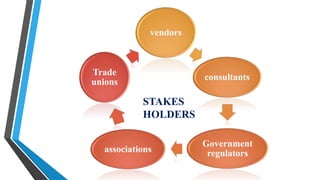
vendors
consultants
Government
regulators
associations
Trade
unions
STAKES
HOLDERS
THERE ARE THREE TYPES OF EXTERNAL
STAKE HOLDER
THOSE THAT PROVIDE INPUTS TO
ORGANIZATION:
• The relationship between the organizational and these external
stake holders are a symbolic one , as an organization depends
on them for its survival.
•There is a mutual understanding between organization
and stakeholder.
THOSE THAT COMPETE WITH
ORGANIZATION
 The competitor may be direct competitor for
patients or competing personnel.
Competitor does not need one another to survive
THOSE THAT HAVE PARTICULAR SPECIAL
INTEREST
a)These are the government regulatory agencies
b)private accrediting associations
c)professional associations
d)labor unions
e)The media
f)Political action group .
INTERFACE STAKEHOLDER:
some stake holders function on the interface
between the organization and its environment.
INTERNAL STAKEHOLDER
Internal stakeholders are almost entirely within the
organization and typically include management,
professional and non-professional staff.
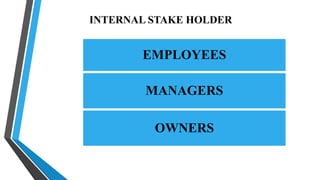
EMPLOYEES
MANAGERS
OWNERS
INTERNAL STAKE HOLDER
ACCORDING TO AVAILABILITY IN AN
ORGANIZATION THERE ARE TWO TYPES OF
STAKEHOLDERS
•PRIMARY STAKEHOLDERS: the primary stakeholders
are engaged to economic transactions with the business.
•SECONDARY STAKEHOLDERS: the secondary
stakeholders are the one who although do not engage in
direct economic exchange business.
ACCORDING TO INVOLVEMENT IN AN
ORGANIZATION THERE ARE TWO TYPES OF
STAKEHOLDERS:
People who will be affected by an enterprise and can
influence but who are not directly involved with doing
the work.
TYPES OF STAKEHOLDERS IN HEALTH
CARE SYSTEM:
GOVERNMENTAL
PUBLIC
PROVIDERS
HOPSITALADMINISTRATORS AND GOVERNING BOARD
NON-GOVERNMENTAL
GOVERNMENTAL
AT CENTRAL LEVEL:
• ENSURING HIGH LEVEL OF EXECUTIVE MANAGEMENT
PERFORMANCE.
• ENSURING QUALITY OF PATIENT -CARE.
• ENSURING FINANCIAL HEALTH OF THE
ORGANIZATION.
• ASSUMING RESPONSIBILITY FOR ITSELF.
• FORMULATING POLICY TO GUIDE DECISION
MAKING AND ACTION.
• MAKING DECISION EITHER BY RETAINING
AUTHORITY WITH RESPECT TO ITS AUTHORITY TO
OTHERS.
• PERFORMING OVERSIGHT BY MONITORING
DECISION AND ACTION TO MAKE SURE THEY ARE IN
COMPLIANCE WITH POLICIES.
AT STATE LEVEL:
THE FUNCTIONS ARE:
• INTEGRATING HEALTHCARE SERVICES.
• DURING INTEGRATION THE STATE LEVEL
ADMINISTRATION MAY HAVE OVERCOME MANY
BARRIERS IN INTEGRATION OF HEALTH SERVICES
• AVAILABILITY OF MEDICAL FACILITIES.
• PLAN HEALTH PROGRAMS AND DRAWING POLICES IN
PROVIDING HEALTH CARE.
• PROVISION OF MEDICINES.
AT DISTRICT LEVEL:
•The district level stakeholders in healthcare delivery
system are deputy commissioner, MLAs of the area,
civil surgeon, senior medical officers and district
public health nurse.
PUBLIC
The public has a stake in health care from several perspectives.
As consumers of health care services or as patients, the public is
concerned with quality, cost and assess to care.
People expect an employer to offer a wide variety of options for
health coverage that can be customized to their specific needs.
They also look for the employs to fund the majority of cost of
health insurance.
PROVIDER
Community health care professional
Hospital health centers
COMMUNITY HEALTH CARE
PROFESSIONAL
• NURSES
• HEALTH WORKERS
• DAIS
• DOCTORS OF THE COMMUNITY HEALTH CENTER
• VOLUNTARY HEALTH WORKERS ETC.
HOSPITAL HEALTH CENTERS
• PHYSICIANS
• NURSES
• PHARMACIST
HOSPITALADMINISTRATORS AND
GOVERNING BOARD
• THE CHIEF EXECUTIVE, CHIEF FINANCIAL OFFICER,
CHIEF NURSING OFFICER, AND GOVERNING BOARD
OF HOSPITALS STRONGLY INFLUENCE HEALTH CARE
DELIVERY IN THEIR INSTITUTIONS.
NON-GOVERNMENTAL
The voluntary agencies occupy an important place in
community health care system.
These organizations directly or indirectly act as stakeholder.
These organizations are administered by autonomous
boards which hold meetings, collect funds from private
sources and spend money for providing health services and
health education to individual, family and Community.
There are many NGO’S in India which serves
to society. Some of these organizations are
given below:
 Indian Red Cross Society
 Hindu Kusht Nivaran Sangh
 Indian Council for Child Welfare
 Tuberculosis Association of India
 Bharat Sevak Samaj
 The Kasturba Memorial Fund
 All India Women Conference
 The All-India Blind Relief Society
 Professional Bodies
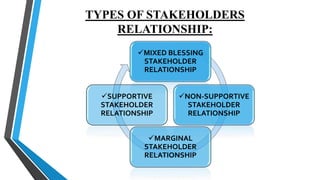
TYPES OF STAKEHOLDERS
RELATIONSHIP:
MIXED BLESSING
STAKEHOLDER
RELATIONSHIP
NON-SUPPORTIVE
STAKEHOLDER
RELATIONSHIP
MARGINAL
STAKEHOLDER
RELATIONSHIP
SUPPORTIVE
STAKEHOLDER
RELATIONSHIP
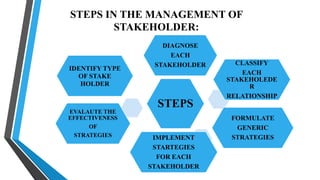
STEPS IN THE MANAGEMENT OF
STAKEHOLDER:
STEPS
DIAGNOSE
EACH
STAKEHOLDER CLASSIFY
EACH
STAKEHOLEDE
R
RELATIONSHIP
FORMULATE
GENERIC
STRATEGIES
IMPLEMENT
STARTEGIES
FOR EACH
STAKEHOLDER
EVALAUTE THE
EFFECTIVENESS
OF
STRATEGIES
IDENTIFY TYPE
OF STAKE
HOLDER
IDENTIFY TYPE OF STAKEHOLDER:
• Identify the major stakeholder and recognizes
the function depicted to them.
DIAGNOSE EACH STAKEHOLDER
RELATIONSHIP:
I.STAKEHOLDER POTENTIAL FOR THREAT
II. STAKEHOLDER POTENTIAL FOR CO-
OPERATION
CLASSIFY EACH STAKEHOLDER
RELATIONSHIP:
• MIXED BLESSING STAKEHOLDER RELATIONSHIP.
• SUPPORTIVE STAKEHOLDER RELATIONSHIP.
• NON-SUPPORTIVE STAKEHOLDER RELATIONSHIP.
• MARGINAL STAKEHOLDER RELATIONSHIP.
FORMULATE THE STRATEGIES TO REDUCE STAKEHOLDER’S
POTENTIAL TO THREAT:
Collaborate cautiously in the mixed blessing
relationship:
The best way to manage the mixed blessing relationship,
high on the dimensions of both potential threat & potential
co-operation may be cautious collaboration.
DEFEND PRO-ACTIVELY IN THE NON-SUPPORTIVE
RELATIONSHIP:
• IN STAKEHOLDER TERMS, A DEFENSIVE STRATEGY
INVOLVES PROACTIVELY PREVENTING THE
STAKEHOLDER FROM IMPOSING COST OR OTHER
DISINCENTIVES ON THE ORGANIZATION.
MONITOR EFFICIENTLY IN MARGINAL
RELATIONSHIPS:
 MONITORING HELPS TO MANAGE THIS MARGINAL
RELATIONSHIP IN WHICH THE POTENTIAL FOR
BOTH THREAT AND CO-OPERATION IS LOW.
IMPLEMENTATION OF STRATEGIES AND
EVALUATION
•The fifth step of management of stakeholder
relationship is implementation of planned and
articulated strategies.
•Thank you !

Stakeholder

  • 1.
    GUJARAT INSTITUTE OF EDUCATIONAND RESEARCH,AHMEDABAD. MAJOR STAKE HOLDERS IN HEALTH CARE SYSTEM PREPARED BY; MS. Stephy Christian F.Y. M.Sc. NURSING STUDENT ROLL NO:20 GINERA
  • 2.
    DEFINITION Stakeholder is aperson, group, organization or system, who affect and can be affected by an organizational action. OR Stakeholder is a person or group who have vested interest in the clinical decision and the evidence that supports that decision. •
  • 3.
  • 4.
    EXTERNAL STAKEHOLDER: THEY RESPONDTO LARGE NUMBER OF EXTERNAL STAKEHOLDERS. THEY ARE OF THREE TYPES.
  • 5.
  • 6.
    THERE ARE THREETYPES OF EXTERNAL STAKE HOLDER THOSE THAT PROVIDE INPUTS TO ORGANIZATION: • The relationship between the organizational and these external stake holders are a symbolic one , as an organization depends on them for its survival. •There is a mutual understanding between organization and stakeholder.
  • 7.
    THOSE THAT COMPETEWITH ORGANIZATION  The competitor may be direct competitor for patients or competing personnel. Competitor does not need one another to survive
  • 8.
    THOSE THAT HAVEPARTICULAR SPECIAL INTEREST a)These are the government regulatory agencies b)private accrediting associations c)professional associations d)labor unions e)The media f)Political action group .
  • 9.
    INTERFACE STAKEHOLDER: some stakeholders function on the interface between the organization and its environment.
  • 10.
    INTERNAL STAKEHOLDER Internal stakeholdersare almost entirely within the organization and typically include management, professional and non-professional staff.
  • 11.
  • 12.
    ACCORDING TO AVAILABILITYIN AN ORGANIZATION THERE ARE TWO TYPES OF STAKEHOLDERS •PRIMARY STAKEHOLDERS: the primary stakeholders are engaged to economic transactions with the business. •SECONDARY STAKEHOLDERS: the secondary stakeholders are the one who although do not engage in direct economic exchange business.
  • 13.
    ACCORDING TO INVOLVEMENTIN AN ORGANIZATION THERE ARE TWO TYPES OF STAKEHOLDERS: People who will be affected by an enterprise and can influence but who are not directly involved with doing the work.
  • 14.
    TYPES OF STAKEHOLDERSIN HEALTH CARE SYSTEM: GOVERNMENTAL PUBLIC PROVIDERS HOPSITALADMINISTRATORS AND GOVERNING BOARD NON-GOVERNMENTAL
  • 15.
    GOVERNMENTAL AT CENTRAL LEVEL: •ENSURING HIGH LEVEL OF EXECUTIVE MANAGEMENT PERFORMANCE. • ENSURING QUALITY OF PATIENT -CARE. • ENSURING FINANCIAL HEALTH OF THE ORGANIZATION.
  • 16.
    • ASSUMING RESPONSIBILITYFOR ITSELF. • FORMULATING POLICY TO GUIDE DECISION MAKING AND ACTION. • MAKING DECISION EITHER BY RETAINING AUTHORITY WITH RESPECT TO ITS AUTHORITY TO OTHERS. • PERFORMING OVERSIGHT BY MONITORING DECISION AND ACTION TO MAKE SURE THEY ARE IN COMPLIANCE WITH POLICIES.
  • 17.
    AT STATE LEVEL: THEFUNCTIONS ARE: • INTEGRATING HEALTHCARE SERVICES. • DURING INTEGRATION THE STATE LEVEL ADMINISTRATION MAY HAVE OVERCOME MANY BARRIERS IN INTEGRATION OF HEALTH SERVICES • AVAILABILITY OF MEDICAL FACILITIES. • PLAN HEALTH PROGRAMS AND DRAWING POLICES IN PROVIDING HEALTH CARE. • PROVISION OF MEDICINES.
  • 18.
    AT DISTRICT LEVEL: •Thedistrict level stakeholders in healthcare delivery system are deputy commissioner, MLAs of the area, civil surgeon, senior medical officers and district public health nurse.
  • 19.
    PUBLIC The public hasa stake in health care from several perspectives. As consumers of health care services or as patients, the public is concerned with quality, cost and assess to care. People expect an employer to offer a wide variety of options for health coverage that can be customized to their specific needs. They also look for the employs to fund the majority of cost of health insurance.
  • 20.
    PROVIDER Community health careprofessional Hospital health centers
  • 21.
    COMMUNITY HEALTH CARE PROFESSIONAL •NURSES • HEALTH WORKERS • DAIS • DOCTORS OF THE COMMUNITY HEALTH CENTER • VOLUNTARY HEALTH WORKERS ETC.
  • 22.
    HOSPITAL HEALTH CENTERS •PHYSICIANS • NURSES • PHARMACIST
  • 23.
    HOSPITALADMINISTRATORS AND GOVERNING BOARD •THE CHIEF EXECUTIVE, CHIEF FINANCIAL OFFICER, CHIEF NURSING OFFICER, AND GOVERNING BOARD OF HOSPITALS STRONGLY INFLUENCE HEALTH CARE DELIVERY IN THEIR INSTITUTIONS.
  • 24.
    NON-GOVERNMENTAL The voluntary agenciesoccupy an important place in community health care system. These organizations directly or indirectly act as stakeholder. These organizations are administered by autonomous boards which hold meetings, collect funds from private sources and spend money for providing health services and health education to individual, family and Community.
  • 25.
    There are manyNGO’S in India which serves to society. Some of these organizations are given below:  Indian Red Cross Society  Hindu Kusht Nivaran Sangh  Indian Council for Child Welfare  Tuberculosis Association of India  Bharat Sevak Samaj
  • 26.
     The KasturbaMemorial Fund  All India Women Conference  The All-India Blind Relief Society  Professional Bodies
  • 27.
    TYPES OF STAKEHOLDERS RELATIONSHIP: MIXEDBLESSING STAKEHOLDER RELATIONSHIP NON-SUPPORTIVE STAKEHOLDER RELATIONSHIP MARGINAL STAKEHOLDER RELATIONSHIP SUPPORTIVE STAKEHOLDER RELATIONSHIP
  • 28.
    STEPS IN THEMANAGEMENT OF STAKEHOLDER: STEPS DIAGNOSE EACH STAKEHOLDER CLASSIFY EACH STAKEHOLEDE R RELATIONSHIP FORMULATE GENERIC STRATEGIES IMPLEMENT STARTEGIES FOR EACH STAKEHOLDER EVALAUTE THE EFFECTIVENESS OF STRATEGIES IDENTIFY TYPE OF STAKE HOLDER
  • 29.
    IDENTIFY TYPE OFSTAKEHOLDER: • Identify the major stakeholder and recognizes the function depicted to them.
  • 30.
    DIAGNOSE EACH STAKEHOLDER RELATIONSHIP: I.STAKEHOLDERPOTENTIAL FOR THREAT II. STAKEHOLDER POTENTIAL FOR CO- OPERATION
  • 31.
    CLASSIFY EACH STAKEHOLDER RELATIONSHIP: •MIXED BLESSING STAKEHOLDER RELATIONSHIP. • SUPPORTIVE STAKEHOLDER RELATIONSHIP. • NON-SUPPORTIVE STAKEHOLDER RELATIONSHIP. • MARGINAL STAKEHOLDER RELATIONSHIP.
  • 32.
    FORMULATE THE STRATEGIESTO REDUCE STAKEHOLDER’S POTENTIAL TO THREAT: Collaborate cautiously in the mixed blessing relationship: The best way to manage the mixed blessing relationship, high on the dimensions of both potential threat & potential co-operation may be cautious collaboration.
  • 33.
    DEFEND PRO-ACTIVELY INTHE NON-SUPPORTIVE RELATIONSHIP: • IN STAKEHOLDER TERMS, A DEFENSIVE STRATEGY INVOLVES PROACTIVELY PREVENTING THE STAKEHOLDER FROM IMPOSING COST OR OTHER DISINCENTIVES ON THE ORGANIZATION.
  • 34.
    MONITOR EFFICIENTLY INMARGINAL RELATIONSHIPS:  MONITORING HELPS TO MANAGE THIS MARGINAL RELATIONSHIP IN WHICH THE POTENTIAL FOR BOTH THREAT AND CO-OPERATION IS LOW.
  • 35.
    IMPLEMENTATION OF STRATEGIESAND EVALUATION •The fifth step of management of stakeholder relationship is implementation of planned and articulated strategies.
  • 36.