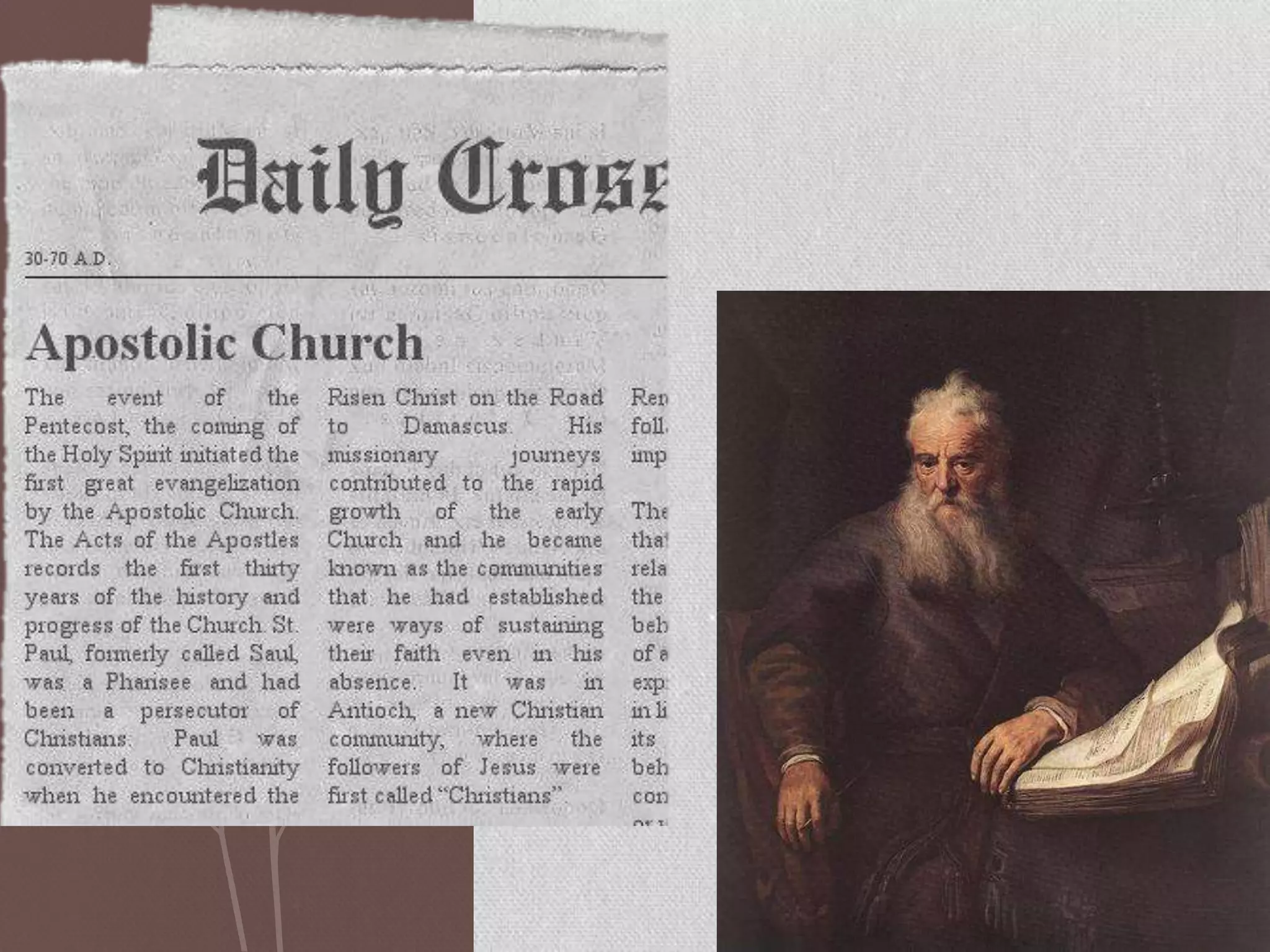
ST. PAUL
Biography
• St. Paul, the indefatigable Apostle of the Gentiles
• He was converted from Judaism on the road to Damascus. He
  remained in Damascus after his baptism, and preaches the good
  news.
• He then went to Jerusalem to see Peter and pay his homage to the
  head of the Church.
• Later, he went back to Tarsus to evangelize his own province until
  called by Barnabus to Antioch. After one year, on the occasion of a
  famine, both Barnabus and Paul were sent with alms to the poor
  Christian community at Jerusalem. Having fulfilled their mission
  they returned to Antioch.
Letters
• 1 Corinthians:
 Paul's letters to the Corinthians reveal how difficult it must have been as a
  small Christian community to live in the midst of an extremely numerous
  pagan environment.
• 2 Corinthians:
 Paul continues to address the people of Corinth, sometime during the
  years 55-57, after he was released initially from Rome
• Ephesians:
 Likely written in the years 61-63, from prison, while in Rome,
• Philippians:
 An example of Paul's affection and tenderness for the early Church that he
  Founded during his second missionary journey in 50 A.D
Letters
• Colossians:
    Written while in captivity in Rome during the years 61-63 A.D., St. Paul is
     Instructing the Church in Colossae in regards to certain specific errors
     concerning Christ's Supreme nature.
• 1 Thessalonians:
        Acknowledged as the first piece of New Testament literature
•       2 Thessalonians:
        warns the people of Thessalonia against living in idleness and failing to
         work for one's own living Philemon: The shortest of Paul's letters
• 1, 2 Timothy & Titus:
     The two epistles to Timothy and one to Titus offer the early Church
      pastoral instructions in regards to organizing and administrating the
      communities.
Letters
• 2 Thessalonians:
 warns the people of Thessalonia against living in idleness and failing to
  work for one's own living
• Philemon:
  The shortest of Paul's letters
Journey
• After the Ascension of Jesus and has received the Holy Spirit, St. Paul
  started to spread the Word of God.
• In the spreading of the Word of God, he went in three journeys across
  the known world. The first journey was led by Barnabas, which led St.
  Paul from Anatolia to Cyprus and to Asia Minor. This is found in Acts
  13-14. Luke,
• Timothy & Silas, accompanied the second journey. They revisited all
  the churches that were established in the Asia Minor during the first
  journey then sailed for Europe.
• On the third, he revisited almost all the places from the second
  journey but at Ephesus, he stayed for 3 years and made it his center of
  missionary activity.
Journey
• 1st missionary journey:
  Paul and Barnabus made the first missionary journey, visiting the island of
   Cypress, then Pamphylia, Pisidia, and Lycaonia, all in Asia Minor, and
   establishing churches at Pisidian Antioch, Iconium, Lystra, and Derbe.
• 2nd missionary journey:
  After the Apostolic Council of Jerusalem Paul, accompanied by Silas and
   later also by Timothy and Luke, made his second missionary journey, first
   revisiting the churches previously established by him in Asia Minor, and
   then passing through Galatia. He accordingly sailed for Europe, and
   preached the Gospel in Philippi. Thessalonica, Beroea, Athens, and
   Corinth. Then he returned to Antioch by way of Ephesus and Jerusalem.
Journey
• 3rd missionary journey:
  Made Ephesus where he nearly remained for three years, the center of
   his missionary activity. He had another plan to leave Jerusalem for
  Rome. Jews hindered him from accomplishing his purpose. Sooner, he
   reached Rome.
  St. Paul was released from his Roman imprisonment, and then traveled to
   Spain, later to the East again, and then back to Rome, where he was
   imprisoned a second time and in the year 67, was beheaded.
  In his Epistles, St. Paul shows himself to be a profound religious thinker
   and he has had an enduring formative influence in the development of
   Christianity. The centuries only make more apparent his greatness of
   mind and spirit. His feast day is June 29th.
Contributions
• St. Paul contributed to the rapid growth of the early Church and he
  became known as the communities that he had established were
  ways of sustaining their faith even in his absence.
• It was in Antioch, a new Christian community, where the followers
  of Jesus were first called “Christians”.
Christian communities that ST. Paul visited
• He visited the Christian communities in Syria, Cilicia and Lycaonia,
  then Galatia, Phyrgia and Mysia, Macedonia and Philippi.
• In Philippi Saint Paul founded the first Christian community in
  Europe. In this town him and his companion Silas were beaten and
  cast into prison from where they miraculously escaped at midnight.
• From Philippi he left for Thessalonica where Saint Paul and his
  followers preached both to the Jews and the Greeks.
• Numerous Greeks, Romans and even Jews were then converted to
  the Christian faith.
Christian communities that ST. Paul visited
• The community in Thessalonica was founded on the second
  missionary journey.
• This town was at that time an important port on the shore of the
  Aegean Sea and was also an important commercial center on the
  road (Via Egnatia) which connected Rome with the Orient. It had
  100,000 inhabitants: Greeks, Romans and Jews who had a
  synagogue and a well established community.
• The city had been reconstructed by Cassander (315 B.C.), the son-in-
  law of Philip II, the king of Macedonia. The town had its name from
  Cassander’s wife, the sister of Alexander the Great, whose name
  was Tessalonica. Thus the settlement changed its name from
  Thermae to Tessalonica.
• Later the city became prosperous and the capital of Macedonia
  moved here.
Christian communities that ST. Paul visited
• From here Paul left for Athens where he converted Dionysius the
  Areopagite, and a woman named Damaris and even the religious
  leader of the Jewish community in town.

St. Paul

  • 1.
  • 2.
    Biography • St. Paul,the indefatigable Apostle of the Gentiles • He was converted from Judaism on the road to Damascus. He remained in Damascus after his baptism, and preaches the good news. • He then went to Jerusalem to see Peter and pay his homage to the head of the Church. • Later, he went back to Tarsus to evangelize his own province until called by Barnabus to Antioch. After one year, on the occasion of a famine, both Barnabus and Paul were sent with alms to the poor Christian community at Jerusalem. Having fulfilled their mission they returned to Antioch.
  • 3.
    Letters • 1 Corinthians: Paul's letters to the Corinthians reveal how difficult it must have been as a small Christian community to live in the midst of an extremely numerous pagan environment. • 2 Corinthians: Paul continues to address the people of Corinth, sometime during the years 55-57, after he was released initially from Rome • Ephesians: Likely written in the years 61-63, from prison, while in Rome, • Philippians: An example of Paul's affection and tenderness for the early Church that he Founded during his second missionary journey in 50 A.D
  • 4.
    Letters • Colossians: Written while in captivity in Rome during the years 61-63 A.D., St. Paul is Instructing the Church in Colossae in regards to certain specific errors concerning Christ's Supreme nature. • 1 Thessalonians:  Acknowledged as the first piece of New Testament literature • 2 Thessalonians:  warns the people of Thessalonia against living in idleness and failing to work for one's own living Philemon: The shortest of Paul's letters • 1, 2 Timothy & Titus:  The two epistles to Timothy and one to Titus offer the early Church pastoral instructions in regards to organizing and administrating the communities.
  • 5.
    Letters • 2 Thessalonians: warns the people of Thessalonia against living in idleness and failing to work for one's own living • Philemon:  The shortest of Paul's letters
  • 6.
    Journey • After theAscension of Jesus and has received the Holy Spirit, St. Paul started to spread the Word of God. • In the spreading of the Word of God, he went in three journeys across the known world. The first journey was led by Barnabas, which led St. Paul from Anatolia to Cyprus and to Asia Minor. This is found in Acts 13-14. Luke, • Timothy & Silas, accompanied the second journey. They revisited all the churches that were established in the Asia Minor during the first journey then sailed for Europe. • On the third, he revisited almost all the places from the second journey but at Ephesus, he stayed for 3 years and made it his center of missionary activity.
  • 7.
    Journey • 1st missionaryjourney:  Paul and Barnabus made the first missionary journey, visiting the island of Cypress, then Pamphylia, Pisidia, and Lycaonia, all in Asia Minor, and establishing churches at Pisidian Antioch, Iconium, Lystra, and Derbe. • 2nd missionary journey:  After the Apostolic Council of Jerusalem Paul, accompanied by Silas and later also by Timothy and Luke, made his second missionary journey, first revisiting the churches previously established by him in Asia Minor, and then passing through Galatia. He accordingly sailed for Europe, and preached the Gospel in Philippi. Thessalonica, Beroea, Athens, and Corinth. Then he returned to Antioch by way of Ephesus and Jerusalem.
  • 8.
    Journey • 3rd missionaryjourney:  Made Ephesus where he nearly remained for three years, the center of his missionary activity. He had another plan to leave Jerusalem for  Rome. Jews hindered him from accomplishing his purpose. Sooner, he reached Rome.  St. Paul was released from his Roman imprisonment, and then traveled to Spain, later to the East again, and then back to Rome, where he was imprisoned a second time and in the year 67, was beheaded.  In his Epistles, St. Paul shows himself to be a profound religious thinker and he has had an enduring formative influence in the development of Christianity. The centuries only make more apparent his greatness of mind and spirit. His feast day is June 29th.
  • 9.
    Contributions • St. Paulcontributed to the rapid growth of the early Church and he became known as the communities that he had established were ways of sustaining their faith even in his absence. • It was in Antioch, a new Christian community, where the followers of Jesus were first called “Christians”.
  • 10.
    Christian communities thatST. Paul visited • He visited the Christian communities in Syria, Cilicia and Lycaonia, then Galatia, Phyrgia and Mysia, Macedonia and Philippi. • In Philippi Saint Paul founded the first Christian community in Europe. In this town him and his companion Silas were beaten and cast into prison from where they miraculously escaped at midnight. • From Philippi he left for Thessalonica where Saint Paul and his followers preached both to the Jews and the Greeks. • Numerous Greeks, Romans and even Jews were then converted to the Christian faith.
  • 11.
    Christian communities thatST. Paul visited • The community in Thessalonica was founded on the second missionary journey. • This town was at that time an important port on the shore of the Aegean Sea and was also an important commercial center on the road (Via Egnatia) which connected Rome with the Orient. It had 100,000 inhabitants: Greeks, Romans and Jews who had a synagogue and a well established community. • The city had been reconstructed by Cassander (315 B.C.), the son-in- law of Philip II, the king of Macedonia. The town had its name from Cassander’s wife, the sister of Alexander the Great, whose name was Tessalonica. Thus the settlement changed its name from Thermae to Tessalonica. • Later the city became prosperous and the capital of Macedonia moved here.
  • 12.
    Christian communities thatST. Paul visited • From here Paul left for Athens where he converted Dionysius the Areopagite, and a woman named Damaris and even the religious leader of the Jewish community in town.