A Chronological Study
Of His
Life and Epistles
Consenting unto Stephen’s Death – Acts 8:1, 22:20
Crucifixion and Resurrection of Jesus Chirst 33 AD
Death of King Aretas of Syria – 40 AD
Start of Claudius Caesar Emperor of Rome – 41 AD
Death of Herod Agrippa I – 44 AD
Porcius Festus succeds Felix as Procurator of Judea – 60 AD
Damascus Road – Acts 9:1-22
Approximately 37 AD
Barnabas’ Defense to the Skeptics - Acts 9:23-31
Between verses 22 and 23 is approx 3 years - Galatians 1:17-18
Let down over wall in basket because the Jews wanted to kill him.
Returns to Jerusalem and openly ministers
Grecians conspire to kill Saul
He is sent to Caesarea then to Tarsus
Remains there until Barnabas seeks him out – Acts 11:25
Ministers with Barnabas – Acts 11:25-30
Separated to Ministry - Acts 13:1-3 Between 41-44 AD
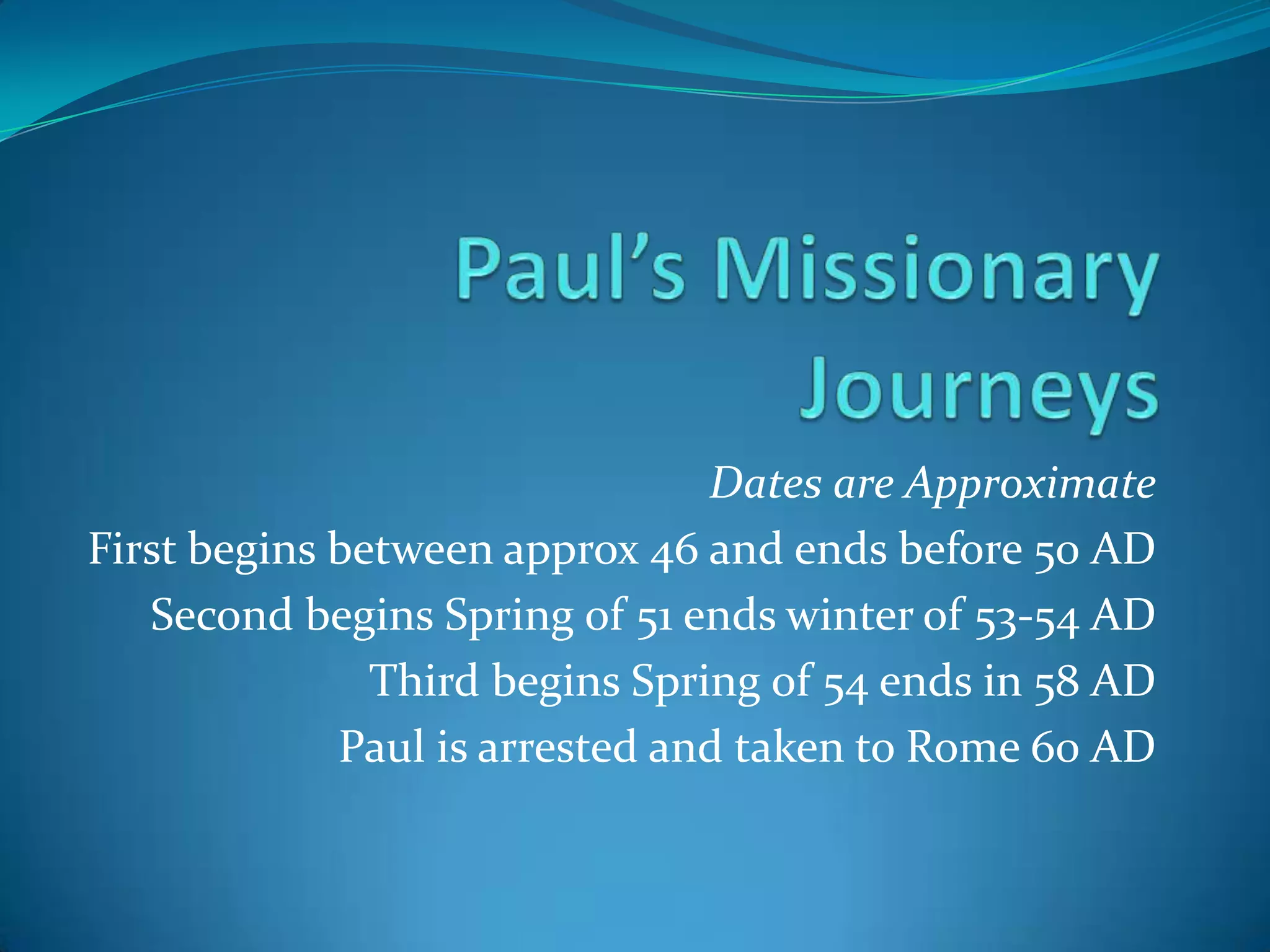
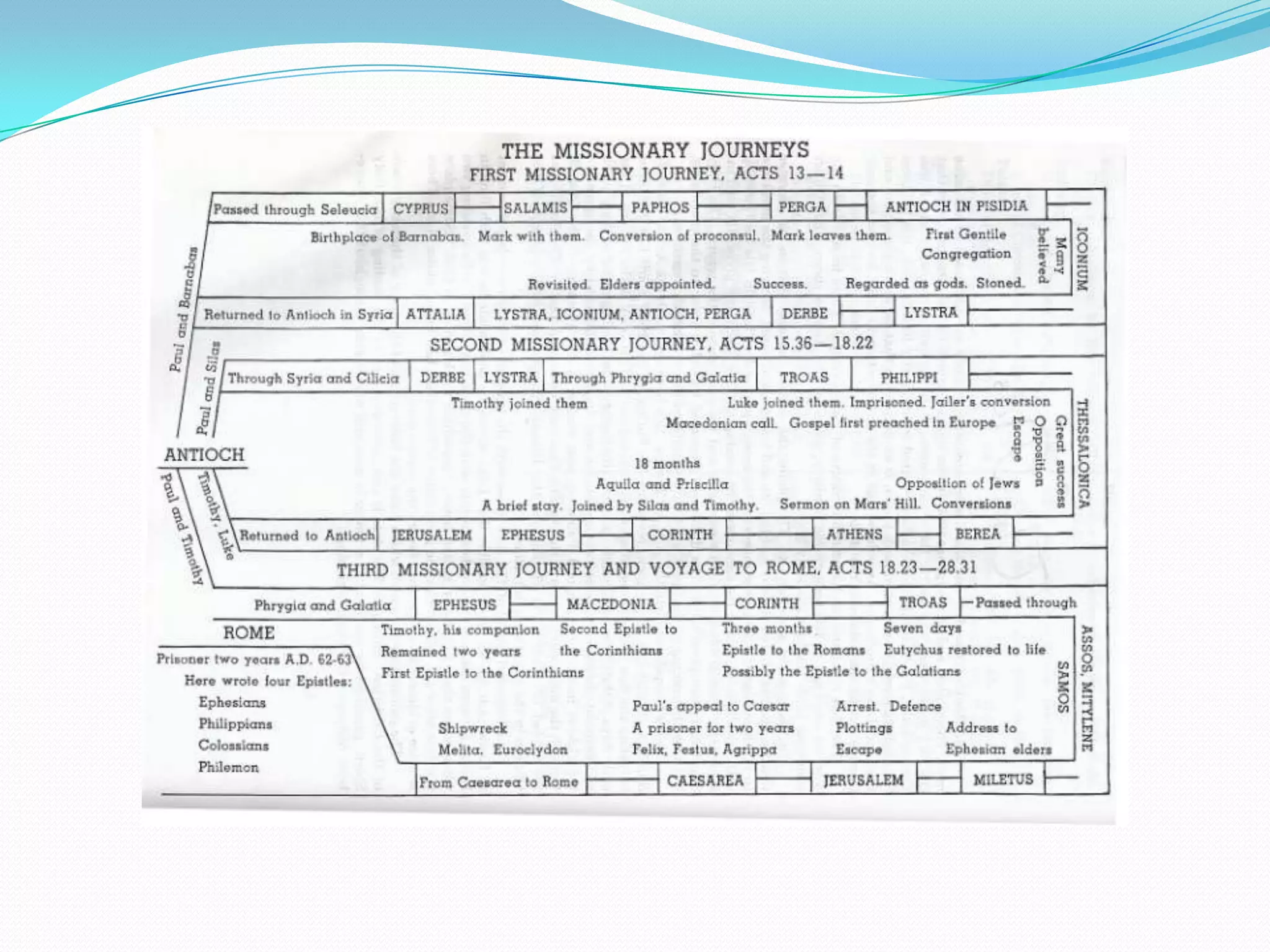
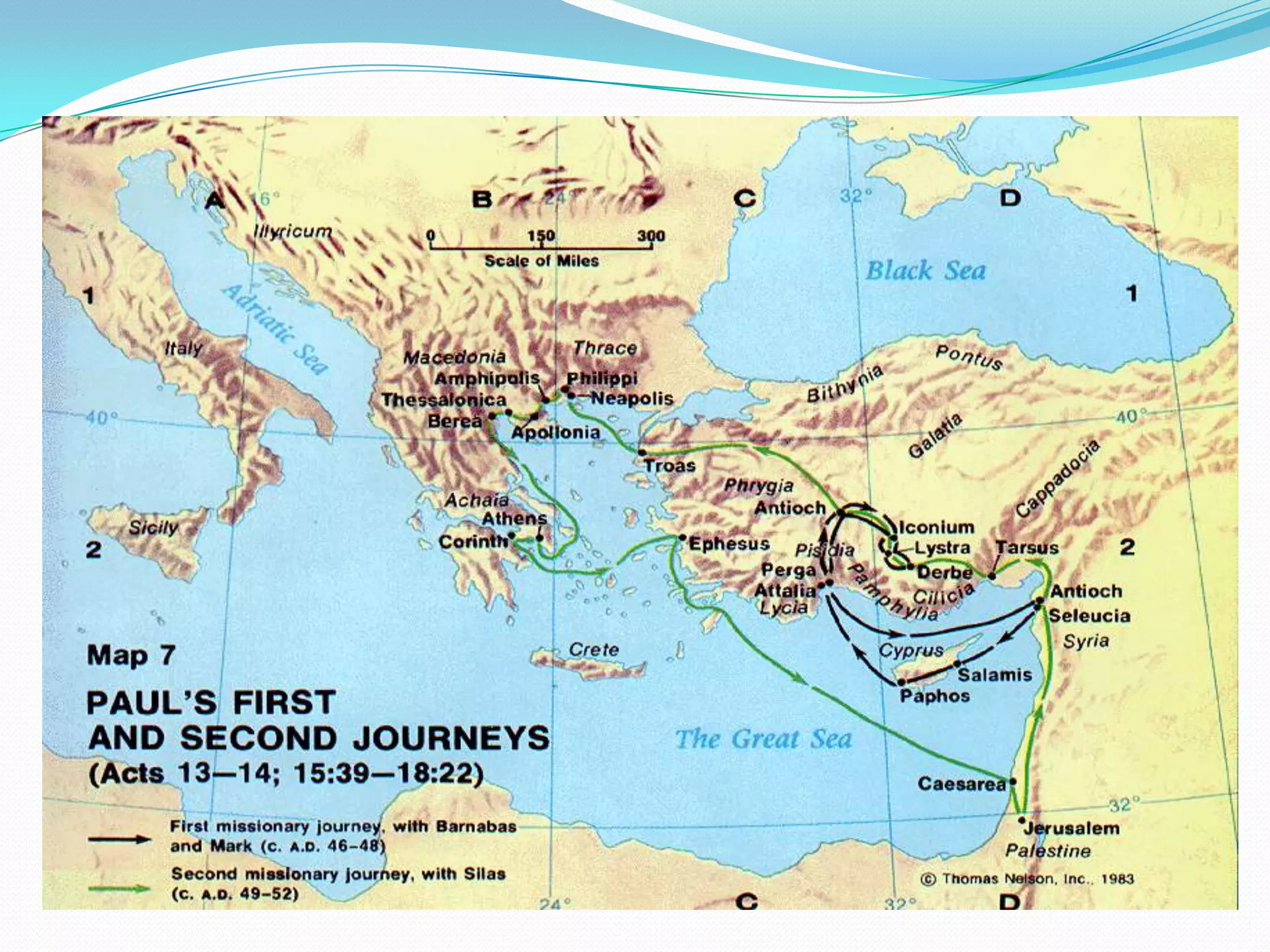
Dates are Approximate
First begins between approx 46 and ends before 50 AD
Second begins Spring of 51 ends winter of 53-54 AD
Third begins Spring of 54 ends in 58 AD
Paul is arrested and taken to Rome 60 AD
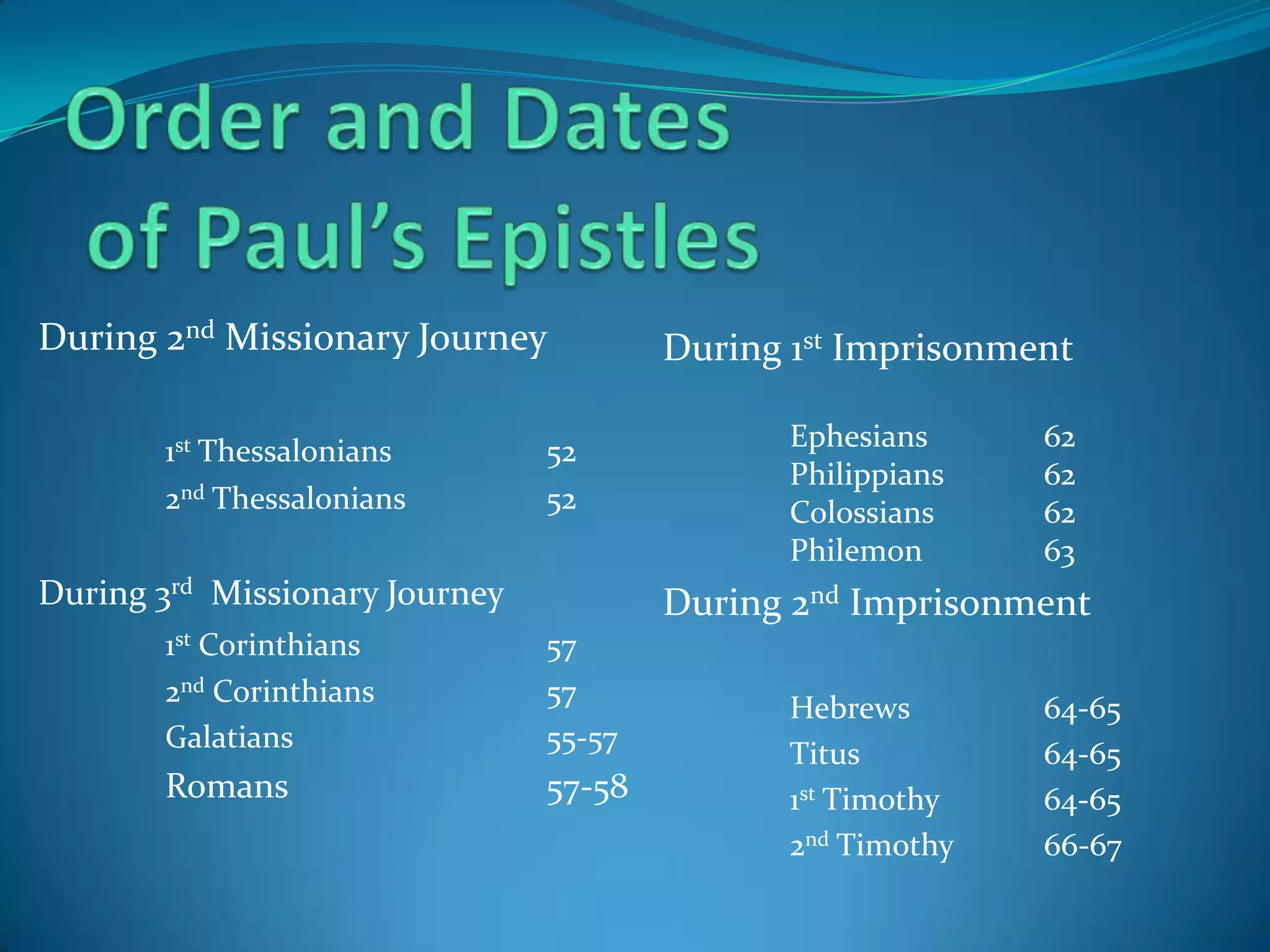
During 2nd Missionary Journey

During 1st Imprisonment

1st Thessalonians
2nd Thessalonians

Ephesians
Philippians
Colossians
Philemon

52
52

During 3rd Missionary Journey

62
62
62
63

During 2nd Imprisonment

1st Corinthians
2nd Corinthians
Galatians

55-57
55-57
55-57

Romans

57-58

Hebrews
Titus
1st Timothy
2nd Timothy

64-65
64-65
64-65
66-67
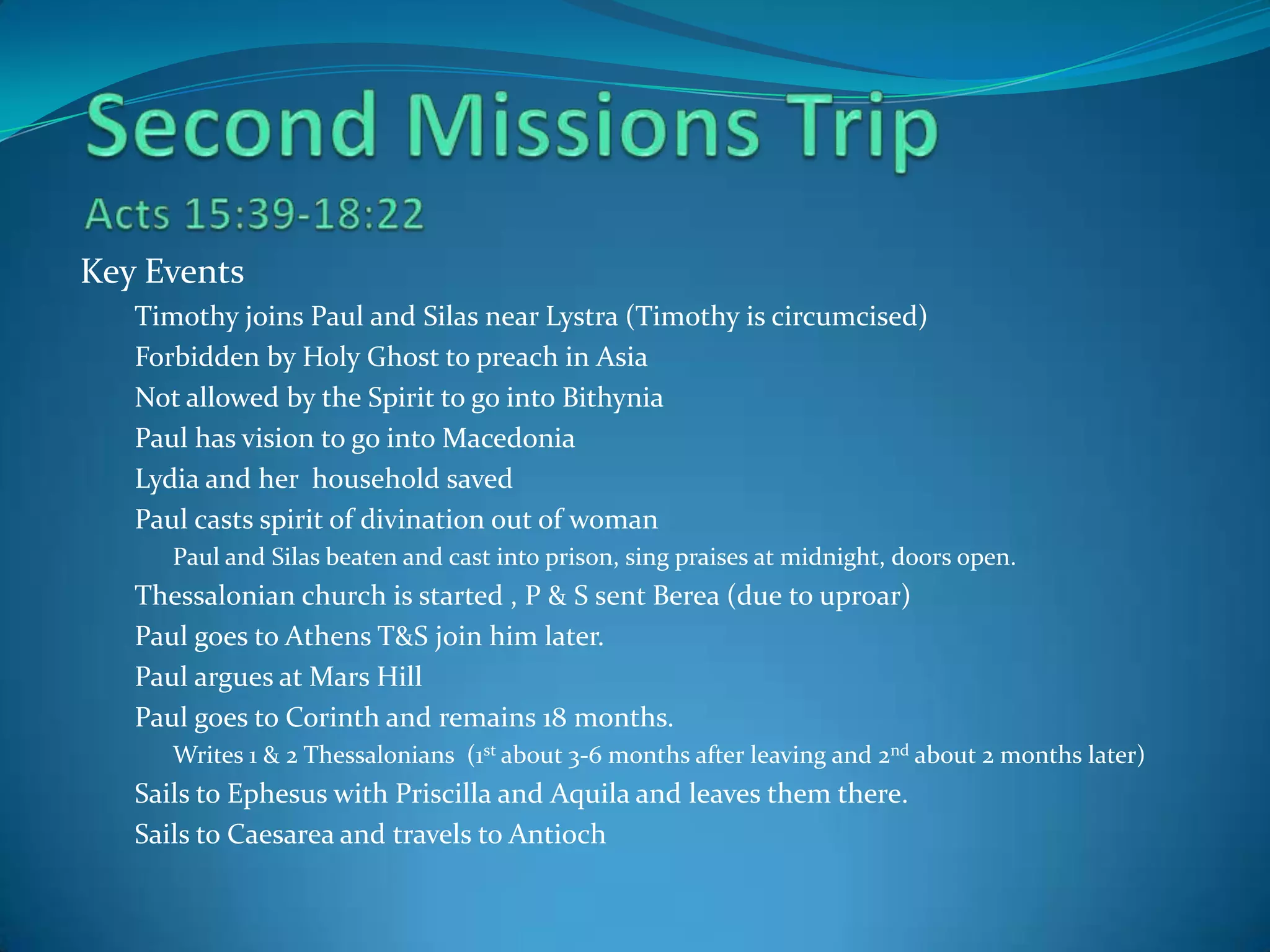
Key Events
Timothy joins Paul and Silas near Lystra (Timothy is circumcised)
Forbidden by Holy Ghost to preach in Asia
Not allowed by the Spirit to go into Bithynia
Paul has vision to go into Macedonia
Lydia and her household saved
Paul casts spirit of divination out of woman
Paul and Silas beaten and cast into prison, sing praises at midnight, doors open.

Thessalonian church is started , P & S sent Berea (due to uproar)
Paul goes to Athens T&S join him later.
Paul argues at Mars Hill
Paul goes to Corinth and remains 18 months.
Writes 1 & 2 Thessalonians (1st about 3-6 months after leaving and 2nd about 2 months later)

Sails to Ephesus with Priscilla and Aquila and leaves them there.
Sails to Caesarea and travels to Antioch
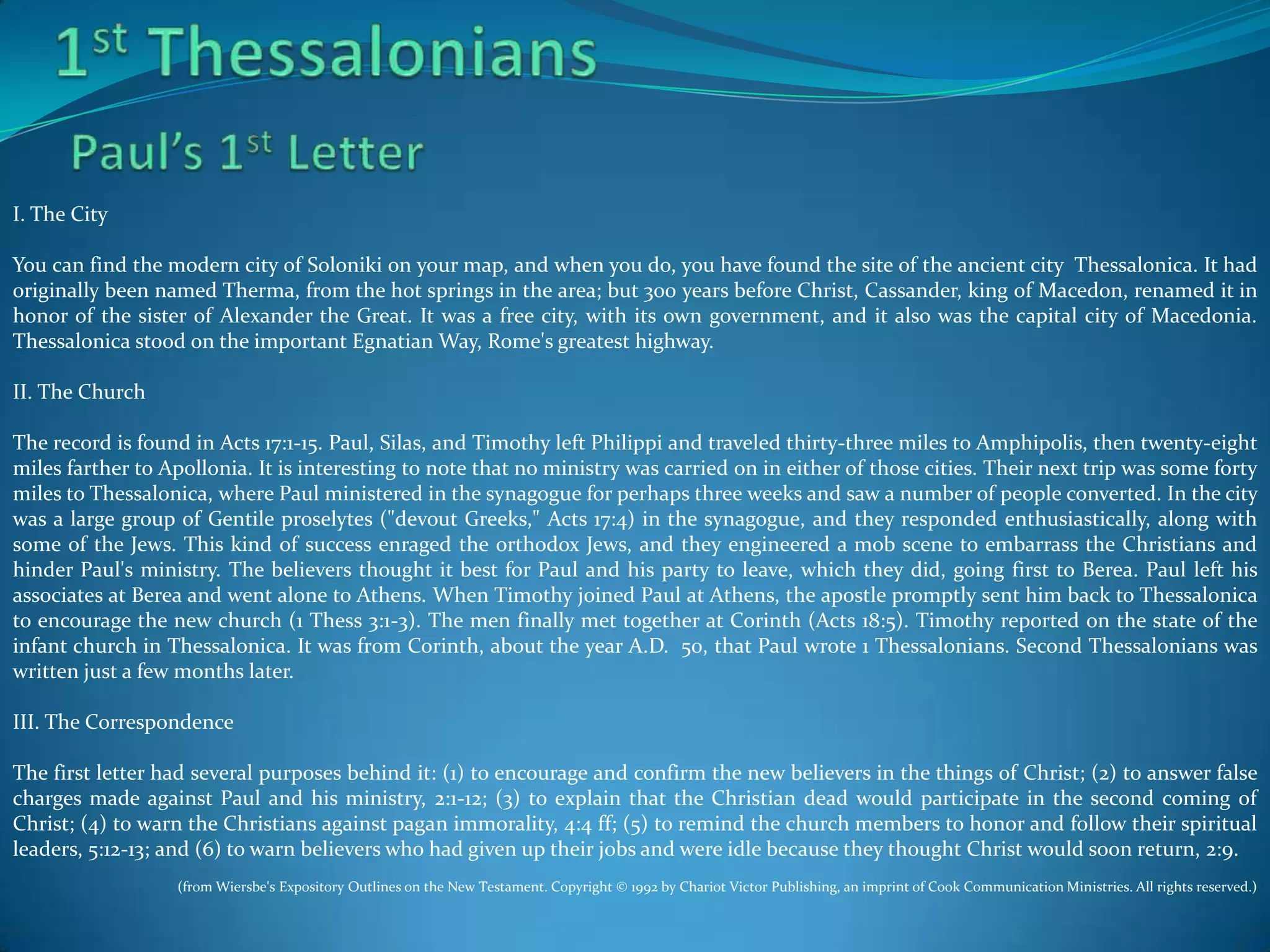
I. The City
You can find the modern city of Soloniki on your map, and when you do, you have found the site of the ancient city Thessalonica. It had
originally been named Therma, from the hot springs in the area; but 300 years before Christ, Cassander, king of Macedon, renamed it in
honor of the sister of Alexander the Great. It was a free city, with its own government, and it also was the capital city of Macedonia.
Thessalonica stood on the important Egnatian Way, Rome's greatest highway.
II. The Church
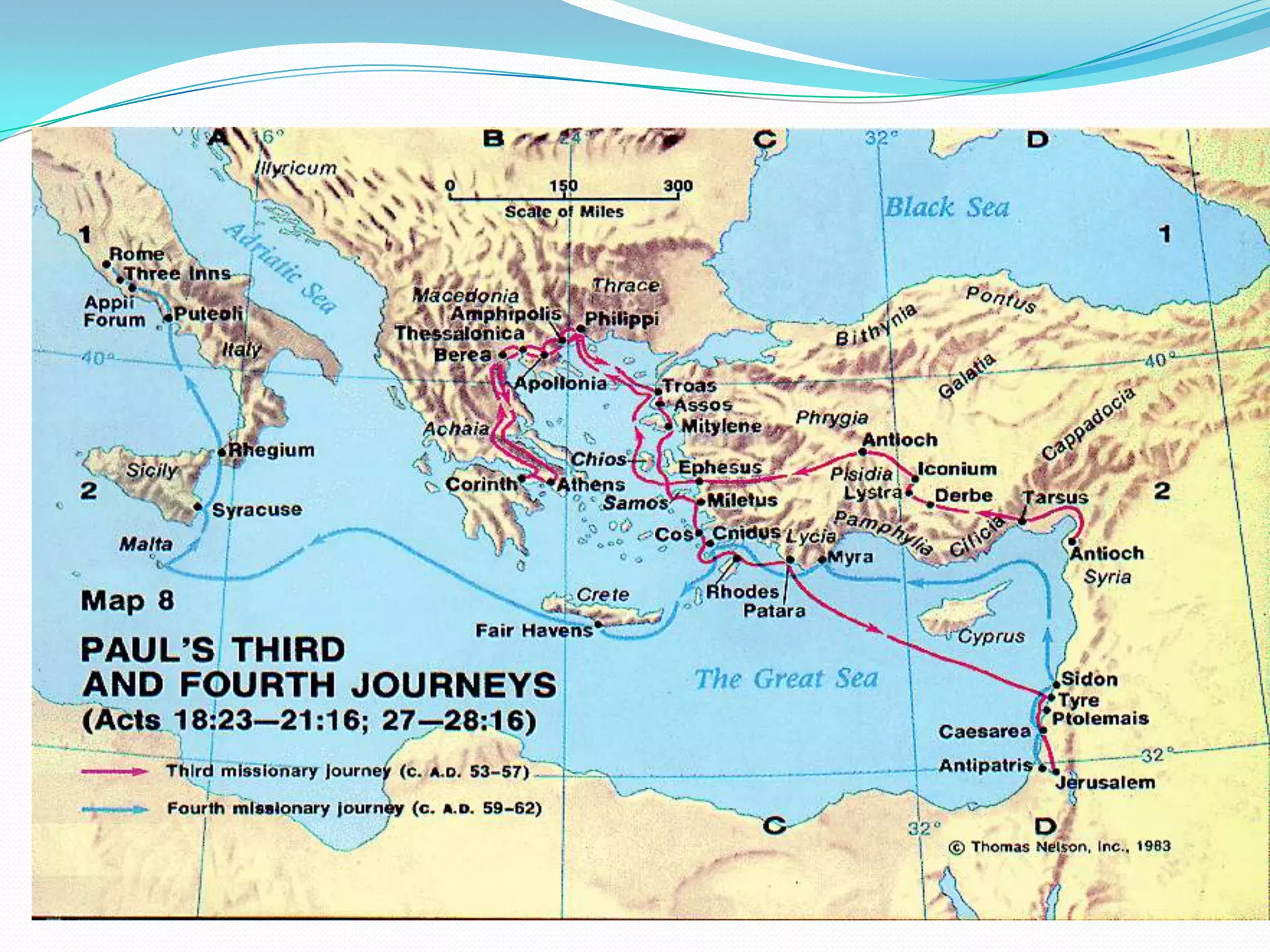
The record is found in Acts 17:1-15. Paul, Silas, and Timothy left Philippi and traveled thirty-three miles to Amphipolis, then twenty-eight
miles farther to Apollonia. It is interesting to note that no ministry was carried on in either of those cities. Their next trip was some forty
miles to Thessalonica, where Paul ministered in the synagogue for perhaps three weeks and saw a number of people converted. In the city
was a large group of Gentile proselytes ("devout Greeks," Acts 17:4) in the synagogue, and they responded enthusiastically, along with
some of the Jews. This kind of success enraged the orthodox Jews, and they engineered a mob scene to embarrass the Christians and
hinder Paul's ministry. The believers thought it best for Paul and his party to leave, which they did, going first to Berea. Paul left his
associates at Berea and went alone to Athens. When Timothy joined Paul at Athens, the apostle promptly sent him back to Thessalonica
to encourage the new church (1 Thess 3:1-3). The men finally met together at Corinth (Acts 18:5). Timothy reported on the state of the
infant church in Thessalonica. It was from Corinth, about the year A.D. 50, that Paul wrote 1 Thessalonians. Second Thessalonians was
written just a few months later.
III. The Correspondence
The first letter had several purposes behind it: (1) to encourage and confirm the new believers in the things of Christ; (2) to answer false
charges made against Paul and his ministry, 2:1-12; (3) to explain that the Christian dead would participate in the second coming of
Christ; (4) to warn the Christians against pagan immorality, 4:4 ff; (5) to remind the church members to honor and follow their spiritual
leaders, 5:12-13; and (6) to warn believers who had given up their jobs and were idle because they thought Christ would soon return, 2:9.
(from Wiersbe's Expository Outlines on the New Testament. Copyright © 1992 by Chariot Victor Publishing, an imprint of Cook Communication Ministries. All rights reserved.)
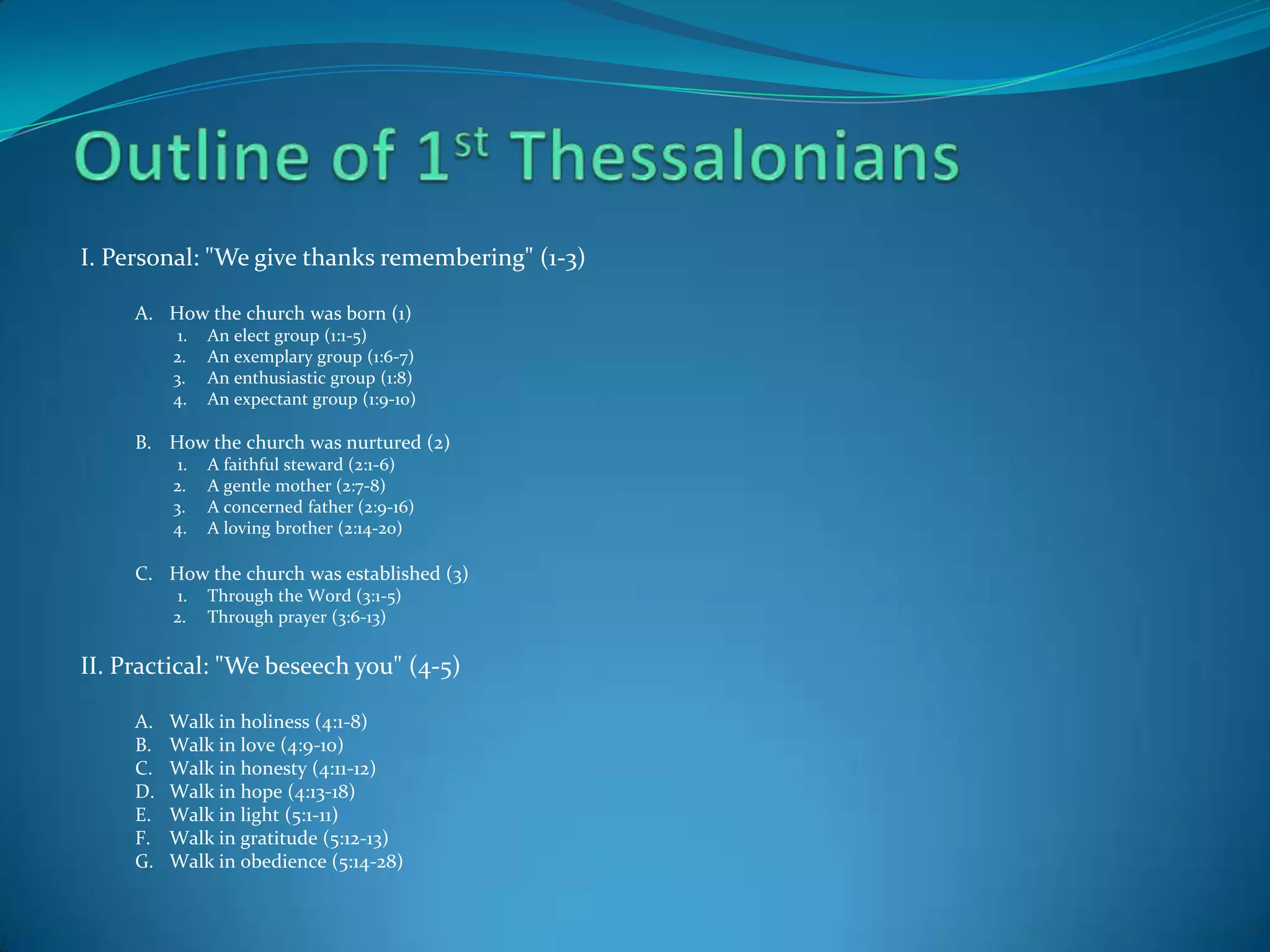
I. Personal: "We give thanks remembering" (1-3)
A. How the church was born (1)
1.
2.
3.
4.

An elect group (1:1-5)
An exemplary group (1:6-7)
An enthusiastic group (1:8)
An expectant group (1:9-10)

B. How the church was nurtured (2)
1.
2.
3.
4.

A faithful steward (2:1-6)
A gentle mother (2:7-8)
A concerned father (2:9-16)
A loving brother (2:14-20)

C. How the church was established (3)
1.
2.

Through the Word (3:1-5)
Through prayer (3:6-13)

II. Practical: "We beseech you" (4-5)
A.
B.
C.
D.
E.
F.
G.

Walk in holiness (4:1-8)
Walk in love (4:9-10)
Walk in honesty (4:11-12)
Walk in hope (4:13-18)
Walk in light (5:1-11)
Walk in gratitude (5:12-13)
Walk in obedience (5:14-28)
I.

Paul's Encouragement in Persecution
A. Thanksgiving for Their Growth
B. Encouragement in Their Persecution
C. Prayer for God's Blessing

II.

1:1-4
1:5-10
1:11-12

Paul's Explanation of the Day of the Lord
A. The Events Preceding the Day of the Lord
1. First a Falling Away
2. The Man of Sin Is Revealed
3. The Restrainer Is Taken Out of the Way
4. The Second Coming of Christ
B. The Comfort of the Believer on the Day of the Lord

III.

2:1-3
2:4-5
2:6-7
2:8-12
2:13-17

Paul's Exhortation to the Church
A. Wait Patiently for Christ
B. Withdraw from the Disorderly
C. Conclusion

3:1-5
3:6-15
3:16-18
Key Events
Ephesians Baptized in the Holy Ghost
Stays in Ephesus About 2 Years
Possibly wrote a “first” letter to the Corinthians alluded to in 1st Cor. 5:9
Special Miracles Wrought by Paul’s Hands
Sons of Sceva Whipped by Demon Possessed Man
Demetrius (Diana Silversmith) Stirs Up City Against Paul
Paul Writes 1st Corinthians

Goes to Macedonia Acts 20: 1
Writes 2nd Corinthians

Goes to Cornith Acts 20: 2
Writes Galatians and Romans

Eutychus Falls Out of the Loft – Raised From the Dead by Paul
Calls Elders From Ephesus
See Him No More
Charges Them in Ministry
Warnings Not to Go To Jerusalem
Disciples
Agabus
Returns to Jerusalem and Meets with James and the Elders
I.

Greeting - 1:1-3

II.

REPROOF: THE REPORT OF SIN IN THE CHURCH - 1:4-6:20
A. Divisions in the church - 1:4-4:21
B. Discipline in the church - 5
C. Disputes in the courts - 6:1-8
D. Defilement in the world - 6:9-20

III. INSTRUCTION: THE REPLY TO THEIR QUESTIONS - 7:1-16:12
A. Marriage and virgins- 7
B. Food offered to idols - 8-10
C. Church ordinances - 11
D. Spiritual Gifts - 12-14
E. The Resurrection - 15
F. The offering - 16:1-12
IV. CONCLUSION 16:13-24

Things Sacrificed to be Evaluated by:

The idol
By freedom
Relation to God
Relation to others

8:1-13
9:1-27
10:1-22
10:23-11:1

The Life and Teachings of Paul

  • 1.
    A Chronological Study OfHis Life and Epistles
  • 2.
    Consenting unto Stephen’sDeath – Acts 8:1, 22:20
  • 3.
    Crucifixion and Resurrectionof Jesus Chirst 33 AD Death of King Aretas of Syria – 40 AD Start of Claudius Caesar Emperor of Rome – 41 AD Death of Herod Agrippa I – 44 AD Porcius Festus succeds Felix as Procurator of Judea – 60 AD
  • 4.
    Damascus Road –Acts 9:1-22 Approximately 37 AD Barnabas’ Defense to the Skeptics - Acts 9:23-31 Between verses 22 and 23 is approx 3 years - Galatians 1:17-18 Let down over wall in basket because the Jews wanted to kill him. Returns to Jerusalem and openly ministers Grecians conspire to kill Saul He is sent to Caesarea then to Tarsus Remains there until Barnabas seeks him out – Acts 11:25 Ministers with Barnabas – Acts 11:25-30
  • 5.
    Separated to Ministry- Acts 13:1-3 Between 41-44 AD
  • 6.
    Dates are Approximate Firstbegins between approx 46 and ends before 50 AD Second begins Spring of 51 ends winter of 53-54 AD Third begins Spring of 54 ends in 58 AD Paul is arrested and taken to Rome 60 AD
  • 11.
    During 2nd MissionaryJourney During 1st Imprisonment 1st Thessalonians 2nd Thessalonians Ephesians Philippians Colossians Philemon 52 52 During 3rd Missionary Journey 62 62 62 63 During 2nd Imprisonment 1st Corinthians 2nd Corinthians Galatians 55-57 55-57 55-57 Romans 57-58 Hebrews Titus 1st Timothy 2nd Timothy 64-65 64-65 64-65 66-67
  • 12.
    Key Events Timothy joinsPaul and Silas near Lystra (Timothy is circumcised) Forbidden by Holy Ghost to preach in Asia Not allowed by the Spirit to go into Bithynia Paul has vision to go into Macedonia Lydia and her household saved Paul casts spirit of divination out of woman Paul and Silas beaten and cast into prison, sing praises at midnight, doors open. Thessalonian church is started , P & S sent Berea (due to uproar) Paul goes to Athens T&S join him later. Paul argues at Mars Hill Paul goes to Corinth and remains 18 months. Writes 1 & 2 Thessalonians (1st about 3-6 months after leaving and 2nd about 2 months later) Sails to Ephesus with Priscilla and Aquila and leaves them there. Sails to Caesarea and travels to Antioch
  • 13.
    I. The City Youcan find the modern city of Soloniki on your map, and when you do, you have found the site of the ancient city Thessalonica. It had originally been named Therma, from the hot springs in the area; but 300 years before Christ, Cassander, king of Macedon, renamed it in honor of the sister of Alexander the Great. It was a free city, with its own government, and it also was the capital city of Macedonia. Thessalonica stood on the important Egnatian Way, Rome's greatest highway. II. The Church The record is found in Acts 17:1-15. Paul, Silas, and Timothy left Philippi and traveled thirty-three miles to Amphipolis, then twenty-eight miles farther to Apollonia. It is interesting to note that no ministry was carried on in either of those cities. Their next trip was some forty miles to Thessalonica, where Paul ministered in the synagogue for perhaps three weeks and saw a number of people converted. In the city was a large group of Gentile proselytes ("devout Greeks," Acts 17:4) in the synagogue, and they responded enthusiastically, along with some of the Jews. This kind of success enraged the orthodox Jews, and they engineered a mob scene to embarrass the Christians and hinder Paul's ministry. The believers thought it best for Paul and his party to leave, which they did, going first to Berea. Paul left his associates at Berea and went alone to Athens. When Timothy joined Paul at Athens, the apostle promptly sent him back to Thessalonica to encourage the new church (1 Thess 3:1-3). The men finally met together at Corinth (Acts 18:5). Timothy reported on the state of the infant church in Thessalonica. It was from Corinth, about the year A.D. 50, that Paul wrote 1 Thessalonians. Second Thessalonians was written just a few months later. III. The Correspondence The first letter had several purposes behind it: (1) to encourage and confirm the new believers in the things of Christ; (2) to answer false charges made against Paul and his ministry, 2:1-12; (3) to explain that the Christian dead would participate in the second coming of Christ; (4) to warn the Christians against pagan immorality, 4:4 ff; (5) to remind the church members to honor and follow their spiritual leaders, 5:12-13; and (6) to warn believers who had given up their jobs and were idle because they thought Christ would soon return, 2:9. (from Wiersbe's Expository Outlines on the New Testament. Copyright © 1992 by Chariot Victor Publishing, an imprint of Cook Communication Ministries. All rights reserved.)
  • 14.
    I. Personal: "Wegive thanks remembering" (1-3) A. How the church was born (1) 1. 2. 3. 4. An elect group (1:1-5) An exemplary group (1:6-7) An enthusiastic group (1:8) An expectant group (1:9-10) B. How the church was nurtured (2) 1. 2. 3. 4. A faithful steward (2:1-6) A gentle mother (2:7-8) A concerned father (2:9-16) A loving brother (2:14-20) C. How the church was established (3) 1. 2. Through the Word (3:1-5) Through prayer (3:6-13) II. Practical: "We beseech you" (4-5) A. B. C. D. E. F. G. Walk in holiness (4:1-8) Walk in love (4:9-10) Walk in honesty (4:11-12) Walk in hope (4:13-18) Walk in light (5:1-11) Walk in gratitude (5:12-13) Walk in obedience (5:14-28)
  • 15.
    I. Paul's Encouragement inPersecution A. Thanksgiving for Their Growth B. Encouragement in Their Persecution C. Prayer for God's Blessing II. 1:1-4 1:5-10 1:11-12 Paul's Explanation of the Day of the Lord A. The Events Preceding the Day of the Lord 1. First a Falling Away 2. The Man of Sin Is Revealed 3. The Restrainer Is Taken Out of the Way 4. The Second Coming of Christ B. The Comfort of the Believer on the Day of the Lord III. 2:1-3 2:4-5 2:6-7 2:8-12 2:13-17 Paul's Exhortation to the Church A. Wait Patiently for Christ B. Withdraw from the Disorderly C. Conclusion 3:1-5 3:6-15 3:16-18
  • 16.
    Key Events Ephesians Baptizedin the Holy Ghost Stays in Ephesus About 2 Years Possibly wrote a “first” letter to the Corinthians alluded to in 1st Cor. 5:9 Special Miracles Wrought by Paul’s Hands Sons of Sceva Whipped by Demon Possessed Man Demetrius (Diana Silversmith) Stirs Up City Against Paul Paul Writes 1st Corinthians Goes to Macedonia Acts 20: 1 Writes 2nd Corinthians Goes to Cornith Acts 20: 2 Writes Galatians and Romans Eutychus Falls Out of the Loft – Raised From the Dead by Paul Calls Elders From Ephesus See Him No More Charges Them in Ministry Warnings Not to Go To Jerusalem Disciples Agabus Returns to Jerusalem and Meets with James and the Elders
  • 17.
    I. Greeting - 1:1-3 II. REPROOF:THE REPORT OF SIN IN THE CHURCH - 1:4-6:20 A. Divisions in the church - 1:4-4:21 B. Discipline in the church - 5 C. Disputes in the courts - 6:1-8 D. Defilement in the world - 6:9-20 III. INSTRUCTION: THE REPLY TO THEIR QUESTIONS - 7:1-16:12 A. Marriage and virgins- 7 B. Food offered to idols - 8-10 C. Church ordinances - 11 D. Spiritual Gifts - 12-14 E. The Resurrection - 15 F. The offering - 16:1-12 IV. CONCLUSION 16:13-24 Things Sacrificed to be Evaluated by: The idol By freedom Relation to God Relation to others 8:1-13 9:1-27 10:1-22 10:23-11:1