Copyright Ó 2023 by Thomas L. Constable
Notes on
Romans
2 0 2 3 E d i t i o n
Dr. Thomas L. Constable
WRITER AND DATE
Throughout the history of the church, from post-apostolic times to the
present, Christians have regarded Romans as having been one of the
Apostle Paul's epistles.1 Not only does the letter claim that he wrote it
(1:1), but it develops many of the same ideas and uses the same
terminology that appear in Paul's earlier writings (e.g., Gal. 2; 1 Cor. 12; 2
Cor. 8—9).
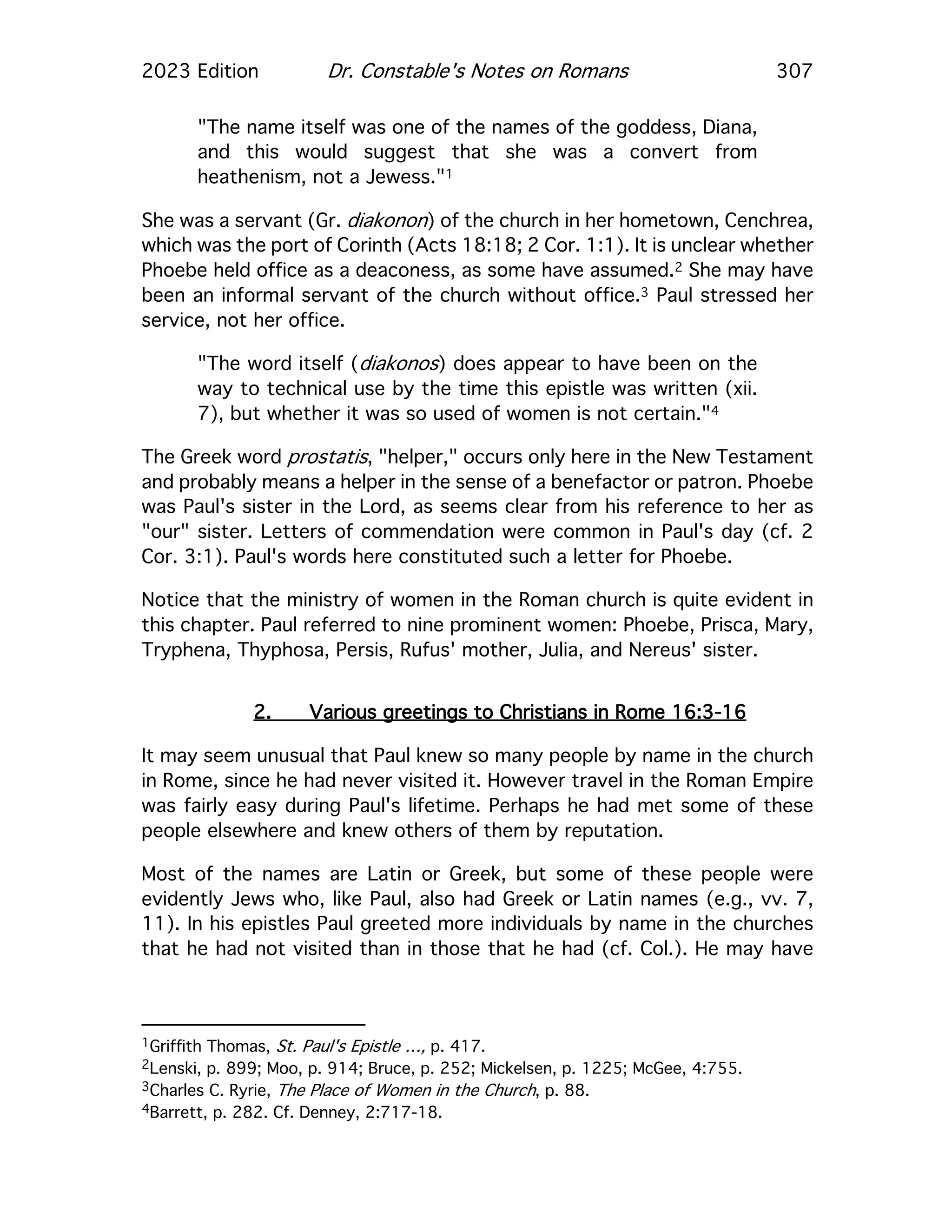
Following his conversion on the Damascus Road (A.D. 34), Paul preached in
Damascus, spent some time in Arabia, and then returned to Damascus.
Next he traveled to Jerusalem where he met briefly with Peter and James.
He then moved on to Tarsus, which was evidently his base of operations
from where he ministered for about six years (A.D. 37-43). In response to
an invitation from Barnabas, he moved to Antioch of Syria where he served
for about five years (A.D. 43-48). He and Barnabas then set out on their
so-called first missionary journey into Asia Minor (A.D. 48-49). Returning
to Antioch, Paul wrote the Epistle to the Galatians to strengthen the
churches that he and Barnabas had just planted in Asia Minor (A.D. 49).
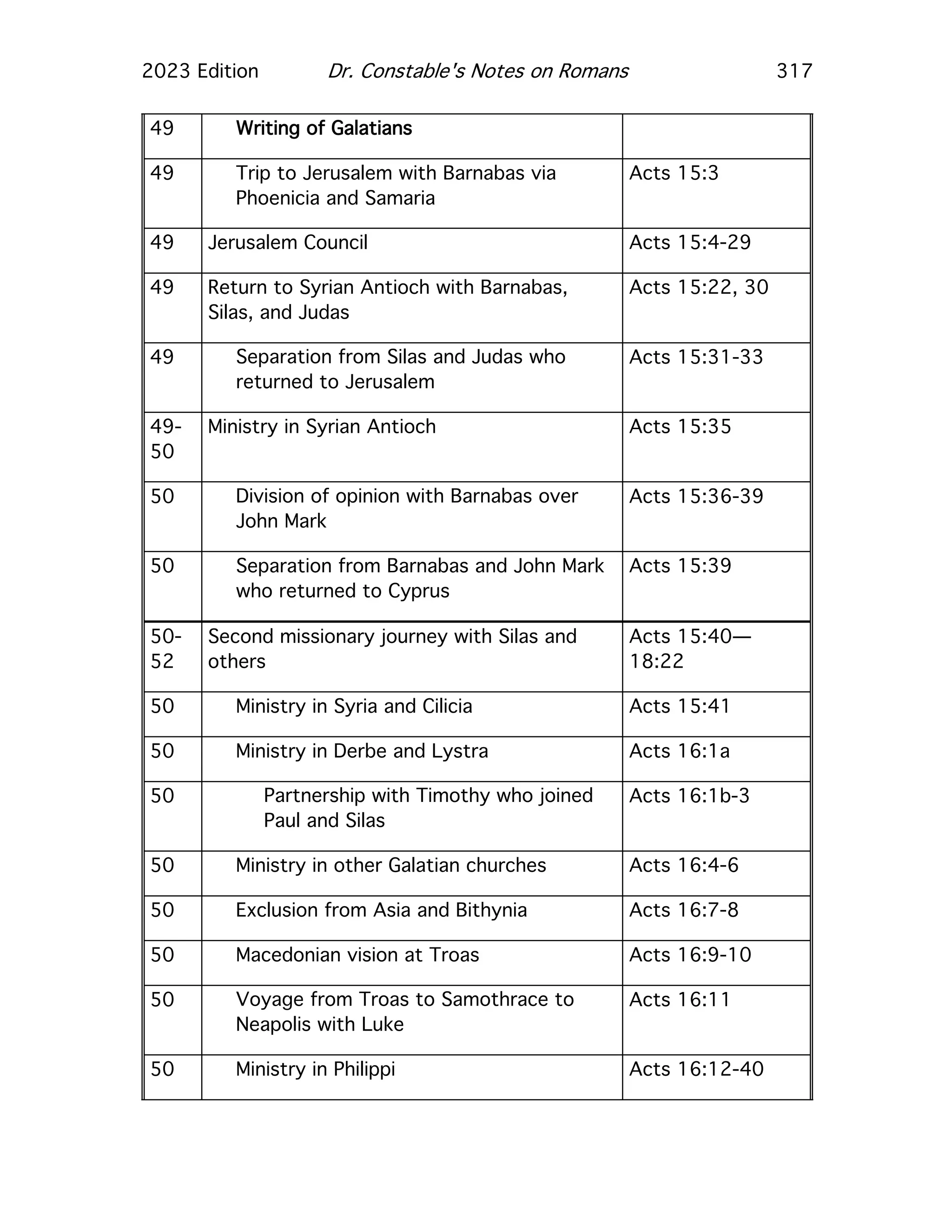
After the Jerusalem Council (Acts 15), Paul took Silas and began his second
missionary journey (A.D. 50-52) through Asia Minor, and farther westward
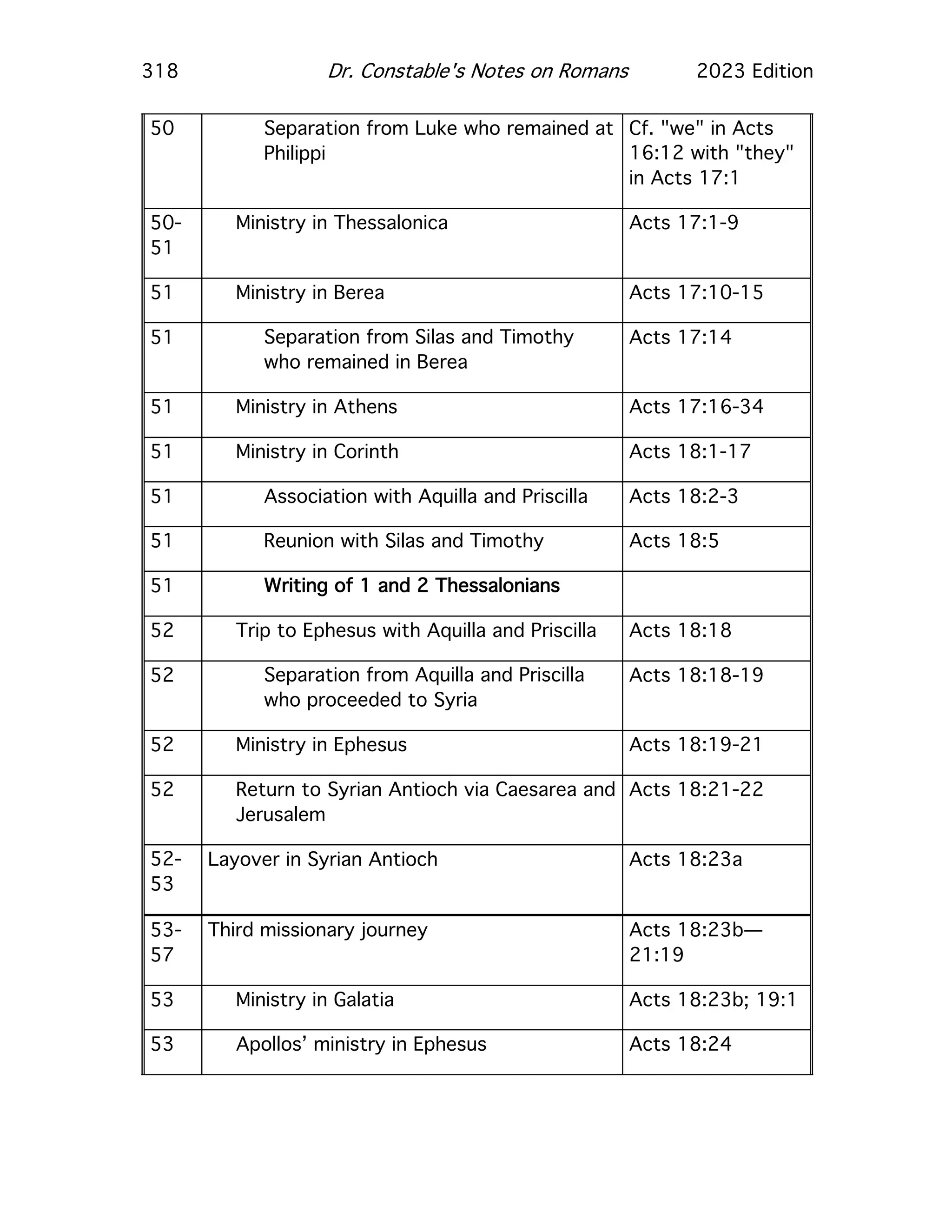
into the Roman provinces of Macedonia and Achaia. From Corinth, Paul
wrote 1 and 2 Thessalonians (A.D. 51). He then proceeded to Ephesus by
ship, and finished the second journey at Syrian Antioch. From there he set
out on his third missionary journey (A.D. 53-57). Passing through Asia
Minor, he arrived in Ephesus where he labored for three years (A.D. 53-56).
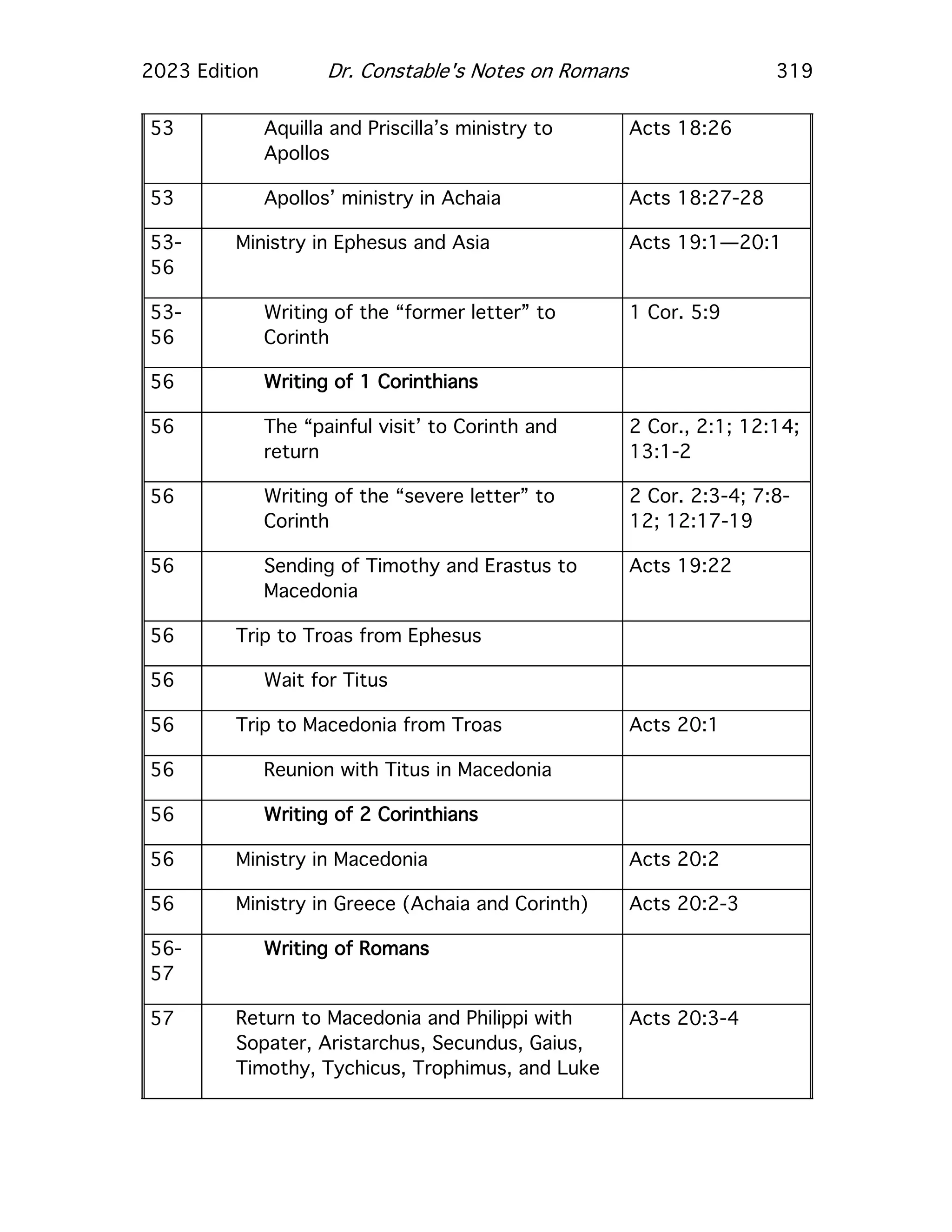
During this time he wrote 1 Corinthians (A.D. 56). Finally, Paul left Ephesus
1See F. Godet, Commentary on the Epistle to the Romans, pp. 45-46; C. E. B. Cranfield, A
Critical and Exegetical Commentary on the Epistle to the Romans, 1:1-2.
2 Dr. Constable's Notes on Romans 2023 Edition
and traveled by land to Macedonia, where he wrote 2 Corinthians (A.D. 56).
He continued south and spent the winter of A.D. 56-57 in Corinth. There
he wrote the Epistle to the Romans, and sent it by Phoebe (16:1-2) to the
Roman church.1
The apostle then proceeded from Corinth, by land, clockwise around the
Aegean Sea back to Troas in Asia, where he boarded a ship and eventually
reached Jerusalem. In Jerusalem, the Jews arrested Paul and imprisoned
him (A.D. 57). Three years later he arrived in Rome as a prisoner, where he
ministered for two years (A.D. 60-62). During this two-year time, Paul
wrote the Prison Epistles (Ephesians, Philippians, Colossians, and Philemon).
The Romans freed Paul, and he returned to the Aegean area. There he wrote
1 Timothy and Titus, was arrested again, suffered imprisonment in Rome a
second time, wrote 2 Timothy, and finally died as a martyr under Nero in
A.D. 68.2
1Cf. W. J. Conybeare, in The Life and Epistles of St. Paul, p. 497; James D. G. Dunn, Romans
1—8, pp. xliii-xliv.
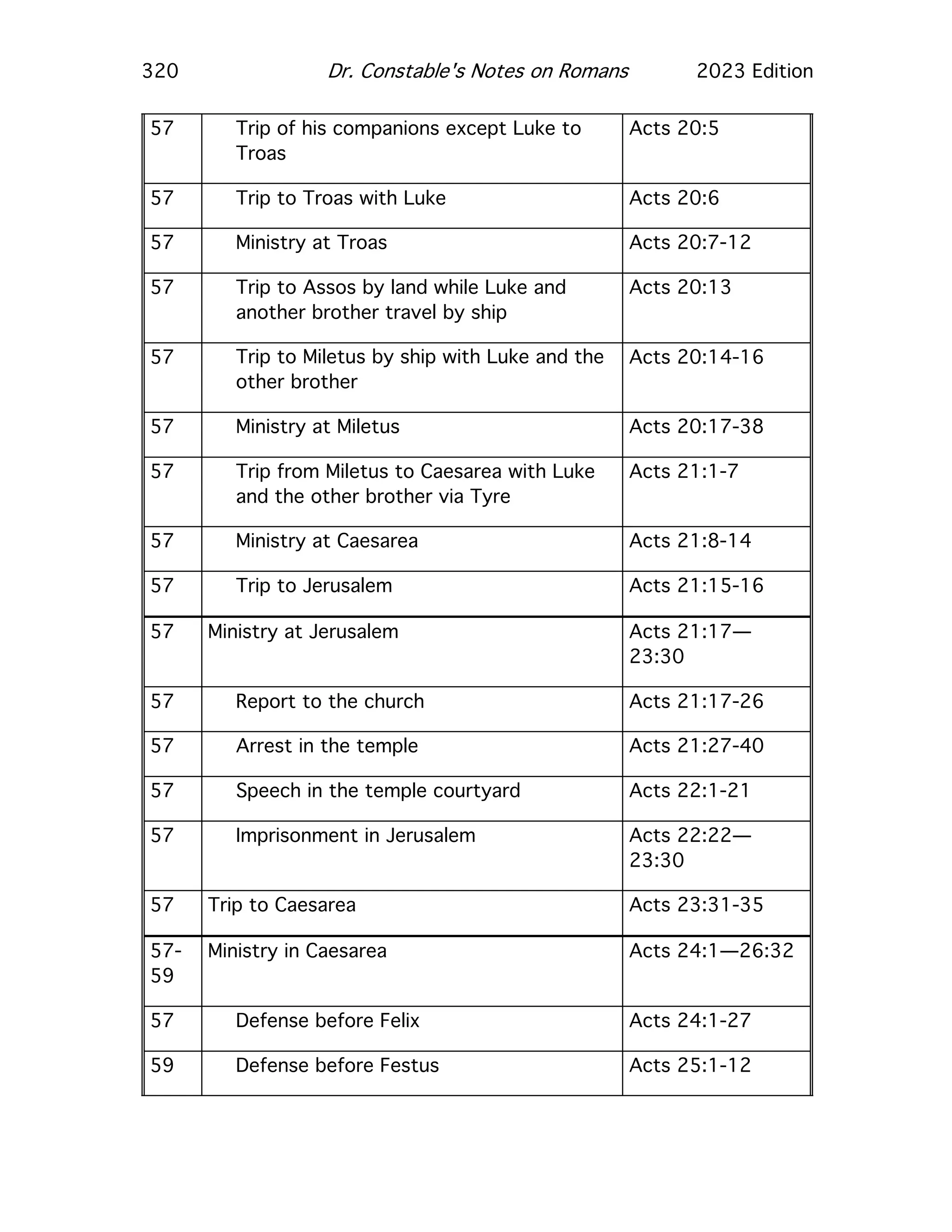
2See the appendix "Sequence of Paul's Activities" at the end of these notes for more
details.
2023 Edition Dr. Constable's Notes on Romans 3
RECIPIENTS
We know very little about the founding of the church in Rome.1 According
to Ambrosiaster, a church father who lived in the fourth century, an apostle
did not found it (thus discrediting the Roman Catholic claim that Peter
founded the church). A group of Jewish Christians did.2 It is possible that
these Jews became believers in Jerusalem on the day of Pentecost (cf.
Acts 2:10), or at some other time quite early in the church's history.3 A
similar theory is that converts of the apostles, both Jews and Gentiles,
founded the church.4 By the time Paul wrote Romans, the church in Rome
was famous throughout the Roman Empire for its faith (1:8).
"The greeting in Romans does not imply a strongly knit church
organization, and chapter 16 gives a picture of small groups
of believers rather than of one large group."5
PURPOSES
Paul, under the inspiration of the Holy Spirit, wrote this epistle for several
reasons.6 First, he wanted to prepare the way for his intended visit to this
church (15:22-24). Second, he evidently hoped that Rome would become
a base of operations and support for his pioneer missionary work in Spain,
as well as the western portions of the empire that he had not yet
evangelized. His full exposition of the gospel in this letter would have
provided a solid foundation for the Roman Christians' participation in this
mission.
As Paul looked forward to returning to Jerusalem between his departure
from Corinth and his arrival in Rome, he was aware of the danger he faced
(15:31). Third, he may have written the exhaustive exposition of the gospel
1See Godet, pp. 36-41; Jack Finegan, Light from the Ancient Past, p. 454.
2William Sanday and Arthur C. Headlam, A Critical and Exegetical Commentary on the
Epistle to the Romans, p. xxv.
3Conybeare, p. 498.
4J. Vernon McGee, Thru the Bible with J. Vernon McGee, 4:640.
5A. Berkeley Mickelsen, "Romans," in The Wycliffe Bible Commentary, p. 1179.
6See Godet, pp. 47-58; Philip R. Williams, "Paul's Purpose in Writing Romans," Bibliotheca
Sacra 128:509 (January-March 1971):62-67; Walter B. Russell, III, "An Alternative
Suggestion for the Purpose of Romans," Bibliotheca Sacra 145:578 (April-June
1985):174-84; Douglas J. Moo, The Epistle to the Romans, pp. 16-22.
4 Dr. Constable's Notes on Romans 2023 Edition
that we have in Romans in order to set forth his teaching—in case he did
not reach Rome. From Rome his doctrine could then go out to the rest of
the empire as others preached it. Paul may have viewed Romans as his
legacy to the church: his last will and testament.
Another reason for writing Romans was undoubtedly Paul's desire to
minister to the spiritual needs of the Christians in Rome, even though they
were in good spiritual condition (15:14-16). The common problems of all
the early churches were dangers to the Roman church as well. These
difficulties included internal conflicts, mainly between Jewish and Gentile
believers, and external threats from false teachers. Paul gave both of these
potential problems attention in this epistle (15:1-8; 16:17-20).
"He felt that the best protection against the infection of false
teaching was the antiseptic of the truth."1
"It is interesting to note that this great document of Christian
doctrine, which was addressed to the church at Rome to keep
it from heresy, did not accomplish its purpose. The Roman
church moved the farthest from the faith which is set forth in
the Epistle to the Romans. It is an illustration of the truth of
this epistle that man does not understand, neither does he
seek after God."2
Paul also wrote Romans because he was at a transition point in his ministry,
as he mentioned at the end of chapter 15. His ministry in the Aegean region
was solid enough that he planned to leave it and move farther west into
new virgin missionary territory. Before he did that, he planned to visit
Jerusalem, where he realized he would be in danger. Probably, therefore,
Paul wrote Romans as he did to leave a full exposition of the gospel in good
hands in case his ministry ended prematurely in Jerusalem.
"The peculiar position of the apostle at the time of writing, as
he reviews the past and anticipates the future, enables us to
understand the absence of controversy in this epistle, the
conciliatory attitude, and the didactic [instructive] and
1William Barclay, The Letter to the Romans, p. xxii.
2McGee, 4:645.
2023 Edition Dr. Constable's Notes on Romans 5
apologetic [defensive] elements which are all found combined
herein."1
James Dunn summarized Paul's purposes for writing Romans as three:
missionary, apologetic, and pastoral.2
GENRE3
Twenty-one of the 27 New Testament books are letters, and they compose
about 35 percent of the New Testament. Paul wrote 13 of these letters,
making him the most prolific New Testament letter-writer. Paul's letters
make up about one-quarter of the New Testament. He wrote more of the
New Testament than anyone except Luke.
"While letters were by no means unknown in the world of the
ancient Near East (see, e.g., 2 Sam. 11:14-15; Ezra 4—5), it
was in the Greco-Roman world that the letter became an
established and popular method of communication."4
Greco-Roman letters typically contained an address and greeting, a body,
and a conclusion. Christian letters usually contained, additionally, a
doxology or benediction after the conclusion.
Adolf Deissmann distinguished between "letters" (unstudied, private
communications) and "epistles" (carefully composed, public pieces of
literature).5 This rigid distinction is no longer popular, since most scholars
view these categories as representing the polar extremes on a continuum.
Both secular and inspired correspondences fall somewhere in between
these extremes. Romans is closer to Deissmann's "epistle" category than
to his "letter" category, though he called it a "letter" and not a "book."6
Letters were not a typical method of religious instruction in Judaism. New
Testament letter-writers evidently adopted this method of instruction for
1W. H. Griffith Thomas, St. Paul's Epistle to the Romans, p. 20.
2Dunn, pp. lx-lxiii.
3"Genre" refers to type of literature.
4Donald A. Carson and Douglas J. Moo, An Introduction to the New Testament, p. 332.
5Adolf Deissmann, "Prolegomena to the Biblical Letters and Epistles," in Bible Studies, pp.
1-59; idem, Paul, pp. 9-26.
6Ibid., p. 23.
6 Dr. Constable's Notes on Romans 2023 Edition
two main reasons: As the church grew fast and spread from Jerusalem to
many distant places, its leaders needed a method that enabled them to
communicate at a distance. Also, letters enabled the apostles to convey a
sense of personal immediacy and establish their personal presence with the
converts.1
CHARACTERISTICS
The great contribution of this letter to the body of New Testament inspired
revelation is its reasoned explanation of how God's righteousness can
become man's possession.
"The Epistle to the Romans is the first great work of Christian
theology."2
"It is the only part of Scripture in which there is found a
detailed and systematic presentation of the main features of
Christian doctrine."3
The Book of Romans is distinctive among Paul's inspired writings in several
respects: It was one of the few letters he wrote to churches with which he
had had no personal dealings. The only other epistle of this kind was
Colossians. It is also a formal treatise within a personal letter.4 Paul
expounded on the gospel in this treatise. He probably did so in this epistle,
rather than in another, because the church in Rome was at the heart of the
Roman Empire. As such, this church was able to exert great influence in the
dissemination of the gospel. For these two reasons Romans is more formal
and less personal than most of Paul's other epistles. In particular, many
students of the book regard 1:18—11:36 as a "treatise" or "literary
digest" or "letter essay" within the larger letter.5
1Carson and Moo, p. 331. See also Gordon Fee, "The Genre of New Testament Literature
and Biblical Hermeneutics," in Interpreting the Word of God, pp. 106-14.
2C. H. Dodd, The Epistle of Paul to the Romans, p. xiii.
3S. Lewis Johnson Jr., Discovering Romans, p. 20.
4For further discussion of the literary genre of Romans, see Robert E. Longacre and Wilber
B. Wallis, "Soteriology and Eschatology in Romans," Journal of the Evangelical Theological
Society 41:3 (September 1998):367-82.
5Dunn, p. lix.
2023 Edition Dr. Constable's Notes on Romans 7
"One feature of the treatise section is the repeated use of
diatribe style (dialogue with an imagined interlocutor
[responder])—particularly 2:1-5, 17-29; 3:27—4:2; 9:19-21;
11:17-24."1
Romans is the longest of Paul's epistles, with 7,114 words in the Greek
text. It may have been placed first in the collection of Paul's epistles in the
New Testament because of its length, which seems probable, or because
of its importance. Paul sent his epistles to churches (Romans through 2
Thessalonians) and to individuals (1 Timothy through Philemon). They do
not appear in our New Testaments in their chronological order, but in their
size order, in each of the two groupings just mentioned.
"Romans at the head of the Pauline corpus and the Pastoral
Epistles at or near the end act as bookends and provide a
missional frame around the epistolary collection."2
Dunn regarded the main themes of Romans as: (1) the righteousness of
God, and (2) the significance of the law.3
"Since the great truth of justification by faith alone is at the
heart of Paul's letter to the Roman church, the epistle may
come as something of a surprise to modern ecclesiastics
[clergymen]. We might have expected the apostle to address
believers at Rome, a city crammed with social problems, with
a social manifesto or, at the least, a recitation of the primary
truths of Christianity in their application to the social problems
of the imperial city. Rome was a city of slaves, but Paul did not
preach against slavery. It was a city of lust and vice, but he did
not aim his mightiest guns at these evils. It was a city of gross
economic injustice, but he did not thrust the sword of the
Spirit into the vitals of that plague. It was a city that had been
erected on and that had fed on and prospered by the violence
and rapacity of war, but the apostle did not expatiate on its
immorality. Apparently, if we are to judge the matter from a
strictly biblical standpoint, Paul did not think that social reform
1Ibid., p. lxii.
2Gregory Goswell, "The Bookends of the Pauline Corpus," Journal of the Evangelical
Theological Society 65:1 (March 2022):111.
3Dunn, pp. lxii-lxiii.
8 Dr. Constable's Notes on Romans 2023 Edition
in Rome was 'an evangelical imperative.'1 The proclamation of
the gospel of Jesus Christ solved the crucial and urgent need
for the society as a whole and for people in particular. It is still
the imperative of the Christian church, and the Christian church
will advance only to the extent that its gospel advances."2
"Paul quoted more often from the Old Testament in this epistle
than in all the other epistles combined. Romans has 61 direct
quotations and many more indirect allusions to the Old
Testament. Paul draws from at least 14 different books of the
Old Testament. Isaiah and Psalms are the most frequently
quoted …"3
VALUE
The Epistle to the Romans is, by popular consent, the greatest of Paul's
writings. William Tyndale, the great English reformer and translator,
referred to Romans as "the principle and most excellent part of the New
Testament." He went on to say the following in his prologue to Romans,
which he wrote in the 1534 edition of his English New Testament:
"No man verily can read it too oft or study it too well; for the
more it is studied the easier it is, the more it is chewed the
pleasanter it is, and the more groundly [sic] it is searched the
preciouser [sic] things are found in it, so great treasures of
spiritual things lieth hid therein."4
Martin Luther wrote the following commendation of this epistle:
"[Romans] is worthy not only that every Christian should know
it word for word, by heart, but occupy himself with it every
day, as the daily bread of the soul. It can never be read or
1"Cf. Claude Thompson, "Social Reform: An Evangelical Imperative," Christianity Today
(March 26, 1971), 8-12 [588-92]."
2Johnson, p. 25.
3Kenneth G. Hanna, From Gospels to Glory, p. 172. See Arnold G. Fruchtenbaum, The Book
of Romans, pp. 309-10, for a list of references, and pp. 9-15 for discussion of the
contribution of Romans to 11 categories of systematic theology.
4Quoted by F. F. Bruce, The Letter of Paul to the Romans, p. 9.
2023 Edition Dr. Constable's Notes on Romans 9
pondered too much, and the more it is dealt with the more
precious it becomes, and the better it tastes."1
OUTLINE
I. Introduction 1:1-17
A. Salutation 1:1-7
1. The writer 1:1
2. The subject of the epistle 1:2-5
3. The original recipients 1:6-7
B. Purpose 1:8-15
C. Theme 1:16-17
II. The need for God's righteousness 1:18—3:20
A. The need of all people 1:18-32
1. The reason for human guilt 1:18
2. The ungodliness of humankind 1:19-27
3. The wickedness of humankind 1:28-32
B. The need of good people 2:1—3:8
1. God's principles of judgment 2:1-16
2. The guilt of the Jews 2:17-29
3. Answers to objections 3:1-8
C. The guilt of all humanity 3:9-20
III. The imputation of God's righteousness 3:21—5:21
A. The description of justification 3:21-26
B. The defense of justification by faith alone 3:27-31
C. The proof of justification by faith from the law ch. 4
1. Abraham's justification by faith 4:1-5
2. David's testimony to justification by faith 4:6-8
1Martin Luther, "Preface to the Epistle to the Romans" (1522), cited by Moo, p. 22.
10 Dr. Constable's Notes on Romans 2023 Edition
3. The priority of faith to circumcision 4:9-12
4. The priority of faith to the promise concerning headship
of many nations 4:13-17
5. The exemplary value of Abraham's faith 4:18-22
6. Conclusions from Abraham's example 4:23-25
D. The benefits of justification 5:1-11
E. The restorative effects of justification 5:12-21
IV. The impartation of God's righteousness chs. 6—8
A. The believer's relationship to sin ch. 6
1. Freedom from sin 6:1-14
2. Slavery to righteousness 6:15-23
B. The believer's relationship to the Law ch. 7
1. The Law's authority 7:1-6
2. The Law's activity 7:7-12
3. The Law's inability 7:13-25
C. The believer's relationship to God ch. 8
1. Our deliverance from the flesh by the power of the Spirit
8:1-11
2. Our new relationship to God 8:12-17
3. Our present sufferings and future glory 8:18-25
4. Our place in God's sovereign plan 8:26-30
5. Our eternal security 8:31-39
V. The vindication of God's righteousness chs. 9—11
A. Israel's past election ch. 9
1. God's blessings on Israel 9:1-5
2. God's election of Israel 9:6-13
3. God's freedom to elect 9:14-18
4. God's mercy toward Israel 9:19-29
5. God's mercy toward the Gentiles 9:30-33
B. Israel's present rejection ch. 10
2023 Edition Dr. Constable's Notes on Romans 11
1. The reason God has set Israel aside 10:1-7
2. The remedy for rejection 10:8-15
3. The continuing unbelief of Israel 10:16-21
C. Israel's future salvation ch. 11
1. Israel's rejection not total 11:1-10
2. Israel's rejection not final 11:11-24
3. Israel's restoration assured 11:25-32
4. Praise for God's wise plans 11:33-36
VI. The practice of God's righteousness 12:1—15:13
A. Dedication to God 12:1-2
B. Conduct within the church 12:3-21
1. The diversity of gifts 12:3-8
2. The necessity of love 12:9-21
C. Conduct within the state ch. 13
1. Conduct towards the government 13:1-7
2. Conduct toward unbelievers 13:8-10
3. Conduct in view of our hope 13:11-14
D. Conduct within Christian liberty 14:1—15:13
1. The folly of judging one another 14:1-12
2. The evil of offending one another 14:13-23
3. The importance of pleasing one another 15:1-6
4. The importance of accepting one another 15:7-13
VII. Conclusion 15:14—16:27
A. Paul's ministry 15:14-33
1. Past labors 15:14-21
2. Present program 15:22-29
3. Future plans 15:30-33
B. Personal matters ch. 16
1. A commendation 16:1-2
12 Dr. Constable's Notes on Romans 2023 Edition
2. Various greetings to Christians in Rome 16:3-16
3. A warning 16:17-20
4. Greetings from Paul's companions 16:21-24
5. A doxology 16:25-27
MESSAGE
Throughout the history of the church, Christians have recognized this
epistle as the most important book in the New Testament. The reason for
this conviction is that it is an exposition of "the gospel of Jesus Christ."
Martin Luther called Romans "the chief part of the New Testament and the
perfect gospel." Coleridge, the English poet, declared it to be "the most
profound work in existence." And Frederick Godet, the French
commentator, described it as "the cathedral of the Christian faith."1
In order to appreciate the message of this book, it will be helpful first to
consider Paul's presuppositions. He based these, of course, on Old
Testament revelation concerning cosmology and history. "Cosmology" is
the study of the nature and principles of the universe.
By the way, there is now what has been called the "new perspective on
Paul," which some writers on Paul have advocated in recent years. These
scholars believe that "Protestant exegesis for too long allowed a typical
Lutheran emphasis on justification by faith to impose a hermeneutical
[interpretive] grid on the text of Romans."2 They believe that the Judaism
of Paul's day was not a coldly legalistic "system of earning salvation by the
merit of good works, with little or no room for the free forgiveness and
grace of God."3 Rather, "Judaism's whole religious self-understanding was
based on the premise of grace."4
E. P. Sanders used the phrase "covenant nomism," by which he meant that,
when Paul wrote Romans, he had in mind the role of the law in maintaining
the Jews' status as God's chosen people, not as a means of salvation. Some
advocates of this view also believe that Paul's Greco-Roman culture
influenced the apostle more than his Jewish background and the Old
1Godet, p. 1.
2Dunn, p. lxv.
3Ibid.
4Ibid.
2023 Edition Dr. Constable's Notes on Romans 13
Testament. This has led to some reinterpreting of Paul's writings.
Advocates of the "new perspective" include E. P. Sanders, James Dunn, the
writer of the Word Biblical Commentary on Romans, N. T. Wright, who has
written many books on Pauline theology, and others. Dunn clarified his
position further as follows:
"This, then, is the context within which and against which we
must set Paul's treatment of the law in Romans. The Jews,
proselytes, and God-worshiping Gentiles among his readership
could read what Paul says about the law in the light of this
close interconnection in Jewish theology of Israel's election,
covenant, and law. They would, I believe, recognize that what
Paul was concerned about was the fact that covenant promise
and law had become too inextricably identified with ethnic
Israel as such, with the Jewish people marked out in their
national distinctiveness by the practices of circumcision, food
laws, and sabbath in particular ([N. T.] Wright appropriately
coins the phrase 'national righteousness'). They would
recognize that what Paul was endeavoring to do was to free
both promise and law for a wider range of recipients, freed
from the ethnic constraints which he saw to be narrowing the
grace of God and diverting the saving purpose of God out of
its main channel—Christ."1
Some evangelical scholars have accepted "new perspective" theories,
though I have not. The result of the "new perspective" is a departure from
traditionally held interpretations of many Pauline texts. The reading that I
have done on this theory has not convinced me that Paul had a "covenant
nomistic" view of the law.2
Returning to discussion of his presuppositions, Paul assumed the God of
the Old Testament. He assumed God's existence and full deity. He believed
that God is holy and just. He also held that God is the Creator, Sustainer,
and Sovereign Ruler of the universe.
Second, Paul's view of man was that he is subject to God's government of
the universe. Paul believed that people have received a measure of freedom
1Ibid., pp. lxxi-lxxi.
2See James E. Allman, "Gaining Perspective on the New Perspective on Paul," Bibliotheca
Sacra 170:677 (January-March 2013):51-68, for an introduction to and evaluation of the
views set forth by Sanders, Wright, and Dunn.
14 Dr. Constable's Notes on Romans 2023 Edition
from God, so they can choose to pursue sin. However, if they do, they are
still in the sovereign hand of God. God allows the consequences of their
sins to have their effects on them both now and forever. Mankind is also in
authority over the rest of the material creation (Gen. 1:28). What
humankind has experienced, the material creation also has experienced, and
reflects as a result of human action.
Third, Paul's view of history was that of Old Testament revelation. The
important historical events for Paul were those in his Scriptures: the Hebrew
Bible, which we call the Old Testament.
Adam was the first man. He rebelled against God's authority. The result
was threefold: the practical dethronement of God in the minds of Adam's
descendants, the degradation of humanity, and the defilement of creation.
This is a very different view of history from what evolutionists and
humanists take. Man has lost his scepter, his right to rule, because he
rebelled against God's scepter: His right to rule.
Two other individuals were especially significant in history for Paul, as we
see in Romans: Abraham, and Jesus Christ. God called Abraham to be a
channel of blessing to the world. Christ is the greatest blessing. Through
Him, people and creation can experience restoration to God's original
intention for them.
These are Paul's basic presuppositions on which all of his reasoning in
Romans rests.
Romans may not be the best biblical book to put in the hands of most
unsaved people to lead them to salvation. John is better for that purpose.
However, Romans is the best book to put in the hands of a saved person
to lead him or her to understand and appreciate their salvation. By the way,
"salvation" is an umbrella term: it covers many aspects of deliverance,
including justification, sanctification, glorification, redemption, propitiation,
et al.1 These terms will be clarified in what follows.
We turn now to the major revelations in this book. These are its central
teachings: the emphases that distinguish Romans from other books of the
Bible.
1See Earl D. Radmacher, Salvation.
2023 Edition Dr. Constable's Notes on Romans 15
First, Romans reveals the tragic helplessness of the human race. No other
book of the Bible looks so fearlessly into the abysmal degradation that has
resulted from human sin. If you read only 1:18—3:20, you will become
depressed by its pessimism. But if you keep reading, you will conclude, from
3:21 on, that we have the best, most wonderful news that anyone has ever
heard. This book is all about ruin and redemption. Its first great revelation
is the absolute ruin and helplessness of the human race.
Paul divides the ruined race into two parts:
The first of these parts is the Gentiles who have the light of nature. God
has given everyone, Gentiles and Jews, the opportunity of observing and
concluding two things about Himself: His wisdom and power. The average
person, as well as the scientist, concludes that Someone wise must have
put the natural world together, and He must be very powerful.
Nevertheless, having come to that conclusion, people turn from God to vain
reasoning, vile passions, unrighteous behavior, envy, murder, strife, deceit,
insolence, pride, and perverted conduct. Just listen to today's news and
you will find confirmation of Paul's analysis of the human race.
A former student of mine came to Christ by looking through his microscope.
He was a research scientist, and he concluded that what he was observing
could not have come into existence accidentally. He believed that an
intelligent Creator must have been responsible, and this was the first step
in his journey toward becoming a Christian. His was not the typical
conclusion (cf. Matt. 16:17). Most people reject the evidence of God's
existence that He has built into His creation.
The other part of the ruined race is the Jews, who, in addition to the light
of nature, also had the light of Scripture. Paul observed that, in spite of his
greater revelation and privilege, the Jew behaves the same way as the
Gentile. Yet he is in one sense a worse sinner. Having professed devotion
to God, and having claimed to be a teacher of the Gentiles—because of his
greater light—he disobeys God and causes the Gentiles to blaspheme His
name.
Paul concluded, "There is no righteous person, not even one" (3:10). "All
have sinned and fall short of the glory of God" (3:23).1
1Quotations from the English Bible in these notes are from the New American Standard
Bible (NASB), 2020 edition, unless otherwise indicated.
16 Dr. Constable's Notes on Romans 2023 Edition
The second major revelation of Romans is the magnificence of the divine
plan of salvation. This plan centers on Jesus Christ, whom Paul introduced
in the very first sentence of his letter (1:3-4). God declared to everyone
that the Jesus of the Gospels is His Son by resurrecting Him from the dead.
Two words describe Christ's relation to the divine plan of salvation:
manifestation (display), and propitiation (satisfaction). To "propitiate"
means to satisfy the demands of God's righteous standards. The
righteousness manifested in Christ is available to people through His
propitiation. God's righteousness is available to everyone, because Jesus
died as the perfect offering for sin, which satisfied the demands of a holy
God completely. The righteousness we see in Jesus, in the Gospel records,
is available to those who believe that His sacrifice satisfied God (3:21, 25).
We can also describe God's relation to the plan of salvation with two words:
holiness and love. The plan of salvation that Romans expounds resulted
from a holy God reaching out to sinful humanity lovingly (3:22, 24). This
plan vindicates the holiness of God as it unveils God's gracious love (chs.
9—11).
Man's relation to the plan of salvation is threefold:
It involves justification: the imputation of God's righteousness to the
believing sinner. To "justify" means to pardon and forgive sinners of their
guilt and to declare them righteous.
"To be justified means to be declared righteous in a judicial
sense. This does not mean that the believer, who has been
justified, is righteous [in his or her character or conduct];
rather, it means that God declares him to be righteous. Thus,
justification has to do with God's declaration concerning the
sinner, not with any change occurring within the sinner.
Justification does not make anyone holy [in his or her
character or conduct]; rather, God declares that the sinner is
no longer guilty before Him. It is a divine act in which God
declares a sinner righteous as a result of the sinner's faith in
Messiah."1
1Fruchtenbaum, p. 43.
2023 Edition Dr. Constable's Notes on Romans 17
Salvation also involves practical sanctification: the impartation (or
communication1) of God's righteousness to the redeemed sinner. Third, it
involves glorification: the perfection of God's righteousness in the
sanctified sinner. In justification, God lifts the sinner into a relationship with
Himself that is more intimate than he would have enjoyed if he had never
sinned (5:12-21). In practical sanctification, God progressively transforms
the sinner into the Savior's image by the power of the indwelling Holy Spirit.
In glorification, God finally restores the sinner to the place that God
intended for him to occupy in creation.
The creation's relation to the plan of salvation is twofold: First, God
restores creation's king, namely, man, to his intended position. Second,
creation realizes all of its intended possibilities that sin has denied it.
Consider next some of the major lessons of this book. What did God want
us to learn from it?
First, Romans calls us to measure ourselves by divine, rather than human,
standards. We sometimes evaluate ourselves, and one another, by using
the criteria that our age uses, or that we ourselves set. However, to know
our true condition, we must use the criteria that God sets. This standard
reveals that we are all guilty before God. This is one of the great lessons
that Romans teaches us.
Second, Romans calls us to live by faith, rather than by sight. God did not
come any closer to humankind in the incarnation of Christ than He ever had
been before. Yet, in the Incarnation, the nearness of God became more
obvious to people. In His resurrection, the Son of God became observable
as the Son of God to human beings. All the glories of salvation come to us
as we believe God. Romans contrasts the folly of trying to obtain salvation
by working for it—with trusting God: simply believing what He has revealed
as true, and relying on it as true.
Third, Romans calls us to dedicate ourselves to God, rather than living self-
centered lives (6:12-13; 12:1). This is the reasonable response to having
received salvation as a gift. We should give ourselves to God. God's grace
puts us in debt to Him. Paul did not say that if we fail to dedicate ourselves
to God, we are therefore unsaved. Rather, he appealed to us as saved
people to do for God what He has done for us, namely, give ourselves to
1J. B. Lightfoot, Notes on the Epistles of St Paul, p. 270.
18 Dr. Constable's Notes on Romans 2023 Edition
Him out of love for Him. When we do this, we show that we truly appreciate
what God has done for us.
On the basis of these observations, I would summarize the message of
Romans in the following words: Since God has lovingly provided salvation
for helpless sinners through His Son, we should accept that sacrifice by
faith, and express our gratitude to God by dedicating our lives to Him.
In view of the greatness of the salvation that God has provided, which
Romans reveals, Christians, like Paul, have a duty to communicate this good
news to the world (1:14-17; Matt. 28:19). We do this both by lip and life,
by explanation and by example (8:29). Our living example will reflect death
to self, as well as life to God (6:13).1
1Adapted from G. Campbell Morgan, Living Messages of the Books of the Bible, 2:1:93-
109.
2023 Edition Dr. Constable's Notes on Romans 19
I. INTRODUCTION 1:1-17
This great epistle begins with a broad perspective. It looks at the promise
of a Savior in the Old Testament, reviews Paul's ministry to date, and
surveys the religious history of the Gentile world.
"The main body of Romans is a treatise on Paul's gospel,
bracketed by an epistolary opening (1:1-17) and conclusion
(15:14—16:27). These opening and concluding statements
have many similarities, not the least of which is the emphasis
on the gospel. (Eight of the 11 occurrences in Romans of
euangelion ["gospel"] and euangelizomia ["to evangelize"] are
in these passages.) Paul's special relationship to this gospel, a
relationship that encompasses the Roman Christians, both
opens and closes the strictly 'epistolary' introductory material
in the section (vv. 1-5, 13-15)."1
"Paul's introduction in 1:1-18 mentions every topic he will
discuss in reverse order in the remainder of the letter."2
A. SALUTATION 1:1-7
This salutation, which is the longest salutation in Paul's epistles, identifies
the writer (v. 1), introduces the subject of the letter (vv. 2-5), and greets
the original readers (vv. 6-7). This salutation is one sentence and it
implicitly sets forth the most fundamental facts of Christianity. In
particular, it shows that the main facts of the gospel fulfill Old Testament
predictions.
"The central idea of the passage is that of the whole epistle,
that the Gospel, as preached by Paul to the Gentiles, was not
1Moo, p. 39. See The Bible Knowledge Commentary: New Testament, p. 439, for a chart
comparing Paul's introductions to his epistles.
2John M. Scoggins Jr., "Romans 1:18 as Key to the Structure of the Letter," Bibliotheca
Sacra 175:700 (October-December 2018):411.
20 Dr. Constable's Notes on Romans 2023 Edition
inconsistent with, but the fulfilment of, God's promises to
Israel."1
1. The writer 1:1
As in all his epistles, Paul used his Roman rather than his Jewish name, Saul,
perhaps because he was the apostle to the Gentiles. Even though he had
not yet visited Rome, his readers knew Paul's reputation well. He just
needed to give his name to identify himself.
"The order of the titles Jesus Christ and Christ Jesus is always
significant: 'Christ Jesus' describes the One who was with the
Father in eternal glory, and who came to earth, becoming
Incarnate; 'Jesus Christ' describes Him as the One who
humbled Himself, who was despised and rejected, and endured
the cross, but who was afterwards exalted and glorified. 'Christ
Jesus' testifies to His pre-existence; 'Jesus Christ' to His
resurrection and exaltation."2
In his relationship to Christ Jesus, Paul was a "bond-servant" (Greek doulos;
cf. James 1:1; 2 Pet. 1:1; Jude 1). Some translators have rendered this
word "slave," but Paul was a willing servant of Christ (cf. Phil. 2:7). This
term is the equivalent of the Old Testament "servant of the Lord," which
describes Moses, Joshua, Elijah, Nehemiah, and especially David.
"He [Paul] regarded himself as the purchased possession of his
Lord and Master. The two ideas of property and service are
suggested. There was no serfdom or servility, and yet there
was an absolute loyalty in the consciousness of absolute
possession. The bond-servant owned nothing, and was
nothing, apart from his master. His time, his strength,
everything belonged altogether to another. There was nothing
nobler to St. Paul than to be a slave of the Lord Jesus. He
desired to be nothing, to do nothing, to own nothing apart
from Him."3
1James Denney, "St. Paul's Epistle to the Romans," in The Expositor's Greek Testament,
2:585.
2W. E. Vine, The Epistle to the Romans, p. 7.
3Thomas, pp. 38-39.
2023 Edition Dr. Constable's Notes on Romans 21
"The principle here is that when Messiah sets a person free
from the slavery of sin, the believer does not go from that
slavery into the slavery of God. Rather, he moves from the
slavery to sin to freedom. At this point, he has the option of
binding himself to God. He can become a bondslave, meaning
a willing slave of God. This is what Paul will encourage all
believers to do in Romans 12:1-2."1
The title "apostle" gives Paul's gift and office in the church. He was Jesus
Christ's special appointee.
"Paul was a 'called' apostle—called is an adjective—he means
that he is that kind of an apostle."2
"'Called' means designated and set apart by an action of God
to some special sphere and manner of being and of consequent
activity."3
His calling as an apostle gave Paul the right not only to preach the gospel
but to found, to supervise, and even to discipline churches if necessary.
The basis of his authority, the right to his office, was God's calling (cf. vv.
6, 7; Jer. 1:5).4
"The Greek word [aphorismenos, "set apart"] is not only
similar in meaning to, but also has the same consonants as the
Hebrew root p-r-sh, which underlies the word Pharisee. Paul
had been a Pharisee (Phil. iii. 5), supposing himself to be set
apart from other men for the service of God; he now truly was
what he had supposed himself to be—separated, not, however,
by human exclusiveness but by God's grace and election."5
"Paul never thought of himself as a man who had aspired to an
honour; he thought of himself as a man who had been given a
task."6
1Fruchtenbaum, p. 22.
2McGee, 4:645.
3William R. Newell, Romans Verse by Verse, p. 3. Italics removed.
4See R. D. Culver, "Apostles and the Apostolate in the New Testament," Bibliotheca Sacra
134:534 (April-June 1977):131-43.
5C. K. Barrett, A Commentary of the Epistle to the Romans, p. 17.
6Barclay, p. 2.
22 Dr. Constable's Notes on Romans 2023 Edition
The particular extent of his work, the scope of his calling, was quite narrow,
namely, to proclaim the gospel (good news) of God. As a Pharisee Paul had
lived a life set apart to strictly observing the Mosaic Law and Jewish
customs. Now his calling was to proclaim the gospel (Acts 9:15; Gal. 1:12).
"Concentration thus follows consecration and commission."1
2. The subject of the epistle 1:2-5
1:2 Paul next began to exalt the gospel that God had called him to
proclaim. It was a message that God had promised, not just
prophesied, in the Old Testament Scriptures. The words "His"
and "holy" stress the unique origin of the gospel. God had
inspired the Old Testament by speaking through men as He
gave His revelation. Paul did not preach an unanticipated
gospel but one that God had promised through His prophets
(cf. 4:13-25; 9:4; 15:8). This was the reason that Paul
appealed to the Old Testament so fully in this and his other
epistles. Specifically, Paul's gospel was not a human invention
that tried to make the best of Israel's rejection of Jesus Christ.
"Paul frequently appealed to the Old Testament in
support of his teaching, quoting from it ninety-
three times."2
1:3-4 Paul identified the gospel's theme in order to exalt it further.
The gospel centers on God's Son, Jesus Christ, who was both
human and divine. The phrases "according to the flesh" (v. 3)
and "according to the Spirit" (v. 4) probably do not contrast
the natures of Christ but His relationships.3 He belonged to
two realms or spheres or orders of existence. As to his human
earthly connection, His origin was the highest: He was not just
an Israelite (9:5) but a descendant of David (Matt. 1:1; Luke
1:32; Acts 13:22-23; 2 Tim. 2:8), which was a messianic
qualification (Isa. 11:1).
1Thomas, p. 39.
2George E. Ladd, A Theology of the New Testament, p. 394.
3James M. Stifler, The Epistle to the Romans, pp. 24-25; Bruce, p. 69.
2023 Edition Dr. Constable's Notes on Romans 23
"The Son did not merely become man but man
'out of David's seed,' which means man as the
Messiah. Since he was this promised descendant
of David, all the Messianic promises centered in
him."1
Concerning the realm above, Jesus Christ was higher than the
angels (Heb. 1:4), the very Son of God (v. 4). The word power
probably modifies the Son rather than the declaration.2 Paul
probably meant that God declared Jesus to be His powerful
Son, rather than that God powerfully declared that Jesus was
His Son. The point of this passage is the greatness of Jesus,
not the wonder of the resurrection.
"A man who was merely a man and said the sort
of things Jesus said would not be a great moral
teacher. He would either be a lunatic—on a level
with the man who says he is a poached egg—or
else he would be the Devil of Hell. You must make
your choice. Either this man was, and is, the Son
of God: or else a madman or something worse."3
Jesus was always the Son of God, but the Father declared Him
to be His Son by resurrecting Him. Jesus did not change in
essence—He always was the Son—but was elevated in status
and function by His resurrection. God appointed the Son to a
new and more powerful position in relation to the world at the
Resurrection (cf. Matt. 28:18). He is now not only the Messiah,
but the Lord (sovereign ruler) over all.4
To what does "the Spirit of holiness" (v. 4) refer? It may be
another way of referring to the Holy Spirit.5 On the other hand,
in view of the parallel expression "according to the flesh" (v.
3), and the fact that Paul could have said Holy Spirit if that is
1Richard C. H. Lenski, The Interpretation of St. Paul's Epistle to the Romans, p. 36.
2Johnson, p. 23.
3C. S. Lewis, Mere Christianity, p. 41.
4See S. Lewis Johnson Jr., "The Jesus That Paul Preached," Bibliotheca Sacra 128:510
(April-June 1971):120-34.
5Godet, p. 80; Bruce, p. 69; John A. Witmer, "Romans," in The Bible Knowledge
Commentary: New Testament, p. 440.
24 Dr. Constable's Notes on Romans 2023 Edition
what he meant, probably Paul was referring to the holy nature
of Jesus. Jesus' nature was so holy (perfectly sinless) that
death could not hold Him.1
1:5 In this verse Paul probably meant that he had received the
special grace (unmerited gift) of being an apostle: his
apostleship. He introduced the character and scope of what
follows, in this epistle, by linking his apostleship with the
resurrected Christ. Jesus' descent from David, plus His
resurrection from the dead, proved that He was the same
Messiah and Lord that was promised in the Old Testament.
Therefore the gospel that Paul preached as an apostle could
bring all the Gentiles, not just the Jews, to faith in Christ. It did
not bring them to obey the Law of Moses but to faith in Christ.
Obeying God by trusting in Jesus Christ is "in behalf of His
name" in that it glorifies God and Christ.
"The law lays down what a man must do; the
gospel lays down what God has done."2
"Some one has truly said that the Gospel is 'good
news' not 'good advice,' …"3
Faith is obedience to God: "obedience which consists in or
springs from faith."4 God commands everyone to believe in
Christ (cf. John 6:29; Acts 17:30-31). To disbelieve in Christ
is to disobey God.
"Faith is the act of assent by which the Gospel is
appropriated."5
This verse is not teaching that saving faith always results in
ongoing obedience to God, though that is normally its effect.6
1Henry Alford, The Greek Testament, 2:2:313; Everett F. Harrison, "Romans," in Romans-
Galatians, vol. 10 of The Expositor's Bible Commentary, p. 15; Sanday and Headlam, p. 9;
Stifler, p. 25; A. T. Robertson, Word Pictures in the New Testament, 4:324.
2Barclay, p. 3.
3Thomas, p. 43.
4Dunn, p. 24.
5Sanday and Headlam, p. 11.
6See Robert N. Wilkin, "Obedience to the Faith: Romans 1:5," Grace in Focus 10:6
(November-December 1995):2-4.
2023 Edition Dr. Constable's Notes on Romans 25
Both Scripture and experience teach that Christians, those who
have exercised saving faith in Christ, often disobey God. Paul's
point in this verse is not the obedience of Christians but the
obedience of non-Christians who need to obey God by placing
their faith in Christ.
3. The original recipients 1:6-7
1:6-7 Paul assured his readers—the majority of whom were Gentiles
(cf. v. 5)—that they were part of those who whom God had
called for salvation. God had not called them to apostleship as
God had called him (v. 1) but to sainthood, saints being a
common term for believers in the New Testament. This word
refers more to position than condition when used this way,
though the implication of holiness in daily living is strong.
Christians are primarily saints even though we sin. 1
"One of the titles of believers is 'the called.'"2
"God's call is not an invitation but a powerful and
effective reaching out to claim individuals for
himself."3
"In the language of the Acts and Epistles the word
'called' always denotes an effectual calling, and
therefore suggests both the call given by God and
obedience to it on the part of believers."4
"'Calling' in Paul always includes obedience as well
as hearing."5
Verse 7 really continues the thought of verse 1, verses 2-6
being somewhat parenthetical. "Grace" and "peace" were
common salutations in Greek and Jewish letters respectively in
1See Robert L. Saucy, "'Sinners' Who Are Forgiven or 'Saints' Who Sin?" Bibliotheca Sacra
152:608 (October-December 1995):400-12.
2Lenski, p. 49.
3Robert H. Mounce, Romans, p. 63. See also W. W. Klein, "Paul's Use of Kalein: A Proposal,"
Journal of the Evangelical Theological Society 27 (1984):53-64.
4Vine, p. 11.
5Denney, 2:587.
26 Dr. Constable's Notes on Romans 2023 Edition
Paul's day. God's grace is both His unmerited favor and His
divine enablement. J. H. Jowett described it as "holy love on
the move."1 God's grace is the basis for any true human peace.
The Hebrew concept of peace (Heb. shalom) did not just mean
freedom from stress, anxiety, and irritation. It included the
fullness of God's blessing. Paul desired a continually deeper and
richer experience of spiritual blessing for his readers. The
linking of Jesus Christ with the Father in verse 7 implies the
deity of the Son.2
The salutation reveals the germ ideas that the writer proceeded to develop
later in this epistle. This is also characteristic of Paul's other epistles. So
far Paul said he had a message that was in harmony with the Old Testament.
It was from the risen Christ, and it was for all people. Furthermore it should
lead people to obey God by exercising faith in Jesus Christ.
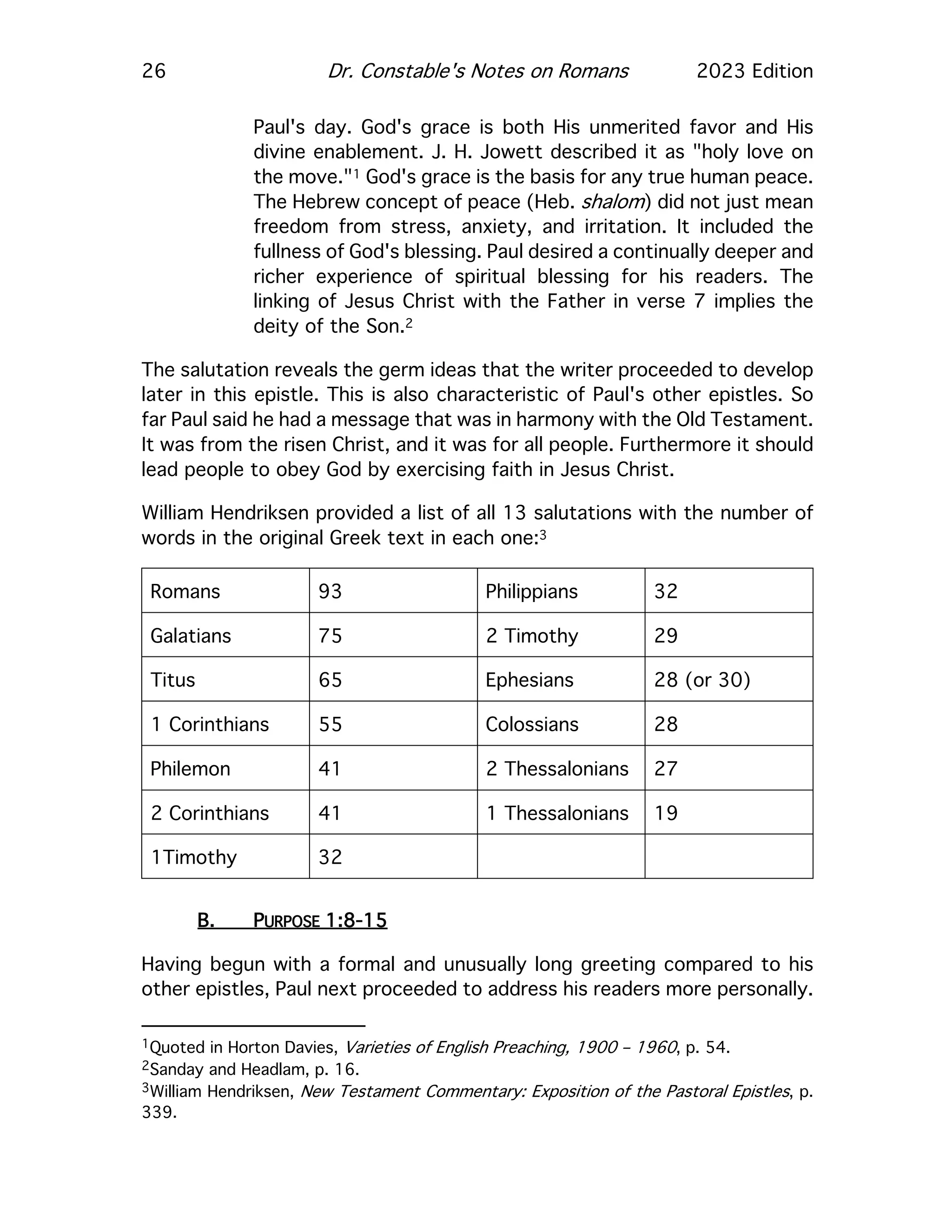
William Hendriksen provided a list of all 13 salutations with the number of
words in the original Greek text in each one:3
Romans 93 Philippians 32
Galatians 75 2 Timothy 29
Titus 65 Ephesians 28 (or 30)
1 Corinthians 55 Colossians 28
Philemon 41 2 Thessalonians 27
2 Corinthians 41 1 Thessalonians 19
1Timothy 32
B. PURPOSE 1:8-15
Having begun with a formal and unusually long greeting compared to his
other epistles, Paul next proceeded to address his readers more personally.
1Quoted in Horton Davies, Varieties of English Preaching, 1900 – 1960, p. 54.
2Sanday and Headlam, p. 16.
3William Hendriksen, New Testament Commentary: Exposition of the Pastoral Epistles, p.
339.
2023 Edition Dr. Constable's Notes on Romans 27
He had not met the Christians to whom he wrote, so he spent some time
getting acquainted and sharing his heart with them.
"One of the first lessons of effective leadership is the
importance of setting priorities. Not only must things be done
right (management) but the right things must be done
(leadership)."1
1:8 Paul felt concern for the welfare of this church. The faith of
the Roman church had become well known in the few years
since it had come into existence (cf. Eph. 1:15-16; Col. 1:3-4;
1 Thess. 1:3). Typically Paul began by offering commendation
to his readers for some praiseworthy trait whenever he could.
Here he thanked God for the Romans through Jesus Christ who
had created their access to God. He praised the Roman
Christians for their obedience to God by trusting in Jesus Christ
(cf. v. 5).
"We must express our love to our friends, not only
by praying for them, but by praising God for
them."2
1:9-10 Paul called God as his witness that he was telling the truth
because what he was about to say might be difficult to believe.
"In my spirit" means "with my whole heart" (NIV).3 Paul
claimed that he prayed for the Romans unceasingly, namely,
frequently—but not without stopping (cf. Eph. 1:15; 3:14;
Phil. 1:3-4; Col. 1:3-4; 1 Thess. 1:2-3). The Greek word
translated unceasingly (adialeiptos, cf. 1 Thess. 5:17) denotes
that not much time elapsed between his prayers for them.
These saints were constantly in his thoughts and prayers.
"We are reminded that the real work of the
ministry is prayer. Preaching is more a result of
the ministry of prayer than it is a ministry itself. A
sermon that does not rise from intense and heart-
1Mounce, p. 65. Cf. Cranfield, 1:78-79.
2Matthew Henry, Commentary on the Whole Bible, p. 1754.
3NIV refers to The Holy Bible: New International Version.
28 Dr. Constable's Notes on Romans 2023 Edition
searching prayer has no chance of bearing real
fruit."1
1:11-13 As Paul had prayed often for the Romans, so he had also
planned often to visit them. The clause "I do not want you to
be unaware" (v. 13) always identifies something important
that Paul had to say (cf. 1 Cor. 10:1; 12:1; 1 Thess. 4:13). His
reason for planning to visit these Christians was for fellowship,
namely, mutual sharing of things profitable. One obstacle that
may have prevented Paul from reaching Rome previously was
the imperial edict of A.D. 49 that expelled Jews from Rome (cf.
Acts 18:2).2
Paul mentioned his contribution to fellowship with the Romans
first (v. 11) and theirs to him last (v. 13) while he stressed
reciprocity in between (v. 12). Paul's spiritual gift to them (v.
11) was probably not one specific gift but anything and
everything that would be to their spiritual benefit (cf. 1 Cor.
12:1). In 1 Corinthians 12:1 he mentioned specific gifts
(plural). We should also probably interpret the fruit that he
hoped to obtain (v. 13) broadly rather than specifically.
Probably all the fruit that would come from his ministry among
them is in view.
"Humility is the teacher's best gown. Read again
vs. 9 to 12 to see how Paul wears it. … Said John
Ruskin: 'I believe the first test of a truly great man
is humility.' And Sir Thomas More: 'To be humble
to superiors, is duty; to equals, it is courtesy; to
inferiors, is nobleness; it being a virtue that, for all
its lowliness commands those it stoops to.' Such
was Paul's leadership.3"
1:14-15 Paul's love for Christian fellowship, and his obligation to preach
the gospel to all people, especially to the Gentiles (cf. Gal.
1:11-12; Eph. 3:1-7; 2 Cor. 12:7-10), motivated him to visit
Rome (cf. vv. 1, 5). Having received the grace of God himself,
1Mounce, p. 66.
2See Bruce, p. 16.
3E. M. Blaiklock, Today's Handbook of Bible Characters, pp. 542, 543. Paragraph division
omitted.
2023 Edition Dr. Constable's Notes on Romans 29
he recognized that this placed him in debt to everyone else.
He owed them the opportunity to hear the gospel and to
receive God's grace themselves. Every Christian is indebted to
every non-Christian, because we possess and can share what
can impart life to those who are dead in sin, namely, the
gospel.
The terms Greek and uncultured (v. 14) distinguish Gentiles by
language and culture. In Paul's day, this was a standard way of
describing all races and classes within the Gentile world.1 The
Jews spoke of all who were not Jews as Greeks.2 But the Greek
people spoke of anyone who did not speak the Greek language
as a "barbarian." The Greek word barbaros is onomatopoetic:
it imitates any rough-sounding, unintelligible language.3 The
wise and foolish distinction divides people intellectually (cf. 1
Cor. 1:19, 20, 26, 27).
Paul did not regard his opportunity to preach the gospel as a
burden that he had to bear, or as a duty that he had to fulfill.
Rather he was eager to share the good news with everyone (v.
15).
"If one has the finest intellectual and formal
preparation for preaching but is lacking in zeal, he
cannot hope for much success."4
The salutation (vv. 1-7) introduced Paul to his readers in a formal tone.
However, the explanation of his purpose in desiring to visit Rome (vv. 8-
15) revealed a pastoral heart, warm to the readers and the lost, ready to
edify the saints and evangelize sinners. Verses 8-15 play an integral part
in introducing the argument (progression of thought) and rhetoric
(persuasive language) of Romans.5
1Dunn, p. 33.
2Robertson, 4:326.
3J. P. Lange, "The Epistle of Paul to the Romans," in Commentary on the Holy Scriptures,
p. 70.
4Harrison, p. 18.
5Marty L. Reid, "A Consideration of the Function of Rom 1:8-15 in Light of Greco-Roman
Rhetoric," Journal of the Evangelical Theological Society 38:2 (June 1995):181-91.
30 Dr. Constable's Notes on Romans 2023 Edition
"One spiritual lesson that may be learned from this section is
that preaching requires the proclamation of the gospel. No one
is ever going to be saved by the way believers live. They will
only be saved by hearing the content of the gospel. Faith
comes by hearing and hearing by the Word of God (Rom.
10:17). Hence, the gospel must be proclaimed."1
C. THEME 1:16-17
If anyone thought that Paul had not visited Rome because he doubted the
power of his gospel to work in that sophisticated environment, the apostle
now clarified his reason for not coming (cf. v. 13). These verses conclude
the epistolary introduction and they transition into the body of the letter
by stating Paul's theme. They also summarize Paul's theology as a whole.2
1:16 Paul's third basic attitude toward the gospel now comes out.
Not only did he feel obligated (v. 14) and eager (v. 15) to
proclaim it, but he also felt unashamed to do so (cf. 2 Tim.
1:8-12). This is an example of the figure of speech called
litotes, in which one sets forth a positive idea (I am proud of
the gospel) by expressing its negative opposite ("I am not
ashamed of the gospel"). The reason for using this figure of
speech is to stress the positive idea. The reason for Paul's
proud confidence in the gospel was that the gospel message
has tremendous power.
"We shall not do wrong if we think of the Gospel
as a 'force' in the same kind of sense as that in
which science has revealed to us the great 'forces'
of nature."3
"Like the word of God in the prophets, the Gospel
itself is a power which leads either to life or to
death (cf. I Cor. i. 23 f.; 2 Cor. ii. 15 f.)."4
1Fruchtenbaum, p. 35. Cf. 1 Cor. 1:21.
2Barrett, p. 27.
3Sanday and Headlam, p. 23.
4Barrett, p. 28.
2023 Edition Dr. Constable's Notes on Romans 31
The Greek word translated power is dunamis, from which the
word dynamite comes. Consequently some interpreters have
concluded that Paul was speaking of the explosive, radical way
in which the gospel produces change in individual lives and
even in history. However the context shows that the apostle
was thinking of its intrinsic ability to affect change.
"The late evangelist Dwight L. Moody commented
that the gospel is like a lion. All the preacher has
to do is to open the door of the cage and get out
of the way!"1
God has the power to deliver physically (Exod. 14:13) and
spiritually (Ps. 51:12, 14). The basic outcome of salvation is
soundness or wholeness. Salvation restores people to what
they cannot experience because of sin. Salvation is an umbrella
term; it covers all aspects of deliverance. The terms
justification, redemption, reconciliation, sanctification, and
glorification describe different aspects of salvation.2
"'The inherent glory of the message of the gospel,
as God's life-giving message to a dying world, so
filled Paul's soul, that like his blessed Master, he
"despised the shame."' So, pray God, may all of
us!"3
The gospel does not announce that everyone is safe because
of what Jesus Christ has done, which is universalism. The
gospel is only effective in those who believe it.4 Believe what?
Believe the good news. What is the good news? It is the news
that Jesus is the Christ (i.e., the Messiah whom God promised
to send) and that He has done everything necessary to save
us from the wrath of God (cf. 1 John 2:2; 5:1). Note that Paul
mentioned no other condition besides believing the good news
in this crucial verse (cf. 4:5). He said nothing about our having
1Mounce, p. 70.
2Definitions of these and other theological terms will follow in these notes.
3Newell, p. 18. He did not identify the source of his quotation.
4See J. Ronald Blue, "Untold Billions: Are They Really Lost?" Bibliotheca Sacra 138:562
(October-December 1981):338-50; and Ramesh P. Richard, "Soteriological Inclusivism and
Dispensationalism," Bibliotheca Sacra 151:601 (January-March 1994):85-108.
32 Dr. Constable's Notes on Romans 2023 Edition
to do anything in addition, such as undergoing baptism, joining
a church, pledging commitment, etc. The issue is believing
good news and trusting Christ. Either a person does or does
not do so.1
"The only way to a right relationship with God is
to take God at His word, and to cast oneself, just
as one is, on the mercy and the love of God. It is
the way of faith. It is to know that the important
thing is, not what we can do for God, but what
God has done for us. For Paul the centre of the
Christian faith was that we can never earn or
deserve the favour of God, nor do we need to. The
whole matter is a matter of grace, and all that we
can do is to accept in wondering love and
gratitude and trust what God has done for us. But
that does not free us from obligations or entitle
us to do as we like; it means that for ever and for
ever we must try to be worthy of the love which
does so much for us. But there is a change in life.
We are no longer trying to fulfil [sic] the demands
of stern and austere and condemnatory law; we
are not like criminals before a judge any more; we
are lovers who have given all life in love to the one
who first loved us."2
The gospel has a special relevance to the Jew. We could
translate "first" (Gr. protos) as "preeminently" (cf. 2:9-10).
This preeminence is due to the fact that God chose the Jews
to be the people through whom the gospel would reach the
Gentiles (non-Jews; cf. Gen. 12:3). As a people the Jews have
a leading place in God's plans involving salvation for the rest
of humanity (cf. chs. 9—11). Their priority is primarily
elective—God chose them first—though it was also historical
and methodological.3
1See Thomas L. Constable, "The Gospel Message," in Walvoord: A Tribute, pp. 201-17.
2Barclay, p. xxvi.
3See Wayne A. Brindle, "'To the Jew First': Rhetoric, Strategy, History, or Theology?"
Bibliotheca Sacra 159:634 (April-June 2002):221-33.
2023 Edition Dr. Constable's Notes on Romans 33
Because God purposed to use Israel as His primary instrument
in bringing blessing to the world (Exod. 19:5-6), He gave the
Jews the first opportunity to receive His Son. This was true
both during Jesus' earthly ministry (John 1:11) and following
His ascension (Acts 1:8; 3:26). Paul also followed this pattern
in his ministry (Acts 13:45-46; 28:25, 28).1
Despite her privileged position of priority, Israel must repent
of her rejection of her Messiah, Jesus Christ, before Christ's
earthly millennial (1,000-year) kingdom will begin (Zech.
12:10).2 Meanwhile, the Great Commission makes no
distinction between Jews and Gentiles in the present age.
Jesus Christ has charged Christians with taking the gospel to
everyone (Matt. 28:19-20). He has identified no group as that
to which we must give priority in evangelism.
1:17 In this verse Paul explained what he meant when he said that
when a person believes the gospel he or she is saved (v. 16).
What makes the gospel powerful is its content. The salvation
(deliverance) that God has provided and offers is in keeping
with His righteous character (cf. 1 Cor. 1:30; 2 Cor. 5:21).
What did Paul mean by "the righteousness of God"? With the
exception of 2 Corinthians 5:21, Paul used this phrase only in
Romans, where it appears eight times (1:17; 3:5, 21, 22, 25,
26; 10:3 [twice]). It could be a moral attribute of God, either
His rectitude (uprightness) or His faithfulness. It could be a
legal status that God gives to people. It could be both of these
things.3 Or it could be an activity of God, specifically, His saving
action.
"For Paul, as in the OT, 'righteousness of God' is a
relational concept. Bringing together the aspects
of activity and status, we can define it as the act
1See Jim R. Sibley, "Israel and the Gospel of Peter, Paul, and Abraham," Bibliotheca Sacra
173:689 (January-March 2016):18-31.
2See Stanley D. Toussaint and Jay A. Quine, "No, Not Yet: The Contingency of God's
Promised Kingdom," Bibliotheca Sacra 164:654 (April-June 2007):145-46.
3Sanday and Headlam, p. 25.
34 Dr. Constable's Notes on Romans 2023 Edition
by which God brings people into right relationship
with himself."1
The gospel displays the righteousness of God.
What does "from faith to faith" mean? Was Paul describing the
way that God has revealed His righteousness, or how people
should receive it? The position of this phrase in the sentence
favors the first option. The idea might be that God's
righteousness comes from one person who exercises faith to
another person who exercises faith. Still, if that is what Paul
intended, he should have used the Greek preposition apo,
which views "from" as a point of departure. Instead he used
ek, which indicates the basis of something (cf. 3:16; 5:1; Gal.
2:16).
Probably the phrase refers to how people receive God's
righteousness. The idea seems to be that faith is the method
whereby we receive salvation, whatever aspect of salvation
may be in view, and whomever we may be. The NIV
interpretation is probably correct: "by faith from first to last."
"Faith is the starting point, and faith the goal."2
"… man (if righteous [right before God] at all) is
righteous by faith; he also lives by faith."3
Another view is that "from faith to faith" means "from God's
faithfulness (to His covenant promises) to man's response of
faith."4 A third view is that it refers to both the deepening of
faith in an individual and to the spreading of it in the world.5
Every aspect of God's salvation comes to us only by faith. That
is true whether we are speaking of justification (past salvation
from the penalty of sin), practical sanctification (present
1Moo, p. 74. See pages 70-74 for the reasons that this is the best conclusion. He also
wrote a good excursus on "'Righteousness' Language in Paul," pp. 79-90.
2Lightfoot, p. 250.
3Barrett, p. 31.
4Dunn, p. 48.
5Sanday and Headlam, p. 28
2023 Edition Dr. Constable's Notes on Romans 35
salvation from the power of sin), or glorification (future
salvation from the presence of sin). Trusting God results in full
salvation.
"It ["faith"] is the 'Yes' of the soul when the
central proposition of Christianity is presented to
it."1
The words of Habakkuk 2:4 support Paul's statement. Faith is
the vehicle that brings the righteousness of God to people. The
person who believes the good news that the righteous God has
proclaimed becomes righteous himself or herself. The
Pharisees, one of which Paul had been, taught that
righteousness came through keeping the Mosaic Law
scrupulously (cf. Matt. 5:20). The gospel Paul proclaimed, on
the other hand, was in harmony with what Habakkuk had
revealed (cf. v. 2). Martin Luther wrote the following about
this verse:
"Night and day I pondered until I saw the
connection between the justice of God and the
statement that 'the just shall live by his faith.'
Then I grasped that the justice of God is that
righteousness by which through grace and sheer
mercy God justifies us [declares us righteous]
through faith. Thereupon I felt myself to be reborn
and to have gone through open doors into
paradise. The whole of Scripture took on a new
meaning, and whereas before the 'justice of God'
had filled me with hate, now it became to me
inexpressibly sweet in greater love. This passage
of Paul became to me a gate to heaven."2
Many students of Romans believe that Habakkuk 2:4 is the
"text" of Romans, and what follows is exposition of that
Scripture text.
1Idem., p. 26.
2Martin Luther, quoted in Roland H. Bainton, Here I Stand, pp. 49-50. See also J. H. Merle
D'Aubigné, The Story of the Reformation, pp. 63-64.
36 Dr. Constable's Notes on Romans 2023 Edition
"Here we have the text of the whole Epistle of
Romans: First, the words 'the gospel'—so dear to
Paul, as will appear. Next, the universal saving
power of this gospel is asserted. Then, the secret
of the gospel's power—the revelation of God's
righteousness on the principle of faith. Finally, the
accord of all this with the Old Testament
Scriptures: 'The righteous shall live by faith.'"1
Thomas suggested the following outline: 1:1—3:20: the
righteous; 3:21—4:25: by faith; and 5:1—16:26: shall live.2
Verses 16-17 are the key verses in Romans because they state the theme
of the revelation that follows. Paul's message was the gospel. He felt no
shame declaring it but was eager to proclaim it because it was a message
that can deliver everyone who believes it from God's wrath. It is a message
of how a righteous God righteously makes people righteous. The theme of
the gospel is the righteousness of God, and the theme of Romans is the
gospel.3
This first section of Romans (1:1-17) introduces the subject of this
epistolary treatise by presenting the gospel as a message that harmonizes
with Old Testament revelation. It is a message that concerns Jesus, the
Messiah and Lord. It is a powerful message since it has the power to save
anyone who believes it.
II. THE NEED FOR GOD'S RIGHTEOUSNESS 1:18—3:20
Paul began his explanation of the gospel by demonstrating that there is a
universal need for it. Every human being needs to trust in Jesus Christ
because everyone lacks the righteousness that God requires before He will
accept us. Paul showed that everyone is a sinner and is therefore subject
to God’s condemnation.
1Newell, p. 18.
2Thomas, p. 63.
3Moo, pp. 22-30; Witmer, p. 437.
2023 Edition Dr. Constable's Notes on Romans 37
"… we cannot seriously aspire to him [i.e., God] before we
begin to become displeased with ourselves."1
Paul began by demonstrating the spiritual need of all people generally
(1:18-32). Then he dealt more particularly with people who would resist
this verdict, namely, self-righteous people (2:1—3:8). He explained three
principles by which God will judge everyone (2:1-16). Then he zeroed in on
the hardest of all cases: the Jews (2:17-29). He answered four objections
the Jews might raise to God's condemnation of them (3:1-8). Finally, he
supported the fact that all people are under God’s condemnation by citing
Old Testament Scripture (3:9-20). All of this shows that everyone needs
to hear the gospel and to believe it (1:16-17).
"Paul implicitly acknowledges that 1:18—3:20 is an
interruption in his exposition of the righteousness of God by
reprising [repeating] 1:17 in 3:21 … Some think that the
'revelation of God's wrath' is a product of the preaching of the
gospel, so that 1:18—3:20 is as much 'gospel' as is 3:21—
4:25 … But, although Paul clearly considers warning about
judgment to come to be related to his preaching of the gospel
(2:16), his generally positive use of 'gospel' language forbids
us from considering God's wrath and judgment to be part of
the gospel. We must consider 1:18—3:20 as a preparation for,
rather than as part of, Paul's exposition of the gospel of God's
righteousness."2
McGee called this section "sinnerama."3
A. THE NEED OF ALL PEOPLE 1:18-32
Perhaps Paul began by showing the need of all people for God's
righteousness because he was the apostle to the Gentiles, and his Roman
readers were primarily Gentiles. His argument in 1:18—3:20 moves inward
through a series of concentric circles of humanity.
1John Calvin, Institutes of the Christian Religion, 1:1:1.
2Moo, p. 92. Paragraph division omitted.
3McGee, 4:652.
38 Dr. Constable's Notes on Romans 2023 Edition
"God never condemns without just cause. Here three bases are
stated for His judgment of the pagan world.
a. For suppressing God's truth (1:18) …
b. For ignoring God's revelation (1:19-20) …
c. For perverting God's glory (1:21-23) …"1
1. The reason for human guilt 1:18
In this verse Paul began to explain why Gentiles need to hear the gospel
and experience salvation. Whereas this verse gives one reason, it also
serves as a general statement that summarizes all human guilt.
God has revealed His wrath as well as His righteousness (v. 17) from heaven
in the gospel message.2 As Paul would explain, the unfolding of history also
reveals God's hatred toward sin and His judgment of sin. The moral
devolution of humanity is not just a natural consequence of man's sinning,
but it is also a result of God's judgment of sinners. The final judgment of
sin will occur in the eschaton (end times), but already God is pouring out
His wrath against sin to a lesser degree (cf. Eph. 5:6; Col. 3:6).3 Paul
described "wrath" as "revealed from heaven" because it comes from God
who is in heaven.4
"God's wrath is his divine displeasure with sin. We call it 'wrath'
because it shares certain basic characteristics of human wrath.
But because it is God's wrath it can have none of the sinful
qualities of its analogical counterpart."5
"Ungodliness" means lack of reverence for God. Man's neglect of God and
rebellion against God are evidences of ungodliness. "Unrighteousness" or
"wickedness" (NIV) means injustice toward other human beings. We see it
1Witmer, p. 442.
2Cranfield, 1:109-10.
3See René A. López, "The First [sic] Epistle of Paul the Apostle to the Romans," in The
Grace New Testament Commentary, 2:627-28, 636; idem, "Do Believers Experience the
Wrath of God?" Journal of the Grace Evangelical Society 15:29 (Autumn 2002):45-66.
4G. Dalman, The Words of Jesus, p. 219. See the excursus on the wrath of God in Romans
in Newell, pp. 40-46.
5Mounce, pp. 76-77.
2023 Edition Dr. Constable's Notes on Romans 39
in any attitude or action that is not loving. Together these two words show
humankind's failure to love God and other people as we should, which are
our two greatest responsibilities (Deut. 6:5; Lev. 19:18; Matt. 22:37-39).
Unrighteousness proceeds from ungodliness. The order of the words is
significant: failure in the religious sphere leads to failure in the moral sphere.
Verses 19-27 demonstrate man's ungodliness, and verses 28-32 show his
unrighteousness (wickedness). "The truth" refers to truth that people
know about God (cf. v. 25). They suppress this truth by their wickedness.
"… whenever the truth starts to exert itself and makes them
feel uneasy in their moral nature, they hold it down, suppress
it. Some drown its voice by rushing on into their immoralities;
others strangle the disturbing voice by argument and by
denial."1
Even if someone acknowledges God for who He is, he still does not honor
God as much as he should. Every person suppresses the revelation of God,
and approves of those who practice evil, to some extent.
2. The ungodliness of humankind 1:19-27
Verse 18 identifies people’s ungodliness and unrighteousness as the
targets of God’s wrath. Some people are more ungodly and unrighteous
than others, but all are ungodly and unrighteous.
1:19-20 These verses begin a discussion of "natural revelation." Verse
19 states the fact of natural revelation, and verse 20 explains
the process.2 Natural revelation describes what everyone
knows about God because of what God has revealed
concerning Himself in nature.3 It is truth about God that is
immediately obvious to every human being. Paul was not
referring to the truth that man has been able to discover
through various disciplines of study (e.g., DNA). What God has
revealed about Himself in Scripture is "special revelation." The
creation bears testimony to its Maker, and every human being
1Lenski, pp. 92-93.
2Witmer, p. 442.
3See Robert L. Thomas, Evangelical Hermeneutics, ch. 5: "General Revelation and Biblical
Hermeneutics," pp. 113-40.
40 Dr. Constable's Notes on Romans 2023 Edition
is aware of this silent witness (cf. Ps. 19).1 That is, it is
observable, not audible.
"Napoleon, on a warship in the Mediterranean on
a star-lit night, passed a group of his officers who
were mocking at the idea of a God. He stopped,
and sweeping his hand toward the stars, said,
'Gentlemen, you must get rid of those first!'"2
Four things characterize natural revelation: First, it is a clear
testimony; everyone is aware of it. Second, everyone can
understand it. We can draw conclusions about the Creator from
His creation. "His invisible attributes … have been clearly
perceived" is an oxymoron (a figure of speech in which
apparently contradictory terms appear together). Third, this
revelation has gone out since the creation of the world in every
generation. Fourth, it is a limited revelation in that it does not
reveal everything about God (e.g., His love and grace) but only
some things about Him (i.e., His power and divine nature).
"This is the only New Testament instance of
theiotes, 'divinity', 'divine nature' (NIV). If God's
divinity is shown in creation, his full deity or divine
essence (theotes) is embodied in Christ (Col.
2:9)."3
Natural revelation tells people that there is a Supreme Being,
and it makes them responsible to respond to their Creator in
worship and submission.4 However, it does not give sufficient
information for people to experience salvation. That is why
everyone needs to hear the gospel.
"If people could be saved without ever hearing the
gospel, the worst thing one could do would be to
send a missionary to them. Why give them the
1See Bruce A. Baker, "Romans 1:18-21 and Presuppositional Apologetics," Bibliotheca
Sacra 155:619 (July-September 1998):280-98.
2Newell, p. 29.
3Bruce, p. 80.
4See Ronald E. Mann, "False and True Worship in Romans 1:18-25," Bibliotheca Sacra
157:625 (January-March 2000):26-34.
2023 Edition Dr. Constable's Notes on Romans 41
chance to reject the gospel and end up in hell if
they can get to heaven simply by not hearing the
gospel?"1
"Utter uncompromising, abandonment of hope in
man is the first preliminary to understanding or
preaching the gospel."2
Paul did not explain exactly how God reveals Himself in nature,
and there have been three popular explanations: One is that
He left behind clues or tracks in creation from which everyone
can reason that there is a Creator. Another explanation is that
God personally reveals His presence to everyone through the
medium of creation. Still another view is that everyone has a
vague awareness of God because we recognize that we are
finite creatures living in a world that is subject to change. None
of these views is demonstrably certain, and all of them have
problems. More than one may be true.3 But there is no question
that God has revealed Himself in nature.4
"The being of God may be apprehended
[perceived], but cannot be comprehended [fully
understood]. Finite understandings cannot
perfectly know an infinite being; but, there is that
which ['in part'] may be known."5
1:21-23 Honoring God as God and giving Him thanks (v. 21) are our
primary duties to God in view of who He is. When people reject
truth it becomes increasingly difficult for them to recognize
and accept truth.
1Fruchtenbaum, p. 46.
2Newell, p. 27.
3For a discussion of them with arguments for the third one, see Richard Alan Young, "The
Knowledge of God in Romans 1:18-23: Exegetical and Theological Reflections," Journal of
the Evangelical Theological Society 43:4 (December 2000):695-707.
4See F. W. Grant, Spiritual Law in the Natural World, for this writer's explanation of how
God's revelations in Scripture and nature harmonize.
5Henry, p. 1754.
42 Dr. Constable's Notes on Romans 2023 Edition
"… in their religion, they deposed God from His
place as Creator,—in their lives, they were
ungrateful by the abuse of His gifts."1
"They followed foolishness (ta mataia) and
became foolish (mataioi) themselves."2
"Whenever human wisdom sets itself against God,
the result is soon seen in human foolishness."3
"Man is not improving physically, morally,
intellectually, or spiritually. The pull is downward.
Of course this contradicts all the anthologies of
religion that start with man in a very primitive
condition as a caveman with very little intellectual
qualities and move him up intellectually and begin
moving him toward God. This is absolute error.
Man is moving away from God, and right now the
world is probably farther from God than at any
time in its history."4
Mythology and idolatry have resulted from man's need to
identify some power greater than himself and his refusal to
acknowledge God as that power. Men and women have
elevated themselves to God's position (cf. Dan. 2:38; 3:1;
5:23). In our day humanism (the belief system that attaches
prime importance to human rather than divine or supernatural
matters) has replaced the worship of individual human leaders
in most developed countries. People have descended to the
worship of animals as well (cf. Ps. 106:20). This is perhaps
more characteristic of third-world countries.
There seem to be seven steps down into degradation in verses
21b-23b. Other interpreters do not see a progression but
simply seven characteristics.
1Alford, 2:2:323.
2Lightfoot, p. 252.
3Griffith Thomas, St. Paul's Epistle …, p. 69.
4McGee, 4:653.
2023 Edition Dr. Constable's Notes on Romans 43
"This tragic process of human 'god-making'
continues apace in our own day, and Paul's words
have as much relevance for people who have made
money or sex or fame their gods as for those who
carved idols out of wood and stone."1
"They [i.e., many unbelievers] will not say it is by
chance that they are distinct from brute
creatures. Yet they set God aside, the while using
'nature,' which for them is the artificer [inventor]
of all things, as a cloak. They see such exquisite
workmanship in their individual members from
mouth and eyes even to their very toenails. Here
also they substitute nature for God."2
Note the allusions to the creation story in the threefold division
of the animal kingdom in verse 23.3
Certainly there have been a few individuals who have
responded properly to general revelation when they have been
enabled by God's Spirit to do so. Missionaries to primitive
people occasionally come back home with stories about how
some tribe had been praying for God to give them more light
and God sent them a missionary. But Paul's point was that
rejection, rather than acceptance, is typical of humanity
unaided by God Himself. By himself fallen man does not
respond to general revelation.
"When good is omitted, there always comes in its
place an evil committed."4
God has revealed Himself in two basic ways: The first is through
general revelation (in nature, Ps. 19:1-6; Rom. 1:18-21; in
providence [normal human affairs], Dan. 2:21; Matt. 5:45;
Acts 14:15-17; and in the human conscience, Rom. 2:14-15).
1Moo, p. 110. For a relevant exposition of verses 21-22, see Francis A. Schaeffer, Death
in the City, pp. 79-123.
2Calvin, 1:5:4.
3See also James M. Howard, "Re-examining Roman 1—8 with the Pentateuch," Bibliotheca
Sacra 177:705 (January-March 2020):70-90.
4Godet, p. 105.
44 Dr. Constable's Notes on Romans 2023 Edition
The second is through special revelation (in Scripture, 2 Tim.
3:16-17; 2 Pet. 1:21; and in Christ, John 1:18; 5:36-37; 6:63;
14:10).1
1:24-25 The false religions that people have devised, and to which Paul
just referred, constitute some of God's judgment on
humankind for turning from Him. False religion is not in any
sense good for humankind. It is what people as a whole have
chosen, but it is also a judgment from God, and it tends to
keep people so distracted that they disregard the true God.
"God's wrath mentioned in Romans 1 is not an
active outpouring of divine displeasure but the
removal of restraint that allows sinners to reap
the just fruits of their rebellion."2
God's wrath is active in another sense, however. God gave
people up (v. 24; cf. vv. 26, 28) by turning them over to the
punishment that their crime earned, like a judge deals with a
criminal (cf. Hos. 4:17).
"… it is not that God permitted rebellious people
to fall into uncleanness and bodily dishonor; he
actively, although justly in view of their sin,
consigned them to the consequences of their
acts."3
"If the patient will not submit to the methods
prescribed, but willfully does that which is
prejudicial to him, the physician is not to be
blamed. The fatal symptoms that follow are not
to be imputed to the physician, but to the disease
itself and to the folly of the patient."4
"Two facts must be noticed here. (1) This
delivering up, this hardening the heart, is the
second stage in the downward fall, not the first,
1Paul P. Enns, The Moody Handbook of Theology, pp. 157, 186-87.
2Mounce, p. 80.
3Johnson, Discovering Romans, p. 35. Cf. Moo, p. 111; and Acts 7:42.
4Henry, p. 1756.
2023 Edition Dr. Constable's Notes on Romans 45
in the language of Scripture. The first is in the
man's own power. (2) This is not represented as
a negative result of God's dealings, not as a
permissive act, a passive acquiescence on His
part. There is a stage in the downward course
when by God's law sin begets more sin and works
out its own punishment in the degradation of the
whole man. Thus there are moral laws of God's
government just as there are physical laws."1
The third characteristic of humankind in rebellion against God
that Paul identified—after ignorance (v. 21) and idolatry (v.
23)—is impurity (v. 24). Here Paul evidently had natural forms
of moral uncleanness in view such as adultery and prostitution.
He went on in verses 26-27 to describe even worse immorality,
namely, unnatural acts such as homosexuality. "Natural" here
means in keeping with how God has designed people, and
"unnatural" refers to behavior that is contrary to how God has
made us.
People exchanged the truth of God (v. 25; cf. v. 18) for
falsehood (lit. "the lie"). The lie in view is the contention that
we should venerate someone or something in place of the true
God (cf. Gen. 3:1-5; Matt. 4:3-10). Paul's concluding doxology
("Creator, who is blessed forever. Amen.") underlined this
folly.
"The doxology expresses the horror of the
Apostle at this dishonour, and puts their sin in a
more striking light."2
"Fetish worship produces fetish morality."3
"It was the greatest honour God did to man that
he made man in the image of God; but it is the
1Lightfoot, p. 254.
2Alford, 2:2:324.
3Lightfoot, p. 254.
46 Dr. Constable's Notes on Romans 2023 Edition
greatest dishonour man has done to God that he
has made God in the image of man."1
1:26-27 Because people exchanged the truth for this falsehood, God
allowed them to degrade themselves through their passions.
The result was that people exchanged the natural human
functions for what is unnatural. In the Greek text, the words
translated "women" (thelus; v. 26) and "men" (arsen, v. 27)
mean "females" and "males." Ironically the homosexuality
described in these verses does not characterize females and
males of other animal species—only human beings.
"Notice the words Paul uses to describe
lesbianism and homosexuality: 'degrading,'
'unnatural,' 'indecent.' Even though homosexuals
and lesbians say that such conduct is not
degrading or unnatural, that does not change the
character of these sins in God's eyes. Lesbianism
and homosexuality are in themselves wrong."2
"Until 1973 homosexuality was on the American
Psychiatric Association's list of mental disorders,
but it was removed that year. Defenders of the
movement tell us that homosexuality should no
longer be considered a deviant lifestyle but rather
an alternative lifestyle. It has even been compared
to left-handedness in an effort to make it morally
neutral and therefore acceptable."3
Homosexuality is a perversion because it uses sex for a
purpose contrary to those for which God created and intended
it (Gen. 1:28; 2:24).
"This need not demand the conclusion that every
homosexual follows the practice in deliberate
rebellion against God's prescribed order. What is
1Henry, p. 1755.
2Charles C. Ryrie, Biblical Answers to Tough Questions, p. 148.
3Ibid., p. 143.
2023 Edition Dr. Constable's Notes on Romans 47
true historically and theologically is in measure
true, however, experientially."1
AIDS, for example, is probably a general consequence of man's
rebellion against God like other diseases, rather than a special
judgment from God. The "due penalty" is what people
experience as a result of God giving them over and letting them
indulge their sinful desires (cf. 6:23).
"Sin comes from the mind, which perverts the
judgment. The effect of retribution is to abandon
the mind to that depravity."2
"Contemporary homosexuals insist that these
verses mean that it is perverse for a heterosexual
male or female to engage in homosexual relations
but it is not perverse for a homosexual male or
female to do so since homosexuality is such a
person's natural preference. This is strained
exegesis unsupported by the Bible. The only
natural sexual relationship the Bible recognizes is
a heterosexual one (Gen. 2:21-24; Matt. 19:4-6)
within marriage."3
"A contextual and exegetical examination of
Romans 1:26-27 reveals that attempts by some
contemporary writers to do away with Paul's
prohibitions against present-day same-sex
relations are false. Paul did not impose Jewish
customs and rules on his readers; instead he
addressed same-sex relations from the trans-
cultural perspective of God's created order. God's
punishment for sin is rooted in a sinful reversal of
the created order. Nor was homosexuality simply
a sin practiced by idolaters in Paul's day; it was a
distorting consequence of the fall of the human
race in the Garden of Eden. Neither did Paul
1Harrison, p. 25.
2Henri Maurier, The Other Covenant, p. 185.
3Witmer, pp. 443-44. See P. Michael Ukleja, "Homosexuality in the New Testament,"
Bibliotheca Sacra 140:560 (October-December 1983):350-58.
48 Dr. Constable's Notes on Romans 2023 Edition
describe homosexual acts by heterosexuals.
Instead he wrote that homosexual activity was an
exchange of the created order (heterosexuality)
for a talionic [equal in kind] perversion
(homosexuality), which is never presented in
Scripture as an acceptable norm for sexuality.
Also Hellenistic pederasty [sexual activity
involving a man and a boy] does not fully account
for the terms and logic of Romans 1:26-27 which
refers to adult-adult mutuality. Therefore it is
clear that in Romans 1:26-27 Paul condemned
homosexuality as a perversion of God's design for
human sexual relations."1
"Paul's attitude to homosexual practice is
unambiguous. … sex treated as an end in itself
becomes a dead end in itself, and sexual
perversion is its own inevitable penalty."2
"A man cannot be delivered up to a greater
slavery than to be given up to his own lusts."3
3. The wickedness of humankind 1:28-32
The second key word in verse 18, unrighteousness (v. 29), reappears at
the head of this list of humankind's sinful practices. It is a general word
describing the evil effects in human relations that people's suppression of
the knowledge of God produces. In the Greek text there is a wordplay that
highlights God's just retribution. As people disapproved of the idea of
retaining God in their thinking, so God gave them over to a disapproved
mind (v. 28). This letting loose has led to all kinds of crazy behavior.
1David E. Malick, "The Condemnation of Homosexuality in Romans 1:26-27," Bibliotheca
Sacra 150:599 (July-September 1993):340. See also Sherwood A. Cole, "Biology,
Homosexuality, and Moral Culpability," Bibliotheca Sacra 154:615 (July-September
1997):355-66; J. Kirby Anderson, Moral Dilemmas, ch. 13: "Homosexuality;" and Darrell
L. Bock and Mikel Del Rosario, "The Table Briefing: Sexuality and Paul's Transcultural
Message in Romans 1:18-32," Bibliotheca Sacra 172:686 (April-June 2015):222-28.
2Dunn, p. 74.
3Henry, p. 1756.
2023 Edition Dr. Constable's Notes on Romans 49
"People who have refused to acknowledge God end up with
minds that are 'disqualified' from being able to understand and
acknowledge the will of God. The result, of course, is that they
do things that are 'not proper.' As in 1:21, Paul stresses that
people who have turned from God are fundamentally unable to
think and decide correctly about God and his will. This tragic
incapacity is the explanation for the apparently inexplicable
failure of people to comprehend, let alone practice, biblical
ethical principles. Only the work of the Spirit in 'renewing the
mind [nous]' (Rom. 12:2) can overcome this deep-seated
blindness and perversity."1
"A mind which is reprobate, worthless, useless, is unable to
fulfill its natural functions as designed by God; it confuses right
and wrong, failing to distinguish what is pleasing to Him from
what is displeasing."2
Unrighteousness (v. 29; wickedness, NIV) is whatever is contrary to what
is right or just. Wickedness (v. 29; evil, NIV) is what is vile and sinister.
Greed (v. 29) is the drive to obtain more. Evil (depravity, NIV) describes
resident moral evil. "Insolent" (v. 30) focuses on activities, "arrogant" (v.
30) on thoughts, and "boastful" (v. 30) on words.3 Most of the rest of
these characteristics need no clarification.4
"Insolent [v. 30]. Greek hybristes, one who behaves with
humiliating and unconscionable arrogance to those who are not
powerful enough to retaliate."5
The final step down in human degradation is people's promotion of
wickedness (v. 32). It is bad to practice these things, but it is even worse
to encourage others to practice them.
"In such cases not only is the voice of conscience stifled, but
the mind has become absolutely callous regarding the moral
1Moo, p. 118.
2Vine, p. 25.
3Richard C. Trench, Synonyms of the New Testament, pp. 93-97.
4See René A. López, "A Study of Pauline Passages with Vice Lists," Bibliotheca Sacra
168:671 (July-September 2011):301-16.
5Bruce, p. 81.
50 Dr. Constable's Notes on Romans 2023 Edition
degradation and ruin of others, and takes pleasure in their
sinfulness."1
"Granted that commending evil is not, in the ultimate sense,
worse than doing it, it is also true that in a certain respect the
person who commits a sin under the influence of strong
temptation is less reprehensible than the one who
dispassionately agrees with and encourages a sin for which he
or she feels no strong attraction him- or herself."2
"The Stoic recognition of what is proper, in accord with good
order, constitutes evidence for Paul that man generally (not
just the Jew) knows what is right, knows it in fact (or in effect)
to be the requirement of God, and knows that to flout it is to
court death, a death justly deserved."3
This is the longest list of vices in the New Testament. Its purpose is to
show the scope of social evils that result when God hands people over to
a depraved mind after they have refused to acknowledge Him. See 13:13;
Matthew 15:19; 1 Corinthians 5:10-11; 6:9-10; 2 Corinthians 12:20-21;
Galatians 5:19-21; Ephesians 4:31; 5:3-5; Colossians 3:5, 8; 1 Timothy
1:9-10; 2 Timothy 3:2-5; and 1 Peter 4:3 for other vice lists.
Paul's use of the past tense in verses 18-32 suggests that he was viewing
humanity historically. Nevertheless his occasional use of the present tense
shows that he observed many of these conditions in his own day. He was
viewing humankind as a whole, not that every individual has followed this
general pattern of departure from God. One expositor labeled the four
stages in man's tragic devolution that Paul explained as follows: intelligence
(vv. 18-20), ignorance (vv. 21-23), indulgence (vv. 24-27), and
impenitence (vv. 28-32).4
1Vine, p. 27.
2Moo, p. 122.
3Dunn, p. 76.
4Warren W. Wiersbe, The Bible Exposition Commentary, 1:518-19. For another exposition
of 1:18-32 see J. Dwight Pentecost, Pattern for Maturity, pp. 52-59. He also offered
expositions of 6:11-23 (2); 7:1-14; 8:1-8; 8:1-13; 12:1-21; 14:1-13; 14:13-23; 14:22—
15:3; and 15:1-7 in this volume.
2023 Edition Dr. Constable's Notes on Romans 51
B. THE NEED OF GOOD PEOPLE 2:1—3:8
In the previous section (1:18-32) Paul showed humankind condemned for
its refusal to respond appropriately to natural (general) revelation. In this
one (2:1—3:8) his subject is more people's failure to respond to special
revelation. Since the Jews had more knowledge of this revelation than the
Gentiles, they are primarily in view throughout this chapter, though they
are not named until verse 9.1 As in the previous section, specific
accusations follow general terms for sin (cf. 1:18 with 1:23, 26-32; and
2:1-16 with 2:17-29).
Arnold Fruchtenbaum believed that Paul had in mind the uncultured Gentiles
in 1:18-32 and the cultured Gentiles in 2:1-16—following his division of the
Gentiles into "Greeks" and "uncultured" in verse 14.2
Paul addressed those people who considered themselves exceptions to
humankind's general sinfulness in this section of the epistle. Obviously
many people could say in his day, and even more say in ours, that they are
not as bad as the people Paul described in chapter 1. The writer dealt with
this objection more generally in 2:1-16 and more specifically about Jewish
objections in verses 17-29.
"Paul has still his statement in view, that the Gospel is the only
power of God for salvation, and nothing to be ashamed of. If
Judaism can save men, the Gospel is an impertinence; hence
the radical failure of the Jew must be shown."3
"Chapter 1 reveals the unrighteousness of man, and chapter 2
reveals the self-righteousness of man."4
"In chap. 2 … it is the second person singular, 'you,' that Paul
uses in making his accusation (2:1-5, 17-29). This does not
mean that Paul is now accusing his readers of these things;
were he to do that, the second person plural would have been
needed. Rather, Paul utilizes here, and sporadically throughout
the letter, a literary style called diatribe. Diatribe style, which
is attested in several ancient authors as well as elsewhere in
1Denney, 2:595.
2Fruchtenbaum, p. 44.
3Stifler, p. 36.
4McGee, 4:655.
52 Dr. Constable's Notes on Romans 2023 Edition
the NT (e.g., James), uses the literary device of an imaginary
dialogue with a student or opponent. Elements of this style
include frequent questions, posed by the author to his
conversation partner or by the conversation partner, emphatic
rejections of possible objections to a line of argument using
me genoito ('May it never be!'), and the direct address of one's
conversation partner or opponent."1
"It often becomes easier to follow Paul's arguments if the
reader imagines the apostle face to face with a heckler, who
makes interjections and receives replies which sometimes are
withering and brusque. It is by no means impossible that some
of the arguments in Romans first took shape in this way, in the
course of debates in synagogue or market place."2
1. God's principles of judgment 2:1-16
Before showing the guilt of moral and religious people before God (vv. 17-
29), Paul set forth the principles by which God will judge everyone (vv. 1-
16). By doing so he warned the self-righteous. These are principles by
which God judges, not principles by which He saves.
2:1-4 "Therefore" seems more logically to relate back to 1:18-19
than to 1:21-32. Paul addressed those people who might think
they were free from God's wrath because they had not
practiced the things to which Paul had just referred (1:29-32).
The apostle now warned them that they had indeed practiced
the same things (v. 1). He seems to have been thinking as
Jesus did, when our Lord corrected His hearers' superficial view
of sin (e.g., Matt. 5—7). Evil desires constitute sin as well as
evil actions.
"God is saying that by the same token that you
have the right to judge other people by your
standards, He has the right to judge you by His
standards."3
1Moo, p. 125.
2Barrett, p. 43.
3McGee, 4:656.
2023 Edition Dr. Constable's Notes on Romans 53
The first principle by which God judges is that He judges
righteously (v 2). He judges on the basis of what really exists,
not what merely appears to be. For example, someone might
assume that since his immoral thoughts are not observable he
is free of guilt. But God looks at the heart. Consequently those
who have practiced the same sins as those listed previously,
though perhaps not in the same way, should not think that
they will escape judgment (v. 3). Rather than acting like judges
of the outwardly immoral, these people should view
themselves as sinners subject to God's judgment. They should
not misinterpret the fact that God may not judge them quickly
as an indication that they are blameless. They should realize
that God is simply giving them time to repent (v. 4; cf. Jer.
18:6-11; 2 Pet. 3:9).1
"Repentance plays a surprisingly small part in
Paul's teaching, considering its importance in
contemporary Judaism. Probably this is because
the coming of Christ had revealed to Paul that
acceptance with God requires a stronger action
than the word 'repentance' often connoted at the
time."2
This is the only occurrence of the Greek word metanoia,
translated repentance, in Romans. (A different Greek word,
ametameletos, appears in 11:29 and has been translated
"without repentance" in some English versions.)
"The more light we sin against the more love we
sin against."3
2:5-11 God's wrath is increasing against sinners while He waits to
judge (v. 5). Each day that the self-righteous person persists
in his self-righteousness God adds more guilt to his record. God
will judge him one day (cf. Rev. 20:11-15). That "day of wrath"
(v. 5) will be the day when God pours out His wrath on every
1See Glenn R. Kreider and Thomas M. Mitchell, "Kindness and Repentance: Romans 2:4 and
Ministry to People with Same-Sex Attraction," Bibliotheca Sacra 173:689 (January-March
2016):57-79.
2Moo, p. 134.
3Henry, p. 1757.
54 Dr. Constable's Notes on Romans 2023 Edition
sinner and the day when people will perceive His judgment as
righteous. This judgment is in contrast to the judgment that
the self-righteous person passes on himself when he considers
himself guiltless (v. 1).
"God's anger stored up in heaven is the most
tragic stockpile a man could lay aside for
himself."1
The second principle by which God judges is that He will deal
with what every person really did (v. 6). He will not deal with
what we intended or hoped or wanted to do (cf. Ps. 62:12;
Matt. 16:27; et al.).
"A man's destiny on Judgment Day will depend
not on whether he has known God's will but on
whether he has done it."2
Paul probably meant that if a person obeys God perfectly
("who by perseverance in doing good," v. 7) he or she will
receive eternal life. Those who do not obey God perfectly
receive wrath. Later he would clarify that no one can obey God
perfectly so all are under His wrath (3:23-24).3
Another view is that eternal life is not only a free gift but it is
also a reward for good deeds.4 On the one hand, we obtain
eternal life as a gift only by faith (3:20; 4:5; cf. John 3:16;
5:24; 6:40; Eph. 2:8; Titus 3:5). However in another sense as
Christians we experience eternal life to the extent that we do
good deeds (cf. 6:22; Matt. 19:29; Mark 10:30; Luke 18:29-
30; John 10:10; 12:25-26; 17:3; Gal. 6:8). According to this
view Paul's point was this: Those who are self-righteous and
unbelieving store up something that will come on them in the
future, namely, wrath (v. 5). Likewise those who are humble
and believing store up something that will come on them in the
1Mickelsen, p. 1188.
2A. M. Hunter, The Epistle to the Romans, p. 36. Cf. Matt. 25:31-46.
3Moo, pp. 139-42. Cf. Bruce, p. 85.
4E.g., The Nelson Study Bible, p. 1881.
2023 Edition Dr. Constable's Notes on Romans 55
future, namely, glory, honor, and peace. Paul was speaking of
the believer's rewards here.1
Other interpreters believe Paul meant that a person's
perseverance demonstrates that his heart is regenerate.2
However, that is not what Paul said here even though this
statement is true. He said those who persevere will receive
eternal life.
Verse 8 restates the reward of the self-righteous (cf. 1:18).3
The point of verses 9 and 10 is that the true basis of judgment
is not whether one is a Jew or a Greek, or whether that person
was outwardly moral or immoral. It is rather what one actually
did that determines whether he or she is truly moral or
immoral. God will deal with "the Jew first" (v. 9) because his
privilege was greater: He received special revelation in addition
to natural revelation.
"It is not possible to draw a clear distinction
between psuche (soul [v. 9]) and pneuma (spirit).
Psuche is from psucho, to breathe or blow,
pneuma from pneo, to blow. Both are used for the
personality and for the immortal part of man. Paul
is usually dichotomous in his language, but
sometimes trichotomous in a popular sense. We
cannot hold Paul's terms to our modern
psychological distinctions."4
The third principle by which God judges is that He will treat
everyone evenhandedly (v. 11). There is equal justice for all
("no partiality") in God's court.
"Justice is blindfolded, not because she is blind,
but that she may not see men in either silk or rags;
all must appear alike."5
1Vine, p. 32. See Joseph C. Dillow, The Reign of the Servant Kings, pp. 28, 135-45.
2E.g., Witmer, p. 445; and Cranfield, 1:147.
3See López, "A Study …"
4Robertson, 4:392-93.
5McGee, 4:658.
56 Dr. Constable's Notes on Romans 2023 Edition
Verses 6-11 contain one unit of thought. Note the chiastic
structure of this passage.1 However, in this chiasmus, the
emphasis is not on the central element, as is common, but on
the beginning and the end, namely, that God will judge
everyone equitably and impartially.
2:12-16 The Gentiles do not have the Mosaic Law in the sense that God
did not give it to them. He gave it to the Jews. Therefore He
will not judge Gentiles by that Law. He will judge them for
rejecting the natural revelation of Himself that they have. The
Jews in Paul's day did have the Law, and God would judge them
by it (v. 12).2
"That completely answers the teaching that the
mercy of God covers in some way the heathen
world and that the heathen are not lost."3
It is not hearing the Law that makes a person acceptable to
God but doing what it commands (v. 13). "Justified" is a legal
term that is suitable in this discussion of law observance.
Justification is a legal verdict. It reflects a person's position
under the Law. The justified person is one whom God sees as
righteous in relation to His Law (cf. Deut. 25:1). The justified
person is not necessarily blameless; he may have done things
that are wrong. Nevertheless in the eyes of the law (God's
justice) he is not culpable (blameworthy). He does not have to
pay for his crimes.
"To be justified is to be declared righteous by God,
not to be made righteous by God."4
Paul said, in verse 13, that God would declare righteous the
person who did not just listen to the Mosaic Law but did what
it required. The Law warned that anything short of perfect
1A chiasmus is a rhetorical or literary figure in which words, grammatical constructions, or
concepts are repeated in reverse order in the same or a modified form.
2See Jeffrey S. Lamp, "Paul, the Law, Jews, and Gentiles: A Contextual and Exegetical
Reading of Romans 2:12-16," Journal of the Evangelical Theological Society 42:1 (March
1999):37-51.
3Arno C. Gaebelein, The Annotated Bible, 3:2:17.
4Johnson, Discovering Romans, p. 27.
2023 Edition Dr. Constable's Notes on Romans 57
obedience to it—even reading or studying it or hearing it
preached and taught—made a person guilty before God (Deut.
27:26; cf. Gal. 3:10). Moses therefore urged the Israelites not
to rely on their own righteousness for acceptance by God but
to rely on Him (e.g., Deut. 18:15).1
Even Gentiles who do not have the Mosaic Law know that they
should do things that are right and not do things that are
wrong (v. 14). Right and wrong are the basic elements of the
Mosaic Law. Paul did not mean that Gentiles are indifferent to
any law except what they invent in their own self-interest ("a
law to themselves"). He meant that they have a law that is
instinctive, namely, an intuitive perception of what is right and
what is wrong. All people have this. One writer sought to
explain what Paul did not explain, namely, how human beings
can and do know God's moral law apart from special
revelation.2
"… Paul never distinguishes between 'ritual law'
and 'moral law' [when he refers to the Mosaic
Law] …"3
In addition to this innate sense of morality Gentiles also have
consciences (v. 15). The New Testament presents the human
conscience as a computer-like faculty. It has no pre-
programmed data in it, but whatever a person experiences
programs his or her conscience. If he learns that lying is wrong,
for example, his conscience will from then on bring that
information to his mind in appropriate situations.
Therefore some individuals who grow up in cultures that value
a particular practice that other cultures abhor, such as
deception or treachery, have no conscience about being
deceptive or practicing treachery. All people grow up learning
that some things that are truly bad are bad, and other things
that are truly good are good. Thus our conscience, while not a
1See Calvin, 3:14:13.
2See Mark D. Mathewson, "Moral Intuitionism and the Law Inscribed on Our Hearts," Journal
of the Evangelical Theological Society 42:4 (December 1999):629-43.
3Barrett, p. 51.
58 Dr. Constable's Notes on Romans 2023 Edition
completely reliable guide, is helpful as we seek to live a morally
consistent life.1
"… in Romans it [the conscience] is a witness (so
here, also ix. 1; cf. 2 Cor. i. 12). This is in accord
with the etymology of the word. It implies man's
ability to detach himself from himself and to view
his character and actions independently. He is
thus able to act as a witness for or against
himself."2
The New Testament speaks of a good conscience (Acts 23:1;
1 Tim. 1:5, 19; 1 Pet. 3:16, 21), a clear conscience (Acts
24:16; 1 Tim. 3:9; 2 Tim. 1:3; Heb. 13:18), a guilty conscience
(Heb. 10:22), a corrupt conscience (Titus 1:15), a weak
conscience (1 Cor. 8:7, 10, 12), and a seared conscience (1
Tim. 4:2).
"… when men have an awareness of divine
judgment adjoined to them as a witness which
does not let them hide their sins but arraigns them
as guilty before the judgment seat—this
awareness is called 'conscience.'"3
Verse 16 completes Paul's earlier statement that God will
judge impartially (vv. 11-13), and it forms the end of the
inclusio dealing with judgment that began with verses 1-5.4
Verses 14-15 are somewhat parenthetical in the flow of Paul's
argument. They qualify his statement that the Gentiles have
no law (v. 12). In verse 16, his point is that God's impartial
judgment will include people's secret thoughts as well as their
overt acts. Both thoughts and actions therefore constitute
deeds (v. 6). Christ Jesus (v. 16) will be God's agent of
judgment (cf. Acts 17:31). "According to my gospel" (v. 16)
1See C. A. Pierce, Conscience in the New Testament; and Roy B. Zuck, "The Doctrine of
Conscience," Bibliotheca Sacra 126:504 (October-December 1969):329-40.
2Barrett, p. 53.
3Calvin, 4:10:3.
4An inclusio is a literary device based on a concentric principle, also known as bracketing,
bookending, or an envelope structure, which consists of creating a frame by placing similar
material at the beginning and end of a section.
2023 Edition Dr. Constable's Notes on Romans 59
means that the gospel Paul preached included the prospect of
judgment. Throughout this section (vv. 1-16), the judgment
of unbelievers (i.e., the Great White Throne judgment, Rev.
20:11-15) is in view.
In summary, in order to convict any self-righteous person of his guilt before
God, Paul reminded his readers of three principles by which God will evaluate
all people. He will judge righteously, in terms of reality, not just appearance
(v. 2). He will judge people because of their deeds, what they actually do,
both covertly and overtly (v. 6). Moreover, He will judge impartially, not
because of how much or how little privilege they have enjoyed but how
they responded to the truth that they had (v. 11).
This last principle has raised a question for many people. Will God condemn
someone who has never heard the gospel of Jesus Christ if he or she
responds appropriately to the limited truth that he or she has? Paul later
showed that no one responds appropriately to the truth that he or she has
(3:23). All fail, so all stand condemned. He also made it very clear that it
is impossible to enjoy salvation without trusting in Jesus Christ (1:16-17;
10:9; cf. John 14:6). That is why Jesus gave the Great Commission and
why the gospel is so important (1:16-17).
"… Paul agreed with the Jewish belief that justification could,
in theory, be secured through works. Where Paul disagreed
with Judaism was in his belief that the power of sin prevents
any person, even the Jew who depends on his or her covenant
status, from actually achieving justification in that manner.
While, therefore, one could be justified by doing the law in
theory, in practice it is impossible …"1
2. The guilt of the Jews 2:17-29
Even though the Jews had the advantages of receiving the Mosaic Law and
the covenant of circumcision, their arrogance and fruitlessness offset these
advantages. Even divinely revealed religion is no substitute for trust and
obedience toward God. Verses 17-29 are similar to 1:18-32. In 2:17-29
Paul showed that Jews are guilty before God just as he formerly proved all
humanity guilty. In both sections he pointed out that people knew the truth
1Moo, p. 155.
60 Dr. Constable's Notes on Romans 2023 Edition
but rejected it and consequently became guilty of idolatry, sensuality, and
immorality.
Why did Paul "pick on" the Jews? He did so because they were the most
self-righteous people and therefore the least willing to admit their
sinfulness and their need for salvation. He wrote what he did not because
he hated the Jews but because he loved them and wanted them to be
saved (cf. 9:1-3; 10:1).
"In the previous section Paul addressed his Jewish readers in a
relatively restrained manner. But here the mood changed. Once
again he employed the diatribe style that he used in the
opening verses of chap. 2. His tone became quite severe as he
laid out before them the absolute necessity of bringing their
conduct into line with their profession. From this point on to
the end of the second major division (Rom 3:20), we hear Paul
the preacher convincing his listeners of their need for a
different kind of righteousness. Although in another letter he
claimed that his preaching was not eloquent (1 Cor 2:1-5), it
is hard to deny that here in Romans we are dealing with the
dynamic rhetoric of an evangelist bent on persuasion."1
"Paul here claims for the Jew nothing more than what the Jews
of his day were claiming for themselves; every item on the list
in vv. 17-20 is paralleled in Jewish literature of the time."2
2:17-20 Paul had been speaking of Jews. They are included in the larger
category of good people in verses 1-16. But now he identified
them by the name Jew. The Jews were very self-righteous.
Paul explained the basis of their boast of being righteous in
these verses.
The name Jew contrasts with the name Greek and calls
attention to nationality.3 The Jews gloried in being members
of God's chosen nation (cf. Exod. 19:5-6). They relied on the
Mosaic Law as the path to salvation because God Himself had
1Mounce, pp. 97-98.
2Moo, p. 159.
3Sanday and Headlam, p. 64.
2023 Edition Dr. Constable's Notes on Romans 61
given it to Moses on Mt. Sinai. They boasted in their knowledge
of God that they had obtained through that Law.
"To glory in God means to find one's highest
treasure in God and to manifest this."1
The Jews also had a relatively precise understanding of what
is more and less important to God (cf. Phil. 1:10). They looked
down on non-Jews as those who needed their guidance even
though, as Paul pointed out earlier, the Gentiles have some
light and law themselves.
"The Jew believed that everyone was destined for
judgment except himself. It would not be any
special goodness which kept him immune from the
wrath of God, but simply the fact that he was a
Jew."2
In these verses Paul first referred to God's gifts to the Jews
(v. 17) and then to the superior capabilities that these gifts
conferred on them (v. 18). Finally, he mentioned the role that
the Jews somewhat pretentiously gloried in playing: God had
called them to enlighten the Gentiles with these gifts and
capabilities (vv. 19-20).3
"Paul is considering the Jewish moralist, and the
business of every moralist is the reformation of
others."4
"It was the custom of the Jews to take a great
deal of pains in teaching their children, and all their
lessons were out of the law; it were well if
Christians were but as industrious to teach their
children out of the gospel."5
1Lenski, p. 180.
2Barclay, p. 35.
3Godet, p. 128.
4Lenski, p. 183.
5Henry, p. 1758.
62 Dr. Constable's Notes on Romans 2023 Edition
2:21-24 With a series of rapier-like interrogations (rhetorical questions)
Paul poked holes in the Jews' hypocritical façade.
"Here is the 'Thou art the man' which we have
been expecting since ver. I."1
Some interpreters have concluded that it was not uncommon
for Jews to rob the temples of the pagan Gentiles (v. 22; cf.
Acts 19:37).2 The Jews may have done this by using the
precious metals from idolatrous articles stolen from pagan
temples (cf. Deut. 7:26). By doing so, they betrayed their own
idolatry, which was love of money. Paul probably did not mean
that they robbed temples by withholding their temple dues.3
Rather than staying away from what they professed to abhor,
the Jews went after (worshipped) pagan idols. The Jews'
Gentile neighbors saw their inconsistency and despised
("blasphemed") Yahweh because of it (v. 24). They were
saying in effect: If the Jews behave this way, what a bad God
they must have.
Other interpreters believe that Paul was not claiming that the
Jews literally and typically practiced theft, adultery, and
sacrilege. In fact, the Jews were known by their Gentile
neighbors as living by higher ethical standards than they did.
What Paul meant was that, when these sins are properly
understood (i.e., as involving coveting, lusting, and idolatry),
Jews as well as Gentiles are guilty of all three of them (cf. Matt.
5:21-48).4
The Jews did not apply their own teaching to themselves. Paul
backed up his claim with a quotation from Isaiah 52:5.
"The greatest obstructors of the success of the
word are those whose bad lives contradict their
good doctrine, who in the pulpit preach so well
that it is a pity they should ever come out, and
1Sanday and Headlam, p. 66.
2E.g., Fruchtenbaum, p. 75.
3Denney, 2:600.
4Barrett, pp. 56-57.
2023 Edition Dr. Constable's Notes on Romans 63
out of the pulpit live so ill that it is a pity they
should ever come in."1
2:25-27 Next to the Mosaic Law the Jews boasted almost equally in
their circumcision. Most of the Jews in Paul's day believed that
God would not permit any observant Jew to enter hell.
"R. [Rabbi] Levi said; In the Hereafter Abraham will
sit at the entrance to Gehenna, and permit no
circumcised Israelite to descend therein. What
then will he do to those who have sinned very
much? He will remove the foreskin from babes
who died before circumcision and set it upon them
[the sinners], and then let them descend into
Gehenna …"2
Another rabbinic view was that God will send an angel who
stretches (as if to cut) the foreskin of great sinners, and then
they descend into Gehenna.3 The Jews believed that
circumcision guaranteed their acceptance by God provided
they did not sin very much (like some Christians believe that
water baptism guarantees salvation). Paul reminded such
people that reality is more important than profession, and
obedience is more vital than testimony. Circumcision would not
shield them from God's wrath if they failed to do all that He
commanded.
"… in contrast to Jewish teachers, who held that
only a radical decision to renounce the covenant
invalidated one's circumcision, Paul argues that
simple transgression of the law can have the same
effect."4
1Henry, p. 1758.
2Midrash Rabbah, Genesis, 1:409-10. Cf. Genesis Rabbah, trans. Jacob Neusner, 2:182.
The Midrash is an ancient commentary on part of the Hebrew Bible (our Old Testament)
attached to the biblical text.
3Midrash Rabbah, Exodus, pp. 234-35.
4Moo, p. 169.
64 Dr. Constable's Notes on Romans 2023 Edition
"In the Greek this second part of verse 25 is
interesting: 'If you are a lawbreaker, your
circumcision has become a foreskin.'"1
In our day cans and bottles have labels on them to indicate
what is inside. Circumcision was a label, and it implied that the
Jew was obedient to God. However, if he was not completely
obedient, the label was not only worthless but misleading. The
contents of the can are more important than the label on the
can. Similarly, if a Gentile was completely obedient to God, the
absence of the label of circumcision was not of major
consequence. The Jews had put more emphasis on the
presence of the label than on the contents of the can. Paul's
point was that disobedience brings condemnation, and perfect
obedience theoretically brings salvation, regardless of whether
one is a Jew or a Gentile.
"Israel's neighbours for the most part practiced
circumcision (the Philistines were a notorious
exception); but the circumcision of Israel's
neighbours was not a sign of God's covenant, as
Israelite circumcision was intended to be."2
The reference to the "letter" of the Law (v. 27) indicates that
the Jews had the Mosaic Law written down. In this verse and
the next two, Paul was contrasting two types of Jews, not
Jews and Christians.
2:28-29 We now discover a second reason that Paul chose to address
his fellow Israelites as Jews in this section (vv. 17-29). Not
only was "Jew" a title that non-Jews used to describe
Israelites, but the word Jew comes from the name Judah, which
means praise. Paul was saying that the person who truly
praises God is not one who merely wears the label of
circumcision but one who really obeys God. Such a person has
a circumcised heart (cf. Deut. 30:6; Jer. 4:4; 9:25-26; Ezek.
44:9). Heart circumcision is a spiritual operation that the Holy
Spirit performs, not a physical operation that conforms to the
1Witmer, p. 447.
2Bruce, p. 89.
2023 Edition Dr. Constable's Notes on Romans 65
letter of the Mosaic Law. The truly obedient person will not
only praise God but God will also praise him. He will not just
receive the praise of men for his professed obedience to God.
"These verses [vv. 25-29] must be kept in their
context, which is that Paul is dealing with Jews
and making a distinction between Jews who
believe and Jews who do not believe. He is not
teaching that every Gentile Christian is a spiritual
Jew. Rather, he is teaching that every Jew is not
a full Jew. A completed Jew is one who has had
both circumcisions, the circumcision of the flesh,
which is outward in obedience to the Abrahamic
covenant, and an inward circumcision of the heart
as an act of obedience to the new covenant."1
In verses 17-29 Paul's point was that perfect obedience is more important
that religious privilege. Even though the Jews boasted in outward matters,
the law and circumcision, they were guilty of failing God inwardly, as were
the Gentiles. Actually a God-fearing Gentile was more pleasing to God than
a disobedient Jew, because God delights in obedience.
3. Answers to objections 3:1-8
In chapter 2, Paul showed that God's judgment of all people is determined
by character rather than ceremony. He put the Jew on the same level as
the Gentile regarding their standing before God. Yet God Himself also made
a distinction between Jews and Gentiles. In 3:1-8 Paul dealt with that
distinction. He did this so that there would be no question in the minds of
his Jewish readers that they were guilty before God and needed to trust in
Jesus Christ. This passage affirms the continuing faithfulness of God to His
covenant people, but it clarifies that His faithfulness in no way precludes
His judging sinful Jews.
"In thus allowing the Roman Christians to 'listen in' on this
dialogue, Paul warns his mainly Gentile audience that they
should not interpret the leveling of distinctions between Jew
1Arnold G. Fruchtenbaum, "Israel and the Church," in Issues in Dispensationalism, pp. 128-
29. See also Alva J. McClain, Romans: The Gospel of God's Grace, p. 86; and Robert L.
Saucy, The Case for Progressive Dispensationalism, pp. 195-98.
66 Dr. Constable's Notes on Romans 2023 Edition
and Gentile in terms of God's judgment and salvation as the
canceling of all the privileges of Israel."1
3:1-2 Paul asked four rhetorical questions in this section (vv. 1-8),
questions that could have been in the mind of a Jewish
objector. Probably Paul was simply posing these questions and
objections to himself in order to clarify his view for his readers.
This is, again, the diatribe style of rhetoric. The words "then
what" (Gr. ti oun) appear in Romans to raise questions about
what Paul has taught to advance his argument (cf. 3:9; 4:1;
6:1, 15; 7:7; 8:31; 9:14, 19, 30; 11:7).
We could paraphrase the first question as follows: If Jews and
Gentiles are both guilty before God, then what advantage is
there in being a Jew? Particularly, what advantage is there in
being circumcised? The Old Testament regarded being a Jew
and circumcision as advantages in one's relationship to God.
There are many advantages to being a circumcised Jew. Paul
only gave the most important one here (v. 2), but later he
referred to others (9:4-5). The phrase "oracles of God" refers
to special revelation. The word oracles (Gr. logia) stresses the
fact that the Old Testament, and the messianic prophecies in
particular,2 were the very utterances of God preserved and
handed down by earlier generations (cf. v. 3; Acts 7:38; Heb.
5:12; 1 Pet. 4:11).3 "Entrusted" highlights Israel's
responsibility to guard and to propagate what she had received
as a treasure.
Some people today also enjoy spiritual advantages and falsely
conclude that because of these God will give them preferential
treatment. I have heard it said: "My grandfather was a minister,
so God will look with favor on me."
3:3-4 Paul's second question was this: God will not forsake His
promises to bless the nation because some of the Israelites
proved unfaithful will He? The objection that Paul voiced calls
1Moo, p. 180.
2Johnson, Discovering Romans, pp. 49-50; William G. T. Shedd, A Critical and Doctrinal
Commentary on the Epistle of St. Paul to the Romans, p. 63.
3Cf. Sanday and Headlam pp. 70-71; and Harrison, p. 35.
2023 Edition Dr. Constable's Notes on Romans 67
attention to the promises God had given to Israel in the Old
Testament covenants. These, too, constituted an advantage
for the Jews.
By referring to the unbelief of the Jews (v. 3) Paul was looking
at the root of their unfaithfulness to God. Of the generation
that received the Law at Sinai, for example, only two adults
proved faithful: Caleb and Joshua. Still God brought the whole
nation into Canaan as He had promised, though the unbelieving
generation died in the wilderness.
Paul agreed that Israel's unbelief would not nullify the
faithfulness of God. "Far from it!" God would remain true to His
word to bless Israel as He had promised He would (v. 4). God
would even be faithful if everyone else proved unfaithful
("though every person be found a liar"), not just if some
proved unfaithful. Paul cited David's testimony to God's
faithfulness after David's own unfaithfulness as historic biblical
support.
Today some people improperly count on God's character to
excuse them from the consequences of their sins. For example,
some believe that since God is love, He will be gracious with
them and not punish them.
3:5-6 The third question connects with David's situation (v. 4): Since
the Jews' failings set off God's righteousness more sharply by
contrast—as was true in David's case—might not God deal
more graciously with the Jews in His judgment of them?
Here, Dunn believed, Paul began to debate with himself with
the voice of the other person taking part in the conversation.1
"What shall we say?" means: What inference shall we draw?2
Richard Lenski believed that "we" in verse 5 and following
refers to Paul and the Roman Christians.3
Evidently Paul felt it necessary to explain that he was speaking
from a human viewpoint, or using a human argument, because
1Dunn, p. 141.
2Denney, 2:604.
3Lenski, 219.
68 Dr. Constable's Notes on Romans 2023 Edition
he, representing an objector, had suggested that God was
unjust. He did not want his readers to conclude that he really
thought that God was unfaithful to His own Person and Word.
He was just saying that for the sake of the argument.
"It [the technical term "I am speaking from a
human viewpoint"] constitutes an apology for a
statement which, but for the apology, would be
too bold, almost blasphemous."1
Paul's answer was this: God will not show favoritism to the
Jews even though by their great unfaithfulness they glorify the
faithfulness of God. If He did so He would be partial and not
qualified to sit in judgment on humankind ("how will God judge
the world?" cf. Gen. 18:25).
Unfortunately, some people still think that God owes them
mercy because their sinful way of life has provided God with
an opportunity to demonstrate His own excellence, such as His
patience, His love, or His kindness.
3:7-8 The fourth question is very similar to the third. Perhaps Paul
raised it as a response to his immediately preceding answer (v.
6). It clarifies the folly of the idea expressed in the third
question. What an objector might really be saying in question
three comes out in question four: If my lying, for example,
glorifies God by showing Him to be the only perfectly truthful
person, why does God punish me for lying? Paul had been
stressing reality and priorities in chapter 2. This objection gets
down to that level. If circumcision is of secondary importance
compared to perfect obedience to God, is not sinning of
secondary importance to glorifying God?
Paul's reply was that, in spite of accusations to the contrary,
he had not taught that the end justifies the means.
Circumcision was secondary, but it was not sinful. God will not
overlook sin, though He will overlook lack of circumcision
(2:26-29). If anyone thinks that God should overlook his
sinning because in some imagined sense it glorifies God, that
1David Daube, The New Testament and Rabbinic Judaism, p. 396.
2023 Edition Dr. Constable's Notes on Romans 69
person deserves condemnation (v. 8). Paul implied that this
objection is so absurd that it is not worth considering.
A notable historical instance of a person who reasoned as this
objector did is the Russian monk Gregory Rasputin. He was the
evil genius of the Romanov family in the last years of that
family's power. Rasputin taught and exemplified the doctrine
that salvation comes through repeated experiences of sin and
repentance. He held that since those who sin most require
most forgiveness, a sinner who continues to sin with abandon
enjoys, each time he repents, more of God's forgiving grace
than an ordinary sinner. This antinomian (against moral law)
point of view has been more common than is often realized,
even when it is not expressed and practiced so blatantly as it
was by Rasputin.
"Evidently Paul had to face the charge that he
taught antinomianism, and worse."1
To summarize, in verses 1-8 Paul raised and answered four objections that
a Jew might have offered to squirm out from under the guilty verdict that
Paul had pronounced on him in chapter 2. The essential objections are as
follows:
1. The Jews are a privileged people (vv. 1-2).
2. God will remain faithful to the Jews despite their unfaithfulness to
Him (vv. 3-4).
3. God will be merciful since the Jews' failings have magnified God's
righteousness (vv. 5-6).
4. God will overlook the Jews' sins since they contribute to the glory of
God (vv. 7-8).
Self-righteous people still raise these objections. Some people assume that
because God has blessed them He will not condemn them (objection one).
Some believe that the character of God prohibits Him from condemning
them (objection two). Some think that even though they have sinned God
will be merciful and not condemn them (objection three). Some feel that
1Barrett, p. 65.
70 Dr. Constable's Notes on Romans 2023 Edition
since everything people do glorifies God in one way or another God would
be unjust to condemn them (objection four).
"Thousands of so-called 'church-members' not only have never
been brought under real conviction of sin and guilt and
personal danger, but rise in anger like the Jews of Paul's day
when one preaches their danger directly to them!"1
C. THE GUILT OF ALL HUMANITY 3:9-20
Having now proven all people, both Jews and Gentiles, under God's wrath,
Paul drove the final nail in humankind's spiritual coffin by citing Scriptural
proof.
3:9 The question "What then?" introduces a conclusion to the
argument that all people are guilty before God. Paul identified
himself with the Jews about whom he had recently been
speaking. Jews are not better (more obedient) than Gentiles,
even though they had received greater privileges from God.
Being "under sin" means being under its domination and
condemnation.
"… the problem with people is not just that they
commit sins; their problem is that they are
enslaved to sin."2
3:10-18 Paul was writing to a primarily Gentile congregation, so he
concluded his argument with an appeal to Scripture. Contrast
the writer of the Epistle to the Hebrews who took the opposite
approach when he addressed a primarily Jewish readership. He
began with Scripture and proceeded to argue from it. The
collection of passages that Paul used both affirmed the
universality of sin (vv. 10-12) and showed its pervasive
inroads into all areas of individual and corporate life (vv. 13-
18).
In verses 10-12 a statement of the universality of sin opens
and closes the passage. Sin has affected human intellect,
1Newell, p. 78.
2Moo, p. 201.
2023 Edition Dr. Constable's Notes on Romans 71
emotions, and volition, namely, all aspects of human
personality. Note the repetition of "not even one" and "not
one" plus "all," which are all universal terms. In verses 13-18
Paul described the words (vv. 13-14), acts (vv. 15-17), and
attitudes (v. 18) of people as all tainted by sin.
"The … five quotations (vv 11-14 [sic 10-14],
18), all from the Psalms, are the more interesting,
since all would normally be read within the
synagogue as bolstering the assumption that the
(Jewish) righteous could plead against the
([G]entile) wicked, very much in the spirit of 1
Enoch 99.3-4 …"1
A sixth quotation, from Isaiah 59:7-8 (cf. Prov. 1:16), appears
in verses 15-17.
This passage is one of the most forceful in Scripture that deals
with the total depravity of man. Total depravity does not mean
that every person is as bad as he or she could be. It means
that sin has affected every part of his or her being, and
consequently there is nothing anyone can do to commend
himself or herself to a holy God.
"Depravity means that man fails the test of
pleasing God. He [sic It] denotes his
unmeritoriousness in God's sight. This failure is
total in that (a) it affects all aspects of man's
being, and (b) it affects all people."2
The statement that "there is no one who seeks out God" (v.
11) means that no one seeks God without God prompting him
or her to do so (cf. John 6:44-46). No one seeks after God for
His own sake. It does not mean that people are constitutionally
incapable of seeking God. People can and should seek God
(Acts 17:26-27), and they are responsible for not doing so.
"Paul's portrayal of the unrighteous person may
seem overly pessimistic to many contemporaries.
1Dunn, p. 157.
2Charles C. Ryrie, Basic Theology, pp. 218-19.
72 Dr. Constable's Notes on Romans 2023 Edition
After all, do we not all know certain individuals
who live rather exemplary lives apart from Christ?
Certainly they do not fit the description just laid
out. Although it may be true that many of our
acquaintances are not as outwardly wicked as the
litany would suggest, we must remember that
they are also benefactors of a civilization deeply
influenced by a pervasive Judeo-Christian ethic.
Take away the beneficent influence of Christian
social ethics and their social behavior would be
considerably different."1
Verse 18 concludes the quotations by giving the root problem
(cf. 1:18-32).
"It is no kindness, but a terrible wrong, to hide
from a criminal the sentence that must surely
overtake him unless pardoned; for a physician to
conceal from a patient a cancer that will destroy
him unless quickly removed; for one acquainted
with the hidden pitfalls of a path he beholds
someone taking, not to warn him of his danger!"2
"… this collection of OT quotations illustrates the
various forms of sin, the undesirable
characteristics of sinners, the effect of their
action, and their attitude toward God. This is the
same picture that Paul himself has been
painting."3
3:19-20 Paul added that "whatever the Law says" it addresses to those
involved in it, namely, all the Jews. He wrote this to "take the
ground out from under" any Jewish reader who might try to
say that the passages just quoted refer only to the godless.
The result of its condemnation is that no one will be able to
open his mouth in his own defense before God (cf. Rev. 20:11-
14). "All the world" (v. 19) describes all of humanity again.
1Mounce, p. 110.
2Newell, pp. 85-86.
3Mickelsen, p. 1191.
2023 Edition Dr. Constable's Notes on Romans 73
"Probably Paul is using an implicit 'from the
greater to the lesser' argument: if Jews, God's
chosen people, cannot be excluded from the
scope of sin's tyranny, then it surely follows that
Gentiles, who have no claim on God's favor, are
also guilty."1
The purpose of the Mosaic Law was not to provide people with
a series of steps that would lead them to heaven. One of its
purposes was to expose their inability to merit heaven (Gal.
3:24).
"It is the proper use and intendment [intention] of
the law to open our wound, and therefore not
likely to be the remedy."2
Jesus had previously said that no one carries out the Law
completely (John 7:19). Paul had more to say about the works
of the Law (i.e., works done in obedience to the Law, good
works) in Galatians (cf. Gal. 2:16; 3:2, 5, 9-10). If someone
breaks only one law, he or she is a lawbreaker. The Law is
similar to a chain. If someone breaks even one link, the chain
cannot save. If someone wants to earn God's commendation
of being perfectly righteous, he or she must obey God's Law
perfectly (cf. Matt. 5:48). It is impossible therefore to earn
justification (a righteous verdict from God) by performing the
works that God's Law requires.3 Verse 20 probably serves to
confirm human accountability rather than giving a reason for
it.4 "None of mankind"(v. 20) is literally "no flesh" in Greek. By
using this phrase Paul drew attention to the frailty of human
nature.5
1Moo, p. 206.
2Henry, p. 1760.
3See Kenneth W. Allen, "Justification by Faith," Bibliotheca Sacra 135:538 (April-June
1978):109-16.
4Moo, p. 206. See Dunn, p. 159, for a "new perspective" interpretation of this verse.
5Denney, 2:608.
74 Dr. Constable's Notes on Romans 2023 Edition
"To hold onto the Law is like a man jumping out
of an airplane, and instead of taking a parachute,
he takes a sack of cement with him."1
Every human being needs the gospel because everyone is a sinner and is
under God's condemnation. In this first major section of Romans (1:18—
3:20) Paul proved the universal sinfulness of humankind. He first showed
the need of all people generally (1:18-32). Then he dealt with the
sinfulness of self-righteous people particularly (2:1—3:8). He set forth
three principles by which God judges (2:1-16), proved the guilt of Jews,
God's chosen people (2:17-29), and answered four objections that Jews
might offer to his argument (3:1-8). Then he concluded by showing that
the Old Testament also taught the depravity of every human being (3:9-
20).
"The whole third chapter of Romans is nothing but a
description of original sin [vs. 1-20]."2
III. THE IMPUTATION OF GOD'S RIGHTEOUSNESS 3:21—5:21
The first major section of Romans, the need for God's righteousness
(1:18—3:20), proves that people have no hope of obtaining righteousness
on their own. In the second major section, the imputation of God's
righteousness (3:21—5:21), we learn how it comes to us, namely, as a
gracious gift from God. We receive God's righteousness, which results in a
right standing with God, by faith.
In beginning the next section of his argument Paul returned to the major
subject of this epistle: the righteousness of God (v. 21; cf. 1:17). He also
repeated the need for faith (v. 22; cf. 1:16), and he summarized his point
that everyone is guilty before God (v. 22; cf. 1:18—3:20). This brief
recapitulation (vv. 21-22) introduces his explanation of the salvation that
God provides for guilty sinners that follows (vv. 23-26).
"The first main division of the epistle forms a powerful
negative argument for the second, and was evidently so
intended. Since man is a sinner with no help in himself and none
1McGee, 4:665.
2Calvin, 2:1:9. See also ibid., 2:3:2.
2023 Edition Dr. Constable's Notes on Romans 75
in the law, what is left to him but to look to the mercy of God?
… In a court of justice it is only after every defense has failed
and the law itself has been shown to be broken, it is only at
this point that the appeal is made to the judge for his clemency
[mercy]. The epistle has brought us to such a point."1
A. THE DESCRIPTION OF JUSTIFICATION 3:21-26
Paul began by explaining the concept of justification.2
"We now come to the unfolding of that word which Paul in
Chapter One declares to be the very heart of the gospel …"3
3:21 The phrase "the righteousness of God" here refers to God's
method of bringing people into right relationship with Himself.
His method is apart from the Mosaic Law (cf. v. 20). The
definite article before "Law" is absent in the Greek text,
though it probably refers to the Mosaic Law.
Dunn understood "apart from the law" to mean "apart from
the law understood as a badge of Jewishness, understood as
the chief identifying characteristic of covenant membership by
those 'within the law.'"4
The righteousness of God "has been revealed" (perfect tense
in Greek, "stands revealed"), namely, through the coming of
Jesus Christ. The Old Testament revealed that this would be
God's method of obtaining His righteousness even before
Christ appeared. The reference to the Old Testament as "the
Law and the Prophets," two major sections of the Hebrew
Bible, prepares the way for chapter 4 (cf. Matt. 5:17). There
Paul discussed Abraham and David, two representatives of
these two sections of Scripture.
1Stifler, p. 58.
2See Carl F. H. Henry, "Justification: A Doctrine in Crisis," Journal of the Evangelical
Theological Society 38:1 (March 1995):57-65, for discussion of the crisis that Protestant
Catholic reconciliation (rapprochement) poses for the doctrine of justification.
3Newell, p. 92.
4Dunn, p. 177.
76 Dr. Constable's Notes on Romans 2023 Edition
3:22 God's righteousness becomes people's possession, and begins
to operate in their life, "through faith in Jesus Christ" (v. 28;
cf. Gal. 2:16; Mark 11:22). "Faith," pistis, can also mean
"faithfulness," but Paul almost always meant "faith" when he
used this Greek word. Strong contextual clues indicate when
he meant "faithfulness."
Here Paul introduced the object of faith, namely, Jesus Christ,
for the first time (cf. 1:16-17). He never wrote that people
obtain salvation because of their faith in Christ, by the way.
This would encourage the idea that our faith makes a
contribution to our salvation and has some merit. Faith simply
takes what God gives. It adds nothing to the gift.
"Faith … plays a double part in justification. It is
the disposition which God accepts, and which He
imputes as righteousness; and it is at the same
time the instrument whereby every one may
appropriate for his own personal advantage this
righteousness of faith."1
Several writers have described faith as the hand of the heart.
It does no work to earn salvation but only accepts a gift that
someone else provides.
"The righteousness of God is not put 'upon' any
one. That is a Romish idea,—still held, alas, among
Protestants who cannot escape the conception of
righteousness as a something bestowed upon us,
rather than a Divine reckoning about us."2
There is no distinction between Jews and Gentiles concerning
their being "under sin" (v. 9). Likewise there is no distinction
regarding the manner by which both Jews and Gentiles obtain
salvation. All receive salvation "through faith."
3:23 All must come to God by faith in Jesus Christ because all have
sinned and fallen short of God's glory (cf. Mark 10:21). The
glory of God refers to the outward display of what God is. It
1Godet, p. 147. Cf. Newell, p. 108.
2Ibid., p. 110.
2023 Edition Dr. Constable's Notes on Romans 77
includes especially the majesty of His powerful Person and the
sublimity of His supremely elevated position.1 Sin separates
people from fellowship with a holy God. We all lack both the
character of God and the fellowship of God because of sin.
"Every man, according to the world's law, is
considered innocent until he is proven guilty. The
Word of God takes the opposite approach. God
says that man is guilty until he is proven
innocent."2
3:24 "We now come to the greatest single verse in the
entire Bible on the manner of justification by faith:
We entreat you, study this verse. We have seen
many a soul, upon understanding it, come into
peace."3
It is all who believe (v. 22), not all who have sinned (v. 23),
who receive justification (v. 24).4 Justification is an act, not a
process. And it is something that God does, not man. As
mentioned previously, justification is a forensic (legal) term.
On the one hand it means to acquit (Exod. 23:7; Deut. 25:1;
Acts 13:39). On the other positive side it means to declare
righteous. But it does not mean to make one's behavior
righteous. It means to make one's position in the sight of God
righteous.
"The word never means to make one righteous, or
holy; but to account one righteous. Justification is
not a change wrought by God in us, but a change
of our relation to God."5
Justification describes a person's status in respect to God's
law, not the condition of his or her character. The condition of
one's character and conduct has to do with sanctification.
1Mickelsen, p. 1192; Harrison, p. 41.
2McGee, 4:318.
3Newell, p. 114.
4See Blue, pp. 338-50.
5Newell, p. 114. See also Moo, p. 227.
78 Dr. Constable's Notes on Romans 2023 Edition
"Justification means that God treats sinful men as
if they were of complete and unstained virtue."1
"Do not confuse justification and sanctification.
Sanctification is the process whereby God makes
the believer more and more like Christ.
Sanctification may change from day to day.
Justification never changes. When the sinner
trusts Christ, God declares him righteous, and that
declaration will never be repealed. God looks on us
and deals with us as though we had never sinned
at all!"2
In the quotation above Wiersbe was describing practical
sanctification. There is a sense in which the believer in Christ
is already sanctified (set apart to God), which is positional
sanctification.
God, the Judge, sees the justified sinner "in Christ" (i.e., in
terms of his relation to His Son), with whom the Father is well
pleased (8:1; cf. Phil. 3:8-9; 1 Cor. 1:30; 2 Cor. 5:21).
Justification includes forgiveness but is larger than
forgiveness.
"God declares that He reckons righteous the
ungodly man who ceases from all works, and
believes on Him (God), as the God who, on the
ground of Christ's shed blood, 'justifies the
ungodly' (4.5). He declares such an one righteous:
reckoning to him all the absolute value of Christ's
work,—of His expiating death [i.e., His death that
removed our guilt], and of His resurrection, and
placing him in Christ: where he is the
righteousness of God: for Christ is that!"3
"We do not need therefore a personal 'standing'
before God at all. This is the perpetual struggle of
legalistic theology,—to state how we can have a
1Barrett, p. 75.
2Wiersbe, 1:522.
3Newell, p. 100.
2023 Edition Dr. Constable's Notes on Romans 79
'standing' before God. But to maintain this is still
to think of us as separate from Christ (instead of
dead and risen with Him), and needing such a
'standing.' But if we are in Christ in such an
absolute way that Christ Himself has been made
unto us righteousness, we are immediately
relieved from the need of having any 'standing.'
Christ is our standing, Christ Himself! And Christ
being the righteousness of God, we, being thus
utterly and vitally in Christ before God, have no
other place but in Him. We are 'the righteousness
of God in Christ.'"1
God bestows justification freely as a gift. The reason for His
giving it is His own grace, not anything in the sinner.
"Grace means pure unrecompensed kindness and
favor."2
Grace (Gr. charis) is the basis for joy (chara), and it leads to
thanksgiving (eucharistia).
"The redemption which is in Christ Jesus" is the means that
God used to bring the gift of justification to human beings. The
Greek word for redemption used here (apolutroseos) denotes
a deliverance obtained by purchase (cf. Matt. 20:28; 1 Tim.
2:6; 1 Pet. 1:18; 1 Cor. 6:20; 7:23; Gal. 3:13). Everywhere in
the New Testament this Greek word, when used metaphorically
as here, refers to "deliverance effected through the death of
Christ from the retributive wrath of a holy God and the merited
penalty of sin …"3
Paul's use of "Christ Jesus," rather than the normal "Jesus
Christ," stresses the fact that God provided redemption by
supplying the payment. That payment was the Messiah
(Christ) promised in the Old Testament, who was Jesus of
Nazareth.
1Ibid., p. 104.
2Lewis S. Chafer, Grace, p. 2. Underlining removed.
3A Greek-English Lexicon of the New Testament, s.v. "apolutrosis," p. 65.
80 Dr. Constable's Notes on Romans 2023 Edition
"The emphasis is on the cost of man's
redemption."1
Though the question of who received the ransom price has
divided scholars, Scripture is quite clear that Jesus Christ
offered Himself as a sacrifice to God (Luke 23:46).
"Before you leave verse 24, apply it to yourself, if
you are a believer. Say of yourself: 'God has
declared me righteous without any cause in me,
by His grace, through the redemption from sin's
penalty that is in Christ Jesus.' It is the bold,
believing use for ourselves of the Scripture we
learn, that God desires; and not merely the
knowledge of Scripture."2
"The gospel is that God sets to rights man's
relationship with himself by an act of sheer
generosity which depends on no payment man can
make, which is without reference to whether any
individual in particular is inside the law/covenant
or outside, and which applies to all human beings
without exception."3
The apostles described justification in several different ways,
as the following table illustrates:4
Justified by faith (Rom.
1:17; 3:28, 30; 5:1).
This phrase emphasizes the
instrument that brings about
justification.
Justified by grace (Rom.
3:24; 5:16; Titus 3:7).
This phrase emphasizes the
motivation behind
justification.
1Sanday and Headlam, p. 86.
2Newell, p. 116.
3Dunn, p. 179.
4Modified from Fruchtenbaum, The Book …, p. 91.
2023 Edition Dr. Constable's Notes on Romans 81
Justified by blood (Rom.
3:25; 5:9).
This phrase emphasizes the
grounds of justification.
Justified by God (Rom.
3:26; 8:30, 33).
This phrase emphasizes the
source of justification.
Justified by Christ (Rom.
4:5, 25; 5:18; 1 Cor. 6:11).
This phrase emphasizes the
provider of justification.
Justified by the Spirit (1
Cor. 6:11).
This phrase emphasizes the
applier of justification.
Justified by works (James
2:21, 24-25).
This phrase emphasizes the
evidence of justification.
3:25 Paul stressed faith in this verse. Therefore we should probably
understand his reference to the public display of Christ as
being an allusion to His being presented in the gospel message
rather than to His crucifixion.
There are two possible meanings of "propitiation"
(satisfaction) or "sacrifice of atonement" (NIV, atoning
sacrifice). The Greek word (hilasterion) is an adjective that can
substitute for a noun. It means having placating or expiating
force.1 It could refer to Jesus Christ as the place where God
satisfied His wrath and removed our sins. This is the
substantival usage, translated "propitiation." In favor of this
interpretation is the use of this Greek word to translate the
mercy seat on the ark of the covenant (Exod. 25:17, LXX; Heb.
9:5).2
However it seems more natural to take hilasterion as referring
to Jesus Christ Himself as the sacrifice that satisfied God's
wrath and removed our sins (cf. Luke 18:13; Heb. 2:17). This
is the normal adjectival use, translated "sacrifice of
atonement" (cf. 1 John 2:2; 4:10). Jesus Christ was the
1A Greek-English …, s.v. "hilasterios," p. 301.
2LXX refers to the Septuagint translation of the Old Testament into Greek that was made
in the third century B.C.
82 Dr. Constable's Notes on Romans 2023 Edition
sacrifice, but the place where God made atonement was the
Cross.
The translation "through faith in His blood" (NIV) correctly
represents the word order in the Greek text. Paul elsewhere
urged faith in the person of Jesus Christ (vv. 22, 26). Probably
Paul mentioned His blood here as representing His life poured
out as a sacrifice that made amends for our sins, instead of
the person of Christ, in order to draw attention to what made
His sacrifice atoning, namely, His blood (cf. 5:9; Eph. 1:7; 2:13;
Col. 1:20). This then is a metonymy, a figure of speech in which
the name of one thing ("blood") appears in the place of
another (death) associated with it.
The full idea of the first part of the verse would then be this:
God has publicly displayed Jesus Christ in the gospel as a
sacrifice of atonement that satisfied God's wrath and removed
the guilt of our sins. His sacrifice becomes effective for those
who trust in Him.
The antecedent of "this" is the redemption (v. 24) that God
provided in Christ, as is clear in the NIV translation. Another
reason that God provided an atoning sacrifice was to justify
(declare righteous) God's own character (i.e., to vindicate
Him). This was necessary because God had not finally dealt
with sins committed before Jesus died. God had shown
forbearance, not out of weakness or sentimentality as might
be suspected, but because He planned to provide a final
sacrifice in the future, namely, at the Cross.
"In what sense can the Death of Christ be said to
demonstrate the righteousness of God? It
demonstrates it by showing the impossibility of
simply passing over sin."1
God did not forgive the sins of Old Testament saints finally
until Jesus died on the cross. The blood of the animal sacrifices
of Judaism only covered (removed) them temporarily. God did
not exact a full penalty for sin until Jesus died. It is as though
1Sanday and Headlam, p. 89.
2023 Edition Dr. Constable's Notes on Romans 83
the Old Testament believers, who offered the sacrifices for the
removal of sin that the Mosaic Law required, paid for those sins
with a credit card. God accepted those sacrifices as a
temporary payment. However, the bill came due later, and
Jesus Christ paid that off entirely.1
"Paul has thus pressed into service the language
of the law-court ('justified'), the slave-market
('redemption') and the altar ('expiation', 'atoning
sacrifice') in the attempt to do justice to the
fullness of God's gracious act in Christ. Pardon,
liberation, atonement—all are made available to
men and women by his free initiative and may be
appropriated by faith."2
3:26 This verse explains the significance of Jesus Christ's death
since the Cross. It demonstrates God's righteousness, the
subject of Romans, by showing that God is both just in His
dealings with sin and the Justifier who provides righteous
standing for the sinner. Note that it is only those who have
faith in Jesus who stand justified.
Dunn defined faith as "trust that Christ's ransom and expiatory
sacrifice has been effective, and trust in Jesus himself …"3
"It is God Himself who, according to this passage,
is to be regarded as the author of the whole work
of redemption."4
Verses 21-26 constitute an excellent explanation of God's imputation of
righteousness to believing sinners by describing justification. These verses
contain "God's great statement of justification by faith."5 To summarize,
God can declare sinners righteous because Jesus Christ has paid the penalty
for their sins by dying in their place. His death satisfied God's demands
1See also Kenneth S. Wuest, Word Studies in the Greek New Testament, 1:2:62; Jarvis
Williams, "Violent Atonement in Romans: The Foundation of Paul's Soteriology," Journal of
the Evangelical Theological Society 53:3 (September 2010):579-99.
2Bruce, pp. 101-2.
3Dunn, p. 183.
4Godet, p. 150.
5Newell, p. 92.
84 Dr. Constable's Notes on Romans 2023 Edition
against sinners completely. Now God declares righteous those who trust in
Jesus Christ as their Substitute.
"Justification is the act of God whereby He declares the
believing sinner righteous in Christ on the basis of the finished
work of Christ on the cross."1
"… we explain justification simply as the acceptance with
which God receives us into his favor as righteous men. And we
say that it consists in the remission of sins and the imputation
of Christ's righteousness."2
"… the direct exposition of the righteousness by faith ends
with the twenty-sixth verse. If the epistle had ended there it
would not have been incomplete. All the rest is a consideration
of objections [and, I might add, implications], in which the
further unfolding of the righteousness is only incidental."3
The characteristics of justification are that it is: apart from the Law (v. 21),
through faith in Christ (v. 22a), for all people (vv. 22b-23), by grace (v.
24), at great cost to God (vv. 24b-25), and in perfect justice (v. 26).4
B. THE DEFENSE OF JUSTIFICATION BY FAITH ALONE 3:27-31
Having shown what justification is, Paul went on to reaffirm that it is
available only by faith. He proceeded to expound his great theological thesis
of 3:21-26. Verses 27-31 state this theme, and chapter 4 clarifies and
elaborates it.
3:27-28 There is no place for human boasting in this plan of salvation
(cf. Eph. 2:8-9). In contrast the Jews were inclined to boast
because of their privileges (2:17, 23). The reason is that God's
provision of salvation by faith springs from a different kind of
law—"the law of faith," taught in the Old Testament—than
salvation by works does.
1Wiersbe, 1:522.
2Calvin, 3:11:2.
3Stifler, p. 67.
4Wiersbe, 1:523-24.
2023 Edition Dr. Constable's Notes on Romans 85
"One would think that the sinner would love to be
forgiven at no cost. Unfortunately that is not the
case. After all, sinners have their pride. They
desperately want to claim some role in their own
redemption."1
Salvation by works requires keeping rules. The Mosaic Law did
not require works for salvation, but those who hope to earn
salvation by their works look to the Mosaic Law as what God
requires ("the works of the Law"). God's gift of salvation,
however, rests on a different law or principle that God has also
ordained and revealed. This law states that salvation becomes
ours by faith in Jesus Christ. Faith is what God requires, not
works.
"… He has sent His Son, who has borne sin for
you. You do not look to Christ to do something to
save you: He has done it at the cross. You simply
receive God's testimony as true, setting your seal
thereto. (I often quote I Timothy 1.15 to inquiring
sinners: 'Christ Jesus came into the world to save
sinners.' In response to my question, they confess
that 'came' is in the past tense. Then I say, 'How
sad that you and I were not there, so that He
might have saved us, for He has now gone back
to heaven!' This shuts them up to contemplate
the work Christ finished when He was here; upon
which work, and God's Word concerning it, sinners
must rest: that is faith.) You rest in God's Word
regarding Christ and His work for you. You rest in
Christ's shed blood."2
Some people have difficulty understanding that faith is not a
work because exercising faith is something that we do. While
faith does involve doing something—trusting—the Bible never
regards trusting God as a work. It regards faith, rather, as the
act of believing a statement and relying on the truthfulness of
the One who made it. God said, "everyone who believes in Him
1Mounce, p. 38.
2Newell, p. 109.
86 Dr. Constable's Notes on Romans 2023 Edition
[Jesus Christ, His Son] will not perish, but have eternal life"
(John 3:16). Faith involves accepting that promise as true.
Someone has compared saving faith to reaching out to accept
a gift that another person offers, like a Christmas present. One
must extend his or her arm to receive the gift, but that act
does not constitute doing something that earns the gift.
3:29-30 Paul continued to appeal particularly to his Jewish audience in
these verses as in the former two. If justification is by the
Mosaic Law, God must be the God of the Jews only, since God
only gave the Mosaic Law to the Jews. Paul's point was that
there are not two ways of salvation, one for the Jews by works
and the other for the Gentiles by faith. This is only logical, he
reasoned, since there is only one God who is the God of all
humankind. Paul probably used two separate prepositions in
verse 30 ("by," ek, and "through," dia) simply for literary
variety.1 His point was that there is only one method of
obtaining God's righteousness: by faith.2
3:31 Paul was not saying that the Mosaic Law is valueless and
therefore no longer necessary. The absence of the definite
article "the" before the first occurrence of "Law," in this verse
in the Greek text, does not indicate that Paul was only thinking
of law in general, as the context makes clear. Even though he
believed in salvation by faith, Paul saw the Law as having an
important function ("we establish the Law").3 Probably he
meant that its function is to convict people of their inability to
gain acceptance with God by their own works (vv. 19-20).
Another view is that Paul meant the Old Testament (law)
testifies to justification by faith.4 A third view is that faith
provides the complete fulfillment of God's demands in His
Law.5 The Law is not something God has given people to obey
1Moo, p. 252.
2Harrison, p. 46.
3See Femi Adeyemi, "Paul's 'Positive' Statements about the Mosaic Law," Bibliotheca
Sacra 164:653 (January-March 2007):49-58; and Gregory S. MaGee, "Paul's Gospel, the
Law, and God's Universal Reign in Romans 3:31," Journal of the Evangelical Theological
Society 57:2 (June 2014):341-50.
4Godet, pp. 166-67; Alford, 2:2:346; Cranfield, 1:224; et al.
5Moo, pp. 254-55; et al.
2023 Edition Dr. Constable's Notes on Romans 87
so they can obtain righteousness. Man's inability to save
himself required the provision of a Savior from God. The Law
in a sense made Jesus Christ's death necessary (vv. 24-25).
S. Lewis Johnson believed that Paul had the Ten
Commandments in mind here (cf. vv. 20, 27, 28).1
The point of verses 27-31 is that justification must come to all people by
faith alone. Paul clarified here that this fact excludes boasting (vv. 27-28).
Justification by faith is also logical in view of the sovereignty of God (vv.
29-30), and it does not nullify the Mosaic Law (v. 31).
"… Luther rendered 'justification by faith' as 'justification by
faith alone.' When taken to task for this liberty, he replied that
he was not translating words but ideas, and that the extra
word was necessary in German in order to bring out the force
of the original. Through all the revisions of his lifetime he would
never relinquish that word 'alone.'"2
C. THE PROOF OF JUSTIFICATION BY FAITH FROM THE LAW CH. 4
Paul's readers could have understood faith as being a new method of
salvation, since he contrasted faith with the Mosaic Law. The apostle began
this epistle by saying that the gospel reveals a righteousness from God,
implying something new (1:17). Was justification by faith a uniquely
Christian revelation contrasted with Jewish doctrine? No. In this chapter
the apostle showed that God has always justified people by faith alone. In
particular, he emphasized that God declared Abraham, the father of the
Jewish nation, righteous because of his faith. One of the present values of
the Old Testament is that it shows that God justified people by faith in the
past. If Paul could show from the Old Testament that Abraham received
justification by faith, he could convince his Jewish readers that there is only
one method of salvation (3:29-30).
"… as in 3:27-31, Paul's purpose is not only to establish the
doctrine of justification by faith alone, but also, indeed
especially, to draw out the implications of this sola fide [faith
alone]. To accomplish these purposes, Paul 'exposits' Gen.
15:6 … This text is quoted in v. 3 after Paul sets up his
1Johnson, Discovering Romans, p. 65.
2Bainton, p. 261.
88 Dr. Constable's Notes on Romans 2023 Edition
problem in terms of Abraham's 'right' to boast (vv. 1-2).
Thereafter, Paul quotes or alludes to this text in every
paragraph of the chapter, using a series of antitheses to draw
out its meaning and implications."1
1. Abraham's justification by faith 4:1-5
Paul began this chapter by showing that God declared Abraham righteous
because of the patriarch's faith.
"Outside of references to the Lord Jesus Christ, and excluding
also such references as 'Moses said' or 'Moses wrote,' the
names most frequently mentioned in the New Testament are
these (in order): (1) Paul, (2) Peter, (3) John the Baptist, and
(4) Abraham."2
4:1 Paul started with a rhetorical question that he used often in
Romans (cf. 6:1; 7:7; 8:31; 9:14, 30): "What then shall we
say?" By referring to Abraham as "our forefather according to
the flesh" (v. 1), Paul revealed that he was aiming these
comments at his Jewish readers primarily. Abraham's case is
significant for Gentiles as well, however, because in another
sense, as the father of the faithful, he is the father of "us all"
(v. 16). "All" in verse 16 refers to all believers, Jews and
Gentiles alike.
4:2 This verse applies Paul's earlier statement about boasting
(3:27) to Abraham's case for the sake of contrast. Abraham
had no ground for boasting before God, because he received
justification by faith, not by works.
This verse may seem to contradict what James wrote in James
2:21: "Was our father Abraham not justified by works when he
offered up his son Isaac on the altar?" The solution lies in the
meaning of justification. As explained above, justification
means to declare righteous. It does not mean to make
righteous. In Genesis 15:6, we read that God declared Abraham
righteous. In Genesis 22:1-19, James wrote that Abraham's
1Moo, p. 255.
2Johnson, Discovering Romans, pp. 68-69.
2023 Edition Dr. Constable's Notes on Romans 89
works declared him righteous. In other words, two different
things, God and Abraham's works, on two different occasions,
both declared or bore witness to Abraham's righteousness.
4:3 Paul appealed to Scripture as the Word of God.
"'The Bible is the Word of God in such a way that
whatever the Bible says God says.'"1
In Paul's day many of the rabbis taught that Abraham
experienced justification because of his obedience, rather than
because of his faith (cf. Gen. 26:5).
"That Abraham was justified on the ground of his
works was indeed what Paul's Jewish
contemporaries were accustomed to assume.
According to Jub. 23.10, 'Abraham was perfect in
all his deeds with the Lord, and well-pleasing in
righteousness all the days of his life'; and in Kidd.
4:14 it is stated that 'we find that Abraham our
father had performed the whole law before it was
given, for it is written, Because that Abraham
obeyed my voice and kept my charge, my
commandments, my statutes, and my laws [Gen.
26.5]."2
The Jews also believed that Abraham had a surplus of merit
that was available to his descendants: the Jews.3 Consequently
Paul went back to Genesis 15:6 for his authority.
"For the Apostle and his readers the Scripture was
the final and infallible court of appeal."4
Exactly what Abraham believed is not clear in Genesis 15. The
Hebrew conjunction waw used with a perfect tense verb, as in
Genesis 15:6, indicates a break in the action. A good
1Benjamin Warfield, quoted by McGee, 4:671.
2Cranfield, 1:227. Jub refers to the Book of Jubilees, a Jewish book dating probably to
the second century B.C. Kiddushin is the last tractate of the third order of the Mishnah
Nashim. Cf. 1 Macc. 2:51.
3Robertson, 4:350; Witmer, p. 453. Cf. Luke 3:8.
4Vine, p. 62.
90 Dr. Constable's Notes on Romans 2023 Edition
translation is: Now he [Abram] had believed in the LORD."
Abraham had obviously believed God previously (cf. Gen. 12:1-
4, 7; 14:22-24; Heb. 11:8). However when Abraham was
promised that he would receive an heir from his own body, plus
innumerable descendants (Gen. 15:4), He believed this
promise as well. Later, in Romans 4:13, Paul revealed that
Abraham believed God's promise that "he would be heir of the
world." That is, he believed that God would bless the whole
world through him. Exactly what Abraham believed is incidental
to Paul's point, which was that he trusted God and, specifically,
believed God's promise.
"… Abraham just believed God: gave Him the
honor of being a God of truth."1
Trust in God's promise is what constitutes faith, and what
results in justification. The promises of God vary. These
promises constitute the content of faith. The object of faith
does not vary, however. It is always the person of God. For us,
God's promise is that Jesus Christ died as our Substitute, and
satisfied all of God's demands against sinners (3:24-25; cf.
John 3:16).
Note that God "credited" Abraham's faith "to him as
righteousness" (v. 3). Faith itself is not righteousness. Faith is
not meritorious in itself. It is not our work that adds to God's
work that together results in justification. It is only the vehicle
by which God's righteousness reaches us. However, it is the
only vehicle by which it reaches us.
"Faith rests not on ignorance, but on knowledge.
And this is, indeed, knowledge not only of God but
of the divine will."2
Today, some preachers warn us about "easy believism," a term
that they use for the teaching that faith alone is all that is
necessary for salvation. But Genesis 15:6 presents faith as the
only thing that resulted in Abraham's justification. It sounds
1Newell, p. 139.
2Calvin, 3:2:2.
2023 Edition Dr. Constable's Notes on Romans 91
very much as though Abraham simply gave mental assent to
what God told him. Whereas it is possible for a person simply
to acknowledge certain facts as true (to give mental assent to
them), saving faith goes beyond that and rests one's hope for
the future on them—without adding anything else (cf. Heb.
11:1).
4:4-5 Verses 4-5 contrast faith and works. Work yields wages that
the person working earns and deserves. Faith receives a gift
(v. 4; lit. grace, Gr. charin) that the person believing does not
earn or deserve. Incredibly God justifies those who not only fail
to deserve justification but deserve condemnation, because
they are "ungodly" or "wicked" (NIV; v. 5; cf. 3:24). This is
how far God's grace goes (cf. Deut. 25:1)!
"Here in a nutshell is the Pauline doctrine of
justification by faith."1
"The parable of the publican and the Pharisee
[Luke 18:9-14] is the best commentary upon St
Paul's doctrine of justification by faith …"2
In our day there are many subtle as well as obvious perversions of the
doctrine of justification by faith alone. Advocates of Lordship Salvation
effectively add works to faith when they make total commitment to Jesus
Christ necessary for salvation. One astute writer has observed that this
"front loading" of the gospel with works is "paving the road back to
Rome."3 Some Lordship Salvation advocates believe that an unbeliever only
has to be willing to submit to Christ's Lordship. However, this is only
changing the human work from submitting to being willing to submit. One
Lordship Salvation advocate wrote that to exclude submission to Christ's
Lordship from the gospel message amounts to antinomianism.4 Later he
defined antinomianism as follows:
"antinomianism: the idea that behavior is unrelated to faith, or
that Christians are not bound by any moral law. Antinomianism
1Mickelsen, p. 1193.
2Lightfoot, p. 278.
3Earl D. Radmacher, "First Response to 'Faith According to the Apostle James' by John F.
MacArthur Jr.," Journal of the Evangelical Theological Society 33:1 (March 1990):40.
4John MacArthur, Faith Works, p. 94.
92 Dr. Constable's Notes on Romans 2023 Edition
radically separates justification and sanctification, making
practical holiness elective."1
Clearly this is not the position of most Christians who believe that faith
alone is what God requires instead of faith plus commitment.2
Another subtle modern form of "works salvation" often accompanies an
incorrect interpretation of the biblical doctrine of perseverance. This view
says that if a professing Christian does not continue in the faith and in
holiness all his or her life, allowing for occasional lapses, he or she is not a
true believer. This view "back loads" the gospel with works. Faithfulness to
the Lord thus becomes a condition for salvation. This incorrect
interpretation of perseverance often goes hand in hand with Lordship
Salvation.
Some who hold these views try to get away from their connection with
works by saying that it is God who produces submission and/or
sanctification in the believer, not the believer himself.3 Nonetheless it is
the professing Christian whom God holds responsible for his or her choices,
not Himself.
"Indeed, every command to the believer implies the necessity
of his involvement as part of the process [of sanctification]."4
Another answer that some who hold these views give is that what the Bible
affirms is that man cannot merit eternal life.5 This is not the same, they
say, as doing something necessary to obtain it, such as submitting or
remaining faithful. Yet the Bible uses the word "works," not just "merit"
(vv. 2, 4, 5; Eph. 2:8-9).6
1Ibid., p. 259. Cf. pp. 94-98.
2For a response to the Reformed claim that dispensationalists are antinomian (i.e., against
law as a standard for Christian living), see Robert A. Pyne, "Antinomianism and
Dispensationalism," Bibliotheca Sacra 153:610 (April-June 1996):141-54.
3E.g., MacArthur, pp. 100-101.
4Charles C. Ryrie, So Great Salvation, p. 152.
5MacArthur, pp. 69, 105-21.
6Three excellent books on salvation by faith alone, all of which respond to Lordship
Salvation, are Ryrie, So Great …; Joseph Dillow, The Reign of the Servant Kings; and Zane
C. Hodges, Absolutely Free!
2023 Edition Dr. Constable's Notes on Romans 93
2. David's testimony to justification by faith 4:6-8
Paul cited another eminent man in Jewish history whose words harmonized
with the apostle's. Whereas Abraham lived before the Mosaic Law, David
lived under it. Abraham's story is in the Law section of the Hebrew Bible
and David's is in the Prophets section. Here is the second witness Paul
referred to in 3:21. Abraham represents the patriarchal period of Israel's
history, and David represents the monarchy period. As Israel's greatest king
one would assume that David would have been a strong advocate of the
Mosaic Law. He was, but he did not view it as the key to justification.
The passage that Paul quoted from David's writings (Ps. 32:1-2) does not
state directly that David himself received justification by faith, though he
did. It stresses that those to whom God "credits" righteousness (i.e., the
justified) are blessed. Paul was carrying the sense of one passage (v. 6)
over to explain the meaning of another (vv. 7-8). The second passage
contained the same word (logizesthai, translated "credits" or "reckons" in
v. 6, and translated "taken into account" in v. 8).
"David is not a new illustration of this doctrine, but a new
witness to it."1
"One of the reasons why Paul quotes these verses is the
presence in them of the key word 'reckon.' The practice of
associating verses from the OT on the basis of verbal parallels
was a common Jewish exegetical technique."2
"He [Paul] merely adduces a saying of David, the inspired
singer, which seems to him to complete the testimony of
Moses about Abraham."3
Psalm 32 is one of David's penitential psalms, which he wrote after he had
sinned greatly. Paul not only proved that David believed in imputed rather
than earned righteousness with this quotation, but he also showed that
when a believer sins his sin does not cancel his justification.
"Forgiveness is more than mere remitting of penalty. Even a
hard-hearted judge might remit a man's fine if it were paid by
1Denney, 2:616.
2Moo, p. 266.
3Godet, p. 172.
94 Dr. Constable's Notes on Romans 2023 Edition
someone else, but forgiveness involves the heart of the
forgiver. God's forgiveness is the going forth of God's infinite
tenderness toward the object of His mercy. It is God folding
the sinner, as the returning prodigal was folded, to His bosom.
Such a one is blessed indeed!"1
"… it is not the 'reckoning' of people's good works but God's
act in not reckoning their sins against them that constitutes
forgiveness."2
"God does keep a record of our works, so that He might reward
us when Jesus comes; but He is not keeping a record of our
sins."3
Since God is omniscient He knows everything that has ever happened. By
saying that God forgets our sins the writers of Scripture meant that He will
never bring us into judgment for our sins or condemn us for them (cf. 8:1).
The idea of forgetting sins is anthropomorphic: the writer ascribes an action
of man (forgetting) to God in order to help us understand that God behaves
as though He forgets our sins.
3. The priority of faith to circumcision 4:9-12
The examples of Abraham and David, who were both Jews, led to the
question that Paul raised in the next verse (v. 9). The apostle pointed out
that when God declared Abraham righteous the patriarch was still
uncircumcised. He was a virtual Gentile. It was fourteen years later that
Abraham underwent circumcision (Gen. 17:24-26). His circumcision was a
sign (label) of what he already possessed. This point would have
encouraged Paul's Jewish readers, who made so much of circumcision, to
keep it in its proper place as secondary to faith. Paul used Abraham as more
than just an example of faith but a model to be followed.
1Newell, p. 136.
2Moo, p. 266.
3Wiersbe, 1:525.
2023 Edition Dr. Constable's Notes on Romans 95
"As the recipient and mediator of the promise, his experience
becomes paradigmatic [of the nature of a model] for his
spiritual progeny."1
4. The priority of faith to the promise concerning headship
of many nations 4:13-17
The Jews believed that they had a claim on Abraham that Gentiles did not
have. Obviously he was the father of their nation, and this did place him in
a unique relationship to his physical descendants. However they incorrectly
concluded that all the blessings that God had promised Abraham would
come to them alone. Paul reminded his readers that part of God's promised
blessing to Abraham was that he would be the father of many nations (v.
17). God had given him this promise after his justification (Gen. 17:4-6),
and He repeated it to Abraham's descendants (Gen. 22:17-18). These
nations included the Edomites, the Moabites, the Ammonites, and many
others, including Gentile nations. Therefore the Israelites were not the only
people that God had promised to bless. They did not have an exclusive right
to God's blessings.
4:13 God gave His promise to bless the Gentiles through Abraham
("he would be heir of the world") long before He gave the
Mosaic Law. Consequently it was wrong for the Jews to think
that the blessing of the Gentiles depended on their obedience
to the Law. It depended on God's faithfulness to His promise.
God gave that promise to Abraham, not because of his
obedience, but because of his faith. The giving of that promise
even antedated Abraham's circumcision.2
4:14 To introduce Law-keeping as a condition for the fulfillment of
this promise would have two effects: First, it would make faith
irrelevant. It would subject this simple unconditional promise
to the condition of human obedience. If, for example, a father
promised his son a new bicycle, the boy would look forward to
receiving it as a gift. However, if the father added the condition
that in order to get the bike the boy had to be obedient, he
would destroy his son's confidence that he would get the bike.
1Moo, p. 267.
2See René A. López, "A Study of Pauline Passages on Inheriting the Kingdom," Bibliotheca
Sacra 168:672 (October-December 2011):443-44.
96 Dr. Constable's Notes on Romans 2023 Edition
Now obtaining the bicycle depended on obedience. It was no
longer a matter of faith ("faith is made void"). The second
effect, which is also evident in this illustration, is that the
promise would be nullified (i.e., cancelled out).
4:15 Rather than bringing blessing, which God promised Abraham,
the Law brings about wrath, because no one can keep the Law
perfectly. Whenever there is failure, wrath follows. However
where there is no law, there can be no violation, and therefore
no wrath. Douglas Moo explained Paul's logic as follows:
"Violation of law turns 'sin' into the more serious
offense of 'transgression,' meriting God's wrath[.]
God gave the law to the Jews[.]
The Jews have transgressed the law (cf. 2:1-29;
3:9-19)[.]
The law brought wrath to the Jews[.]"1
"Paul, then, is not claiming that there is no 'sin'
where there is no law, but, in almost a 'truism,'
that there is no deliberate disobedience of
positive commands where there is no positive
command to disobey."2
4:16 This verse summarizes the thought of verses 13-15. God gave
His promise to make Abraham the father of many nations (v.
13) unconditionally ("in accordance with grace") after the
patriarch was justified. Abraham obtained the promise simply
by believing it (i.e., "by faith"), not by keeping the Law. This
is the only way that the realization of what God had promised
could be certain. This part of Paul's argument, therefore,
further exalts faith as the only method of justification.3
1Moo, p. 276.
2Ibid., p. 277.
3See Robert A. Pyne, "The 'Seed,' the Spirit, and the Blessing of Abraham," Bibliotheca
Sacra 152:606 (April-June 1995):216-17.
2023 Edition Dr. Constable's Notes on Romans 97
"Faith is helplessness reaching out in total
dependence upon God."1
4:17 Paul described God as he did here in harmony with the promise
that he cited. God gave to Abraham the ability to father many
nations when his reproductive powers were dead. God called
into being yet uncreated nations as He had called into being
the yet uncreated cosmos. He created these nations with a
word ("I have made you a father of many nations"), In this case
God's word was a promise (cf. Heb. 11:3; 2 Pet. 3:5).2 Another
view is that God named or addressed these uncreated nations,
even though they did not yet exist. The interpretation hinges
on the meaning of "calls," which is debatable.
5. The exemplary value of Abraham's faith 4:18-22
Paul concluded his proof that faith was the only method of justification
before the Cross by showing that what Abraham did in trusting God is
essentially what everyone must do.
4:18 Abraham's hope rested solely on God's promise. He had no
hope of obtaining descendants naturally. His faith was not a
condition for the reception of the promise, but he believed the
promise with the intention of receiving it.3
"It [Abraham's faith] was both contrary to hope
(as far as nature could give hope), and rested on
hope (that God could do what nature could not)."4
4:19-21 Even though Abraham's faith was stronger at some times than
it was at others (cf. Gen. 17:17, 23-27), Paul could say that
he did not become weak in faith when God gave him the
promise (v. 19).
"When Paul says that Abraham did not 'doubt …
because of unbelief,' he means not that Abraham
1Mounce, p. 127.
2Cranfield, 1:246.
3Godet, p. 181.
4Denney, 2:620.
98 Dr. Constable's Notes on Romans 2023 Edition
never had momentary hesitations, but that he
avoided a deep-seated and permanent attitude of
distrust and inconsistency in relationship to God
and his promises."1
The patriarch believed God in the face of discouraging facts
that he contemplated courageously ("he did not waver in
unbelief"). He believed despite the knowledge that what God
had promised could not happen naturally. Abraham grew
stronger in faith as time passed. The record of his life in
Genesis shows this (v. 20). He was giving glory to God by
believing that what God had promised He was also able to
perform.
4:22 This verse brings Paul's argument concerning Abraham's
justification to a climax. The apostle had proved the point that
he set out to demonstrate, and he restated Genesis 15:6 as a
conclusion (cf. v. 4).
"The spiritual attitude of a man, who is conscious
that in himself he has no strength, and no hope of
a future, and who nevertheless casts himself
upon, and lives by, the word of God which assures
him of a future, is the necessarily and eternally
right attitude of all souls to God. He whose
attitude it is, is at bottom right with God."2
6. Conclusions from Abraham's example 4:23-25
Paul applied God's dealings with Abraham to his readers in this chapter's
final verses.
4:23-24 God will credit His righteousness to all who believe in Him. As
in verse 3, the content of faith here (v. 24) is not specific. The
more important point is that we trust God as Abraham did. Our
confidence must be in Him.
1Moo, pp. 284-85. Cf. Alford, 2:2:354; James. 1:6-8.
2Denney, 2:621.
2023 Edition Dr. Constable's Notes on Romans 99
Paul was not saying here that we need to believe that God
raised Jesus from the dead. That is important, as he wrote
elsewhere (1 Cor. 15), not as a condition for salvation but
because it is a fact of history. The Resurrection was not part
of the saving work of Christ, but it was the consequence of it.
Having paid the debt of people's sin, death had no claim on
Christ, because He had no sin in Himself (cf. 6:23).
Paul intended his mention of God raising Jesus here to help the
reader to remember that He is the same God who brings life
out of death as the God whom Abraham believed. It may be
easier for us to believe than it was for Abraham, because we
look back on a resurrection completed, whereas Abraham
looked forward to one anticipated.
4:25 What did Paul mean when he spoke of the death and
resurrection of Jesus? The NIV interprets the Greek
proposition dia, which occurs twice in this verse, as "for,"
implying a prospective sense. The NASB translates it as having
a retrospective sense: "because of."
"The clauses are parallel. Christ was raised
because all that was necessary on God's part for
our justification had been effected in the death of
Christ. We had sinned, and therefore Christ was
delivered up. The ground of our justification was
completely provided in the death of Christ, and
therefore He was raised."1
The retrospective sense is its usual significance rather than the
rarer prospective sense, which we could render "with a view
to." "Because of" is probably a clearer translation in view of
the normal retrospective use of dia, which is its use in parallel
statements in this context, and since it makes good sense
here. However Paul may have meant that Jesus underwent
crucifixion because of our transgressions of God's law (cf. Isa.
53:11-12) and He experienced resurrection with a view to our
justification. In other words, it is possible to understand the
preposition in a retrospective sense in the first line and in a
1Vine, p. 71.
100 Dr. Constable's Notes on Romans 2023 Edition
prospective sense in the second line.1 God is the implied agent
of the action (cf. 3:25; Isa. 53:12).
Taking both phrases in a prospective sense also makes sense,
as Denney did:
"He was delivered up on account of our offences—
to make atonement for them; and he was raised
on account of our justification—that it might
become an accomplished fact."2
"Christ being raised up, God announces to me,
'Not only were your sins put away by Christ's
blood, so that you are justified from all things; but
I have also raised up Christ; and you shall have
your standing in Him. I have given you this faith in
a Risen Christ, and announce to you that in Him
alone now is your place and standing. Judgment is
forever past for you, both as concerns your sin,
and as concerns My demand that you have a
standing of holiness and righteousness of your
own before Me. All this is past. Christ is now your
standing! He is your life and your righteousness;
and you need nothing of your own forever. I made
Christ to become sin on your behalf, identified Him
with all that you were, in order that you might
become the righteousness of God in Him.'"3
"God's entire redemptive plan is summarized in
this final verse of chap. 4."4
I like the story about old Uncle Oscar and his first airplane ride.
Knowing that he had been somewhat apprehensive about it,
his friends were eager to hear how it went. At the first
opportunity they asked him if he enjoyed the flight. “Well,” he
said, “it wasn’t as bad as I thought it might be. But I’ll tell you
1See Moo, pp. 288-89; Cranfield, 1:252; and Robertson, 4:354.
2Denney, 2:622.
3Newell, pp. 157-58. His review of what justification is and is not, on pages 159-61, is
also helpful.
4Mounce, p. 131.
2023 Edition Dr. Constable's Notes on Romans 101
this. I never did put all my weight down!” Unfortunately that is
how some Christians go through their lives. Even though Jesus’
death satisfied God (1 John 2:2), it does not quite satisfy
them.
Chapter 4 is a unit within Paul's exposition of how God imputes His
righteousness to sinners (3:21—5:21). It serves to show that justification
has always come because of faith toward God and not because the sinner
obeyed God's law. This was true before Jesus Christ died as well as after
He died. Faith is the only way by which anyone has ever received
justification from God. Paul's emphasis was on faith as the method of
obtaining righteousness, not on the content of faith.
"In chapter 4, Paul presented several irrefutable reasons why
justification is by faith: (1) Since justification is a gift, it cannot
be earned by works (vv. 1-8). (2) Since Abraham was justified
before he was circumcised, circumcision has no relationship to
justification (vv. 9-12). (3) Since Abraham was justified
centuries before the Law, justification is not based on the Law
(vv. 13-17). (4) Abraham was justified because of his faith in
God, not because of his works (vv. 18-25)."1
D. THE BENEFITS OF JUSTIFICATION 5:1-11`
Paul's original readers would have had another question because of what
he had written in chapters 1—4: Is this method of justification safe? Since
it is by faith it seems that it would be quite uncertain. Paul next gave
evidence that this method is reliable by explaining the results of
justification by faith.
Moo argued that chapter 5 belongs with chapters 6—8 more than with
3:21—4:25.2 He noted a chiastic structure in chapters 5—8, and he
believed the theme of this section is assurance of glory. Most scholars,
however, have felt that the major break in Paul's thought occurs after
chapter 5 rather than before it.
"In the first eleven verses we have the blessed results of
justification by faith, along with the most comprehensive
1Witmer, p. 455.
2Moo, pp. 290-95.
102 Dr. Constable's Notes on Romans 2023 Edition
statement in the Bible of the pure love and grace of God, in
giving Christ for us sinners."1
"Paul has demonstrated from the crucial scriptural testimony
concerning Abraham how scripture's talk of God's
righteousness as reckoned to man should be understood. He
now proceeds to draw out this basic insight and its implications
not only for the individual believer but also for humankind as a
whole."2
5:1 "Therefore" signals that what follows rests on what has
preceded. Paul now put the question of whether justification is
by faith or by works behind him. He had proved that it comes
to us by faith apart from works.
"We must note at once that the Greek form of this
verb 'declared righteous,' or 'justified,' is not the
present participle, 'being declared righteous,' but
rather the aorist participle, 'having been declared
righteous,' or 'justified.' You say, What is the
difference? The answer is, 'being declared
righteous' looks to a state you are in; 'having been
declared righteous' looks back to a fact that
happened. 'Being in a justified state' of course is
incorrect, confusing, as it does, justification and
sanctification."3
"Justification is an act of pure grace. Many
ministers actually stay away from the topic of
grace because they are inwardly afraid that
congregants might misinterpret the message and
cheapen grace by thinking that God somehow
justifies sin. But true grace says that God justifies
the sinner. Don't be afraid of true grace just
because some have cheapened it with a lifestyle
where they take their position before God for
granted and continue unchanged. Yes, to accept
1Newell, p. 162.
2Dunn, pp. 261-62.
3Newell, p. 163.
2023 Edition Dr. Constable's Notes on Romans 103
grace for what it truly is and to live grace out
means that some will take advantage of it. You
can count on that. But we dare not corrupt the
message of grace that permeates the gospel. We
are sinners, and true grace is the only possible
remedy."1
Some important Greek manuscripts read: Let us have peace
with God. If this is the correct reading, the meaning is: Let us
keep on having (and enjoying) peace with God.2
The second of the blessings "that came spilling out of the
cornucopia of justification,"3 after justification itself, is peace
(cf. 1:7; 2:10). However, this is peace with God (i.e.,
reconciliation), not just a subjective feeling of tranquility that
is the peace of God (Phil. 4:7).
"Indeed, to say that we have peace with God is
hardly more than to say that we have been
justified, since justification puts an end to the
legal strife between Judge and accused. No more
than justification is 'peace' an experience; it is an
objective status or condition, a relation which
exists between God and those whom he justifies.
Of course, the objective state is reflected in the
feeling of peace and security which man enjoys
when he knows that he is reconciled to God, and
peace in biblical and Jewish usage is a
comprehensive description of the blessings of
salvation (e.g. Isa. xlviii. 18; 2 Thess. iii. 16)."4
Paul had been speaking of God's wrath being poured out on
sinners (1:18). Those who stand justified need not fear God's
wrath because Jesus Christ has made peace between them and
God by His death (cf. Col. 1:20; Eph. 2:14). Note that
1Charles R. Swindoll, The Swindoll Study Bible, p. 1384.
2Robertson, 4:354; Witmer, p. 456. See also Verlyn D. Verbrugge, "The Grammatical
Internal Evidence for 'EXOMEN in Romans 5:1," Journal of the Evangelical Theological
Society 54:3 (September 2011):559-72.
3Harrison, p. 55.
4Barrett, pp. 101-2.
104 Dr. Constable's Notes on Romans 2023 Edition
references to peace and reconciliation frame this pericope
(section of text; vv. 1, 11).
"Peace and joy are twin blessings of the gospel:
as an old preacher put it, 'peace is joy resting; joy
is peace dancing.'"1
"Our peace with God is not as between two
nations before at war; but as between a king and
rebellious and guilty subjects."2
"It is well known that Romans lacks any extended
christological discussion per se, but Paul's
repeated insistence in these chapters [5—8] that
all the believer experiences of God's blessings
comes only through Christ develops a very
significant christological focus in its own right.
Christology, we might say, is not the topic of any
part of Rom. 5—8, but it is the basis for
everything in these chapters."3
5:2 The third benefit is access (Gr. prosagoge). The idea here is
that Jesus Christ enables us to enjoy a continuing relationship
with God (cf. Eph. 2:17-18; 3:12). Paul spoke of "this grace in
which we stand" as the realm into which Christ's redeeming
work transfers us. To redeem means to free or release from
the slavery or bondage of sin by the payment of a ransom
price. Paul stressed the fact that our being in this state of
grace is an act of God's grace. Our present position in relation
to God is all from or based on grace, and our justification
admits us into that position.
The last part of the verse focuses on that part of our
reconciliation that we can look forward to with joyful
confidence: hope. Paul had in view the glory that we will
experience when we stand in the Lord's presence. To reconcile
means to remove enmity, making peace between enemies.
1Bruce, p. 114.
2Newell, p. 165.
3Moo, p. 300.
2023 Edition Dr. Constable's Notes on Romans 105
The Greek word kauchometha, translated "celebrate" here, is
the same word translated "boast" earlier (cf. 2:17, 23; 3:27;
4:2). There it was used in a bad sense of selfish, boastful
confidence. Here it means triumphant, rejoicing confidence.
5:3-4 The fourth benefit of justification is joy in tribulations. Peace
with God does not always result in peace with other people.
Nevertheless, the fact that we have peace with God and a
harmonious relationship with Him, with assurance of standing
accepted by Him in His presence, enables us to view present
difficulties with joy. We can celebrate in tribulations because
God has revealed that He uses them to produce steadfast
endurance ("perseverance") and "proven character" in those
who relate to their sufferings properly (cf. Job 23:10; James
1:2-4; Heb. 12).1
"Our English word 'tribulation' comes from a Latin
word tribulum. In Paul's day, a tribulum was a
heavy piece of timber with spikes in it, used for
threshing the grain. The tribulum was drawn over
the grain and it separated the wheat from the
chaff."2
"The whole process produces hope because for
Paul it is itself the process of salvation, the
process whereby God recreates humanity in his
own image …"3
"The newborn child of God is precious in His sight,
but the tested and proven saint means even more
to Him because such a one is a living
demonstration of the character-developing power
of the gospel. When we stand in the presence of
God, all material possessions will have been left
1See Stanley D. Toussaint, "Suffering in Acts and the Pauline Epistles," in Why, O God?
Suffering and Disability in the Bible and Church, pp. 189-90; Charles R. Swindoll, Come
before Winter, "Persistence," pp. 138-40..
2Wiersbe, 1:527.
3Dunn, p. 265.
106 Dr. Constable's Notes on Romans 2023 Edition
behind, but all that we have gained by way of
spiritual advance will be retained."1
The quotation above helps us to see how character produces
hope. The hope of glorifying God with our proven characters
when we see Him is in view. Our progress in character
development will then testify to God's grace in our lives.
5:5 This hope, which is the focal point of this pericope, will not
disappoint, "remaining unfulfilled when the hour for fulfillment
arrives."2 That is because God loves us and enables us to
withstand tribulations. He does this through His Holy Spirit,
whom He has given to indwell every justified sinner in the
Church Age (cf. Acts 2:33; Rom. 8:9). Paul developed the Holy
Spirit's ministry to the believer later (ch. 8). The fifth benefit
of justification, therefore, is the indwelling Holy Spirit. Note the
progression in these verses from faith (v. 1), to hope (vv. 2-
5), to love (v. 5; cf. 1 Cor. 13:13).
"The confidence we have for the day of judgment
is not based only on our intellectual recognition of
the fact of God's love, or even only on the
demonstration of God's love on the cross
(although that is important; cf. vv. 6-8), but also
on the inner, subjective certainty that God does
love us."3
"God loves us [now] as He will love us in heaven."4
5:6 The depth of God's love (v. 5) becomes clearer in this verse
and in those that follow (vv. 6-10). Four terms that are
increasingly uncomplimentary describe those for whom Christ
died. The first is "helpless" morally. The idea expressed by the
Greek word (asthenon) is that we were "incapable of working
out any righteousness for ourselves."5 At that very time Christ
died for us. "At the right time" refers to the fullness of time,
1Harrison, p. 57.
2Lenski, p. 339.
3Moo, p. 304.
4J. N. Darby, Synopsis of the Books of the Bible, 4:417.
5Sanday and Headlam, p. 127.
2023 Edition Dr. Constable's Notes on Romans 107
the right time from God's perspective (cf. 3:26; 8:18; 13:11;
Gal. 4:4).
The second term is "ungodly," which is a strong pejorative
term as Paul used it (cf. 1:18; 4:5). Even though some people
who are lost seek the things of God, everyone neglects God
and rebels against God. This is ungodliness.
5:7 This verse prepares for the next one that contrasts with it.
Paul used the word righteous here in the general sense of an
upright person, not in the theological sense of a person made
right with God by faith in Christ. People normally appreciate a
righteous person more than an upright person. Righteous
carries the idea of one who is not only upright but one who is
loved for it, because he or she reaches out to help others.
5:8 The third term used to describe those for whom Christ died is
"sinners" (cf. 3:23): those who are neither righteous nor good.
Paul here was contrasting the worth of the life laid down, Jesus
Christ's life, and the unworthiness of those who benefit from
His sacrifice. Whereas people may look at one another as
meriting love because they are righteous or good, God views
them as sinners. Nevertheless God loves them. His provision of
His own Son as their Savior demonstrated the depth of His love
(John 3:16).
The preposition in the clause "Christ died for (huper) us"
stresses the substitute character of His sacrifice. It also
highlights the fact that God in His love for us provided that
sacrifice for our welfare.
5:9 So far Paul had referred to five benefits of justification. These
blessings, in addition to justification itself, were peace with
God (v. 1), access into a gracious realm (v. 2), joy in
tribulations (vv. 3-5a), and the indwelling Holy Spirit (v. 5b).
Still there is "much more" (cf. vv. 10, 15, 17, 20).
What Paul next described is a benefit that justified sinners will
experience in the future, namely, deliverance from the
outpouring of God's wrath on the unrighteous (cf. 1:18). Jesus
Christ's blood is both the symbol of His death and the literal
108 Dr. Constable's Notes on Romans 2023 Edition
expression of His life poured out as a sacrifice (cf. 3:25).
Having done the harder thing, namely, justifying us when we
were yet sinners (v. 8), how much more will He do the easier
thing, namely, delivering us from coming wrath.
"No clearer passage can be quoted for
distinguishing the spheres of justification and
[progressive] sanctification than this verse and
the next—the one an objective fact accomplished
without us, the other a change operated within us.
Both, though in different ways, proceed from
Christ."1
5:10 "For" (Gr. gar) in this case means: Let me explain more fully.2
The fourth and worst term used to describe those for whom
Christ died is enemies. People are not only helpless to save
themselves (v. 6), neglectful of God (v. 6), and wicked (v. 8),
but they also set themselves against God and His purposes.
Even though many unsaved people profess to love God, God,
who knows their hearts, sees opposition to Himself in them.
Their antagonism toward Him is the proof of their enmity.
Jesus Christ's death reconciled us to God (cf. 2 Cor. 5:18; Col.
1:21-22). The Scriptures always speak of man as being
reconciled to God. They never speak of God as reconciled to
man.3 God reconciles people to Himself, He redeems them from
sin, and He propitiates (satisfies) Himself—all through the
death of His Son. Humankind has offended and departed from
God and needs reconciliation into relationship with Him. It is
people who have turned from God, not God who has turned
from people.4 There are two aspects of reconciliation: one for
all humankind (2 Cor. 5:19), and another for the believer (2
Cor. 5:20). Jesus Christ's death put humankind in a savable
condition, but people still need to experience full reconciliation
with God by believing in His Son.
1Ibid., p. 129.
2Lenski, p. 351.
3Cf. Lightfoot, p. 284.
4See Lewis S. Chafer, Systematic Theology, 3:91-93.
2023 Edition Dr. Constable's Notes on Romans 109
"Justification and reconciliation are different
metaphors describing the same fact. …
'Reconciliation' evokes the picture of men acting
as rebels against God their king, and making war
upon him; 'justification' that of men who have
offended against the law and are therefore
arraigned before God their judge."1
Jesus Christ's death was responsible for our justification. His
continuing life is responsible for our progressive (practical)
sanctification and our glorification. The idea is not that what
Christ now does for believers saves us now, but it is the fact
that He is alive that saves us.2 Because He lives we can
experience sanctification and glorification as well as
justification. Having done the harder thing for us, namely,
delivering Christ to death in order to reconcile us to Himself,
God will certainly do the easier thing: He will see that we share
Christ's risen life forever.
Some expositors have concluded from Paul's statement that
Christ must have died only for the elect, since he wrote that
God will bestow eternal life on them, and only the elect receive
eternal life.3 I think Paul's point was that since Christ died for
believers, He will certainly give believers eternal life, not that
He died only for believers.
We experience continuing salvation (progressive
sanctification) and ultimate salvation (glorification) because of
Jesus Christ's ongoing life. These present and future aspects
of our salvation were not the direct results of His death, but
they are the consequences of His life after death and
resurrection (cf. 6:8-13). We have salvation in the present and
in the future because our Savior lives. He is still saving us. This
verse shows that we are eternally secure.
5:11 Jesus Christ's death reconciled us to God with the effect that
one day in the future we will stand before Him complete (cf.
1Barrett, p. 108.
2Alford, 2:2:359.
3E.g., Johnson, Discovering Romans, p. 83.
110 Dr. Constable's Notes on Romans 2023 Edition
vv. 5-10). However, we also enter into the benefits of that
reconciliation now (cf. vv. 1-4). "This" probably refers to our
future salvation, which is its closest antecedent. The seventh
benefit of justification by faith is our present relationship with
God made possible by Christ's reconciling work on the cross.
We were saved by His death in the past, we will be saved by
His life in the future, and we are presently enjoying a current
saving relationship with God—all because of His work of
reconciliation.
In this section Paul identified the following benefits of justification by faith:
1. Past justification (v. 1)
2. Peace with God (v. 1)
3. Access into God's grace (having been under God's wrath, v. 2)
4. Joy in tribulation (vv. 3-5a)
5. The indwelling Holy Spirit (v. 5b)
6. Deliverance from future condemnation (vv. 9-10)
7. Present reconciliation with God (v. 11)
This section of the argument of the book should help any reader realize
that justification by faith is a safe method of salvation. It is the doorway
that leads into many blessings that obedience to the Law could never
guarantee.
"Totally apart from Law, and purely by grace, we have a
salvation that takes care of the past, the present, and the
future. Christ died for us; Christ lives for us; Christ is coming
for us! Hallelujah, what a Savior!"1
1Wiersbe, 1:528.
2023 Edition Dr. Constable's Notes on Romans 111
E. THE RESTORATIVE EFFECTS OF JUSTIFICATION 5:12-21
"This paragraph is evidently intended as a conclusion to the
whole opening section (1:18—5:21)."1
Justification by faith not only carries with it many benefits (vv. 1-11), but
it also overcomes the effects of the Fall. Paul's final argument in support
of justification by faith involves a development of his previous emphasis on
the solidarity that the saved person experiences with their Savior (5:1-2,
9-10). In this section (5:12-21) he expanded that idea by showing that,
just as Adam's sin has affected all people, so Jesus Christ's obedience has
affected all those who believe in Him.
"As Adam's one sin never fails to bring death, so Christ's one
righteous act in behalf of sinners never fails to bring the
opposite award to those who are in Him."2
"There are three great acts of imputation in the Bible. First,
Scripture teaches the imputation of Adam's sin to his
posterity, or to the whole human race (cf. 1 Cor. 15:21-22).
Second, there is the imputation of the sin of the elect to Jesus
Christ, who bore that sin's penalty in his death on the cross
(cf. 2 Cor. 5:21; Gal. 3:13). Third, there is the imputation of
the righteousness of God to the elect (cf. Rom. 3:24-26; 4:1-
8). It is to the first of these imputations that the passage in
Romans 5:12 [and vv. 13-21] refers."3
The apostle Paul viewed Adam and Christ as heads of two groups of people:
all human beings, and believers, respectively. In this section of his epistle
Paul was not looking primarily at what individual sinners have done, which
had been his interest previously. Rather he was looking at what Adam did
in the Fall and what Jesus Christ did at the Cross—and the consequences
of their actions for humanity.4 Adam's act resulted in his descendants
sinning and dying. All people are sinners not only because we commit acts
of sin, but also because Adam's sin corrupted the human race and made
sin and punishment inevitable for his descendants, as well as for himself.
1Dunn, p. 271.
2Stifler, p. 95.
3Johnson, Discovering Romans, p. 85.
4Dunn, p. 288.
112 Dr. Constable's Notes on Romans 2023 Edition
However Christ's act of dying made all who trust in Him righteous apart
from their own works.
There are two ways that Adam's sin has been passed on to all of his
descendants. Adam was the head of the human race in two ways: naturally,
and federally. The first way is that sin has been handed down to us by our
parents. Just as they are the human sources of our bodies (our material
part) they are the human source of our souls (our immaterial part). Thus
we inherit our sinful human nature from our parents.
The second way that all people have become sinners is that, as members
of the human race, we participate in the action of the head of the race,
Adam, our federal head. As the head of the human race what Adam did
affects all of his descendants—like the decisions of the president of a
country affect everyone who is a citizen of that country. As federal head
of the human race Adam acted as the representative of every one of his
descendants, and his actions resulted in consequences that those he
represents inevitably experience. Thus Adam's sin has been imputed to us.
"When one man fails in the accomplishment of God's purpose
(as, in measure, all did), God raises up another to take his
place—Joshua to replace Moses, David to replace Saul, Elisha
to replace Elijah[, Jesus to replace Adam]."1
"Starting with himself and the Romans in v. 6-11, Paul in v. 12-
21 sweeps through the world age, from Adam to the last day,
from one border of eternity to the other, Christ being in the
center. This is theology, indeed."2
"The power of Christ's act of obedience to overcome Adam's
act of disobedience is the great theme of this paragraph."3
"The main connection is with the teaching of assurance of final
salvation in the immediately preceding paragraph (vv. 2b, 9-
10). The passage shows why those who have been justified
and reconciled can be so certain that they will be saved from
wrath and share in 'the glory of God': it is because Christ's act
1Bruce, p. 119.
2Lenski, p. 357.
3Moo, p. 315.
2023 Edition Dr. Constable's Notes on Romans 113
of obedience ensures eternal life for all those who are 'in
Christ.'"1
5:12 The first verse of this section (vv. 12-21) picks up the idea of
future salvation from verses 9-10. "Therefore" is transitional
and indicates a loose relation between what has gone before
and what follows.2
Paul did not call Adam and Christ by name in this passage when
he first spoke of them but referred to each as "one man." The
key word "one" occurs 14 times in verses 12-21. Paul thereby
stressed the unity of each head with those under him, who are
also men (i.e., human beings).
If we did not continue reading we might interpret this verse as
meaning that Adam only set a bad example for humankind that
everyone has followed. However Adam's sin had a more direct
and powerful effect than simply that of a bad example (v. 15).
It resulted in his descendants being born sinners, which
accounts in large part for our sinfulness. It resulted in our being
born in a state of sinfulness.
My ancestors on my father's side emigrated to the United
States from Great Britain, and my ancestors on my mother's
side came to the U.S. from Switzerland. Their decision to move
to the United States resulted in my being born in the U.S.A.
Just so, Adam's decision to move into a state of sin resulted
in all of his descendants being born in a state of sin.
Paul personified sin, presenting it as an evil power. He probably
meant physical death in this reference to the effect of sin.
Why did Paul and God hold Adam responsible for the sinfulness
of the race when it was really Eve who sinned first? They did
so because Adam was the person in authority over, and
therefore responsible for, Eve (Gen. 2:18-23; 1 Cor. 11:3).
Furthermore, Eve was deceived (2 Cor. 11:3), but Adam sinned
1Ibid., p. 316.
2Barrett, p. 110.
114 Dr. Constable's Notes on Romans 2023 Edition
fully aware of the fact that what he was doing was wrong (1
Tim. 2:14).
Paul compared the manner in which death entered the world,
through sin, with the manner in which it spread to everyone,
also through sin. Death is universal because sin is universal.
Paul's concern here was more with original death ("death
spread to all mankind") than with original sin.
"Death, then, is due immediately to the sinning of
each individual but ultimately to the sin of Adam;
for it was Adam's sin that corrupted human nature
and made individual sinning an inevitability."1
John Witmer compared Adam's sin to a vapor that entered a
house (humanity) through the front door and then penetrated
the whole house.2
"Perhaps what makes this sermon ["Sinners in the
Hands of an Angry God," by Jonathan Edwards]
most offensive to the ears of contemporary
interpreters is not the language of impending
destruction nor even that God is angry. What is
probably most distasteful in Edwards's theology is
the doctrine of original sin, that he would believe
that human beings are born guilty of sin and
deserving of divine wrath. Perhaps implicitly, the
view of the universal goodness of humanity that
permeates the worldview of many people today
has also penetrated evangelical theology as well.
That all humans, including children, are guilty of
sin and therefore deserving of the wrath of God
seems harsh and unfair to modern ears."3
1Moo, p. 325. See also Alford, 2:2:360.
2Witmer, p. 458.
3Glenn R. Kreider, "Sinners in the Hands of a Gracious God," Bibliotheca Sacra 163:651
(July-September 2006):274.
2023 Edition Dr. Constable's Notes on Romans 115
"… nothing evinces the sin of all and the death of
all in the sin of Adam more than the death of little
infants."1
The term "original sin" refers to the fact that people are born
sinners. Scripture reveals that we are born sinners in two ways:
We inherited a sinful nature from our parents, and Adam's sin
was imputed directly to us because we are members of his
race.2
"In general Pelagians differed from Augustine in
denying that the taint of Adam's sin and the
impairment of the will brought by it have been
transmitted to all Adam's descendants, but, in
contrast, declared that each man at birth has the
ability to choose the good. In other words, they
denounced 'original sin.'"3
Dunn warned against using this verse as a proof of the
historicity of Adam.4 But C. K. Barrett believed that Paul
accepted Genesis 1—3 "as a straightforward narrative of
events which really happened."5 I agree with Barrett.
5:13-14 Paul did not carry through the comparison begun in verse 12
here. If he had, verse 13 would have read something like: so
righteousness entered the world by one man and life through
righteousness. Evidently Paul broke off his statement because
he wanted to explain the relationship between sin and the Law,
specifically, why there was physical death before the Law.
Verses 13-14 explain verse 12. He returned to the thought
begun in verse 12 in verse 18.
People died before God gave the Mosaic Law. If there is no law,
there can be no transgression of law (cf. 3:20). Since death is
the penalty for transgression of law, why did those people die?
1John Murray, The Epistle to the Romans, 1:190.
2See Enns, pp. 311-13, for four views of the imputation of sin: the Pelagian, Arminian,
Federal, and Augustinian.
3Kenneth Scott Latourette, A History of Christianity, p. 181.
4Dunn, pp. 289-90.
5Barrett, p. 111.
116 Dr. Constable's Notes on Romans 2023 Edition
The answer is that they died because they sinned in Adam.
Adam transgressed God's moral law in the Garden of Eden, and
ever since then his descendants have transgressed God's
moral law, not just the Mosaic Law. This accounts for the
universality of death. Moral law is an absolute principle
established by God or reason that defines right and wrong.
Verses 12 through 14 describe imputed sin, not inherited sin.
In the case of inherited sin, Adam's sin is passed on from one
generation to the next, from parents to children—because of
Adam's natural headship of the human race (cf. Eph. 2:3). In
the case of imputed sin, Adam's sin is passed on directly from
Adam to each individual—because of Adam's federal headship
of the human race. Ryrie offered the following chart that
compares the ways that all human beings are sinners:1
Aspect Scripture Transmission Principal
consequence
Remedy
Inherited
sin
Eph. 2:3 Generation to
generation
Spiritual
death
Redemption
and the gift
of the Holy
Spirit
Imputed
sin
Rom. 5:12 Direct from
Adam to me
Physical
death
Imputed
righteousness
Personal
sins
Rom. 3:23
1 John 1:9
None Loss of
fellowship
Forgiveness
The idea that people should involuntarily suffer punishment
because of the sins of another person is naturally repugnant
to us. Nevertheless, as the head of the human race, Adam's
actions resulted in consequences that his descendants had to
bear. Likewise any representative leader's decisions result in
consequences that his or her followers must bear. For example,
when our president decides to sign some piece of legislation
into law, it becomes binding on everyone under his authority—
whether we like it or not.
1Ryrie, Basic Theology, p. 229.
2023 Edition Dr. Constable's Notes on Romans 117
It is just one of the facts of life that we all suffer the
consequences of the decisions of those who have preceded us
or are over us in authority (cf. Heb. 7:9-10). Some of those
consequences are good for us and others are bad for us. We
all have to suffer the punishment for our sins ultimately, not
only because Adam sinned, but because we all commit acts of
sin. Some people rebel against God because of this universal
punishment. However God has promised not to punish us if we
will trust in His Son (2 Cor. 5:19). He has provided a way for
us to secure pardon from punishment.
It is the punishment for Adam's sin that we bear, not its guilt.
We are guilty because we sin, but we die (the punishment for
sin) because Adam sinned. Christ bore the punishment of our
sins, not our guilt. He died in our place and for us. We are still
guilty, but God will not condemn us for being guilty, because
He has declared us righteous in Christ (i.e., has justified us).
Guilt is both objective and subjective. We are objectively
guilty, but we should feel no subjective guilt because we have
been justified (declared righteous).
"Every little white coffin,—yea, every coffin,
should remind us of the universal effect of that sin
of Adam, for it was thus and thus only that 'death
passed to all men.'"1
Most evangelicals believe that infants and mentally
handicapped people who are incapable of understanding die
physically because of Adam's sin, but they do not die eternally
(are unsaved) because they are incapable of exercising saving
faith in Christ. Therefore, since God is just, He will have mercy
on them (cf. Gen. 18:25).2 Some people base their belief in
the salvation of such people on 2 Samuel 12:23, but that verse
probably only means that David anticipated going into the
grave (Sheol), where his infant son had gone, not going to
heaven.
1Newell, p. 183.
2See Robertson, 4:358-59. See Gleason L. Archer, Encyclopedia of Bible Difficulties, pp.
338-90, for discussion of this issue.
118 Dr. Constable's Notes on Romans 2023 Edition
Adam was a type or pattern (Gr. tupos) of one who would
follow him, namely, Jesus Christ. A type is a divinely intended
illustration of something else: the antitype. A type may be a
person, as here, or a thing (cf. Heb. 10:19-20), an event (cf.
1 Cor. 10:11), a ceremony (cf. 1 Cor. 5:7), or an institution
(cf. Heb. 9:11-12). Adam is the only Old Testament character
who is explicitly identified as a type of Christ in the New
Testament. Adam's act had universal impact and prefigured
Christ's act, which also had universal impact. The point of
similarity between Adam and Christ is that what each did
resulted in a significant change. Each communicated what
belonged to him (his legacy) to those that he represented.
"Adam came from the earth, but Jesus is the Lord from heaven
(1 Cor. 15:47). Adam was tested in a Garden, surrounded by
beauty and love; Jesus was tempted in a wilderness, and He
died on a cruel cross surrounded by hatred and ugliness. Adam
was a thief, and was cast out of Paradise; but Jesus Christ
turned to a thief and said, 'Today shalt thou be with Me in
Paradise' (Luke 23:43). The Old Testament is 'the book of the
generations of Adam' (Gen. 5:1) and it ends with 'a curse' (Mal.
4:6). The New Testament is 'The book of the generation of
Jesus Christ' (Matt. 1:1) and it ends with 'no more curse' (Rev.
22:3)."1
The rest of this chapter develops seven contrasts (one per verse) between
Adam's act of sin and Christ's act of salvation. As Adam's act of sin
resulted in inevitable death for all his descendants, so Christ's act of
obedience resulted in inevitable life for all who believe in Him.
5:15 In this verse the essences of Adam's act and Christ's act are
contrasted, namely, an "offense" and a "gracious gift."
Paul probably used the phrase "the many" in order to contrast
those individuals in each group with Adam or Christ, who were
individuals (cf. Isa. 53:11-12; Mark 10:45). "Many" is a
comparative word, and it can compare many with all, or with
one, or with a few. In the case of Adam, "the many" means all
people, but in the case of Christ, "the many" means all who
1Wiersbe, 1:530.
2023 Edition Dr. Constable's Notes on Romans 119
receive the benefit of His saving act by faith, namely, all
believers.1
"… the benefits of Christ's obedience extend to
all men potentially. It is only human self-will which
places limits to its operation."2
The effect of Jesus Christ's act on people was totally different
from that of Adam's act, and it was vastly superior to it, as
"much more" indicates (cf. vv. 9, 10, 17, 20). "Much more"
here shows that Jesus Christ did not only cancel the effects of
Adam's sin, but He provided more than Adam lost or even
possessed before the Fall, namely, the righteousness of God.
5:16 In Adam's case, a single sin by a single individual was sufficient
to bring condemnation to the whole human race. In Christ's
case, one act of obedience, which the transgressions of many
people made necessary, was sufficient to bring justification to
all those who believe in Him (v. 16). Here the divine verdicts,
following Adam's act and Christ's act, are in view:
condemnation and justification.
5:17 The consequence of Adam's sin was death reigning over
humankind. The consequence of Christ's obedience was
humankind reigning over death (v. 17). This implies the
believer's ultimate resurrection and participation in Jesus
Christ's reign, as well as his or her reigning over death in this
life. Death and life are the contrasting consequences of
Adam's act and Christ's act.
"That we are to reign in life involves much more
than participation in eternal life; it indicates the
activity of life in fellowship with Christ in His
Kingdom."3
5:18 This verse and the next three summarize Paul's point, as
indicated by "So then." They also complete the thought that
Paul broke off at the end of verse 12. Paul contrasted the
1Dunn, pp. 293-94.
2Lightfoot, p. 291.
3Vine, p. 82.
120 Dr. Constable's Notes on Romans 2023 Edition
extents of Adam's act and Christ's act: condemnation came
upon all people, and justification came upon all people who
believe in Christ.
There are really three reasons why all human beings, except
Christ, are guilty before God: First, God imputed Adam's guilt
to each of his descendants. This is called "original sin." This is
a legal matter. Just as children who are born in any given
country are automatically governed by conditions that the
country's forefathers set in motion, so people who are born in
Adam's race automatically fall under conditions that Adam set
in motion. Second, every human being is born with a human
nature that has been defiled by sin. This is called our "sin
nature." This is an inheritance matter (cf. Ps. 51:5). Third,
every person commits acts of sin. This is "personal sin." This
is an individual matter (cf. Rom. 3:23).
"In general, it may be said that the New
Testament teaching concerning original sin and its
consequences finds no analogy in the Rabbinical
writings of that period. As to the mode of
salvation, their doctrine may be broadly summed
up under the designation of work-righteousness."1
"There is nothing about which the natural man is
more blind than about original corruption."2
5:19 Here the contrast is between the issues involved in Adam's act
and in Christ's act. Adam disobeyed God, and Christ obeyed
God. Many will be made righteous both forensically (justified),
when they believe, and finally (glorified), after they believe.
"The many" here, of course, means the justified. Obviously
these verses do not mean that everyone will be justified. The
obedience of Christ is a reference to His death as the ultimate
act of His obedience, rather than to His life of obedience—
since it is His death that saves us.
1Alfred Edersheim, Sketches of Jewish Social Life in the Days of Christ, p. 177.
2Henry, p. 1769.
2023 Edition Dr. Constable's Notes on Romans 121
"There is no more direct statement in Scripture
concerning justification than we find in verse 19
…"1
5:20 One of the purposes of the Mosaic Law was to illuminate the
sinfulness of people. It did so by exposing behavior that was
until then not obviously contrary to God's will. God gave the
Law to prove man's sinfulness to him, as well as for other
reasons.
"It [the Law] does not create, but it evokes sin."2
"The fact and power of 'sin' introduced into the
world by Adam has not been decreased by the
law, but given a new dimension as rebellion against
the revealed, detailed will of God; sin has become
'transgression' …"3
"['The offense'] seems expressly chosen in order
to remind us that all sins done in defiance of a
definite command are as such repetitions of the
sin of Adam."4
Paul's statement "the Law came in so that" can be understood
as both a purpose clause and a result clause.5 However, when
God provided Jesus Christ, He provided grace (favor) that far
exceeded the sin that He exposed when He provided the Law.
We could translate "abounded": super-abounded, or abounded
more exceedingly (Gr. hupereperisseusen).
"The apostle waxes almost ecstatic as he revels in
the superlative excellence of the divine overruling
that makes sin serve a gracious purpose."6
1Newell, p. 178.
2Lightfoot, p. 293.
3Moo, p. 348. Cf. 7:13; Gal. 3:19.
4Sanday and Headlam, p. 143.
5Witmer, p. 460.
6Harrison, p. 65.
122 Dr. Constable's Notes on Romans 2023 Edition
The contrast in this verse deals with the significances of
Adam's act and Christ's act. The Law showed the significance
of Adam's sin more clearly, and God's provision of Christ
showed the significance of God's grace more clearly.
5:21 Verse 21 is the grand conclusion of the argument in this
section (5:12-21). It brings together the main concepts of sin
and death, and righteousness and life. Paul effectively played
down Adam and exalted Jesus Christ. Here Paul contrasted the
dominions of Adam's act and Christ's act: sin reigning in death
and grace reigning to eternal life.
"Paul often thinks in terms of 'spheres' or
'dominions,' and the language of 'reigning' is
particularly well suited to this idea. Death has its
own dominion: humanity as determined, and
dominated, by Adam. And in this dominion, sin is
in control. But those who 'receive the gift' (v. 17)
enjoy a transfer from this domain to another, the
domain of righteousness, in which grace reigns
and where life is the eventual outcome."1
"The greater the strength of the enemy, the
greater the honour of the conqueror."2
CONTRASTS IN ROMANS 5:12-213
Two men Adam (v. 14) Christ (v. 14)
Two acts One trespass in the
garden (vv. 12, 15, 17,
18, 19)
One righteous act on
the cross (v. 18)
1Moo, p. 350.
2Henry, p. 1766.
3Adapted from Newell, p. 176. See also the chart in The Bible Knowledge Commentary:
New Testament, p. 461.
2023 Edition Dr. Constable's Notes on Romans 123
Two results Condemnation, guilt,
and death (vv. 15, 16,
18, 19)
Justification, life, and
kingship (vv. 17, 18,
19)
Two differences
• In degree (v. 15) Sin abounds Grace super-abounds
• In operation
(v. 16)
One sin by Adam
resulting in
condemnation and the
reign of death for
everyone
Many sins on Christ
resulting in
justification and
reigning in life for
believers
Two kings Sin reigning through
death (v. 17)
Grace reigning
through
righteousness (v. 21)
Two abundances Of grace (v. 17)
Of the gift of
righteousness (v. 17)
Two contrasting states Condemned people
slaves of sin by Adam
Justified people
reigning in life by
Christ
This section (5:12-21) shows that humankind is guilty before God because
all of Adam's descendants are sinners due to Adam's sin. Both personal
sins and the sinful human nature are consequences of Adam's sin. Earlier
Paul wrote that we are all guilty because we have all committed acts of sin
(chs. 3—4). Ultimately, we sin and die because Adam sinned and died.
Jesus Christ's death has righteously removed both causes for
condemnation: guilt for our sins and punishment for Adam's sin. This
section stresses our union with Christ, which Paul explained further in
chapter 6.
124 Dr. Constable's Notes on Romans 2023 Edition
IV. THE IMPARTATION OF GOD'S RIGHTEOUSNESS CHS. 6—8
The apostle moved on from questions about why people need salvation
(1:18—3:20), what God has done to provide it, and how we can appropriate
it (3:21—5:21). He next explained that salvation involves more than a right
standing before God, which justification affords. God also provides salvation
from the present power of sin in the redeemed sinner's daily experience.
This is progressive sanctification (chs. 6—8). (Some expositors regard
5:12-21 as explaining "potential sanctification."1)
When a sinner experiences redemption—"converted" is the subjective
term—he or she simultaneously experiences justification. Justification
imputes God's righteousness to him or her. Justification is the same thing
as "positional sanctification." This term means that God views the believer
as completely holy in his or her standing before God. Consequently, that
person is no longer guilty because of his or her sins (cf. 8:1; 1 Cor. 1:2;
6:11).
When a sinner experiences redemption, he or she begins a process of
progressive practical sanctification. This process of becoming progressively
1E.g., McGee, 4:677.
SALVATION
God's Righteousness
Man's Sinfulness
REGENERATION
JUSTIFICATION
GLORIFICATIO N
positional
sanctification
progressive sanctification
death
or
rapture
2023 Edition Dr. Constable's Notes on Romans 125
more righteous (holy) in his or her daily experience is not automatic. It
involves growth and requires the believer to cooperate with God in order
to produce holiness in daily life. God leads the believer and provides the
enablement for him or her to follow, but the believer must choose to follow
and must make use of the resources for sanctification that God provides.1
Our progressive sanctification will end at death or the Rapture, whichever
occurs first. Then the believer will experience glorification. Then his
experiential condition will finally conform to his legal standing before God.
He or she will then be completely righteous as well as having been declared
righteous. God will remove our sinful nature and will conform our lives fully
to His will (8:29).
"Justification is for us; sanctification is in us. Justification
declares the sinner righteous; sanctification makes the sinner
righteous. Justification removes the guilt and penalty of sin;
sanctification removes the growth and the power of sin."2
In chapters 6—8 Paul explained how justified sinners can become more holy
(godly, righteous) in daily living before our glorification. We need to
understand our relationship as believers to sin (i.e., victory, ch. 6), to the
Law (i.e., liberty, ch. 7), and to God (i.e., security, ch. 8) in order to attain
that worthy goal.
"… the fundamental thought is that the believer is united to
Christ. This new principle makes him dead to sin (ch. vi.); but
it also provides a new power which enables him to be free from
law (ch. vii.); and still more, it includes a new possibility, for in
the gift of the Holy Spirit there is a new position for holiness
(ch. viii.)."3
A. THE BELIEVER'S RELATIONSHIP TO SIN CH. 6
"Up to chapter 6, Paul does not discuss the holy life of the
saint. From chapter 6 on, Paul does not discuss the salvation
[i.e., justification] of the sinner."4
1See Ryrie, So Great …, pp. 152-54.
2McGee, 4:681.
3Griffith Thomas, St. Paul's Epistle …, p. 164.
4McGee, 4:681.
126 Dr. Constable's Notes on Romans 2023 Edition
"Subduing the power of sin is the topic of Rom. 6."1
1. Freedom from sin 6:1-14
Paul began his explanation of the believer's relationship to sin by explaining
the implications of our union with Christ (6:1-14). He had already spoken
of this in 5:12-21 regarding justification, but now he showed how that
union affects our progressive sanctification.
"Justification brings us from the tomb; sanctification delivers
us from the old 'threads' of the unbelieving life."2
"The focus of his discussion, particularly in chapter 6, is not on
how to obey God and avoid sinning, but on why we should obey
God."3
The apostle referred to Jesus Christ's death, burial, and resurrection in this
section of chapter 6. Seen from the viewpoint of His substitute sacrifice,
these events did not involve the believer's participation. Jesus Christ alone
endured the cross, experienced burial, and rose from the grave.
Nevertheless His work of redemption was not only substitutionary but also
representative. It is in this respect that Paul described believers as
identified with Christ in His death, burial, and resurrection in the following
verses. Paul previously introduced the concept of Adam and Christ as our
representatives in 5:12-21 (cf. 2 Cor. 5:14). Sin has no further claim on
Christ because He paid the penalty for sin. Sin no longer has a claim on us
because He died as our representative. We are free from sin's domination
because of our union with Him. This was Paul's line of thought, and it
obviously develops further what Paul wrote in 5:12-21.
"In ch. 6 there are four key words which indicate the believer's
personal responsibility in relation to God's sanctifying work:
(1) to 'know' the facts of our union and identification with
Christ in His death and resurrection (vv. 3, 6, 9); to 'reckon'
or count these facts to be true concerning ourselves (v. 11);
to 'yield,' or present ourselves once for all as alive from the
1Moo, p. 350.
2Johnson, Discovering Romans, p. 98.
3Robert A. Pyne, "Dependence and Duty: The Spiritual Life in Galatians 5 and Romans 6,"
in Integrity of Heart, Skillfulness of Hands, p. 149.
2023 Edition Dr. Constable's Notes on Romans 127
dead for God's possession and use (vv. 13, 16, 19); and (4)
to 'obey' in the realization that sanctification can proceed only
as we are obedient to the will of God as revealed in His Word
(vv. 16-17)."1
6:1 One writer counted 74 rhetorical questions in Romans.2 This
chapter begins with one of them. Paul had just said that grace
super-abounded where sin increased (5:20). Perhaps then
believers should not worry about practicing sin, since it results
in the demonstration of more of God's grace and His greater
glory. One expression of this view is Voltaire's famous
statement: "God will forgive; that is his 'business.'"3 W. H.
Auden voiced similar sentiments:
"I like committing crimes. God likes forgiving
them. Really the world is admirably arranged."4
Paul probably posed the question to draw out the implications
of God's grace ("Are we to continue in sin so that grace may
increase?").
"… justification by faith is not simply a legal
matter between me and God; it is a living
relationship."5
6:2 This is definitely not a proper conclusion (cf. 3:8). It is illogical
that those who have died in relation to sin should continue to
live in sin. Paul personified sin and described it as having a
ruling power or realm. We died to sin through Christ when we
experienced conversion.
"How despicable it would be for a son or a
daughter to consider himself or herself free to sin,
1The New Scofield Reference Bible, p. 1217.
2B. Kaye, The Argument of Romans with Special Reference to Chapter 6, p. 14.
3Cited by Moo, p. 356.
4W. H. Auden, For the Time Being, p. 116.
5Wiersbe, 1:531.
128 Dr. Constable's Notes on Romans 2023 Edition
because he or she knew that a father or a mother
would forgive."1
Note that Paul did not say it is impossible to live in sin, or that
sin is dead to the Christian (i.e., that it no longer appeals to
us). He meant that it is unnecessary and undesirable to live in
sin, to habitually practice it.
For example, if a man's wife died it would be unrealistic for him
to continue living as though she were alive. Her death changed
his relationship to her. He could, of course, continue to live as
though she were alive, but such a man no longer needs to do
so, and he should not.
It is incredible that one advocate of Lordship Salvation wrote
the following:
"What is no-lordship theology but the teaching
that those who have died to sin can indeed live in
it?"2
This expositor caricatured those of us who believe in salvation
by faith alone as "no-lordship" advocates, implying that we do
not believe in the Lordship of Christ. We do believe in it, but
we do not believe that submitting to Jesus Christ's mastery
over every area of our lives, or even being willing to do so, is
a biblical condition for obtaining justification (cf. 6:23; John
3:16; Eph. 2:8-9; et al.). Romans 6:13 and 12:1-2 are three of
the clearest verses in the Bible that submission to the Lordship
of Christ is the duty of every Christian. It is not optional or
unimportant, but it is a command addressed to Christians, not
to unbelievers.
Matthew Henry described the nature of sanctification as
twofold: mortification ("How shall we who died to sin still live
in it?" v. 2) and vivification ("walk in newness of life," v. 4).3
1Barclay, p. 86.
2MacArthur, p. 106.
3Henry, p. 1766.
2023 Edition Dr. Constable's Notes on Romans 129
6:3-4 Our baptism into (with respect to) Jesus Christ resulted in our
death to sin.
"It appears that Paul had both the literal and
figurative in mind in this paragraph, for he used
the readers' experience of water baptism to
remind them of their identification with Christ
through the baptism of the Holy Spirit."1
"Baptism … functions as shorthand for the
conversion experience as a whole."2
Water baptism for the early Christians was an initiation into
Christian living. Ritual (water) baptism joins the believer with
Jesus Christ by public profession. Real (Holy Spirit) baptism
joins him or her with Christ in His death, burial, and
resurrection.
"… there is no evidence in Rom. 6, or in the NT
elsewhere, that the actual physical movements—
immersion and emersion—involved in baptism
were accorded symbolical significance. The focus
in Rom. 6, certainly, is not on the ritual of baptism,
but the simple event of baptism."3
"'Burial with Christ' is a description of the
participation of the believer in Christ's own burial,
a participation that is mediated by baptism."4
"It is not that the believer in baptism is laid in his
own grave, but that through that action he is set
alongside Christ Jesus in his."5
1Wiersbe, 1:531.
2Moo, p. 355.
3Ibid., p. 362.
4Ibid., p. 363.
5G. R. Beasley-Murray, Baptism in the New Testament, p. 130.
130 Dr. Constable's Notes on Romans 2023 Edition
"… baptism is introduced not to explain how we
were buried with Christ but to demonstrate that
we were buried with Christ."1
"From this and other references to baptism in
Paul's writings, it is plain that he did not regard
[ritual] baptism as an 'optional extra' in the
Christian life."2
Neither did Paul regard it as essential for salvation (e.g., 1 Cor.
1:17). Jesus' burial was not part of His saving work. It simply
proved that He had died (1 Cor. 15:3-4). Similarly His
resurrection was not part of His saving work. It proved that
death could not hold Him because He was sinless (cf. Acts
2:24).
Some good expositors see no reference to water baptism in
this verse but only Spirit baptism.3
God not only raised Jesus Christ, but He also imparts newness
of life to believers. Walking in newness (a new kind) of life
shows outwardly that the believer has received new life (cf. 2
Cor. 5:17). "Glory" in this verse has power in view (cf. John
11:40).
"Walk by new rules. Make a new choice of the way.
Choose new paths to walk in, new leaders to walk
after, new companions to walk with."4
6:5 In this verse Paul apparently referred to our physical
resurrection in view of what follows. He was speaking of the
Christian's bodily resurrection at a future date, rather than the
believer's resurrection to a new type of life with Christ (cf. Eph.
2:6; Col. 2:12; 3:1). This is parallel to what he said about our
death in the context.
1Moo, p. 364. See his excursus on Paul's "with Christ" concept on pages 391-95.
2Bruce, p. 128.
3E.g., McGee, 4:682.
4Henry, p. 1766.
2023 Edition Dr. Constable's Notes on Romans 131
We could paraphrase "united" as "fused together." The Greek
word (sumphytoi) means "grown together." Our union with
Christ in His death and resurrection is the basis for our future
resurrection.
6:6 As we sinned in Adam, so we died with Christ (cf. Gal. 2:20).
Paul said it is important that we know this, because it is crucial
to understanding our relationship to sin as believers.
"Christian living depends on Christian learning;
duty is always founded on doctrine. If Satan can
keep a Christian ignorant, he can keep him
impotent."1
"Satan's great device is to drive earnest souls
back to beseeching God for what God says has
already been done!"2
Our old "man" or "self" refers to the person we were before
we experienced justification. That person was crucified with
Christ (cf. Col. 3:9). That person is now dead; he no longer
exists as he once was. Nevertheless we can adopt his or her
old characteristics if we choose to do so (cf. Eph. 4:22). The
believer is not the same person he or she used to be before
justification (cf. 2 Cor. 5:17).
The "old self" is not the same as the old nature.3 The old
nature refers to our sinful human nature that every human
being possesses as long as he or she lives. The old nature is
the same as the flesh (cf. 7:5). The old self is the person I was
before I experienced regeneration.
"'The flesh,' which is sin entrenched in the body
[i.e., the old nature], is unchangeably evil, and will
1Wiersbe, 1:530.
2Newell, p. 213.
3See John R. W. Stott, Men Made New: An Exposition of Romans 5—8, p. 45.
132 Dr. Constable's Notes on Romans 2023 Edition
war against us till Christ comes. Only the Holy
Spirit has power over 'the flesh' (Chapter 8.1)."1
Even though the old self has died, the old nature lives on. I am
not the same person I was before justification because sin no
longer can dominate me, but I still have a sinful human nature.
Human nature has been defined as "the fundamental
tendencies and feelings of mankind."2
I prefer not to use the term "new nature." It does not appear
in Scripture. The New Testament does not present the
Christian as a person with two natures warring within him or
her. Rather it presents the Christian as a person with one sinful
nature (the flesh) that is in conflict with the indwelling Holy
Spirit (cf. Gal. 5:16-23). It also speaks of the Christian as
struggling with the decision to live as the new man that he or
she now is. Our alternative is to live like the old self, who we
were, but are no longer (cf. Rom. 7:13-24).
"What we were 'in Adam' is no more; but, until
heaven, the temptation to live in Adam always
remains."3
Our "body of sin" is not the same as a sinful body, since the
physical body itself is not sinful (cf. Mark 7:21-23). Probably
the body in this expression represents the whole person (cf.
vv. 12-13). We express our sinfulness through our bodies. The
result of our crucifixion with Christ was that the body no longer
needs to be an instrument that we use to sin, since we are no
longer slaves of sin.
6:7 Death ends all claims. Paul illustrated his point in verse 6 by
referring to this general truth in verse 7. Once a person has
died, he or she has no more earthly obligations. Because of our
death with Christ, we have no further obligation to respond to
the dictates of our sinful nature. We may choose to do so, but
1Newell, p. 212. See I. Howard Marshall, "Living in the 'Flesh'," Bibliotheca Sacra 159:636
(October-December 2002):387-403, for an excellent word study of "flesh."
2Will and Ariel Durant, The Lessons of History, p. 31.
3Moo, p. 375.
2023 Edition Dr. Constable's Notes on Romans 133
we do not have to do so, and we should not do so (cf. Eph.
4:22-32).
This verse does not mean that the power of sinful habits or
the effects of sinful influences will cease to bother a person
when he or she becomes a Christian. It does mean that the
Christian is no longer under the slavery to sin that he or she
used to live under. Our senses create a problem for us here.
The unsaved person may think that he is not a slave to sin
when he really is. Conversely the Christian may think that he is
a slave to sin though he is not. The fact remains: God has
broken the chain that once bound us to sin, and, happily, we
are free of its domination. Unfortunately we will not be free of
its enticement until our glorification.
The translation "freed from sin" is legitimate but perhaps
misleading. It may imply a forensic relationship to sin: sinless.
But Paul was speaking of our relationship to sin's power or
dominion in daily living in this section (practical sanctification,
not justification).
6:8 "If" could be translated "since" (first class condition in Greek,
that in this case represents a condition genuinely true to
reality). Believers have died with Christ. Paul now turned from
discussing the effect that our union with Christ has on our
problem with sin (vv. 6-7). He proceeded to explain the affect
that our union with Him has on our problem with death. Death
is the result of sin. Here physical resurrection is in view, as is
clear from the future tense (cf. 1 Cor. 15:54-57). However,
some writers have taken this as referring to our life lived out
here and now.1
"Life with Christ, upon which the believer enters
when he is born of God, never ceases. Its
continuance rests, not upon our efforts any more
than salvation by grace does."2
1E.g., Mounce, p. 152; and Cranfield, 1:312-13.
2Vine, p. 90.
134 Dr. Constable's Notes on Romans 2023 Edition
6:9 Death could not hold Jesus Christ, our Representative, in the
grave. It cannot hold the believer there either. Furthermore
neither He nor we will die a second time. We will never again
come under the enslaving, spiritual death-dealing power of sin.
6:10 Jesus Christ will never have to die again, because when He died
for sin, He died to sin. This means that when He died, His
relationship to sin changed. It was never the same again. Sin
now has no power over Him. How could sin have had a claim
on Him who knew no sin? God treated Him as though He were
sinful for our sakes. He bore our sins. After He paid for our sins
He was free to resume His intimate relationship with God
forever.
"This stands in opposition to the doctrine and
practice of the so-called perpetual sacrifice of
Christ in the Roman Catholic Mass."1
6:11 Since God has united us with Christ, we should consider (count,
or reckon) ourselves as those who are not under the
dominating influence of sin any longer. The verb is a present
imperative in the Greek text indicating that we should
definitely and constantly view ourselves this way. We must
realize that we are free to enjoy our new relationship with God
forever.2
Paul previously stressed the importance of knowing certain
facts (vv. 3, 6, 9). Now he said that we should count on their
being true. We must not only understand them but believe
them. He used the same Greek word (logisthesetai, translated
consider) here as he did in his explanation of justification
(2:26; 4:3, 4, 5, 6, 8, 9, 10, 11, 22, 23, 24). God considers
the believer righteous. Similarly, we should consider it true that
our relationship to sin and death has changed. Only as we do
so will we relate to temptation, sin, and death realistically.
If we fail to believe that sin no longer dominates us we will be
much more vulnerable to yield to temptation, to practice sin,
1Witmer, p. 463. Cf. Heb. 7:27; 9:12; 10:10. See Ludwig Ott, Fundamentals of Catholic
Dogma, pp. 402-13, for the Roman Catholic doctrine of the sacrifice of the Mass.
2See Don Matzat, Christ-Esteem.
2023 Edition Dr. Constable's Notes on Romans 135
and to fear death. However if we count on sin not having that
power we will be more apt to resist temptation, to stay clear
of sin, and to anticipate death less fearfully. Logisthesetai is in
the present tense in the Greek text, indicating that we need
to maintain a realistic view of our relationship to sin (i.e., to
keep on considering).
"The word reckon is a word for faith—in the face
of appearances."1
In some parts of the United States, "I reckon" means "I guess."
For example, "I reckon it's going to rain this afternoon." That
is not its meaning here. It means to count on something being
true, to believe it.
"This is no game of 'let's pretend'; believers
should consider themselves to be what God in fact
has made them."2
It is a mistake to conclude, however, that "this makes
impossible a life of habitual sin."3 The Christian may choose to
sin, and to sin repeatedly. That is why Paul proceeded to urge
believers not to let sin reign in their mortal bodies (v. 12).
6:12 Paul had expounded the reality and implications of the
believer's union with Christ in His death, burial, and
resurrection (vv. 1-10). He had also urged his readers,
therefore, to consider themselves dead to sin and alive to God
(v. 11). He now proceeded to call on them to present
themselves to God in a decisive act of self-dedication (vv. 12-
23).
"Therefore" draws a conclusion on the basis of what has
preceded. Since as believers we know that we are no longer
subject to sin's domination, and since we count that as true,
we should not let sin reign in our bodies any longer. That is, we
should not use our bodies, including our minds, to sin. Sin is no
1Newell, p. 225.
2Bruce, p. 132.
3Wuest, 3:1:95.
136 Dr. Constable's Notes on Romans 2023 Edition
longer our master, so we can and should stop carrying out its
orders.
"Though we may be sometimes overtaken and
overcome by it, yet let us never be obedient to
it."1
Paul undoubtedly was giving a general prohibition, not implying
that the Roman Christians in particular were letting sin reign
over them (cf. 15:14-15). When temptation comes, we do not
have to yield to it (cf. 1 Cor. 10:13).
"… 'passions' would include not only the physical
lusts and appetites but also those desires that
reside in the mind and will: the desire to have our
own way, the desire to possess what other people
have (cf. 7:7-8), the desire to have dominance
over others."2
"People sometimes see an individual who is under
the power of addiction and say, 'He obviously
can't be a Christian if he's in bondage to this.'
Where do you find support for that in Scripture?
Paul suggests otherwise. A believer can also
become enslaved to greed, anger, sloth, envy, or
lust, for example. But we are commanded not to,
and we are promised that God's power is there to
help us find freedom from this slavery."3
6:13 In particular, we should not use our natural capacities (all our
faculties, not only our limbs) to commit sin. Positively, we
should present ourselves to God, and our body parts (eyes
[representing what we look at], ears [what we listen to],
mouths [what we say], hands [what we do], feet [where we
go], hearts [what we love], minds [what we think about], wills
[the decisions we make], etc.) as His instruments in order to
fulfill His will (cf. 12:1). Believers have a choice. We can
present ourselves to sin or to God, to do its will or His will (cf.
1Henry, p. 1766.
2Moo, p. 383.
3Swindoll, The Swindoll …, p. 1386.
2023 Edition Dr. Constable's Notes on Romans 137
Eph. 4:17-32). The unbeliever only has this choice to a limited
extent, since he is the slave of sin. The unbeliever can
sometimes choose to do what is right, but he or she can never
escape the dominating effect of sin in his or her life.
"Some commentators think that Paul … pictures
this 'presenting' as a 'once-for-all' action, or as
ingressive ('start presenting'), or as urgent. But
the aorist tense in itself does not indicate such
nuances and nothing in the context here clearly
suggests any of them. In fact, the aorist
imperative often lacks any special force, being
used simply to command that an action take
place—without regard for the duration, urgency,
or frequency of the action. This is probably the
case here. However, we may surmise that, as the
negative not presenting ourselves to sin is
constantly necessary, so is the positive giving
ourselves in service to God, our rightful ruler."1
"God is to have the complete use of all that we
are and have."2
"He is no fool who gives what he cannot keep to
gain what he cannot lose."3
I find that it is helpful for me to make this conscious
presentation of myself to God daily.
1Moo, p. 385.
2Vine, p. 93.
3Jim Elliot, quoted in Elisabeth Elliot, Shadow of the Almighty, p. 108.
138 Dr. Constable's Notes on Romans 2023 Edition
THE CHRISTIAN'S THREE-FOLD ENEMY
The Problem The Solution
The World
(1 John 2:15-17)
Lust of the flesh
Lust of the eyes
Pride of life
Flee
(1 Tim. 6:11; 2 Tim. 2:22)
The flesh
(Rom. 7:18-24)
Deny
(Rom. 6:12-13; 8:13)
The devil
(1 Peter 5:8)
Resist
(1 Peter 5:9)
"The moment we come to exhortation, we have
to do with the will; whereas believing is a matter
of the heart: 'With the heart man believeth.'"1
"Paul's first instruction ('know') centered in the
mind, and this second instruction ('reckon')
focuses on the heart. His third instruction touches
the will."2
Some Reformed interpreters believe that progressive
sanctification is automatic. They believe that God
automatically transforms every true Christian into the image
of Christ during his or her present lifetime. If this
transformation is not obvious, then the person professing to
1Newell, p. 229.
2Wiersbe, 1:532.
2023 Edition Dr. Constable's Notes on Romans 139
be a Christian must not be one. I would respond that he or she
may not be, but there is another possibility:
"Is the Holy Spirit being allowed to transform your
life? There are only two possible answers: yes or
no. If your answer is no, there are two possible
reasons. Either you do not have the Spirit within
you (i.e., you're not a Christian), or He is there but
you prefer to live life on your own."1
"Why does the Lord want your body? To begin
with, the believer's body is God's temple, and He
wants to use it for His glory (1 Cor. 6:19-20; Phil.
1:20-21). But Paul wrote that the body is also
God's tool and God's weapon (Rom. 6:13). God
wants to use the members of the body as tools
for building His kingdom and weapons for fighting
His enemies."2
Whereas presenting our bodies to Christ for His service is not
a requirement for salvation, the person who makes this
presentation furnishes proof that he or she is a child of God by
doing so.
"The surest evidence of our spiritual life is the
dedication of ourselves to God."3
6:14 "In verses 1-11 the Apostle has shown what it
means to be united to Christ; in verses 12 and 13
he has shown the consequences and made his
appeal to the believer; and now in verse 14 he
assures us of the Divine provision for the
complete fulfillment of these exhortations."4
1Charles R. Swindoll, "Is the Holy Spirit Transforming You?" Kindred Spirit 18:1 (January-
April 1994):7. Paragraph division omitted. This article is an excerpt from the same writer's
book Flying Closer to the Flame, p. 52.
2Wiersbe, 1:533.
3Henry, p. 1766.
4Griffith Thomas, St. Paul's Epistle …, p. 171.
140 Dr. Constable's Notes on Romans 2023 Edition
The apostle concluded this section of his argument with a word
of encouragement: Sin will no longer be master over the
believer. The basic reason for this is that the believer is not
under the Mosaic Law—as the authority under which he or she
lives—but under grace. Satan can no longer use the Law to
hinder the believer's progress (cf. 3:23). God has redeemed
us, not by the Law but by grace. We now live under that
authority. Paul dealt with the tension that this situation
creates for the believer in chapter 7.
Usually the word grace refers to the principle by which God
operates. Yet it also describes the sphere in which the believer
lives, as here (cf. 5:2)—as the Law describes the old realm.
Being under grace is not, however, a condition in which we are
free from any responsibility (cf. Matt. 11:28-30; Titus 2:11-
12), as Paul proceeded to clarify in verses 15-23. Neither was
there an absence of grace under the Mosaic Law.
"It is not restraint, but inspiration, which liberates
from sin: not Mount Sinai but Mount Calvary which
makes saints."1
"Romans 6 is the classic biblical text on the importance of
relating the 'indicative' of what God has done for us with the
'imperative' of what we are to do. Paul stresses that we must
actualize in daily experience the freedom from sin's lordship
(cf. v. 14a) that is ours 'in Christ Jesus.'"2
2. Slavery to righteousness 6:15-23
"The next two sections (vi. 15-23; vii. 1-6) might be described
summarily as a description of the Christian's release, what it is
and what it is not."3
In the first part of this chapter Paul explained that Christ has broken the
bonds of sin that enslave the Christian (vv. 1-14). In the second part, he
warned that even though Christians are free, they can become enslaved to
1Denney, 2:635.
2Moo, pp. 390-91.
3Sanday and Headlam, p. 167.
2023 Edition Dr. Constable's Notes on Romans 141
sin by yielding to temptation (vv. 15-23; cf. John 8:34). Rather than being
enslaved to sin, as believers, we should voluntarily yield ourselves as slaves
to righteousness.
"Emancipation from Sin is but the prelude to a new service of
Righteousness."1
"Three words summarize the reasons for our yielding: favor
(Rom. 6:14-15), freedom (Rom. 6:16-20), and fruit (Rom.
6:21-23)."2
6:15 Paul's question here is not a repetition of verse 1. There he
asked if we could continue in sin. Here he said, "Are we to sin?"
In verse 1 he was looking at continual sinning. Here he dealt
with specific acts of sin. A sinful lifestyle and acts of sin are
both inappropriate for a believer who is living under God's
gracious authority.
"There is a strong inclination to think that law
stops sinning, that, unless we have at least some
law, we shall not be kept from sinning even when
we are under the fulness of grace; that grace
alone is insufficient for this purpose. For this
reason so many Christians are legalists. On the
other hand, some are inclined to think that, since
grace pardons sins so freely, one need not be so
careful about not sinning, a few sins more or less
make no difference to grace which will take care
of the additional sins."3
"Surely, the objector says, we may take a night
off now and then and sin a little bit 'since we are
under grace.'"4
6:16 Having presented himself to God in dedication (v. 13), the
believer needs to obey Him. Obligation always follows
dedication, whether the dedication is to sin or to obedience
1Ibid.
2Wiersbe, 1:533.
3Lenski, p. 420.
4Robertson, 4:364.
142 Dr. Constable's Notes on Romans 2023 Edition
(cf. Matt. 6:24). The outcome of dedication to sin is death
(5:12; 8:13), but the outcome of dedication to obedience is
righteousness. Imparted, moral righteousness (progressive
sanctification) is in view here, not imputed righteousness
(justification, cf. 5:19).
"Many people who have been convicted of the
guilt of sin and have relied on the shed blood of
Christ as putting away that guilt, have not yet,
however, seen a state of sin as abject slavery."1
"Sin has a power of development; it goes beyond
the primary intentions of those who give
themselves to it."2
"Sin will take you farther than you want to go,
keep you longer than you want to stay, and cost
you more than you want to pay."3
6:17 The form of teaching that Paul had in mind here was the
teaching that the Lord Jesus Himself gave during His earthly
ministry and then through His apostles (cf. Gal. 6:2). It is in
contrast to the teaching of the Mosaic Law. God had not
forced Paul's readers to yield to Jesus' teachings as to the
Law. They had willingly embraced it as law for themselves.
They had committed themselves to it from their hearts. Paul
was not stressing the fact that the Lord had committed His
teachings to his readers, as the AV translation implies, but that
they had committed themselves to it.4
6:18 The slavery of the readers to righteousness was therefore
voluntary. It seems that because of our very nature, human
beings must be the slave of something. Righteousness here is
the result of following Christian teaching, and it is the
equivalent of godly living. It is righteous character and
conduct.
1Newell, p. 238.
2Vine, p. 95.
3Unknown source.
4AV refers to The Holy Bible: Authorized King James Version.
2023 Edition Dr. Constable's Notes on Romans 143
Paul did not say that every believer takes advantage of his or
her freedom from sin's tyranny to become a slave of God
("slaves to righteousness"). He said the Roman Christians had
done so, and in this he rejoiced. Dedication to God is voluntary,
not automatic for the Christian (cf. v. 13; 12:1). If a believer
does not truly dedicate himself or herself to God, he or she will
continue to practice sin to a greater extent than he would if
he did present himself to God (v. 16).
6:19 Paul had put his teaching in human terms. He had compared
the believer's situation to that of a free person, on the one
hand, and to a slave on the other. He did this in order to help
his readers grasp his point but also in order to make a strong
impact on them. Paul felt constrained to be very graphic and
direct in view of their past. They had formerly deliberately
yielded to sin ("as slaves to impurity"). Now they needed to
deliberately present themselves as slaves to righteousness (cf.
vv. 13, 16). This would result in their progressive
sanctification.1 Paul personified "impurity," "lawlessness," and
"righteousness." Note again that progressive sanctification is
not totally passive or automatic. It requires some human
action.
"… what we most earnestly assert is that not only
Paul here, but our Lord Himself, and Scripture
generally, sets forth that only those that know the
truth and walk therein, are free."2
6:20 As an added incentive Paul reminded his readers that when
they had chosen the slavery to sin option in the past they did
not gain any moral righteousness. Again, he used
personification: "sin" and "righteousness." What Paul said
applied equally to their pre-conversion and post-conversion
experience.
6:21 His readers reaped no benefits from their slavery to sin. Shame
was its immediate result, and death was its final outcome.
1See Larry J. Waters, "Paradoxes in the Pauline Epistles," Bibliotheca Sacra 167:668
(October-December 2010):435-41.
2Newell, p. 242. Cf. John 8:31-32, 34, 36.
144 Dr. Constable's Notes on Romans 2023 Edition
6:22 Now, in contrast, they were free from sin's tyranny because of
their union with Christ. If they presented themselves as slaves
to God voluntarily they could anticipate the benefit of
progressive sanctification (holiness) and the outcome of
eternal life (cf. John 10:10; 17:3). Scripture speaks of eternal
life as both the immediate and the ultimate product of
progressive sanctification. Quality of life is involved as well as
quantity.
6:23 Paul brought his thoughts on this subject to a summary
conclusion in this verse. The principle stated here is applicable
to all people, believers and unbelievers. It contrasts the
masters, sin and God, with the outcomes, death and eternal
life. Paul also distinguished the means whereby death and life
come to people: Death is the wages that a person earns by his
or her working, but eternal life is a gift that is free to those
who rely on the work of Another.
Wages normally maintain life, but the wages of sin result in
death. Employers usually pay wages out regularly and
periodically rather than in a lump sum. Death also comes to the
sinner regularly and periodically during the sinner's lifetime, not
only when he or she dies. Furthermore wages are a right.
"Man has rights only in relation to sin, and these
rights become his judgment. When he throws
himself on God without claim, salvation comes to
him."1
Verses 15-23 teach truth by way of contrasts. Obedience to sin yields
unfruitfulness, shame, and death. Obedience to righteousness results in
progressive sanctification and the fullness (or abundance) of eternal life.
"The obedience of first commitment must be repeated in every
decision of any moral consequence so that it may increasingly
be an obedience which results in righteousness, a
1Theological Dictionary of the New Testament, s.v. "opsonion," by H. W. Heiland,
5(1967):592.
2023 Edition Dr. Constable's Notes on Romans 145
righteousness which results in sanctification, a sanctification
which results in eternal life."1
In chapter 6 Paul prescribed four steps designed to promote practical
sanctification: First, we must know certain facts about our union with
Christ, specifically that sin no longer possesses the dominating power over
the believer that it has over the unbeliever (vv. 3-10). Second, we must
consider these facts to be true of us personally (v. 11). Third, we must
present ourselves to God in dedication as His slaves to perform
righteousness (vv. 12-14). Fourth, we must obey God (vv. 15-23). If we
do not, we will find ourselves falling back under the domination of sin in our
lives and becoming its slaves once again. Each of these verbs has the force
of an active command. Each represents something every believer should
do. These are our basic responsibilities in our progressive sanctification
regarding our relationship to sin.2
Christians over the years have understood the role of dedication in practical
sanctification in several different ways: First, some believe that when a
Christian experiences a second work of grace in his or her life (a "second
blessing" or a spiritual crisis), he or she rises to new heights of holiness
from which he or she never falls. This is the sinless perfection view.
Second, some believe that when a Christian truly dedicates himself or
herself to God, he or she rises to a level of holiness from which he or she
never falls. This is not sinless perfection, but a higher level of holiness than
those who do not dedicate themselves to God experience. This teaching
has been popularized by the Keswick movement.3
Third, some believe that dedication to God is a good idea but not very
important, because Christians struggle with sin all their lives. This is a rather
fatalistic view that does not give enough credit to the transforming power
of the Holy Spirit.
Fourth, some believe that unless a person dedicates himself or herself to
God, or at least is willing to do so, he or she cannot be saved. This view
confuses the requirement for justification (faith) with the requirement for
discipleship (obedience) by mixing them together. Ideally, dedication should
1Dunn, p. 357.
2See Chafer, Systematic Theology, 2:351-54.
3See Evan H. Hopkins, The Law of Liberty in the Spiritual Life.
146 Dr. Constable's Notes on Romans 2023 Edition
accompany saving faith, but it does not need to do so for a person to be
saved.
Fifth, some believe that dedicating oneself to God once is all that is
necessary in order to live a consistently upright life. This view often
interprets the aorist tense of the Greek verb, translated "present" in 6:13
and 12:1, as meaning "present once and for all."
Sixth, some believe that, in view of repeated lapses in the Christian's
dedication, repeated dedications are helpful to make progress in Christian
growth. The aorist tense also means to present in an act of decisive
dedication, and it allows for rededications.
I favor the last view. Of course, there are other views, and various
combinations of these six, but I believe these are some of the most
common views within evangelicalism.
B. THE BELIEVER'S RELATIONSHIP TO THE LAW CH. 7
Having explained that we are now under grace (ch. 6), Paul explained that
we are not under the Mosaic Law (ch. 7; cf. 6:15). He followed a similar
pattern as he unpacked his revelation in this chapter like he did in the
former one. He began chapter 6 by explaining that we are no longer the
slaves of sin because of our union with Christ (6:1-14). He then warned us
that we can, nevertheless, become slaves of sin if we yield to it (6:15-23).
In chapter 7 he explained that we are no longer under obligation to keep
the Mosaic Law because of our union with Christ (7:1-6). He then warned
us that we can become slaves to our flesh, nonetheless, if we put ourselves
under the Law (7:7-25).
Paul needed to explain the believer's relationship to the Law because of
people's natural tendency to view keeping laws as a means of making
progress, even progress in sanctification. The apostle had already shown
that the Law has no value in justification (3:20). Now he spoke of it in
relation to progressive sanctification. If believers are not under the Mosaic
Law (6:14), what is our relationship to it?
"Something in human nature makes us want to go to extremes,
a weakness from which Christians are not wholly free. 'Since
we are saved by grace,' some argue, 'we are free to live as we
please,' which is the extreme of license. 'But we cannot ignore
2023 Edition Dr. Constable's Notes on Romans 147
God's Law,' others argue. 'We are saved by grace, to be sure;
but we must live under Law if we are to please God.' This is
the extreme expression of legalism. Paul answered the first
group in Romans 6; the second group he answered in Romans
7. The word law is used twenty-three times in this chapter. In
Romans 6, Paul told us how to stop doing bad things; in
Romans 7 he told how not to do good things."1
McGee titled verses 1 through 14 "the shackles of a saved soul," and verses
15 through 25 "the struggle of a saved soul."2
1. The Law's authority 7:1-6
7:1 For the first time since 1:13 Paul addressed his readers as
"brothers."
"Comparing the other seven instances in which
this address is used, it is easily seen that it always
marks some special concern on Paul's part,
sometimes in connection with a fervent
admonition, sometimes in connection with a
subject that is close to Paul's heart, which he feels
it necessary to impress upon his hearers beyond
other subjects. The latter is the case here where
he comes to speak with regard to our deliverance
from law."3
"Those who know the Law"—the article "the" before "Law" is
absent in the Greek text—were Paul's Roman readers. They
lived in the capital of the empire where officials debated,
enacted, and enforced laws. They of all people were very
familiar with law and legal matters. But it is the acquaintance
of these Roman believers with Old Testament law that was
probably in Paul's mind.4
1Wiersbe, 1:534. Paragraph divisions omitted.
2McGee, 4:688.
3Lenski, pp. 442-43.
4Cranfield, 1:333; Barrett, p. 135.
148 Dr. Constable's Notes on Romans 2023 Edition
The Romans would not have argued with Paul that law has
authority only over living people. We can anticipate where Paul
would go with his argument, since he earlier explained the
believer's death with Christ. Since we have died with Christ,
law has no authority over us (cf. 6:14).
"It is a general principle of the law that death
cancels engagements."1
7:2-3 These verses illustrate the truth of the principle stated in verse
1. The law binds a wife to her husband. Paul's example was
especially true in Jewish life, where the Mosaic Law did not
permit a woman to divorce her husband. In the illustration, the
wife represents the believer, and the husband represents the
Law. A married woman is no longer a wife if her husband dies,
so she is free as a woman to marry again.
"As a woman whose husband has died is free to
marry another, so also are believers, since they
have died to the law, free to belong to Christ."2
7:4 "Therefore" introduces an application of the illustration to the
readers. The believer was not "put to death in regard to the
Law" (i.e., freed from its binding authority) because the Law
died, but because he or she died with Christ. Believers have
died to the Mosaic Law (Torah, lit. instruction), not to the Old
Testament. The Old Testament is still authoritative revelation
for the Christian. But the relationship that once existed
between the Old Testament believer and the Mosaic Law no
longer exists for the Christian. The "body of Christ" is the
literal body that died on the cross. Paul viewed Jesus again as
our representative, as he did in 5:12-21 and chapter 6, rather
than as our substitute, as he did in 3:25. Since we died with
Christ, we no longer have to live according to the commands
of the Mosaic Law.
Every believer not only died with Christ but also arose with Him
(6:14). Thus God has joined us to Christ in both His death and
1Lightfoot, p. 300.
2Mounce, p. 160.
2023 Edition Dr. Constable's Notes on Romans 149
resurrection. The phrase "might belong to another" does not
imply that our union is only a possibility. God did unite us with
Christ (6:5). The result of our union should be fruit for God (cf.
John 15:1-6; Gal. 5:22-23).
7:5 This is the first use of the term "the flesh" in the ethical sense
in Romans. As mentioned previously the flesh, used
metaphorically, often refers to our human nature, which is
sinful. The NIV translators interpreted it properly as "sinful
nature." The description itself does not indicate whether the
people in view are saved or unsaved, since both groups have
"the flesh" and live by employing it. Here the context suggests
that Paul had pre-conversion days in mind in this verse. Just as
union with Christ can bear fruit for God (v. 4), so can life in the
flesh can bear fruit for death. The Law aroused sinful passions
by prohibiting them. Forbidden fruit is the sweetest kind in the
mouth, but it often produces a stomachache (cf. Gen. 3).
7:6 Paul summarized verses 1-5 here. Believers died to the Law
just as we died to sin (6:6). The same Greek word translated
died (katargeo) occurs in both verses. Christ's death as our
representative changed (lit. rendered idle) our relationship to
both entities. It is as though God shifted the transmissions of
our lives into neutral gear. Now something else drives our lives,
namely, the Holy Spirit. Sin and the Law no longer drive us
forward, though we can engage those powers (gears) if we
choose to do so and take back control of our lives from God.
"The Christian life turns [operates] on an
inspiration from above, not on an elaborate code
of commands and prohibitions."1
The contrast between "the Spirit" and "the letter" raises a
question about whether Paul meant the Holy Spirit or the spirit
of the Law (cf. 2:27-29). Both meanings fit his argument, so
he could have intended either one or both. The definite article
the is not in the Greek text. On the one hand, "the spirit" of
the Mosaic Law, restated by Christ and the apostles, is what
1Sanday and Headlam, p. 176.
150 Dr. Constable's Notes on Romans 2023 Edition
we are responsible to obey (6:13-19), rather than the letter
of the Mosaic Law.
On the other hand, we serve with the enablement of the
indwelling Holy Spirit, which most Old Testament believers did
not possess.1 The Greek word translated "newness" (kainoteti)
suggests something fresh rather than something recent. Our
service is more recent, but Paul stressed the superiority,
freshness, and vitality of the believer's relationship to God,
having experienced union with Christ.
Perhaps the Holy Spirit was Paul's primary referent, since he
developed the ministry of the Holy Spirit in the believer's life
in chapter 8. But "spirit" and "flesh" probably refer to the new
and old covenants respectively.2 The verse, of course, is saying
nothing about the non-literal, as contrasted with the literal,
interpretation of Scripture.
Paul did not say: We have been released from the ceremonial
part of the Law—as opposed to the whole Law. The Mosaic
Law was a unified code that contained moral, religious, and civil
regulations that regulated the entire life of the Israelites (Exod.
20—Num. 10). God has terminated the whole code as a
regulator of Christians' lives (cf. 10:4).
Christians have received a new code that Paul called "the Law
of Christ" (Gal. 6:2). It contains some of the same
commandments as the old Mosaic Code, including nine of the
Ten Commandments. The only one that Jesus did not carry
over was the fourth commandment about Sabbath
observance. Even though it repeats nine of the Ten
Commandments, the Law of Christ is nevertheless a new code.
Thus Paul could say that God has released us from the Law of
Moses. The Law of Christ consists of the teachings of Jesus
Christ that He communicated during His earthly ministry that
are in the New Testament. It also consists of teachings that
He gave through His apostles and prophets following His
1See Leon Wood, The Holy Spirit in the Old Testament.
2Moo, p. 421.
2023 Edition Dr. Constable's Notes on Romans 151
ascension to heaven.1 This is one of several passages that
reveal that Christians have no obligation to keep the Law of
Moses (cf. 10:4; 14:17; Mark 7:18-19; John 1:17; Acts 10:10-
15; 1 Cor. 8:8; 2 Cor. 3:7-11; Heb. 7:12; 9:10; Gal. 3:24; 4:9-
11; 5:1).2
2. The Law's activity 7:7-12
Paul wrote that the believer is dead to both sin (6:2) and the Law (7:4).
Are they in some sense the same? The answer is no (v. 7). The apostle
referred to the relationship between sin and the Law in verse 5, but now
he developed it more fully. Essentially his argument was that the Law is not
sinful simply because it makes us aware of what is sinful (cf. 3:20). The
Law is similar to an X-ray machine that reveals a tumor. The machine itself
is not bad because it reveals something bad.
The apostle probably appealed to his own personal experience in what
follows. The main alternative views are that he was speaking of Adam's
experience, Israel's experience, or the experience of every man.3 Paul
broadened his own experience into a more general picture of the struggle
that every person faces (vv. 7-13) and the struggle that every believer
encounters when he or she tries to serve God by obeying the Law (vv. 14-
25).
"It is the Apostle's spiritual history, but universalized …"4
Others hold that Paul was describing only the experience of an unbeliever.
Discussion of these views will follow. Every believer, particularly, feels
frustrated by the operation of his or her sinful human nature.
"Before beginning the study of this great struggle of Paul's, let
us get it settled firmly in our minds that Paul is here exercised
not at all about pardon, but about deliverance: 'Who shall
deliver me from this body of death?' The whole question is
1See Charles C. Ryrie, "The End of the Law," Bibliotheca Sacra 124:495 (July-September
1967):239-47.
2See John F. Hart, "Released From the Law for Sanctification: A Dispensational Perspective
on Romans 7:6," in Dispensationalism Tomorrow & Beyond, pp. 397-417.
3See Moo, pp. 425-31, and Cranfield, 1:342-47, for explanations of these other views.
4Denney, 2:639.
152 Dr. Constable's Notes on Romans 2023 Edition
concerning indwelling sin, as a power; and not committed sins,
as a danger."1
"He gives a picture of all men under law in order to show why
death to law is a part of the Gospel."2
7:7 Paul's example of the Law, the tenth commandment, clarifies
that by "the Law" he was not referring to the whole Old
Testament. He meant the Mosaic Law and particularly the
moral part of it, namely, the Ten Commandments. Reformed
theologians like to distinguish the moral from the ceremonial
parts of the Mosaic Law at this point. Many of them contend
that God has only terminated the ceremonial part of the Law.3
Here, however, Paul, arguing that the Christian is dead to the
Law, used one of the Ten Commandments as an example of
the Law. He was not saying, of course, that immoral behavior
is all right for the Christian (cf. 8:4).
Paul's use of "sin" in this paragraph shows that he was thinking
of sin as a force within everyone: our sinful human nature. He
was not thinking of an act of sin. It is that force, or sin principle,
that the Law's prohibitions and requirements arouse. The basic
meaning of the Greek word translated sin (hamartia) is "falling
short." We see that we fall short of what God requires when
we become aware of His laws.
"The Law is a mirror that reveals the inner man
and shows us how dirty we are (James 1:22-
25)."4
The demands of the Law—in this case, "You shall not covet"—
make us consciously aware of ("come to know") our sin.
Probably Paul selected the tenth commandment for his
illustration because it deals with desires (i.e., illicit desires of
every kind). Our desires are the roots of our actions. The tenth
commandment is also the most convicting commandment.
1Newell, p. 261.
2Griffith Thomas, St. Paul's Epistle …, p. 186.
3E.g., Calvin, 2:458-60.
4Wiersbe, 1:535.
2023 Edition Dr. Constable's Notes on Romans 153
Everyone who is honest would have to admit that he or she
has broken it.
7:8 One illustration of what Paul had in mind here is the story of
the temptation and Fall in Genesis 3. Whenever someone
establishes a law prohibiting something, the natural tendency
of people is to resist it. If you tell a small child: Don't do such-
and-such, you may create a desire within him or her to do it, a
desire that was not there before. The Law is a catalyst that
aids and even initiates the action of sin in us.1
"Suppose a man determined to drive his
automobile to the very limit of its speed. If …
signs along the road would say, No Speed Limit,
the man's only thought would be to press his
machine forward. But now suddenly he encounters
a road with frequent signs limiting speed to thirty
miles an hour. The man's will rebels, and his
rebellion is aroused still further by threats: Speed
Limit Strictly Enforced. Now the man drives on
fiercely, conscious both of his desire to 'speed,'
and his rebellion against restraint. The speed limit
signs did not create the wild desire to rush
forward: that was there before. But the notices
brought the man into conscious conflict with
authority."2
The word coveting covers a wide range of appetites, not just
sexual desires, which the AV translation "lust" (and
"concupiscence," v. 8) implies. "Dead" here (v. 8) means
dormant or inactive, but not completely impotent, as is clear
from verse 9 where this "dead" sin springs to life. The absence
of the verb before dead in the Greek text indicates that what
Paul was saying was a generalization rather than a specific
historical allusion.
7:9 Paul was relatively "alive apart from the Law." No one is ever
completely unrelated to or unaffected by it. However, in his
1Barrett, p. 141.
2Newell, pp. 265-66. Cf. Barclay, p. 99.
154 Dr. Constable's Notes on Romans 2023 Edition
past, Paul had lived unaware of the Law's true demands and
was therefore self-righteous (cf. Phil. 3:6). His pre-conversion
struggles were mainly intellectual (e.g., Was Jesus the
Messiah?) rather than moral.
"Saul of Tarsus could have headed the Spanish
Inquisition, and have had no qualms of
conscience!"1
When the commandment entered Paul's consciousness, it
aroused sin, and he died, in the sense that he became aware
of his spiritual deadness. This is true of everyone. Paul was not
speaking of His union with Christ in death here but of his
moment of recognition of his unsaved condition.
"Sin at first is there, but dormant; not until it has
the help of the Law does it become an active
power of mischief."2
7:10 The original intent of the Law (for Old Testament believers to
whom it was given) was to bring people blessing ("life") as
they obeyed it (Lev. 18:5). Nevertheless because Paul did not
obey it, he found that it condemned him.
"… it seems fair to conclude that the law would
have given life had it been perfectly obeyed."3
7:11 Paul personified sin as an actor here. Sin plays the part of a
tempter. It deceived Paul and killed (destroyed) him (cf. Gen.
3:13). Paul's sinful nature urged him to do the very thing the
commandment forbade. This is what sin does to all people.
"So throughout the ages sin makes a double
promise to her victims; first, that no evil
consequences will ensue; secondly, that their view
1Newell, p. 268.
2Sanday and Headlam, p. 180.
3Moo, p. 439.
2023 Edition Dr. Constable's Notes on Romans 155
of life will be enlarged and that on this increased
knowledge will follow increased happiness."1
"Ever since Adam ate forbidden fruit, we have all
been fond of forbidden paths."2
"As the new Christian grows, he comes into
contact with various philosophies of the Christian
life. He can read books, attend seminars, listen to
tapes, and get a great deal of information. If he is
not careful, he will start following a human leader
and accept his teachings as Law. This practice is
a very subtle form of legalism, and it kills spiritual
growth. No human teacher can take the place of
Christ; no book can take the place of the Bible.
Men can give us information, but only the Spirit
can give us illumination and help us understand
spiritual truths. The Spirit enlightens us and
enables us; no human leader can do that."3
7:12 Here is a concluding reaffirmation of the answer to Paul's
question in verse 7. Far from being sinful, the Law is holy. It
comes from a holy God and searches out sin. It is righteous
because it lays just requirements on people and because it
forbids and condemns sin. It is good because its purpose is to
produce blessing and life (v. 10).4
3. The Law's inability 7:13-25
In verses 13-25 Paul continued to describe his personal struggle with sin
but with mounting intensity. The forces of external Law and internal sin
(i.e., his sinful nature) conflicted. He found no deliverance from this conflict
except through the Lord Jesus Christ (v. 25). Many students of this
passage, including myself, believe that what Paul was describing here was
his own personal struggle as a Christian to obey the Law and so overcome
1Lightfoot, p. 303.
2Henry, p. 1769.
3Wiersbe, 1:536.
4See Adeyemi, pp. 55-57.
156 Dr. Constable's Notes on Romans 2023 Edition
the promptings of his sinful nature (his flesh) to disobey it.1 The present
tenses in his testimony support this view. Without God's help he could not
succeed. I will say more in defense of this view later. However, what he
wrote here is not the normal or necessary Christian experience. What is
normal and necessary for a Christian is to obey God, since the Holy Spirit
leads, motivates, and enables us. Disobedience is, in this sense, abnormal
Christian conduct.
7:13 Paul next explained the Law's relationship to death. The
responsibility for death belongs to sin, not the Law (cf. 6:23).
Sin's use of something good, the Law, to bring about
something bad, death, shows the utter sinfulness of sin (cf.
Gen. 3:1).
7:14 As a foundation for what follows the apostle reminded his
readers that all the godly ("we") know that the Law is spiritual
(Gr. pneumatikos; cf. 1 Cor. 3:1). It came from God (cf. vv. 22,
25); it was Holy Spirit-given.2 Paul did not want his readers to
understand what he was going to say about the Law as a
criticism of the God who gave it.
In contrast to the good Law Paul was fleshly (Gr. sarkinos,
made of flesh; cf. 1 Cor. 3:1). People are essentially different
from the Law because we have a sinful nature, whereas the
Law itself is sinless. Therefore there is a basic antagonism
between people and the Law.
"'Sold under sin' is exactly what the new convert
does not know! Forgiven, justified, he knows
himself to be: and he has the joy of it! But now to
find an evil nature, of which he had never become
really conscious, and of which he thought himself
fully rid, when he first believed, is a 'second
lesson' which is often more bitter than the first—
of guilt!"3
1Cf. John F. Hart, "Paul as Weak in Faith in Romans 7:7-25," Bibliotheca Sacra 170:679
(July-September 2013):317-43.
2Sanday and Headlam, p. 181.
3Newell, p 272.
2023 Edition Dr. Constable's Notes on Romans 157
Paul's statement that he was even now as a Christian the slave
of sin may seem to contradict what he wrote earlier in chapter
6 about no longer being the slave of sin. The phrase "sold into
bondage to sin" is proof to many interpreters that Paul was
describing a non-Christian here. However in chapter 6 Paul did
not say that considering oneself dead to sin means that sin
has lost its appeal for the Christian. It still has a strong appeal
to every Christian because our human nature is still sinful
(6:15-23). He said that considering oneself dead to sin means
that we no longer must follow sin's dictates.
In one sense the Christian is not a slave of sin (6:1-14). We
have died to it through Christ, and it no longer dominates us.
Nevertheless in another sense sin still has a strong attraction
for us, since our basic human nature is still sinful, and we retain
that nature throughout our lifetime. For example, a criminal
released from prison no longer has to live within the sphere of
existence prescribed by prison walls. However, he still has to
live within the confines of his human limitations. God has
liberated Christians from the prison house of sin (6:1-14). Even
so, we still carry with us a sinful nature that will be a source of
temptation for us as long as we live (7:14-25).
In order to minimize the difficulty of grasping this distinction
Paul used different expressions to describe the two
relationships. In chapter 6 he used "slaves," but in chapter 7
he wrote "sold" (v. 14). In chapter 6 he spoke of the
relationship of the new man in Christ (the whole person, the
Christian) to sin. In chapter 7 he spoke of the relationship of
the old nature (a part of every person, including the new man
in Christ) to sin. Adam sold all human beings into bondage to
sin when he sinned (5:12, 14).
"We take it then that Paul is here describing the
Christian as carnal and implying that even in him
there remains, so long as he continues to live this
mortal life, that which is radically opposed to God
(cf. 8.7), though chapter 8 will make it abundantly
clear that he does not regard the Christian as
158 Dr. Constable's Notes on Romans 2023 Edition
being carnal in the same unqualified way that the
natural man is carnal."1
7:15 Paul's sinful human nature influenced him to such an extent
that he found himself volitionally doing (with approval) the
very things that he despised intellectually. This caused him to
marvel. All Christians can identify with him in this irony.
7:16 The apostle's attitude toward the Law was not the reason for
his dilemma, since he admitted that the Law is good.
7:17 Rather, his problem was traceable to the sin that dwelled within
him, namely, his sinful human nature. Paul was not trying to
escape responsibility, but he was identifying the source of his
sin: his sinful nature. "I" describes the new man that Paul had
become at his conversion (Gal. 2:20): his true self.2 Viewed as
a whole person, he was dead to sin. Nevertheless, the source
of sin within him was specifically his sinful human nature, which
was still very much alive.
It comes as a terrible discovery for a new believer, or an
untaught believer, to realize that their problem with sin is
complex. We are sinners, not only because we commit acts of
sin (ch. 3), but because, as descendants of Adam, we are born
in sin (ch. 5). We are also sinners because we possess a nature
that is thoroughly sinful (ch. 7). Jesus Christ paid the penalty
for acts of sin, He removed the punishment of original sin, and
He enables us to overcome the power of innate sin.
7:18 "In general, we may say that in verses 14-17, the
emphasis is upon the practicing what is hated,—
that is, the inability to overcome evil in the flesh;
while in verses 18-21, the emphasis is upon the
failure to do the desired good,—the inability, on
account of the flesh, to do right. Thus the double
failure of a quickened man either to overcome evil
1Cranfield, 1:357. Cf. 1 Cor. 2:14—3:3.
2Vine, p. 106.
2023 Edition Dr. Constable's Notes on Romans 159
or to accomplish good—is set forth. There must
come in help from outside, beyond himself!"1
By "good does not dwell in me" Paul meant that sin had
thoroughly corrupted his nature ("my flesh"). Even though he
was a Christian he was still a totally depraved sinner (3:10-18,
23). He knew what he should do, but he did not always do it.
"Total depravity" refers to the fact that sin has affected every
aspect of a person. It does not mean that people are
necessarily as bad as they could be.
7:19-20 These verses restate the idea of verses 15 and 17
respectively. Paul evidently repeated these ideas in order to
heighten our appreciation of the frustration that he felt. He
also wanted to emphasize the importance of this principle and
to help believers identify personally with his experience.
7:21 The statement of this "principle" or law summarizes Paul's
thought.2 Here, when Paul wrote "me," he meant his better
self, his true personality, the one who wants to do good.3
Six 'laws' are to be differentiated in Romans: (1)
the law of Moses, which condemns (3:19); (2) law
as a principle (3:21); (3) the law of faith, which
excludes self-righteousness (3:27); (4) the law of
sin in the members, which is victorious over the
law of the mind (7:21, 23, 25); (5) the law of the
mind, which consents to the law of Moses but
cannot do it because of the law of sin in the
members (7:16, 23); and (6) the law of the Spirit,
having power to deliver the believer from the law
of sin which is in his members, and his conscience
from condemnation by the Mosaic law. Moreover
the Spirit works in the yielded Christian the very
righteousness which Moses' law requires (8:2,
4)."4
1Newell, p. 270. Paragraph division omitted.
2See Saucy, "'Sinners' Who …," pp. 405-11.
3Lightfoot, p. 304.
4The New Scofield …, p. 1220.
160 Dr. Constable's Notes on Romans 2023 Edition
7:22-23 Intellectually Paul knew that he should obey the Mosaic Law (v.
22), but morally he found himself in rebellion against what he
knew was right (v. 23).
"In the light of 8:7-8 it is difficult to view the
speaker here [in v. 22] as other than a believer."1
This natural rebelliousness was something he could not rid
himself of. Perhaps Paul used the term "law of the mind" (v.
23) because the mind has the capacity to perceive and make
moral judgments.2
"It is because people do not recognize their all-
badness that they do not find Christ all in all to
them."3
Happily, Paul explained in chapter 8 that someone with infinite
power can enable us to control and overcome our
rebelliousness.
7:24 The agony of this tension, and our inability to rid ourselves of
our sinful nature that urges us to do things that lead to death,
come out even more strongly here ("Wretched man that I
am!"). What Christian has not felt the guilt and pain of doing
things that he or she knows are wrong?4 We will never escape
this battle with temptation in this life. Eugene Peterson recast
Paul's thought in this verse as follows:
"I've tried everything and nothing helps. I'm at the
end of my rope. Is there no one who can do
anything for me?"5
"Here certainly Paul speaks for himself, and not
merely as a spokesperson for humanity at large;
this is not the stylized formulation of one who is
long since removed from the situation in question.
1Bruce, p. 146.
2Witmer, p. 468.
3Newell, p. 278.
4See Toussaint, "Suffering in …," p. 193.
5Eugene H. Peterson, The Message, p. 317.
2023 Edition Dr. Constable's Notes on Romans 161
The one who cries for help so piteously cries from
within the contradiction; he longs for deliverance
from the endless war and frequent defeat."1
"It was Alfred Lord Tennyson who wrote, 'Oh! that
a man would arise in me / that the man I am may
cease to be.'"2
John Wesley taught that it is possible and important for a
Christian to attain freedom from rebellion against God through
a crisis second work of grace by faith.3 Wesleyan scholar Melvin
E. Dieter described Wesley's position as follows:
"There was a remedy for the sickness of systemic
sinfulness, namely, entire sanctification—a
personal, definitive work of God's sanctifying
grace by which the war within oneself might cease
and the heart be fully released from rebellion into
wholehearted love for God and others."4
"In the Church of the Nazarene, the Salvation
Army, the Pilgrim Holiness Church, the Wesleyan
Methodist Church (the latter two now merged into
the Wesleyan Church), the Free Methodist church,
the Church of God (Anderson, Indiana), and many
related smaller religious bodies, the Wesleyan
doctrine of sanctification found its major
expression within the Methodist tradition after the
turn of the nineteenth century."5
The Wesleyan doctrine of entire sanctification should not be
understood as synonymous with sinless perfection. Wesleyans
believe that Christians can and do sin. "Entire sanctification,"
1Dunn, p. 410.
2Johnson, Discovering Romans, p. 121. The quotation is from Alfred Lord Tennyson,
"Maud: a Monodrama,' pt. 1, sec. 10, stanza 5 (1855).
3Melvin E. Dieter, "The Wesleyan Perspective," in Five Views on Sanctification, p. 19.
4Ibid., p. 17.
5Ibid., p. 39.
162 Dr. Constable's Notes on Romans 2023 Edition
for Wesleyans includes freedom from original sin and willful
rebellion but not freedom from all sin.1
Holiness Pentecostals also hold to a second blessing that
supposedly elevates the Christian to a higher level of
spirituality. Non-holiness Pentecostals, including the
Assemblies of God, reject a second work of grace and hold to
progressive sanctification.2 The Keswick movement has
advocated a similar higher level of spirituality from which one
may not fall, not through a second blessing, but from
wholehearted consecration to the Lord.3
If such second levels of spirituality were possible, the Apostle
Paul evidently knew nothing of them. He made no mention of
them in his writings nor did any of the other New Testament
writers. Of course advocates of these doctrines believe that
they have scriptural authority and cite biblical support, but
there are better explanations of these texts.
7:25 The solution to this dilemma is not escape from temptation,
but victory over it "through Jesus Christ our Lord."
"This thanksgiving comes out of place. But St Paul
cannot endure to leave the difficulty unsolved; he
cannot consent to abandon his imaginary self to
the depths of this despair. Thus he gives the
solution parenthetically, though at the cost of
interrupting his argument."4
"The source of Paul's wretchedness is clear. It is
not a 'divided self' [i.e., old nature versus new
nature], but the fact that the last hope of
mankind, religion, has proven to be a broken reed.
Through sin it is no longer a comfort but an
1Ibid, pp. 13-15, 21-25.
2Stanley M. Horton, "The Pentecostal Perspective," in Five View on Sanctification, p. 134.
3See J. Robertson McQuilkin, "The Keswick Perspective," in Five Views on Sanctification,
pp. 151-83.
4Lightfoot, p. 305.
2023 Edition Dr. Constable's Notes on Romans 163
accusation. Man needs not a law but
deliverance."1
"If it were not for Christ, this iniquity that dwells
in us would certainly be our ruin."2
"When we give up, he takes up."3
The last part of this verse is another summary. "I myself"
contrasts with "Jesus Christ." Apparently Paul wanted to state
again the essence of the struggle that he had just described
in order to prepare his readers for the grand deliverance that
he expounded in the next chapter.
There are two problems involving the interpretation of chapter 7 that merit
additional attention. The first is this: Was Paul relating his own unique
experience, or was he offering his own struggle as an example of something
everyone experiences? Our experience would lead us to prefer the latter
alternative, and the text supports it. Certainly Paul must have undergone
this struggle, since he said he did. However, every human being does as
well, because we all possess some knowledge of the law of God—at least
by natural (general) revelation if not through special revelation or the
Mosaic Law—as well as a sinful human nature.
The second question is this: Does the struggle that Paul described in verses
14-25 picture the experience of an unsaved person or a Christian?
Arguments for the unsaved view
Pro Con
1. This was the most popular
view among the early church
fathers.
Other views held by the fathers
have since proved false.
2. The terminology "fleshly" or
unspiritual, and "sold into
bondage to sin" or sold as a
These are appropriate terms to use
in describing the Christian's
1Barrett, p. 151.
2Henry, p. 1770.
3Johnson, Discovering Romans, p. 121.
164 Dr. Constable's Notes on Romans 2023 Edition
slave to sin (v. 14) fits an
unbeliever better than a
Christian.
relationship to his or her sinful
human nature.
3. If 7:14-25 describes
Christians, it conflicts with
how Paul described them in
6:3.
Two different relationships of the
Christian are in view in these two
passages: In chapter 6 our
relationship to sin is in view, but in
chapter 7 it is our relationship to
our human nature that is in view.
4. 8:1 marks a change from
dealing with the unsaved to
the saved condition.
8:1 marks a transition from the
domination of the sinful human
nature to deliverance through Jesus
Christ.
5. The absence of references to
the Holy Spirit and Jesus
Christ, except in v. 25, shows
that an unsaved person is in
view here.
Paul's argument did not require
these references since the conflict
in view is between the Law and the
flesh (human nature).
Arguments for the saved view
Pro Con
1. Augustine and the Reformers
held this view.
Older support by the church fathers
favors the other view.
2. The change from past tense
in 7:7-13 to present tense in
7:14-25 indicates that verses
14-25 describe Paul's post-
conversion experience.
Paul used the present tense in
verses 14-25 for vividness of
expression.
3. If Paul described his pre-
Christian life here, he
contradicted what he said of
it in Philippians 3:6.
In Philippians 3 Paul described his
standing before other people, but
here he described his relationship to
God.
2023 Edition Dr. Constable's Notes on Romans 165
4. The argument of the epistle
proceeds from justification
(chs. 3—5) to sanctification
(chs. 6—8).
In chapter 6 Paul also referred to
pre-conversion experience (vv. 6,
8).
5. The conflict is true to
Christian experience.
It is only apparently characteristic
of Christian experience since the
Christian is dead to sin.
6. The last part of verse 25
implies that this conflict
continues after one
acknowledges that
deliverance comes through
Jesus Christ.
The end of verse 25 is only a final
summary statement.
As mentioned previously, I believe the evidence for the saved view is
stronger, as do many others.1
The conflict described in verses 13-25 is not the same one that Paul
presented in Galatians 5:16-23. The opponent of the sinful human nature
in Romans 7 is the whole Christian individual who wants to be obedient, but
in Galatians 5 the opponent of the sinful human nature is the Holy Spirit.
The condition of the believer in Romans is under the Law, but in Galatians
it is under Law or grace. The result of the conflict in Romans is inevitable
defeat, but in Galatians it is defeat or victory. The nature of the conflict in
1E.g., Calvin, 2:2:27; Henry, p. 1769; R. Jamieson, A. R. Fausset, and D. Brown,
Commentary Practical and Explanatory on the Whole Bible, pp. 1157-58; Gaebelein,
3:2:44; Vine, pp. 105-9; Lenski, pp. 439-40; MacArthur, pp. 123-38; Cranfield, 1:365-70;
Witmer, p. 467; Bruce, pp. 140-47; Wuest, 4:1:63; McGee, 4:692-94. Moo, pp. 442-51,
has a good discussion of the problem, but he concluded that Paul was describing his own
experience as a typical unregenerate Israelite, as did Anthony A. Hoekema, "Response to
Walvoord," in Five Views on Sanctification, p 232. G. Campbell Morgan, An Exposition of
the Whole Bible, p. 464, believed that Paul was describing his experience before his
conversion. For another interpretation, see Walt Russell, "Insights from Postmodernism's
Emphasis on Interpretive Communities in the Interpretation of Romans 7," Journal of the
Evangelical Theological Society 37:4 (December 1994):511-27.
166 Dr. Constable's Notes on Romans 2023 Edition
Romans is abnormal Christian experience, but in Galatians it is normal
Christian experience.1
This chapter is very important for several reasons. It corrects the popular
idea that our struggle with sin is only against specific sins and habits
whereas it is also against our basic human nature. Second, it shows that
human nature is not essentially good but bad. Third, it argues that
progressive sanctification does not come by obeying laws, which is a form
of legalism called nomism, but it comes apart from law. It also proves that
doing right requires more than just determining to do it. All of these insights
are necessary in order for us to appreciate what Paul proceeded to explain
in chapter 8.
Related to the question of the believer's relationship to the law is the
subject of legalism.
"Legalism is that fleshly attitude which conforms to a code in
order to glorify self. It is not the code itself. Neither is it
participation or nonparticipation [in activities]. It is the
attitude with which we approach the standards of the code
and ultimately the God who authored it."2
Legalism also involves judging the behavior of ourselves, or others, as
acceptable or unacceptable to God by the standard of obedience to laws
that we, rather than God, have imposed. Someone else has defined legalism
(really nomism) as the belief that I can obtain justification and/or
sanctification simply by obeying rules.
SOME RESULTS OF CHRISTIANS' UNION WITH CHRIST IN ROMANS 6 AND 7
Chapter Six Seven
Subject The believer's relationship
to sin
The believer's relationship
to the Law
1See Stanley D. Toussaint, "The Contrast Between the Spiritual Conflict in Romans 7 and
Galatians 5," Bibliotheca Sacra 123:492 (October-December 1966):310-14; and Bruce,
p. 144.
2Charles C. Ryrie, The Grace of God, p. 120.
2023 Edition Dr. Constable's Notes on Romans 167
Our former
condition
Enslavement to sin (cf.
6:1-11)
Obligation to the Law (of
Moses; cf. 7:1-6)
Our present
condition
No longer slaves of sin
(cf. 6:12-14)
No longer obligated to
keep the Law (cf. 7:7-12)
Our present
danger
Becoming slaves to sin by
yielding to it (cf. 6:15-18)
Becoming incapable of
overcoming the flesh by
trying to keep the Law (cf.
7:13-24)
Our present
responsibility
Present ourselves to God
and our members as His
instruments (cf. 6:19-23)
Trust and obey God who
alone can enable us to
overcome the flesh (cf.
7:25ff)
C. THE BELIEVER'S RELATIONSHIP TO GOD CH. 8
"[Philipp] Spener is reported to have said that if holy Scripture
was a ring, and the Epistle to the Romans its precious stone,
chap. viii would be the sparkling point of the jewel."1
"It is undoubtedly the chapter of chapters for the life of the
believer …"2
As the fifth chapter climaxed Paul's revelation concerning the justification
of the sinner, so the eighth chapter culminates the truth concerning the
sanctification of the saint. Both chapters end by affirming the eternal
security of the believer. In chapter 5 our security depends on the Son's life,
and in chapter 8 it depends on the Spirit's power, both of which rest on
the Father's love. This chapter contains the greatest concentration of
references to the Holy Spirit in the New Testament—an average of one
reference almost every two verses. Whereas there are about 30
occurrences of "I" in chapter 7, there are 21 references to the Holy Spirit
in chapter 8. This chapter explains the benefits of sanctification made
1Godet, p. 295.
2Griffith Thomas, St. Paul's Epistle …, p. 200.
168 Dr. Constable's Notes on Romans 2023 Edition
available through the presence and power of God's Holy Spirit who indwells
every believer.1
"Having dealt in sequence with the continuing impact of the
powers of sin and death in the life of the believer (chap. 6) and
then with the ambivalent role of the law, whether determined
by sin or by God (chap. 7), Paul returns to the conclusion
reached in chap. 5 in the same clear-cut terms already used in
6:4 and 7:5, but now with the focus narrowing to the other
factor (other than the death and resurrection of Christ), which
makes all the difference in the new age: the Spirit (pneuma,
21 times in chap. 8)."2
"It is altogether too narrow a view to see in this portion simply
the antidote to the wretched state pictured in chapter 7.
Actually the chapter gathers up various strands of thought
from the entire discussion of both justification and
sanctification and ties them together with the crowning knot
of glorification."3
Lewis Sperry Chafer called this chapter: "The consummating Scripture on
security."4
1. Our deliverance from the flesh by the power of the Spirit
8:1-11
Paul proceeded to state the believer's condition and then to explain it.
The statement of the believer's condition 8:1-4
8:1 "Therefore" introduces a conclusion based on everything that
Paul wrote from chapter 3 on, not just chapter 7. It continues
the thought that Paul broke off in 7:6.
1See Dillow, pp. 358-82.
2Dunn, p. 412.
3Harrison, p. 85.
4Lewis S. Chafer, "The Consummating Scripture on Security," Bibliotheca Sacra 175:698
(April-June 2018):131-44.
2023 Edition Dr. Constable's Notes on Romans 169
Paul reaffirmed justification as the indispensable basis for
sanctification.1 A Christian must believe that he or she has
permanent acceptance with God before he or she will grow
much in grace and godliness.
"Romans 3:20 shows the 'therefore' of
condemnation; but Romans 8:1 gives the
'therefore' of no condemnation …"2
No condemnation is different from no judgment (2 Cor. 5:10).
No condemnation (Gr. katakrima, penal servitude) means that
God will never condemn believers to an eternity separate from
Himself because of our sins. The reason is not that the believer
has been forgiven, which he has, but because he or she is "in
Christ Jesus." The Savior has suffered the judgment for our
sins as our Substitute. He will experience no condemnation,
and we, as those who are in Him, will not either. Note the
absolute force of this great promise. We are eternally secure!
"The Law condemns; but the believer has a new
relationship to the Law, and therefore he cannot
be condemned."3
James Stewart argued that the concept of being "in Christ"
(union with Him), rather than justification or election or
eschatology or any of the other apostolic themes, is the real
key to understanding Paul's thought and experience (cf. 6:11;
et al).4
8:2 Paul used "law" here in the sense of "principle" (cf. 7:23). He
was not referring to the Mosaic Law (cf. 7:21). These laws
refer to the certainty and regularity that characterize the
operations of the Spirit and sin. The Spirit's work that comes
1For three ways of interpreting the basis of no condemnation, see Chuck Lowe, "'There Is
No Condemnation' (Romans 8:1): But Why Not?" Journal of the Evangelical Theological
Society 42:2 (June 1999):231-50.
2Wiersbe, 1:538.
3Ibid.
4James S. Stewart, A Man in Christ. See especially, pp. vii, 147.
170 Dr. Constable's Notes on Romans 2023 Edition
to us because of faith in Jesus Christ leads to fullness of life,
but sin leads to death. Ultimate ends are again in view.
"Both the Spirit and sin and death are called the
law because of the constancy of their influence
and action."1
"The subject here is no longer Christ's work for us,
but the Spirit's work within us. Without the Spirit
within as a law of life, there would be nothing but
condemnation: for the new creature has no power
within himself apart from the blessed Spirit,—as
against a life of perpetual bondage to the flesh,—
'the end of which things is death' (6.21)."2
"… the Spirit brings life because it essentially is
life."3
The law of sin is like the law of gravity: it pulls us down. But
the law of the Spirit is like the law of aerodynamics: it
overcomes the law of sin, lifts us up, and enables us to be
victorious over the flesh.
So far in Romans (1:1—8:1), Paul only referred to the Holy
Spirit once (5:5), but in this chapter he mentions Him 21
times.
8:3 The Mosaic Law cannot set us free from sin and death (v. 2;
cf. ch. 7) because its only appeal is to the willpower of man. It
has to act through the flesh.4 It urges us intellectually to obey
God, but it does not provide sufficient power for obedience.
Fortunately God sent His own Son, out of the depths of His
love, to deal effectively with sin (cf. Heb. 10:1-10).
Paul referred to both the person and work of Christ in this
verse. Jesus Christ came in the likeness of sinful flesh (cf. Phil.
1Mickelsen, p. 1205.
2Newell, p. 288.
3Sanday and Headlam, p. 190.
4See Alford, 2:2:386.
2023 Edition Dr. Constable's Notes on Romans 171
2:7), but not in sinful flesh or in the likeness of flesh. He was
both sinless and a real human being.
"For sin," the literal Greek rendering, has a wider connotation
than "as an offering for sin" or "a sin offering," and it is the
better translation. The Law could not condemn sin. It could
only identify it. Consequently God sent His own Son to
condemn sin.
"The battle was joined and the triumph secured in
that same flesh which in us is the seat and agent
of sin."1
"For all that are Christ's both the damning and the
domineering power of sin is broken."2
"The 'law of double jeopardy' states that a man
cannot be tried twice for the same crime. Since
Jesus Christ paid the penalty for your sins, and
since you are 'in Christ,' God will not condemn
you."3
The law of double jeopardy is a universally recognized principle
of justice. It is unjust to punish two people for the same crime
unless, of course, more than one person was involved in
committing it.
8:4 Here the purpose of the Incarnation appears in the context of
the struggle of chapter 7. God fulfills the Law's requirement in
believers by His Spirit, who indwells and empowers us.
However, this is not automatic simply because He indwells us.
He fulfills this requirement (i.e., obedience) if and as we walk
according to the Spirit rather than walking according to the
flesh. Walking according to the Spirit means walking in
submission to and dependence on the Spirit (cf. Gal. 5:16).
Walking according to the flesh means behaving as the flesh
dictates and allowing our sinful nature to govern our lives.
1Murray, 1:282.
2Henry, p. 1771.
3Wiersbe, 1:539.
172 Dr. Constable's Notes on Romans 2023 Edition
"Walking in the flesh means that whatever a
person does, both good and bad, is done in
disregard to God."1
"'To walk according to the flesh,' then, is to have
one's life determined and directed by the values
of 'this world,' of the world in rebellion against
God. It is a lifestyle that is purely 'human' in its
orientation. To 'walk according to the Spirit,' on
the other hand, is to live under the control, and
according to the values, of the 'new age,' created
and dominated by God's Spirit as his
eschatological gift."2
"The law's requirement will be fulfilled by the
determination of the direction, the set, of our lives
by the Spirit, by our being enabled again and again
to decide for the Spirit and against the flesh, to
turn our backs more and more upon our own
insatiable egotism and to turn our faces more and
more toward the freedom which the Spirit of God
has given us."3
"To run and work the law commands,
Yet gives me neither feet nor hands;
But better news the gospel brings:
It bids me fly, and gives me wings."4
"The importance of these verses [1-4] lies in the fact that
they provide a summary of chs. v. to viii., and indicate in brief
but sufficient form the secrets of Christian holiness."5
1Fruchtenbaum, The Book …, pp. 150-51.
2Moo, p. 485. Cf. Kevin W. McFadden, "The Fulfillment of the Law's Dikaioma: Another
Look at Romans 8:1-4," Journal of the Evangelical Theological Society 52:3 (September
2009):483-97.
3Cranfield, 1:385.
4Writer unknown. Quoted in Bruce, p. 154.
5Griffith Thomas, St. Paul's Epistle …, p. 205.
2023 Edition Dr. Constable's Notes on Romans 173
The explanation of the believer's condition 8:5-11
"The antithesis of Flesh and Spirit is the subject of the next
section."1
8:5 Here Paul began to elaborate the difference between "flesh"
and "Spirit." This distinction is difficult to grasp because both
terms have more than one meaning. To "walk according to the
flesh" (v. 4) means to carry out in conduct what the sinful
human nature desires. To be "in accord with the flesh" (v. 5)
means to allow the human nature to dominate one's life. To be
"in the flesh" (v. 8) is to be unregenerate, to be devoid of the
Spirit.
The "Spirit" seems from the context to refer to the Holy Spirit
rather than to the regenerated spirit of man. Those who prefer
the second view tend to describe man as having two natures:
an old sinful one, and a new regenerated one (cf. Gal. 5:16-
17). In favor of the former view, the chapter began with a clear
reference to the Holy Spirit (v. 2). Additional following
references to spirit (Gr. pneuma) would therefore normally
refer to the same Holy Spirit. Furthermore, it is reasonable that
in identifying the basis for Christian victory, Paul would point
to the ultimate source, the Holy Spirit, rather than to a
secondary agent, our regenerated human spirit.
8:6 A mind set on following the flesh concentrates on and desires
the things of the flesh (cf. Phil. 2:5; Col. 3:2). The end of that
attitude is ultimately death. However, a mind set on yielding
to the Holy Spirit will experience life and peace. Peace with God
seems to be in view here. Yet whenever there is peace with
God, peace with other people normally follows.
"… this does not so much mean that a man living
after the flesh is without the life of God, as that
death is the end of this line of conduct, chap. vi.
23, Gal. vi. 8."2
1Sanday and Headlam, p. 194.
2Denney, 2:646.
174 Dr. Constable's Notes on Romans 2023 Edition
8:7-8 A mind set on the flesh is essentially hostile toward God. To
set one's mind on the flesh is contrary to God's law. Here the
law of God refers to God's law that humans are to obey Him.
"'Being in the flesh' may almost be defined as
'pleasing (not God but) oneself'."1
From the end of verse 7 to the end of verse 8 it seems clear
that Paul wanted "to expose the flesh in its stark reality as
being totally alien to God and his purpose."2 What interests a
person reveals his or her essential being. It is possible to walk
according to the flesh (vv. 4-5) and not to be in the flesh,
however. In other words, it is possible to live like an
unregenerate person even though one has experienced
regeneration.
Some expositors have concluded that verse 8 teaches that
regeneration precedes faith.3 However, Acts 16:31 says,
"Believe in the Lord Jesus, and you will be saved." In this text
faith precedes regeneration. The solution is probably that
these two things happen simultaneously.
8:9 "However" marks a contrast. Paul's readers were not in the
flesh (unregenerate). They were in the Spirit (regenerate).
They had the indwelling Holy Spirit. We could translate the first
"if" as "since" (first class condition in Greek) because here it
represents a condition that Paul assumed was true to reality
("since indeed the Spirit of God dwells in you"). Everyone who
trusts in Jesus Christ in the age in which we live possesses the
indwelling Holy Spirit (cf. Eph. 1:13; 1 Cor. 12:13).
"Here the great mark of a true Christian is, that
the Spirit of God dwells in him."4
1Barrett, p. 158.
2Harrison, p. 89.
3E.g., Johnson, Discovering Romans, p. 128.
4Newell, p. 299.
2023 Edition Dr. Constable's Notes on Romans 175
"This teaches the doctrine of the Tri-unity of the
Godhead; for the Holy Spirit is both the Spirit of
God and the Spirit of Christ."1
This is one of the clearest statements in Scripture that
corrects the false notion that baptism with the Spirit is a
second work of grace for the Christian.
"Nowhere in Scripture do we find a clearer
indication that the Spirit enters a person's life at
the moment of conversion (cf. also 1 Cor 12:13).
If the Spirit needed to wait for some subsequent
commitment to holiness, it follows that he would
be absent between conversion and that later point
in time. But that cannot be because Paul clearly
indicated that a person without the Spirit does not
belong to Christ."2
There are a few instances in the Book of Acts where the Spirit
came on believers after they became Christians (Acts 2:4;
8:17; 10:44-45; 19:6). But these were exceptional occasions
in which the coming of the Spirit was dramatically given in
order to impress people with the Spirit's coming on Jews,
Samaritans, Gentiles, and John the Baptist's disciples.
8:10 "If" is again "Since." Christ is indeed in every believer even
though the believer will die because of sin (cf. vv. 9, 11; Eph.
3:16-17).
"The spirit" in this verse also probably refers to the Holy
Spirit.3 The context favors this interpretation, as does the
sense of the verse. "Alive" is literally "life" (cf. v. 2). The
meaning of the clause evidently is this: The Holy Spirit is the
source of spiritual life for the redeemed person who now
possesses Jesus Christ's imputed righteousness.
1Vine, p. 116.
2Mounce, pp. 178-79.
3See Sanday and Headlam, p. 197.
176 Dr. Constable's Notes on Romans 2023 Edition
"… whenever you see a Christian living the
Christian life, you are witnessing a resurrection
miracle!"1
The "body" represents the whole person, not just his or her
physical shell. This was Paul's normal meaning when he used
this word.2 Here he meant by "is dead" that the body is mortal,
that it remains subject to death because of sin.
8:11 "The Spirit" in view is again God's Spirit. The point is that the
same Holy Spirit who raised Jesus will also raise ("give life to")
believers' mortal bodies.
"The Spirit is both the instrumental cause of the
resurrection-act and the permanent substratum
of the resurrection-life."3
"The link which connects the believer with Christ,
and makes him participate in Christ's resurrection,
is the possession of His Spirit (cp. I Thess. iv. 14
…)."4
This verse constitutes a powerful argument for the physical
resurrection of believers. It also contains the longest title of
the Holy Spirit in the New Testament ("the Spirit of Him who
raised Jesus from the dead").5
As noted above (6:6), sometimes Christians describe the change that has
taken place in believers, when they trusted in Christ, as having received a
new nature. The idea is that unbelievers have an old unregenerate nature,
and that Christians now have two natures: the old nature and a new nature.
Sometimes these two natures are seen warring against each other, like two
lion cubs within the believer.
1Zane Hodges, "The Death/Life Option," Grace Evangelical Society News 6:11 (November
1991):3.
2Theological Dictionary of the New Testament, s. v. "soma," by E. Schweizer and F.
Baumgärtel, 7(1971):1064.
3Gerhardus Vos, The Pauline Eschatology, p. 169.
4Sanday and Headlam, p. 198.
5Vine, p. 117.
2023 Edition Dr. Constable's Notes on Romans 177
However I and others prefer a different explanation of the inner makeup of
the Christian that we believe is more biblical. Rather than getting a new
nature, the New Testament says that we get the Holy Spirit (v. 9). God's
nature now becomes a part of our total makeup, which already includes our
old sinful human nature. The New Testament speaks of our "old self" (Rom.
6:6; Eph. 4:22; Col. 3:9), which refers to who we were before we trusted
Christ. That "old self" contained a sinful human nature. But now we are to
"put on the new self" (Eph. 4:24; Col. 3:10), which means that we are to
live like the new people that we are, having received the Holy Spirit (though
still possessing a sinful human nature).
2. Our new relationship to God 8:12-17
Paul proceeded to apply this truth and then to point out evidence of the
believer's new relationship to God.
The application of the believer's condition 8:12-13
8:12 Because of what God has done for us (vv. 1-11) believers have
an obligation to respond to Him appropriately. However we can
only do so with the Spirit's help. Paul stated only the negative
side of our responsibility here. He could have gone on to say
"… but to God, to live according to the Spirit." He planned to
stress that in the verses that follow.
This verse teaches clearly that the believer still has a sinful
human nature within him, even though he has died with Christ.
God does not eradicate the believer's flesh at conversion. We
can still live according to the flesh if we choose to do so. But
we must not live according to it. Progressive sanctification is
not something the Christian may take or leave. God
commanded us to pursue it (cf. Titus 2:12; 2 Pet. 1:3-11;
3:18).
8:13 Christians who consistently follow the dictates of the flesh can
look forward to death. This cannot be spiritual death
(separation from God forever) in view of specific promises to
the contrary (e.g., vv. 1, 31-39). Therefore it must mean
physical death. Sin produces death in many forms, for example,
separation of the body from the soul (physical death that may
be premature for those who follow the flesh; cf. 1 Cor. 11:30;
178 Dr. Constable's Notes on Romans 2023 Edition
1 John 5:16). It may be separation of the person from others
(death in social relationships), or separation of the person from
himself (psychological alienation and mental disorders). Of
course unbelievers who consistently follow the dictates of the
flesh also experience death.
Conversely believers who follow God's will with the enablement
of the Holy Spirit and put the deeds of the body (i.e., the works
of the flesh; cf. 6:6; Col. 3:5) to death will experience life. It is
possible to possess eternal life and yet not experience it fully
(John 10:10). Only Christians who follow God faithfully will
experience their eternal life to its fullest potential. This fullness
of life involves psychological and social wholeness as well as
physical wholeness, under normal circumstances.
The present tense of the verbs is significant. This tense
stresses the necessity of continually putting to death the
deeds of the flesh. Paul viewed the presentation of ourselves
to God as an initial act of commitment (6:13; 12:1), but he
wrote that we must daily and hourly choose to curb our flesh
(cf. 13:14).
"Here is a terrible warning: … It is one of the great
red lights by which God keeps His elect out of fatal
paths."1
"… we must note most carefully that a holy life is
to be lived by us. It is not that we have any
power,—we have none. But God's Spirit dwells in
us for the express object of being called 'upon by
us to put to death the doings of the body.' Self-
control is one of that sweet cluster called 'the
fruit of the Spirit,' in Galatians 5:22."2
1Newell, p. 307.
2Ibid., p. 309.
2023 Edition Dr. Constable's Notes on Romans 179
The confirmation of the believer's condition 8:14-17
Verses 14-17 explain the Spirit's ministry of confirming the reality of the
believer's position as a son of God to him or her.1 Paul believed that the
believer who is aware of his or her secure position will be more effective in
controlling his or her flesh (cf. 6:1-11).
8:14 Paul wrote to the Galatians that the law leads people to Christ
(Gal. 3:24). The Holy Spirit does this too (John 16:8-11). After
believers come to Christ the Holy Spirit continues to lead them
in the moral will of God. The Holy Spirit leads every true child
of God (Gal. 5:18). He goes before them and expects them to
follow Him, like a shepherd expects his sheep to follow him.
However, we can choose to follow or not follow our Shepherd,
to walk according to the Spirit or to walk according to the flesh
(v. 13). The Spirit leads us objectively through the Scriptures,
and subjectively by His internal promptings and providential
guidance (John 20:31; Rom 8:16; Gal. 4:6; 1 John 3:24;
5:13).2 Another view is that to be led by the Spirit here, and
in Galatians 5:18, means that the Spirit determines the
direction of one's life as a whole, rather than that He guides
us day by day.3
"There is deep mystery, no doubt, in the great
double fact of [sic] God is working in us to will,
and on the other hand, of our choosing His will,
moment by moment. We can only affirm that both
are taught in Scripture …"4
The Holy Spirit acts as a guide for the Christian by showing him
or her the way to go, like a guide goes before hikers on a
mountain pathway blazing a safe trail for them. However, as
with hikers, Christians do not have to follow their Guide. We
1On the link between this section and chapter 9 see George C. Gianoulis, "Is Sonship in
Romans 8:14-17 a Link with Romans 9?" Bibliotheca Sacra 166:661 (January-March
2009):70-83.
2See Bernard Ramm, The Witness of the Spirit.
3E.g., Moo, p. 498.
4Newell, p. 310.
180 Dr. Constable's Notes on Romans 2023 Edition
can turn aside, and sometimes do, taking a more dangerous
path.
"The difference between huios [son] and teknon
[child] appears to be that whereas teknon
denotes the natural relationship of child to parent,
huios implies, in addition to this, the recognized
status and legal privileges reserved for sons."1
8:15 Unlike sin, the Spirit does not enslave us. He does not compel
or force us to do God's will as slaves of God. Rather, He appeals
to us to submit voluntarily, as sons and daughters of God. The
spirit of adoption in view is probably the Holy Spirit, who has
made us God's sons and daughters by regeneration and
adoption.
Abba and Father are equivalent terms, the first being a
transliteration of the Aramaic word abba and the second a
translation of the Greek pater (cf. Gal. 4:6). Probably Paul used
the Aramaic as well as the Greek term in order to highlight the
intimate relationship the Christian disciple enjoys with God. The
Lord Jesus revealed this intimate relationship during His
training of the Twelve (Mark 14:36).2 In their translations, J.
B. Phillips paraphrased "Abba! Father!" as "Father, my Father,"
and Arthur Way rendered it, "My Father, my own dear Father."
Adoption is another legal term (cf. justification). It indicates
the legal bestowal of a legal standing. Both adoption and
justification result in a permanent condition, and they both
rest on the love and grace of God.3
"Paul could hardly have chosen a better term than
'adoption' to characterize this peace and security.
The word denoted the Greek, and particularly
Roman, legal institution whereby one can 'adopt'
a child and confer on that child all the legal rights
and privileges that would ordinarily accrue to a
1Sanday and Headlam, p. 202.
2See Joachim Jeremias, The Central Message of the New Testament, p. 28.
3See Francis Lyall, "Roman Law in the Writings of Paul—Adoption," Journal of Biblical
Literature 88 (December 1969):458-66.
2023 Edition Dr. Constable's Notes on Romans 181
natural child. However, while the institution is a
Greco-Roman one, the underlying concept is
rooted in the OT and Judaism [i.e., God's adoption
of Israel]."1
"… the Jews did not practice adoption …"2
8:16 Many people believe that God has provided the believer with
two witnesses to his or her salvation: the Holy Spirit, and the
believer's human spirit (cf. Deut. 17:6; Matt. 18:16). The
former witness is objective in Scripture (cf. v. 14), while the
latter is subjective.
Another view is that the Holy Spirit bears witness to God when
we use our human spirits to pray (v. 15).3 Incidentally, this
second reference to spirit ("our spirit") is probably the only
one in Romans 8 that is not a reference to the Holy Spirit.
"This verse provides ground for the assurance of
salvation on the part of believers. At the same
time it bears testimony against the doctrine of
pantheism, which confounds the human spirit with
the Divine."4
The term children in Romans 8 identifies our family relationship
based on regeneration, whereas the term sons stresses our
legal standing based on adoption. We are both God's children,
by new birth, and His sons, by adoption (cf. v. 14).
8:17 Being adopted children of God makes us His heirs (cf. 1 Pet.
1:3-4).
"Not least of importance in the concept of sonship
is the fact that it links into the theme of
inheritance, not unnaturally since the primary
1Moo, p. 501. Cf. Bruce, p. 157; Ryrie, Basic Theology, pp. 306-7.
2Barrett, p. 163.
3See Griffith Thomas, St. Paul's Epistle …, pp. 216; Robert N. Wilkin, "Assurance by Inner
Witness?" Grace Evangelical Society News 8:2 (March-April 1993):2-3; idem, Confident in
Christ, pp. 69-71.
4Vine, pp. 120-21.
182 Dr. Constable's Notes on Romans 2023 Edition
purpose of adoption was to provide a suitable
heir."1
We inherit (are "heirs") along with Jesus Christ our Brother (v.
29). We inherit both sufferings now, as His disciples, and glory,
most of which lies in the future (cf. 1 Pet. 4:13).2 The phrase
"if indeed" seeks to render the first class condition in the
Greek, that in this case we could translate "since." Just as
surely as we share in His sufferings now (Gr. sumpaschomen,
any sufferings we may experience because we live for Him, not
just those connected with our bearing verbal witness for
Christ), we will also share in His glory in the future. This is a
reference to the glorification that every believer will
experience at the end of his or her life (vv. 18-25). Our glory
then will be somewhat proportionate to our suffering for His
sake as His disciples now (cf. 1 Pet. 4:12-19).
The New Testament teaches that the amount of inheritance
the children of God receive will vary depending on our
faithfulness to God (Luke 19:11-27). However there is no
doubt that all Christians are the heirs of God, and will inherit
glorification as well as many other blessings (cf. Eph. 1:3-14;
1 Pet. 1:3-12).3
"All regenerate men have God as their inheritance,
or as Paul puts it, are 'heirs of God' (Rom. 8:17;
Gal. 4:7). That heirship is received on the basis of
only one work, the work of believing. But there is
another inheritance in the New Testament, an
inheritance which, like that of the Israelites, is
merited. They are also heirs of the kingdom and
joint-heirs with the Messiah (2 Tim. 2:12; Rom.
8:17)."4
1Dunn, p. 462.
2See López, "A Study … Inheriting …," pp. 444-46.
3For a study of the variable factors involved in inheriting, see Zane C. Hodges, The Hungry
Inherit.
4Dillow, p. 55. See also William N. W. Pass III, "A Reexamination of Calvin's Approach to
Romans 8:17," Bibliotheca Sacra 170:677 (January-March 2013):69-81.
2023 Edition Dr. Constable's Notes on Romans 183
This verse is not teaching that experiencing glorification, which
is the third stage of every believer's salvation, depends on our
suffering for Jesus' sake. God will eventually glorify every
Christian: those who take a stand for the Lord as well as those
who do not (vv. 29-39).
"Such passages leave no room at all for a 'partial
rapture!' All the saints will share Christ's glory."1
3. Our present sufferings and future glory 8:18-25
Paul proceeded to expound on the thought that he introduced at the end
of verse 17. This passage gives a very wide perspective of God's great plan
of redemption, which is the heart of Paul's theology.2
8:18 In the light of eternity we should view the cost of suffering
with Jesus Christ now as insignificant ("not worthy to be
compared") in view of the glory that lies ahead for us (cf. 2
Cor. 4:17). Paul again used a word, pathemata, which means
sufferings—for any reason and in any form—because we are
His sons. By glory Paul meant the glory that we will experience
at our glorification (v. 17). Our glorification is the third and
final aspect of our salvation, in which God will deliver us from
the presence of sin forever. The Greek preposition eis can
mean either "to" or "in" (NIV), and it probably includes both
ideas here in view of the vastness of this glory. We will not
only see glory, but we will also display glory.3
"There is something to come, something behind
the curtain, that will outshine all."4
8:19 Paul broadened his view of glorification to include all of
creation. He personified it as leaning forward eagerly (intensely
or longingly straining or looking) in anticipation of the great
day when God will fully redeem it too (cf. Gal. 5:5; Phil. 3:20;
1Newell, p. 317.
2See Don N. Howell Jr., "The Center of Pauline Theology," Bibliotheca Sacra 151:601
(January-March 1994):50-70.
3Alford, 2:2:393.
4Henry, p. 1772.
184 Dr. Constable's Notes on Romans 2023 Edition
Heb. 9:28). Then God will reveal His sons ("the sons of God")
as such, whereas now we appear simply as Adam's sons. Paul
mentioned the creation here in order to emphasize the
certainty of future salvation for Christians.1
"… the word here translated 'revealing' is
apokalupsis, a removal of a covering,—as when
some wonderful statue has been completed and a
veil thrown over it, people assemble for the
'unveiling' of this work of art. It will be as when
sky rockets are sent up on a festival night: rockets
which, covered with brown paper, seem quite
common and unattractive, but up they are sent
into the air and then they are revealed in all colors
of beauty, and the multitude waiting below shout
in admiration. Now the saints are wrapped up in
the common brown paper of flesh, looking
outwardly like other folks. But the whole creation
is waiting for their unveiling at Christ's coming, for
they are connected with Christ, one with Him, and
are to be glorified with Him at His coming."2
8:20 Because of the Fall God subjected the whole creation to futility
(frustration). Consequently it never reaches the perfection
that He originally intended it to achieve. Probably God is in view
as the one who subjected it, though Satan and Adam were
instrumental in that action.
8:21 In view of prophecies concerning creation's restoration during
Messiah's earthly reign, that time was probably in Paul's mind
(e.g., Jer. 31:12-14; 33). Paul did not have the annihilation of
the present earth in view, which will happen at the end of
Messiah's earthly reign (cf. 2 Pet. 3:11-13). He was writing of
its transformation at the beginning of that reign.
8:22 The whole creation (excluding man, v. 23) acts as though it is
going through birth pains in that it is straining to produce its
1Barrett, p. 165.
2Newell, p. 320.
2023 Edition Dr. Constable's Notes on Romans 185
fruit. Its sufferings are both a result of past events, and they
are a sign of future deliverance (cf. v. 20; Matt. 19:28).
8:23 The saints share this sense of groaning and anticipation that
Paul described the whole creation as feeling. God will fully
redeem both it and us finally. However only the saints have the
first fruits of the Spirit.
God commanded the Israelites to present a portion of their
harvest that ripened first (the "first fruits") as an offering to
Him (Exod. 23:19; Neh. 10:35). This offering acknowledged
that the whole harvest was from Him and that it was really His.
It was an offering that the Israelites made in faith, confident
that the rest of the harvest would follow.
Like these first fruits, God's gift of the Spirit at the
commencement of the believer's Christian life is His pledge
that He will complete the process of salvation. Even though He
has redeemed and adopted us, there is more of redemption
and adoption for us to experience in the future (Eph. 1:13-14;
4:30; 1 John 3:2). When will that take place? It will happen at
the Rapture, when He glorifies our bodies by making them
immortal (Phil. 3:20-21; cf. 1 Cor. 15:44; John 14:1-2). The
judgment seat of Christ will follow, when we will receive more
of our glorious inheritance (1 Pet. 1:3-4; 1 Cor. 3:12-15; 2
Cor. 5:10).
"The 'adoption' here is the full manifestation of
the status of believers when they are invested as
sons and daughters of God (cf. verses 14-17) and
enter on the inheritance which is theirs by virtue
of that status. 'The redemption of our bodies' is
the resurrection, a theme on which Paul had
recently enlarged in 2 Corinthians 4:7—5:10."1
8:24-25 In the meantime, we should look forward with hope to what
God has promised and patiently endure with perseverance our
present sufferings (cf. 5:4).
1Bruce, pp. 164-65.
186 Dr. Constable's Notes on Romans 2023 Edition
"The point of these two verses is that the attitude
of hope, so distinctive of the Christian, implies
that there is more in store for him than anything
that is his already."1
4. Our place in God's sovereign plan 8:26-30
In the foregoing verses Paul spoke of God's plan for creation and the
believer. In these verses he showed how central a place His children occupy
in the plan that He is bringing to completion in history.
8:26 Hope helps us in our sufferings (vv. 24-25) and so does the
Holy Spirit. The context suggests that our "weakness"
probably refers to all our limitations as creatures (cf. v. 23; 2
Cor. 12:9-10).
Some translators understood Paul to be saying: We do not
know how to pray as we should, which implies ignorance
concerning the proper method and procedure in prayer. Other
translators thought he meant, "We do not know what to pray
for as we should," implying ignorance regarding the content
and subjects of our praying. The Greek text permits either
interpretation, though it favors the former one. Jesus gave
instruction to His disciples about both content and method in
prayer (Matt. 6:9-15; Luke 11:2-4).
Perhaps what Paul meant was this: We know how to approach
God in prayer and the general subjects that we should pray
about, but we struggle with exactly how to pray most
effectively and exactly what to pray about. The basic principle
of effective praying is that it must be in harmony with the will
of God to be effective (1 John 5:14-15; John 14:13; 15:16;
16:23-24).2 However, what the precise will of God is is often
hard for us to know. The Holy Spirit then comes to our aid:
"the Spirit Himself intercedes for us." To intercede means to
pray for someone else. "Groanings" expresses feelings of
compassion for our weak condition. The Holy Spirit requests
1Sanday and Headlam, p. 210.
2See Thomas L. Constable, Talking to God: What the Bible Teaches about Prayer, pp. 175-
76.
2023 Edition Dr. Constable's Notes on Romans 187
the Father's help for us with deep compassion (cf. Eph. 6:18).
Essentially He prays for the glory of God to be revealed in us
through our sanctification.1
"We cannot without God, and he will not without
us."2
We should not confuse these groanings with praying in
tongues. This passage promises all Christians God's help, not
just those who had the gift of tongues. Furthermore, the
Scriptures never connect the gift of tongues with intercessory
prayer. This verse seems to be saying that the Holy Spirit prays
for us, not that He prays through us to the Father.3
"… the Holy Spirit does not and cannot groan;
these groans are ours. … These 'groanings' come
from our own hearts even as Paul says that 'he
who searches the hearts' knows what they mean
(v. 27). They are neither uttered nor utterable;
they do not rise to our lips in inarticulate
sounds."4
"I take it that Paul is saying, then, that our failure
to know God's will and consequent inability to
petition God specifically and assuredly is met by
God's Spirit, who himself expresses to God those
intercessory petitions that perfectly match the
will of God. When we do not know what to pray
for—yes, even when we pray for things that are
not best for us—we need not despair, for we can
depend on the Spirit's ministry of perfect
intercession 'on our behalf.'"5
Imagine a loving parent seeking to help a child with a speech
problem or hearing impairment. As the youngster struggles to
1See Donnie Berry, "Groaning for Glory: Another Look at the Spirit's Intercession in Romans
8:26-27," Journal of the Evangelical Theological Society 63:2 (June 2020):281-96.
2Henry, p. 1773.
3See Cranfield, 1:423.
4Lenski, pp. 547-48.
5Moo, p. 526.
188 Dr. Constable's Notes on Romans 2023 Edition
express his feelings and desires, the parent imparts knowledge,
and with his own lips, carefully tries to formulate what the child
wants to say. This is a picture of how the Holy Spirit catches
up our deepest longings and aspirations and brings them in line
with the Father’s ultimate purposes for us.
8:27 The Father understands the Spirit's intercession for the saints
even though we ourselves cannot hear it. We can be assured
that His intercession is effective in securing God's help for us
because the Spirit prays in harmony with God's will.
Thus God Himself, by the Spirit, comes to our aid whenever we
need help. He also assures us in His Word that we will get
assistance from the Father. The consequence of this promise
should be that when we feel frustrated about our inability to
pray about a particular need we can relax. We can have
confidence that our compassionate God understands just how
we feel and what we want or need, and He will respond
according to His will.1
"The assurance Paul feels able to give is that God,
who looks beyond outward appearance and mere
words, recognizes full well what the inarticulate
groans signify—namely, that basic orientation to
and dependence on God which still looks to God
even when it has nothing to say."2
8:28 "We have been dealing in the first part of the
chapter with the human will and its consent to
walk by the Spirit. Not so from the 28th verse to
the chapter's end. It will be all God from now on!"3
Different translators have interpreted this verse in different
ways. Some saw "God" as the subject and have translated it
"God causes …". Others believed that "all things" is the
subject and rendered it "all things God works …" (NIV).
However, the differences are not significant. The whole
1See Curtis C. Mitchell, "The Holy Spirit's Intercessory Ministry," Bibliotheca Sacra 139:555
(July-September 1982):230-42.
2Dunn, p. 493.
3Newell, p. 330.
2023 Edition Dr. Constable's Notes on Romans 189
chapter, even all of Scripture, presents God as sovereign over
all the affairs of life.1 Consequently we know what Paul meant.
God orders all the events of life, not just the intercession of
the indwelling Spirit, so that they culminate in the blessing of
His children (cf. vv. 26-27).
"All things" means just that: everything, "every event of life."2
In the context, these "things" include the misfortunes that the
believer experiences. The "good" is what is good from God's
perspective, and, in view of verses 18-27, conformity to the
Son of God is particularly prominent (v. 29). "Those who love
God" could be a group of believers who love God more than
others. However, since Paul described them from the divine
side as the elect of God ("those called"), they must refer to
all Christians (cf. 1 John 4:19). This is the only place in Romans
where Paul wrote of the believer's love for God. Everywhere
else he referred to God's love for the believer.
This verse does not say that God causes all things—period.
Nowhere in Scripture do we read that God causes sin or evil.
He permits these things, but that is much different than
causing them.3 Therefore when tragedy touches a believer, we
should not conclude that this is one of the "all things" that
God causes. Rather, this verse says that God brings good out
of all things, even tragedies, for the Christian. The causes of
tragedy are Satan, the sinful choices of people, and the
consequences of living in a sinful world (cf. James 1:13-14):
Satan, sin, and sinners. Even though God permits and allows
bad things to happen, Scripture never lays the blame for these
things on God, and neither should we.
"Sometimes Romans 8:28 is not easy to accept.
But Paul did not say, 'We understand how all
things work together for good' to the believer. He
1See A. W. Tozer, The Knowledge of the Holy, pp. 115-20, for his helpful discussion of
God's attribute of sovereignty.
2Alford, 2:2:397.
3See Charles R. Swindoll, The Mystery of God's Will, pp. 18-28.
190 Dr. Constable's Notes on Romans 2023 Edition
said, 'We know that they do.' We know many
things we do not understand."1
8:29 Paul next explained God's calling in terms of His foreknowledge
and predestination. It is a mistake to conclude that God knew
beforehand who would believe on His Son and then predestined
those individuals for salvation. Foreknowledge is a term that
specifically describes God's decision to elect: to choose to
bless someone (cf. ch. 9; 1 Pet. 1:20). Notice that it is only
those whom He foreknows that He predestines, not everyone.
This indicates that a limited foreknowledge is in view, not just
general knowledge of everyone and everything, which God
possesses.
Foreknowledge here does not mean simply knowledge of an
event that precedes that event. If God knows that something
will happen before it does, He is in some sense responsible for
making it happen, since He is sovereign (cf. 11:2; Acts 2:23;
1 Pet. 1:2). Yet, as mentioned above, the Bible does not regard
Him as the direct cause of all that happens, or blameworthy
because bad things happen. The reason for God's choice of the
elect was not human merit (Eph. 1:4), or even the faith of the
elect, but God's love and purpose (v. 28; cf. Deut. 7:6-8).2
"Theologians rightly point out that prior to
knowledge must be the divine decree. Unless God
determines in some sense that something will
happen, he cannot 'know' that it will. For God to
foreknow requires an earlier decree."3
"Nothing could be foreknown as certain that had
not been made certain by foreordination, nor
could anything be foreordained that was not
foreknown."4
1Vance Havner, Vance Havner: Just a Preacher, p. 157.
2See The Nelson …, p. 1894, for a concise summary of the Arminian and Calvinist
interpretations of foreknowledge.
3Mounce, pp. 188-89.
4Chafer, Systematic Theology, 3:173.
2023 Edition Dr. Constable's Notes on Romans 191
Of three passages bearing on the relationship between
foreknowledge and foreordination, two mention foreknowledge
as preceding foreordination (Rom. 8:29; 1 Pet. 1:2), while the
other one reverses this order (Acts 2:23). This shows that
these divine activities coincide; they should not be thought of
as occurring in sequence.
"To suggest that 'foreknowledge' refers merely to
God's advance knowledge of human actions is
refuted by His choice of Israel. If God foreknew the
people of Israel because of His advanced
knowledge of a favorable response, He was wrong!
Israel rebelled against God and rejected their
Messiah. God 'foreknew' the people of Israel (Rom.
11:2) in the sense that He sovereignly chose them
to be His own in spite of the unbelief that He knew
would characterize that nation (10:21)."1
"Predestined" (or foreordained) means that God determined
the destiny of the elect previously, specifically, before Creation
(Eph. 1:3-4). That destiny is conformity to Jesus Christ's
image, which is much more than just deliverance from sin and
death. God accomplished this goal partially through believers'
justification. He is presently accomplishing it partially through
our progressive sanctification, and He will accomplish it
completely through our glorification.
"This blessed hope—that believers will be
conformed to the image of His own Son—explains
God's dealings with them as His chosen sons in
this present age. He is ever at work to reproduce
the moral image of Christ in them. All that now
comes into their lives He uses for their good to
further that glorious goal. His aim for them now is
not to make them happy, materially prosperous,
or famous, but to make them Christlike. He now
uses 'all things,' the sad as well as the glad, the
painful as well as the pleasant, the things that
1J. Carl Laney, God, p. 133. See also The Theological Wordbook, s.v. "Foreknowledge," by
John F. Walvoord, pp. 128-30.
192 Dr. Constable's Notes on Romans 2023 Edition
perplex and disappoint as well as the things they
eagerly strive and pray for, to further His eternal
purpose for them. In His infinite wisdom He knows
what is needed to bring about that
transformation. For some of His own He may need
to use hotter fire and strike with harder blows
than in His dealings with others to effect the
formation of Christ's image in them. This may be
because some believers may be more resistant to
His moulding activities or are more prone to insist
on their own efforts."1
The Son became as we are (v. 3) so that we could become as
He is. In this respect we are brothers of Jesus Christ.
"Firstborn" refers to Jesus Christ's relation to resurrection (cf.
Col. 1:15), the event that inaugurated His entrance into the
glorified state that we will share with Him eventually.
"This distinctive designation of Jesus Christ
expresses His position of priority to and
preeminence over all the other members of the
family."2
"As the final cause of all things is the glory of God,
so the final cause of the Incarnation and of the
effect of the Incarnation upon man is that the Son
may be surrounded by a multitude of the
redeemed."3
8:30 Paul summarized the steps involved in our realization of God's
purpose: calling, justification, and glorification. Though
glorification is yet future, the apostle spoke of it here as past.
He could do so, not because it has already happened, but
because it is so certain to take place that it is as good as
having happened already (cf. Isa. 53). Bruce suggested that
perhaps Paul was imitating the Hebrew prophetic past tense,
1D. Edmond Hiebert, "Romans 8:28-29 and the Assurance of the Believer," Bibliotheca
Sacra 148:590 (April-June 1991):182.
2Ibid., p. 183. See also Calvin, 2:13:2.
3Sanday and Headlam, p. 218.
2023 Edition Dr. Constable's Notes on Romans 193
in which a future event is spoken of as past because of the
certainty of its coming (cf. Jude 14).1
Another view is that the process of glorification has already
begun in the believer.2 Paul left sanctification out of this list
because it is the one stage of our salvation in which human
cooperation is essential. Paul listed only those things that God
does by Himself in order to stress His sovereign working to
bring the believer to His goal.3
"The argument, when condensed, comes to this:
that the very ones He foreknew, these, without
the loss of one, He glorified."4
"Bridging the gap between predestination and
justification by faith, God's effectual call brings
the elect to salvation. This effectual call consists
of a divine summons to salvation along with
illumination, through which the elect rightly
perceive the gospel and inevitably trust in Jesus
Christ."5
"God's intention, Paul emphasizes, is to bring to
glory every person who has been justified by faith
in Jesus Christ. Our assurance of ultimate victory
rests on this promise of God to us."6
1Bruce, p. 168.
2See Dane Ortlund, "Inaugurated Glorification: Revisiting Romans 8:30," Journal of the
Evangelical Theological Society 57:1 (2014):111-33.
3On the apparent conflict between God's sovereignty and human freedom, see Lewis, pp.
52-53.
4Stifler, p. 149.
5Robert A. Pyne, "The Role of the Holy Spirit in Conversion," Bibliotheca Sacra 150:598
(April-June 1993):218.
6Moo, p. 536.
194 Dr. Constable's Notes on Romans 2023 Edition
5. Our eternal security 8:31-39
In this climactic section the apostle developed the fact that God will not
lose one person whom He has foreknown, and he rejoiced in this great truth.
He asked and answered seven questions to drive home this truth.
"Nowhere in the annals of sacred literature do we find anything
to match the power and beauty of this remarkable paean of
praise."1
"This whole passage … strikes all thoughtful interpreters and
readers, as transcending almost every thing in language …"2
"… God's, or Christ's, love is the motif of this paragraph,
mentioned three times (vv. 35, 37, 39; cf. Rom. 5:5-8)."3
Godet titled this section: "Hymn of the Assurance of Salvation."4
8:31 The key to the believer's security is: "God is for us." What He
has done for us through His Son in the past and what He is
doing for us through the Spirit in the present should give us
confidence as we look forward to the future. He will certainly
complete His work of salvation by glorifying us in the future
(cf. Phil. 1:6). Nobody and nothing can stand in His way: "who
is against us?"
8:32 God's plan for us cost Him dearly: He did not spare His own
Son (cf. Gen. 22:16).
"The same God who three times is said by Paul in
Romans 1 to have given up men and women (cf.
1:24, 26, 28) is now said by Paul to have given up
his only son for us (cf. 8:32)."5
Having made the greatest possible sacrifice for us already, we
can be assured that God will also do whatever else may be
1Mounce, p. 173.
2Jamieson, et al., p. 1163.
3Moo, p. 539.
4Godet, p. 329. See also Robert G. Gromacki, Salvation is Forever; R. T. Kendall, Once
Saved Always Saved; Michael Eaton, No Condemnation; Robert N. Wilkin, Secure and Sure.
5Johnson, Discovering Romans, p. 142.
2023 Edition Dr. Constable's Notes on Romans 195
necessary ("give us all things") in order to conform us to the
image of His Son (cf. 2 Pet. 1:3).
"If you buy a costly watch at the jeweller's [sic],
he sends it to you in a lovely case which he gives
you freely—with your purchase. … For 'all things'
of this created universe,—yea, even all gifts or
blessings God may give us, here or hereafter, are
but nothing, compared with Christ!"1
"Romans 5:8-10 and 8:32 appear to me to be
unanswerable texts for those who deny the
scriptural teaching of Christ's substitutionary
atonement. These passages state plainly that, if
Jesus gave Himself for us in atonement,
everything else must follow because, having done
the most that He could do in dying as our
substitute, the lesser things—such as conviction
of sin, repentance, effectual grace, faith—must
inevitably follow. God's great eternal purpose,
expressed so beautifully in 8:28-30, must reach
its fruition in glorification for all those for whom
He died."2
8:33 The question that opens this verse ("Who will bring a charge
against God's elect?"), along with the two others that follow
in verses 34 and 35, expands on the implications of "If God is
for us, who is against us?" (v. 31).
Satan is the accuser of the brethren (Rev. 12:10; cf. Job 1—
2). He charges God's chosen ones with sin. However, when he
does this, he gets nowhere with God, because all sin is against
God ultimately (Ps. 51:4), and He has already acquitted the
elect. Therefore God, not Satan, is the only one in the position
to charge the believer with guilt. But He will not do so because
He is for us. The Father already provided His Son to pay the
1Newell, p. 337.
2S. Lewis Johnson Jr., "Behold the Lamb: The Gospel and Substitutionary Atonement," in
The Coming Evangelical Crisis, p. 134.
196 Dr. Constable's Notes on Romans 2023 Edition
penalty for our sins, Christ already paid the penalty, and God
has already declared us righteous.
"… 'to justify' means nothing else than to acquit
of guilt him who was accused, as if his innocence
were confirmed."1
Some see in this verse proof that Christ died only for the
elect.2 But the contrast in this verse is between God bringing
a charge against the elect and His justifying the elect, not
between the elect and the non-elect.
8:34 Christ Jesus is God's appointed Judge who will condemn the
unrighteous (Acts 17:31), but He will not condemn the elect.
Paul cited four reasons: First, Christ died for us and thereby
removed our guilt. Second, He arose from the dead and is
therefore able to give life to those who trust in Him (cf. John
11:25; 14:19). Third, He has ascended to the position of
supreme authority in heaven at the right hand of God, where
He represents us (v. 29). Fourth, He presently intercedes for
us to the Father for our welfare (Heb. 4:14-16; 7:25; cf. Rom.
8:26).
8:35 "The love of Christ" could mean (1) our love for Christ, (2) His
love for us, or (3) our sense of His love for us. View 2 is
probably what Paul meant.3 Present trials and sufferings are no
indication that God has withdrawn His love from us.
"The world likes to point to our afflictions as proof
of the fact that Christ has ceased to love us, or
that his love is imaginary."4
Even though the Father allowed His Son to suffer, He did not
stop loving Him. The Father deals with His adopted sons as He
dealt with His unique Son (cf. John 16:33). Paul listed seven
things, in increasing intensity, that a believer might experience
that some might think could come between a believer and
1Calvin, 3:11:3.
2E.g., Johnson, Discovering Romans, p. 144.
3See Alford, 2:2:400-401.
4Lenski, p. 573.
2023 Edition Dr. Constable's Notes on Romans 197
Christ's love.1 Paul himself experienced them all (2 Cor. 11:23-
28).
"Justification is not concerned with our spiritual
condition, but with our spiritual relation; not with
our actual state, but with our judicial position. …
Justification is the restoration of this true relation
to God, and as such includes (a) the removal of
condemnation by the gift of forgiveness [v. 33];
(b) the removal of guilt by the reckoning (or
imputation) of righteousness [v. 34]; and (c) the
removal of separation by the restoration to
fellowship [v. 35]."2
8:36 Suffering has always been the portion of the righteous (Ps.
44:22). The sufferings in view are the consequence of our
identification with Christ (cf. Acts 5:41; 1 Pet. 2:21-25; 4:14-
19).
8:37 Verses 37-39 express very eloquently the impregnability of
our position as believers. "In all these things" is possibly the
translation of a Hebraism meaning "in spite of all these
things."3 Another interpretation is that Paul meant "in the
midst of all these things."4 The Greek word hypernikomen
suggests hyper-conquerors. Our victory is sure. The Cross is
the great proof of God's love for us, and it is the basis for our
victory. It proves that God is for us (v. 31).
8:38 God will continue to love us when we die, and He will continue
to love us whatever may befall us before we die. He loves us
on both sides of the grave ("neither death, nor life"). Neither
helpful nor hostile angelic beings ("nor angels, nor
principalities") can change God's commitment to love us.
Nothing that the present or future may hold ("nor things
present, nor things to come") can do so either. No force of
any kind ("nor powers") can remove us from His loving care.
1Witmer, p. 475.
2W. H. Griffith Thomas, Grace and Power, pp. 28-29. Paragraph divisions omitted.
3Bruce, p. 171.
4Cranfield, 1:440-41; Dunn, p. 506.
198 Dr. Constable's Notes on Romans 2023 Edition
Paul listed the extremities of existence in this verse and the
next.1 These are the things that can separate us from the love
of our other friends.2
8:39 Space ("nor height, nor depth") cannot separate us from God's
loving care either. Finally, nothing in all creation ("nor any
other created thing") can drive a wedge between our loving
God and His redeemed people. That has to include the behavior
and beliefs of His own children as well (John 10:28-29). Not
even the redeemed can remove themselves from God's love,
which Christ Jesus has secured for them.3
"Since God alone is creator, nothing else is
omitted in krisis ['creature']."4
God's love for His own implies His choice of His own for Himself,
since He chooses to set His love on whom He will (cf. Song of
Sol. 2:2; 4:1; Mal. 1:2; et al.).
If I hold a wooden pencil in my hands, I can break it easily. But
if I insert the pencil inside a stout wooden dowel with a hole
running through it, I will not be able to break it. Just so,
Christians are safe because they are "in Christ."
Someone might contend that, even though God will never stop
loving us, He may withdraw salvation from us if we do not keep
loving and obeying Him (cf. Jude 21). However, such a
statement reflects failure to appreciate the full significance of
God's love for the believer. His love involves a commitment to
finish the good work that He has begun in us (cf. Phil. 1:6).
God has revealed all of Romans 6—8 in order to help us
appreciate this fact.
Furthermore, the nature of our salvation argues against this
view. Salvation is a gracious work of God for us. Our good
works did not earn us salvation, and our bad works cannot take
it from us. The fact that we have responsibilities in our
1Witmer, p. 475.
2Henry, p. 1775.
3See Gromacki, p. 72; Radmacher, Salvation, pp. 187-201.
4Dunn, p. 508.
2023 Edition Dr. Constable's Notes on Romans 199
progressive sanctification does not mean that we have to keep
ourselves saved. Our sanctification is only a small part of our
total salvation. Sinful behavior cannot separate a believer from
his or her salvation any more than sinful conduct can separate
a beloved child from his relationship to his loving father.
"This [verses 38 and 39] is the grandest sentence
in Greek literature."1
Paul's paean (hymn) of praise concludes this section of the epistle that
expounds God's present work of salvation in and for those whom He has
redeemed (chs. 6—8).
"Nowhere has the feeling of St. Paul been displayed in such
overflowing measure, and yet the thread of logical deduction
is not broken for an instant. This passage sums up, as we have
seen, all that Paul has hitherto expounded in this Epistle."2
"The results of justification are thus fully presented (chapters
5 to 8). No one has ever set them forth so compactly and so
profoundly, in a way that is so stimulating, effective, and
uplifting."3
V. THE VINDICATION OF GOD'S RIGHTEOUSNESS CHS. 9—11
"The first eight chapters of Romans emphasize faith. Chapters
9—11 emphasize hope. Chapters 12—16 emphasize love."4
A major problem concerning God's righteousness arises out of what Paul
just claimed for God. It is this: If God is for His elect and will never remove
His love from them, why has He set aside His chosen people, the Jews? It
certainly looks as though something separated them from His love. For
example, He allowed them to experience the Holocaust. If God has turned
away from Israel, are Christians really that secure? The problem focuses on
God's righteous dealings with humankind, and, therefore, it was one that
1Charles B. Williams, A Commentary on the Pauline Epistles, p. 278.
2Godet, p. 335.
3Lenski, p. 578.
4McGee, 4:708.
200 Dr. Constable's Notes on Romans 2023 Edition
Paul needed to deal with in this epistle, which deals with the righteousness
of God.
In chapters 9—11 the apostle defended the righteousness of God in His
dealings with Israel. Having explained how God justifies sinners, Paul now
found it necessary to justify God Himself in order to prove and declare Him
righteous. The theological term that describes a vindication of God is
theodicy. The apostle to the Gentiles proceeded to show that God had not
removed His love from the Jews. Nothing had separated them from His
love. God's present dealings with Israel do not indicate that He has
abandoned them but must be viewed in the light of His future plans for the
nation. In the future God will glorify Israel.1
"More than half the OT quotations in Romans come in chaps.
9—11, and about 40 percent of these are from Isaiah …"2
In chapter 9 Paul dealt primarily with God's dealings with Israel in the past,
in chapter 10 with the Jews' present situation, and in chapter 11 with His
future plans for Israel.
"The chief subject of chapter 9 is the sovereignty of God. That
of chapter 10 is the possibilities of faith. That of chapter 11
is God's grace and mercy."3
We note in these three chapters that God's dealings with Israel as a nation
are similar to His dealings with individual Christians, whom Paul had been
speaking of in recent chapters. God elected both Israel (Gen. 12:1-3; Exod.
19:5-6; et al.) and each Christian (John 6:37, 44-45, 64-65; 10:26; Acts
13:48; 16:14; et al.).4 Unsaved Israel, viewed as a whole (as well as many
unsaved individuals), tried to establish its own righteousness by obeying
the Mosaic Law instead of by faith in God. A mass conversion of Israel will
occur in the future (11:25-32). Paul pictured this great event as similar to
the grand picture of the climax of individual salvation that he gave us in
chapter 8. God will prove faithful to His promises to Israel as well as to His
1For a brief tracing of Paul's argument through these chapters, see Robert Thomas,
Evangelical Hermeneutics, pp. 495-99.
2James D. G. Dunn, Romans 9—16, p. 520.
3Vine, p. 136.
4See Thomas R. Schreiner, "Does Romans 9 Teach Individual Election unto Salvation? Some
Exegetical and Theological Reflections," Journal of the Evangelical Theological Society
36:1 (March 1993):25-40.
2023 Edition Dr. Constable's Notes on Romans 201
promises to individual Christians. The whole section dealing with Israel
culminates in rapturous praise to God (11:33-36) like the section dealing
with individual salvation did (8:31-39). While these parallels do exist and
are clear in the text, Paul did not stress them.
Throughout this whole section Paul was speaking of Israel as the ethnic
Jews only, not all the people of God in general throughout history, as most
covenant theologians interpret the name Israel, especially in chapter 11.
Covenant theologians believe that the church inherits the promises that
God gave to Israel whereas dispensational theologians believe that Israel
will inherit those promises.
A. ISRAEL'S PAST ELECTION CH. 9
Paul began by tracing God's dealings with the nation of Israel in the past.
He first reminded his readers that God had blessed Israel (vv. 1-5). Then
he pointed out that God's choice to bless Israel in a special way did not
arise out of Israel's heritage (vv. 6-10) or out of Israel's actions or behavior
(vv. 11-13). His choice to bless Israel arose out of His own love and
sovereign choice to bless the Jews more than other people. Israel's
disobedience did not lead Him to cast her off permanently. God had been
merciful to Israel. Israel's rejection of Christ led God to show mercy to
Gentiles by treating them on an equal basis with Jews (in the church).
"No conjunction or particle connects the two chapters, and the
tone shifts dramatically from celebration (8:31-39) to
lamentation (9:1-3)."1
1. God's blessing on Israel 9:1-5
9:1 The apostle opened his discussion of God's relations with Israel
very personally: by sharing his heart for his own people. Some
might have thought that Paul hated the Jews, since he had
departed from Judaism and now preached a Law-free gospel.
Therefore he took pains to affirm his love for his fellow Jews—
with a triple oath.
1Moo, p. 555.
202 Dr. Constable's Notes on Romans 2023 Edition
"No man will ever even begin to try to save men
unless he first loves them."1
Paul claimed two witnesses that testified that he was telling
the truth when he professed love for the Jews. These
witnesses were (1) his own position in Christ who is: The Truth,
and (2) his clear conscience that the Holy Spirit had sensitized.
"… Paul takes his stand as one for whom
everything focuses in Christ—his gospel, his
relation to his people, his day-by-day
responsibility as believer and apostle—the
implication being that any kind of deliberate
falsification is not possible for one so conscious of
his dependence on Christ. The effect for the
Christian listeners would be to underscore the
reliability of the oath."2
The human conscience is not the same as the voice of God.
"To many people conscience is almost all that
they have by way of knowledge of God. This still
small voice which makes them feel guilty and
unhappy before, during, or after wrong-doing, is
God speaking to them. … Yet to make conscience
into God is a highly dangerous thing to do. …
Conscience can be so easily perverted or morbidly
developed in the sensitive person, and so easily
ignored and silenced by the insensitive, that it
makes a very unsatisfactory god."3
9:2 Paul's great sorrow and unceasing grief over Israel's condition
contrast with his joy and exultation over his own condition
(8:38-39).
1Barclay, p. 130.
2Dunn, Romans 9—16, p. 531.
3J. B. Philips, Your God Is Too Small, p. 9. Paragraph divisions omitted.
2023 Edition Dr. Constable's Notes on Romans 203
"The words are the more touching when we
remember that Israel not only did not like Paul;
they hated him (cf. Acts 22:22; 25:24)."1
9:3 "I could wish" introduces a wish that God would not possibly
grant (8:35). Nevertheless it was Paul's sincere wish. Hel had
given up many things for the salvation of others (Phil. 3:8).
Moses voiced a similar self-sacrificing wish for the Israelites'
salvation (Exod. 32:30-35). Paul's brethren here were not his
spiritual but his racial brothers and sisters ("my kinsmen
according to the flesh"). Even though he was the apostle to
the Gentiles he still took pleasure in being a Jew.
9:4 Paul shared much in common with his blood brothers and
sisters. The name "Israelites" denotes the chosen people of
God, whereas the name "Jews" simply distinguishes them from
Gentiles.2 Here the apostle pointed out further advantages of
the Jews (cf. 3:2). He named eight of their special blessings in
verses 4 and 5.
First, God graciously had adopted Israel (cf. 8:15; Exod. 4:22;
Deut. 14:1-2). Second, the Israelites had the glory of God's
visible presence among them, notably in the pillar of cloud and
fire (Exod. 40:34; 1 Kings 8:11). Third, God took the initiative
in reaching out to Israel with covenants that bound Him and
the nation together (i.e., the Abrahamic, Land or Palestinian,
Davidic, and New Covenants). All of these covenants belong
exclusively to Israel, though Gentiles benefit from them.
Fourth, the giving (not receiving, NIV) of the Mosaic Law was
a great privilege for Israel. Fifth, the Jewish temple service
enabled Israel to have fellowship with God. Sixth, the promises
revealed to the patriarchs guaranteed God's action for them.
"He also gave them His Law to govern their
political, social, and religious life, and to guarantee
His blessing if they obeyed."3
1Johnson, Discovering Romans, p. 149.
2See Cranfield, 2:460-61, for a summary of the way "Israel" was used in the Hebrew
Scriptures and in Judaism.
3Wiersbe, 1:543.
204 Dr. Constable's Notes on Romans 2023 Edition
"… in the last four words Paul has summed up the
four most distinctive features of first-century
Judaism, as perceived and noted both by Jews
themselves and by non-Jews …"1
"The meaning and extent of these promises are
the linchpin in Paul's interpretation of salvation
history; see 9:6b-13; 11:15; and especially 11:28,
which forms with this verse an 'inclusio'
surrounding Paul's discussion in these chapters."2
9:5 Seventh, the patriarchs were "the fathers" to whom God gave
the promises even before Israel was a nation. Eighth, the
Messiah ("the Christ") came from Israel. Here Paul called Jesus
"God" (cf. Phil. 2:6, 10-11; Titus 2:13; 2 Pet. 1:2).3
"It is a very full proof of the Godhead of Christ; he
is not only over all, as Mediator, but he is God
blessed for ever."4
Paul did not explicitly compare Israel's blessings and ours. His point was
simply that God had blessed Israel greatly. Obviously, even though God had
blessed the Israelites greatly, their blessings did not exceed those of
Christians today. The writer of the Book of Hebrews argued that God's
blessings of Christians under the New Covenant surpass His blessings of
Israelites under the Old (Mosaic) Covenant.
2. God's election of Israel 9:6-13
Paul's train of thought unfolds as follows in these verses: Because God's
election of Israel did not depend on natural descent (vv. 6-10) or human
merit (vv. 11-14), Israel's disobedience cannot nullify God's determined
purpose for the nation.
9:6 The word of God that was in Paul's mind when he wrote this
verse was evidently God's revelation of His plans for Israel in
1Dunn, Romans 9—16, p. 528.
2Moo, pp. 564-65.
3See Bruce, p. 176; and Robertson, 4:381.
4Henry, p. 1776.
2023 Edition Dr. Constable's Notes on Romans 205
the Old Testament. There God revealed that He had chosen
Israel to be a kingdom of priests (Exod. 19:5-6). The Israelites
were to function as priests in the world by bringing the nations
to God (cf. Isa. 42:6). They were to do this by demonstrating
through their life in the Holy Land how glorious it can be to live
under the government of God.
Israel had failed to carry out God's purpose for her thus far and
consequently had suffered His discipline. It looked as though
the word that God had spoken concerning Israel's purpose had
failed. The Greek word translated failed (ekpeptoken) means
gone off its course, like a ship. Paul proceeded to show that
God would accomplish His purpose for Israel in the rest of
chapters 9—11. The first part of verse 6 has been called "the
text or thesis to be expounded."1
"… Romans 9—11 contains 11 occurrences of the
term 'Israel,' and in every case it refers to ethnic,
or national, Israel. Never does the term include
Gentiles within its meaning. The NT use of the
term is identical with the Pauline sense in this
section."2
Even though all the physical descendants of Israel (Jacob)
constitute the nation of Israel, as Scripture speaks of Israel,
God spoke of Israel in a more restricted sense as well, namely,
saved Israelites (cf. John 8:39, 44; Gal. 6:16). Paul had
previously pointed out this distinction between the outward
Jew and the inward Jew (2:28-29).
Non-dispensationalists, who believe that the church replaces
Israel in God's program (i.e., "replacement theology"),
frequently appeal to this verse for support. They take the first
"Israel" here as the "old Israel," and the second "Israel" as the
"new Israel," the church.3 Saved Gentiles are also Abraham's
seed, but they are not in view here. Paul was considering only
1Dunn, Romans 9—16, p. 518.
2S. Lewis Johnson Jr., "Evidence from Romans 9—11," in A Case for Premillennialism: A
New Consensus, p. 203.
3For further refutation of this interpretation, see Saucy, The Case …, pp. 195-98.
206 Dr. Constable's Notes on Romans 2023 Edition
two kinds of Israelites: natural (ethnic) Israelites, both saved
and unsaved, and spiritual Israelites, saved natural Israelites.1
"… St. Paul does not mean here to distinguish a
spiritual Israel (i.e. the Christian Church) from the
fleshly Israel, but to state that the promises made
to Israel might be fulfilled even if some of his
descendants were shut out from them. What he
states is that not all the physical descendants of
Jacob are necessarily inheritors of the Divine
promises implied in the sacred name Israel."2
Normal interpretation of references to Israel throughout
Scripture identifies Israel as the physical descendants of the
patriarch Israel (i.e., Jacob). While Scripture sometimes
ascribes more than one referent to words, it always gives clues
as to which meaning is in view. For example, the word flesh has
three referents in Scripture: the physical material that covers
our bodies (our skin), all that Christians were in Adam (before
we became Christians), and sinful human nature. Clues to the
referent are usually in the context of the passage in which the
word appears, either the near context or a larger context.
Dispensationalists believe that Scripture gives no warrant for
interpreting "Israel" as anything other than Jews, saved or
unsaved.3
9:7 Even though God promised to bless Abraham's descendants, it
was only one main branch of his family ("through Isaac") that
He singled out for special blessing. God's special elective
purpose applied only to Isaac and his line of descendants. This
reference to God's choice of Isaac over Ishmael is the first of
three Old Testament illustrations of God's sovereignty. The
other two are Jacob/Esau (vv. 10-13) and Pharaoh (vv. 14-
18).
"In chapters 9, 10, and 11 of Romans, Paul
illustrates the use of the Old Testament by a New
1See Fruchtenbaum, The Book …, pp. 181-82.
2Sanday and Headlam, p. 240. Cf. McGee, 4:711.
3See Darrell L. Bock and Mikel Del Rosario, "The Table Briefing: Does Israel Have a Future
in God's Program?" Bibliotheca Sacra 172:685 (January-March 2015):100-107.
2023 Edition Dr. Constable's Notes on Romans 207
Testament writer. In his letters he cites the Old
Testament 93 times (1/3 of the total Old
Testament citations, with introductory formulas,
in the New); yet twenty-six of his quotes occur in
these three chapters of Romans."1
9:8 It was not all the natural children of Abraham ("children of the
flesh") that God had in mind when He spoke of uniquely
blessing Abraham's seed. It was only regarding the children
born supernaturally—in fulfillment of God's promise to
Abraham about seed—that He was speaking, namely, Isaac's
descendants ("children of the promise").
"What counts is grace, not race."2
9:9 God did not choose to bless Isaac, after his birth, only because
he was Abraham's son. Rather He promised Abraham, before
Isaac's birth, that He would provide and bless a son for the
patriarch supernaturally ("at this time"). His unusual birth
confirmed God's choice of Isaac, as the channel of special
blessing, to his parents.
9:10-12 God's special election of one portion of Abraham's
descendants for special blessing is also evident in His choice
of Jacob rather than Esau. Someone might suggest that Isaac
was obviously the natural son through whom blessing would
come, since he was the first son born to both Abraham and
Sarah, and he was their legitimate son. But of Isaac and
Rebekah's two sons, Jacob was not the first born.
Furthermore, Esau and Jacob both had the same mother as
well as the same father, so that was not a factor, as an
objector might claim it was in Isaac's and Ishmael's case. Also,
Jacob and Esau might have normally shared the firstborn
privilege, since they were twins. One conception produced
both of them.
However, God chose Jacob even though Rebekah bore Esau
before Jacob. As in the case of Isaac, God made a choice
1Edwin A. Blum, "The Apostles' View of Scripture, in Inerrancy, p. 41.
2N. T. Wright, The Climax of the Covenant, p. 238.
208 Dr. Constable's Notes on Romans 2023 Edition
between them before their birth. Their birth was also
supernatural since their mother was barren. God chose Jacob
before he had done any deeds ("anything good or bad') or
demonstrated a character worthy of God's special blessing.
The fact that Jacob became a less admirable person, in some
respects, than Esau, shows that God's choice was not due to
Jacob but to God Himself.
"Surely, if Paul had assumed that faith was the
basis for God's election, he would have pointed
this out when he raised the question in v. 14
about the fairness of God's election. All he would
have needed to say at that point was 'of course
God is not unjust in choosing Jacob and rejecting
Esau, for his choosing took into account the faith
of one and the unbelief of the other.'"1
"'the Divine purpose which has worked on the
principle of selection.' These words are the key to
chaps. ix—xi and suggest the solution of the
problem before St. Paul."2
9:13 By quoting Malachi 1:2-3 Paul raised his discussion from the
level of personal election to national election. Malachi was
speaking of nations, as the context of this Malachi quotation
shows. Paul's point was that God does not wait until He sees
how individuals or nations develop, and what choices they
make, before He elects them. God chose Jacob and the nation
of Israel for reasons that lay within Himself, not because they
merited election (cf. Deut. 7:6-8). This is a powerful refutation
of the claim that election results from prior knowledge: that
God chooses a person for salvation having foreseen that he or
she will believe the gospel.3
"The connection of this quotation with v. 12
suggests that God's love is the same as his
election: God chose Jacob to inherit the blessings
1Moo, p. 583.
2Sanday and Headlam, p. 244.
3See Calvin, 3:21:5 and 6.
2023 Edition Dr. Constable's Notes on Romans 209
promised first to Abraham. … If God's love of
Jacob consists in his choosing Jacob to be the
'seed' who would inherit the blessings promised to
Abraham, then God's hatred of Esau is best
understood to refer to God's decision not to
bestow this privilege on Esau. It might best be
translated 'reject.' 'Love' and 'hate' are not here,
then, emotions that God feels but actions that he
carries out."1
"… the point made here does not pertain to the
question of loving more and loving less; rather, it
literally means that God took Jacob to be His, but
Esau He set aside. God made only one of these
sons the recipient of Messianic promises and not
the other. It is not a question of personal
animosity or personal preference."2
"The strong contrast [love and hate] is a Semitic
idiom that heightens the comparison by stating it
in absolute terms."3
"… the Hebrew idiom means, 'I preferred Jacob to
Esau' …"4
This "love" equals "elect" equation is also clear in Genesis
29:30 and 31. In verse 30, we read that Jacob "loved Rachel
more than Leah." In the next verse, we read that "Leah was
[literally] hated."
"As to 'Jacob I loved, but Esau I hated,' a woman
once said to Mr. Spurgeon, 'I cannot understand
why God should say that He hated Esau.' 'That,'
Spurgeon replied, 'is not my difficulty, madam. My
1Moo, p. 587. Cf. Godet, p. 350; Cranfield, 2:480. See also Matt. 6:24; Luke 14:26; and
John 12:25.
2Fruchtenbaum, The Book …, pp. 184-85.
3Mounce, p. 199.
4Barrett, p. 182.
210 Dr. Constable's Notes on Romans 2023 Edition
trouble is to understand how God could love
Jacob!'"1
In verses 6-13 Paul established that Israel was the object of God's choice
for special blessing because of His own gracious will. He did not choose
Israel because of the Israelites' natural descent from Abraham or because
of any superior qualities in them.
3. God's freedom to elect 9:14-18
The question of fairness arises whenever someone makes a choice to favor
one person or group over another. In this pericope Paul dealt with the
justice of God in doing what He did.
"These verses are a detour from the main road of Paul's
argument. Paul takes this detour because he knows that his
insistence on God's initiative in determining who should be
saved and who rejected (see vv. 10-13 especially) will meet
with questions and even objections. Appropriately, therefore,
Paul reverts to the diatribe style, with its question-and-answer
format and references to a dialogue partner, that he has
utilized earlier in the letter (see 2:1—3:8; 3:27-31; 6—7)."2
9:14 The apostle first flatly denied the charge that God is unjust:
"There is no injustice with God, is there? Far from it!" God
cannot be unjust because He is God.
9:15 Then Paul proceeded to refute the charge that God is unjust.
When the whole nation of Israel rebelled against God by
worshipping the golden calf (Exod. 32), God took the lives of
only 3,000 of the rebels. He could have justly killed the whole
nation. His mercy caused Him to do something that appeared
to be unjust.
"The grace of God has been spoken of in this
Epistle often before; but not until these chapters
1Newell, p. 364.
2Moo, pp. 549-50.
2023 Edition Dr. Constable's Notes on Romans 211
is mercy named; and until mercy is understood,
grace cannot be fully appreciated."1
9:16 It is not a person's determination ("wants") or effort ("runs")
that causes God to be merciful, but His own sovereign choice.
God is under no obligation to show mercy or extend grace to
anyone. If we insist on receiving just treatment from God, what
we will get is condemnation (3:23).
9:17 God said that He raised Pharaoh up. God had mercifully spared
Pharaoh up to the moment when He said these words to him—
through six plagues—and in spite of his consistent opposition
to God. God did not mean that He had created Pharaoh and
allowed him to sit on Egypt's throne, though He had done that
too. This is clear from Exodus 9:16, which Paul quoted here.
Pharaoh deserved death for his opposition and insolence to
God—without question. However, God said that He would not
take his life in the remaining plagues so that his continuing
opposition and God's victory over him would result in greater
glory for God (cf. Josh. 9:9; Ps. 76:10). Here is another
example, similar to the one in verse 15, of God not giving
people what they deserve but extending mercy to them
instead.
"Paul introduced this quotation with the words,
For the Scripture says, for he equated the words
of God with the words of Scripture."2
"dunamis ["power"] is usually taken as a reference
to God's power as creator … but Cranfield is
probably right in seeing here a reference primarily
to God's saving power (1:16; 1 Cor 1:18, 24; 2:5;
6:14; 2 Cor 4:7; 6:7; 13:4; etc.)."3
9:18 This statement summarizes Paul's point. In chapter 1 the
apostle had spoken about the way that God gives people over
to their own evil desires as a form of punishment for their sins.
1Newell, p. 355.
2Witmer, p. 477.
3Dunn, Romans 9—16, p. 554. Cf. Cranfield, 2:487.
212 Dr. Constable's Notes on Romans 2023 Edition
This is how God hardens people's hearts. In Pharaoh's case we
see this working out clearly. God was not unjust because He
allowed the hardening process to continue. His justice
demanded punishment. Similarly, a person may choose to drink
poison or he may choose not to, but if he chooses to drink it,
inevitable consequences will follow.
"Neither here nor anywhere else is God said to
harden anyone who had not first hardened
himself."1
"God's hardening, then, is an action that renders
a person insensitive to God and his word and that,
if not reversed, culminates in eternal damnation."2
"God's hardening does not, then, cause spiritual
insensitivity to the things of God; it maintains
people in the state of sin that already
characterizes them."3
"People are not lost because they are hardened;
they are hardened because they are already
lost."4
"He [Paul] never says or implies that God has
created man for the purpose of his damnation.
What he does say is that in His government of the
world God reserves to Himself perfect freedom of
dealing with man on His own conditions and not
on man's."5
1Leon Morris, The Epistle to the Romans, p. 361.
2Moo, p. 597.
3Ibid., p. 599. See also Dorian G. Coover Cox, "The Hardening of Pharaoh's Heart in Its
Literary and Cultural Contexts," Bibliotheca Sacra 163:651 (July-September 2006):292-
311.
4Fruchtenbaum, The Book …, p. 188.
5Sanday and Headlam, p. 258. See also Charles C. Ryrie, Biblical Theology of the New
Testament, p. 173; J. Sidlow Baxter, Explore the Book, 6:86-90.
2023 Edition Dr. Constable's Notes on Romans 213
"Those who are saved must thank God only, and
those who perish must thank themselves only."1
"… we say boldly, that a believer's heart is not
fully yielded to God until it accepts without
question, and without demanding softening, this
eighteenth verse."2
Paul did not include the fact that Pharaoh hardened his own heart before
God hardened his heart, which Moses plainly stated in Exodus.3 Paul's point
was simply that God can freely and justly extend mercy, or not extend
mercy, to those who deserve His judgment.
"The reconciliation of God's sovereignty and man's
responsibility is beyond our power. The Bible states and
emphasizes both, and then leaves them. We shall be wise if we
do the same."4
"The attempt to understand the relation between the human
will and the Divine seems to lead of necessity to an antinomy
which thought has not as yet succeeded in transcending."5
4. God's mercy toward Israel 9:19-29
Next Paul dealt with a question that rises out of what he had just argued
for, namely, God's freedom to extend mercy to whom He will. Is it not
logical that if God is going to show mercy to whom He will, in spite of human
actions and merit, that human actions really provide no basis for His judging
us? Is not the basis of judgment really God's will rather than human actions?
9:19 Paul posed the question in this verse: "Why does He [God] still
find fault [blame us]? For who has resisted His will?" Then he
answered it in the verses that follow. However, he did not
1Henry, p. 1777.
2Newell, p. 369.
3See my comments on Exodus 4:19-23 in my notes on Exodus.
4Griffith Thomas, St. Paul's Epistle …, p. 257. Cf. p. 266.
5Denney, 2:663. An antinomy is a contradiction between two beliefs or conclusions that
are in themselves reasonable; a paradox.
214 Dr. Constable's Notes on Romans 2023 Edition
answer the question directly but "dealt with the attitude of
the heart that produced the question."1
9:20 In the first place it is presumptuous for human beings, the
objects of divine judgment, to sit in judgment on their Judge
("answers back to God"). Judging is God's prerogative, not
ours. Creatures have no right to complain about their Creator's
behavior.
"… men are not lost because they are hardened;
they are hardened because they are lost; they are
lost because they are sinners."2
9:21 The illustration in this verse clarifies the inappropriateness of
the objector's critical attitude. Clearly Israel is in view as the
pottery vessel in the illustration (cf. Isa. 29:16; Jer. 18:6).
Israel had no right to criticize God for shaping her for a
particular purpose of His own choosing. Actually Israel had
nothing to complain about, since God had formed her for an
honorable purpose. The same is true of individuals.
"Neither Moses, nor Pharaoh, nor anyone else,
could choose his parents, his genetic structure, or
his time and place of birth. We have to believe
that these matters are in the hands of God."3
"It is the recognition that Paul refuses to be drawn
into a discussion of the fairness or unfairness of
God's judgment, and that he is intent on using
Israel's history to illuminate God's purpose in
salvation-history, which provides the key to the
difficult verses 22-23/24."4
"The question of [the objector in] v. 19 is wrongly
framed, for God is not making complaints against
men who have had no opportunity of being good
1Fruchtenbaum, The Book …, p. 187.
2Newell, p. 371.
3Wiersbe, 1:545.
4Dunn, Romans 9—16, p. 566.
2023 Edition Dr. Constable's Notes on Romans 215
[like earthenware pots], but commending his love
to willful rebels in the death of his Son (v. 8)."1
9:22 People prepare themselves for destruction by pursuing sin (ch.
1; cf. Matt. 7:13; 1 Thess. 2:15-16; 2 Thess. 2:3; Phil. 3:19).
However, the Greek verb translated prepared in this verse is
probably a passive rather than a middle, though the form of
the passive and middle tenses is identical in Greek. The passive
is much more common in the New Testament. Paul probably
meant that God prepares some people for destruction. Pharaoh
was one of the objects of His wrath. Paul had in mind those in
Israel who had opposed the gospel in his day. God was patient
and merciful with them (cf. 2:3-4; Acts 2:38; 3:19-20; 2 Pet.
3:9).
9:23-24 Those who believe the gospel are those in whom God will
display the riches of His glory, not His wrath.
"Paul teaches that God has brought upon certain
people whom he chooses on the basis of nothing
but his own will a condition of spiritual stupor, a
condition that leads to eternal condemnation."2
"In verses 22 and 23 we have a strong indication
of why God determined that evil should exist in his
universe. The greatest good that people can have
is the knowledge of God, and the revelation of God
would be incomplete if we did not know him in his
justice and in his mercy. But we can never know
him in these attributes if sin does not exist in the
universe. Thus, God has evidently determined that
sin should exist in his world in order that the
angels and humans can know him in his justice by
his judgment of sin, and that people alone should
know him in his mercy by virtue of the saving
ministry of the Lamb of God."3
1Barrett, p. 188.
2Moo, p. 609.
3Johnson, Discovering Romans, p. 160.
216 Dr. Constable's Notes on Romans 2023 Edition
The objects of God's mercy include both Jews and Gentiles (cf.
1:16; 2:10-11; 3:22).
"Men fit themselves for hell; but it is God that fits
men for heaven."1
9:25-26 The inclusion of Gentiles ("not My people") in this group of the
objects of God's mercy is in harmony with Old Testament
prophecy. But how Hosea 2:23 and 1:10, which Paul quoted
here, should be understood is debatable. Some interpreters
say that this is a direct fulfillment of Old Testament prophecy.2
Other interpreters claim that this was an initial partial
fulfillment that does not eliminate a future complete
fulfillment.3 Another explanation is that Paul saw an analogy
between God's present calling of Gentiles and His future calling
of Israel.4 Others say that it is an application because of a
similar situation.5 However one takes this Old Testament
quotation the point of it is clear: Gentiles were not a distinct
people, as were the Jews, but constituted the mass of
humanity. Nevertheless, by God's grace, believing Gentiles
have become members of the new people of God ("sons of the
living God").
9:27-28 Israel's election as a nation did not preclude God's judgment
of the unbelievers in it. His mercy and faithfulness are
observable in His sparing a remnant. Isaiah 10:22-23
anticipated the depletion of Israel through Sennacherib's
invasion. That was God's instrument of judgment. When Paul
wrote, the believing remnant of Israel was within the church,
as it is today.
1Griffith Thomas, St. Paul's Epistle …, p. 261. See also Henry, p. 1777.
2E.g., McClain, p. 183; and John A. Battle Jr., "Paul's Use of the Old Testament in Romans
9:25-26," Grace Theological Journal 2 (1981):115-29.
3E.g., Darrell L. Bock, "The Reign of the Lord Christ," in Dispensationalism, Israel and the
Church: The Search for Definition, pp. 37-67; W. Edward Glenny, "The Israel Imagery of 1
Peter 2," in ibid., pp. 156-87; and idem, "The 'People of God' in Romans 9:25-26,"
Bibliotheca Sacra 152:605 (January-March 1995):42-59.
4Johnson, "Evidence from …," p. 209-11; Witmer, p. 479.
5Fruchtenbaum, The Book …, p. 189.
2023 Edition Dr. Constable's Notes on Romans 217
9:29 If God had not tempered His judgment with mercy He would
have destroyed Israel as completely ("thoroughly and quickly,"
v. 28) as He had obliterated Sodom and Gomorrah. The
remnant of believers ("descendants") among the mass of
racial Jews is proof of God's mercy to the children of Israel.
"The reason that all attempts to annihilate the
Jews have failed is because there has always been
a believing remnant among the Jews."1
"The remnant is not the germ of a new people;
Paul expects Israel as a whole to be restored [cf.
11:26]."2
"St. Paul in this section (vv. 19-29) expands and strengthens
the previous argument. He had proved in vv. 14-18 the
absolute character of the Divine sovereignty from the O. T.; he
now proves the same from the fundamental relations of God
to man implied in that fact which all his antagonists must
admit—that God had created man."3
5. God's mercy toward the Gentiles 9:30-33
This short pericope concludes Paul's argument concerning Israel's past
election, and it begins the train of thought that he continued in chapter
10. The use of "righteousness" ten times in 9:30—10:21 illustrates the
unity of this section and identifies a major theme in it.
"In Romans 9:1-29, Paul dealt with Israel's rejection of the
Messiahship of Yeshua [Jesus] from the standpoint of divine
sovereignty, showing that God's program had not failed. All
that has happened is within His program of sovereignty and
election. In this section [9:30—10:21], Paul will deal with the
same subject but from the standpoint of human responsibility,
and he will show how and why Israel has failed."4
1Ibid., p. 191.
2Denney, 2:666.
3Sanday and Headlam, p. 266.
4Fruchtenbaum, The Book …, pp. 191-92.
218 Dr. Constable's Notes on Romans 2023 Edition
9:30-31 A question by Paul, which often marks a new argument in
Romans, introduced his concluding summary that he couched
in terminology suggestive of a foot race. Israel struggled hard
to obtain the prize of righteousness, the righteousness that
God requires for acceptance by Him. But Israel crossed the
finish line behind the Gentiles, who were not running as hard.
Israel as a whole hoped to gain righteousness by doing good
works (law-keeping), but believing Gentiles obtained the prize
by believing the gospel ("faith"). Again, the contrast between
law and faith recurs.
"Hardly a passage in the New Testament is
stronger than this one in its exposure of the
futility of works as a means of justification."1
9:32-33 Israel as a whole, excluding the believing remnant, failed to gain
a righteous standing before God because she tried to win it by
works. A stone on the racetrack over which she stumbled
impeded her progress. Intent on winning in her own effort,
Israel failed to recognize the Stone prophesied in Scripture,
who was sent to provide salvation for her.
The quotation is from Isaiah 8:14 and 28:16 (cf. 1 Pet. 2:6-
8). God intended the Messiah to be the provider of salvation.
However, the Jews did not allow Him to fulfill this function for
them. Consequently this Stone became a stone that they
stumbled over (cf. 1 Cor. 1:23). Because the Jews rejected
their Messiah, their progress toward God's goal for them was
impeded. Specifically, the earthly messianic kingdom was
postponed.
Israel's rejection of Jesus Christ did not make God unfaithful or unrighteous
in His dealings with the nation. What it did do was make it possible for
Gentiles to surpass the Jews as the main recipients of salvation.
1Harrison, p. 109.
2023 Edition Dr. Constable's Notes on Romans 219
B. ISRAEL'S PRESENT REJECTION CH. 10
The chapter division signals a shift in Paul's emphasis from God's dealings
with Israel in the past to His dealings with them in the present.
"The concluding verses of the ninth chapter and the whole of
the tenth are devoted to proving the guilt of Israel."1
1. The reason God has set Israel aside 10:1-7
The reason for Israel's failure mentioned in 9:32-33, namely, her rejection
of Christ, led Paul to develop that subject further in this section.
10:1 This pericope opens with Paul returning to his feelings of
compassionate concern for his fellow Israelites' salvation (9:1-
3). Mention of their deliberate rejection of Christ (9:32-33)
evidently triggered this emotional expression.
"The reality of his love is seen in the fact that he
prayed for them."2
"Spiritual desires should always be turned into
prayer."3
"Every preacher should labour to be the means of
saving his hearers."4
10:2 Ironically it was Israel's zeal of God that set her up for failure.
Zeal also characterized Paul's life, which in many ways
duplicated Israel's experience as a nation. It had kept him from
believing on Christ too (cf. Acts 22:3; Gal. 1:14). Paul and
Israel both had zeal for God, but it was zeal that lacked
knowledge, knowledge that Jesus was the Messiah (1 Tim.
1:13).
10:3 The Jews were ignorant of the righteousness that comes from
God as a gift (1:17). They sought to earn righteousness by
1Sanday and Headlam, p. 278.
2Mounce, pp. 206-7.
3Vine, p. 153.
4C. H. Spurgeon, An All Round Ministry, p. 236.
220 Dr. Constable's Notes on Romans 2023 Edition
keeping the Law. Instead, they should have humbly received
the gift of righteousness that God gives to those who believe
on His Son (cf. Phil. 3:9).
"The Law was designed not to bring about self-
righteousness or self-hope, but contrariwise, self-
despair."1
"In true faith, there is need of a great deal of
submission."2
One advocate of "covenant nomism" interpreted Paul as saying
that the Jews claimed to have "a special relationship with God
secure for all who remain loyal to the covenant."3 This is
another way of saying that the Jews trusted in their own
efforts for their salvation.
10:4 The Greek word telos and its English equivalent "end" can refer
either to termination (as in "the end of the matter") or to
purpose (as in "to the end that"). Paul believed that Jesus
Christ was the "end" (goal or "culmination" NIV) of the Mosaic
Law in both respects. Jesus Christ both fulfilled the demands
of the Mosaic Law, and He terminated it. Paul spoke of the Law
as having a function to fulfill in history after which Jesus Christ
terminated it (7:6; Gal. 3:19, 23; cf. Mark 7:18-19; Luke
16:16; John 1:17; Acts 10:10-15; Rom. 14:17; 1 Cor. 8:8; 2
Cor. 3:6-18; Gal. 4:9-11; 5:1; Eph. 2:15; Col. 2:14, 17; Heb.
7:12; 9:10). Furthermore he described the purpose of the Law
as bringing people to Christ (7:7-13; Gal. 3:24; cf. Matt. 5:17).
The Mosaic Covenant is evidently in view, rather than the whole
Torah (Genesis through Deuteronomy).4
"In the progress of salvation history the beginning
of the end of the role of law is in the coming of
1Newell, p. 389.
2Henry, p. 1778.
3Dunn, Romans 9—16, p. 588.
4Ibid., p. 591, believed that the Torah was what Paul meant.
2023 Edition Dr. Constable's Notes on Romans 221
Christ. Its end is based on the work he effected
and applied to the church he established."1
In the verse before us Paul evidently meant that the Mosaic
Law ended when Jesus Christ died. The support for this view
is that Paul had just been contrasting, in 9:30-33, the Law with
the righteousness that comes through faith in Christ. The Jews
incorrectly imagined that the Law was a means of justification.
But when Jesus Christ came He provided the real means of
justification. Paul did not mean that the Law was at one time
a means of justification that ended when Jesus Christ died. The
Jews only thought of the Law as a means of obtaining
righteousness. It is that supposed function of the Law, to
justify, that ends for everyone who believes in Christ.
God gave the Mosaic Law for two purposes primarily: One
purpose was to reveal the character and standards of a holy
God. Understanding the Law people would recognize their
inability to be good enough to earn acceptance by God for
salvation and consequently look to God for salvation (7:13,
Gal. 3:24). The second purpose was to regulate the moral,
religious, and civil life of the children of Israel (Deut. 4:1). God
never intended the Law to provide eternal salvation for the
Israelites (3:20). He did not give it for a redemptive purpose.
God has preserved the Mosaic Law in Scripture for Christians
because of its revelatory value. He never intended Christians
to regulate their lives by its precepts.
"It is because Reformed theology has kept us
Gentiles under the Law,—if not as a means of
righteousness, then as 'a rule of life,' that all the
trouble has arisen. The Law is no more a rule of
life than it is a means of righteousness."2
God has terminated the whole Mosaic Law. It is one unified
code (cf. 7:6). God wants Christians to observe nine of the
Ten Commandments because they are part of the Law of
1David K. Lowery, "Christ, the End of the Law in Romans 10:4," in Dispensationalism, Israel
and the Church, p. 246.
2Newell, p. 393.
222 Dr. Constable's Notes on Romans 2023 Edition
Christ. This is the regulatory code that God has given the
church, namely, the teachings of Christ and the apostles (Gal.
6:2).1
10:5 Paul supported his contention that justification results from
faith in Christ (v. 4) through verse 13. These verses contrast
righteousness that comes through the law and that which is
based on faith. Paul used the Law (Deut. 30:6, 11, 14) to
prove that Moses showed that it was futile to trust in law-
keeping for salvation. Moses revealed that the person who
practiced the righteousness commanded in the Law would live
(Lev. 18:5; cf. Gal. 3:12). Here living means experiencing
justification (cf. 2:13). However, no one can keep the whole
Law (3:19-20).
10:6-7 Positively Moses taught that justification comes by faith (Deut.
30:11-14). In the context of Moses' statement there is a
strong emphasis on an attitude of loving obedience rather than
a legalistic approach to earning righteousness (Deut. 30:6-
10). Moses' point was that the Israelites should not think that
pleasing God was something beyond their reach. A proper
attitude of faith toward God is essentially what He requires.
"'To say in thy heart' is a Hebraism for 'to think
secretly' and is used especially regarding some
unworthy thought which one fears to utter
aloud."2
In quoting this passage Paul made his own application of it in
harmony with his argument. It was vain for the Israelites to
think that they had to be good enough to ascend into heaven
in order to bring the promised Messiah down to earth to save
His people.
1See J. Dwight Pentecost, "The Purpose of the Law," Bibliotheca Sacra 128:511 (July-
September 1971):227-33; Hal Harless, "The Cessation of the Mosaic Covenant,"
Bibliotheca Sacra 160:639 (July-September 2003):349-66; and Ping-Kuen Eric Li, "The
Relationship of the Christian to the Law as Expressed in Romans 10:4" (Th.M. thesis, Dallas
Theological Seminary, 1991).
2Lenski, p. 650.
2023 Edition Dr. Constable's Notes on Romans 223
"'Bringing Christ down from heaven' means to
precipitate the Incarnation. This has already taken
place; the Messiah has appeared, and it is
therefore impossible to hasten his coming (as
some devout Jews thought to do) by perfect
obedience to the law and penitence for its
transgression."1
Likewise it was foolish for them to think that they had to be
good enough to raise Messiah up from the dead, which the
prophets had predicted would happen. God had already
accomplished those things for the ungodly in the incarnation
and resurrection of Jesus Christ. All they had to do was accept
what God had done for them in Christ.
2. The remedy for rejection 10:8-15
10:8 Paul quoted Moses again (Deut. 30:14) in order to reaffirm the
fact that the great lawgiver taught that salvation came by
faith. The "word of faith" means the message that
righteousness comes by faith. Faith is easy compared to a
lifetime of slavish obedience to the Law. Anyone can express
it easily, with the mouth, and accept it easily, with the heart.
10:9 The terms mouth and heart, which have been a source of
confusion in the interpretation of this verse, come from Moses'
words that Paul quoted in the preceding verse. The statement
quoted accounts for the unusual order of "confess" and then
"believe" in this verse. The normal chronological order is that
one believes first and then acknowledges his or her belief (i.e.,
confesses; cf. v. 10; 2 Cor. 4:13-14).
"But the two formulations interpret each other, so
that what is to be both believed and confessed is
the more precisely defined."2
"Paul is saying that man needs to bring into
agreement his confession and his life. The mouth
1Barrett, p. 199.
2Cranfield, 2:527.
224 Dr. Constable's Notes on Romans 2023 Edition
and the heart should be in harmony, saying the
same thing."1
"Confess" means to say the same thing about something as
someone else does (Gr. homologeo; cf. 1 John 1:9). In this
context it refers to saying the same thing about Jesus Christ
as other believers in Him do. It is an acknowledgment of one's
faith in Christ. Obedient Christians in the early church made
this confession verbally and in water baptism, as we do today
(cf. Matt. 28:19-20).
In the early church the phrase "Jesus is Lord" was one of the
most common and simple expressions by which believers
confessed their faith in Christ (cf. Acts. 2:36; 1 Cor. 8:6; 12:3;
Phil. 2:11). It is a confession parallel and very similar to Israel's
basic confession of faith in Yahweh: "The LORD is our God"
(Deut. 6:4, the Shema). In the Roman world faithful citizens
were increasingly being expected to acknowledge that Caesar
was Lord, by which they meant divine. So the original
recipients of this epistle, especially, had to face the issue of
who really is deity, Jesus or Caesar.
"We take it that, for Paul, the confession that
Jesus is Lord meant the acknowledgment that
Jesus shares the name and the nature, the
holiness, the authority, power, majesty and
eternity of the one and only true God."2
"Paul's statement in vv. 9, 10 is misunderstood
when it is made to support the claim that one
cannot be saved unless he makes Jesus the Lord
of his life by a personal commitment. Such a
commitment is most important [cf. 6:13-19;
12:1]; however, in this passage, Paul is speaking
of the objective lordship of Christ, which is the
1McGee, 4:718.
2Cranfield, 2:529. Cf. Bruce, p. 176; and Mickelsen, pp. 1214-15.
2023 Edition Dr. Constable's Notes on Romans 225
very cornerstone for faith, something without
which no one could be saved."1
The fact that Jesus is Lord (God and Savior) became clear
when He arose from the dead (cf. v. 7). Jesus' resurrection
was the proof that He really was the divine Messiah, God's Holy
One (cf. Ps. 16:10-11). Belief in the resurrection of Jesus
Christ meant belief that Jesus is Lord. Paul was probably
speaking of belief in His resurrection as an evidence of saving
faith, not as a condition for salvation.
Jesus' resurrection was not part of His saving work. His death
saved us (3:25). While the resurrection is part of the good
news of salvation, the gospel message (1 Cor. 15:3-4), belief
in the resurrection of Christ is not a condition for salvation. A
person could experience regeneration if he or she only knew
and believed that Jesus Christ died for their sins—without
knowing of His resurrection.
What if a person heard the gospel, including the fact that Jesus
arose from the dead, and did not believe that Jesus arose? If
he disbelieved in Jesus' resurrection because he did not believe
Jesus Christ is whom He claimed to be, that person would not
experience regeneration. However, if he disbelieved in Jesus'
resurrection because he did not believe in the possibility of
bodily resurrection, he probably would experience
regeneration. In the latter case, he would just need teaching
on this subject.
10:10 This verse summarizes the ideas in the previous verse in
general terms. Paul frequently summarized in Romans, and
often these summaries refer to the results of the action in
view, as here (cf. 4:25; 5:21; 6:23; 7:25).
Belief in Jesus Christ in one's heart results in acceptance by
God (i.e., forgiveness, imputed righteousness, justification,
and positional sanctification). Testimony to one's belief in
Jesus Christ normally follows, and it normally is verbal ("with
1Harrison, p. 112. See also Ryrie, So Great …, pp. 70-73; idem, Balancing the Christian
Life, pp. 169-81; Roy B. Zuck, "Cheap Grace?" Kindred Spirit 13:2 (Summer 1989):4-7;
and Constable, "The Gospel …," p. 209.
226 Dr. Constable's Notes on Romans 2023 Edition
the mouth"). Paul was describing the normal consequence of
belief. Witmer wrote that the confession is to God.1 One's
confession that Jesus is Lord would be to God initially (i.e.,
expressing trust in Christ to the Father), but most interpreters
have believed that the confession in view goes beyond God
and includes other people as well. This seems to be a
reasonable conclusion, since the confession is to be made with
the mouth.
In what sense does this confession (profession) result in
salvation? Paul obviously did not mean that confession of
Jesus Christ secures acceptance with God, since he had just
said belief in the heart does that (v. 9; cf. ch. 4). Salvation is
a broad term that includes many kinds of deliverance, as we
have seen. What aspect of salvation does taking a public stand
for Christ secure? For one thing, it saves the person making
the confession from the potential discipline of God.2 It also
saves him or her from the loss of reward, which those who are
unwilling to identify themselves with Him will suffer to some
extent (cf. Matt. 10:32-33; 2 Tim. 2:12). Furthermore, it often
results in the eternal salvation of other people who hear the
confession of faith and then believe themselves.
10:11 Paul removed all doubt about the requirement for justification,
which his statement in verses 9-10 might have created, with
this quotation from Isaiah 28:16. Belief in God, specifically in
His promise, is the only condition for justification (cf. 3:24-
25). God's promise is also the basis of the believer's assurance
that he or she possesses salvation (cf. 1 John 5:12-13).
10:12 The blessing of justification is available to Jew and Gentile alike
(cf. 3:22). Its source is "the same Lord." This reference
confirms the fact that "Lord" in verse 9 refers to Jesus as God,
rather than as personal master, as does the next verse. He is
"Lord of all" (cf. 3:29-30).
10:13 The LORD of Joel 2:32 is the same God as the Lord Jesus Christ.
Peter also appealed to Joel 2:32, in his Pentecost sermon, for
1Witmer, p. 481. See also Fruchtenbaum, The Book …, pp. 203-4.
2See Dillow, pp. 122-24.
2023 Edition Dr. Constable's Notes on Romans 227
the same reason that Paul did here (Acts 2:21). Both apostles
wanted to show that the door of salvation is open to everyone.
When the elect call on God they are responding to His call of
them (8:28-30). The only prayer of an unbeliever that God has
promised to answer is this prayer for salvation, though He
sometimes graciously answers other prayers that they pray.
Possibly Paul had a more restricted concept of salvation in
mind in this verse, as Dillow suggested:
"This verse (10:13) is a quotation from Joel 2:32
and refers to the physical deliverance from the
future day of wrath upon the earth and the
restoration of the Jews to Palestine and not
deliverance from hell."1
10:14-15 "They" refers to the lost, particularly the elect. Paul presented
the logical sequence in a lost person's coming to faith in Jesus
Christ in reverse order here. Faith depends on knowledge of
facts. Someone has to proclaim these facts for others to know
about them. The word "preacher" unfortunately implies an
ordained minister, but Paul meant "someone preaching" (NIV),
namely, any Christian who is proclaiming the gospel.
Being sent (v. 15) suggests that those heralding the gospel
operate under orders from a higher authority. This description
also implies that that authority has given them their message.
God has sent every Christian to proclaim the gospel to the lost
(Matt. 28:19-20; John 20:21). Unfortunately many Christians
are waiting for some special calling from God to go. They do
not realize that God has already sent them. Where we go, and
to what segments of humanity we proclaim the gospel, are
secondary issues. If we get active proclaiming the gospel, God
will direct us where He wants to use us (Ps. 37:23).
As is clear from Paul's quotation of Isaiah 52:7, the message
is one of good news that brings joy to those who accept it.
"How beautiful are the feet" is a figurative way of describing
and expressing gratitude for the obedience of the messengers
1Ibid., p. 124.
228 Dr. Constable's Notes on Romans 2023 Edition
who have brought good news. The context of Isaiah's words
was the announcement of God's favor in restoring Jerusalem
following the Babylonian Captivity.
3. The continuing unbelief of Israel 10:16-21
Even though the door of salvation is open to Jews as well as to Gentiles
(vv. 8-15), the majority within Israel still refuse to believe in Jesus Christ.
10:16 In spite of the good news of Israel's restoration (Isa. 52:7),
and the promises of Messiah's coming and deliverance, most
of the Jews did not believe: "Who has believed our report?"
(cf. Isa. 53:1).
10:17 This verse summarizes the thought of verses 14-16. The word
of Christ could mean the word from Him, namely, the message
that He has sent us to proclaim (v. 15).1 It could also refer to
the message about Christ (v. 9). Both meanings could have
been in Paul's mind. In either case, the gospel is in view.
"What faith really is, in biblical language, is
receiving the testimony of God. It is the inward
conviction that what God says to us in the gospel
is true. That—and that alone—is saving faith."2
10:18 This rhetorical question ("They have never heard, have they?")
suggests the possibility that Israel's rejection of her Messiah
may have been due to a failure to get the message to the Jews
(v. 14). However Paul's quotation of Psalm 19:4 clarifies that
the Jews had heard. Every human being hears the testimony
of nature (ch. 1), and all Israel had heard the special revelation
of God concerning His Son from the prophets. They could not
plead ignorance as a nation.
"But perhaps it would be simpler to think that Paul
engages in hyperbole, using the language of the
Psalm to assert that very many people by the time
Paul writes Romans have had opportunity to hear.
1Cranfield, 2:537.
2Hodges, Absolutely Free! p. 31. Cf. pp. 37-43.
2023 Edition Dr. Constable's Notes on Romans 229
It cannot be lack of opportunity, then, that
explains why so few Jews have come to
experience the salvation God offers in Christ."1
10:19 Might there be a second possible reason for Israel's rejection
of the gospel? Even though the Jews heard the message,
perhaps they did not understand it.
The quotation from Deuteronomy 32:21 comes from Moses'
criticism of Israel for forsaking Yahweh. God said that He would
give Israel a desire to return to Himself (provoke her to
jealousy) by blessing another people. This is what had
happened since Jesus Christ had died. God had opened the
door of the church to the Gentiles ("those who are not a
nation"). This should have made Israel more desirous of
returning to God, accepting His Messiah, and experiencing
God's blessing. However this had not happened, as the record
of the church's growth in Acts proves. As time went by fewer
and fewer Jews responded to the gospel, whereas more and
more Gentiles accepted it. This response by the Jews was not
due to ignorance but to deliberate rejection.
"The apostle understands the Deuteronomy
passage to predict that, since Israel will worship
'no-gods,' the idols, God will provoke them to
jealousy by a 'no-people,' that is, the Gentiles,
who were not the chosen people, as Abraham's
descendants were (cf. 11:11, 14)."2
10:20 Isaiah 65:1-2 supports Deuteronomy 32:21 with emphasis on
the fact that the Gentiles came to God ("I was found by those
who did not seek Me").
10:21 The Jews, on the other hand, refused to come to God, even
when He reached out to draw them to Himself ("all day long").
The reason that God has temporarily set them aside is their
stubborn ("obstinate") rebelliousness. Moses and the prophets
warned Israel of this attitude repeatedly, but the Chosen
1Moo, p. 667.
2Johnson, Discovering Romans, p. 171.
230 Dr. Constable's Notes on Romans 2023 Edition
People persisted in it even after God had provided their
Messiah.
"It is a wonder of mercy in God that his goodness
is not overcome by man's badness; and it is a
wonder of wickedness in man that his badness is
not overcome by God's goodness."1
Chapter 10 deals with Israel's present rejection of Jesus Christ that has
resulted in God's temporary rejection of her. Both rejections will change in
the future, as the next chapter explains.
C. ISRAEL'S FUTURE SALVATION CH. 11
In chapter 9 Paul glorified God's past grace in sovereignly choosing Israel
as a vessel that would honor Him in a special way in time and space. In
chapter 10 he spoke of Israel's present refusal to respond to God's
provision of Jesus Christ. In chapter 11 Paul revealed God's future plans for
Israel that, when accomplished, will fully vindicate His righteousness.
This chapter proves that God has a future for ethnic Israel, the racial
descendants of Jacob. That future is distinct from the future of the church,
which true believers of both Jewish and Gentile races living now compose.
Romans 11 not only vindicates God, but it vindicates dispensational
theology. Covenant theology, on the other hand, argues that God will fulfill
the promises concerning future blessing that He gave Israel in the church.2
"This chapter from the historical point of view is logically
necessary. The Old Testament clearly promises Israel headship
or leadership in the world's worship … Israel as a separate
people is to be restored and to realize the promises made to
them in the Old Testament."3
1Henry, p. 1780.
2See Saucy, The Case …, pp. 250-63, for a good presentation of Israel's future restoration
in this chapter, and Griffith Thomas, St. Paul's Epistle …, pp. 310-17.
3Stifler, p. 183.
2023 Edition Dr. Constable's Notes on Romans 231
"The great historian Arnold Toynbee classified Israel as 'a fossil
civilization' and did not know what to do with it. For some
reason, the nation did not fit into his historical theories."1
1. Israel's rejection not total 11:1-10
The first pericope in this chapter gives hope for the future by showing that
even now some Jews believe in Christ. A future for Israel is possible, but
more than that, it is certain based on God's promises.
11:1 The opening question carries on the diatribe rhetorical style of
10:18 and 19. "God has not [totally] rejected" the Israelites,
even though they have, on the whole, rejected Him. The proof
of this is that Paul himself was a member of the believing
remnant, being a Christian Jew. Many Jewish Christians today
prefer to refer to themselves as Messianic Jews. Paul even
came from the small and sometimes despised tribe of Benjamin
(cf. Judg. 19—21), yet God had saved him.
This verse alone proves that God has a future for Israel as a
nation.
11:2 The fact that Paul and other believing Jews have had faith,
though they have been relatively few compared to the total
number of ethnic Jews, proves that God has not completely
rejected the people whom He had elected (i.e., foreknew, cf.
8:29). In Elijah's day, Israel's departure from God was
widespread.
11:3-4 Elijah wrongly concluded that he was the only Israelite who had
remained faithful to the Lord. But God assured him that He had
preserved 7,000 other Israelites who constituted a believing
remnant within the unfaithful nation.
"The very fact of God's choice excludes the
possibility of his desertion of his own."2
1Wiersbe, 1:550.
2Harrison, p. 117.
232 Dr. Constable's Notes on Romans 2023 Edition
11:5 Not only in Elijah's day but also in both Paul's day and our day
there are believing Jews who constitute a remnant among the
physical descendants of Jacob. By referring to "God's gracious
choice" Paul identified the real reason for the presence of a
believing remnant.
11:6 The apostle elaborated the final thought of verse 5 here. It is
the grace of God, not the works of the remnant, that is the
real cause of their condition. Believing Jews are not superior.
They are just greatly blessed.
11:7 Verses 7-10 summarize the argument (v. 7) with supporting
Old Testament quotations (vv. 8-10). Verse 7 ties back to
10:3.
The Greek word translated hardened (eporothesan) is not the
same one that Paul used in 9:18 (sklerunei). The one he used
in 9:18 simply pictures a hardening. The one he used here
describes a special hardening, with the result that the hardness
renders the person more difficult to get through to from then
on. It is as though a callus had built up over the Israelites that
made them less sensitive to God.1
"… God's hardening permanently binds people in
the sin that they have chosen for themselves."2
"This postponement in Israelite history is not so
much an interruption of redemption as an
extension of predicted hardening (Rom. 11:7-10).
The Exile, which was a punishment for national
disobedience, has therefore been prolonged
during the present age until the appointed time
for Israel's national (and spiritual) restoration
(Acts 1:7; 3:21; Rom. 11:25-27)."3
11:8 The quotation in this verse is a combination of Deuteronomy
29:4 and Isaiah 29:10. Paul used these passages to prove the
1H. P. Liddon, Explanatory Analysis of St. Paul's Epistle to the Romans, pp. 199-200.
2Moo, p. 681.
3J. Randall Price, "Prophetic Postponement in Daniel 9 and Other Texts," in Issues in
Dispensationalism, p. 136.
2023 Edition Dr. Constable's Notes on Romans 233
following point: The Israelites did not follow God faithfully even
though they saw God's miraculous deliverance from Egypt,
experienced His preservation in the wilderness, and heard the
warnings of the prophets. God gave them a spirit of stupor
because they failed to respond to the numerous blessings that
He bestowed on them.1 A similar example would be a person
losing his appetite for steak because he eats steak every day.
This was apparently an instance of God giving the Jews over
to the natural consequences of their actions (1:24, 26, 28).
11:9-10 The Jews regarded Psalm 69 as Messianic in Paul's day (cf.
John 15:25). The quotation from this psalm (vv. 22-23)
records David's desire. He wished that his enemies' "table" (a
metaphor for what is associated with it, i.e., blessings) would
become something that they would stumble over ("a
stumbling block"). The enemies in view were the Lord's
enemies, as well as the king's enemies, since David was the
LORD's anointed. This is what actually happened to the
Israelites who had set themselves against God by rejecting His
Son. Inability to see clearly and bondage to the Law had
resulted (cf. Acts 15:10).
The Greek phrase dia pantos usually means continually. It
probably means that here as well, rather than forever.2 Paul
would explain that Israel's obstinacy and bondage would not
last indefinitely (v. 26). He explained that God had brought
upon the Jews what David had prayed would happen to his
persecutors.
"Their table is their table-fellowship: the unity and
interrelatedness created by the law and so highly
valued in Judaism were no more than a delusion
since they were a union in sin (iii. 20), not
righteousness. The bent back is a symbol of
bondage; compare Gal. iv. 25."3
1Robertson, 4:393.
2Cranfield, 2:552.
3Barrett, p. 211.
234 Dr. Constable's Notes on Romans 2023 Edition
Even though as a whole Israel had reaped the fruit of her own stubborn
rebellion against God, He had chosen a remnant within the nation for
salvation. The presence of this remnant shows that God has not cast off
His chosen people totally, nor has He been unfaithful to His promises to
them.
2. Israel's rejection not final 11:11-24
Now Paul put the remnant aside and dealt with Israel as a whole. Even while
Israel resists God's plan centered in Messiah, the Lord is at work bringing
Gentiles to salvation. Gentile salvation really depends on Israel's covenant
relationship with God, which Paul illustrated with an olive tree. The salvation
of Gentiles in the present age not only magnifies the grace of God, but it
will also provoke Israel to jealousy and lead her ultimately to return to the
Lord.
11:11 Another rhetorical question marks another advance in the
movement of Paul's thought. The stumbling of Israel did not
result in a hopeless fall (cf. 9:32-33; 11:9). God now deals with
Gentiles on the same basis as Jews, regarding their salvation,
because Israel as a whole rejected Jesus Christ. One reason
God chose to do this was to make Israel jealous of the Gentiles
as the recipients of God's blessings so that Israel would turn
back to God.
To illustrate, sometimes parents will reward one of their
children for being obedient, but will withhold a reward from
another one of their children who has been disobedient. The
intent of that treatment is, in part, to motivate the disobedient
child to become more obedient (cf. Matt. 22:1-14; Luke
14:15-24).
11:12 Paul here anticipated the national repentance of Israel, which
he articulated later (v. 26). God had promised to bless the
world through Israel (Gen. 12:1-3). How much more blessing
will come to the world when Israel turns back to God ("their
fulfillment" or fullness) than is coming to the world now while
she is in rebellion against God!
"While pleroma probably has a qualitative
denotation—'fullness'—the context and the
2023 Edition Dr. Constable's Notes on Romans 235
parallel with v. 25 suggest that this 'fullness' is
attained through a numerical process. Paul would
then be suggesting that the present 'defeat' of
Israel, in which Israel is numerically reduced to a
small remnant, will be reversed by the addition of
far greater numbers of true believers: this will be
Israel's destined 'fullness.'"1
"From one point of view the unbelief of the Jews
was a transgression (paraptoma), from another it
was a defeat, for they were repulsed from the
Messianic kingdom, since they had failed to obtain
what they sought."2
11:13-14 Here Paul applied what he had said earlier to his own ministry.
By evangelizing Gentiles Paul was causing more Jews to
become jealous of God's blessings on Gentile converts. He was
thereby playing a part in bringing some Jews to faith.
"The Gentiles are not saved merely for their own
sake, but for the sake of God's election of Israel."3
"However strange it may sound, the way to
salvation of Israel is by the mission to the
Gentiles."4
11:15 When Israel returns to God and He accepts her, the results for
all humankind will be comparable to life from the dead (cf.
Ezek. 37). God's blessings on humanity now ("reconciliation")
will pale by comparison with what the world will experience
then (i.e., during the Millennium).5
"The reconciling of the world does not mean that
all men will be reconciled, but that all who will may
1Moo, p. 690.
2Sanday and Headlam, p. 322.
3James Daane, The Freedom of God, p. 145.
4Johannes Munck, Paul and the Salvation of Mankind, p. 301.
5See Jim R. Sibley, "Has the Church Put Israel on the Shelf? The Evidence from Romans
11:15," Journal of the Evangelical Theological Society 58:3 (September 2015):571-81.
236 Dr. Constable's Notes on Romans 2023 Edition
be reconciled. The scope of reconciliation is the
whole world and the instrument is the Gospel."1
11:16 The "first piece of dough" describes the believing remnant in
Israel now: Christian Jews. The "lump" refers to the whole
nation: Israel. God has consecrated both groups to Himself.
The "root" probably refers to the Abrahamic Covenant, and
the "branches" probably refer to the believing and unbelieving
Gentiles and Jews, in view of how Paul proceeded to develop
this illustration in verses 17-24.2 Moo saw the root as the
patriarchs and God's promises to them.3 J. N. Darby and Arno
Gaebelein believed that the root refers to Abraham.4 Others
have held that the first piece of dough and the root refer to
Abraham and the patriarchs.5
11:17 The cultivated olive tree probably represents God's promised
blessings. The olive tree was a symbol of the nation of Israel
in the Old Testament (Jer. 11:16-17; Hos. 14:4-6). So some
interpreters believe that the wild olive tree therefore
represents the Gentile world.6 The "rich root" of the cultivated
tree probably corresponds to the Abrahamic Covenant7 (or the
patriarchs, or Abraham) from which all of God's future
promised blessings sprang. We might add to the illustration by
saying that the roots derive their nourishment from God
Himself.
Paul said that God grafted Gentiles in among the Jews. They
became partakers with the Jews of the blessings that come
through the root. That is, Gentiles have become partakers with
the Jews of the promises that God gave in the Abrahamic
Covenant.
1Vine, p. 165.
2See J. Dwight Pentecost, Thy Kingdom Come, p. 286.
3Moo, p. 698.
4Darby, 4:207; Gaebelein, 3:2:68.
5Alford, 2:2:430; Johnson, Discovering Romans, p. 180; Marvin R. Wilson, Our Father
Abraham, pp. 14-15.
6Bruce, p. 204.
7Ryrie, Biblical Theology …, p. 214; Fruchtenbaum, The Book …, p. 223.
2023 Edition Dr. Constable's Notes on Romans 237
"Men graft to mend the tree; but God grafts to
mend the branch."1
Paul did not say that the Gentiles became part of Israel, only
that they partake with Israel of the blessings of the root. This
is a very important point of distinction. The olive tree is not
the church, or the so-called "new Israel," in which God has
united Jewish and Gentile believers in one body (Eph. 3:6). This
is the view of many amillennialists and covenant theologians.2
The branches from the wild olive tree retain their own identity
as wild branches (Gentiles), even though they receive
blessings that come through the Abrahamic Covenant (e.g.,
the Messiah, the Scriptures, etc.). Some believe that the
grafted in branches represent specifically all who profess to be
Christians (i.e., Christendom), saved and unsaved alike.3 I
prefer the view that they are simply Gentiles.
A common misunderstanding of this figure is that the olive tree
is a symbol of all believers throughout history: all the people
of God. The natural branches, in this view, represent Israel, and
the grafted in branches represent the church, not the Gentiles.
The Old Testament use of the olive tree as a symbol of the
nation of Israel argues against this view. Furthermore this
verse says "some" of the natural olive branches (Israelites,
according to this view) "were broken off" the tree. If the tree
represents all believers, this must mean that some believing
Israelites have ceased to be part of the people of God. This of
course is not true.
Some interpreters have objected to Paul's illustration because
he spoke of grafting wild branches into a good olive tree.
Horticulturalists know that the opposite is normally done: good
branches are grafted into a wild tree. However Paul proceeded
to say that what he was describing was "contrary to nature"
1Henry, p. 1782.
2E.g., ibid., et al.
3E.g., Gaebelein, 3:2:68.
238 Dr. Constable's Notes on Romans 2023 Edition
(v. 24). He knew that his illustration was not typical
horticultural practice, which he changed for his own purpose.1
11:18 Gentile believers should not feel superior to ("arrogant
toward") Jewish unbelievers, the branches that God has
broken off the tree of blessing (vv. 17, 19). Gentile believers
might conclude that their salvation is what was responsible for
the continuing existence of Israel (cf. v. 14). Actually it is
God's faithfulness in honoring the Abrahamic Covenant (the
root) that is responsible for that.
11:19-20 It is true that one of the reasons that Gentiles have become
partakers of the blessings of the Abrahamic Covenant is that
many of the Jews have not believed. Of course, it was always
God's purpose to bless Gentiles (Gen. 12:1-3). However, the
Gentile believer who may feel superior to the unbelieving Jew
needs to remember something: The only reason he is where he
is (partaking of blessings from the Abrahamic Covenant), is
because he has simply believed God ("you stand by your
faith"). He is not there because he has done some meritorious
work that would be a ground for boasting (cf. 5:2) Therefore
Paul warned: "Do not be conceited, but fear."
11:21 Throughout this whole discussion Paul was viewing Gentile
believers and Jewish unbelievers as two groups. This fact is
clear from his use of the singular "you" in the Greek text (su,
vv. 17-24). If he had been speaking of individual believers we
might conclude that this verse provides some basis for
believing that a believer could lose his or her salvation. Paul's
point was: if God set aside Jews ("did not spare the natural
branches") temporarily, because of their unbelief, He could do
(not will do) the same with Gentiles because of their boasting.
11:22 "Those who fell" are the unbelieving Jews, and "you" are the
believing Gentiles. The positions are reversible. Gentiles can
become the object of God's severity, and Jews can become
the object of His kindness. This depends on their responses to
1See Godet, p. 406.
2023 Edition Dr. Constable's Notes on Romans 239
God. Their response determines whether God will spare them
(v. 21) or cut them off (v. 22) as a group, not individually.
11:23 Belief is what resulted in God grafting in believing Gentiles (v.
17), and belief could result in Him grafting in believing Jews in
the future ("God is able to graft them in again"). In the
illustration the whole trunk of the cultivated olive tree
represents the blessings of the Abrahamic Covenant and the
natural branches are Jews. Again, Paul was not speaking of
individual salvation here but of God's program for Jews and
Gentiles as groups.
11:24 Here is another of Paul's "much more" comparisons (5:9, 19,
15, 17; cf. Luke 11:13). If God did the difficult thing, namely,
grafting wild branches (believing Gentiles) onto the trunk
(God's blessings), it should not be hard to believe that He will
do the easier thing. The easier thing is restoring the pruned
natural branches of the cultivated tree (unbelieving Jews who
will come to faith in Christ) to their former position (as
beneficiaries of God's blessings).
"The restoration of converted Jews to the
Patriarchal communion must from the nature of
the case be more natural than the conversion of
the heathen."1
Obviously the branches formerly broken off do not represent
the same individuals as those grafted in in the future. They are
Jews who, in the former case, did not believe and, in the latter
case, will believe. However, the grafting in of Jews in the future
will not involve the breaking off (rejection) of Gentile believers.
"The important place the olive has had in Rome's
economy from Bible times until now is indicated
by Italy's being the leading olive-growing country
in the world today [in 1989]. Thus it should not
seem strange that the apostle, when writing to
1Liddon, p. 314. Cf. Sanday and Headlam, p. 330.
240 Dr. Constable's Notes on Romans 2023 Edition
the church at Rome, would use the figure of the
olive tree."1
3. Israel's restoration assured 11:25-32
Paul previously laid the groundwork for this section. His point so far was
that God is able to restore Israel. That is, He can restore the nation of
Israel—which now has many natural branches (unbelieving Jews) broken
off—to its former condition as a blessed and fruitful nation in the world.
Now we learn that He is not only able to do this, but He will do it. This
section is the climax of everything that Paul wrote in chapters 9—11.
"The same mercy that has overtaken the Gentiles who were
formerly disobedient will finally overtake the now disobedient
Israel."2
"Just as when treating of the Resurrection, his argument
passes into revelation, 'Behold, I tell you a mystery' (I Cor. xv.
51): so here he declares not merely as the result of his
argument, but as an authoritative revelation, the mystery of
the Divine purpose."3
11:25 A "mystery" in the New Testament refers to a truth previously
unknown but now revealed. It does not mean something
incomprehensible or something eerie. In the mystery religions
of the Greco-Roman world initiates received secret information
that was unknown to non-initiates. A modern counterpart is
the "secret societies" (e.g., the Masons, the Eastern Star, et
al.). The previously unrevealed revelation in this case was that
Israel (ethnic Jews) would experience a partial hardening of
heart from God until the full number of elect Gentiles would be
saved. God's plan to put the nation of Israel aside temporarily
should not make Gentile believers think too highly of
themselves. God designed this plan to display His own glory.
We must be careful not to equate the modern State of Israel
with the Israel spoken of in the Bible. Biblical Israel was a
1Wilson, p. 13.
2Harrison, p. 123.
3Sanday and Headlam, pp. 333-34.
2023 Edition Dr. Constable's Notes on Romans 241
sovereign nation among nations in the world that lost its
sovereignty when Nebuchadnezzar destroyed Jerusalem in
586 B.C. Whereas some Jews have organized the modern
State of Israel, God has promised that He will yet cause the
great majority of Jewish people to believe on His Son and
return to the Promised Land as believers in Him. This will
happen when Jesus Christ returns to the earth. He will then
reestablish Israel as the specially blessed people of God and
reign over them (and the whole world) as their Davidic King
(cf. Zech. 12—14). The present State of Israel is not enjoying
the abundant blessings that God promised to bring on Israel
when Christ returns.
The "fullness of the Gentiles" refers to the "full number of the
Gentiles" (NIV; cf. v. 12; Luke 21:23-24; Acts 15:14). When
all the Gentiles whom God has chosen for salvation during the
present age of Jewish rejection (or setting aside, i.e., "the
times of the Gentiles," Luke 21:24) have experienced
salvation, God will initiate a revival of faith among the Jews.
Even though some Jews trust in Christ now, God is not
presently working through them as Israel, as He will in the
future (i.e., in the Millennium), after multitudes of them turn
to faith in Christ. He is now working through the church.
"Till the accomplishment of the conversion of the
Gentiles, there will be among the Jews only
individual conversions; but this goal reached, their
conversion en masse will take place."1
11:26 "The first clause of v. 26 is the storm center in
the interpretation of Rom. 9—11 and of NT
teaching about the Jews and their future."2
"It is impossible to entertain an exegesis which
understands 'Israel' here in a different sense from
'Israel' in verse 25 ([that is, it is impossible to
1Godet, p. 411. See also pp. 528-30.
2Moo, p. 719. See H. Wayne House, "The Future of National Israel," Bibliotheca Sacra
166:664 (October-December 2009):643-81, for a discussion of the major views.
242 Dr. Constable's Notes on Romans 2023 Edition
understand "Israel" in verse 26 as meaning] 'a
hardening has come upon part of Israel')."1
Nevertheless, many interpreters have done this. For example,
amillennialist Lenski wrote:
"In v. 25 'Israel' is a physical nation; hence it is
claimed that in v. 26 'all Israel' must have the
same meaning. But in 9:7 we read: 'all those of
Israel (the physical nation), not these are Israel
(the spiritual Israel).' In that same brief sentence
'Israel' is used in different senses."2
"All Israel" means Israel as a whole in contrast to the relatively
small believing remnant of Jews. The context makes this clear.
This conclusion does not require that every individual Israelite
living at this time will be saved. It only requires the salvation
of the bulk of the nation (cf. 1 Kings 12:1; 2 Chron. 12:1-5;
Dan. 9:11; Zech. 12—13).3 Similarly, "all Israel" has
temporarily been set aside as a whole and does not believe the
gospel (v. 25), though individuals within the nation do believe.
"To understand this great statement ["all Israel
will be saved"], as some still do, merely of such a
gradual inbringing of individual Jews, that there
shall at length remain none in unbelief, is to do
manifest violence both to it and to the whole
context. It can only mean the ultimate ingathering
of Israel as a nation, in contrast with the present
'remnant.'"4
Whenever the name "Israel" appears in the New Testament, it
refers either to the whole nation of Jacob's racial descendants
(ethnic Jews) or to the believing remnant within that group. It
is not another name for the church. John Calvin believed
"Israel" meant "the church," and covenant theologians have
1Bruce, p. 209.
2Lenski, p. 726.
3Bruce, p. 209. Cf. Mickelsen, p. 1218; Dunn, Romans 9—16, p. 681; Johnson, Discovering
Romans, p. 186.
4Jamieson, et al., p. 1172.
2023 Edition Dr. Constable's Notes on Romans 243
followed in his train.1 "All Israel" does not refer to all Jews who
have been believers throughout history either.2 If that were
what Paul meant, this statement would be irrelevant to his
argument.3
"So" here means "when that has happened" (NEB), or "then
after this" (JB).4 It may also mean "in this manner," namely, in
the way that Paul described in verses 11-24.5
"Whatever is happening to Israel now, Paul has
been given the divinely revealed assurance that all
will come out right for Israel in the end, that God's
faithfulness to his first love will be demonstrated
for all to see."6
The quotation from Isaiah 59:20-21 not only supported Paul's
assertion but also hinted at the time this revival will take place.
It will happen when Messiah will come out of the heavenly
Jerusalem (heaven; Gal. 4:26; Heb. 12:22). This will be at His
second coming (Zech. 12:10).7
"Israel … was chosen for a fourfold mission: (1) to
witness to the unity of God in the midst of
universal idolatry (cp. Dt. 6:4 with Isa. 43:10-12);
(2) to illustrate to the nations the blessedness of
serving the true God (Dt. 33:26-29; 1 Chr. 17:20-
21; Ps. 144:15); (3) to receive, preserve, and
transmit the Scriptures (Dt. 4:5-8; Rom. 3:1-2);
and (4) to be the human channel for the Messiah
(Gen. 3:15; 12:3; 22:18; 28:10-14; 49:10; 2
1See John Calvin, The Epistles of Paul the Apostle to the Romans and to the Thessalonians,
p. 255; C. B. Williams, p. 298.
2For defense of this view, see Ben L. Merkle, "Romans 11 and the Future of Ethnic Israel,"
Journal of the Evangelical Theological Society 43:4 (December 2000):709-21.
3Murray, 2:96-98.
4NEB refers to The New English Bible with the Apocrypha, and JB refers to The Jerusalem
Bible.
5Cranfield, 2:576.
6Dunn, Romans 9—16, p. 691.
7See Toussaint and Quine, pp. 146-47.
244 Dr. Constable's Notes on Romans 2023 Edition
Sam. 7:12-16; Isa. 7:14; 9:6; Mt. 1:1; Rom.
1:3)."1
11:27 Isaiah 27:9 also predicted a great removal of Israel's sins (i.e.,
the sins of believing Jews when Christ returns) and connected
this removal with the bestowal of the New Covenant blessings
on Israel (cf. Jer. 31:31-34).
"… the history of God's dealings with ethnic Israel
as set out in Romans 11:1-10, the logic of Israel's
reversal of fortune in verses 11-15, supported by
the illustration of the olive tree and the regrafting
of the natural branches of ethnic Israel into it
'again' in verses 16-24, and the prophecy of the
salvation of 'all Israel' in verses 25-27 combine to
establish the future of ethnic Israel as a glorious
hope of both Israel and the church."2
11:28 Under the present economy God views Israel's physical
descendants (as a whole) as His enemies because of their
unbelief. They are enemies of His additionally for the sake of
the Gentiles to whom He extends grace in this period of Jewish
unbelief. However from the standpoint of their national
election for a special purpose, they are the objects of His love
because of the patriarchs.
11:29 The special privileges that God gave Israel are probably what
Paul intended by his reference here to God's gifts (cf. 9:4-5).
These privileges have intimate connection with God's calling of
Israel for a special purpose. God will not withdraw these from
Israel (they "are irrevocable"). He did not choose Israel for her
goodness, and He will not abandon her for her badness. Paul
said virtually the same thing about the security of individual
Christians in 8:31-39.
11:30-31 These verses are a warning to Gentile believers. Gentiles should
beware of becoming critical of God for planning to bless the
Jews in the future. We should also beware of becoming proud
1The New Scofield …, p. 1226.
2Johnson, "Evidence from …," p. 219.
2023 Edition Dr. Constable's Notes on Romans 245
because we are presently the special objects of God's favor.
We need to remember that God chose Israel so that we who
are Gentiles could enjoy salvation (Gen. 12:1-3).
11:32 The conclusion of the matter is this: As everyone has been
disobedient, Gentiles and Jews alike, so God will show mercy
to all as well (cf. 3:9; Gal. 3:22). That is, He will show mercy
to all without distinction (between Gentiles and Jews), not to
all without exception (cf. 9:17). This is a great ground of
assurance.
"A critical frame of reference in Paul's treatment
of Israel's salvation is a distinction between
corporate and individual election."1
This concludes the argument of chapters 9—11.
"Ethnic Israel has a future, because God will accomplish
salvation for Israel according to his new-covenant promise.
This awaits the fullness of the Gentiles, when Israel's hardening
will be removed and when Gentile provocation will have taken
its course. All Israel will be saved in such a way that God's
mercy will be evident to all."2
"Perhaps the view most commonly held among evangelical
non-dispensationalists is that Israel's future is simply an
incorporation of that people into the church. Hoekema speaks
for many when he writes, '… the future of believing Israelites
is not to be separated from the future of believing Gentiles.'
He states that Israel has no particular place in God's future
salvation economy: 'Israel's hope for the future is exactly the
same as that of believing Gentiles: salvation and ultimate
glorification through faith in Christ.'"3
1Moo, p. 737.
2J. Lanier Burns, "The Future of Ethnic Israel in Romans 11," in Dispensationalism, Israel
and the Church, p. 216.
3Saucy, The Case …, p. 23. The quotation is from Anthony Hoekema, The Bible and the
Future, p. 201.
246 Dr. Constable's Notes on Romans 2023 Edition
Nothing remains but to praise God for His righteousness in dealing with
Israel as He has and as He will.
4. Praise for God's wise plan 11:33-36
This doxology corresponds to the one at the end of chapter 8, where Paul
concluded his exposition of God's plan for bringing His righteousness to
humankind (8:31-39). There the emphasis was on the people of God. Here
it is on the plan of God. There it was on individual salvation, here it is on
the national salvation of the Jews.
"Here theology turns to poetry. Here the seeking of the mind
turns to the adoration of the heart."1
"In an argument which began with man's rebellion against God
as creator (1:18-25), what could be more appropriate than a
final acclamation of God the creator?"2
Vine noted the chiastic structure of this doxology:3
A "Oh, the depth
B of the riches
C both of the wisdom
D and knowledge of God!
E How unsearchable are His judgments
E' and unfathomable His ways!
D' For who has known the mind of the LORD?
C' or who became His counselor?
B' Or who has first given to Him, that it should be paid back to him?
1Barclay, p. 167.
2Dunn, Romans 9—16, p. 704.
3Vine, p. 173.
2023 Edition Dr. Constable's Notes on Romans 247
A' For from Him, and through Him, and to Him are all things. To Him be
the glory forever. Amen."
11:33 God's wisdom is His ability to arrange His plan so that it results
in good for both Jews and Gentiles and His own glory. His
knowledge testifies to His ability to construct such a plan—His
divine ingenuity. His decisions ("judgments") spring from logic
that extends beyond human ability to comprehend. His
procedures ("ways") are so complex that humans cannot
discover them without the aid of divine revelation (cf. Isa.
55:8-9).
"I have heard many Christians say, 'Why are the
heathen lost when they haven't heard the gospel?
God has no right to condemn them!' My friend,
God has every right imaginable. He is God. And
what He is doing is right. If you don't think it is
right, your thinking is wrong. And if you don't
think He is being smart, you are wrong. God is not
stupid. You and I may be stupid, but God is not."1
11:34 Paul agreed with Isaiah again (Isa. 40:13-14). No one can fully
know God's mind. God is so wise that He has no need of
counselors.
11:35 Job's observation that God has never needed to depend on
human assistance, which would put Him in man's debt (Job
35:7; 41:11), is also true. The fact that God makes people His
partners in executing His will in the world does not mean that
He cannot accomplish His purposes without human agents. He
can.
11:36 God is the source from which all things come ("from Him"), the
means (agent) by which all things happen ("through Him"), and
the goal toward which all things are moving ("to Him"). He is
likewise the originator, sustainer, and completer of everything
ultimately (cf. Col. 1:16-17). In view of all these attributes,
roles, and redemptive works (vv. 33-36) He deserves all glory
forever.
1McGee, 4:726.
248 Dr. Constable's Notes on Romans 2023 Edition
The primary focus of this doxology, which harmonizes with the theme of
chapters 9—11, is God's great plan of salvation through history. However,
"all things" (v. 36) includes the lives of individuals as well.
In chapter 11, Paul cited five witnesses to Israel's future salvation: himself
(v. 1), Elijah (vv. 2-10), the Gentiles (vv. 11-15), the patriarchs (vv. 16-
24), and God (vv. 25-36).1
Paul had now concluded his theological exposition of how unrighteous
human beings can obtain the righteousness of God. Only the explanation of
the implications of possessing this righteousness remained for him to spell
out. This practical guidance (in 12:1—15:13) is especially important since
the Christian is no longer under the regulations of the Mosaic Law (7:6;
10:4). What follows is New Covenant teaching.
VI. THE PRACTICE OF GOD'S RIGHTEOUSNESS 12:1—15:13
In contrasting chapters 1—11 with chapters 12—16 of Romans perhaps
the most important distinction is that the first part deals primarily with
God's actions for humanity and the last part deals with people's actions in
response to God's. This is an oversimplification of the book, but the
distinction is a valid one. God's provision contrasts with man's responsibility
to behave in a manner consistent with what God has done, is doing, and
will do for him (cf. Eph. 4:1; Phil. 2:12-13). The first part is more
information for belief whereas the last part is more exhortation for action.
The first part stresses right relations with God and the last part right
relations with other people.
"Doctrine must always precede exhortation since in doctrine
the saint is shown his exalted position which makes the
exhortation to a holy life, a reasonable one, and in doctrine,
the saint is informed as to the resources of grace he possesses
with which to obey the exhortations."2
"Someone may suggest that we have already studied the
practical application in the section on sanctification. There the
1See Fruchtenbaum, The Book …, pp. 311-86, for a discussion of differing view on
chapters 9—11.
2Wuest, 1:2:204.
2023 Edition Dr. Constable's Notes on Romans 249
gospel walked in shoe leather, it is true, but there is a sharp
distinction in these two sections. Under 'sanctification' we
were dealing with Christian character; in this section we are
dealing with Christian conduct. There it was the inner man;
here it is the outward man. There it was the condition of the
Christian; here it is the consecration of the Christian. There it
was who the Christian is; here it is what he does. We have seen
the privileges of grace; we now consider the precepts of grace.
Enunciation of the way of life must be followed by evidences
of life. Announcement of justification by faith must be
augmented by activity of life."1
"Sin is death, disease, and departure; righteousness must meet
all three aspects. In Romans 3:21 to 5:11, the main thought is
of sin as death; in 5:12 to 8:39, of sin as disease. In chapters
12 to 16 the ruling idea is of sin as departure. Thus the Apostle
deals with justification, sanctification, and consecration."2
Essentially this exhortation, which is both positive and negative, deals with
behavior within the spheres of life where the believer lives. These areas are
his or her relationship to God, to other members of the body of Christ, and
to the civil state. There is a general correspondence here with the
instruction that God gave the Israelites through Moses for life in Israel. Paul
dealt with the same areas of life: moral, religious and civil life. The
differences with the Mosaic Code are as striking as the similarities. Romans
does not contain all the Law of Christ (Gal. 6:2), but each of the other New
1McGee, 4:728.
2Griffith Thomas, Grace and …, pp. 44-45.
God
church
state
moral
religious
civil
250 Dr. Constable's Notes on Romans 2023 Edition
Testament books makes its unique contribution to our understanding of
God's will for Christians.
"One of the most striking features of Rom. 12:1—15:13 is the
way in which its various themes resemble teaching that Paul
gives elsewhere [cf. 12:1-2 and Eph. 4:17-24; 12:3-8 and 1
Cor. 12 and Eph. 4:11-17; 12:9-21 and 1 Thess. 4:9-12 and
1 Cor. 13; 13:8-10 and Gal. 5:13-15; 13:11-14 and 1 Thess.
5:1-11; 14:1—15:13 and 1 Cor. 8—10]."1
"The main idea running through the whole section seems to be
that of peace and unity for the Church in all relations both
internal and external."2
Chapters 12—13 give directions for Christian conduct generally, and
14:1—15:13 deals with a specific problem that the Roman Christians faced
and which all Christians share.
"It is so easy to put down rules of conduct, but Paul is not
doing that. He has delivered us from the Mosaic Law, and he
did not deliver us in order to put us under another legal system.
… However, Paul puts down great principles that are to guide
the believer."3
A. DEDICATION TO GOD 12:1-2
Verses 1 and 2 of chapter 12 deal with the Christian's most important
relationship: his or her relationship to God. These verses are both parallel
to the sections to follow that deal with the Christian's conduct, and they
introduce them. Our relationship to God is foundational and governs all our
other conduct. Dunn entitled this section of verses "the basis for
responsible living—the Christian's worship."4
Paul had already called for the Christian to present himself or herself to God
(6:13, 19). Now he repeated that duty as the Christian's most imperative
1Moo, p. 745.
2Sanday and Headlam, p. 351.
3McGee, 4:728.
4Dunn, Romans 9—16, p. 706.
2023 Edition Dr. Constable's Notes on Romans 251
obligation. He had also spoken of false worship and corrupted minds (1:25,
28). This exhortation ties into these two former passages especially.
12:1 "Therefore" draws a conclusion from all that Paul had
presented so far, not just chapters 9—11 (cf. 2:1; 5:1; 8:1).
This is clear from what he proceeded to say. The charge rises
out of humankind's universal condemnation by God (3:20), the
justification that God has provided freely (5:1), and the
assurance of acceptance that the believing sinner can have
(8:1). Because of all this it is only reasonable to present our
lives to God as living sacrifices (12:1). In particular, the
exhortation to present ourselves to God in 6:13 and 19 is in
view.
Exhortation now replaces instruction. Urging (Gr. parakaleo)
lies between commanding and beseeching. "I urge you" is "one
of the tenderest expressions in all the Bible."1 Paul used
parakaleo about 50 times in his epistles (1 Cor. 4:16; Eph. 4:1;
1 Tim. 2:1; et al.). Probably he did not command his readers
because the attitude with which one presents himself or
herself to God is crucial. The apostle did not want his readers
to comply because he had commanded them to do so but
because they wanted to in response to what God had done for
them. Therefore he made his appeal as strong as possible
without commanding. He had previously commanded this
conduct (6:13, 19).
"… I BESEECH YOU — What an astonishing word
to come from God! From a God against whom we
had sinned, and under whose judgment we were!
What a word to us, believers,—a race of sinners
so lately at enmity with God,—'I beseech you!'"2
The phrase "the mercies of God" refers to all that Paul revealed
in this epistle that God has done for the believer. Paul used the
singular mercy in the Greek text evidently because of his
recent exposition of God's mercy in 11:30-32. Mercy denotes
the quality in God that led Him to deliver us from our sin and
1J. P. McBeth, Exegetical and Practical Commentary on the Epistle to the Romans, p. 229.
2Newell, p. 447. Cf. Phile. 9-10; 2 Cor. 5:20.
252 Dr. Constable's Notes on Romans 2023 Edition
misery. It contrasts with grace. Mercy expresses deliverance
from condemnation that we deserve, and grace describes the
bestowal of blessings that we do not deserve. Paul called us
to sacrifice ourselves to God because He has been merciful to
us. In pagan religions of Paul's day the worshippers typically
first offered sacrifices to secure the mercy of the gods. That
is unnecessary in Christianity because God has taken the
initiative and provided the sacrifice that secured His mercy for
us.
Hebrew thought viewed the body as the representation of the
whole person. Paul was urging the presentation of the whole
person, not just the outer shell (cf. 6:13).1 However the body
does stand in antithesis to the mind in verse 2, so the physical
body does seem to be what Paul was stressing particularly (cf.
1 Cor. 6:20; 2 Cor. 4:10; Phil. 1:20).2 Jewish priests needed
to present themselves without blemish as sacrifices to God
before they could serve Him (cf. Mal. 1:8-13). The same is true
in Christianity. The believer-priest's whole life needs to be
given over to the Lord (cf. Lev. 1). We need to separate from
sin to God. This is the essence of holiness (cf. 6:19). This kind
of sacrifice is acceptable to God and pleases Him.
Some scholars claim that the tense of the verb translated
"present" (aorist in Greek) presupposes a decisive offering
made once-for-all.3 Others say that the aorist tense does not
carry the once-for-all meaning, and that Paul simply meant that
we should make this offering, without implying how often.4 In
view of the nature of the commitment that Paul called for, it
seems that we should make it decisively, as often as we desire.
What the Christian needs to present is his or her life for service
to God. In Israel the whole burnt offering, which represented
the entire person of the offerer (Lev. 1), burned up completely
on the altar. The offerer could not reclaim it because it
1Cranfield, 2:598-99; Griffith Thomas, St. Paul's Epistle …, p. 324.
2Liddon, p. 228; D. Edmond Hiebert, "Presentation and Transformation: An Exposition of
Romans 12:1-2," Bibliotheca Sacra 151:603 (July-September 1994):314.
3E.g., Harrison, p. 127.
4E.g., Moo, p. 750.
2023 Edition Dr. Constable's Notes on Romans 253
belonged to God. Paul implied that this should also characterize
the Christian's self-sacrifice.
"The sacrifices of the new order do not consist in
taking the lives of others, like the ancient animal
sacrifices, but in giving one's own (cf. Heb. 13:15-
16; 1 Pet. 2:5)."1
"Spiritual service of worship" or "reasonable service" (AV)
means that the sacrifice should be thoughtful and deliberate.
The animals in Jewish sacrifices could not offer themselves this
way because they were animals.
"Paul means, a worship consisting not in outward
rites but in the movement of man's inward being.
This is better described as 'spiritual worship' than
as 'rational', for Paul is not thinking of what is
meant in modern English by 'rational'."2
There are many ways in which we can worship God, but self-
dedication is the most fundamental and important way. This
service of worship should precede all other service of worship,
or else worship and service are superficial. Two notable
examples of this decisive dedication of self are Isaac (Gen. 22)
and our Lord Jesus Christ (John 6:38). Both individuals allowed
themselves to be bound and offered up as sacrifices.
It was during his first visit to Great Britain in 1867, at the age
of 30, that D. L. Moody, who became the most effective
evangelist of the 19th
century, heard the challenging words:
"The world has yet to see what God will do, with, and for, and
through, and in and by, the man who is fully and wholly
consecrated to Him." He responded: "I will try my utmost to
be that man."3
12:2 Verse 1 deals with making the commitment, and verse 2 deals
with maintaining it.
1Bruce, p. 213.
2Barrett, p. 231.
3W. R. Moody, The Life of Dwight L. Moody, p. 122.
254 Dr. Constable's Notes on Romans 2023 Edition
"The first verse calls for an explicit act; the second
commands a resultant lifelong process. These
verses are a call for an act of presentation and the
resultant duty of transformation."1
Both activities are important. The present tense in the Greek
text of verse 2 indicates a continuing responsibility, in contrast
to the aorist tense in verse 1 that stresses a decisive act. The
"world" (Gr. aion) is the spirit of our age that seeks to exclude
God from life (1 John 2:15). The world seeks to "squeeze you
into its own mold."2 The Christian should be continually
renewing his or her mind by returning mentally to the decision
to dedicate self to God, and by reaffirming that decision. This
continual rededication to God will result in the transformation
of the Christian into Christ's image (8:29; cf. Mark 9:2-3). A
daily rededication is none too often.
"This re-programming of the mind does not take
place overnight but is a lifelong process by which
our way of thinking is to resemble more and more
the way God wants us to think."3
The Holy Spirit is the unidentified transformer whom Paul set
in contrast to the world (8:9-11; cf. Matt. 17:1-2; 2 Cor. 3:18;
6:17-18; 7:1; Col. 3:9-10; 1 Thess. 5:23; Titus 3:5). "Prove"
or "test and approve" (NIV) involves evaluating and choosing
to practice what is the will of God instead of what the world
recommends (cf. Eph. 5:8-10). We clarify what God's will for
us is by rededicating ourselves to God often. God's will
sometimes becomes blurred when our commitment to Him
wavers (cf. Eph. 5:8-10; Jas. 1:6-8). Nevertheless, it is always
good. Notice that total commitment to the Lordship of Jesus
Christ is a prerequisite for experiencing God's will.
Dedication results in discernment that leads to delight in God's
will. The initial dedication and the subsequent reaffirmation
both please God (vv. 1-2; cf. Phil. 4:18; Heb. 13:16). "Good"
1Hiebert, "Presentation and …," p. 312.
2J. B. Phillips' paraphrase.
3Moo, p. 757.
2023 Edition Dr. Constable's Notes on Romans 255
means essentially good. "Acceptable" means pleasing to God.
"Perfect" means it cannot get any better.
Kenneth Wuest's interpretive paraphrase of this verse is
helpful:
"And stop assuming an outward expression that
does not come from within you and is not
representative of what you are in your inner being,
but is patterned after this age; but change your
outward expression to one that comes from within
and is representative of your inner being, by the
renewing of your mind, resulting in your putting to
the test what is the will of God, the good and well-
pleasing, and complete will, and having found that
it meets specification, placing your approval upon
it."1
Romans 12:1-2 are extremely important verses for Christians. They express
our most important responsibility to God, namely, submitting completely
to His Lordship over our lives. The popular saying: "God is my co-pilot,"
does not give God His rightful place. God wants and deserves to be our
Pilot, not our co-pilot. Christians should make this commitment as close to
the moment of their justification as possible. However, notice that Paul
addressed his appeal to believers, not to the unsaved. Dedication to God is
a response to the mercy of God that we already received in salvation. It is
not a condition for receiving that mercy. It is a voluntary commitment that
every Christian should make out of love for the Savior, but it is not one
that every Christian does make. It is possible to be a Christian without ever
making this commitment, since it is voluntary.
"To require from the unsaved a dedication to His lordship for
their salvation is to make imperative what is only voluntary for
believers (Rom. 12:1; 1 Pet. 3:15)."2
"With this combined emphasis on commitment to and
dependence on God, marked out in distinction from the more
typical Jewish reliance on cult [ritual worship] and law, Paul has
1Wuest, 1:2:209.
2Livingston Blauvelt Jr., "Does the Bible Teach Lordship Salvation?" Bibliotheca Sacra
143:569 (January-March 1986):38.
256 Dr. Constable's Notes on Romans 2023 Edition
set out the basis for responsible living and for the more
specific parenesis [exhortation] which follows."1
"What follows is instruction on how the newly redefined people
of God should live as such …"2
B. CONDUCT WITHIN THE CHURCH 12:3-21
Every Christian has the same duty toward God, namely, self-dedication (vv.
1-2). But the will of God for one Christian will differ from His will for another
concerning life and ministry within the body of Christ, the church (vv. 3-
21).
1. The diversity of gifts 12:3-8
12:3 Paul began this pericope with a reminder of his apostolic
authority. He probably did so because what he was about to
say required personal application that would affect the
conduct of his readers. The Romans had not met Paul
personally, so he urged them to receive his teaching humbly.
A humble attitude was also important as they evaluated and
exercised the individual abilities that God had given each of
them (cf. 1 Pet. 4:10). Paul had had experiences with
Christians who were proud because of their spiritual gifts in
Corinth, where he was when he wrote this epistle (cf. 1 Cor.
12:14-31; 13:4; 4:12, 20).
The main point of this entire paragraph (vv. 3-8) is that
Christians should not think more highly of themselves than
they should but use sound judgment in evaluating themselves.
"Humility is the direct effect of consecration,
because pride is, and ever has been, the great
enemy of true righteousness."3
The faith in view in this verse, and in verse 6, seems to refer
to one's ability to view and use his or her gifts as abilities that
1Dunn, Romans 9—16, p. 718.
2Ibid., p. 708.
3Griffith Thomas, St. Paul's Epistle …, p. 331.
2023 Edition Dr. Constable's Notes on Romans 257
God has given. It also involves trusting in God to work through
us to bring blessing to others. Such a view of oneself, in
relation to his or her gifts, is sound judgment because it is
consistent with reality.
The measure of faith, therefore, does not refer to how much
faith one can muster up but to the amount of faith that God
has given each Christian. This amount varies from believer to
believer. We can see this evidenced in that it is easier for some
Christians to trust God than it is for others to do so. Spiritual
gifts do not reflect the worth of the person who has them. For
example, a person who has gifts that enable him or her to
minister effectively to large crowds of people should not
conclude that he or she is a superior Christian.
"The man who is humble before God is unlikely to
be arrogant before his fellow-creatures."1
12:4-5 It is important that we remember that we are part of a larger
organism ("body"). We are not just a loose collection of
individuals ("members") each doing our own thing. Paul had
previously used the body to illustrate the church in 1
Corinthians 12. What he said here summarized the main idea
that he expounded more fully there. The body of Christ is a
unified organism ("one body"), and its members are diverse,
personally and in their functions.
"Your right hand has never yet had a fight with
the left: on the contrary, each constantly helps
the other!"2
All the members belong to each other. There is mutuality in
the church. As members of each other we cannot work
independently effectively. Each member benefits from the
contribution of every other member as well. This realization
should help us to avoid becoming proud.
1Barrett, p. 235.
2Newell, pp. 460-61.
258 Dr. Constable's Notes on Romans 2023 Edition
"The point is that each member functions to serve
the body, not the body to serve the members."1
12:6 The gifts that we have are abilities that God has given us by
His grace (cf. 1 Cor. 12:6; Eph. 4:7; 1 Pet. 4:10). They are
capacities for His service.2
"Spiritual gifts are tools to build with, not toys to
play with or weapons to fight with."3
The list of seven gifts that follows is not exhaustive but only
illustrative (cf. 1 Cor. 12:27-28). Paul's point here was that it
is important that we use our gifts and that we use them in the
proper way. All the gifts must be used according to the
proportion (Gr. analogia) of the faith that God has given each
of us in order to be effective. The faith in view, as in verse 3,
is probably the amount of faith that God has given us, not what
we believe, namely, Christian teaching. In other words, we
should use our gifts trusting in God as much as we can.
(1) Probably Paul meant "prophecy" in the sense of
communicating revealed truth in order to exhort, encourage,
and comfort people (cf. 1 Cor. 14:3, 31) and, perhaps, to
praise God (1 Chron. 25:1). Predicting or proclaiming new
revelation is probably not what he meant. All the other gifts
listed here have served the whole church throughout its
history, so probably Paul viewed prophecy this way, too. If so,
none of the seven gifts listed here are "sign gifts."
12:7 All the gifts that Paul mentioned in verses 6-8 need to be
exercised within the body of Christ for its members' mutual
benefit (cf. v. 5). Obviously other gifts have other purposes.
However Paul was stressing here the need to recognize that
the members of the body contribute to the common welfare.
1Witmer, p. 488.
2For defense of the view that spiritual gifts are ministries rather than abilities, see Kenneth
Berding, "Confusing Word and Concept in 'Spiritual Gifts': Have We Forgotten James Barr's
Exhortations?" Journal of the Evangelical Theological Society 43:1 (March 200):37-51.
3Wiersbe, 1:555.
2023 Edition Dr. Constable's Notes on Romans 259
For each gift listed, he was speaking of the way we use these
gifts.
(2) "Service" or "serving" (v. 7, Gr. diakonia) probably refers
to ministering to the material needs of other believers.1
(3) "Teaching" involves explaining what God has revealed (cf.
1 Cor. 14:6). It differs from prophesying in that prophesying
(from propheteuo, lit. to speak forth) evidently included
communicating any word from God, inspired or uninspired (1
Cor. 12:28; Eph. 4:11).2
"… teaching preserves continuity, but prophecy
gives life; with teaching a community will not die,
but without prophecy it will not live."3
12:8 (4) "Exhorts" translates the Greek word parakalesis (cf. v. 1),
sometimes rendered comfort. Both words are good
translations. The context provides the clue to the main idea
wherever the word appears. Here, "exhortation" is perhaps the
best. Whereas teaching appeals to the mind, exhortation
(preaching) appeals to the will.
(5) "Giving" is capable of broad application within the body.
We should practice giving with singleness of heart, namely,
freedom from mixed motives (cf. Acts 5:1-11), "in sincere
concern."4 The idea is not so much giving lavishly as giving
single-mindedly, whole-heartedly: in order to please the Lord.
"Mixed motives wither liberality."5
(6) People with leadership gifts experience the temptation to
simply enjoy the benefits of their position instead of providing
true leadership by serving. Instead of "the one who is in
1Cranfield, 2:622.
2See John E. Johnson, "The Old Testament Offices as Paradigm for Pastoral Identity,"
Bibliotheca Sacra 152:606 (April-June 1995):182-200.
3James D. G. Dunn, Jesus and the Spirit, p. 284.
4Idem, Romans 9—16, p. 730.
5Vine, p. 180.
260 Dr. Constable's Notes on Romans 2023 Edition
leadership, with diligence" the RSV has "he who gives aid, with
zeal."1
(7) Showing mercy relates to ministering to the sick and
specially needy. A cheerful rather than a grudging attitude is
an important part of such ministry.
"He [Paul] did not think of spiritual gifts as synonymous with
the eye-catching and very physical; the charismatic Spirit came
to expression characteristically for him in service, no doubt
often hidden from the public eye, in the humdrum maintenance
of others in the basics of everyday living, as the Spirit of the
crucified."2
"With these seven works Paul covers all the main lines of
activity in the church."3
2. The necessity of love 12:9-21
Verses 9-13 deal with the importance of demonstrating love to fellow
believers, and verses 14-21 broaden this responsibility to include wider
application to non-believers. Note this passage's similarity with Jesus'
instructions in the Sermon on the Mount (Matt. 5—7).
"From the thought of humility the idea of love naturally
follows, for humility will necessarily express itself in affection
for those around."4
Love for fellow believers 12:9-13
"Nowhere else in Paul's writings do we find a more concise
collection of ethical injunctions. In these five verses are
thirteen exhortations ranging from love of Christians to
hospitality for strangers. There are no finite verbs in the
paragraph. There are, however, ten participles that serve as
imperatives. In the three other clauses (vv. 9, 10, 11) an
imperative must be supplied. Each of the thirteen exhortations
1RSV refers to The Holy Bible: Revised Standard Version.
2Dunn, Romans 9—16, p. 735.
3Lenski, p. 765.
4Griffith Thomas, St. Paul's Epistle …, p. 337.
2023 Edition Dr. Constable's Notes on Romans 261
could serve as the text for a full-length sermon. What they
deal with are basic to effective Christian living."1
12:9 (1) Love is of primary importance (cf. Lev. 19:18; Matt. 22:39;
1 Cor. 13). However, it must be sincere ("free of hypocrisy";
cf. 1 John 4:19-21). This command acts as a heading for this
whole list of exhortations.
"Paul is not always talking specifically about love,
but he keeps coming back to love as the single
most important criterion for approved Christian
behavior."2
(2) The totally committed Christian should detest evil like his
or her Lord does. This is a matter of the heart, which God can
change. Some forms of evil remain attractive to believers, but
God can, over time, change our attitude toward them.
(3) Cleaving to what is good is the opposite of hating what is
evil. Seeking out and pursuing good things can help us wean
our hearts away from what is evil. There is an expulsive force
in a positive affection.
"What God seeks in the believer is not so much a
single worthy act as it is a continuing quality of
life."3
12:10 (4) Christians need to express love to individual people as well
as to ideals (v. 9).We should love one another like brothers
and sisters love each other. "Devoted" (Gr. philostorgoi)
suggests family affection (cf. 1 Tim. 5:1-2). This is one of four
Greek words for love, the others being agape (self-sacrificing
love), philos (affectionate regard), and eros (physical love).
"This too is part of the redefinition of boundaries
in which Paul engages—a sense of family
belongingness which transcended immediate
1Mounce, p. 236.
2Moo, p. 774.
3Mounce, p. 237.
262 Dr. Constable's Notes on Romans 2023 Edition
family ties and did not depend on natural or ethnic
bonds [in contrast to Judaism]."1
(5) Giving recognition and appreciation to those who deserve
it is a concrete way of expressing love. We are to do this by
giving preference to others over ourselves.
12:11 (6) It is natural for Christians to slack off in their diligence in
when they have been Christians for some time. Diligence
involves careful and persistent work or effort.
(7) Apollos was a model of someone who maintained fervency
in his service (Acts 18:24-25; cf. Rev. 3:15-16), as was Paul.
They were "aglow with the Spirit."2
(8) It is also a temptation to turn away from serving the Lord.
Though changing circumstances and the seasons of life may
affect where and how we serve the Lord, we should always
look for ways to serve Him—even after retirement.
12:12 (9) We must never lose sight of our hope as believers. This will
help us to persevere in tribulation (cf. 5:3-4). The NEB
translates this phrase "Let hope keep you joyful."
"I think of a brother down in my Southland years
ago. In a church service they were giving favorite
Scripture verses. He stood and said that his
favorite verse was 'It came to pass." Everyone
looked puzzled. The preacher stood up and said,
'Brother, how in the world can "It came to pass"
be your favorite?' His answer was, 'When I have
trouble, and when I have problems, I like to read
that verse, 'It came to pass," and I know that my
trouble or my problem has come to pass; it hasn't
come to stay.' He was looking for a new day out
there, and that is what Paul has in mind when he
says, 'rejoicing in hope."3
1Dunn, Romans 9—16, p. 741.
2Ibid., p. 742.
3McGee, 4:732.
2023 Edition Dr. Constable's Notes on Romans 263
(10) Perseverance is not automatic for the Christian. Paul
encouraged it here, and there are many other exhortations in
Scripture to "keep on keeping on."
(11) Prayer is our great resource whenever we feel stress and
strain (cf. Phil. 4:6-7). Note the same progression—from hope,
to perseverance, to prayer—in 8:24-27. We should not just
pray, but we should be devoted to prayer (cf. Acts 1:14).1 It
should have high priority in our lives. Frequent attendance at
prayer meetings is one indication of devotion to prayer.
12:13 (12) We should never be so self-centered that we fail to reach
out to others and contribute to the needs of the saints.
"It is not enough to draw out the soul, but we
must draw out the purse to the hungry."2
(13) The practice of hospitality was especially important in
Paul's day because there were few public lodging places, and
those that existed were more often than not undesirable. But
hospitality (lit. love of strangers) is still important in our day.
Opening one's home to others is a unique way to demonstrate
Christian love to them.
"… one is not just to wait and take the stranger
in, if he actually presents himself at the door, but
to go out and look for those to whom one can
show hospitality …"3
God the Father and God the Son are our great examples in all of these
exhortations.
Love for all 12:14-21
In this section Paul urged activity that is contrary to how people normally
function, that is, how they operate in the flesh.
1See Dan R. Crawford, compiler, Giving Ourselves to Prayer.
2Henry, p. 1786.
3Cranfield, 2:639-40. See also Vine, p. 181.
264 Dr. Constable's Notes on Romans 2023 Edition
"The exhortations in this section are to some extent parallel
to those in the Sermon on the Mount …"1
12:14 Paul repeated Jesus' instruction here (Matt. 5:44; Luke 6:27-
28). To persecute means to pursue, namely, to chase after or
hunt down. To bless involves both wishing God's best on
people and praying for them.
"The principle of nonretaliation for personal injury
permeates the entire New Testament."2
12:15 Believers should share the joys and sorrows of their neighbors,
especially fellow believers (1 Cor. 12:26; Phil. 4:14).
"To weep with those that weep is easier than to
rejoice with those who rejoice. Those who rejoice
neither need, expect, nor feel grateful for
sympathy in the same degree as those who
weep."3
"His [Jesus'] first miracle [i.e., turning water into
wine, John 2] was performed in rejoicing with
them that rejoice and His greatest miracle [i.e.,
the raising of Lazarus, John 11] while weeping
with those that wept."4
12:16 The first part of this verse means: "Have equal regard for one
another" (NEB). Feelings of superiority are neither realistic nor
appropriate for those who owe all to God's grace. The secret
to not being wise in one's own estimation is to remember how
much we do not know.
12:17 The Christian can never justify returning evil treatment for evil
treatment. The second exhortation probably means that we
should give thought to how we do what is right, so that our
witness may be most effective to believers and unbelievers
alike (cf. Col. 4:5; 1 Tim. 3:7). Sometimes Christians do things
1Ibid.
2Mounce, p. 239.
3Denney, 2:693.
4Vine, p. 182.
2023 Edition Dr. Constable's Notes on Romans 265
that everyone else thinks are inappropriate. This should never
be.
12:18 Paul strongly advocated being a peacemaker (cf. Matt. 5:9),
but he did not promote peace at any price. In some situations
peace might give way to conflict if, for example, the truth is
at stake (cf. Gal. 2:11). In any case, the believer should not be
the instigator of trouble under normal circumstances. Note
Paul's two qualifiers regarding living at peace in this verse. It is
not always possible to live peacefully with some people,
because they make it impossible.
"Just do the best you can."1
12:19 If hostility does erupt, the Christian should not retaliate (take
revenge; cf. v. 17; Prov. 20:22; 24:29; Ps. 94:1; Matt. 5:39;
Luke 6:29; 1 Thess. 4:6; Heb. 10:30). Rather, he or she should
trust God to right the wrong (cf. 1 Sam. 24—26). Long ago
God promised to take care of His people when others wrong
them (Deut. 32:35). We have a responsibility to defend the
weak and to pursue justice, but we should not retaliate, but
trust God, when others attack us personally (cf. David).
"There was a man, an officer in one of the
churches I served, who did me a great injury, a
terrible injury. My first thought was to clobber
him, but I remembered this passage of Scripture.
I went to the Lord and said, 'Lord, I'd like to hit
back and I can, but I don't think I will. I'll turn him
over to You, and I expect you to handle him.' Well,
I saw that man the other day. I have never looked
at a person who is as unhappy as that man is. He
has troubles, friend. The Lord has taken him to the
woodshed and whipped him within an inch of his
life. When I looked into that man's face, I couldn't
help but feel sorry for him."2
1McGee, 4:733.
2Ibid., 4:734.
266 Dr. Constable's Notes on Romans 2023 Edition
12:20 Instead of showing one's enemy unkindness, the believer
should do him or her positive good (cf. Matt. 5:44). This may
result in the antagonist feeling ashamed, acknowledging his
error, and even turning to God in repentance.
One interpretation of heaping burning coals on one's head is
that it figuratively describes doing good that results in the
conviction and shame of the enemy.1 The expression
supposedly alludes to the old custom of carrying burning coals
in a pan. When one's fire went out at home, a person would
have to go to a neighbor and request hot coals that he or she
would then carry home in a pan, typically on the head. Carrying
the coals involved some danger, discomfort, and uneasiness
for the person carrying them. Nevertheless they were the
evidence of the neighbor's love. Likewise the person who
receives good for evil feels uncomfortable because of his
neighbor's love. This guilt may convict the wrongdoer of his or
her ways in a gentle manner.2
A better interpretation, I think, takes the burning coals as a
figure of God's judgment that will come on the enemy if he
persists in his antagonism. The figure of coals of fire in the Old
Testament consistently refers to God's anger and judgment
(cf. 2 Sam. 22:9, 13; Ps. 11:6; 18:13; 140:9-10; Prov. 25:21-
22). Thus the meaning appears to be that the Christian can
return good for evil with the assurance that God will eventually
punish his or her enemy.3
12:21 Paul again concluded his exhortations with a summary. Being
overcome by evil means giving in to the temptation to pay
back evil for evil. When people do wrong they expect to receive
evil from those that they have wronged. When they receive
kindness instead their hard hearts often become softer. The
1Sanday and Headlam, p. 365; Witmer, p. 490.
2Cf. Griffith Thomas, St. Paul's Epistle …, p. 347.
3See John N. Day, "'Coals of Fire' in Romans 12:19-20," Bibliotheca Sacra 160:640
(October-December 2003):414-20; John Piper, "Love Your Enemies": Jesus' Love
Command in the Synoptic Gospels and in the Early Christian Paraenesis, p. 115; and Krister
Stendahl, "Hate, Non-Retaliation, and Love: 1 QS x, 17-20 and Rom. 12:19-20," Harvard
Theological Review 55(1962):352.
2023 Edition Dr. Constable's Notes on Romans 267
best way to get rid of an enemy is to turn him or her into a
friend.1
There is a progression in 12:9-21. Paul moved from the Christian's duty to
his fellow believers to acts that would affect non-Christians as well.
However all that Paul wrote in 12:3-21 is directly applicable to life within
the body of Christ. The believer may encounter enemies in the church as
well as in the world.
"He [Paul] takes it for granted that Christians will live out their
daily lives and wider relationships motivated by the same love
as in their relationships with fellow believers."2
The general nature of the commands in this pericope illustrates the
essentially gracious character of the New Covenant's Law of Christ (Gal.
6:2) under which Christians now live. Compare this with the legal nature of
the commands in the Mosaic Law (cf. 10:4). God gave the Israelites many
explicit commands about how they were to behave in a multitude of specific
situations. The commands in verses 9-21, as well as those in all the New
Testament, are much more general, and they are more like principles. This
is one reason the New Testament writers said that the Israelites lived under
law and we live under grace.
C. CONDUCT WITHIN THE STATE CH. 13
This chapter broadens the Christian's sphere of responsibility by extending
it to include the civil government under which he or she lives. Romans 13
is the premier New Testament passage that explains the believer's civil
responsibilities (cf. Mark 12:17; John 18:33-38; Titus 3:1; 1 Pet. 2:13-17).
Here Paul expounded what it means to give to Caesar what belongs to him
(Matt. 22:21). This subject has bearing on the spread of the gospel, so it
is especially appropriate in this epistle. The connection with 12:17-21 is
obvious. This passage also ties in with 12:1-2 as one sphere of application
of that exhortation. The church is not a nation among nations, as Israel
1Bruce, p. 218.
2Dunn, Romans 9—16, p. 756.
268 Dr. Constable's Notes on Romans 2023 Edition
was. Consequently it was important that Paul should clarify Christians'
duties to our earthly rulers as well as our duty to our heavenly Ruler.1
1. Conduct towards the government 13:1-7
Paul passed from a loosely connected series of exhortations in 12:9-21 to
a well-organized argument about a single subject in 13:1-7 (cf. Matt.
22:15-22; Mark 12:13-17; Luke 20:20-26; 1 Pet. 2:13-14).
"Forbidding the Christian from taking vengeance and allowing
God to exercise this right in the last judgment [cf. 12:19-21]
might lead one to think that God was letting evildoers have
their way in this world. Not so, says Paul in 13:1-7: for God,
through governing authorities, is even now inflicting wrath on
evildoers (vv. 3-4)."2
13:1 When Paul wrote "Every person" (Gr. psyche) he probably had
every Christian person in mind, since he was writing to
Christians. Nevertheless what he taught about his readers'
conduct toward their civil government also applies to the
unsaved. He was not legislating Christian behavior for
unbelievers, but when unbelievers behave this way the best
responses follow for them too.
Subjection, or submission, involves placing oneself under the
authority of another and doing or not doing what the authority
requires. Paul did not say "obey." Submission includes
obedience, but it also includes an attitude from which the
obedience springs. Submission involves an attitude of
compliance and deference that is not necessarily present in
obedience. Submission implies support. The Christian might
have to disobey his government (cf. Acts 5:29), but in those
cases he or she must still be submissive and bear the
1See John A. Witmer, "The Man with Two Countries," Bibliotheca Sacra 133:532 (October-
December 1976):338-49; W. Robert Cook, "Biblical Light on the Christian's Civil
Responsibility," Bibliotheca Sacra 127:505 (January-March 1970):44-47); and Charles C.
Ryrie, What You Should Know about Social Responsibility, pp. 77-84; or idem, You Mean
the Bible Teaches That …, pp. 11-22. For the view that the Christian has only one
citizenship—in heaven—but has responsibilities on earth, see Fred R. Lybrand Jr., Heavenly
Citizenship: The Spiritual Alternative to Power Politics.
2Moo, p. 792.
2023 Edition Dr. Constable's Notes on Romans 269
consequences of his or her disobedience (cf. Dan. 4:17, 25,
32). "Governing authorities" is a term that embraces all the
rulers who govern the citizen.
"Paul's reminder is, in effect, to say: since you
cannot change the terms under which you live,
and since your position is already hazardous,
remember the political realities of the politically
powerless and live accordingly."1
Every ruler exercises his or her authority because God has
allowed him or her to occupy his or her position—even Satan
(Luke 4:6). The Christian should acknowledge that the
government under which he or she lives has received authority
from God to govern, regardless of whether it governs well or
poorly.
God has established three institutions to control life in our
dispensation: the family (Gen. 2:18-25), the civil government
(Gen. 9:1-7), and the church (Acts 2). In each institution there
are authorities to whom we need to submit for God's will to be
done. Women are not the only people that God commands to
be submissive or supportive (Eph. 5:22). Male and female
adults, children, citizens, and church members also need to
demonstrate a submissive spirit.
"… the prime task of government is to establish
order; organized central force is the sole
alternative to incalculable and disruptive force in
private hands."2
13:2 Refusal to submit to one's government is tantamount to
refusing to submit to God. Those who resist God's ordained
authority can expect to receive condemnation by the
government. This condemnation is really the indirect judgment
of God (cf. Matt. 26:52).
1Dunn, Romans 9—16, p. 770.
2Durant, p. 68.
270 Dr. Constable's Notes on Romans 2023 Edition
"Capital punishment was ordained in Genesis 9:5-
6, and it has not been abolished [by God]."1
"The clear implication is of a state of affairs, a
structure of society, that cannot be changed, so
that resistance is not only against God's ordering
of society, but wasteful of time and energy."2
13:3 There are two possible ways to explain this verse, which, on
the surface, seems very naive. Each of these interpretations
will have very different results for those who hold them. The
problem is that rulers sometimes are, perhaps often, a cause
of fear for those who do right. Government authorities
sometimes abuse their powers for selfish ends. If they do not
abuse but serve the welfare of the people as they should, we
have no reason to fear them and can submit to them fairly
easily. But what if they are evil?
The first way some people have interpreted this verse is to
assume that Paul was speaking only of the norm.3 The normal
situation would be a good government that punishes evil and
rewards good. Obviously rebellion and revolution would be
wrong in such a situation. However, those actions might not
be wrong if the state ceased to serve its God-given function
and began denying the rights and removing the liberties of its
citizens.
Moderate advocates of this interpretation usually do not
suggest that the church, as an institution, should lead a
revolution. Most of them would say, however, that Christians
as individuals could justifiably participate in a revolution
against such a government. Christians should at least speak
out against such abuses. We must be careful not to confuse
submission with silence, because silence can express approval.
The second way of interpreting this verse is to take Paul's
words at face value and trust in the reassuring truth expressed
in 8:28. The Christian who takes this view would not
1Wiersbe, 1:557. See Newell, pp. 497-98, for a brief excursus on capital punishment.
2Dunn, Romans 9—16, p. 762.
3See Sanday and Headlam, p. 367.
2023 Edition Dr. Constable's Notes on Romans 271
participate in a revolution, although he might speak out against
a government's evils. He should prepare himself to accept the
consequences of his actions. Such was the position of some
pastors in Nazi Germany during World War II, for example, who
went to prison, not for revolting against the government, but
for speaking out against it. Another alternative might be to
flee from the persecution of a hostile government (cf. Matt.
10:23). This is what the Huguenots, who fled from France to
England, and the Puritans, who fled from England to America,
did.
I tend to prefer the second option, mainly because I would be
uncomfortable to assume that Paul meant something that he
did not state. I prefer to accept what he said at face value. In
this case the rulers would not be a cause of fear for the
Christian either way, whether the rulers were just or unjust.
The Christian would be obedient to God by submitting in either
case. The objection to this view is that evil governments do
not "praise" those who oppose them. But in a sense they do.
Perhaps Paul meant that when good people stand up against
evil governments even the evil rulers respect those who
oppose them.
The martyrdom of Christians by Nero, shortly after Paul wrote
Romans, was an indirect praise of them for their fidelity to
Christ. The evil government itself may not issue a certificate
of commendation to the faithful Christian, but his or her
submissive conduct can still result in his praise. Even if no other
human being ever learned of a martyr's conduct, God would
still know about it, and He would praise him or her.
13:4 God will use government, whether good or bad, in order to
bring the submissive Christian what is good from His
perspective (cf. 8:28). Christians who are not submissive
should fear because government has received its power to
punish evildoers from God.
272 Dr. Constable's Notes on Romans 2023 Edition
"… Romans 13:4 does teach the right of
government to take the life of a criminal, although
in what cases is not specified."1
13:5 There are two reasons that a Christian needs to be submissive
to his or her government: One is that the government may
punish him if he is not submissive. The other is that God may
punish him. God's punishment may be during the Christian's
lifetime or after that, at the judgment seat of Christ. In the
latter case the punishment might involve the loss of some
reward that the believer would otherwise have received had he
or she been submissive. "Conscience" refers to the believer's
knowledge of God's will and purposes.2
"The United States Government maintains a
'Conscience Fund' for people who want to pay
their debts to the Government and yet remain
anonymous. Some city governments have a similar
fund. I read about a city that had investigated
some tax frauds and announced that several
citizens were going to be indicted. They did not
release the names of the culprits. That week, a
number of people visited the City Hall to
'straighten out their taxes'—and many of them
were not on the indictment list. When conscience
begins to work, we cannot live with ourselves until
we have made things right."3
13:6 Our double duty—to government and to God—should also
make the Christian submissive when the bill for his taxes comes
due. Government workers are indirectly God's servants, and we
should support God's servants (Luke 10:7). Individual rulers
may be unworthy, but the institution of government is not.
Governments cannot function without revenue. This is the
third time that Paul referred to rulers as servants of God (twice
in v. 4).
1Ryrie, Biblical Answers …, p. 31. See also pp. 28-31; and Anderson, ch. 7: "Capital
Punishment."
2Moo, p. 803.
3Wiersbe, 1:557.
2023 Edition Dr. Constable's Notes on Romans 273
"Capital punishment finds divine justification from
this passage."1
13:7 Paul, like Jesus, commanded believers to pay or give back (Gr.
apodote) to the government what they owe for that services
that it provides (cf. Mark 12:14, 17). Paying taxes has always
been repugnant to people, including Christians. Some
Christians argue this way: Since the government uses my tax
money for purposes that are contrary to God's will, I do not
want to support evil by paying taxes.
But Jesus came out flatly in favor of paying taxes, and He led
His disciples in doing so, even though the Roman government
to which He paid them crucified Him. Likewise Paul here urged
Christians to pay taxes to whom taxes are due (e.g., income
taxes, etc.). "Custom" may refer to indirect taxes (e.g., sales
taxes, etc.).2 Paul also commanded his readers to show
respect for those in positions of civil authority—because of
their office, if not because of their personal lives. He called us
to honor all who serve the public in civil service positions—
because they too are God's servants being a part of the
government (e.g., veterans, police officers, fire fighters, first
responders, etc.).
"It is a striking fact that the discussion builds up
to its climax on the subject of paying taxes. This
is unlikely to be accidental, and these verses [vv.
6-7] should not be regarded as an anticlimax or
simply another argument. Nowhere else does Paul
include such instruction in any of his letters, and
there must have been some reason for his doing
so here. Those listening to his letter read out in
Rome itself would know well enough what that
reason was—the abuses, particularly of indirect
taxation, which were causing increasing unrest in
the capital at that very time."3
1Johnson, Discovering Romans, p. 210.
2Moo, p. 805.
3Dunn, Romans 9—16, p. 772.
274 Dr. Constable's Notes on Romans 2023 Edition
Peter practiced and taught submission to governmental rulers
like Paul did (Acts 4:1-3; 12:3-5; 1 Pet. 2:13-17). Peter did
disobey his rulers, but he willingly suffered the consequences
for his disobedience. He only disobeyed the law under which
he lived as a citizen of Israel when it conflicted with the law
under which he lived as a citizen of heaven (Acts 4:19-20;
5:29). In the Great Tribulation, believers must not give
allegiance to the Beast who will rule over the whole earth, but
they must remain loyal to Christ. I believe that Paul's emphasis
on submission, rather than obedience, allows room for civil
disobedience when the civil government requires, but not
permits, the Christian to disobey God (cf. Exod. 1:17-21).
When the will of the people conflicts with the will of God, the
Christian must choose to do the will of God (Acts 5:29).1
For example, the Christian's obligation to submit to a
government that requires abortions would be different from
his or her duty to one that only permits them. I believe a
Christian should disobey a government when it requires him or
her to practice abortion, but not if it only permits abortions
(cf. Exod. 1:15-22). I do not believe a Christian should break
the law in order to protest an ungodly practice that his or her
government only permits. If he or she disagrees with a law,
that Christian should pursue whatever options exist to change
the law, short of breaking the law. I believe that those who
choose to break the law simply to make a statement, even
though they are willing to suffer the consequences (e.g., go to
jail), violate New Testament teaching on this subject.
"… where a government was not serving God for the good of
its citizens, any appeal to this passage as a way of maintaining
their [the oppressed's] subservience would be a complete
distortion and an abuse both of Paul's purpose and of its
continuing scriptural significance."2
1See Charles C. Ryrie, "The Christian and Civil Disobedience," Bibliotheca Sacra 127:506
(April-June 1970):153-62; and Denny Burk, "Is Paul's Gospel Counterimperial? Evaluating
the Prospects of the 'Fresh Perspective' for Evangelical Theology," Journal of the
Evangelical Theological Society 51:2 (June 2008):309-37.
2Dunn, Romans 9—16, p. 774.
2023 Edition Dr. Constable's Notes on Romans 275
2. Conduct toward unbelievers 13:8-10
Paul had previously glorified the importance of love among believers (12:9-
10; cf. 1 Cor. 13). Now he urged this attitude toward all people, though
unbelievers are primarily in view in this chapter. The connecting link in the
argument is our obligations to the government (v. 7) and to our fellow
citizens (v. 8; cf. Gal. 5:13-15).
13:8 The translation "Owe nothing to anyone" is misleading,
because it contradicts Jesus' teaching to loan to those who
want to borrow from us (Matt. 5:42; Luke 6:35; cf. Exod.
22:25; Ps. 37:26). He implied that borrowing is not always
wrong. The New Testament does not forbid borrowing, but it
does forbid the practice of charging exorbitant interest on
loans and failing to pay debts (Matt. 25:27; Luke 19:23).
There are two kinds of debts: those with the lender's consent,
and those without his consent. It is the second type to which
Paul apparently referred here. The NIV's "Let no debt remain
outstanding" avoids the problem and gives the proper sense
of the command.
"Christians are to leave no debts, no obligations
to their fellowmen, undischarged."1
"… do not continue in anyone's debt, while you
are able to pay it."2
Some Christians who have trouble controlling their
indebtedness have found motivation for cutting up their credit
cards in this verse, but Paul did not say that all borrowing is
wrong.
We do have a debt that continues forever ("to love one
another"). This debt is our obligation to seek the welfare of
our fellow human beings (cf. 8:4). The Mosaic Law required the
same thing (Lev. 19:18, cf. Matt. 22:39), but it provided no
internal power to love. In Christ, however, we have the
1Cranfield, 2:673. Cf. Barrett, p. 249.
2Henry, p. 1789.
276 Dr. Constable's Notes on Romans 2023 Edition
indwelling Holy Spirit, who produces love within us as a fruit of
His life (Gal. 5:22-23).
"This is not a prohibition against a proper use of
credit; it is an underscoring of a Christian's
obligation to express divine love in all
interpersonal relationships."1
13:9-10 Paul again appealed to the Mosaic Law to show that what he
had written in verse 8 was in harmony with what God had
commanded earlier. Whereas the Mosaic Law specified
numerous situations in which the Israelites were to practice
love, the Law of Christ contains comparatively few. The simple
principle is enough: "Love your neighbor as yourself." This is
another excellent example of the essentially legal character of
the Mosaic Law and the gracious character of Christ's
teachings. Jesus Christ gave us a model to follow in loving
(John 13:34). Love promotes obedience.
"The Christian, who belongs to the New Covenant
people of God, is no longer 'under the [Mosaic]
law,' the law for the Old Covenant people of God;
he is under a 'new law,' 'the law of Christ' (see Gal.
6:2 and 1 Cor. 9:19-21). And central to this new
law is a command that Christ himself took from
the Mosaic law and made central to his new
demand: the command to love our neighbors as
ourselves (cf. Gal. 6:2 with 5:13-14)."2
"This verse is not a command to love ourselves. It
is a recognition that we do love ourselves, and
commands us to love others just as genuinely and
sincerely."3
1Witmer, "Romans," p. 491.
2Moo, pp. 816-17.
3The Nelson …, p. 1905.
2023 Edition Dr. Constable's Notes on Romans 277
"What is commanded is that we are to have the
same loving regard for others that we have
instinctively for ourselves."1
3. Conduct in view of our hope 13:11-14
Paul's thought moved from identifying responsibilities to urging their
practice. What lies before us as Christians provides essential motivation for
doing so.
"Four things we are here taught, as a Christian's directory for
his day's work: when to awake, how to dress ourselves, how
to walk, and what provision to make."2
13:11 "This" refers to the duties urged earlier, not only in this
chapter but also in chapter 12. It is important that we follow
God's will carefully because the final phase of our salvation will
take place very soon (i.e., glorification, cf. 1 Pet. 1:9). We
must get ready to meet the Lord, after which we must give an
account of our stewardship to Him (cf. 14:10; Phil. 3:20; 1
Thess. 5:6; 1 Cor. 15:34). It is possible for us to go through
our lives as believers lethargic and insensible, as though asleep,
but such a condition is not wise in view of what lies ahead of
us.
13:12 Here Paul was thinking similarly to the way he thought when
he wrote 1 Thessalonians 5:1-11. "The night" represents our
earthly life, plagued as it is with spiritual darkness and danger.
When the Lord Jesus calls us to Himself at the Rapture, which
"day is near," a new "day" will begin for us, in which we will
walk and live in sinless light. In view of this prospect we need
to prepare for it by laying aside evil deeds ("deeds of
darkness"), like a garment, and putting on deeds of holiness
("the armor of light"). Paul called these new clothes armor
because we are still at war with sin and the forces of evil (cf.
Eph. 6:11).
1Mounce, p. 246.
2Henry, p. 1789.
278 Dr. Constable's Notes on Romans 2023 Edition
"Christ's return is the next event in God's plan;
Paul knew it could take place at any time and
sought to prepare Christians—both in his
generation and in ours—for that 'blessed hope.'"1
13:13 Our behavior, and especially those things that Paul called on
his readers to do in 13:1-10, should be distinctively Christian
since we live among unbelievers. The practices that he urged
us to avoid here were common in Corinth, where Paul was when
he wrote this epistle. He observed them constantly.
Intemperance often leads to sexual sin ("promiscuity and
debauchery"), which frequently results in interpersonal
conflicts ("strife and jealousy").2
13:14 In one sense every believer puts on Jesus Christ when he or
she trusts Him as Savior (Gal. 3:27). However in another sense
we put Him on when we dedicate ourselves to Him as our Lord
(12:1).3 The first step in putting on the armor of light (v. 12)
is committing ourselves to follow Jesus Christ wholeheartedly.
"A literary parallel to this use of 'put on' is quoted
from Dionysius of Halicarnassus, Roman
Antiquities 11.5, where 'to put on Tarquin' means
to play the part of Tarquin."4
However dedicating is not the only thing that is necessary.
There must also be a deliberate turning away from desires to
indulge the flesh (cf. ch. 6; 2 Tim. 2:22; 1 Pet. 2:11).
"… we must continually renew that life with which
we have been clothed (Eph. iv. 24; Col. iii. 12)."5
Chapter 13 deals with living in the world as a Christian. Paul counseled
submission to human government and love for all people while we actively
wait for our Lord to appear.
1Moo, p. 822.
2See López, "A Study … Vice Lists."
3See Cranfield, 2:688-89.
4Bruce, p. 229.
5Sanday and Headlam, p. 379.
2023 Edition Dr. Constable's Notes on Romans 279
D. CONDUCT WITHIN CHRISTIAN LIBERTY 14:1—15:13
In 14:1—15:13 Paul gave special attention to the problem of knowing how
to live in Christian freedom. This section of Romans deals with Christian
conduct for which God does not specify exactly what to do in every
situation (cf. 1 Cor. 8). In such cases, some Christians will do one thing and
others another, both within God's will. How to handle these situations is
the focus of this section.
Paul moved on to discuss a problem that arises as the dedicated Christian
seeks to live within God's will in the body of Christ (12:3-21) and in the
body politic (ch. 13). As Christians the 613 specific commands of the
Mosaic Law no longer govern our conduct (7:6; 10:4), but the principles
that Jesus Christ and His apostles revealed do (cf. chs. 12—13). How then
should we deal with conflicting applications of these principles? How should
we conduct ourselves when our interpretation of God's will differs from that
of another believer? Paul explained how believers can disagree on
nonessentials and still maintain unity in the church.
"From speaking of those who were too lax in the indulgence of
natural appetites [13:11-14], the subject passes mainly to
those who are too scrupulous. The object is not to remove
these scruples, but to show those who have them and those
who have them not how to live in Christian peace."1
The command to accept one another (fellow believers) begins (14:1) and
climaxes this section (15:7). Within it Paul also gave three other "one
another" references (14:13, 19; 15:5).
"… the section evidences Paul's knowledge of circumstances
in Rome itself, at least in broad terms, with tensions between
those who saw themselves as part of an essentially Jewish
movement and therefore obligated to observe the
characteristic and distinctively Jewish customs, and those who
shared Pauls' understanding of the gospel which transcended
Jewish particularity."2
1Stifler, p. 222.
2Dunn, Romans 9—16, p. 795.
280 Dr. Constable's Notes on Romans 2023 Edition
1. The folly of judging one another 14:1-12
The apostle dealt first with the importance of not judging one another. This
was a particular temptation for those Christians who believed that they
should refrain from some practices, which they believed were displeasing
to God, but which other Christians felt were legitimate. When Paul wrote,
the first group included Jewish Christians who, because of their background
in Judaism, tended to perpetuate the practices commanded in the Mosaic
Code. Some Jewish Christians do this today as well. In our day this group
also includes Christians, both Jewish and Gentile, who for one reason or
another do not believe that certain non-moral practices are proper for a
believer, even though other Christians consider them permissible.
A non-moral practice is neither right nor wrong in itself. It does not involve
sin or morality. Examples include food, drink, recreation, clothing, personal
grooming, birth control, schooling, lifestyles, et al.—when no sin is involved.
Some Christians who have black-and-white mentalities have difficulty
recognizing the existence of non-moral activity; to them everything is
either right or wrong. However, the Bible teaches that there are many
activities that may be right but are unadvisable for any number of reasons.
Also, there are actions that are right for some people but not right for
others.
"This paragraph divides into three sections: vv. 1-3, 4-9, and
10-12. The divisions between the sections are marked with
similar rhetorical questions, each using the second person
singular: 'Who are you who is judging the servant of another?'
(v. 4a); 'Why are you judging your brother?' (v. 10a). … The
first (vv. 1-3) and the third (vv. 10-12) state in almost
identical language the main point of the paragraph: the 'strong'
are not to 'despise' the 'weak'; the 'weak' are not to 'judge'
the 'strong' (cf. vv. 3a and 10a). In the central section, vv. 4-
9, Paul provides the theological foundation for these
commands: every Christian is a servant of the Lord; and it is
to that 'master,' and not to any other fellow servant, that the
believer must answer."1
14:1 Paul spoke here to those who, like himself, understood the
implications of Christian liberty. The other group, the "weak in
1Moo, pp. 834-35.
2023 Edition Dr. Constable's Notes on Romans 281
faith," consisted of those whose faith was not strong enough
to enable them to exercise the full liberty they had in Christ.
Paul may have coined the designations "weak" and "strong,"
or these may have been terms with which his Roman readers
were already familiar.
"The weakness in faith to which this chapter
refers is not weakness in basic Christian faith but
weakness in assurance that one's faith permits
one to do certain things …"1
In view of what Paul wrote about the "weak," they appear to
have been mainly Jewish Christians who refrained from certain
foods and observed certain days because they remained loyal
to the teachings of the Mosaic Law. Peter at one time
struggled with the extent of his liberty, and he developed from
being weak to being strong in faith (Acts 10). However in the
process of his growth he had a relapse (Gal. 2:11-12). The
weak in faith have an overly sensitive conscience about doing
things that are permissible for a Christian.
A sensitive conscience is a good thing, but it can sometimes
lead a person to restrict his or her freedom unnecessarily. Paul
urged the stronger Christian, who appreciated the extent of
his freedom in Christ, to accept his weaker brother as an equal.
Nevertheless he was not to accept him outwardly (not tolerate
his behavior), and then condemn him inwardly (mentally),
much less publicly, for his scruples.
"The liberty of the Christian assembly should be
able to embrace divergent views and practices
without a feeling that they must be resolved or
that a common mind must be achieved on every
point of disagreement."2
14:2 Paul offered a specific case of disagreement. He did not say
why the weaker brother chose not to eat meat. This brother's
reasons were immaterial to Paul. The point is that for some
1Cranfield, 2:700.
2Dunn, Romans 9—16, p. 799.
282 Dr. Constable's Notes on Romans 2023 Edition
reason this Christian believed that he would please God more
by not eating meat than by eating it. He was wrong. God has
not forbidden Christians from eating any food (1 Tim. 4:3-4).
Eating food is a non-moral matter. It is neither morally good
nor morally bad. What we eat does not in itself affect our
relationship with God. The contrast with life in Israel is again
striking where, in order to please God, an Israelite had to
abstain from certain foods. Under certain circumstances eating
certain food could become a moral issue (cf. Acts 15:20; 1
Cor. 11:20-21), but in itself food is non-moral.
14:3 The person who eats meat should not view himself as superior,
even though he is right that eating meat is a non-moral issue.
Nor should he look down on his extremely sensitive fellow
Christian, who does not feel free to eat certain kinds of meat,
with a condescending attitude. The weaker brother should not
judge the more liberal Christian as being displeasing to God
either, because God has accepted him.
14:4 The weaker brother needs to remember to whom the stronger
brother is responsible and leave his judgment to God. Paul
assured the weaker brother that the stronger brother would
stand approved by God because God approves his liberty.
God's grace provides both the possibility and the power for
standing ("the Lord is able to make him stand"). The first part
of this verse sounds very much like 2:1 and 3, where Paul
rebuked the self-satisfied Jew.
Fritz Ridenour suggested three practical things to do to show
love to someone with whom we disagree: Be genuine, be
accepting, and be understanding (which requires listening).1
14:5 Here is a second illustration. In this case the weaker brother
does something, and the stronger one does not do it (v. 6).
This is the opposite of the situation that Paul pictured in the
previous illustration. Again, the reason that the weaker brother
observes the day is immaterial. The point is that he observes
the day (v. 6), and regards one day above another. At the time
Paul was writing, Sabbath and Jewish feast-day observances
1Fritz Ridenour, How to Be a Christian Without Being Religious, pp. 124-29.
2023 Edition Dr. Constable's Notes on Romans 283
were matters of disagreement among Christians. The Jewish
believers tended to observe these because they were part of
their Jewish heritage, but the Gentile believers did not. Today
the idea that by observing a certain day we please God more
than we would if we did not is quite common. Some Christians
believe that we should behave differently on Sunday, during
Lent, or on some other "religious" day.
"The fundamental principle is that such things are
in themselves indifferent, but that each person
must be fully assured in his own conscience that
he is doing right."1
14:6 The most important thing is to seek to please the Lord in all
that we do.2 Christians will come to differing conclusions about
what this means in practice, but their submission to Jesus
Christ's Lordship is primary. Paul meant that one person does
not eat meat and another does eat meat, but both give God
thanks for whatever they do eat (v. 2; cf. 1 Tim. 4:4-5).
14:7-8 In verse 7 Paul did not mean that our behavior influences other
people. Obviously it does. He meant that no Christian should
live to please himself alone, but that all of us should live to
please the Lord. The context makes this clear (vv. 6, 8).
Actually, the dedicated Christian's desire to please the Lord
will continue beyond the grave, so Paul could also say that we
do not die for ourselves ("not one dies for himself"). Our whole
existence, this side of the grave and the other, in life and in
death ("whether we live or die"), should express our
commitment to please the Lord (8:38-39; cf. Phil. 1:20; 2 Cor.
5:9). James Denney believed, correctly I think, that this refers
also to choosing the time or mode of our death:
"He [the Christian who lives to please the Lord]
dies when the Lord will, as the Lord will [as
opposed to when and how he pleases], and even
by his death glorifies God."3
1Sanday and Headlam, p. 386.
2See Godet, p. 457.
3Denney, 2:703.
284 Dr. Constable's Notes on Romans 2023 Edition
Death does not just mark a transition for the Christian from
struggle to rest. Death (not only at the end of our life, but
dying to our selfish desires) is also a doorway that leads to
new, enlarged opportunities for service and worship (cf. Luke
19:11-27). Intimate relationship to the Lord is and continues
to be of primary importance. God controls the events leading
to our death as He does those governing our life.
14:9 Jesus Christ also lived, died, and lives again. Consequently He
is Lord of both those who have died and those who are still
alive. Paul's point was that He is the Judge and we are not.
14:10 Both the critical weaker brother and the scorning stronger
brother are guilty of the same offense, namely, judging
prematurely and without authority. Jesus Christ (v. 9) is the
God (v. 10) who will judge (cf. John 5:22, 27). This then is
another reference to the judgment seat (Gr. bema) of Christ
(2 Cor. 5:10; cf. 1 Cor. 3:12-15; Eph. 6:8).1
"The remembrance that all Christians will have to
stand before the judgment-seat of God is a
powerful dissuasive from all sitting in judgment on
one's fellows."2
14:11 Everyone will bow in judgment before the Son of God (Isa.
45:23; 49:13; cf. Phil. 2:10-11). Christians will do so at the
judgment seat of Christ following the Rapture (Luke 14:14; 1
Thess. 4:13-17; 1 Cor. 4:5; 2 Tim. 4:8; Rev. 22:12). Old
Testament saints will do so at the Second Coming (Isa. 26:19;
Dan. 12:2). Unbelievers will do so at the great white throne
judgment at the end of the Millennium (Rev. 20:11-15). Of
course, no one judged at the judgment seat of Christ will be
an unbeliever. The Lord will judge believers for our faithfulness
to our stewardship during our earthly lives. The judgment we
receive will apparently determine our opportunity to serve Him
in the future (Matt. 25:14-30; Luke 19:11-27).
1See Joe L. Wall, Going for the Gold.
2Cranfield, 2:709.
2023 Edition Dr. Constable's Notes on Romans 285
14:12 In this summary statement Paul identified the personal
responsibility that every Christian has, namely, to give an
account of himself or herself to God. We will not have to
answer for our fellow Christians or anyone else, but we will
have to account for our own deeds.
"We stand before God in the awful loneliness of
our own souls; to God we can take nothing but the
self and the character which in life we have been
building up."1
In this pericope (vv. 1-12) the apostle stressed the folly of judging our
fellow Christians who relate to non-moral practices differently from the way
we do. There is a strong emphasis on recognizing Jesus' Lordship in our
lives in these verses (cf. 12:1-2). The word Lord occurs seven times in
verses 5-9.
2. The evil of offending one another 14:13-23
In the previous section of verses Paul addressed both the "weak" and the
"strong" Christians, but he spoke mainly about the weaker brother's
temptation to condemn the stronger believer. In this section he dealt more
with the temptation that the stronger brother faces. Paul structured his
argument in a chiasm.2
A Warning about stumbling blocks (13b)
B Nothing is "unclean" in itself (14a)
C Warning about destroying one for whom Christ died (15b)
C' Warning about tearing down the work of God (20a)
B' All things are "clean" in themselves (20b)
A' Warning about causing another believer to stumble (21)
14:13 The Greek word translated obstacle or stumbling block (NIV;
proskomma) refers to an object on a path against which
1Barclay, p. 205.
2Moo, p. 850.
286 Dr. Constable's Notes on Romans 2023 Edition
someone strikes his foot and consequently stumbles or falls
(cf. 1 Cor. 8:9). The stronger brother's liberty might retard
the weaker brother's progress as he walks the Christian path.
It might set him back temporarily or even do permanent
damage to his overly sensitive conscience (cf. Matt. 18:6-7;
Mark 9:42; Luke 17:1-2).
Another Greek word translated stumbling block or obstacle
(NIV; skandalon) describes a snare that was used to catch an
animal or victim as it walked by (cf. Matt 16:23; 1 Cor. 8:13).
The stronger brother's liberty might even constitute a
temptation for the weaker brother to sin. It might tempt him
to go beyond his stronger brother's behavior, and cast off
restraint in moral, as well as non-moral (Gr. adiaphora,
indifferent), matters.
"It was one thing for God to lay the stumbling
stone of Christ in the path of his people (9:33). It
is quite another for the self-consciously 'strong'
(mainly Gentile) to do so."1
"Here now is indeed a field for judging! and it is
ourselves, not our brother, which we are to
judge!"2
14:14 The Lord Jesus taught that the distinction between
ceremonially clean and unclean food had come to an end (Mark
7:15-23). Nevertheless not all Christians had grasped this
teaching (e.g., Acts 10:9-15). Many have still regarded the
Jewish dietary laws as God's will for them. Is it any wonder that
many Christians, even today, mistakenly think that the Mosaic
Code constitutes their rule of life? Defilement springs from the
mind, not material objects (cf. Matt. 12:34-35; 15:18-19;
Titus 1:15). "Nothing is unclean in itself" must be interpreted
within its context: no kind of food is now ritually unclean in
itself.
1Dunn, Romans 9—16, p. 830.
2Newell, p. 510.
2023 Edition Dr. Constable's Notes on Romans 287
"Conscience alone is not an infallible guide as to
the right or wrong of a thing in itself; but to act
against one's conscience, even when it is
misguided, is always wrong."1
"Our wills, in all their choices should follow the
dictates of our understandings. This order is
broken if the understanding (though misguided)
tells us that such a thing is a sin, and yet we will
do it. This is a will to do evil; there is the same
corruption of the will in the doing of it as if really
it were a sin."2
14:15 The words hurt and destroy describe two different stages.
When one person sees another doing what his own conscience
condemns, it grieves him or causes him pain. When he then
proceeds to do what his conscience condemns, he commits sin
and ultimately experiences moral destruction.
The apostle's point was this: If your behavior regarding non-
moral things is creating spiritual problems for another
Christian, your conduct is not loving (cf. 12:10). The welfare
of a brother should obviously take precedence over our liberty
to do something non-moral (cf. 1 Cor. 8:13). The stronger
brother's conduct could destroy the weaker brother's walk
with God temporarily, or even permanently. It would be terrible
for a Christian to destroy someone whom our Lord has saved.
14:16 The good thing refers to the liberty to eat meat or to do
anything non-moral. People could legitimately speak of it as
evil if it resulted in the fall of a brother.
14:17 The kingdom of God here refers to the realm in which we live
as Christians.
"[The 'kingdom of God' is] an echo of our Lord's
teaching. The phrase is used normally in St. Paul
of that Messianic kingdom which is to be the
reward and goal of the Christian life … Hence it
1Vine, p. 200.
2Henry, p. 1792. Cf. Johnson, Discovering Romans, p. 220.
288 Dr. Constable's Notes on Romans 2023 Edition
comes to mean the principles or ideas on which
that kingdom is founded, and which are already
exhibited in this world (cf. I Cor. iv. 20)."1
Alva McClain believed that Paul was referring to the future
millennial kingdom here:
"The thought here fits a future Kingdom better
than a present one. For surely in the present life
no one can deny the importance of meat and
drink; but so far as the Church is concerned in the
future Kingdom, these things will be of no
consequence. Therefore, since the Church is to
reign in that Kingdom, its members should not
judge or grieve one another in such matters here
and now (cf. vss. 13-21)."2
The emphasis in this reference to the kingdom of God is on the
authority of God over His own. The primary issues in the lives
of dedicated Christians should not be external non-moral
practices but the great spiritual qualities that the Holy Spirit
seeks to produce in them. These qualities include right
conduct, or righteousness (cf. 6:13, 16, 18), peace with God
(cf. Phil. 4:7), and joy (cf. Gal. 5:22-23). Paul wanted his
readers to keep their priorities in perspective.
14:18 Acceptance with God for Christians involves emphasizing these
great kingdom graces, rather than whether or not we engage
in some non-moral practice.
"Those are most pleasing to God that are best
pleased with him."3
This emphasis also wins the approval of other people because
they can recognize what is more and less important.
1Sanday and Headlam, p. 391. See also Robert L. Saucy, "The Presence of the Kingdom
and the Life of the Church," Bibliotheca Sacra 145:577 (January-March 1988):42.
2Alva J. McClain, The Greatness of the Kingdom, p. 434. Cf. Denney, 2:705.
3Henry, p. 1792.
2023 Edition Dr. Constable's Notes on Romans 289
"Let us ask ourselves, Does my walk please God?
Is it approved in the hearts of men?"1
14:19 The things which make for peace in the context refer to
practices that do not cause others to stumble and attitudes
that are non-judgmental. Peace between the strong and the
weak is in view primarily. Rather than tearing one another
down, we should do things that build one another up (1 Cor.
10:23; 1 Thess. 5:11). For the strong this might mean
foregoing some legitimate non-moral practice. For the weak it
could mean refraining from verbal criticism and judgmental
thinking.
"… Paul is really not as concerned about 'not
being a stumbling block' as he is about 'becoming
a stepping stone.'"2
14:20 "Christian history, alas, shows numerous examples
of people utterly earnest about nonessentials,
who have felt at liberty to break the unity of the
Church for the sake of their particular fetish."3
Even though God permits the eating of all foods, for example,
He does not sanction eating a food if a Christian causes
spiritual problems for someone else ("causes offense") by
eating it. This destroys the work that God is doing in building
His church.
"While freedom is a right, it is not a guide for
conduct. Love serves that purpose. Rights are to
be laid aside in the interest of love."4
14:21 It is interesting that the apostle mentioned drinking wine, since
that is one of the most problematic non-moral practices in
American evangelicalism. Paul himself was willing to forego any
particular food or drink in order to avoid causing spiritual
growth problems for a brother or sister (1 Cor. 8:13; cf. Mark
1Newell, pp. 513-14.
2Ridenour, p. 136.
3Hunter, p. 121.
4Mounce, pp. 257-58.
290 Dr. Constable's Notes on Romans 2023 Edition
9:42). Certainly we should be willing to do the same. People
willingly alter their pace of walking while leading a small child
by the hand so the child will not stumble. How much more
should we be willing to alter our Christian walk for the benefit
of a weaker brother or sister in Christ whom we are leading.
"… modern Christians who … abstain from all
alcoholic beverages do so not because they fear
ritual contamination. Some abstain because they
are leery of a product that has had such a sad
history of 'enslaving' those who partake (see the
principle of 1 Cor. 6:12b). Many others do not
drink because they do not want to set a bad
example for others who might not be able to
handle alcohol. Abstinence on these grounds may
be a laudable course of action; but it has little
basis in Paul's argument in these chapters. For the
'weak' here are not those who cannot control their
drinking. They are people who are not convinced
that their faith in Christ allows them to do a
particular thing. They are not 'weak' in respect to
handling alcohol; they are 'weak' in respect to
their faith (14:1). And Paul urges the 'strong' to
abstain, not because their example might lead the
'weak' to drink to excess but because their
example might lead the 'weak' to drink and so to
violate their conscience (14:22-23)."1
14:22 Paul evidently wrote this verse primarily with the strong in view
(cf. v. 23). He did not want his readers to force their
convictions about non-moral practices on others. The strong
believer can be happy in his private enjoyment of non-moral
practices, because he knows that he is neither violating the will
of God nor the conscience of a weak brother. Another inferior
interpretation is that Paul meant …
"… blessed is he who never judges himself in what
he values, who has learned never to trust his own
judgment regarding any value but ever goes to
1Moo, p. 881.
2023 Edition Dr. Constable's Notes on Romans 291
God's Word for God's judgment and regards as
valuable only what that judgment approves!"1
14:23 This verse, in contrast to verse 22, seems addressed
particularly to the weak. The weak brother, who eats
something that he believes he should not eat, stands
condemned by his own conscience and by God (cf. Gal. 2:11).
His action is contrary to what he believes is right. "Faith" here,
as in verses 1 and 22, does not refer to the teachings of
Christianity but to what a person believes to be the will of God
for him or her.2 If a person does what he believes to be wrong
(eats with doubts), even though it is not wrong in itself, it
becomes sin for him. He has violated what he believes to be
God's will, so his action has become an act of rebellion against
God for him. Perhaps "the one who creates divisions" would be
a better translation of diakrinomenos than "the one who
doubts."3
"Whatever is done without the conviction that
God has approved it is by definition sin. God has
called us to a life of faith. Trust is the willingness
to put all of life before God for his approval. Any
doubt concerning an action automatically
removes that action from the category of that
which is acceptable."4
"For a Christian not a single decision and action
can be good which he does not think he can justify
on the ground of his Christian conviction and his
liberty before God in Christ."5
1Lenski, p. 852.
2See Cranfield, 2:729.
3David DeGraaf, "Some Doubts about Doubt: The New Testament Use of Diakrino," Journal
of the Evangelical Theological Society 48:8 (December 2005):733-55.
4Mounce, pp. 258-59. See also Calvin, Institutes of …, 4:13:20.
5H. Ridderbos, Paul: An Outline of His Theology, p. 291. See also Dunn, Romans 9—16, p.
835; McGee, 4:745.
292 Dr. Constable's Notes on Romans 2023 Edition
"Paul's words meant, then, that it is wrong to do
anything we think is wrong, although it is not
always right to do what we think is right."1
3. The importance of pleasing one another 15:1-6
Paul now developed the key concept to which he referred in chapter 14,
namely, putting the welfare of others before that of self (cf. Gal. 6:2). This
is love. He cited the example of Christ, who lived free of taboos and
unnecessary inhibitions, but was always careful to bear with the
weaknesses of others.
15:1 The strong ought to take the initiative in resolving the tension
between the strong and the weak. The strong need to be
willing to limit their Christian liberty, if, by doing so, they can
reduce the problems of their brethren. The weak need
knowledge, and the strong need love. By "bear the weaknesses
of those without strength" Paul was not saying that the strong
must determine to put up with the weak. He meant: "Those of
us who are strong must accept as our own burden the tender
scruples of the weak" (REB).2
S. Lewis Johnson Jr. has given good advice based on what Paul
wrote about the strong bearing the weakness of the weak:
"Strong believers should avoid confirming legalists
in their weakness by continually yielding on the
things that offend the legalists. It is the
responsibility of weak believers to grow to
strength, and that can hardly be done if the strong
always yield without explanation. Then the life of
the body of believers becomes determined by the
narrowest and the most prejudiced of its
members. That would not be so bad, were it not
also an inevitable result that the unbelieving world
is led to conclude that the gospel itself depends
on obedience to the scruples and inhibitions of the
weak. The gospel issue, then is no longer the issue
1Johnson, Discovering Romans, p. 223.
2REB refers to The Revised English Bible. See also Vine, p. 205.
2023 Edition Dr. Constable's Notes on Romans 293
of Christ and his saving cross alone, but the cross
plus obedience to the scruples. Salvation appears
to unbelievers to be the product of faith and
works, not of faith alone, dishonoring Christ's
work and confusing the good news."1
15:2 All Christians, not just the strong, need to apply this principle
of love. Paul was not saying that we should be people-pleasers
and do whatever anyone wants us to do simply because it will
please them (cf. Gal. 1:10, 19; Eph. 6:6; Col. 3:22; 1 Thess.
2:4). The goal of our behavior should be the other person's
welfare and spiritual edification (cf. 1 Cor. 9:19-23). We should
not please others rather than God, but we should please others
rather than ourselves.
15:3 The apostle illustrated the commitment to doing the will of
God, that he advocated with the example of Jesus Christ. In
Him we can see the difference between a people-pleaser and a
people-lover. Sacrificing His own preferences for the welfare of
others did not make Him acceptable to everyone, but it did
make Him acceptable to His Father.
"Paul has no room for a piety which neglects the
neighbor. Strength means not only accepting
those who differ as brothers, but also a readiness
to take responsibility (as Paul does here) for their
right to hold these different views."2
David voiced the testimony that Paul quoted here regarding
his zeal for God's house (Ps. 69:9). Christians need to show as
strong a commitment to building up God's spiritual house as
David displayed in promoting His physical house.
"Convictions about what constitutes Christian
conduct sometimes reflect ecclesiastical and
social backgrounds, but the principles written in
this passage are timeless. They may be stated as
follows: Christians (1) are not to judge the
1Johnson, Discovering Romans, p. 224. Cf. Ray Stedman, From Glory to Glory, 2:156-57.
2Dunn, Romans 9—16, p. 843.
294 Dr. Constable's Notes on Romans 2023 Edition
practice of other Christians in respect to doubtful
things (v. 3); (2) are personally accountable to
God for their actions (v. 12); (3) are not to do
anything that will put a stumbling block before
their brethren (v. 13); (4) have Christian liberty
regarding what they do (vv. 14, 20); (5) are to do
what will edify their brethren (v. 19); (6) should,
for the sake of their weaker brethren, voluntarily
abstain from certain practices (v. 21); (7) are to
do only what can be done without self-
condemnation (v. 22); and (8) are to follow the
example of Christ, who did not live to please
Himself (15:1-3)."1
McGee summarized Paul's principles of Christian conduct
regarding doubtful things as: conviction, conscience, and
consideration.2
15:4 Paul used his reference to David's experience as an occasion
to comment on the usefulness of all Old Testament Scripture
("whatever was written in earlier times").3 It provides
motivation for perseverance and gives encouragement as we
seek to remain faithful in our commitment to do God's will.
These Scriptures give us hope because in them we see God's
approval of those who persevered faithfully in spite of
opposition and frustration (cf. Heb. 11).
"Two points then St. Paul teaches, the permanent
value of the great moral and spiritual truths of the
O. T., and the witness of the O. T. to Christ."4
"In my opinion, the greatest sin in the church of
Jesus Christ in this generation is ignorance of the
Word of God. Many times I have heard a church
officer say, 'Well, I don't know much about the
Bible, but …' and then he gives his opinion, which
1The New Scofield …, p. 1228.
2See McGee, 4:741-47.
3See George W. Knight, III, "The Scriptures Were Written for Our Instruction," Journal of
the Evangelical Theological Society 39:1 (March 1996):3-13.
4Sanday and Headlam, p. 396.
2023 Edition Dr. Constable's Notes on Romans 295
often actually contradicts the Word of God! Why
doesn't he know much about the Bible? These
things were written aforetime for our learning.
God wants you to know His Word."1
15:5 Perseverance and encouragement come to us through the
Scriptures, but they are gifts from God. Paul wished that all his
readers, both the strong and the weak, would appropriate
these gifts and apply them in their interpersonal relationships.2
The result would be unity in the church.
"The centripetal magnetism of the Lord can
effectively counter the centrifugal force of
individual judgment and opinion."3
15:6 United vocal praise of God in the assembly would be an
evidence of unity among the strong and the weak. Christians
who do not love God and one another often have difficulty
praising God together in church meetings.
"… Paul looks not merely for a tacit toleration of
differences, but for a mutual acceptance which
expresses itself in the common act of worship."4
"This suggests to us that the local church must
major in the Word of God and prayer. The first real
danger to the unity of the church came because
the Apostles were too busy to minister God's
Word and pray (Acts 6:1-7)."5
4. The importance of accepting one another 15:7-13
This section concludes Paul's instructions concerning the importance of
accepting one another as Christians that he began in 14:1. In this section
the apostle charged both the strong and the weak.
1McGee, 4:747.
2See Cranfield, 2:736, for helpful comments on Paul's prayerful wishes.
3Harrison, p. 153.
4Dunn, Romans 9—16, p. 843.
5Wiersbe, 1:562.
296 Dr. Constable's Notes on Romans 2023 Edition
15:7 "Accept" repeats Paul's opening exhortation (14:1). "One
another" encompasses the two groups: the strong and the
weak. It is inconsistent for a Christian to reject someone whom
God has accepted. We are to accept one another as Jesus
Christ has accepted us. We are fellow members of the family
of God. Accepting one another glorifies God.
15:8 Verses 8-10 expand the idea of Jesus Christ accepting us.
Verse 8 deals with His acceptance of Jews ("the
circumcision"). He not only accepted Jewish believers but
came to serve the Jewish people, as the Old Testament
predicted, fulfilling God's promise to the patriarchs (Mark
10:45; Matt. 15:24; cf. Gal. 3:16). Consequently the typically
stronger Gentile believers should not despise their occasionally
weaker Jewish brethren.
Why did Paul refer to the Jews here as "the circumcision"? He
may have regarded them as the most awkward and irritating
of scrupulous persons.1 Or he may have used this term
because of its connection to "the promises given to the
fathers." This term also is a way of distinguishing the Jews
from the Gentiles (v. 9).
15:9-10 These verses deal with Jesus Christ's acceptance of Gentiles.
The citations show that God always purposed to have mercy
on the Gentiles. Therefore conservative Jewish believers
should not despise their more liberal Gentile brethren. I use the
adjectives conservative and liberal to describe their
relationship to non-moral matters. Four quotations from the
Old Testament follow, which support Paul's assertions in
verses 8 and 9a as a whole.
Psalm 18:49 pictures David rejoicing in God for his victories
over the nations that had become subject to him. In
Deuteronomy 32:43, Moses saw the Gentiles praising God with
the Israelites. These passages would have encouraged Paul's
Jewish readers to accept their Gentile brethren.
1Barrett, p. 271.
2023 Edition Dr. Constable's Notes on Romans 297
15:11-12 Two more quotations picture the Gentiles by themselves
praising God—apart from participation with Israel (Ps. 117:1;
Isa. 11:10). Perhaps Paul cited these references in order to
help his Jewish readers remember that their Gentile brethren
did not need to come to God through the Jews or Judaism. Nor
did not need to practice some of the things that Jewish
Christians did as a part of their cultural heritage.
"The four quotations are taken from all three parts
of the Old Testament, the Law (v. 10), the Psalms
(vv. 9, 11), and the Prophets (v. 12). Accordingly
the truth of the inclusion of Jew and Gentile in
Christ through the Gospel is shown to extend
through the whole range of Old Testament
prophecy. This, adds point to the preceding
exhortations as to mutual forbearance."1
Some interpreters have concluded that verse 12 teaches that
Christ is presently reigning over the nations as Messianic King.
But the context makes clear that Paul was not claiming a
present fulfillment of this prophecy. Fulfillment lies in the
future: in the Millennium.
15:13 This verse concludes the section dealing with the practice of
God's righteousness (12:1—15:13). It is another pious wish
that amounts to a prayer (cf. v. 5).
The mention of hope points forward to the future. Throughout
this epistle Paul kept referring to the fact that God had not
finished His saving work in his readers' lives. They were still
under construction as Christians. There was more to God's
salvation than they had experienced so far. In closing his
treatise on God's righteousness the apostle focused his
readers' attention on the rest of their sanctification and their
final glorification.
The God of hope is the God who inspires hope in, and provides
hope for, His redeemed ones. Christians can be filled with all
joy because of what God has already done for them, and what
1Vine, p. 209.
298 Dr. Constable's Notes on Romans 2023 Edition
He is still doing for them. We can also be filled with all peace
as we realize both what He is doing for us now and what He
will do for us in the future. It is possible for us to "abound in
hope" because the power of the omnipotent Holy Spirit is at
work in us (cf. ch. 8).
"The achievement of all God's purposes for the
spiritual welfare of His children comes from the
power given by the Spirit of God. What a fitting
closing reminder to the apostle's discussion of
Christian living."1
This concludes Paul's exposition of the theme of the righteousness of God
that constitutes the heart of this epistle (1:18—15:13). Paul showed
man's need of God's righteousness (1:18—3:20), how God imputes it to
people who trust in His Son (3:21—5:21), and how He imparts it to those
to whom He has imputed it (chs. 6—8). Moreover, he demonstrated that
God is consistently righteous in doing all these things (chs. 9—11). He
ended by urging his readers to practice their righteousness in their most
important relationships: with God, with the world, and with their fellow
believers (12:1—15:13).
VII. CONCLUSION 15:14—16:27
The conclusion of the epistle corresponds to its introduction (1:1-17; cf.
15:14 and 1:8; 15:15b-21 and 1:3, 13; 15:22 and 1:13a; 15:27 and 1:14;
15:29 and 1:11-12; and 15:30-32 and 1:9-10). Both sections deal with
matters of personal interest to Paul, and they frame his exposition of the
righteousness of God (cf. 1 Cor. 1:1-9; 16:5-24). However in both sections
what Paul wrote about himself pertained to the gospel of Jesus Christ.
A. PAUL'S MINISTRY 15:14-33
The apostle first gave information concerning his past labors (15:14-21).
Then he explained his present program (15:22-29). Finally he shared his
future plans (15:30-33).
1Witmer, "Romans," p. 496.
2023 Edition Dr. Constable's Notes on Romans 299
1. Past labors 15:14-21
Paul had been somewhat critical of the strong and the weak in the Roman
church (14:1—15:13). He now balanced those comments by pointing out
other strengths in the church besides the faith of his Roman brethren (1:8).
"Almost as though the whole sweep of the argument from
1:16 to 15:13 had been one long parenthesis, Paul returns to
the theme and mood of 1:8-15."1
15:14 Paul's knowledge of the church in Rome had come to him
through sources other than personal observation (vv. 22-24;
cf. 1:8).
Goodness is moral excellence that comes through the working
of God's Spirit (Gal. 5:22; cf. Rom. 6:13). Goodness is
necessary to apply truth to life, as is knowledge. This was
primarily a self-taught church (6:17), and the believers were
able to instruct one another. Admonish (or instruct) means to
inculcate, to instill in, to implant in (cf. Col. 3:16; 1 Thess.
5:14).
"Morally, they were 'full of goodness,'
intellectually they were 'complete in knowledge,'
and functionally they were 'competent to instruct
one another.'"2
15:15 The apostle gave his readers credit for some knowledge of
what he had written in the foregoing chapters. Nevertheless
they needed reminding, as do all of God's people. This is the
closest Paul got to explaining his purpose for writing Romans
in this epistle, but this purpose statement is obviously very
general.
15:16 Paul had a special obligation to this primarily Gentile
congregation (1:13) because God had sent him to minister to
the Gentiles. As a believer-priest it was his duty to bring people
to God with the gospel. He regarded the Gentiles who were
coming to faith and growing through his ministry as his offering
1Dunn, Romans 9—16, p. 866.
2Mounce, p. 266.
300 Dr. Constable's Notes on Romans 2023 Edition
to God.1 These Gentiles would be acceptable to God as the
Holy Spirit set them apart to God as His possession (cf. 1 Cor.
6:11). Positional sanctification is in view here rather than
progressive sanctification.
15:17-18 Paul had grounds to boast because Gentiles had come to Jesus
Christ through his ministry. But he gave all the credit for what
had happened to Jesus Christ who had worked through His
servant to lead the Gentiles to obey God in word and deed.
Obedience in this context involved putting their trust in Christ
(cf. 1:5; 16:26; Acts 17:30; 1 Pet. 1:2).
15:19 Signs and wonders, standard biblical phraseology for miracles,
accredited the messenger of God and validated the message
that he proclaimed (Acts 2:22; 5:12).2 The power of the Holy
Spirit enabled people to see the connection between the
miracle and the message, and, therefore, to believe the gospel
and experience salvation.
Paul's arena of ministry when he wrote this epistle stretched
about 1,400 miles, from Jerusalem to the Roman province of
Illyricum.
"At this period Illurikon [Illyricum] stretched down
the northeast coast of the Adriatic (across from
Italy), from somewhere near the top of the
Adriatic Gulf, to Macedonia (coinciding roughly
with modern Yugoslavia and Albania)."3
Currently, this region includes northern Albania, with much of
former Yugoslavia, and Bosnia-Herzegovina. There is no record
in Acts of Paul having gone there, though he may have done
so on his second missionary journey (Acts 17:1-9) or during
his third journey (Acts 21:1-2). Another possibility is that he
meant that Illyricum was the next province beyond the one
1See William A. Simmons, "Priest—Sacrifice—Life as Worship: A Pauline Matrix for
Understanding Romans," Bibliotheca Sacra 172:685 (January-March 2015):85-99.
2See Ken L. Sarles, "An Appraisal of the Signs and Wonders Movement," Bibliotheca Sacra
145:577 (January-March 1988):57-82.
3Dunn, Romans 9—16, p. 864.
2023 Edition Dr. Constable's Notes on Romans 301
that he had evangelized: Macedonia.1 Paul's claim to have fully
preached the gospel means that he had faithfully proclaimed
it, not that he had personally delivered it to every individual.
"Paul's vision then could be likened to lighting a
series of candles at intervals in a curve round the
northeastern quadrant of the Mediterranean;
having lit them and ensured that the flame was
steady, he left it to others to widen the pool of
light while he went on to light more at further
discrete centers of influence."2
15:20 This verse, along with verses 18-19, explains why Paul had not
yet been able to visit Rome. His desire to do pioneer missionary
work grew out of his zeal to reach as many unsaved people as
possible (cf. 1:14). He went to unreached people ("not where
Christ was already known by name") to preach the gospel
(Matt. 28:19-20). He did not wait for them to come and inquire
about it.
1Alford, 2:2:462.
2Dunn, p. 869.
302 Dr. Constable's Notes on Romans 2023 Edition
"The duty of an Apostle was with the foundation,
not the superstructure. I Cor. iii. 10."1
15:21 Apparently Paul found encouragement to pursue his goal in this
prophecy from Isaiah, which describes the mission of the
Servant of the LORD (Isa. 52:15).
2. Present program 15:22-29
Paul wanted the Roman Christians' help in two matters: First, he wanted
their help in reaching another destination, namely, Spain (vv. 23-24).
Second, he wanted their prayer support for his task of taking a collection
to the poor saints in Jerusalem (vv. 25-29).
"The long discussion from 1:16—15:13 was preparing the way
for these more detailed requests in two ways: on the one hand,
it served as an indication of what Paul could contribute to them
in the mutual sharing of their faith—the teaching embodied in
the letter is in part exchange for the help he asks from them;
and, on the other, it indicated the argument he would use to
defend himself in Jerusalem, if called upon to do so, as he no
doubt fully expected to be."2
15:22 This verse captures the point of what Paul explained in the
preceding pericope: "For this reason [i.e., that Paul had
committed himself to reaching the unreached] I have often
been prevented from coming to you."
15:23-24 The apostle felt that the Christians in the areas that he had
evangelized were in a good position to carry on the
propagation of the gospel in their territories ("no further place
for me in these regions"). Consequently he believed that he
could look to comparatively unreached fields farther to the
west in what is now Europe (cf. 1:11-12): "whenever I go to
Spain."
"Parts of Spain (which in the ancient world
included all the Iberian peninsula) had been
1Denney, 2:713-14.
2Dunn, Romans 9—16, p. 884.
2023 Edition Dr. Constable's Notes on Romans 303
occupied by Rome since about 200 B.C.; but it was
only in Paul's lifetime that the Romans had fully
organized the entire area."1
15:25-26 The purpose of Paul's collection of money ("a contribution")
from the Macedonian and Achaean churches was to relieve the
poverty that existed among the Jewish Christians in Jerusalem.
A secondary purpose was to cement relations between Gentile
and Jewish believers (cf. 1 Cor. 16:1-4; 2 Cor. 8—9).
15:27 The money that Paul was collecting was both a love-gift and
an obligation. He could say that the givers owed it because the
gospel, which they benefited from, had come from Jerusalem
and Judea to the Gentiles (cf. 11:11, 17). Believers in Asia
Minor also contributed to this fund (1 Cor. 16:1; Acts 20:4).
"In summary, the principle of verse 27 is that
Gentile believers are indebted to Jewish believers,
and they ought to pay their debt by sharing their
material blessings with them."2
15:28 Paul evidently anticipated the completion of this project
eagerly. The money given was "fruit" in that it was the product
of gospel seed-sowing. Paul, as an apostle to the Gentiles,
evidently wanted the gift to serve as a token of the Gentile
churches' love and gratitude to the Jerusalem church. Or,
possibly, he wanted it to serve as a token of the "fruit" that
God had produced among the Gentiles because of the
Jerusalem church.3
15:29 The blessing of Christ in view was God's blessing on Paul by
allowing him to reach Rome. The apostle probably also had in
mind the blessing that would come to the Romans through his
ministry among them. He did not know at this time that he
would later arrive in Rome in chains (Acts 28:16).
1Moo, p. 900. See also The New Bible Dictionary, s.v. "Spain," by A. F. Walls, p. 1209.
2Fruchtenbaum, The Book …, p. 288.
3Cranfield, 2:775.
304 Dr. Constable's Notes on Romans 2023 Edition
3. Future plans 15:30-33
15:30 Paul drew attention to the great need that he felt for his
readers' prayers by using the same term ("urge") that he did
when he appealed for them to dedicate themselves to God
(12:1). He exhorted them on the basis of their relationship
with their Lord Jesus Christ and their love that the Holy Spirit
inspires. Paul realized that, in view of the spiritual forces
antagonistic to his ministry, energetic praying was necessary
(cf. Eph. 6:18-20; 2 Cor. 1:10-11).
"… our praying must not be a casual experience
that has no heart or earnestness. We should put
as much fervor into our praying as a wrestler does
into his wrestling!"1
"Prayer is never rendered superfluous by any
circumstances, not even by the knowledge of
God's will and purpose. On the contrary, the
revelation of that will is an incentive to prayer. See
Ezek. 36:37."2
"A Christian's intercession is a means of sharing in
the ministry of others."3
15:31 Paul identified two immediate prayer requests: One was safety
from the opposition of hostile unbelieving Jews (cf. Acts 9:29-
30) and the distrust of Jewish Christians. The other was that
the Jewish Christians would receive the monetary gift of their
Gentile brethren. If they did not receive it the unity of the
saints would be in jeopardy.
15:32 The granting of these two requests would hopefully contribute
to the realization of a third goal. This goal was Paul's joyful
arrival in Rome in God's will (1:10) and his refreshment in the
fellowship of the Roman Christians.
1Wiersbe, 1:565.
2Vine, p. 214.
3Witmer, p. 498.
2023 Edition Dr. Constable's Notes on Romans 305
15:33 Even though Paul's life was full of turmoil because of his
ministry, he wished the peace that comes from God as a special
portion for all the Roman saints.
"St. Paul concludes his request for a prayer with a
prayer of his own for them. 'Peace,' a keynote of
the Epistle, is one of his last thoughts."1
"Far from being an afterthought that included only a few
personal remarks, Romans 15:14-33 is key for understanding
the Book of Romans and Paul's theology of missions. As such,
it offers significant insights for a contemporary biblical
theology of missions. The passage is a reminder, first, that all
missionary efforts must be dependent on God and all results
must be recognized as the work of God's grace. Second, the
task of missions is a priestly privilege of presenting the nations
to God. Third, missions must maintain a balance between the
ultimate goal of establishing mature strategic congregations
and not losing the urgency of evangelism among the
unreached. Fourth, those who carry the gospel to the
unreached among the nations are helping fulfill the purposes
of God in salvation history. Fifth, reciprocal, mutual
partnerships, so central to the task of missions, must emerge
among churches around the world."2
B. PERSONAL MATTERS CH. 16
This last chapter is very letter-like in its spontaneous arrangement of
material. Paul evidently related matters as they occurred to him. He named
36 persons in this chapter. Eight of these people were with Paul, and the
rest were in Rome. He identified 27 men and eight women by name, plus
two more by their relationship to someone else. In addition he referred to
at least two households (vv. 10-11) and three house churches (vv. 5, 14,
15) plus some other unnamed men (v. 14) and two other women (vv. 13,
15). The households might also have been house churches. Most of the
names are Gentile, which reflects the mainly Gentile population of the
1Sanday and Headlam, p. 416.
2Steve Strauss, "Missions Theology in Romans 15:14-33," Bibliotheca Sacra 160:640
(October-December 2003):474.
306 Dr. Constable's Notes on Romans 2023 Edition
church in Rome, and most are those of slaves and freedmen and
freedwomen.1
Several commentators have believed that chapter 16 was originally a
separate letter that Paul wrote to the church at Ephesus.2 The hypothesis
behind this view is that since Paul had not visited Rome he could not have
known so many people, whom he greeted. He had ministered for three years
in Ephesus and undoubtedly knew many people there. This view is highly
improbable.3
"This sixteenth chapter is neglected by many to their own loss.
It is by far the most extensive, intimate and particular of all
the words of loving greeting in Paul's marvelous letters. No one
can afford to miss this wonderful outpouring of the heart of
our apostle toward the saints whom he so loved—which means
all the real Church of God!"4
"… Paul's extensive request for greetings in Rom. 16 may
reflect his desire to mention all the Christians in Rome he
knows—a procedure plainly impossible in those letters directed
to churches where he has ministered."5
"… Paul was a friend maker as well as a soul winner. He did not
try to live an isolated life; he had friends in the Lord, and he
appreciated them."6
1. A commendation 16:1-2
Phoebe (lit. Bright or Radiant) was evidently the woman who carried this
epistle from Corinth to Rome.
1See P. Lampe, "The Roman Christians in Romans 16," in The Romans Debate, pp. 227-
29.
2E.g., Deissmann, Paul, p. 21.
3See Bruce, pp. 253-57, for an effective rebuttal.
4Newell, p. 548.
5Moo, p. 917.
6Wiersbe, 1:565.
2023 Edition Dr. Constable's Notes on Romans 307
"The name itself was one of the names of the goddess, Diana,
and this would suggest that she was a convert from
heathenism, not a Jewess."1
She was a servant (Gr. diakonon) of the church in her hometown, Cenchrea,
which was the port of Corinth (Acts 18:18; 2 Cor. 1:1). It is unclear whether
Phoebe held office as a deaconess, as some have assumed.2 She may have
been an informal servant of the church without office.3 Paul stressed her
service, not her office.
"The word itself (diakonos) does appear to have been on the
way to technical use by the time this epistle was written (xii.
7), but whether it was so used of women is not certain."4
The Greek word prostatis, "helper," occurs only here in the New Testament
and probably means a helper in the sense of a benefactor or patron. Phoebe
was Paul's sister in the Lord, as seems clear from his reference to her as
"our" sister. Letters of commendation were common in Paul's day (cf. 2
Cor. 3:1). Paul's words here constituted such a letter for Phoebe.
Notice that the ministry of women in the Roman church is quite evident in
this chapter. Paul referred to nine prominent women: Phoebe, Prisca, Mary,
Tryphena, Thyphosa, Persis, Rufus' mother, Julia, and Nereus' sister.
2. Various greetings to Christians in Rome 16:3-16
It may seem unusual that Paul knew so many people by name in the church
in Rome, since he had never visited it. However travel in the Roman Empire
was fairly easy during Paul's lifetime. Perhaps he had met some of these
people elsewhere and knew others of them by reputation.
Most of the names are Latin or Greek, but some of these people were
evidently Jews who, like Paul, also had Greek or Latin names (e.g., vv. 7,
11). In his epistles Paul greeted more individuals by name in the churches
that he had not visited than in those that he had (cf. Col.). He may have
1Griffith Thomas, St. Paul's Epistle …, p. 417.
2Lenski, p. 899; Moo, p. 914; Bruce, p. 252; Mickelsen, p. 1225; McGee, 4:755.
3Charles C. Ryrie, The Place of Women in the Church, p. 88.
4Barrett, p. 282. Cf. Denney, 2:717-18.
308 Dr. Constable's Notes on Romans 2023 Edition
wanted to establish a more personal contact with the congregations that
had not seen his face.
16:3-5a Paul had met Prisca (Priscilla is the diminutive form of her
name) and her husband Aquila in Corinth (Acts 18:2). They
had risked their lives for Paul. When he left for Ephesus he took
them with him (Acts 18:18), but he left them in Ephesus when
he moved on to Jerusalem (Acts 18:19). In Ephesus they
helped Apollos (Acts 18:24-28). Later they returned to Rome
where they had lived previously (Acts 18:2). Later still they
returned to Ephesus (2 Tim. 4:19). Churches normally met in
houses at that time, and one met in their house (cf. v. 23; 1
Cor. 16:19).
"There is no decisive evidence until the third
century of the existence of special buildings used
for churches. The references seem all to be to
places in private houses, sometimes very probably
houses of a large size."1
16:5b-7 Most of the people mentioned in these verses require no
explanatory comment. Asia (v. 5) was the Roman province of
Asia, of which Ephesus was the capital. Junias (or Junia, or
Junianus, v. 7) was perhaps the wife of Andronicus (cf. vv. 3,
15), though this may not be a woman's name.2 The term
kinfolk (v. 7; cf. vv. 11, 21) seems to refer to relatives of Paul
only in the sense of being fellow Jews (cf. 9:13; Phil. 1:7;
4:14).
"Fellow-prisoners" may mean voluntary servants committed to
the Lord, since Paul was not in prison. However he had been in
prison (2 Cor. 6:5; 11:23), so the imprisonment in view may
have been literal. "Apostles" (v. 7) here must have the general
meaning of representatives (traveling missionaries) rather
than being a technical reference to one of the 13 official
apostles (cf. Acts 14:4, 14; 2 Cor. 8:23; 1 Thess. 2:6; Phil.
2:25).
1Sanday and Headlam, p. 420.
2See Esther Yue L. Ng, "Was Junia(s) in Rom 16:7 a Female Apostle? And So What?"
Journal of the Evangelical Theological Society 63:3 (September 2020):517-33.
2023 Edition Dr. Constable's Notes on Romans 309
16:8-15 "Those who are of the household of Aristobulus" (v. 10) were
probably his slaves (household servants). Since Paul did not
greet Aristobulus himself here, this man may have been an
unbeliever.
"Although Aristobulus was a common name (MM,
BGD), there is certainly a strong plausibility in the
suggestion that the Aristobulus here mentioned
was the grandson of Herod the Great and brother
of Agrippa I."1
Tryphena (v. 12, Dainty) and Tryphosa (Delicate) may have
been sisters. Both names derive from the verb truphao,
meaning to live delicately or luxuriously (cf. James 5:5). Rufus
(v. 13) may have been the son of Simon of Cyrene, who carried
Jesus' cross (cf. Mark 15:21). Rufus' mother may have been
Paul's ("and mine") only in the sense that she had at one time
acted like a mother to him. It is unlikely that he would have
referred to her as he did if she had been his physical mother.
"Let Christian mothers find here a great field for
that wonderful heart of instinctive loving care
given by God to mothers,—that they extend their
maternal care beyond their own family circle, to all
Christians, and especially to all laborers for Christ.
The Lord will remember it at His coming!"2
"The brothers and sisters [or saints] with them" (vv. 14, 15)
probably refers to the other Christians who met with those
named in a house church.
"Very probably … Philologus and Julia, husband
and wife, or brother and sister, were slaves in the
emperor's household."3
1Dunn, Romans 9—16, p. 896. MM stands for J. H. Moulton and G. Milligan, The Vocabulary
of the Greek Testament; and BGD is W. Bauer, A Greek-English Lexicon of the New
Testament and Other Early Christian Literature, English translation. See also J. B.
Lightfoot, St. Paul's Epistle to the Philippians, p. 174.
2Newell, p. 554.
3Dunn, Romans 9—16, p. 898. Cf. Denney, 2:721.
310 Dr. Constable's Notes on Romans 2023 Edition
16:16 The holy kiss was, and still is, a common affectionate greeting,
expressing mutual love, forgiveness, and unity in Christ. Paul
relayed the greetings of all the churches that he represented.
"The greeting thus has a 'political' overtone: Paul
speaks for all these churches, and they are behind
him in his mission as articulated both in theological
and political terms in the preceding chapters …"1
Paul's acknowledgement of his co-workers (vv. 3, 9; cf. v. 7) shows that
he was not a "lone ranger" minister. He had strong personal connections
with several of the people whom he named. The significant number of
women (nine) mentioned in these verses argues against the view of some
that Paul was a woman-hater. Obviously women played important roles in
the ministry of the early church, and Paul appreciated them.
3. A warning 16:17-20
Again Paul introduced his comments with a strong exhortation (cf. 12:1;
15:30). He warned the Roman Christians about false teachers who might
enter the fold of the faithful. The brevity of Paul's warning argues against
concluding that false teachers were at that time active in the church.
"Paul at this point probably took the pen from his amanuensis
(Tertius) and added a final personal note. This was certainly
his regular style, and though he does not draw attention to the
fact as he did when writing to the churches of his own mission,
it would be evident enough from the change of writing style
on the papyrus."2
16:17-18 False teachers were, and are, a danger to all the churches. Paul
urged his Roman readers to avoid them.3
"If Paul had one particular group [of false
teachers] in mind, we cannot be at all certain
which it was. But he may well have had more than
one group in mind, or he may have been warning
1Dunn, Romans 9—16, p. 899.
2Ibid., p. 906.
3See Ted G. Kitchens, "Perimeters of Corrective Church Discipline," Bibliotheca Sacra
148:590 (April-June 1991):205-7.
2023 Edition Dr. Constable's Notes on Romans 311
in a quite general way against a danger which he
knew would always threaten the churches but
could present itself in many different forms."1
16:19 Paul was confident that his readers could handle this threat,
because they had a reputation for following the apostles'
instructions. The innocent among God's people tend to accept
false teachers, and the wise normally reject them. Paul wanted
his readers to be wise concerning all good, and innocent only
with regard to evil (cf. Matt. 10:16; 2 Cor. 11:1-4, 13-15).
"… so wise as not to be deceived, and yet so
simple as not to be deceivers."2
16:20 Satan is behind all evil ultimately, under God's sovereign plan.
God desires peac" among His people, not the antagonism that
some in the church who chose to follow Satan's spokesmen
would create. "Soon crush" does not imply that Jesus Christ
would return soon necessarily. Paul meant that the Roman
Christians would frustrate Satan's work among them soon,
when they rejected the false teachers. His terminology
suggests that he had Genesis 3:15 in mind.
Paul's benediction magnified God's grace, as does this whole
epistle. Usually such a benediction signaled the end of a Pauline
letter, but the apostle had more to communicate in this
instance.3
4. Greetings from Paul's companions 16:21-24
The men that Paul mentioned in verses 21 and 22 all seem to be fellow
missionaries who were working with him in Corinth when he wrote this
epistle. Lucius may have been Luke, the writer of Luke and Acts.4 Jason
may have been Paul's host in Thessalonica (cf. Acts 17:5-9). Sosipater was
probably Sopater of Berea, who accompanied Paul when he left Greece
1Cranfield, 2:802.
2Henry, p. 1800.
3For a chart of Paul's benedictions in his epistles, see The Bible Knowledge Commentary:
New Testament, p. 500.
4See John Wenham, "The Identification of Luke," Evangelical Quarterly 63:1 (1991):38-
41.
312 Dr. Constable's Notes on Romans 2023 Edition
toward the end of his third missionary journey (Acts 20:4). Tertius was
Paul's amanuensis (copyist/secretary, scribe) who wrote down this epistle
for him.
"A crucial and debated question is the degree of freedom that
a letter writer might give to his or her scribe in the choice of
wording. A reasonable conclusion is that the freedom given to
an amanuensis would have differed depending on the skill of
the amanuensis and the nature of the relationship between the
writer and the amanuensis It may be, for instance, that when
Paul used a close and trusted companion for his amanuensis,
he gave that person some degree of freedom to choose the
exact wording of the letter—always, we can assume, checking
the letter over and attesting to its accurate representation of
his thoughts with his closing greeting. Many scholars think that
the influence of various amanuenses may explain the
differences in Greek style among the Pauline letters, rendering
it difficult, if not impossible, to draw conclusions about
authorship based on such criteria."1
The men in verse 23 were evidently all Corinthian believers.
Erastus, the city treasurer "has been identified with the civic
official of that name mentioned in a Latin inscription on a
marble paving-block discovered at Corinth in 1929 by
members of the American School at Athens: 'ERASTVS. PRO.
AED. S. P. STRAVIT' ('Erastus, in return for his aedileship, laid
this pavement at his own expense'). The aedile ('commissioner
for public works') was a responsible magistrate in a Roman
city. The office of oikonomos, perhaps 'clerk of works' rather
than 'city treasurer', was a much humbler one (Lat. arcarius).
Since the pavement seems to belong to a later part of the first
century, it might be inferred that Erastus acquitted himself so
satisfactorily in the inferior office that he was promoted to the
higher magistracy, and showed his appreciation of the honour
thus done him by presenting the city with a marble pavement.
1Carson and Moo, pp. 334-35.
2023 Edition Dr. Constable's Notes on Romans 313
He need not be identified with the Erastus of Acts 19:22 or 2
Timothy 4:20; the name was common enough."1
The name of Quartus "is stuck on at the end since, presumably,
of those closest to Tertius at the time of writing, he was known
to some of the Christians at Rome."2
Some later manuscripts have as verse 24: "The grace of our Lord Jesus
Christ be with you all. Amen"
5. A doxology 16:25-27
The apostle brought together words and ideas from his earlier epistles, as
well as from this one, in this doxology.
16:25-26 The apostle was confident that God could do for his readers
what they needed (cf. 1:11; Eph. 3:20): "Him who is able to
establish you." The "gospel" is God's chief tool to that end.
"My gospel" identifies the one that Paul had preached widely
and had expounded in this epistle. The "preaching of Jesus
Christ" is another name for the gospel that stresses its
subject: Jesus Christ. Proclamation ("preaching") followed
"revelation" (Jesus presented and revealed to Israel, as the
Messiah-Savior of the world).
The "mystery" refers in particular to those revelations that
God had not given previously but had revealed to Paul and the
other apostles and to the revelations that had been given
previously but had not been completely understood (cf. 11:25;
Gal. 1:12, 15-16; Eph. 3:9; Col. 1:26; 4:3). Even though the
Old Testament prophets revealed the gospel (good news),
they did not always grasp all of its implications (1 Pet. 1:10-
12; cf. Rom. 1:1-2).
The commandment of God in view is probably the expression
of God's will. This new revelation and the understanding of
1Bruce, p. 266.
2Dunn, Romans 9—16, p. 911.
314 Dr. Constable's Notes on Romans 2023 Edition
previous revelation was now available to all nations, not just to
the Jews.
16:27 As the only God, He is the God of both Jews and Gentiles (cf.
3:29-30). As the wise God, He is the author of the plan of
salvation for all humankind that Paul had expounded (cf.
11:33).
"What does the Bible mean when it calls God wise?
In Scripture wisdom is a moral as well as an
intellectual quality, more than mere intelligence or
knowledge, just as it is more than mere cleverness
or cunning. To be truly wise, in the Bible sense,
one's intelligence and cleverness must be
harnessed to a right end. Wisdom is the power to
see, and the inclination to choose, the best and
highest goal, together with the surest means of
attaining it."1
God is worthy of all glory, not only because of who He is, but
because of all that He has done. Our access to Him is through
His Son: Jesus Christ.
This doxology is similar to the others in 8:31-39 and 11:33-36.
1J. I. Packer, Knowing God, p. 80.
2023 Edition Dr. Constable's Notes on Romans 315
Sequence of Paul's Activities
Date Event Reference
Birth in Tarsus Acts 22:3
Early life and theological education in
Jerusalem under Gamaliel
Acts 22:3
34 Participation in Stephen’s stoning outside
Jerusalem
Acts 7:57—8:1
34 Leadership in the persecution of
Christians in Jerusalem
Acts 9:1
34 Leadership in the persecution of
Christians beyond Jerusalem to Damascus
Acts 9:2
34 Conversion on the road to Damascus Acts 9:3-17
34 Baptism in Damascus Acts 9:18
34 Preaching in Damascus Acts 9:19-22
34 Trip to Arabia Gal. 1:17
34 Return to Damascus Gal. 1:17
37 Trip to Jerusalem Acts 9:26; Gal.
1:18
37 Meeting with Peter and James and
preaching in Jerusalem
Acts 9:27-29;Gal.
1:18-19
37 Trip to Tarsus via Caesarea Acts 9:30; Gal.
1:21
37-
43
Ministry in and around Tarsus Acts 11:25
316 Dr. Constable's Notes on Romans 2023 Edition
37-
43
Caught up to the third heaven 2 Cor. 12:2-4
43 Move to Antioch of Syria on Barnabas’
invitation
Acts 11:26
43 Ministry in Antioch of Syria Acts 11:26
47 Trip to Jerusalem with Barnabas and Titus
to deliver a famine relief gift
Acts 11:30; Gal.
2:1-10
47 Return to Antioch Acts 12:25
47-
48
Continued ministry in Antioch Acts 13:1-3
48-
49
First missionary journey with Barnabas and
John Mark
Acts 13:4—14:27
48 Ministry in Cyprus Acts 13:4-12
48 Voyage to Asia Minor Acts 13:13
48 Separation from John Mark who departed
at Perga
Acts 13:13
48 Ministry at Pisidian Antioch Acts 13:14-52
48-
49
Ministry at Iconium Acts 14:1-5
49 Ministry at Lystra Acts 14:8-19
49 Ministry at Derbe Acts 14:20-23
49 Return to Attalia Acts 14:24-25
49 Return to Syrian Antioch Acts 14:26
49 Ministry in Syrian Antioch Acts 14:27-15:2
49 Rebuke of Peter Gal. 2:11-14
2023 Edition Dr. Constable's Notes on Romans 317
49 Writing of Galatians
49 Trip to Jerusalem with Barnabas via
Phoenicia and Samaria
Acts 15:3
49 Jerusalem Council Acts 15:4-29
49 Return to Syrian Antioch with Barnabas,
Silas, and Judas
Acts 15:22, 30
49 Separation from Silas and Judas who
returned to Jerusalem
Acts 15:31-33
49-
50
Ministry in Syrian Antioch Acts 15:35
50 Division of opinion with Barnabas over
John Mark
Acts 15:36-39
50 Separation from Barnabas and John Mark
who returned to Cyprus
Acts 15:39
50-
52
Second missionary journey with Silas and
others
Acts 15:40—
18:22
50 Ministry in Syria and Cilicia Acts 15:41
50 Ministry in Derbe and Lystra Acts 16:1a
50 Partnership with Timothy who joined
Paul and Silas
Acts 16:1b-3
50 Ministry in other Galatian churches Acts 16:4-6
50 Exclusion from Asia and Bithynia Acts 16:7-8
50 Macedonian vision at Troas Acts 16:9-10
50 Voyage from Troas to Samothrace to
Neapolis with Luke
Acts 16:11
50 Ministry in Philippi Acts 16:12-40
318 Dr. Constable's Notes on Romans 2023 Edition
50 Separation from Luke who remained at
Philippi
Cf. "we" in Acts
16:12 with "they"
in Acts 17:1
50-
51
Ministry in Thessalonica Acts 17:1-9
51 Ministry in Berea Acts 17:10-15
51 Separation from Silas and Timothy
who remained in Berea
Acts 17:14
51 Ministry in Athens Acts 17:16-34
51 Ministry in Corinth Acts 18:1-17
51 Association with Aquilla and Priscilla Acts 18:2-3
51 Reunion with Silas and Timothy Acts 18:5
51 Writing of 1 and 2 Thessalonians
52 Trip to Ephesus with Aquilla and Priscilla Acts 18:18
52 Separation from Aquilla and Priscilla
who proceeded to Syria
Acts 18:18-19
52 Ministry in Ephesus Acts 18:19-21
52 Return to Syrian Antioch via Caesarea and
Jerusalem
Acts 18:21-22
52-
53
Layover in Syrian Antioch Acts 18:23a
53-
57
Third missionary journey Acts 18:23b—
21:19
53 Ministry in Galatia Acts 18:23b; 19:1
53 Apollos’ ministry in Ephesus Acts 18:24
2023 Edition Dr. Constable's Notes on Romans 319
53 Aquilla and Priscilla’s ministry to
Apollos
Acts 18:26
53 Apollos’ ministry in Achaia Acts 18:27-28
53-
56
Ministry in Ephesus and Asia Acts 19:1—20:1
53-
56
Writing of the “former letter” to
Corinth
1 Cor. 5:9
56 Writing of 1 Corinthians
56 The “painful visit’ to Corinth and
return
2 Cor., 2:1; 12:14;
13:1-2
56 Writing of the “severe letter” to
Corinth
2 Cor. 2:3-4; 7:8-
12; 12:17-19
56 Sending of Timothy and Erastus to
Macedonia
Acts 19:22
56 Trip to Troas from Ephesus
56 Wait for Titus
56 Trip to Macedonia from Troas Acts 20:1
56 Reunion with Titus in Macedonia
56 Writing of 2 Corinthians
56 Ministry in Macedonia Acts 20:2
56 Ministry in Greece (Achaia and Corinth) Acts 20:2-3
56-
57
Writing of Romans
57 Return to Macedonia and Philippi with
Sopater, Aristarchus, Secundus, Gaius,
Timothy, Tychicus, Trophimus, and Luke
Acts 20:3-4
320 Dr. Constable's Notes on Romans 2023 Edition
57 Trip of his companions except Luke to
Troas
Acts 20:5
57 Trip to Troas with Luke Acts 20:6
57 Ministry at Troas Acts 20:7-12
57 Trip to Assos by land while Luke and
another brother travel by ship
Acts 20:13
57 Trip to Miletus by ship with Luke and the
other brother
Acts 20:14-16
57 Ministry at Miletus Acts 20:17-38
57 Trip from Miletus to Caesarea with Luke
and the other brother via Tyre
Acts 21:1-7
57 Ministry at Caesarea Acts 21:8-14
57 Trip to Jerusalem Acts 21:15-16
57 Ministry at Jerusalem Acts 21:17—
23:30
57 Report to the church Acts 21:17-26
57 Arrest in the temple Acts 21:27-40
57 Speech in the temple courtyard Acts 22:1-21
57 Imprisonment in Jerusalem Acts 22:22—
23:30
57 Trip to Caesarea Acts 23:31-35
57-
59
Ministry in Caesarea Acts 24:1—26:32
57 Defense before Felix Acts 24:1-27
59 Defense before Festus Acts 25:1-12
2023 Edition Dr. Constable's Notes on Romans 321
59 Defense before Agrippa and Festus Acts 26:1-32
59-
60
Journey to Rome with Luke and Aristarchus Acts 27:1—28:16
59 Trip to Crete Acts 27:1-13
59 Shipwreck Acts 27:14-44
59-
60
Ministry on Malta Acts 28:1-10
60 Trip from Malta to Rome Acts 28:11-16
60-
62
Ministry in Rome Acts 28:16-31
60-
62
Writing of the Prison Epistles
62 Release from Rome
62 Return to the Aegean area
62-
66
Writing of 1 Timothy and Titus
67 Arrest
67-
68
Imprisonment in Rome
67 Writing of 2 Timothy
68 Martyrdom in Rome
322 Dr. Constable's Notes on Romans 2023 Edition
Adeyemi, Femi. "Paul's 'Positive' Statements about the Mosaic Law."
Bibliotheca Sacra 164:653 (January-March 2007):49-58.
Alford, Henry. The Greek Testament. 4 vols. New ed. Cambridge: Deighton,
Bell, and Co., 1883, 1881, 1880, 1884.
Allen, Kenneth W. "Justification by Faith." Bibliotheca Sacra 135:538
(April-June 1978):109-16.
Allman, James E. "Gaining Perspective on the New Perspective on Paul."
Bibliotheca Sacra 170:677 (January-March 2013):51-68.
Anderson, J. Kirby. Moral Dilemmas: Biblical Perspectives on Contemporary
Ethical Issues. Swindoll Leadership Library series. Nashville: Word
Publishing, 1998.
Archer, Gleason L., Jr. Encyclopedia of Bible Difficulties. Grand Rapids:
Zondervan Publishing House, 1982.
Auden, W. H. For the Time Being. London: Faber and Faber, 1958.
Bailey, Mark L., and Thomas L. Constable. The New Testament Explorer.
Nashville: Word Publishing Co., 1999. Reprinted as Nelson's New
Testament Survey. Nashville: Thomas Nelson Publishers, 1999.
Bainton, Roland H. Here I Stand: A Life of Martin Luther. Nashville: Abingdon
Press, 1950. Reprint ed., New York: Mentor Books, 1955.
Baker, Bruce A. "Romans 1:18-21 and Presuppositional Apologetics."
Bibliotheca Sacra 155:619 (July-September 1998):280-98.
Barclay, William. The Letter to the Romans. The Daily Study Bible series.
2nd ed. Edinburgh: Saint Andrew Press, 1963.
Barrett, C. K. A Commentary on the Epistle to the Romans. Harper's New
Testament Commentaries series. New York: Harper & Row Publishers,
1957.
Battle, John A., Jr. "Paul's Use of the Old Testament in Romans 9:25-26."
Grace Theological Journal 2 (1981):115-29.
2023 Edition Dr. Constable's Notes on Romans 323
Bauer, W. A Greek-English Lexicon of the New Testament and Other Early
Christian Literature. English trans. Edited by W. F. Arndt and F. W.
Gingrich. Second ed. Revised by F. W. Gingrich and F. W. Danker.
Chicago: University of Chicago, 1979.
Baxter, J. Sidlow. Explore the Book. 1960. One vol. ed. Grand Rapids:
Zondervan Publishing House, 1980.
Baylis, Robert H. Romans: a letter to non-conformists. Downers Grove, Ill.:
InterVarsity Press, 1972.
Beasley-Murray, G. R. Baptism in the New Testament. Grand Rapids: Wm. B.
Eerdmans Publishing Co., 1962.
Berding, Kenneth. "Confusing Word and Concept in 'Spiritual Gifts': Have
We Forgotten James Barr's Exhortations?" Journal of the Evangelical
Theological Society 43:1 (March 200):37-51.
Berry, Donnie. "Groaning for Glory: Another Look at the Spirit's Intercession
in Romans 8:26-27." Journal of the Evangelical Theological Society
63:2 (June 2020):281-96.
Blaiklock, E. M. Today's Handbook of Bible Characters. Minneapolis: Bethany
House Publishers, 1979.
Blauvelt, Livingston, Jr. "Does the Bible Teach Lordship Salvation?"
Bibliotheca Sacra 143:569 (January-March 1986):37-45.
Blue, J. Ronald. "Untold Billions: Are They Really Lost?" Bibliotheca Sacra
138:552 (October-December 1981):338-50.
Blum, Edwin A. "The Apostles' View of Scripture." In Inerrancy, pp. 39-53.
Edited by Norman L. Geisler. Grand Rapids: Zondervan Publishing
House, 1980.
Bock, Darrell L. "The Reign of the Lord Christ." In Dispensationalism, Israel
and the Church: The Search for Definition, pp. 37-67. Edited by Craig
A. Blaising and Darrell L. Bock. Grand Rapids: Zondervan Publishing
House, 1992.
Bock, Darrell L., and Mikel Del Rosario. "The Table Briefing: Does Israel Have
a Future in God's Program?" Bibliotheca Sacra 172:685 (January-
March 2015):100-107.
324 Dr. Constable's Notes on Romans 2023 Edition
_____. "The Table Briefing: Sexuality and Paul's Transcultural Message in
Romans 1:18-32." Bibliotheca Sacra 172:686 (April-June
2015):222-28.
Brindle, Wayne A. "'To the Jew First': Rhetoric, Strategy, History, or
Theology?" Bibliotheca Sacra 159:634 (April-June 2002):221-33.
Bruce, Frederick F. The Letter of Paul to the Romans: An Introduction and
Commentary. Tyndale New Testament Commentary series. Revised
ed. Leicester, England: InterVarsity Press, and Grand Rapids: Wm. B.
Eerdmans Publishing Co., 1985.
Burk, Denny. "Is Paul's Gospel Counterimperial? Evaluating the Prospects of
the 'Fresh Perspective' for Evangelical Theology." Journal of the
Evangelical Theological Society 51:2 (June 2008):309-37.
Burns, J. Lanier. "The Future of Ethnic Israel in Romans 11." In
Dispensationalism, Israel and the Church: The Search for Definition,
pp. 188-229. Edited by Craig A. Blaising and Darrell L. Bock. Grand
Rapids: Zondervan Publishing House, 1992.
Calvin, John. The Epistles of Paul the Apostle to the Romans and to the
Thessalonians. Translated by Ross Mackenzie. Edited by David W.
Torrance and Thomas F. Torrance. Grand Rapids: Wm. B. Eerdmans
Publishing Co., 1961.
_____. Institutes of the Christian Religion. The Library of Christian Classics
series, volumes 20 and 21. Edited by John T. McNeill. Translated by
Ford Lewis Battles. Philadelphia: Westminster Press, 1960.
Carson, Donald A., and Douglas J. Moo. An Introduction to the New
Testament. 2nd
ed. Grand Rapids: Zondervan, 2005.
Chafer, Lewis Sperry. "The Consummating Scripture on Security."
Bibliotheca Sacra 175:698 (April-June 2018):131-44. Reprinted
from 1950 issue.
_____. "For Whom Did Christ Die?" Bibliotheca Sacra 137:548 (October-
December 1980):310-26. Reprinted from January 1948 issue.
_____. Grace. 1922. Reprint ed. Grand Rapids: Zondervan Publishing
House, Academie Books, n. d.
2023 Edition Dr. Constable's Notes on Romans 325
_____. Salvation. Philadelphia: Sunday School Times, 1926.
_____. Systematic Theology. 8 vols. Dallas: Dallas Seminary Press, 1947-
48.
Coates, C. A. An Outline of the Epistle to the Romans. Kingston-on-Thames,
England: Stow Hill Bible and Tract Depot, n. d.
Cole, Sherwood A. "Biology, Homosexuality, and Moral Culpability."
Bibliotheca Sacra 154:615 (July-September 1997):355-66.
Cook, W. Robert. "Biblical Light on the Christian's Civil Responsibility."
Bibliotheca Sacra 127:505 (January-March 1970):44-57.
Constable, Thomas L. "The Doctrine of Prayer." Th.D. dissertation, Dallas
Theological Seminary, 1969.
_____. "The Gospel Message." In Walvoord: A Tribute, pp. 201-17. Edited
by Donald K. Campbell. Chicago: Moody Press, 1982.
_____. Talking to God: What the Bible Teaches about Prayer. Grand Rapids:
Baker Book House, 1995; reprint ed., Eugene, Oreg.: Wipf & Stock
Publishers, 2005.
Conybeare, William John, and John Saul Howson. The Life and Epistles of
St. Paul. London: n.p., 1851; New ed. Grand Rapids: Wm. B. Eerdmans
Publishing Co., 1964.
Cox, Dorian G. Coover. "The Hardening of Pharaoh's Heart in Its Literary
and Cultural Contexts." Bibliotheca Sacra 163:651 (July-September
2006):292-311.
Crain, C. Readings on the Epistle to the Romans. New York: Loizeaux
Brothers, n. d.
Cranfield, C. E. B. A Critical and Exegetical Commentary on the Epistle to
the Romans. International Critical Commentary series. 2 vols.
Edinburgh: T. & T. Clark, 1975, 1998.
Crawford, Dan R., compiler. Giving Ourselves to Prayer: An Acts 6:4 Primer
for Ministry. Terre Haute, Ind.: PrayerShop Publishing, 2005.
326 Dr. Constable's Notes on Romans 2023 Edition
Culver, Robert Duncan. "Apostles and the Apostolate in the New
Testament." Bibliotheca Sacra 134:534 (April-June 1977):131-43.
Daane, James. The Freedom of God. Grand Rapids: Wm. B. Eerdmans
Publishing Co., 1973.
Dalman, G. The Words of Jesus. Edinburgh: T. & T. Clark, 1909.
Darby, John Nelson. Synopsis of the Books of the Bible. Revised ed. 5 vols.
New York: Loizeaux Brothers Publishers, 1942.
Daube, David. The New Testament and Rabbinic Judaism. London: Athlone
Press, 1956.
D'Aubigné, J. H. Merle. The Story of the Reformation. 2nd
ed. Translated by
John Gill. London: George Routledge and Sons; New York: E. P. Dutton
and Co., n.d.
Davies, Horton. Varieties of English Preaching, 1900 – 1960. London: SCM,
1963.
Day, John N. "'Coals of Fire' in Romans 12:19-20." Bibliotheca Sacra
160:640 (October-December 2003):414-20.
DeGraaf, David. "Some Doubts about Doubt: The New Testament Use of
Diakrino." Journal of the Evangelical Theological Society 48:8
(December 2005):733-55.
Deissmann, Adolf. Bible Studies. Edinburgh: T. & T. Clark, 1901.
_____. Paul: A Study in Social and Religious History. 2nd
ed. Translated by
William E. Wilson. New York: Harper & Row, 1957.
Denney, James. "St. Paul's Epistle to the Romans." In The Expositor's Greek
Testament. 2 (1912):555-725. 4th
ed. Edited by W. Robertson Nicoll.
London: 5 vols. Hodder and Stoughton, 1900-12.
Dieter, Melvin E. "The Wesleyan Perspective." In Five Views on
Sanctification, pp. 11-46. Counterpoints series. Grand Rapids:
Zondervan Publishing House, 1987.
Dillow, Joseph C. The Reign of the Servant Kings. Miami Springs, Fla.:
Schoettle Publishing Co., 1992.
2023 Edition Dr. Constable's Notes on Romans 327
Dodd, C. H. The Epistle of Paul to the Romans. New York: Harper and Bros.,
1932.
Dunn, J. D. G. Jesus and the Spirit. London: SCM, 1975.
_____. Romans 1—8. Word Biblical Commentary series. Dallas: Word,
1988.
_____. Romans 9—16. Word Biblical Commentaries series. Dallas: Word,
1988.
Dunnett, Walter M. The Secret of Life, Victory and Service. Moody Manna
series. Chicago: Moody Bible Institute, 1961.
Durant, Will and Ariel. The Lessons of History. New York: Simon and
Schuster, 1968.
Eaton, Michael. No Condemnation: A New Theology of Assurance. Downers
Grove, Ill.: InterVarsity Press, 1995.
Edersheim, Alfred. Sketches of Jewish Social Life in the Days of Christ.
Reprint ed. Grand Rapids: Wm. B. Eerdmans Publishing Co., 1974.
Ehrman, Bart D. A Brief Introduction to the New Testament. New York and
Oxford, U.K.: Oxford University Press, 2004.
_____. The New Testament: A Historical Introduction to the Early Christian
Writings. 3rd
ed. New York and Oxford, U.K.: Oxford University Press,
2000, 2004.
Elliot, Elisabeth. Shadow of the Almighty: The Life & Testament of Jim Elliot.
New York: Harper & Brothers Publishers, 1958.
English, E. Schuyler. "Was St. Peter Ever in Rome?" Bibliotheca Sacra
124:496 (October-December 1967):314-20.
Enns, Paul P. The Moody Handbook of Theology. Chicago: Moody Press,
1989.
Fee, Gordon. "The Genre of New Testament Literature and Biblical
Hermeneutics." In Interpreting the Word of God, pp. 105-27. Edited
by Samuel J. Schultz and Morris A. Inch. Chicago: Moody Press, 1976.
328 Dr. Constable's Notes on Romans 2023 Edition
Finegan, Jack. Light from the Ancient Past: The Archeological Background
of Judaism and Christianity. 2nd
edition. Princeton University Press.
London: Oxford University Press, 1959.
Fort, John. God's Salvation. New ed. revised. New York: Loizeaux Brothers,
n.d.
Fruchtenbaum, Arnold G. The Book of Romans: Exposition from a Messianic
Jewish Perspective. Ariel's Bible Commentary series. San Antonio:
Ariel Ministries, 2022.
_____. "Israel and the Church." In Issues in Dispensationalism, pp. 113-30.
Edited by Wesley R. Willis and John R. Master. Chicago: Moody Press,
1994.
Gaebelein, Arno C. The Annotated Bible. 4 vols. Reprint ed. Chicago: Moody
Press, and New York: Loizeaux Brothers, 1970.
Geisler, Norman L. "A Premillennial View of Law and Government."
Bibliotheca Sacra 142:567 (July-September 1985):250-66.
_____. "The Significance of Christ's Physical Resurrection." Bibliotheca
Sacra 146:582 (April-June 1989):148-70.
Genesis Rabbah: The Judaic Commentary to the Book of Genesis. A New
American Translation. 3 vols. Translated by Jacob Neusner. Atlanta:
Scholars Press, 1985.
Gianoulis, George C. "Is Sonship in Romans 8:14-17 a Link with Romans 9?"
Bibliotheca Sacra 166:661 (January-March 2009):70-83.
Glenny, W. Edward. "The Israel Imagery of 1 Peter 2." In Dispensationalism,
Israel and the Church: The Search for Definition, pp. 156-87. Edited
by Craig A. Blaising and Darrell L. Bock. Grand Rapids: Zondervan
Publishing House, 1992.
_____. "The 'People of God' in Romans 9:25-26." Bibliotheca Sacra
152:605 (January-March 1995):42-59.
Godet, Frederick L. Commentary on the Epistle to the Romans. Translated
by A. Cusin. Revised and edited by Talbot W. Chambers. Classic
Commentary Library series. Grand Rapids: Zondervan Publishing
House, 1956.
2023 Edition Dr. Constable's Notes on Romans 329
Goswell, Gregory. "The Bookends of the Pauline Corpus." Journal of the
Evangelical Theological Society 65:1 (March 2022):111-26.
Grant, F. W. Spiritual Law in the Natural World. New York: Loizeaux Brothers,
Publishers, n.d.
A Greek-English Lexicon of the New Testament. By C. G. Wilke. Revised by
C. L. Wilibald Grimm. Translated, revised, and enlarged by Joseph
Henry Thayer, 1889.
Gromacki, Robert Glenn. Salvation is Forever. Chicago: Moody Press, 1973.
Guthrie, Donald. New Testament Introduction: The Pauline Epistles. 2nd ed.
reprinted. London: Tyndale Press, 1961, 1966.
Hanna, Kenneth G. From Gospels to Glory: Exploring the New Testament.
Bloomington, Ind.: CrossBooks, 2014.
Hannah, John D. "The Doctrine of Original Sin in Postrevolutionary America."
Bibliotheca Sacra 134:535 (July-September 1977):238-56.
_____. "The Meaning of Saving Faith: Luther's Interpretation of Romans
3:28." Bibliotheca Sacra 140:560 (October-December 1983):322-
34.
Harless, Hal. "The Cessation of the Mosaic Covenant." Bibliotheca Sacra
160:639 (July-September 2003):349-66.
Harrison, Everett F. "Romans." In Romans-Galatians. Vol. 10 of The
Expositor's Bible Commentary. 12 vols. Edited by Frank E. Gaebelein
and J. D. Douglas. Grand Rapids: Zondervan Publishing House, 1976.
Hart, John F. "Paul as Weak in Faith in Romans 7:7-25." Bibliotheca Sacra
170:679 (July-September 2013):317-43.
_____. "Released From the Law for Sanctification: A Dispensational
Perspective on Romans 7:6." In Dispensationalism Tomorrow &
Beyond, pp. 397-417. Edited by Christopher Cone. Ft. Worth:
Tyndale Seminary Press, 2008.
Havner, Vance. Vance Havner: Just a Preacher. Chicago: Moody Press,
1981.
330 Dr. Constable's Notes on Romans 2023 Edition
Hendriksen, William. New Testament Commentary: Exposition of the
Pastoral Epistles. Reprint ed. Grand Rapids: Baker Book House, 1968.
Henry, Carl F. H. "Justification: A Doctrine in Crisis." Journal of the
Evangelical Theological Society 38:1 (March 1995):57-65.
Henry, Matthew. Commentary on the Whole Bible. One volume ed. Edited
by Leslie F. Church. Grand Rapids: Zondervan Publishing Co., 1961.
Hiebert, D. Edmond. "Presentation and Transformation: An Exposition of
Romans 12:1-2." Bibliotheca Sacra 151:603 (July-September
1994):309-24.
_____. "Romans 8:28-29 and the Assurance of the Believer." Bibliotheca
Sacra 148:590 (April-June 1991):170-83.
Hodges, Zane C. Absolutely Free! A Biblical Reply to Lordship Salvation.
Dallas: Redencion Viva, and Grand Rapids: Zondervan Publishing
House, Academie Books, 1989.
_____. "The Death/Life Option." Grace Evangelical Society News 6:11
(November 1991):
_____. The Hungry Inherit. Chicago: Moody Press, 1972.
Hoekema, Anthony A. The Bible and the Future. Grand Rapids: Wm. B.
Eerdmans Publishing Co., 1974.
_____. "Response to Walvoord." In Five Views on Sanctification, pp. 230-
32. Counterpoints series. Grand Rapids: Zondervan Publishing House,
1987.
The Holy Bible: Authorized King James Version. Cambridge, U.K.: Cambridge
University Press, n.d.
The Holy Bible: New International Version. Colorado Springs, et al.:
International Bible Society, 1984.
The Holy Bible: Revised Standard Version. New York: Thomas Nelson &
Sons, 1952.
Hook, H. Phillip. "A Biblical Definition of Faith." Bibliotheca Sacra 121:482
(April-June 1964):133-40.
2023 Edition Dr. Constable's Notes on Romans 331
Hopkins, Evan H. The Law of Liberty in the Spiritual Life. Revised ed.
Philadelphia: Sunday School Times, 1952.
Horton, Stanley M. "The Pentecostal Perspective." In Five View on
Sanctification, pp. 105-35. Counterpoints series. Grand Rapids:
Zondervan Publishing House, 1987.
House, H. Wayne. "The Future of National Israel." Bibliotheca Sacra
166:664 (October-December 2009):643-81.
Howard, James M. "Re-examining Roman 1—8 with the Pentateuch."
Bibliotheca Sacra 177:705 (January-March 2020):70-90.
Howe, Frederic R. "A Review of Birthright, by David C. Needham."
Bibliotheca Sacra 141:561 (January-March 1984):68-78.
Howell, Don N., Jr. "The Center of Pauline Theology." Bibliotheca Sacra
151:601 (January-March 1994):50-70.
Hunter, A. M. The Epistle to the Romans. Torch Bible Commentaries series.
London: SCM, 1955.
Ironside, Harry A. Sailing With Paul. New York: Loizeaux Brothers, 1946.
James, David. "Romans." In Surveying the Pauline Epistles, pp. 13-49.
Edited by Paul D. Weaver. [Schroon Lake, N.Y.]: Word of Life, 2017.
Jamieson, Robert; A. R. Fausset; and David Brown. Commentary Practical
and Explanatory on the Whole Bible. Reprint ed. Grand Rapids:
Zondervan Publishing House, 1961.
Jeremias, Joachim. The Central Message of the New Testament. New York:
Scribners, 1965.
The Jerusalem Bible. New York: Doubleday and Co., 1966. (Eccles. Jonah
notes)
Johnson, John E. "The Old Testament Offices as Paradigm for Pastoral
Identity." Bibliotheca Sacra 152:606 (April-June 1995):182-200.
Johnson, S. Lewis, Jr. "Behold the Lamb: The Gospel and Substitutionary
Atonement." In The Coming Evangelical Crisis, pp. 119-38. Edited by
John H. Armstrong. Chicago: Moody Press, 1996.
332 Dr. Constable's Notes on Romans 2023 Edition
_____. Discovering Romans: Spiritual Revival for the Soul. Adapted by Mike
Abendroth. Grand Rapids: Zondervan, 2014.
_____. "Evidence from Romans 9—11." In A Case for Premillennialism: A
New Consensus, pp. 199-223. Edited by Donald K. Campbell and
Jeffrey L. Townsend. Chicago: Moody Press, 1992.
_____. "G. C. Berkouwer and the Doctrine of Original Sin." Bibliotheca
Sacra 132:528 (October-December 1975):316-26.
_____. "Studies in Romans." Bibliotheca Sacra 128:510 (April-June
1971):120-34; 512 (October-December 1971):327-40; 129:513
(January-March 1972):61-74; 514 (April-June 1972):124-33;
130:517 (January-March 1973):24-34; 518 (April-June 1973):151-
63; 519 (July-September 1973):235-49; 520 (October-December
1973):329-37; 131:522 (April-June 1974):163-72.
Kasemann, Ernst. Commentary on Romans. Translated and edited by
Geoffrey W. Bromiley. Grand Rapids: Wm. B. Eerdmans Publishing Co.,
1980.
Kaye, B. The Argument of Romans with Special Reference to Chapter 6.
Austin, Tex.: Scholars Press, 1979.
Kendall, R. T. Once Saved Always Saved. Chicago: Moody Press, 1983.
Ketcham, Robert T. God's Provision for Normal Christian Living. Chicago:
Moody Press, 1960.
Kitchens, Ted G. "Perimeters of Corrective Church Discipline." Bibliotheca
Sacra 148:590 (April-June 1991):201-13.
Klein, W. W. "Paul's Use of Kalein: A Proposal." Journal of the Evangelical
Theological Society 27 (1984):53-64.
Knight, George W., III. "The Scriptures Were Written for Our Instruction."
Journal of the Evangelical Theological Society 39:1 (March 1996):3-
13.
Kreider, Glenn R. "Sinners in the Hands of a Gracious God." Bibliotheca Sacra
163:651 (July-September 2006):259-75.
2023 Edition Dr. Constable's Notes on Romans 333
Kreider, Glenn R., and Thomas M. Mitchell. "Kindness and Repentance:
Romans 2:4 and Ministry to People with Same-Sex Attraction."
Bibliotheca Sacra 173:689 (January-March 2016):57-79.
Ladd, George Eldon. A Theology of the New Testament. Grand Rapids: Wm.
B. Eerdmans Publishing Co., 1974, 1979.
Lamp, Jeffrey S. "Paul, the Law, Jews, and Gentiles: A Contextual and
Exegetical Reading of Romans 2:12-16." Journal of the Evangelical
Theological Society 42:1 (March 1999):37-51.
Lampe, P. "The Roman Christians in Romans 16." In The Romans Debate,
pp. 216-230. Revised and expanded ed. Edited by Karl P. Donfried.
Peabody, Mass.: Hendrickson Publishers, 1991.
Laney, J. Carl. God. The Swindoll Leadership Library series. Nashville: Word
Publishing, 1999.
Lange, John Peter, ed. Commentary on the Holy Scriptures. 12 vols. Reprint
ed. Grand Rapids: Zondervan Publishing House, 1960. Vol. 10:
Romans-Corinthians, by J. P. Lange, F. R. Fry, and C. F. Kling.
Translated by J. F. Hurst, Daniel W. Poor, and Conway P. Wing.
Latourette, Kenneth Scott. A History of Christianity. New York: Harper &
Brothers Publishers, 1953.
Lenski, Richard C. H. The Interpretation of St. Paul's Epistle to the Romans.
Minneapolis: Augsburg Publishing House, 1961.
Lewis, C. S. Mere Christianity. New York: Macmillan, 1958.
Li, Ping-Kuen Eric. "The Relationship of the Christian to the Law as
Expressed in Romans 10:4." Th.M. thesis, Dallas Theological
Seminary, 1991.
Liddon, Henry Parry. Explanatory Analysis of St. Paul's Epistle to the
Romans. 4th ed. London: Longmans, Green and Co., 1899.
Lightfoot, J. B. Notes on the Epistles of St. Paul. Reprint ed. Winona Lake,
Ind.: Alpha Publications, n. d.
_____. St. Paul's Epistle to the Philippians. London: Macmillan & Co., 1913.
Reprint ed. Grand Rapids: Zondervan Publishing House, 1953.
334 Dr. Constable's Notes on Romans 2023 Edition
Longacre, Robert E., and Wallis, Wilber B. "Soteriology and Eschatology in
Romans." Journal of the Evangelical Theological Society 41:3
(September 1998):367-82.
López, René A. "Do Believers Experience the Wrath of God?" Journal of the
Grace Evangelical Society 15:29 (Autumn 2002):45-66.
_____ "The First [sic] Epistle of Paul the Apostle to the Romans." In The
Grace New Testament Commentary, 2:621-707. Edited by Robert N.
Wilkin. 2 vols. Denton, Tex.: Grace Evangelical Society, 2010.
_____. "A Study of Pauline Passages on Inheriting the Kingdom."
Bibliotheca Sacra 168:672 (October-December 2011):443-59.
_____. "A Study of Pauline Passages with Vice Lists." Bibliotheca Sacra
168:671 (July-September 2011):301-16.
Lowe, Chuck. "'There Is No Condemnation' (Romans 8:1): But Why Not?"
Journal of the Evangelical Theological Society 42:2 (June
1999):231-50.
Lowery, David K. "Christ, the End of the Law in Romans 10:4." In
Dispensationalism, Israel and the Church: The Search for Definition,
pp. 230-47. Edited by Craig A. Blaising and Darrell L. Bock. Grand
Rapids: Zondervan Publishing House, 1992.
_____. "A Theology of Paul's Missionary Epistles." In A Biblical Theology of
the New Testament, pp. 243-97. Edited by Roy B. Zuck. Chicago:
Moody Press, 1994.
Lyall, Francis. "Roman Law in the Writings of Paul—Adoption." Journal of
Biblical Literature 88 (December 1969):458-66.
Lybrand, Fred R., Jr. Heavenly Citizenship: The Spiritual Alternative to
Power Politics. Destiny Image: Shippensburg, Penn., 1993.
MacArthur, John F., Jr. Faith Works: The Gospel According to the Apostles.
Dallas: Word Publishing, 1993.
MacDonald, William. The Epistle to the Romans. Oak Park, Ill.: Emmaus Bible
School, 1953.
2023 Edition Dr. Constable's Notes on Romans 335
MaGee, Gregory S. "Paul's Gospel, the Law, and God's Universal Reign in
Romans 3:31." Journal of the Evangelical Theological Society 57:2
(June 2014):341-50.
Malick, David E. "The Condemnation of Homosexuality in Romans 1:26-27."
Bibliotheca Sacra 150:599 (July-September 1993):327-40.
Mann, Ronald E. "False and True Worship in Romans 1:18-25." Bibliotheca
Sacra 157:625 (January-March 2000):26-34.
Marshall, I. Howard. "Living in the 'Flesh'." Bibliotheca Sacra 159:636
(October-December 2002):387-403.
Mathewson, Mark D. "Moral Intuitionism and the Law Inscribed on Our
Hearts." Journal of the Evangelical Theological Society 42:4
(December 1999):629-43.
Matzat, Don. Christ-Esteem. Eugene, Oreg.: Harvest House Publishers,
1990.
Maurier, Henri. The Other Covenant. New York: Newman Press, 1968.
McBeth, J. P. Exegetical and Practical Commentary on the Epistle to the
Romans. New York: Fleming H. Revell Co., 1937.
McClain, Alva J. The Greatness of the Kingdom, An Inductive Study of the
Kingdom of God. Winona Lake, Ind.: BMH Books, 1959; Chicago:
Moody Press, 1968.
_____. Romans: The Gospel of God's Grace. Reprint ed. Chicago: Moody
Press, 1973.
McFadden, Kevin W. "The Fulfillment of the Law's Dikaioma: Another Look
at Romans 8:1-4." Journal of the Evangelical Theological Society
52:3 (September 2009):483-97.
McGee, J. Vernon. Reasoning through Romans. 2 vols. Los Angeles: Church
of the Open Door, n. d.
_____. Thru the Bible with J. Vernon McGee. 5 vols. Pasadena, Calif.: Thru
The Bible Radio; and Nashville: Thomas Nelson, Inc., 1983.
336 Dr. Constable's Notes on Romans 2023 Edition
McNeile, Alan Hugh. An Introduction to the Study of the New Testament.
2nd
ed. revised by C. S. C. Williams. Oxford: Clarendon Press, 1927,
1953.
McQuilkin, J. Robertson. "The Keswick Perspective." In Five Views on
Sanctification, pp. 151-83. Counterpoints series. Grand Rapids:
Zondervan Publishing House, 1987.
Merkle, Ben L. "Romans 11 and the Future of Ethnic Israel." Journal of the
Evangelical Theological Society 43:4 (December 2000):709-21.
Mickelsen, A. Berkeley. "The Epistle to the Romans." In The Wycliffe Bible
Commentary, pp. 1179-1226. Edited by Charles F. Pfeiffer and
Everett F. Harrison. Chicago: Moody Press, 1962.
Midrash Rabbah. Genesis. 3rd
edition. 2 vols. Translated by H. Freedman.
London and New York: Soncino Press, 1983.
Midrash Rabbah. Exodus. 3rd
edition. Translated by S. R. Lehrman. London
and New York, Soncino Press, 1983.
Mitchell, Curtis C. "The Holy Spirit's Intercessory Ministry." Bibliotheca
Sacra 139:555 (July-September 1982):230-42.
Moo, Douglas J. The Epistle to the Romans. New International Commentary
on the New Testament series. Grand Rapids: Wm. B. Eerdmans
Publishing Co., 1996.
_____. Romans 1—8. Wycliffe Exegetical Commentary series. Chicago:
Moody Press, 1991.
Moody, Will. R. The Life of Dwight L. Moody. London: Morgan and Scott,
n.d.
Morgan, G. Campbell. An Exposition of the Whole Bible. Westwood, N.J.:
Fleming H. Revell, 1959.
_____. Living Messages of the Books of the Bible. 2 vols. New York:
Fleming H. Revell Co., 1912.
_____. The Unfolding Message of the Bible. Westwood, N.J.: Fleming H.
Revell Co., 1961.
2023 Edition Dr. Constable's Notes on Romans 337
Morris, Leon. The Epistle to the Romans. Grand Rapids: Wm. B. Eerdmans
Publishing Co., 1988.
Moulton, J. H., and G. Milligan. The Vocabulary of the Greek Testament.
London: Hodder, 1930.
Mounce, Robert H. Romans. The New American Commentary series.
Nashville: Broadman & Holman Publishers, 1995.
Munck, Johannes. Paul and the Salvation of Mankind. Translated by Frank
Clarke. Richmond: John Knox Press, 1959.
Murray, John. The Epistle to the Romans. New International Commentary
on the New Testament series. 2 vols. in 1. Grand Rapids: Wm. B.
Eerdmans Publishing Co., 1968.
Nee, Watchman. The Normal Christian Life. Second British ed. London:
Witness and Testimony Publishers, 1958.
Needham, David C. Birthright. Portland: Multnomah Press, 1979.
The Nelson Study Bible. Edited by Earl D. Radmacher. Nashville: Thomas
Nelson Publishers, 1997.
The NET (New English Translation) Bible. First beta printing. Spokane,
Wash.: Biblical Studies Press, 2001.
The New American Standard Bible. La Habra, Cal.: The Lockman Foundation,
2020.
The New English Bible with the Apocrypha. N.c.: Oxford University Press
and Cambridge University Press. 1970.
The New Bible Dictionary. Edited by J. D. Douglas. 1962 ed. S.v. "Spain,"
by A. F. Walls, p. 1209.
The New Scofield Reference Bible. Edited by E. Schuyler English, et al. New
York: Oxford University Press, 1967.
Newell, William R. Romans Verse by Verse. 1938. Chicago: Moody Press,
1970.
338 Dr. Constable's Notes on Romans 2023 Edition
Ng, Esther Yue L. "Was Junia(s) in Rom 16:7 a Female Apostle? And So
What?" Journal of the Evangelical Theological Society 63:3
(September 2020):517-33.
Nygren, Anders. Commentary on Romans. Eng. trans. of Pauli Brev till
Romarna, 1944. London: SCM, 1952.
Ortlund, Dane. "Inaugurated Glorification: Revisiting Romans 8:30." Journal
of the Evangelical Theological Society 57:1 (2014):111-33.
Ott, Ludwig. Fundamentals of Catholic Dogma. 6th
ed. Translated by Patrick
Lynch. Edited by James Canon Bastible. St. Louis: B. Herder Book Co.,
1964.
Packer, J. I. Knowing God. 9th American printing. Downers Grove, Ill.: Inter-
Varsity Press, 1973, 1976.
_____. "The Way of Salvation." Bibliotheca Sacra 129:515 (July-
September 1972):195-205; 516 (October-December 1972):291-
306; 130:517 (January-March 1973):3-11; 518 (April-June
1973):110-16.
Pass, William N. W., III. "A Reexamination of Calvin's Approach to Romans
8:17." Bibliotheca Sacra 170:677 (January-March 2013):69-81.
Pentecost, J. Dwight. Pattern for Maturity. Chicago: Moody Press, 1966.
_____. "The Purpose of the Law." Bibliotheca Sacra 128:511 (July-
September 1971):227-33.
_____. Things to Come. Findlay, Ohio: Dunham Publishing Co., 1958.
_____. Thy Kingdom Come. Wheaton, Ill.: Scripture Press Publications,
Victor Books, 1990.
Peterson, Eugene H. The Message: The New Testament in Contemporary
English. Colorado Springs: NavPress, 1993.
Pfeiffer, Robert H. History of New Testament Times With an Introduction
to the Apocrypha. London: Adam and Charles Black, 1949, 1963.
Phillips, J. B. The New Testament in Modern English. New York: Macmillan
Co., 1958.
2023 Edition Dr. Constable's Notes on Romans 339
_____. Your God Is Too Small. New York: The Macmillan Co., 1952.
Pierce, C. A. Conscience in the New Testament. London: SCM Press, 1955.
Piper, John. "Love Your Enemies": Jesus' Love Command in the Synoptic
Gospels and in the Early Christian Paraenesis. Cambridge: Cambridge
University Press, 1979.
Price, J. Randall. "Prophetic Postponement in Daniel 9 and Other Texts." In
Issues in Dispensationalism, pp. 133-65. Edited by Wesley R. Willis
and John R. Master. Chicago: Moody Press, 1994.
Pyne, Robert A. "Antinomianism and Dispensationalism." Bibliotheca Sacra
153:610 (April-June 1996):141-54.
_____. "Dependence and Duty: The Spiritual Life in Galatians 5 and Romans
6." In Integrity of Heart, Skillfulness of Hands, pp. 144-56. Edited by
Charles H. Dyer and Roy B. Zuck. Grand Rapids: Baker Book House,
1994.
_____. "The Role of the Holy Spirit in Conversion." Bibliotheca Sacra
150:598 (April-June 1993):203-18.
_____. "The 'Seed,' the Spirit, and the Blessing of Abraham." Bibliotheca
Sacra 152:606 (April-June 1995):211-22.
Radmacher, Earl D. "First Response to 'Faith According to the Apostle
James' by John F. MacArthur, Jr." Journal of the Evangelical
Theological Society 33:1 (March 1990):35-41.
_____. Salvation. Swindoll Leadership Library series. Nashville: Word
Publishing, 2000.
Ramm, Bernard. The Witness of the Spirit. Grand Rapids: Wm. B. Eerdmans
Publishing Co., 1959.
Ramsay, William M. St. Paul the Traveller [sic] and the Roman Citizen.
Reprint ed. Grand Rapids: Baker Book House, 1960.
Reid, Marty L. "A Consideration of the Function of Rom 1:8-15 in Light of
Greco-Roman Rhetoric." Journal of the Evangelical Theological
Society 38:2 (June 1995):181-91.
340 Dr. Constable's Notes on Romans 2023 Edition
The Revised English Bible. Oxford and Cambridge, U.K.: Oxford University
Press and Cambridge University Press, 1989. (1 Kings notes)
Richard, Ramesh P. "Soteriological Inclusivism and Dispensationalism."
Bibliotheca Sacra 151:601 (January-March 1994):85-108.
Richardson, Alan. An Introduction to the Theology of the New Testament.
New York: Harper & Row, 1958.
Ridderbos, H. Paul: An Outline of His Theology. Grand Rapids: Wm. B.
Eerdmans Publishing Co., 1974.
Ridenour, Fritz. How to Be a Christian Without Being Religious. Glendale,
Calif.: Gospel Light Publications, Regal Books, 1967.
Robertson, Archibald Thomas. Word Pictures in the New Testament. 6 vols.
Nashville: Broadman Press, 1931.
Rogers, Cleon L., Jr. "The Davidic Covenant in Acts-Revelation." Bibliotheca
Sacra 151:601 (January-March 1994):71-84.
Russell, Walter B., III. "An Alternative Suggestion for the Purpose of
Romans." Bibliotheca Sacra 145:578 (April-June 1988):174-84.
_____. "Insights from Postmodernism's Emphasis on Interpretive
Communities in the Interpretation of Romans 7." Journal of the
Evangelical Theological Society 37:4 (December 1994):511-27.
Ryrie, Charles Caldwell. Balancing the Christian Life. Chicago: Moody Press,
1969.
_____. Basic Theology. Wheaton, Ill.: Scripture Press Publications, Victor
Books, 1986.
_____. Biblical Answers to Tough Questions. Previously published as
Biblical Answers to Contemporary Issues. Chicago: Moody Press,
1974, 1991. Ft. Worth: Tyndale Seminary Press, 2008.
_____. Biblical Theology of the New Testament. Chicago: Moody Press,
1959.
_____. "The Christian and Civil Disobedience." Bibliotheca Sacra 127:506
(April-June 1970):153-62.
2023 Edition Dr. Constable's Notes on Romans 341
_____. "Contrasting Views on Sanctification." In Walvoord: A Tribute, pp.
189-200. Edited by Donald K. Campbell. Chicago: Moody Press,
1982.
_____. "The End of the Law." Bibliotheca Sacra 124:495 (July-September
1967):239-47.
_____. The Grace of God. Chicago: Moody Press, 1963.
_____. The Place of Women in the Church. Chicago: Moody Press, 1958,
1968.
_____. So Great Salvation. Wheaton, Ill.: Scripture Press Publications,
Victor Books, 1989.
_____. What You Should Know about Social Responsibility. Current
Christian Issues series. Chicago: Moody Press, 1982.
_____. You Mean the Bible Teaches That … Chicago: Moody Press, 1974.
Sanday, William, and Arthur C. Headlam. A Critical and Exegetical
Commentary on the Epistle to the Romans. International Critical
Commentary series. 5th ed. Edinburgh: T. & T. Clark, 1902.
Sarles, Ken. L. "An Appraisal of the Signs and Wonders Movement."
Bibliotheca Sacra 145-577 (January-March 1988):57-82.
Saucy, Robert L. The Case for Progressive Dispensationalism. Grand Rapids:
Zondervan Publishing House, 1993.
_____. "The Presence of the Kingdom and the Life of the Church."
Bibliotheca Sacra 145:577 (January-March 1988):30-46.
_____. "'Sinners' Who Are Forgiven or 'Saints' Who Sin?" Bibliotheca Sacra
152:608 (October-December 1995):400-12.
Schaeffer, Francis A. Death in the City. Chicago: Inter-Varsity Press, 1969.
Schreiner, Thomas R. "The Church as the New Israel and the Future of
Ethnic Israel." Studia Biblica et Theologica 13:1 (April 1983):17-38.
342 Dr. Constable's Notes on Romans 2023 Edition
_____. "Does Romans 9 Teach Individual Election unto Salvation? Some
Exegetical and Theological Reflections." Journal of the Evangelical
Theological Society 36:1 (March 1993):25-40.
Scoggins, John M., Jr. "Romans 1:18 as Key to the Structure of the Letter."
Bibliotheca Sacra 175:700 (October-December 2018):411-24.
Shedd, William G. T. A Critical and Doctrinal Commentary on the Epistle of
St. Paul to the Romans. Grand Rapids: Zondervan, 1967.
Sibley, Jim R. "Has the Church Put Israel on the Shelf? The Evidence from
Romans 11:15." Journal of the Evangelical Theological Society 58:3
(September 2015):571-81.
_____. "Israel and the Gospel of Peter, Paul, and Abraham." Bibliotheca
Sacra 173:689 (January-March 2016):18-31.
Simmons, William A. "Priest—Sacrifice—Life as Worship: A Pauline Matrix
for Understanding Romans." Bibliotheca Sacra 172:685 (January-
March 2015):85-99.
Spurgeon, Charles Haddon. An All Round Ministry. Reprint ed. London and
Carlisle, Pa.: The Banner of Truth Trust, 1900, 1972.
Stedman, Ray. From Glory to Glory. 2 vols. Waco: Word, 1978.
Stendahl, Krister. "Hate, Non-Retaliation, and Love: 1 QS x, 17-20 and Rom.
12:19-20." Harvard Theological Review 55(1962):343-55.
Stewart, James S. A Man in Christ: The Vital Elements of St. Paul's Religion.
1935. Reprint ed. London: Hodder & Stoughton Ltd., 1964.
Stifler, James M. The Epistle to the Romans. Chicago: Moody Press, 1960.
Stott, John R. W. Basic Introduction to the New Testament. 1st
American
ed. Grand Rapids: Wm. B. Eerdmans Publishing Co., 1964.
_____. Men Made New: An Exposition of Romans 5—8. London:
InterVarsity Press, 1966.
Strauss, Steve. "Missions Theology in Romans 15:14-33." Bibliotheca Sacra
160:640 (October-December 2003):457-74.
2023 Edition Dr. Constable's Notes on Romans 343
Strickland, Wayne G. "Preunderstanding and Daniel Fuller's Law-Gospel
Continuum." Bibliotheca Sacra 144:574 (April-June 1987):181-93.
Swindoll, Charles R. Come before Winter … and Share My Hope. Portland:
Multnomah Press, 1985.
_____. "Is the Holy Spirit Transforming You?" Kindred Spirit 18:1 (January-
April 1994):4-7.
_____. The Mystery of God's Will. Nashville: Word Publishing, 1999.
_____. The Swindoll Study Bible. Carol Stream, Ill.: Tyndale House
Publishers, 2017.
Taylor, Clyde W. "Christian Citizens." Bibliotheca Sacra 122:487 (July-
September 1965):200-14.
Tenney, Merrill C. The New Testament: An Historical and Analytic Survey.
Grand Rapids: Wm. B. Eerdmans Publishing Co., 1953, 1957.
Theological Dictionary of the New Testament. Edited by Gerhard Kittel and
Gerhard Friedrich. Translated and edited by Geoffrey W. Bromiley.
1964-76 ed. 10 vols. S.v. "opsonion," by Hans Wolfgang Heidland,
5(1967):591-92.
_____. S.v. "soma," by Edward Schweizer and Friedrich Baumgärtel,
7(1971):1024-94.
The Theological Wordbook. Edited by Charles R. Swindoll and Roy B. Zuck.
Swindoll Leadership Library series. 2000. S.v. "Foreknowledge," by
John F. Walvoord, pp. 128-30.
Thiessen, Henry Clarence. Introduction to the New Testament. Grand
Rapids: Wm. B. Eerdmans Publishing Co., 1943, 1962.
Thomas, Robert L. Evangelical Hermeneutics: The New Versus the Old.
Grand Rapids: Kregel Publications, 2002.
Thomas, W. H. Griffith, Grace and Power. Reprint ed. Nashville: Thomas
Nelson Publishers, 1984.
_____. St. Paul's Epistle to the Romans. Grand Rapids: Wm. B. Eerdmans
Publishing Co., 1946.
344 Dr. Constable's Notes on Romans 2023 Edition
Thompson, Claude. "Social Reform: An Evangelical Imperative." Christianity
Today (March 26, 1971), 8-12 [588-92].
Toussaint, Stanley D. "The Contrast Between the Spiritual Conflict in
Romans 7 and Galatians 5." Bibliotheca Sacra 123:492 (October-
December 1966):310-14.
_____. "Suffering in Acts and the Pauline Epistles." In Why, O God?
Suffering and Disability in the Bible and the Church, pp. 183-93.
Edited by Larry J. Waters and Roy B. Zuck. Wheaton: Crossway,
2011.
Toussaint, Stanley D., and Jay A. Quine. "No, Not Yet: The Contingency of
God's Promised Kingdom." Bibliotheca Sacra 164:654 (April-June
2007):131-47.
Towns, Elmer L. "Martin Luther on Sanctification." Bibliotheca Sacra
125:502 (April-June 1969):115-22.
Tozer, A. W. The Knowledge of the Holy. New York, et al.: Harper & Row
Publishers, 1961.
_____. "Total Commitment." Decision 4:8 (August 1963):4.
Trench, Richard C. Synonyms of the New Testament. Ninth ed. London:
James Clarke & Co., 1961.
Ukleja, P. Michael. "Homosexuality in the New Testament." Bibliotheca
Sacra 140:560 (October-December 1983):350-58.
Van den Doel, Anthonie. "Submission in the New Testament." Brethren Life
and Thought 31:2 (Spring 1986):121-25.
Verbrugge, Verlyn D. "The Grammatical Internal Evidence for 'EXOMEN in
Romans 5:1." Journal of the Evangelical Theological Society 54:3
(September 2011):559-72.
Vine, W. E. The Epistle to the Romans. Revised ed. Grand Rapids: Zondervan
Publishing House, 1957.
Vos, Gerhardus. The Pauline Eschatology. Princeton, N.J.: By the author,
1930.
2023 Edition Dr. Constable's Notes on Romans 345
Wall, Joe L. Going for the Gold. Chicago: Moody Press, 1991.
Walvoord, John F. The Millennial Kingdom. Revised ed. Findlay, Ohio:
Dunham Publishing Co., 1963.
Warfield, Benjamin B. The Plan of Salvation. Revised ed. Grand Rapids: Wm.
B. Eerdmans Publishing Co., n. d..
Waters, Larry J. "Paradoxes in the Pauline Epistles." Bibliotheca Sacra
167:668 (October-December 2010):423-41.
Way, Arthur S. The Letters of St. Paul and Hebrews. Reprint. ed. Chicago:
Moody Press, 1950.
Wedderburn, A. J. M. "Some Observations on Paul's Use of the Phrases 'In
Christ' and 'With Christ'." Journal for the Study of the New
Testament 25 (October 1985):83-97.
Wenham, John. "The Identification of Luke." Evangelical Quarterly 63:1
(1991):3-44.
Wiersbe, Warren W. The Bible Exposition Commentary. 2 vols. Wheaton, Ill.:
Victor Books, Scripture Press, 1989.
Wilkin, Robert N. "Assurance by Inner Witness?" Grace Evangelical Society
News 8:2 (March-April 1993):2-3.
_____. Confident in Christ: Living by Faith Really Works. Irving, Tex.: Grace
Evangelical Society, 1999.
_____. "Obedience to the Faith: Romans 1:5." Grace in Focus 10:6
(November-December 1995):2-4.
_____. Secure and Sure: Grasping the Promises of God. Irving, Tex.: Grace
Evangelical Society, 2005.
Williams, Charles B. A Commentary on the Pauline Epistles. Chicago: Moody
Press, 1953.
Williams, Jarvis. "Violent Atonement in Romans: The Foundation of Paul's
Soteriology." Journal of the Evangelical Theological Society 53:3
(September 2010):579-99.
346 Dr. Constable's Notes on Romans 2023 Edition
Williams, Philip R. "Paul's Purpose in Writing Romans." Bibliotheca Sacra
128:509 (January-March 1971):62-67.
Wilson, Marvin R. Our Father Abraham: Jewish Roots of the Christian Faith.
Grand Rapids: William B. Eerdmans Publishing Co., and Dayton, Ohio:
Center for Judaic-Christian Studies, 1989.
Witmer, John A. "The Man with Two Countries." Bibliotheca Sacra 133:532
(October-December 1976):338-49.
_____. "Romans." In The Bible Knowledge Commentary: New Testament,
pp. 435-503. Edited by John F. Walvoord and Roy B. Zuck. Wheaton,
Ill.: Scripture Press Publications, Victor Books, 1983.
Wood, Leon. The Holy Spirit in the Old Testament. Grand Rapids: Zondervan
Publishing House, 1976.
Wright, N. T. The Climax of the Covenant. Edinburgh: T. & T. Clark, 1991.
Wuest, Kenneth S. Word Studies in the Greek New Testament. Reprint ed.
16 vols. in 4. Grand Rapids: Wm. B. Eerdmans Publishing Company,
1966.
Young, Richard Alan. "The Knowledge of God in Romans 1:18-23: Exegetical
and Theological Reflections." Journal of the Evangelical Theological
Society 43:4 (December 2000):695-707.
Zuck, Roy B. "Cheap Grace?" Kindred Spirit 13:2 (Summer 1989):4-7.
_____. "The Doctrine of Conscience." Bibliotheca Sacra 126:504
(October-December 1969):329-40.

romans.pdf

  • 1.
    Copyright Ó 2023by Thomas L. Constable Notes on Romans 2 0 2 3 E d i t i o n Dr. Thomas L. Constable WRITER AND DATE Throughout the history of the church, from post-apostolic times to the present, Christians have regarded Romans as having been one of the Apostle Paul's epistles.1 Not only does the letter claim that he wrote it (1:1), but it develops many of the same ideas and uses the same terminology that appear in Paul's earlier writings (e.g., Gal. 2; 1 Cor. 12; 2 Cor. 8—9). Following his conversion on the Damascus Road (A.D. 34), Paul preached in Damascus, spent some time in Arabia, and then returned to Damascus. Next he traveled to Jerusalem where he met briefly with Peter and James. He then moved on to Tarsus, which was evidently his base of operations from where he ministered for about six years (A.D. 37-43). In response to an invitation from Barnabas, he moved to Antioch of Syria where he served for about five years (A.D. 43-48). He and Barnabas then set out on their so-called first missionary journey into Asia Minor (A.D. 48-49). Returning to Antioch, Paul wrote the Epistle to the Galatians to strengthen the churches that he and Barnabas had just planted in Asia Minor (A.D. 49). After the Jerusalem Council (Acts 15), Paul took Silas and began his second missionary journey (A.D. 50-52) through Asia Minor, and farther westward into the Roman provinces of Macedonia and Achaia. From Corinth, Paul wrote 1 and 2 Thessalonians (A.D. 51). He then proceeded to Ephesus by ship, and finished the second journey at Syrian Antioch. From there he set out on his third missionary journey (A.D. 53-57). Passing through Asia Minor, he arrived in Ephesus where he labored for three years (A.D. 53-56). During this time he wrote 1 Corinthians (A.D. 56). Finally, Paul left Ephesus 1See F. Godet, Commentary on the Epistle to the Romans, pp. 45-46; C. E. B. Cranfield, A Critical and Exegetical Commentary on the Epistle to the Romans, 1:1-2.
  • 2.
    2 Dr. Constable'sNotes on Romans 2023 Edition and traveled by land to Macedonia, where he wrote 2 Corinthians (A.D. 56). He continued south and spent the winter of A.D. 56-57 in Corinth. There he wrote the Epistle to the Romans, and sent it by Phoebe (16:1-2) to the Roman church.1 The apostle then proceeded from Corinth, by land, clockwise around the Aegean Sea back to Troas in Asia, where he boarded a ship and eventually reached Jerusalem. In Jerusalem, the Jews arrested Paul and imprisoned him (A.D. 57). Three years later he arrived in Rome as a prisoner, where he ministered for two years (A.D. 60-62). During this two-year time, Paul wrote the Prison Epistles (Ephesians, Philippians, Colossians, and Philemon). The Romans freed Paul, and he returned to the Aegean area. There he wrote 1 Timothy and Titus, was arrested again, suffered imprisonment in Rome a second time, wrote 2 Timothy, and finally died as a martyr under Nero in A.D. 68.2 1Cf. W. J. Conybeare, in The Life and Epistles of St. Paul, p. 497; James D. G. Dunn, Romans 1—8, pp. xliii-xliv. 2See the appendix "Sequence of Paul's Activities" at the end of these notes for more details.
  • 3.
    2023 Edition Dr.Constable's Notes on Romans 3 RECIPIENTS We know very little about the founding of the church in Rome.1 According to Ambrosiaster, a church father who lived in the fourth century, an apostle did not found it (thus discrediting the Roman Catholic claim that Peter founded the church). A group of Jewish Christians did.2 It is possible that these Jews became believers in Jerusalem on the day of Pentecost (cf. Acts 2:10), or at some other time quite early in the church's history.3 A similar theory is that converts of the apostles, both Jews and Gentiles, founded the church.4 By the time Paul wrote Romans, the church in Rome was famous throughout the Roman Empire for its faith (1:8). "The greeting in Romans does not imply a strongly knit church organization, and chapter 16 gives a picture of small groups of believers rather than of one large group."5 PURPOSES Paul, under the inspiration of the Holy Spirit, wrote this epistle for several reasons.6 First, he wanted to prepare the way for his intended visit to this church (15:22-24). Second, he evidently hoped that Rome would become a base of operations and support for his pioneer missionary work in Spain, as well as the western portions of the empire that he had not yet evangelized. His full exposition of the gospel in this letter would have provided a solid foundation for the Roman Christians' participation in this mission. As Paul looked forward to returning to Jerusalem between his departure from Corinth and his arrival in Rome, he was aware of the danger he faced (15:31). Third, he may have written the exhaustive exposition of the gospel 1See Godet, pp. 36-41; Jack Finegan, Light from the Ancient Past, p. 454. 2William Sanday and Arthur C. Headlam, A Critical and Exegetical Commentary on the Epistle to the Romans, p. xxv. 3Conybeare, p. 498. 4J. Vernon McGee, Thru the Bible with J. Vernon McGee, 4:640. 5A. Berkeley Mickelsen, "Romans," in The Wycliffe Bible Commentary, p. 1179. 6See Godet, pp. 47-58; Philip R. Williams, "Paul's Purpose in Writing Romans," Bibliotheca Sacra 128:509 (January-March 1971):62-67; Walter B. Russell, III, "An Alternative Suggestion for the Purpose of Romans," Bibliotheca Sacra 145:578 (April-June 1985):174-84; Douglas J. Moo, The Epistle to the Romans, pp. 16-22.
  • 4.
    4 Dr. Constable'sNotes on Romans 2023 Edition that we have in Romans in order to set forth his teaching—in case he did not reach Rome. From Rome his doctrine could then go out to the rest of the empire as others preached it. Paul may have viewed Romans as his legacy to the church: his last will and testament. Another reason for writing Romans was undoubtedly Paul's desire to minister to the spiritual needs of the Christians in Rome, even though they were in good spiritual condition (15:14-16). The common problems of all the early churches were dangers to the Roman church as well. These difficulties included internal conflicts, mainly between Jewish and Gentile believers, and external threats from false teachers. Paul gave both of these potential problems attention in this epistle (15:1-8; 16:17-20). "He felt that the best protection against the infection of false teaching was the antiseptic of the truth."1 "It is interesting to note that this great document of Christian doctrine, which was addressed to the church at Rome to keep it from heresy, did not accomplish its purpose. The Roman church moved the farthest from the faith which is set forth in the Epistle to the Romans. It is an illustration of the truth of this epistle that man does not understand, neither does he seek after God."2 Paul also wrote Romans because he was at a transition point in his ministry, as he mentioned at the end of chapter 15. His ministry in the Aegean region was solid enough that he planned to leave it and move farther west into new virgin missionary territory. Before he did that, he planned to visit Jerusalem, where he realized he would be in danger. Probably, therefore, Paul wrote Romans as he did to leave a full exposition of the gospel in good hands in case his ministry ended prematurely in Jerusalem. "The peculiar position of the apostle at the time of writing, as he reviews the past and anticipates the future, enables us to understand the absence of controversy in this epistle, the conciliatory attitude, and the didactic [instructive] and 1William Barclay, The Letter to the Romans, p. xxii. 2McGee, 4:645.
  • 5.
    2023 Edition Dr.Constable's Notes on Romans 5 apologetic [defensive] elements which are all found combined herein."1 James Dunn summarized Paul's purposes for writing Romans as three: missionary, apologetic, and pastoral.2 GENRE3 Twenty-one of the 27 New Testament books are letters, and they compose about 35 percent of the New Testament. Paul wrote 13 of these letters, making him the most prolific New Testament letter-writer. Paul's letters make up about one-quarter of the New Testament. He wrote more of the New Testament than anyone except Luke. "While letters were by no means unknown in the world of the ancient Near East (see, e.g., 2 Sam. 11:14-15; Ezra 4—5), it was in the Greco-Roman world that the letter became an established and popular method of communication."4 Greco-Roman letters typically contained an address and greeting, a body, and a conclusion. Christian letters usually contained, additionally, a doxology or benediction after the conclusion. Adolf Deissmann distinguished between "letters" (unstudied, private communications) and "epistles" (carefully composed, public pieces of literature).5 This rigid distinction is no longer popular, since most scholars view these categories as representing the polar extremes on a continuum. Both secular and inspired correspondences fall somewhere in between these extremes. Romans is closer to Deissmann's "epistle" category than to his "letter" category, though he called it a "letter" and not a "book."6 Letters were not a typical method of religious instruction in Judaism. New Testament letter-writers evidently adopted this method of instruction for 1W. H. Griffith Thomas, St. Paul's Epistle to the Romans, p. 20. 2Dunn, pp. lx-lxiii. 3"Genre" refers to type of literature. 4Donald A. Carson and Douglas J. Moo, An Introduction to the New Testament, p. 332. 5Adolf Deissmann, "Prolegomena to the Biblical Letters and Epistles," in Bible Studies, pp. 1-59; idem, Paul, pp. 9-26. 6Ibid., p. 23.
  • 6.
    6 Dr. Constable'sNotes on Romans 2023 Edition two main reasons: As the church grew fast and spread from Jerusalem to many distant places, its leaders needed a method that enabled them to communicate at a distance. Also, letters enabled the apostles to convey a sense of personal immediacy and establish their personal presence with the converts.1 CHARACTERISTICS The great contribution of this letter to the body of New Testament inspired revelation is its reasoned explanation of how God's righteousness can become man's possession. "The Epistle to the Romans is the first great work of Christian theology."2 "It is the only part of Scripture in which there is found a detailed and systematic presentation of the main features of Christian doctrine."3 The Book of Romans is distinctive among Paul's inspired writings in several respects: It was one of the few letters he wrote to churches with which he had had no personal dealings. The only other epistle of this kind was Colossians. It is also a formal treatise within a personal letter.4 Paul expounded on the gospel in this treatise. He probably did so in this epistle, rather than in another, because the church in Rome was at the heart of the Roman Empire. As such, this church was able to exert great influence in the dissemination of the gospel. For these two reasons Romans is more formal and less personal than most of Paul's other epistles. In particular, many students of the book regard 1:18—11:36 as a "treatise" or "literary digest" or "letter essay" within the larger letter.5 1Carson and Moo, p. 331. See also Gordon Fee, "The Genre of New Testament Literature and Biblical Hermeneutics," in Interpreting the Word of God, pp. 106-14. 2C. H. Dodd, The Epistle of Paul to the Romans, p. xiii. 3S. Lewis Johnson Jr., Discovering Romans, p. 20. 4For further discussion of the literary genre of Romans, see Robert E. Longacre and Wilber B. Wallis, "Soteriology and Eschatology in Romans," Journal of the Evangelical Theological Society 41:3 (September 1998):367-82. 5Dunn, p. lix.
  • 7.
    2023 Edition Dr.Constable's Notes on Romans 7 "One feature of the treatise section is the repeated use of diatribe style (dialogue with an imagined interlocutor [responder])—particularly 2:1-5, 17-29; 3:27—4:2; 9:19-21; 11:17-24."1 Romans is the longest of Paul's epistles, with 7,114 words in the Greek text. It may have been placed first in the collection of Paul's epistles in the New Testament because of its length, which seems probable, or because of its importance. Paul sent his epistles to churches (Romans through 2 Thessalonians) and to individuals (1 Timothy through Philemon). They do not appear in our New Testaments in their chronological order, but in their size order, in each of the two groupings just mentioned. "Romans at the head of the Pauline corpus and the Pastoral Epistles at or near the end act as bookends and provide a missional frame around the epistolary collection."2 Dunn regarded the main themes of Romans as: (1) the righteousness of God, and (2) the significance of the law.3 "Since the great truth of justification by faith alone is at the heart of Paul's letter to the Roman church, the epistle may come as something of a surprise to modern ecclesiastics [clergymen]. We might have expected the apostle to address believers at Rome, a city crammed with social problems, with a social manifesto or, at the least, a recitation of the primary truths of Christianity in their application to the social problems of the imperial city. Rome was a city of slaves, but Paul did not preach against slavery. It was a city of lust and vice, but he did not aim his mightiest guns at these evils. It was a city of gross economic injustice, but he did not thrust the sword of the Spirit into the vitals of that plague. It was a city that had been erected on and that had fed on and prospered by the violence and rapacity of war, but the apostle did not expatiate on its immorality. Apparently, if we are to judge the matter from a strictly biblical standpoint, Paul did not think that social reform 1Ibid., p. lxii. 2Gregory Goswell, "The Bookends of the Pauline Corpus," Journal of the Evangelical Theological Society 65:1 (March 2022):111. 3Dunn, pp. lxii-lxiii.
  • 8.
    8 Dr. Constable'sNotes on Romans 2023 Edition in Rome was 'an evangelical imperative.'1 The proclamation of the gospel of Jesus Christ solved the crucial and urgent need for the society as a whole and for people in particular. It is still the imperative of the Christian church, and the Christian church will advance only to the extent that its gospel advances."2 "Paul quoted more often from the Old Testament in this epistle than in all the other epistles combined. Romans has 61 direct quotations and many more indirect allusions to the Old Testament. Paul draws from at least 14 different books of the Old Testament. Isaiah and Psalms are the most frequently quoted …"3 VALUE The Epistle to the Romans is, by popular consent, the greatest of Paul's writings. William Tyndale, the great English reformer and translator, referred to Romans as "the principle and most excellent part of the New Testament." He went on to say the following in his prologue to Romans, which he wrote in the 1534 edition of his English New Testament: "No man verily can read it too oft or study it too well; for the more it is studied the easier it is, the more it is chewed the pleasanter it is, and the more groundly [sic] it is searched the preciouser [sic] things are found in it, so great treasures of spiritual things lieth hid therein."4 Martin Luther wrote the following commendation of this epistle: "[Romans] is worthy not only that every Christian should know it word for word, by heart, but occupy himself with it every day, as the daily bread of the soul. It can never be read or 1"Cf. Claude Thompson, "Social Reform: An Evangelical Imperative," Christianity Today (March 26, 1971), 8-12 [588-92]." 2Johnson, p. 25. 3Kenneth G. Hanna, From Gospels to Glory, p. 172. See Arnold G. Fruchtenbaum, The Book of Romans, pp. 309-10, for a list of references, and pp. 9-15 for discussion of the contribution of Romans to 11 categories of systematic theology. 4Quoted by F. F. Bruce, The Letter of Paul to the Romans, p. 9.
  • 9.
    2023 Edition Dr.Constable's Notes on Romans 9 pondered too much, and the more it is dealt with the more precious it becomes, and the better it tastes."1 OUTLINE I. Introduction 1:1-17 A. Salutation 1:1-7 1. The writer 1:1 2. The subject of the epistle 1:2-5 3. The original recipients 1:6-7 B. Purpose 1:8-15 C. Theme 1:16-17 II. The need for God's righteousness 1:18—3:20 A. The need of all people 1:18-32 1. The reason for human guilt 1:18 2. The ungodliness of humankind 1:19-27 3. The wickedness of humankind 1:28-32 B. The need of good people 2:1—3:8 1. God's principles of judgment 2:1-16 2. The guilt of the Jews 2:17-29 3. Answers to objections 3:1-8 C. The guilt of all humanity 3:9-20 III. The imputation of God's righteousness 3:21—5:21 A. The description of justification 3:21-26 B. The defense of justification by faith alone 3:27-31 C. The proof of justification by faith from the law ch. 4 1. Abraham's justification by faith 4:1-5 2. David's testimony to justification by faith 4:6-8 1Martin Luther, "Preface to the Epistle to the Romans" (1522), cited by Moo, p. 22.
  • 10.
    10 Dr. Constable'sNotes on Romans 2023 Edition 3. The priority of faith to circumcision 4:9-12 4. The priority of faith to the promise concerning headship of many nations 4:13-17 5. The exemplary value of Abraham's faith 4:18-22 6. Conclusions from Abraham's example 4:23-25 D. The benefits of justification 5:1-11 E. The restorative effects of justification 5:12-21 IV. The impartation of God's righteousness chs. 6—8 A. The believer's relationship to sin ch. 6 1. Freedom from sin 6:1-14 2. Slavery to righteousness 6:15-23 B. The believer's relationship to the Law ch. 7 1. The Law's authority 7:1-6 2. The Law's activity 7:7-12 3. The Law's inability 7:13-25 C. The believer's relationship to God ch. 8 1. Our deliverance from the flesh by the power of the Spirit 8:1-11 2. Our new relationship to God 8:12-17 3. Our present sufferings and future glory 8:18-25 4. Our place in God's sovereign plan 8:26-30 5. Our eternal security 8:31-39 V. The vindication of God's righteousness chs. 9—11 A. Israel's past election ch. 9 1. God's blessings on Israel 9:1-5 2. God's election of Israel 9:6-13 3. God's freedom to elect 9:14-18 4. God's mercy toward Israel 9:19-29 5. God's mercy toward the Gentiles 9:30-33 B. Israel's present rejection ch. 10
  • 11.
    2023 Edition Dr.Constable's Notes on Romans 11 1. The reason God has set Israel aside 10:1-7 2. The remedy for rejection 10:8-15 3. The continuing unbelief of Israel 10:16-21 C. Israel's future salvation ch. 11 1. Israel's rejection not total 11:1-10 2. Israel's rejection not final 11:11-24 3. Israel's restoration assured 11:25-32 4. Praise for God's wise plans 11:33-36 VI. The practice of God's righteousness 12:1—15:13 A. Dedication to God 12:1-2 B. Conduct within the church 12:3-21 1. The diversity of gifts 12:3-8 2. The necessity of love 12:9-21 C. Conduct within the state ch. 13 1. Conduct towards the government 13:1-7 2. Conduct toward unbelievers 13:8-10 3. Conduct in view of our hope 13:11-14 D. Conduct within Christian liberty 14:1—15:13 1. The folly of judging one another 14:1-12 2. The evil of offending one another 14:13-23 3. The importance of pleasing one another 15:1-6 4. The importance of accepting one another 15:7-13 VII. Conclusion 15:14—16:27 A. Paul's ministry 15:14-33 1. Past labors 15:14-21 2. Present program 15:22-29 3. Future plans 15:30-33 B. Personal matters ch. 16 1. A commendation 16:1-2
  • 12.
    12 Dr. Constable'sNotes on Romans 2023 Edition 2. Various greetings to Christians in Rome 16:3-16 3. A warning 16:17-20 4. Greetings from Paul's companions 16:21-24 5. A doxology 16:25-27 MESSAGE Throughout the history of the church, Christians have recognized this epistle as the most important book in the New Testament. The reason for this conviction is that it is an exposition of "the gospel of Jesus Christ." Martin Luther called Romans "the chief part of the New Testament and the perfect gospel." Coleridge, the English poet, declared it to be "the most profound work in existence." And Frederick Godet, the French commentator, described it as "the cathedral of the Christian faith."1 In order to appreciate the message of this book, it will be helpful first to consider Paul's presuppositions. He based these, of course, on Old Testament revelation concerning cosmology and history. "Cosmology" is the study of the nature and principles of the universe. By the way, there is now what has been called the "new perspective on Paul," which some writers on Paul have advocated in recent years. These scholars believe that "Protestant exegesis for too long allowed a typical Lutheran emphasis on justification by faith to impose a hermeneutical [interpretive] grid on the text of Romans."2 They believe that the Judaism of Paul's day was not a coldly legalistic "system of earning salvation by the merit of good works, with little or no room for the free forgiveness and grace of God."3 Rather, "Judaism's whole religious self-understanding was based on the premise of grace."4 E. P. Sanders used the phrase "covenant nomism," by which he meant that, when Paul wrote Romans, he had in mind the role of the law in maintaining the Jews' status as God's chosen people, not as a means of salvation. Some advocates of this view also believe that Paul's Greco-Roman culture influenced the apostle more than his Jewish background and the Old 1Godet, p. 1. 2Dunn, p. lxv. 3Ibid. 4Ibid.
  • 13.
    2023 Edition Dr.Constable's Notes on Romans 13 Testament. This has led to some reinterpreting of Paul's writings. Advocates of the "new perspective" include E. P. Sanders, James Dunn, the writer of the Word Biblical Commentary on Romans, N. T. Wright, who has written many books on Pauline theology, and others. Dunn clarified his position further as follows: "This, then, is the context within which and against which we must set Paul's treatment of the law in Romans. The Jews, proselytes, and God-worshiping Gentiles among his readership could read what Paul says about the law in the light of this close interconnection in Jewish theology of Israel's election, covenant, and law. They would, I believe, recognize that what Paul was concerned about was the fact that covenant promise and law had become too inextricably identified with ethnic Israel as such, with the Jewish people marked out in their national distinctiveness by the practices of circumcision, food laws, and sabbath in particular ([N. T.] Wright appropriately coins the phrase 'national righteousness'). They would recognize that what Paul was endeavoring to do was to free both promise and law for a wider range of recipients, freed from the ethnic constraints which he saw to be narrowing the grace of God and diverting the saving purpose of God out of its main channel—Christ."1 Some evangelical scholars have accepted "new perspective" theories, though I have not. The result of the "new perspective" is a departure from traditionally held interpretations of many Pauline texts. The reading that I have done on this theory has not convinced me that Paul had a "covenant nomistic" view of the law.2 Returning to discussion of his presuppositions, Paul assumed the God of the Old Testament. He assumed God's existence and full deity. He believed that God is holy and just. He also held that God is the Creator, Sustainer, and Sovereign Ruler of the universe. Second, Paul's view of man was that he is subject to God's government of the universe. Paul believed that people have received a measure of freedom 1Ibid., pp. lxxi-lxxi. 2See James E. Allman, "Gaining Perspective on the New Perspective on Paul," Bibliotheca Sacra 170:677 (January-March 2013):51-68, for an introduction to and evaluation of the views set forth by Sanders, Wright, and Dunn.
  • 14.
    14 Dr. Constable'sNotes on Romans 2023 Edition from God, so they can choose to pursue sin. However, if they do, they are still in the sovereign hand of God. God allows the consequences of their sins to have their effects on them both now and forever. Mankind is also in authority over the rest of the material creation (Gen. 1:28). What humankind has experienced, the material creation also has experienced, and reflects as a result of human action. Third, Paul's view of history was that of Old Testament revelation. The important historical events for Paul were those in his Scriptures: the Hebrew Bible, which we call the Old Testament. Adam was the first man. He rebelled against God's authority. The result was threefold: the practical dethronement of God in the minds of Adam's descendants, the degradation of humanity, and the defilement of creation. This is a very different view of history from what evolutionists and humanists take. Man has lost his scepter, his right to rule, because he rebelled against God's scepter: His right to rule. Two other individuals were especially significant in history for Paul, as we see in Romans: Abraham, and Jesus Christ. God called Abraham to be a channel of blessing to the world. Christ is the greatest blessing. Through Him, people and creation can experience restoration to God's original intention for them. These are Paul's basic presuppositions on which all of his reasoning in Romans rests. Romans may not be the best biblical book to put in the hands of most unsaved people to lead them to salvation. John is better for that purpose. However, Romans is the best book to put in the hands of a saved person to lead him or her to understand and appreciate their salvation. By the way, "salvation" is an umbrella term: it covers many aspects of deliverance, including justification, sanctification, glorification, redemption, propitiation, et al.1 These terms will be clarified in what follows. We turn now to the major revelations in this book. These are its central teachings: the emphases that distinguish Romans from other books of the Bible. 1See Earl D. Radmacher, Salvation.
  • 15.
    2023 Edition Dr.Constable's Notes on Romans 15 First, Romans reveals the tragic helplessness of the human race. No other book of the Bible looks so fearlessly into the abysmal degradation that has resulted from human sin. If you read only 1:18—3:20, you will become depressed by its pessimism. But if you keep reading, you will conclude, from 3:21 on, that we have the best, most wonderful news that anyone has ever heard. This book is all about ruin and redemption. Its first great revelation is the absolute ruin and helplessness of the human race. Paul divides the ruined race into two parts: The first of these parts is the Gentiles who have the light of nature. God has given everyone, Gentiles and Jews, the opportunity of observing and concluding two things about Himself: His wisdom and power. The average person, as well as the scientist, concludes that Someone wise must have put the natural world together, and He must be very powerful. Nevertheless, having come to that conclusion, people turn from God to vain reasoning, vile passions, unrighteous behavior, envy, murder, strife, deceit, insolence, pride, and perverted conduct. Just listen to today's news and you will find confirmation of Paul's analysis of the human race. A former student of mine came to Christ by looking through his microscope. He was a research scientist, and he concluded that what he was observing could not have come into existence accidentally. He believed that an intelligent Creator must have been responsible, and this was the first step in his journey toward becoming a Christian. His was not the typical conclusion (cf. Matt. 16:17). Most people reject the evidence of God's existence that He has built into His creation. The other part of the ruined race is the Jews, who, in addition to the light of nature, also had the light of Scripture. Paul observed that, in spite of his greater revelation and privilege, the Jew behaves the same way as the Gentile. Yet he is in one sense a worse sinner. Having professed devotion to God, and having claimed to be a teacher of the Gentiles—because of his greater light—he disobeys God and causes the Gentiles to blaspheme His name. Paul concluded, "There is no righteous person, not even one" (3:10). "All have sinned and fall short of the glory of God" (3:23).1 1Quotations from the English Bible in these notes are from the New American Standard Bible (NASB), 2020 edition, unless otherwise indicated.
  • 16.
    16 Dr. Constable'sNotes on Romans 2023 Edition The second major revelation of Romans is the magnificence of the divine plan of salvation. This plan centers on Jesus Christ, whom Paul introduced in the very first sentence of his letter (1:3-4). God declared to everyone that the Jesus of the Gospels is His Son by resurrecting Him from the dead. Two words describe Christ's relation to the divine plan of salvation: manifestation (display), and propitiation (satisfaction). To "propitiate" means to satisfy the demands of God's righteous standards. The righteousness manifested in Christ is available to people through His propitiation. God's righteousness is available to everyone, because Jesus died as the perfect offering for sin, which satisfied the demands of a holy God completely. The righteousness we see in Jesus, in the Gospel records, is available to those who believe that His sacrifice satisfied God (3:21, 25). We can also describe God's relation to the plan of salvation with two words: holiness and love. The plan of salvation that Romans expounds resulted from a holy God reaching out to sinful humanity lovingly (3:22, 24). This plan vindicates the holiness of God as it unveils God's gracious love (chs. 9—11). Man's relation to the plan of salvation is threefold: It involves justification: the imputation of God's righteousness to the believing sinner. To "justify" means to pardon and forgive sinners of their guilt and to declare them righteous. "To be justified means to be declared righteous in a judicial sense. This does not mean that the believer, who has been justified, is righteous [in his or her character or conduct]; rather, it means that God declares him to be righteous. Thus, justification has to do with God's declaration concerning the sinner, not with any change occurring within the sinner. Justification does not make anyone holy [in his or her character or conduct]; rather, God declares that the sinner is no longer guilty before Him. It is a divine act in which God declares a sinner righteous as a result of the sinner's faith in Messiah."1 1Fruchtenbaum, p. 43.
  • 17.
    2023 Edition Dr.Constable's Notes on Romans 17 Salvation also involves practical sanctification: the impartation (or communication1) of God's righteousness to the redeemed sinner. Third, it involves glorification: the perfection of God's righteousness in the sanctified sinner. In justification, God lifts the sinner into a relationship with Himself that is more intimate than he would have enjoyed if he had never sinned (5:12-21). In practical sanctification, God progressively transforms the sinner into the Savior's image by the power of the indwelling Holy Spirit. In glorification, God finally restores the sinner to the place that God intended for him to occupy in creation. The creation's relation to the plan of salvation is twofold: First, God restores creation's king, namely, man, to his intended position. Second, creation realizes all of its intended possibilities that sin has denied it. Consider next some of the major lessons of this book. What did God want us to learn from it? First, Romans calls us to measure ourselves by divine, rather than human, standards. We sometimes evaluate ourselves, and one another, by using the criteria that our age uses, or that we ourselves set. However, to know our true condition, we must use the criteria that God sets. This standard reveals that we are all guilty before God. This is one of the great lessons that Romans teaches us. Second, Romans calls us to live by faith, rather than by sight. God did not come any closer to humankind in the incarnation of Christ than He ever had been before. Yet, in the Incarnation, the nearness of God became more obvious to people. In His resurrection, the Son of God became observable as the Son of God to human beings. All the glories of salvation come to us as we believe God. Romans contrasts the folly of trying to obtain salvation by working for it—with trusting God: simply believing what He has revealed as true, and relying on it as true. Third, Romans calls us to dedicate ourselves to God, rather than living self- centered lives (6:12-13; 12:1). This is the reasonable response to having received salvation as a gift. We should give ourselves to God. God's grace puts us in debt to Him. Paul did not say that if we fail to dedicate ourselves to God, we are therefore unsaved. Rather, he appealed to us as saved people to do for God what He has done for us, namely, give ourselves to 1J. B. Lightfoot, Notes on the Epistles of St Paul, p. 270.
  • 18.
    18 Dr. Constable'sNotes on Romans 2023 Edition Him out of love for Him. When we do this, we show that we truly appreciate what God has done for us. On the basis of these observations, I would summarize the message of Romans in the following words: Since God has lovingly provided salvation for helpless sinners through His Son, we should accept that sacrifice by faith, and express our gratitude to God by dedicating our lives to Him. In view of the greatness of the salvation that God has provided, which Romans reveals, Christians, like Paul, have a duty to communicate this good news to the world (1:14-17; Matt. 28:19). We do this both by lip and life, by explanation and by example (8:29). Our living example will reflect death to self, as well as life to God (6:13).1 1Adapted from G. Campbell Morgan, Living Messages of the Books of the Bible, 2:1:93- 109.
  • 19.
    2023 Edition Dr.Constable's Notes on Romans 19 I. INTRODUCTION 1:1-17 This great epistle begins with a broad perspective. It looks at the promise of a Savior in the Old Testament, reviews Paul's ministry to date, and surveys the religious history of the Gentile world. "The main body of Romans is a treatise on Paul's gospel, bracketed by an epistolary opening (1:1-17) and conclusion (15:14—16:27). These opening and concluding statements have many similarities, not the least of which is the emphasis on the gospel. (Eight of the 11 occurrences in Romans of euangelion ["gospel"] and euangelizomia ["to evangelize"] are in these passages.) Paul's special relationship to this gospel, a relationship that encompasses the Roman Christians, both opens and closes the strictly 'epistolary' introductory material in the section (vv. 1-5, 13-15)."1 "Paul's introduction in 1:1-18 mentions every topic he will discuss in reverse order in the remainder of the letter."2 A. SALUTATION 1:1-7 This salutation, which is the longest salutation in Paul's epistles, identifies the writer (v. 1), introduces the subject of the letter (vv. 2-5), and greets the original readers (vv. 6-7). This salutation is one sentence and it implicitly sets forth the most fundamental facts of Christianity. In particular, it shows that the main facts of the gospel fulfill Old Testament predictions. "The central idea of the passage is that of the whole epistle, that the Gospel, as preached by Paul to the Gentiles, was not 1Moo, p. 39. See The Bible Knowledge Commentary: New Testament, p. 439, for a chart comparing Paul's introductions to his epistles. 2John M. Scoggins Jr., "Romans 1:18 as Key to the Structure of the Letter," Bibliotheca Sacra 175:700 (October-December 2018):411.
  • 20.
    20 Dr. Constable'sNotes on Romans 2023 Edition inconsistent with, but the fulfilment of, God's promises to Israel."1 1. The writer 1:1 As in all his epistles, Paul used his Roman rather than his Jewish name, Saul, perhaps because he was the apostle to the Gentiles. Even though he had not yet visited Rome, his readers knew Paul's reputation well. He just needed to give his name to identify himself. "The order of the titles Jesus Christ and Christ Jesus is always significant: 'Christ Jesus' describes the One who was with the Father in eternal glory, and who came to earth, becoming Incarnate; 'Jesus Christ' describes Him as the One who humbled Himself, who was despised and rejected, and endured the cross, but who was afterwards exalted and glorified. 'Christ Jesus' testifies to His pre-existence; 'Jesus Christ' to His resurrection and exaltation."2 In his relationship to Christ Jesus, Paul was a "bond-servant" (Greek doulos; cf. James 1:1; 2 Pet. 1:1; Jude 1). Some translators have rendered this word "slave," but Paul was a willing servant of Christ (cf. Phil. 2:7). This term is the equivalent of the Old Testament "servant of the Lord," which describes Moses, Joshua, Elijah, Nehemiah, and especially David. "He [Paul] regarded himself as the purchased possession of his Lord and Master. The two ideas of property and service are suggested. There was no serfdom or servility, and yet there was an absolute loyalty in the consciousness of absolute possession. The bond-servant owned nothing, and was nothing, apart from his master. His time, his strength, everything belonged altogether to another. There was nothing nobler to St. Paul than to be a slave of the Lord Jesus. He desired to be nothing, to do nothing, to own nothing apart from Him."3 1James Denney, "St. Paul's Epistle to the Romans," in The Expositor's Greek Testament, 2:585. 2W. E. Vine, The Epistle to the Romans, p. 7. 3Thomas, pp. 38-39.
  • 21.
    2023 Edition Dr.Constable's Notes on Romans 21 "The principle here is that when Messiah sets a person free from the slavery of sin, the believer does not go from that slavery into the slavery of God. Rather, he moves from the slavery to sin to freedom. At this point, he has the option of binding himself to God. He can become a bondslave, meaning a willing slave of God. This is what Paul will encourage all believers to do in Romans 12:1-2."1 The title "apostle" gives Paul's gift and office in the church. He was Jesus Christ's special appointee. "Paul was a 'called' apostle—called is an adjective—he means that he is that kind of an apostle."2 "'Called' means designated and set apart by an action of God to some special sphere and manner of being and of consequent activity."3 His calling as an apostle gave Paul the right not only to preach the gospel but to found, to supervise, and even to discipline churches if necessary. The basis of his authority, the right to his office, was God's calling (cf. vv. 6, 7; Jer. 1:5).4 "The Greek word [aphorismenos, "set apart"] is not only similar in meaning to, but also has the same consonants as the Hebrew root p-r-sh, which underlies the word Pharisee. Paul had been a Pharisee (Phil. iii. 5), supposing himself to be set apart from other men for the service of God; he now truly was what he had supposed himself to be—separated, not, however, by human exclusiveness but by God's grace and election."5 "Paul never thought of himself as a man who had aspired to an honour; he thought of himself as a man who had been given a task."6 1Fruchtenbaum, p. 22. 2McGee, 4:645. 3William R. Newell, Romans Verse by Verse, p. 3. Italics removed. 4See R. D. Culver, "Apostles and the Apostolate in the New Testament," Bibliotheca Sacra 134:534 (April-June 1977):131-43. 5C. K. Barrett, A Commentary of the Epistle to the Romans, p. 17. 6Barclay, p. 2.
  • 22.
    22 Dr. Constable'sNotes on Romans 2023 Edition The particular extent of his work, the scope of his calling, was quite narrow, namely, to proclaim the gospel (good news) of God. As a Pharisee Paul had lived a life set apart to strictly observing the Mosaic Law and Jewish customs. Now his calling was to proclaim the gospel (Acts 9:15; Gal. 1:12). "Concentration thus follows consecration and commission."1 2. The subject of the epistle 1:2-5 1:2 Paul next began to exalt the gospel that God had called him to proclaim. It was a message that God had promised, not just prophesied, in the Old Testament Scriptures. The words "His" and "holy" stress the unique origin of the gospel. God had inspired the Old Testament by speaking through men as He gave His revelation. Paul did not preach an unanticipated gospel but one that God had promised through His prophets (cf. 4:13-25; 9:4; 15:8). This was the reason that Paul appealed to the Old Testament so fully in this and his other epistles. Specifically, Paul's gospel was not a human invention that tried to make the best of Israel's rejection of Jesus Christ. "Paul frequently appealed to the Old Testament in support of his teaching, quoting from it ninety- three times."2 1:3-4 Paul identified the gospel's theme in order to exalt it further. The gospel centers on God's Son, Jesus Christ, who was both human and divine. The phrases "according to the flesh" (v. 3) and "according to the Spirit" (v. 4) probably do not contrast the natures of Christ but His relationships.3 He belonged to two realms or spheres or orders of existence. As to his human earthly connection, His origin was the highest: He was not just an Israelite (9:5) but a descendant of David (Matt. 1:1; Luke 1:32; Acts 13:22-23; 2 Tim. 2:8), which was a messianic qualification (Isa. 11:1). 1Thomas, p. 39. 2George E. Ladd, A Theology of the New Testament, p. 394. 3James M. Stifler, The Epistle to the Romans, pp. 24-25; Bruce, p. 69.
  • 23.
    2023 Edition Dr.Constable's Notes on Romans 23 "The Son did not merely become man but man 'out of David's seed,' which means man as the Messiah. Since he was this promised descendant of David, all the Messianic promises centered in him."1 Concerning the realm above, Jesus Christ was higher than the angels (Heb. 1:4), the very Son of God (v. 4). The word power probably modifies the Son rather than the declaration.2 Paul probably meant that God declared Jesus to be His powerful Son, rather than that God powerfully declared that Jesus was His Son. The point of this passage is the greatness of Jesus, not the wonder of the resurrection. "A man who was merely a man and said the sort of things Jesus said would not be a great moral teacher. He would either be a lunatic—on a level with the man who says he is a poached egg—or else he would be the Devil of Hell. You must make your choice. Either this man was, and is, the Son of God: or else a madman or something worse."3 Jesus was always the Son of God, but the Father declared Him to be His Son by resurrecting Him. Jesus did not change in essence—He always was the Son—but was elevated in status and function by His resurrection. God appointed the Son to a new and more powerful position in relation to the world at the Resurrection (cf. Matt. 28:18). He is now not only the Messiah, but the Lord (sovereign ruler) over all.4 To what does "the Spirit of holiness" (v. 4) refer? It may be another way of referring to the Holy Spirit.5 On the other hand, in view of the parallel expression "according to the flesh" (v. 3), and the fact that Paul could have said Holy Spirit if that is 1Richard C. H. Lenski, The Interpretation of St. Paul's Epistle to the Romans, p. 36. 2Johnson, p. 23. 3C. S. Lewis, Mere Christianity, p. 41. 4See S. Lewis Johnson Jr., "The Jesus That Paul Preached," Bibliotheca Sacra 128:510 (April-June 1971):120-34. 5Godet, p. 80; Bruce, p. 69; John A. Witmer, "Romans," in The Bible Knowledge Commentary: New Testament, p. 440.
  • 24.
    24 Dr. Constable'sNotes on Romans 2023 Edition what he meant, probably Paul was referring to the holy nature of Jesus. Jesus' nature was so holy (perfectly sinless) that death could not hold Him.1 1:5 In this verse Paul probably meant that he had received the special grace (unmerited gift) of being an apostle: his apostleship. He introduced the character and scope of what follows, in this epistle, by linking his apostleship with the resurrected Christ. Jesus' descent from David, plus His resurrection from the dead, proved that He was the same Messiah and Lord that was promised in the Old Testament. Therefore the gospel that Paul preached as an apostle could bring all the Gentiles, not just the Jews, to faith in Christ. It did not bring them to obey the Law of Moses but to faith in Christ. Obeying God by trusting in Jesus Christ is "in behalf of His name" in that it glorifies God and Christ. "The law lays down what a man must do; the gospel lays down what God has done."2 "Some one has truly said that the Gospel is 'good news' not 'good advice,' …"3 Faith is obedience to God: "obedience which consists in or springs from faith."4 God commands everyone to believe in Christ (cf. John 6:29; Acts 17:30-31). To disbelieve in Christ is to disobey God. "Faith is the act of assent by which the Gospel is appropriated."5 This verse is not teaching that saving faith always results in ongoing obedience to God, though that is normally its effect.6 1Henry Alford, The Greek Testament, 2:2:313; Everett F. Harrison, "Romans," in Romans- Galatians, vol. 10 of The Expositor's Bible Commentary, p. 15; Sanday and Headlam, p. 9; Stifler, p. 25; A. T. Robertson, Word Pictures in the New Testament, 4:324. 2Barclay, p. 3. 3Thomas, p. 43. 4Dunn, p. 24. 5Sanday and Headlam, p. 11. 6See Robert N. Wilkin, "Obedience to the Faith: Romans 1:5," Grace in Focus 10:6 (November-December 1995):2-4.
  • 25.
    2023 Edition Dr.Constable's Notes on Romans 25 Both Scripture and experience teach that Christians, those who have exercised saving faith in Christ, often disobey God. Paul's point in this verse is not the obedience of Christians but the obedience of non-Christians who need to obey God by placing their faith in Christ. 3. The original recipients 1:6-7 1:6-7 Paul assured his readers—the majority of whom were Gentiles (cf. v. 5)—that they were part of those who whom God had called for salvation. God had not called them to apostleship as God had called him (v. 1) but to sainthood, saints being a common term for believers in the New Testament. This word refers more to position than condition when used this way, though the implication of holiness in daily living is strong. Christians are primarily saints even though we sin. 1 "One of the titles of believers is 'the called.'"2 "God's call is not an invitation but a powerful and effective reaching out to claim individuals for himself."3 "In the language of the Acts and Epistles the word 'called' always denotes an effectual calling, and therefore suggests both the call given by God and obedience to it on the part of believers."4 "'Calling' in Paul always includes obedience as well as hearing."5 Verse 7 really continues the thought of verse 1, verses 2-6 being somewhat parenthetical. "Grace" and "peace" were common salutations in Greek and Jewish letters respectively in 1See Robert L. Saucy, "'Sinners' Who Are Forgiven or 'Saints' Who Sin?" Bibliotheca Sacra 152:608 (October-December 1995):400-12. 2Lenski, p. 49. 3Robert H. Mounce, Romans, p. 63. See also W. W. Klein, "Paul's Use of Kalein: A Proposal," Journal of the Evangelical Theological Society 27 (1984):53-64. 4Vine, p. 11. 5Denney, 2:587.
  • 26.
    26 Dr. Constable'sNotes on Romans 2023 Edition Paul's day. God's grace is both His unmerited favor and His divine enablement. J. H. Jowett described it as "holy love on the move."1 God's grace is the basis for any true human peace. The Hebrew concept of peace (Heb. shalom) did not just mean freedom from stress, anxiety, and irritation. It included the fullness of God's blessing. Paul desired a continually deeper and richer experience of spiritual blessing for his readers. The linking of Jesus Christ with the Father in verse 7 implies the deity of the Son.2 The salutation reveals the germ ideas that the writer proceeded to develop later in this epistle. This is also characteristic of Paul's other epistles. So far Paul said he had a message that was in harmony with the Old Testament. It was from the risen Christ, and it was for all people. Furthermore it should lead people to obey God by exercising faith in Jesus Christ. William Hendriksen provided a list of all 13 salutations with the number of words in the original Greek text in each one:3 Romans 93 Philippians 32 Galatians 75 2 Timothy 29 Titus 65 Ephesians 28 (or 30) 1 Corinthians 55 Colossians 28 Philemon 41 2 Thessalonians 27 2 Corinthians 41 1 Thessalonians 19 1Timothy 32 B. PURPOSE 1:8-15 Having begun with a formal and unusually long greeting compared to his other epistles, Paul next proceeded to address his readers more personally. 1Quoted in Horton Davies, Varieties of English Preaching, 1900 – 1960, p. 54. 2Sanday and Headlam, p. 16. 3William Hendriksen, New Testament Commentary: Exposition of the Pastoral Epistles, p. 339.
  • 27.
    2023 Edition Dr.Constable's Notes on Romans 27 He had not met the Christians to whom he wrote, so he spent some time getting acquainted and sharing his heart with them. "One of the first lessons of effective leadership is the importance of setting priorities. Not only must things be done right (management) but the right things must be done (leadership)."1 1:8 Paul felt concern for the welfare of this church. The faith of the Roman church had become well known in the few years since it had come into existence (cf. Eph. 1:15-16; Col. 1:3-4; 1 Thess. 1:3). Typically Paul began by offering commendation to his readers for some praiseworthy trait whenever he could. Here he thanked God for the Romans through Jesus Christ who had created their access to God. He praised the Roman Christians for their obedience to God by trusting in Jesus Christ (cf. v. 5). "We must express our love to our friends, not only by praying for them, but by praising God for them."2 1:9-10 Paul called God as his witness that he was telling the truth because what he was about to say might be difficult to believe. "In my spirit" means "with my whole heart" (NIV).3 Paul claimed that he prayed for the Romans unceasingly, namely, frequently—but not without stopping (cf. Eph. 1:15; 3:14; Phil. 1:3-4; Col. 1:3-4; 1 Thess. 1:2-3). The Greek word translated unceasingly (adialeiptos, cf. 1 Thess. 5:17) denotes that not much time elapsed between his prayers for them. These saints were constantly in his thoughts and prayers. "We are reminded that the real work of the ministry is prayer. Preaching is more a result of the ministry of prayer than it is a ministry itself. A sermon that does not rise from intense and heart- 1Mounce, p. 65. Cf. Cranfield, 1:78-79. 2Matthew Henry, Commentary on the Whole Bible, p. 1754. 3NIV refers to The Holy Bible: New International Version.
  • 28.
    28 Dr. Constable'sNotes on Romans 2023 Edition searching prayer has no chance of bearing real fruit."1 1:11-13 As Paul had prayed often for the Romans, so he had also planned often to visit them. The clause "I do not want you to be unaware" (v. 13) always identifies something important that Paul had to say (cf. 1 Cor. 10:1; 12:1; 1 Thess. 4:13). His reason for planning to visit these Christians was for fellowship, namely, mutual sharing of things profitable. One obstacle that may have prevented Paul from reaching Rome previously was the imperial edict of A.D. 49 that expelled Jews from Rome (cf. Acts 18:2).2 Paul mentioned his contribution to fellowship with the Romans first (v. 11) and theirs to him last (v. 13) while he stressed reciprocity in between (v. 12). Paul's spiritual gift to them (v. 11) was probably not one specific gift but anything and everything that would be to their spiritual benefit (cf. 1 Cor. 12:1). In 1 Corinthians 12:1 he mentioned specific gifts (plural). We should also probably interpret the fruit that he hoped to obtain (v. 13) broadly rather than specifically. Probably all the fruit that would come from his ministry among them is in view. "Humility is the teacher's best gown. Read again vs. 9 to 12 to see how Paul wears it. … Said John Ruskin: 'I believe the first test of a truly great man is humility.' And Sir Thomas More: 'To be humble to superiors, is duty; to equals, it is courtesy; to inferiors, is nobleness; it being a virtue that, for all its lowliness commands those it stoops to.' Such was Paul's leadership.3" 1:14-15 Paul's love for Christian fellowship, and his obligation to preach the gospel to all people, especially to the Gentiles (cf. Gal. 1:11-12; Eph. 3:1-7; 2 Cor. 12:7-10), motivated him to visit Rome (cf. vv. 1, 5). Having received the grace of God himself, 1Mounce, p. 66. 2See Bruce, p. 16. 3E. M. Blaiklock, Today's Handbook of Bible Characters, pp. 542, 543. Paragraph division omitted.
  • 29.
    2023 Edition Dr.Constable's Notes on Romans 29 he recognized that this placed him in debt to everyone else. He owed them the opportunity to hear the gospel and to receive God's grace themselves. Every Christian is indebted to every non-Christian, because we possess and can share what can impart life to those who are dead in sin, namely, the gospel. The terms Greek and uncultured (v. 14) distinguish Gentiles by language and culture. In Paul's day, this was a standard way of describing all races and classes within the Gentile world.1 The Jews spoke of all who were not Jews as Greeks.2 But the Greek people spoke of anyone who did not speak the Greek language as a "barbarian." The Greek word barbaros is onomatopoetic: it imitates any rough-sounding, unintelligible language.3 The wise and foolish distinction divides people intellectually (cf. 1 Cor. 1:19, 20, 26, 27). Paul did not regard his opportunity to preach the gospel as a burden that he had to bear, or as a duty that he had to fulfill. Rather he was eager to share the good news with everyone (v. 15). "If one has the finest intellectual and formal preparation for preaching but is lacking in zeal, he cannot hope for much success."4 The salutation (vv. 1-7) introduced Paul to his readers in a formal tone. However, the explanation of his purpose in desiring to visit Rome (vv. 8- 15) revealed a pastoral heart, warm to the readers and the lost, ready to edify the saints and evangelize sinners. Verses 8-15 play an integral part in introducing the argument (progression of thought) and rhetoric (persuasive language) of Romans.5 1Dunn, p. 33. 2Robertson, 4:326. 3J. P. Lange, "The Epistle of Paul to the Romans," in Commentary on the Holy Scriptures, p. 70. 4Harrison, p. 18. 5Marty L. Reid, "A Consideration of the Function of Rom 1:8-15 in Light of Greco-Roman Rhetoric," Journal of the Evangelical Theological Society 38:2 (June 1995):181-91.
  • 30.
    30 Dr. Constable'sNotes on Romans 2023 Edition "One spiritual lesson that may be learned from this section is that preaching requires the proclamation of the gospel. No one is ever going to be saved by the way believers live. They will only be saved by hearing the content of the gospel. Faith comes by hearing and hearing by the Word of God (Rom. 10:17). Hence, the gospel must be proclaimed."1 C. THEME 1:16-17 If anyone thought that Paul had not visited Rome because he doubted the power of his gospel to work in that sophisticated environment, the apostle now clarified his reason for not coming (cf. v. 13). These verses conclude the epistolary introduction and they transition into the body of the letter by stating Paul's theme. They also summarize Paul's theology as a whole.2 1:16 Paul's third basic attitude toward the gospel now comes out. Not only did he feel obligated (v. 14) and eager (v. 15) to proclaim it, but he also felt unashamed to do so (cf. 2 Tim. 1:8-12). This is an example of the figure of speech called litotes, in which one sets forth a positive idea (I am proud of the gospel) by expressing its negative opposite ("I am not ashamed of the gospel"). The reason for using this figure of speech is to stress the positive idea. The reason for Paul's proud confidence in the gospel was that the gospel message has tremendous power. "We shall not do wrong if we think of the Gospel as a 'force' in the same kind of sense as that in which science has revealed to us the great 'forces' of nature."3 "Like the word of God in the prophets, the Gospel itself is a power which leads either to life or to death (cf. I Cor. i. 23 f.; 2 Cor. ii. 15 f.)."4 1Fruchtenbaum, p. 35. Cf. 1 Cor. 1:21. 2Barrett, p. 27. 3Sanday and Headlam, p. 23. 4Barrett, p. 28.
  • 31.
    2023 Edition Dr.Constable's Notes on Romans 31 The Greek word translated power is dunamis, from which the word dynamite comes. Consequently some interpreters have concluded that Paul was speaking of the explosive, radical way in which the gospel produces change in individual lives and even in history. However the context shows that the apostle was thinking of its intrinsic ability to affect change. "The late evangelist Dwight L. Moody commented that the gospel is like a lion. All the preacher has to do is to open the door of the cage and get out of the way!"1 God has the power to deliver physically (Exod. 14:13) and spiritually (Ps. 51:12, 14). The basic outcome of salvation is soundness or wholeness. Salvation restores people to what they cannot experience because of sin. Salvation is an umbrella term; it covers all aspects of deliverance. The terms justification, redemption, reconciliation, sanctification, and glorification describe different aspects of salvation.2 "'The inherent glory of the message of the gospel, as God's life-giving message to a dying world, so filled Paul's soul, that like his blessed Master, he "despised the shame."' So, pray God, may all of us!"3 The gospel does not announce that everyone is safe because of what Jesus Christ has done, which is universalism. The gospel is only effective in those who believe it.4 Believe what? Believe the good news. What is the good news? It is the news that Jesus is the Christ (i.e., the Messiah whom God promised to send) and that He has done everything necessary to save us from the wrath of God (cf. 1 John 2:2; 5:1). Note that Paul mentioned no other condition besides believing the good news in this crucial verse (cf. 4:5). He said nothing about our having 1Mounce, p. 70. 2Definitions of these and other theological terms will follow in these notes. 3Newell, p. 18. He did not identify the source of his quotation. 4See J. Ronald Blue, "Untold Billions: Are They Really Lost?" Bibliotheca Sacra 138:562 (October-December 1981):338-50; and Ramesh P. Richard, "Soteriological Inclusivism and Dispensationalism," Bibliotheca Sacra 151:601 (January-March 1994):85-108.
  • 32.
    32 Dr. Constable'sNotes on Romans 2023 Edition to do anything in addition, such as undergoing baptism, joining a church, pledging commitment, etc. The issue is believing good news and trusting Christ. Either a person does or does not do so.1 "The only way to a right relationship with God is to take God at His word, and to cast oneself, just as one is, on the mercy and the love of God. It is the way of faith. It is to know that the important thing is, not what we can do for God, but what God has done for us. For Paul the centre of the Christian faith was that we can never earn or deserve the favour of God, nor do we need to. The whole matter is a matter of grace, and all that we can do is to accept in wondering love and gratitude and trust what God has done for us. But that does not free us from obligations or entitle us to do as we like; it means that for ever and for ever we must try to be worthy of the love which does so much for us. But there is a change in life. We are no longer trying to fulfil [sic] the demands of stern and austere and condemnatory law; we are not like criminals before a judge any more; we are lovers who have given all life in love to the one who first loved us."2 The gospel has a special relevance to the Jew. We could translate "first" (Gr. protos) as "preeminently" (cf. 2:9-10). This preeminence is due to the fact that God chose the Jews to be the people through whom the gospel would reach the Gentiles (non-Jews; cf. Gen. 12:3). As a people the Jews have a leading place in God's plans involving salvation for the rest of humanity (cf. chs. 9—11). Their priority is primarily elective—God chose them first—though it was also historical and methodological.3 1See Thomas L. Constable, "The Gospel Message," in Walvoord: A Tribute, pp. 201-17. 2Barclay, p. xxvi. 3See Wayne A. Brindle, "'To the Jew First': Rhetoric, Strategy, History, or Theology?" Bibliotheca Sacra 159:634 (April-June 2002):221-33.
  • 33.
    2023 Edition Dr.Constable's Notes on Romans 33 Because God purposed to use Israel as His primary instrument in bringing blessing to the world (Exod. 19:5-6), He gave the Jews the first opportunity to receive His Son. This was true both during Jesus' earthly ministry (John 1:11) and following His ascension (Acts 1:8; 3:26). Paul also followed this pattern in his ministry (Acts 13:45-46; 28:25, 28).1 Despite her privileged position of priority, Israel must repent of her rejection of her Messiah, Jesus Christ, before Christ's earthly millennial (1,000-year) kingdom will begin (Zech. 12:10).2 Meanwhile, the Great Commission makes no distinction between Jews and Gentiles in the present age. Jesus Christ has charged Christians with taking the gospel to everyone (Matt. 28:19-20). He has identified no group as that to which we must give priority in evangelism. 1:17 In this verse Paul explained what he meant when he said that when a person believes the gospel he or she is saved (v. 16). What makes the gospel powerful is its content. The salvation (deliverance) that God has provided and offers is in keeping with His righteous character (cf. 1 Cor. 1:30; 2 Cor. 5:21). What did Paul mean by "the righteousness of God"? With the exception of 2 Corinthians 5:21, Paul used this phrase only in Romans, where it appears eight times (1:17; 3:5, 21, 22, 25, 26; 10:3 [twice]). It could be a moral attribute of God, either His rectitude (uprightness) or His faithfulness. It could be a legal status that God gives to people. It could be both of these things.3 Or it could be an activity of God, specifically, His saving action. "For Paul, as in the OT, 'righteousness of God' is a relational concept. Bringing together the aspects of activity and status, we can define it as the act 1See Jim R. Sibley, "Israel and the Gospel of Peter, Paul, and Abraham," Bibliotheca Sacra 173:689 (January-March 2016):18-31. 2See Stanley D. Toussaint and Jay A. Quine, "No, Not Yet: The Contingency of God's Promised Kingdom," Bibliotheca Sacra 164:654 (April-June 2007):145-46. 3Sanday and Headlam, p. 25.
  • 34.
    34 Dr. Constable'sNotes on Romans 2023 Edition by which God brings people into right relationship with himself."1 The gospel displays the righteousness of God. What does "from faith to faith" mean? Was Paul describing the way that God has revealed His righteousness, or how people should receive it? The position of this phrase in the sentence favors the first option. The idea might be that God's righteousness comes from one person who exercises faith to another person who exercises faith. Still, if that is what Paul intended, he should have used the Greek preposition apo, which views "from" as a point of departure. Instead he used ek, which indicates the basis of something (cf. 3:16; 5:1; Gal. 2:16). Probably the phrase refers to how people receive God's righteousness. The idea seems to be that faith is the method whereby we receive salvation, whatever aspect of salvation may be in view, and whomever we may be. The NIV interpretation is probably correct: "by faith from first to last." "Faith is the starting point, and faith the goal."2 "… man (if righteous [right before God] at all) is righteous by faith; he also lives by faith."3 Another view is that "from faith to faith" means "from God's faithfulness (to His covenant promises) to man's response of faith."4 A third view is that it refers to both the deepening of faith in an individual and to the spreading of it in the world.5 Every aspect of God's salvation comes to us only by faith. That is true whether we are speaking of justification (past salvation from the penalty of sin), practical sanctification (present 1Moo, p. 74. See pages 70-74 for the reasons that this is the best conclusion. He also wrote a good excursus on "'Righteousness' Language in Paul," pp. 79-90. 2Lightfoot, p. 250. 3Barrett, p. 31. 4Dunn, p. 48. 5Sanday and Headlam, p. 28
  • 35.
    2023 Edition Dr.Constable's Notes on Romans 35 salvation from the power of sin), or glorification (future salvation from the presence of sin). Trusting God results in full salvation. "It ["faith"] is the 'Yes' of the soul when the central proposition of Christianity is presented to it."1 The words of Habakkuk 2:4 support Paul's statement. Faith is the vehicle that brings the righteousness of God to people. The person who believes the good news that the righteous God has proclaimed becomes righteous himself or herself. The Pharisees, one of which Paul had been, taught that righteousness came through keeping the Mosaic Law scrupulously (cf. Matt. 5:20). The gospel Paul proclaimed, on the other hand, was in harmony with what Habakkuk had revealed (cf. v. 2). Martin Luther wrote the following about this verse: "Night and day I pondered until I saw the connection between the justice of God and the statement that 'the just shall live by his faith.' Then I grasped that the justice of God is that righteousness by which through grace and sheer mercy God justifies us [declares us righteous] through faith. Thereupon I felt myself to be reborn and to have gone through open doors into paradise. The whole of Scripture took on a new meaning, and whereas before the 'justice of God' had filled me with hate, now it became to me inexpressibly sweet in greater love. This passage of Paul became to me a gate to heaven."2 Many students of Romans believe that Habakkuk 2:4 is the "text" of Romans, and what follows is exposition of that Scripture text. 1Idem., p. 26. 2Martin Luther, quoted in Roland H. Bainton, Here I Stand, pp. 49-50. See also J. H. Merle D'Aubigné, The Story of the Reformation, pp. 63-64.
  • 36.
    36 Dr. Constable'sNotes on Romans 2023 Edition "Here we have the text of the whole Epistle of Romans: First, the words 'the gospel'—so dear to Paul, as will appear. Next, the universal saving power of this gospel is asserted. Then, the secret of the gospel's power—the revelation of God's righteousness on the principle of faith. Finally, the accord of all this with the Old Testament Scriptures: 'The righteous shall live by faith.'"1 Thomas suggested the following outline: 1:1—3:20: the righteous; 3:21—4:25: by faith; and 5:1—16:26: shall live.2 Verses 16-17 are the key verses in Romans because they state the theme of the revelation that follows. Paul's message was the gospel. He felt no shame declaring it but was eager to proclaim it because it was a message that can deliver everyone who believes it from God's wrath. It is a message of how a righteous God righteously makes people righteous. The theme of the gospel is the righteousness of God, and the theme of Romans is the gospel.3 This first section of Romans (1:1-17) introduces the subject of this epistolary treatise by presenting the gospel as a message that harmonizes with Old Testament revelation. It is a message that concerns Jesus, the Messiah and Lord. It is a powerful message since it has the power to save anyone who believes it. II. THE NEED FOR GOD'S RIGHTEOUSNESS 1:18—3:20 Paul began his explanation of the gospel by demonstrating that there is a universal need for it. Every human being needs to trust in Jesus Christ because everyone lacks the righteousness that God requires before He will accept us. Paul showed that everyone is a sinner and is therefore subject to God’s condemnation. 1Newell, p. 18. 2Thomas, p. 63. 3Moo, pp. 22-30; Witmer, p. 437.
  • 37.
    2023 Edition Dr.Constable's Notes on Romans 37 "… we cannot seriously aspire to him [i.e., God] before we begin to become displeased with ourselves."1 Paul began by demonstrating the spiritual need of all people generally (1:18-32). Then he dealt more particularly with people who would resist this verdict, namely, self-righteous people (2:1—3:8). He explained three principles by which God will judge everyone (2:1-16). Then he zeroed in on the hardest of all cases: the Jews (2:17-29). He answered four objections the Jews might raise to God's condemnation of them (3:1-8). Finally, he supported the fact that all people are under God’s condemnation by citing Old Testament Scripture (3:9-20). All of this shows that everyone needs to hear the gospel and to believe it (1:16-17). "Paul implicitly acknowledges that 1:18—3:20 is an interruption in his exposition of the righteousness of God by reprising [repeating] 1:17 in 3:21 … Some think that the 'revelation of God's wrath' is a product of the preaching of the gospel, so that 1:18—3:20 is as much 'gospel' as is 3:21— 4:25 … But, although Paul clearly considers warning about judgment to come to be related to his preaching of the gospel (2:16), his generally positive use of 'gospel' language forbids us from considering God's wrath and judgment to be part of the gospel. We must consider 1:18—3:20 as a preparation for, rather than as part of, Paul's exposition of the gospel of God's righteousness."2 McGee called this section "sinnerama."3 A. THE NEED OF ALL PEOPLE 1:18-32 Perhaps Paul began by showing the need of all people for God's righteousness because he was the apostle to the Gentiles, and his Roman readers were primarily Gentiles. His argument in 1:18—3:20 moves inward through a series of concentric circles of humanity. 1John Calvin, Institutes of the Christian Religion, 1:1:1. 2Moo, p. 92. Paragraph division omitted. 3McGee, 4:652.
  • 38.
    38 Dr. Constable'sNotes on Romans 2023 Edition "God never condemns without just cause. Here three bases are stated for His judgment of the pagan world. a. For suppressing God's truth (1:18) … b. For ignoring God's revelation (1:19-20) … c. For perverting God's glory (1:21-23) …"1 1. The reason for human guilt 1:18 In this verse Paul began to explain why Gentiles need to hear the gospel and experience salvation. Whereas this verse gives one reason, it also serves as a general statement that summarizes all human guilt. God has revealed His wrath as well as His righteousness (v. 17) from heaven in the gospel message.2 As Paul would explain, the unfolding of history also reveals God's hatred toward sin and His judgment of sin. The moral devolution of humanity is not just a natural consequence of man's sinning, but it is also a result of God's judgment of sinners. The final judgment of sin will occur in the eschaton (end times), but already God is pouring out His wrath against sin to a lesser degree (cf. Eph. 5:6; Col. 3:6).3 Paul described "wrath" as "revealed from heaven" because it comes from God who is in heaven.4 "God's wrath is his divine displeasure with sin. We call it 'wrath' because it shares certain basic characteristics of human wrath. But because it is God's wrath it can have none of the sinful qualities of its analogical counterpart."5 "Ungodliness" means lack of reverence for God. Man's neglect of God and rebellion against God are evidences of ungodliness. "Unrighteousness" or "wickedness" (NIV) means injustice toward other human beings. We see it 1Witmer, p. 442. 2Cranfield, 1:109-10. 3See René A. López, "The First [sic] Epistle of Paul the Apostle to the Romans," in The Grace New Testament Commentary, 2:627-28, 636; idem, "Do Believers Experience the Wrath of God?" Journal of the Grace Evangelical Society 15:29 (Autumn 2002):45-66. 4G. Dalman, The Words of Jesus, p. 219. See the excursus on the wrath of God in Romans in Newell, pp. 40-46. 5Mounce, pp. 76-77.
  • 39.
    2023 Edition Dr.Constable's Notes on Romans 39 in any attitude or action that is not loving. Together these two words show humankind's failure to love God and other people as we should, which are our two greatest responsibilities (Deut. 6:5; Lev. 19:18; Matt. 22:37-39). Unrighteousness proceeds from ungodliness. The order of the words is significant: failure in the religious sphere leads to failure in the moral sphere. Verses 19-27 demonstrate man's ungodliness, and verses 28-32 show his unrighteousness (wickedness). "The truth" refers to truth that people know about God (cf. v. 25). They suppress this truth by their wickedness. "… whenever the truth starts to exert itself and makes them feel uneasy in their moral nature, they hold it down, suppress it. Some drown its voice by rushing on into their immoralities; others strangle the disturbing voice by argument and by denial."1 Even if someone acknowledges God for who He is, he still does not honor God as much as he should. Every person suppresses the revelation of God, and approves of those who practice evil, to some extent. 2. The ungodliness of humankind 1:19-27 Verse 18 identifies people’s ungodliness and unrighteousness as the targets of God’s wrath. Some people are more ungodly and unrighteous than others, but all are ungodly and unrighteous. 1:19-20 These verses begin a discussion of "natural revelation." Verse 19 states the fact of natural revelation, and verse 20 explains the process.2 Natural revelation describes what everyone knows about God because of what God has revealed concerning Himself in nature.3 It is truth about God that is immediately obvious to every human being. Paul was not referring to the truth that man has been able to discover through various disciplines of study (e.g., DNA). What God has revealed about Himself in Scripture is "special revelation." The creation bears testimony to its Maker, and every human being 1Lenski, pp. 92-93. 2Witmer, p. 442. 3See Robert L. Thomas, Evangelical Hermeneutics, ch. 5: "General Revelation and Biblical Hermeneutics," pp. 113-40.
  • 40.
    40 Dr. Constable'sNotes on Romans 2023 Edition is aware of this silent witness (cf. Ps. 19).1 That is, it is observable, not audible. "Napoleon, on a warship in the Mediterranean on a star-lit night, passed a group of his officers who were mocking at the idea of a God. He stopped, and sweeping his hand toward the stars, said, 'Gentlemen, you must get rid of those first!'"2 Four things characterize natural revelation: First, it is a clear testimony; everyone is aware of it. Second, everyone can understand it. We can draw conclusions about the Creator from His creation. "His invisible attributes … have been clearly perceived" is an oxymoron (a figure of speech in which apparently contradictory terms appear together). Third, this revelation has gone out since the creation of the world in every generation. Fourth, it is a limited revelation in that it does not reveal everything about God (e.g., His love and grace) but only some things about Him (i.e., His power and divine nature). "This is the only New Testament instance of theiotes, 'divinity', 'divine nature' (NIV). If God's divinity is shown in creation, his full deity or divine essence (theotes) is embodied in Christ (Col. 2:9)."3 Natural revelation tells people that there is a Supreme Being, and it makes them responsible to respond to their Creator in worship and submission.4 However, it does not give sufficient information for people to experience salvation. That is why everyone needs to hear the gospel. "If people could be saved without ever hearing the gospel, the worst thing one could do would be to send a missionary to them. Why give them the 1See Bruce A. Baker, "Romans 1:18-21 and Presuppositional Apologetics," Bibliotheca Sacra 155:619 (July-September 1998):280-98. 2Newell, p. 29. 3Bruce, p. 80. 4See Ronald E. Mann, "False and True Worship in Romans 1:18-25," Bibliotheca Sacra 157:625 (January-March 2000):26-34.
  • 41.
    2023 Edition Dr.Constable's Notes on Romans 41 chance to reject the gospel and end up in hell if they can get to heaven simply by not hearing the gospel?"1 "Utter uncompromising, abandonment of hope in man is the first preliminary to understanding or preaching the gospel."2 Paul did not explain exactly how God reveals Himself in nature, and there have been three popular explanations: One is that He left behind clues or tracks in creation from which everyone can reason that there is a Creator. Another explanation is that God personally reveals His presence to everyone through the medium of creation. Still another view is that everyone has a vague awareness of God because we recognize that we are finite creatures living in a world that is subject to change. None of these views is demonstrably certain, and all of them have problems. More than one may be true.3 But there is no question that God has revealed Himself in nature.4 "The being of God may be apprehended [perceived], but cannot be comprehended [fully understood]. Finite understandings cannot perfectly know an infinite being; but, there is that which ['in part'] may be known."5 1:21-23 Honoring God as God and giving Him thanks (v. 21) are our primary duties to God in view of who He is. When people reject truth it becomes increasingly difficult for them to recognize and accept truth. 1Fruchtenbaum, p. 46. 2Newell, p. 27. 3For a discussion of them with arguments for the third one, see Richard Alan Young, "The Knowledge of God in Romans 1:18-23: Exegetical and Theological Reflections," Journal of the Evangelical Theological Society 43:4 (December 2000):695-707. 4See F. W. Grant, Spiritual Law in the Natural World, for this writer's explanation of how God's revelations in Scripture and nature harmonize. 5Henry, p. 1754.
  • 42.
    42 Dr. Constable'sNotes on Romans 2023 Edition "… in their religion, they deposed God from His place as Creator,—in their lives, they were ungrateful by the abuse of His gifts."1 "They followed foolishness (ta mataia) and became foolish (mataioi) themselves."2 "Whenever human wisdom sets itself against God, the result is soon seen in human foolishness."3 "Man is not improving physically, morally, intellectually, or spiritually. The pull is downward. Of course this contradicts all the anthologies of religion that start with man in a very primitive condition as a caveman with very little intellectual qualities and move him up intellectually and begin moving him toward God. This is absolute error. Man is moving away from God, and right now the world is probably farther from God than at any time in its history."4 Mythology and idolatry have resulted from man's need to identify some power greater than himself and his refusal to acknowledge God as that power. Men and women have elevated themselves to God's position (cf. Dan. 2:38; 3:1; 5:23). In our day humanism (the belief system that attaches prime importance to human rather than divine or supernatural matters) has replaced the worship of individual human leaders in most developed countries. People have descended to the worship of animals as well (cf. Ps. 106:20). This is perhaps more characteristic of third-world countries. There seem to be seven steps down into degradation in verses 21b-23b. Other interpreters do not see a progression but simply seven characteristics. 1Alford, 2:2:323. 2Lightfoot, p. 252. 3Griffith Thomas, St. Paul's Epistle …, p. 69. 4McGee, 4:653.
  • 43.
    2023 Edition Dr.Constable's Notes on Romans 43 "This tragic process of human 'god-making' continues apace in our own day, and Paul's words have as much relevance for people who have made money or sex or fame their gods as for those who carved idols out of wood and stone."1 "They [i.e., many unbelievers] will not say it is by chance that they are distinct from brute creatures. Yet they set God aside, the while using 'nature,' which for them is the artificer [inventor] of all things, as a cloak. They see such exquisite workmanship in their individual members from mouth and eyes even to their very toenails. Here also they substitute nature for God."2 Note the allusions to the creation story in the threefold division of the animal kingdom in verse 23.3 Certainly there have been a few individuals who have responded properly to general revelation when they have been enabled by God's Spirit to do so. Missionaries to primitive people occasionally come back home with stories about how some tribe had been praying for God to give them more light and God sent them a missionary. But Paul's point was that rejection, rather than acceptance, is typical of humanity unaided by God Himself. By himself fallen man does not respond to general revelation. "When good is omitted, there always comes in its place an evil committed."4 God has revealed Himself in two basic ways: The first is through general revelation (in nature, Ps. 19:1-6; Rom. 1:18-21; in providence [normal human affairs], Dan. 2:21; Matt. 5:45; Acts 14:15-17; and in the human conscience, Rom. 2:14-15). 1Moo, p. 110. For a relevant exposition of verses 21-22, see Francis A. Schaeffer, Death in the City, pp. 79-123. 2Calvin, 1:5:4. 3See also James M. Howard, "Re-examining Roman 1—8 with the Pentateuch," Bibliotheca Sacra 177:705 (January-March 2020):70-90. 4Godet, p. 105.
  • 44.
    44 Dr. Constable'sNotes on Romans 2023 Edition The second is through special revelation (in Scripture, 2 Tim. 3:16-17; 2 Pet. 1:21; and in Christ, John 1:18; 5:36-37; 6:63; 14:10).1 1:24-25 The false religions that people have devised, and to which Paul just referred, constitute some of God's judgment on humankind for turning from Him. False religion is not in any sense good for humankind. It is what people as a whole have chosen, but it is also a judgment from God, and it tends to keep people so distracted that they disregard the true God. "God's wrath mentioned in Romans 1 is not an active outpouring of divine displeasure but the removal of restraint that allows sinners to reap the just fruits of their rebellion."2 God's wrath is active in another sense, however. God gave people up (v. 24; cf. vv. 26, 28) by turning them over to the punishment that their crime earned, like a judge deals with a criminal (cf. Hos. 4:17). "… it is not that God permitted rebellious people to fall into uncleanness and bodily dishonor; he actively, although justly in view of their sin, consigned them to the consequences of their acts."3 "If the patient will not submit to the methods prescribed, but willfully does that which is prejudicial to him, the physician is not to be blamed. The fatal symptoms that follow are not to be imputed to the physician, but to the disease itself and to the folly of the patient."4 "Two facts must be noticed here. (1) This delivering up, this hardening the heart, is the second stage in the downward fall, not the first, 1Paul P. Enns, The Moody Handbook of Theology, pp. 157, 186-87. 2Mounce, p. 80. 3Johnson, Discovering Romans, p. 35. Cf. Moo, p. 111; and Acts 7:42. 4Henry, p. 1756.
  • 45.
    2023 Edition Dr.Constable's Notes on Romans 45 in the language of Scripture. The first is in the man's own power. (2) This is not represented as a negative result of God's dealings, not as a permissive act, a passive acquiescence on His part. There is a stage in the downward course when by God's law sin begets more sin and works out its own punishment in the degradation of the whole man. Thus there are moral laws of God's government just as there are physical laws."1 The third characteristic of humankind in rebellion against God that Paul identified—after ignorance (v. 21) and idolatry (v. 23)—is impurity (v. 24). Here Paul evidently had natural forms of moral uncleanness in view such as adultery and prostitution. He went on in verses 26-27 to describe even worse immorality, namely, unnatural acts such as homosexuality. "Natural" here means in keeping with how God has designed people, and "unnatural" refers to behavior that is contrary to how God has made us. People exchanged the truth of God (v. 25; cf. v. 18) for falsehood (lit. "the lie"). The lie in view is the contention that we should venerate someone or something in place of the true God (cf. Gen. 3:1-5; Matt. 4:3-10). Paul's concluding doxology ("Creator, who is blessed forever. Amen.") underlined this folly. "The doxology expresses the horror of the Apostle at this dishonour, and puts their sin in a more striking light."2 "Fetish worship produces fetish morality."3 "It was the greatest honour God did to man that he made man in the image of God; but it is the 1Lightfoot, p. 254. 2Alford, 2:2:324. 3Lightfoot, p. 254.
  • 46.
    46 Dr. Constable'sNotes on Romans 2023 Edition greatest dishonour man has done to God that he has made God in the image of man."1 1:26-27 Because people exchanged the truth for this falsehood, God allowed them to degrade themselves through their passions. The result was that people exchanged the natural human functions for what is unnatural. In the Greek text, the words translated "women" (thelus; v. 26) and "men" (arsen, v. 27) mean "females" and "males." Ironically the homosexuality described in these verses does not characterize females and males of other animal species—only human beings. "Notice the words Paul uses to describe lesbianism and homosexuality: 'degrading,' 'unnatural,' 'indecent.' Even though homosexuals and lesbians say that such conduct is not degrading or unnatural, that does not change the character of these sins in God's eyes. Lesbianism and homosexuality are in themselves wrong."2 "Until 1973 homosexuality was on the American Psychiatric Association's list of mental disorders, but it was removed that year. Defenders of the movement tell us that homosexuality should no longer be considered a deviant lifestyle but rather an alternative lifestyle. It has even been compared to left-handedness in an effort to make it morally neutral and therefore acceptable."3 Homosexuality is a perversion because it uses sex for a purpose contrary to those for which God created and intended it (Gen. 1:28; 2:24). "This need not demand the conclusion that every homosexual follows the practice in deliberate rebellion against God's prescribed order. What is 1Henry, p. 1755. 2Charles C. Ryrie, Biblical Answers to Tough Questions, p. 148. 3Ibid., p. 143.
  • 47.
    2023 Edition Dr.Constable's Notes on Romans 47 true historically and theologically is in measure true, however, experientially."1 AIDS, for example, is probably a general consequence of man's rebellion against God like other diseases, rather than a special judgment from God. The "due penalty" is what people experience as a result of God giving them over and letting them indulge their sinful desires (cf. 6:23). "Sin comes from the mind, which perverts the judgment. The effect of retribution is to abandon the mind to that depravity."2 "Contemporary homosexuals insist that these verses mean that it is perverse for a heterosexual male or female to engage in homosexual relations but it is not perverse for a homosexual male or female to do so since homosexuality is such a person's natural preference. This is strained exegesis unsupported by the Bible. The only natural sexual relationship the Bible recognizes is a heterosexual one (Gen. 2:21-24; Matt. 19:4-6) within marriage."3 "A contextual and exegetical examination of Romans 1:26-27 reveals that attempts by some contemporary writers to do away with Paul's prohibitions against present-day same-sex relations are false. Paul did not impose Jewish customs and rules on his readers; instead he addressed same-sex relations from the trans- cultural perspective of God's created order. God's punishment for sin is rooted in a sinful reversal of the created order. Nor was homosexuality simply a sin practiced by idolaters in Paul's day; it was a distorting consequence of the fall of the human race in the Garden of Eden. Neither did Paul 1Harrison, p. 25. 2Henri Maurier, The Other Covenant, p. 185. 3Witmer, pp. 443-44. See P. Michael Ukleja, "Homosexuality in the New Testament," Bibliotheca Sacra 140:560 (October-December 1983):350-58.
  • 48.
    48 Dr. Constable'sNotes on Romans 2023 Edition describe homosexual acts by heterosexuals. Instead he wrote that homosexual activity was an exchange of the created order (heterosexuality) for a talionic [equal in kind] perversion (homosexuality), which is never presented in Scripture as an acceptable norm for sexuality. Also Hellenistic pederasty [sexual activity involving a man and a boy] does not fully account for the terms and logic of Romans 1:26-27 which refers to adult-adult mutuality. Therefore it is clear that in Romans 1:26-27 Paul condemned homosexuality as a perversion of God's design for human sexual relations."1 "Paul's attitude to homosexual practice is unambiguous. … sex treated as an end in itself becomes a dead end in itself, and sexual perversion is its own inevitable penalty."2 "A man cannot be delivered up to a greater slavery than to be given up to his own lusts."3 3. The wickedness of humankind 1:28-32 The second key word in verse 18, unrighteousness (v. 29), reappears at the head of this list of humankind's sinful practices. It is a general word describing the evil effects in human relations that people's suppression of the knowledge of God produces. In the Greek text there is a wordplay that highlights God's just retribution. As people disapproved of the idea of retaining God in their thinking, so God gave them over to a disapproved mind (v. 28). This letting loose has led to all kinds of crazy behavior. 1David E. Malick, "The Condemnation of Homosexuality in Romans 1:26-27," Bibliotheca Sacra 150:599 (July-September 1993):340. See also Sherwood A. Cole, "Biology, Homosexuality, and Moral Culpability," Bibliotheca Sacra 154:615 (July-September 1997):355-66; J. Kirby Anderson, Moral Dilemmas, ch. 13: "Homosexuality;" and Darrell L. Bock and Mikel Del Rosario, "The Table Briefing: Sexuality and Paul's Transcultural Message in Romans 1:18-32," Bibliotheca Sacra 172:686 (April-June 2015):222-28. 2Dunn, p. 74. 3Henry, p. 1756.
  • 49.
    2023 Edition Dr.Constable's Notes on Romans 49 "People who have refused to acknowledge God end up with minds that are 'disqualified' from being able to understand and acknowledge the will of God. The result, of course, is that they do things that are 'not proper.' As in 1:21, Paul stresses that people who have turned from God are fundamentally unable to think and decide correctly about God and his will. This tragic incapacity is the explanation for the apparently inexplicable failure of people to comprehend, let alone practice, biblical ethical principles. Only the work of the Spirit in 'renewing the mind [nous]' (Rom. 12:2) can overcome this deep-seated blindness and perversity."1 "A mind which is reprobate, worthless, useless, is unable to fulfill its natural functions as designed by God; it confuses right and wrong, failing to distinguish what is pleasing to Him from what is displeasing."2 Unrighteousness (v. 29; wickedness, NIV) is whatever is contrary to what is right or just. Wickedness (v. 29; evil, NIV) is what is vile and sinister. Greed (v. 29) is the drive to obtain more. Evil (depravity, NIV) describes resident moral evil. "Insolent" (v. 30) focuses on activities, "arrogant" (v. 30) on thoughts, and "boastful" (v. 30) on words.3 Most of the rest of these characteristics need no clarification.4 "Insolent [v. 30]. Greek hybristes, one who behaves with humiliating and unconscionable arrogance to those who are not powerful enough to retaliate."5 The final step down in human degradation is people's promotion of wickedness (v. 32). It is bad to practice these things, but it is even worse to encourage others to practice them. "In such cases not only is the voice of conscience stifled, but the mind has become absolutely callous regarding the moral 1Moo, p. 118. 2Vine, p. 25. 3Richard C. Trench, Synonyms of the New Testament, pp. 93-97. 4See René A. López, "A Study of Pauline Passages with Vice Lists," Bibliotheca Sacra 168:671 (July-September 2011):301-16. 5Bruce, p. 81.
  • 50.
    50 Dr. Constable'sNotes on Romans 2023 Edition degradation and ruin of others, and takes pleasure in their sinfulness."1 "Granted that commending evil is not, in the ultimate sense, worse than doing it, it is also true that in a certain respect the person who commits a sin under the influence of strong temptation is less reprehensible than the one who dispassionately agrees with and encourages a sin for which he or she feels no strong attraction him- or herself."2 "The Stoic recognition of what is proper, in accord with good order, constitutes evidence for Paul that man generally (not just the Jew) knows what is right, knows it in fact (or in effect) to be the requirement of God, and knows that to flout it is to court death, a death justly deserved."3 This is the longest list of vices in the New Testament. Its purpose is to show the scope of social evils that result when God hands people over to a depraved mind after they have refused to acknowledge Him. See 13:13; Matthew 15:19; 1 Corinthians 5:10-11; 6:9-10; 2 Corinthians 12:20-21; Galatians 5:19-21; Ephesians 4:31; 5:3-5; Colossians 3:5, 8; 1 Timothy 1:9-10; 2 Timothy 3:2-5; and 1 Peter 4:3 for other vice lists. Paul's use of the past tense in verses 18-32 suggests that he was viewing humanity historically. Nevertheless his occasional use of the present tense shows that he observed many of these conditions in his own day. He was viewing humankind as a whole, not that every individual has followed this general pattern of departure from God. One expositor labeled the four stages in man's tragic devolution that Paul explained as follows: intelligence (vv. 18-20), ignorance (vv. 21-23), indulgence (vv. 24-27), and impenitence (vv. 28-32).4 1Vine, p. 27. 2Moo, p. 122. 3Dunn, p. 76. 4Warren W. Wiersbe, The Bible Exposition Commentary, 1:518-19. For another exposition of 1:18-32 see J. Dwight Pentecost, Pattern for Maturity, pp. 52-59. He also offered expositions of 6:11-23 (2); 7:1-14; 8:1-8; 8:1-13; 12:1-21; 14:1-13; 14:13-23; 14:22— 15:3; and 15:1-7 in this volume.
  • 51.
    2023 Edition Dr.Constable's Notes on Romans 51 B. THE NEED OF GOOD PEOPLE 2:1—3:8 In the previous section (1:18-32) Paul showed humankind condemned for its refusal to respond appropriately to natural (general) revelation. In this one (2:1—3:8) his subject is more people's failure to respond to special revelation. Since the Jews had more knowledge of this revelation than the Gentiles, they are primarily in view throughout this chapter, though they are not named until verse 9.1 As in the previous section, specific accusations follow general terms for sin (cf. 1:18 with 1:23, 26-32; and 2:1-16 with 2:17-29). Arnold Fruchtenbaum believed that Paul had in mind the uncultured Gentiles in 1:18-32 and the cultured Gentiles in 2:1-16—following his division of the Gentiles into "Greeks" and "uncultured" in verse 14.2 Paul addressed those people who considered themselves exceptions to humankind's general sinfulness in this section of the epistle. Obviously many people could say in his day, and even more say in ours, that they are not as bad as the people Paul described in chapter 1. The writer dealt with this objection more generally in 2:1-16 and more specifically about Jewish objections in verses 17-29. "Paul has still his statement in view, that the Gospel is the only power of God for salvation, and nothing to be ashamed of. If Judaism can save men, the Gospel is an impertinence; hence the radical failure of the Jew must be shown."3 "Chapter 1 reveals the unrighteousness of man, and chapter 2 reveals the self-righteousness of man."4 "In chap. 2 … it is the second person singular, 'you,' that Paul uses in making his accusation (2:1-5, 17-29). This does not mean that Paul is now accusing his readers of these things; were he to do that, the second person plural would have been needed. Rather, Paul utilizes here, and sporadically throughout the letter, a literary style called diatribe. Diatribe style, which is attested in several ancient authors as well as elsewhere in 1Denney, 2:595. 2Fruchtenbaum, p. 44. 3Stifler, p. 36. 4McGee, 4:655.
  • 52.
    52 Dr. Constable'sNotes on Romans 2023 Edition the NT (e.g., James), uses the literary device of an imaginary dialogue with a student or opponent. Elements of this style include frequent questions, posed by the author to his conversation partner or by the conversation partner, emphatic rejections of possible objections to a line of argument using me genoito ('May it never be!'), and the direct address of one's conversation partner or opponent."1 "It often becomes easier to follow Paul's arguments if the reader imagines the apostle face to face with a heckler, who makes interjections and receives replies which sometimes are withering and brusque. It is by no means impossible that some of the arguments in Romans first took shape in this way, in the course of debates in synagogue or market place."2 1. God's principles of judgment 2:1-16 Before showing the guilt of moral and religious people before God (vv. 17- 29), Paul set forth the principles by which God will judge everyone (vv. 1- 16). By doing so he warned the self-righteous. These are principles by which God judges, not principles by which He saves. 2:1-4 "Therefore" seems more logically to relate back to 1:18-19 than to 1:21-32. Paul addressed those people who might think they were free from God's wrath because they had not practiced the things to which Paul had just referred (1:29-32). The apostle now warned them that they had indeed practiced the same things (v. 1). He seems to have been thinking as Jesus did, when our Lord corrected His hearers' superficial view of sin (e.g., Matt. 5—7). Evil desires constitute sin as well as evil actions. "God is saying that by the same token that you have the right to judge other people by your standards, He has the right to judge you by His standards."3 1Moo, p. 125. 2Barrett, p. 43. 3McGee, 4:656.
  • 53.
    2023 Edition Dr.Constable's Notes on Romans 53 The first principle by which God judges is that He judges righteously (v 2). He judges on the basis of what really exists, not what merely appears to be. For example, someone might assume that since his immoral thoughts are not observable he is free of guilt. But God looks at the heart. Consequently those who have practiced the same sins as those listed previously, though perhaps not in the same way, should not think that they will escape judgment (v. 3). Rather than acting like judges of the outwardly immoral, these people should view themselves as sinners subject to God's judgment. They should not misinterpret the fact that God may not judge them quickly as an indication that they are blameless. They should realize that God is simply giving them time to repent (v. 4; cf. Jer. 18:6-11; 2 Pet. 3:9).1 "Repentance plays a surprisingly small part in Paul's teaching, considering its importance in contemporary Judaism. Probably this is because the coming of Christ had revealed to Paul that acceptance with God requires a stronger action than the word 'repentance' often connoted at the time."2 This is the only occurrence of the Greek word metanoia, translated repentance, in Romans. (A different Greek word, ametameletos, appears in 11:29 and has been translated "without repentance" in some English versions.) "The more light we sin against the more love we sin against."3 2:5-11 God's wrath is increasing against sinners while He waits to judge (v. 5). Each day that the self-righteous person persists in his self-righteousness God adds more guilt to his record. God will judge him one day (cf. Rev. 20:11-15). That "day of wrath" (v. 5) will be the day when God pours out His wrath on every 1See Glenn R. Kreider and Thomas M. Mitchell, "Kindness and Repentance: Romans 2:4 and Ministry to People with Same-Sex Attraction," Bibliotheca Sacra 173:689 (January-March 2016):57-79. 2Moo, p. 134. 3Henry, p. 1757.
  • 54.
    54 Dr. Constable'sNotes on Romans 2023 Edition sinner and the day when people will perceive His judgment as righteous. This judgment is in contrast to the judgment that the self-righteous person passes on himself when he considers himself guiltless (v. 1). "God's anger stored up in heaven is the most tragic stockpile a man could lay aside for himself."1 The second principle by which God judges is that He will deal with what every person really did (v. 6). He will not deal with what we intended or hoped or wanted to do (cf. Ps. 62:12; Matt. 16:27; et al.). "A man's destiny on Judgment Day will depend not on whether he has known God's will but on whether he has done it."2 Paul probably meant that if a person obeys God perfectly ("who by perseverance in doing good," v. 7) he or she will receive eternal life. Those who do not obey God perfectly receive wrath. Later he would clarify that no one can obey God perfectly so all are under His wrath (3:23-24).3 Another view is that eternal life is not only a free gift but it is also a reward for good deeds.4 On the one hand, we obtain eternal life as a gift only by faith (3:20; 4:5; cf. John 3:16; 5:24; 6:40; Eph. 2:8; Titus 3:5). However in another sense as Christians we experience eternal life to the extent that we do good deeds (cf. 6:22; Matt. 19:29; Mark 10:30; Luke 18:29- 30; John 10:10; 12:25-26; 17:3; Gal. 6:8). According to this view Paul's point was this: Those who are self-righteous and unbelieving store up something that will come on them in the future, namely, wrath (v. 5). Likewise those who are humble and believing store up something that will come on them in the 1Mickelsen, p. 1188. 2A. M. Hunter, The Epistle to the Romans, p. 36. Cf. Matt. 25:31-46. 3Moo, pp. 139-42. Cf. Bruce, p. 85. 4E.g., The Nelson Study Bible, p. 1881.
  • 55.
    2023 Edition Dr.Constable's Notes on Romans 55 future, namely, glory, honor, and peace. Paul was speaking of the believer's rewards here.1 Other interpreters believe Paul meant that a person's perseverance demonstrates that his heart is regenerate.2 However, that is not what Paul said here even though this statement is true. He said those who persevere will receive eternal life. Verse 8 restates the reward of the self-righteous (cf. 1:18).3 The point of verses 9 and 10 is that the true basis of judgment is not whether one is a Jew or a Greek, or whether that person was outwardly moral or immoral. It is rather what one actually did that determines whether he or she is truly moral or immoral. God will deal with "the Jew first" (v. 9) because his privilege was greater: He received special revelation in addition to natural revelation. "It is not possible to draw a clear distinction between psuche (soul [v. 9]) and pneuma (spirit). Psuche is from psucho, to breathe or blow, pneuma from pneo, to blow. Both are used for the personality and for the immortal part of man. Paul is usually dichotomous in his language, but sometimes trichotomous in a popular sense. We cannot hold Paul's terms to our modern psychological distinctions."4 The third principle by which God judges is that He will treat everyone evenhandedly (v. 11). There is equal justice for all ("no partiality") in God's court. "Justice is blindfolded, not because she is blind, but that she may not see men in either silk or rags; all must appear alike."5 1Vine, p. 32. See Joseph C. Dillow, The Reign of the Servant Kings, pp. 28, 135-45. 2E.g., Witmer, p. 445; and Cranfield, 1:147. 3See López, "A Study …" 4Robertson, 4:392-93. 5McGee, 4:658.
  • 56.
    56 Dr. Constable'sNotes on Romans 2023 Edition Verses 6-11 contain one unit of thought. Note the chiastic structure of this passage.1 However, in this chiasmus, the emphasis is not on the central element, as is common, but on the beginning and the end, namely, that God will judge everyone equitably and impartially. 2:12-16 The Gentiles do not have the Mosaic Law in the sense that God did not give it to them. He gave it to the Jews. Therefore He will not judge Gentiles by that Law. He will judge them for rejecting the natural revelation of Himself that they have. The Jews in Paul's day did have the Law, and God would judge them by it (v. 12).2 "That completely answers the teaching that the mercy of God covers in some way the heathen world and that the heathen are not lost."3 It is not hearing the Law that makes a person acceptable to God but doing what it commands (v. 13). "Justified" is a legal term that is suitable in this discussion of law observance. Justification is a legal verdict. It reflects a person's position under the Law. The justified person is one whom God sees as righteous in relation to His Law (cf. Deut. 25:1). The justified person is not necessarily blameless; he may have done things that are wrong. Nevertheless in the eyes of the law (God's justice) he is not culpable (blameworthy). He does not have to pay for his crimes. "To be justified is to be declared righteous by God, not to be made righteous by God."4 Paul said, in verse 13, that God would declare righteous the person who did not just listen to the Mosaic Law but did what it required. The Law warned that anything short of perfect 1A chiasmus is a rhetorical or literary figure in which words, grammatical constructions, or concepts are repeated in reverse order in the same or a modified form. 2See Jeffrey S. Lamp, "Paul, the Law, Jews, and Gentiles: A Contextual and Exegetical Reading of Romans 2:12-16," Journal of the Evangelical Theological Society 42:1 (March 1999):37-51. 3Arno C. Gaebelein, The Annotated Bible, 3:2:17. 4Johnson, Discovering Romans, p. 27.
  • 57.
    2023 Edition Dr.Constable's Notes on Romans 57 obedience to it—even reading or studying it or hearing it preached and taught—made a person guilty before God (Deut. 27:26; cf. Gal. 3:10). Moses therefore urged the Israelites not to rely on their own righteousness for acceptance by God but to rely on Him (e.g., Deut. 18:15).1 Even Gentiles who do not have the Mosaic Law know that they should do things that are right and not do things that are wrong (v. 14). Right and wrong are the basic elements of the Mosaic Law. Paul did not mean that Gentiles are indifferent to any law except what they invent in their own self-interest ("a law to themselves"). He meant that they have a law that is instinctive, namely, an intuitive perception of what is right and what is wrong. All people have this. One writer sought to explain what Paul did not explain, namely, how human beings can and do know God's moral law apart from special revelation.2 "… Paul never distinguishes between 'ritual law' and 'moral law' [when he refers to the Mosaic Law] …"3 In addition to this innate sense of morality Gentiles also have consciences (v. 15). The New Testament presents the human conscience as a computer-like faculty. It has no pre- programmed data in it, but whatever a person experiences programs his or her conscience. If he learns that lying is wrong, for example, his conscience will from then on bring that information to his mind in appropriate situations. Therefore some individuals who grow up in cultures that value a particular practice that other cultures abhor, such as deception or treachery, have no conscience about being deceptive or practicing treachery. All people grow up learning that some things that are truly bad are bad, and other things that are truly good are good. Thus our conscience, while not a 1See Calvin, 3:14:13. 2See Mark D. Mathewson, "Moral Intuitionism and the Law Inscribed on Our Hearts," Journal of the Evangelical Theological Society 42:4 (December 1999):629-43. 3Barrett, p. 51.
  • 58.
    58 Dr. Constable'sNotes on Romans 2023 Edition completely reliable guide, is helpful as we seek to live a morally consistent life.1 "… in Romans it [the conscience] is a witness (so here, also ix. 1; cf. 2 Cor. i. 12). This is in accord with the etymology of the word. It implies man's ability to detach himself from himself and to view his character and actions independently. He is thus able to act as a witness for or against himself."2 The New Testament speaks of a good conscience (Acts 23:1; 1 Tim. 1:5, 19; 1 Pet. 3:16, 21), a clear conscience (Acts 24:16; 1 Tim. 3:9; 2 Tim. 1:3; Heb. 13:18), a guilty conscience (Heb. 10:22), a corrupt conscience (Titus 1:15), a weak conscience (1 Cor. 8:7, 10, 12), and a seared conscience (1 Tim. 4:2). "… when men have an awareness of divine judgment adjoined to them as a witness which does not let them hide their sins but arraigns them as guilty before the judgment seat—this awareness is called 'conscience.'"3 Verse 16 completes Paul's earlier statement that God will judge impartially (vv. 11-13), and it forms the end of the inclusio dealing with judgment that began with verses 1-5.4 Verses 14-15 are somewhat parenthetical in the flow of Paul's argument. They qualify his statement that the Gentiles have no law (v. 12). In verse 16, his point is that God's impartial judgment will include people's secret thoughts as well as their overt acts. Both thoughts and actions therefore constitute deeds (v. 6). Christ Jesus (v. 16) will be God's agent of judgment (cf. Acts 17:31). "According to my gospel" (v. 16) 1See C. A. Pierce, Conscience in the New Testament; and Roy B. Zuck, "The Doctrine of Conscience," Bibliotheca Sacra 126:504 (October-December 1969):329-40. 2Barrett, p. 53. 3Calvin, 4:10:3. 4An inclusio is a literary device based on a concentric principle, also known as bracketing, bookending, or an envelope structure, which consists of creating a frame by placing similar material at the beginning and end of a section.
  • 59.
    2023 Edition Dr.Constable's Notes on Romans 59 means that the gospel Paul preached included the prospect of judgment. Throughout this section (vv. 1-16), the judgment of unbelievers (i.e., the Great White Throne judgment, Rev. 20:11-15) is in view. In summary, in order to convict any self-righteous person of his guilt before God, Paul reminded his readers of three principles by which God will evaluate all people. He will judge righteously, in terms of reality, not just appearance (v. 2). He will judge people because of their deeds, what they actually do, both covertly and overtly (v. 6). Moreover, He will judge impartially, not because of how much or how little privilege they have enjoyed but how they responded to the truth that they had (v. 11). This last principle has raised a question for many people. Will God condemn someone who has never heard the gospel of Jesus Christ if he or she responds appropriately to the limited truth that he or she has? Paul later showed that no one responds appropriately to the truth that he or she has (3:23). All fail, so all stand condemned. He also made it very clear that it is impossible to enjoy salvation without trusting in Jesus Christ (1:16-17; 10:9; cf. John 14:6). That is why Jesus gave the Great Commission and why the gospel is so important (1:16-17). "… Paul agreed with the Jewish belief that justification could, in theory, be secured through works. Where Paul disagreed with Judaism was in his belief that the power of sin prevents any person, even the Jew who depends on his or her covenant status, from actually achieving justification in that manner. While, therefore, one could be justified by doing the law in theory, in practice it is impossible …"1 2. The guilt of the Jews 2:17-29 Even though the Jews had the advantages of receiving the Mosaic Law and the covenant of circumcision, their arrogance and fruitlessness offset these advantages. Even divinely revealed religion is no substitute for trust and obedience toward God. Verses 17-29 are similar to 1:18-32. In 2:17-29 Paul showed that Jews are guilty before God just as he formerly proved all humanity guilty. In both sections he pointed out that people knew the truth 1Moo, p. 155.
  • 60.
    60 Dr. Constable'sNotes on Romans 2023 Edition but rejected it and consequently became guilty of idolatry, sensuality, and immorality. Why did Paul "pick on" the Jews? He did so because they were the most self-righteous people and therefore the least willing to admit their sinfulness and their need for salvation. He wrote what he did not because he hated the Jews but because he loved them and wanted them to be saved (cf. 9:1-3; 10:1). "In the previous section Paul addressed his Jewish readers in a relatively restrained manner. But here the mood changed. Once again he employed the diatribe style that he used in the opening verses of chap. 2. His tone became quite severe as he laid out before them the absolute necessity of bringing their conduct into line with their profession. From this point on to the end of the second major division (Rom 3:20), we hear Paul the preacher convincing his listeners of their need for a different kind of righteousness. Although in another letter he claimed that his preaching was not eloquent (1 Cor 2:1-5), it is hard to deny that here in Romans we are dealing with the dynamic rhetoric of an evangelist bent on persuasion."1 "Paul here claims for the Jew nothing more than what the Jews of his day were claiming for themselves; every item on the list in vv. 17-20 is paralleled in Jewish literature of the time."2 2:17-20 Paul had been speaking of Jews. They are included in the larger category of good people in verses 1-16. But now he identified them by the name Jew. The Jews were very self-righteous. Paul explained the basis of their boast of being righteous in these verses. The name Jew contrasts with the name Greek and calls attention to nationality.3 The Jews gloried in being members of God's chosen nation (cf. Exod. 19:5-6). They relied on the Mosaic Law as the path to salvation because God Himself had 1Mounce, pp. 97-98. 2Moo, p. 159. 3Sanday and Headlam, p. 64.
  • 61.
    2023 Edition Dr.Constable's Notes on Romans 61 given it to Moses on Mt. Sinai. They boasted in their knowledge of God that they had obtained through that Law. "To glory in God means to find one's highest treasure in God and to manifest this."1 The Jews also had a relatively precise understanding of what is more and less important to God (cf. Phil. 1:10). They looked down on non-Jews as those who needed their guidance even though, as Paul pointed out earlier, the Gentiles have some light and law themselves. "The Jew believed that everyone was destined for judgment except himself. It would not be any special goodness which kept him immune from the wrath of God, but simply the fact that he was a Jew."2 In these verses Paul first referred to God's gifts to the Jews (v. 17) and then to the superior capabilities that these gifts conferred on them (v. 18). Finally, he mentioned the role that the Jews somewhat pretentiously gloried in playing: God had called them to enlighten the Gentiles with these gifts and capabilities (vv. 19-20).3 "Paul is considering the Jewish moralist, and the business of every moralist is the reformation of others."4 "It was the custom of the Jews to take a great deal of pains in teaching their children, and all their lessons were out of the law; it were well if Christians were but as industrious to teach their children out of the gospel."5 1Lenski, p. 180. 2Barclay, p. 35. 3Godet, p. 128. 4Lenski, p. 183. 5Henry, p. 1758.
  • 62.
    62 Dr. Constable'sNotes on Romans 2023 Edition 2:21-24 With a series of rapier-like interrogations (rhetorical questions) Paul poked holes in the Jews' hypocritical façade. "Here is the 'Thou art the man' which we have been expecting since ver. I."1 Some interpreters have concluded that it was not uncommon for Jews to rob the temples of the pagan Gentiles (v. 22; cf. Acts 19:37).2 The Jews may have done this by using the precious metals from idolatrous articles stolen from pagan temples (cf. Deut. 7:26). By doing so, they betrayed their own idolatry, which was love of money. Paul probably did not mean that they robbed temples by withholding their temple dues.3 Rather than staying away from what they professed to abhor, the Jews went after (worshipped) pagan idols. The Jews' Gentile neighbors saw their inconsistency and despised ("blasphemed") Yahweh because of it (v. 24). They were saying in effect: If the Jews behave this way, what a bad God they must have. Other interpreters believe that Paul was not claiming that the Jews literally and typically practiced theft, adultery, and sacrilege. In fact, the Jews were known by their Gentile neighbors as living by higher ethical standards than they did. What Paul meant was that, when these sins are properly understood (i.e., as involving coveting, lusting, and idolatry), Jews as well as Gentiles are guilty of all three of them (cf. Matt. 5:21-48).4 The Jews did not apply their own teaching to themselves. Paul backed up his claim with a quotation from Isaiah 52:5. "The greatest obstructors of the success of the word are those whose bad lives contradict their good doctrine, who in the pulpit preach so well that it is a pity they should ever come out, and 1Sanday and Headlam, p. 66. 2E.g., Fruchtenbaum, p. 75. 3Denney, 2:600. 4Barrett, pp. 56-57.
  • 63.
    2023 Edition Dr.Constable's Notes on Romans 63 out of the pulpit live so ill that it is a pity they should ever come in."1 2:25-27 Next to the Mosaic Law the Jews boasted almost equally in their circumcision. Most of the Jews in Paul's day believed that God would not permit any observant Jew to enter hell. "R. [Rabbi] Levi said; In the Hereafter Abraham will sit at the entrance to Gehenna, and permit no circumcised Israelite to descend therein. What then will he do to those who have sinned very much? He will remove the foreskin from babes who died before circumcision and set it upon them [the sinners], and then let them descend into Gehenna …"2 Another rabbinic view was that God will send an angel who stretches (as if to cut) the foreskin of great sinners, and then they descend into Gehenna.3 The Jews believed that circumcision guaranteed their acceptance by God provided they did not sin very much (like some Christians believe that water baptism guarantees salvation). Paul reminded such people that reality is more important than profession, and obedience is more vital than testimony. Circumcision would not shield them from God's wrath if they failed to do all that He commanded. "… in contrast to Jewish teachers, who held that only a radical decision to renounce the covenant invalidated one's circumcision, Paul argues that simple transgression of the law can have the same effect."4 1Henry, p. 1758. 2Midrash Rabbah, Genesis, 1:409-10. Cf. Genesis Rabbah, trans. Jacob Neusner, 2:182. The Midrash is an ancient commentary on part of the Hebrew Bible (our Old Testament) attached to the biblical text. 3Midrash Rabbah, Exodus, pp. 234-35. 4Moo, p. 169.
  • 64.
    64 Dr. Constable'sNotes on Romans 2023 Edition "In the Greek this second part of verse 25 is interesting: 'If you are a lawbreaker, your circumcision has become a foreskin.'"1 In our day cans and bottles have labels on them to indicate what is inside. Circumcision was a label, and it implied that the Jew was obedient to God. However, if he was not completely obedient, the label was not only worthless but misleading. The contents of the can are more important than the label on the can. Similarly, if a Gentile was completely obedient to God, the absence of the label of circumcision was not of major consequence. The Jews had put more emphasis on the presence of the label than on the contents of the can. Paul's point was that disobedience brings condemnation, and perfect obedience theoretically brings salvation, regardless of whether one is a Jew or a Gentile. "Israel's neighbours for the most part practiced circumcision (the Philistines were a notorious exception); but the circumcision of Israel's neighbours was not a sign of God's covenant, as Israelite circumcision was intended to be."2 The reference to the "letter" of the Law (v. 27) indicates that the Jews had the Mosaic Law written down. In this verse and the next two, Paul was contrasting two types of Jews, not Jews and Christians. 2:28-29 We now discover a second reason that Paul chose to address his fellow Israelites as Jews in this section (vv. 17-29). Not only was "Jew" a title that non-Jews used to describe Israelites, but the word Jew comes from the name Judah, which means praise. Paul was saying that the person who truly praises God is not one who merely wears the label of circumcision but one who really obeys God. Such a person has a circumcised heart (cf. Deut. 30:6; Jer. 4:4; 9:25-26; Ezek. 44:9). Heart circumcision is a spiritual operation that the Holy Spirit performs, not a physical operation that conforms to the 1Witmer, p. 447. 2Bruce, p. 89.
  • 65.
    2023 Edition Dr.Constable's Notes on Romans 65 letter of the Mosaic Law. The truly obedient person will not only praise God but God will also praise him. He will not just receive the praise of men for his professed obedience to God. "These verses [vv. 25-29] must be kept in their context, which is that Paul is dealing with Jews and making a distinction between Jews who believe and Jews who do not believe. He is not teaching that every Gentile Christian is a spiritual Jew. Rather, he is teaching that every Jew is not a full Jew. A completed Jew is one who has had both circumcisions, the circumcision of the flesh, which is outward in obedience to the Abrahamic covenant, and an inward circumcision of the heart as an act of obedience to the new covenant."1 In verses 17-29 Paul's point was that perfect obedience is more important that religious privilege. Even though the Jews boasted in outward matters, the law and circumcision, they were guilty of failing God inwardly, as were the Gentiles. Actually a God-fearing Gentile was more pleasing to God than a disobedient Jew, because God delights in obedience. 3. Answers to objections 3:1-8 In chapter 2, Paul showed that God's judgment of all people is determined by character rather than ceremony. He put the Jew on the same level as the Gentile regarding their standing before God. Yet God Himself also made a distinction between Jews and Gentiles. In 3:1-8 Paul dealt with that distinction. He did this so that there would be no question in the minds of his Jewish readers that they were guilty before God and needed to trust in Jesus Christ. This passage affirms the continuing faithfulness of God to His covenant people, but it clarifies that His faithfulness in no way precludes His judging sinful Jews. "In thus allowing the Roman Christians to 'listen in' on this dialogue, Paul warns his mainly Gentile audience that they should not interpret the leveling of distinctions between Jew 1Arnold G. Fruchtenbaum, "Israel and the Church," in Issues in Dispensationalism, pp. 128- 29. See also Alva J. McClain, Romans: The Gospel of God's Grace, p. 86; and Robert L. Saucy, The Case for Progressive Dispensationalism, pp. 195-98.
  • 66.
    66 Dr. Constable'sNotes on Romans 2023 Edition and Gentile in terms of God's judgment and salvation as the canceling of all the privileges of Israel."1 3:1-2 Paul asked four rhetorical questions in this section (vv. 1-8), questions that could have been in the mind of a Jewish objector. Probably Paul was simply posing these questions and objections to himself in order to clarify his view for his readers. This is, again, the diatribe style of rhetoric. The words "then what" (Gr. ti oun) appear in Romans to raise questions about what Paul has taught to advance his argument (cf. 3:9; 4:1; 6:1, 15; 7:7; 8:31; 9:14, 19, 30; 11:7). We could paraphrase the first question as follows: If Jews and Gentiles are both guilty before God, then what advantage is there in being a Jew? Particularly, what advantage is there in being circumcised? The Old Testament regarded being a Jew and circumcision as advantages in one's relationship to God. There are many advantages to being a circumcised Jew. Paul only gave the most important one here (v. 2), but later he referred to others (9:4-5). The phrase "oracles of God" refers to special revelation. The word oracles (Gr. logia) stresses the fact that the Old Testament, and the messianic prophecies in particular,2 were the very utterances of God preserved and handed down by earlier generations (cf. v. 3; Acts 7:38; Heb. 5:12; 1 Pet. 4:11).3 "Entrusted" highlights Israel's responsibility to guard and to propagate what she had received as a treasure. Some people today also enjoy spiritual advantages and falsely conclude that because of these God will give them preferential treatment. I have heard it said: "My grandfather was a minister, so God will look with favor on me." 3:3-4 Paul's second question was this: God will not forsake His promises to bless the nation because some of the Israelites proved unfaithful will He? The objection that Paul voiced calls 1Moo, p. 180. 2Johnson, Discovering Romans, pp. 49-50; William G. T. Shedd, A Critical and Doctrinal Commentary on the Epistle of St. Paul to the Romans, p. 63. 3Cf. Sanday and Headlam pp. 70-71; and Harrison, p. 35.
  • 67.
    2023 Edition Dr.Constable's Notes on Romans 67 attention to the promises God had given to Israel in the Old Testament covenants. These, too, constituted an advantage for the Jews. By referring to the unbelief of the Jews (v. 3) Paul was looking at the root of their unfaithfulness to God. Of the generation that received the Law at Sinai, for example, only two adults proved faithful: Caleb and Joshua. Still God brought the whole nation into Canaan as He had promised, though the unbelieving generation died in the wilderness. Paul agreed that Israel's unbelief would not nullify the faithfulness of God. "Far from it!" God would remain true to His word to bless Israel as He had promised He would (v. 4). God would even be faithful if everyone else proved unfaithful ("though every person be found a liar"), not just if some proved unfaithful. Paul cited David's testimony to God's faithfulness after David's own unfaithfulness as historic biblical support. Today some people improperly count on God's character to excuse them from the consequences of their sins. For example, some believe that since God is love, He will be gracious with them and not punish them. 3:5-6 The third question connects with David's situation (v. 4): Since the Jews' failings set off God's righteousness more sharply by contrast—as was true in David's case—might not God deal more graciously with the Jews in His judgment of them? Here, Dunn believed, Paul began to debate with himself with the voice of the other person taking part in the conversation.1 "What shall we say?" means: What inference shall we draw?2 Richard Lenski believed that "we" in verse 5 and following refers to Paul and the Roman Christians.3 Evidently Paul felt it necessary to explain that he was speaking from a human viewpoint, or using a human argument, because 1Dunn, p. 141. 2Denney, 2:604. 3Lenski, 219.
  • 68.
    68 Dr. Constable'sNotes on Romans 2023 Edition he, representing an objector, had suggested that God was unjust. He did not want his readers to conclude that he really thought that God was unfaithful to His own Person and Word. He was just saying that for the sake of the argument. "It [the technical term "I am speaking from a human viewpoint"] constitutes an apology for a statement which, but for the apology, would be too bold, almost blasphemous."1 Paul's answer was this: God will not show favoritism to the Jews even though by their great unfaithfulness they glorify the faithfulness of God. If He did so He would be partial and not qualified to sit in judgment on humankind ("how will God judge the world?" cf. Gen. 18:25). Unfortunately, some people still think that God owes them mercy because their sinful way of life has provided God with an opportunity to demonstrate His own excellence, such as His patience, His love, or His kindness. 3:7-8 The fourth question is very similar to the third. Perhaps Paul raised it as a response to his immediately preceding answer (v. 6). It clarifies the folly of the idea expressed in the third question. What an objector might really be saying in question three comes out in question four: If my lying, for example, glorifies God by showing Him to be the only perfectly truthful person, why does God punish me for lying? Paul had been stressing reality and priorities in chapter 2. This objection gets down to that level. If circumcision is of secondary importance compared to perfect obedience to God, is not sinning of secondary importance to glorifying God? Paul's reply was that, in spite of accusations to the contrary, he had not taught that the end justifies the means. Circumcision was secondary, but it was not sinful. God will not overlook sin, though He will overlook lack of circumcision (2:26-29). If anyone thinks that God should overlook his sinning because in some imagined sense it glorifies God, that 1David Daube, The New Testament and Rabbinic Judaism, p. 396.
  • 69.
    2023 Edition Dr.Constable's Notes on Romans 69 person deserves condemnation (v. 8). Paul implied that this objection is so absurd that it is not worth considering. A notable historical instance of a person who reasoned as this objector did is the Russian monk Gregory Rasputin. He was the evil genius of the Romanov family in the last years of that family's power. Rasputin taught and exemplified the doctrine that salvation comes through repeated experiences of sin and repentance. He held that since those who sin most require most forgiveness, a sinner who continues to sin with abandon enjoys, each time he repents, more of God's forgiving grace than an ordinary sinner. This antinomian (against moral law) point of view has been more common than is often realized, even when it is not expressed and practiced so blatantly as it was by Rasputin. "Evidently Paul had to face the charge that he taught antinomianism, and worse."1 To summarize, in verses 1-8 Paul raised and answered four objections that a Jew might have offered to squirm out from under the guilty verdict that Paul had pronounced on him in chapter 2. The essential objections are as follows: 1. The Jews are a privileged people (vv. 1-2). 2. God will remain faithful to the Jews despite their unfaithfulness to Him (vv. 3-4). 3. God will be merciful since the Jews' failings have magnified God's righteousness (vv. 5-6). 4. God will overlook the Jews' sins since they contribute to the glory of God (vv. 7-8). Self-righteous people still raise these objections. Some people assume that because God has blessed them He will not condemn them (objection one). Some believe that the character of God prohibits Him from condemning them (objection two). Some think that even though they have sinned God will be merciful and not condemn them (objection three). Some feel that 1Barrett, p. 65.
  • 70.
    70 Dr. Constable'sNotes on Romans 2023 Edition since everything people do glorifies God in one way or another God would be unjust to condemn them (objection four). "Thousands of so-called 'church-members' not only have never been brought under real conviction of sin and guilt and personal danger, but rise in anger like the Jews of Paul's day when one preaches their danger directly to them!"1 C. THE GUILT OF ALL HUMANITY 3:9-20 Having now proven all people, both Jews and Gentiles, under God's wrath, Paul drove the final nail in humankind's spiritual coffin by citing Scriptural proof. 3:9 The question "What then?" introduces a conclusion to the argument that all people are guilty before God. Paul identified himself with the Jews about whom he had recently been speaking. Jews are not better (more obedient) than Gentiles, even though they had received greater privileges from God. Being "under sin" means being under its domination and condemnation. "… the problem with people is not just that they commit sins; their problem is that they are enslaved to sin."2 3:10-18 Paul was writing to a primarily Gentile congregation, so he concluded his argument with an appeal to Scripture. Contrast the writer of the Epistle to the Hebrews who took the opposite approach when he addressed a primarily Jewish readership. He began with Scripture and proceeded to argue from it. The collection of passages that Paul used both affirmed the universality of sin (vv. 10-12) and showed its pervasive inroads into all areas of individual and corporate life (vv. 13- 18). In verses 10-12 a statement of the universality of sin opens and closes the passage. Sin has affected human intellect, 1Newell, p. 78. 2Moo, p. 201.
  • 71.
    2023 Edition Dr.Constable's Notes on Romans 71 emotions, and volition, namely, all aspects of human personality. Note the repetition of "not even one" and "not one" plus "all," which are all universal terms. In verses 13-18 Paul described the words (vv. 13-14), acts (vv. 15-17), and attitudes (v. 18) of people as all tainted by sin. "The … five quotations (vv 11-14 [sic 10-14], 18), all from the Psalms, are the more interesting, since all would normally be read within the synagogue as bolstering the assumption that the (Jewish) righteous could plead against the ([G]entile) wicked, very much in the spirit of 1 Enoch 99.3-4 …"1 A sixth quotation, from Isaiah 59:7-8 (cf. Prov. 1:16), appears in verses 15-17. This passage is one of the most forceful in Scripture that deals with the total depravity of man. Total depravity does not mean that every person is as bad as he or she could be. It means that sin has affected every part of his or her being, and consequently there is nothing anyone can do to commend himself or herself to a holy God. "Depravity means that man fails the test of pleasing God. He [sic It] denotes his unmeritoriousness in God's sight. This failure is total in that (a) it affects all aspects of man's being, and (b) it affects all people."2 The statement that "there is no one who seeks out God" (v. 11) means that no one seeks God without God prompting him or her to do so (cf. John 6:44-46). No one seeks after God for His own sake. It does not mean that people are constitutionally incapable of seeking God. People can and should seek God (Acts 17:26-27), and they are responsible for not doing so. "Paul's portrayal of the unrighteous person may seem overly pessimistic to many contemporaries. 1Dunn, p. 157. 2Charles C. Ryrie, Basic Theology, pp. 218-19.
  • 72.
    72 Dr. Constable'sNotes on Romans 2023 Edition After all, do we not all know certain individuals who live rather exemplary lives apart from Christ? Certainly they do not fit the description just laid out. Although it may be true that many of our acquaintances are not as outwardly wicked as the litany would suggest, we must remember that they are also benefactors of a civilization deeply influenced by a pervasive Judeo-Christian ethic. Take away the beneficent influence of Christian social ethics and their social behavior would be considerably different."1 Verse 18 concludes the quotations by giving the root problem (cf. 1:18-32). "It is no kindness, but a terrible wrong, to hide from a criminal the sentence that must surely overtake him unless pardoned; for a physician to conceal from a patient a cancer that will destroy him unless quickly removed; for one acquainted with the hidden pitfalls of a path he beholds someone taking, not to warn him of his danger!"2 "… this collection of OT quotations illustrates the various forms of sin, the undesirable characteristics of sinners, the effect of their action, and their attitude toward God. This is the same picture that Paul himself has been painting."3 3:19-20 Paul added that "whatever the Law says" it addresses to those involved in it, namely, all the Jews. He wrote this to "take the ground out from under" any Jewish reader who might try to say that the passages just quoted refer only to the godless. The result of its condemnation is that no one will be able to open his mouth in his own defense before God (cf. Rev. 20:11- 14). "All the world" (v. 19) describes all of humanity again. 1Mounce, p. 110. 2Newell, pp. 85-86. 3Mickelsen, p. 1191.
  • 73.
    2023 Edition Dr.Constable's Notes on Romans 73 "Probably Paul is using an implicit 'from the greater to the lesser' argument: if Jews, God's chosen people, cannot be excluded from the scope of sin's tyranny, then it surely follows that Gentiles, who have no claim on God's favor, are also guilty."1 The purpose of the Mosaic Law was not to provide people with a series of steps that would lead them to heaven. One of its purposes was to expose their inability to merit heaven (Gal. 3:24). "It is the proper use and intendment [intention] of the law to open our wound, and therefore not likely to be the remedy."2 Jesus had previously said that no one carries out the Law completely (John 7:19). Paul had more to say about the works of the Law (i.e., works done in obedience to the Law, good works) in Galatians (cf. Gal. 2:16; 3:2, 5, 9-10). If someone breaks only one law, he or she is a lawbreaker. The Law is similar to a chain. If someone breaks even one link, the chain cannot save. If someone wants to earn God's commendation of being perfectly righteous, he or she must obey God's Law perfectly (cf. Matt. 5:48). It is impossible therefore to earn justification (a righteous verdict from God) by performing the works that God's Law requires.3 Verse 20 probably serves to confirm human accountability rather than giving a reason for it.4 "None of mankind"(v. 20) is literally "no flesh" in Greek. By using this phrase Paul drew attention to the frailty of human nature.5 1Moo, p. 206. 2Henry, p. 1760. 3See Kenneth W. Allen, "Justification by Faith," Bibliotheca Sacra 135:538 (April-June 1978):109-16. 4Moo, p. 206. See Dunn, p. 159, for a "new perspective" interpretation of this verse. 5Denney, 2:608.
  • 74.
    74 Dr. Constable'sNotes on Romans 2023 Edition "To hold onto the Law is like a man jumping out of an airplane, and instead of taking a parachute, he takes a sack of cement with him."1 Every human being needs the gospel because everyone is a sinner and is under God's condemnation. In this first major section of Romans (1:18— 3:20) Paul proved the universal sinfulness of humankind. He first showed the need of all people generally (1:18-32). Then he dealt with the sinfulness of self-righteous people particularly (2:1—3:8). He set forth three principles by which God judges (2:1-16), proved the guilt of Jews, God's chosen people (2:17-29), and answered four objections that Jews might offer to his argument (3:1-8). Then he concluded by showing that the Old Testament also taught the depravity of every human being (3:9- 20). "The whole third chapter of Romans is nothing but a description of original sin [vs. 1-20]."2 III. THE IMPUTATION OF GOD'S RIGHTEOUSNESS 3:21—5:21 The first major section of Romans, the need for God's righteousness (1:18—3:20), proves that people have no hope of obtaining righteousness on their own. In the second major section, the imputation of God's righteousness (3:21—5:21), we learn how it comes to us, namely, as a gracious gift from God. We receive God's righteousness, which results in a right standing with God, by faith. In beginning the next section of his argument Paul returned to the major subject of this epistle: the righteousness of God (v. 21; cf. 1:17). He also repeated the need for faith (v. 22; cf. 1:16), and he summarized his point that everyone is guilty before God (v. 22; cf. 1:18—3:20). This brief recapitulation (vv. 21-22) introduces his explanation of the salvation that God provides for guilty sinners that follows (vv. 23-26). "The first main division of the epistle forms a powerful negative argument for the second, and was evidently so intended. Since man is a sinner with no help in himself and none 1McGee, 4:665. 2Calvin, 2:1:9. See also ibid., 2:3:2.
  • 75.
    2023 Edition Dr.Constable's Notes on Romans 75 in the law, what is left to him but to look to the mercy of God? … In a court of justice it is only after every defense has failed and the law itself has been shown to be broken, it is only at this point that the appeal is made to the judge for his clemency [mercy]. The epistle has brought us to such a point."1 A. THE DESCRIPTION OF JUSTIFICATION 3:21-26 Paul began by explaining the concept of justification.2 "We now come to the unfolding of that word which Paul in Chapter One declares to be the very heart of the gospel …"3 3:21 The phrase "the righteousness of God" here refers to God's method of bringing people into right relationship with Himself. His method is apart from the Mosaic Law (cf. v. 20). The definite article before "Law" is absent in the Greek text, though it probably refers to the Mosaic Law. Dunn understood "apart from the law" to mean "apart from the law understood as a badge of Jewishness, understood as the chief identifying characteristic of covenant membership by those 'within the law.'"4 The righteousness of God "has been revealed" (perfect tense in Greek, "stands revealed"), namely, through the coming of Jesus Christ. The Old Testament revealed that this would be God's method of obtaining His righteousness even before Christ appeared. The reference to the Old Testament as "the Law and the Prophets," two major sections of the Hebrew Bible, prepares the way for chapter 4 (cf. Matt. 5:17). There Paul discussed Abraham and David, two representatives of these two sections of Scripture. 1Stifler, p. 58. 2See Carl F. H. Henry, "Justification: A Doctrine in Crisis," Journal of the Evangelical Theological Society 38:1 (March 1995):57-65, for discussion of the crisis that Protestant Catholic reconciliation (rapprochement) poses for the doctrine of justification. 3Newell, p. 92. 4Dunn, p. 177.
  • 76.
    76 Dr. Constable'sNotes on Romans 2023 Edition 3:22 God's righteousness becomes people's possession, and begins to operate in their life, "through faith in Jesus Christ" (v. 28; cf. Gal. 2:16; Mark 11:22). "Faith," pistis, can also mean "faithfulness," but Paul almost always meant "faith" when he used this Greek word. Strong contextual clues indicate when he meant "faithfulness." Here Paul introduced the object of faith, namely, Jesus Christ, for the first time (cf. 1:16-17). He never wrote that people obtain salvation because of their faith in Christ, by the way. This would encourage the idea that our faith makes a contribution to our salvation and has some merit. Faith simply takes what God gives. It adds nothing to the gift. "Faith … plays a double part in justification. It is the disposition which God accepts, and which He imputes as righteousness; and it is at the same time the instrument whereby every one may appropriate for his own personal advantage this righteousness of faith."1 Several writers have described faith as the hand of the heart. It does no work to earn salvation but only accepts a gift that someone else provides. "The righteousness of God is not put 'upon' any one. That is a Romish idea,—still held, alas, among Protestants who cannot escape the conception of righteousness as a something bestowed upon us, rather than a Divine reckoning about us."2 There is no distinction between Jews and Gentiles concerning their being "under sin" (v. 9). Likewise there is no distinction regarding the manner by which both Jews and Gentiles obtain salvation. All receive salvation "through faith." 3:23 All must come to God by faith in Jesus Christ because all have sinned and fallen short of God's glory (cf. Mark 10:21). The glory of God refers to the outward display of what God is. It 1Godet, p. 147. Cf. Newell, p. 108. 2Ibid., p. 110.
  • 77.
    2023 Edition Dr.Constable's Notes on Romans 77 includes especially the majesty of His powerful Person and the sublimity of His supremely elevated position.1 Sin separates people from fellowship with a holy God. We all lack both the character of God and the fellowship of God because of sin. "Every man, according to the world's law, is considered innocent until he is proven guilty. The Word of God takes the opposite approach. God says that man is guilty until he is proven innocent."2 3:24 "We now come to the greatest single verse in the entire Bible on the manner of justification by faith: We entreat you, study this verse. We have seen many a soul, upon understanding it, come into peace."3 It is all who believe (v. 22), not all who have sinned (v. 23), who receive justification (v. 24).4 Justification is an act, not a process. And it is something that God does, not man. As mentioned previously, justification is a forensic (legal) term. On the one hand it means to acquit (Exod. 23:7; Deut. 25:1; Acts 13:39). On the other positive side it means to declare righteous. But it does not mean to make one's behavior righteous. It means to make one's position in the sight of God righteous. "The word never means to make one righteous, or holy; but to account one righteous. Justification is not a change wrought by God in us, but a change of our relation to God."5 Justification describes a person's status in respect to God's law, not the condition of his or her character. The condition of one's character and conduct has to do with sanctification. 1Mickelsen, p. 1192; Harrison, p. 41. 2McGee, 4:318. 3Newell, p. 114. 4See Blue, pp. 338-50. 5Newell, p. 114. See also Moo, p. 227.
  • 78.
    78 Dr. Constable'sNotes on Romans 2023 Edition "Justification means that God treats sinful men as if they were of complete and unstained virtue."1 "Do not confuse justification and sanctification. Sanctification is the process whereby God makes the believer more and more like Christ. Sanctification may change from day to day. Justification never changes. When the sinner trusts Christ, God declares him righteous, and that declaration will never be repealed. God looks on us and deals with us as though we had never sinned at all!"2 In the quotation above Wiersbe was describing practical sanctification. There is a sense in which the believer in Christ is already sanctified (set apart to God), which is positional sanctification. God, the Judge, sees the justified sinner "in Christ" (i.e., in terms of his relation to His Son), with whom the Father is well pleased (8:1; cf. Phil. 3:8-9; 1 Cor. 1:30; 2 Cor. 5:21). Justification includes forgiveness but is larger than forgiveness. "God declares that He reckons righteous the ungodly man who ceases from all works, and believes on Him (God), as the God who, on the ground of Christ's shed blood, 'justifies the ungodly' (4.5). He declares such an one righteous: reckoning to him all the absolute value of Christ's work,—of His expiating death [i.e., His death that removed our guilt], and of His resurrection, and placing him in Christ: where he is the righteousness of God: for Christ is that!"3 "We do not need therefore a personal 'standing' before God at all. This is the perpetual struggle of legalistic theology,—to state how we can have a 1Barrett, p. 75. 2Wiersbe, 1:522. 3Newell, p. 100.
  • 79.
    2023 Edition Dr.Constable's Notes on Romans 79 'standing' before God. But to maintain this is still to think of us as separate from Christ (instead of dead and risen with Him), and needing such a 'standing.' But if we are in Christ in such an absolute way that Christ Himself has been made unto us righteousness, we are immediately relieved from the need of having any 'standing.' Christ is our standing, Christ Himself! And Christ being the righteousness of God, we, being thus utterly and vitally in Christ before God, have no other place but in Him. We are 'the righteousness of God in Christ.'"1 God bestows justification freely as a gift. The reason for His giving it is His own grace, not anything in the sinner. "Grace means pure unrecompensed kindness and favor."2 Grace (Gr. charis) is the basis for joy (chara), and it leads to thanksgiving (eucharistia). "The redemption which is in Christ Jesus" is the means that God used to bring the gift of justification to human beings. The Greek word for redemption used here (apolutroseos) denotes a deliverance obtained by purchase (cf. Matt. 20:28; 1 Tim. 2:6; 1 Pet. 1:18; 1 Cor. 6:20; 7:23; Gal. 3:13). Everywhere in the New Testament this Greek word, when used metaphorically as here, refers to "deliverance effected through the death of Christ from the retributive wrath of a holy God and the merited penalty of sin …"3 Paul's use of "Christ Jesus," rather than the normal "Jesus Christ," stresses the fact that God provided redemption by supplying the payment. That payment was the Messiah (Christ) promised in the Old Testament, who was Jesus of Nazareth. 1Ibid., p. 104. 2Lewis S. Chafer, Grace, p. 2. Underlining removed. 3A Greek-English Lexicon of the New Testament, s.v. "apolutrosis," p. 65.
  • 80.
    80 Dr. Constable'sNotes on Romans 2023 Edition "The emphasis is on the cost of man's redemption."1 Though the question of who received the ransom price has divided scholars, Scripture is quite clear that Jesus Christ offered Himself as a sacrifice to God (Luke 23:46). "Before you leave verse 24, apply it to yourself, if you are a believer. Say of yourself: 'God has declared me righteous without any cause in me, by His grace, through the redemption from sin's penalty that is in Christ Jesus.' It is the bold, believing use for ourselves of the Scripture we learn, that God desires; and not merely the knowledge of Scripture."2 "The gospel is that God sets to rights man's relationship with himself by an act of sheer generosity which depends on no payment man can make, which is without reference to whether any individual in particular is inside the law/covenant or outside, and which applies to all human beings without exception."3 The apostles described justification in several different ways, as the following table illustrates:4 Justified by faith (Rom. 1:17; 3:28, 30; 5:1). This phrase emphasizes the instrument that brings about justification. Justified by grace (Rom. 3:24; 5:16; Titus 3:7). This phrase emphasizes the motivation behind justification. 1Sanday and Headlam, p. 86. 2Newell, p. 116. 3Dunn, p. 179. 4Modified from Fruchtenbaum, The Book …, p. 91.
  • 81.
    2023 Edition Dr.Constable's Notes on Romans 81 Justified by blood (Rom. 3:25; 5:9). This phrase emphasizes the grounds of justification. Justified by God (Rom. 3:26; 8:30, 33). This phrase emphasizes the source of justification. Justified by Christ (Rom. 4:5, 25; 5:18; 1 Cor. 6:11). This phrase emphasizes the provider of justification. Justified by the Spirit (1 Cor. 6:11). This phrase emphasizes the applier of justification. Justified by works (James 2:21, 24-25). This phrase emphasizes the evidence of justification. 3:25 Paul stressed faith in this verse. Therefore we should probably understand his reference to the public display of Christ as being an allusion to His being presented in the gospel message rather than to His crucifixion. There are two possible meanings of "propitiation" (satisfaction) or "sacrifice of atonement" (NIV, atoning sacrifice). The Greek word (hilasterion) is an adjective that can substitute for a noun. It means having placating or expiating force.1 It could refer to Jesus Christ as the place where God satisfied His wrath and removed our sins. This is the substantival usage, translated "propitiation." In favor of this interpretation is the use of this Greek word to translate the mercy seat on the ark of the covenant (Exod. 25:17, LXX; Heb. 9:5).2 However it seems more natural to take hilasterion as referring to Jesus Christ Himself as the sacrifice that satisfied God's wrath and removed our sins (cf. Luke 18:13; Heb. 2:17). This is the normal adjectival use, translated "sacrifice of atonement" (cf. 1 John 2:2; 4:10). Jesus Christ was the 1A Greek-English …, s.v. "hilasterios," p. 301. 2LXX refers to the Septuagint translation of the Old Testament into Greek that was made in the third century B.C.
  • 82.
    82 Dr. Constable'sNotes on Romans 2023 Edition sacrifice, but the place where God made atonement was the Cross. The translation "through faith in His blood" (NIV) correctly represents the word order in the Greek text. Paul elsewhere urged faith in the person of Jesus Christ (vv. 22, 26). Probably Paul mentioned His blood here as representing His life poured out as a sacrifice that made amends for our sins, instead of the person of Christ, in order to draw attention to what made His sacrifice atoning, namely, His blood (cf. 5:9; Eph. 1:7; 2:13; Col. 1:20). This then is a metonymy, a figure of speech in which the name of one thing ("blood") appears in the place of another (death) associated with it. The full idea of the first part of the verse would then be this: God has publicly displayed Jesus Christ in the gospel as a sacrifice of atonement that satisfied God's wrath and removed the guilt of our sins. His sacrifice becomes effective for those who trust in Him. The antecedent of "this" is the redemption (v. 24) that God provided in Christ, as is clear in the NIV translation. Another reason that God provided an atoning sacrifice was to justify (declare righteous) God's own character (i.e., to vindicate Him). This was necessary because God had not finally dealt with sins committed before Jesus died. God had shown forbearance, not out of weakness or sentimentality as might be suspected, but because He planned to provide a final sacrifice in the future, namely, at the Cross. "In what sense can the Death of Christ be said to demonstrate the righteousness of God? It demonstrates it by showing the impossibility of simply passing over sin."1 God did not forgive the sins of Old Testament saints finally until Jesus died on the cross. The blood of the animal sacrifices of Judaism only covered (removed) them temporarily. God did not exact a full penalty for sin until Jesus died. It is as though 1Sanday and Headlam, p. 89.
  • 83.
    2023 Edition Dr.Constable's Notes on Romans 83 the Old Testament believers, who offered the sacrifices for the removal of sin that the Mosaic Law required, paid for those sins with a credit card. God accepted those sacrifices as a temporary payment. However, the bill came due later, and Jesus Christ paid that off entirely.1 "Paul has thus pressed into service the language of the law-court ('justified'), the slave-market ('redemption') and the altar ('expiation', 'atoning sacrifice') in the attempt to do justice to the fullness of God's gracious act in Christ. Pardon, liberation, atonement—all are made available to men and women by his free initiative and may be appropriated by faith."2 3:26 This verse explains the significance of Jesus Christ's death since the Cross. It demonstrates God's righteousness, the subject of Romans, by showing that God is both just in His dealings with sin and the Justifier who provides righteous standing for the sinner. Note that it is only those who have faith in Jesus who stand justified. Dunn defined faith as "trust that Christ's ransom and expiatory sacrifice has been effective, and trust in Jesus himself …"3 "It is God Himself who, according to this passage, is to be regarded as the author of the whole work of redemption."4 Verses 21-26 constitute an excellent explanation of God's imputation of righteousness to believing sinners by describing justification. These verses contain "God's great statement of justification by faith."5 To summarize, God can declare sinners righteous because Jesus Christ has paid the penalty for their sins by dying in their place. His death satisfied God's demands 1See also Kenneth S. Wuest, Word Studies in the Greek New Testament, 1:2:62; Jarvis Williams, "Violent Atonement in Romans: The Foundation of Paul's Soteriology," Journal of the Evangelical Theological Society 53:3 (September 2010):579-99. 2Bruce, pp. 101-2. 3Dunn, p. 183. 4Godet, p. 150. 5Newell, p. 92.
  • 84.
    84 Dr. Constable'sNotes on Romans 2023 Edition against sinners completely. Now God declares righteous those who trust in Jesus Christ as their Substitute. "Justification is the act of God whereby He declares the believing sinner righteous in Christ on the basis of the finished work of Christ on the cross."1 "… we explain justification simply as the acceptance with which God receives us into his favor as righteous men. And we say that it consists in the remission of sins and the imputation of Christ's righteousness."2 "… the direct exposition of the righteousness by faith ends with the twenty-sixth verse. If the epistle had ended there it would not have been incomplete. All the rest is a consideration of objections [and, I might add, implications], in which the further unfolding of the righteousness is only incidental."3 The characteristics of justification are that it is: apart from the Law (v. 21), through faith in Christ (v. 22a), for all people (vv. 22b-23), by grace (v. 24), at great cost to God (vv. 24b-25), and in perfect justice (v. 26).4 B. THE DEFENSE OF JUSTIFICATION BY FAITH ALONE 3:27-31 Having shown what justification is, Paul went on to reaffirm that it is available only by faith. He proceeded to expound his great theological thesis of 3:21-26. Verses 27-31 state this theme, and chapter 4 clarifies and elaborates it. 3:27-28 There is no place for human boasting in this plan of salvation (cf. Eph. 2:8-9). In contrast the Jews were inclined to boast because of their privileges (2:17, 23). The reason is that God's provision of salvation by faith springs from a different kind of law—"the law of faith," taught in the Old Testament—than salvation by works does. 1Wiersbe, 1:522. 2Calvin, 3:11:2. 3Stifler, p. 67. 4Wiersbe, 1:523-24.
  • 85.
    2023 Edition Dr.Constable's Notes on Romans 85 "One would think that the sinner would love to be forgiven at no cost. Unfortunately that is not the case. After all, sinners have their pride. They desperately want to claim some role in their own redemption."1 Salvation by works requires keeping rules. The Mosaic Law did not require works for salvation, but those who hope to earn salvation by their works look to the Mosaic Law as what God requires ("the works of the Law"). God's gift of salvation, however, rests on a different law or principle that God has also ordained and revealed. This law states that salvation becomes ours by faith in Jesus Christ. Faith is what God requires, not works. "… He has sent His Son, who has borne sin for you. You do not look to Christ to do something to save you: He has done it at the cross. You simply receive God's testimony as true, setting your seal thereto. (I often quote I Timothy 1.15 to inquiring sinners: 'Christ Jesus came into the world to save sinners.' In response to my question, they confess that 'came' is in the past tense. Then I say, 'How sad that you and I were not there, so that He might have saved us, for He has now gone back to heaven!' This shuts them up to contemplate the work Christ finished when He was here; upon which work, and God's Word concerning it, sinners must rest: that is faith.) You rest in God's Word regarding Christ and His work for you. You rest in Christ's shed blood."2 Some people have difficulty understanding that faith is not a work because exercising faith is something that we do. While faith does involve doing something—trusting—the Bible never regards trusting God as a work. It regards faith, rather, as the act of believing a statement and relying on the truthfulness of the One who made it. God said, "everyone who believes in Him 1Mounce, p. 38. 2Newell, p. 109.
  • 86.
    86 Dr. Constable'sNotes on Romans 2023 Edition [Jesus Christ, His Son] will not perish, but have eternal life" (John 3:16). Faith involves accepting that promise as true. Someone has compared saving faith to reaching out to accept a gift that another person offers, like a Christmas present. One must extend his or her arm to receive the gift, but that act does not constitute doing something that earns the gift. 3:29-30 Paul continued to appeal particularly to his Jewish audience in these verses as in the former two. If justification is by the Mosaic Law, God must be the God of the Jews only, since God only gave the Mosaic Law to the Jews. Paul's point was that there are not two ways of salvation, one for the Jews by works and the other for the Gentiles by faith. This is only logical, he reasoned, since there is only one God who is the God of all humankind. Paul probably used two separate prepositions in verse 30 ("by," ek, and "through," dia) simply for literary variety.1 His point was that there is only one method of obtaining God's righteousness: by faith.2 3:31 Paul was not saying that the Mosaic Law is valueless and therefore no longer necessary. The absence of the definite article "the" before the first occurrence of "Law," in this verse in the Greek text, does not indicate that Paul was only thinking of law in general, as the context makes clear. Even though he believed in salvation by faith, Paul saw the Law as having an important function ("we establish the Law").3 Probably he meant that its function is to convict people of their inability to gain acceptance with God by their own works (vv. 19-20). Another view is that Paul meant the Old Testament (law) testifies to justification by faith.4 A third view is that faith provides the complete fulfillment of God's demands in His Law.5 The Law is not something God has given people to obey 1Moo, p. 252. 2Harrison, p. 46. 3See Femi Adeyemi, "Paul's 'Positive' Statements about the Mosaic Law," Bibliotheca Sacra 164:653 (January-March 2007):49-58; and Gregory S. MaGee, "Paul's Gospel, the Law, and God's Universal Reign in Romans 3:31," Journal of the Evangelical Theological Society 57:2 (June 2014):341-50. 4Godet, pp. 166-67; Alford, 2:2:346; Cranfield, 1:224; et al. 5Moo, pp. 254-55; et al.
  • 87.
    2023 Edition Dr.Constable's Notes on Romans 87 so they can obtain righteousness. Man's inability to save himself required the provision of a Savior from God. The Law in a sense made Jesus Christ's death necessary (vv. 24-25). S. Lewis Johnson believed that Paul had the Ten Commandments in mind here (cf. vv. 20, 27, 28).1 The point of verses 27-31 is that justification must come to all people by faith alone. Paul clarified here that this fact excludes boasting (vv. 27-28). Justification by faith is also logical in view of the sovereignty of God (vv. 29-30), and it does not nullify the Mosaic Law (v. 31). "… Luther rendered 'justification by faith' as 'justification by faith alone.' When taken to task for this liberty, he replied that he was not translating words but ideas, and that the extra word was necessary in German in order to bring out the force of the original. Through all the revisions of his lifetime he would never relinquish that word 'alone.'"2 C. THE PROOF OF JUSTIFICATION BY FAITH FROM THE LAW CH. 4 Paul's readers could have understood faith as being a new method of salvation, since he contrasted faith with the Mosaic Law. The apostle began this epistle by saying that the gospel reveals a righteousness from God, implying something new (1:17). Was justification by faith a uniquely Christian revelation contrasted with Jewish doctrine? No. In this chapter the apostle showed that God has always justified people by faith alone. In particular, he emphasized that God declared Abraham, the father of the Jewish nation, righteous because of his faith. One of the present values of the Old Testament is that it shows that God justified people by faith in the past. If Paul could show from the Old Testament that Abraham received justification by faith, he could convince his Jewish readers that there is only one method of salvation (3:29-30). "… as in 3:27-31, Paul's purpose is not only to establish the doctrine of justification by faith alone, but also, indeed especially, to draw out the implications of this sola fide [faith alone]. To accomplish these purposes, Paul 'exposits' Gen. 15:6 … This text is quoted in v. 3 after Paul sets up his 1Johnson, Discovering Romans, p. 65. 2Bainton, p. 261.
  • 88.
    88 Dr. Constable'sNotes on Romans 2023 Edition problem in terms of Abraham's 'right' to boast (vv. 1-2). Thereafter, Paul quotes or alludes to this text in every paragraph of the chapter, using a series of antitheses to draw out its meaning and implications."1 1. Abraham's justification by faith 4:1-5 Paul began this chapter by showing that God declared Abraham righteous because of the patriarch's faith. "Outside of references to the Lord Jesus Christ, and excluding also such references as 'Moses said' or 'Moses wrote,' the names most frequently mentioned in the New Testament are these (in order): (1) Paul, (2) Peter, (3) John the Baptist, and (4) Abraham."2 4:1 Paul started with a rhetorical question that he used often in Romans (cf. 6:1; 7:7; 8:31; 9:14, 30): "What then shall we say?" By referring to Abraham as "our forefather according to the flesh" (v. 1), Paul revealed that he was aiming these comments at his Jewish readers primarily. Abraham's case is significant for Gentiles as well, however, because in another sense, as the father of the faithful, he is the father of "us all" (v. 16). "All" in verse 16 refers to all believers, Jews and Gentiles alike. 4:2 This verse applies Paul's earlier statement about boasting (3:27) to Abraham's case for the sake of contrast. Abraham had no ground for boasting before God, because he received justification by faith, not by works. This verse may seem to contradict what James wrote in James 2:21: "Was our father Abraham not justified by works when he offered up his son Isaac on the altar?" The solution lies in the meaning of justification. As explained above, justification means to declare righteous. It does not mean to make righteous. In Genesis 15:6, we read that God declared Abraham righteous. In Genesis 22:1-19, James wrote that Abraham's 1Moo, p. 255. 2Johnson, Discovering Romans, pp. 68-69.
  • 89.
    2023 Edition Dr.Constable's Notes on Romans 89 works declared him righteous. In other words, two different things, God and Abraham's works, on two different occasions, both declared or bore witness to Abraham's righteousness. 4:3 Paul appealed to Scripture as the Word of God. "'The Bible is the Word of God in such a way that whatever the Bible says God says.'"1 In Paul's day many of the rabbis taught that Abraham experienced justification because of his obedience, rather than because of his faith (cf. Gen. 26:5). "That Abraham was justified on the ground of his works was indeed what Paul's Jewish contemporaries were accustomed to assume. According to Jub. 23.10, 'Abraham was perfect in all his deeds with the Lord, and well-pleasing in righteousness all the days of his life'; and in Kidd. 4:14 it is stated that 'we find that Abraham our father had performed the whole law before it was given, for it is written, Because that Abraham obeyed my voice and kept my charge, my commandments, my statutes, and my laws [Gen. 26.5]."2 The Jews also believed that Abraham had a surplus of merit that was available to his descendants: the Jews.3 Consequently Paul went back to Genesis 15:6 for his authority. "For the Apostle and his readers the Scripture was the final and infallible court of appeal."4 Exactly what Abraham believed is not clear in Genesis 15. The Hebrew conjunction waw used with a perfect tense verb, as in Genesis 15:6, indicates a break in the action. A good 1Benjamin Warfield, quoted by McGee, 4:671. 2Cranfield, 1:227. Jub refers to the Book of Jubilees, a Jewish book dating probably to the second century B.C. Kiddushin is the last tractate of the third order of the Mishnah Nashim. Cf. 1 Macc. 2:51. 3Robertson, 4:350; Witmer, p. 453. Cf. Luke 3:8. 4Vine, p. 62.
  • 90.
    90 Dr. Constable'sNotes on Romans 2023 Edition translation is: Now he [Abram] had believed in the LORD." Abraham had obviously believed God previously (cf. Gen. 12:1- 4, 7; 14:22-24; Heb. 11:8). However when Abraham was promised that he would receive an heir from his own body, plus innumerable descendants (Gen. 15:4), He believed this promise as well. Later, in Romans 4:13, Paul revealed that Abraham believed God's promise that "he would be heir of the world." That is, he believed that God would bless the whole world through him. Exactly what Abraham believed is incidental to Paul's point, which was that he trusted God and, specifically, believed God's promise. "… Abraham just believed God: gave Him the honor of being a God of truth."1 Trust in God's promise is what constitutes faith, and what results in justification. The promises of God vary. These promises constitute the content of faith. The object of faith does not vary, however. It is always the person of God. For us, God's promise is that Jesus Christ died as our Substitute, and satisfied all of God's demands against sinners (3:24-25; cf. John 3:16). Note that God "credited" Abraham's faith "to him as righteousness" (v. 3). Faith itself is not righteousness. Faith is not meritorious in itself. It is not our work that adds to God's work that together results in justification. It is only the vehicle by which God's righteousness reaches us. However, it is the only vehicle by which it reaches us. "Faith rests not on ignorance, but on knowledge. And this is, indeed, knowledge not only of God but of the divine will."2 Today, some preachers warn us about "easy believism," a term that they use for the teaching that faith alone is all that is necessary for salvation. But Genesis 15:6 presents faith as the only thing that resulted in Abraham's justification. It sounds 1Newell, p. 139. 2Calvin, 3:2:2.
  • 91.
    2023 Edition Dr.Constable's Notes on Romans 91 very much as though Abraham simply gave mental assent to what God told him. Whereas it is possible for a person simply to acknowledge certain facts as true (to give mental assent to them), saving faith goes beyond that and rests one's hope for the future on them—without adding anything else (cf. Heb. 11:1). 4:4-5 Verses 4-5 contrast faith and works. Work yields wages that the person working earns and deserves. Faith receives a gift (v. 4; lit. grace, Gr. charin) that the person believing does not earn or deserve. Incredibly God justifies those who not only fail to deserve justification but deserve condemnation, because they are "ungodly" or "wicked" (NIV; v. 5; cf. 3:24). This is how far God's grace goes (cf. Deut. 25:1)! "Here in a nutshell is the Pauline doctrine of justification by faith."1 "The parable of the publican and the Pharisee [Luke 18:9-14] is the best commentary upon St Paul's doctrine of justification by faith …"2 In our day there are many subtle as well as obvious perversions of the doctrine of justification by faith alone. Advocates of Lordship Salvation effectively add works to faith when they make total commitment to Jesus Christ necessary for salvation. One astute writer has observed that this "front loading" of the gospel with works is "paving the road back to Rome."3 Some Lordship Salvation advocates believe that an unbeliever only has to be willing to submit to Christ's Lordship. However, this is only changing the human work from submitting to being willing to submit. One Lordship Salvation advocate wrote that to exclude submission to Christ's Lordship from the gospel message amounts to antinomianism.4 Later he defined antinomianism as follows: "antinomianism: the idea that behavior is unrelated to faith, or that Christians are not bound by any moral law. Antinomianism 1Mickelsen, p. 1193. 2Lightfoot, p. 278. 3Earl D. Radmacher, "First Response to 'Faith According to the Apostle James' by John F. MacArthur Jr.," Journal of the Evangelical Theological Society 33:1 (March 1990):40. 4John MacArthur, Faith Works, p. 94.
  • 92.
    92 Dr. Constable'sNotes on Romans 2023 Edition radically separates justification and sanctification, making practical holiness elective."1 Clearly this is not the position of most Christians who believe that faith alone is what God requires instead of faith plus commitment.2 Another subtle modern form of "works salvation" often accompanies an incorrect interpretation of the biblical doctrine of perseverance. This view says that if a professing Christian does not continue in the faith and in holiness all his or her life, allowing for occasional lapses, he or she is not a true believer. This view "back loads" the gospel with works. Faithfulness to the Lord thus becomes a condition for salvation. This incorrect interpretation of perseverance often goes hand in hand with Lordship Salvation. Some who hold these views try to get away from their connection with works by saying that it is God who produces submission and/or sanctification in the believer, not the believer himself.3 Nonetheless it is the professing Christian whom God holds responsible for his or her choices, not Himself. "Indeed, every command to the believer implies the necessity of his involvement as part of the process [of sanctification]."4 Another answer that some who hold these views give is that what the Bible affirms is that man cannot merit eternal life.5 This is not the same, they say, as doing something necessary to obtain it, such as submitting or remaining faithful. Yet the Bible uses the word "works," not just "merit" (vv. 2, 4, 5; Eph. 2:8-9).6 1Ibid., p. 259. Cf. pp. 94-98. 2For a response to the Reformed claim that dispensationalists are antinomian (i.e., against law as a standard for Christian living), see Robert A. Pyne, "Antinomianism and Dispensationalism," Bibliotheca Sacra 153:610 (April-June 1996):141-54. 3E.g., MacArthur, pp. 100-101. 4Charles C. Ryrie, So Great Salvation, p. 152. 5MacArthur, pp. 69, 105-21. 6Three excellent books on salvation by faith alone, all of which respond to Lordship Salvation, are Ryrie, So Great …; Joseph Dillow, The Reign of the Servant Kings; and Zane C. Hodges, Absolutely Free!
  • 93.
    2023 Edition Dr.Constable's Notes on Romans 93 2. David's testimony to justification by faith 4:6-8 Paul cited another eminent man in Jewish history whose words harmonized with the apostle's. Whereas Abraham lived before the Mosaic Law, David lived under it. Abraham's story is in the Law section of the Hebrew Bible and David's is in the Prophets section. Here is the second witness Paul referred to in 3:21. Abraham represents the patriarchal period of Israel's history, and David represents the monarchy period. As Israel's greatest king one would assume that David would have been a strong advocate of the Mosaic Law. He was, but he did not view it as the key to justification. The passage that Paul quoted from David's writings (Ps. 32:1-2) does not state directly that David himself received justification by faith, though he did. It stresses that those to whom God "credits" righteousness (i.e., the justified) are blessed. Paul was carrying the sense of one passage (v. 6) over to explain the meaning of another (vv. 7-8). The second passage contained the same word (logizesthai, translated "credits" or "reckons" in v. 6, and translated "taken into account" in v. 8). "David is not a new illustration of this doctrine, but a new witness to it."1 "One of the reasons why Paul quotes these verses is the presence in them of the key word 'reckon.' The practice of associating verses from the OT on the basis of verbal parallels was a common Jewish exegetical technique."2 "He [Paul] merely adduces a saying of David, the inspired singer, which seems to him to complete the testimony of Moses about Abraham."3 Psalm 32 is one of David's penitential psalms, which he wrote after he had sinned greatly. Paul not only proved that David believed in imputed rather than earned righteousness with this quotation, but he also showed that when a believer sins his sin does not cancel his justification. "Forgiveness is more than mere remitting of penalty. Even a hard-hearted judge might remit a man's fine if it were paid by 1Denney, 2:616. 2Moo, p. 266. 3Godet, p. 172.
  • 94.
    94 Dr. Constable'sNotes on Romans 2023 Edition someone else, but forgiveness involves the heart of the forgiver. God's forgiveness is the going forth of God's infinite tenderness toward the object of His mercy. It is God folding the sinner, as the returning prodigal was folded, to His bosom. Such a one is blessed indeed!"1 "… it is not the 'reckoning' of people's good works but God's act in not reckoning their sins against them that constitutes forgiveness."2 "God does keep a record of our works, so that He might reward us when Jesus comes; but He is not keeping a record of our sins."3 Since God is omniscient He knows everything that has ever happened. By saying that God forgets our sins the writers of Scripture meant that He will never bring us into judgment for our sins or condemn us for them (cf. 8:1). The idea of forgetting sins is anthropomorphic: the writer ascribes an action of man (forgetting) to God in order to help us understand that God behaves as though He forgets our sins. 3. The priority of faith to circumcision 4:9-12 The examples of Abraham and David, who were both Jews, led to the question that Paul raised in the next verse (v. 9). The apostle pointed out that when God declared Abraham righteous the patriarch was still uncircumcised. He was a virtual Gentile. It was fourteen years later that Abraham underwent circumcision (Gen. 17:24-26). His circumcision was a sign (label) of what he already possessed. This point would have encouraged Paul's Jewish readers, who made so much of circumcision, to keep it in its proper place as secondary to faith. Paul used Abraham as more than just an example of faith but a model to be followed. 1Newell, p. 136. 2Moo, p. 266. 3Wiersbe, 1:525.
  • 95.
    2023 Edition Dr.Constable's Notes on Romans 95 "As the recipient and mediator of the promise, his experience becomes paradigmatic [of the nature of a model] for his spiritual progeny."1 4. The priority of faith to the promise concerning headship of many nations 4:13-17 The Jews believed that they had a claim on Abraham that Gentiles did not have. Obviously he was the father of their nation, and this did place him in a unique relationship to his physical descendants. However they incorrectly concluded that all the blessings that God had promised Abraham would come to them alone. Paul reminded his readers that part of God's promised blessing to Abraham was that he would be the father of many nations (v. 17). God had given him this promise after his justification (Gen. 17:4-6), and He repeated it to Abraham's descendants (Gen. 22:17-18). These nations included the Edomites, the Moabites, the Ammonites, and many others, including Gentile nations. Therefore the Israelites were not the only people that God had promised to bless. They did not have an exclusive right to God's blessings. 4:13 God gave His promise to bless the Gentiles through Abraham ("he would be heir of the world") long before He gave the Mosaic Law. Consequently it was wrong for the Jews to think that the blessing of the Gentiles depended on their obedience to the Law. It depended on God's faithfulness to His promise. God gave that promise to Abraham, not because of his obedience, but because of his faith. The giving of that promise even antedated Abraham's circumcision.2 4:14 To introduce Law-keeping as a condition for the fulfillment of this promise would have two effects: First, it would make faith irrelevant. It would subject this simple unconditional promise to the condition of human obedience. If, for example, a father promised his son a new bicycle, the boy would look forward to receiving it as a gift. However, if the father added the condition that in order to get the bike the boy had to be obedient, he would destroy his son's confidence that he would get the bike. 1Moo, p. 267. 2See René A. López, "A Study of Pauline Passages on Inheriting the Kingdom," Bibliotheca Sacra 168:672 (October-December 2011):443-44.
  • 96.
    96 Dr. Constable'sNotes on Romans 2023 Edition Now obtaining the bicycle depended on obedience. It was no longer a matter of faith ("faith is made void"). The second effect, which is also evident in this illustration, is that the promise would be nullified (i.e., cancelled out). 4:15 Rather than bringing blessing, which God promised Abraham, the Law brings about wrath, because no one can keep the Law perfectly. Whenever there is failure, wrath follows. However where there is no law, there can be no violation, and therefore no wrath. Douglas Moo explained Paul's logic as follows: "Violation of law turns 'sin' into the more serious offense of 'transgression,' meriting God's wrath[.] God gave the law to the Jews[.] The Jews have transgressed the law (cf. 2:1-29; 3:9-19)[.] The law brought wrath to the Jews[.]"1 "Paul, then, is not claiming that there is no 'sin' where there is no law, but, in almost a 'truism,' that there is no deliberate disobedience of positive commands where there is no positive command to disobey."2 4:16 This verse summarizes the thought of verses 13-15. God gave His promise to make Abraham the father of many nations (v. 13) unconditionally ("in accordance with grace") after the patriarch was justified. Abraham obtained the promise simply by believing it (i.e., "by faith"), not by keeping the Law. This is the only way that the realization of what God had promised could be certain. This part of Paul's argument, therefore, further exalts faith as the only method of justification.3 1Moo, p. 276. 2Ibid., p. 277. 3See Robert A. Pyne, "The 'Seed,' the Spirit, and the Blessing of Abraham," Bibliotheca Sacra 152:606 (April-June 1995):216-17.
  • 97.
    2023 Edition Dr.Constable's Notes on Romans 97 "Faith is helplessness reaching out in total dependence upon God."1 4:17 Paul described God as he did here in harmony with the promise that he cited. God gave to Abraham the ability to father many nations when his reproductive powers were dead. God called into being yet uncreated nations as He had called into being the yet uncreated cosmos. He created these nations with a word ("I have made you a father of many nations"), In this case God's word was a promise (cf. Heb. 11:3; 2 Pet. 3:5).2 Another view is that God named or addressed these uncreated nations, even though they did not yet exist. The interpretation hinges on the meaning of "calls," which is debatable. 5. The exemplary value of Abraham's faith 4:18-22 Paul concluded his proof that faith was the only method of justification before the Cross by showing that what Abraham did in trusting God is essentially what everyone must do. 4:18 Abraham's hope rested solely on God's promise. He had no hope of obtaining descendants naturally. His faith was not a condition for the reception of the promise, but he believed the promise with the intention of receiving it.3 "It [Abraham's faith] was both contrary to hope (as far as nature could give hope), and rested on hope (that God could do what nature could not)."4 4:19-21 Even though Abraham's faith was stronger at some times than it was at others (cf. Gen. 17:17, 23-27), Paul could say that he did not become weak in faith when God gave him the promise (v. 19). "When Paul says that Abraham did not 'doubt … because of unbelief,' he means not that Abraham 1Mounce, p. 127. 2Cranfield, 1:246. 3Godet, p. 181. 4Denney, 2:620.
  • 98.
    98 Dr. Constable'sNotes on Romans 2023 Edition never had momentary hesitations, but that he avoided a deep-seated and permanent attitude of distrust and inconsistency in relationship to God and his promises."1 The patriarch believed God in the face of discouraging facts that he contemplated courageously ("he did not waver in unbelief"). He believed despite the knowledge that what God had promised could not happen naturally. Abraham grew stronger in faith as time passed. The record of his life in Genesis shows this (v. 20). He was giving glory to God by believing that what God had promised He was also able to perform. 4:22 This verse brings Paul's argument concerning Abraham's justification to a climax. The apostle had proved the point that he set out to demonstrate, and he restated Genesis 15:6 as a conclusion (cf. v. 4). "The spiritual attitude of a man, who is conscious that in himself he has no strength, and no hope of a future, and who nevertheless casts himself upon, and lives by, the word of God which assures him of a future, is the necessarily and eternally right attitude of all souls to God. He whose attitude it is, is at bottom right with God."2 6. Conclusions from Abraham's example 4:23-25 Paul applied God's dealings with Abraham to his readers in this chapter's final verses. 4:23-24 God will credit His righteousness to all who believe in Him. As in verse 3, the content of faith here (v. 24) is not specific. The more important point is that we trust God as Abraham did. Our confidence must be in Him. 1Moo, pp. 284-85. Cf. Alford, 2:2:354; James. 1:6-8. 2Denney, 2:621.
  • 99.
    2023 Edition Dr.Constable's Notes on Romans 99 Paul was not saying here that we need to believe that God raised Jesus from the dead. That is important, as he wrote elsewhere (1 Cor. 15), not as a condition for salvation but because it is a fact of history. The Resurrection was not part of the saving work of Christ, but it was the consequence of it. Having paid the debt of people's sin, death had no claim on Christ, because He had no sin in Himself (cf. 6:23). Paul intended his mention of God raising Jesus here to help the reader to remember that He is the same God who brings life out of death as the God whom Abraham believed. It may be easier for us to believe than it was for Abraham, because we look back on a resurrection completed, whereas Abraham looked forward to one anticipated. 4:25 What did Paul mean when he spoke of the death and resurrection of Jesus? The NIV interprets the Greek proposition dia, which occurs twice in this verse, as "for," implying a prospective sense. The NASB translates it as having a retrospective sense: "because of." "The clauses are parallel. Christ was raised because all that was necessary on God's part for our justification had been effected in the death of Christ. We had sinned, and therefore Christ was delivered up. The ground of our justification was completely provided in the death of Christ, and therefore He was raised."1 The retrospective sense is its usual significance rather than the rarer prospective sense, which we could render "with a view to." "Because of" is probably a clearer translation in view of the normal retrospective use of dia, which is its use in parallel statements in this context, and since it makes good sense here. However Paul may have meant that Jesus underwent crucifixion because of our transgressions of God's law (cf. Isa. 53:11-12) and He experienced resurrection with a view to our justification. In other words, it is possible to understand the preposition in a retrospective sense in the first line and in a 1Vine, p. 71.
  • 100.
    100 Dr. Constable'sNotes on Romans 2023 Edition prospective sense in the second line.1 God is the implied agent of the action (cf. 3:25; Isa. 53:12). Taking both phrases in a prospective sense also makes sense, as Denney did: "He was delivered up on account of our offences— to make atonement for them; and he was raised on account of our justification—that it might become an accomplished fact."2 "Christ being raised up, God announces to me, 'Not only were your sins put away by Christ's blood, so that you are justified from all things; but I have also raised up Christ; and you shall have your standing in Him. I have given you this faith in a Risen Christ, and announce to you that in Him alone now is your place and standing. Judgment is forever past for you, both as concerns your sin, and as concerns My demand that you have a standing of holiness and righteousness of your own before Me. All this is past. Christ is now your standing! He is your life and your righteousness; and you need nothing of your own forever. I made Christ to become sin on your behalf, identified Him with all that you were, in order that you might become the righteousness of God in Him.'"3 "God's entire redemptive plan is summarized in this final verse of chap. 4."4 I like the story about old Uncle Oscar and his first airplane ride. Knowing that he had been somewhat apprehensive about it, his friends were eager to hear how it went. At the first opportunity they asked him if he enjoyed the flight. “Well,” he said, “it wasn’t as bad as I thought it might be. But I’ll tell you 1See Moo, pp. 288-89; Cranfield, 1:252; and Robertson, 4:354. 2Denney, 2:622. 3Newell, pp. 157-58. His review of what justification is and is not, on pages 159-61, is also helpful. 4Mounce, p. 131.
  • 101.
    2023 Edition Dr.Constable's Notes on Romans 101 this. I never did put all my weight down!” Unfortunately that is how some Christians go through their lives. Even though Jesus’ death satisfied God (1 John 2:2), it does not quite satisfy them. Chapter 4 is a unit within Paul's exposition of how God imputes His righteousness to sinners (3:21—5:21). It serves to show that justification has always come because of faith toward God and not because the sinner obeyed God's law. This was true before Jesus Christ died as well as after He died. Faith is the only way by which anyone has ever received justification from God. Paul's emphasis was on faith as the method of obtaining righteousness, not on the content of faith. "In chapter 4, Paul presented several irrefutable reasons why justification is by faith: (1) Since justification is a gift, it cannot be earned by works (vv. 1-8). (2) Since Abraham was justified before he was circumcised, circumcision has no relationship to justification (vv. 9-12). (3) Since Abraham was justified centuries before the Law, justification is not based on the Law (vv. 13-17). (4) Abraham was justified because of his faith in God, not because of his works (vv. 18-25)."1 D. THE BENEFITS OF JUSTIFICATION 5:1-11` Paul's original readers would have had another question because of what he had written in chapters 1—4: Is this method of justification safe? Since it is by faith it seems that it would be quite uncertain. Paul next gave evidence that this method is reliable by explaining the results of justification by faith. Moo argued that chapter 5 belongs with chapters 6—8 more than with 3:21—4:25.2 He noted a chiastic structure in chapters 5—8, and he believed the theme of this section is assurance of glory. Most scholars, however, have felt that the major break in Paul's thought occurs after chapter 5 rather than before it. "In the first eleven verses we have the blessed results of justification by faith, along with the most comprehensive 1Witmer, p. 455. 2Moo, pp. 290-95.
  • 102.
    102 Dr. Constable'sNotes on Romans 2023 Edition statement in the Bible of the pure love and grace of God, in giving Christ for us sinners."1 "Paul has demonstrated from the crucial scriptural testimony concerning Abraham how scripture's talk of God's righteousness as reckoned to man should be understood. He now proceeds to draw out this basic insight and its implications not only for the individual believer but also for humankind as a whole."2 5:1 "Therefore" signals that what follows rests on what has preceded. Paul now put the question of whether justification is by faith or by works behind him. He had proved that it comes to us by faith apart from works. "We must note at once that the Greek form of this verb 'declared righteous,' or 'justified,' is not the present participle, 'being declared righteous,' but rather the aorist participle, 'having been declared righteous,' or 'justified.' You say, What is the difference? The answer is, 'being declared righteous' looks to a state you are in; 'having been declared righteous' looks back to a fact that happened. 'Being in a justified state' of course is incorrect, confusing, as it does, justification and sanctification."3 "Justification is an act of pure grace. Many ministers actually stay away from the topic of grace because they are inwardly afraid that congregants might misinterpret the message and cheapen grace by thinking that God somehow justifies sin. But true grace says that God justifies the sinner. Don't be afraid of true grace just because some have cheapened it with a lifestyle where they take their position before God for granted and continue unchanged. Yes, to accept 1Newell, p. 162. 2Dunn, pp. 261-62. 3Newell, p. 163.
  • 103.
    2023 Edition Dr.Constable's Notes on Romans 103 grace for what it truly is and to live grace out means that some will take advantage of it. You can count on that. But we dare not corrupt the message of grace that permeates the gospel. We are sinners, and true grace is the only possible remedy."1 Some important Greek manuscripts read: Let us have peace with God. If this is the correct reading, the meaning is: Let us keep on having (and enjoying) peace with God.2 The second of the blessings "that came spilling out of the cornucopia of justification,"3 after justification itself, is peace (cf. 1:7; 2:10). However, this is peace with God (i.e., reconciliation), not just a subjective feeling of tranquility that is the peace of God (Phil. 4:7). "Indeed, to say that we have peace with God is hardly more than to say that we have been justified, since justification puts an end to the legal strife between Judge and accused. No more than justification is 'peace' an experience; it is an objective status or condition, a relation which exists between God and those whom he justifies. Of course, the objective state is reflected in the feeling of peace and security which man enjoys when he knows that he is reconciled to God, and peace in biblical and Jewish usage is a comprehensive description of the blessings of salvation (e.g. Isa. xlviii. 18; 2 Thess. iii. 16)."4 Paul had been speaking of God's wrath being poured out on sinners (1:18). Those who stand justified need not fear God's wrath because Jesus Christ has made peace between them and God by His death (cf. Col. 1:20; Eph. 2:14). Note that 1Charles R. Swindoll, The Swindoll Study Bible, p. 1384. 2Robertson, 4:354; Witmer, p. 456. See also Verlyn D. Verbrugge, "The Grammatical Internal Evidence for 'EXOMEN in Romans 5:1," Journal of the Evangelical Theological Society 54:3 (September 2011):559-72. 3Harrison, p. 55. 4Barrett, pp. 101-2.
  • 104.
    104 Dr. Constable'sNotes on Romans 2023 Edition references to peace and reconciliation frame this pericope (section of text; vv. 1, 11). "Peace and joy are twin blessings of the gospel: as an old preacher put it, 'peace is joy resting; joy is peace dancing.'"1 "Our peace with God is not as between two nations before at war; but as between a king and rebellious and guilty subjects."2 "It is well known that Romans lacks any extended christological discussion per se, but Paul's repeated insistence in these chapters [5—8] that all the believer experiences of God's blessings comes only through Christ develops a very significant christological focus in its own right. Christology, we might say, is not the topic of any part of Rom. 5—8, but it is the basis for everything in these chapters."3 5:2 The third benefit is access (Gr. prosagoge). The idea here is that Jesus Christ enables us to enjoy a continuing relationship with God (cf. Eph. 2:17-18; 3:12). Paul spoke of "this grace in which we stand" as the realm into which Christ's redeeming work transfers us. To redeem means to free or release from the slavery or bondage of sin by the payment of a ransom price. Paul stressed the fact that our being in this state of grace is an act of God's grace. Our present position in relation to God is all from or based on grace, and our justification admits us into that position. The last part of the verse focuses on that part of our reconciliation that we can look forward to with joyful confidence: hope. Paul had in view the glory that we will experience when we stand in the Lord's presence. To reconcile means to remove enmity, making peace between enemies. 1Bruce, p. 114. 2Newell, p. 165. 3Moo, p. 300.
  • 105.
    2023 Edition Dr.Constable's Notes on Romans 105 The Greek word kauchometha, translated "celebrate" here, is the same word translated "boast" earlier (cf. 2:17, 23; 3:27; 4:2). There it was used in a bad sense of selfish, boastful confidence. Here it means triumphant, rejoicing confidence. 5:3-4 The fourth benefit of justification is joy in tribulations. Peace with God does not always result in peace with other people. Nevertheless, the fact that we have peace with God and a harmonious relationship with Him, with assurance of standing accepted by Him in His presence, enables us to view present difficulties with joy. We can celebrate in tribulations because God has revealed that He uses them to produce steadfast endurance ("perseverance") and "proven character" in those who relate to their sufferings properly (cf. Job 23:10; James 1:2-4; Heb. 12).1 "Our English word 'tribulation' comes from a Latin word tribulum. In Paul's day, a tribulum was a heavy piece of timber with spikes in it, used for threshing the grain. The tribulum was drawn over the grain and it separated the wheat from the chaff."2 "The whole process produces hope because for Paul it is itself the process of salvation, the process whereby God recreates humanity in his own image …"3 "The newborn child of God is precious in His sight, but the tested and proven saint means even more to Him because such a one is a living demonstration of the character-developing power of the gospel. When we stand in the presence of God, all material possessions will have been left 1See Stanley D. Toussaint, "Suffering in Acts and the Pauline Epistles," in Why, O God? Suffering and Disability in the Bible and Church, pp. 189-90; Charles R. Swindoll, Come before Winter, "Persistence," pp. 138-40.. 2Wiersbe, 1:527. 3Dunn, p. 265.
  • 106.
    106 Dr. Constable'sNotes on Romans 2023 Edition behind, but all that we have gained by way of spiritual advance will be retained."1 The quotation above helps us to see how character produces hope. The hope of glorifying God with our proven characters when we see Him is in view. Our progress in character development will then testify to God's grace in our lives. 5:5 This hope, which is the focal point of this pericope, will not disappoint, "remaining unfulfilled when the hour for fulfillment arrives."2 That is because God loves us and enables us to withstand tribulations. He does this through His Holy Spirit, whom He has given to indwell every justified sinner in the Church Age (cf. Acts 2:33; Rom. 8:9). Paul developed the Holy Spirit's ministry to the believer later (ch. 8). The fifth benefit of justification, therefore, is the indwelling Holy Spirit. Note the progression in these verses from faith (v. 1), to hope (vv. 2- 5), to love (v. 5; cf. 1 Cor. 13:13). "The confidence we have for the day of judgment is not based only on our intellectual recognition of the fact of God's love, or even only on the demonstration of God's love on the cross (although that is important; cf. vv. 6-8), but also on the inner, subjective certainty that God does love us."3 "God loves us [now] as He will love us in heaven."4 5:6 The depth of God's love (v. 5) becomes clearer in this verse and in those that follow (vv. 6-10). Four terms that are increasingly uncomplimentary describe those for whom Christ died. The first is "helpless" morally. The idea expressed by the Greek word (asthenon) is that we were "incapable of working out any righteousness for ourselves."5 At that very time Christ died for us. "At the right time" refers to the fullness of time, 1Harrison, p. 57. 2Lenski, p. 339. 3Moo, p. 304. 4J. N. Darby, Synopsis of the Books of the Bible, 4:417. 5Sanday and Headlam, p. 127.
  • 107.
    2023 Edition Dr.Constable's Notes on Romans 107 the right time from God's perspective (cf. 3:26; 8:18; 13:11; Gal. 4:4). The second term is "ungodly," which is a strong pejorative term as Paul used it (cf. 1:18; 4:5). Even though some people who are lost seek the things of God, everyone neglects God and rebels against God. This is ungodliness. 5:7 This verse prepares for the next one that contrasts with it. Paul used the word righteous here in the general sense of an upright person, not in the theological sense of a person made right with God by faith in Christ. People normally appreciate a righteous person more than an upright person. Righteous carries the idea of one who is not only upright but one who is loved for it, because he or she reaches out to help others. 5:8 The third term used to describe those for whom Christ died is "sinners" (cf. 3:23): those who are neither righteous nor good. Paul here was contrasting the worth of the life laid down, Jesus Christ's life, and the unworthiness of those who benefit from His sacrifice. Whereas people may look at one another as meriting love because they are righteous or good, God views them as sinners. Nevertheless God loves them. His provision of His own Son as their Savior demonstrated the depth of His love (John 3:16). The preposition in the clause "Christ died for (huper) us" stresses the substitute character of His sacrifice. It also highlights the fact that God in His love for us provided that sacrifice for our welfare. 5:9 So far Paul had referred to five benefits of justification. These blessings, in addition to justification itself, were peace with God (v. 1), access into a gracious realm (v. 2), joy in tribulations (vv. 3-5a), and the indwelling Holy Spirit (v. 5b). Still there is "much more" (cf. vv. 10, 15, 17, 20). What Paul next described is a benefit that justified sinners will experience in the future, namely, deliverance from the outpouring of God's wrath on the unrighteous (cf. 1:18). Jesus Christ's blood is both the symbol of His death and the literal
  • 108.
    108 Dr. Constable'sNotes on Romans 2023 Edition expression of His life poured out as a sacrifice (cf. 3:25). Having done the harder thing, namely, justifying us when we were yet sinners (v. 8), how much more will He do the easier thing, namely, delivering us from coming wrath. "No clearer passage can be quoted for distinguishing the spheres of justification and [progressive] sanctification than this verse and the next—the one an objective fact accomplished without us, the other a change operated within us. Both, though in different ways, proceed from Christ."1 5:10 "For" (Gr. gar) in this case means: Let me explain more fully.2 The fourth and worst term used to describe those for whom Christ died is enemies. People are not only helpless to save themselves (v. 6), neglectful of God (v. 6), and wicked (v. 8), but they also set themselves against God and His purposes. Even though many unsaved people profess to love God, God, who knows their hearts, sees opposition to Himself in them. Their antagonism toward Him is the proof of their enmity. Jesus Christ's death reconciled us to God (cf. 2 Cor. 5:18; Col. 1:21-22). The Scriptures always speak of man as being reconciled to God. They never speak of God as reconciled to man.3 God reconciles people to Himself, He redeems them from sin, and He propitiates (satisfies) Himself—all through the death of His Son. Humankind has offended and departed from God and needs reconciliation into relationship with Him. It is people who have turned from God, not God who has turned from people.4 There are two aspects of reconciliation: one for all humankind (2 Cor. 5:19), and another for the believer (2 Cor. 5:20). Jesus Christ's death put humankind in a savable condition, but people still need to experience full reconciliation with God by believing in His Son. 1Ibid., p. 129. 2Lenski, p. 351. 3Cf. Lightfoot, p. 284. 4See Lewis S. Chafer, Systematic Theology, 3:91-93.
  • 109.
    2023 Edition Dr.Constable's Notes on Romans 109 "Justification and reconciliation are different metaphors describing the same fact. … 'Reconciliation' evokes the picture of men acting as rebels against God their king, and making war upon him; 'justification' that of men who have offended against the law and are therefore arraigned before God their judge."1 Jesus Christ's death was responsible for our justification. His continuing life is responsible for our progressive (practical) sanctification and our glorification. The idea is not that what Christ now does for believers saves us now, but it is the fact that He is alive that saves us.2 Because He lives we can experience sanctification and glorification as well as justification. Having done the harder thing for us, namely, delivering Christ to death in order to reconcile us to Himself, God will certainly do the easier thing: He will see that we share Christ's risen life forever. Some expositors have concluded from Paul's statement that Christ must have died only for the elect, since he wrote that God will bestow eternal life on them, and only the elect receive eternal life.3 I think Paul's point was that since Christ died for believers, He will certainly give believers eternal life, not that He died only for believers. We experience continuing salvation (progressive sanctification) and ultimate salvation (glorification) because of Jesus Christ's ongoing life. These present and future aspects of our salvation were not the direct results of His death, but they are the consequences of His life after death and resurrection (cf. 6:8-13). We have salvation in the present and in the future because our Savior lives. He is still saving us. This verse shows that we are eternally secure. 5:11 Jesus Christ's death reconciled us to God with the effect that one day in the future we will stand before Him complete (cf. 1Barrett, p. 108. 2Alford, 2:2:359. 3E.g., Johnson, Discovering Romans, p. 83.
  • 110.
    110 Dr. Constable'sNotes on Romans 2023 Edition vv. 5-10). However, we also enter into the benefits of that reconciliation now (cf. vv. 1-4). "This" probably refers to our future salvation, which is its closest antecedent. The seventh benefit of justification by faith is our present relationship with God made possible by Christ's reconciling work on the cross. We were saved by His death in the past, we will be saved by His life in the future, and we are presently enjoying a current saving relationship with God—all because of His work of reconciliation. In this section Paul identified the following benefits of justification by faith: 1. Past justification (v. 1) 2. Peace with God (v. 1) 3. Access into God's grace (having been under God's wrath, v. 2) 4. Joy in tribulation (vv. 3-5a) 5. The indwelling Holy Spirit (v. 5b) 6. Deliverance from future condemnation (vv. 9-10) 7. Present reconciliation with God (v. 11) This section of the argument of the book should help any reader realize that justification by faith is a safe method of salvation. It is the doorway that leads into many blessings that obedience to the Law could never guarantee. "Totally apart from Law, and purely by grace, we have a salvation that takes care of the past, the present, and the future. Christ died for us; Christ lives for us; Christ is coming for us! Hallelujah, what a Savior!"1 1Wiersbe, 1:528.
  • 111.
    2023 Edition Dr.Constable's Notes on Romans 111 E. THE RESTORATIVE EFFECTS OF JUSTIFICATION 5:12-21 "This paragraph is evidently intended as a conclusion to the whole opening section (1:18—5:21)."1 Justification by faith not only carries with it many benefits (vv. 1-11), but it also overcomes the effects of the Fall. Paul's final argument in support of justification by faith involves a development of his previous emphasis on the solidarity that the saved person experiences with their Savior (5:1-2, 9-10). In this section (5:12-21) he expanded that idea by showing that, just as Adam's sin has affected all people, so Jesus Christ's obedience has affected all those who believe in Him. "As Adam's one sin never fails to bring death, so Christ's one righteous act in behalf of sinners never fails to bring the opposite award to those who are in Him."2 "There are three great acts of imputation in the Bible. First, Scripture teaches the imputation of Adam's sin to his posterity, or to the whole human race (cf. 1 Cor. 15:21-22). Second, there is the imputation of the sin of the elect to Jesus Christ, who bore that sin's penalty in his death on the cross (cf. 2 Cor. 5:21; Gal. 3:13). Third, there is the imputation of the righteousness of God to the elect (cf. Rom. 3:24-26; 4:1- 8). It is to the first of these imputations that the passage in Romans 5:12 [and vv. 13-21] refers."3 The apostle Paul viewed Adam and Christ as heads of two groups of people: all human beings, and believers, respectively. In this section of his epistle Paul was not looking primarily at what individual sinners have done, which had been his interest previously. Rather he was looking at what Adam did in the Fall and what Jesus Christ did at the Cross—and the consequences of their actions for humanity.4 Adam's act resulted in his descendants sinning and dying. All people are sinners not only because we commit acts of sin, but also because Adam's sin corrupted the human race and made sin and punishment inevitable for his descendants, as well as for himself. 1Dunn, p. 271. 2Stifler, p. 95. 3Johnson, Discovering Romans, p. 85. 4Dunn, p. 288.
  • 112.
    112 Dr. Constable'sNotes on Romans 2023 Edition However Christ's act of dying made all who trust in Him righteous apart from their own works. There are two ways that Adam's sin has been passed on to all of his descendants. Adam was the head of the human race in two ways: naturally, and federally. The first way is that sin has been handed down to us by our parents. Just as they are the human sources of our bodies (our material part) they are the human source of our souls (our immaterial part). Thus we inherit our sinful human nature from our parents. The second way that all people have become sinners is that, as members of the human race, we participate in the action of the head of the race, Adam, our federal head. As the head of the human race what Adam did affects all of his descendants—like the decisions of the president of a country affect everyone who is a citizen of that country. As federal head of the human race Adam acted as the representative of every one of his descendants, and his actions resulted in consequences that those he represents inevitably experience. Thus Adam's sin has been imputed to us. "When one man fails in the accomplishment of God's purpose (as, in measure, all did), God raises up another to take his place—Joshua to replace Moses, David to replace Saul, Elisha to replace Elijah[, Jesus to replace Adam]."1 "Starting with himself and the Romans in v. 6-11, Paul in v. 12- 21 sweeps through the world age, from Adam to the last day, from one border of eternity to the other, Christ being in the center. This is theology, indeed."2 "The power of Christ's act of obedience to overcome Adam's act of disobedience is the great theme of this paragraph."3 "The main connection is with the teaching of assurance of final salvation in the immediately preceding paragraph (vv. 2b, 9- 10). The passage shows why those who have been justified and reconciled can be so certain that they will be saved from wrath and share in 'the glory of God': it is because Christ's act 1Bruce, p. 119. 2Lenski, p. 357. 3Moo, p. 315.
  • 113.
    2023 Edition Dr.Constable's Notes on Romans 113 of obedience ensures eternal life for all those who are 'in Christ.'"1 5:12 The first verse of this section (vv. 12-21) picks up the idea of future salvation from verses 9-10. "Therefore" is transitional and indicates a loose relation between what has gone before and what follows.2 Paul did not call Adam and Christ by name in this passage when he first spoke of them but referred to each as "one man." The key word "one" occurs 14 times in verses 12-21. Paul thereby stressed the unity of each head with those under him, who are also men (i.e., human beings). If we did not continue reading we might interpret this verse as meaning that Adam only set a bad example for humankind that everyone has followed. However Adam's sin had a more direct and powerful effect than simply that of a bad example (v. 15). It resulted in his descendants being born sinners, which accounts in large part for our sinfulness. It resulted in our being born in a state of sinfulness. My ancestors on my father's side emigrated to the United States from Great Britain, and my ancestors on my mother's side came to the U.S. from Switzerland. Their decision to move to the United States resulted in my being born in the U.S.A. Just so, Adam's decision to move into a state of sin resulted in all of his descendants being born in a state of sin. Paul personified sin, presenting it as an evil power. He probably meant physical death in this reference to the effect of sin. Why did Paul and God hold Adam responsible for the sinfulness of the race when it was really Eve who sinned first? They did so because Adam was the person in authority over, and therefore responsible for, Eve (Gen. 2:18-23; 1 Cor. 11:3). Furthermore, Eve was deceived (2 Cor. 11:3), but Adam sinned 1Ibid., p. 316. 2Barrett, p. 110.
  • 114.
    114 Dr. Constable'sNotes on Romans 2023 Edition fully aware of the fact that what he was doing was wrong (1 Tim. 2:14). Paul compared the manner in which death entered the world, through sin, with the manner in which it spread to everyone, also through sin. Death is universal because sin is universal. Paul's concern here was more with original death ("death spread to all mankind") than with original sin. "Death, then, is due immediately to the sinning of each individual but ultimately to the sin of Adam; for it was Adam's sin that corrupted human nature and made individual sinning an inevitability."1 John Witmer compared Adam's sin to a vapor that entered a house (humanity) through the front door and then penetrated the whole house.2 "Perhaps what makes this sermon ["Sinners in the Hands of an Angry God," by Jonathan Edwards] most offensive to the ears of contemporary interpreters is not the language of impending destruction nor even that God is angry. What is probably most distasteful in Edwards's theology is the doctrine of original sin, that he would believe that human beings are born guilty of sin and deserving of divine wrath. Perhaps implicitly, the view of the universal goodness of humanity that permeates the worldview of many people today has also penetrated evangelical theology as well. That all humans, including children, are guilty of sin and therefore deserving of the wrath of God seems harsh and unfair to modern ears."3 1Moo, p. 325. See also Alford, 2:2:360. 2Witmer, p. 458. 3Glenn R. Kreider, "Sinners in the Hands of a Gracious God," Bibliotheca Sacra 163:651 (July-September 2006):274.
  • 115.
    2023 Edition Dr.Constable's Notes on Romans 115 "… nothing evinces the sin of all and the death of all in the sin of Adam more than the death of little infants."1 The term "original sin" refers to the fact that people are born sinners. Scripture reveals that we are born sinners in two ways: We inherited a sinful nature from our parents, and Adam's sin was imputed directly to us because we are members of his race.2 "In general Pelagians differed from Augustine in denying that the taint of Adam's sin and the impairment of the will brought by it have been transmitted to all Adam's descendants, but, in contrast, declared that each man at birth has the ability to choose the good. In other words, they denounced 'original sin.'"3 Dunn warned against using this verse as a proof of the historicity of Adam.4 But C. K. Barrett believed that Paul accepted Genesis 1—3 "as a straightforward narrative of events which really happened."5 I agree with Barrett. 5:13-14 Paul did not carry through the comparison begun in verse 12 here. If he had, verse 13 would have read something like: so righteousness entered the world by one man and life through righteousness. Evidently Paul broke off his statement because he wanted to explain the relationship between sin and the Law, specifically, why there was physical death before the Law. Verses 13-14 explain verse 12. He returned to the thought begun in verse 12 in verse 18. People died before God gave the Mosaic Law. If there is no law, there can be no transgression of law (cf. 3:20). Since death is the penalty for transgression of law, why did those people die? 1John Murray, The Epistle to the Romans, 1:190. 2See Enns, pp. 311-13, for four views of the imputation of sin: the Pelagian, Arminian, Federal, and Augustinian. 3Kenneth Scott Latourette, A History of Christianity, p. 181. 4Dunn, pp. 289-90. 5Barrett, p. 111.
  • 116.
    116 Dr. Constable'sNotes on Romans 2023 Edition The answer is that they died because they sinned in Adam. Adam transgressed God's moral law in the Garden of Eden, and ever since then his descendants have transgressed God's moral law, not just the Mosaic Law. This accounts for the universality of death. Moral law is an absolute principle established by God or reason that defines right and wrong. Verses 12 through 14 describe imputed sin, not inherited sin. In the case of inherited sin, Adam's sin is passed on from one generation to the next, from parents to children—because of Adam's natural headship of the human race (cf. Eph. 2:3). In the case of imputed sin, Adam's sin is passed on directly from Adam to each individual—because of Adam's federal headship of the human race. Ryrie offered the following chart that compares the ways that all human beings are sinners:1 Aspect Scripture Transmission Principal consequence Remedy Inherited sin Eph. 2:3 Generation to generation Spiritual death Redemption and the gift of the Holy Spirit Imputed sin Rom. 5:12 Direct from Adam to me Physical death Imputed righteousness Personal sins Rom. 3:23 1 John 1:9 None Loss of fellowship Forgiveness The idea that people should involuntarily suffer punishment because of the sins of another person is naturally repugnant to us. Nevertheless, as the head of the human race, Adam's actions resulted in consequences that his descendants had to bear. Likewise any representative leader's decisions result in consequences that his or her followers must bear. For example, when our president decides to sign some piece of legislation into law, it becomes binding on everyone under his authority— whether we like it or not. 1Ryrie, Basic Theology, p. 229.
  • 117.
    2023 Edition Dr.Constable's Notes on Romans 117 It is just one of the facts of life that we all suffer the consequences of the decisions of those who have preceded us or are over us in authority (cf. Heb. 7:9-10). Some of those consequences are good for us and others are bad for us. We all have to suffer the punishment for our sins ultimately, not only because Adam sinned, but because we all commit acts of sin. Some people rebel against God because of this universal punishment. However God has promised not to punish us if we will trust in His Son (2 Cor. 5:19). He has provided a way for us to secure pardon from punishment. It is the punishment for Adam's sin that we bear, not its guilt. We are guilty because we sin, but we die (the punishment for sin) because Adam sinned. Christ bore the punishment of our sins, not our guilt. He died in our place and for us. We are still guilty, but God will not condemn us for being guilty, because He has declared us righteous in Christ (i.e., has justified us). Guilt is both objective and subjective. We are objectively guilty, but we should feel no subjective guilt because we have been justified (declared righteous). "Every little white coffin,—yea, every coffin, should remind us of the universal effect of that sin of Adam, for it was thus and thus only that 'death passed to all men.'"1 Most evangelicals believe that infants and mentally handicapped people who are incapable of understanding die physically because of Adam's sin, but they do not die eternally (are unsaved) because they are incapable of exercising saving faith in Christ. Therefore, since God is just, He will have mercy on them (cf. Gen. 18:25).2 Some people base their belief in the salvation of such people on 2 Samuel 12:23, but that verse probably only means that David anticipated going into the grave (Sheol), where his infant son had gone, not going to heaven. 1Newell, p. 183. 2See Robertson, 4:358-59. See Gleason L. Archer, Encyclopedia of Bible Difficulties, pp. 338-90, for discussion of this issue.
  • 118.
    118 Dr. Constable'sNotes on Romans 2023 Edition Adam was a type or pattern (Gr. tupos) of one who would follow him, namely, Jesus Christ. A type is a divinely intended illustration of something else: the antitype. A type may be a person, as here, or a thing (cf. Heb. 10:19-20), an event (cf. 1 Cor. 10:11), a ceremony (cf. 1 Cor. 5:7), or an institution (cf. Heb. 9:11-12). Adam is the only Old Testament character who is explicitly identified as a type of Christ in the New Testament. Adam's act had universal impact and prefigured Christ's act, which also had universal impact. The point of similarity between Adam and Christ is that what each did resulted in a significant change. Each communicated what belonged to him (his legacy) to those that he represented. "Adam came from the earth, but Jesus is the Lord from heaven (1 Cor. 15:47). Adam was tested in a Garden, surrounded by beauty and love; Jesus was tempted in a wilderness, and He died on a cruel cross surrounded by hatred and ugliness. Adam was a thief, and was cast out of Paradise; but Jesus Christ turned to a thief and said, 'Today shalt thou be with Me in Paradise' (Luke 23:43). The Old Testament is 'the book of the generations of Adam' (Gen. 5:1) and it ends with 'a curse' (Mal. 4:6). The New Testament is 'The book of the generation of Jesus Christ' (Matt. 1:1) and it ends with 'no more curse' (Rev. 22:3)."1 The rest of this chapter develops seven contrasts (one per verse) between Adam's act of sin and Christ's act of salvation. As Adam's act of sin resulted in inevitable death for all his descendants, so Christ's act of obedience resulted in inevitable life for all who believe in Him. 5:15 In this verse the essences of Adam's act and Christ's act are contrasted, namely, an "offense" and a "gracious gift." Paul probably used the phrase "the many" in order to contrast those individuals in each group with Adam or Christ, who were individuals (cf. Isa. 53:11-12; Mark 10:45). "Many" is a comparative word, and it can compare many with all, or with one, or with a few. In the case of Adam, "the many" means all people, but in the case of Christ, "the many" means all who 1Wiersbe, 1:530.
  • 119.
    2023 Edition Dr.Constable's Notes on Romans 119 receive the benefit of His saving act by faith, namely, all believers.1 "… the benefits of Christ's obedience extend to all men potentially. It is only human self-will which places limits to its operation."2 The effect of Jesus Christ's act on people was totally different from that of Adam's act, and it was vastly superior to it, as "much more" indicates (cf. vv. 9, 10, 17, 20). "Much more" here shows that Jesus Christ did not only cancel the effects of Adam's sin, but He provided more than Adam lost or even possessed before the Fall, namely, the righteousness of God. 5:16 In Adam's case, a single sin by a single individual was sufficient to bring condemnation to the whole human race. In Christ's case, one act of obedience, which the transgressions of many people made necessary, was sufficient to bring justification to all those who believe in Him (v. 16). Here the divine verdicts, following Adam's act and Christ's act, are in view: condemnation and justification. 5:17 The consequence of Adam's sin was death reigning over humankind. The consequence of Christ's obedience was humankind reigning over death (v. 17). This implies the believer's ultimate resurrection and participation in Jesus Christ's reign, as well as his or her reigning over death in this life. Death and life are the contrasting consequences of Adam's act and Christ's act. "That we are to reign in life involves much more than participation in eternal life; it indicates the activity of life in fellowship with Christ in His Kingdom."3 5:18 This verse and the next three summarize Paul's point, as indicated by "So then." They also complete the thought that Paul broke off at the end of verse 12. Paul contrasted the 1Dunn, pp. 293-94. 2Lightfoot, p. 291. 3Vine, p. 82.
  • 120.
    120 Dr. Constable'sNotes on Romans 2023 Edition extents of Adam's act and Christ's act: condemnation came upon all people, and justification came upon all people who believe in Christ. There are really three reasons why all human beings, except Christ, are guilty before God: First, God imputed Adam's guilt to each of his descendants. This is called "original sin." This is a legal matter. Just as children who are born in any given country are automatically governed by conditions that the country's forefathers set in motion, so people who are born in Adam's race automatically fall under conditions that Adam set in motion. Second, every human being is born with a human nature that has been defiled by sin. This is called our "sin nature." This is an inheritance matter (cf. Ps. 51:5). Third, every person commits acts of sin. This is "personal sin." This is an individual matter (cf. Rom. 3:23). "In general, it may be said that the New Testament teaching concerning original sin and its consequences finds no analogy in the Rabbinical writings of that period. As to the mode of salvation, their doctrine may be broadly summed up under the designation of work-righteousness."1 "There is nothing about which the natural man is more blind than about original corruption."2 5:19 Here the contrast is between the issues involved in Adam's act and in Christ's act. Adam disobeyed God, and Christ obeyed God. Many will be made righteous both forensically (justified), when they believe, and finally (glorified), after they believe. "The many" here, of course, means the justified. Obviously these verses do not mean that everyone will be justified. The obedience of Christ is a reference to His death as the ultimate act of His obedience, rather than to His life of obedience— since it is His death that saves us. 1Alfred Edersheim, Sketches of Jewish Social Life in the Days of Christ, p. 177. 2Henry, p. 1769.
  • 121.
    2023 Edition Dr.Constable's Notes on Romans 121 "There is no more direct statement in Scripture concerning justification than we find in verse 19 …"1 5:20 One of the purposes of the Mosaic Law was to illuminate the sinfulness of people. It did so by exposing behavior that was until then not obviously contrary to God's will. God gave the Law to prove man's sinfulness to him, as well as for other reasons. "It [the Law] does not create, but it evokes sin."2 "The fact and power of 'sin' introduced into the world by Adam has not been decreased by the law, but given a new dimension as rebellion against the revealed, detailed will of God; sin has become 'transgression' …"3 "['The offense'] seems expressly chosen in order to remind us that all sins done in defiance of a definite command are as such repetitions of the sin of Adam."4 Paul's statement "the Law came in so that" can be understood as both a purpose clause and a result clause.5 However, when God provided Jesus Christ, He provided grace (favor) that far exceeded the sin that He exposed when He provided the Law. We could translate "abounded": super-abounded, or abounded more exceedingly (Gr. hupereperisseusen). "The apostle waxes almost ecstatic as he revels in the superlative excellence of the divine overruling that makes sin serve a gracious purpose."6 1Newell, p. 178. 2Lightfoot, p. 293. 3Moo, p. 348. Cf. 7:13; Gal. 3:19. 4Sanday and Headlam, p. 143. 5Witmer, p. 460. 6Harrison, p. 65.
  • 122.
    122 Dr. Constable'sNotes on Romans 2023 Edition The contrast in this verse deals with the significances of Adam's act and Christ's act. The Law showed the significance of Adam's sin more clearly, and God's provision of Christ showed the significance of God's grace more clearly. 5:21 Verse 21 is the grand conclusion of the argument in this section (5:12-21). It brings together the main concepts of sin and death, and righteousness and life. Paul effectively played down Adam and exalted Jesus Christ. Here Paul contrasted the dominions of Adam's act and Christ's act: sin reigning in death and grace reigning to eternal life. "Paul often thinks in terms of 'spheres' or 'dominions,' and the language of 'reigning' is particularly well suited to this idea. Death has its own dominion: humanity as determined, and dominated, by Adam. And in this dominion, sin is in control. But those who 'receive the gift' (v. 17) enjoy a transfer from this domain to another, the domain of righteousness, in which grace reigns and where life is the eventual outcome."1 "The greater the strength of the enemy, the greater the honour of the conqueror."2 CONTRASTS IN ROMANS 5:12-213 Two men Adam (v. 14) Christ (v. 14) Two acts One trespass in the garden (vv. 12, 15, 17, 18, 19) One righteous act on the cross (v. 18) 1Moo, p. 350. 2Henry, p. 1766. 3Adapted from Newell, p. 176. See also the chart in The Bible Knowledge Commentary: New Testament, p. 461.
  • 123.
    2023 Edition Dr.Constable's Notes on Romans 123 Two results Condemnation, guilt, and death (vv. 15, 16, 18, 19) Justification, life, and kingship (vv. 17, 18, 19) Two differences • In degree (v. 15) Sin abounds Grace super-abounds • In operation (v. 16) One sin by Adam resulting in condemnation and the reign of death for everyone Many sins on Christ resulting in justification and reigning in life for believers Two kings Sin reigning through death (v. 17) Grace reigning through righteousness (v. 21) Two abundances Of grace (v. 17) Of the gift of righteousness (v. 17) Two contrasting states Condemned people slaves of sin by Adam Justified people reigning in life by Christ This section (5:12-21) shows that humankind is guilty before God because all of Adam's descendants are sinners due to Adam's sin. Both personal sins and the sinful human nature are consequences of Adam's sin. Earlier Paul wrote that we are all guilty because we have all committed acts of sin (chs. 3—4). Ultimately, we sin and die because Adam sinned and died. Jesus Christ's death has righteously removed both causes for condemnation: guilt for our sins and punishment for Adam's sin. This section stresses our union with Christ, which Paul explained further in chapter 6.
  • 124.
    124 Dr. Constable'sNotes on Romans 2023 Edition IV. THE IMPARTATION OF GOD'S RIGHTEOUSNESS CHS. 6—8 The apostle moved on from questions about why people need salvation (1:18—3:20), what God has done to provide it, and how we can appropriate it (3:21—5:21). He next explained that salvation involves more than a right standing before God, which justification affords. God also provides salvation from the present power of sin in the redeemed sinner's daily experience. This is progressive sanctification (chs. 6—8). (Some expositors regard 5:12-21 as explaining "potential sanctification."1) When a sinner experiences redemption—"converted" is the subjective term—he or she simultaneously experiences justification. Justification imputes God's righteousness to him or her. Justification is the same thing as "positional sanctification." This term means that God views the believer as completely holy in his or her standing before God. Consequently, that person is no longer guilty because of his or her sins (cf. 8:1; 1 Cor. 1:2; 6:11). When a sinner experiences redemption, he or she begins a process of progressive practical sanctification. This process of becoming progressively 1E.g., McGee, 4:677. SALVATION God's Righteousness Man's Sinfulness REGENERATION JUSTIFICATION GLORIFICATIO N positional sanctification progressive sanctification death or rapture
  • 125.
    2023 Edition Dr.Constable's Notes on Romans 125 more righteous (holy) in his or her daily experience is not automatic. It involves growth and requires the believer to cooperate with God in order to produce holiness in daily life. God leads the believer and provides the enablement for him or her to follow, but the believer must choose to follow and must make use of the resources for sanctification that God provides.1 Our progressive sanctification will end at death or the Rapture, whichever occurs first. Then the believer will experience glorification. Then his experiential condition will finally conform to his legal standing before God. He or she will then be completely righteous as well as having been declared righteous. God will remove our sinful nature and will conform our lives fully to His will (8:29). "Justification is for us; sanctification is in us. Justification declares the sinner righteous; sanctification makes the sinner righteous. Justification removes the guilt and penalty of sin; sanctification removes the growth and the power of sin."2 In chapters 6—8 Paul explained how justified sinners can become more holy (godly, righteous) in daily living before our glorification. We need to understand our relationship as believers to sin (i.e., victory, ch. 6), to the Law (i.e., liberty, ch. 7), and to God (i.e., security, ch. 8) in order to attain that worthy goal. "… the fundamental thought is that the believer is united to Christ. This new principle makes him dead to sin (ch. vi.); but it also provides a new power which enables him to be free from law (ch. vii.); and still more, it includes a new possibility, for in the gift of the Holy Spirit there is a new position for holiness (ch. viii.)."3 A. THE BELIEVER'S RELATIONSHIP TO SIN CH. 6 "Up to chapter 6, Paul does not discuss the holy life of the saint. From chapter 6 on, Paul does not discuss the salvation [i.e., justification] of the sinner."4 1See Ryrie, So Great …, pp. 152-54. 2McGee, 4:681. 3Griffith Thomas, St. Paul's Epistle …, p. 164. 4McGee, 4:681.
  • 126.
    126 Dr. Constable'sNotes on Romans 2023 Edition "Subduing the power of sin is the topic of Rom. 6."1 1. Freedom from sin 6:1-14 Paul began his explanation of the believer's relationship to sin by explaining the implications of our union with Christ (6:1-14). He had already spoken of this in 5:12-21 regarding justification, but now he showed how that union affects our progressive sanctification. "Justification brings us from the tomb; sanctification delivers us from the old 'threads' of the unbelieving life."2 "The focus of his discussion, particularly in chapter 6, is not on how to obey God and avoid sinning, but on why we should obey God."3 The apostle referred to Jesus Christ's death, burial, and resurrection in this section of chapter 6. Seen from the viewpoint of His substitute sacrifice, these events did not involve the believer's participation. Jesus Christ alone endured the cross, experienced burial, and rose from the grave. Nevertheless His work of redemption was not only substitutionary but also representative. It is in this respect that Paul described believers as identified with Christ in His death, burial, and resurrection in the following verses. Paul previously introduced the concept of Adam and Christ as our representatives in 5:12-21 (cf. 2 Cor. 5:14). Sin has no further claim on Christ because He paid the penalty for sin. Sin no longer has a claim on us because He died as our representative. We are free from sin's domination because of our union with Him. This was Paul's line of thought, and it obviously develops further what Paul wrote in 5:12-21. "In ch. 6 there are four key words which indicate the believer's personal responsibility in relation to God's sanctifying work: (1) to 'know' the facts of our union and identification with Christ in His death and resurrection (vv. 3, 6, 9); to 'reckon' or count these facts to be true concerning ourselves (v. 11); to 'yield,' or present ourselves once for all as alive from the 1Moo, p. 350. 2Johnson, Discovering Romans, p. 98. 3Robert A. Pyne, "Dependence and Duty: The Spiritual Life in Galatians 5 and Romans 6," in Integrity of Heart, Skillfulness of Hands, p. 149.
  • 127.
    2023 Edition Dr.Constable's Notes on Romans 127 dead for God's possession and use (vv. 13, 16, 19); and (4) to 'obey' in the realization that sanctification can proceed only as we are obedient to the will of God as revealed in His Word (vv. 16-17)."1 6:1 One writer counted 74 rhetorical questions in Romans.2 This chapter begins with one of them. Paul had just said that grace super-abounded where sin increased (5:20). Perhaps then believers should not worry about practicing sin, since it results in the demonstration of more of God's grace and His greater glory. One expression of this view is Voltaire's famous statement: "God will forgive; that is his 'business.'"3 W. H. Auden voiced similar sentiments: "I like committing crimes. God likes forgiving them. Really the world is admirably arranged."4 Paul probably posed the question to draw out the implications of God's grace ("Are we to continue in sin so that grace may increase?"). "… justification by faith is not simply a legal matter between me and God; it is a living relationship."5 6:2 This is definitely not a proper conclusion (cf. 3:8). It is illogical that those who have died in relation to sin should continue to live in sin. Paul personified sin and described it as having a ruling power or realm. We died to sin through Christ when we experienced conversion. "How despicable it would be for a son or a daughter to consider himself or herself free to sin, 1The New Scofield Reference Bible, p. 1217. 2B. Kaye, The Argument of Romans with Special Reference to Chapter 6, p. 14. 3Cited by Moo, p. 356. 4W. H. Auden, For the Time Being, p. 116. 5Wiersbe, 1:531.
  • 128.
    128 Dr. Constable'sNotes on Romans 2023 Edition because he or she knew that a father or a mother would forgive."1 Note that Paul did not say it is impossible to live in sin, or that sin is dead to the Christian (i.e., that it no longer appeals to us). He meant that it is unnecessary and undesirable to live in sin, to habitually practice it. For example, if a man's wife died it would be unrealistic for him to continue living as though she were alive. Her death changed his relationship to her. He could, of course, continue to live as though she were alive, but such a man no longer needs to do so, and he should not. It is incredible that one advocate of Lordship Salvation wrote the following: "What is no-lordship theology but the teaching that those who have died to sin can indeed live in it?"2 This expositor caricatured those of us who believe in salvation by faith alone as "no-lordship" advocates, implying that we do not believe in the Lordship of Christ. We do believe in it, but we do not believe that submitting to Jesus Christ's mastery over every area of our lives, or even being willing to do so, is a biblical condition for obtaining justification (cf. 6:23; John 3:16; Eph. 2:8-9; et al.). Romans 6:13 and 12:1-2 are three of the clearest verses in the Bible that submission to the Lordship of Christ is the duty of every Christian. It is not optional or unimportant, but it is a command addressed to Christians, not to unbelievers. Matthew Henry described the nature of sanctification as twofold: mortification ("How shall we who died to sin still live in it?" v. 2) and vivification ("walk in newness of life," v. 4).3 1Barclay, p. 86. 2MacArthur, p. 106. 3Henry, p. 1766.
  • 129.
    2023 Edition Dr.Constable's Notes on Romans 129 6:3-4 Our baptism into (with respect to) Jesus Christ resulted in our death to sin. "It appears that Paul had both the literal and figurative in mind in this paragraph, for he used the readers' experience of water baptism to remind them of their identification with Christ through the baptism of the Holy Spirit."1 "Baptism … functions as shorthand for the conversion experience as a whole."2 Water baptism for the early Christians was an initiation into Christian living. Ritual (water) baptism joins the believer with Jesus Christ by public profession. Real (Holy Spirit) baptism joins him or her with Christ in His death, burial, and resurrection. "… there is no evidence in Rom. 6, or in the NT elsewhere, that the actual physical movements— immersion and emersion—involved in baptism were accorded symbolical significance. The focus in Rom. 6, certainly, is not on the ritual of baptism, but the simple event of baptism."3 "'Burial with Christ' is a description of the participation of the believer in Christ's own burial, a participation that is mediated by baptism."4 "It is not that the believer in baptism is laid in his own grave, but that through that action he is set alongside Christ Jesus in his."5 1Wiersbe, 1:531. 2Moo, p. 355. 3Ibid., p. 362. 4Ibid., p. 363. 5G. R. Beasley-Murray, Baptism in the New Testament, p. 130.
  • 130.
    130 Dr. Constable'sNotes on Romans 2023 Edition "… baptism is introduced not to explain how we were buried with Christ but to demonstrate that we were buried with Christ."1 "From this and other references to baptism in Paul's writings, it is plain that he did not regard [ritual] baptism as an 'optional extra' in the Christian life."2 Neither did Paul regard it as essential for salvation (e.g., 1 Cor. 1:17). Jesus' burial was not part of His saving work. It simply proved that He had died (1 Cor. 15:3-4). Similarly His resurrection was not part of His saving work. It proved that death could not hold Him because He was sinless (cf. Acts 2:24). Some good expositors see no reference to water baptism in this verse but only Spirit baptism.3 God not only raised Jesus Christ, but He also imparts newness of life to believers. Walking in newness (a new kind) of life shows outwardly that the believer has received new life (cf. 2 Cor. 5:17). "Glory" in this verse has power in view (cf. John 11:40). "Walk by new rules. Make a new choice of the way. Choose new paths to walk in, new leaders to walk after, new companions to walk with."4 6:5 In this verse Paul apparently referred to our physical resurrection in view of what follows. He was speaking of the Christian's bodily resurrection at a future date, rather than the believer's resurrection to a new type of life with Christ (cf. Eph. 2:6; Col. 2:12; 3:1). This is parallel to what he said about our death in the context. 1Moo, p. 364. See his excursus on Paul's "with Christ" concept on pages 391-95. 2Bruce, p. 128. 3E.g., McGee, 4:682. 4Henry, p. 1766.
  • 131.
    2023 Edition Dr.Constable's Notes on Romans 131 We could paraphrase "united" as "fused together." The Greek word (sumphytoi) means "grown together." Our union with Christ in His death and resurrection is the basis for our future resurrection. 6:6 As we sinned in Adam, so we died with Christ (cf. Gal. 2:20). Paul said it is important that we know this, because it is crucial to understanding our relationship to sin as believers. "Christian living depends on Christian learning; duty is always founded on doctrine. If Satan can keep a Christian ignorant, he can keep him impotent."1 "Satan's great device is to drive earnest souls back to beseeching God for what God says has already been done!"2 Our old "man" or "self" refers to the person we were before we experienced justification. That person was crucified with Christ (cf. Col. 3:9). That person is now dead; he no longer exists as he once was. Nevertheless we can adopt his or her old characteristics if we choose to do so (cf. Eph. 4:22). The believer is not the same person he or she used to be before justification (cf. 2 Cor. 5:17). The "old self" is not the same as the old nature.3 The old nature refers to our sinful human nature that every human being possesses as long as he or she lives. The old nature is the same as the flesh (cf. 7:5). The old self is the person I was before I experienced regeneration. "'The flesh,' which is sin entrenched in the body [i.e., the old nature], is unchangeably evil, and will 1Wiersbe, 1:530. 2Newell, p. 213. 3See John R. W. Stott, Men Made New: An Exposition of Romans 5—8, p. 45.
  • 132.
    132 Dr. Constable'sNotes on Romans 2023 Edition war against us till Christ comes. Only the Holy Spirit has power over 'the flesh' (Chapter 8.1)."1 Even though the old self has died, the old nature lives on. I am not the same person I was before justification because sin no longer can dominate me, but I still have a sinful human nature. Human nature has been defined as "the fundamental tendencies and feelings of mankind."2 I prefer not to use the term "new nature." It does not appear in Scripture. The New Testament does not present the Christian as a person with two natures warring within him or her. Rather it presents the Christian as a person with one sinful nature (the flesh) that is in conflict with the indwelling Holy Spirit (cf. Gal. 5:16-23). It also speaks of the Christian as struggling with the decision to live as the new man that he or she now is. Our alternative is to live like the old self, who we were, but are no longer (cf. Rom. 7:13-24). "What we were 'in Adam' is no more; but, until heaven, the temptation to live in Adam always remains."3 Our "body of sin" is not the same as a sinful body, since the physical body itself is not sinful (cf. Mark 7:21-23). Probably the body in this expression represents the whole person (cf. vv. 12-13). We express our sinfulness through our bodies. The result of our crucifixion with Christ was that the body no longer needs to be an instrument that we use to sin, since we are no longer slaves of sin. 6:7 Death ends all claims. Paul illustrated his point in verse 6 by referring to this general truth in verse 7. Once a person has died, he or she has no more earthly obligations. Because of our death with Christ, we have no further obligation to respond to the dictates of our sinful nature. We may choose to do so, but 1Newell, p. 212. See I. Howard Marshall, "Living in the 'Flesh'," Bibliotheca Sacra 159:636 (October-December 2002):387-403, for an excellent word study of "flesh." 2Will and Ariel Durant, The Lessons of History, p. 31. 3Moo, p. 375.
  • 133.
    2023 Edition Dr.Constable's Notes on Romans 133 we do not have to do so, and we should not do so (cf. Eph. 4:22-32). This verse does not mean that the power of sinful habits or the effects of sinful influences will cease to bother a person when he or she becomes a Christian. It does mean that the Christian is no longer under the slavery to sin that he or she used to live under. Our senses create a problem for us here. The unsaved person may think that he is not a slave to sin when he really is. Conversely the Christian may think that he is a slave to sin though he is not. The fact remains: God has broken the chain that once bound us to sin, and, happily, we are free of its domination. Unfortunately we will not be free of its enticement until our glorification. The translation "freed from sin" is legitimate but perhaps misleading. It may imply a forensic relationship to sin: sinless. But Paul was speaking of our relationship to sin's power or dominion in daily living in this section (practical sanctification, not justification). 6:8 "If" could be translated "since" (first class condition in Greek, that in this case represents a condition genuinely true to reality). Believers have died with Christ. Paul now turned from discussing the effect that our union with Christ has on our problem with sin (vv. 6-7). He proceeded to explain the affect that our union with Him has on our problem with death. Death is the result of sin. Here physical resurrection is in view, as is clear from the future tense (cf. 1 Cor. 15:54-57). However, some writers have taken this as referring to our life lived out here and now.1 "Life with Christ, upon which the believer enters when he is born of God, never ceases. Its continuance rests, not upon our efforts any more than salvation by grace does."2 1E.g., Mounce, p. 152; and Cranfield, 1:312-13. 2Vine, p. 90.
  • 134.
    134 Dr. Constable'sNotes on Romans 2023 Edition 6:9 Death could not hold Jesus Christ, our Representative, in the grave. It cannot hold the believer there either. Furthermore neither He nor we will die a second time. We will never again come under the enslaving, spiritual death-dealing power of sin. 6:10 Jesus Christ will never have to die again, because when He died for sin, He died to sin. This means that when He died, His relationship to sin changed. It was never the same again. Sin now has no power over Him. How could sin have had a claim on Him who knew no sin? God treated Him as though He were sinful for our sakes. He bore our sins. After He paid for our sins He was free to resume His intimate relationship with God forever. "This stands in opposition to the doctrine and practice of the so-called perpetual sacrifice of Christ in the Roman Catholic Mass."1 6:11 Since God has united us with Christ, we should consider (count, or reckon) ourselves as those who are not under the dominating influence of sin any longer. The verb is a present imperative in the Greek text indicating that we should definitely and constantly view ourselves this way. We must realize that we are free to enjoy our new relationship with God forever.2 Paul previously stressed the importance of knowing certain facts (vv. 3, 6, 9). Now he said that we should count on their being true. We must not only understand them but believe them. He used the same Greek word (logisthesetai, translated consider) here as he did in his explanation of justification (2:26; 4:3, 4, 5, 6, 8, 9, 10, 11, 22, 23, 24). God considers the believer righteous. Similarly, we should consider it true that our relationship to sin and death has changed. Only as we do so will we relate to temptation, sin, and death realistically. If we fail to believe that sin no longer dominates us we will be much more vulnerable to yield to temptation, to practice sin, 1Witmer, p. 463. Cf. Heb. 7:27; 9:12; 10:10. See Ludwig Ott, Fundamentals of Catholic Dogma, pp. 402-13, for the Roman Catholic doctrine of the sacrifice of the Mass. 2See Don Matzat, Christ-Esteem.
  • 135.
    2023 Edition Dr.Constable's Notes on Romans 135 and to fear death. However if we count on sin not having that power we will be more apt to resist temptation, to stay clear of sin, and to anticipate death less fearfully. Logisthesetai is in the present tense in the Greek text, indicating that we need to maintain a realistic view of our relationship to sin (i.e., to keep on considering). "The word reckon is a word for faith—in the face of appearances."1 In some parts of the United States, "I reckon" means "I guess." For example, "I reckon it's going to rain this afternoon." That is not its meaning here. It means to count on something being true, to believe it. "This is no game of 'let's pretend'; believers should consider themselves to be what God in fact has made them."2 It is a mistake to conclude, however, that "this makes impossible a life of habitual sin."3 The Christian may choose to sin, and to sin repeatedly. That is why Paul proceeded to urge believers not to let sin reign in their mortal bodies (v. 12). 6:12 Paul had expounded the reality and implications of the believer's union with Christ in His death, burial, and resurrection (vv. 1-10). He had also urged his readers, therefore, to consider themselves dead to sin and alive to God (v. 11). He now proceeded to call on them to present themselves to God in a decisive act of self-dedication (vv. 12- 23). "Therefore" draws a conclusion on the basis of what has preceded. Since as believers we know that we are no longer subject to sin's domination, and since we count that as true, we should not let sin reign in our bodies any longer. That is, we should not use our bodies, including our minds, to sin. Sin is no 1Newell, p. 225. 2Bruce, p. 132. 3Wuest, 3:1:95.
  • 136.
    136 Dr. Constable'sNotes on Romans 2023 Edition longer our master, so we can and should stop carrying out its orders. "Though we may be sometimes overtaken and overcome by it, yet let us never be obedient to it."1 Paul undoubtedly was giving a general prohibition, not implying that the Roman Christians in particular were letting sin reign over them (cf. 15:14-15). When temptation comes, we do not have to yield to it (cf. 1 Cor. 10:13). "… 'passions' would include not only the physical lusts and appetites but also those desires that reside in the mind and will: the desire to have our own way, the desire to possess what other people have (cf. 7:7-8), the desire to have dominance over others."2 "People sometimes see an individual who is under the power of addiction and say, 'He obviously can't be a Christian if he's in bondage to this.' Where do you find support for that in Scripture? Paul suggests otherwise. A believer can also become enslaved to greed, anger, sloth, envy, or lust, for example. But we are commanded not to, and we are promised that God's power is there to help us find freedom from this slavery."3 6:13 In particular, we should not use our natural capacities (all our faculties, not only our limbs) to commit sin. Positively, we should present ourselves to God, and our body parts (eyes [representing what we look at], ears [what we listen to], mouths [what we say], hands [what we do], feet [where we go], hearts [what we love], minds [what we think about], wills [the decisions we make], etc.) as His instruments in order to fulfill His will (cf. 12:1). Believers have a choice. We can present ourselves to sin or to God, to do its will or His will (cf. 1Henry, p. 1766. 2Moo, p. 383. 3Swindoll, The Swindoll …, p. 1386.
  • 137.
    2023 Edition Dr.Constable's Notes on Romans 137 Eph. 4:17-32). The unbeliever only has this choice to a limited extent, since he is the slave of sin. The unbeliever can sometimes choose to do what is right, but he or she can never escape the dominating effect of sin in his or her life. "Some commentators think that Paul … pictures this 'presenting' as a 'once-for-all' action, or as ingressive ('start presenting'), or as urgent. But the aorist tense in itself does not indicate such nuances and nothing in the context here clearly suggests any of them. In fact, the aorist imperative often lacks any special force, being used simply to command that an action take place—without regard for the duration, urgency, or frequency of the action. This is probably the case here. However, we may surmise that, as the negative not presenting ourselves to sin is constantly necessary, so is the positive giving ourselves in service to God, our rightful ruler."1 "God is to have the complete use of all that we are and have."2 "He is no fool who gives what he cannot keep to gain what he cannot lose."3 I find that it is helpful for me to make this conscious presentation of myself to God daily. 1Moo, p. 385. 2Vine, p. 93. 3Jim Elliot, quoted in Elisabeth Elliot, Shadow of the Almighty, p. 108.
  • 138.
    138 Dr. Constable'sNotes on Romans 2023 Edition THE CHRISTIAN'S THREE-FOLD ENEMY The Problem The Solution The World (1 John 2:15-17) Lust of the flesh Lust of the eyes Pride of life Flee (1 Tim. 6:11; 2 Tim. 2:22) The flesh (Rom. 7:18-24) Deny (Rom. 6:12-13; 8:13) The devil (1 Peter 5:8) Resist (1 Peter 5:9) "The moment we come to exhortation, we have to do with the will; whereas believing is a matter of the heart: 'With the heart man believeth.'"1 "Paul's first instruction ('know') centered in the mind, and this second instruction ('reckon') focuses on the heart. His third instruction touches the will."2 Some Reformed interpreters believe that progressive sanctification is automatic. They believe that God automatically transforms every true Christian into the image of Christ during his or her present lifetime. If this transformation is not obvious, then the person professing to 1Newell, p. 229. 2Wiersbe, 1:532.
  • 139.
    2023 Edition Dr.Constable's Notes on Romans 139 be a Christian must not be one. I would respond that he or she may not be, but there is another possibility: "Is the Holy Spirit being allowed to transform your life? There are only two possible answers: yes or no. If your answer is no, there are two possible reasons. Either you do not have the Spirit within you (i.e., you're not a Christian), or He is there but you prefer to live life on your own."1 "Why does the Lord want your body? To begin with, the believer's body is God's temple, and He wants to use it for His glory (1 Cor. 6:19-20; Phil. 1:20-21). But Paul wrote that the body is also God's tool and God's weapon (Rom. 6:13). God wants to use the members of the body as tools for building His kingdom and weapons for fighting His enemies."2 Whereas presenting our bodies to Christ for His service is not a requirement for salvation, the person who makes this presentation furnishes proof that he or she is a child of God by doing so. "The surest evidence of our spiritual life is the dedication of ourselves to God."3 6:14 "In verses 1-11 the Apostle has shown what it means to be united to Christ; in verses 12 and 13 he has shown the consequences and made his appeal to the believer; and now in verse 14 he assures us of the Divine provision for the complete fulfillment of these exhortations."4 1Charles R. Swindoll, "Is the Holy Spirit Transforming You?" Kindred Spirit 18:1 (January- April 1994):7. Paragraph division omitted. This article is an excerpt from the same writer's book Flying Closer to the Flame, p. 52. 2Wiersbe, 1:533. 3Henry, p. 1766. 4Griffith Thomas, St. Paul's Epistle …, p. 171.
  • 140.
    140 Dr. Constable'sNotes on Romans 2023 Edition The apostle concluded this section of his argument with a word of encouragement: Sin will no longer be master over the believer. The basic reason for this is that the believer is not under the Mosaic Law—as the authority under which he or she lives—but under grace. Satan can no longer use the Law to hinder the believer's progress (cf. 3:23). God has redeemed us, not by the Law but by grace. We now live under that authority. Paul dealt with the tension that this situation creates for the believer in chapter 7. Usually the word grace refers to the principle by which God operates. Yet it also describes the sphere in which the believer lives, as here (cf. 5:2)—as the Law describes the old realm. Being under grace is not, however, a condition in which we are free from any responsibility (cf. Matt. 11:28-30; Titus 2:11- 12), as Paul proceeded to clarify in verses 15-23. Neither was there an absence of grace under the Mosaic Law. "It is not restraint, but inspiration, which liberates from sin: not Mount Sinai but Mount Calvary which makes saints."1 "Romans 6 is the classic biblical text on the importance of relating the 'indicative' of what God has done for us with the 'imperative' of what we are to do. Paul stresses that we must actualize in daily experience the freedom from sin's lordship (cf. v. 14a) that is ours 'in Christ Jesus.'"2 2. Slavery to righteousness 6:15-23 "The next two sections (vi. 15-23; vii. 1-6) might be described summarily as a description of the Christian's release, what it is and what it is not."3 In the first part of this chapter Paul explained that Christ has broken the bonds of sin that enslave the Christian (vv. 1-14). In the second part, he warned that even though Christians are free, they can become enslaved to 1Denney, 2:635. 2Moo, pp. 390-91. 3Sanday and Headlam, p. 167.
  • 141.
    2023 Edition Dr.Constable's Notes on Romans 141 sin by yielding to temptation (vv. 15-23; cf. John 8:34). Rather than being enslaved to sin, as believers, we should voluntarily yield ourselves as slaves to righteousness. "Emancipation from Sin is but the prelude to a new service of Righteousness."1 "Three words summarize the reasons for our yielding: favor (Rom. 6:14-15), freedom (Rom. 6:16-20), and fruit (Rom. 6:21-23)."2 6:15 Paul's question here is not a repetition of verse 1. There he asked if we could continue in sin. Here he said, "Are we to sin?" In verse 1 he was looking at continual sinning. Here he dealt with specific acts of sin. A sinful lifestyle and acts of sin are both inappropriate for a believer who is living under God's gracious authority. "There is a strong inclination to think that law stops sinning, that, unless we have at least some law, we shall not be kept from sinning even when we are under the fulness of grace; that grace alone is insufficient for this purpose. For this reason so many Christians are legalists. On the other hand, some are inclined to think that, since grace pardons sins so freely, one need not be so careful about not sinning, a few sins more or less make no difference to grace which will take care of the additional sins."3 "Surely, the objector says, we may take a night off now and then and sin a little bit 'since we are under grace.'"4 6:16 Having presented himself to God in dedication (v. 13), the believer needs to obey Him. Obligation always follows dedication, whether the dedication is to sin or to obedience 1Ibid. 2Wiersbe, 1:533. 3Lenski, p. 420. 4Robertson, 4:364.
  • 142.
    142 Dr. Constable'sNotes on Romans 2023 Edition (cf. Matt. 6:24). The outcome of dedication to sin is death (5:12; 8:13), but the outcome of dedication to obedience is righteousness. Imparted, moral righteousness (progressive sanctification) is in view here, not imputed righteousness (justification, cf. 5:19). "Many people who have been convicted of the guilt of sin and have relied on the shed blood of Christ as putting away that guilt, have not yet, however, seen a state of sin as abject slavery."1 "Sin has a power of development; it goes beyond the primary intentions of those who give themselves to it."2 "Sin will take you farther than you want to go, keep you longer than you want to stay, and cost you more than you want to pay."3 6:17 The form of teaching that Paul had in mind here was the teaching that the Lord Jesus Himself gave during His earthly ministry and then through His apostles (cf. Gal. 6:2). It is in contrast to the teaching of the Mosaic Law. God had not forced Paul's readers to yield to Jesus' teachings as to the Law. They had willingly embraced it as law for themselves. They had committed themselves to it from their hearts. Paul was not stressing the fact that the Lord had committed His teachings to his readers, as the AV translation implies, but that they had committed themselves to it.4 6:18 The slavery of the readers to righteousness was therefore voluntary. It seems that because of our very nature, human beings must be the slave of something. Righteousness here is the result of following Christian teaching, and it is the equivalent of godly living. It is righteous character and conduct. 1Newell, p. 238. 2Vine, p. 95. 3Unknown source. 4AV refers to The Holy Bible: Authorized King James Version.
  • 143.
    2023 Edition Dr.Constable's Notes on Romans 143 Paul did not say that every believer takes advantage of his or her freedom from sin's tyranny to become a slave of God ("slaves to righteousness"). He said the Roman Christians had done so, and in this he rejoiced. Dedication to God is voluntary, not automatic for the Christian (cf. v. 13; 12:1). If a believer does not truly dedicate himself or herself to God, he or she will continue to practice sin to a greater extent than he would if he did present himself to God (v. 16). 6:19 Paul had put his teaching in human terms. He had compared the believer's situation to that of a free person, on the one hand, and to a slave on the other. He did this in order to help his readers grasp his point but also in order to make a strong impact on them. Paul felt constrained to be very graphic and direct in view of their past. They had formerly deliberately yielded to sin ("as slaves to impurity"). Now they needed to deliberately present themselves as slaves to righteousness (cf. vv. 13, 16). This would result in their progressive sanctification.1 Paul personified "impurity," "lawlessness," and "righteousness." Note again that progressive sanctification is not totally passive or automatic. It requires some human action. "… what we most earnestly assert is that not only Paul here, but our Lord Himself, and Scripture generally, sets forth that only those that know the truth and walk therein, are free."2 6:20 As an added incentive Paul reminded his readers that when they had chosen the slavery to sin option in the past they did not gain any moral righteousness. Again, he used personification: "sin" and "righteousness." What Paul said applied equally to their pre-conversion and post-conversion experience. 6:21 His readers reaped no benefits from their slavery to sin. Shame was its immediate result, and death was its final outcome. 1See Larry J. Waters, "Paradoxes in the Pauline Epistles," Bibliotheca Sacra 167:668 (October-December 2010):435-41. 2Newell, p. 242. Cf. John 8:31-32, 34, 36.
  • 144.
    144 Dr. Constable'sNotes on Romans 2023 Edition 6:22 Now, in contrast, they were free from sin's tyranny because of their union with Christ. If they presented themselves as slaves to God voluntarily they could anticipate the benefit of progressive sanctification (holiness) and the outcome of eternal life (cf. John 10:10; 17:3). Scripture speaks of eternal life as both the immediate and the ultimate product of progressive sanctification. Quality of life is involved as well as quantity. 6:23 Paul brought his thoughts on this subject to a summary conclusion in this verse. The principle stated here is applicable to all people, believers and unbelievers. It contrasts the masters, sin and God, with the outcomes, death and eternal life. Paul also distinguished the means whereby death and life come to people: Death is the wages that a person earns by his or her working, but eternal life is a gift that is free to those who rely on the work of Another. Wages normally maintain life, but the wages of sin result in death. Employers usually pay wages out regularly and periodically rather than in a lump sum. Death also comes to the sinner regularly and periodically during the sinner's lifetime, not only when he or she dies. Furthermore wages are a right. "Man has rights only in relation to sin, and these rights become his judgment. When he throws himself on God without claim, salvation comes to him."1 Verses 15-23 teach truth by way of contrasts. Obedience to sin yields unfruitfulness, shame, and death. Obedience to righteousness results in progressive sanctification and the fullness (or abundance) of eternal life. "The obedience of first commitment must be repeated in every decision of any moral consequence so that it may increasingly be an obedience which results in righteousness, a 1Theological Dictionary of the New Testament, s.v. "opsonion," by H. W. Heiland, 5(1967):592.
  • 145.
    2023 Edition Dr.Constable's Notes on Romans 145 righteousness which results in sanctification, a sanctification which results in eternal life."1 In chapter 6 Paul prescribed four steps designed to promote practical sanctification: First, we must know certain facts about our union with Christ, specifically that sin no longer possesses the dominating power over the believer that it has over the unbeliever (vv. 3-10). Second, we must consider these facts to be true of us personally (v. 11). Third, we must present ourselves to God in dedication as His slaves to perform righteousness (vv. 12-14). Fourth, we must obey God (vv. 15-23). If we do not, we will find ourselves falling back under the domination of sin in our lives and becoming its slaves once again. Each of these verbs has the force of an active command. Each represents something every believer should do. These are our basic responsibilities in our progressive sanctification regarding our relationship to sin.2 Christians over the years have understood the role of dedication in practical sanctification in several different ways: First, some believe that when a Christian experiences a second work of grace in his or her life (a "second blessing" or a spiritual crisis), he or she rises to new heights of holiness from which he or she never falls. This is the sinless perfection view. Second, some believe that when a Christian truly dedicates himself or herself to God, he or she rises to a level of holiness from which he or she never falls. This is not sinless perfection, but a higher level of holiness than those who do not dedicate themselves to God experience. This teaching has been popularized by the Keswick movement.3 Third, some believe that dedication to God is a good idea but not very important, because Christians struggle with sin all their lives. This is a rather fatalistic view that does not give enough credit to the transforming power of the Holy Spirit. Fourth, some believe that unless a person dedicates himself or herself to God, or at least is willing to do so, he or she cannot be saved. This view confuses the requirement for justification (faith) with the requirement for discipleship (obedience) by mixing them together. Ideally, dedication should 1Dunn, p. 357. 2See Chafer, Systematic Theology, 2:351-54. 3See Evan H. Hopkins, The Law of Liberty in the Spiritual Life.
  • 146.
    146 Dr. Constable'sNotes on Romans 2023 Edition accompany saving faith, but it does not need to do so for a person to be saved. Fifth, some believe that dedicating oneself to God once is all that is necessary in order to live a consistently upright life. This view often interprets the aorist tense of the Greek verb, translated "present" in 6:13 and 12:1, as meaning "present once and for all." Sixth, some believe that, in view of repeated lapses in the Christian's dedication, repeated dedications are helpful to make progress in Christian growth. The aorist tense also means to present in an act of decisive dedication, and it allows for rededications. I favor the last view. Of course, there are other views, and various combinations of these six, but I believe these are some of the most common views within evangelicalism. B. THE BELIEVER'S RELATIONSHIP TO THE LAW CH. 7 Having explained that we are now under grace (ch. 6), Paul explained that we are not under the Mosaic Law (ch. 7; cf. 6:15). He followed a similar pattern as he unpacked his revelation in this chapter like he did in the former one. He began chapter 6 by explaining that we are no longer the slaves of sin because of our union with Christ (6:1-14). He then warned us that we can, nevertheless, become slaves of sin if we yield to it (6:15-23). In chapter 7 he explained that we are no longer under obligation to keep the Mosaic Law because of our union with Christ (7:1-6). He then warned us that we can become slaves to our flesh, nonetheless, if we put ourselves under the Law (7:7-25). Paul needed to explain the believer's relationship to the Law because of people's natural tendency to view keeping laws as a means of making progress, even progress in sanctification. The apostle had already shown that the Law has no value in justification (3:20). Now he spoke of it in relation to progressive sanctification. If believers are not under the Mosaic Law (6:14), what is our relationship to it? "Something in human nature makes us want to go to extremes, a weakness from which Christians are not wholly free. 'Since we are saved by grace,' some argue, 'we are free to live as we please,' which is the extreme of license. 'But we cannot ignore
  • 147.
    2023 Edition Dr.Constable's Notes on Romans 147 God's Law,' others argue. 'We are saved by grace, to be sure; but we must live under Law if we are to please God.' This is the extreme expression of legalism. Paul answered the first group in Romans 6; the second group he answered in Romans 7. The word law is used twenty-three times in this chapter. In Romans 6, Paul told us how to stop doing bad things; in Romans 7 he told how not to do good things."1 McGee titled verses 1 through 14 "the shackles of a saved soul," and verses 15 through 25 "the struggle of a saved soul."2 1. The Law's authority 7:1-6 7:1 For the first time since 1:13 Paul addressed his readers as "brothers." "Comparing the other seven instances in which this address is used, it is easily seen that it always marks some special concern on Paul's part, sometimes in connection with a fervent admonition, sometimes in connection with a subject that is close to Paul's heart, which he feels it necessary to impress upon his hearers beyond other subjects. The latter is the case here where he comes to speak with regard to our deliverance from law."3 "Those who know the Law"—the article "the" before "Law" is absent in the Greek text—were Paul's Roman readers. They lived in the capital of the empire where officials debated, enacted, and enforced laws. They of all people were very familiar with law and legal matters. But it is the acquaintance of these Roman believers with Old Testament law that was probably in Paul's mind.4 1Wiersbe, 1:534. Paragraph divisions omitted. 2McGee, 4:688. 3Lenski, pp. 442-43. 4Cranfield, 1:333; Barrett, p. 135.
  • 148.
    148 Dr. Constable'sNotes on Romans 2023 Edition The Romans would not have argued with Paul that law has authority only over living people. We can anticipate where Paul would go with his argument, since he earlier explained the believer's death with Christ. Since we have died with Christ, law has no authority over us (cf. 6:14). "It is a general principle of the law that death cancels engagements."1 7:2-3 These verses illustrate the truth of the principle stated in verse 1. The law binds a wife to her husband. Paul's example was especially true in Jewish life, where the Mosaic Law did not permit a woman to divorce her husband. In the illustration, the wife represents the believer, and the husband represents the Law. A married woman is no longer a wife if her husband dies, so she is free as a woman to marry again. "As a woman whose husband has died is free to marry another, so also are believers, since they have died to the law, free to belong to Christ."2 7:4 "Therefore" introduces an application of the illustration to the readers. The believer was not "put to death in regard to the Law" (i.e., freed from its binding authority) because the Law died, but because he or she died with Christ. Believers have died to the Mosaic Law (Torah, lit. instruction), not to the Old Testament. The Old Testament is still authoritative revelation for the Christian. But the relationship that once existed between the Old Testament believer and the Mosaic Law no longer exists for the Christian. The "body of Christ" is the literal body that died on the cross. Paul viewed Jesus again as our representative, as he did in 5:12-21 and chapter 6, rather than as our substitute, as he did in 3:25. Since we died with Christ, we no longer have to live according to the commands of the Mosaic Law. Every believer not only died with Christ but also arose with Him (6:14). Thus God has joined us to Christ in both His death and 1Lightfoot, p. 300. 2Mounce, p. 160.
  • 149.
    2023 Edition Dr.Constable's Notes on Romans 149 resurrection. The phrase "might belong to another" does not imply that our union is only a possibility. God did unite us with Christ (6:5). The result of our union should be fruit for God (cf. John 15:1-6; Gal. 5:22-23). 7:5 This is the first use of the term "the flesh" in the ethical sense in Romans. As mentioned previously the flesh, used metaphorically, often refers to our human nature, which is sinful. The NIV translators interpreted it properly as "sinful nature." The description itself does not indicate whether the people in view are saved or unsaved, since both groups have "the flesh" and live by employing it. Here the context suggests that Paul had pre-conversion days in mind in this verse. Just as union with Christ can bear fruit for God (v. 4), so can life in the flesh can bear fruit for death. The Law aroused sinful passions by prohibiting them. Forbidden fruit is the sweetest kind in the mouth, but it often produces a stomachache (cf. Gen. 3). 7:6 Paul summarized verses 1-5 here. Believers died to the Law just as we died to sin (6:6). The same Greek word translated died (katargeo) occurs in both verses. Christ's death as our representative changed (lit. rendered idle) our relationship to both entities. It is as though God shifted the transmissions of our lives into neutral gear. Now something else drives our lives, namely, the Holy Spirit. Sin and the Law no longer drive us forward, though we can engage those powers (gears) if we choose to do so and take back control of our lives from God. "The Christian life turns [operates] on an inspiration from above, not on an elaborate code of commands and prohibitions."1 The contrast between "the Spirit" and "the letter" raises a question about whether Paul meant the Holy Spirit or the spirit of the Law (cf. 2:27-29). Both meanings fit his argument, so he could have intended either one or both. The definite article the is not in the Greek text. On the one hand, "the spirit" of the Mosaic Law, restated by Christ and the apostles, is what 1Sanday and Headlam, p. 176.
  • 150.
    150 Dr. Constable'sNotes on Romans 2023 Edition we are responsible to obey (6:13-19), rather than the letter of the Mosaic Law. On the other hand, we serve with the enablement of the indwelling Holy Spirit, which most Old Testament believers did not possess.1 The Greek word translated "newness" (kainoteti) suggests something fresh rather than something recent. Our service is more recent, but Paul stressed the superiority, freshness, and vitality of the believer's relationship to God, having experienced union with Christ. Perhaps the Holy Spirit was Paul's primary referent, since he developed the ministry of the Holy Spirit in the believer's life in chapter 8. But "spirit" and "flesh" probably refer to the new and old covenants respectively.2 The verse, of course, is saying nothing about the non-literal, as contrasted with the literal, interpretation of Scripture. Paul did not say: We have been released from the ceremonial part of the Law—as opposed to the whole Law. The Mosaic Law was a unified code that contained moral, religious, and civil regulations that regulated the entire life of the Israelites (Exod. 20—Num. 10). God has terminated the whole code as a regulator of Christians' lives (cf. 10:4). Christians have received a new code that Paul called "the Law of Christ" (Gal. 6:2). It contains some of the same commandments as the old Mosaic Code, including nine of the Ten Commandments. The only one that Jesus did not carry over was the fourth commandment about Sabbath observance. Even though it repeats nine of the Ten Commandments, the Law of Christ is nevertheless a new code. Thus Paul could say that God has released us from the Law of Moses. The Law of Christ consists of the teachings of Jesus Christ that He communicated during His earthly ministry that are in the New Testament. It also consists of teachings that He gave through His apostles and prophets following His 1See Leon Wood, The Holy Spirit in the Old Testament. 2Moo, p. 421.
  • 151.
    2023 Edition Dr.Constable's Notes on Romans 151 ascension to heaven.1 This is one of several passages that reveal that Christians have no obligation to keep the Law of Moses (cf. 10:4; 14:17; Mark 7:18-19; John 1:17; Acts 10:10- 15; 1 Cor. 8:8; 2 Cor. 3:7-11; Heb. 7:12; 9:10; Gal. 3:24; 4:9- 11; 5:1).2 2. The Law's activity 7:7-12 Paul wrote that the believer is dead to both sin (6:2) and the Law (7:4). Are they in some sense the same? The answer is no (v. 7). The apostle referred to the relationship between sin and the Law in verse 5, but now he developed it more fully. Essentially his argument was that the Law is not sinful simply because it makes us aware of what is sinful (cf. 3:20). The Law is similar to an X-ray machine that reveals a tumor. The machine itself is not bad because it reveals something bad. The apostle probably appealed to his own personal experience in what follows. The main alternative views are that he was speaking of Adam's experience, Israel's experience, or the experience of every man.3 Paul broadened his own experience into a more general picture of the struggle that every person faces (vv. 7-13) and the struggle that every believer encounters when he or she tries to serve God by obeying the Law (vv. 14- 25). "It is the Apostle's spiritual history, but universalized …"4 Others hold that Paul was describing only the experience of an unbeliever. Discussion of these views will follow. Every believer, particularly, feels frustrated by the operation of his or her sinful human nature. "Before beginning the study of this great struggle of Paul's, let us get it settled firmly in our minds that Paul is here exercised not at all about pardon, but about deliverance: 'Who shall deliver me from this body of death?' The whole question is 1See Charles C. Ryrie, "The End of the Law," Bibliotheca Sacra 124:495 (July-September 1967):239-47. 2See John F. Hart, "Released From the Law for Sanctification: A Dispensational Perspective on Romans 7:6," in Dispensationalism Tomorrow & Beyond, pp. 397-417. 3See Moo, pp. 425-31, and Cranfield, 1:342-47, for explanations of these other views. 4Denney, 2:639.
  • 152.
    152 Dr. Constable'sNotes on Romans 2023 Edition concerning indwelling sin, as a power; and not committed sins, as a danger."1 "He gives a picture of all men under law in order to show why death to law is a part of the Gospel."2 7:7 Paul's example of the Law, the tenth commandment, clarifies that by "the Law" he was not referring to the whole Old Testament. He meant the Mosaic Law and particularly the moral part of it, namely, the Ten Commandments. Reformed theologians like to distinguish the moral from the ceremonial parts of the Mosaic Law at this point. Many of them contend that God has only terminated the ceremonial part of the Law.3 Here, however, Paul, arguing that the Christian is dead to the Law, used one of the Ten Commandments as an example of the Law. He was not saying, of course, that immoral behavior is all right for the Christian (cf. 8:4). Paul's use of "sin" in this paragraph shows that he was thinking of sin as a force within everyone: our sinful human nature. He was not thinking of an act of sin. It is that force, or sin principle, that the Law's prohibitions and requirements arouse. The basic meaning of the Greek word translated sin (hamartia) is "falling short." We see that we fall short of what God requires when we become aware of His laws. "The Law is a mirror that reveals the inner man and shows us how dirty we are (James 1:22- 25)."4 The demands of the Law—in this case, "You shall not covet"— make us consciously aware of ("come to know") our sin. Probably Paul selected the tenth commandment for his illustration because it deals with desires (i.e., illicit desires of every kind). Our desires are the roots of our actions. The tenth commandment is also the most convicting commandment. 1Newell, p. 261. 2Griffith Thomas, St. Paul's Epistle …, p. 186. 3E.g., Calvin, 2:458-60. 4Wiersbe, 1:535.
  • 153.
    2023 Edition Dr.Constable's Notes on Romans 153 Everyone who is honest would have to admit that he or she has broken it. 7:8 One illustration of what Paul had in mind here is the story of the temptation and Fall in Genesis 3. Whenever someone establishes a law prohibiting something, the natural tendency of people is to resist it. If you tell a small child: Don't do such- and-such, you may create a desire within him or her to do it, a desire that was not there before. The Law is a catalyst that aids and even initiates the action of sin in us.1 "Suppose a man determined to drive his automobile to the very limit of its speed. If … signs along the road would say, No Speed Limit, the man's only thought would be to press his machine forward. But now suddenly he encounters a road with frequent signs limiting speed to thirty miles an hour. The man's will rebels, and his rebellion is aroused still further by threats: Speed Limit Strictly Enforced. Now the man drives on fiercely, conscious both of his desire to 'speed,' and his rebellion against restraint. The speed limit signs did not create the wild desire to rush forward: that was there before. But the notices brought the man into conscious conflict with authority."2 The word coveting covers a wide range of appetites, not just sexual desires, which the AV translation "lust" (and "concupiscence," v. 8) implies. "Dead" here (v. 8) means dormant or inactive, but not completely impotent, as is clear from verse 9 where this "dead" sin springs to life. The absence of the verb before dead in the Greek text indicates that what Paul was saying was a generalization rather than a specific historical allusion. 7:9 Paul was relatively "alive apart from the Law." No one is ever completely unrelated to or unaffected by it. However, in his 1Barrett, p. 141. 2Newell, pp. 265-66. Cf. Barclay, p. 99.
  • 154.
    154 Dr. Constable'sNotes on Romans 2023 Edition past, Paul had lived unaware of the Law's true demands and was therefore self-righteous (cf. Phil. 3:6). His pre-conversion struggles were mainly intellectual (e.g., Was Jesus the Messiah?) rather than moral. "Saul of Tarsus could have headed the Spanish Inquisition, and have had no qualms of conscience!"1 When the commandment entered Paul's consciousness, it aroused sin, and he died, in the sense that he became aware of his spiritual deadness. This is true of everyone. Paul was not speaking of His union with Christ in death here but of his moment of recognition of his unsaved condition. "Sin at first is there, but dormant; not until it has the help of the Law does it become an active power of mischief."2 7:10 The original intent of the Law (for Old Testament believers to whom it was given) was to bring people blessing ("life") as they obeyed it (Lev. 18:5). Nevertheless because Paul did not obey it, he found that it condemned him. "… it seems fair to conclude that the law would have given life had it been perfectly obeyed."3 7:11 Paul personified sin as an actor here. Sin plays the part of a tempter. It deceived Paul and killed (destroyed) him (cf. Gen. 3:13). Paul's sinful nature urged him to do the very thing the commandment forbade. This is what sin does to all people. "So throughout the ages sin makes a double promise to her victims; first, that no evil consequences will ensue; secondly, that their view 1Newell, p. 268. 2Sanday and Headlam, p. 180. 3Moo, p. 439.
  • 155.
    2023 Edition Dr.Constable's Notes on Romans 155 of life will be enlarged and that on this increased knowledge will follow increased happiness."1 "Ever since Adam ate forbidden fruit, we have all been fond of forbidden paths."2 "As the new Christian grows, he comes into contact with various philosophies of the Christian life. He can read books, attend seminars, listen to tapes, and get a great deal of information. If he is not careful, he will start following a human leader and accept his teachings as Law. This practice is a very subtle form of legalism, and it kills spiritual growth. No human teacher can take the place of Christ; no book can take the place of the Bible. Men can give us information, but only the Spirit can give us illumination and help us understand spiritual truths. The Spirit enlightens us and enables us; no human leader can do that."3 7:12 Here is a concluding reaffirmation of the answer to Paul's question in verse 7. Far from being sinful, the Law is holy. It comes from a holy God and searches out sin. It is righteous because it lays just requirements on people and because it forbids and condemns sin. It is good because its purpose is to produce blessing and life (v. 10).4 3. The Law's inability 7:13-25 In verses 13-25 Paul continued to describe his personal struggle with sin but with mounting intensity. The forces of external Law and internal sin (i.e., his sinful nature) conflicted. He found no deliverance from this conflict except through the Lord Jesus Christ (v. 25). Many students of this passage, including myself, believe that what Paul was describing here was his own personal struggle as a Christian to obey the Law and so overcome 1Lightfoot, p. 303. 2Henry, p. 1769. 3Wiersbe, 1:536. 4See Adeyemi, pp. 55-57.
  • 156.
    156 Dr. Constable'sNotes on Romans 2023 Edition the promptings of his sinful nature (his flesh) to disobey it.1 The present tenses in his testimony support this view. Without God's help he could not succeed. I will say more in defense of this view later. However, what he wrote here is not the normal or necessary Christian experience. What is normal and necessary for a Christian is to obey God, since the Holy Spirit leads, motivates, and enables us. Disobedience is, in this sense, abnormal Christian conduct. 7:13 Paul next explained the Law's relationship to death. The responsibility for death belongs to sin, not the Law (cf. 6:23). Sin's use of something good, the Law, to bring about something bad, death, shows the utter sinfulness of sin (cf. Gen. 3:1). 7:14 As a foundation for what follows the apostle reminded his readers that all the godly ("we") know that the Law is spiritual (Gr. pneumatikos; cf. 1 Cor. 3:1). It came from God (cf. vv. 22, 25); it was Holy Spirit-given.2 Paul did not want his readers to understand what he was going to say about the Law as a criticism of the God who gave it. In contrast to the good Law Paul was fleshly (Gr. sarkinos, made of flesh; cf. 1 Cor. 3:1). People are essentially different from the Law because we have a sinful nature, whereas the Law itself is sinless. Therefore there is a basic antagonism between people and the Law. "'Sold under sin' is exactly what the new convert does not know! Forgiven, justified, he knows himself to be: and he has the joy of it! But now to find an evil nature, of which he had never become really conscious, and of which he thought himself fully rid, when he first believed, is a 'second lesson' which is often more bitter than the first— of guilt!"3 1Cf. John F. Hart, "Paul as Weak in Faith in Romans 7:7-25," Bibliotheca Sacra 170:679 (July-September 2013):317-43. 2Sanday and Headlam, p. 181. 3Newell, p 272.
  • 157.
    2023 Edition Dr.Constable's Notes on Romans 157 Paul's statement that he was even now as a Christian the slave of sin may seem to contradict what he wrote earlier in chapter 6 about no longer being the slave of sin. The phrase "sold into bondage to sin" is proof to many interpreters that Paul was describing a non-Christian here. However in chapter 6 Paul did not say that considering oneself dead to sin means that sin has lost its appeal for the Christian. It still has a strong appeal to every Christian because our human nature is still sinful (6:15-23). He said that considering oneself dead to sin means that we no longer must follow sin's dictates. In one sense the Christian is not a slave of sin (6:1-14). We have died to it through Christ, and it no longer dominates us. Nevertheless in another sense sin still has a strong attraction for us, since our basic human nature is still sinful, and we retain that nature throughout our lifetime. For example, a criminal released from prison no longer has to live within the sphere of existence prescribed by prison walls. However, he still has to live within the confines of his human limitations. God has liberated Christians from the prison house of sin (6:1-14). Even so, we still carry with us a sinful nature that will be a source of temptation for us as long as we live (7:14-25). In order to minimize the difficulty of grasping this distinction Paul used different expressions to describe the two relationships. In chapter 6 he used "slaves," but in chapter 7 he wrote "sold" (v. 14). In chapter 6 he spoke of the relationship of the new man in Christ (the whole person, the Christian) to sin. In chapter 7 he spoke of the relationship of the old nature (a part of every person, including the new man in Christ) to sin. Adam sold all human beings into bondage to sin when he sinned (5:12, 14). "We take it then that Paul is here describing the Christian as carnal and implying that even in him there remains, so long as he continues to live this mortal life, that which is radically opposed to God (cf. 8.7), though chapter 8 will make it abundantly clear that he does not regard the Christian as
  • 158.
    158 Dr. Constable'sNotes on Romans 2023 Edition being carnal in the same unqualified way that the natural man is carnal."1 7:15 Paul's sinful human nature influenced him to such an extent that he found himself volitionally doing (with approval) the very things that he despised intellectually. This caused him to marvel. All Christians can identify with him in this irony. 7:16 The apostle's attitude toward the Law was not the reason for his dilemma, since he admitted that the Law is good. 7:17 Rather, his problem was traceable to the sin that dwelled within him, namely, his sinful human nature. Paul was not trying to escape responsibility, but he was identifying the source of his sin: his sinful nature. "I" describes the new man that Paul had become at his conversion (Gal. 2:20): his true self.2 Viewed as a whole person, he was dead to sin. Nevertheless, the source of sin within him was specifically his sinful human nature, which was still very much alive. It comes as a terrible discovery for a new believer, or an untaught believer, to realize that their problem with sin is complex. We are sinners, not only because we commit acts of sin (ch. 3), but because, as descendants of Adam, we are born in sin (ch. 5). We are also sinners because we possess a nature that is thoroughly sinful (ch. 7). Jesus Christ paid the penalty for acts of sin, He removed the punishment of original sin, and He enables us to overcome the power of innate sin. 7:18 "In general, we may say that in verses 14-17, the emphasis is upon the practicing what is hated,— that is, the inability to overcome evil in the flesh; while in verses 18-21, the emphasis is upon the failure to do the desired good,—the inability, on account of the flesh, to do right. Thus the double failure of a quickened man either to overcome evil 1Cranfield, 1:357. Cf. 1 Cor. 2:14—3:3. 2Vine, p. 106.
  • 159.
    2023 Edition Dr.Constable's Notes on Romans 159 or to accomplish good—is set forth. There must come in help from outside, beyond himself!"1 By "good does not dwell in me" Paul meant that sin had thoroughly corrupted his nature ("my flesh"). Even though he was a Christian he was still a totally depraved sinner (3:10-18, 23). He knew what he should do, but he did not always do it. "Total depravity" refers to the fact that sin has affected every aspect of a person. It does not mean that people are necessarily as bad as they could be. 7:19-20 These verses restate the idea of verses 15 and 17 respectively. Paul evidently repeated these ideas in order to heighten our appreciation of the frustration that he felt. He also wanted to emphasize the importance of this principle and to help believers identify personally with his experience. 7:21 The statement of this "principle" or law summarizes Paul's thought.2 Here, when Paul wrote "me," he meant his better self, his true personality, the one who wants to do good.3 Six 'laws' are to be differentiated in Romans: (1) the law of Moses, which condemns (3:19); (2) law as a principle (3:21); (3) the law of faith, which excludes self-righteousness (3:27); (4) the law of sin in the members, which is victorious over the law of the mind (7:21, 23, 25); (5) the law of the mind, which consents to the law of Moses but cannot do it because of the law of sin in the members (7:16, 23); and (6) the law of the Spirit, having power to deliver the believer from the law of sin which is in his members, and his conscience from condemnation by the Mosaic law. Moreover the Spirit works in the yielded Christian the very righteousness which Moses' law requires (8:2, 4)."4 1Newell, p. 270. Paragraph division omitted. 2See Saucy, "'Sinners' Who …," pp. 405-11. 3Lightfoot, p. 304. 4The New Scofield …, p. 1220.
  • 160.
    160 Dr. Constable'sNotes on Romans 2023 Edition 7:22-23 Intellectually Paul knew that he should obey the Mosaic Law (v. 22), but morally he found himself in rebellion against what he knew was right (v. 23). "In the light of 8:7-8 it is difficult to view the speaker here [in v. 22] as other than a believer."1 This natural rebelliousness was something he could not rid himself of. Perhaps Paul used the term "law of the mind" (v. 23) because the mind has the capacity to perceive and make moral judgments.2 "It is because people do not recognize their all- badness that they do not find Christ all in all to them."3 Happily, Paul explained in chapter 8 that someone with infinite power can enable us to control and overcome our rebelliousness. 7:24 The agony of this tension, and our inability to rid ourselves of our sinful nature that urges us to do things that lead to death, come out even more strongly here ("Wretched man that I am!"). What Christian has not felt the guilt and pain of doing things that he or she knows are wrong?4 We will never escape this battle with temptation in this life. Eugene Peterson recast Paul's thought in this verse as follows: "I've tried everything and nothing helps. I'm at the end of my rope. Is there no one who can do anything for me?"5 "Here certainly Paul speaks for himself, and not merely as a spokesperson for humanity at large; this is not the stylized formulation of one who is long since removed from the situation in question. 1Bruce, p. 146. 2Witmer, p. 468. 3Newell, p. 278. 4See Toussaint, "Suffering in …," p. 193. 5Eugene H. Peterson, The Message, p. 317.
  • 161.
    2023 Edition Dr.Constable's Notes on Romans 161 The one who cries for help so piteously cries from within the contradiction; he longs for deliverance from the endless war and frequent defeat."1 "It was Alfred Lord Tennyson who wrote, 'Oh! that a man would arise in me / that the man I am may cease to be.'"2 John Wesley taught that it is possible and important for a Christian to attain freedom from rebellion against God through a crisis second work of grace by faith.3 Wesleyan scholar Melvin E. Dieter described Wesley's position as follows: "There was a remedy for the sickness of systemic sinfulness, namely, entire sanctification—a personal, definitive work of God's sanctifying grace by which the war within oneself might cease and the heart be fully released from rebellion into wholehearted love for God and others."4 "In the Church of the Nazarene, the Salvation Army, the Pilgrim Holiness Church, the Wesleyan Methodist Church (the latter two now merged into the Wesleyan Church), the Free Methodist church, the Church of God (Anderson, Indiana), and many related smaller religious bodies, the Wesleyan doctrine of sanctification found its major expression within the Methodist tradition after the turn of the nineteenth century."5 The Wesleyan doctrine of entire sanctification should not be understood as synonymous with sinless perfection. Wesleyans believe that Christians can and do sin. "Entire sanctification," 1Dunn, p. 410. 2Johnson, Discovering Romans, p. 121. The quotation is from Alfred Lord Tennyson, "Maud: a Monodrama,' pt. 1, sec. 10, stanza 5 (1855). 3Melvin E. Dieter, "The Wesleyan Perspective," in Five Views on Sanctification, p. 19. 4Ibid., p. 17. 5Ibid., p. 39.
  • 162.
    162 Dr. Constable'sNotes on Romans 2023 Edition for Wesleyans includes freedom from original sin and willful rebellion but not freedom from all sin.1 Holiness Pentecostals also hold to a second blessing that supposedly elevates the Christian to a higher level of spirituality. Non-holiness Pentecostals, including the Assemblies of God, reject a second work of grace and hold to progressive sanctification.2 The Keswick movement has advocated a similar higher level of spirituality from which one may not fall, not through a second blessing, but from wholehearted consecration to the Lord.3 If such second levels of spirituality were possible, the Apostle Paul evidently knew nothing of them. He made no mention of them in his writings nor did any of the other New Testament writers. Of course advocates of these doctrines believe that they have scriptural authority and cite biblical support, but there are better explanations of these texts. 7:25 The solution to this dilemma is not escape from temptation, but victory over it "through Jesus Christ our Lord." "This thanksgiving comes out of place. But St Paul cannot endure to leave the difficulty unsolved; he cannot consent to abandon his imaginary self to the depths of this despair. Thus he gives the solution parenthetically, though at the cost of interrupting his argument."4 "The source of Paul's wretchedness is clear. It is not a 'divided self' [i.e., old nature versus new nature], but the fact that the last hope of mankind, religion, has proven to be a broken reed. Through sin it is no longer a comfort but an 1Ibid, pp. 13-15, 21-25. 2Stanley M. Horton, "The Pentecostal Perspective," in Five View on Sanctification, p. 134. 3See J. Robertson McQuilkin, "The Keswick Perspective," in Five Views on Sanctification, pp. 151-83. 4Lightfoot, p. 305.
  • 163.
    2023 Edition Dr.Constable's Notes on Romans 163 accusation. Man needs not a law but deliverance."1 "If it were not for Christ, this iniquity that dwells in us would certainly be our ruin."2 "When we give up, he takes up."3 The last part of this verse is another summary. "I myself" contrasts with "Jesus Christ." Apparently Paul wanted to state again the essence of the struggle that he had just described in order to prepare his readers for the grand deliverance that he expounded in the next chapter. There are two problems involving the interpretation of chapter 7 that merit additional attention. The first is this: Was Paul relating his own unique experience, or was he offering his own struggle as an example of something everyone experiences? Our experience would lead us to prefer the latter alternative, and the text supports it. Certainly Paul must have undergone this struggle, since he said he did. However, every human being does as well, because we all possess some knowledge of the law of God—at least by natural (general) revelation if not through special revelation or the Mosaic Law—as well as a sinful human nature. The second question is this: Does the struggle that Paul described in verses 14-25 picture the experience of an unsaved person or a Christian? Arguments for the unsaved view Pro Con 1. This was the most popular view among the early church fathers. Other views held by the fathers have since proved false. 2. The terminology "fleshly" or unspiritual, and "sold into bondage to sin" or sold as a These are appropriate terms to use in describing the Christian's 1Barrett, p. 151. 2Henry, p. 1770. 3Johnson, Discovering Romans, p. 121.
  • 164.
    164 Dr. Constable'sNotes on Romans 2023 Edition slave to sin (v. 14) fits an unbeliever better than a Christian. relationship to his or her sinful human nature. 3. If 7:14-25 describes Christians, it conflicts with how Paul described them in 6:3. Two different relationships of the Christian are in view in these two passages: In chapter 6 our relationship to sin is in view, but in chapter 7 it is our relationship to our human nature that is in view. 4. 8:1 marks a change from dealing with the unsaved to the saved condition. 8:1 marks a transition from the domination of the sinful human nature to deliverance through Jesus Christ. 5. The absence of references to the Holy Spirit and Jesus Christ, except in v. 25, shows that an unsaved person is in view here. Paul's argument did not require these references since the conflict in view is between the Law and the flesh (human nature). Arguments for the saved view Pro Con 1. Augustine and the Reformers held this view. Older support by the church fathers favors the other view. 2. The change from past tense in 7:7-13 to present tense in 7:14-25 indicates that verses 14-25 describe Paul's post- conversion experience. Paul used the present tense in verses 14-25 for vividness of expression. 3. If Paul described his pre- Christian life here, he contradicted what he said of it in Philippians 3:6. In Philippians 3 Paul described his standing before other people, but here he described his relationship to God.
  • 165.
    2023 Edition Dr.Constable's Notes on Romans 165 4. The argument of the epistle proceeds from justification (chs. 3—5) to sanctification (chs. 6—8). In chapter 6 Paul also referred to pre-conversion experience (vv. 6, 8). 5. The conflict is true to Christian experience. It is only apparently characteristic of Christian experience since the Christian is dead to sin. 6. The last part of verse 25 implies that this conflict continues after one acknowledges that deliverance comes through Jesus Christ. The end of verse 25 is only a final summary statement. As mentioned previously, I believe the evidence for the saved view is stronger, as do many others.1 The conflict described in verses 13-25 is not the same one that Paul presented in Galatians 5:16-23. The opponent of the sinful human nature in Romans 7 is the whole Christian individual who wants to be obedient, but in Galatians 5 the opponent of the sinful human nature is the Holy Spirit. The condition of the believer in Romans is under the Law, but in Galatians it is under Law or grace. The result of the conflict in Romans is inevitable defeat, but in Galatians it is defeat or victory. The nature of the conflict in 1E.g., Calvin, 2:2:27; Henry, p. 1769; R. Jamieson, A. R. Fausset, and D. Brown, Commentary Practical and Explanatory on the Whole Bible, pp. 1157-58; Gaebelein, 3:2:44; Vine, pp. 105-9; Lenski, pp. 439-40; MacArthur, pp. 123-38; Cranfield, 1:365-70; Witmer, p. 467; Bruce, pp. 140-47; Wuest, 4:1:63; McGee, 4:692-94. Moo, pp. 442-51, has a good discussion of the problem, but he concluded that Paul was describing his own experience as a typical unregenerate Israelite, as did Anthony A. Hoekema, "Response to Walvoord," in Five Views on Sanctification, p 232. G. Campbell Morgan, An Exposition of the Whole Bible, p. 464, believed that Paul was describing his experience before his conversion. For another interpretation, see Walt Russell, "Insights from Postmodernism's Emphasis on Interpretive Communities in the Interpretation of Romans 7," Journal of the Evangelical Theological Society 37:4 (December 1994):511-27.
  • 166.
    166 Dr. Constable'sNotes on Romans 2023 Edition Romans is abnormal Christian experience, but in Galatians it is normal Christian experience.1 This chapter is very important for several reasons. It corrects the popular idea that our struggle with sin is only against specific sins and habits whereas it is also against our basic human nature. Second, it shows that human nature is not essentially good but bad. Third, it argues that progressive sanctification does not come by obeying laws, which is a form of legalism called nomism, but it comes apart from law. It also proves that doing right requires more than just determining to do it. All of these insights are necessary in order for us to appreciate what Paul proceeded to explain in chapter 8. Related to the question of the believer's relationship to the law is the subject of legalism. "Legalism is that fleshly attitude which conforms to a code in order to glorify self. It is not the code itself. Neither is it participation or nonparticipation [in activities]. It is the attitude with which we approach the standards of the code and ultimately the God who authored it."2 Legalism also involves judging the behavior of ourselves, or others, as acceptable or unacceptable to God by the standard of obedience to laws that we, rather than God, have imposed. Someone else has defined legalism (really nomism) as the belief that I can obtain justification and/or sanctification simply by obeying rules. SOME RESULTS OF CHRISTIANS' UNION WITH CHRIST IN ROMANS 6 AND 7 Chapter Six Seven Subject The believer's relationship to sin The believer's relationship to the Law 1See Stanley D. Toussaint, "The Contrast Between the Spiritual Conflict in Romans 7 and Galatians 5," Bibliotheca Sacra 123:492 (October-December 1966):310-14; and Bruce, p. 144. 2Charles C. Ryrie, The Grace of God, p. 120.
  • 167.
    2023 Edition Dr.Constable's Notes on Romans 167 Our former condition Enslavement to sin (cf. 6:1-11) Obligation to the Law (of Moses; cf. 7:1-6) Our present condition No longer slaves of sin (cf. 6:12-14) No longer obligated to keep the Law (cf. 7:7-12) Our present danger Becoming slaves to sin by yielding to it (cf. 6:15-18) Becoming incapable of overcoming the flesh by trying to keep the Law (cf. 7:13-24) Our present responsibility Present ourselves to God and our members as His instruments (cf. 6:19-23) Trust and obey God who alone can enable us to overcome the flesh (cf. 7:25ff) C. THE BELIEVER'S RELATIONSHIP TO GOD CH. 8 "[Philipp] Spener is reported to have said that if holy Scripture was a ring, and the Epistle to the Romans its precious stone, chap. viii would be the sparkling point of the jewel."1 "It is undoubtedly the chapter of chapters for the life of the believer …"2 As the fifth chapter climaxed Paul's revelation concerning the justification of the sinner, so the eighth chapter culminates the truth concerning the sanctification of the saint. Both chapters end by affirming the eternal security of the believer. In chapter 5 our security depends on the Son's life, and in chapter 8 it depends on the Spirit's power, both of which rest on the Father's love. This chapter contains the greatest concentration of references to the Holy Spirit in the New Testament—an average of one reference almost every two verses. Whereas there are about 30 occurrences of "I" in chapter 7, there are 21 references to the Holy Spirit in chapter 8. This chapter explains the benefits of sanctification made 1Godet, p. 295. 2Griffith Thomas, St. Paul's Epistle …, p. 200.
  • 168.
    168 Dr. Constable'sNotes on Romans 2023 Edition available through the presence and power of God's Holy Spirit who indwells every believer.1 "Having dealt in sequence with the continuing impact of the powers of sin and death in the life of the believer (chap. 6) and then with the ambivalent role of the law, whether determined by sin or by God (chap. 7), Paul returns to the conclusion reached in chap. 5 in the same clear-cut terms already used in 6:4 and 7:5, but now with the focus narrowing to the other factor (other than the death and resurrection of Christ), which makes all the difference in the new age: the Spirit (pneuma, 21 times in chap. 8)."2 "It is altogether too narrow a view to see in this portion simply the antidote to the wretched state pictured in chapter 7. Actually the chapter gathers up various strands of thought from the entire discussion of both justification and sanctification and ties them together with the crowning knot of glorification."3 Lewis Sperry Chafer called this chapter: "The consummating Scripture on security."4 1. Our deliverance from the flesh by the power of the Spirit 8:1-11 Paul proceeded to state the believer's condition and then to explain it. The statement of the believer's condition 8:1-4 8:1 "Therefore" introduces a conclusion based on everything that Paul wrote from chapter 3 on, not just chapter 7. It continues the thought that Paul broke off in 7:6. 1See Dillow, pp. 358-82. 2Dunn, p. 412. 3Harrison, p. 85. 4Lewis S. Chafer, "The Consummating Scripture on Security," Bibliotheca Sacra 175:698 (April-June 2018):131-44.
  • 169.
    2023 Edition Dr.Constable's Notes on Romans 169 Paul reaffirmed justification as the indispensable basis for sanctification.1 A Christian must believe that he or she has permanent acceptance with God before he or she will grow much in grace and godliness. "Romans 3:20 shows the 'therefore' of condemnation; but Romans 8:1 gives the 'therefore' of no condemnation …"2 No condemnation is different from no judgment (2 Cor. 5:10). No condemnation (Gr. katakrima, penal servitude) means that God will never condemn believers to an eternity separate from Himself because of our sins. The reason is not that the believer has been forgiven, which he has, but because he or she is "in Christ Jesus." The Savior has suffered the judgment for our sins as our Substitute. He will experience no condemnation, and we, as those who are in Him, will not either. Note the absolute force of this great promise. We are eternally secure! "The Law condemns; but the believer has a new relationship to the Law, and therefore he cannot be condemned."3 James Stewart argued that the concept of being "in Christ" (union with Him), rather than justification or election or eschatology or any of the other apostolic themes, is the real key to understanding Paul's thought and experience (cf. 6:11; et al).4 8:2 Paul used "law" here in the sense of "principle" (cf. 7:23). He was not referring to the Mosaic Law (cf. 7:21). These laws refer to the certainty and regularity that characterize the operations of the Spirit and sin. The Spirit's work that comes 1For three ways of interpreting the basis of no condemnation, see Chuck Lowe, "'There Is No Condemnation' (Romans 8:1): But Why Not?" Journal of the Evangelical Theological Society 42:2 (June 1999):231-50. 2Wiersbe, 1:538. 3Ibid. 4James S. Stewart, A Man in Christ. See especially, pp. vii, 147.
  • 170.
    170 Dr. Constable'sNotes on Romans 2023 Edition to us because of faith in Jesus Christ leads to fullness of life, but sin leads to death. Ultimate ends are again in view. "Both the Spirit and sin and death are called the law because of the constancy of their influence and action."1 "The subject here is no longer Christ's work for us, but the Spirit's work within us. Without the Spirit within as a law of life, there would be nothing but condemnation: for the new creature has no power within himself apart from the blessed Spirit,—as against a life of perpetual bondage to the flesh,— 'the end of which things is death' (6.21)."2 "… the Spirit brings life because it essentially is life."3 The law of sin is like the law of gravity: it pulls us down. But the law of the Spirit is like the law of aerodynamics: it overcomes the law of sin, lifts us up, and enables us to be victorious over the flesh. So far in Romans (1:1—8:1), Paul only referred to the Holy Spirit once (5:5), but in this chapter he mentions Him 21 times. 8:3 The Mosaic Law cannot set us free from sin and death (v. 2; cf. ch. 7) because its only appeal is to the willpower of man. It has to act through the flesh.4 It urges us intellectually to obey God, but it does not provide sufficient power for obedience. Fortunately God sent His own Son, out of the depths of His love, to deal effectively with sin (cf. Heb. 10:1-10). Paul referred to both the person and work of Christ in this verse. Jesus Christ came in the likeness of sinful flesh (cf. Phil. 1Mickelsen, p. 1205. 2Newell, p. 288. 3Sanday and Headlam, p. 190. 4See Alford, 2:2:386.
  • 171.
    2023 Edition Dr.Constable's Notes on Romans 171 2:7), but not in sinful flesh or in the likeness of flesh. He was both sinless and a real human being. "For sin," the literal Greek rendering, has a wider connotation than "as an offering for sin" or "a sin offering," and it is the better translation. The Law could not condemn sin. It could only identify it. Consequently God sent His own Son to condemn sin. "The battle was joined and the triumph secured in that same flesh which in us is the seat and agent of sin."1 "For all that are Christ's both the damning and the domineering power of sin is broken."2 "The 'law of double jeopardy' states that a man cannot be tried twice for the same crime. Since Jesus Christ paid the penalty for your sins, and since you are 'in Christ,' God will not condemn you."3 The law of double jeopardy is a universally recognized principle of justice. It is unjust to punish two people for the same crime unless, of course, more than one person was involved in committing it. 8:4 Here the purpose of the Incarnation appears in the context of the struggle of chapter 7. God fulfills the Law's requirement in believers by His Spirit, who indwells and empowers us. However, this is not automatic simply because He indwells us. He fulfills this requirement (i.e., obedience) if and as we walk according to the Spirit rather than walking according to the flesh. Walking according to the Spirit means walking in submission to and dependence on the Spirit (cf. Gal. 5:16). Walking according to the flesh means behaving as the flesh dictates and allowing our sinful nature to govern our lives. 1Murray, 1:282. 2Henry, p. 1771. 3Wiersbe, 1:539.
  • 172.
    172 Dr. Constable'sNotes on Romans 2023 Edition "Walking in the flesh means that whatever a person does, both good and bad, is done in disregard to God."1 "'To walk according to the flesh,' then, is to have one's life determined and directed by the values of 'this world,' of the world in rebellion against God. It is a lifestyle that is purely 'human' in its orientation. To 'walk according to the Spirit,' on the other hand, is to live under the control, and according to the values, of the 'new age,' created and dominated by God's Spirit as his eschatological gift."2 "The law's requirement will be fulfilled by the determination of the direction, the set, of our lives by the Spirit, by our being enabled again and again to decide for the Spirit and against the flesh, to turn our backs more and more upon our own insatiable egotism and to turn our faces more and more toward the freedom which the Spirit of God has given us."3 "To run and work the law commands, Yet gives me neither feet nor hands; But better news the gospel brings: It bids me fly, and gives me wings."4 "The importance of these verses [1-4] lies in the fact that they provide a summary of chs. v. to viii., and indicate in brief but sufficient form the secrets of Christian holiness."5 1Fruchtenbaum, The Book …, pp. 150-51. 2Moo, p. 485. Cf. Kevin W. McFadden, "The Fulfillment of the Law's Dikaioma: Another Look at Romans 8:1-4," Journal of the Evangelical Theological Society 52:3 (September 2009):483-97. 3Cranfield, 1:385. 4Writer unknown. Quoted in Bruce, p. 154. 5Griffith Thomas, St. Paul's Epistle …, p. 205.
  • 173.
    2023 Edition Dr.Constable's Notes on Romans 173 The explanation of the believer's condition 8:5-11 "The antithesis of Flesh and Spirit is the subject of the next section."1 8:5 Here Paul began to elaborate the difference between "flesh" and "Spirit." This distinction is difficult to grasp because both terms have more than one meaning. To "walk according to the flesh" (v. 4) means to carry out in conduct what the sinful human nature desires. To be "in accord with the flesh" (v. 5) means to allow the human nature to dominate one's life. To be "in the flesh" (v. 8) is to be unregenerate, to be devoid of the Spirit. The "Spirit" seems from the context to refer to the Holy Spirit rather than to the regenerated spirit of man. Those who prefer the second view tend to describe man as having two natures: an old sinful one, and a new regenerated one (cf. Gal. 5:16- 17). In favor of the former view, the chapter began with a clear reference to the Holy Spirit (v. 2). Additional following references to spirit (Gr. pneuma) would therefore normally refer to the same Holy Spirit. Furthermore, it is reasonable that in identifying the basis for Christian victory, Paul would point to the ultimate source, the Holy Spirit, rather than to a secondary agent, our regenerated human spirit. 8:6 A mind set on following the flesh concentrates on and desires the things of the flesh (cf. Phil. 2:5; Col. 3:2). The end of that attitude is ultimately death. However, a mind set on yielding to the Holy Spirit will experience life and peace. Peace with God seems to be in view here. Yet whenever there is peace with God, peace with other people normally follows. "… this does not so much mean that a man living after the flesh is without the life of God, as that death is the end of this line of conduct, chap. vi. 23, Gal. vi. 8."2 1Sanday and Headlam, p. 194. 2Denney, 2:646.
  • 174.
    174 Dr. Constable'sNotes on Romans 2023 Edition 8:7-8 A mind set on the flesh is essentially hostile toward God. To set one's mind on the flesh is contrary to God's law. Here the law of God refers to God's law that humans are to obey Him. "'Being in the flesh' may almost be defined as 'pleasing (not God but) oneself'."1 From the end of verse 7 to the end of verse 8 it seems clear that Paul wanted "to expose the flesh in its stark reality as being totally alien to God and his purpose."2 What interests a person reveals his or her essential being. It is possible to walk according to the flesh (vv. 4-5) and not to be in the flesh, however. In other words, it is possible to live like an unregenerate person even though one has experienced regeneration. Some expositors have concluded that verse 8 teaches that regeneration precedes faith.3 However, Acts 16:31 says, "Believe in the Lord Jesus, and you will be saved." In this text faith precedes regeneration. The solution is probably that these two things happen simultaneously. 8:9 "However" marks a contrast. Paul's readers were not in the flesh (unregenerate). They were in the Spirit (regenerate). They had the indwelling Holy Spirit. We could translate the first "if" as "since" (first class condition in Greek) because here it represents a condition that Paul assumed was true to reality ("since indeed the Spirit of God dwells in you"). Everyone who trusts in Jesus Christ in the age in which we live possesses the indwelling Holy Spirit (cf. Eph. 1:13; 1 Cor. 12:13). "Here the great mark of a true Christian is, that the Spirit of God dwells in him."4 1Barrett, p. 158. 2Harrison, p. 89. 3E.g., Johnson, Discovering Romans, p. 128. 4Newell, p. 299.
  • 175.
    2023 Edition Dr.Constable's Notes on Romans 175 "This teaches the doctrine of the Tri-unity of the Godhead; for the Holy Spirit is both the Spirit of God and the Spirit of Christ."1 This is one of the clearest statements in Scripture that corrects the false notion that baptism with the Spirit is a second work of grace for the Christian. "Nowhere in Scripture do we find a clearer indication that the Spirit enters a person's life at the moment of conversion (cf. also 1 Cor 12:13). If the Spirit needed to wait for some subsequent commitment to holiness, it follows that he would be absent between conversion and that later point in time. But that cannot be because Paul clearly indicated that a person without the Spirit does not belong to Christ."2 There are a few instances in the Book of Acts where the Spirit came on believers after they became Christians (Acts 2:4; 8:17; 10:44-45; 19:6). But these were exceptional occasions in which the coming of the Spirit was dramatically given in order to impress people with the Spirit's coming on Jews, Samaritans, Gentiles, and John the Baptist's disciples. 8:10 "If" is again "Since." Christ is indeed in every believer even though the believer will die because of sin (cf. vv. 9, 11; Eph. 3:16-17). "The spirit" in this verse also probably refers to the Holy Spirit.3 The context favors this interpretation, as does the sense of the verse. "Alive" is literally "life" (cf. v. 2). The meaning of the clause evidently is this: The Holy Spirit is the source of spiritual life for the redeemed person who now possesses Jesus Christ's imputed righteousness. 1Vine, p. 116. 2Mounce, pp. 178-79. 3See Sanday and Headlam, p. 197.
  • 176.
    176 Dr. Constable'sNotes on Romans 2023 Edition "… whenever you see a Christian living the Christian life, you are witnessing a resurrection miracle!"1 The "body" represents the whole person, not just his or her physical shell. This was Paul's normal meaning when he used this word.2 Here he meant by "is dead" that the body is mortal, that it remains subject to death because of sin. 8:11 "The Spirit" in view is again God's Spirit. The point is that the same Holy Spirit who raised Jesus will also raise ("give life to") believers' mortal bodies. "The Spirit is both the instrumental cause of the resurrection-act and the permanent substratum of the resurrection-life."3 "The link which connects the believer with Christ, and makes him participate in Christ's resurrection, is the possession of His Spirit (cp. I Thess. iv. 14 …)."4 This verse constitutes a powerful argument for the physical resurrection of believers. It also contains the longest title of the Holy Spirit in the New Testament ("the Spirit of Him who raised Jesus from the dead").5 As noted above (6:6), sometimes Christians describe the change that has taken place in believers, when they trusted in Christ, as having received a new nature. The idea is that unbelievers have an old unregenerate nature, and that Christians now have two natures: the old nature and a new nature. Sometimes these two natures are seen warring against each other, like two lion cubs within the believer. 1Zane Hodges, "The Death/Life Option," Grace Evangelical Society News 6:11 (November 1991):3. 2Theological Dictionary of the New Testament, s. v. "soma," by E. Schweizer and F. Baumgärtel, 7(1971):1064. 3Gerhardus Vos, The Pauline Eschatology, p. 169. 4Sanday and Headlam, p. 198. 5Vine, p. 117.
  • 177.
    2023 Edition Dr.Constable's Notes on Romans 177 However I and others prefer a different explanation of the inner makeup of the Christian that we believe is more biblical. Rather than getting a new nature, the New Testament says that we get the Holy Spirit (v. 9). God's nature now becomes a part of our total makeup, which already includes our old sinful human nature. The New Testament speaks of our "old self" (Rom. 6:6; Eph. 4:22; Col. 3:9), which refers to who we were before we trusted Christ. That "old self" contained a sinful human nature. But now we are to "put on the new self" (Eph. 4:24; Col. 3:10), which means that we are to live like the new people that we are, having received the Holy Spirit (though still possessing a sinful human nature). 2. Our new relationship to God 8:12-17 Paul proceeded to apply this truth and then to point out evidence of the believer's new relationship to God. The application of the believer's condition 8:12-13 8:12 Because of what God has done for us (vv. 1-11) believers have an obligation to respond to Him appropriately. However we can only do so with the Spirit's help. Paul stated only the negative side of our responsibility here. He could have gone on to say "… but to God, to live according to the Spirit." He planned to stress that in the verses that follow. This verse teaches clearly that the believer still has a sinful human nature within him, even though he has died with Christ. God does not eradicate the believer's flesh at conversion. We can still live according to the flesh if we choose to do so. But we must not live according to it. Progressive sanctification is not something the Christian may take or leave. God commanded us to pursue it (cf. Titus 2:12; 2 Pet. 1:3-11; 3:18). 8:13 Christians who consistently follow the dictates of the flesh can look forward to death. This cannot be spiritual death (separation from God forever) in view of specific promises to the contrary (e.g., vv. 1, 31-39). Therefore it must mean physical death. Sin produces death in many forms, for example, separation of the body from the soul (physical death that may be premature for those who follow the flesh; cf. 1 Cor. 11:30;
  • 178.
    178 Dr. Constable'sNotes on Romans 2023 Edition 1 John 5:16). It may be separation of the person from others (death in social relationships), or separation of the person from himself (psychological alienation and mental disorders). Of course unbelievers who consistently follow the dictates of the flesh also experience death. Conversely believers who follow God's will with the enablement of the Holy Spirit and put the deeds of the body (i.e., the works of the flesh; cf. 6:6; Col. 3:5) to death will experience life. It is possible to possess eternal life and yet not experience it fully (John 10:10). Only Christians who follow God faithfully will experience their eternal life to its fullest potential. This fullness of life involves psychological and social wholeness as well as physical wholeness, under normal circumstances. The present tense of the verbs is significant. This tense stresses the necessity of continually putting to death the deeds of the flesh. Paul viewed the presentation of ourselves to God as an initial act of commitment (6:13; 12:1), but he wrote that we must daily and hourly choose to curb our flesh (cf. 13:14). "Here is a terrible warning: … It is one of the great red lights by which God keeps His elect out of fatal paths."1 "… we must note most carefully that a holy life is to be lived by us. It is not that we have any power,—we have none. But God's Spirit dwells in us for the express object of being called 'upon by us to put to death the doings of the body.' Self- control is one of that sweet cluster called 'the fruit of the Spirit,' in Galatians 5:22."2 1Newell, p. 307. 2Ibid., p. 309.
  • 179.
    2023 Edition Dr.Constable's Notes on Romans 179 The confirmation of the believer's condition 8:14-17 Verses 14-17 explain the Spirit's ministry of confirming the reality of the believer's position as a son of God to him or her.1 Paul believed that the believer who is aware of his or her secure position will be more effective in controlling his or her flesh (cf. 6:1-11). 8:14 Paul wrote to the Galatians that the law leads people to Christ (Gal. 3:24). The Holy Spirit does this too (John 16:8-11). After believers come to Christ the Holy Spirit continues to lead them in the moral will of God. The Holy Spirit leads every true child of God (Gal. 5:18). He goes before them and expects them to follow Him, like a shepherd expects his sheep to follow him. However, we can choose to follow or not follow our Shepherd, to walk according to the Spirit or to walk according to the flesh (v. 13). The Spirit leads us objectively through the Scriptures, and subjectively by His internal promptings and providential guidance (John 20:31; Rom 8:16; Gal. 4:6; 1 John 3:24; 5:13).2 Another view is that to be led by the Spirit here, and in Galatians 5:18, means that the Spirit determines the direction of one's life as a whole, rather than that He guides us day by day.3 "There is deep mystery, no doubt, in the great double fact of [sic] God is working in us to will, and on the other hand, of our choosing His will, moment by moment. We can only affirm that both are taught in Scripture …"4 The Holy Spirit acts as a guide for the Christian by showing him or her the way to go, like a guide goes before hikers on a mountain pathway blazing a safe trail for them. However, as with hikers, Christians do not have to follow their Guide. We 1On the link between this section and chapter 9 see George C. Gianoulis, "Is Sonship in Romans 8:14-17 a Link with Romans 9?" Bibliotheca Sacra 166:661 (January-March 2009):70-83. 2See Bernard Ramm, The Witness of the Spirit. 3E.g., Moo, p. 498. 4Newell, p. 310.
  • 180.
    180 Dr. Constable'sNotes on Romans 2023 Edition can turn aside, and sometimes do, taking a more dangerous path. "The difference between huios [son] and teknon [child] appears to be that whereas teknon denotes the natural relationship of child to parent, huios implies, in addition to this, the recognized status and legal privileges reserved for sons."1 8:15 Unlike sin, the Spirit does not enslave us. He does not compel or force us to do God's will as slaves of God. Rather, He appeals to us to submit voluntarily, as sons and daughters of God. The spirit of adoption in view is probably the Holy Spirit, who has made us God's sons and daughters by regeneration and adoption. Abba and Father are equivalent terms, the first being a transliteration of the Aramaic word abba and the second a translation of the Greek pater (cf. Gal. 4:6). Probably Paul used the Aramaic as well as the Greek term in order to highlight the intimate relationship the Christian disciple enjoys with God. The Lord Jesus revealed this intimate relationship during His training of the Twelve (Mark 14:36).2 In their translations, J. B. Phillips paraphrased "Abba! Father!" as "Father, my Father," and Arthur Way rendered it, "My Father, my own dear Father." Adoption is another legal term (cf. justification). It indicates the legal bestowal of a legal standing. Both adoption and justification result in a permanent condition, and they both rest on the love and grace of God.3 "Paul could hardly have chosen a better term than 'adoption' to characterize this peace and security. The word denoted the Greek, and particularly Roman, legal institution whereby one can 'adopt' a child and confer on that child all the legal rights and privileges that would ordinarily accrue to a 1Sanday and Headlam, p. 202. 2See Joachim Jeremias, The Central Message of the New Testament, p. 28. 3See Francis Lyall, "Roman Law in the Writings of Paul—Adoption," Journal of Biblical Literature 88 (December 1969):458-66.
  • 181.
    2023 Edition Dr.Constable's Notes on Romans 181 natural child. However, while the institution is a Greco-Roman one, the underlying concept is rooted in the OT and Judaism [i.e., God's adoption of Israel]."1 "… the Jews did not practice adoption …"2 8:16 Many people believe that God has provided the believer with two witnesses to his or her salvation: the Holy Spirit, and the believer's human spirit (cf. Deut. 17:6; Matt. 18:16). The former witness is objective in Scripture (cf. v. 14), while the latter is subjective. Another view is that the Holy Spirit bears witness to God when we use our human spirits to pray (v. 15).3 Incidentally, this second reference to spirit ("our spirit") is probably the only one in Romans 8 that is not a reference to the Holy Spirit. "This verse provides ground for the assurance of salvation on the part of believers. At the same time it bears testimony against the doctrine of pantheism, which confounds the human spirit with the Divine."4 The term children in Romans 8 identifies our family relationship based on regeneration, whereas the term sons stresses our legal standing based on adoption. We are both God's children, by new birth, and His sons, by adoption (cf. v. 14). 8:17 Being adopted children of God makes us His heirs (cf. 1 Pet. 1:3-4). "Not least of importance in the concept of sonship is the fact that it links into the theme of inheritance, not unnaturally since the primary 1Moo, p. 501. Cf. Bruce, p. 157; Ryrie, Basic Theology, pp. 306-7. 2Barrett, p. 163. 3See Griffith Thomas, St. Paul's Epistle …, pp. 216; Robert N. Wilkin, "Assurance by Inner Witness?" Grace Evangelical Society News 8:2 (March-April 1993):2-3; idem, Confident in Christ, pp. 69-71. 4Vine, pp. 120-21.
  • 182.
    182 Dr. Constable'sNotes on Romans 2023 Edition purpose of adoption was to provide a suitable heir."1 We inherit (are "heirs") along with Jesus Christ our Brother (v. 29). We inherit both sufferings now, as His disciples, and glory, most of which lies in the future (cf. 1 Pet. 4:13).2 The phrase "if indeed" seeks to render the first class condition in the Greek, that in this case we could translate "since." Just as surely as we share in His sufferings now (Gr. sumpaschomen, any sufferings we may experience because we live for Him, not just those connected with our bearing verbal witness for Christ), we will also share in His glory in the future. This is a reference to the glorification that every believer will experience at the end of his or her life (vv. 18-25). Our glory then will be somewhat proportionate to our suffering for His sake as His disciples now (cf. 1 Pet. 4:12-19). The New Testament teaches that the amount of inheritance the children of God receive will vary depending on our faithfulness to God (Luke 19:11-27). However there is no doubt that all Christians are the heirs of God, and will inherit glorification as well as many other blessings (cf. Eph. 1:3-14; 1 Pet. 1:3-12).3 "All regenerate men have God as their inheritance, or as Paul puts it, are 'heirs of God' (Rom. 8:17; Gal. 4:7). That heirship is received on the basis of only one work, the work of believing. But there is another inheritance in the New Testament, an inheritance which, like that of the Israelites, is merited. They are also heirs of the kingdom and joint-heirs with the Messiah (2 Tim. 2:12; Rom. 8:17)."4 1Dunn, p. 462. 2See López, "A Study … Inheriting …," pp. 444-46. 3For a study of the variable factors involved in inheriting, see Zane C. Hodges, The Hungry Inherit. 4Dillow, p. 55. See also William N. W. Pass III, "A Reexamination of Calvin's Approach to Romans 8:17," Bibliotheca Sacra 170:677 (January-March 2013):69-81.
  • 183.
    2023 Edition Dr.Constable's Notes on Romans 183 This verse is not teaching that experiencing glorification, which is the third stage of every believer's salvation, depends on our suffering for Jesus' sake. God will eventually glorify every Christian: those who take a stand for the Lord as well as those who do not (vv. 29-39). "Such passages leave no room at all for a 'partial rapture!' All the saints will share Christ's glory."1 3. Our present sufferings and future glory 8:18-25 Paul proceeded to expound on the thought that he introduced at the end of verse 17. This passage gives a very wide perspective of God's great plan of redemption, which is the heart of Paul's theology.2 8:18 In the light of eternity we should view the cost of suffering with Jesus Christ now as insignificant ("not worthy to be compared") in view of the glory that lies ahead for us (cf. 2 Cor. 4:17). Paul again used a word, pathemata, which means sufferings—for any reason and in any form—because we are His sons. By glory Paul meant the glory that we will experience at our glorification (v. 17). Our glorification is the third and final aspect of our salvation, in which God will deliver us from the presence of sin forever. The Greek preposition eis can mean either "to" or "in" (NIV), and it probably includes both ideas here in view of the vastness of this glory. We will not only see glory, but we will also display glory.3 "There is something to come, something behind the curtain, that will outshine all."4 8:19 Paul broadened his view of glorification to include all of creation. He personified it as leaning forward eagerly (intensely or longingly straining or looking) in anticipation of the great day when God will fully redeem it too (cf. Gal. 5:5; Phil. 3:20; 1Newell, p. 317. 2See Don N. Howell Jr., "The Center of Pauline Theology," Bibliotheca Sacra 151:601 (January-March 1994):50-70. 3Alford, 2:2:393. 4Henry, p. 1772.
  • 184.
    184 Dr. Constable'sNotes on Romans 2023 Edition Heb. 9:28). Then God will reveal His sons ("the sons of God") as such, whereas now we appear simply as Adam's sons. Paul mentioned the creation here in order to emphasize the certainty of future salvation for Christians.1 "… the word here translated 'revealing' is apokalupsis, a removal of a covering,—as when some wonderful statue has been completed and a veil thrown over it, people assemble for the 'unveiling' of this work of art. It will be as when sky rockets are sent up on a festival night: rockets which, covered with brown paper, seem quite common and unattractive, but up they are sent into the air and then they are revealed in all colors of beauty, and the multitude waiting below shout in admiration. Now the saints are wrapped up in the common brown paper of flesh, looking outwardly like other folks. But the whole creation is waiting for their unveiling at Christ's coming, for they are connected with Christ, one with Him, and are to be glorified with Him at His coming."2 8:20 Because of the Fall God subjected the whole creation to futility (frustration). Consequently it never reaches the perfection that He originally intended it to achieve. Probably God is in view as the one who subjected it, though Satan and Adam were instrumental in that action. 8:21 In view of prophecies concerning creation's restoration during Messiah's earthly reign, that time was probably in Paul's mind (e.g., Jer. 31:12-14; 33). Paul did not have the annihilation of the present earth in view, which will happen at the end of Messiah's earthly reign (cf. 2 Pet. 3:11-13). He was writing of its transformation at the beginning of that reign. 8:22 The whole creation (excluding man, v. 23) acts as though it is going through birth pains in that it is straining to produce its 1Barrett, p. 165. 2Newell, p. 320.
  • 185.
    2023 Edition Dr.Constable's Notes on Romans 185 fruit. Its sufferings are both a result of past events, and they are a sign of future deliverance (cf. v. 20; Matt. 19:28). 8:23 The saints share this sense of groaning and anticipation that Paul described the whole creation as feeling. God will fully redeem both it and us finally. However only the saints have the first fruits of the Spirit. God commanded the Israelites to present a portion of their harvest that ripened first (the "first fruits") as an offering to Him (Exod. 23:19; Neh. 10:35). This offering acknowledged that the whole harvest was from Him and that it was really His. It was an offering that the Israelites made in faith, confident that the rest of the harvest would follow. Like these first fruits, God's gift of the Spirit at the commencement of the believer's Christian life is His pledge that He will complete the process of salvation. Even though He has redeemed and adopted us, there is more of redemption and adoption for us to experience in the future (Eph. 1:13-14; 4:30; 1 John 3:2). When will that take place? It will happen at the Rapture, when He glorifies our bodies by making them immortal (Phil. 3:20-21; cf. 1 Cor. 15:44; John 14:1-2). The judgment seat of Christ will follow, when we will receive more of our glorious inheritance (1 Pet. 1:3-4; 1 Cor. 3:12-15; 2 Cor. 5:10). "The 'adoption' here is the full manifestation of the status of believers when they are invested as sons and daughters of God (cf. verses 14-17) and enter on the inheritance which is theirs by virtue of that status. 'The redemption of our bodies' is the resurrection, a theme on which Paul had recently enlarged in 2 Corinthians 4:7—5:10."1 8:24-25 In the meantime, we should look forward with hope to what God has promised and patiently endure with perseverance our present sufferings (cf. 5:4). 1Bruce, pp. 164-65.
  • 186.
    186 Dr. Constable'sNotes on Romans 2023 Edition "The point of these two verses is that the attitude of hope, so distinctive of the Christian, implies that there is more in store for him than anything that is his already."1 4. Our place in God's sovereign plan 8:26-30 In the foregoing verses Paul spoke of God's plan for creation and the believer. In these verses he showed how central a place His children occupy in the plan that He is bringing to completion in history. 8:26 Hope helps us in our sufferings (vv. 24-25) and so does the Holy Spirit. The context suggests that our "weakness" probably refers to all our limitations as creatures (cf. v. 23; 2 Cor. 12:9-10). Some translators understood Paul to be saying: We do not know how to pray as we should, which implies ignorance concerning the proper method and procedure in prayer. Other translators thought he meant, "We do not know what to pray for as we should," implying ignorance regarding the content and subjects of our praying. The Greek text permits either interpretation, though it favors the former one. Jesus gave instruction to His disciples about both content and method in prayer (Matt. 6:9-15; Luke 11:2-4). Perhaps what Paul meant was this: We know how to approach God in prayer and the general subjects that we should pray about, but we struggle with exactly how to pray most effectively and exactly what to pray about. The basic principle of effective praying is that it must be in harmony with the will of God to be effective (1 John 5:14-15; John 14:13; 15:16; 16:23-24).2 However, what the precise will of God is is often hard for us to know. The Holy Spirit then comes to our aid: "the Spirit Himself intercedes for us." To intercede means to pray for someone else. "Groanings" expresses feelings of compassion for our weak condition. The Holy Spirit requests 1Sanday and Headlam, p. 210. 2See Thomas L. Constable, Talking to God: What the Bible Teaches about Prayer, pp. 175- 76.
  • 187.
    2023 Edition Dr.Constable's Notes on Romans 187 the Father's help for us with deep compassion (cf. Eph. 6:18). Essentially He prays for the glory of God to be revealed in us through our sanctification.1 "We cannot without God, and he will not without us."2 We should not confuse these groanings with praying in tongues. This passage promises all Christians God's help, not just those who had the gift of tongues. Furthermore, the Scriptures never connect the gift of tongues with intercessory prayer. This verse seems to be saying that the Holy Spirit prays for us, not that He prays through us to the Father.3 "… the Holy Spirit does not and cannot groan; these groans are ours. … These 'groanings' come from our own hearts even as Paul says that 'he who searches the hearts' knows what they mean (v. 27). They are neither uttered nor utterable; they do not rise to our lips in inarticulate sounds."4 "I take it that Paul is saying, then, that our failure to know God's will and consequent inability to petition God specifically and assuredly is met by God's Spirit, who himself expresses to God those intercessory petitions that perfectly match the will of God. When we do not know what to pray for—yes, even when we pray for things that are not best for us—we need not despair, for we can depend on the Spirit's ministry of perfect intercession 'on our behalf.'"5 Imagine a loving parent seeking to help a child with a speech problem or hearing impairment. As the youngster struggles to 1See Donnie Berry, "Groaning for Glory: Another Look at the Spirit's Intercession in Romans 8:26-27," Journal of the Evangelical Theological Society 63:2 (June 2020):281-96. 2Henry, p. 1773. 3See Cranfield, 1:423. 4Lenski, pp. 547-48. 5Moo, p. 526.
  • 188.
    188 Dr. Constable'sNotes on Romans 2023 Edition express his feelings and desires, the parent imparts knowledge, and with his own lips, carefully tries to formulate what the child wants to say. This is a picture of how the Holy Spirit catches up our deepest longings and aspirations and brings them in line with the Father’s ultimate purposes for us. 8:27 The Father understands the Spirit's intercession for the saints even though we ourselves cannot hear it. We can be assured that His intercession is effective in securing God's help for us because the Spirit prays in harmony with God's will. Thus God Himself, by the Spirit, comes to our aid whenever we need help. He also assures us in His Word that we will get assistance from the Father. The consequence of this promise should be that when we feel frustrated about our inability to pray about a particular need we can relax. We can have confidence that our compassionate God understands just how we feel and what we want or need, and He will respond according to His will.1 "The assurance Paul feels able to give is that God, who looks beyond outward appearance and mere words, recognizes full well what the inarticulate groans signify—namely, that basic orientation to and dependence on God which still looks to God even when it has nothing to say."2 8:28 "We have been dealing in the first part of the chapter with the human will and its consent to walk by the Spirit. Not so from the 28th verse to the chapter's end. It will be all God from now on!"3 Different translators have interpreted this verse in different ways. Some saw "God" as the subject and have translated it "God causes …". Others believed that "all things" is the subject and rendered it "all things God works …" (NIV). However, the differences are not significant. The whole 1See Curtis C. Mitchell, "The Holy Spirit's Intercessory Ministry," Bibliotheca Sacra 139:555 (July-September 1982):230-42. 2Dunn, p. 493. 3Newell, p. 330.
  • 189.
    2023 Edition Dr.Constable's Notes on Romans 189 chapter, even all of Scripture, presents God as sovereign over all the affairs of life.1 Consequently we know what Paul meant. God orders all the events of life, not just the intercession of the indwelling Spirit, so that they culminate in the blessing of His children (cf. vv. 26-27). "All things" means just that: everything, "every event of life."2 In the context, these "things" include the misfortunes that the believer experiences. The "good" is what is good from God's perspective, and, in view of verses 18-27, conformity to the Son of God is particularly prominent (v. 29). "Those who love God" could be a group of believers who love God more than others. However, since Paul described them from the divine side as the elect of God ("those called"), they must refer to all Christians (cf. 1 John 4:19). This is the only place in Romans where Paul wrote of the believer's love for God. Everywhere else he referred to God's love for the believer. This verse does not say that God causes all things—period. Nowhere in Scripture do we read that God causes sin or evil. He permits these things, but that is much different than causing them.3 Therefore when tragedy touches a believer, we should not conclude that this is one of the "all things" that God causes. Rather, this verse says that God brings good out of all things, even tragedies, for the Christian. The causes of tragedy are Satan, the sinful choices of people, and the consequences of living in a sinful world (cf. James 1:13-14): Satan, sin, and sinners. Even though God permits and allows bad things to happen, Scripture never lays the blame for these things on God, and neither should we. "Sometimes Romans 8:28 is not easy to accept. But Paul did not say, 'We understand how all things work together for good' to the believer. He 1See A. W. Tozer, The Knowledge of the Holy, pp. 115-20, for his helpful discussion of God's attribute of sovereignty. 2Alford, 2:2:397. 3See Charles R. Swindoll, The Mystery of God's Will, pp. 18-28.
  • 190.
    190 Dr. Constable'sNotes on Romans 2023 Edition said, 'We know that they do.' We know many things we do not understand."1 8:29 Paul next explained God's calling in terms of His foreknowledge and predestination. It is a mistake to conclude that God knew beforehand who would believe on His Son and then predestined those individuals for salvation. Foreknowledge is a term that specifically describes God's decision to elect: to choose to bless someone (cf. ch. 9; 1 Pet. 1:20). Notice that it is only those whom He foreknows that He predestines, not everyone. This indicates that a limited foreknowledge is in view, not just general knowledge of everyone and everything, which God possesses. Foreknowledge here does not mean simply knowledge of an event that precedes that event. If God knows that something will happen before it does, He is in some sense responsible for making it happen, since He is sovereign (cf. 11:2; Acts 2:23; 1 Pet. 1:2). Yet, as mentioned above, the Bible does not regard Him as the direct cause of all that happens, or blameworthy because bad things happen. The reason for God's choice of the elect was not human merit (Eph. 1:4), or even the faith of the elect, but God's love and purpose (v. 28; cf. Deut. 7:6-8).2 "Theologians rightly point out that prior to knowledge must be the divine decree. Unless God determines in some sense that something will happen, he cannot 'know' that it will. For God to foreknow requires an earlier decree."3 "Nothing could be foreknown as certain that had not been made certain by foreordination, nor could anything be foreordained that was not foreknown."4 1Vance Havner, Vance Havner: Just a Preacher, p. 157. 2See The Nelson …, p. 1894, for a concise summary of the Arminian and Calvinist interpretations of foreknowledge. 3Mounce, pp. 188-89. 4Chafer, Systematic Theology, 3:173.
  • 191.
    2023 Edition Dr.Constable's Notes on Romans 191 Of three passages bearing on the relationship between foreknowledge and foreordination, two mention foreknowledge as preceding foreordination (Rom. 8:29; 1 Pet. 1:2), while the other one reverses this order (Acts 2:23). This shows that these divine activities coincide; they should not be thought of as occurring in sequence. "To suggest that 'foreknowledge' refers merely to God's advance knowledge of human actions is refuted by His choice of Israel. If God foreknew the people of Israel because of His advanced knowledge of a favorable response, He was wrong! Israel rebelled against God and rejected their Messiah. God 'foreknew' the people of Israel (Rom. 11:2) in the sense that He sovereignly chose them to be His own in spite of the unbelief that He knew would characterize that nation (10:21)."1 "Predestined" (or foreordained) means that God determined the destiny of the elect previously, specifically, before Creation (Eph. 1:3-4). That destiny is conformity to Jesus Christ's image, which is much more than just deliverance from sin and death. God accomplished this goal partially through believers' justification. He is presently accomplishing it partially through our progressive sanctification, and He will accomplish it completely through our glorification. "This blessed hope—that believers will be conformed to the image of His own Son—explains God's dealings with them as His chosen sons in this present age. He is ever at work to reproduce the moral image of Christ in them. All that now comes into their lives He uses for their good to further that glorious goal. His aim for them now is not to make them happy, materially prosperous, or famous, but to make them Christlike. He now uses 'all things,' the sad as well as the glad, the painful as well as the pleasant, the things that 1J. Carl Laney, God, p. 133. See also The Theological Wordbook, s.v. "Foreknowledge," by John F. Walvoord, pp. 128-30.
  • 192.
    192 Dr. Constable'sNotes on Romans 2023 Edition perplex and disappoint as well as the things they eagerly strive and pray for, to further His eternal purpose for them. In His infinite wisdom He knows what is needed to bring about that transformation. For some of His own He may need to use hotter fire and strike with harder blows than in His dealings with others to effect the formation of Christ's image in them. This may be because some believers may be more resistant to His moulding activities or are more prone to insist on their own efforts."1 The Son became as we are (v. 3) so that we could become as He is. In this respect we are brothers of Jesus Christ. "Firstborn" refers to Jesus Christ's relation to resurrection (cf. Col. 1:15), the event that inaugurated His entrance into the glorified state that we will share with Him eventually. "This distinctive designation of Jesus Christ expresses His position of priority to and preeminence over all the other members of the family."2 "As the final cause of all things is the glory of God, so the final cause of the Incarnation and of the effect of the Incarnation upon man is that the Son may be surrounded by a multitude of the redeemed."3 8:30 Paul summarized the steps involved in our realization of God's purpose: calling, justification, and glorification. Though glorification is yet future, the apostle spoke of it here as past. He could do so, not because it has already happened, but because it is so certain to take place that it is as good as having happened already (cf. Isa. 53). Bruce suggested that perhaps Paul was imitating the Hebrew prophetic past tense, 1D. Edmond Hiebert, "Romans 8:28-29 and the Assurance of the Believer," Bibliotheca Sacra 148:590 (April-June 1991):182. 2Ibid., p. 183. See also Calvin, 2:13:2. 3Sanday and Headlam, p. 218.
  • 193.
    2023 Edition Dr.Constable's Notes on Romans 193 in which a future event is spoken of as past because of the certainty of its coming (cf. Jude 14).1 Another view is that the process of glorification has already begun in the believer.2 Paul left sanctification out of this list because it is the one stage of our salvation in which human cooperation is essential. Paul listed only those things that God does by Himself in order to stress His sovereign working to bring the believer to His goal.3 "The argument, when condensed, comes to this: that the very ones He foreknew, these, without the loss of one, He glorified."4 "Bridging the gap between predestination and justification by faith, God's effectual call brings the elect to salvation. This effectual call consists of a divine summons to salvation along with illumination, through which the elect rightly perceive the gospel and inevitably trust in Jesus Christ."5 "God's intention, Paul emphasizes, is to bring to glory every person who has been justified by faith in Jesus Christ. Our assurance of ultimate victory rests on this promise of God to us."6 1Bruce, p. 168. 2See Dane Ortlund, "Inaugurated Glorification: Revisiting Romans 8:30," Journal of the Evangelical Theological Society 57:1 (2014):111-33. 3On the apparent conflict between God's sovereignty and human freedom, see Lewis, pp. 52-53. 4Stifler, p. 149. 5Robert A. Pyne, "The Role of the Holy Spirit in Conversion," Bibliotheca Sacra 150:598 (April-June 1993):218. 6Moo, p. 536.
  • 194.
    194 Dr. Constable'sNotes on Romans 2023 Edition 5. Our eternal security 8:31-39 In this climactic section the apostle developed the fact that God will not lose one person whom He has foreknown, and he rejoiced in this great truth. He asked and answered seven questions to drive home this truth. "Nowhere in the annals of sacred literature do we find anything to match the power and beauty of this remarkable paean of praise."1 "This whole passage … strikes all thoughtful interpreters and readers, as transcending almost every thing in language …"2 "… God's, or Christ's, love is the motif of this paragraph, mentioned three times (vv. 35, 37, 39; cf. Rom. 5:5-8)."3 Godet titled this section: "Hymn of the Assurance of Salvation."4 8:31 The key to the believer's security is: "God is for us." What He has done for us through His Son in the past and what He is doing for us through the Spirit in the present should give us confidence as we look forward to the future. He will certainly complete His work of salvation by glorifying us in the future (cf. Phil. 1:6). Nobody and nothing can stand in His way: "who is against us?" 8:32 God's plan for us cost Him dearly: He did not spare His own Son (cf. Gen. 22:16). "The same God who three times is said by Paul in Romans 1 to have given up men and women (cf. 1:24, 26, 28) is now said by Paul to have given up his only son for us (cf. 8:32)."5 Having made the greatest possible sacrifice for us already, we can be assured that God will also do whatever else may be 1Mounce, p. 173. 2Jamieson, et al., p. 1163. 3Moo, p. 539. 4Godet, p. 329. See also Robert G. Gromacki, Salvation is Forever; R. T. Kendall, Once Saved Always Saved; Michael Eaton, No Condemnation; Robert N. Wilkin, Secure and Sure. 5Johnson, Discovering Romans, p. 142.
  • 195.
    2023 Edition Dr.Constable's Notes on Romans 195 necessary ("give us all things") in order to conform us to the image of His Son (cf. 2 Pet. 1:3). "If you buy a costly watch at the jeweller's [sic], he sends it to you in a lovely case which he gives you freely—with your purchase. … For 'all things' of this created universe,—yea, even all gifts or blessings God may give us, here or hereafter, are but nothing, compared with Christ!"1 "Romans 5:8-10 and 8:32 appear to me to be unanswerable texts for those who deny the scriptural teaching of Christ's substitutionary atonement. These passages state plainly that, if Jesus gave Himself for us in atonement, everything else must follow because, having done the most that He could do in dying as our substitute, the lesser things—such as conviction of sin, repentance, effectual grace, faith—must inevitably follow. God's great eternal purpose, expressed so beautifully in 8:28-30, must reach its fruition in glorification for all those for whom He died."2 8:33 The question that opens this verse ("Who will bring a charge against God's elect?"), along with the two others that follow in verses 34 and 35, expands on the implications of "If God is for us, who is against us?" (v. 31). Satan is the accuser of the brethren (Rev. 12:10; cf. Job 1— 2). He charges God's chosen ones with sin. However, when he does this, he gets nowhere with God, because all sin is against God ultimately (Ps. 51:4), and He has already acquitted the elect. Therefore God, not Satan, is the only one in the position to charge the believer with guilt. But He will not do so because He is for us. The Father already provided His Son to pay the 1Newell, p. 337. 2S. Lewis Johnson Jr., "Behold the Lamb: The Gospel and Substitutionary Atonement," in The Coming Evangelical Crisis, p. 134.
  • 196.
    196 Dr. Constable'sNotes on Romans 2023 Edition penalty for our sins, Christ already paid the penalty, and God has already declared us righteous. "… 'to justify' means nothing else than to acquit of guilt him who was accused, as if his innocence were confirmed."1 Some see in this verse proof that Christ died only for the elect.2 But the contrast in this verse is between God bringing a charge against the elect and His justifying the elect, not between the elect and the non-elect. 8:34 Christ Jesus is God's appointed Judge who will condemn the unrighteous (Acts 17:31), but He will not condemn the elect. Paul cited four reasons: First, Christ died for us and thereby removed our guilt. Second, He arose from the dead and is therefore able to give life to those who trust in Him (cf. John 11:25; 14:19). Third, He has ascended to the position of supreme authority in heaven at the right hand of God, where He represents us (v. 29). Fourth, He presently intercedes for us to the Father for our welfare (Heb. 4:14-16; 7:25; cf. Rom. 8:26). 8:35 "The love of Christ" could mean (1) our love for Christ, (2) His love for us, or (3) our sense of His love for us. View 2 is probably what Paul meant.3 Present trials and sufferings are no indication that God has withdrawn His love from us. "The world likes to point to our afflictions as proof of the fact that Christ has ceased to love us, or that his love is imaginary."4 Even though the Father allowed His Son to suffer, He did not stop loving Him. The Father deals with His adopted sons as He dealt with His unique Son (cf. John 16:33). Paul listed seven things, in increasing intensity, that a believer might experience that some might think could come between a believer and 1Calvin, 3:11:3. 2E.g., Johnson, Discovering Romans, p. 144. 3See Alford, 2:2:400-401. 4Lenski, p. 573.
  • 197.
    2023 Edition Dr.Constable's Notes on Romans 197 Christ's love.1 Paul himself experienced them all (2 Cor. 11:23- 28). "Justification is not concerned with our spiritual condition, but with our spiritual relation; not with our actual state, but with our judicial position. … Justification is the restoration of this true relation to God, and as such includes (a) the removal of condemnation by the gift of forgiveness [v. 33]; (b) the removal of guilt by the reckoning (or imputation) of righteousness [v. 34]; and (c) the removal of separation by the restoration to fellowship [v. 35]."2 8:36 Suffering has always been the portion of the righteous (Ps. 44:22). The sufferings in view are the consequence of our identification with Christ (cf. Acts 5:41; 1 Pet. 2:21-25; 4:14- 19). 8:37 Verses 37-39 express very eloquently the impregnability of our position as believers. "In all these things" is possibly the translation of a Hebraism meaning "in spite of all these things."3 Another interpretation is that Paul meant "in the midst of all these things."4 The Greek word hypernikomen suggests hyper-conquerors. Our victory is sure. The Cross is the great proof of God's love for us, and it is the basis for our victory. It proves that God is for us (v. 31). 8:38 God will continue to love us when we die, and He will continue to love us whatever may befall us before we die. He loves us on both sides of the grave ("neither death, nor life"). Neither helpful nor hostile angelic beings ("nor angels, nor principalities") can change God's commitment to love us. Nothing that the present or future may hold ("nor things present, nor things to come") can do so either. No force of any kind ("nor powers") can remove us from His loving care. 1Witmer, p. 475. 2W. H. Griffith Thomas, Grace and Power, pp. 28-29. Paragraph divisions omitted. 3Bruce, p. 171. 4Cranfield, 1:440-41; Dunn, p. 506.
  • 198.
    198 Dr. Constable'sNotes on Romans 2023 Edition Paul listed the extremities of existence in this verse and the next.1 These are the things that can separate us from the love of our other friends.2 8:39 Space ("nor height, nor depth") cannot separate us from God's loving care either. Finally, nothing in all creation ("nor any other created thing") can drive a wedge between our loving God and His redeemed people. That has to include the behavior and beliefs of His own children as well (John 10:28-29). Not even the redeemed can remove themselves from God's love, which Christ Jesus has secured for them.3 "Since God alone is creator, nothing else is omitted in krisis ['creature']."4 God's love for His own implies His choice of His own for Himself, since He chooses to set His love on whom He will (cf. Song of Sol. 2:2; 4:1; Mal. 1:2; et al.). If I hold a wooden pencil in my hands, I can break it easily. But if I insert the pencil inside a stout wooden dowel with a hole running through it, I will not be able to break it. Just so, Christians are safe because they are "in Christ." Someone might contend that, even though God will never stop loving us, He may withdraw salvation from us if we do not keep loving and obeying Him (cf. Jude 21). However, such a statement reflects failure to appreciate the full significance of God's love for the believer. His love involves a commitment to finish the good work that He has begun in us (cf. Phil. 1:6). God has revealed all of Romans 6—8 in order to help us appreciate this fact. Furthermore, the nature of our salvation argues against this view. Salvation is a gracious work of God for us. Our good works did not earn us salvation, and our bad works cannot take it from us. The fact that we have responsibilities in our 1Witmer, p. 475. 2Henry, p. 1775. 3See Gromacki, p. 72; Radmacher, Salvation, pp. 187-201. 4Dunn, p. 508.
  • 199.
    2023 Edition Dr.Constable's Notes on Romans 199 progressive sanctification does not mean that we have to keep ourselves saved. Our sanctification is only a small part of our total salvation. Sinful behavior cannot separate a believer from his or her salvation any more than sinful conduct can separate a beloved child from his relationship to his loving father. "This [verses 38 and 39] is the grandest sentence in Greek literature."1 Paul's paean (hymn) of praise concludes this section of the epistle that expounds God's present work of salvation in and for those whom He has redeemed (chs. 6—8). "Nowhere has the feeling of St. Paul been displayed in such overflowing measure, and yet the thread of logical deduction is not broken for an instant. This passage sums up, as we have seen, all that Paul has hitherto expounded in this Epistle."2 "The results of justification are thus fully presented (chapters 5 to 8). No one has ever set them forth so compactly and so profoundly, in a way that is so stimulating, effective, and uplifting."3 V. THE VINDICATION OF GOD'S RIGHTEOUSNESS CHS. 9—11 "The first eight chapters of Romans emphasize faith. Chapters 9—11 emphasize hope. Chapters 12—16 emphasize love."4 A major problem concerning God's righteousness arises out of what Paul just claimed for God. It is this: If God is for His elect and will never remove His love from them, why has He set aside His chosen people, the Jews? It certainly looks as though something separated them from His love. For example, He allowed them to experience the Holocaust. If God has turned away from Israel, are Christians really that secure? The problem focuses on God's righteous dealings with humankind, and, therefore, it was one that 1Charles B. Williams, A Commentary on the Pauline Epistles, p. 278. 2Godet, p. 335. 3Lenski, p. 578. 4McGee, 4:708.
  • 200.
    200 Dr. Constable'sNotes on Romans 2023 Edition Paul needed to deal with in this epistle, which deals with the righteousness of God. In chapters 9—11 the apostle defended the righteousness of God in His dealings with Israel. Having explained how God justifies sinners, Paul now found it necessary to justify God Himself in order to prove and declare Him righteous. The theological term that describes a vindication of God is theodicy. The apostle to the Gentiles proceeded to show that God had not removed His love from the Jews. Nothing had separated them from His love. God's present dealings with Israel do not indicate that He has abandoned them but must be viewed in the light of His future plans for the nation. In the future God will glorify Israel.1 "More than half the OT quotations in Romans come in chaps. 9—11, and about 40 percent of these are from Isaiah …"2 In chapter 9 Paul dealt primarily with God's dealings with Israel in the past, in chapter 10 with the Jews' present situation, and in chapter 11 with His future plans for Israel. "The chief subject of chapter 9 is the sovereignty of God. That of chapter 10 is the possibilities of faith. That of chapter 11 is God's grace and mercy."3 We note in these three chapters that God's dealings with Israel as a nation are similar to His dealings with individual Christians, whom Paul had been speaking of in recent chapters. God elected both Israel (Gen. 12:1-3; Exod. 19:5-6; et al.) and each Christian (John 6:37, 44-45, 64-65; 10:26; Acts 13:48; 16:14; et al.).4 Unsaved Israel, viewed as a whole (as well as many unsaved individuals), tried to establish its own righteousness by obeying the Mosaic Law instead of by faith in God. A mass conversion of Israel will occur in the future (11:25-32). Paul pictured this great event as similar to the grand picture of the climax of individual salvation that he gave us in chapter 8. God will prove faithful to His promises to Israel as well as to His 1For a brief tracing of Paul's argument through these chapters, see Robert Thomas, Evangelical Hermeneutics, pp. 495-99. 2James D. G. Dunn, Romans 9—16, p. 520. 3Vine, p. 136. 4See Thomas R. Schreiner, "Does Romans 9 Teach Individual Election unto Salvation? Some Exegetical and Theological Reflections," Journal of the Evangelical Theological Society 36:1 (March 1993):25-40.
  • 201.
    2023 Edition Dr.Constable's Notes on Romans 201 promises to individual Christians. The whole section dealing with Israel culminates in rapturous praise to God (11:33-36) like the section dealing with individual salvation did (8:31-39). While these parallels do exist and are clear in the text, Paul did not stress them. Throughout this whole section Paul was speaking of Israel as the ethnic Jews only, not all the people of God in general throughout history, as most covenant theologians interpret the name Israel, especially in chapter 11. Covenant theologians believe that the church inherits the promises that God gave to Israel whereas dispensational theologians believe that Israel will inherit those promises. A. ISRAEL'S PAST ELECTION CH. 9 Paul began by tracing God's dealings with the nation of Israel in the past. He first reminded his readers that God had blessed Israel (vv. 1-5). Then he pointed out that God's choice to bless Israel in a special way did not arise out of Israel's heritage (vv. 6-10) or out of Israel's actions or behavior (vv. 11-13). His choice to bless Israel arose out of His own love and sovereign choice to bless the Jews more than other people. Israel's disobedience did not lead Him to cast her off permanently. God had been merciful to Israel. Israel's rejection of Christ led God to show mercy to Gentiles by treating them on an equal basis with Jews (in the church). "No conjunction or particle connects the two chapters, and the tone shifts dramatically from celebration (8:31-39) to lamentation (9:1-3)."1 1. God's blessing on Israel 9:1-5 9:1 The apostle opened his discussion of God's relations with Israel very personally: by sharing his heart for his own people. Some might have thought that Paul hated the Jews, since he had departed from Judaism and now preached a Law-free gospel. Therefore he took pains to affirm his love for his fellow Jews— with a triple oath. 1Moo, p. 555.
  • 202.
    202 Dr. Constable'sNotes on Romans 2023 Edition "No man will ever even begin to try to save men unless he first loves them."1 Paul claimed two witnesses that testified that he was telling the truth when he professed love for the Jews. These witnesses were (1) his own position in Christ who is: The Truth, and (2) his clear conscience that the Holy Spirit had sensitized. "… Paul takes his stand as one for whom everything focuses in Christ—his gospel, his relation to his people, his day-by-day responsibility as believer and apostle—the implication being that any kind of deliberate falsification is not possible for one so conscious of his dependence on Christ. The effect for the Christian listeners would be to underscore the reliability of the oath."2 The human conscience is not the same as the voice of God. "To many people conscience is almost all that they have by way of knowledge of God. This still small voice which makes them feel guilty and unhappy before, during, or after wrong-doing, is God speaking to them. … Yet to make conscience into God is a highly dangerous thing to do. … Conscience can be so easily perverted or morbidly developed in the sensitive person, and so easily ignored and silenced by the insensitive, that it makes a very unsatisfactory god."3 9:2 Paul's great sorrow and unceasing grief over Israel's condition contrast with his joy and exultation over his own condition (8:38-39). 1Barclay, p. 130. 2Dunn, Romans 9—16, p. 531. 3J. B. Philips, Your God Is Too Small, p. 9. Paragraph divisions omitted.
  • 203.
    2023 Edition Dr.Constable's Notes on Romans 203 "The words are the more touching when we remember that Israel not only did not like Paul; they hated him (cf. Acts 22:22; 25:24)."1 9:3 "I could wish" introduces a wish that God would not possibly grant (8:35). Nevertheless it was Paul's sincere wish. Hel had given up many things for the salvation of others (Phil. 3:8). Moses voiced a similar self-sacrificing wish for the Israelites' salvation (Exod. 32:30-35). Paul's brethren here were not his spiritual but his racial brothers and sisters ("my kinsmen according to the flesh"). Even though he was the apostle to the Gentiles he still took pleasure in being a Jew. 9:4 Paul shared much in common with his blood brothers and sisters. The name "Israelites" denotes the chosen people of God, whereas the name "Jews" simply distinguishes them from Gentiles.2 Here the apostle pointed out further advantages of the Jews (cf. 3:2). He named eight of their special blessings in verses 4 and 5. First, God graciously had adopted Israel (cf. 8:15; Exod. 4:22; Deut. 14:1-2). Second, the Israelites had the glory of God's visible presence among them, notably in the pillar of cloud and fire (Exod. 40:34; 1 Kings 8:11). Third, God took the initiative in reaching out to Israel with covenants that bound Him and the nation together (i.e., the Abrahamic, Land or Palestinian, Davidic, and New Covenants). All of these covenants belong exclusively to Israel, though Gentiles benefit from them. Fourth, the giving (not receiving, NIV) of the Mosaic Law was a great privilege for Israel. Fifth, the Jewish temple service enabled Israel to have fellowship with God. Sixth, the promises revealed to the patriarchs guaranteed God's action for them. "He also gave them His Law to govern their political, social, and religious life, and to guarantee His blessing if they obeyed."3 1Johnson, Discovering Romans, p. 149. 2See Cranfield, 2:460-61, for a summary of the way "Israel" was used in the Hebrew Scriptures and in Judaism. 3Wiersbe, 1:543.
  • 204.
    204 Dr. Constable'sNotes on Romans 2023 Edition "… in the last four words Paul has summed up the four most distinctive features of first-century Judaism, as perceived and noted both by Jews themselves and by non-Jews …"1 "The meaning and extent of these promises are the linchpin in Paul's interpretation of salvation history; see 9:6b-13; 11:15; and especially 11:28, which forms with this verse an 'inclusio' surrounding Paul's discussion in these chapters."2 9:5 Seventh, the patriarchs were "the fathers" to whom God gave the promises even before Israel was a nation. Eighth, the Messiah ("the Christ") came from Israel. Here Paul called Jesus "God" (cf. Phil. 2:6, 10-11; Titus 2:13; 2 Pet. 1:2).3 "It is a very full proof of the Godhead of Christ; he is not only over all, as Mediator, but he is God blessed for ever."4 Paul did not explicitly compare Israel's blessings and ours. His point was simply that God had blessed Israel greatly. Obviously, even though God had blessed the Israelites greatly, their blessings did not exceed those of Christians today. The writer of the Book of Hebrews argued that God's blessings of Christians under the New Covenant surpass His blessings of Israelites under the Old (Mosaic) Covenant. 2. God's election of Israel 9:6-13 Paul's train of thought unfolds as follows in these verses: Because God's election of Israel did not depend on natural descent (vv. 6-10) or human merit (vv. 11-14), Israel's disobedience cannot nullify God's determined purpose for the nation. 9:6 The word of God that was in Paul's mind when he wrote this verse was evidently God's revelation of His plans for Israel in 1Dunn, Romans 9—16, p. 528. 2Moo, pp. 564-65. 3See Bruce, p. 176; and Robertson, 4:381. 4Henry, p. 1776.
  • 205.
    2023 Edition Dr.Constable's Notes on Romans 205 the Old Testament. There God revealed that He had chosen Israel to be a kingdom of priests (Exod. 19:5-6). The Israelites were to function as priests in the world by bringing the nations to God (cf. Isa. 42:6). They were to do this by demonstrating through their life in the Holy Land how glorious it can be to live under the government of God. Israel had failed to carry out God's purpose for her thus far and consequently had suffered His discipline. It looked as though the word that God had spoken concerning Israel's purpose had failed. The Greek word translated failed (ekpeptoken) means gone off its course, like a ship. Paul proceeded to show that God would accomplish His purpose for Israel in the rest of chapters 9—11. The first part of verse 6 has been called "the text or thesis to be expounded."1 "… Romans 9—11 contains 11 occurrences of the term 'Israel,' and in every case it refers to ethnic, or national, Israel. Never does the term include Gentiles within its meaning. The NT use of the term is identical with the Pauline sense in this section."2 Even though all the physical descendants of Israel (Jacob) constitute the nation of Israel, as Scripture speaks of Israel, God spoke of Israel in a more restricted sense as well, namely, saved Israelites (cf. John 8:39, 44; Gal. 6:16). Paul had previously pointed out this distinction between the outward Jew and the inward Jew (2:28-29). Non-dispensationalists, who believe that the church replaces Israel in God's program (i.e., "replacement theology"), frequently appeal to this verse for support. They take the first "Israel" here as the "old Israel," and the second "Israel" as the "new Israel," the church.3 Saved Gentiles are also Abraham's seed, but they are not in view here. Paul was considering only 1Dunn, Romans 9—16, p. 518. 2S. Lewis Johnson Jr., "Evidence from Romans 9—11," in A Case for Premillennialism: A New Consensus, p. 203. 3For further refutation of this interpretation, see Saucy, The Case …, pp. 195-98.
  • 206.
    206 Dr. Constable'sNotes on Romans 2023 Edition two kinds of Israelites: natural (ethnic) Israelites, both saved and unsaved, and spiritual Israelites, saved natural Israelites.1 "… St. Paul does not mean here to distinguish a spiritual Israel (i.e. the Christian Church) from the fleshly Israel, but to state that the promises made to Israel might be fulfilled even if some of his descendants were shut out from them. What he states is that not all the physical descendants of Jacob are necessarily inheritors of the Divine promises implied in the sacred name Israel."2 Normal interpretation of references to Israel throughout Scripture identifies Israel as the physical descendants of the patriarch Israel (i.e., Jacob). While Scripture sometimes ascribes more than one referent to words, it always gives clues as to which meaning is in view. For example, the word flesh has three referents in Scripture: the physical material that covers our bodies (our skin), all that Christians were in Adam (before we became Christians), and sinful human nature. Clues to the referent are usually in the context of the passage in which the word appears, either the near context or a larger context. Dispensationalists believe that Scripture gives no warrant for interpreting "Israel" as anything other than Jews, saved or unsaved.3 9:7 Even though God promised to bless Abraham's descendants, it was only one main branch of his family ("through Isaac") that He singled out for special blessing. God's special elective purpose applied only to Isaac and his line of descendants. This reference to God's choice of Isaac over Ishmael is the first of three Old Testament illustrations of God's sovereignty. The other two are Jacob/Esau (vv. 10-13) and Pharaoh (vv. 14- 18). "In chapters 9, 10, and 11 of Romans, Paul illustrates the use of the Old Testament by a New 1See Fruchtenbaum, The Book …, pp. 181-82. 2Sanday and Headlam, p. 240. Cf. McGee, 4:711. 3See Darrell L. Bock and Mikel Del Rosario, "The Table Briefing: Does Israel Have a Future in God's Program?" Bibliotheca Sacra 172:685 (January-March 2015):100-107.
  • 207.
    2023 Edition Dr.Constable's Notes on Romans 207 Testament writer. In his letters he cites the Old Testament 93 times (1/3 of the total Old Testament citations, with introductory formulas, in the New); yet twenty-six of his quotes occur in these three chapters of Romans."1 9:8 It was not all the natural children of Abraham ("children of the flesh") that God had in mind when He spoke of uniquely blessing Abraham's seed. It was only regarding the children born supernaturally—in fulfillment of God's promise to Abraham about seed—that He was speaking, namely, Isaac's descendants ("children of the promise"). "What counts is grace, not race."2 9:9 God did not choose to bless Isaac, after his birth, only because he was Abraham's son. Rather He promised Abraham, before Isaac's birth, that He would provide and bless a son for the patriarch supernaturally ("at this time"). His unusual birth confirmed God's choice of Isaac, as the channel of special blessing, to his parents. 9:10-12 God's special election of one portion of Abraham's descendants for special blessing is also evident in His choice of Jacob rather than Esau. Someone might suggest that Isaac was obviously the natural son through whom blessing would come, since he was the first son born to both Abraham and Sarah, and he was their legitimate son. But of Isaac and Rebekah's two sons, Jacob was not the first born. Furthermore, Esau and Jacob both had the same mother as well as the same father, so that was not a factor, as an objector might claim it was in Isaac's and Ishmael's case. Also, Jacob and Esau might have normally shared the firstborn privilege, since they were twins. One conception produced both of them. However, God chose Jacob even though Rebekah bore Esau before Jacob. As in the case of Isaac, God made a choice 1Edwin A. Blum, "The Apostles' View of Scripture, in Inerrancy, p. 41. 2N. T. Wright, The Climax of the Covenant, p. 238.
  • 208.
    208 Dr. Constable'sNotes on Romans 2023 Edition between them before their birth. Their birth was also supernatural since their mother was barren. God chose Jacob before he had done any deeds ("anything good or bad') or demonstrated a character worthy of God's special blessing. The fact that Jacob became a less admirable person, in some respects, than Esau, shows that God's choice was not due to Jacob but to God Himself. "Surely, if Paul had assumed that faith was the basis for God's election, he would have pointed this out when he raised the question in v. 14 about the fairness of God's election. All he would have needed to say at that point was 'of course God is not unjust in choosing Jacob and rejecting Esau, for his choosing took into account the faith of one and the unbelief of the other.'"1 "'the Divine purpose which has worked on the principle of selection.' These words are the key to chaps. ix—xi and suggest the solution of the problem before St. Paul."2 9:13 By quoting Malachi 1:2-3 Paul raised his discussion from the level of personal election to national election. Malachi was speaking of nations, as the context of this Malachi quotation shows. Paul's point was that God does not wait until He sees how individuals or nations develop, and what choices they make, before He elects them. God chose Jacob and the nation of Israel for reasons that lay within Himself, not because they merited election (cf. Deut. 7:6-8). This is a powerful refutation of the claim that election results from prior knowledge: that God chooses a person for salvation having foreseen that he or she will believe the gospel.3 "The connection of this quotation with v. 12 suggests that God's love is the same as his election: God chose Jacob to inherit the blessings 1Moo, p. 583. 2Sanday and Headlam, p. 244. 3See Calvin, 3:21:5 and 6.
  • 209.
    2023 Edition Dr.Constable's Notes on Romans 209 promised first to Abraham. … If God's love of Jacob consists in his choosing Jacob to be the 'seed' who would inherit the blessings promised to Abraham, then God's hatred of Esau is best understood to refer to God's decision not to bestow this privilege on Esau. It might best be translated 'reject.' 'Love' and 'hate' are not here, then, emotions that God feels but actions that he carries out."1 "… the point made here does not pertain to the question of loving more and loving less; rather, it literally means that God took Jacob to be His, but Esau He set aside. God made only one of these sons the recipient of Messianic promises and not the other. It is not a question of personal animosity or personal preference."2 "The strong contrast [love and hate] is a Semitic idiom that heightens the comparison by stating it in absolute terms."3 "… the Hebrew idiom means, 'I preferred Jacob to Esau' …"4 This "love" equals "elect" equation is also clear in Genesis 29:30 and 31. In verse 30, we read that Jacob "loved Rachel more than Leah." In the next verse, we read that "Leah was [literally] hated." "As to 'Jacob I loved, but Esau I hated,' a woman once said to Mr. Spurgeon, 'I cannot understand why God should say that He hated Esau.' 'That,' Spurgeon replied, 'is not my difficulty, madam. My 1Moo, p. 587. Cf. Godet, p. 350; Cranfield, 2:480. See also Matt. 6:24; Luke 14:26; and John 12:25. 2Fruchtenbaum, The Book …, pp. 184-85. 3Mounce, p. 199. 4Barrett, p. 182.
  • 210.
    210 Dr. Constable'sNotes on Romans 2023 Edition trouble is to understand how God could love Jacob!'"1 In verses 6-13 Paul established that Israel was the object of God's choice for special blessing because of His own gracious will. He did not choose Israel because of the Israelites' natural descent from Abraham or because of any superior qualities in them. 3. God's freedom to elect 9:14-18 The question of fairness arises whenever someone makes a choice to favor one person or group over another. In this pericope Paul dealt with the justice of God in doing what He did. "These verses are a detour from the main road of Paul's argument. Paul takes this detour because he knows that his insistence on God's initiative in determining who should be saved and who rejected (see vv. 10-13 especially) will meet with questions and even objections. Appropriately, therefore, Paul reverts to the diatribe style, with its question-and-answer format and references to a dialogue partner, that he has utilized earlier in the letter (see 2:1—3:8; 3:27-31; 6—7)."2 9:14 The apostle first flatly denied the charge that God is unjust: "There is no injustice with God, is there? Far from it!" God cannot be unjust because He is God. 9:15 Then Paul proceeded to refute the charge that God is unjust. When the whole nation of Israel rebelled against God by worshipping the golden calf (Exod. 32), God took the lives of only 3,000 of the rebels. He could have justly killed the whole nation. His mercy caused Him to do something that appeared to be unjust. "The grace of God has been spoken of in this Epistle often before; but not until these chapters 1Newell, p. 364. 2Moo, pp. 549-50.
  • 211.
    2023 Edition Dr.Constable's Notes on Romans 211 is mercy named; and until mercy is understood, grace cannot be fully appreciated."1 9:16 It is not a person's determination ("wants") or effort ("runs") that causes God to be merciful, but His own sovereign choice. God is under no obligation to show mercy or extend grace to anyone. If we insist on receiving just treatment from God, what we will get is condemnation (3:23). 9:17 God said that He raised Pharaoh up. God had mercifully spared Pharaoh up to the moment when He said these words to him— through six plagues—and in spite of his consistent opposition to God. God did not mean that He had created Pharaoh and allowed him to sit on Egypt's throne, though He had done that too. This is clear from Exodus 9:16, which Paul quoted here. Pharaoh deserved death for his opposition and insolence to God—without question. However, God said that He would not take his life in the remaining plagues so that his continuing opposition and God's victory over him would result in greater glory for God (cf. Josh. 9:9; Ps. 76:10). Here is another example, similar to the one in verse 15, of God not giving people what they deserve but extending mercy to them instead. "Paul introduced this quotation with the words, For the Scripture says, for he equated the words of God with the words of Scripture."2 "dunamis ["power"] is usually taken as a reference to God's power as creator … but Cranfield is probably right in seeing here a reference primarily to God's saving power (1:16; 1 Cor 1:18, 24; 2:5; 6:14; 2 Cor 4:7; 6:7; 13:4; etc.)."3 9:18 This statement summarizes Paul's point. In chapter 1 the apostle had spoken about the way that God gives people over to their own evil desires as a form of punishment for their sins. 1Newell, p. 355. 2Witmer, p. 477. 3Dunn, Romans 9—16, p. 554. Cf. Cranfield, 2:487.
  • 212.
    212 Dr. Constable'sNotes on Romans 2023 Edition This is how God hardens people's hearts. In Pharaoh's case we see this working out clearly. God was not unjust because He allowed the hardening process to continue. His justice demanded punishment. Similarly, a person may choose to drink poison or he may choose not to, but if he chooses to drink it, inevitable consequences will follow. "Neither here nor anywhere else is God said to harden anyone who had not first hardened himself."1 "God's hardening, then, is an action that renders a person insensitive to God and his word and that, if not reversed, culminates in eternal damnation."2 "God's hardening does not, then, cause spiritual insensitivity to the things of God; it maintains people in the state of sin that already characterizes them."3 "People are not lost because they are hardened; they are hardened because they are already lost."4 "He [Paul] never says or implies that God has created man for the purpose of his damnation. What he does say is that in His government of the world God reserves to Himself perfect freedom of dealing with man on His own conditions and not on man's."5 1Leon Morris, The Epistle to the Romans, p. 361. 2Moo, p. 597. 3Ibid., p. 599. See also Dorian G. Coover Cox, "The Hardening of Pharaoh's Heart in Its Literary and Cultural Contexts," Bibliotheca Sacra 163:651 (July-September 2006):292- 311. 4Fruchtenbaum, The Book …, p. 188. 5Sanday and Headlam, p. 258. See also Charles C. Ryrie, Biblical Theology of the New Testament, p. 173; J. Sidlow Baxter, Explore the Book, 6:86-90.
  • 213.
    2023 Edition Dr.Constable's Notes on Romans 213 "Those who are saved must thank God only, and those who perish must thank themselves only."1 "… we say boldly, that a believer's heart is not fully yielded to God until it accepts without question, and without demanding softening, this eighteenth verse."2 Paul did not include the fact that Pharaoh hardened his own heart before God hardened his heart, which Moses plainly stated in Exodus.3 Paul's point was simply that God can freely and justly extend mercy, or not extend mercy, to those who deserve His judgment. "The reconciliation of God's sovereignty and man's responsibility is beyond our power. The Bible states and emphasizes both, and then leaves them. We shall be wise if we do the same."4 "The attempt to understand the relation between the human will and the Divine seems to lead of necessity to an antinomy which thought has not as yet succeeded in transcending."5 4. God's mercy toward Israel 9:19-29 Next Paul dealt with a question that rises out of what he had just argued for, namely, God's freedom to extend mercy to whom He will. Is it not logical that if God is going to show mercy to whom He will, in spite of human actions and merit, that human actions really provide no basis for His judging us? Is not the basis of judgment really God's will rather than human actions? 9:19 Paul posed the question in this verse: "Why does He [God] still find fault [blame us]? For who has resisted His will?" Then he answered it in the verses that follow. However, he did not 1Henry, p. 1777. 2Newell, p. 369. 3See my comments on Exodus 4:19-23 in my notes on Exodus. 4Griffith Thomas, St. Paul's Epistle …, p. 257. Cf. p. 266. 5Denney, 2:663. An antinomy is a contradiction between two beliefs or conclusions that are in themselves reasonable; a paradox.
  • 214.
    214 Dr. Constable'sNotes on Romans 2023 Edition answer the question directly but "dealt with the attitude of the heart that produced the question."1 9:20 In the first place it is presumptuous for human beings, the objects of divine judgment, to sit in judgment on their Judge ("answers back to God"). Judging is God's prerogative, not ours. Creatures have no right to complain about their Creator's behavior. "… men are not lost because they are hardened; they are hardened because they are lost; they are lost because they are sinners."2 9:21 The illustration in this verse clarifies the inappropriateness of the objector's critical attitude. Clearly Israel is in view as the pottery vessel in the illustration (cf. Isa. 29:16; Jer. 18:6). Israel had no right to criticize God for shaping her for a particular purpose of His own choosing. Actually Israel had nothing to complain about, since God had formed her for an honorable purpose. The same is true of individuals. "Neither Moses, nor Pharaoh, nor anyone else, could choose his parents, his genetic structure, or his time and place of birth. We have to believe that these matters are in the hands of God."3 "It is the recognition that Paul refuses to be drawn into a discussion of the fairness or unfairness of God's judgment, and that he is intent on using Israel's history to illuminate God's purpose in salvation-history, which provides the key to the difficult verses 22-23/24."4 "The question of [the objector in] v. 19 is wrongly framed, for God is not making complaints against men who have had no opportunity of being good 1Fruchtenbaum, The Book …, p. 187. 2Newell, p. 371. 3Wiersbe, 1:545. 4Dunn, Romans 9—16, p. 566.
  • 215.
    2023 Edition Dr.Constable's Notes on Romans 215 [like earthenware pots], but commending his love to willful rebels in the death of his Son (v. 8)."1 9:22 People prepare themselves for destruction by pursuing sin (ch. 1; cf. Matt. 7:13; 1 Thess. 2:15-16; 2 Thess. 2:3; Phil. 3:19). However, the Greek verb translated prepared in this verse is probably a passive rather than a middle, though the form of the passive and middle tenses is identical in Greek. The passive is much more common in the New Testament. Paul probably meant that God prepares some people for destruction. Pharaoh was one of the objects of His wrath. Paul had in mind those in Israel who had opposed the gospel in his day. God was patient and merciful with them (cf. 2:3-4; Acts 2:38; 3:19-20; 2 Pet. 3:9). 9:23-24 Those who believe the gospel are those in whom God will display the riches of His glory, not His wrath. "Paul teaches that God has brought upon certain people whom he chooses on the basis of nothing but his own will a condition of spiritual stupor, a condition that leads to eternal condemnation."2 "In verses 22 and 23 we have a strong indication of why God determined that evil should exist in his universe. The greatest good that people can have is the knowledge of God, and the revelation of God would be incomplete if we did not know him in his justice and in his mercy. But we can never know him in these attributes if sin does not exist in the universe. Thus, God has evidently determined that sin should exist in his world in order that the angels and humans can know him in his justice by his judgment of sin, and that people alone should know him in his mercy by virtue of the saving ministry of the Lamb of God."3 1Barrett, p. 188. 2Moo, p. 609. 3Johnson, Discovering Romans, p. 160.
  • 216.
    216 Dr. Constable'sNotes on Romans 2023 Edition The objects of God's mercy include both Jews and Gentiles (cf. 1:16; 2:10-11; 3:22). "Men fit themselves for hell; but it is God that fits men for heaven."1 9:25-26 The inclusion of Gentiles ("not My people") in this group of the objects of God's mercy is in harmony with Old Testament prophecy. But how Hosea 2:23 and 1:10, which Paul quoted here, should be understood is debatable. Some interpreters say that this is a direct fulfillment of Old Testament prophecy.2 Other interpreters claim that this was an initial partial fulfillment that does not eliminate a future complete fulfillment.3 Another explanation is that Paul saw an analogy between God's present calling of Gentiles and His future calling of Israel.4 Others say that it is an application because of a similar situation.5 However one takes this Old Testament quotation the point of it is clear: Gentiles were not a distinct people, as were the Jews, but constituted the mass of humanity. Nevertheless, by God's grace, believing Gentiles have become members of the new people of God ("sons of the living God"). 9:27-28 Israel's election as a nation did not preclude God's judgment of the unbelievers in it. His mercy and faithfulness are observable in His sparing a remnant. Isaiah 10:22-23 anticipated the depletion of Israel through Sennacherib's invasion. That was God's instrument of judgment. When Paul wrote, the believing remnant of Israel was within the church, as it is today. 1Griffith Thomas, St. Paul's Epistle …, p. 261. See also Henry, p. 1777. 2E.g., McClain, p. 183; and John A. Battle Jr., "Paul's Use of the Old Testament in Romans 9:25-26," Grace Theological Journal 2 (1981):115-29. 3E.g., Darrell L. Bock, "The Reign of the Lord Christ," in Dispensationalism, Israel and the Church: The Search for Definition, pp. 37-67; W. Edward Glenny, "The Israel Imagery of 1 Peter 2," in ibid., pp. 156-87; and idem, "The 'People of God' in Romans 9:25-26," Bibliotheca Sacra 152:605 (January-March 1995):42-59. 4Johnson, "Evidence from …," p. 209-11; Witmer, p. 479. 5Fruchtenbaum, The Book …, p. 189.
  • 217.
    2023 Edition Dr.Constable's Notes on Romans 217 9:29 If God had not tempered His judgment with mercy He would have destroyed Israel as completely ("thoroughly and quickly," v. 28) as He had obliterated Sodom and Gomorrah. The remnant of believers ("descendants") among the mass of racial Jews is proof of God's mercy to the children of Israel. "The reason that all attempts to annihilate the Jews have failed is because there has always been a believing remnant among the Jews."1 "The remnant is not the germ of a new people; Paul expects Israel as a whole to be restored [cf. 11:26]."2 "St. Paul in this section (vv. 19-29) expands and strengthens the previous argument. He had proved in vv. 14-18 the absolute character of the Divine sovereignty from the O. T.; he now proves the same from the fundamental relations of God to man implied in that fact which all his antagonists must admit—that God had created man."3 5. God's mercy toward the Gentiles 9:30-33 This short pericope concludes Paul's argument concerning Israel's past election, and it begins the train of thought that he continued in chapter 10. The use of "righteousness" ten times in 9:30—10:21 illustrates the unity of this section and identifies a major theme in it. "In Romans 9:1-29, Paul dealt with Israel's rejection of the Messiahship of Yeshua [Jesus] from the standpoint of divine sovereignty, showing that God's program had not failed. All that has happened is within His program of sovereignty and election. In this section [9:30—10:21], Paul will deal with the same subject but from the standpoint of human responsibility, and he will show how and why Israel has failed."4 1Ibid., p. 191. 2Denney, 2:666. 3Sanday and Headlam, p. 266. 4Fruchtenbaum, The Book …, pp. 191-92.
  • 218.
    218 Dr. Constable'sNotes on Romans 2023 Edition 9:30-31 A question by Paul, which often marks a new argument in Romans, introduced his concluding summary that he couched in terminology suggestive of a foot race. Israel struggled hard to obtain the prize of righteousness, the righteousness that God requires for acceptance by Him. But Israel crossed the finish line behind the Gentiles, who were not running as hard. Israel as a whole hoped to gain righteousness by doing good works (law-keeping), but believing Gentiles obtained the prize by believing the gospel ("faith"). Again, the contrast between law and faith recurs. "Hardly a passage in the New Testament is stronger than this one in its exposure of the futility of works as a means of justification."1 9:32-33 Israel as a whole, excluding the believing remnant, failed to gain a righteous standing before God because she tried to win it by works. A stone on the racetrack over which she stumbled impeded her progress. Intent on winning in her own effort, Israel failed to recognize the Stone prophesied in Scripture, who was sent to provide salvation for her. The quotation is from Isaiah 8:14 and 28:16 (cf. 1 Pet. 2:6- 8). God intended the Messiah to be the provider of salvation. However, the Jews did not allow Him to fulfill this function for them. Consequently this Stone became a stone that they stumbled over (cf. 1 Cor. 1:23). Because the Jews rejected their Messiah, their progress toward God's goal for them was impeded. Specifically, the earthly messianic kingdom was postponed. Israel's rejection of Jesus Christ did not make God unfaithful or unrighteous in His dealings with the nation. What it did do was make it possible for Gentiles to surpass the Jews as the main recipients of salvation. 1Harrison, p. 109.
  • 219.
    2023 Edition Dr.Constable's Notes on Romans 219 B. ISRAEL'S PRESENT REJECTION CH. 10 The chapter division signals a shift in Paul's emphasis from God's dealings with Israel in the past to His dealings with them in the present. "The concluding verses of the ninth chapter and the whole of the tenth are devoted to proving the guilt of Israel."1 1. The reason God has set Israel aside 10:1-7 The reason for Israel's failure mentioned in 9:32-33, namely, her rejection of Christ, led Paul to develop that subject further in this section. 10:1 This pericope opens with Paul returning to his feelings of compassionate concern for his fellow Israelites' salvation (9:1- 3). Mention of their deliberate rejection of Christ (9:32-33) evidently triggered this emotional expression. "The reality of his love is seen in the fact that he prayed for them."2 "Spiritual desires should always be turned into prayer."3 "Every preacher should labour to be the means of saving his hearers."4 10:2 Ironically it was Israel's zeal of God that set her up for failure. Zeal also characterized Paul's life, which in many ways duplicated Israel's experience as a nation. It had kept him from believing on Christ too (cf. Acts 22:3; Gal. 1:14). Paul and Israel both had zeal for God, but it was zeal that lacked knowledge, knowledge that Jesus was the Messiah (1 Tim. 1:13). 10:3 The Jews were ignorant of the righteousness that comes from God as a gift (1:17). They sought to earn righteousness by 1Sanday and Headlam, p. 278. 2Mounce, pp. 206-7. 3Vine, p. 153. 4C. H. Spurgeon, An All Round Ministry, p. 236.
  • 220.
    220 Dr. Constable'sNotes on Romans 2023 Edition keeping the Law. Instead, they should have humbly received the gift of righteousness that God gives to those who believe on His Son (cf. Phil. 3:9). "The Law was designed not to bring about self- righteousness or self-hope, but contrariwise, self- despair."1 "In true faith, there is need of a great deal of submission."2 One advocate of "covenant nomism" interpreted Paul as saying that the Jews claimed to have "a special relationship with God secure for all who remain loyal to the covenant."3 This is another way of saying that the Jews trusted in their own efforts for their salvation. 10:4 The Greek word telos and its English equivalent "end" can refer either to termination (as in "the end of the matter") or to purpose (as in "to the end that"). Paul believed that Jesus Christ was the "end" (goal or "culmination" NIV) of the Mosaic Law in both respects. Jesus Christ both fulfilled the demands of the Mosaic Law, and He terminated it. Paul spoke of the Law as having a function to fulfill in history after which Jesus Christ terminated it (7:6; Gal. 3:19, 23; cf. Mark 7:18-19; Luke 16:16; John 1:17; Acts 10:10-15; Rom. 14:17; 1 Cor. 8:8; 2 Cor. 3:6-18; Gal. 4:9-11; 5:1; Eph. 2:15; Col. 2:14, 17; Heb. 7:12; 9:10). Furthermore he described the purpose of the Law as bringing people to Christ (7:7-13; Gal. 3:24; cf. Matt. 5:17). The Mosaic Covenant is evidently in view, rather than the whole Torah (Genesis through Deuteronomy).4 "In the progress of salvation history the beginning of the end of the role of law is in the coming of 1Newell, p. 389. 2Henry, p. 1778. 3Dunn, Romans 9—16, p. 588. 4Ibid., p. 591, believed that the Torah was what Paul meant.
  • 221.
    2023 Edition Dr.Constable's Notes on Romans 221 Christ. Its end is based on the work he effected and applied to the church he established."1 In the verse before us Paul evidently meant that the Mosaic Law ended when Jesus Christ died. The support for this view is that Paul had just been contrasting, in 9:30-33, the Law with the righteousness that comes through faith in Christ. The Jews incorrectly imagined that the Law was a means of justification. But when Jesus Christ came He provided the real means of justification. Paul did not mean that the Law was at one time a means of justification that ended when Jesus Christ died. The Jews only thought of the Law as a means of obtaining righteousness. It is that supposed function of the Law, to justify, that ends for everyone who believes in Christ. God gave the Mosaic Law for two purposes primarily: One purpose was to reveal the character and standards of a holy God. Understanding the Law people would recognize their inability to be good enough to earn acceptance by God for salvation and consequently look to God for salvation (7:13, Gal. 3:24). The second purpose was to regulate the moral, religious, and civil life of the children of Israel (Deut. 4:1). God never intended the Law to provide eternal salvation for the Israelites (3:20). He did not give it for a redemptive purpose. God has preserved the Mosaic Law in Scripture for Christians because of its revelatory value. He never intended Christians to regulate their lives by its precepts. "It is because Reformed theology has kept us Gentiles under the Law,—if not as a means of righteousness, then as 'a rule of life,' that all the trouble has arisen. The Law is no more a rule of life than it is a means of righteousness."2 God has terminated the whole Mosaic Law. It is one unified code (cf. 7:6). God wants Christians to observe nine of the Ten Commandments because they are part of the Law of 1David K. Lowery, "Christ, the End of the Law in Romans 10:4," in Dispensationalism, Israel and the Church, p. 246. 2Newell, p. 393.
  • 222.
    222 Dr. Constable'sNotes on Romans 2023 Edition Christ. This is the regulatory code that God has given the church, namely, the teachings of Christ and the apostles (Gal. 6:2).1 10:5 Paul supported his contention that justification results from faith in Christ (v. 4) through verse 13. These verses contrast righteousness that comes through the law and that which is based on faith. Paul used the Law (Deut. 30:6, 11, 14) to prove that Moses showed that it was futile to trust in law- keeping for salvation. Moses revealed that the person who practiced the righteousness commanded in the Law would live (Lev. 18:5; cf. Gal. 3:12). Here living means experiencing justification (cf. 2:13). However, no one can keep the whole Law (3:19-20). 10:6-7 Positively Moses taught that justification comes by faith (Deut. 30:11-14). In the context of Moses' statement there is a strong emphasis on an attitude of loving obedience rather than a legalistic approach to earning righteousness (Deut. 30:6- 10). Moses' point was that the Israelites should not think that pleasing God was something beyond their reach. A proper attitude of faith toward God is essentially what He requires. "'To say in thy heart' is a Hebraism for 'to think secretly' and is used especially regarding some unworthy thought which one fears to utter aloud."2 In quoting this passage Paul made his own application of it in harmony with his argument. It was vain for the Israelites to think that they had to be good enough to ascend into heaven in order to bring the promised Messiah down to earth to save His people. 1See J. Dwight Pentecost, "The Purpose of the Law," Bibliotheca Sacra 128:511 (July- September 1971):227-33; Hal Harless, "The Cessation of the Mosaic Covenant," Bibliotheca Sacra 160:639 (July-September 2003):349-66; and Ping-Kuen Eric Li, "The Relationship of the Christian to the Law as Expressed in Romans 10:4" (Th.M. thesis, Dallas Theological Seminary, 1991). 2Lenski, p. 650.
  • 223.
    2023 Edition Dr.Constable's Notes on Romans 223 "'Bringing Christ down from heaven' means to precipitate the Incarnation. This has already taken place; the Messiah has appeared, and it is therefore impossible to hasten his coming (as some devout Jews thought to do) by perfect obedience to the law and penitence for its transgression."1 Likewise it was foolish for them to think that they had to be good enough to raise Messiah up from the dead, which the prophets had predicted would happen. God had already accomplished those things for the ungodly in the incarnation and resurrection of Jesus Christ. All they had to do was accept what God had done for them in Christ. 2. The remedy for rejection 10:8-15 10:8 Paul quoted Moses again (Deut. 30:14) in order to reaffirm the fact that the great lawgiver taught that salvation came by faith. The "word of faith" means the message that righteousness comes by faith. Faith is easy compared to a lifetime of slavish obedience to the Law. Anyone can express it easily, with the mouth, and accept it easily, with the heart. 10:9 The terms mouth and heart, which have been a source of confusion in the interpretation of this verse, come from Moses' words that Paul quoted in the preceding verse. The statement quoted accounts for the unusual order of "confess" and then "believe" in this verse. The normal chronological order is that one believes first and then acknowledges his or her belief (i.e., confesses; cf. v. 10; 2 Cor. 4:13-14). "But the two formulations interpret each other, so that what is to be both believed and confessed is the more precisely defined."2 "Paul is saying that man needs to bring into agreement his confession and his life. The mouth 1Barrett, p. 199. 2Cranfield, 2:527.
  • 224.
    224 Dr. Constable'sNotes on Romans 2023 Edition and the heart should be in harmony, saying the same thing."1 "Confess" means to say the same thing about something as someone else does (Gr. homologeo; cf. 1 John 1:9). In this context it refers to saying the same thing about Jesus Christ as other believers in Him do. It is an acknowledgment of one's faith in Christ. Obedient Christians in the early church made this confession verbally and in water baptism, as we do today (cf. Matt. 28:19-20). In the early church the phrase "Jesus is Lord" was one of the most common and simple expressions by which believers confessed their faith in Christ (cf. Acts. 2:36; 1 Cor. 8:6; 12:3; Phil. 2:11). It is a confession parallel and very similar to Israel's basic confession of faith in Yahweh: "The LORD is our God" (Deut. 6:4, the Shema). In the Roman world faithful citizens were increasingly being expected to acknowledge that Caesar was Lord, by which they meant divine. So the original recipients of this epistle, especially, had to face the issue of who really is deity, Jesus or Caesar. "We take it that, for Paul, the confession that Jesus is Lord meant the acknowledgment that Jesus shares the name and the nature, the holiness, the authority, power, majesty and eternity of the one and only true God."2 "Paul's statement in vv. 9, 10 is misunderstood when it is made to support the claim that one cannot be saved unless he makes Jesus the Lord of his life by a personal commitment. Such a commitment is most important [cf. 6:13-19; 12:1]; however, in this passage, Paul is speaking of the objective lordship of Christ, which is the 1McGee, 4:718. 2Cranfield, 2:529. Cf. Bruce, p. 176; and Mickelsen, pp. 1214-15.
  • 225.
    2023 Edition Dr.Constable's Notes on Romans 225 very cornerstone for faith, something without which no one could be saved."1 The fact that Jesus is Lord (God and Savior) became clear when He arose from the dead (cf. v. 7). Jesus' resurrection was the proof that He really was the divine Messiah, God's Holy One (cf. Ps. 16:10-11). Belief in the resurrection of Jesus Christ meant belief that Jesus is Lord. Paul was probably speaking of belief in His resurrection as an evidence of saving faith, not as a condition for salvation. Jesus' resurrection was not part of His saving work. His death saved us (3:25). While the resurrection is part of the good news of salvation, the gospel message (1 Cor. 15:3-4), belief in the resurrection of Christ is not a condition for salvation. A person could experience regeneration if he or she only knew and believed that Jesus Christ died for their sins—without knowing of His resurrection. What if a person heard the gospel, including the fact that Jesus arose from the dead, and did not believe that Jesus arose? If he disbelieved in Jesus' resurrection because he did not believe Jesus Christ is whom He claimed to be, that person would not experience regeneration. However, if he disbelieved in Jesus' resurrection because he did not believe in the possibility of bodily resurrection, he probably would experience regeneration. In the latter case, he would just need teaching on this subject. 10:10 This verse summarizes the ideas in the previous verse in general terms. Paul frequently summarized in Romans, and often these summaries refer to the results of the action in view, as here (cf. 4:25; 5:21; 6:23; 7:25). Belief in Jesus Christ in one's heart results in acceptance by God (i.e., forgiveness, imputed righteousness, justification, and positional sanctification). Testimony to one's belief in Jesus Christ normally follows, and it normally is verbal ("with 1Harrison, p. 112. See also Ryrie, So Great …, pp. 70-73; idem, Balancing the Christian Life, pp. 169-81; Roy B. Zuck, "Cheap Grace?" Kindred Spirit 13:2 (Summer 1989):4-7; and Constable, "The Gospel …," p. 209.
  • 226.
    226 Dr. Constable'sNotes on Romans 2023 Edition the mouth"). Paul was describing the normal consequence of belief. Witmer wrote that the confession is to God.1 One's confession that Jesus is Lord would be to God initially (i.e., expressing trust in Christ to the Father), but most interpreters have believed that the confession in view goes beyond God and includes other people as well. This seems to be a reasonable conclusion, since the confession is to be made with the mouth. In what sense does this confession (profession) result in salvation? Paul obviously did not mean that confession of Jesus Christ secures acceptance with God, since he had just said belief in the heart does that (v. 9; cf. ch. 4). Salvation is a broad term that includes many kinds of deliverance, as we have seen. What aspect of salvation does taking a public stand for Christ secure? For one thing, it saves the person making the confession from the potential discipline of God.2 It also saves him or her from the loss of reward, which those who are unwilling to identify themselves with Him will suffer to some extent (cf. Matt. 10:32-33; 2 Tim. 2:12). Furthermore, it often results in the eternal salvation of other people who hear the confession of faith and then believe themselves. 10:11 Paul removed all doubt about the requirement for justification, which his statement in verses 9-10 might have created, with this quotation from Isaiah 28:16. Belief in God, specifically in His promise, is the only condition for justification (cf. 3:24- 25). God's promise is also the basis of the believer's assurance that he or she possesses salvation (cf. 1 John 5:12-13). 10:12 The blessing of justification is available to Jew and Gentile alike (cf. 3:22). Its source is "the same Lord." This reference confirms the fact that "Lord" in verse 9 refers to Jesus as God, rather than as personal master, as does the next verse. He is "Lord of all" (cf. 3:29-30). 10:13 The LORD of Joel 2:32 is the same God as the Lord Jesus Christ. Peter also appealed to Joel 2:32, in his Pentecost sermon, for 1Witmer, p. 481. See also Fruchtenbaum, The Book …, pp. 203-4. 2See Dillow, pp. 122-24.
  • 227.
    2023 Edition Dr.Constable's Notes on Romans 227 the same reason that Paul did here (Acts 2:21). Both apostles wanted to show that the door of salvation is open to everyone. When the elect call on God they are responding to His call of them (8:28-30). The only prayer of an unbeliever that God has promised to answer is this prayer for salvation, though He sometimes graciously answers other prayers that they pray. Possibly Paul had a more restricted concept of salvation in mind in this verse, as Dillow suggested: "This verse (10:13) is a quotation from Joel 2:32 and refers to the physical deliverance from the future day of wrath upon the earth and the restoration of the Jews to Palestine and not deliverance from hell."1 10:14-15 "They" refers to the lost, particularly the elect. Paul presented the logical sequence in a lost person's coming to faith in Jesus Christ in reverse order here. Faith depends on knowledge of facts. Someone has to proclaim these facts for others to know about them. The word "preacher" unfortunately implies an ordained minister, but Paul meant "someone preaching" (NIV), namely, any Christian who is proclaiming the gospel. Being sent (v. 15) suggests that those heralding the gospel operate under orders from a higher authority. This description also implies that that authority has given them their message. God has sent every Christian to proclaim the gospel to the lost (Matt. 28:19-20; John 20:21). Unfortunately many Christians are waiting for some special calling from God to go. They do not realize that God has already sent them. Where we go, and to what segments of humanity we proclaim the gospel, are secondary issues. If we get active proclaiming the gospel, God will direct us where He wants to use us (Ps. 37:23). As is clear from Paul's quotation of Isaiah 52:7, the message is one of good news that brings joy to those who accept it. "How beautiful are the feet" is a figurative way of describing and expressing gratitude for the obedience of the messengers 1Ibid., p. 124.
  • 228.
    228 Dr. Constable'sNotes on Romans 2023 Edition who have brought good news. The context of Isaiah's words was the announcement of God's favor in restoring Jerusalem following the Babylonian Captivity. 3. The continuing unbelief of Israel 10:16-21 Even though the door of salvation is open to Jews as well as to Gentiles (vv. 8-15), the majority within Israel still refuse to believe in Jesus Christ. 10:16 In spite of the good news of Israel's restoration (Isa. 52:7), and the promises of Messiah's coming and deliverance, most of the Jews did not believe: "Who has believed our report?" (cf. Isa. 53:1). 10:17 This verse summarizes the thought of verses 14-16. The word of Christ could mean the word from Him, namely, the message that He has sent us to proclaim (v. 15).1 It could also refer to the message about Christ (v. 9). Both meanings could have been in Paul's mind. In either case, the gospel is in view. "What faith really is, in biblical language, is receiving the testimony of God. It is the inward conviction that what God says to us in the gospel is true. That—and that alone—is saving faith."2 10:18 This rhetorical question ("They have never heard, have they?") suggests the possibility that Israel's rejection of her Messiah may have been due to a failure to get the message to the Jews (v. 14). However Paul's quotation of Psalm 19:4 clarifies that the Jews had heard. Every human being hears the testimony of nature (ch. 1), and all Israel had heard the special revelation of God concerning His Son from the prophets. They could not plead ignorance as a nation. "But perhaps it would be simpler to think that Paul engages in hyperbole, using the language of the Psalm to assert that very many people by the time Paul writes Romans have had opportunity to hear. 1Cranfield, 2:537. 2Hodges, Absolutely Free! p. 31. Cf. pp. 37-43.
  • 229.
    2023 Edition Dr.Constable's Notes on Romans 229 It cannot be lack of opportunity, then, that explains why so few Jews have come to experience the salvation God offers in Christ."1 10:19 Might there be a second possible reason for Israel's rejection of the gospel? Even though the Jews heard the message, perhaps they did not understand it. The quotation from Deuteronomy 32:21 comes from Moses' criticism of Israel for forsaking Yahweh. God said that He would give Israel a desire to return to Himself (provoke her to jealousy) by blessing another people. This is what had happened since Jesus Christ had died. God had opened the door of the church to the Gentiles ("those who are not a nation"). This should have made Israel more desirous of returning to God, accepting His Messiah, and experiencing God's blessing. However this had not happened, as the record of the church's growth in Acts proves. As time went by fewer and fewer Jews responded to the gospel, whereas more and more Gentiles accepted it. This response by the Jews was not due to ignorance but to deliberate rejection. "The apostle understands the Deuteronomy passage to predict that, since Israel will worship 'no-gods,' the idols, God will provoke them to jealousy by a 'no-people,' that is, the Gentiles, who were not the chosen people, as Abraham's descendants were (cf. 11:11, 14)."2 10:20 Isaiah 65:1-2 supports Deuteronomy 32:21 with emphasis on the fact that the Gentiles came to God ("I was found by those who did not seek Me"). 10:21 The Jews, on the other hand, refused to come to God, even when He reached out to draw them to Himself ("all day long"). The reason that God has temporarily set them aside is their stubborn ("obstinate") rebelliousness. Moses and the prophets warned Israel of this attitude repeatedly, but the Chosen 1Moo, p. 667. 2Johnson, Discovering Romans, p. 171.
  • 230.
    230 Dr. Constable'sNotes on Romans 2023 Edition People persisted in it even after God had provided their Messiah. "It is a wonder of mercy in God that his goodness is not overcome by man's badness; and it is a wonder of wickedness in man that his badness is not overcome by God's goodness."1 Chapter 10 deals with Israel's present rejection of Jesus Christ that has resulted in God's temporary rejection of her. Both rejections will change in the future, as the next chapter explains. C. ISRAEL'S FUTURE SALVATION CH. 11 In chapter 9 Paul glorified God's past grace in sovereignly choosing Israel as a vessel that would honor Him in a special way in time and space. In chapter 10 he spoke of Israel's present refusal to respond to God's provision of Jesus Christ. In chapter 11 Paul revealed God's future plans for Israel that, when accomplished, will fully vindicate His righteousness. This chapter proves that God has a future for ethnic Israel, the racial descendants of Jacob. That future is distinct from the future of the church, which true believers of both Jewish and Gentile races living now compose. Romans 11 not only vindicates God, but it vindicates dispensational theology. Covenant theology, on the other hand, argues that God will fulfill the promises concerning future blessing that He gave Israel in the church.2 "This chapter from the historical point of view is logically necessary. The Old Testament clearly promises Israel headship or leadership in the world's worship … Israel as a separate people is to be restored and to realize the promises made to them in the Old Testament."3 1Henry, p. 1780. 2See Saucy, The Case …, pp. 250-63, for a good presentation of Israel's future restoration in this chapter, and Griffith Thomas, St. Paul's Epistle …, pp. 310-17. 3Stifler, p. 183.
  • 231.
    2023 Edition Dr.Constable's Notes on Romans 231 "The great historian Arnold Toynbee classified Israel as 'a fossil civilization' and did not know what to do with it. For some reason, the nation did not fit into his historical theories."1 1. Israel's rejection not total 11:1-10 The first pericope in this chapter gives hope for the future by showing that even now some Jews believe in Christ. A future for Israel is possible, but more than that, it is certain based on God's promises. 11:1 The opening question carries on the diatribe rhetorical style of 10:18 and 19. "God has not [totally] rejected" the Israelites, even though they have, on the whole, rejected Him. The proof of this is that Paul himself was a member of the believing remnant, being a Christian Jew. Many Jewish Christians today prefer to refer to themselves as Messianic Jews. Paul even came from the small and sometimes despised tribe of Benjamin (cf. Judg. 19—21), yet God had saved him. This verse alone proves that God has a future for Israel as a nation. 11:2 The fact that Paul and other believing Jews have had faith, though they have been relatively few compared to the total number of ethnic Jews, proves that God has not completely rejected the people whom He had elected (i.e., foreknew, cf. 8:29). In Elijah's day, Israel's departure from God was widespread. 11:3-4 Elijah wrongly concluded that he was the only Israelite who had remained faithful to the Lord. But God assured him that He had preserved 7,000 other Israelites who constituted a believing remnant within the unfaithful nation. "The very fact of God's choice excludes the possibility of his desertion of his own."2 1Wiersbe, 1:550. 2Harrison, p. 117.
  • 232.
    232 Dr. Constable'sNotes on Romans 2023 Edition 11:5 Not only in Elijah's day but also in both Paul's day and our day there are believing Jews who constitute a remnant among the physical descendants of Jacob. By referring to "God's gracious choice" Paul identified the real reason for the presence of a believing remnant. 11:6 The apostle elaborated the final thought of verse 5 here. It is the grace of God, not the works of the remnant, that is the real cause of their condition. Believing Jews are not superior. They are just greatly blessed. 11:7 Verses 7-10 summarize the argument (v. 7) with supporting Old Testament quotations (vv. 8-10). Verse 7 ties back to 10:3. The Greek word translated hardened (eporothesan) is not the same one that Paul used in 9:18 (sklerunei). The one he used in 9:18 simply pictures a hardening. The one he used here describes a special hardening, with the result that the hardness renders the person more difficult to get through to from then on. It is as though a callus had built up over the Israelites that made them less sensitive to God.1 "… God's hardening permanently binds people in the sin that they have chosen for themselves."2 "This postponement in Israelite history is not so much an interruption of redemption as an extension of predicted hardening (Rom. 11:7-10). The Exile, which was a punishment for national disobedience, has therefore been prolonged during the present age until the appointed time for Israel's national (and spiritual) restoration (Acts 1:7; 3:21; Rom. 11:25-27)."3 11:8 The quotation in this verse is a combination of Deuteronomy 29:4 and Isaiah 29:10. Paul used these passages to prove the 1H. P. Liddon, Explanatory Analysis of St. Paul's Epistle to the Romans, pp. 199-200. 2Moo, p. 681. 3J. Randall Price, "Prophetic Postponement in Daniel 9 and Other Texts," in Issues in Dispensationalism, p. 136.
  • 233.
    2023 Edition Dr.Constable's Notes on Romans 233 following point: The Israelites did not follow God faithfully even though they saw God's miraculous deliverance from Egypt, experienced His preservation in the wilderness, and heard the warnings of the prophets. God gave them a spirit of stupor because they failed to respond to the numerous blessings that He bestowed on them.1 A similar example would be a person losing his appetite for steak because he eats steak every day. This was apparently an instance of God giving the Jews over to the natural consequences of their actions (1:24, 26, 28). 11:9-10 The Jews regarded Psalm 69 as Messianic in Paul's day (cf. John 15:25). The quotation from this psalm (vv. 22-23) records David's desire. He wished that his enemies' "table" (a metaphor for what is associated with it, i.e., blessings) would become something that they would stumble over ("a stumbling block"). The enemies in view were the Lord's enemies, as well as the king's enemies, since David was the LORD's anointed. This is what actually happened to the Israelites who had set themselves against God by rejecting His Son. Inability to see clearly and bondage to the Law had resulted (cf. Acts 15:10). The Greek phrase dia pantos usually means continually. It probably means that here as well, rather than forever.2 Paul would explain that Israel's obstinacy and bondage would not last indefinitely (v. 26). He explained that God had brought upon the Jews what David had prayed would happen to his persecutors. "Their table is their table-fellowship: the unity and interrelatedness created by the law and so highly valued in Judaism were no more than a delusion since they were a union in sin (iii. 20), not righteousness. The bent back is a symbol of bondage; compare Gal. iv. 25."3 1Robertson, 4:393. 2Cranfield, 2:552. 3Barrett, p. 211.
  • 234.
    234 Dr. Constable'sNotes on Romans 2023 Edition Even though as a whole Israel had reaped the fruit of her own stubborn rebellion against God, He had chosen a remnant within the nation for salvation. The presence of this remnant shows that God has not cast off His chosen people totally, nor has He been unfaithful to His promises to them. 2. Israel's rejection not final 11:11-24 Now Paul put the remnant aside and dealt with Israel as a whole. Even while Israel resists God's plan centered in Messiah, the Lord is at work bringing Gentiles to salvation. Gentile salvation really depends on Israel's covenant relationship with God, which Paul illustrated with an olive tree. The salvation of Gentiles in the present age not only magnifies the grace of God, but it will also provoke Israel to jealousy and lead her ultimately to return to the Lord. 11:11 Another rhetorical question marks another advance in the movement of Paul's thought. The stumbling of Israel did not result in a hopeless fall (cf. 9:32-33; 11:9). God now deals with Gentiles on the same basis as Jews, regarding their salvation, because Israel as a whole rejected Jesus Christ. One reason God chose to do this was to make Israel jealous of the Gentiles as the recipients of God's blessings so that Israel would turn back to God. To illustrate, sometimes parents will reward one of their children for being obedient, but will withhold a reward from another one of their children who has been disobedient. The intent of that treatment is, in part, to motivate the disobedient child to become more obedient (cf. Matt. 22:1-14; Luke 14:15-24). 11:12 Paul here anticipated the national repentance of Israel, which he articulated later (v. 26). God had promised to bless the world through Israel (Gen. 12:1-3). How much more blessing will come to the world when Israel turns back to God ("their fulfillment" or fullness) than is coming to the world now while she is in rebellion against God! "While pleroma probably has a qualitative denotation—'fullness'—the context and the
  • 235.
    2023 Edition Dr.Constable's Notes on Romans 235 parallel with v. 25 suggest that this 'fullness' is attained through a numerical process. Paul would then be suggesting that the present 'defeat' of Israel, in which Israel is numerically reduced to a small remnant, will be reversed by the addition of far greater numbers of true believers: this will be Israel's destined 'fullness.'"1 "From one point of view the unbelief of the Jews was a transgression (paraptoma), from another it was a defeat, for they were repulsed from the Messianic kingdom, since they had failed to obtain what they sought."2 11:13-14 Here Paul applied what he had said earlier to his own ministry. By evangelizing Gentiles Paul was causing more Jews to become jealous of God's blessings on Gentile converts. He was thereby playing a part in bringing some Jews to faith. "The Gentiles are not saved merely for their own sake, but for the sake of God's election of Israel."3 "However strange it may sound, the way to salvation of Israel is by the mission to the Gentiles."4 11:15 When Israel returns to God and He accepts her, the results for all humankind will be comparable to life from the dead (cf. Ezek. 37). God's blessings on humanity now ("reconciliation") will pale by comparison with what the world will experience then (i.e., during the Millennium).5 "The reconciling of the world does not mean that all men will be reconciled, but that all who will may 1Moo, p. 690. 2Sanday and Headlam, p. 322. 3James Daane, The Freedom of God, p. 145. 4Johannes Munck, Paul and the Salvation of Mankind, p. 301. 5See Jim R. Sibley, "Has the Church Put Israel on the Shelf? The Evidence from Romans 11:15," Journal of the Evangelical Theological Society 58:3 (September 2015):571-81.
  • 236.
    236 Dr. Constable'sNotes on Romans 2023 Edition be reconciled. The scope of reconciliation is the whole world and the instrument is the Gospel."1 11:16 The "first piece of dough" describes the believing remnant in Israel now: Christian Jews. The "lump" refers to the whole nation: Israel. God has consecrated both groups to Himself. The "root" probably refers to the Abrahamic Covenant, and the "branches" probably refer to the believing and unbelieving Gentiles and Jews, in view of how Paul proceeded to develop this illustration in verses 17-24.2 Moo saw the root as the patriarchs and God's promises to them.3 J. N. Darby and Arno Gaebelein believed that the root refers to Abraham.4 Others have held that the first piece of dough and the root refer to Abraham and the patriarchs.5 11:17 The cultivated olive tree probably represents God's promised blessings. The olive tree was a symbol of the nation of Israel in the Old Testament (Jer. 11:16-17; Hos. 14:4-6). So some interpreters believe that the wild olive tree therefore represents the Gentile world.6 The "rich root" of the cultivated tree probably corresponds to the Abrahamic Covenant7 (or the patriarchs, or Abraham) from which all of God's future promised blessings sprang. We might add to the illustration by saying that the roots derive their nourishment from God Himself. Paul said that God grafted Gentiles in among the Jews. They became partakers with the Jews of the blessings that come through the root. That is, Gentiles have become partakers with the Jews of the promises that God gave in the Abrahamic Covenant. 1Vine, p. 165. 2See J. Dwight Pentecost, Thy Kingdom Come, p. 286. 3Moo, p. 698. 4Darby, 4:207; Gaebelein, 3:2:68. 5Alford, 2:2:430; Johnson, Discovering Romans, p. 180; Marvin R. Wilson, Our Father Abraham, pp. 14-15. 6Bruce, p. 204. 7Ryrie, Biblical Theology …, p. 214; Fruchtenbaum, The Book …, p. 223.
  • 237.
    2023 Edition Dr.Constable's Notes on Romans 237 "Men graft to mend the tree; but God grafts to mend the branch."1 Paul did not say that the Gentiles became part of Israel, only that they partake with Israel of the blessings of the root. This is a very important point of distinction. The olive tree is not the church, or the so-called "new Israel," in which God has united Jewish and Gentile believers in one body (Eph. 3:6). This is the view of many amillennialists and covenant theologians.2 The branches from the wild olive tree retain their own identity as wild branches (Gentiles), even though they receive blessings that come through the Abrahamic Covenant (e.g., the Messiah, the Scriptures, etc.). Some believe that the grafted in branches represent specifically all who profess to be Christians (i.e., Christendom), saved and unsaved alike.3 I prefer the view that they are simply Gentiles. A common misunderstanding of this figure is that the olive tree is a symbol of all believers throughout history: all the people of God. The natural branches, in this view, represent Israel, and the grafted in branches represent the church, not the Gentiles. The Old Testament use of the olive tree as a symbol of the nation of Israel argues against this view. Furthermore this verse says "some" of the natural olive branches (Israelites, according to this view) "were broken off" the tree. If the tree represents all believers, this must mean that some believing Israelites have ceased to be part of the people of God. This of course is not true. Some interpreters have objected to Paul's illustration because he spoke of grafting wild branches into a good olive tree. Horticulturalists know that the opposite is normally done: good branches are grafted into a wild tree. However Paul proceeded to say that what he was describing was "contrary to nature" 1Henry, p. 1782. 2E.g., ibid., et al. 3E.g., Gaebelein, 3:2:68.
  • 238.
    238 Dr. Constable'sNotes on Romans 2023 Edition (v. 24). He knew that his illustration was not typical horticultural practice, which he changed for his own purpose.1 11:18 Gentile believers should not feel superior to ("arrogant toward") Jewish unbelievers, the branches that God has broken off the tree of blessing (vv. 17, 19). Gentile believers might conclude that their salvation is what was responsible for the continuing existence of Israel (cf. v. 14). Actually it is God's faithfulness in honoring the Abrahamic Covenant (the root) that is responsible for that. 11:19-20 It is true that one of the reasons that Gentiles have become partakers of the blessings of the Abrahamic Covenant is that many of the Jews have not believed. Of course, it was always God's purpose to bless Gentiles (Gen. 12:1-3). However, the Gentile believer who may feel superior to the unbelieving Jew needs to remember something: The only reason he is where he is (partaking of blessings from the Abrahamic Covenant), is because he has simply believed God ("you stand by your faith"). He is not there because he has done some meritorious work that would be a ground for boasting (cf. 5:2) Therefore Paul warned: "Do not be conceited, but fear." 11:21 Throughout this whole discussion Paul was viewing Gentile believers and Jewish unbelievers as two groups. This fact is clear from his use of the singular "you" in the Greek text (su, vv. 17-24). If he had been speaking of individual believers we might conclude that this verse provides some basis for believing that a believer could lose his or her salvation. Paul's point was: if God set aside Jews ("did not spare the natural branches") temporarily, because of their unbelief, He could do (not will do) the same with Gentiles because of their boasting. 11:22 "Those who fell" are the unbelieving Jews, and "you" are the believing Gentiles. The positions are reversible. Gentiles can become the object of God's severity, and Jews can become the object of His kindness. This depends on their responses to 1See Godet, p. 406.
  • 239.
    2023 Edition Dr.Constable's Notes on Romans 239 God. Their response determines whether God will spare them (v. 21) or cut them off (v. 22) as a group, not individually. 11:23 Belief is what resulted in God grafting in believing Gentiles (v. 17), and belief could result in Him grafting in believing Jews in the future ("God is able to graft them in again"). In the illustration the whole trunk of the cultivated olive tree represents the blessings of the Abrahamic Covenant and the natural branches are Jews. Again, Paul was not speaking of individual salvation here but of God's program for Jews and Gentiles as groups. 11:24 Here is another of Paul's "much more" comparisons (5:9, 19, 15, 17; cf. Luke 11:13). If God did the difficult thing, namely, grafting wild branches (believing Gentiles) onto the trunk (God's blessings), it should not be hard to believe that He will do the easier thing. The easier thing is restoring the pruned natural branches of the cultivated tree (unbelieving Jews who will come to faith in Christ) to their former position (as beneficiaries of God's blessings). "The restoration of converted Jews to the Patriarchal communion must from the nature of the case be more natural than the conversion of the heathen."1 Obviously the branches formerly broken off do not represent the same individuals as those grafted in in the future. They are Jews who, in the former case, did not believe and, in the latter case, will believe. However, the grafting in of Jews in the future will not involve the breaking off (rejection) of Gentile believers. "The important place the olive has had in Rome's economy from Bible times until now is indicated by Italy's being the leading olive-growing country in the world today [in 1989]. Thus it should not seem strange that the apostle, when writing to 1Liddon, p. 314. Cf. Sanday and Headlam, p. 330.
  • 240.
    240 Dr. Constable'sNotes on Romans 2023 Edition the church at Rome, would use the figure of the olive tree."1 3. Israel's restoration assured 11:25-32 Paul previously laid the groundwork for this section. His point so far was that God is able to restore Israel. That is, He can restore the nation of Israel—which now has many natural branches (unbelieving Jews) broken off—to its former condition as a blessed and fruitful nation in the world. Now we learn that He is not only able to do this, but He will do it. This section is the climax of everything that Paul wrote in chapters 9—11. "The same mercy that has overtaken the Gentiles who were formerly disobedient will finally overtake the now disobedient Israel."2 "Just as when treating of the Resurrection, his argument passes into revelation, 'Behold, I tell you a mystery' (I Cor. xv. 51): so here he declares not merely as the result of his argument, but as an authoritative revelation, the mystery of the Divine purpose."3 11:25 A "mystery" in the New Testament refers to a truth previously unknown but now revealed. It does not mean something incomprehensible or something eerie. In the mystery religions of the Greco-Roman world initiates received secret information that was unknown to non-initiates. A modern counterpart is the "secret societies" (e.g., the Masons, the Eastern Star, et al.). The previously unrevealed revelation in this case was that Israel (ethnic Jews) would experience a partial hardening of heart from God until the full number of elect Gentiles would be saved. God's plan to put the nation of Israel aside temporarily should not make Gentile believers think too highly of themselves. God designed this plan to display His own glory. We must be careful not to equate the modern State of Israel with the Israel spoken of in the Bible. Biblical Israel was a 1Wilson, p. 13. 2Harrison, p. 123. 3Sanday and Headlam, pp. 333-34.
  • 241.
    2023 Edition Dr.Constable's Notes on Romans 241 sovereign nation among nations in the world that lost its sovereignty when Nebuchadnezzar destroyed Jerusalem in 586 B.C. Whereas some Jews have organized the modern State of Israel, God has promised that He will yet cause the great majority of Jewish people to believe on His Son and return to the Promised Land as believers in Him. This will happen when Jesus Christ returns to the earth. He will then reestablish Israel as the specially blessed people of God and reign over them (and the whole world) as their Davidic King (cf. Zech. 12—14). The present State of Israel is not enjoying the abundant blessings that God promised to bring on Israel when Christ returns. The "fullness of the Gentiles" refers to the "full number of the Gentiles" (NIV; cf. v. 12; Luke 21:23-24; Acts 15:14). When all the Gentiles whom God has chosen for salvation during the present age of Jewish rejection (or setting aside, i.e., "the times of the Gentiles," Luke 21:24) have experienced salvation, God will initiate a revival of faith among the Jews. Even though some Jews trust in Christ now, God is not presently working through them as Israel, as He will in the future (i.e., in the Millennium), after multitudes of them turn to faith in Christ. He is now working through the church. "Till the accomplishment of the conversion of the Gentiles, there will be among the Jews only individual conversions; but this goal reached, their conversion en masse will take place."1 11:26 "The first clause of v. 26 is the storm center in the interpretation of Rom. 9—11 and of NT teaching about the Jews and their future."2 "It is impossible to entertain an exegesis which understands 'Israel' here in a different sense from 'Israel' in verse 25 ([that is, it is impossible to 1Godet, p. 411. See also pp. 528-30. 2Moo, p. 719. See H. Wayne House, "The Future of National Israel," Bibliotheca Sacra 166:664 (October-December 2009):643-81, for a discussion of the major views.
  • 242.
    242 Dr. Constable'sNotes on Romans 2023 Edition understand "Israel" in verse 26 as meaning] 'a hardening has come upon part of Israel')."1 Nevertheless, many interpreters have done this. For example, amillennialist Lenski wrote: "In v. 25 'Israel' is a physical nation; hence it is claimed that in v. 26 'all Israel' must have the same meaning. But in 9:7 we read: 'all those of Israel (the physical nation), not these are Israel (the spiritual Israel).' In that same brief sentence 'Israel' is used in different senses."2 "All Israel" means Israel as a whole in contrast to the relatively small believing remnant of Jews. The context makes this clear. This conclusion does not require that every individual Israelite living at this time will be saved. It only requires the salvation of the bulk of the nation (cf. 1 Kings 12:1; 2 Chron. 12:1-5; Dan. 9:11; Zech. 12—13).3 Similarly, "all Israel" has temporarily been set aside as a whole and does not believe the gospel (v. 25), though individuals within the nation do believe. "To understand this great statement ["all Israel will be saved"], as some still do, merely of such a gradual inbringing of individual Jews, that there shall at length remain none in unbelief, is to do manifest violence both to it and to the whole context. It can only mean the ultimate ingathering of Israel as a nation, in contrast with the present 'remnant.'"4 Whenever the name "Israel" appears in the New Testament, it refers either to the whole nation of Jacob's racial descendants (ethnic Jews) or to the believing remnant within that group. It is not another name for the church. John Calvin believed "Israel" meant "the church," and covenant theologians have 1Bruce, p. 209. 2Lenski, p. 726. 3Bruce, p. 209. Cf. Mickelsen, p. 1218; Dunn, Romans 9—16, p. 681; Johnson, Discovering Romans, p. 186. 4Jamieson, et al., p. 1172.
  • 243.
    2023 Edition Dr.Constable's Notes on Romans 243 followed in his train.1 "All Israel" does not refer to all Jews who have been believers throughout history either.2 If that were what Paul meant, this statement would be irrelevant to his argument.3 "So" here means "when that has happened" (NEB), or "then after this" (JB).4 It may also mean "in this manner," namely, in the way that Paul described in verses 11-24.5 "Whatever is happening to Israel now, Paul has been given the divinely revealed assurance that all will come out right for Israel in the end, that God's faithfulness to his first love will be demonstrated for all to see."6 The quotation from Isaiah 59:20-21 not only supported Paul's assertion but also hinted at the time this revival will take place. It will happen when Messiah will come out of the heavenly Jerusalem (heaven; Gal. 4:26; Heb. 12:22). This will be at His second coming (Zech. 12:10).7 "Israel … was chosen for a fourfold mission: (1) to witness to the unity of God in the midst of universal idolatry (cp. Dt. 6:4 with Isa. 43:10-12); (2) to illustrate to the nations the blessedness of serving the true God (Dt. 33:26-29; 1 Chr. 17:20- 21; Ps. 144:15); (3) to receive, preserve, and transmit the Scriptures (Dt. 4:5-8; Rom. 3:1-2); and (4) to be the human channel for the Messiah (Gen. 3:15; 12:3; 22:18; 28:10-14; 49:10; 2 1See John Calvin, The Epistles of Paul the Apostle to the Romans and to the Thessalonians, p. 255; C. B. Williams, p. 298. 2For defense of this view, see Ben L. Merkle, "Romans 11 and the Future of Ethnic Israel," Journal of the Evangelical Theological Society 43:4 (December 2000):709-21. 3Murray, 2:96-98. 4NEB refers to The New English Bible with the Apocrypha, and JB refers to The Jerusalem Bible. 5Cranfield, 2:576. 6Dunn, Romans 9—16, p. 691. 7See Toussaint and Quine, pp. 146-47.
  • 244.
    244 Dr. Constable'sNotes on Romans 2023 Edition Sam. 7:12-16; Isa. 7:14; 9:6; Mt. 1:1; Rom. 1:3)."1 11:27 Isaiah 27:9 also predicted a great removal of Israel's sins (i.e., the sins of believing Jews when Christ returns) and connected this removal with the bestowal of the New Covenant blessings on Israel (cf. Jer. 31:31-34). "… the history of God's dealings with ethnic Israel as set out in Romans 11:1-10, the logic of Israel's reversal of fortune in verses 11-15, supported by the illustration of the olive tree and the regrafting of the natural branches of ethnic Israel into it 'again' in verses 16-24, and the prophecy of the salvation of 'all Israel' in verses 25-27 combine to establish the future of ethnic Israel as a glorious hope of both Israel and the church."2 11:28 Under the present economy God views Israel's physical descendants (as a whole) as His enemies because of their unbelief. They are enemies of His additionally for the sake of the Gentiles to whom He extends grace in this period of Jewish unbelief. However from the standpoint of their national election for a special purpose, they are the objects of His love because of the patriarchs. 11:29 The special privileges that God gave Israel are probably what Paul intended by his reference here to God's gifts (cf. 9:4-5). These privileges have intimate connection with God's calling of Israel for a special purpose. God will not withdraw these from Israel (they "are irrevocable"). He did not choose Israel for her goodness, and He will not abandon her for her badness. Paul said virtually the same thing about the security of individual Christians in 8:31-39. 11:30-31 These verses are a warning to Gentile believers. Gentiles should beware of becoming critical of God for planning to bless the Jews in the future. We should also beware of becoming proud 1The New Scofield …, p. 1226. 2Johnson, "Evidence from …," p. 219.
  • 245.
    2023 Edition Dr.Constable's Notes on Romans 245 because we are presently the special objects of God's favor. We need to remember that God chose Israel so that we who are Gentiles could enjoy salvation (Gen. 12:1-3). 11:32 The conclusion of the matter is this: As everyone has been disobedient, Gentiles and Jews alike, so God will show mercy to all as well (cf. 3:9; Gal. 3:22). That is, He will show mercy to all without distinction (between Gentiles and Jews), not to all without exception (cf. 9:17). This is a great ground of assurance. "A critical frame of reference in Paul's treatment of Israel's salvation is a distinction between corporate and individual election."1 This concludes the argument of chapters 9—11. "Ethnic Israel has a future, because God will accomplish salvation for Israel according to his new-covenant promise. This awaits the fullness of the Gentiles, when Israel's hardening will be removed and when Gentile provocation will have taken its course. All Israel will be saved in such a way that God's mercy will be evident to all."2 "Perhaps the view most commonly held among evangelical non-dispensationalists is that Israel's future is simply an incorporation of that people into the church. Hoekema speaks for many when he writes, '… the future of believing Israelites is not to be separated from the future of believing Gentiles.' He states that Israel has no particular place in God's future salvation economy: 'Israel's hope for the future is exactly the same as that of believing Gentiles: salvation and ultimate glorification through faith in Christ.'"3 1Moo, p. 737. 2J. Lanier Burns, "The Future of Ethnic Israel in Romans 11," in Dispensationalism, Israel and the Church, p. 216. 3Saucy, The Case …, p. 23. The quotation is from Anthony Hoekema, The Bible and the Future, p. 201.
  • 246.
    246 Dr. Constable'sNotes on Romans 2023 Edition Nothing remains but to praise God for His righteousness in dealing with Israel as He has and as He will. 4. Praise for God's wise plan 11:33-36 This doxology corresponds to the one at the end of chapter 8, where Paul concluded his exposition of God's plan for bringing His righteousness to humankind (8:31-39). There the emphasis was on the people of God. Here it is on the plan of God. There it was on individual salvation, here it is on the national salvation of the Jews. "Here theology turns to poetry. Here the seeking of the mind turns to the adoration of the heart."1 "In an argument which began with man's rebellion against God as creator (1:18-25), what could be more appropriate than a final acclamation of God the creator?"2 Vine noted the chiastic structure of this doxology:3 A "Oh, the depth B of the riches C both of the wisdom D and knowledge of God! E How unsearchable are His judgments E' and unfathomable His ways! D' For who has known the mind of the LORD? C' or who became His counselor? B' Or who has first given to Him, that it should be paid back to him? 1Barclay, p. 167. 2Dunn, Romans 9—16, p. 704. 3Vine, p. 173.
  • 247.
    2023 Edition Dr.Constable's Notes on Romans 247 A' For from Him, and through Him, and to Him are all things. To Him be the glory forever. Amen." 11:33 God's wisdom is His ability to arrange His plan so that it results in good for both Jews and Gentiles and His own glory. His knowledge testifies to His ability to construct such a plan—His divine ingenuity. His decisions ("judgments") spring from logic that extends beyond human ability to comprehend. His procedures ("ways") are so complex that humans cannot discover them without the aid of divine revelation (cf. Isa. 55:8-9). "I have heard many Christians say, 'Why are the heathen lost when they haven't heard the gospel? God has no right to condemn them!' My friend, God has every right imaginable. He is God. And what He is doing is right. If you don't think it is right, your thinking is wrong. And if you don't think He is being smart, you are wrong. God is not stupid. You and I may be stupid, but God is not."1 11:34 Paul agreed with Isaiah again (Isa. 40:13-14). No one can fully know God's mind. God is so wise that He has no need of counselors. 11:35 Job's observation that God has never needed to depend on human assistance, which would put Him in man's debt (Job 35:7; 41:11), is also true. The fact that God makes people His partners in executing His will in the world does not mean that He cannot accomplish His purposes without human agents. He can. 11:36 God is the source from which all things come ("from Him"), the means (agent) by which all things happen ("through Him"), and the goal toward which all things are moving ("to Him"). He is likewise the originator, sustainer, and completer of everything ultimately (cf. Col. 1:16-17). In view of all these attributes, roles, and redemptive works (vv. 33-36) He deserves all glory forever. 1McGee, 4:726.
  • 248.
    248 Dr. Constable'sNotes on Romans 2023 Edition The primary focus of this doxology, which harmonizes with the theme of chapters 9—11, is God's great plan of salvation through history. However, "all things" (v. 36) includes the lives of individuals as well. In chapter 11, Paul cited five witnesses to Israel's future salvation: himself (v. 1), Elijah (vv. 2-10), the Gentiles (vv. 11-15), the patriarchs (vv. 16- 24), and God (vv. 25-36).1 Paul had now concluded his theological exposition of how unrighteous human beings can obtain the righteousness of God. Only the explanation of the implications of possessing this righteousness remained for him to spell out. This practical guidance (in 12:1—15:13) is especially important since the Christian is no longer under the regulations of the Mosaic Law (7:6; 10:4). What follows is New Covenant teaching. VI. THE PRACTICE OF GOD'S RIGHTEOUSNESS 12:1—15:13 In contrasting chapters 1—11 with chapters 12—16 of Romans perhaps the most important distinction is that the first part deals primarily with God's actions for humanity and the last part deals with people's actions in response to God's. This is an oversimplification of the book, but the distinction is a valid one. God's provision contrasts with man's responsibility to behave in a manner consistent with what God has done, is doing, and will do for him (cf. Eph. 4:1; Phil. 2:12-13). The first part is more information for belief whereas the last part is more exhortation for action. The first part stresses right relations with God and the last part right relations with other people. "Doctrine must always precede exhortation since in doctrine the saint is shown his exalted position which makes the exhortation to a holy life, a reasonable one, and in doctrine, the saint is informed as to the resources of grace he possesses with which to obey the exhortations."2 "Someone may suggest that we have already studied the practical application in the section on sanctification. There the 1See Fruchtenbaum, The Book …, pp. 311-86, for a discussion of differing view on chapters 9—11. 2Wuest, 1:2:204.
  • 249.
    2023 Edition Dr.Constable's Notes on Romans 249 gospel walked in shoe leather, it is true, but there is a sharp distinction in these two sections. Under 'sanctification' we were dealing with Christian character; in this section we are dealing with Christian conduct. There it was the inner man; here it is the outward man. There it was the condition of the Christian; here it is the consecration of the Christian. There it was who the Christian is; here it is what he does. We have seen the privileges of grace; we now consider the precepts of grace. Enunciation of the way of life must be followed by evidences of life. Announcement of justification by faith must be augmented by activity of life."1 "Sin is death, disease, and departure; righteousness must meet all three aspects. In Romans 3:21 to 5:11, the main thought is of sin as death; in 5:12 to 8:39, of sin as disease. In chapters 12 to 16 the ruling idea is of sin as departure. Thus the Apostle deals with justification, sanctification, and consecration."2 Essentially this exhortation, which is both positive and negative, deals with behavior within the spheres of life where the believer lives. These areas are his or her relationship to God, to other members of the body of Christ, and to the civil state. There is a general correspondence here with the instruction that God gave the Israelites through Moses for life in Israel. Paul dealt with the same areas of life: moral, religious and civil life. The differences with the Mosaic Code are as striking as the similarities. Romans does not contain all the Law of Christ (Gal. 6:2), but each of the other New 1McGee, 4:728. 2Griffith Thomas, Grace and …, pp. 44-45. God church state moral religious civil
  • 250.
    250 Dr. Constable'sNotes on Romans 2023 Edition Testament books makes its unique contribution to our understanding of God's will for Christians. "One of the most striking features of Rom. 12:1—15:13 is the way in which its various themes resemble teaching that Paul gives elsewhere [cf. 12:1-2 and Eph. 4:17-24; 12:3-8 and 1 Cor. 12 and Eph. 4:11-17; 12:9-21 and 1 Thess. 4:9-12 and 1 Cor. 13; 13:8-10 and Gal. 5:13-15; 13:11-14 and 1 Thess. 5:1-11; 14:1—15:13 and 1 Cor. 8—10]."1 "The main idea running through the whole section seems to be that of peace and unity for the Church in all relations both internal and external."2 Chapters 12—13 give directions for Christian conduct generally, and 14:1—15:13 deals with a specific problem that the Roman Christians faced and which all Christians share. "It is so easy to put down rules of conduct, but Paul is not doing that. He has delivered us from the Mosaic Law, and he did not deliver us in order to put us under another legal system. … However, Paul puts down great principles that are to guide the believer."3 A. DEDICATION TO GOD 12:1-2 Verses 1 and 2 of chapter 12 deal with the Christian's most important relationship: his or her relationship to God. These verses are both parallel to the sections to follow that deal with the Christian's conduct, and they introduce them. Our relationship to God is foundational and governs all our other conduct. Dunn entitled this section of verses "the basis for responsible living—the Christian's worship."4 Paul had already called for the Christian to present himself or herself to God (6:13, 19). Now he repeated that duty as the Christian's most imperative 1Moo, p. 745. 2Sanday and Headlam, p. 351. 3McGee, 4:728. 4Dunn, Romans 9—16, p. 706.
  • 251.
    2023 Edition Dr.Constable's Notes on Romans 251 obligation. He had also spoken of false worship and corrupted minds (1:25, 28). This exhortation ties into these two former passages especially. 12:1 "Therefore" draws a conclusion from all that Paul had presented so far, not just chapters 9—11 (cf. 2:1; 5:1; 8:1). This is clear from what he proceeded to say. The charge rises out of humankind's universal condemnation by God (3:20), the justification that God has provided freely (5:1), and the assurance of acceptance that the believing sinner can have (8:1). Because of all this it is only reasonable to present our lives to God as living sacrifices (12:1). In particular, the exhortation to present ourselves to God in 6:13 and 19 is in view. Exhortation now replaces instruction. Urging (Gr. parakaleo) lies between commanding and beseeching. "I urge you" is "one of the tenderest expressions in all the Bible."1 Paul used parakaleo about 50 times in his epistles (1 Cor. 4:16; Eph. 4:1; 1 Tim. 2:1; et al.). Probably he did not command his readers because the attitude with which one presents himself or herself to God is crucial. The apostle did not want his readers to comply because he had commanded them to do so but because they wanted to in response to what God had done for them. Therefore he made his appeal as strong as possible without commanding. He had previously commanded this conduct (6:13, 19). "… I BESEECH YOU — What an astonishing word to come from God! From a God against whom we had sinned, and under whose judgment we were! What a word to us, believers,—a race of sinners so lately at enmity with God,—'I beseech you!'"2 The phrase "the mercies of God" refers to all that Paul revealed in this epistle that God has done for the believer. Paul used the singular mercy in the Greek text evidently because of his recent exposition of God's mercy in 11:30-32. Mercy denotes the quality in God that led Him to deliver us from our sin and 1J. P. McBeth, Exegetical and Practical Commentary on the Epistle to the Romans, p. 229. 2Newell, p. 447. Cf. Phile. 9-10; 2 Cor. 5:20.
  • 252.
    252 Dr. Constable'sNotes on Romans 2023 Edition misery. It contrasts with grace. Mercy expresses deliverance from condemnation that we deserve, and grace describes the bestowal of blessings that we do not deserve. Paul called us to sacrifice ourselves to God because He has been merciful to us. In pagan religions of Paul's day the worshippers typically first offered sacrifices to secure the mercy of the gods. That is unnecessary in Christianity because God has taken the initiative and provided the sacrifice that secured His mercy for us. Hebrew thought viewed the body as the representation of the whole person. Paul was urging the presentation of the whole person, not just the outer shell (cf. 6:13).1 However the body does stand in antithesis to the mind in verse 2, so the physical body does seem to be what Paul was stressing particularly (cf. 1 Cor. 6:20; 2 Cor. 4:10; Phil. 1:20).2 Jewish priests needed to present themselves without blemish as sacrifices to God before they could serve Him (cf. Mal. 1:8-13). The same is true in Christianity. The believer-priest's whole life needs to be given over to the Lord (cf. Lev. 1). We need to separate from sin to God. This is the essence of holiness (cf. 6:19). This kind of sacrifice is acceptable to God and pleases Him. Some scholars claim that the tense of the verb translated "present" (aorist in Greek) presupposes a decisive offering made once-for-all.3 Others say that the aorist tense does not carry the once-for-all meaning, and that Paul simply meant that we should make this offering, without implying how often.4 In view of the nature of the commitment that Paul called for, it seems that we should make it decisively, as often as we desire. What the Christian needs to present is his or her life for service to God. In Israel the whole burnt offering, which represented the entire person of the offerer (Lev. 1), burned up completely on the altar. The offerer could not reclaim it because it 1Cranfield, 2:598-99; Griffith Thomas, St. Paul's Epistle …, p. 324. 2Liddon, p. 228; D. Edmond Hiebert, "Presentation and Transformation: An Exposition of Romans 12:1-2," Bibliotheca Sacra 151:603 (July-September 1994):314. 3E.g., Harrison, p. 127. 4E.g., Moo, p. 750.
  • 253.
    2023 Edition Dr.Constable's Notes on Romans 253 belonged to God. Paul implied that this should also characterize the Christian's self-sacrifice. "The sacrifices of the new order do not consist in taking the lives of others, like the ancient animal sacrifices, but in giving one's own (cf. Heb. 13:15- 16; 1 Pet. 2:5)."1 "Spiritual service of worship" or "reasonable service" (AV) means that the sacrifice should be thoughtful and deliberate. The animals in Jewish sacrifices could not offer themselves this way because they were animals. "Paul means, a worship consisting not in outward rites but in the movement of man's inward being. This is better described as 'spiritual worship' than as 'rational', for Paul is not thinking of what is meant in modern English by 'rational'."2 There are many ways in which we can worship God, but self- dedication is the most fundamental and important way. This service of worship should precede all other service of worship, or else worship and service are superficial. Two notable examples of this decisive dedication of self are Isaac (Gen. 22) and our Lord Jesus Christ (John 6:38). Both individuals allowed themselves to be bound and offered up as sacrifices. It was during his first visit to Great Britain in 1867, at the age of 30, that D. L. Moody, who became the most effective evangelist of the 19th century, heard the challenging words: "The world has yet to see what God will do, with, and for, and through, and in and by, the man who is fully and wholly consecrated to Him." He responded: "I will try my utmost to be that man."3 12:2 Verse 1 deals with making the commitment, and verse 2 deals with maintaining it. 1Bruce, p. 213. 2Barrett, p. 231. 3W. R. Moody, The Life of Dwight L. Moody, p. 122.
  • 254.
    254 Dr. Constable'sNotes on Romans 2023 Edition "The first verse calls for an explicit act; the second commands a resultant lifelong process. These verses are a call for an act of presentation and the resultant duty of transformation."1 Both activities are important. The present tense in the Greek text of verse 2 indicates a continuing responsibility, in contrast to the aorist tense in verse 1 that stresses a decisive act. The "world" (Gr. aion) is the spirit of our age that seeks to exclude God from life (1 John 2:15). The world seeks to "squeeze you into its own mold."2 The Christian should be continually renewing his or her mind by returning mentally to the decision to dedicate self to God, and by reaffirming that decision. This continual rededication to God will result in the transformation of the Christian into Christ's image (8:29; cf. Mark 9:2-3). A daily rededication is none too often. "This re-programming of the mind does not take place overnight but is a lifelong process by which our way of thinking is to resemble more and more the way God wants us to think."3 The Holy Spirit is the unidentified transformer whom Paul set in contrast to the world (8:9-11; cf. Matt. 17:1-2; 2 Cor. 3:18; 6:17-18; 7:1; Col. 3:9-10; 1 Thess. 5:23; Titus 3:5). "Prove" or "test and approve" (NIV) involves evaluating and choosing to practice what is the will of God instead of what the world recommends (cf. Eph. 5:8-10). We clarify what God's will for us is by rededicating ourselves to God often. God's will sometimes becomes blurred when our commitment to Him wavers (cf. Eph. 5:8-10; Jas. 1:6-8). Nevertheless, it is always good. Notice that total commitment to the Lordship of Jesus Christ is a prerequisite for experiencing God's will. Dedication results in discernment that leads to delight in God's will. The initial dedication and the subsequent reaffirmation both please God (vv. 1-2; cf. Phil. 4:18; Heb. 13:16). "Good" 1Hiebert, "Presentation and …," p. 312. 2J. B. Phillips' paraphrase. 3Moo, p. 757.
  • 255.
    2023 Edition Dr.Constable's Notes on Romans 255 means essentially good. "Acceptable" means pleasing to God. "Perfect" means it cannot get any better. Kenneth Wuest's interpretive paraphrase of this verse is helpful: "And stop assuming an outward expression that does not come from within you and is not representative of what you are in your inner being, but is patterned after this age; but change your outward expression to one that comes from within and is representative of your inner being, by the renewing of your mind, resulting in your putting to the test what is the will of God, the good and well- pleasing, and complete will, and having found that it meets specification, placing your approval upon it."1 Romans 12:1-2 are extremely important verses for Christians. They express our most important responsibility to God, namely, submitting completely to His Lordship over our lives. The popular saying: "God is my co-pilot," does not give God His rightful place. God wants and deserves to be our Pilot, not our co-pilot. Christians should make this commitment as close to the moment of their justification as possible. However, notice that Paul addressed his appeal to believers, not to the unsaved. Dedication to God is a response to the mercy of God that we already received in salvation. It is not a condition for receiving that mercy. It is a voluntary commitment that every Christian should make out of love for the Savior, but it is not one that every Christian does make. It is possible to be a Christian without ever making this commitment, since it is voluntary. "To require from the unsaved a dedication to His lordship for their salvation is to make imperative what is only voluntary for believers (Rom. 12:1; 1 Pet. 3:15)."2 "With this combined emphasis on commitment to and dependence on God, marked out in distinction from the more typical Jewish reliance on cult [ritual worship] and law, Paul has 1Wuest, 1:2:209. 2Livingston Blauvelt Jr., "Does the Bible Teach Lordship Salvation?" Bibliotheca Sacra 143:569 (January-March 1986):38.
  • 256.
    256 Dr. Constable'sNotes on Romans 2023 Edition set out the basis for responsible living and for the more specific parenesis [exhortation] which follows."1 "What follows is instruction on how the newly redefined people of God should live as such …"2 B. CONDUCT WITHIN THE CHURCH 12:3-21 Every Christian has the same duty toward God, namely, self-dedication (vv. 1-2). But the will of God for one Christian will differ from His will for another concerning life and ministry within the body of Christ, the church (vv. 3- 21). 1. The diversity of gifts 12:3-8 12:3 Paul began this pericope with a reminder of his apostolic authority. He probably did so because what he was about to say required personal application that would affect the conduct of his readers. The Romans had not met Paul personally, so he urged them to receive his teaching humbly. A humble attitude was also important as they evaluated and exercised the individual abilities that God had given each of them (cf. 1 Pet. 4:10). Paul had had experiences with Christians who were proud because of their spiritual gifts in Corinth, where he was when he wrote this epistle (cf. 1 Cor. 12:14-31; 13:4; 4:12, 20). The main point of this entire paragraph (vv. 3-8) is that Christians should not think more highly of themselves than they should but use sound judgment in evaluating themselves. "Humility is the direct effect of consecration, because pride is, and ever has been, the great enemy of true righteousness."3 The faith in view in this verse, and in verse 6, seems to refer to one's ability to view and use his or her gifts as abilities that 1Dunn, Romans 9—16, p. 718. 2Ibid., p. 708. 3Griffith Thomas, St. Paul's Epistle …, p. 331.
  • 257.
    2023 Edition Dr.Constable's Notes on Romans 257 God has given. It also involves trusting in God to work through us to bring blessing to others. Such a view of oneself, in relation to his or her gifts, is sound judgment because it is consistent with reality. The measure of faith, therefore, does not refer to how much faith one can muster up but to the amount of faith that God has given each Christian. This amount varies from believer to believer. We can see this evidenced in that it is easier for some Christians to trust God than it is for others to do so. Spiritual gifts do not reflect the worth of the person who has them. For example, a person who has gifts that enable him or her to minister effectively to large crowds of people should not conclude that he or she is a superior Christian. "The man who is humble before God is unlikely to be arrogant before his fellow-creatures."1 12:4-5 It is important that we remember that we are part of a larger organism ("body"). We are not just a loose collection of individuals ("members") each doing our own thing. Paul had previously used the body to illustrate the church in 1 Corinthians 12. What he said here summarized the main idea that he expounded more fully there. The body of Christ is a unified organism ("one body"), and its members are diverse, personally and in their functions. "Your right hand has never yet had a fight with the left: on the contrary, each constantly helps the other!"2 All the members belong to each other. There is mutuality in the church. As members of each other we cannot work independently effectively. Each member benefits from the contribution of every other member as well. This realization should help us to avoid becoming proud. 1Barrett, p. 235. 2Newell, pp. 460-61.
  • 258.
    258 Dr. Constable'sNotes on Romans 2023 Edition "The point is that each member functions to serve the body, not the body to serve the members."1 12:6 The gifts that we have are abilities that God has given us by His grace (cf. 1 Cor. 12:6; Eph. 4:7; 1 Pet. 4:10). They are capacities for His service.2 "Spiritual gifts are tools to build with, not toys to play with or weapons to fight with."3 The list of seven gifts that follows is not exhaustive but only illustrative (cf. 1 Cor. 12:27-28). Paul's point here was that it is important that we use our gifts and that we use them in the proper way. All the gifts must be used according to the proportion (Gr. analogia) of the faith that God has given each of us in order to be effective. The faith in view, as in verse 3, is probably the amount of faith that God has given us, not what we believe, namely, Christian teaching. In other words, we should use our gifts trusting in God as much as we can. (1) Probably Paul meant "prophecy" in the sense of communicating revealed truth in order to exhort, encourage, and comfort people (cf. 1 Cor. 14:3, 31) and, perhaps, to praise God (1 Chron. 25:1). Predicting or proclaiming new revelation is probably not what he meant. All the other gifts listed here have served the whole church throughout its history, so probably Paul viewed prophecy this way, too. If so, none of the seven gifts listed here are "sign gifts." 12:7 All the gifts that Paul mentioned in verses 6-8 need to be exercised within the body of Christ for its members' mutual benefit (cf. v. 5). Obviously other gifts have other purposes. However Paul was stressing here the need to recognize that the members of the body contribute to the common welfare. 1Witmer, p. 488. 2For defense of the view that spiritual gifts are ministries rather than abilities, see Kenneth Berding, "Confusing Word and Concept in 'Spiritual Gifts': Have We Forgotten James Barr's Exhortations?" Journal of the Evangelical Theological Society 43:1 (March 200):37-51. 3Wiersbe, 1:555.
  • 259.
    2023 Edition Dr.Constable's Notes on Romans 259 For each gift listed, he was speaking of the way we use these gifts. (2) "Service" or "serving" (v. 7, Gr. diakonia) probably refers to ministering to the material needs of other believers.1 (3) "Teaching" involves explaining what God has revealed (cf. 1 Cor. 14:6). It differs from prophesying in that prophesying (from propheteuo, lit. to speak forth) evidently included communicating any word from God, inspired or uninspired (1 Cor. 12:28; Eph. 4:11).2 "… teaching preserves continuity, but prophecy gives life; with teaching a community will not die, but without prophecy it will not live."3 12:8 (4) "Exhorts" translates the Greek word parakalesis (cf. v. 1), sometimes rendered comfort. Both words are good translations. The context provides the clue to the main idea wherever the word appears. Here, "exhortation" is perhaps the best. Whereas teaching appeals to the mind, exhortation (preaching) appeals to the will. (5) "Giving" is capable of broad application within the body. We should practice giving with singleness of heart, namely, freedom from mixed motives (cf. Acts 5:1-11), "in sincere concern."4 The idea is not so much giving lavishly as giving single-mindedly, whole-heartedly: in order to please the Lord. "Mixed motives wither liberality."5 (6) People with leadership gifts experience the temptation to simply enjoy the benefits of their position instead of providing true leadership by serving. Instead of "the one who is in 1Cranfield, 2:622. 2See John E. Johnson, "The Old Testament Offices as Paradigm for Pastoral Identity," Bibliotheca Sacra 152:606 (April-June 1995):182-200. 3James D. G. Dunn, Jesus and the Spirit, p. 284. 4Idem, Romans 9—16, p. 730. 5Vine, p. 180.
  • 260.
    260 Dr. Constable'sNotes on Romans 2023 Edition leadership, with diligence" the RSV has "he who gives aid, with zeal."1 (7) Showing mercy relates to ministering to the sick and specially needy. A cheerful rather than a grudging attitude is an important part of such ministry. "He [Paul] did not think of spiritual gifts as synonymous with the eye-catching and very physical; the charismatic Spirit came to expression characteristically for him in service, no doubt often hidden from the public eye, in the humdrum maintenance of others in the basics of everyday living, as the Spirit of the crucified."2 "With these seven works Paul covers all the main lines of activity in the church."3 2. The necessity of love 12:9-21 Verses 9-13 deal with the importance of demonstrating love to fellow believers, and verses 14-21 broaden this responsibility to include wider application to non-believers. Note this passage's similarity with Jesus' instructions in the Sermon on the Mount (Matt. 5—7). "From the thought of humility the idea of love naturally follows, for humility will necessarily express itself in affection for those around."4 Love for fellow believers 12:9-13 "Nowhere else in Paul's writings do we find a more concise collection of ethical injunctions. In these five verses are thirteen exhortations ranging from love of Christians to hospitality for strangers. There are no finite verbs in the paragraph. There are, however, ten participles that serve as imperatives. In the three other clauses (vv. 9, 10, 11) an imperative must be supplied. Each of the thirteen exhortations 1RSV refers to The Holy Bible: Revised Standard Version. 2Dunn, Romans 9—16, p. 735. 3Lenski, p. 765. 4Griffith Thomas, St. Paul's Epistle …, p. 337.
  • 261.
    2023 Edition Dr.Constable's Notes on Romans 261 could serve as the text for a full-length sermon. What they deal with are basic to effective Christian living."1 12:9 (1) Love is of primary importance (cf. Lev. 19:18; Matt. 22:39; 1 Cor. 13). However, it must be sincere ("free of hypocrisy"; cf. 1 John 4:19-21). This command acts as a heading for this whole list of exhortations. "Paul is not always talking specifically about love, but he keeps coming back to love as the single most important criterion for approved Christian behavior."2 (2) The totally committed Christian should detest evil like his or her Lord does. This is a matter of the heart, which God can change. Some forms of evil remain attractive to believers, but God can, over time, change our attitude toward them. (3) Cleaving to what is good is the opposite of hating what is evil. Seeking out and pursuing good things can help us wean our hearts away from what is evil. There is an expulsive force in a positive affection. "What God seeks in the believer is not so much a single worthy act as it is a continuing quality of life."3 12:10 (4) Christians need to express love to individual people as well as to ideals (v. 9).We should love one another like brothers and sisters love each other. "Devoted" (Gr. philostorgoi) suggests family affection (cf. 1 Tim. 5:1-2). This is one of four Greek words for love, the others being agape (self-sacrificing love), philos (affectionate regard), and eros (physical love). "This too is part of the redefinition of boundaries in which Paul engages—a sense of family belongingness which transcended immediate 1Mounce, p. 236. 2Moo, p. 774. 3Mounce, p. 237.
  • 262.
    262 Dr. Constable'sNotes on Romans 2023 Edition family ties and did not depend on natural or ethnic bonds [in contrast to Judaism]."1 (5) Giving recognition and appreciation to those who deserve it is a concrete way of expressing love. We are to do this by giving preference to others over ourselves. 12:11 (6) It is natural for Christians to slack off in their diligence in when they have been Christians for some time. Diligence involves careful and persistent work or effort. (7) Apollos was a model of someone who maintained fervency in his service (Acts 18:24-25; cf. Rev. 3:15-16), as was Paul. They were "aglow with the Spirit."2 (8) It is also a temptation to turn away from serving the Lord. Though changing circumstances and the seasons of life may affect where and how we serve the Lord, we should always look for ways to serve Him—even after retirement. 12:12 (9) We must never lose sight of our hope as believers. This will help us to persevere in tribulation (cf. 5:3-4). The NEB translates this phrase "Let hope keep you joyful." "I think of a brother down in my Southland years ago. In a church service they were giving favorite Scripture verses. He stood and said that his favorite verse was 'It came to pass." Everyone looked puzzled. The preacher stood up and said, 'Brother, how in the world can "It came to pass" be your favorite?' His answer was, 'When I have trouble, and when I have problems, I like to read that verse, 'It came to pass," and I know that my trouble or my problem has come to pass; it hasn't come to stay.' He was looking for a new day out there, and that is what Paul has in mind when he says, 'rejoicing in hope."3 1Dunn, Romans 9—16, p. 741. 2Ibid., p. 742. 3McGee, 4:732.
  • 263.
    2023 Edition Dr.Constable's Notes on Romans 263 (10) Perseverance is not automatic for the Christian. Paul encouraged it here, and there are many other exhortations in Scripture to "keep on keeping on." (11) Prayer is our great resource whenever we feel stress and strain (cf. Phil. 4:6-7). Note the same progression—from hope, to perseverance, to prayer—in 8:24-27. We should not just pray, but we should be devoted to prayer (cf. Acts 1:14).1 It should have high priority in our lives. Frequent attendance at prayer meetings is one indication of devotion to prayer. 12:13 (12) We should never be so self-centered that we fail to reach out to others and contribute to the needs of the saints. "It is not enough to draw out the soul, but we must draw out the purse to the hungry."2 (13) The practice of hospitality was especially important in Paul's day because there were few public lodging places, and those that existed were more often than not undesirable. But hospitality (lit. love of strangers) is still important in our day. Opening one's home to others is a unique way to demonstrate Christian love to them. "… one is not just to wait and take the stranger in, if he actually presents himself at the door, but to go out and look for those to whom one can show hospitality …"3 God the Father and God the Son are our great examples in all of these exhortations. Love for all 12:14-21 In this section Paul urged activity that is contrary to how people normally function, that is, how they operate in the flesh. 1See Dan R. Crawford, compiler, Giving Ourselves to Prayer. 2Henry, p. 1786. 3Cranfield, 2:639-40. See also Vine, p. 181.
  • 264.
    264 Dr. Constable'sNotes on Romans 2023 Edition "The exhortations in this section are to some extent parallel to those in the Sermon on the Mount …"1 12:14 Paul repeated Jesus' instruction here (Matt. 5:44; Luke 6:27- 28). To persecute means to pursue, namely, to chase after or hunt down. To bless involves both wishing God's best on people and praying for them. "The principle of nonretaliation for personal injury permeates the entire New Testament."2 12:15 Believers should share the joys and sorrows of their neighbors, especially fellow believers (1 Cor. 12:26; Phil. 4:14). "To weep with those that weep is easier than to rejoice with those who rejoice. Those who rejoice neither need, expect, nor feel grateful for sympathy in the same degree as those who weep."3 "His [Jesus'] first miracle [i.e., turning water into wine, John 2] was performed in rejoicing with them that rejoice and His greatest miracle [i.e., the raising of Lazarus, John 11] while weeping with those that wept."4 12:16 The first part of this verse means: "Have equal regard for one another" (NEB). Feelings of superiority are neither realistic nor appropriate for those who owe all to God's grace. The secret to not being wise in one's own estimation is to remember how much we do not know. 12:17 The Christian can never justify returning evil treatment for evil treatment. The second exhortation probably means that we should give thought to how we do what is right, so that our witness may be most effective to believers and unbelievers alike (cf. Col. 4:5; 1 Tim. 3:7). Sometimes Christians do things 1Ibid. 2Mounce, p. 239. 3Denney, 2:693. 4Vine, p. 182.
  • 265.
    2023 Edition Dr.Constable's Notes on Romans 265 that everyone else thinks are inappropriate. This should never be. 12:18 Paul strongly advocated being a peacemaker (cf. Matt. 5:9), but he did not promote peace at any price. In some situations peace might give way to conflict if, for example, the truth is at stake (cf. Gal. 2:11). In any case, the believer should not be the instigator of trouble under normal circumstances. Note Paul's two qualifiers regarding living at peace in this verse. It is not always possible to live peacefully with some people, because they make it impossible. "Just do the best you can."1 12:19 If hostility does erupt, the Christian should not retaliate (take revenge; cf. v. 17; Prov. 20:22; 24:29; Ps. 94:1; Matt. 5:39; Luke 6:29; 1 Thess. 4:6; Heb. 10:30). Rather, he or she should trust God to right the wrong (cf. 1 Sam. 24—26). Long ago God promised to take care of His people when others wrong them (Deut. 32:35). We have a responsibility to defend the weak and to pursue justice, but we should not retaliate, but trust God, when others attack us personally (cf. David). "There was a man, an officer in one of the churches I served, who did me a great injury, a terrible injury. My first thought was to clobber him, but I remembered this passage of Scripture. I went to the Lord and said, 'Lord, I'd like to hit back and I can, but I don't think I will. I'll turn him over to You, and I expect you to handle him.' Well, I saw that man the other day. I have never looked at a person who is as unhappy as that man is. He has troubles, friend. The Lord has taken him to the woodshed and whipped him within an inch of his life. When I looked into that man's face, I couldn't help but feel sorry for him."2 1McGee, 4:733. 2Ibid., 4:734.
  • 266.
    266 Dr. Constable'sNotes on Romans 2023 Edition 12:20 Instead of showing one's enemy unkindness, the believer should do him or her positive good (cf. Matt. 5:44). This may result in the antagonist feeling ashamed, acknowledging his error, and even turning to God in repentance. One interpretation of heaping burning coals on one's head is that it figuratively describes doing good that results in the conviction and shame of the enemy.1 The expression supposedly alludes to the old custom of carrying burning coals in a pan. When one's fire went out at home, a person would have to go to a neighbor and request hot coals that he or she would then carry home in a pan, typically on the head. Carrying the coals involved some danger, discomfort, and uneasiness for the person carrying them. Nevertheless they were the evidence of the neighbor's love. Likewise the person who receives good for evil feels uncomfortable because of his neighbor's love. This guilt may convict the wrongdoer of his or her ways in a gentle manner.2 A better interpretation, I think, takes the burning coals as a figure of God's judgment that will come on the enemy if he persists in his antagonism. The figure of coals of fire in the Old Testament consistently refers to God's anger and judgment (cf. 2 Sam. 22:9, 13; Ps. 11:6; 18:13; 140:9-10; Prov. 25:21- 22). Thus the meaning appears to be that the Christian can return good for evil with the assurance that God will eventually punish his or her enemy.3 12:21 Paul again concluded his exhortations with a summary. Being overcome by evil means giving in to the temptation to pay back evil for evil. When people do wrong they expect to receive evil from those that they have wronged. When they receive kindness instead their hard hearts often become softer. The 1Sanday and Headlam, p. 365; Witmer, p. 490. 2Cf. Griffith Thomas, St. Paul's Epistle …, p. 347. 3See John N. Day, "'Coals of Fire' in Romans 12:19-20," Bibliotheca Sacra 160:640 (October-December 2003):414-20; John Piper, "Love Your Enemies": Jesus' Love Command in the Synoptic Gospels and in the Early Christian Paraenesis, p. 115; and Krister Stendahl, "Hate, Non-Retaliation, and Love: 1 QS x, 17-20 and Rom. 12:19-20," Harvard Theological Review 55(1962):352.
  • 267.
    2023 Edition Dr.Constable's Notes on Romans 267 best way to get rid of an enemy is to turn him or her into a friend.1 There is a progression in 12:9-21. Paul moved from the Christian's duty to his fellow believers to acts that would affect non-Christians as well. However all that Paul wrote in 12:3-21 is directly applicable to life within the body of Christ. The believer may encounter enemies in the church as well as in the world. "He [Paul] takes it for granted that Christians will live out their daily lives and wider relationships motivated by the same love as in their relationships with fellow believers."2 The general nature of the commands in this pericope illustrates the essentially gracious character of the New Covenant's Law of Christ (Gal. 6:2) under which Christians now live. Compare this with the legal nature of the commands in the Mosaic Law (cf. 10:4). God gave the Israelites many explicit commands about how they were to behave in a multitude of specific situations. The commands in verses 9-21, as well as those in all the New Testament, are much more general, and they are more like principles. This is one reason the New Testament writers said that the Israelites lived under law and we live under grace. C. CONDUCT WITHIN THE STATE CH. 13 This chapter broadens the Christian's sphere of responsibility by extending it to include the civil government under which he or she lives. Romans 13 is the premier New Testament passage that explains the believer's civil responsibilities (cf. Mark 12:17; John 18:33-38; Titus 3:1; 1 Pet. 2:13-17). Here Paul expounded what it means to give to Caesar what belongs to him (Matt. 22:21). This subject has bearing on the spread of the gospel, so it is especially appropriate in this epistle. The connection with 12:17-21 is obvious. This passage also ties in with 12:1-2 as one sphere of application of that exhortation. The church is not a nation among nations, as Israel 1Bruce, p. 218. 2Dunn, Romans 9—16, p. 756.
  • 268.
    268 Dr. Constable'sNotes on Romans 2023 Edition was. Consequently it was important that Paul should clarify Christians' duties to our earthly rulers as well as our duty to our heavenly Ruler.1 1. Conduct towards the government 13:1-7 Paul passed from a loosely connected series of exhortations in 12:9-21 to a well-organized argument about a single subject in 13:1-7 (cf. Matt. 22:15-22; Mark 12:13-17; Luke 20:20-26; 1 Pet. 2:13-14). "Forbidding the Christian from taking vengeance and allowing God to exercise this right in the last judgment [cf. 12:19-21] might lead one to think that God was letting evildoers have their way in this world. Not so, says Paul in 13:1-7: for God, through governing authorities, is even now inflicting wrath on evildoers (vv. 3-4)."2 13:1 When Paul wrote "Every person" (Gr. psyche) he probably had every Christian person in mind, since he was writing to Christians. Nevertheless what he taught about his readers' conduct toward their civil government also applies to the unsaved. He was not legislating Christian behavior for unbelievers, but when unbelievers behave this way the best responses follow for them too. Subjection, or submission, involves placing oneself under the authority of another and doing or not doing what the authority requires. Paul did not say "obey." Submission includes obedience, but it also includes an attitude from which the obedience springs. Submission involves an attitude of compliance and deference that is not necessarily present in obedience. Submission implies support. The Christian might have to disobey his government (cf. Acts 5:29), but in those cases he or she must still be submissive and bear the 1See John A. Witmer, "The Man with Two Countries," Bibliotheca Sacra 133:532 (October- December 1976):338-49; W. Robert Cook, "Biblical Light on the Christian's Civil Responsibility," Bibliotheca Sacra 127:505 (January-March 1970):44-47); and Charles C. Ryrie, What You Should Know about Social Responsibility, pp. 77-84; or idem, You Mean the Bible Teaches That …, pp. 11-22. For the view that the Christian has only one citizenship—in heaven—but has responsibilities on earth, see Fred R. Lybrand Jr., Heavenly Citizenship: The Spiritual Alternative to Power Politics. 2Moo, p. 792.
  • 269.
    2023 Edition Dr.Constable's Notes on Romans 269 consequences of his or her disobedience (cf. Dan. 4:17, 25, 32). "Governing authorities" is a term that embraces all the rulers who govern the citizen. "Paul's reminder is, in effect, to say: since you cannot change the terms under which you live, and since your position is already hazardous, remember the political realities of the politically powerless and live accordingly."1 Every ruler exercises his or her authority because God has allowed him or her to occupy his or her position—even Satan (Luke 4:6). The Christian should acknowledge that the government under which he or she lives has received authority from God to govern, regardless of whether it governs well or poorly. God has established three institutions to control life in our dispensation: the family (Gen. 2:18-25), the civil government (Gen. 9:1-7), and the church (Acts 2). In each institution there are authorities to whom we need to submit for God's will to be done. Women are not the only people that God commands to be submissive or supportive (Eph. 5:22). Male and female adults, children, citizens, and church members also need to demonstrate a submissive spirit. "… the prime task of government is to establish order; organized central force is the sole alternative to incalculable and disruptive force in private hands."2 13:2 Refusal to submit to one's government is tantamount to refusing to submit to God. Those who resist God's ordained authority can expect to receive condemnation by the government. This condemnation is really the indirect judgment of God (cf. Matt. 26:52). 1Dunn, Romans 9—16, p. 770. 2Durant, p. 68.
  • 270.
    270 Dr. Constable'sNotes on Romans 2023 Edition "Capital punishment was ordained in Genesis 9:5- 6, and it has not been abolished [by God]."1 "The clear implication is of a state of affairs, a structure of society, that cannot be changed, so that resistance is not only against God's ordering of society, but wasteful of time and energy."2 13:3 There are two possible ways to explain this verse, which, on the surface, seems very naive. Each of these interpretations will have very different results for those who hold them. The problem is that rulers sometimes are, perhaps often, a cause of fear for those who do right. Government authorities sometimes abuse their powers for selfish ends. If they do not abuse but serve the welfare of the people as they should, we have no reason to fear them and can submit to them fairly easily. But what if they are evil? The first way some people have interpreted this verse is to assume that Paul was speaking only of the norm.3 The normal situation would be a good government that punishes evil and rewards good. Obviously rebellion and revolution would be wrong in such a situation. However, those actions might not be wrong if the state ceased to serve its God-given function and began denying the rights and removing the liberties of its citizens. Moderate advocates of this interpretation usually do not suggest that the church, as an institution, should lead a revolution. Most of them would say, however, that Christians as individuals could justifiably participate in a revolution against such a government. Christians should at least speak out against such abuses. We must be careful not to confuse submission with silence, because silence can express approval. The second way of interpreting this verse is to take Paul's words at face value and trust in the reassuring truth expressed in 8:28. The Christian who takes this view would not 1Wiersbe, 1:557. See Newell, pp. 497-98, for a brief excursus on capital punishment. 2Dunn, Romans 9—16, p. 762. 3See Sanday and Headlam, p. 367.
  • 271.
    2023 Edition Dr.Constable's Notes on Romans 271 participate in a revolution, although he might speak out against a government's evils. He should prepare himself to accept the consequences of his actions. Such was the position of some pastors in Nazi Germany during World War II, for example, who went to prison, not for revolting against the government, but for speaking out against it. Another alternative might be to flee from the persecution of a hostile government (cf. Matt. 10:23). This is what the Huguenots, who fled from France to England, and the Puritans, who fled from England to America, did. I tend to prefer the second option, mainly because I would be uncomfortable to assume that Paul meant something that he did not state. I prefer to accept what he said at face value. In this case the rulers would not be a cause of fear for the Christian either way, whether the rulers were just or unjust. The Christian would be obedient to God by submitting in either case. The objection to this view is that evil governments do not "praise" those who oppose them. But in a sense they do. Perhaps Paul meant that when good people stand up against evil governments even the evil rulers respect those who oppose them. The martyrdom of Christians by Nero, shortly after Paul wrote Romans, was an indirect praise of them for their fidelity to Christ. The evil government itself may not issue a certificate of commendation to the faithful Christian, but his or her submissive conduct can still result in his praise. Even if no other human being ever learned of a martyr's conduct, God would still know about it, and He would praise him or her. 13:4 God will use government, whether good or bad, in order to bring the submissive Christian what is good from His perspective (cf. 8:28). Christians who are not submissive should fear because government has received its power to punish evildoers from God.
  • 272.
    272 Dr. Constable'sNotes on Romans 2023 Edition "… Romans 13:4 does teach the right of government to take the life of a criminal, although in what cases is not specified."1 13:5 There are two reasons that a Christian needs to be submissive to his or her government: One is that the government may punish him if he is not submissive. The other is that God may punish him. God's punishment may be during the Christian's lifetime or after that, at the judgment seat of Christ. In the latter case the punishment might involve the loss of some reward that the believer would otherwise have received had he or she been submissive. "Conscience" refers to the believer's knowledge of God's will and purposes.2 "The United States Government maintains a 'Conscience Fund' for people who want to pay their debts to the Government and yet remain anonymous. Some city governments have a similar fund. I read about a city that had investigated some tax frauds and announced that several citizens were going to be indicted. They did not release the names of the culprits. That week, a number of people visited the City Hall to 'straighten out their taxes'—and many of them were not on the indictment list. When conscience begins to work, we cannot live with ourselves until we have made things right."3 13:6 Our double duty—to government and to God—should also make the Christian submissive when the bill for his taxes comes due. Government workers are indirectly God's servants, and we should support God's servants (Luke 10:7). Individual rulers may be unworthy, but the institution of government is not. Governments cannot function without revenue. This is the third time that Paul referred to rulers as servants of God (twice in v. 4). 1Ryrie, Biblical Answers …, p. 31. See also pp. 28-31; and Anderson, ch. 7: "Capital Punishment." 2Moo, p. 803. 3Wiersbe, 1:557.
  • 273.
    2023 Edition Dr.Constable's Notes on Romans 273 "Capital punishment finds divine justification from this passage."1 13:7 Paul, like Jesus, commanded believers to pay or give back (Gr. apodote) to the government what they owe for that services that it provides (cf. Mark 12:14, 17). Paying taxes has always been repugnant to people, including Christians. Some Christians argue this way: Since the government uses my tax money for purposes that are contrary to God's will, I do not want to support evil by paying taxes. But Jesus came out flatly in favor of paying taxes, and He led His disciples in doing so, even though the Roman government to which He paid them crucified Him. Likewise Paul here urged Christians to pay taxes to whom taxes are due (e.g., income taxes, etc.). "Custom" may refer to indirect taxes (e.g., sales taxes, etc.).2 Paul also commanded his readers to show respect for those in positions of civil authority—because of their office, if not because of their personal lives. He called us to honor all who serve the public in civil service positions— because they too are God's servants being a part of the government (e.g., veterans, police officers, fire fighters, first responders, etc.). "It is a striking fact that the discussion builds up to its climax on the subject of paying taxes. This is unlikely to be accidental, and these verses [vv. 6-7] should not be regarded as an anticlimax or simply another argument. Nowhere else does Paul include such instruction in any of his letters, and there must have been some reason for his doing so here. Those listening to his letter read out in Rome itself would know well enough what that reason was—the abuses, particularly of indirect taxation, which were causing increasing unrest in the capital at that very time."3 1Johnson, Discovering Romans, p. 210. 2Moo, p. 805. 3Dunn, Romans 9—16, p. 772.
  • 274.
    274 Dr. Constable'sNotes on Romans 2023 Edition Peter practiced and taught submission to governmental rulers like Paul did (Acts 4:1-3; 12:3-5; 1 Pet. 2:13-17). Peter did disobey his rulers, but he willingly suffered the consequences for his disobedience. He only disobeyed the law under which he lived as a citizen of Israel when it conflicted with the law under which he lived as a citizen of heaven (Acts 4:19-20; 5:29). In the Great Tribulation, believers must not give allegiance to the Beast who will rule over the whole earth, but they must remain loyal to Christ. I believe that Paul's emphasis on submission, rather than obedience, allows room for civil disobedience when the civil government requires, but not permits, the Christian to disobey God (cf. Exod. 1:17-21). When the will of the people conflicts with the will of God, the Christian must choose to do the will of God (Acts 5:29).1 For example, the Christian's obligation to submit to a government that requires abortions would be different from his or her duty to one that only permits them. I believe a Christian should disobey a government when it requires him or her to practice abortion, but not if it only permits abortions (cf. Exod. 1:15-22). I do not believe a Christian should break the law in order to protest an ungodly practice that his or her government only permits. If he or she disagrees with a law, that Christian should pursue whatever options exist to change the law, short of breaking the law. I believe that those who choose to break the law simply to make a statement, even though they are willing to suffer the consequences (e.g., go to jail), violate New Testament teaching on this subject. "… where a government was not serving God for the good of its citizens, any appeal to this passage as a way of maintaining their [the oppressed's] subservience would be a complete distortion and an abuse both of Paul's purpose and of its continuing scriptural significance."2 1See Charles C. Ryrie, "The Christian and Civil Disobedience," Bibliotheca Sacra 127:506 (April-June 1970):153-62; and Denny Burk, "Is Paul's Gospel Counterimperial? Evaluating the Prospects of the 'Fresh Perspective' for Evangelical Theology," Journal of the Evangelical Theological Society 51:2 (June 2008):309-37. 2Dunn, Romans 9—16, p. 774.
  • 275.
    2023 Edition Dr.Constable's Notes on Romans 275 2. Conduct toward unbelievers 13:8-10 Paul had previously glorified the importance of love among believers (12:9- 10; cf. 1 Cor. 13). Now he urged this attitude toward all people, though unbelievers are primarily in view in this chapter. The connecting link in the argument is our obligations to the government (v. 7) and to our fellow citizens (v. 8; cf. Gal. 5:13-15). 13:8 The translation "Owe nothing to anyone" is misleading, because it contradicts Jesus' teaching to loan to those who want to borrow from us (Matt. 5:42; Luke 6:35; cf. Exod. 22:25; Ps. 37:26). He implied that borrowing is not always wrong. The New Testament does not forbid borrowing, but it does forbid the practice of charging exorbitant interest on loans and failing to pay debts (Matt. 25:27; Luke 19:23). There are two kinds of debts: those with the lender's consent, and those without his consent. It is the second type to which Paul apparently referred here. The NIV's "Let no debt remain outstanding" avoids the problem and gives the proper sense of the command. "Christians are to leave no debts, no obligations to their fellowmen, undischarged."1 "… do not continue in anyone's debt, while you are able to pay it."2 Some Christians who have trouble controlling their indebtedness have found motivation for cutting up their credit cards in this verse, but Paul did not say that all borrowing is wrong. We do have a debt that continues forever ("to love one another"). This debt is our obligation to seek the welfare of our fellow human beings (cf. 8:4). The Mosaic Law required the same thing (Lev. 19:18, cf. Matt. 22:39), but it provided no internal power to love. In Christ, however, we have the 1Cranfield, 2:673. Cf. Barrett, p. 249. 2Henry, p. 1789.
  • 276.
    276 Dr. Constable'sNotes on Romans 2023 Edition indwelling Holy Spirit, who produces love within us as a fruit of His life (Gal. 5:22-23). "This is not a prohibition against a proper use of credit; it is an underscoring of a Christian's obligation to express divine love in all interpersonal relationships."1 13:9-10 Paul again appealed to the Mosaic Law to show that what he had written in verse 8 was in harmony with what God had commanded earlier. Whereas the Mosaic Law specified numerous situations in which the Israelites were to practice love, the Law of Christ contains comparatively few. The simple principle is enough: "Love your neighbor as yourself." This is another excellent example of the essentially legal character of the Mosaic Law and the gracious character of Christ's teachings. Jesus Christ gave us a model to follow in loving (John 13:34). Love promotes obedience. "The Christian, who belongs to the New Covenant people of God, is no longer 'under the [Mosaic] law,' the law for the Old Covenant people of God; he is under a 'new law,' 'the law of Christ' (see Gal. 6:2 and 1 Cor. 9:19-21). And central to this new law is a command that Christ himself took from the Mosaic law and made central to his new demand: the command to love our neighbors as ourselves (cf. Gal. 6:2 with 5:13-14)."2 "This verse is not a command to love ourselves. It is a recognition that we do love ourselves, and commands us to love others just as genuinely and sincerely."3 1Witmer, "Romans," p. 491. 2Moo, pp. 816-17. 3The Nelson …, p. 1905.
  • 277.
    2023 Edition Dr.Constable's Notes on Romans 277 "What is commanded is that we are to have the same loving regard for others that we have instinctively for ourselves."1 3. Conduct in view of our hope 13:11-14 Paul's thought moved from identifying responsibilities to urging their practice. What lies before us as Christians provides essential motivation for doing so. "Four things we are here taught, as a Christian's directory for his day's work: when to awake, how to dress ourselves, how to walk, and what provision to make."2 13:11 "This" refers to the duties urged earlier, not only in this chapter but also in chapter 12. It is important that we follow God's will carefully because the final phase of our salvation will take place very soon (i.e., glorification, cf. 1 Pet. 1:9). We must get ready to meet the Lord, after which we must give an account of our stewardship to Him (cf. 14:10; Phil. 3:20; 1 Thess. 5:6; 1 Cor. 15:34). It is possible for us to go through our lives as believers lethargic and insensible, as though asleep, but such a condition is not wise in view of what lies ahead of us. 13:12 Here Paul was thinking similarly to the way he thought when he wrote 1 Thessalonians 5:1-11. "The night" represents our earthly life, plagued as it is with spiritual darkness and danger. When the Lord Jesus calls us to Himself at the Rapture, which "day is near," a new "day" will begin for us, in which we will walk and live in sinless light. In view of this prospect we need to prepare for it by laying aside evil deeds ("deeds of darkness"), like a garment, and putting on deeds of holiness ("the armor of light"). Paul called these new clothes armor because we are still at war with sin and the forces of evil (cf. Eph. 6:11). 1Mounce, p. 246. 2Henry, p. 1789.
  • 278.
    278 Dr. Constable'sNotes on Romans 2023 Edition "Christ's return is the next event in God's plan; Paul knew it could take place at any time and sought to prepare Christians—both in his generation and in ours—for that 'blessed hope.'"1 13:13 Our behavior, and especially those things that Paul called on his readers to do in 13:1-10, should be distinctively Christian since we live among unbelievers. The practices that he urged us to avoid here were common in Corinth, where Paul was when he wrote this epistle. He observed them constantly. Intemperance often leads to sexual sin ("promiscuity and debauchery"), which frequently results in interpersonal conflicts ("strife and jealousy").2 13:14 In one sense every believer puts on Jesus Christ when he or she trusts Him as Savior (Gal. 3:27). However in another sense we put Him on when we dedicate ourselves to Him as our Lord (12:1).3 The first step in putting on the armor of light (v. 12) is committing ourselves to follow Jesus Christ wholeheartedly. "A literary parallel to this use of 'put on' is quoted from Dionysius of Halicarnassus, Roman Antiquities 11.5, where 'to put on Tarquin' means to play the part of Tarquin."4 However dedicating is not the only thing that is necessary. There must also be a deliberate turning away from desires to indulge the flesh (cf. ch. 6; 2 Tim. 2:22; 1 Pet. 2:11). "… we must continually renew that life with which we have been clothed (Eph. iv. 24; Col. iii. 12)."5 Chapter 13 deals with living in the world as a Christian. Paul counseled submission to human government and love for all people while we actively wait for our Lord to appear. 1Moo, p. 822. 2See López, "A Study … Vice Lists." 3See Cranfield, 2:688-89. 4Bruce, p. 229. 5Sanday and Headlam, p. 379.
  • 279.
    2023 Edition Dr.Constable's Notes on Romans 279 D. CONDUCT WITHIN CHRISTIAN LIBERTY 14:1—15:13 In 14:1—15:13 Paul gave special attention to the problem of knowing how to live in Christian freedom. This section of Romans deals with Christian conduct for which God does not specify exactly what to do in every situation (cf. 1 Cor. 8). In such cases, some Christians will do one thing and others another, both within God's will. How to handle these situations is the focus of this section. Paul moved on to discuss a problem that arises as the dedicated Christian seeks to live within God's will in the body of Christ (12:3-21) and in the body politic (ch. 13). As Christians the 613 specific commands of the Mosaic Law no longer govern our conduct (7:6; 10:4), but the principles that Jesus Christ and His apostles revealed do (cf. chs. 12—13). How then should we deal with conflicting applications of these principles? How should we conduct ourselves when our interpretation of God's will differs from that of another believer? Paul explained how believers can disagree on nonessentials and still maintain unity in the church. "From speaking of those who were too lax in the indulgence of natural appetites [13:11-14], the subject passes mainly to those who are too scrupulous. The object is not to remove these scruples, but to show those who have them and those who have them not how to live in Christian peace."1 The command to accept one another (fellow believers) begins (14:1) and climaxes this section (15:7). Within it Paul also gave three other "one another" references (14:13, 19; 15:5). "… the section evidences Paul's knowledge of circumstances in Rome itself, at least in broad terms, with tensions between those who saw themselves as part of an essentially Jewish movement and therefore obligated to observe the characteristic and distinctively Jewish customs, and those who shared Pauls' understanding of the gospel which transcended Jewish particularity."2 1Stifler, p. 222. 2Dunn, Romans 9—16, p. 795.
  • 280.
    280 Dr. Constable'sNotes on Romans 2023 Edition 1. The folly of judging one another 14:1-12 The apostle dealt first with the importance of not judging one another. This was a particular temptation for those Christians who believed that they should refrain from some practices, which they believed were displeasing to God, but which other Christians felt were legitimate. When Paul wrote, the first group included Jewish Christians who, because of their background in Judaism, tended to perpetuate the practices commanded in the Mosaic Code. Some Jewish Christians do this today as well. In our day this group also includes Christians, both Jewish and Gentile, who for one reason or another do not believe that certain non-moral practices are proper for a believer, even though other Christians consider them permissible. A non-moral practice is neither right nor wrong in itself. It does not involve sin or morality. Examples include food, drink, recreation, clothing, personal grooming, birth control, schooling, lifestyles, et al.—when no sin is involved. Some Christians who have black-and-white mentalities have difficulty recognizing the existence of non-moral activity; to them everything is either right or wrong. However, the Bible teaches that there are many activities that may be right but are unadvisable for any number of reasons. Also, there are actions that are right for some people but not right for others. "This paragraph divides into three sections: vv. 1-3, 4-9, and 10-12. The divisions between the sections are marked with similar rhetorical questions, each using the second person singular: 'Who are you who is judging the servant of another?' (v. 4a); 'Why are you judging your brother?' (v. 10a). … The first (vv. 1-3) and the third (vv. 10-12) state in almost identical language the main point of the paragraph: the 'strong' are not to 'despise' the 'weak'; the 'weak' are not to 'judge' the 'strong' (cf. vv. 3a and 10a). In the central section, vv. 4- 9, Paul provides the theological foundation for these commands: every Christian is a servant of the Lord; and it is to that 'master,' and not to any other fellow servant, that the believer must answer."1 14:1 Paul spoke here to those who, like himself, understood the implications of Christian liberty. The other group, the "weak in 1Moo, pp. 834-35.
  • 281.
    2023 Edition Dr.Constable's Notes on Romans 281 faith," consisted of those whose faith was not strong enough to enable them to exercise the full liberty they had in Christ. Paul may have coined the designations "weak" and "strong," or these may have been terms with which his Roman readers were already familiar. "The weakness in faith to which this chapter refers is not weakness in basic Christian faith but weakness in assurance that one's faith permits one to do certain things …"1 In view of what Paul wrote about the "weak," they appear to have been mainly Jewish Christians who refrained from certain foods and observed certain days because they remained loyal to the teachings of the Mosaic Law. Peter at one time struggled with the extent of his liberty, and he developed from being weak to being strong in faith (Acts 10). However in the process of his growth he had a relapse (Gal. 2:11-12). The weak in faith have an overly sensitive conscience about doing things that are permissible for a Christian. A sensitive conscience is a good thing, but it can sometimes lead a person to restrict his or her freedom unnecessarily. Paul urged the stronger Christian, who appreciated the extent of his freedom in Christ, to accept his weaker brother as an equal. Nevertheless he was not to accept him outwardly (not tolerate his behavior), and then condemn him inwardly (mentally), much less publicly, for his scruples. "The liberty of the Christian assembly should be able to embrace divergent views and practices without a feeling that they must be resolved or that a common mind must be achieved on every point of disagreement."2 14:2 Paul offered a specific case of disagreement. He did not say why the weaker brother chose not to eat meat. This brother's reasons were immaterial to Paul. The point is that for some 1Cranfield, 2:700. 2Dunn, Romans 9—16, p. 799.
  • 282.
    282 Dr. Constable'sNotes on Romans 2023 Edition reason this Christian believed that he would please God more by not eating meat than by eating it. He was wrong. God has not forbidden Christians from eating any food (1 Tim. 4:3-4). Eating food is a non-moral matter. It is neither morally good nor morally bad. What we eat does not in itself affect our relationship with God. The contrast with life in Israel is again striking where, in order to please God, an Israelite had to abstain from certain foods. Under certain circumstances eating certain food could become a moral issue (cf. Acts 15:20; 1 Cor. 11:20-21), but in itself food is non-moral. 14:3 The person who eats meat should not view himself as superior, even though he is right that eating meat is a non-moral issue. Nor should he look down on his extremely sensitive fellow Christian, who does not feel free to eat certain kinds of meat, with a condescending attitude. The weaker brother should not judge the more liberal Christian as being displeasing to God either, because God has accepted him. 14:4 The weaker brother needs to remember to whom the stronger brother is responsible and leave his judgment to God. Paul assured the weaker brother that the stronger brother would stand approved by God because God approves his liberty. God's grace provides both the possibility and the power for standing ("the Lord is able to make him stand"). The first part of this verse sounds very much like 2:1 and 3, where Paul rebuked the self-satisfied Jew. Fritz Ridenour suggested three practical things to do to show love to someone with whom we disagree: Be genuine, be accepting, and be understanding (which requires listening).1 14:5 Here is a second illustration. In this case the weaker brother does something, and the stronger one does not do it (v. 6). This is the opposite of the situation that Paul pictured in the previous illustration. Again, the reason that the weaker brother observes the day is immaterial. The point is that he observes the day (v. 6), and regards one day above another. At the time Paul was writing, Sabbath and Jewish feast-day observances 1Fritz Ridenour, How to Be a Christian Without Being Religious, pp. 124-29.
  • 283.
    2023 Edition Dr.Constable's Notes on Romans 283 were matters of disagreement among Christians. The Jewish believers tended to observe these because they were part of their Jewish heritage, but the Gentile believers did not. Today the idea that by observing a certain day we please God more than we would if we did not is quite common. Some Christians believe that we should behave differently on Sunday, during Lent, or on some other "religious" day. "The fundamental principle is that such things are in themselves indifferent, but that each person must be fully assured in his own conscience that he is doing right."1 14:6 The most important thing is to seek to please the Lord in all that we do.2 Christians will come to differing conclusions about what this means in practice, but their submission to Jesus Christ's Lordship is primary. Paul meant that one person does not eat meat and another does eat meat, but both give God thanks for whatever they do eat (v. 2; cf. 1 Tim. 4:4-5). 14:7-8 In verse 7 Paul did not mean that our behavior influences other people. Obviously it does. He meant that no Christian should live to please himself alone, but that all of us should live to please the Lord. The context makes this clear (vv. 6, 8). Actually, the dedicated Christian's desire to please the Lord will continue beyond the grave, so Paul could also say that we do not die for ourselves ("not one dies for himself"). Our whole existence, this side of the grave and the other, in life and in death ("whether we live or die"), should express our commitment to please the Lord (8:38-39; cf. Phil. 1:20; 2 Cor. 5:9). James Denney believed, correctly I think, that this refers also to choosing the time or mode of our death: "He [the Christian who lives to please the Lord] dies when the Lord will, as the Lord will [as opposed to when and how he pleases], and even by his death glorifies God."3 1Sanday and Headlam, p. 386. 2See Godet, p. 457. 3Denney, 2:703.
  • 284.
    284 Dr. Constable'sNotes on Romans 2023 Edition Death does not just mark a transition for the Christian from struggle to rest. Death (not only at the end of our life, but dying to our selfish desires) is also a doorway that leads to new, enlarged opportunities for service and worship (cf. Luke 19:11-27). Intimate relationship to the Lord is and continues to be of primary importance. God controls the events leading to our death as He does those governing our life. 14:9 Jesus Christ also lived, died, and lives again. Consequently He is Lord of both those who have died and those who are still alive. Paul's point was that He is the Judge and we are not. 14:10 Both the critical weaker brother and the scorning stronger brother are guilty of the same offense, namely, judging prematurely and without authority. Jesus Christ (v. 9) is the God (v. 10) who will judge (cf. John 5:22, 27). This then is another reference to the judgment seat (Gr. bema) of Christ (2 Cor. 5:10; cf. 1 Cor. 3:12-15; Eph. 6:8).1 "The remembrance that all Christians will have to stand before the judgment-seat of God is a powerful dissuasive from all sitting in judgment on one's fellows."2 14:11 Everyone will bow in judgment before the Son of God (Isa. 45:23; 49:13; cf. Phil. 2:10-11). Christians will do so at the judgment seat of Christ following the Rapture (Luke 14:14; 1 Thess. 4:13-17; 1 Cor. 4:5; 2 Tim. 4:8; Rev. 22:12). Old Testament saints will do so at the Second Coming (Isa. 26:19; Dan. 12:2). Unbelievers will do so at the great white throne judgment at the end of the Millennium (Rev. 20:11-15). Of course, no one judged at the judgment seat of Christ will be an unbeliever. The Lord will judge believers for our faithfulness to our stewardship during our earthly lives. The judgment we receive will apparently determine our opportunity to serve Him in the future (Matt. 25:14-30; Luke 19:11-27). 1See Joe L. Wall, Going for the Gold. 2Cranfield, 2:709.
  • 285.
    2023 Edition Dr.Constable's Notes on Romans 285 14:12 In this summary statement Paul identified the personal responsibility that every Christian has, namely, to give an account of himself or herself to God. We will not have to answer for our fellow Christians or anyone else, but we will have to account for our own deeds. "We stand before God in the awful loneliness of our own souls; to God we can take nothing but the self and the character which in life we have been building up."1 In this pericope (vv. 1-12) the apostle stressed the folly of judging our fellow Christians who relate to non-moral practices differently from the way we do. There is a strong emphasis on recognizing Jesus' Lordship in our lives in these verses (cf. 12:1-2). The word Lord occurs seven times in verses 5-9. 2. The evil of offending one another 14:13-23 In the previous section of verses Paul addressed both the "weak" and the "strong" Christians, but he spoke mainly about the weaker brother's temptation to condemn the stronger believer. In this section he dealt more with the temptation that the stronger brother faces. Paul structured his argument in a chiasm.2 A Warning about stumbling blocks (13b) B Nothing is "unclean" in itself (14a) C Warning about destroying one for whom Christ died (15b) C' Warning about tearing down the work of God (20a) B' All things are "clean" in themselves (20b) A' Warning about causing another believer to stumble (21) 14:13 The Greek word translated obstacle or stumbling block (NIV; proskomma) refers to an object on a path against which 1Barclay, p. 205. 2Moo, p. 850.
  • 286.
    286 Dr. Constable'sNotes on Romans 2023 Edition someone strikes his foot and consequently stumbles or falls (cf. 1 Cor. 8:9). The stronger brother's liberty might retard the weaker brother's progress as he walks the Christian path. It might set him back temporarily or even do permanent damage to his overly sensitive conscience (cf. Matt. 18:6-7; Mark 9:42; Luke 17:1-2). Another Greek word translated stumbling block or obstacle (NIV; skandalon) describes a snare that was used to catch an animal or victim as it walked by (cf. Matt 16:23; 1 Cor. 8:13). The stronger brother's liberty might even constitute a temptation for the weaker brother to sin. It might tempt him to go beyond his stronger brother's behavior, and cast off restraint in moral, as well as non-moral (Gr. adiaphora, indifferent), matters. "It was one thing for God to lay the stumbling stone of Christ in the path of his people (9:33). It is quite another for the self-consciously 'strong' (mainly Gentile) to do so."1 "Here now is indeed a field for judging! and it is ourselves, not our brother, which we are to judge!"2 14:14 The Lord Jesus taught that the distinction between ceremonially clean and unclean food had come to an end (Mark 7:15-23). Nevertheless not all Christians had grasped this teaching (e.g., Acts 10:9-15). Many have still regarded the Jewish dietary laws as God's will for them. Is it any wonder that many Christians, even today, mistakenly think that the Mosaic Code constitutes their rule of life? Defilement springs from the mind, not material objects (cf. Matt. 12:34-35; 15:18-19; Titus 1:15). "Nothing is unclean in itself" must be interpreted within its context: no kind of food is now ritually unclean in itself. 1Dunn, Romans 9—16, p. 830. 2Newell, p. 510.
  • 287.
    2023 Edition Dr.Constable's Notes on Romans 287 "Conscience alone is not an infallible guide as to the right or wrong of a thing in itself; but to act against one's conscience, even when it is misguided, is always wrong."1 "Our wills, in all their choices should follow the dictates of our understandings. This order is broken if the understanding (though misguided) tells us that such a thing is a sin, and yet we will do it. This is a will to do evil; there is the same corruption of the will in the doing of it as if really it were a sin."2 14:15 The words hurt and destroy describe two different stages. When one person sees another doing what his own conscience condemns, it grieves him or causes him pain. When he then proceeds to do what his conscience condemns, he commits sin and ultimately experiences moral destruction. The apostle's point was this: If your behavior regarding non- moral things is creating spiritual problems for another Christian, your conduct is not loving (cf. 12:10). The welfare of a brother should obviously take precedence over our liberty to do something non-moral (cf. 1 Cor. 8:13). The stronger brother's conduct could destroy the weaker brother's walk with God temporarily, or even permanently. It would be terrible for a Christian to destroy someone whom our Lord has saved. 14:16 The good thing refers to the liberty to eat meat or to do anything non-moral. People could legitimately speak of it as evil if it resulted in the fall of a brother. 14:17 The kingdom of God here refers to the realm in which we live as Christians. "[The 'kingdom of God' is] an echo of our Lord's teaching. The phrase is used normally in St. Paul of that Messianic kingdom which is to be the reward and goal of the Christian life … Hence it 1Vine, p. 200. 2Henry, p. 1792. Cf. Johnson, Discovering Romans, p. 220.
  • 288.
    288 Dr. Constable'sNotes on Romans 2023 Edition comes to mean the principles or ideas on which that kingdom is founded, and which are already exhibited in this world (cf. I Cor. iv. 20)."1 Alva McClain believed that Paul was referring to the future millennial kingdom here: "The thought here fits a future Kingdom better than a present one. For surely in the present life no one can deny the importance of meat and drink; but so far as the Church is concerned in the future Kingdom, these things will be of no consequence. Therefore, since the Church is to reign in that Kingdom, its members should not judge or grieve one another in such matters here and now (cf. vss. 13-21)."2 The emphasis in this reference to the kingdom of God is on the authority of God over His own. The primary issues in the lives of dedicated Christians should not be external non-moral practices but the great spiritual qualities that the Holy Spirit seeks to produce in them. These qualities include right conduct, or righteousness (cf. 6:13, 16, 18), peace with God (cf. Phil. 4:7), and joy (cf. Gal. 5:22-23). Paul wanted his readers to keep their priorities in perspective. 14:18 Acceptance with God for Christians involves emphasizing these great kingdom graces, rather than whether or not we engage in some non-moral practice. "Those are most pleasing to God that are best pleased with him."3 This emphasis also wins the approval of other people because they can recognize what is more and less important. 1Sanday and Headlam, p. 391. See also Robert L. Saucy, "The Presence of the Kingdom and the Life of the Church," Bibliotheca Sacra 145:577 (January-March 1988):42. 2Alva J. McClain, The Greatness of the Kingdom, p. 434. Cf. Denney, 2:705. 3Henry, p. 1792.
  • 289.
    2023 Edition Dr.Constable's Notes on Romans 289 "Let us ask ourselves, Does my walk please God? Is it approved in the hearts of men?"1 14:19 The things which make for peace in the context refer to practices that do not cause others to stumble and attitudes that are non-judgmental. Peace between the strong and the weak is in view primarily. Rather than tearing one another down, we should do things that build one another up (1 Cor. 10:23; 1 Thess. 5:11). For the strong this might mean foregoing some legitimate non-moral practice. For the weak it could mean refraining from verbal criticism and judgmental thinking. "… Paul is really not as concerned about 'not being a stumbling block' as he is about 'becoming a stepping stone.'"2 14:20 "Christian history, alas, shows numerous examples of people utterly earnest about nonessentials, who have felt at liberty to break the unity of the Church for the sake of their particular fetish."3 Even though God permits the eating of all foods, for example, He does not sanction eating a food if a Christian causes spiritual problems for someone else ("causes offense") by eating it. This destroys the work that God is doing in building His church. "While freedom is a right, it is not a guide for conduct. Love serves that purpose. Rights are to be laid aside in the interest of love."4 14:21 It is interesting that the apostle mentioned drinking wine, since that is one of the most problematic non-moral practices in American evangelicalism. Paul himself was willing to forego any particular food or drink in order to avoid causing spiritual growth problems for a brother or sister (1 Cor. 8:13; cf. Mark 1Newell, pp. 513-14. 2Ridenour, p. 136. 3Hunter, p. 121. 4Mounce, pp. 257-58.
  • 290.
    290 Dr. Constable'sNotes on Romans 2023 Edition 9:42). Certainly we should be willing to do the same. People willingly alter their pace of walking while leading a small child by the hand so the child will not stumble. How much more should we be willing to alter our Christian walk for the benefit of a weaker brother or sister in Christ whom we are leading. "… modern Christians who … abstain from all alcoholic beverages do so not because they fear ritual contamination. Some abstain because they are leery of a product that has had such a sad history of 'enslaving' those who partake (see the principle of 1 Cor. 6:12b). Many others do not drink because they do not want to set a bad example for others who might not be able to handle alcohol. Abstinence on these grounds may be a laudable course of action; but it has little basis in Paul's argument in these chapters. For the 'weak' here are not those who cannot control their drinking. They are people who are not convinced that their faith in Christ allows them to do a particular thing. They are not 'weak' in respect to handling alcohol; they are 'weak' in respect to their faith (14:1). And Paul urges the 'strong' to abstain, not because their example might lead the 'weak' to drink to excess but because their example might lead the 'weak' to drink and so to violate their conscience (14:22-23)."1 14:22 Paul evidently wrote this verse primarily with the strong in view (cf. v. 23). He did not want his readers to force their convictions about non-moral practices on others. The strong believer can be happy in his private enjoyment of non-moral practices, because he knows that he is neither violating the will of God nor the conscience of a weak brother. Another inferior interpretation is that Paul meant … "… blessed is he who never judges himself in what he values, who has learned never to trust his own judgment regarding any value but ever goes to 1Moo, p. 881.
  • 291.
    2023 Edition Dr.Constable's Notes on Romans 291 God's Word for God's judgment and regards as valuable only what that judgment approves!"1 14:23 This verse, in contrast to verse 22, seems addressed particularly to the weak. The weak brother, who eats something that he believes he should not eat, stands condemned by his own conscience and by God (cf. Gal. 2:11). His action is contrary to what he believes is right. "Faith" here, as in verses 1 and 22, does not refer to the teachings of Christianity but to what a person believes to be the will of God for him or her.2 If a person does what he believes to be wrong (eats with doubts), even though it is not wrong in itself, it becomes sin for him. He has violated what he believes to be God's will, so his action has become an act of rebellion against God for him. Perhaps "the one who creates divisions" would be a better translation of diakrinomenos than "the one who doubts."3 "Whatever is done without the conviction that God has approved it is by definition sin. God has called us to a life of faith. Trust is the willingness to put all of life before God for his approval. Any doubt concerning an action automatically removes that action from the category of that which is acceptable."4 "For a Christian not a single decision and action can be good which he does not think he can justify on the ground of his Christian conviction and his liberty before God in Christ."5 1Lenski, p. 852. 2See Cranfield, 2:729. 3David DeGraaf, "Some Doubts about Doubt: The New Testament Use of Diakrino," Journal of the Evangelical Theological Society 48:8 (December 2005):733-55. 4Mounce, pp. 258-59. See also Calvin, Institutes of …, 4:13:20. 5H. Ridderbos, Paul: An Outline of His Theology, p. 291. See also Dunn, Romans 9—16, p. 835; McGee, 4:745.
  • 292.
    292 Dr. Constable'sNotes on Romans 2023 Edition "Paul's words meant, then, that it is wrong to do anything we think is wrong, although it is not always right to do what we think is right."1 3. The importance of pleasing one another 15:1-6 Paul now developed the key concept to which he referred in chapter 14, namely, putting the welfare of others before that of self (cf. Gal. 6:2). This is love. He cited the example of Christ, who lived free of taboos and unnecessary inhibitions, but was always careful to bear with the weaknesses of others. 15:1 The strong ought to take the initiative in resolving the tension between the strong and the weak. The strong need to be willing to limit their Christian liberty, if, by doing so, they can reduce the problems of their brethren. The weak need knowledge, and the strong need love. By "bear the weaknesses of those without strength" Paul was not saying that the strong must determine to put up with the weak. He meant: "Those of us who are strong must accept as our own burden the tender scruples of the weak" (REB).2 S. Lewis Johnson Jr. has given good advice based on what Paul wrote about the strong bearing the weakness of the weak: "Strong believers should avoid confirming legalists in their weakness by continually yielding on the things that offend the legalists. It is the responsibility of weak believers to grow to strength, and that can hardly be done if the strong always yield without explanation. Then the life of the body of believers becomes determined by the narrowest and the most prejudiced of its members. That would not be so bad, were it not also an inevitable result that the unbelieving world is led to conclude that the gospel itself depends on obedience to the scruples and inhibitions of the weak. The gospel issue, then is no longer the issue 1Johnson, Discovering Romans, p. 223. 2REB refers to The Revised English Bible. See also Vine, p. 205.
  • 293.
    2023 Edition Dr.Constable's Notes on Romans 293 of Christ and his saving cross alone, but the cross plus obedience to the scruples. Salvation appears to unbelievers to be the product of faith and works, not of faith alone, dishonoring Christ's work and confusing the good news."1 15:2 All Christians, not just the strong, need to apply this principle of love. Paul was not saying that we should be people-pleasers and do whatever anyone wants us to do simply because it will please them (cf. Gal. 1:10, 19; Eph. 6:6; Col. 3:22; 1 Thess. 2:4). The goal of our behavior should be the other person's welfare and spiritual edification (cf. 1 Cor. 9:19-23). We should not please others rather than God, but we should please others rather than ourselves. 15:3 The apostle illustrated the commitment to doing the will of God, that he advocated with the example of Jesus Christ. In Him we can see the difference between a people-pleaser and a people-lover. Sacrificing His own preferences for the welfare of others did not make Him acceptable to everyone, but it did make Him acceptable to His Father. "Paul has no room for a piety which neglects the neighbor. Strength means not only accepting those who differ as brothers, but also a readiness to take responsibility (as Paul does here) for their right to hold these different views."2 David voiced the testimony that Paul quoted here regarding his zeal for God's house (Ps. 69:9). Christians need to show as strong a commitment to building up God's spiritual house as David displayed in promoting His physical house. "Convictions about what constitutes Christian conduct sometimes reflect ecclesiastical and social backgrounds, but the principles written in this passage are timeless. They may be stated as follows: Christians (1) are not to judge the 1Johnson, Discovering Romans, p. 224. Cf. Ray Stedman, From Glory to Glory, 2:156-57. 2Dunn, Romans 9—16, p. 843.
  • 294.
    294 Dr. Constable'sNotes on Romans 2023 Edition practice of other Christians in respect to doubtful things (v. 3); (2) are personally accountable to God for their actions (v. 12); (3) are not to do anything that will put a stumbling block before their brethren (v. 13); (4) have Christian liberty regarding what they do (vv. 14, 20); (5) are to do what will edify their brethren (v. 19); (6) should, for the sake of their weaker brethren, voluntarily abstain from certain practices (v. 21); (7) are to do only what can be done without self- condemnation (v. 22); and (8) are to follow the example of Christ, who did not live to please Himself (15:1-3)."1 McGee summarized Paul's principles of Christian conduct regarding doubtful things as: conviction, conscience, and consideration.2 15:4 Paul used his reference to David's experience as an occasion to comment on the usefulness of all Old Testament Scripture ("whatever was written in earlier times").3 It provides motivation for perseverance and gives encouragement as we seek to remain faithful in our commitment to do God's will. These Scriptures give us hope because in them we see God's approval of those who persevered faithfully in spite of opposition and frustration (cf. Heb. 11). "Two points then St. Paul teaches, the permanent value of the great moral and spiritual truths of the O. T., and the witness of the O. T. to Christ."4 "In my opinion, the greatest sin in the church of Jesus Christ in this generation is ignorance of the Word of God. Many times I have heard a church officer say, 'Well, I don't know much about the Bible, but …' and then he gives his opinion, which 1The New Scofield …, p. 1228. 2See McGee, 4:741-47. 3See George W. Knight, III, "The Scriptures Were Written for Our Instruction," Journal of the Evangelical Theological Society 39:1 (March 1996):3-13. 4Sanday and Headlam, p. 396.
  • 295.
    2023 Edition Dr.Constable's Notes on Romans 295 often actually contradicts the Word of God! Why doesn't he know much about the Bible? These things were written aforetime for our learning. God wants you to know His Word."1 15:5 Perseverance and encouragement come to us through the Scriptures, but they are gifts from God. Paul wished that all his readers, both the strong and the weak, would appropriate these gifts and apply them in their interpersonal relationships.2 The result would be unity in the church. "The centripetal magnetism of the Lord can effectively counter the centrifugal force of individual judgment and opinion."3 15:6 United vocal praise of God in the assembly would be an evidence of unity among the strong and the weak. Christians who do not love God and one another often have difficulty praising God together in church meetings. "… Paul looks not merely for a tacit toleration of differences, but for a mutual acceptance which expresses itself in the common act of worship."4 "This suggests to us that the local church must major in the Word of God and prayer. The first real danger to the unity of the church came because the Apostles were too busy to minister God's Word and pray (Acts 6:1-7)."5 4. The importance of accepting one another 15:7-13 This section concludes Paul's instructions concerning the importance of accepting one another as Christians that he began in 14:1. In this section the apostle charged both the strong and the weak. 1McGee, 4:747. 2See Cranfield, 2:736, for helpful comments on Paul's prayerful wishes. 3Harrison, p. 153. 4Dunn, Romans 9—16, p. 843. 5Wiersbe, 1:562.
  • 296.
    296 Dr. Constable'sNotes on Romans 2023 Edition 15:7 "Accept" repeats Paul's opening exhortation (14:1). "One another" encompasses the two groups: the strong and the weak. It is inconsistent for a Christian to reject someone whom God has accepted. We are to accept one another as Jesus Christ has accepted us. We are fellow members of the family of God. Accepting one another glorifies God. 15:8 Verses 8-10 expand the idea of Jesus Christ accepting us. Verse 8 deals with His acceptance of Jews ("the circumcision"). He not only accepted Jewish believers but came to serve the Jewish people, as the Old Testament predicted, fulfilling God's promise to the patriarchs (Mark 10:45; Matt. 15:24; cf. Gal. 3:16). Consequently the typically stronger Gentile believers should not despise their occasionally weaker Jewish brethren. Why did Paul refer to the Jews here as "the circumcision"? He may have regarded them as the most awkward and irritating of scrupulous persons.1 Or he may have used this term because of its connection to "the promises given to the fathers." This term also is a way of distinguishing the Jews from the Gentiles (v. 9). 15:9-10 These verses deal with Jesus Christ's acceptance of Gentiles. The citations show that God always purposed to have mercy on the Gentiles. Therefore conservative Jewish believers should not despise their more liberal Gentile brethren. I use the adjectives conservative and liberal to describe their relationship to non-moral matters. Four quotations from the Old Testament follow, which support Paul's assertions in verses 8 and 9a as a whole. Psalm 18:49 pictures David rejoicing in God for his victories over the nations that had become subject to him. In Deuteronomy 32:43, Moses saw the Gentiles praising God with the Israelites. These passages would have encouraged Paul's Jewish readers to accept their Gentile brethren. 1Barrett, p. 271.
  • 297.
    2023 Edition Dr.Constable's Notes on Romans 297 15:11-12 Two more quotations picture the Gentiles by themselves praising God—apart from participation with Israel (Ps. 117:1; Isa. 11:10). Perhaps Paul cited these references in order to help his Jewish readers remember that their Gentile brethren did not need to come to God through the Jews or Judaism. Nor did not need to practice some of the things that Jewish Christians did as a part of their cultural heritage. "The four quotations are taken from all three parts of the Old Testament, the Law (v. 10), the Psalms (vv. 9, 11), and the Prophets (v. 12). Accordingly the truth of the inclusion of Jew and Gentile in Christ through the Gospel is shown to extend through the whole range of Old Testament prophecy. This, adds point to the preceding exhortations as to mutual forbearance."1 Some interpreters have concluded that verse 12 teaches that Christ is presently reigning over the nations as Messianic King. But the context makes clear that Paul was not claiming a present fulfillment of this prophecy. Fulfillment lies in the future: in the Millennium. 15:13 This verse concludes the section dealing with the practice of God's righteousness (12:1—15:13). It is another pious wish that amounts to a prayer (cf. v. 5). The mention of hope points forward to the future. Throughout this epistle Paul kept referring to the fact that God had not finished His saving work in his readers' lives. They were still under construction as Christians. There was more to God's salvation than they had experienced so far. In closing his treatise on God's righteousness the apostle focused his readers' attention on the rest of their sanctification and their final glorification. The God of hope is the God who inspires hope in, and provides hope for, His redeemed ones. Christians can be filled with all joy because of what God has already done for them, and what 1Vine, p. 209.
  • 298.
    298 Dr. Constable'sNotes on Romans 2023 Edition He is still doing for them. We can also be filled with all peace as we realize both what He is doing for us now and what He will do for us in the future. It is possible for us to "abound in hope" because the power of the omnipotent Holy Spirit is at work in us (cf. ch. 8). "The achievement of all God's purposes for the spiritual welfare of His children comes from the power given by the Spirit of God. What a fitting closing reminder to the apostle's discussion of Christian living."1 This concludes Paul's exposition of the theme of the righteousness of God that constitutes the heart of this epistle (1:18—15:13). Paul showed man's need of God's righteousness (1:18—3:20), how God imputes it to people who trust in His Son (3:21—5:21), and how He imparts it to those to whom He has imputed it (chs. 6—8). Moreover, he demonstrated that God is consistently righteous in doing all these things (chs. 9—11). He ended by urging his readers to practice their righteousness in their most important relationships: with God, with the world, and with their fellow believers (12:1—15:13). VII. CONCLUSION 15:14—16:27 The conclusion of the epistle corresponds to its introduction (1:1-17; cf. 15:14 and 1:8; 15:15b-21 and 1:3, 13; 15:22 and 1:13a; 15:27 and 1:14; 15:29 and 1:11-12; and 15:30-32 and 1:9-10). Both sections deal with matters of personal interest to Paul, and they frame his exposition of the righteousness of God (cf. 1 Cor. 1:1-9; 16:5-24). However in both sections what Paul wrote about himself pertained to the gospel of Jesus Christ. A. PAUL'S MINISTRY 15:14-33 The apostle first gave information concerning his past labors (15:14-21). Then he explained his present program (15:22-29). Finally he shared his future plans (15:30-33). 1Witmer, "Romans," p. 496.
  • 299.
    2023 Edition Dr.Constable's Notes on Romans 299 1. Past labors 15:14-21 Paul had been somewhat critical of the strong and the weak in the Roman church (14:1—15:13). He now balanced those comments by pointing out other strengths in the church besides the faith of his Roman brethren (1:8). "Almost as though the whole sweep of the argument from 1:16 to 15:13 had been one long parenthesis, Paul returns to the theme and mood of 1:8-15."1 15:14 Paul's knowledge of the church in Rome had come to him through sources other than personal observation (vv. 22-24; cf. 1:8). Goodness is moral excellence that comes through the working of God's Spirit (Gal. 5:22; cf. Rom. 6:13). Goodness is necessary to apply truth to life, as is knowledge. This was primarily a self-taught church (6:17), and the believers were able to instruct one another. Admonish (or instruct) means to inculcate, to instill in, to implant in (cf. Col. 3:16; 1 Thess. 5:14). "Morally, they were 'full of goodness,' intellectually they were 'complete in knowledge,' and functionally they were 'competent to instruct one another.'"2 15:15 The apostle gave his readers credit for some knowledge of what he had written in the foregoing chapters. Nevertheless they needed reminding, as do all of God's people. This is the closest Paul got to explaining his purpose for writing Romans in this epistle, but this purpose statement is obviously very general. 15:16 Paul had a special obligation to this primarily Gentile congregation (1:13) because God had sent him to minister to the Gentiles. As a believer-priest it was his duty to bring people to God with the gospel. He regarded the Gentiles who were coming to faith and growing through his ministry as his offering 1Dunn, Romans 9—16, p. 866. 2Mounce, p. 266.
  • 300.
    300 Dr. Constable'sNotes on Romans 2023 Edition to God.1 These Gentiles would be acceptable to God as the Holy Spirit set them apart to God as His possession (cf. 1 Cor. 6:11). Positional sanctification is in view here rather than progressive sanctification. 15:17-18 Paul had grounds to boast because Gentiles had come to Jesus Christ through his ministry. But he gave all the credit for what had happened to Jesus Christ who had worked through His servant to lead the Gentiles to obey God in word and deed. Obedience in this context involved putting their trust in Christ (cf. 1:5; 16:26; Acts 17:30; 1 Pet. 1:2). 15:19 Signs and wonders, standard biblical phraseology for miracles, accredited the messenger of God and validated the message that he proclaimed (Acts 2:22; 5:12).2 The power of the Holy Spirit enabled people to see the connection between the miracle and the message, and, therefore, to believe the gospel and experience salvation. Paul's arena of ministry when he wrote this epistle stretched about 1,400 miles, from Jerusalem to the Roman province of Illyricum. "At this period Illurikon [Illyricum] stretched down the northeast coast of the Adriatic (across from Italy), from somewhere near the top of the Adriatic Gulf, to Macedonia (coinciding roughly with modern Yugoslavia and Albania)."3 Currently, this region includes northern Albania, with much of former Yugoslavia, and Bosnia-Herzegovina. There is no record in Acts of Paul having gone there, though he may have done so on his second missionary journey (Acts 17:1-9) or during his third journey (Acts 21:1-2). Another possibility is that he meant that Illyricum was the next province beyond the one 1See William A. Simmons, "Priest—Sacrifice—Life as Worship: A Pauline Matrix for Understanding Romans," Bibliotheca Sacra 172:685 (January-March 2015):85-99. 2See Ken L. Sarles, "An Appraisal of the Signs and Wonders Movement," Bibliotheca Sacra 145:577 (January-March 1988):57-82. 3Dunn, Romans 9—16, p. 864.
  • 301.
    2023 Edition Dr.Constable's Notes on Romans 301 that he had evangelized: Macedonia.1 Paul's claim to have fully preached the gospel means that he had faithfully proclaimed it, not that he had personally delivered it to every individual. "Paul's vision then could be likened to lighting a series of candles at intervals in a curve round the northeastern quadrant of the Mediterranean; having lit them and ensured that the flame was steady, he left it to others to widen the pool of light while he went on to light more at further discrete centers of influence."2 15:20 This verse, along with verses 18-19, explains why Paul had not yet been able to visit Rome. His desire to do pioneer missionary work grew out of his zeal to reach as many unsaved people as possible (cf. 1:14). He went to unreached people ("not where Christ was already known by name") to preach the gospel (Matt. 28:19-20). He did not wait for them to come and inquire about it. 1Alford, 2:2:462. 2Dunn, p. 869.
  • 302.
    302 Dr. Constable'sNotes on Romans 2023 Edition "The duty of an Apostle was with the foundation, not the superstructure. I Cor. iii. 10."1 15:21 Apparently Paul found encouragement to pursue his goal in this prophecy from Isaiah, which describes the mission of the Servant of the LORD (Isa. 52:15). 2. Present program 15:22-29 Paul wanted the Roman Christians' help in two matters: First, he wanted their help in reaching another destination, namely, Spain (vv. 23-24). Second, he wanted their prayer support for his task of taking a collection to the poor saints in Jerusalem (vv. 25-29). "The long discussion from 1:16—15:13 was preparing the way for these more detailed requests in two ways: on the one hand, it served as an indication of what Paul could contribute to them in the mutual sharing of their faith—the teaching embodied in the letter is in part exchange for the help he asks from them; and, on the other, it indicated the argument he would use to defend himself in Jerusalem, if called upon to do so, as he no doubt fully expected to be."2 15:22 This verse captures the point of what Paul explained in the preceding pericope: "For this reason [i.e., that Paul had committed himself to reaching the unreached] I have often been prevented from coming to you." 15:23-24 The apostle felt that the Christians in the areas that he had evangelized were in a good position to carry on the propagation of the gospel in their territories ("no further place for me in these regions"). Consequently he believed that he could look to comparatively unreached fields farther to the west in what is now Europe (cf. 1:11-12): "whenever I go to Spain." "Parts of Spain (which in the ancient world included all the Iberian peninsula) had been 1Denney, 2:713-14. 2Dunn, Romans 9—16, p. 884.
  • 303.
    2023 Edition Dr.Constable's Notes on Romans 303 occupied by Rome since about 200 B.C.; but it was only in Paul's lifetime that the Romans had fully organized the entire area."1 15:25-26 The purpose of Paul's collection of money ("a contribution") from the Macedonian and Achaean churches was to relieve the poverty that existed among the Jewish Christians in Jerusalem. A secondary purpose was to cement relations between Gentile and Jewish believers (cf. 1 Cor. 16:1-4; 2 Cor. 8—9). 15:27 The money that Paul was collecting was both a love-gift and an obligation. He could say that the givers owed it because the gospel, which they benefited from, had come from Jerusalem and Judea to the Gentiles (cf. 11:11, 17). Believers in Asia Minor also contributed to this fund (1 Cor. 16:1; Acts 20:4). "In summary, the principle of verse 27 is that Gentile believers are indebted to Jewish believers, and they ought to pay their debt by sharing their material blessings with them."2 15:28 Paul evidently anticipated the completion of this project eagerly. The money given was "fruit" in that it was the product of gospel seed-sowing. Paul, as an apostle to the Gentiles, evidently wanted the gift to serve as a token of the Gentile churches' love and gratitude to the Jerusalem church. Or, possibly, he wanted it to serve as a token of the "fruit" that God had produced among the Gentiles because of the Jerusalem church.3 15:29 The blessing of Christ in view was God's blessing on Paul by allowing him to reach Rome. The apostle probably also had in mind the blessing that would come to the Romans through his ministry among them. He did not know at this time that he would later arrive in Rome in chains (Acts 28:16). 1Moo, p. 900. See also The New Bible Dictionary, s.v. "Spain," by A. F. Walls, p. 1209. 2Fruchtenbaum, The Book …, p. 288. 3Cranfield, 2:775.
  • 304.
    304 Dr. Constable'sNotes on Romans 2023 Edition 3. Future plans 15:30-33 15:30 Paul drew attention to the great need that he felt for his readers' prayers by using the same term ("urge") that he did when he appealed for them to dedicate themselves to God (12:1). He exhorted them on the basis of their relationship with their Lord Jesus Christ and their love that the Holy Spirit inspires. Paul realized that, in view of the spiritual forces antagonistic to his ministry, energetic praying was necessary (cf. Eph. 6:18-20; 2 Cor. 1:10-11). "… our praying must not be a casual experience that has no heart or earnestness. We should put as much fervor into our praying as a wrestler does into his wrestling!"1 "Prayer is never rendered superfluous by any circumstances, not even by the knowledge of God's will and purpose. On the contrary, the revelation of that will is an incentive to prayer. See Ezek. 36:37."2 "A Christian's intercession is a means of sharing in the ministry of others."3 15:31 Paul identified two immediate prayer requests: One was safety from the opposition of hostile unbelieving Jews (cf. Acts 9:29- 30) and the distrust of Jewish Christians. The other was that the Jewish Christians would receive the monetary gift of their Gentile brethren. If they did not receive it the unity of the saints would be in jeopardy. 15:32 The granting of these two requests would hopefully contribute to the realization of a third goal. This goal was Paul's joyful arrival in Rome in God's will (1:10) and his refreshment in the fellowship of the Roman Christians. 1Wiersbe, 1:565. 2Vine, p. 214. 3Witmer, p. 498.
  • 305.
    2023 Edition Dr.Constable's Notes on Romans 305 15:33 Even though Paul's life was full of turmoil because of his ministry, he wished the peace that comes from God as a special portion for all the Roman saints. "St. Paul concludes his request for a prayer with a prayer of his own for them. 'Peace,' a keynote of the Epistle, is one of his last thoughts."1 "Far from being an afterthought that included only a few personal remarks, Romans 15:14-33 is key for understanding the Book of Romans and Paul's theology of missions. As such, it offers significant insights for a contemporary biblical theology of missions. The passage is a reminder, first, that all missionary efforts must be dependent on God and all results must be recognized as the work of God's grace. Second, the task of missions is a priestly privilege of presenting the nations to God. Third, missions must maintain a balance between the ultimate goal of establishing mature strategic congregations and not losing the urgency of evangelism among the unreached. Fourth, those who carry the gospel to the unreached among the nations are helping fulfill the purposes of God in salvation history. Fifth, reciprocal, mutual partnerships, so central to the task of missions, must emerge among churches around the world."2 B. PERSONAL MATTERS CH. 16 This last chapter is very letter-like in its spontaneous arrangement of material. Paul evidently related matters as they occurred to him. He named 36 persons in this chapter. Eight of these people were with Paul, and the rest were in Rome. He identified 27 men and eight women by name, plus two more by their relationship to someone else. In addition he referred to at least two households (vv. 10-11) and three house churches (vv. 5, 14, 15) plus some other unnamed men (v. 14) and two other women (vv. 13, 15). The households might also have been house churches. Most of the names are Gentile, which reflects the mainly Gentile population of the 1Sanday and Headlam, p. 416. 2Steve Strauss, "Missions Theology in Romans 15:14-33," Bibliotheca Sacra 160:640 (October-December 2003):474.
  • 306.
    306 Dr. Constable'sNotes on Romans 2023 Edition church in Rome, and most are those of slaves and freedmen and freedwomen.1 Several commentators have believed that chapter 16 was originally a separate letter that Paul wrote to the church at Ephesus.2 The hypothesis behind this view is that since Paul had not visited Rome he could not have known so many people, whom he greeted. He had ministered for three years in Ephesus and undoubtedly knew many people there. This view is highly improbable.3 "This sixteenth chapter is neglected by many to their own loss. It is by far the most extensive, intimate and particular of all the words of loving greeting in Paul's marvelous letters. No one can afford to miss this wonderful outpouring of the heart of our apostle toward the saints whom he so loved—which means all the real Church of God!"4 "… Paul's extensive request for greetings in Rom. 16 may reflect his desire to mention all the Christians in Rome he knows—a procedure plainly impossible in those letters directed to churches where he has ministered."5 "… Paul was a friend maker as well as a soul winner. He did not try to live an isolated life; he had friends in the Lord, and he appreciated them."6 1. A commendation 16:1-2 Phoebe (lit. Bright or Radiant) was evidently the woman who carried this epistle from Corinth to Rome. 1See P. Lampe, "The Roman Christians in Romans 16," in The Romans Debate, pp. 227- 29. 2E.g., Deissmann, Paul, p. 21. 3See Bruce, pp. 253-57, for an effective rebuttal. 4Newell, p. 548. 5Moo, p. 917. 6Wiersbe, 1:565.
  • 307.
    2023 Edition Dr.Constable's Notes on Romans 307 "The name itself was one of the names of the goddess, Diana, and this would suggest that she was a convert from heathenism, not a Jewess."1 She was a servant (Gr. diakonon) of the church in her hometown, Cenchrea, which was the port of Corinth (Acts 18:18; 2 Cor. 1:1). It is unclear whether Phoebe held office as a deaconess, as some have assumed.2 She may have been an informal servant of the church without office.3 Paul stressed her service, not her office. "The word itself (diakonos) does appear to have been on the way to technical use by the time this epistle was written (xii. 7), but whether it was so used of women is not certain."4 The Greek word prostatis, "helper," occurs only here in the New Testament and probably means a helper in the sense of a benefactor or patron. Phoebe was Paul's sister in the Lord, as seems clear from his reference to her as "our" sister. Letters of commendation were common in Paul's day (cf. 2 Cor. 3:1). Paul's words here constituted such a letter for Phoebe. Notice that the ministry of women in the Roman church is quite evident in this chapter. Paul referred to nine prominent women: Phoebe, Prisca, Mary, Tryphena, Thyphosa, Persis, Rufus' mother, Julia, and Nereus' sister. 2. Various greetings to Christians in Rome 16:3-16 It may seem unusual that Paul knew so many people by name in the church in Rome, since he had never visited it. However travel in the Roman Empire was fairly easy during Paul's lifetime. Perhaps he had met some of these people elsewhere and knew others of them by reputation. Most of the names are Latin or Greek, but some of these people were evidently Jews who, like Paul, also had Greek or Latin names (e.g., vv. 7, 11). In his epistles Paul greeted more individuals by name in the churches that he had not visited than in those that he had (cf. Col.). He may have 1Griffith Thomas, St. Paul's Epistle …, p. 417. 2Lenski, p. 899; Moo, p. 914; Bruce, p. 252; Mickelsen, p. 1225; McGee, 4:755. 3Charles C. Ryrie, The Place of Women in the Church, p. 88. 4Barrett, p. 282. Cf. Denney, 2:717-18.
  • 308.
    308 Dr. Constable'sNotes on Romans 2023 Edition wanted to establish a more personal contact with the congregations that had not seen his face. 16:3-5a Paul had met Prisca (Priscilla is the diminutive form of her name) and her husband Aquila in Corinth (Acts 18:2). They had risked their lives for Paul. When he left for Ephesus he took them with him (Acts 18:18), but he left them in Ephesus when he moved on to Jerusalem (Acts 18:19). In Ephesus they helped Apollos (Acts 18:24-28). Later they returned to Rome where they had lived previously (Acts 18:2). Later still they returned to Ephesus (2 Tim. 4:19). Churches normally met in houses at that time, and one met in their house (cf. v. 23; 1 Cor. 16:19). "There is no decisive evidence until the third century of the existence of special buildings used for churches. The references seem all to be to places in private houses, sometimes very probably houses of a large size."1 16:5b-7 Most of the people mentioned in these verses require no explanatory comment. Asia (v. 5) was the Roman province of Asia, of which Ephesus was the capital. Junias (or Junia, or Junianus, v. 7) was perhaps the wife of Andronicus (cf. vv. 3, 15), though this may not be a woman's name.2 The term kinfolk (v. 7; cf. vv. 11, 21) seems to refer to relatives of Paul only in the sense of being fellow Jews (cf. 9:13; Phil. 1:7; 4:14). "Fellow-prisoners" may mean voluntary servants committed to the Lord, since Paul was not in prison. However he had been in prison (2 Cor. 6:5; 11:23), so the imprisonment in view may have been literal. "Apostles" (v. 7) here must have the general meaning of representatives (traveling missionaries) rather than being a technical reference to one of the 13 official apostles (cf. Acts 14:4, 14; 2 Cor. 8:23; 1 Thess. 2:6; Phil. 2:25). 1Sanday and Headlam, p. 420. 2See Esther Yue L. Ng, "Was Junia(s) in Rom 16:7 a Female Apostle? And So What?" Journal of the Evangelical Theological Society 63:3 (September 2020):517-33.
  • 309.
    2023 Edition Dr.Constable's Notes on Romans 309 16:8-15 "Those who are of the household of Aristobulus" (v. 10) were probably his slaves (household servants). Since Paul did not greet Aristobulus himself here, this man may have been an unbeliever. "Although Aristobulus was a common name (MM, BGD), there is certainly a strong plausibility in the suggestion that the Aristobulus here mentioned was the grandson of Herod the Great and brother of Agrippa I."1 Tryphena (v. 12, Dainty) and Tryphosa (Delicate) may have been sisters. Both names derive from the verb truphao, meaning to live delicately or luxuriously (cf. James 5:5). Rufus (v. 13) may have been the son of Simon of Cyrene, who carried Jesus' cross (cf. Mark 15:21). Rufus' mother may have been Paul's ("and mine") only in the sense that she had at one time acted like a mother to him. It is unlikely that he would have referred to her as he did if she had been his physical mother. "Let Christian mothers find here a great field for that wonderful heart of instinctive loving care given by God to mothers,—that they extend their maternal care beyond their own family circle, to all Christians, and especially to all laborers for Christ. The Lord will remember it at His coming!"2 "The brothers and sisters [or saints] with them" (vv. 14, 15) probably refers to the other Christians who met with those named in a house church. "Very probably … Philologus and Julia, husband and wife, or brother and sister, were slaves in the emperor's household."3 1Dunn, Romans 9—16, p. 896. MM stands for J. H. Moulton and G. Milligan, The Vocabulary of the Greek Testament; and BGD is W. Bauer, A Greek-English Lexicon of the New Testament and Other Early Christian Literature, English translation. See also J. B. Lightfoot, St. Paul's Epistle to the Philippians, p. 174. 2Newell, p. 554. 3Dunn, Romans 9—16, p. 898. Cf. Denney, 2:721.
  • 310.
    310 Dr. Constable'sNotes on Romans 2023 Edition 16:16 The holy kiss was, and still is, a common affectionate greeting, expressing mutual love, forgiveness, and unity in Christ. Paul relayed the greetings of all the churches that he represented. "The greeting thus has a 'political' overtone: Paul speaks for all these churches, and they are behind him in his mission as articulated both in theological and political terms in the preceding chapters …"1 Paul's acknowledgement of his co-workers (vv. 3, 9; cf. v. 7) shows that he was not a "lone ranger" minister. He had strong personal connections with several of the people whom he named. The significant number of women (nine) mentioned in these verses argues against the view of some that Paul was a woman-hater. Obviously women played important roles in the ministry of the early church, and Paul appreciated them. 3. A warning 16:17-20 Again Paul introduced his comments with a strong exhortation (cf. 12:1; 15:30). He warned the Roman Christians about false teachers who might enter the fold of the faithful. The brevity of Paul's warning argues against concluding that false teachers were at that time active in the church. "Paul at this point probably took the pen from his amanuensis (Tertius) and added a final personal note. This was certainly his regular style, and though he does not draw attention to the fact as he did when writing to the churches of his own mission, it would be evident enough from the change of writing style on the papyrus."2 16:17-18 False teachers were, and are, a danger to all the churches. Paul urged his Roman readers to avoid them.3 "If Paul had one particular group [of false teachers] in mind, we cannot be at all certain which it was. But he may well have had more than one group in mind, or he may have been warning 1Dunn, Romans 9—16, p. 899. 2Ibid., p. 906. 3See Ted G. Kitchens, "Perimeters of Corrective Church Discipline," Bibliotheca Sacra 148:590 (April-June 1991):205-7.
  • 311.
    2023 Edition Dr.Constable's Notes on Romans 311 in a quite general way against a danger which he knew would always threaten the churches but could present itself in many different forms."1 16:19 Paul was confident that his readers could handle this threat, because they had a reputation for following the apostles' instructions. The innocent among God's people tend to accept false teachers, and the wise normally reject them. Paul wanted his readers to be wise concerning all good, and innocent only with regard to evil (cf. Matt. 10:16; 2 Cor. 11:1-4, 13-15). "… so wise as not to be deceived, and yet so simple as not to be deceivers."2 16:20 Satan is behind all evil ultimately, under God's sovereign plan. God desires peac" among His people, not the antagonism that some in the church who chose to follow Satan's spokesmen would create. "Soon crush" does not imply that Jesus Christ would return soon necessarily. Paul meant that the Roman Christians would frustrate Satan's work among them soon, when they rejected the false teachers. His terminology suggests that he had Genesis 3:15 in mind. Paul's benediction magnified God's grace, as does this whole epistle. Usually such a benediction signaled the end of a Pauline letter, but the apostle had more to communicate in this instance.3 4. Greetings from Paul's companions 16:21-24 The men that Paul mentioned in verses 21 and 22 all seem to be fellow missionaries who were working with him in Corinth when he wrote this epistle. Lucius may have been Luke, the writer of Luke and Acts.4 Jason may have been Paul's host in Thessalonica (cf. Acts 17:5-9). Sosipater was probably Sopater of Berea, who accompanied Paul when he left Greece 1Cranfield, 2:802. 2Henry, p. 1800. 3For a chart of Paul's benedictions in his epistles, see The Bible Knowledge Commentary: New Testament, p. 500. 4See John Wenham, "The Identification of Luke," Evangelical Quarterly 63:1 (1991):38- 41.
  • 312.
    312 Dr. Constable'sNotes on Romans 2023 Edition toward the end of his third missionary journey (Acts 20:4). Tertius was Paul's amanuensis (copyist/secretary, scribe) who wrote down this epistle for him. "A crucial and debated question is the degree of freedom that a letter writer might give to his or her scribe in the choice of wording. A reasonable conclusion is that the freedom given to an amanuensis would have differed depending on the skill of the amanuensis and the nature of the relationship between the writer and the amanuensis It may be, for instance, that when Paul used a close and trusted companion for his amanuensis, he gave that person some degree of freedom to choose the exact wording of the letter—always, we can assume, checking the letter over and attesting to its accurate representation of his thoughts with his closing greeting. Many scholars think that the influence of various amanuenses may explain the differences in Greek style among the Pauline letters, rendering it difficult, if not impossible, to draw conclusions about authorship based on such criteria."1 The men in verse 23 were evidently all Corinthian believers. Erastus, the city treasurer "has been identified with the civic official of that name mentioned in a Latin inscription on a marble paving-block discovered at Corinth in 1929 by members of the American School at Athens: 'ERASTVS. PRO. AED. S. P. STRAVIT' ('Erastus, in return for his aedileship, laid this pavement at his own expense'). The aedile ('commissioner for public works') was a responsible magistrate in a Roman city. The office of oikonomos, perhaps 'clerk of works' rather than 'city treasurer', was a much humbler one (Lat. arcarius). Since the pavement seems to belong to a later part of the first century, it might be inferred that Erastus acquitted himself so satisfactorily in the inferior office that he was promoted to the higher magistracy, and showed his appreciation of the honour thus done him by presenting the city with a marble pavement. 1Carson and Moo, pp. 334-35.
  • 313.
    2023 Edition Dr.Constable's Notes on Romans 313 He need not be identified with the Erastus of Acts 19:22 or 2 Timothy 4:20; the name was common enough."1 The name of Quartus "is stuck on at the end since, presumably, of those closest to Tertius at the time of writing, he was known to some of the Christians at Rome."2 Some later manuscripts have as verse 24: "The grace of our Lord Jesus Christ be with you all. Amen" 5. A doxology 16:25-27 The apostle brought together words and ideas from his earlier epistles, as well as from this one, in this doxology. 16:25-26 The apostle was confident that God could do for his readers what they needed (cf. 1:11; Eph. 3:20): "Him who is able to establish you." The "gospel" is God's chief tool to that end. "My gospel" identifies the one that Paul had preached widely and had expounded in this epistle. The "preaching of Jesus Christ" is another name for the gospel that stresses its subject: Jesus Christ. Proclamation ("preaching") followed "revelation" (Jesus presented and revealed to Israel, as the Messiah-Savior of the world). The "mystery" refers in particular to those revelations that God had not given previously but had revealed to Paul and the other apostles and to the revelations that had been given previously but had not been completely understood (cf. 11:25; Gal. 1:12, 15-16; Eph. 3:9; Col. 1:26; 4:3). Even though the Old Testament prophets revealed the gospel (good news), they did not always grasp all of its implications (1 Pet. 1:10- 12; cf. Rom. 1:1-2). The commandment of God in view is probably the expression of God's will. This new revelation and the understanding of 1Bruce, p. 266. 2Dunn, Romans 9—16, p. 911.
  • 314.
    314 Dr. Constable'sNotes on Romans 2023 Edition previous revelation was now available to all nations, not just to the Jews. 16:27 As the only God, He is the God of both Jews and Gentiles (cf. 3:29-30). As the wise God, He is the author of the plan of salvation for all humankind that Paul had expounded (cf. 11:33). "What does the Bible mean when it calls God wise? In Scripture wisdom is a moral as well as an intellectual quality, more than mere intelligence or knowledge, just as it is more than mere cleverness or cunning. To be truly wise, in the Bible sense, one's intelligence and cleverness must be harnessed to a right end. Wisdom is the power to see, and the inclination to choose, the best and highest goal, together with the surest means of attaining it."1 God is worthy of all glory, not only because of who He is, but because of all that He has done. Our access to Him is through His Son: Jesus Christ. This doxology is similar to the others in 8:31-39 and 11:33-36. 1J. I. Packer, Knowing God, p. 80.
  • 315.
    2023 Edition Dr.Constable's Notes on Romans 315 Sequence of Paul's Activities Date Event Reference Birth in Tarsus Acts 22:3 Early life and theological education in Jerusalem under Gamaliel Acts 22:3 34 Participation in Stephen’s stoning outside Jerusalem Acts 7:57—8:1 34 Leadership in the persecution of Christians in Jerusalem Acts 9:1 34 Leadership in the persecution of Christians beyond Jerusalem to Damascus Acts 9:2 34 Conversion on the road to Damascus Acts 9:3-17 34 Baptism in Damascus Acts 9:18 34 Preaching in Damascus Acts 9:19-22 34 Trip to Arabia Gal. 1:17 34 Return to Damascus Gal. 1:17 37 Trip to Jerusalem Acts 9:26; Gal. 1:18 37 Meeting with Peter and James and preaching in Jerusalem Acts 9:27-29;Gal. 1:18-19 37 Trip to Tarsus via Caesarea Acts 9:30; Gal. 1:21 37- 43 Ministry in and around Tarsus Acts 11:25
  • 316.
    316 Dr. Constable'sNotes on Romans 2023 Edition 37- 43 Caught up to the third heaven 2 Cor. 12:2-4 43 Move to Antioch of Syria on Barnabas’ invitation Acts 11:26 43 Ministry in Antioch of Syria Acts 11:26 47 Trip to Jerusalem with Barnabas and Titus to deliver a famine relief gift Acts 11:30; Gal. 2:1-10 47 Return to Antioch Acts 12:25 47- 48 Continued ministry in Antioch Acts 13:1-3 48- 49 First missionary journey with Barnabas and John Mark Acts 13:4—14:27 48 Ministry in Cyprus Acts 13:4-12 48 Voyage to Asia Minor Acts 13:13 48 Separation from John Mark who departed at Perga Acts 13:13 48 Ministry at Pisidian Antioch Acts 13:14-52 48- 49 Ministry at Iconium Acts 14:1-5 49 Ministry at Lystra Acts 14:8-19 49 Ministry at Derbe Acts 14:20-23 49 Return to Attalia Acts 14:24-25 49 Return to Syrian Antioch Acts 14:26 49 Ministry in Syrian Antioch Acts 14:27-15:2 49 Rebuke of Peter Gal. 2:11-14
  • 317.
    2023 Edition Dr.Constable's Notes on Romans 317 49 Writing of Galatians 49 Trip to Jerusalem with Barnabas via Phoenicia and Samaria Acts 15:3 49 Jerusalem Council Acts 15:4-29 49 Return to Syrian Antioch with Barnabas, Silas, and Judas Acts 15:22, 30 49 Separation from Silas and Judas who returned to Jerusalem Acts 15:31-33 49- 50 Ministry in Syrian Antioch Acts 15:35 50 Division of opinion with Barnabas over John Mark Acts 15:36-39 50 Separation from Barnabas and John Mark who returned to Cyprus Acts 15:39 50- 52 Second missionary journey with Silas and others Acts 15:40— 18:22 50 Ministry in Syria and Cilicia Acts 15:41 50 Ministry in Derbe and Lystra Acts 16:1a 50 Partnership with Timothy who joined Paul and Silas Acts 16:1b-3 50 Ministry in other Galatian churches Acts 16:4-6 50 Exclusion from Asia and Bithynia Acts 16:7-8 50 Macedonian vision at Troas Acts 16:9-10 50 Voyage from Troas to Samothrace to Neapolis with Luke Acts 16:11 50 Ministry in Philippi Acts 16:12-40
  • 318.
    318 Dr. Constable'sNotes on Romans 2023 Edition 50 Separation from Luke who remained at Philippi Cf. "we" in Acts 16:12 with "they" in Acts 17:1 50- 51 Ministry in Thessalonica Acts 17:1-9 51 Ministry in Berea Acts 17:10-15 51 Separation from Silas and Timothy who remained in Berea Acts 17:14 51 Ministry in Athens Acts 17:16-34 51 Ministry in Corinth Acts 18:1-17 51 Association with Aquilla and Priscilla Acts 18:2-3 51 Reunion with Silas and Timothy Acts 18:5 51 Writing of 1 and 2 Thessalonians 52 Trip to Ephesus with Aquilla and Priscilla Acts 18:18 52 Separation from Aquilla and Priscilla who proceeded to Syria Acts 18:18-19 52 Ministry in Ephesus Acts 18:19-21 52 Return to Syrian Antioch via Caesarea and Jerusalem Acts 18:21-22 52- 53 Layover in Syrian Antioch Acts 18:23a 53- 57 Third missionary journey Acts 18:23b— 21:19 53 Ministry in Galatia Acts 18:23b; 19:1 53 Apollos’ ministry in Ephesus Acts 18:24
  • 319.
    2023 Edition Dr.Constable's Notes on Romans 319 53 Aquilla and Priscilla’s ministry to Apollos Acts 18:26 53 Apollos’ ministry in Achaia Acts 18:27-28 53- 56 Ministry in Ephesus and Asia Acts 19:1—20:1 53- 56 Writing of the “former letter” to Corinth 1 Cor. 5:9 56 Writing of 1 Corinthians 56 The “painful visit’ to Corinth and return 2 Cor., 2:1; 12:14; 13:1-2 56 Writing of the “severe letter” to Corinth 2 Cor. 2:3-4; 7:8- 12; 12:17-19 56 Sending of Timothy and Erastus to Macedonia Acts 19:22 56 Trip to Troas from Ephesus 56 Wait for Titus 56 Trip to Macedonia from Troas Acts 20:1 56 Reunion with Titus in Macedonia 56 Writing of 2 Corinthians 56 Ministry in Macedonia Acts 20:2 56 Ministry in Greece (Achaia and Corinth) Acts 20:2-3 56- 57 Writing of Romans 57 Return to Macedonia and Philippi with Sopater, Aristarchus, Secundus, Gaius, Timothy, Tychicus, Trophimus, and Luke Acts 20:3-4
  • 320.
    320 Dr. Constable'sNotes on Romans 2023 Edition 57 Trip of his companions except Luke to Troas Acts 20:5 57 Trip to Troas with Luke Acts 20:6 57 Ministry at Troas Acts 20:7-12 57 Trip to Assos by land while Luke and another brother travel by ship Acts 20:13 57 Trip to Miletus by ship with Luke and the other brother Acts 20:14-16 57 Ministry at Miletus Acts 20:17-38 57 Trip from Miletus to Caesarea with Luke and the other brother via Tyre Acts 21:1-7 57 Ministry at Caesarea Acts 21:8-14 57 Trip to Jerusalem Acts 21:15-16 57 Ministry at Jerusalem Acts 21:17— 23:30 57 Report to the church Acts 21:17-26 57 Arrest in the temple Acts 21:27-40 57 Speech in the temple courtyard Acts 22:1-21 57 Imprisonment in Jerusalem Acts 22:22— 23:30 57 Trip to Caesarea Acts 23:31-35 57- 59 Ministry in Caesarea Acts 24:1—26:32 57 Defense before Felix Acts 24:1-27 59 Defense before Festus Acts 25:1-12
  • 321.
    2023 Edition Dr.Constable's Notes on Romans 321 59 Defense before Agrippa and Festus Acts 26:1-32 59- 60 Journey to Rome with Luke and Aristarchus Acts 27:1—28:16 59 Trip to Crete Acts 27:1-13 59 Shipwreck Acts 27:14-44 59- 60 Ministry on Malta Acts 28:1-10 60 Trip from Malta to Rome Acts 28:11-16 60- 62 Ministry in Rome Acts 28:16-31 60- 62 Writing of the Prison Epistles 62 Release from Rome 62 Return to the Aegean area 62- 66 Writing of 1 Timothy and Titus 67 Arrest 67- 68 Imprisonment in Rome 67 Writing of 2 Timothy 68 Martyrdom in Rome
  • 322.
    322 Dr. Constable'sNotes on Romans 2023 Edition Adeyemi, Femi. "Paul's 'Positive' Statements about the Mosaic Law." Bibliotheca Sacra 164:653 (January-March 2007):49-58. Alford, Henry. The Greek Testament. 4 vols. New ed. Cambridge: Deighton, Bell, and Co., 1883, 1881, 1880, 1884. Allen, Kenneth W. "Justification by Faith." Bibliotheca Sacra 135:538 (April-June 1978):109-16. Allman, James E. "Gaining Perspective on the New Perspective on Paul." Bibliotheca Sacra 170:677 (January-March 2013):51-68. Anderson, J. Kirby. Moral Dilemmas: Biblical Perspectives on Contemporary Ethical Issues. Swindoll Leadership Library series. Nashville: Word Publishing, 1998. Archer, Gleason L., Jr. Encyclopedia of Bible Difficulties. Grand Rapids: Zondervan Publishing House, 1982. Auden, W. H. For the Time Being. London: Faber and Faber, 1958. Bailey, Mark L., and Thomas L. Constable. The New Testament Explorer. Nashville: Word Publishing Co., 1999. Reprinted as Nelson's New Testament Survey. Nashville: Thomas Nelson Publishers, 1999. Bainton, Roland H. Here I Stand: A Life of Martin Luther. Nashville: Abingdon Press, 1950. Reprint ed., New York: Mentor Books, 1955. Baker, Bruce A. "Romans 1:18-21 and Presuppositional Apologetics." Bibliotheca Sacra 155:619 (July-September 1998):280-98. Barclay, William. The Letter to the Romans. The Daily Study Bible series. 2nd ed. Edinburgh: Saint Andrew Press, 1963. Barrett, C. K. A Commentary on the Epistle to the Romans. Harper's New Testament Commentaries series. New York: Harper & Row Publishers, 1957. Battle, John A., Jr. "Paul's Use of the Old Testament in Romans 9:25-26." Grace Theological Journal 2 (1981):115-29.
  • 323.
    2023 Edition Dr.Constable's Notes on Romans 323 Bauer, W. A Greek-English Lexicon of the New Testament and Other Early Christian Literature. English trans. Edited by W. F. Arndt and F. W. Gingrich. Second ed. Revised by F. W. Gingrich and F. W. Danker. Chicago: University of Chicago, 1979. Baxter, J. Sidlow. Explore the Book. 1960. One vol. ed. Grand Rapids: Zondervan Publishing House, 1980. Baylis, Robert H. Romans: a letter to non-conformists. Downers Grove, Ill.: InterVarsity Press, 1972. Beasley-Murray, G. R. Baptism in the New Testament. Grand Rapids: Wm. B. Eerdmans Publishing Co., 1962. Berding, Kenneth. "Confusing Word and Concept in 'Spiritual Gifts': Have We Forgotten James Barr's Exhortations?" Journal of the Evangelical Theological Society 43:1 (March 200):37-51. Berry, Donnie. "Groaning for Glory: Another Look at the Spirit's Intercession in Romans 8:26-27." Journal of the Evangelical Theological Society 63:2 (June 2020):281-96. Blaiklock, E. M. Today's Handbook of Bible Characters. Minneapolis: Bethany House Publishers, 1979. Blauvelt, Livingston, Jr. "Does the Bible Teach Lordship Salvation?" Bibliotheca Sacra 143:569 (January-March 1986):37-45. Blue, J. Ronald. "Untold Billions: Are They Really Lost?" Bibliotheca Sacra 138:552 (October-December 1981):338-50. Blum, Edwin A. "The Apostles' View of Scripture." In Inerrancy, pp. 39-53. Edited by Norman L. Geisler. Grand Rapids: Zondervan Publishing House, 1980. Bock, Darrell L. "The Reign of the Lord Christ." In Dispensationalism, Israel and the Church: The Search for Definition, pp. 37-67. Edited by Craig A. Blaising and Darrell L. Bock. Grand Rapids: Zondervan Publishing House, 1992. Bock, Darrell L., and Mikel Del Rosario. "The Table Briefing: Does Israel Have a Future in God's Program?" Bibliotheca Sacra 172:685 (January- March 2015):100-107.
  • 324.
    324 Dr. Constable'sNotes on Romans 2023 Edition _____. "The Table Briefing: Sexuality and Paul's Transcultural Message in Romans 1:18-32." Bibliotheca Sacra 172:686 (April-June 2015):222-28. Brindle, Wayne A. "'To the Jew First': Rhetoric, Strategy, History, or Theology?" Bibliotheca Sacra 159:634 (April-June 2002):221-33. Bruce, Frederick F. The Letter of Paul to the Romans: An Introduction and Commentary. Tyndale New Testament Commentary series. Revised ed. Leicester, England: InterVarsity Press, and Grand Rapids: Wm. B. Eerdmans Publishing Co., 1985. Burk, Denny. "Is Paul's Gospel Counterimperial? Evaluating the Prospects of the 'Fresh Perspective' for Evangelical Theology." Journal of the Evangelical Theological Society 51:2 (June 2008):309-37. Burns, J. Lanier. "The Future of Ethnic Israel in Romans 11." In Dispensationalism, Israel and the Church: The Search for Definition, pp. 188-229. Edited by Craig A. Blaising and Darrell L. Bock. Grand Rapids: Zondervan Publishing House, 1992. Calvin, John. The Epistles of Paul the Apostle to the Romans and to the Thessalonians. Translated by Ross Mackenzie. Edited by David W. Torrance and Thomas F. Torrance. Grand Rapids: Wm. B. Eerdmans Publishing Co., 1961. _____. Institutes of the Christian Religion. The Library of Christian Classics series, volumes 20 and 21. Edited by John T. McNeill. Translated by Ford Lewis Battles. Philadelphia: Westminster Press, 1960. Carson, Donald A., and Douglas J. Moo. An Introduction to the New Testament. 2nd ed. Grand Rapids: Zondervan, 2005. Chafer, Lewis Sperry. "The Consummating Scripture on Security." Bibliotheca Sacra 175:698 (April-June 2018):131-44. Reprinted from 1950 issue. _____. "For Whom Did Christ Die?" Bibliotheca Sacra 137:548 (October- December 1980):310-26. Reprinted from January 1948 issue. _____. Grace. 1922. Reprint ed. Grand Rapids: Zondervan Publishing House, Academie Books, n. d.
  • 325.
    2023 Edition Dr.Constable's Notes on Romans 325 _____. Salvation. Philadelphia: Sunday School Times, 1926. _____. Systematic Theology. 8 vols. Dallas: Dallas Seminary Press, 1947- 48. Coates, C. A. An Outline of the Epistle to the Romans. Kingston-on-Thames, England: Stow Hill Bible and Tract Depot, n. d. Cole, Sherwood A. "Biology, Homosexuality, and Moral Culpability." Bibliotheca Sacra 154:615 (July-September 1997):355-66. Cook, W. Robert. "Biblical Light on the Christian's Civil Responsibility." Bibliotheca Sacra 127:505 (January-March 1970):44-57. Constable, Thomas L. "The Doctrine of Prayer." Th.D. dissertation, Dallas Theological Seminary, 1969. _____. "The Gospel Message." In Walvoord: A Tribute, pp. 201-17. Edited by Donald K. Campbell. Chicago: Moody Press, 1982. _____. Talking to God: What the Bible Teaches about Prayer. Grand Rapids: Baker Book House, 1995; reprint ed., Eugene, Oreg.: Wipf & Stock Publishers, 2005. Conybeare, William John, and John Saul Howson. The Life and Epistles of St. Paul. London: n.p., 1851; New ed. Grand Rapids: Wm. B. Eerdmans Publishing Co., 1964. Cox, Dorian G. Coover. "The Hardening of Pharaoh's Heart in Its Literary and Cultural Contexts." Bibliotheca Sacra 163:651 (July-September 2006):292-311. Crain, C. Readings on the Epistle to the Romans. New York: Loizeaux Brothers, n. d. Cranfield, C. E. B. A Critical and Exegetical Commentary on the Epistle to the Romans. International Critical Commentary series. 2 vols. Edinburgh: T. & T. Clark, 1975, 1998. Crawford, Dan R., compiler. Giving Ourselves to Prayer: An Acts 6:4 Primer for Ministry. Terre Haute, Ind.: PrayerShop Publishing, 2005.
  • 326.
    326 Dr. Constable'sNotes on Romans 2023 Edition Culver, Robert Duncan. "Apostles and the Apostolate in the New Testament." Bibliotheca Sacra 134:534 (April-June 1977):131-43. Daane, James. The Freedom of God. Grand Rapids: Wm. B. Eerdmans Publishing Co., 1973. Dalman, G. The Words of Jesus. Edinburgh: T. & T. Clark, 1909. Darby, John Nelson. Synopsis of the Books of the Bible. Revised ed. 5 vols. New York: Loizeaux Brothers Publishers, 1942. Daube, David. The New Testament and Rabbinic Judaism. London: Athlone Press, 1956. D'Aubigné, J. H. Merle. The Story of the Reformation. 2nd ed. Translated by John Gill. London: George Routledge and Sons; New York: E. P. Dutton and Co., n.d. Davies, Horton. Varieties of English Preaching, 1900 – 1960. London: SCM, 1963. Day, John N. "'Coals of Fire' in Romans 12:19-20." Bibliotheca Sacra 160:640 (October-December 2003):414-20. DeGraaf, David. "Some Doubts about Doubt: The New Testament Use of Diakrino." Journal of the Evangelical Theological Society 48:8 (December 2005):733-55. Deissmann, Adolf. Bible Studies. Edinburgh: T. & T. Clark, 1901. _____. Paul: A Study in Social and Religious History. 2nd ed. Translated by William E. Wilson. New York: Harper & Row, 1957. Denney, James. "St. Paul's Epistle to the Romans." In The Expositor's Greek Testament. 2 (1912):555-725. 4th ed. Edited by W. Robertson Nicoll. London: 5 vols. Hodder and Stoughton, 1900-12. Dieter, Melvin E. "The Wesleyan Perspective." In Five Views on Sanctification, pp. 11-46. Counterpoints series. Grand Rapids: Zondervan Publishing House, 1987. Dillow, Joseph C. The Reign of the Servant Kings. Miami Springs, Fla.: Schoettle Publishing Co., 1992.
  • 327.
    2023 Edition Dr.Constable's Notes on Romans 327 Dodd, C. H. The Epistle of Paul to the Romans. New York: Harper and Bros., 1932. Dunn, J. D. G. Jesus and the Spirit. London: SCM, 1975. _____. Romans 1—8. Word Biblical Commentary series. Dallas: Word, 1988. _____. Romans 9—16. Word Biblical Commentaries series. Dallas: Word, 1988. Dunnett, Walter M. The Secret of Life, Victory and Service. Moody Manna series. Chicago: Moody Bible Institute, 1961. Durant, Will and Ariel. The Lessons of History. New York: Simon and Schuster, 1968. Eaton, Michael. No Condemnation: A New Theology of Assurance. Downers Grove, Ill.: InterVarsity Press, 1995. Edersheim, Alfred. Sketches of Jewish Social Life in the Days of Christ. Reprint ed. Grand Rapids: Wm. B. Eerdmans Publishing Co., 1974. Ehrman, Bart D. A Brief Introduction to the New Testament. New York and Oxford, U.K.: Oxford University Press, 2004. _____. The New Testament: A Historical Introduction to the Early Christian Writings. 3rd ed. New York and Oxford, U.K.: Oxford University Press, 2000, 2004. Elliot, Elisabeth. Shadow of the Almighty: The Life & Testament of Jim Elliot. New York: Harper & Brothers Publishers, 1958. English, E. Schuyler. "Was St. Peter Ever in Rome?" Bibliotheca Sacra 124:496 (October-December 1967):314-20. Enns, Paul P. The Moody Handbook of Theology. Chicago: Moody Press, 1989. Fee, Gordon. "The Genre of New Testament Literature and Biblical Hermeneutics." In Interpreting the Word of God, pp. 105-27. Edited by Samuel J. Schultz and Morris A. Inch. Chicago: Moody Press, 1976.
  • 328.
    328 Dr. Constable'sNotes on Romans 2023 Edition Finegan, Jack. Light from the Ancient Past: The Archeological Background of Judaism and Christianity. 2nd edition. Princeton University Press. London: Oxford University Press, 1959. Fort, John. God's Salvation. New ed. revised. New York: Loizeaux Brothers, n.d. Fruchtenbaum, Arnold G. The Book of Romans: Exposition from a Messianic Jewish Perspective. Ariel's Bible Commentary series. San Antonio: Ariel Ministries, 2022. _____. "Israel and the Church." In Issues in Dispensationalism, pp. 113-30. Edited by Wesley R. Willis and John R. Master. Chicago: Moody Press, 1994. Gaebelein, Arno C. The Annotated Bible. 4 vols. Reprint ed. Chicago: Moody Press, and New York: Loizeaux Brothers, 1970. Geisler, Norman L. "A Premillennial View of Law and Government." Bibliotheca Sacra 142:567 (July-September 1985):250-66. _____. "The Significance of Christ's Physical Resurrection." Bibliotheca Sacra 146:582 (April-June 1989):148-70. Genesis Rabbah: The Judaic Commentary to the Book of Genesis. A New American Translation. 3 vols. Translated by Jacob Neusner. Atlanta: Scholars Press, 1985. Gianoulis, George C. "Is Sonship in Romans 8:14-17 a Link with Romans 9?" Bibliotheca Sacra 166:661 (January-March 2009):70-83. Glenny, W. Edward. "The Israel Imagery of 1 Peter 2." In Dispensationalism, Israel and the Church: The Search for Definition, pp. 156-87. Edited by Craig A. Blaising and Darrell L. Bock. Grand Rapids: Zondervan Publishing House, 1992. _____. "The 'People of God' in Romans 9:25-26." Bibliotheca Sacra 152:605 (January-March 1995):42-59. Godet, Frederick L. Commentary on the Epistle to the Romans. Translated by A. Cusin. Revised and edited by Talbot W. Chambers. Classic Commentary Library series. Grand Rapids: Zondervan Publishing House, 1956.
  • 329.
    2023 Edition Dr.Constable's Notes on Romans 329 Goswell, Gregory. "The Bookends of the Pauline Corpus." Journal of the Evangelical Theological Society 65:1 (March 2022):111-26. Grant, F. W. Spiritual Law in the Natural World. New York: Loizeaux Brothers, Publishers, n.d. A Greek-English Lexicon of the New Testament. By C. G. Wilke. Revised by C. L. Wilibald Grimm. Translated, revised, and enlarged by Joseph Henry Thayer, 1889. Gromacki, Robert Glenn. Salvation is Forever. Chicago: Moody Press, 1973. Guthrie, Donald. New Testament Introduction: The Pauline Epistles. 2nd ed. reprinted. London: Tyndale Press, 1961, 1966. Hanna, Kenneth G. From Gospels to Glory: Exploring the New Testament. Bloomington, Ind.: CrossBooks, 2014. Hannah, John D. "The Doctrine of Original Sin in Postrevolutionary America." Bibliotheca Sacra 134:535 (July-September 1977):238-56. _____. "The Meaning of Saving Faith: Luther's Interpretation of Romans 3:28." Bibliotheca Sacra 140:560 (October-December 1983):322- 34. Harless, Hal. "The Cessation of the Mosaic Covenant." Bibliotheca Sacra 160:639 (July-September 2003):349-66. Harrison, Everett F. "Romans." In Romans-Galatians. Vol. 10 of The Expositor's Bible Commentary. 12 vols. Edited by Frank E. Gaebelein and J. D. Douglas. Grand Rapids: Zondervan Publishing House, 1976. Hart, John F. "Paul as Weak in Faith in Romans 7:7-25." Bibliotheca Sacra 170:679 (July-September 2013):317-43. _____. "Released From the Law for Sanctification: A Dispensational Perspective on Romans 7:6." In Dispensationalism Tomorrow & Beyond, pp. 397-417. Edited by Christopher Cone. Ft. Worth: Tyndale Seminary Press, 2008. Havner, Vance. Vance Havner: Just a Preacher. Chicago: Moody Press, 1981.
  • 330.
    330 Dr. Constable'sNotes on Romans 2023 Edition Hendriksen, William. New Testament Commentary: Exposition of the Pastoral Epistles. Reprint ed. Grand Rapids: Baker Book House, 1968. Henry, Carl F. H. "Justification: A Doctrine in Crisis." Journal of the Evangelical Theological Society 38:1 (March 1995):57-65. Henry, Matthew. Commentary on the Whole Bible. One volume ed. Edited by Leslie F. Church. Grand Rapids: Zondervan Publishing Co., 1961. Hiebert, D. Edmond. "Presentation and Transformation: An Exposition of Romans 12:1-2." Bibliotheca Sacra 151:603 (July-September 1994):309-24. _____. "Romans 8:28-29 and the Assurance of the Believer." Bibliotheca Sacra 148:590 (April-June 1991):170-83. Hodges, Zane C. Absolutely Free! A Biblical Reply to Lordship Salvation. Dallas: Redencion Viva, and Grand Rapids: Zondervan Publishing House, Academie Books, 1989. _____. "The Death/Life Option." Grace Evangelical Society News 6:11 (November 1991): _____. The Hungry Inherit. Chicago: Moody Press, 1972. Hoekema, Anthony A. The Bible and the Future. Grand Rapids: Wm. B. Eerdmans Publishing Co., 1974. _____. "Response to Walvoord." In Five Views on Sanctification, pp. 230- 32. Counterpoints series. Grand Rapids: Zondervan Publishing House, 1987. The Holy Bible: Authorized King James Version. Cambridge, U.K.: Cambridge University Press, n.d. The Holy Bible: New International Version. Colorado Springs, et al.: International Bible Society, 1984. The Holy Bible: Revised Standard Version. New York: Thomas Nelson & Sons, 1952. Hook, H. Phillip. "A Biblical Definition of Faith." Bibliotheca Sacra 121:482 (April-June 1964):133-40.
  • 331.
    2023 Edition Dr.Constable's Notes on Romans 331 Hopkins, Evan H. The Law of Liberty in the Spiritual Life. Revised ed. Philadelphia: Sunday School Times, 1952. Horton, Stanley M. "The Pentecostal Perspective." In Five View on Sanctification, pp. 105-35. Counterpoints series. Grand Rapids: Zondervan Publishing House, 1987. House, H. Wayne. "The Future of National Israel." Bibliotheca Sacra 166:664 (October-December 2009):643-81. Howard, James M. "Re-examining Roman 1—8 with the Pentateuch." Bibliotheca Sacra 177:705 (January-March 2020):70-90. Howe, Frederic R. "A Review of Birthright, by David C. Needham." Bibliotheca Sacra 141:561 (January-March 1984):68-78. Howell, Don N., Jr. "The Center of Pauline Theology." Bibliotheca Sacra 151:601 (January-March 1994):50-70. Hunter, A. M. The Epistle to the Romans. Torch Bible Commentaries series. London: SCM, 1955. Ironside, Harry A. Sailing With Paul. New York: Loizeaux Brothers, 1946. James, David. "Romans." In Surveying the Pauline Epistles, pp. 13-49. Edited by Paul D. Weaver. [Schroon Lake, N.Y.]: Word of Life, 2017. Jamieson, Robert; A. R. Fausset; and David Brown. Commentary Practical and Explanatory on the Whole Bible. Reprint ed. Grand Rapids: Zondervan Publishing House, 1961. Jeremias, Joachim. The Central Message of the New Testament. New York: Scribners, 1965. The Jerusalem Bible. New York: Doubleday and Co., 1966. (Eccles. Jonah notes) Johnson, John E. "The Old Testament Offices as Paradigm for Pastoral Identity." Bibliotheca Sacra 152:606 (April-June 1995):182-200. Johnson, S. Lewis, Jr. "Behold the Lamb: The Gospel and Substitutionary Atonement." In The Coming Evangelical Crisis, pp. 119-38. Edited by John H. Armstrong. Chicago: Moody Press, 1996.
  • 332.
    332 Dr. Constable'sNotes on Romans 2023 Edition _____. Discovering Romans: Spiritual Revival for the Soul. Adapted by Mike Abendroth. Grand Rapids: Zondervan, 2014. _____. "Evidence from Romans 9—11." In A Case for Premillennialism: A New Consensus, pp. 199-223. Edited by Donald K. Campbell and Jeffrey L. Townsend. Chicago: Moody Press, 1992. _____. "G. C. Berkouwer and the Doctrine of Original Sin." Bibliotheca Sacra 132:528 (October-December 1975):316-26. _____. "Studies in Romans." Bibliotheca Sacra 128:510 (April-June 1971):120-34; 512 (October-December 1971):327-40; 129:513 (January-March 1972):61-74; 514 (April-June 1972):124-33; 130:517 (January-March 1973):24-34; 518 (April-June 1973):151- 63; 519 (July-September 1973):235-49; 520 (October-December 1973):329-37; 131:522 (April-June 1974):163-72. Kasemann, Ernst. Commentary on Romans. Translated and edited by Geoffrey W. Bromiley. Grand Rapids: Wm. B. Eerdmans Publishing Co., 1980. Kaye, B. The Argument of Romans with Special Reference to Chapter 6. Austin, Tex.: Scholars Press, 1979. Kendall, R. T. Once Saved Always Saved. Chicago: Moody Press, 1983. Ketcham, Robert T. God's Provision for Normal Christian Living. Chicago: Moody Press, 1960. Kitchens, Ted G. "Perimeters of Corrective Church Discipline." Bibliotheca Sacra 148:590 (April-June 1991):201-13. Klein, W. W. "Paul's Use of Kalein: A Proposal." Journal of the Evangelical Theological Society 27 (1984):53-64. Knight, George W., III. "The Scriptures Were Written for Our Instruction." Journal of the Evangelical Theological Society 39:1 (March 1996):3- 13. Kreider, Glenn R. "Sinners in the Hands of a Gracious God." Bibliotheca Sacra 163:651 (July-September 2006):259-75.
  • 333.
    2023 Edition Dr.Constable's Notes on Romans 333 Kreider, Glenn R., and Thomas M. Mitchell. "Kindness and Repentance: Romans 2:4 and Ministry to People with Same-Sex Attraction." Bibliotheca Sacra 173:689 (January-March 2016):57-79. Ladd, George Eldon. A Theology of the New Testament. Grand Rapids: Wm. B. Eerdmans Publishing Co., 1974, 1979. Lamp, Jeffrey S. "Paul, the Law, Jews, and Gentiles: A Contextual and Exegetical Reading of Romans 2:12-16." Journal of the Evangelical Theological Society 42:1 (March 1999):37-51. Lampe, P. "The Roman Christians in Romans 16." In The Romans Debate, pp. 216-230. Revised and expanded ed. Edited by Karl P. Donfried. Peabody, Mass.: Hendrickson Publishers, 1991. Laney, J. Carl. God. The Swindoll Leadership Library series. Nashville: Word Publishing, 1999. Lange, John Peter, ed. Commentary on the Holy Scriptures. 12 vols. Reprint ed. Grand Rapids: Zondervan Publishing House, 1960. Vol. 10: Romans-Corinthians, by J. P. Lange, F. R. Fry, and C. F. Kling. Translated by J. F. Hurst, Daniel W. Poor, and Conway P. Wing. Latourette, Kenneth Scott. A History of Christianity. New York: Harper & Brothers Publishers, 1953. Lenski, Richard C. H. The Interpretation of St. Paul's Epistle to the Romans. Minneapolis: Augsburg Publishing House, 1961. Lewis, C. S. Mere Christianity. New York: Macmillan, 1958. Li, Ping-Kuen Eric. "The Relationship of the Christian to the Law as Expressed in Romans 10:4." Th.M. thesis, Dallas Theological Seminary, 1991. Liddon, Henry Parry. Explanatory Analysis of St. Paul's Epistle to the Romans. 4th ed. London: Longmans, Green and Co., 1899. Lightfoot, J. B. Notes on the Epistles of St. Paul. Reprint ed. Winona Lake, Ind.: Alpha Publications, n. d. _____. St. Paul's Epistle to the Philippians. London: Macmillan & Co., 1913. Reprint ed. Grand Rapids: Zondervan Publishing House, 1953.
  • 334.
    334 Dr. Constable'sNotes on Romans 2023 Edition Longacre, Robert E., and Wallis, Wilber B. "Soteriology and Eschatology in Romans." Journal of the Evangelical Theological Society 41:3 (September 1998):367-82. López, René A. "Do Believers Experience the Wrath of God?" Journal of the Grace Evangelical Society 15:29 (Autumn 2002):45-66. _____ "The First [sic] Epistle of Paul the Apostle to the Romans." In The Grace New Testament Commentary, 2:621-707. Edited by Robert N. Wilkin. 2 vols. Denton, Tex.: Grace Evangelical Society, 2010. _____. "A Study of Pauline Passages on Inheriting the Kingdom." Bibliotheca Sacra 168:672 (October-December 2011):443-59. _____. "A Study of Pauline Passages with Vice Lists." Bibliotheca Sacra 168:671 (July-September 2011):301-16. Lowe, Chuck. "'There Is No Condemnation' (Romans 8:1): But Why Not?" Journal of the Evangelical Theological Society 42:2 (June 1999):231-50. Lowery, David K. "Christ, the End of the Law in Romans 10:4." In Dispensationalism, Israel and the Church: The Search for Definition, pp. 230-47. Edited by Craig A. Blaising and Darrell L. Bock. Grand Rapids: Zondervan Publishing House, 1992. _____. "A Theology of Paul's Missionary Epistles." In A Biblical Theology of the New Testament, pp. 243-97. Edited by Roy B. Zuck. Chicago: Moody Press, 1994. Lyall, Francis. "Roman Law in the Writings of Paul—Adoption." Journal of Biblical Literature 88 (December 1969):458-66. Lybrand, Fred R., Jr. Heavenly Citizenship: The Spiritual Alternative to Power Politics. Destiny Image: Shippensburg, Penn., 1993. MacArthur, John F., Jr. Faith Works: The Gospel According to the Apostles. Dallas: Word Publishing, 1993. MacDonald, William. The Epistle to the Romans. Oak Park, Ill.: Emmaus Bible School, 1953.
  • 335.
    2023 Edition Dr.Constable's Notes on Romans 335 MaGee, Gregory S. "Paul's Gospel, the Law, and God's Universal Reign in Romans 3:31." Journal of the Evangelical Theological Society 57:2 (June 2014):341-50. Malick, David E. "The Condemnation of Homosexuality in Romans 1:26-27." Bibliotheca Sacra 150:599 (July-September 1993):327-40. Mann, Ronald E. "False and True Worship in Romans 1:18-25." Bibliotheca Sacra 157:625 (January-March 2000):26-34. Marshall, I. Howard. "Living in the 'Flesh'." Bibliotheca Sacra 159:636 (October-December 2002):387-403. Mathewson, Mark D. "Moral Intuitionism and the Law Inscribed on Our Hearts." Journal of the Evangelical Theological Society 42:4 (December 1999):629-43. Matzat, Don. Christ-Esteem. Eugene, Oreg.: Harvest House Publishers, 1990. Maurier, Henri. The Other Covenant. New York: Newman Press, 1968. McBeth, J. P. Exegetical and Practical Commentary on the Epistle to the Romans. New York: Fleming H. Revell Co., 1937. McClain, Alva J. The Greatness of the Kingdom, An Inductive Study of the Kingdom of God. Winona Lake, Ind.: BMH Books, 1959; Chicago: Moody Press, 1968. _____. Romans: The Gospel of God's Grace. Reprint ed. Chicago: Moody Press, 1973. McFadden, Kevin W. "The Fulfillment of the Law's Dikaioma: Another Look at Romans 8:1-4." Journal of the Evangelical Theological Society 52:3 (September 2009):483-97. McGee, J. Vernon. Reasoning through Romans. 2 vols. Los Angeles: Church of the Open Door, n. d. _____. Thru the Bible with J. Vernon McGee. 5 vols. Pasadena, Calif.: Thru The Bible Radio; and Nashville: Thomas Nelson, Inc., 1983.
  • 336.
    336 Dr. Constable'sNotes on Romans 2023 Edition McNeile, Alan Hugh. An Introduction to the Study of the New Testament. 2nd ed. revised by C. S. C. Williams. Oxford: Clarendon Press, 1927, 1953. McQuilkin, J. Robertson. "The Keswick Perspective." In Five Views on Sanctification, pp. 151-83. Counterpoints series. Grand Rapids: Zondervan Publishing House, 1987. Merkle, Ben L. "Romans 11 and the Future of Ethnic Israel." Journal of the Evangelical Theological Society 43:4 (December 2000):709-21. Mickelsen, A. Berkeley. "The Epistle to the Romans." In The Wycliffe Bible Commentary, pp. 1179-1226. Edited by Charles F. Pfeiffer and Everett F. Harrison. Chicago: Moody Press, 1962. Midrash Rabbah. Genesis. 3rd edition. 2 vols. Translated by H. Freedman. London and New York: Soncino Press, 1983. Midrash Rabbah. Exodus. 3rd edition. Translated by S. R. Lehrman. London and New York, Soncino Press, 1983. Mitchell, Curtis C. "The Holy Spirit's Intercessory Ministry." Bibliotheca Sacra 139:555 (July-September 1982):230-42. Moo, Douglas J. The Epistle to the Romans. New International Commentary on the New Testament series. Grand Rapids: Wm. B. Eerdmans Publishing Co., 1996. _____. Romans 1—8. Wycliffe Exegetical Commentary series. Chicago: Moody Press, 1991. Moody, Will. R. The Life of Dwight L. Moody. London: Morgan and Scott, n.d. Morgan, G. Campbell. An Exposition of the Whole Bible. Westwood, N.J.: Fleming H. Revell, 1959. _____. Living Messages of the Books of the Bible. 2 vols. New York: Fleming H. Revell Co., 1912. _____. The Unfolding Message of the Bible. Westwood, N.J.: Fleming H. Revell Co., 1961.
  • 337.
    2023 Edition Dr.Constable's Notes on Romans 337 Morris, Leon. The Epistle to the Romans. Grand Rapids: Wm. B. Eerdmans Publishing Co., 1988. Moulton, J. H., and G. Milligan. The Vocabulary of the Greek Testament. London: Hodder, 1930. Mounce, Robert H. Romans. The New American Commentary series. Nashville: Broadman & Holman Publishers, 1995. Munck, Johannes. Paul and the Salvation of Mankind. Translated by Frank Clarke. Richmond: John Knox Press, 1959. Murray, John. The Epistle to the Romans. New International Commentary on the New Testament series. 2 vols. in 1. Grand Rapids: Wm. B. Eerdmans Publishing Co., 1968. Nee, Watchman. The Normal Christian Life. Second British ed. London: Witness and Testimony Publishers, 1958. Needham, David C. Birthright. Portland: Multnomah Press, 1979. The Nelson Study Bible. Edited by Earl D. Radmacher. Nashville: Thomas Nelson Publishers, 1997. The NET (New English Translation) Bible. First beta printing. Spokane, Wash.: Biblical Studies Press, 2001. The New American Standard Bible. La Habra, Cal.: The Lockman Foundation, 2020. The New English Bible with the Apocrypha. N.c.: Oxford University Press and Cambridge University Press. 1970. The New Bible Dictionary. Edited by J. D. Douglas. 1962 ed. S.v. "Spain," by A. F. Walls, p. 1209. The New Scofield Reference Bible. Edited by E. Schuyler English, et al. New York: Oxford University Press, 1967. Newell, William R. Romans Verse by Verse. 1938. Chicago: Moody Press, 1970.
  • 338.
    338 Dr. Constable'sNotes on Romans 2023 Edition Ng, Esther Yue L. "Was Junia(s) in Rom 16:7 a Female Apostle? And So What?" Journal of the Evangelical Theological Society 63:3 (September 2020):517-33. Nygren, Anders. Commentary on Romans. Eng. trans. of Pauli Brev till Romarna, 1944. London: SCM, 1952. Ortlund, Dane. "Inaugurated Glorification: Revisiting Romans 8:30." Journal of the Evangelical Theological Society 57:1 (2014):111-33. Ott, Ludwig. Fundamentals of Catholic Dogma. 6th ed. Translated by Patrick Lynch. Edited by James Canon Bastible. St. Louis: B. Herder Book Co., 1964. Packer, J. I. Knowing God. 9th American printing. Downers Grove, Ill.: Inter- Varsity Press, 1973, 1976. _____. "The Way of Salvation." Bibliotheca Sacra 129:515 (July- September 1972):195-205; 516 (October-December 1972):291- 306; 130:517 (January-March 1973):3-11; 518 (April-June 1973):110-16. Pass, William N. W., III. "A Reexamination of Calvin's Approach to Romans 8:17." Bibliotheca Sacra 170:677 (January-March 2013):69-81. Pentecost, J. Dwight. Pattern for Maturity. Chicago: Moody Press, 1966. _____. "The Purpose of the Law." Bibliotheca Sacra 128:511 (July- September 1971):227-33. _____. Things to Come. Findlay, Ohio: Dunham Publishing Co., 1958. _____. Thy Kingdom Come. Wheaton, Ill.: Scripture Press Publications, Victor Books, 1990. Peterson, Eugene H. The Message: The New Testament in Contemporary English. Colorado Springs: NavPress, 1993. Pfeiffer, Robert H. History of New Testament Times With an Introduction to the Apocrypha. London: Adam and Charles Black, 1949, 1963. Phillips, J. B. The New Testament in Modern English. New York: Macmillan Co., 1958.
  • 339.
    2023 Edition Dr.Constable's Notes on Romans 339 _____. Your God Is Too Small. New York: The Macmillan Co., 1952. Pierce, C. A. Conscience in the New Testament. London: SCM Press, 1955. Piper, John. "Love Your Enemies": Jesus' Love Command in the Synoptic Gospels and in the Early Christian Paraenesis. Cambridge: Cambridge University Press, 1979. Price, J. Randall. "Prophetic Postponement in Daniel 9 and Other Texts." In Issues in Dispensationalism, pp. 133-65. Edited by Wesley R. Willis and John R. Master. Chicago: Moody Press, 1994. Pyne, Robert A. "Antinomianism and Dispensationalism." Bibliotheca Sacra 153:610 (April-June 1996):141-54. _____. "Dependence and Duty: The Spiritual Life in Galatians 5 and Romans 6." In Integrity of Heart, Skillfulness of Hands, pp. 144-56. Edited by Charles H. Dyer and Roy B. Zuck. Grand Rapids: Baker Book House, 1994. _____. "The Role of the Holy Spirit in Conversion." Bibliotheca Sacra 150:598 (April-June 1993):203-18. _____. "The 'Seed,' the Spirit, and the Blessing of Abraham." Bibliotheca Sacra 152:606 (April-June 1995):211-22. Radmacher, Earl D. "First Response to 'Faith According to the Apostle James' by John F. MacArthur, Jr." Journal of the Evangelical Theological Society 33:1 (March 1990):35-41. _____. Salvation. Swindoll Leadership Library series. Nashville: Word Publishing, 2000. Ramm, Bernard. The Witness of the Spirit. Grand Rapids: Wm. B. Eerdmans Publishing Co., 1959. Ramsay, William M. St. Paul the Traveller [sic] and the Roman Citizen. Reprint ed. Grand Rapids: Baker Book House, 1960. Reid, Marty L. "A Consideration of the Function of Rom 1:8-15 in Light of Greco-Roman Rhetoric." Journal of the Evangelical Theological Society 38:2 (June 1995):181-91.
  • 340.
    340 Dr. Constable'sNotes on Romans 2023 Edition The Revised English Bible. Oxford and Cambridge, U.K.: Oxford University Press and Cambridge University Press, 1989. (1 Kings notes) Richard, Ramesh P. "Soteriological Inclusivism and Dispensationalism." Bibliotheca Sacra 151:601 (January-March 1994):85-108. Richardson, Alan. An Introduction to the Theology of the New Testament. New York: Harper & Row, 1958. Ridderbos, H. Paul: An Outline of His Theology. Grand Rapids: Wm. B. Eerdmans Publishing Co., 1974. Ridenour, Fritz. How to Be a Christian Without Being Religious. Glendale, Calif.: Gospel Light Publications, Regal Books, 1967. Robertson, Archibald Thomas. Word Pictures in the New Testament. 6 vols. Nashville: Broadman Press, 1931. Rogers, Cleon L., Jr. "The Davidic Covenant in Acts-Revelation." Bibliotheca Sacra 151:601 (January-March 1994):71-84. Russell, Walter B., III. "An Alternative Suggestion for the Purpose of Romans." Bibliotheca Sacra 145:578 (April-June 1988):174-84. _____. "Insights from Postmodernism's Emphasis on Interpretive Communities in the Interpretation of Romans 7." Journal of the Evangelical Theological Society 37:4 (December 1994):511-27. Ryrie, Charles Caldwell. Balancing the Christian Life. Chicago: Moody Press, 1969. _____. Basic Theology. Wheaton, Ill.: Scripture Press Publications, Victor Books, 1986. _____. Biblical Answers to Tough Questions. Previously published as Biblical Answers to Contemporary Issues. Chicago: Moody Press, 1974, 1991. Ft. Worth: Tyndale Seminary Press, 2008. _____. Biblical Theology of the New Testament. Chicago: Moody Press, 1959. _____. "The Christian and Civil Disobedience." Bibliotheca Sacra 127:506 (April-June 1970):153-62.
  • 341.
    2023 Edition Dr.Constable's Notes on Romans 341 _____. "Contrasting Views on Sanctification." In Walvoord: A Tribute, pp. 189-200. Edited by Donald K. Campbell. Chicago: Moody Press, 1982. _____. "The End of the Law." Bibliotheca Sacra 124:495 (July-September 1967):239-47. _____. The Grace of God. Chicago: Moody Press, 1963. _____. The Place of Women in the Church. Chicago: Moody Press, 1958, 1968. _____. So Great Salvation. Wheaton, Ill.: Scripture Press Publications, Victor Books, 1989. _____. What You Should Know about Social Responsibility. Current Christian Issues series. Chicago: Moody Press, 1982. _____. You Mean the Bible Teaches That … Chicago: Moody Press, 1974. Sanday, William, and Arthur C. Headlam. A Critical and Exegetical Commentary on the Epistle to the Romans. International Critical Commentary series. 5th ed. Edinburgh: T. & T. Clark, 1902. Sarles, Ken. L. "An Appraisal of the Signs and Wonders Movement." Bibliotheca Sacra 145-577 (January-March 1988):57-82. Saucy, Robert L. The Case for Progressive Dispensationalism. Grand Rapids: Zondervan Publishing House, 1993. _____. "The Presence of the Kingdom and the Life of the Church." Bibliotheca Sacra 145:577 (January-March 1988):30-46. _____. "'Sinners' Who Are Forgiven or 'Saints' Who Sin?" Bibliotheca Sacra 152:608 (October-December 1995):400-12. Schaeffer, Francis A. Death in the City. Chicago: Inter-Varsity Press, 1969. Schreiner, Thomas R. "The Church as the New Israel and the Future of Ethnic Israel." Studia Biblica et Theologica 13:1 (April 1983):17-38.
  • 342.
    342 Dr. Constable'sNotes on Romans 2023 Edition _____. "Does Romans 9 Teach Individual Election unto Salvation? Some Exegetical and Theological Reflections." Journal of the Evangelical Theological Society 36:1 (March 1993):25-40. Scoggins, John M., Jr. "Romans 1:18 as Key to the Structure of the Letter." Bibliotheca Sacra 175:700 (October-December 2018):411-24. Shedd, William G. T. A Critical and Doctrinal Commentary on the Epistle of St. Paul to the Romans. Grand Rapids: Zondervan, 1967. Sibley, Jim R. "Has the Church Put Israel on the Shelf? The Evidence from Romans 11:15." Journal of the Evangelical Theological Society 58:3 (September 2015):571-81. _____. "Israel and the Gospel of Peter, Paul, and Abraham." Bibliotheca Sacra 173:689 (January-March 2016):18-31. Simmons, William A. "Priest—Sacrifice—Life as Worship: A Pauline Matrix for Understanding Romans." Bibliotheca Sacra 172:685 (January- March 2015):85-99. Spurgeon, Charles Haddon. An All Round Ministry. Reprint ed. London and Carlisle, Pa.: The Banner of Truth Trust, 1900, 1972. Stedman, Ray. From Glory to Glory. 2 vols. Waco: Word, 1978. Stendahl, Krister. "Hate, Non-Retaliation, and Love: 1 QS x, 17-20 and Rom. 12:19-20." Harvard Theological Review 55(1962):343-55. Stewart, James S. A Man in Christ: The Vital Elements of St. Paul's Religion. 1935. Reprint ed. London: Hodder & Stoughton Ltd., 1964. Stifler, James M. The Epistle to the Romans. Chicago: Moody Press, 1960. Stott, John R. W. Basic Introduction to the New Testament. 1st American ed. Grand Rapids: Wm. B. Eerdmans Publishing Co., 1964. _____. Men Made New: An Exposition of Romans 5—8. London: InterVarsity Press, 1966. Strauss, Steve. "Missions Theology in Romans 15:14-33." Bibliotheca Sacra 160:640 (October-December 2003):457-74.
  • 343.
    2023 Edition Dr.Constable's Notes on Romans 343 Strickland, Wayne G. "Preunderstanding and Daniel Fuller's Law-Gospel Continuum." Bibliotheca Sacra 144:574 (April-June 1987):181-93. Swindoll, Charles R. Come before Winter … and Share My Hope. Portland: Multnomah Press, 1985. _____. "Is the Holy Spirit Transforming You?" Kindred Spirit 18:1 (January- April 1994):4-7. _____. The Mystery of God's Will. Nashville: Word Publishing, 1999. _____. The Swindoll Study Bible. Carol Stream, Ill.: Tyndale House Publishers, 2017. Taylor, Clyde W. "Christian Citizens." Bibliotheca Sacra 122:487 (July- September 1965):200-14. Tenney, Merrill C. The New Testament: An Historical and Analytic Survey. Grand Rapids: Wm. B. Eerdmans Publishing Co., 1953, 1957. Theological Dictionary of the New Testament. Edited by Gerhard Kittel and Gerhard Friedrich. Translated and edited by Geoffrey W. Bromiley. 1964-76 ed. 10 vols. S.v. "opsonion," by Hans Wolfgang Heidland, 5(1967):591-92. _____. S.v. "soma," by Edward Schweizer and Friedrich Baumgärtel, 7(1971):1024-94. The Theological Wordbook. Edited by Charles R. Swindoll and Roy B. Zuck. Swindoll Leadership Library series. 2000. S.v. "Foreknowledge," by John F. Walvoord, pp. 128-30. Thiessen, Henry Clarence. Introduction to the New Testament. Grand Rapids: Wm. B. Eerdmans Publishing Co., 1943, 1962. Thomas, Robert L. Evangelical Hermeneutics: The New Versus the Old. Grand Rapids: Kregel Publications, 2002. Thomas, W. H. Griffith, Grace and Power. Reprint ed. Nashville: Thomas Nelson Publishers, 1984. _____. St. Paul's Epistle to the Romans. Grand Rapids: Wm. B. Eerdmans Publishing Co., 1946.
  • 344.
    344 Dr. Constable'sNotes on Romans 2023 Edition Thompson, Claude. "Social Reform: An Evangelical Imperative." Christianity Today (March 26, 1971), 8-12 [588-92]. Toussaint, Stanley D. "The Contrast Between the Spiritual Conflict in Romans 7 and Galatians 5." Bibliotheca Sacra 123:492 (October- December 1966):310-14. _____. "Suffering in Acts and the Pauline Epistles." In Why, O God? Suffering and Disability in the Bible and the Church, pp. 183-93. Edited by Larry J. Waters and Roy B. Zuck. Wheaton: Crossway, 2011. Toussaint, Stanley D., and Jay A. Quine. "No, Not Yet: The Contingency of God's Promised Kingdom." Bibliotheca Sacra 164:654 (April-June 2007):131-47. Towns, Elmer L. "Martin Luther on Sanctification." Bibliotheca Sacra 125:502 (April-June 1969):115-22. Tozer, A. W. The Knowledge of the Holy. New York, et al.: Harper & Row Publishers, 1961. _____. "Total Commitment." Decision 4:8 (August 1963):4. Trench, Richard C. Synonyms of the New Testament. Ninth ed. London: James Clarke & Co., 1961. Ukleja, P. Michael. "Homosexuality in the New Testament." Bibliotheca Sacra 140:560 (October-December 1983):350-58. Van den Doel, Anthonie. "Submission in the New Testament." Brethren Life and Thought 31:2 (Spring 1986):121-25. Verbrugge, Verlyn D. "The Grammatical Internal Evidence for 'EXOMEN in Romans 5:1." Journal of the Evangelical Theological Society 54:3 (September 2011):559-72. Vine, W. E. The Epistle to the Romans. Revised ed. Grand Rapids: Zondervan Publishing House, 1957. Vos, Gerhardus. The Pauline Eschatology. Princeton, N.J.: By the author, 1930.
  • 345.
    2023 Edition Dr.Constable's Notes on Romans 345 Wall, Joe L. Going for the Gold. Chicago: Moody Press, 1991. Walvoord, John F. The Millennial Kingdom. Revised ed. Findlay, Ohio: Dunham Publishing Co., 1963. Warfield, Benjamin B. The Plan of Salvation. Revised ed. Grand Rapids: Wm. B. Eerdmans Publishing Co., n. d.. Waters, Larry J. "Paradoxes in the Pauline Epistles." Bibliotheca Sacra 167:668 (October-December 2010):423-41. Way, Arthur S. The Letters of St. Paul and Hebrews. Reprint. ed. Chicago: Moody Press, 1950. Wedderburn, A. J. M. "Some Observations on Paul's Use of the Phrases 'In Christ' and 'With Christ'." Journal for the Study of the New Testament 25 (October 1985):83-97. Wenham, John. "The Identification of Luke." Evangelical Quarterly 63:1 (1991):3-44. Wiersbe, Warren W. The Bible Exposition Commentary. 2 vols. Wheaton, Ill.: Victor Books, Scripture Press, 1989. Wilkin, Robert N. "Assurance by Inner Witness?" Grace Evangelical Society News 8:2 (March-April 1993):2-3. _____. Confident in Christ: Living by Faith Really Works. Irving, Tex.: Grace Evangelical Society, 1999. _____. "Obedience to the Faith: Romans 1:5." Grace in Focus 10:6 (November-December 1995):2-4. _____. Secure and Sure: Grasping the Promises of God. Irving, Tex.: Grace Evangelical Society, 2005. Williams, Charles B. A Commentary on the Pauline Epistles. Chicago: Moody Press, 1953. Williams, Jarvis. "Violent Atonement in Romans: The Foundation of Paul's Soteriology." Journal of the Evangelical Theological Society 53:3 (September 2010):579-99.
  • 346.
    346 Dr. Constable'sNotes on Romans 2023 Edition Williams, Philip R. "Paul's Purpose in Writing Romans." Bibliotheca Sacra 128:509 (January-March 1971):62-67. Wilson, Marvin R. Our Father Abraham: Jewish Roots of the Christian Faith. Grand Rapids: William B. Eerdmans Publishing Co., and Dayton, Ohio: Center for Judaic-Christian Studies, 1989. Witmer, John A. "The Man with Two Countries." Bibliotheca Sacra 133:532 (October-December 1976):338-49. _____. "Romans." In The Bible Knowledge Commentary: New Testament, pp. 435-503. Edited by John F. Walvoord and Roy B. Zuck. Wheaton, Ill.: Scripture Press Publications, Victor Books, 1983. Wood, Leon. The Holy Spirit in the Old Testament. Grand Rapids: Zondervan Publishing House, 1976. Wright, N. T. The Climax of the Covenant. Edinburgh: T. & T. Clark, 1991. Wuest, Kenneth S. Word Studies in the Greek New Testament. Reprint ed. 16 vols. in 4. Grand Rapids: Wm. B. Eerdmans Publishing Company, 1966. Young, Richard Alan. "The Knowledge of God in Romans 1:18-23: Exegetical and Theological Reflections." Journal of the Evangelical Theological Society 43:4 (December 2000):695-707. Zuck, Roy B. "Cheap Grace?" Kindred Spirit 13:2 (Summer 1989):4-7. _____. "The Doctrine of Conscience." Bibliotheca Sacra 126:504 (October-December 1969):329-40.