Paul’s second
journey
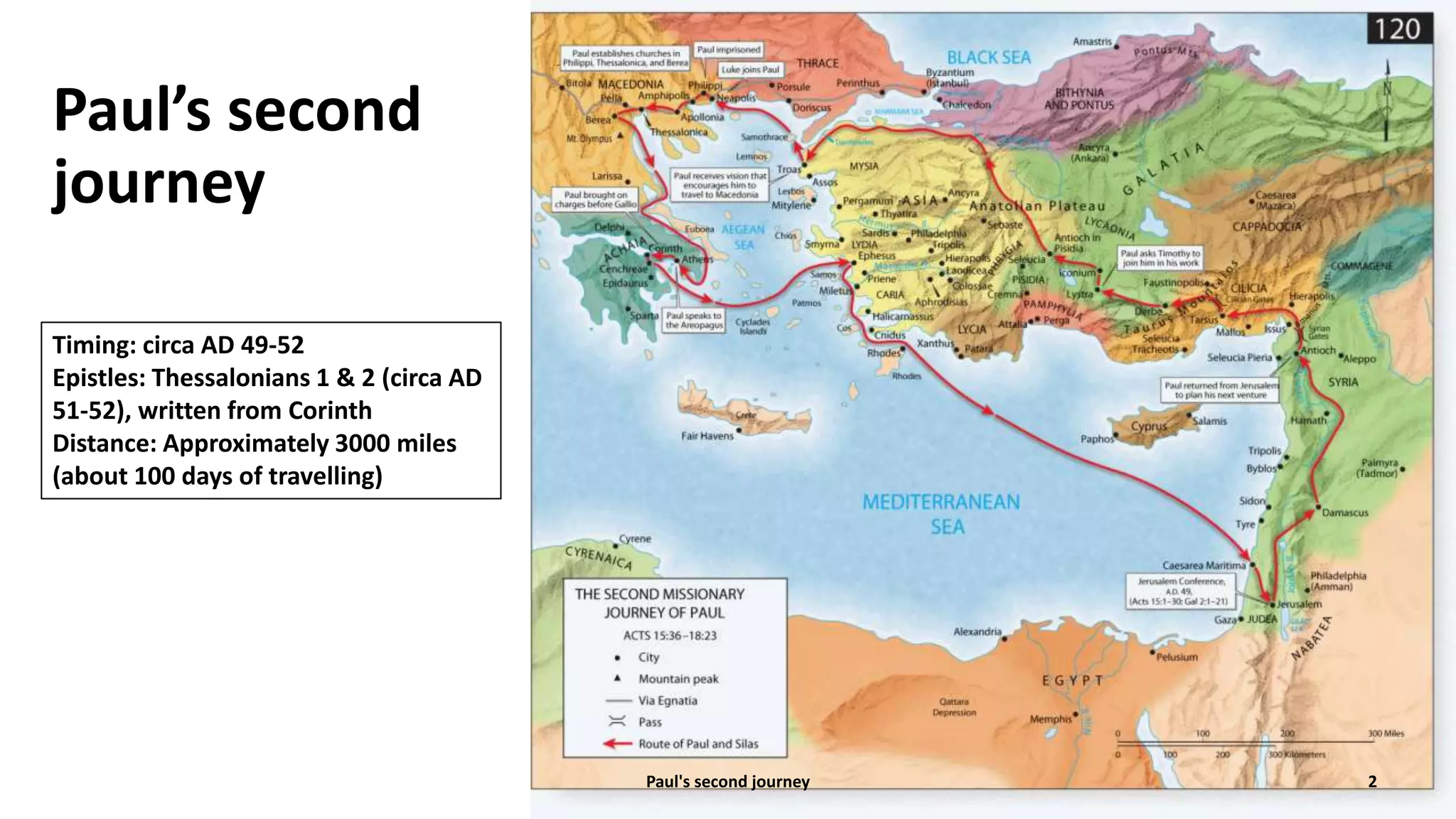
Timing: circa AD 49-52
Epistles: Thessalonians 1 & 2 (circa AD
51-52), written from Corinth
Distance: Approximately 3000 miles
(about 100 days of travelling)
Paul's second journey 2
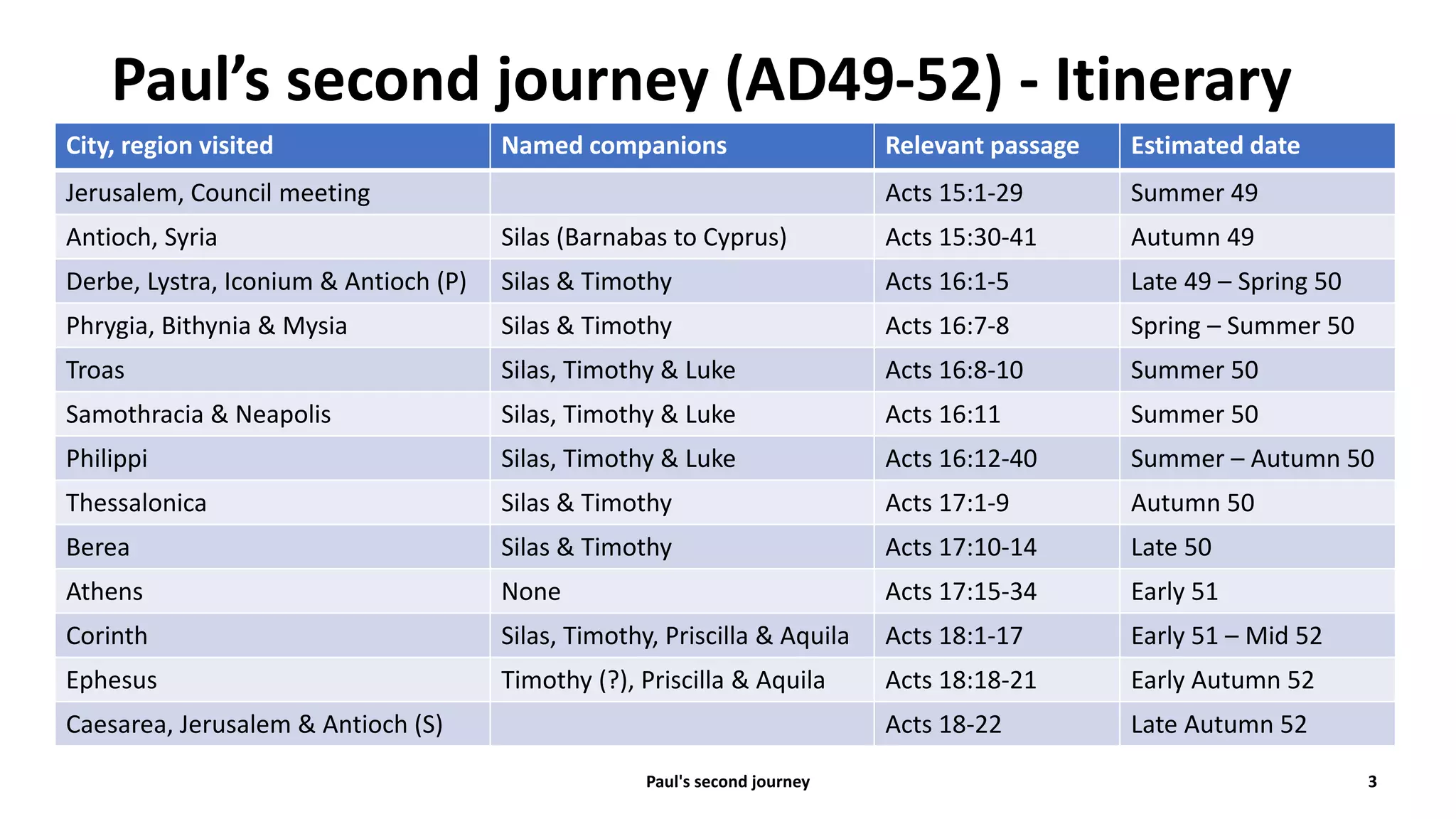
Paul’s second journey (AD49-52) - Itinerary
City, region visited Named companions Relevant passage Estimated date
Jerusalem, Council meeting Acts 15:1-29 Summer 49
Antioch, Syria Silas (Barnabas to Cyprus) Acts 15:30-41 Autumn 49
Derbe, Lystra, Iconium & Antioch (P) Silas & Timothy Acts 16:1-5 Late 49 – Spring 50
Phrygia, Bithynia & Mysia Silas & Timothy Acts 16:7-8 Spring – Summer 50
Troas Silas, Timothy & Luke Acts 16:8-10 Summer 50
Samothracia & Neapolis Silas, Timothy & Luke Acts 16:11 Summer 50
Philippi Silas, Timothy & Luke Acts 16:12-40 Summer – Autumn 50
Thessalonica Silas & Timothy Acts 17:1-9 Autumn 50
Berea Silas & Timothy Acts 17:10-14 Late 50
Athens None Acts 17:15-34 Early 51
Corinth Silas, Timothy, Priscilla & Aquila Acts 18:1-17 Early 51 – Mid 52
Ephesus Timothy (?), Priscilla & Aquila Acts 18:18-21 Early Autumn 52
Caesarea, Jerusalem & Antioch (S) Acts 18-22 Late Autumn 52
Paul's second journey 3
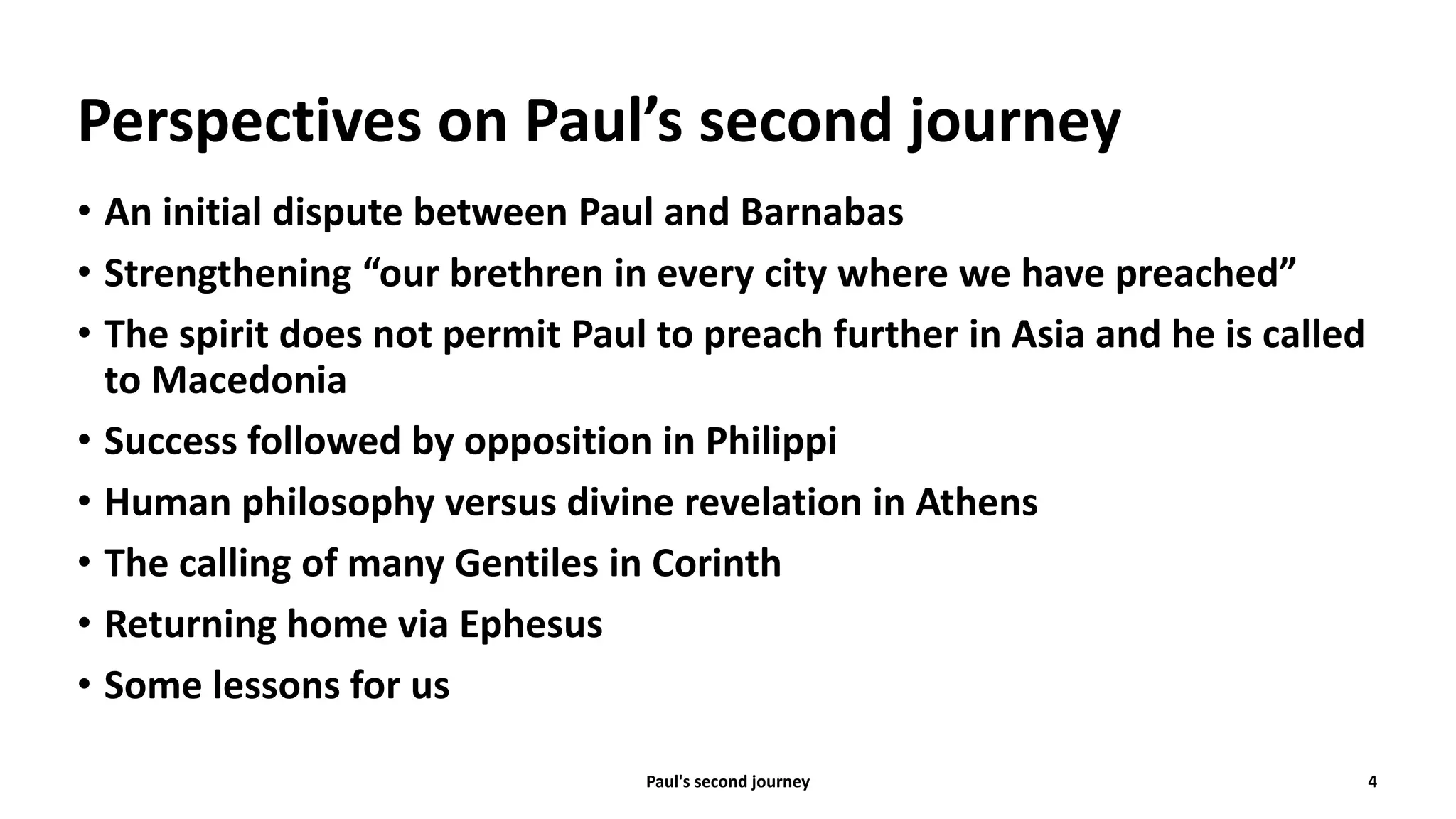
Perspectives on Paul’s second journey
• An initial dispute between Paul and Barnabas
• Strengthening “our brethren in every city where we have preached”
• The spirit does not permit Paul to preach further in Asia and he is called
to Macedonia
• Success followed by opposition in Philippi
• Human philosophy versus divine revelation in Athens
• The calling of many Gentiles in Corinth
• Returning home via Ephesus
• Some lessons for us
Paul's second journey 4
An initial dispute between Paul & Barnabas
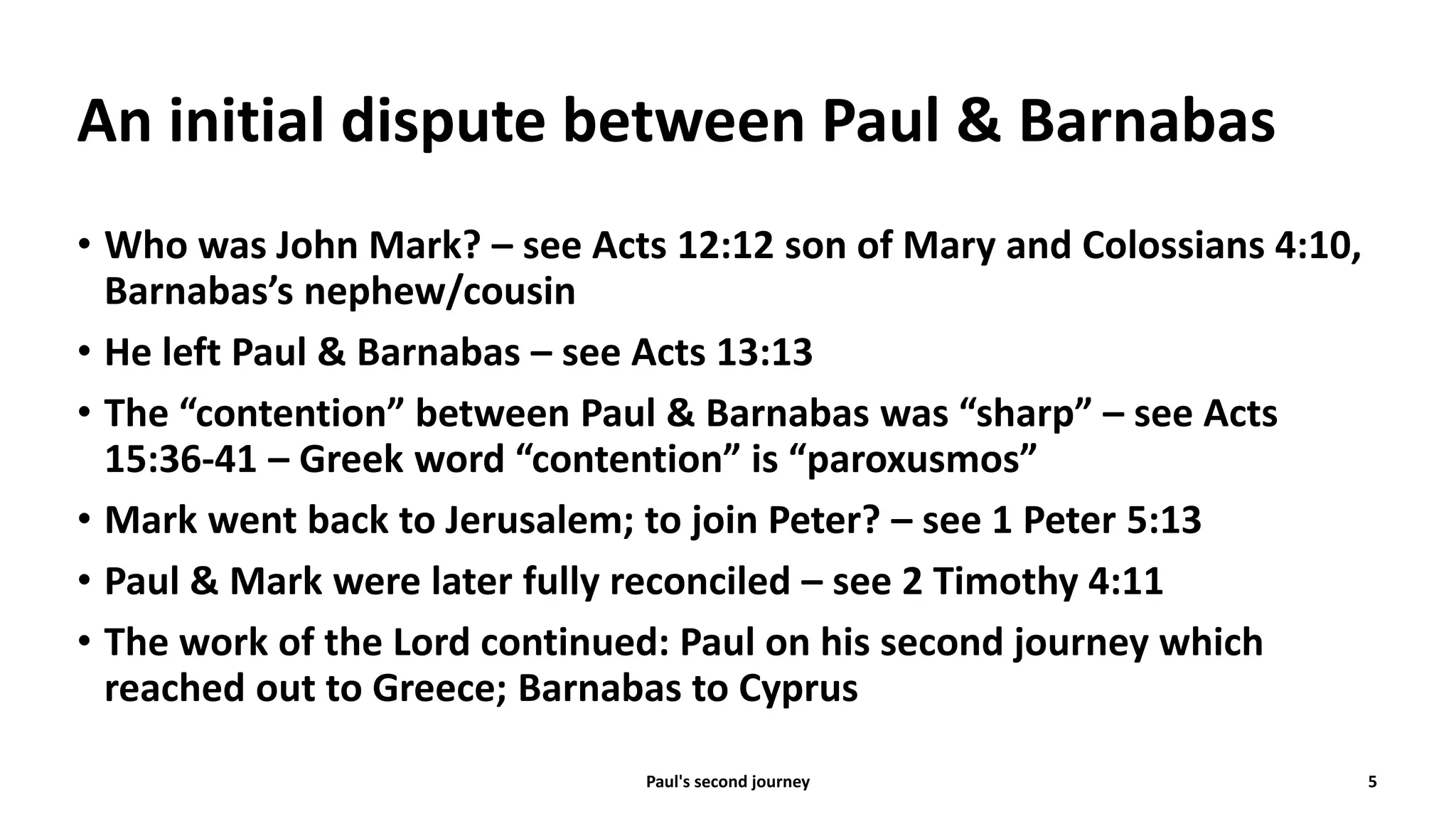
• Who was John Mark? – see Acts 12:12 son of Mary and Colossians 4:10,
Barnabas’s nephew/cousin
• He left Paul & Barnabas – see Acts 13:13
• The “contention” between Paul & Barnabas was “sharp” – see Acts
15:36-41 – Greek word “contention” is “paroxusmos”
• Mark went back to Jerusalem; to join Peter? – see 1 Peter 5:13
• Paul & Mark were later fully reconciled – see 2 Timothy 4:11
• The work of the Lord continued: Paul on his second journey which
reached out to Greece; Barnabas to Cyprus
Paul's second journey 5
Strengthening “our brethren…”
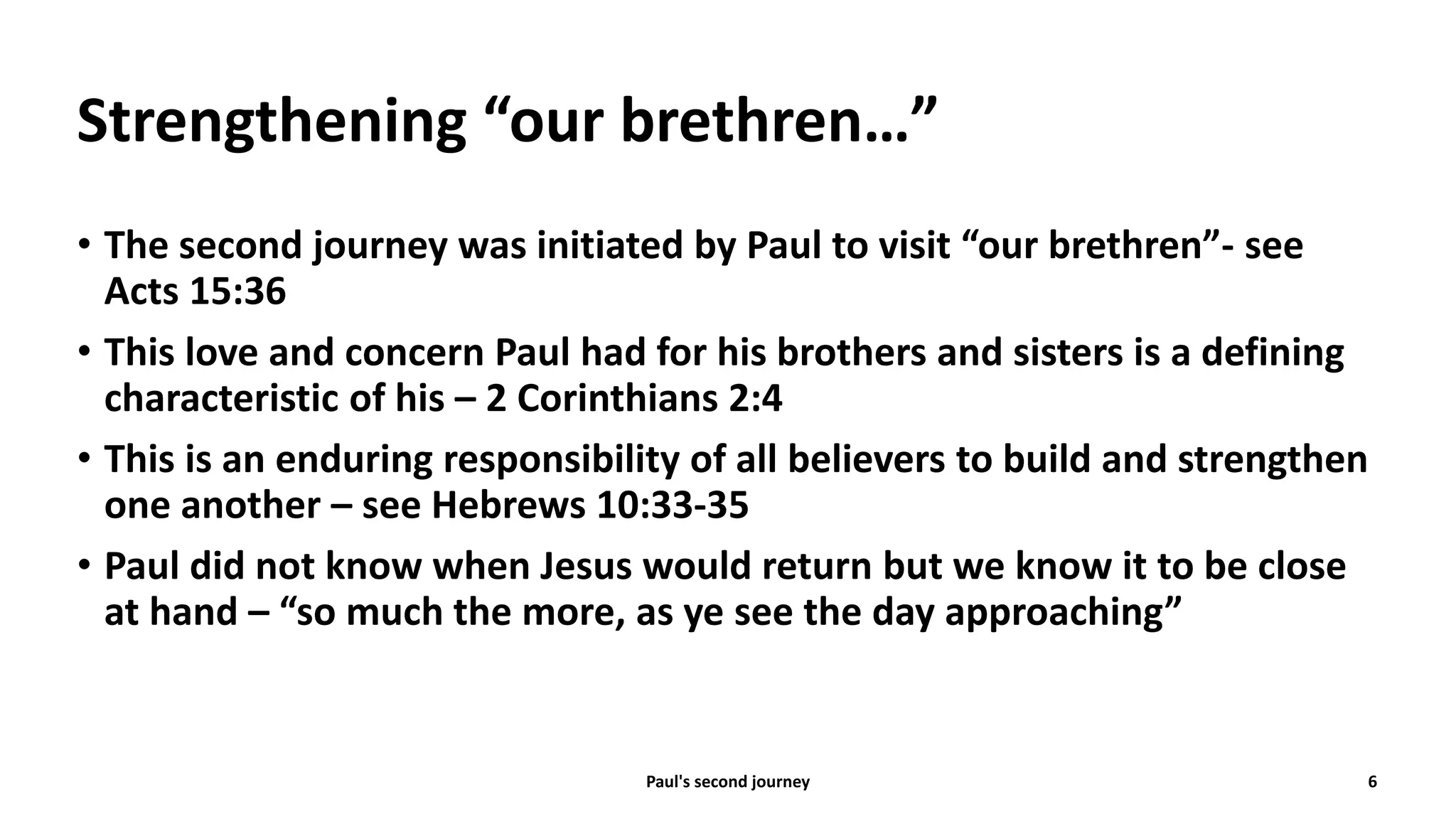
• The second journey was initiated by Paul to visit “our brethren”- see
Acts 15:36
• This love and concern Paul had for his brothers and sisters is a defining
characteristic of his – 2 Corinthians 2:4
• This is an enduring responsibility of all believers to build and strengthen
one another – see Hebrews 10:33-35
• Paul did not know when Jesus would return but we know it to be close
at hand – “so much the more, as ye see the day approaching”
Paul's second journey 6
Paul not permitted to preach further in Asia
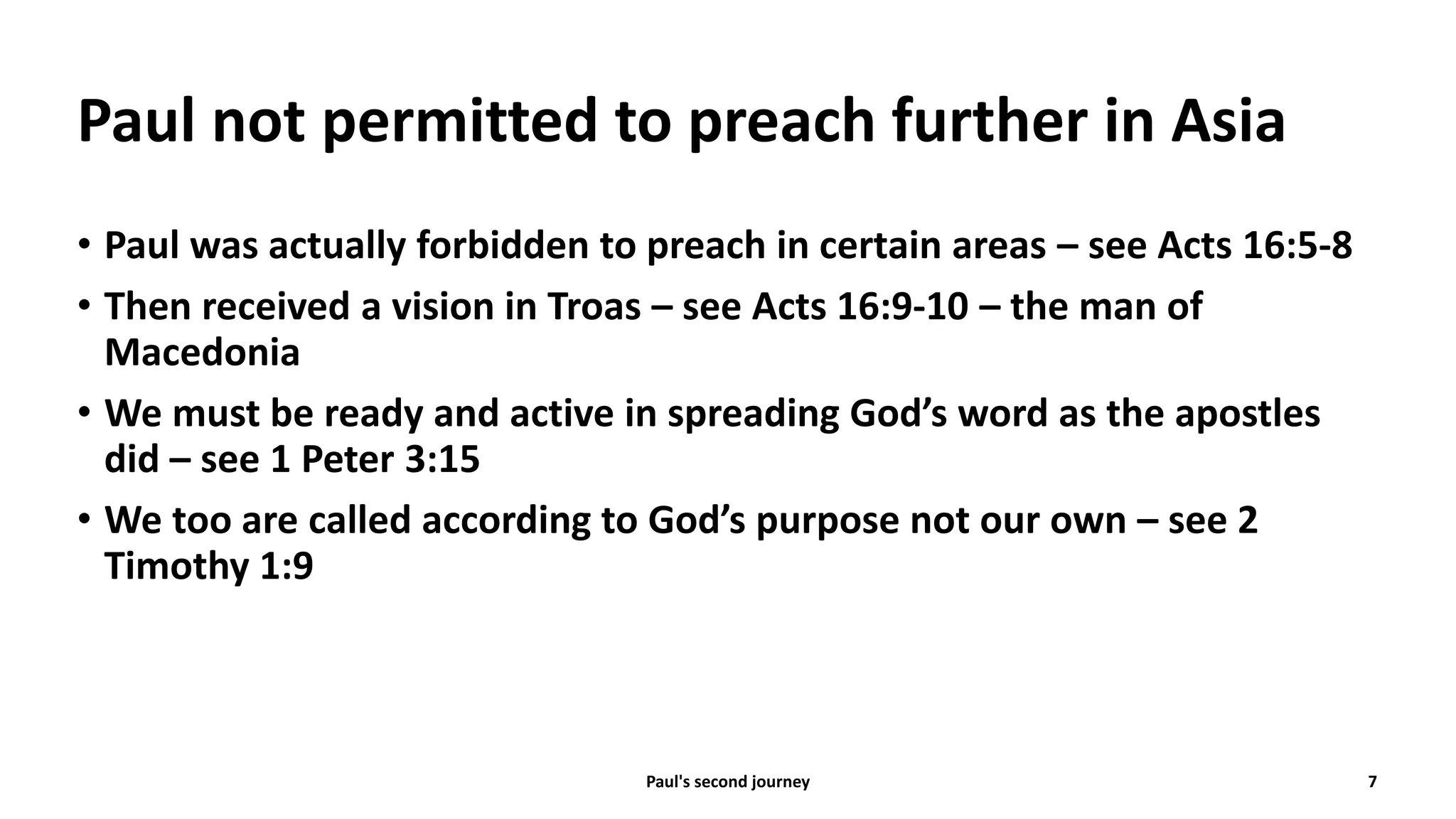
• Paul was actually forbidden to preach in certain areas – see Acts 16:5-8
• Then received a vision in Troas – see Acts 16:9-10 – the man of
Macedonia
• We must be ready and active in spreading God’s word as the apostles
did – see 1 Peter 3:15
• We too are called according to God’s purpose not our own – see 2
Timothy 1:9
Paul's second journey 7
Success followed by opposition in Philippi
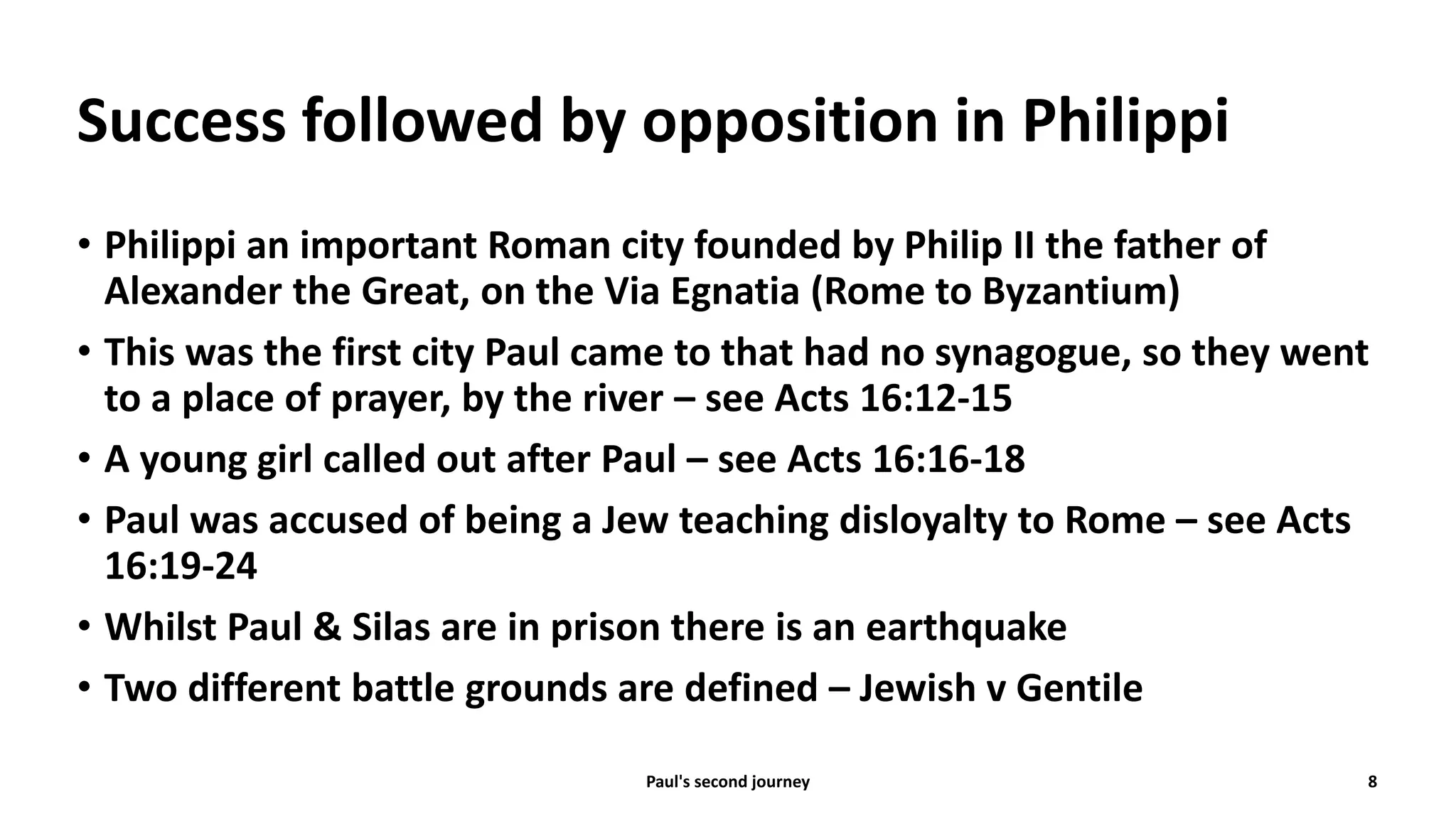
• Philippi an important Roman city founded by Philip II the father of
Alexander the Great, on the Via Egnatia (Rome to Byzantium)
• This was the first city Paul came to that had no synagogue, so they went
to a place of prayer, by the river – see Acts 16:12-15
• A young girl called out after Paul – see Acts 16:16-18
• Paul was accused of being a Jew teaching disloyalty to Rome – see Acts
16:19-24
• Whilst Paul & Silas are in prison there is an earthquake
• Two different battle grounds are defined – Jewish v Gentile
Paul's second journey 8
Human philosophy versus divine revelation
• Paul leaves Berea and sails to Athens – see Acts 17
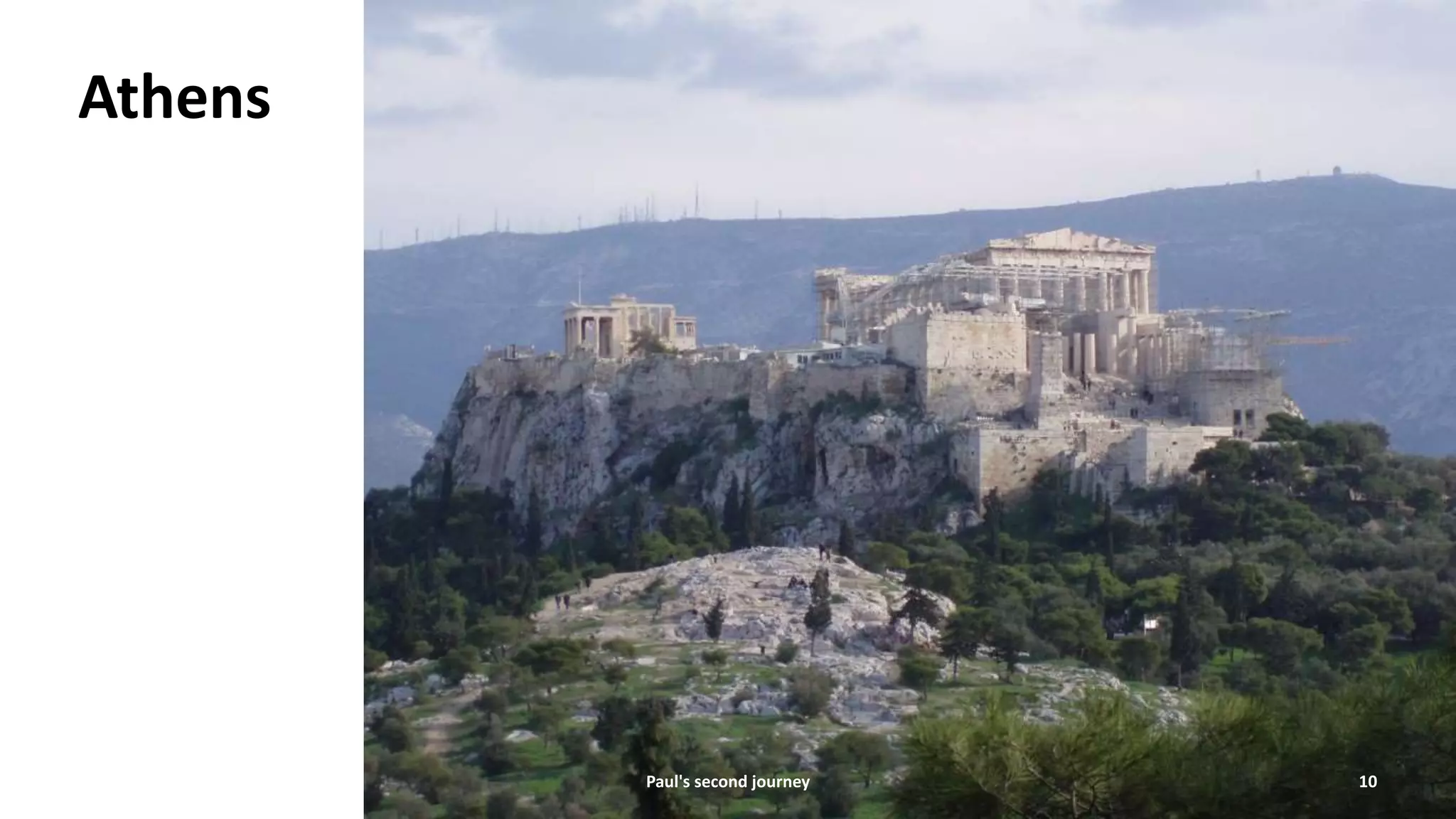
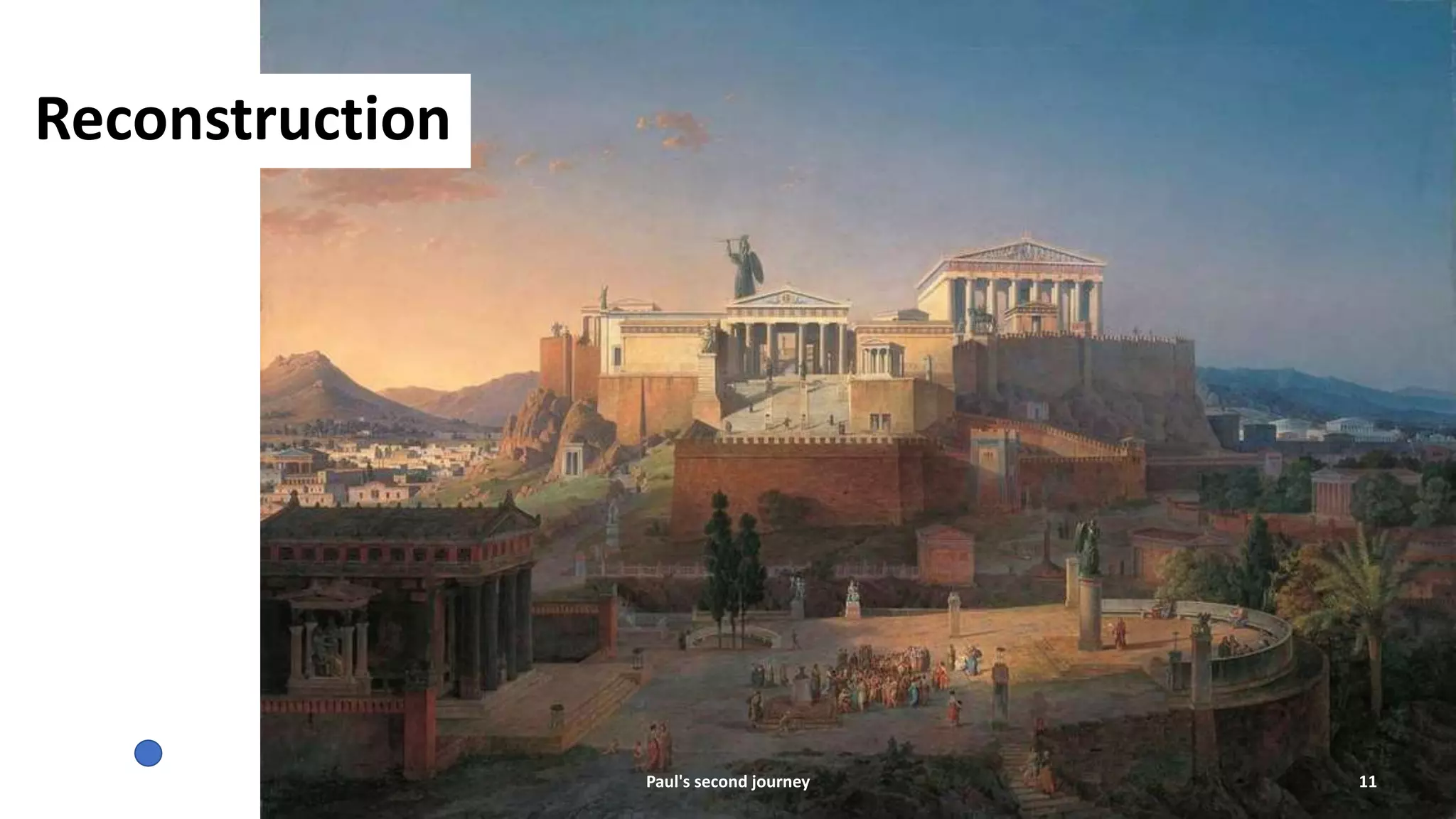
• Athens was the centre for the worship of many gods, notably the
Acropolis – Paul preached Jesus and the resurrection (anastasis) :18
• The Epicureans and the Stoics took him to the Areopagus, which was
the Athenian court – accused of introducing a foreign god
• This was the clash of the Greco-Roman world view and Paul’s Jewish
world view
• What they in ignorance tried to reason out, Paul told them the One
True God had revealed through Jesus and his resurrection – see :22-31
Paul's second journey 9
Athens
Paul's second journey 10
Reconstruction
Paul's second journey 11
The calling of many Gentiles in Corinth
• Paul moved on to Corinth, where he was joined by Silas and Timothy
and remained for 18 months – see Acts 18:1-18
• Corinth was a wealthy and powerful city, rebuilt as a Roman colony by
Julius Caesar in 44BC (springs of water; fertile plains & passing trade)
• It had seaports at Lechaeum (W) and Cenchreae (E) and had a unique
and widespread reputation for immorality
• A city of contrasts: 50% slaves; mostly poor with a small minority rich
and powerful
• Represented a clash between the desires of the flesh and the
commands of God
• Gallio ruled that following Jesus was merely a variation of Jewish
worship – see 18:12-17
Paul's second journey 12
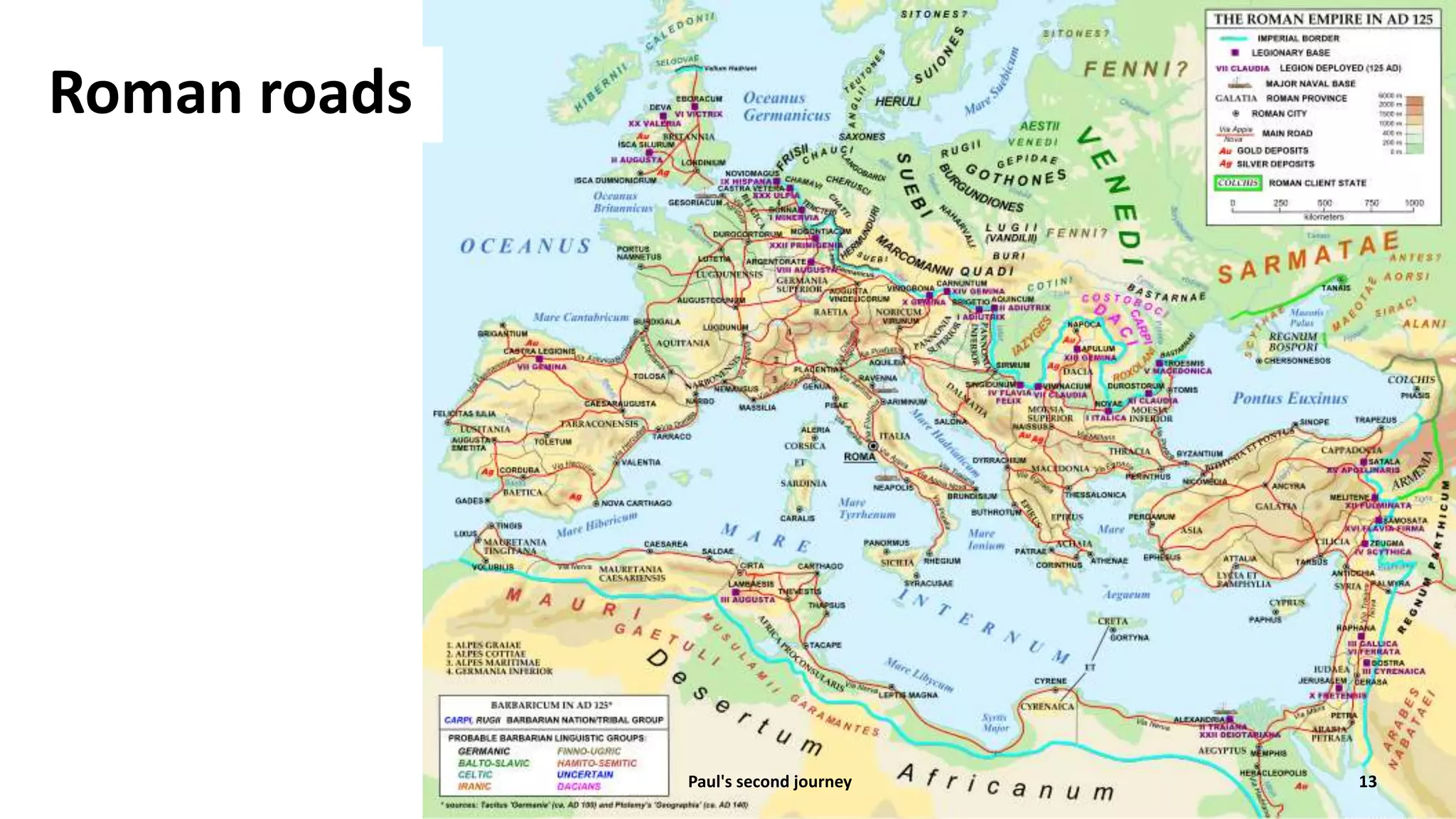
Roman roads
Paul's second journey 13
Paul's second journey 14
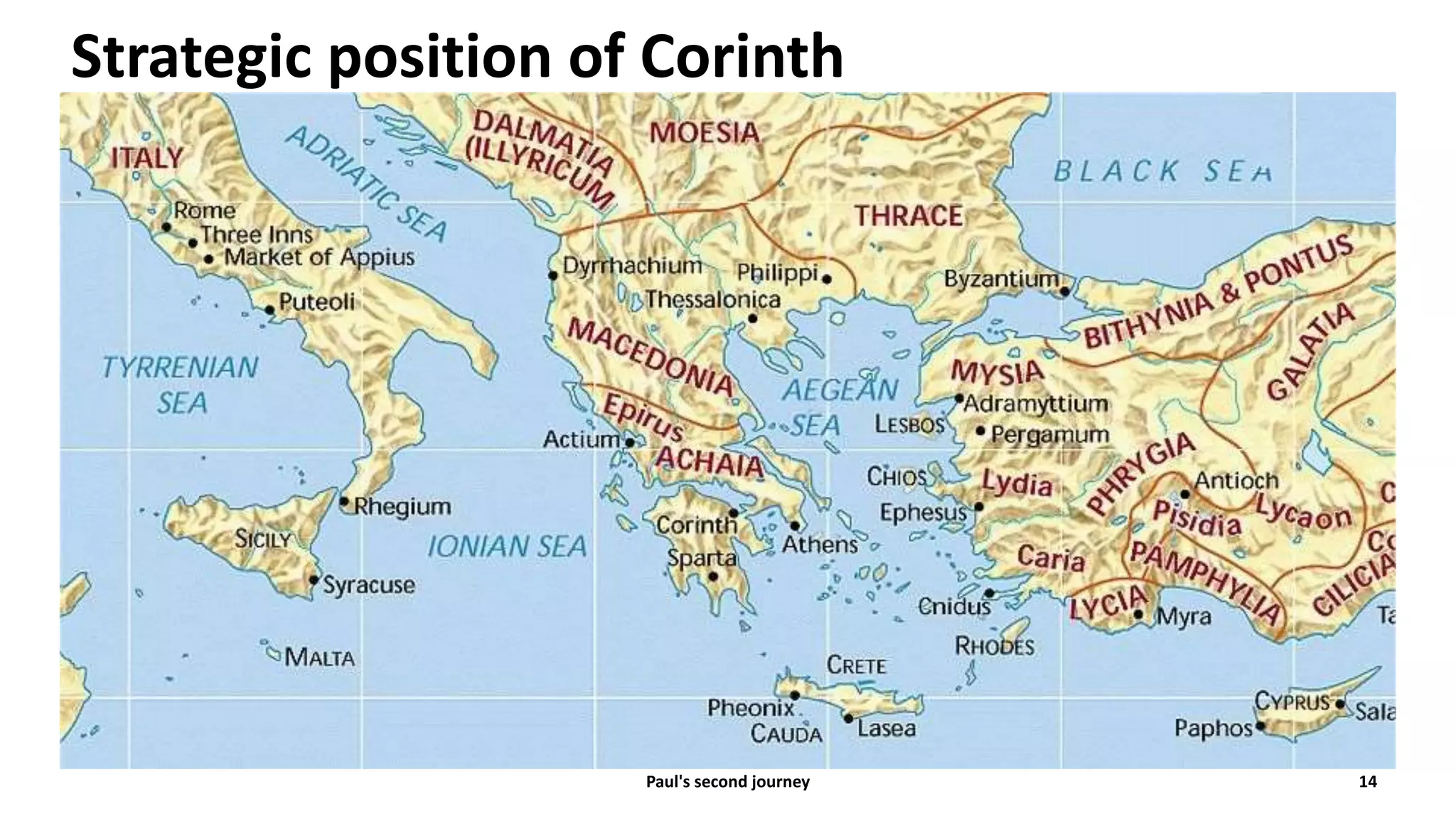
Strategic position of Corinth
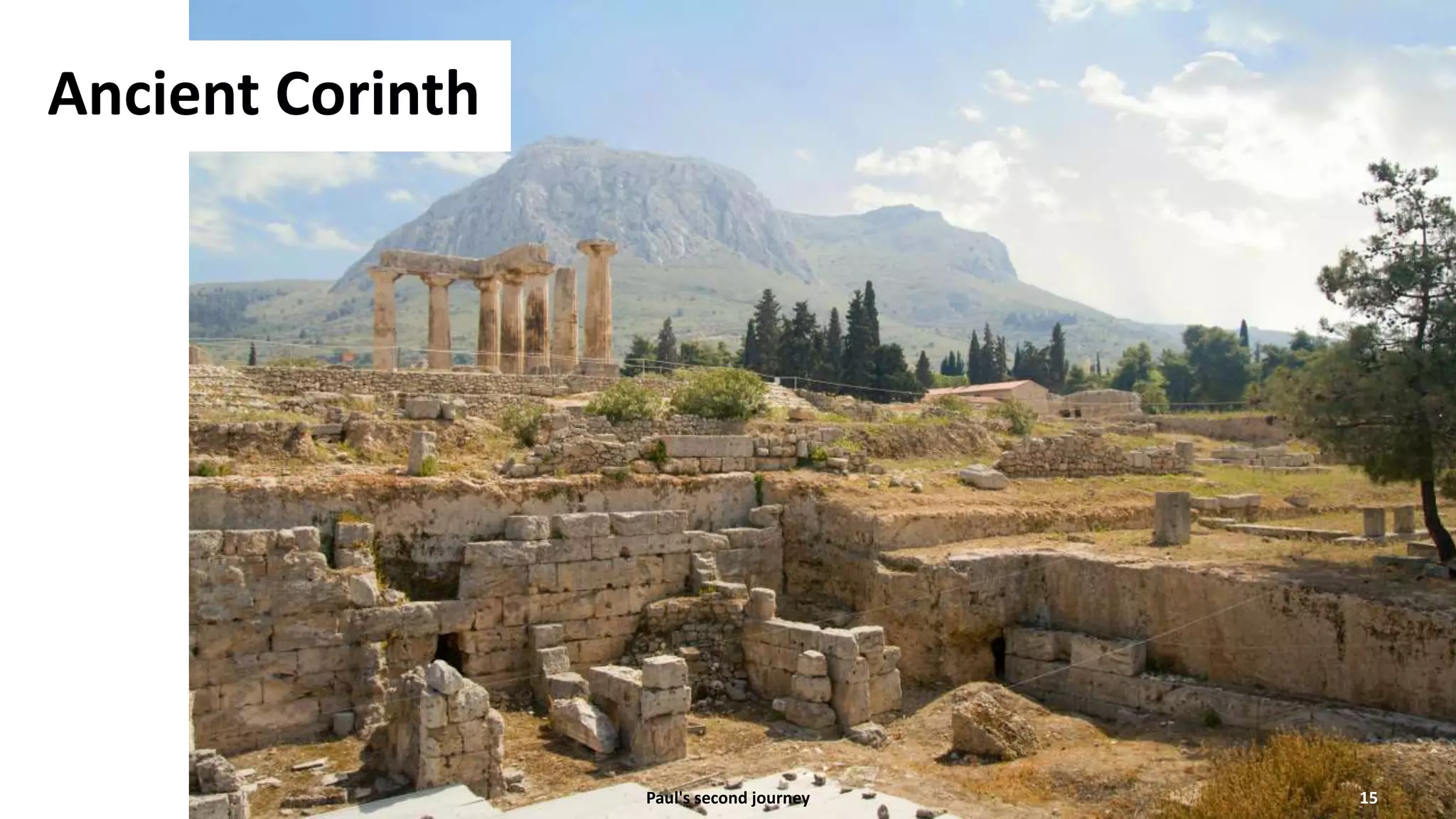
Ancient Corinth
Paul's second journey 15
Paul's second journey 16
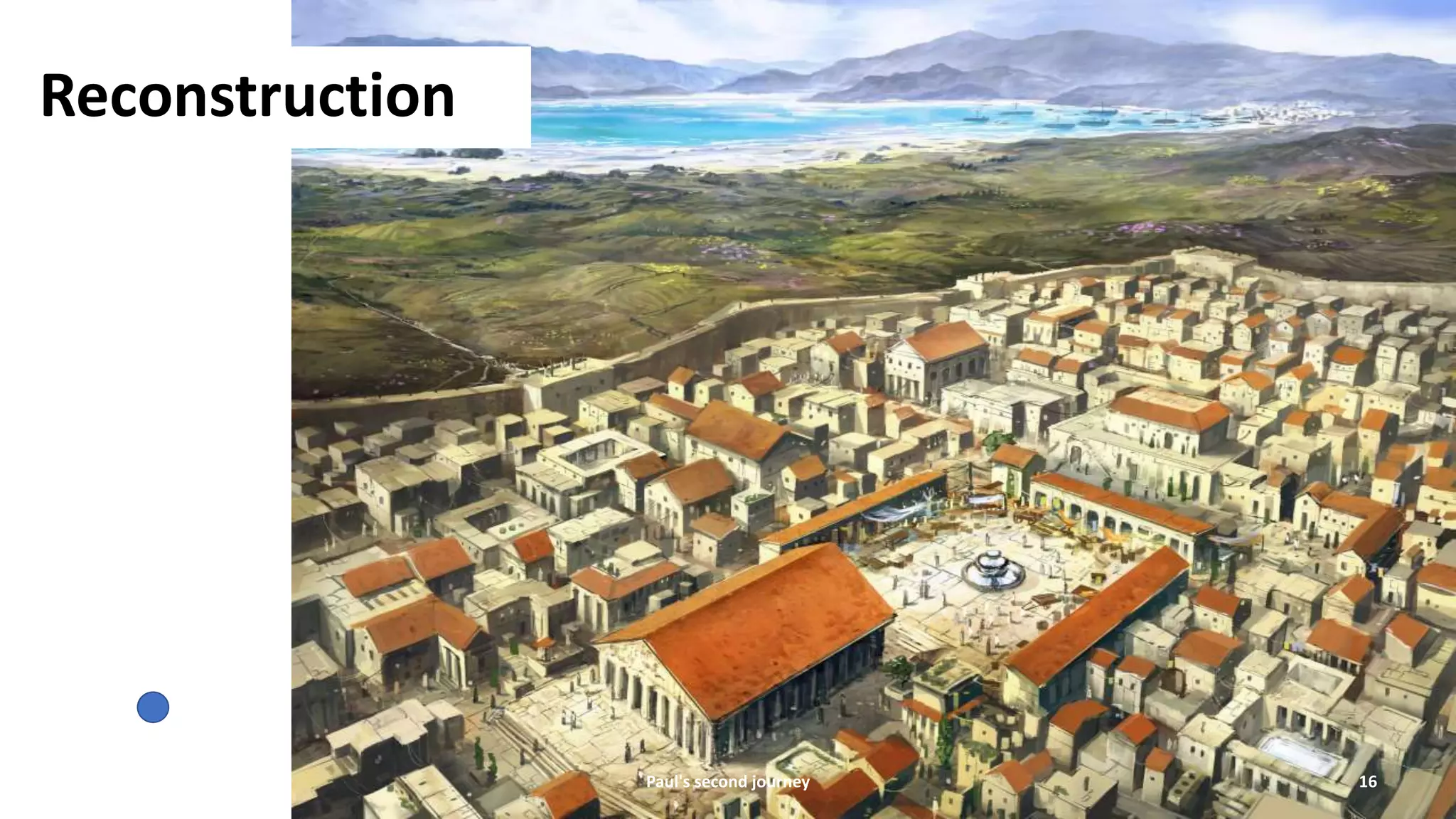
Reconstruction
Returning home via Ephesus
• Whilst Paul was at Corinth he wrote his two epistles to the
Thessalonians (circa AD 51/52)
• Paul confirms a vow – see Acts 18:18
• As was his habit, Paul, when he arrived at Ephesus, went to the
synagogue – see Acts 18:19-21
• He left Priscilla and Aquila to await his planned return
• He then went first to Jerusalem and then to Antioch in Syria (:22)
Paul's second journey 17
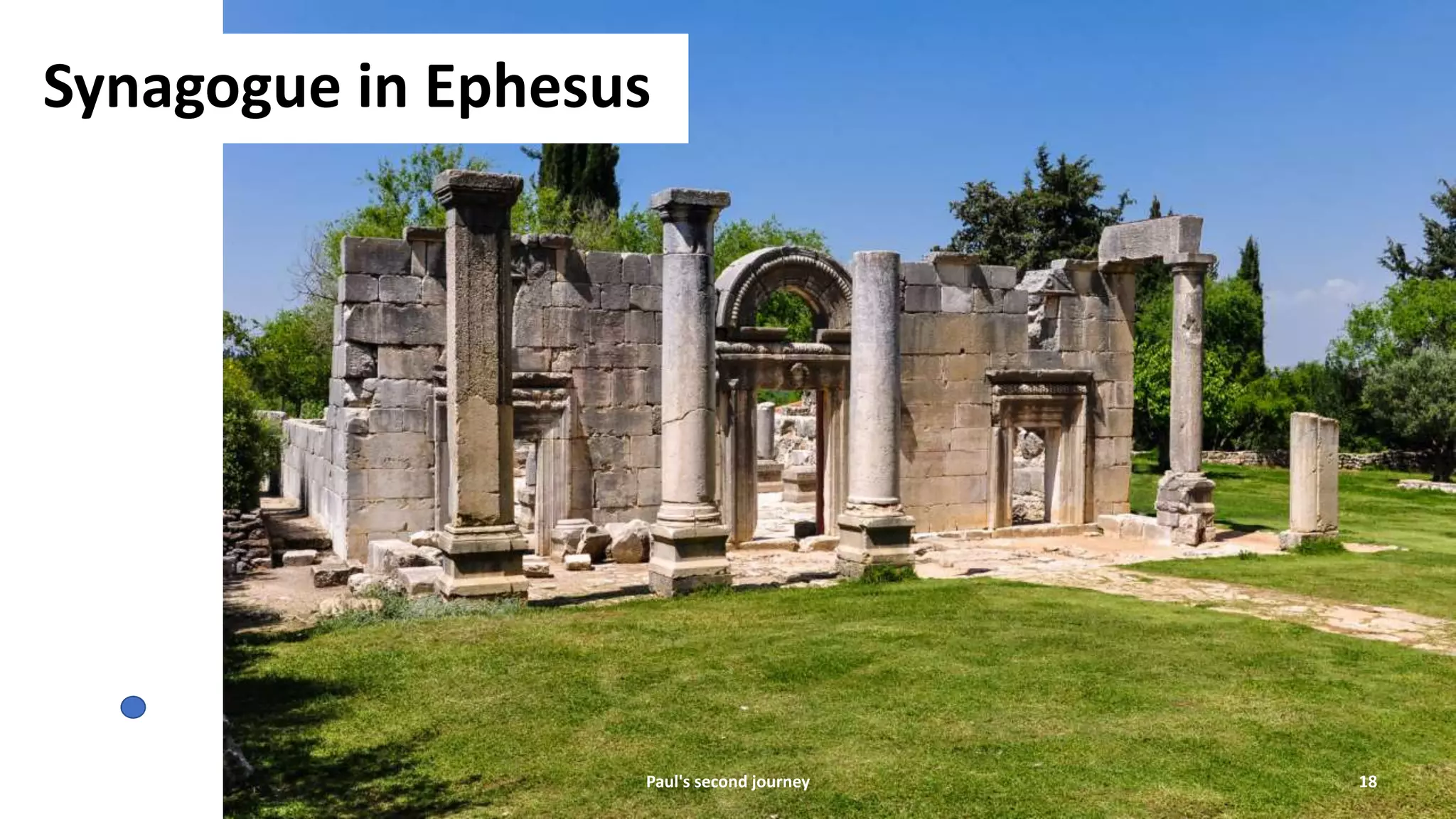
Synagogue in Ephesus
Paul's second journey 18
Some lessons for us
• We must also build one another up and strengthen one another
• We are battling against the product of human reasoning, as against
divine revelation – initiative v receiving
• We are also fighting against the desires of the flesh, as against the
commands of God – internal v external control
• The foundation of our belief is the One True God, His son Jesus Christ
and resurrection (‘anastasis’) and that foundation is established
throughout both the Old and New Testaments
• We too must take the Gospel message to any who will listen
• We must submit to the providential care of Our Heavenly Father
Paul's second journey 19

Pauls second journey

  • 2.
    Paul’s second journey Timing: circaAD 49-52 Epistles: Thessalonians 1 & 2 (circa AD 51-52), written from Corinth Distance: Approximately 3000 miles (about 100 days of travelling) Paul's second journey 2
  • 3.
    Paul’s second journey(AD49-52) - Itinerary City, region visited Named companions Relevant passage Estimated date Jerusalem, Council meeting Acts 15:1-29 Summer 49 Antioch, Syria Silas (Barnabas to Cyprus) Acts 15:30-41 Autumn 49 Derbe, Lystra, Iconium & Antioch (P) Silas & Timothy Acts 16:1-5 Late 49 – Spring 50 Phrygia, Bithynia & Mysia Silas & Timothy Acts 16:7-8 Spring – Summer 50 Troas Silas, Timothy & Luke Acts 16:8-10 Summer 50 Samothracia & Neapolis Silas, Timothy & Luke Acts 16:11 Summer 50 Philippi Silas, Timothy & Luke Acts 16:12-40 Summer – Autumn 50 Thessalonica Silas & Timothy Acts 17:1-9 Autumn 50 Berea Silas & Timothy Acts 17:10-14 Late 50 Athens None Acts 17:15-34 Early 51 Corinth Silas, Timothy, Priscilla & Aquila Acts 18:1-17 Early 51 – Mid 52 Ephesus Timothy (?), Priscilla & Aquila Acts 18:18-21 Early Autumn 52 Caesarea, Jerusalem & Antioch (S) Acts 18-22 Late Autumn 52 Paul's second journey 3
  • 4.
    Perspectives on Paul’ssecond journey • An initial dispute between Paul and Barnabas • Strengthening “our brethren in every city where we have preached” • The spirit does not permit Paul to preach further in Asia and he is called to Macedonia • Success followed by opposition in Philippi • Human philosophy versus divine revelation in Athens • The calling of many Gentiles in Corinth • Returning home via Ephesus • Some lessons for us Paul's second journey 4
  • 5.
    An initial disputebetween Paul & Barnabas • Who was John Mark? – see Acts 12:12 son of Mary and Colossians 4:10, Barnabas’s nephew/cousin • He left Paul & Barnabas – see Acts 13:13 • The “contention” between Paul & Barnabas was “sharp” – see Acts 15:36-41 – Greek word “contention” is “paroxusmos” • Mark went back to Jerusalem; to join Peter? – see 1 Peter 5:13 • Paul & Mark were later fully reconciled – see 2 Timothy 4:11 • The work of the Lord continued: Paul on his second journey which reached out to Greece; Barnabas to Cyprus Paul's second journey 5
  • 6.
    Strengthening “our brethren…” •The second journey was initiated by Paul to visit “our brethren”- see Acts 15:36 • This love and concern Paul had for his brothers and sisters is a defining characteristic of his – 2 Corinthians 2:4 • This is an enduring responsibility of all believers to build and strengthen one another – see Hebrews 10:33-35 • Paul did not know when Jesus would return but we know it to be close at hand – “so much the more, as ye see the day approaching” Paul's second journey 6
  • 7.
    Paul not permittedto preach further in Asia • Paul was actually forbidden to preach in certain areas – see Acts 16:5-8 • Then received a vision in Troas – see Acts 16:9-10 – the man of Macedonia • We must be ready and active in spreading God’s word as the apostles did – see 1 Peter 3:15 • We too are called according to God’s purpose not our own – see 2 Timothy 1:9 Paul's second journey 7
  • 8.
    Success followed byopposition in Philippi • Philippi an important Roman city founded by Philip II the father of Alexander the Great, on the Via Egnatia (Rome to Byzantium) • This was the first city Paul came to that had no synagogue, so they went to a place of prayer, by the river – see Acts 16:12-15 • A young girl called out after Paul – see Acts 16:16-18 • Paul was accused of being a Jew teaching disloyalty to Rome – see Acts 16:19-24 • Whilst Paul & Silas are in prison there is an earthquake • Two different battle grounds are defined – Jewish v Gentile Paul's second journey 8
  • 9.
    Human philosophy versusdivine revelation • Paul leaves Berea and sails to Athens – see Acts 17 • Athens was the centre for the worship of many gods, notably the Acropolis – Paul preached Jesus and the resurrection (anastasis) :18 • The Epicureans and the Stoics took him to the Areopagus, which was the Athenian court – accused of introducing a foreign god • This was the clash of the Greco-Roman world view and Paul’s Jewish world view • What they in ignorance tried to reason out, Paul told them the One True God had revealed through Jesus and his resurrection – see :22-31 Paul's second journey 9
  • 10.
  • 11.
  • 12.
    The calling ofmany Gentiles in Corinth • Paul moved on to Corinth, where he was joined by Silas and Timothy and remained for 18 months – see Acts 18:1-18 • Corinth was a wealthy and powerful city, rebuilt as a Roman colony by Julius Caesar in 44BC (springs of water; fertile plains & passing trade) • It had seaports at Lechaeum (W) and Cenchreae (E) and had a unique and widespread reputation for immorality • A city of contrasts: 50% slaves; mostly poor with a small minority rich and powerful • Represented a clash between the desires of the flesh and the commands of God • Gallio ruled that following Jesus was merely a variation of Jewish worship – see 18:12-17 Paul's second journey 12
  • 13.
  • 14.
    Paul's second journey14 Strategic position of Corinth
  • 15.
  • 16.
    Paul's second journey16 Reconstruction
  • 17.
    Returning home viaEphesus • Whilst Paul was at Corinth he wrote his two epistles to the Thessalonians (circa AD 51/52) • Paul confirms a vow – see Acts 18:18 • As was his habit, Paul, when he arrived at Ephesus, went to the synagogue – see Acts 18:19-21 • He left Priscilla and Aquila to await his planned return • He then went first to Jerusalem and then to Antioch in Syria (:22) Paul's second journey 17
  • 18.
    Synagogue in Ephesus Paul'ssecond journey 18
  • 19.
    Some lessons forus • We must also build one another up and strengthen one another • We are battling against the product of human reasoning, as against divine revelation – initiative v receiving • We are also fighting against the desires of the flesh, as against the commands of God – internal v external control • The foundation of our belief is the One True God, His son Jesus Christ and resurrection (‘anastasis’) and that foundation is established throughout both the Old and New Testaments • We too must take the Gospel message to any who will listen • We must submit to the providential care of Our Heavenly Father Paul's second journey 19